Blog

  • The GOP’s Hispanic Political Malpractice

    One of the more curious developments in American politics over the last two decades is the political malpractice of Republicans in dealing with Hispanic-Americans.  Indeed, it now appears that the 2012 election may well be determined by the share of the Latino vote that Governor Mitt Romney is able to keep from falling into President Barack Obama’s column.

    According to the Investor’s Business Daily tracking poll, Hispanics prefer Barack Obama by a greater than 2:1 margin (61% to 29% on October 25).  Hispanic-Americans have tilted toward the Democrats for decades, so it is hard to blame the Republican Party’s current predicament on just the political tactics of this year’s campaign.

    But unlike the African-American vote since the 1960s, which has remained rock solid Democratic, history indicates that on occasion the GOP has competed for and won a significant share of the Latino vote.  Hispanics tend to be family oriented and somewhat entrepreneurial, which should make them potential Republicans.

    But deliberate, conscious decisions by Republican leaders focused on the short run gains from immigrant bashing have done severe damage to the long term health of their party. Attacks on immigrants have caused Hispanics to desert the GOP in droves, particularly in the two most recent presidential elections. And, because the Latino population is relatively youthful, if this concern is not dealt with, it may become even more acute for the Republican Party in the years ahead. Among Millennials, America’s youngest adult generation, about one in five is Latino as compared with about one in ten among Baby Boomers and one in twenty among seniors. Among the even younger Pluralist generation (children 10 years old and younger) between a quarter and 30% are Hispanic. Between these two up-and-coming generations, it’s likely that Hispanics will represent nearly 30% of the nation’s population within the next few decades. This suggests that the Republican Party has little hope of winning national elections in the future unless it reverses its current policies to bring them more in alignment with the attitudes and beliefs of this key voter group.   

    Some have estimated that Ronald Reagan won 37% of the Hispanic vote in his successful 1984 re-election campaign.  Since then the presence of Hispanic voters in the electorate has grown by 400%, but the Republican share of their votes has risen above the level at which Latinos supported Reagan only once. That occurred in 2004 when Karl Rove’s strategic focus on Latinos enabled President George W. Bush’s re-election effort to win upwards of 40% of the Hispanic vote. In every other presidential election since 1984, Republicans have struggled to win the votes of even one out of three Hispanics.  

    Recent data from Pew Research demonstrates that the Hispanic rejection of the GOP was not pre-ordained. Their recent survey  showed 70% of Hispanics now identify themselves as Democrats,  but that this percentage falls to just 52% among Evangelical Hispanics, a fast growing  group whose cultural attitudes are more conservative than those of the overall Hispanic population. In 2004, President Bush actually won a majority of the Hispanic Protestant vote even as his support among Catholic Hispanics failed to improve from his showing in 2000.   

    Catholic Hispanics, who comprise about 60% of all Latinos, are more likely to vote based on perceived loyalties to their social-economic class than their attitudes on social issues. Bertha Gallegos, who is Catholic, pro-life and the Vice President of the Colorado Society of Hispanic Genealogy, a nonprofit and nonpartisan organization that researches the state’s Latino history, typifies the attitude among members of her faith toward the Republican Party. “I still don’t get how Hispanics can be Republicans. The only time they’re nice to us is when they want our vote. Republicans work to make the rich richer. They don’t care about the poor.”   

    Since the virulently anti-immigrant campaign in favor of Proposition 187 in California that attempted to bar immigrant access to basic social services the Republicans have continued to play exactly the wrong tune for Hispanics.  In this year’s Republican primary, there was much emphasis on removing undocumented immigrants from American soil through self-deportation or other more draconian means, Republicans have allowed economic resentment and cultural fears to get in the way of positive voter outreach to America’s fastest growing minority population. After all, many Latino legal residents and citizens also have relatives and friends who are undocumented.

    Yet studies as far back as the 2000 presidential election have shown that when properly engaged, Hispanics have an open mind on which party deserves their support. Latinos in that election were statistically more likely to support Bush over Gore if they were contacted by Latino rather than Anglo Republicans. Clearly the election in 2010 of Latino Republican governors, Susana Martinez of New Mexico and Brian Sandoval of Nevada, suggests that the community remains open to such appeals in the future.

    Before such efforts can be successful however, Republicans will have to reverse course on their attitudes toward comprehensive immigration reform, a cause which traces its historical lineage to Ronald Reagan and which was a key part of Karl Rove’s re-election strategy for George W. Bush. Only when the Republican Party’s message changes will their messengers deserve and be able to gain a respectful hearing from America’s Hispanics.   

    Morley Winograd and Michael D. Hais are co-authors of the newly published Millennial Momentum: How a New Generation is Remaking America and Millennial Makeover: MySpace, YouTube, and the Future of American Politics and fellows of NDN and the New Policy Institute.

    Polling place photo by BigStockPhoto.com.

  • Deep in the Heart of Texas: Private Donors Build a Medical Complex the Size of a Small City

    When Americans think of oil executives, they tend to conjure up the image of J. R. Ewing: slick smile, sharp suits, cowboy boots, and a 10-gallon hat packed with bluster, vanity, and greed. According to Gallup, no industry is more widely reviled than oil and gas—not even banking, real estate, or heath care. The poll found that 64 percent of Americans disapprove of its activities. Only the federal government fared worse.

    The image is unfair in many ways. It’s true that the energy sector can be brutal; the business of pulling hydrocarbons from the earth seems to attract more than its share of ruthless personalities. But there’s a more nuanced character to the oil and gas industry. At heart—and yes, it has a heart—it’s an industry with a surprisingly charitable nature. And nowhere is the pulsing heart of the industry more evident than in Houston, where the fortunes generated by profits from energy companies have fueled some of the most impressive personal giving in the world.

    Take, for instance, the massive Texas Medical Center (TMC). Based in Houston, it is by far the world’s largest center for healing the sick. Among its 52 member institutions are world-famous research and treatment facilities like the M. D. Anderson Cancer Clinic, Methodist Hospital, St. Luke’s Episcopal Hospital, and the Texas Children’s Hospital. Every year, the TMC serves as a campus where some 34,000 full-time students work toward degrees in the healthcare professions. It’s also home to smaller nonprofits like a Ronald McDonald House (a comfort home for families of children getting treatment), a Fisher House (a comfort home for families of hospitalized service members and veterans), the Institute for Spirituality and Health, and St. Dominic Village (a Catholic retirement community). All in all, it represents “probably the biggest confluence of philanthropy in the world,” says TMC chief executive officer Richard Wainerdi, “and a lot of it is oil money.”


    West Campus of the Texas Medical Center

    All of that oil money has fueled a massive experiment in private, voluntary initiative—a major healthcare system that is more private than public, more charitable than profitable. Its scale can only be described as Texan. The campus is equal in size to the Inner Loop of Chicago. It currently has over 28.3 million square feet of office space—more than downtown Houston, even more than all of downtown Los Angeles. (By the end of 2014, its square footage is expected to exceed 41 million square feet, which would make the medical campus the nation’s seventh-largest business district of any sort.) Every day, 160,000 people enter the area, which has grown into Houston’s largest employer. Every year, TMC hosts about 7.1 million patient visits, including 350,000 surgeries and 28,000 newborns delivered.

    Houston’s real philanthropic achievement, however, is not just the scale of the TMC. It’s the extraordinary quality of its institutions. In the 2013 U.S. News & World Report hospital rankings, TMC-affiliated institutions topped the charts. Methodist Hospital was a nationally ranked leader in 13 of 16 adult specialties. (Of the 4,793 hospitals included in the rankings, only 148 facilities—roughly 3 percent of the total—were considered a nationally ranked leader in even one of the 16 specialties.) St. Luke’s Episcopal Hospital, likewise on the TMC campus, earned national ranking in 10 adult specialties. The Texas Children’s Hospital was ranked fourth among all U.S. children’s hospitals. M. D. Anderson has been named the best cancer center in America for 9 of the past 11 years, including 2012.

    None of it would be possible without private philanthropy. M. D. Anderson, for instance, began a capital campaign in September 2006, with a goal of raising $1 billion within six years. Donations poured in from across the Lone Star state. From San Antonio, Clear Channel co-founder Lowry Mays and his wife, Peggy, donated $20 million. From Dallas, H. Ross Perot kicked in another $20 million. T. Boone Pickens contributed $50 million, with one condition. Before putting the funds to use, M. D. Anderson was required to turn the gift into a $500 million corpus within 25 years. Anderson hit the target within three years, and used the funds to establish the Pickens Research Endowment. Two years ahead of schedule, the capital campaign passed the $1.2 billion mark. There were more than 630,000 individual gifts, and a staggering 127 donors gave at least $1 million.

    It’s testimony to an extraordinarily generous culture—one that’s driven by energy profits. Of the top 10 corporate foundations in the region, for instance, eight are directly tied to the energy industry. As Federal Reserve Bank economist Bill Gilmer notes, Houston’s economy rests on the energy sector—not only drilling and exploration, but also downstream industries like refining, finance, and petrochemical production. It is there that much of Houston’s wealth has been generated, and from which much of the funding for good works like the TMC is likely to continue coming.

    “The people who founded the Texas Medical Center believed that for Houston to thrive, the city had to have a great medical establishment,” explains Ann Stern, president of the $1.5 billion Houston Endowment, the charitable legacy of Houston patriarch Jesse Jones and his wife, Mary Gibbs Jones. “There’s a long history of generosity and a healthy peer pressure among people in the energy business—and other civic leaders—to contribute. They may have not gone to college, they may have made their money in the oil fields, but the Texas Medical Center has become in large part their legacy.”

    Deep in the Heart of Texas

    To be sure, the extraction of sweet, light crude from deep in the earth is hardly animated by sweetness and light on the business side. The energy business is capital-intensive and very competitive. It requires leaders who can adapt and make things happen.

    Anthony Petrello fits that bill. Petrello is the chief executive officer of Nabors Industries, the world’s largest land-based drilling contractor. Nabors is hired by oil companies to drill oil and gas wells. Like many other leaders in the energy industry, Petrello is competitive and looking for ways to differentiate his company. His pedigree is perhaps a bit unusual for the industry: it includes bachelor’s and master’s degrees in mathematics from Yale—and a law degree from Harvard.

    Petrello is a Newark native. He left his job in New York as managing partner of Baker & McKenzie, arriving in Houston in 1991 to become president of Nabors. “The first five years I was in Houston,” Petrello recalls, “I worked six or seven days every week, and with my wife’s work schedule, we did not have much time to socialize.” He and his wife, Cynthia, a former New York actress, focused on their careers and kept mainly to a small group of close personal friends.


    Anthony and Cynthia Petrello (Photo courtesy of Longines)

    Then in 1997, Anthony and Cynthia had a baby girl at Houston Women’s Hospital. Carena Francesca was born at 24 weeks, weighing only 20 ounces, and experienced PVL (periventricular leukomalacia), a disorder in premature infants caused by a lack of oxygen to the brain. First came a rash of operations to save her sight and heart. Then it became clear Carena would suffer from cerebral palsy. Despite having financially successful parents, she was entering life with enormous challenges. “It changed everything,” Petrello says. “It was the turning point in our lives.”

    As Carena matured, she started to lose abilities. She gained language, but lost it at age five. Today, she cannot get around without a wheelchair. She can’t speak or feed herself. “It caused a major change in our perceptions,” Petrello recalls. “My wife thought we’d have a dancer. I thought we’d have a mathematician. Instead, we had to adjust our expectations.”

    Carena’s difficult circumstances impelled the Petrellos to rethink their priorities. “You realize that your time here on earth is short and you want to make a difference,” Petrello says. “You don’t have time to feel sorry for yourself.” By instinct and training a problem-solving mathematician, Petrello wanted to understand what caused Carena’s condition—and find out if there were better ways to treat it. In 2000, he consulted with a team of specialists at a prestigious eastern hospital; they held out little hope and less understanding. “The doctor told us he couldn’t do anything for her,” Petrello says, his voice showing clear disappointment. “He just said we needed to get a good estate planner for her.”

    Petrello looked for serious research into childhood neurological diseases. He was shocked to find how little of it actually was taking place. Particularly troubling was the lack of research into what he calls the “DNA arithmetic” of these disorders, which range from mild forms like ADHD to cerebral palsy and Down syndrome. “The lack of knowledge about this problem is astounding,” says Petrello. “And the lack of resources is sinful.”

    He found kindred spirits at the Texas Children’s Hospital. He conceived of an institute dedicated to exploring the causes of neurological afflictions for children. In 2006, he made a commitment of $7 million. “I had lunches with friends—many, when judged by my weight gain—and they were eager to hear more,” says Petrello. “My wife and I were overwhelmed by the support of friends and energy industry colleagues who came on board to help.”

    And in the process he found some impressive allies, like Dan Duncan, the now-deceased chairman and director of Houston-based Enterprise Products, a leading North American provider of midstream energy services. A self-made man who grew up in rural east Texas, Duncan turned a small business with one truck, two partners, and $10,000 in cash into a multi-billion dollar energy company that today ranks among the nation’s most successful.

    Duncan and his wife, Jan, were among Houston’s most generous healthcare philanthropists. In 2006, they donated $100 million to Baylor College of Medicine to establish the Dan L. Duncan Cancer Center; two years later, they gave M. D. Anderson $35 million to create the Duncan Family Institute for Cancer Prevention and Risk Assessment, which addresses the risks—genetic, lifestyle—that can lead to cancer. In 2007, the Duncans made news with a $50 million gift, earmarked to create a collaborative institute that would research and treat pediatric neurological disorders. The Jan and Dan Duncan Neurological Research Institute opened in 2010. Today, it occupies 300,000 square feet at Texas Children’s Hospital. The center has more than 130 researchers led by Huda Zoghbi, a renowned Lebanese neurogeneticist.

    Petrello sees the center as a leading-edge institution that can change the odds for millions of children with neurological disorders. “Everyone needs a dream to keep them motivated,” he explains. “It may not help our daughter, but we cannot accept her fate for so many others. We have to do something.”

    The Great Equalizer

    Ever since he left his small hometown of Wharton, Texas, Lester Smith has lived, from a strictly economic point of view, a rather charmed life. At age seven, he knew he wanted to be a wildcatter; to his nose, oil “just smelled like perfume.” Today, he heads up Smith Energy, a Houston-based firm that specializes in the exploration and production of oil and gas reserves.

    In Smith’s social circles, nobody looks down on making money and living well—even lavishly. But it’s not all big cars, big houses, and big hair. Like Petrello, Smith was brought down by disease, and has chosen to dedicate much of his fortune to fighting it. Smith struggled for 17 years with prostate and bladder cancer. He has undergone some 40 surgeries at the Baylor College of Medicine—“no fun,” he recalls—until 2001, when both organs were removed. “I’m a bladder and prostate cancer survivor,” he reflects. “My wife’s sister died at 50 from breast cancer. My former wife was diagnosed with breast cancer eight years ago, but she is doing well because of what they did at Baylor. This sticks with you.”


    Lester and Sue Smith with Gloria Gaynor (AP photo / Dave Rossman)

    These personal tragedies have driven much of his philanthropy, $40 million of which has gone to Baylor’s medical school, where it supports research into and treatment for breast cancer, urology, and oncology. Smith also serves on the board of M. D. Anderson and Baylor College, and has donated an additional $20 million to the cancer center at Texas Children’s Hospital. “I never considered giving away so much,” he admits, “until cancer affected me and my loved ones personally.”

    Cancer, adds Smith, is “a great equalizer,” one that doesn’t respect class or wealth. For that reason, he has donated $15 million to the Harris County hospital district to set up a clinic to treat poor families, like many of those that he grew up around in rural Texas. It now treats some 160,000 underserved people annually. “Illegal aliens, the indigent—they should get the same care that my wife gets,” he insists.

    Smith also raises money for cancer causes by hosting social events—most notably, ballroom dancing. The galas that he and his wife put on have become highlights of Houston’s social season. In February, the Smiths hosted 1,100 guests at the Legends Event for Texas Children’s Cancer Center, featuring Gloria Gaynor, the Pointer Sisters, and Nile Rodgers. The evening raised $32 million. It was again heavily underwritten by Houston’s oil-and-gas philanthropists.

    “It’s the oil guys who give the most money to things that matter in people’s lives,” he suggests. “They may be tough people to deal with, but they are very philanthropic.”

    A Culture of Leadership

    David Wolff is not one of Houston’s oilmen, but he has made his fortune selling land to the energy corporations and developers who serve them. He left Philadelphia in 1970. Once he landed in Houston, he started his own company—at age 29. “This was not considered crazy in Houston,” he recalls, “but back in Philadelphia it would have been. What I liked about Houston is people didn’t just think about doing things. They really did them.”

    Over the next three decades, Wolff did quite a lot of things. His real estate firm has office parks all around Houston and led the development of what is widely known as the “energy corridor” along Interstate 10 in the western part of town—now home to a working population of 80,000 people. “It was all cows and rice fields back then,” he recalls. All the while, he was involved in the city’s philanthropic community, serving as chairman of the Houston Parks board, as well as Metro, the regional transit agency, and on the board of the Houston Grand Opera.

    But these days Wolff’s great passion is medical philanthropy. He donated 10 acres of prime land for the new TMC West Campus, which now includes Texas Children’s Hospital, Texas Methodist, and others. He is now working, largely through additional land he has acquired, to aid the expansion of the TMC toward Beltway 8 (Houston’s outer-loop freeway) and the surrounding suburban communities.


    David and Mary Wolff

    The idea, Wolff explains, is to bring the hospitals closer “to where the patients are.” For generations, Houstonians—particularly those with children—have been moving to the city’s periphery. As the TMC’s main campus has expanded, traffic and parking have become more difficult for people coming from the communities surrounding Houston. The market is certainly there: Texas Children’s CEO Mark Wallace estimates there are 400,000 children within a 10-minute drive of the new campus. In 20 years, says Wallace, the west-side hospital will be as large as the original site.

    “We are making it easier for the medical center to serve people,” Wolff says, beaming with pride in the bright new lobby of Texas Children’s Hospital–West Houston. “For those coming from the suburbs, or for the folks coming from the smaller towns in central and southeast Texas, this is an easier place to get to, and one where they can still find the same quality health care you would get in the city.”

    That sense of service reflects the spirit that made the Texas Medical Center possible in the first place. In a state where the proportion of uninsured is higher than the national average, the TMC provides critical services for the poor—and is sufficiently well funded to deliver them at the highest level. “Like other cities, Houston has its challenges,” observes Houston Endowment’s Ann Stern. “But Houston is exceptional in that philanthropy makes up for a lot of it. It’s kind of a calling here. It’s a culture of leadership—of getting things done.” And it has made Houston perhaps the most philanthropic city in America today.

    This piece first appeared at The Philanthropy Roundtable.

    Joel Kotkin is executive editor of NewGeography.com and is a distinguished presidential fellow in urban futures at Chapman University, and contributing editor to the City Journal in New York. He is author of The City: A Global History. His newest book is The Next Hundred Million: America in 2050, released in February, 2010.

    Houston skyline photo by Bigstock.

  • Postwar Prefabs: Britain’s Factory-Made Palaces

    After the financial crisis of 2008, much of Great Britain’s construction industry capacity was wiped out. Now, in 2012, there is much fear that the “traditional” construction industry is too weak to rapidly increase the rate of housing production, even if the administrative planning system wanted it to. Which it doesn’t. Yet there is also no suggestion by Local Authorities or the national government that the present lack of construction capacity could be addressed by the manufacture of housing by new businesses in other industrial sectors — the creation of factory made homes — as was done post-World War II.

    Between 1944 and 1949 the British Government organised the production and installation of two bedroom prefabricated bungalows as emergency housing. The Prefabs were a popular success, but have never been repeated.

    As the Second World War was concluding, Clement Attlee, the Labour Party’s Deputy Prime Minister in Winston Churchill’s wartime coalition Government, told the House of Commons,
    ‘The Government have reviewed the potential building capacity of the country, and have come to the conclusion that it will not be possible, for some years, to build enough permanent houses to meet the urgent demands for separate homes. We shall therefore need, in addition, emergency factory-made houses.’

    A budget of £150,000,000 was sanctioned in the Housing (Temporary Accommodation) Act, 1944, and increased to £220,000,000 by 1947. By the time the financial account was closed in 1957 a total of 156,623 prefabricated bungalows of a few types were built on Local Authority Land for £207,309,000. They were all rented out by 1949, popular as suburban “prefabs”.

    Many of of the Prefabs were manufactured by the aircraft industry using aluminium as the production of war-planes wound down. Others were constructed with steel and timber. The aluminium bungalows were road-delivered as sectional buildings. All the Prefabs were built round a central core of a kitchen, toilet and bathroom. The fitted kitchen had a fridge and cooker, running hot water, and a wash (laundry) boiler There was built-in storage, electric lighting, and sockets. For many residents the Prefabs offered a huge advance in their quality of life.

    They were supposed to last 10 to 15 years, but many were so popular that their residents successfully campaigned to save them from demolition. They proved as permanent as any other housing.

    A few of the Prefabs still exist today, but they are gradually being cleared by Local Authorities keen to arrange the redevelopment of the often well-located land that can now be occupied with far denser housing, mostly for a lucrative sale. In today’s model, space inside and outside the home are both sacrificed. Buyers hope that expensive mortage payments might result in equity in an inflating housing market, where rents have also become unaffordable.

    Of course, new housing is needed, but it begs the question of who can afford it. Not the residents of the homes that are being demolished, that is certain. The Prefabs were built during a time when the aim was to keep rents low, while producing spacious homes with gardens for working class people.

    The best example of this Prefab demolition is to be seen at the Excalibur Estate in Catford, South East London, which is Britain’s largest and last surviving post-war prefab estate. It consists of 186 homes built by Italian and German prisoners of war in 1945 and ’46 to house returning servicemen and their families. For many years, a long and bitter battle between the residents and Lewisham Council has continued. The Council plans to develop the site with up to 400 new homes. Some residents continue to fight against the plan. Six Prefabs are listed by English Heritage and saved from demolition; 180 are to be pulled down in phases within the next few years, starting this month.

    Photographer Elisabeth Blanchet has long studied the way these surviving “Palaces for the People” have been lived in by residents. She was struck by the way the Prefabs did not look like British brick, semi-detatched or terraced houses, but more like American homes, with a garden and more space and privacy. “Prefab estates around the country were designed with a sense of community,” says Blanchet, “… sometimes around a green and connected by footpaths, giving them the feel of holiday villages.”

    Speaking of the way the Excalibur Estate has been lived in over the many decades after it was supposed to be demolished, she says, “Apart from slight modifications, the Catford Estate remains virtually unchanged. Some residents have added new doors and windows, painted walls… Some have even given their home mock-Tudor makeovers, or added fake beams to the outside. The sense of community, a rare thing in today’s society, is in danger… I met wonderful people, mainly in their 60s, 70s, 80s and even 90s.” One resident, Eddy, who had been living there since 1946 told Blanchet, “I wouldn’t swap the place for Buckingham Palace, even if it included the Queen!”

    Over more than a decade Blanchet collaborated with Greg Stevenson on a book, Palaces for the People, that includes her unique archive of photographs and interviews with residents. She is now recording stories from people who once lived in the Prefabs, and planning a documentary film, all aiming to answer a simple question: Why do people love these homes so much?

    It is almost impossible to imagine any British Government initiating such an ambitious and popular manufacturing effort today. Even while the rate of “traditional” house building is at an historic low, there appears little willingness by the planning system to increase construction industry capacity. No one is arguing for it in Parliament, but Prefabs 2014-2019 would be great for the public, and a boost to the construction and manufacturing industries.

    Photos by Elisabeth Blanchet

    Ian Abley is a Project Manager for audacity, an experienced site Architect, and is co-author of Why Is Construction So Backward?, as well as co-editor of Manmade Modular Megastructures. He is planning 250 new British towns. Elisabeth Blanchet’s current project, “The Prefabs Tour of the UK”, will show how the homes produced in an emergency turned out to be enduring and well liked. You can get involved here.
  • The Future of Passenger Rail in America

    On October 19, an Amtrak passenger train hit 111 mph in a test run on a 15-mile stretch of track between Dwight and Pontiac, Illinois. It was the first tangible return from a three-year $1.5 billion program of improvements funded under the Administration’s high-speed rail initiative. The program hopes to shave about an hour off the 5 ½ hour rail trip between Chicago and St. Louis. Transportation Secretary Ray LaHood and Illinois Gov. Pat Quinn who were aboard, called it a "historic" event. They were perhaps unaware, as Chicago SunTimes respected columnist Mark Brown pointed out, that "ten years ago, also on the eve of an election, the same Illinois Department of Transportation offered another demonstration along nearly the same stretch of track, also reaching 110 mph."

    Setting this pre-election rhetoric aside, of President Obama’s vaunted HSR initiative that promised to connect 80 percent of Americans with high-speed rail, only two true high-speed rail projects remain.  They are the California SF-to-LA Bullet Train and the "Amtrak Vision for the Northeast Corridor." The future of these two projects is discussed below. A condensed version of this commentary appeared in the Wall Street Journal on September 24, 2012.

    ### 

    High speed trains are hardly new — they have been crisscrossing France and Japan for over 40 years. But building a nationwide high-speed rail network in America is quite a novel idea. It originated with President Obama who, on April 16, 2009, announced a plan "to give 80 percent of Americans access to high-speed rail within the next 25 years." The program was seeded with an $8 billion grant from the American Recovery and Reinvestment Act of 2009 (ARRA), later supplemented with an additional $2.1 billion in general funds.

    But this lofty and extravagant vision soon yielded to practical realities. One such reality is America’s demography. Unlike Western Europe and Japan, the United States, lacks an urban pattern that favors high-speed rail connections. This pattern requires large traffic generating city-pairs that are neither close enough to each other to favor travel by car nor far enough apart to favor travel by air. In Europe and Japan those distances happen to fall in the range of 200-400 miles (Think Paris-Lyon, 290 miles; or Tokyo-Nagoya, 220 miles). The only corridor in the United States that fits this description is the Northeast Corridor. No wonder, the Boston-to-Washington rail line has lately become a focus of high-speed rail planning.

    Another reality is that true high-speed rail service requires a dedicated alignment reserved exclusively for passenger trains. Such is the case with the French TGV, the German ICE and the Japanese Shinkansen trains— as indeed, with any train that runs at top speeds of 150 miles per hour or higher. Having high-speed trains share a common track with lumbering freight trains as the Obama Administration has proposed to do, is to invite serious operational conflicts and safety problems. But dedicated rights-of-way for high speed trains require relatively straight and level alignments with minimal curvature. To assemble such rights-of-way in densely populated corridors where land holdings are highly fragmented, would be extremely costly and disruptive if not totally impossible.

    Yet another reality is the uncertain prospect for further federal support. Such support is deemed essential for the future of the Administration’s HSR program (but not for the future of privately funded ventures such as the proposed Lone Star HSR line between Dallas and Houston). Congress, by denying White House requests for high-speed rail funds three years in a row, has sent a clear bipartisan signal that states should not count on continued congressional appropriations for high-speed rail. The lawmakers reaffirmed this intention by eliminating Title V of the Senate transportation bill (the National Rail System Preservation, Expansion and Development Act of 2012) from the final version of the surface transportation reauthorization (MAP-21). In the meantime, the $10.1 billion earmarked for high-speed rail has been fully committed.

    In sum, high-speed rail advocates, promoters and dreamers need a triple reality check.

    Improving Existing Rail Service

    But this is not to say that nothing should be done to improve and expand existing passenger rail services, especially commuter rail lines serving major metropolitan areas. Even though such improvements will not result in significant travel time savings, they could lead to more efficient, frequent and reliable transportation service benefitting millions of daily commuters. In 2010, commuter rail systems across the country provided service to nearly 460 million riders.

    Improving commuter rail services is indeed, the approach embraced by the California High Speed Rail Authority. Despite its avowed goal to link LA and San Francisco with high-speed trains, almost half of its initial $10 billion first stage of the project will be devoted to upgrading conventional transit and commuter rail services in Los Angeles and the Bay Area, the "bookends" of the high-speed rail line, e.g. through electrification of the SF-to-San Jose Caltrain and "connectivity" improvements in LA’s Metrolink.

    The dollars spent on commuter rail improvements will have "an immediate and dramatic effect" according to the Authority’s chairman, Dan Richard. Will Kempton, chief executive of the Orange County Transportation Authority (OCTA) and chairman of the Independent Peer Review Group advising the High Speed Rail Authority concurs. It will be a good investment, he said, whether or not the overall $68 billion high-speed rail project ever gets completed.

    Similarly, in the Northeast Corridor where Amtrak has proposed a 30-year $151 billion capital investment program to bring true high-speed rail service between Boston and Washington DC, the initial efforts will be focused on "meaningful incremental improvements" in track, catenary and signals in the New York-to-Philadelphia corridor (the "NEC Upgrade Program"). This stretch of the line was chosen for the initial upgrade because it carries a heavy volume of local commuter traffic in addition to serving long distance trains. As in the case of California’s "bookend" improvements, the upgrades of the 90-mile NY-Philadelphia rail line will not only benefit large numbers of travelers – they also will be far more cost-effective in dollars-per-passenger terms than any eventual improvements raising line speeds over the entire Boston-to-Washington corridor.

    Thus, fiscal, economic and political constraints have caused both the California Bullet Train and the Amtrak vision for the Northeast Corridor — the only two projects that have survived on the Obama Administration’s vaunted high-speed rail agenda — to morph largely into a program of modest near-term improvements in existing commuter rail services. Lack of funds may prevent either project from achieving its avowed goal of providing true high-speed rail service— in the case of California, reducing travel time between LA and San Francisco to two hours and forty minutes (see Note below).  To achieve it, the California project will require $68 billion; the NEC program will need $151 billion.

    Is this goal even worth pursuing? Some people think so—in fact they passionately believe in it. They contend that in order to make our cities less auto-dependent we need to invest in high-speed trains. Minor upgrades in existing rail services, they argue, will not make a significant dent in auto use. But many planners beg to differ. They believe that the best chance of persuading current auto users to leave their cars at home is to improve the daily suburban rail commute. Business travelers will continue flying because they look for the fastest way to get to their destination. Families on vacation trips will not abandon their cars in favor of trains because cars offer the least costly and most convenient way to travel to holiday destinations. The only sector of the traveling public that can be influenced to shift to trains in large numbers are suburban commuters.

    What of the argument that a great nation like ours—a nation that built the Erie Canal, the transcontinental railroad, the Panama Canal and the Interstate Highway System — should continue the tradition of visionary grandiose public works.

    Regretfully, both ventures have come at a most inopportune time. The nation is recovering from a serious recession and is trying to rein in the deficit and reduce the 16 trillion dollar national debt. At a more distant moment in time, when the economy is growing again and the deficit has come under control, the nation might be able to resume its tradition of pursuing "bold endeavors"—ambitious programs of federally financed public works that benefit the whole nation. When that time comes, perhaps toward the end of this decade, it might be appropriate to revive the idea of high-speed rail— at least in the context of the densely populated Northeast Corridor where road and air traffic congestion may eventually threaten its continued growth and productivity. For now, prudence, good sense and the nation’s fiscal well-being require that we lower our sights and focus on improving commuter rail connections.

    ###

    Note on the Status of the California HSR Project

    There is a high likelihood that the LA-SF bullet train project will never get completed. Law suits are pending to stop construction of the first stage of the project—the Central Valley segment from Madera to Bakersfield. A motion for a preliminary injunction has been filed by Madera County, the Madera and Merced County farm bureaus and other opponents. The motion seeks to prevent the rail Authority from moving forward on the initial Madera-to-Fresno section until a trial on the lawsuit is completed. Hearing on the preliminary injunction is set for November 16.

    Even if the preliminary injunction is denied, construction on the rail section will not begin until the fall of 2013 according to a legal declaration filed by the Authority in the Sacramento Superior Court. What’s more, the Madera-to-Fresno section will not be electrified before 2022 according to the rail Authority—and then only if more funds become available. Additional legal challenges are expected over the Fresno-to-Bakersfield section of the line. The City of Bakersfield has already announced plans to file a lawsuit contending that the Authority’s environmental impact report doesn’t meet CEQA standards. The cumulative effect of these delays has led to speculations that the Authority may not be able to complete work on the Central Valley segment by September 2017 when the federal $3 billion grant expires. And if the federal money stops flowing, who will step in to fill the gap?

  • Local Government in Ohio: More Accessible and More Efficient

    There is general agreement that smaller units of government are more responsive and accountable to their electorates. However, proponents of larger governments often claim that this advantage also creates   higher spending and tax levels. On this basis, bigger-is-better proponents often suggest consolidating local governments to save money. Such calls have increased in recent years, with the unprecedented fiscal difficulties faced by governments from the federal to local level. However, more often than not, nothing more underlies consolidation proposals more than an interest in reducing the number (count) of local governments. It is largely taken as an article of faith that larger governments save money relative to smaller governments.

    Ohio has had more than its share of local government consolidation proposals. The Ohio Township Association asked us to review local government financial performance in the state. We were able to confirm that Ohio’s smaller governments are, on the whole, more responsive and accountable. However, the analysis clearly showed that smaller local governments have materially better financial performance.

    We analyzed per capita financial measures for all reporting local general purpose governments in the state, using Auditor of State data (Note). Ohio has three types of general purpose governments. Cities are incorporated municipalities with 5,000 or more population in the last federal census. Villages are incorporated municipalities with less than 5,000 population. The balance of the state is made of townships, which have virtually the same powers as municipalities.

    The Efficiency of Smaller Local Government

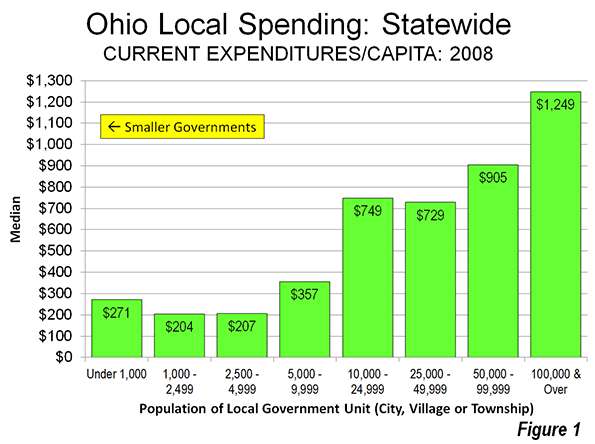
    The data indicates that smaller units of local government have median spending per capita that is less than larger local governments. Local governments with more than 10,000 population spent an average of at least twice that of smaller governments. The lowest per capita spending was in local governments with between 1,000 and 4,999 population (Figure 1).

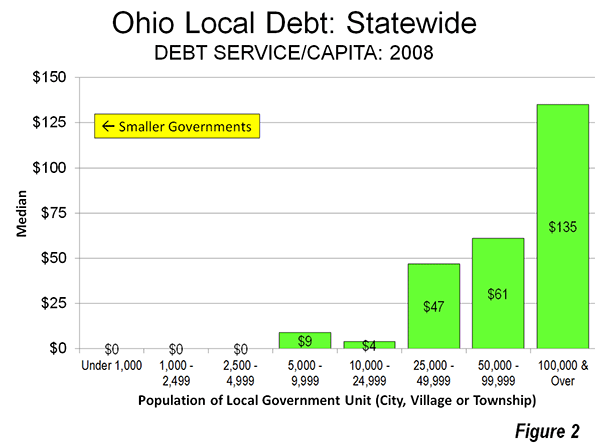
    The smaller government advantage extended to debt. The median debt service per capita for local governments with fewer than 5,000 population was zero, while the median debt service per capita for local governments with 10,000 to 25,000 population was under $10 annually (Figure 2).

    The incidence of debt was also less among smaller local governments. Fewer than one-half of the local governments under 5,000 population had any debt. In contrast, all of the local governments with 50,000 or more population had debt (Figure 3).

    Smaller Governments Excel in Metropolitan Areas

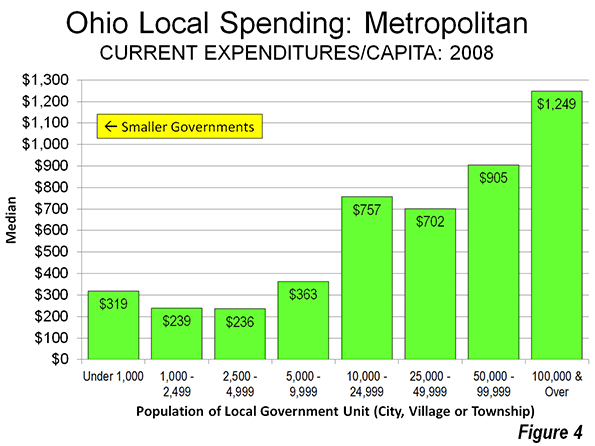
    It might be thought that this smaller-is-better relationship stems from the more rural setting of some smaller local governments. However, an analysis of local government spending and debt per capita within metropolitan areas indicates the same conclusion:  smaller governments spend less and borrow less per capita (Figure 4).

    Townships: Even Less Costly

    Townships have been a particular target of "bigger-is-better" consolidation proposals, perhaps because of their smaller average population. Yet, despite their much larger average service areas (in square miles), townships represent a far smaller share of local government spending than their population share. Townships account for 11 percent of local general purpose government spending (excluding counties), yet have 35 percent of the state’s population.

    Townships have lower current expenditures per capita than villages and cities in all but one population category. In metropolitan areas, townships spend less per capita in all population categories (Figure 5). In addition, townships have lower per capita debt service payments than cities and villages
    The lower per capita spending of townships is attributable, at least in part, to lower administrative costs and lower labor costs per capita. Further, as with smaller municipalities, taxpayers often do not often demand the same level of service that is provided in the larger cities.

    Small Government: Less Likely to Enter Fiscal Distress

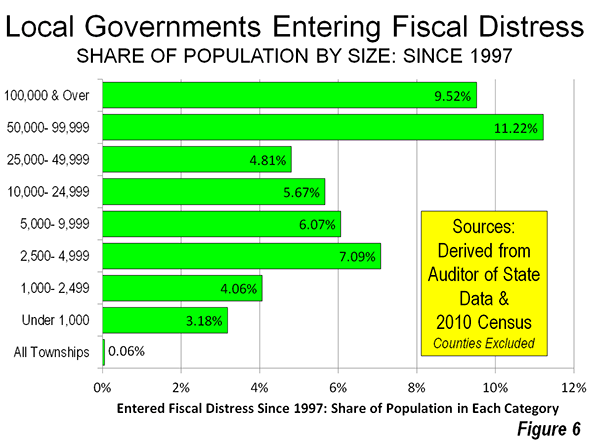
    Smaller local governments have experienced financial distress less. After the city of Cleveland bankruptcy in the 1970s, the state established the Local Government Fiscal Distress, which identifies local governments in serious distress and aids them in returning to normal fiscal health. The smallest cities and villages entered the Fiscal Distress program at a rate less than one-half that of the largest governments. The townships did even better. Only two of the state’s more than 1,300 townships were placed in the Local Government Distress Program (Figure 6).

    Why Larger Local Governments are Less Efficient

    One of the reasons that larger governments spend and borrow more is that they are less accessible to taxpayers and more accessible to interests which benefit from higher spending. This can lead to a vicious cycle that drives taxes so high that governments borrow more, followed by proposals to consolidate when the borrowing capacity becomes more constrained. Further, the very size of some larger governments can make them "too big to fail," like large financial institutions in the Great Financial Crisis. This can lead to "bailouts" by state taxpayers. Ohio’s Local Government Distress Program is an attempt to avoid these difficulties, by providing technical assistance and guidance.

    Smaller governments that consolidate face two critical challenges likely to increase costs. The first is that labor costs tend to be "leveled up" to the compensation levels in the higher cost jurisdiction. The other problem is that services and service levels also tend to be "leveled up."

    Proponents of consolidation sometimes assume that a large number of governments results in duplication of services. However, each of the local governments have exclusive service areas. For example, garbage is not collected by multiple jurisdictions to the same addresses. Smaller jurisdictions also tend to employ more part time staff, and even volunteers, especially in fire departments. Another advantage of smaller governments is that their elected officials are able to more directly manage the business of a smaller jurisdiction, because they do not have to rely more on intermediate staff.

    The performance of Ohio’s smaller governments shows that there is no need to choose between accessible government and efficient government. Ohio’s smaller local governments deliver both.

    Wendell Cox is a Visiting Professor, Conservatoire National des Arts et Metiers, Paris and the author of “War on the Dream: How Anti-Sprawl Policy Threatens the Quality of Life.”

    —–

    Note: These do not include counties, school districts or special districts.

    Illustration: Great Seal of the State of Ohio (from http://www.netstate.com/states/symb/seals/images/seal_ohio2.jpg)

  • The Rise of the Great Plains: Regional Opportunity in the 21st Century

    This is the introduction to a new report on the future of the American Great Plains released today by Texas Tech University (TTU). The report was authored by Joel Kotkin; Delore Zimmerman, Mark Schill, and Matthew Leiphon of Praxis Strategy Group; and Kevin Mulligan of TTU. Visit TTU’s page to download the full report, read the online version, or to check out the interactive online atlas of the region containing economic, demographic, and geographic data.

    For much of the past century, the vast expanse known as the Great Plains has been largely written off as a bit player on the American stage. As the nation has urbanized, and turned increasingly into a service and technology-based economy, the semi-arid area between the Mississippi Valley and the Rockies has been described as little more than a mistaken misadventure best left undone.

    Much of the media portray the Great Plains as a desiccated, lost world of emptying towns, meth labs, and Native Americans about to reclaim a place best left to the forces of nature. “Much of North Dakota has a ghostly feel to it," wrote Tim Egan in the New York Times in 2006. This picture of the region has been a consistent theme in media coverage for much of the past few decades.

    In a call for a reversal of national policy that had for two centuries promoted growth, two New Jersey academics, Frank J. Popper and Deborah Popper, proposed that Washington accelerate the depopulation of the Plains and create “the ultimate national park.” They suggested the government return the land and communities to a “buffalo commons,” claiming that development of The Plains constitutes, “the largest, longest-running agricultural and environmental miscalculation in American history.” They predicted the region will “become almost totally depopulated.”

    Our research shows that the Great Plains, far from dying, is in the midst of a historic recovery. While the area we have studied encompasses portions of thirteen states, our focus here is on ten core locations: North Dakota, South Dakota, Nebraska, Kansas, Oklahoma, Texas, New Mexico, Colorado, Wyoming, and Montana.

    Rather than decline, over the past decade the area has surpassed the national norms in everything from population increase to income and job growth. After generations of net out-migration, the entire region now enjoys a net in-migration from other states, as well as increased immigration from around the world. Remarkably, for an area long suffering from aging, the bulk of this new migration consists largely of younger families and their offspring.

    No less striking has been a rapid improvement in the region’s economy. Paced by strong growth in agriculture, manufacturing and energy — as well as a growing tech sector — the Great Plains now boasts the lowest unemployment rate of any region. North Dakota, South Dakota and Nebraska are the only states with a jobless rate of around 4 percent; Kansas, Montana, Oklahoma and Texas all have unemployment rates below the national average.

    A map of areas with the most rapid job growth over the past decade and through the Great Recession would show a swath of prosperity extending across the high plains of Texas to the Canada/North Dakota border. Rises in wage income during the past ten years follow a similar pattern. The Plains now boasts some of the healthiest economies in terms of job growth and unemployment on the North American continent.

    Of course, this tide of prosperity has not lifted all boats. Large areas have been left behind — rural small towns, deserted mining settlements, Native American reservations — and continue to suffer widespread poverty, low wages and, in many cases, demographic decline.

    In addition, the region faces formidable environmental and infrastructural challenges. Most prominent is the continuing issue of adequate water supplies, particularly in the southern plains. The large-scale increase in both farming and fossil fuel production, particularly the use of hydraulic fracking, could, if not approached carefully, exacerbate this situation in the not so distant future.

    Inadequate infrastructure, particularly air connections, still leaves much of the area distressingly cut off from the larger urban economy. The area’s industrial economy and rich resources are subject to a lack of sufficient road, rail and port connections to markets around the world. Yet despite these challenges, we believe that three critical factors will propel the region’s future.

    First, with its vast resources, the Great Plains is in an excellent position to take advantage of worldwide increases in demand for food, fiber and fuel. This growth is driven primarily by markets overseas, particularly in the developing countries of east and south Asia, and Latin America.

    As these countries have added hundreds of millions of middle class consumers, the price and value of commodities has continued to rise and seem likely to remain strong, with some short-term market corrections, over time.

    Second, the rapid evolution and adoption of new technologies has enhanced the development of resources, notably oil and gas previously considered impractical to tap. At the same time, the internet and advanced communications have reduced many of the traditional barriers — economic, cultural and social — that have cut off rural regions from the rest of country and the world.

    Third, and perhaps most important, are demographic changes. The late Soichiro Honda once noted that “more important than gold or diamonds are people.” The reversal of outmigration in the region suggests that it is once again becoming attractive to people with ambition and talent. This is particularly true of the region’s leading cities — Omaha, Oklahoma City, Tulsa, Kansas City, Sioux Falls, Greeley, Wichita, Lubbock, and Dallas-Fort Worth — many of which now enjoy positive net migration not only from their own hinterlands, but from leading metropolitan areas such as Los Angeles, the San Francisco Bay Area, New York and Chicago. Of the 40 metropolitan areas in the region, 32 show positive average net domestic migration since 2008.

    Together these factors — resources, information technology and changing demographics — augur well for the future of the Great Plains. Once forlorn and seemingly soon-to-be abandoned, the Great Plains enters the 21st century with a prairie wind at its back.

    Visit TTU’s page to download the full report, read the online version, or to check out the interactive online atlas of the region containing economic, demographic, and geographic data.

    Praxis Strategy Group is an economic research, analysis, and strategic planning firm. Joel Kotkin is executive editor of NewGeography.com and author of The Next Hundred Million: America in 2050. Kevin Mulligan is Associate Professor of Geography at Texas Tech University and Director of TTU’s Center for Geospatial Technology.

  • Decline Of The Asian Family: Drop In Births Threatens Economic Ascendancy

    In the last half century, East Asia emerged as the uber-performer on the global economic stage. The various countries in the region found success with substantially different systems: state-led capitalism in South Korea, Singapore and Japan; wild and wooly, competitive, entrepreneur-led growth in Taiwan and Hong Kong; and more recently, what Deng Xiaoping once described as “socialism with Chinese characteristics.”

    But these countries shared one common element: a strong Confucian family ethos. Three of Confucianism’s five key relationships are familial, led by the all-important father-son tie. In East Asia, business has often been driven by familial concerns. Hard-driving “tiger Moms” or workaholic Dads sacrificed all for the benefit of the next generation. But now that foundation is beginning to crumble, and if the trend is not reduced, the 50-year-long ascendency of the region could be threatened.

    The signs of an emerging Asian malaise can be seen in slowing economies — in Japan’s case an almost two-decade-long stagnation. South Korea and Singapore may grow this year at levels approaching that of the United States — mediocre by their historic standards. The notion of assured further progress is fading, as populations age and domestic markets seem unlikely to expand much.

    This malaise is reflect in declining birthrates, which now rival southern Europe for the world’s lowest, as demonstrated in a new report by myself and colleagues at the Singapore Civil Service College. Equally troubling, up to a quarter of all East Asian women, estimates the National University of Singapore’s Gavin Jones, will remain single by age 50, and up to a third will remain childless. Since few Asian women, unlike their North American or northern European counterparts, have children out of wedlock, the overall effect on already poor demographics could be catastrophic.

    The reasons for this decline in marriage and family are complex. Demographers such as Austria’s Wolfgang Lutz see a reinforcing pattern in which singleness becomes normative and child-rearing more difficult, and less widely supported by society. This creates, as my Singaporean colleague Anuradha Schoff puts it, “an ecosystem where childlessness is the preferred option.”

    Interviews and survey data from various East Asian countries show that part of the problem is extremely high housing costs — roughly twice or more as a percentage of income as in the United States, according to demographer Wendell Cox — and often pitiably small space. No surprise, then, that Asians coming to the United States flock to suburbs, increasingly in the more affordable parts of the country.

    The extremely competitive work environment, which now includes growing numbers of well-educated females, is having a negative impact on birth rates. In 1970, less than half of women in Japan and Korea were working, and only one-fifth in Singapore. By 2004, that number had increased to three-quarters in Japan, and roughly three in five in South Korea and Singapore, notes NUS’ Gavin Jones. As one researcher in Singapore explained, how could it be possible for her to start a family when she has to compete with other women who are not so encumbered? It made no sense to her to have children, even if the state provided her with as much as a million dollars.

    Huge time commitments at work, notes demographer Phil Longman, often work against potential parents. “As modern societies demand more and more investment in human capital,” he suggests” this demand threatens its own supply.”

    Then there are distinctly cultural issues, such as the perceived unwillingness of many East Asian men to share child-raising duties with their wives. And among parents, the much-celebrated obsession with achievement and education — also generally favored by Mandarins around the region — tends to make child-bearing seem ever more onerous and expensive. In this sense, the Confucian ethic on education undermines its paramount familialistic values.

    Japan represents the cutting edge of this lurch into what may in a decade be the general East Asian pattern. By 2010, a third of Japanese women entering their 30s were single, as were roughly one in five of those entering their 40s. That is roughly eight times the percentage in 1960, and twice as many as in 2000. By 2030, according to sociologist Mika Toyota, almost one in three Japanese males may be unmarried by age 50.

    Lacking the innovative energy of new entrants into the workplace and the economic stimulus of expanding households, Japan’s economy has become ever more stagnant and inward looking. And most Japanese view the future as far from bright; the Japanese, according to Gallup, are now among the most pessimistic people on the planet. Not too far behind them are, surprisingly, the Singaporeans.

    In Japan, the demographic clock is already ticking toward a kind of demographic doomsday. It’s been over two decades since the number of Japanese over 65 exceeded the number of those under 15, and the trajectory points to a time — by 2050 – when Japan will have 3.7 times as many people 65 and older as 15 and under, according to U.N. estimates. In 2050, the number of people over 80 will be 10% greater than the 15 and under population.

    Even Tokyo faces Japan’s emerging demographic winter. Given current trends away from family formation, Tokyo, now the world’s most populous metropolitan area, may see its population drop from its current 35 million to roughly half that in 2100. By then Japan’s overall population could fall to 48 million, according to Japan’s National Institute of Population and Social Security Research. And what will be left of the Japanese will be very urban, very old, and at some point, probably well before, bereft of savings.

    The other East Asian countries could face a similar fate, albeit a decade or two later. In Taiwan, 30% of women aged between 30 and 34 are single; only 30 years ago, just 2% of women were. In three decades, “remaining single and childless” merged from a rarity to a commonplace, and appears to be picking up momentum. In a 2011 poll of Taiwanese women under 50, a huge majority claimed they did not want children.

    For its part, Singapore has been able to keep itself going largely by importing talent from abroad. But the mass migration of newcomers, who have increased tremendously as a portion of the population, has also sparked widespread resentment among Singaporeans faced with ever greater congestion, crowding, high property prices and ever-greater competition for good jobs.

    Unlike intrinsically multicultural Singapore, Korea, Taiwan and China will struggle with the notion of tapping immigration to forestall their problems. As China progresses and urbanises, its demography increasingly mimics that of the Tigers, just as they now resemble Japan. Most of the world’s decline in children and young workers between 15 and 19 will take place in China; the People’s Republic will lose 60 million people under 15 years of age by 2050, approximately Italy’s population. It will gain nearly 190 million people 65 and over, approximately the population of Pakistan, which is the world’s fourth most populous country.

    In the longer run, these countries will have to reconsider their priorities. In order to restore a sense of a prosperous future, they must first consider what factors would encourage families and child-bearing in their societies. This may, among other things, require “tiger Moms” and workaholic Dads, as well as the bureaucracy, to change their ways. As my Japanese mentor Jiro Tokuyama used to say, East Asia will have to unlearn the secrets of its past success.

    Joel Kotkin is executive editor of NewGeography.com and is a distinguished presidential fellow in urban futures at Chapman University, and contributing editor to the City Journal in New York. He is author of The City: A Global History. His newest book is The Next Hundred Million: America in 2050, released in February, 2010.

    This piece originally appeared in Forbes.

    Happy Baby Photo by Bigstock.

  • The Swaps of Damocles

    "Privileged people don’t march and protest; their world is safe and clean and governed by laws designed to keep them happy…." Michael Brock in John Grisham’s The Street Lawyer (Doubleday, 1998).

    "There can be nothing happy for the person over whom some fear always looms…” Cicero, Tusculan Disputations 5.62, via Wikipedia.com

    If you were fearful after Wall Street decimated your life-savings in September 2008 then you should know that the sword of Damocles remains above your head.

    Absolutely nothing of any significance has changed. Not rules, laws or regulations. Not government oversight or external auditing. Nothing. What happened to our financial well-being in the Fall of 2008 can happen again tomorrow. If anything is being done, it is being expertly designed to make things worse for Main Street and better for Wall Street. When the tech bubble burst in March 2000, the Federal Reserve dropped dollar bills from helicopters and inflated the housing market. At least that time around, it was obvious where the next bubble would come. In an effort to hide the inflation this time around, the Fed is pumping money into dark corners of finance where it will eventually impact everything everywhere.

    First, a quick recap: During 2007, mortgage-backed bonds began failing faster than actual mortgages. Wall Street wrote bonds faster than Main Street needed mortgages – two bankruptcy judges estimated that one-third of the bonds didn’t have mortgages backing them.

    Meanwhile, insurance companies like AIG were writing credit default swaps even faster – some say there were as many as 15 swaps for every bond (by value). In 2008, AIG was unable to pay off on the credit default swaps (like insurance contracts) they wrote for the Wall Street bankers. The bankers had named themselves beneficiaries and they began cashing in – again – when the whole thing went up in flames.

    Then-Secretary of the Treasury Hank Paulson went to Congress and said the world would end if taxpayers did not give him $750 billion to bailout the banks. Congress said, “Sure, why not, you seem like a nice guy” and the Wall Street Bailout was signed into law by George W. Bush on October 1, 2008. In the months that followed, we learned that the Federal Reserve topped off the Wall Street tanks with trillions more dollars – a lot of which went to foreigners and private companies not under their regulatory purview. Since then, Federal Reserve Chairman Ben Bernanke has been dropping dollar bills out of helicopters by buying more and more mortgage un-backed bonds from Wall Street because – well, no one is quite sure why he is doing this.

    Eventually, Senator Chris Dodd (D-CT) and Representative Barney Frank (D-MA) got their names attached to a new public law, which President Obama signed on July 21, 2010 – about two years after the bailout – that was supposed to reform Wall Street and protect Consumers. Five months after the signing, Sen. Dodd announced his retirement (not long after it was made public that he and several Senators received very friendly terms on a mortgage from sub-prime mortgage bond King Angelo Mozilo of Countrywide). Rep. Frank will not seek reelection in November 2012. Neither Dodd nor Frank planned to be around when the bill is actually effective. You see, a lot of Dodd-Frank was only to require that someone else do studies, write reports and propose rules. Less than half of the rules were required to be written before Rep. Frank leaves office – Dodd left office before any action was required under the public law with his name on it.

    Both Dodd and Frank are retiring with full pensions, but the same cannot be said about the public law with their names on it. As of September 21, 2012, about as many Dodd-Frank rules have been proposed as there are mortgages backing those mortgage-bonds the Fed is buying. According to a review by New York law firm Davis Polk (as of September 4, 2012):

    • Of the 398 total Dodd-Frank rulemaking requirements:
      • 131 (32.9%) have final rules
      • 135 (33.9%) have proposed rules
      • 132 (33.2%) have not yet been proposed
    • Of the 247 rulemaking deadlines that have passed:
      • 145 (61.2%) have been missed
      • 31 (13%) have not even had proposals
        Source: http://regreformtracker.aba.com

    So far as I was concerned, the only actual success of Dodd-Frank came from an amendment which required the Federal Reserve to disclose exactly to whom they gave the bailout money  – information on 21,000 transactions valued at $16 trillion that Fox News, Bloomberg and Rolling Stone Magazine sued to get after the Chairman and Vice Chairman of the Fed refused to reply to questions from Congress. Turns out the Fed officials went from sins of omission to sins of commission – Bloomberg reported in December that they hid billions of dollars in loans from the mandated reports. Despite now knowing that the Federal Reserve is giving money to unregulated companies with no means of retrieving it, the U.S. public – outside of a faithful few Occupy Wall Street protestors still out there – have failed to notice or react. Hence, nothing has changed that would prevent a repeat of the events that precipitated the 2008 bailouts from occurring again tomorrow.

    “But wait! That’s not all!” as they say in late-night TV infomercials. More than ignoring the law, more than delaying the reforms, Wall Street is now actively working to get new laws written to exempt themselves from Dodd-Frank – which, we thought, was specifically written to reform their activities. On September 19, H.R. 2827 was passed by Congress to exempt from any Dodd–Frank rulemaking the very activity that is bankrupting some US cities and states and counties.

    The law they are now exempted from is the one that would require them to accept legal responsibility for putting the best interests of the municipalities and taxpayers first – a blanket requirement for fiduciary duty that already exists but is consistently ignored by the “survivors of Wall Street survivors of the financial crisis” as they are called by William D. Cohan, author of the New York Times bestseller House of Cards: A Tale of Hubris and Wretched Excess on Wall Street. Cohan emphasizes that bribing clients like Jefferson County is not new – although it seems evident that the problem may be more wide spread now than ever before in US history. Jefferson County (AL) may be the best known – bankruptcy followed on the heels of bribes and billions of dollars worth of toxic swap deals. The Wall Street banks not only bribe officials to commit municipal taxpayers to financial obligations they can never repay, they also pay competing banks so they can charge higher fees and interest rates. This breaches the simple trust you are entitled to expect even from used car salesmen (in states with “Lemon Laws”) – but no such protection is afforded anyone who has to deal with Wall Street.

    In the end, we are all required to deal with Wall Street. This is a danger more real, and more imminent, than anything the world may ever have faced. It is as if we have been told that an asteroid the size of Texas is barreling toward Earth and Ben Bernanke hit the button that launched the nuke — that missed. It’s still coming. Wall Street remains unreformed and consumers of financial services remain unprotected.

    Susanne Trimbath, Ph.D. is CEO and Chief Economist of STP Advisory Services. Dr. Trimbath’s credits include appearances on national television and radio programs and the Emmy® Award nominated Bloomberg report Phantom Shares. She appears in four documentaries on the financial crisis, including Stock Shock: the Rise of Sirius XM and Collapse of Wall Street Ethics and the newly released Wall Street Conspiracy. Dr. Trimbath was formerly Senior Research Economist at the Milken Institute. She served as Senior Advisor on United States Agency for International Development capital markets projects in Russia, Romania and Ukraine. Dr. Trimbath teaches graduate and undergraduate finance and economics.

  • Is College Worth It?

    Is college worth it? The question almost seems ludicrous on its face.  The unemployment rate for people with a college degree is only 4.2% versus 9.1% for people without a college degree and 13.0% for people with less than a high school education. In this economy, that should be an open and shut case.

    Yet in an uncertain world, many are questioning the value of college. There’s significant talk of a “higher education bubble.”  Skyrocketing tuition rates and the correspondingly high levels of student debt has driven a lot of this. Tuition has been rising at a much faster rate than inflation overall. Total student loan debt is now at $1 trillion. And unlike other forms of debt, student loans can’t be easily discharged in bankruptcy.

    In many ways college finance does mirror the housing bubble. You’ve got an asset everyone believes will only go up in value, a multi-party transaction, a situation where the seller of the product (the college) gets their money up front and so is indifferent   to the student’s ability to repay, third parties  insured against loss by the federal government, a non-transparent market where each student is in effect charged a unique price, young and unsophisticated consumers who are told they “have to get” a college degree, financial products without any income requirements, and even worse the asset (a degree) doesn’t have a secondary market.

    All of these factors create a situation ripe for exploitation and abuse. Indeed, it isn’t hard to see that the massive increases in tuition cost are heavily driven by the ability of students to get huge loans with few questions asked. And as with the housing crisis, outright fraud by educational institutions is likely more widespread than commonly believed.  The University of Illinois law school falsified its admissions data, for example, by inflating its students LSAT scores. The “cockroach theory” (if you see one, there’s probably a lot more you don’t see) suggests that this type of behavior is probably rampant.

    Students and their parents are starting to wise up to the game, and the amount of student loan debt they think appropriate is plummeting. For example, in 2011 only 21% of people felt $20,000 in college debt was too much. Just a year later that percentage increased to 42%. In 2008, 81% of adults thought a college degree was a good investment. In 2012 that had dropped to 57%.  That’s a stunning decline in the number of people who think college is worthwhile, though it might suggest that the problem is less with the value of a degree itself than in how much is paid for it. But there are anecdotes to suggest that some feel college (especially graduate school) isn’t worth what it used to be.

    Why is that? In part it is surely the economy. Though degreed adults as a whole have lower unemployment, youth unemployment and probably more important underemployment remains high for college grads. A shocking 53% of recent graduates are jobless or underemployed. This has fed through into popular culture, with student loan debt relief being part of the grab bag of demands made by the various “Occupy” movements.  When you graduate from college with huge, non-dischargeable debts, and you can’t find a job, particularly in your chosen field, you no doubt complain loudly about this to your friends.

    But there’s also good reason to believe college is worth less today in many cases. Back in the 1980s and 90s the value of college was clear. Manufacturing was in decline. If you didn’t have a degree, you would probably struggle. In contrast, a college degree was like a golden ticket to success.

    Today, in the age of globalization, it’s not so simple. Those without degrees are still hurting, but so are plenty of people with degrees. The emerging new separation is not between those with degrees and without, but those in jobs that are subject to international competition (tradeable) vs. those that aren’t (non-tradeable). High skill, white collar workers like computer programmers suddenly found themselves in competition with much lower paid people in places like India. This upended that entire job market.  Today you might be better off as an ironworker or welder whose job has to be done on site than as an accounting manager whose entire department can be sent to the Philippines. A college degree is no longer a guaranteed passport to prosperity.

    Also, today’s technology driven world is changing so rapidly that skills learned in college can prove obsolete by graduation.  At the same time, open source frameworks and cloud computing have dropped the cost of starting a tech business to almost literally zero. In the dot com era, it took millions of dollars to buy servers and database licenses if you wanted to start a company. Today anybody can start a technology business in his bedroom.

    So if you’ve got a good idea, why wait around for graduation to get started? The role models here are Bill Gates and Mark Zuckerberg, who dropped out of Harvard but both got rich starting companies.  This dropping out of college to start companies is actively being encouraged by some folks like Peter Thiel, who is actually paying people to do it.

    What these modern day Timothy Learys overlook is what Bill Gates and Mark Zuckerberg already had in common. Namely, they had already gotten in to Harvard. If you make it to Harvard, you already probably come from a privileged background. Thus you’ve got a family safety net in place if things go south. Those from working class backgrounds aren’t so lucky. Indeed, I’m struck that many suggesting that college isn’t the answer are presently an upper-middle class or better situations.

    For a limited number of people, dropping out of or skipping school to start a business might make sense. But trend setters may manage to convince a significant numbers of kids from marginal backgrounds to forgo the college education —perhaps in a needed skill — that would provide necessary credentials and culturally acclimate them to the new economy world. Many of those kids don’t have a family cushion to fall back on.  For them, turn on, tune in, drop out is not the answer.

    The real answer isn’t to skip education, but to be more judicious about the decisions being made. Racking up large amounts of debt probably isn’t the right answer. The marketing promises of especially for-profit colleges should be heavily discounted. For some, getting education through going into a skilled trade may be a good choice. College majors that don’t deliver skills in demand in the marketplace or that aren’t considered valuable credentials by employers ought to be scrutinized. But getting an education remains one of the single best decisions any person can make.

    Aaron M. Renn is an independent writer on urban affairs and the founder of Telestrian, a data analysis and mapping tool. He writes at The Urbanophile.

    Graduation photo by Bigstock.

  • It’s Mormon in America

    Whether or not Mitt Romney makes it to the White House, his candidacy signals that Mormons have arrived in American political life. Just as President Obama’s nomination and election marked a sea change in the country’s tortured racial history, so Romney’s nomination has changed religious boundaries that have persisted for more than 160 years. No religious group has been more persecuted by the U.S. government, or more derided by other faiths present in the country, than the Church of Jesus Christ of Latter-day Saints (or the LDS Church, as many Mormons refer to it). Indeed, it was to seek a secure home to practice their heterodox beliefs, including polygamy, that Mormons moved from upstate New York to Ohio, Missouri, Illinois, and finally the Salt Lake Valley in present-day Utah. Led by the irrepressible organizer Brigham Young, the Mormons did more than settle open land. They created a unique blend of communalism and capitalism, industriousness and religious faith, that withstood threats from Native Americans and, later, from the U.S. Army.

    Today, some religious fundamentalists continue to rail against Mormons, while coastal sophisticates scoff at their earnest approach to life, religion, and family. Yet the methodical Mormon way, which stresses education, ambition, and charitable giving, has succeeded in ways equaled by few religious groups. Mormons enjoy levels of education and wealth higher than the national average, for example. Some 54 percent of LDS men and 44 percent of women have secured postsecondary education; the numbers for the general American population are 37 percent and 28 percent, respectively. Mormons also enjoy the nation’s highest rate of charitable giving.

    And while many religious groups in the United States—including the Catholic and mainline Protestant churches, along with most non-Orthodox Jewish denominations—are struggling with declining numbers, the LDS Church is one of the nation’s fastest-growing. Its American membership jumped from 4 million to 6 million between 2000 and 2010. Its global growth over the same period was 45.5 percent, and today, most of its total membership of 14 million resides outside North America. The fastest growth is occurring in Brazil, the South Pacific, and Central America.

    The best advertisement for Mormonism, though, is the kind of society that it seems able to create. Utah, 60 percent of whose population belongs to the LDS Church, has enjoyed one of the fastest job-growth rates in the nation over the past decade, taking a strong lead in a host of industries, from energy and software to composite manufacturing. It has also seen the highest population growth rate of any state, aside from neighboring Arizona and Nevada—and unlike those “bubble” states, Utah survived the housing bust in strong shape.

    The Beehive State’s success is less about low taxes—Utah is not a tax haven like Texas, Nevada, or Florida—than about support for wealth-creating industry. Utahans have a great interest in promoting business growth. Though they revere their state’s handsome landscape, they suffer little from the antigrowth “progressivism” common to the East and West Coasts. Whether backing the creation of a vast mixed-used project in downtown Salt Lake City or encouraging new building for the area’s swelling population, the LDS Church tends to be pro-development.

    That applies to residences as well. Unlike such rival states as California, Utah continues to build affordable single-family houses. Many newly minted housing tracts run along the corridor from Ogden in the north to Provo. A handful of tall condo towers dot downtown Salt Lake City as well. A median-price home in the Salt Lake City region, according to an affordability survey by Demographia, costs roughly three times the median family income—much less than in Los Angeles, New York, and the San Francisco Bay area. Not surprisingly, the New York metropolitan area and California have become the largest net senders of migrants to the Salt Lake City region.

    Such cost advantages, plus the presence of an educated population, appeal to global companies. Goldman Sachs, for example, has set up its second-largest American operation in downtown Salt Lake City. “We consider Salt Lake a high-leverage location,” says Goldman managing director David Lang. “There’s a huge cost differential, and you have a huge, talent-rich environment.” Drive through Provo, and you’ll see office buildings, often just finished, for some of Silicon Valley’s signature companies, including Intel, Adobe, Twitter, eBay, and Fairchild Semiconductor. Over the past decade, the number of Salt Lake–area employees in STEM jobs (those relating to science, technology, engineering, or math) has increased 17.5 percent. The number of such jobs actually declined in Silicon Valley and stagnated in New York, Boston, and Los Angeles.

    Few of the non-Mormon Salt Lake City residents with whom I spoke—“Gentiles,” as LDS members call them—found the city’s atmosphere oppressive. A 2012 Gallup survey ranked Utah first among the states in quality of life. Two decades ago, Gentiles often expressed frustration with Salt Lake City’s dearth of decent restaurants, bars, and even coffeehouses, as Mormons drink neither alcohol nor caffeine. These days, though it’s hardly a party town, the city offers reasonable restaurants and coffee shops, along with plenty of available alcohol. When Kayvan Esfarjani, co–executive director of a Flash Technologies semiconductor plant south of Salt Lake City, first got his assignment there, he thought that he would commute weekly from Silicon Valley. “I had a misconception that this place was somewhere you can’t get a drink, people have multiple wives,” he laughs in his office at the plant, which employs 1,600 workers. But after a short while, the Iranian-born engineer decided to settle down in the Wasatch foothills: “It turns out to be a very good place to raise a family and run a business.”

    Mormons aren’t the wide-eyed, naive people of stereotype; they’re increasingly cosmopolitan and sophisticated. Indeed, Romney may represent only a first move toward the apex of influence in America. We may well hear from former Utah governor Jon Huntsman, a candidate for the Republican presidential nomination this year, or from such engaging newcomers as congressional candidate Mia Love, an exemplar of the new LDS Church (she is of Haitian descent; the church banned black men from its priesthood until the late 1970s). Whether he wins or loses, Romney’s candidacy represents the beginning of the Mormon moment, not its culmination.

    Joel Kotkin is executive editor of NewGeography.com and is a distinguished presidential fellow in urban futures at Chapman University, and contributing editor to the City Journal in New York. He is author of The City: A Global History. His newest book is The Next Hundred Million: America in 2050, released in February, 2010.

    This piece originally appeared in The City Journal.

    Mormon Church Photo by Bigstock.