Blog

  • Warnings of an “infrastructure Crisis” are Meeting with Skepticism

    Is the "infrastructure crisis" a myth or a reality? Many  within the transportation community firmly believe that the crisis is real. They point out that many of our roads, bridges and transit systems are approaching the end of their useful life and are badly in need of repair, reconstruction and modernization. They are convinced that without an ambitious program of investment —beyond the billions that already are being spent—the transportation infrastructure will continue to deteriorate, rendering great harm to the nation’s economy. They find it difficult to understand why politicians and the public do not necessarily share the same sense of urgency. They tend to blame themselves for doing a poor job of "educating" the public about the catastrophic consequences of inaction.

    Even though the new two-year transportation bill has barely gone into effect (on October 1), activists already are strategizing  how better, i.e. more convincingly,  to present  the case for higher transportation spending in the next transportation bill.  As an AASHTO spokesman reminded us recently, "it is never too early to consider your strategy for making the case that the United States should continue to invest in its transportation infrastructure." "We can’t afford to relax," echoed Pete Ruane, president of the American Road and Transportation Builders Association (ARTBA). "We’re in a very serious struggle over the future of federal investment in transportation." Similar sentiments have been voiced in various transportation-related meetings over the past several months..   

    But proponents of greater spending ignore the political realities. With mounting deficits and the shadow of a $16 trillion debt hovering over all fiscal decisions, Congress is not about to vastly increase spending on transportation. Concern about deteriorating infrastructure has failed to resonate with the electorate during the election campaign.  Nor did  the presidential condidates care to mention transportation in their recent debate on domestic priorities, despite pleas by stakeholder groups to include infrastructure on the political agenda.

    Infrastructure crisis believers decry this supposed "indifference" or "short-sightedness" on the part of the politicians and the public. But their anger is misplaced. People recognize and acknowledge the need to modernize and expand the nation’s infrastructure.  They simply are not convinced by the "sky is falling" rhetoric employed by the alarmists—dire warnings of collapsing bridges and crumbling roads if  government does not greatly increase spending on infrastructure. 

    As the Washington Post editorialized no too long ago, people see no signs of  "crumbling infrastructure." They trust their own eyes more than they trust the unverified claims of  the experts —and what they see is highways and transit networks that are well maintained and functioning smoothly and reliably most of the time. They suspect that  warnings of catastrophic consequences if spending on infrastructure is not boosted, are overblown, self-serving, and more often than not inspired by liberal advocacy groups, lobbyists and industry spokesmen who have a financial stake in pushing for more federal spending.  As one senior congressional aide confided to us, "I don’t see our constituents lobbying to raise the gas tax in order to spend more money on transportation."

    Moreover, the public is not sure that all of the billions of dollars that the federal government already devotes to  transportation ($114 billion in FY 2012) are spent  wisely, nor that more money will make the transportation system perform any better (e.g. reduce congestion).  They believe that the desire to greatly increase investment in infrastructure must be tempered by the overriding  imperative to get the nation’s fiscal house in order.

    Beyond MAP-21 
    The fiscal and political climate in the next few years will make the job of convincing the skeptical electorate to support higher transportation spending even harder. Funding constraints will continue to make it difficult if not downright impossible for Congress to commit hundreds of billions of federal dollars in a single legislative package, regardless of which party controls the purse strings. Unwilling to raise fuel taxes, Congress is likely to embrace short-term bills as a convenient way out of the dilemma.  Short-term authorizations such as MAP-21 will require only modest transfers from the general fund —especially if states are willing to step in with increased contributions of their own. On the other hand, a six-year bill would require an injection of nearly $90 billion in general revenue.  

    To be sure, some in the stakeholder community will contend that longer-term (i.e. five- or six-year) authorizations are necessary to allow for orderly planning and implementation of capital projects. They will argue that short-term bills will not provide the kind of funding certainty that major public works require. But to the extent that large capital investments still figure on State DOTs’ and transit authorities’ agendas, private capital, tolling, and credit instruments such as TIFIA and state infrastructure banks, will provide adequate alternatives to the funding stability that long-term congressional  authorizations offered in years past.

    The bottom line: regardless of the outcome of the November elections, do not expect a boost in federal transportation spending. Indeed, minor reductions in discretionary programs (TIGER, New Starts) are possible if automatic year-end spending cuts under sequestration are not avoided.

  • How California Lost its Mojo

    The preferred story for California’s economy runs like this:

    In the beginning there was prosperity.  It started with gold.  Then, agriculture thrived in California’s climate.  Movies and entertainment came along in the early 20th Century.  In the 1930s there was migration from the Dust Bowl.  California became an industrial powerhouse in World War II.  Defense, aerospace, the world’s best higher education system, theme parks, entertainment, and tech combined to drive California’s post-war expansion.

    Then, in the evening of November 9th, 1989, the Berlin Wall came down.  On December 25, 1991, the Soviet Union was dissolved.  The Cold War was over.  America responded by cutting defense spending and called the savings the Peace Dividend.

    California paid that peace dividend.  A huge portion of California’s military industrial complex was destroyed.  The aerospace industry was downsized, never to come back.  Hundreds of thousands of well-paying manufacturing and engineering jobs were lost.

    The ever-resilient California bounced back though.  Tech, driven by an entrepreneurial culture and fed by California’s great universities drove California’s economy to new heights.

    Then, there was the dot.com bust.  A mild national recession was much more painful for a California dependent on its tech sector.  Eventually California recovered.  California’s tech sector and climate, aided by a housing boom, restored California’s prosperity.

    The housing boom was followed by a housing bust.  Again, California paid a high price, and unemployment skyrocketed to 30 percent above the national average.

    Today, California is recovering.  Its tech sector is once again bringing prosperity to the state.  Furthermore, California’s green legislation is providing the motivation for a brave new future of economic growth and environmental virtue.

    The story is true through the Peace Dividend.  California did pay a high price for the collapse of the Soviet Union.  California’s defense sector did begin a decline, and it never recovered.  But, defense recovered in other places, as the country expanded defense spending by 21 percent in the 2000s.  The United States has constantly been engaged in wars and conflicts for over a decade.  On a real-per-person basis, the United States is spending as much on defense as it has at any time since 1960. 

    But when it comes to the present, the narrative falls down.  Defense has rebounded, but not in California.  California’s defense sector is small and declining, not because of a permanently smaller U.S. defense sector, but because of something about California.

    California’s tech sector did boom after the collapse of California’s defense sector, but that doesn’t mean that California recovered.  In fact, much of California never recovered.  It’s the aggregation problem. 

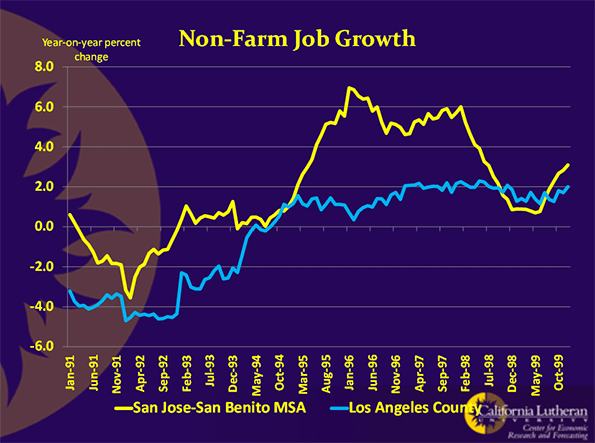
    The 1990s’ recovery was largely a Bay Area recovery.  Los Angeles hardly saw any uptick in employment.  Here is a chart comparing Los Angeles County’s jobs growth rate with the San Jose Metropolitan Statistical Area (MSA): 

    San Jose probably had California’s fastest growing job market in the 1990s.  Los Angeles was not the states slowest.  Still, the differences are striking.

    A few years ago, a couple of my graduate students looked at California data from 1990 through 1999.  They divided California into two regions, the Bay Area and everywhere else.  The Bay Area was defined as Sonoma, Marin, Napa, Solano, Contra Costa, Alameda, Santa Clara, Santa Cruz, San Mateo, and San Francisco counties.  Using seven indicators of economic growth, they performed relatively simple statistical tests to see if the two geographies experienced similar economies.  The indicators were employment, wages, home prices, bank deposits, population growth, construction permits, and household income.

    By every measure except population growth, the Bay Area outperformed the rest of the state.  The exception was probably due to commuters to the Bay Area, given that region’s exceptionally high housing prices. 

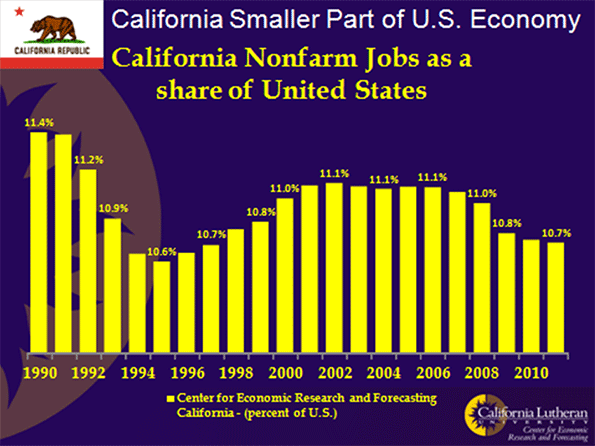
    Some economists will tell you that California saw faster-than-national job growth from the mid 1990s until the great recession.  This is another aggregation problem.  The claim is technically true, but only in the sense that California had a higher proportion of the nation’s jobs in 2007 than it did in 1995.  If you look at annual data, you will see that California’s share of the nation’s jobs only grew from 1995 through 2002.  Since then, California’s share of United States jobs resumed its decline:

    In reality, California never recovered from the dot.com bust.  California, perhaps the best place on the planet to live, couldn’t keep up in a housing boom.  Something was wrong.

    California had lost its mojo. 

    Opportunity is now greater outside California than inside California.  For almost 150 years, California was as widely known for its opportunity as it was for its sunshine.  The combination was like a drug.  George Stoneman, an army officer destined to become California’s 15th governor, spoke for millions when he said "I will embrace the first opportunity to get to California and it is altogether probable that when once there I shall never again leave it." 

    They did come to California, and they made an amazing place.  Opportunity-driven migrants are different than other people.  They take big risks to leave everything they know for an uncertain future in a new place.  They are confident, bold, and brash.   California became just as confident, bold, and brash.  The Anglo-American novelist Taylor Caldwell spoke the truth when she said "If they can’t do it in California, it can’t be done anywhere."

    That was then.  Today, California can’t even rebuild an old Hotel.

    The Miramar Hotel is a partially-demolished eyesore beside the 101 Freeway in Montecito, just south of Santa Barbara.  The Hotel’s initial structure was built in 1889.  Over the years, it was expanded to a 29 structure luxury hotel and resort.  In September 2000 it was closed for renovations which were expected to take 18 months.  That was when the fighting started.  Community groups, neighbors, and governments all had their own idea of what the Miramar should be.  Two owners later, and after millions of dollars, the future to the Miramar is still uncertain.

    The Miramar Hotel is a case study of what is wrong with post-industrial California, precisely because it should have been easy, and because it is not unique.  Everything is hard to do in California.  The state that once moved rivers of water hundreds of miles across deserts and over or through mountain ranges can’t rebuild a hotel.

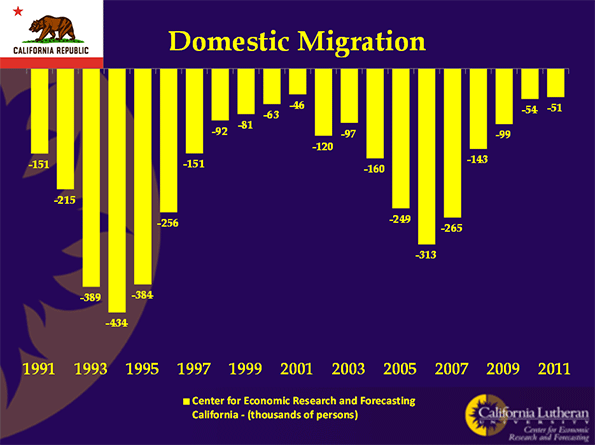
    The situation will get worse.  California has become the place people are leaving.  The following chart shows that for 20 years more people have left California for other states than came to California from other states:

    California’s population is still increasing because of births and international immigration. 

    Two decades of negative domestic migration has taken its toll.  Millions of risk-taking, confident, bold, and brash people have left California.  They took California’s mojo with them.

    That seems pretty clear when you look at some statistics:  California’s unemployment is way above the national average.  With only about 12 percent of the nation’s population, California has over 30 percent of the nation’s welfare recipients.  San Bernardino has the nation’s second highest poverty rate among cities over 200,000.

    Sometimes though, aggregated data can hide California’s weakness, and some, representing the always-present constituency for the status quo, use these data to deny that California’s future is any less golden. 

    Most recently, those representing the constituency for the status quo have used California’s aggregated jobs data to argue that all is well in California.  They argue that California’s tech sector is leading California to a new golden future.

    Year-over-year data confirm that, through August 2012, California gained jobs at a faster pace than the United States.  Once again, though, that growth is largely confined to one industry and one geography.  California’s tech sector is recovering, and amidst a generally weak recovery, it appears strong enough to generate pretty impressive aggregated results.  If we disaggregate California’s data, we will find that there is not just one California.  There is a rich and mostly coastal California, with a few smaller inland counties on the San Francisco-Lake Tahoe corridor.  Another California is very poor and mostly inland.

    Here’s a list of California’s poorest counties by poverty rate:

    County

    Poverty Rate

    Child Poverty Rate

    Rank

    Del Norte

    23.5

    30.6

    3

    Fresno

    26.8

    38.2

    1

    Imperial

    22.3

    31.8

    6

    Kern

    21.4

    30.3

    10

    Kings

    22.5

    29.7

    5

    Madera

    21.7

    31.7

    8

    Merced

    23.1

    31.4

    4

    Modoc

    21.9

    32.5

    7

    Siskiyou

    21.5

    30.7

    9

    Tulare

    33.6

    33.6

    2

    Here’s a list of California richest counties by poverty rate:

    County

    Poverty Rate

    Child Poverty Rate

    Rank

    Calaveras

    11.1

    18.3

    10

    Contra Costa

    9.3

    12.7

    4

    El Dorado

    9.4

    11.6

    5

    Marin

    9.2

    10.9

    3

    Mono

    10.8

    15

    8

    Napa

    10.7

    14.7

    7

    Placer

    9.1

    10.7

    2

    San Mateo

    7

    8.5

    1

    Santa Clara

    10.6

    13.3

    6

    Ventura

    11

    15.3

    9

    There are some big differences here.  The percentage of Fresno’s children living in poverty is four and half times the percentage of San Mateo children living in poverty.  In fact, the data for California’s poorest counties looks like third-world data.

    When disaggregated, the job-growth data shows the same story.  Through 2012’s second quarter, jobs in the San Jose MSA were up 3.6 percent on a year-over-year basis.  In Los Angeles, jobs were up only 1.1 percent, while in Sacramento they were up only 0.6 percent.  For comparison, U.S. jobs were up about 1.3 percent for the same time period.

    You can perform this analysis for all types of data.  When the data are disaggregated, the story is always the same.  It’s telling us that California needs to get its mojo back, and the current tech boom is likely not to be enough for its recovery.

    Bill Watkins is a professor at California Lutheran University and runs the Center for Economic Research and Forecasting, which can be found at clucerf.org.

    Unemployment photo by BigStockPhoto.com.

  • The Evolving Urban Form: Barcelona

    Among those for whom Paris is not their favorite European city, Barcelona often fills the void. Barcelona is the capital of Spain’s Catalonia region. Catalonia has been in the news in recent weeks because of the rising a settlement for independence from Spain, or at a minimum, considerably expanded autonomy. In part, the discontent is driven by a concern about the extent to which more affluent Catalonia subsidizes the rest of Spain. Another driving factor is the interest in separating Catalonian language and culture from that of Spain.

    Barcelona is nestled on the Mediterranean coast with mountains and valleys immediately behind. It would be easy to visit Barcelona without being aware of the huge expanse of suburbanization that has developed especially over the last 50 years.

    The Core City

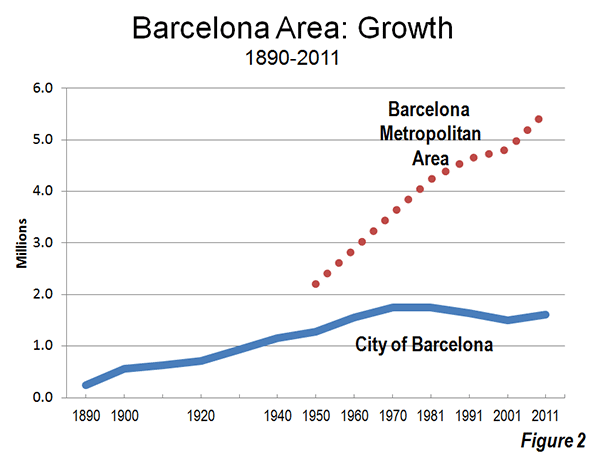
    Like virtually all European core cities that have not annexed or combined with other jurisdictions, Barcelona’s population had peaked well before the turn of the 21st century. In 1960, the city of Barcelona had a population of just below 1.6 million people. Today, after having risen to 1.75 million in 1981, Barcelona’s population has dropped to approximately 1.62 million. Nonetheless, like other European core cities, Barcelona experienced strong growth before 1970, rising to nearly 7 times its 1890 population of 250,000.

    At the same time, like some other European and North American core cities, the city of Barcelona has begun to grow again. Having reached a modern low point of 1.5 million in 2001, the city grew by approximately 7 percent by the 2011 census.

    The city itself covers a land area of approximately 55 square miles/143 square kilometers, slightly less than that of Washington, DC. Barcelona’s density is much higher, at approximately 40,700 per square mile/15,700 per square kilometer, as opposed to the approximately 10,000 per square mile/4,000 per square kilometer of Washington. Yet, other core areas are considerably more dense, such as the ville de Paris, which is at least 30 percent more dense and Manhattan, which is approximately 50 percent more dense.

    The Metropolitan Area and the Urban Area

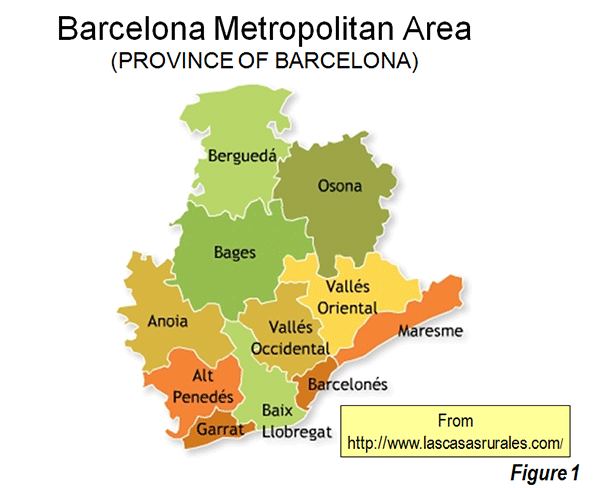
    The metropolitan area is generally considered to be the province of Barcelona, which is a part of the region of Catalonia (Figure 1). Since 1950, the metropolitan area has expanded from 2.2 million to 5.6 million people. Since 1960, nearly all of the population growth has been outside the city of Barcelona. The city has added approximately 60,000 people, while the balance of Barcelona province has added approximately 2.7 million people (Figure 2).


    The province of Barcelona is divided into comarques, which are the equivalent of counties. The core comarca (the singular form) is also called Barcelona and includes the city as well as other municipalities (or local government authorities), the largest of which is Hospitalet de Llobregat, with a population of 250,000.

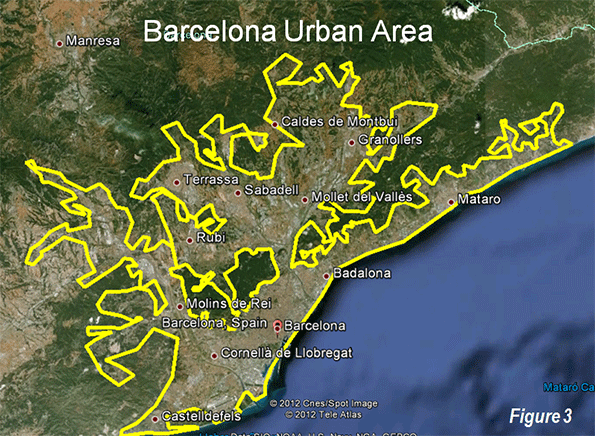
    Barcelona’s urban area (area of continuous urban development) continues along the Mediterranean coast to the southwest into the comarca of Baix Llobregat, which includes the international airport. To the northwest the urbanization continues along the coast for some distance into the comarca of Maresme.

    The urbanization then surrounds Tibidabo Mountain behind the city along freeway routes on either side. These roadways connect with the AP-7 autopista (toll motorway), which provides direct access between Madrid, Valencia, Andalusia and France. The large valley through which the AP-7 runs contains the largest suburbs of Barcelona, which are divided into two comarques, the Valles Oriental (East Valley) and the Valles Occidental (West Valley).

    The Barcelona urban area covers approximately 415 square miles/1,075 square kilometers (Figure 3) and has a population of 4.6 million. At approximately 11,000 persons per square mile/4200 per square kilometer, Barcelona is one of Western Europe’s most dense urban areas. It is approximately 15 percent more dense than Paris and among the larger urban areas trails only Madrid (11,800 per square mile/4,500 per square kilometer) and London (15,100 per square mile/5,800 per square kilometer).

    The Barcelona urban area’s high density is also illustrated by comparison to the Zürich urban area, with its reputation for high density. As defined by the Federal Statistical Office of Switzerland, Zürich covers virtually the same land area as Barcelona, yet has less than one quarter of its population.

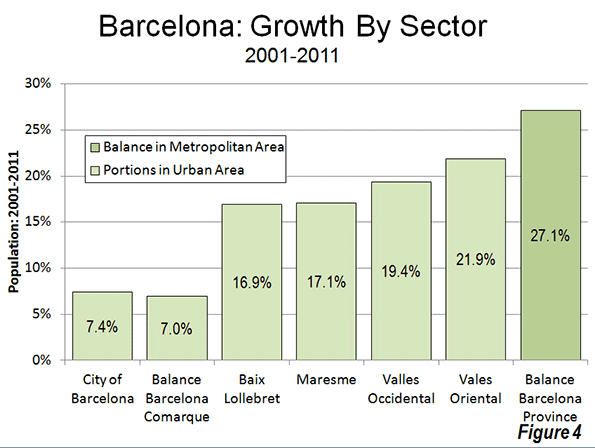
    Between the 2001 and the 2011 censuses, there was seven percent growth in the inner suburbs surrounding the city of Barcelona within the comarca of Barcelona. Much greater growth, however, was experienced in the more peripheral parts of the urban area. The coastal suburbs of Baix Llobregat and Maresme grew approximately 17 percent and now have a population of more than 1,000,000.

    Growth was even stronger in the interior valley, with the Valles Occidental growing at 19 percent and the Valles Oriental, which and with much more vacant land for development, grew 22 percent (Figure 4). Now the population of the Valles approaches 1.2 million.

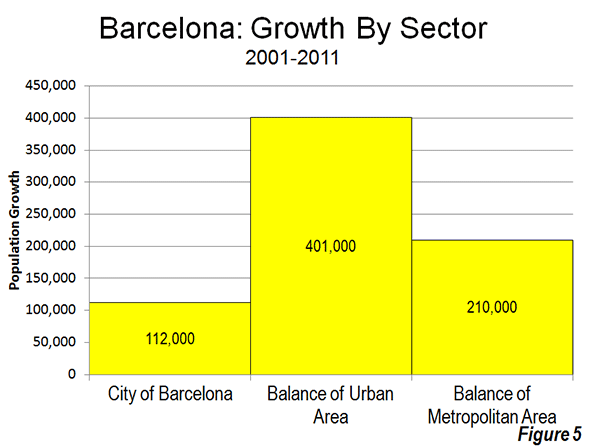
    However the largest growth was outside the urban area entirely, in the balance of the metropolitan area, where the population increased 27 percent (Figure 5), and now approaches 1,000,000.

    Newer Development

    Much of the most recent growth has been relatively unusual for large Spanish urban areas, which have largely experienced high density expansion, with multi-family buildings (often high rise), even in the suburbs (see top photo). However, considerable detached housing has been built in the Barcelona metropolitan area over the past decade.

    Barcelona’s Dispersion

    Thus, the Barcelona metropolitan area is generally following the trend of greater growth in the urban periphery and the strongest growth in the rural and smaller urban areas that are outside the continuous urbanization.

    Wendell Cox is a Visiting Professor, Conservatoire National des Arts et Metiers, Paris and the author of “War on the Dream: How Anti-Sprawl Policy Threatens the Quality of Life.”

    Photo: Residential area in Valles Occidentale (Barcelona suburbs), by author.

  • The Braking Of The BRICs

    For over a decade, conventional wisdom has held that the future of the world economy rests on the rise of the so-called BRIC countries: Brazil, Russia, India, China (and, in some cases, with the addition of an ‘S’ for South Africa). A concept coined by Goldman Sachs economist Jim O’Neill, the BRICs were widely touted as the building blocks of the “post-American world.”

    Such notions are particularly popular among intellectuals like India’s Brankaj Mishra, who sees world power shifting inexorably to “ascendant nations and peoples” — i.e. the BRICs — while “America’s retrenchment is inevitable.” Yet in reality, it is increasingly clear that the BRICs upward trajectory is slowing and many long-term trends suggest that their growth rates will continue to fall in the coming decades. Like other former “America-killers” such as Europe (1960s), Japan (1970s and 1980s) and the Asian Tigers (1990s), the BRIC countries appear to be unable to sustain the steady, inevitable progress projected by enthusiasts both at home and abroad.

    One sign can be seen in the equity markets. Between 2001 and 2007, BRIC stocks soared, more than doubling in China and rising 369% in Brazil and 499% in India. Faith in the destiny of the BRICs grew even more after the world financial crisis, which these economies seemed to shrug off.

    Yet more recently the edifice appears to have begun to erode, and in some cases, could well crumble. After rising almost fourfold from 2000 until the financial crisis, the BRICs’ stock-market value is at a three-year low.

    This decline has impacted numerous key BRIC companies such as Petroleo Brasileiro SA, Brazil’s state-controlled oil company. This year it fell to the world’s 39th-largest company by market value from the 10th-biggest in July 2011. China Construction Bank Corp. dropped to 20th from 12th while Rosneft, Russia’s largest oil producer, sank to 106th from 70th. Shares of ICICI Bank Ltd., India’s second-biggest lender, have lost 17% during the past year, compared with an average gain of 9% for global peers.

    Mutual funds that invest in BRIC equities, which recorded about $70 billion of inflows in the past decade, also have posted 16 straight weeks of withdrawals, losing a net $5.3 billion, EPFR Global data show.

    This reflects serious, deep-seated problems in these economies. Brazilian consumer defaults increased to a 30-month high in May, while prices for Russia’s oil exports have dropped about 10% this year. In India, the central bank unexpectedly left interest rates unchanged last month after inflation accelerated. A gauge of Chinese manufacturing compiled by the government fell to a seven-month low in June.

    The BRICS are learning — as the Japanese did before them — the meaning of gravity. With the dollar gaining value against the Brazilian real, Brazil could slip from the world’s sixth largest economy to seventh, overtaken again by the United Kingdom.

    BRIC countries are suffering, in part, because of the slowdown in the European Union and North America. Depressed levels of spending in these export markets devastates these economies, in part because their domestic markets are not yet wealthy enough to support strong growth on their own.

    Brazil has experienced a rampant property boom in recent years, with house prices in Rio trebling since 2008, and mortgage borrowing soaring. Reduced consumer demand could help drive the country’s economic growth rate to 2.2%, a pace more familiar in developed Western economies, and less than half the rate predicted by official government economists.

    India seems to be drifting into a political crisis and remains handicapped by its deep-seated culture of corruption and favoritism. Malnutrition has increased — and is higher than in most African countries — while the political system creaks and blocks reform.

    This is one reason why credit default swaps suggest India is already a bigger investment risk than emerging markets such as Vietnam and more than double the risk of Brazil, Russia, China and South Africa. India may also lose its investment-grade credit rating as Prime Minister Manmohan Singh’s administration struggles to curb a record trade deficit, a budget shortfall that exceeded targets and fighting within the ruling coalition, Standard & Poor’s and Fitch Ratings said last month.

    In the short run, things are likely to get worse in India; S&P recently cut its forecast for growth in 2012 to 5.5% from 6.5%. Inflation running at 10% is sending investors fleeing from the rupee in favor of the dollar’s safety. Growth in industrial production fell from 9.7% in 2010 to 4.8% in 2011. The pace has slowed further in 2012.

    BRIC member Russia, as Rodney Dangerfield would have put it, is no bargain either. The crippling problem Russia faces is an economy dependent on oil for 75% of its export income. In 2008 oil was 5% of Russia’s GDP; now it’s 12.5%.

    As in India, corruption is pervasive, sparking political unrest against Vladimir Putin’s neo-czarist regime. Investment and retail has slowed down. At the same time Russia faces one of the steepest demographic declines on the planet, spurred by unusually low lifespans among males, with excessive drinking a prime contributor. Russia has lost nearly 10 million people since the collapse of the former Soviet Union. By 2050, the population could fall to as low as 126 million from 142 million in 2010. President Vladimir Putin has identified the demographic crisis as Russia’s “most urgent problem.”

    Due to its one-child policy, China, too, faces the prospect of demographic decline. The U.S. Census Bureau estimates that China’s population will peak in 2026, and will then age faster than any country in the world besides Japan. Its rapid urbanization, expansion of education, and rising housing costs all will contribute to this process. Most of the world’s decline in children and young workers between 15 and 19 will take place in China during the balance of the century.

    But China’s most pressing problems are more immediate. With exports slowing, China’s GDP growth has decelerated from 10.9% in 2010 to 9.5% in 2011. It is estimated by S&P to be 7.5% in 2012. China’s economic growth is set to slow for the ninth consecutive quarter. Schisms within the Communist Party, and growing labor and other unrest, make the Middle Kingdom somewhat less the inevitable replacement power to the U.S. that many have assumed.

    South Africa is also pressed by political and economic problems.The economy is slowing down to a very un-BRIC like 2.7% growth rate. This is well below the heady 4% plus of 2011. And, as in China and India, instability, as seen in the recent, violent work stoppage of 26,000 workers at platinum mines, could further hurt growth.

    With unemployment roughly at 25%, South Africa will hard pressed to remain an investment star in the years ahead.

    So what now? Well, we can expect financial speculators, like Goldman Sachs, to keep trolling for the next thing. Wall Street’s most influential player recently coined a new term — MIST — to cover their new favorites: Mexico, Indonesia, South Korea and Turkey. One can only imagine how long this fixation will last, given the problems these countries face with either political violence and demographic decline, and in the case of Turkey both.

    Of course, brokers hawking investments will continue to look for new places of opportunity. But as we are learning from the experience with the BRICS, not all emerging economies maintain their upward trajectory. Sometimes it might make more sense ,even given our inept political parties, to look at opportunities closer to home, where constitutional protections, a large domestic market and a diversified economy may provide better long-run prospects.

    Joel Kotkin is executive editor of NewGeography.com and is a distinguished presidential fellow in urban futures at Chapman University, and contributing editor to the City Journal in New York. He is author of The City: A Global History. His newest book is The Next Hundred Million: America in 2050, released in February, 2010.

    This piece originally appeared in Forbes.

    BRIC country map by Filipe Menegaz.

  • As Partisan Rancor Rises, States That Back a Loser Will Be Punished

    Never mind the big-tent debate talk from both Barack Obama and Mitt Romney about how their respective politics will benefit all Americans. There’s a broader, ugly truth that as the last traces of purple fade from the electoral map, whoever wins will have little reason to take care of much of the country that rejected them.

     At least since the dissolving of the “solid South” in the late ’50s and early ’60s, both parties have competed to extend their reach to virtually every region. As recently as 1996, Democrat Bill Clinton could compete in the South, winning several states in the mid-South and even in the heart of Dixie, including Louisiana, Arkansas, Kentucky, and Tennessee. President Obama has about as much chance of winning these states this year as Abraham Lincoln did in 1860—giving him little reason to consider them in a second term.

    In the Clinton years, powerful Democrats hailed from what we now call red states not only in the South but also in the Great Plains. South Dakota’s Tom Daschle served as both Senate majority and minority leader, and Louisiana’s John Breaux and North Dakota’s Kent Conrad and Byron Dorgan were also players.

    After his 2008 win, Obama dismissed Republican objections to his stimulus with a two-word rejoinder: “I won.” But it’s become clear since that neither party is willing to accept the other’s claim of a popular mandate for its agenda. And the log jam  probably won’t be broken in November—especially if, as seems like the most likely outcome, Obama wins a second term while Republicans hold the House and edge closer to retaking the Senate.

    The 2010 Republican landslide was the rare election that radicalized both parties. The new GOP House majority was attained by adding Tea Partiers who have pushed the House—and to a lesser extent the Senate—rightward. At the same time, Democrats lost many of their remaining members who’d held on in Republican-leaning districts, leaving the party with a smaller but more ideologically pure cast of true believers in office.

    The right-leaning Blue Dog Democrats who once dominated the party’s ranks in the Plains and the Southeast are virtually extinct (as are Northeastern Republicans). In 2008 there were more than 50 Blue Dogs; the 2010 election sliced their ranks by half. After November there could be fewer than a dozen remaining. More and more Democrats, as Michael Barone has noted, come from overwhelmingly Democratic districts.

    A reelected President Obama may well find himself with almost no Plains or Southern Democrats in Congress outside of a few House members in Dixie’s handful of overwhelmingly African-American districts. With little reason to make compromise or common cause with solid red-state Republicans, the administration could leave the denizens of these states to bitterly cling to their guns and religion, while the president expands on his first-term practice of bypassing Congress to legislate by decree on everything from environmental policy to immigration and the implementation of health-care reform.  

    Already, notes National Journal’s Ron Brownstein, Democrats hold congressional majorities in only three noncoastal states—Iowa, New Mexico, and Vermont. Much of the country inside the coasts may find themselves with little sympathy from or access to a president whose reelection they will have rejected, often by lopsided double-digit margins.

    This could impact, in particular, energy policy since American fossil-fuel production is increasingly concentrated on the Plains, the rural Intermountain west and the Texas-Louisiana coast. Virtually all the mineral-rich economies excepting green-dominated California now lies well outside the electoral base of the president and his party. In a second Obama term, these states could well propel the national economy but could have little say on energy policies. Farming and ranching concerns will also have little political leverage with the White House. And traditional social concerns, most deeply felt in the Southern and more rural states, would lose all currency in a second-term administration whose worldview stems from that in big-city-dominated, deep-blue coastal states.

    The dissenting states with large fossil-fuel-driven economies—West Virginia, Texas, Oklahoma and North Dakota—would likely go to court to battle regulatory steps that they see as threatening large parts of their economies. In the Great Plains, expect a reprise of the 1970s Sagebrush Rebellion that bedeviled Jimmy Carter, as states fight back against green-oriented Washington regulators cracking down on users of federal land and water.

    Of course, if Romney finds a way to win, the coastal states would likely come in for some similarly rough treatment. The former Massachusetts governor has saved his harshest remarks for closed-door private events with big backers, dismissing 47 percent of the electorate as spongers at one such event, and telling backers at another that the Department of Education would become a “heck of a lot smaller” under his presidency and that the Department of Housing and Urban Development, which his father led during Richard Nixon’s first term in office, would face substantial cuts and “might not be around later.” The most devastating policy move he shared behind closed doors, though, was telling donors that he might eliminate the deductibility of state and local income and property taxes on federal returns—a move that would amount to a significant tax hike to many people living in high-tax and high-cost-of-living deep-blue states like New York and California.

    But since those states are solidly Democratic, Romney has little to lose politically by punishing or alienating their citizens.

    Deep-blue business interests could also lose their influence in a Romney administration, particularly if Republicans hold on to their strong majority in the House. The green-energy tax and subsidy farmers that have staked their future on the continued favor of the Democratic Party could find themselves cut off, and transit developers would also take a hit as the vast majority of train and bus riders come from a handful of dense and Democratic states (almost 40 percent of all national riders are in the New York area alone).

    But with Romney, the blue states would at least have a kind of patrician insurance, much as Clinton brought Southern sensibilities to the Democrats. The former Massachusetts governor is tied by a cultural and financial umbilical cord to his old comrades in the financial world of New York and Boston, making him less of a threat to the coastal ruling structures than Obama is to those of the interior states or the South.

    Whoever takes the White House, the nation’s best hope may be the regional mavericks who defy the trend toward geographical polarization. Democrats such as Sen. Jon Tester in Montana and Senate candidate Heidi Heitkamp in North Dakota are running hard against the anti-Obama tide in their states. Should they win, the party’s need to protect their seats would help press the White House to modify the party’s drift to an increasingly leftish social and environmental agenda.

    On the Republican side, the need to protect a middle-of-the-road politician like Massachusetts Sen. Scott Brown would push other party members into moderating their more extreme positions on social issues and regulation. Republican victories by Tommy Thompson in Wisconsin and Linda McMahon in Connecticut might also help moderate the party by adding to the numbers of “blue states” in the GOP caucus.

    For the federal union to work effectively, there has to be a sense that we are all, in different ways, linked to each other and share common interests that mean we’re willing to make compromises to live together. It’s time to bridge our partisan regional divides and avoid an ever more nasty, and divisive war between the states.

    Joel Kotkin is executive editor of NewGeography.com and is a distinguished presidential fellow in urban futures at Chapman University, and contributing editor to the City Journal in New York. He is author of The City: A Global History. His newest book is The Next Hundred Million: America in 2050, released in February, 2010.

    This piece originally appeared in The Daily Beast.

    State text map by Bigstock.

  • BBC Monster Traffic Jam List Includes Lexington, Kentucky? Really?

    The British Broadcasting Corporation (BBC) has just published a list of 10 "monster commutes" around the world. Some are to be expected, and are usually found on any list of extreme traffic congestion, such as Jakarta, Bangkok, Manila, Mumbai, Seoul, Nairobi and Dhaka.

    Lexington? However, reading further it becomes clearer that the BBC story deserves its own exhibit in the "Ripley’s Don’t Believe It" Room at the British Museum. BBC lists Lexington, Kentucky as one of 10 with "monster traffic jams." At first I thought BBC might have listed the wrong "L" place, having intended to cite Lagos or Lima instead. Not so, however since BBC quotes a Lexington commuter who claims to have spent an hour commuting to work one morning.

    That, surely is not the experience of the average Lexington resident. According to the United States Census Bureau, the average work trip travel time, one way, in the Lexington metropolitan area is 21 minutes. This compares to the US national average of approximately 25 minutes. Researchers David Hartgen and M. Gregory Fields estimated the excess travel time during peak hour in Lexington at five percent in 2003 (traffic congestion has not become serious enough to warrant the attention of the long-standing Texas Transportation Institute’s congestion reporting system). A quick review of data supplied by INRIX suggests that about 150 out of more than 180 rated US, European and Canadian metropolitan areas have worse traffic congestion than Lexington.

    Austin? Perhaps a stronger case can be made for the inclusion of Austin, Texas on the list. But even so, Austin barely makes the most congested quarter of the INRIX international list. Austin’s worse than average traffic congestion is the result of its late development an express roadway system, as this metropolitan area of the nearly 2,000,000 population was the last in the nation to connect two freeways together.

    BBC’s Austin commuter is quoted as indicating that he commutes by car, for which "I castigate myself daily." He continues: “I see two things that make me feel both guilty and shocked. A vacant city bus inching along my route and an empty tram cutting across traffic at 5pm." He misses the point. If the city bus is a vacant and the tram is empty, it is because they do not meet the needs of a sufficient number of customers (needs, which by the way can only be defined by consumers, not planners).

    The proof is the crowded buses and trains that converge on six large downtown areas in the United States, where 40 percent to 75 percent of commuters use transit. This is not because the people who work south of 59th Street in Manhattan, in Chicago’s Loop, or the downtown areas of Philadelphia, Washington, Boston or San Francisco have more effectively managed their guilt than the Austin commuter. It is rather because transit meets their needs. Commuters are rational. They take the mode of transport that best suits their needs. Transit’s market shares around the country (many of them miniscule) speak volumes about how well transit meets the needs of potential customers.

    Finally, BBC’s Austin commuter claims that it takes 45 minutes to drive three kilometers (2 miles) to work (walking would be as fast for most people). It is hard to imagine a more unrepresentative commute in Austin. According to the United States Census Bureau, the average one way commute in Austin in 2011 was 26 minutes. Somehow 85 percent of Austin commuters get to work in less time than the Austin commuter, and they travel a lot farther.

  • Top Cities for Engineers Based on Actual vs. Expected Wages

    EMSI recently developed a methodology for calculating expected wages for occupations by region. The analysis is aimed at helping us better understand what regional earnings should be given the performance of a set of standardized occupations that are ubiquitous, stable, and diverse across the US economy. It’s a bit like the consumer price index, just for occupations.

    Read more about that here.

    To illustrate how enlightening this can be, we produced a high-level summary for architecture and engineering occupations (SOC 17) to see what cities rank above and below where you might expect. In this case, we limited our analysis to metros with greater than 190,000 jobs. Also note, we are using 2011 wages in this model, and most of the occupations in the group are related to engineering.

    Looking for a job?

    The top six MSAs on our list are the cities (190,000+ jobs) with the highest actual-to-expected ratios in that nation. They are therefore good regions for jobseekers and employees because of the higher-than-expected wages. Also notice how these are cities you might not expect (e.g., San Francisco and Seattle aren’t on the list). Why? Well, the wages in those cities are good, but there is more competition (in the form of talent), the cost of living is quite high, and the other occupations in the region are also pretty high-paying. The regions we have listed here have architecture and engineering jobs that are paid substantially higher than what we would predict given the local economy.

    1. Augusta-Richmond MSA

    Right off the bat, the model gives us some data that we might not have expected. The Augusta-Richmond MSA, which is spread between the Georgia-South Carolina border, has the highest actual-to-expected ratio (1.15). Based upon our analysis of a set of standardized occupations, we expect that architecture and engineering occupations would make $34.29 per hour (average earnings for all occupations in this category) in this MSA. In reality, wages are just about $5.00 per hour more ($39.36), which is significant.

    This means that the Augusta-Richmond MSA has the highest national earnings for architecture and engineering given the conditions in the local economy. This also makes Augusta-Richmond the second-highest paying region for these jobs among cities where wages are higher than we would expect. This MSA also has the highest percent job growth since 2009, which might be a prime factor contributing to the higher-than-expected wages. High local demand means that companies have to pay more to get the workers they want. This region also has a concentration of architecture and engineering workers above the national average.

    Oddly enough, the labor market in this area has actually declined by 1% since 2009, which equals a loss of more than 3,000 jobs. Sectors like construction and education are still not doing very well.

    So what companies might we be talking about in Augusta-Richmond? After all, if you are considering a job as an engineer or architect, this seems like a good region to focus on. We searched through Equifax data, which is now part of our tools, and found that URS has a strong presence in the region. If you are not familiar, URS is on the list of top 500 largest companies in America. CH2M Hill, Ingersoll Rand, and John Deere also employ engineers in this area.

    2. Knoxville, Tenn.

    With an actual-to-expected ratio of 1.14, Knoxville is No. 2 on the list. Actual wages ($37.35 per hour) are $4.69 more than we would expect and, like Augusta-Richmond, we see good job growth since 2009. Also note that there are 2,000 more jobs in this region than Augusta-Richmond. In general, Knoxville’s economy is healthier than the top city in our list. Since 2009, the region has expanded by 4%, adding some 14,000 new jobs.

    A high demand for engineers in the region is also likely driving the wages up to levels higher than we would expect. A big factor here is Oak Ridge National Laboratory. URS also has a presence in Knoxville, as does Navarro Research, a big government contracting firm, and ABSG Consulting, a company that designs products and services for risk management.

    Obviously, people who focus on engineering and architecture would have many other employment opportunities with different types of companies, but these are just good examples of groups that employ engineers.


    3. Oklahoma City, Okla.

    The third city with better-than-expected wages for architecture and engineering occupations is Oklahoma City. Wages are $4.50 above where we would expect and job growth is strong (more than 10% since 2009). Also, with nearly 14,000 current jobs, OKC is a good spot for engineers to be looking.

    OKC is also demonstrating very healthy growth. Architecture and engineering gained 1,300 new jobs since 2009 and the overall economy grew by over 14,000 jobs. This is even better than our previous two cities.

    With companies like Interim Solutions for Government, OKC is a big city for government contracting. Firms like Northrop Grumman, CH2M Hill, Chesapeake Energy, Wyle, and Boeing also have a strong presence there.


    4. Baton Rogue, La.

    Unlike our previous three cities, Baton Rogue has experienced overall decline since 2009. Despite this, the actual-to-expected ratio is quite high (1.13) and wages are $4.32 per hour higher than we would expect.

    A more stagnant economy combined with a dip in total employment should result in a drop in wages in the coming years. It should also be noted that the region has more than 9,000 jobs in this sector and a relatively high concentration (when compared to the state and nation) for architecture and engineering jobs. However, the regional concentration is slipping more toward the national average and away from specialization. Basic summary: Wages are still pretty high, but the job market isn’t as good as Knoxville or Augusta-Richmond.

    Jacobs Engineering, Richard Design Services, and Stebbins Engineering have a presence in this region.


    5. Huntsville, Ala.

    Huntsville, which is fifth on our list, is the highest-paying metro region on the list. Despite that good news, architecture and engineering jobs have contracted by a surprising 8% since 2009, making it the second-worst city in terms of decline on this list. The regional labor market in general has contracted by 2% in that same period. The only occupation category to lose more jobs than architecture and engineering is production. Pretty much every engineering occupation — from aerospace, which is the largest engineering sector, to mechanical — lost jobs.

    As it stands, hourly wages for architecture and engineering occupations are still $5.00 higher than we would predict and even $5.00 higher than a place like the New York City MSA. So, if you can find an architecture or engineering job here, it’s likely going to be well-paying for the economy. Again, wages are high, but the labor market is pretty shaky.

    Huntsville is pretty well known for aerospace and defense (companies like Northrop Grumman, Raytheon and Lockheed Martin) and the Cummings Research Park.


    6. Ogden-Clearfield, Utah

    Ogden, Utah, is ranked sixth for cities where actual architecture and engineering wages are higher than expected and is the only non-Southern city in the top six. Current pay stands at $36.48 per hour, which is $4.00 greater than we would expect ($32.54).

    Ogden is also the smallest city in our top six. Despite its size, architecture and engineering jobs play a big role in the regional economy. We can say this because, next to military occupations, architecture and engineering jobs have the second-highest concentration in Ogden relative to the national average.

    Since 2009, there really hasn’t been any job growth, however. And the local economy has only increased by 2%, so it might be a tough area to find a job right now. As far as employers go, the Air Force has a strong presence as well as Northrop Grumman, General Dynamics, and General Atomics.

    Where Actual < Expected

    So now we reverse the perspective a bit. In our previous analysis, we looked at the top six cities where architecture and engineering occupations make more than we would expect. Now we will look at the top six (or bottom six, depending on how you want to think about it) cities where pay for architecture and engineering is below what you would expect. These might be good targets for employers who are looking for lower-wage areas.

    1. Milwaukee-Waukesha-West Allis, Wisc.

    Expected wages for architecture and engineering occupations in Milwaukee are $36.69 per hour. In reality, the average is more like $32.81, which is $3.88 below what we would expect. There also hasn’t been much job growth (in percent terms) for either engineering or the general economy.

    There are 16,000 jobs in the region, and if you are employer looking to hire or relocate, Milwaukee might be a good target. Wages are a bit lower than we would expect, so workers might move jobs for slightly higher offers, and there is a fairly large pool of workers. Milwaukee is the second largest city on this list.

    In terms of employment, Siemens and Johnson Controls have a presence in the region.


    2. Columbus, Ohio

    Architecture and engineering jobs in Columbus have contracted by 3% while the rest of the economy has actually increased by 3.4%. Actual hourly wages ($32.26) are similar to Milwaukee and are $4.00 below what we would expect.

    The basic story: Columbus appears to have a rapidly decreasing share of engineering jobs. In three short years, the region’s location quotient — a measure of concentration — for architecture and engineering jobs dropped from .93 to .85 (1.0 is the national average). So what is driving this region’s growth? The healthy sectors appear to be health care and computer-related jobs.

    If you’re an engineer looking for work in Columbus or you’re thinking of setting up a shop there, note that the region seems to be de-specializing in the architecture and engineering occupation sector. One notable engineering group in the Columbus area is the Honda R&D group. Again, if you are an employer looking for underpaid engineers, Columbus could be a good target.


    3. New York-Northern New Jersey-Long Island

    The expansive New York City MSA, which covers half of New Jersey, is third on our list of metros where wages are below what we would expect. The NYC MSA has 92,500 architecture and engineering jobs, with average pay about $5.00 per hour below what we would expect given the economy. There hasn’t been job growth either. Since 2009, architecture and engineering jobs have contracted by 1% in an economy that grew by 2%.

    Another important statistic: The NYC MSA is pretty far below the national average when it comes to the concentration of engineering jobs. This means that even though the region has nearly 100,000 jobs, it is actually below what we would expect for a region of its size.

    Finally, the NYC MSA has the highest expected wage (nearly $45 per hour) on our list, which isn’t surprising (note: Huntsville’s actual wage is in this range). In reality, the actual wage for the NYC metro area is much closer to what is seen in metros like Augusta-Richmond or Oklahoma City.

    The number of well-known companies in this region are more numerous than we can include. For now, here are three to consider: Foster Wheeler, Hazen and Sawyer, and Syska Hennessy.

    4. Lakeland-Winter Haven, Fla.

    Next we jump from the largest city to the smallest in terms of architecture and engineering employment. The economy of Lakeland-Winter Haven has about 210,000 jobs total and only 1,900 jobs related to architecture and engineering. In addition, since 2009, the economy has increased by 1% while architecture and engineering jobs have contracted by 9%. This means that the metro area, which has a very low concentration of engineering jobs, is quickly losing the architecture and engineering base it has. Not surprisingly, wages are $3.50 per hour below what we would expect.

    Furthermore, the average wage for architects and engineers in Lakeland-Winter Haven is the lowest on our list. Wages in Hunstville are a whopping $17.71 greater than Lakeland-Winter Haven. If you are an employer looking for underpaid engineers, this region is a good target. Lockheed Martin, DCR Services, and AMEC have a presence in the region.

    5. Trenton-Ewing, NJ

    When it comes to cities with actual-to-expected wages lower than we would expect, Trenton, N.J., is second-to-last on the list. Actual wages are $38.61 per hour, which is $5.19 below the expected level of $43.80.

    There are 4,000 architecture and engineering jobs in this economy, which, given its total workforce of 247,000, means it has a architecture and engineering workforce similar to the national average for its size. This is another region where the economy has had 1% growth, but fairly significant decline (-5%) in architecture and engineering occupations since 2009. If you are an employer looking for engineers who might be a bit footloose, the Trenton area could be worth checking out.

    RMJM, URS, and Raytheon are located in this region.


    6. Fayetteville-Springdale-Rogers, AR-MO

    So now we reach the bottom. The city with the lowest actual-to-expected ratio (.85) in the nation for engineering and architecture jobs is Fayetteville-Springdale-Rogers, a MSA in northwest Arkansas and southwest Missouri. This region has the unique distinction of having architecture and engineering wages that are nearly $6.00 per hour below what we would expect for the economy. Fayetteville is also about $12 an hour below places like Oklahoma City, Augusta-Richmond, and New York City — and $17 below Huntsville.

    Furthermore, this metro has the second-fewest jobs on our list. As of 2012, there are about 223,000 jobs in the economy and just 2,475 are related to architecture and engineering. This means that the Fayetteville area has a concentration very similar to Lakeland-Winter Haven and the New York MSA — far below the national average.

    Oddly enough, this is also the only region with an actual-to-expected ratio below 1.0 that had some growth (a modest 1.2%). The rest of the regional economy grew by 5% since 2009, making it the fastest-growing region for our lower-cost cities. Wages should jump a bit if these trends continue. Again, this would be a good region for employers to target workers because of the relatively low wages.

    Some of the top regional employers are Walmart, the Benchmark Group, Cisco, and Oracle.

    Further Information & Observations

    So, if you’re curious, here is a look at architecture and engineering occupations. Most of them are engineering jobs that have grown at a rate consistent with the national economy (2% growth since 2009).

    SOC Code Description 2009 Jobs 2012 Jobs Change % Change Median Hourly Wage
    Source: QCEW Employees, Non-QCEW Employees & Self-Employed – EMSI 2012.3 Class of Worker BETA
    17-1010 Architects, Except Naval 140,119 130,859 (9,260) (7%) $32.20
    17-1020 Surveyors, Cartographers, and Photogrammetrists 56,884 55,873 (1,011) (2%) $27.02
    17-2010 Aerospace Engineers 84,304 86,455 2,151 3% $49.54
    17-2020 Agricultural Engineers 3,429 3,551 122 4% $37.04
    17-2030 Biomedical Engineers 16,062 19,387 3,325 21% $40.43
    17-2040 Chemical Engineers 28,311 29,003 692 2% $44.86
    17-2050 Civil Engineers 270,999 269,908 (1,091) 0% $37.18
    17-2060 Computer Hardware Engineers 75,483 78,174 2,691 4% $46.76
    17-2070 Electrical and Electronics Engineers 300,133 302,289 2,156 1% $42.85
    17-2080 Environmental Engineers 49,868 51,953 2,085 4% $38.07
    17-2110 Industrial Engineers, Including Health and Safety 234,314 245,694 11,380 5% $37.38
    17-2120 Marine Engineers and Naval Architects 6,849 7,158 309 5% $41.17
    17-2130 Materials Engineers 22,979 24,540 1,561 7% $40.78
    17-2140 Mechanical Engineers 239,935 253,033 13,098 5% $38.28
    17-2150 Mining and Geological Engineers, Including Mining Safety Engineers 7,662 8,087 425 6% $40.11
    17-2160 Nuclear Engineers 21,776 22,847 1,071 5% $48.44
    17-2170 Petroleum Engineers 32,187 37,513 5,326 17% $59.25
    17-2190 Miscellaneous Engineers 139,248 145,169 5,921 4% $43.29
    17-3010 Drafters 218,065 207,185 (10,880) (5%) $23.72
    17-3020 Engineering Technicians, Except Drafters 449,601 459,529 9,928 2% $25.72
    17-3030 Surveying and Mapping Technicians 54,551 51,896 (2,655) (5%) $19.39
    Total 2,452,759 2,490,105 37,346 0.02 35.56

    Drafters and architects have taken the biggest hit nationally. Surveyors and surveying/mapping tech haven’t fared too well either. Otherwise, engineers are doing pretty well. Biomedical engineers have grown by 21% and petroleum engineers have grown by 17% since 2009.

    If you are interested in finding a good spot to be an engineer, we suggest taking a look at the Augusta-Richmond area, the metro region with the highest actual-to-expected ratio in the nation. Architecture and engineering occupations in Augusta-Georgia make nearly $40 per hour, which is the third highest on this list and on par with the wages seen in the NYC MSA. To put that in perspective, if you want to work as an engineer in the NYC MSA and live in a place like Long Island, where the average home price is $815,000, the dollar isn’t going to stretch quite as far as it would in a place like Augusta, Ga., where the average home price is $163,000.

    Other top cities to consider based on the actual-to-expected ratio are Knoxville and Oklahoma City. Both have strong labor markets, a decent amount of jobs, and wages quite a bit above what we would expect.

    In general, cities in the South seem to be pretty competitive for architecture and engineering wages. Ogden was our only non-Southern city to have wages higher than we would expect. This could indicate that there is more of a scarcity of good talent in these regions, which should drive the price up. Baton Rouge and Huntsville have shakier labor markets, but the pay tends to be good if you have a job there.

    Cities that tend to demonstrate underpay for engineering are spread about a bit more. Two are in the New York/New Jersey area (NYC MSA and Trenton MSA), two are more Southern (Lakeland-Winter Haven and the Fayetteville-Springdale-Rogers MSA), and two are in the Rust Belt (Columbus and Milwaukee). This could be due to labor markets that are more unstable and therefore slightly saturated with engineers.

    Finally, if employers are complaining about skills shortage in cities where the actual pay is far below the expected, chances are they are not willing to pay enough. To put it in perspective: If you are an employer in Milwaukee that is looking for engineers and are only willing to pay $32 per hour, you will likely find a limited pool of candidates. This might prompt you think there’s a skills shortage. Before you jump to that conclusion, try raising the hourly wage to $36 or higher and you will likely see a lot more interested engineers flocking in your direction.

    Data and analysis from this report came from Analyst, EMSI’s web-based labor market tool. Please contact Rob Sentz (rob@economicmodeling.com) if you have questions or comments. Follow us @desktopecon. Read more about our wage estimating process here.

    Illustration by Mark Beauchamp.
  • Where Do You Live?

    I recently moved to Providence, Rhode Island, where I live in the town of West Warwick. I’ve been learning the place more and soaking in New England culture (and seafood). This area has a Rust Belt type profile: declining population, post-industrial economic landscape, high unemployment, etc. So I’ve been trying to get a handle on conditions and think a bit about what the opportunities are.

    I have been really struck by the way people here seem to think about their geographic identity. All of us have various layers of identity. Some of these are more primary than others. But let’s consider three possibilities in trying to answer the basic question “Where do you live?” Those are your state, your metro, or your town. Which of these forms the most important basis of identity?

    My observation so far is that most people here think of themselves first as Rhode Islanders, and secondly as residents of their town. Providence, possibly because at 178,000 people it’s fairly small, is sort of seen as just another town. (Southern Massachusetts is maybe seen as a type of Canadian province with its own collection of towns).

    So what? you might ask. Unit recently I probably would have said that it doesn’t matter that much. But now I see that it has a profound effect on creating the lens through which people process the world. Here are some local implications.

    First, it leads people to exaggerate the uniqueness here. Rhode Island is geographically the smallest state, and also quite small in population. I heard people say that only in Rhode Island can you get pretty much every leader in the place to show up for a conference on the state’s economic future. If your worldview is the state, that may be true. But if your worldview is metro area, I think there are many similar sized regions that could pull this off. There are many things that appear unique if your lens is Rhode Island that are not if your lens is Metro Providence. It may be that there’s uniqueness in the small geography of Rhode Island from the standpoint of state policy, but if I may be so bold, this is hardly its strong suit. (But for a positive example of how this can work in a place like Rhode Island where it’s more difficult elsewhere, see the example of pension reform).

    Second, the economic geography of the new economy is metro regions. When you look state first, you are missing the bigger picture. If you doubt that the metro area is the primary economic unit, I suggest spending some time perusing material over at the Brookings Institution. States are more or less irrelevant economically, except that they can screw things up for the metro and non-metro regions they contain.

    Third, Providence is a bi-state metro area that includes Southern Massachusetts. You can also see Providence as an extended node in the Greater Boston economy. If you look primarily at the state, you miss this, or even see Massachusetts as the competition. You also lose about 60% of the population scale you have to work with.

    Fourth, when you look state first, your natural inclination is to compare yourself against other states. In Rhode Island’s case, there really aren’t many similar places, so the default is other New England states. On the other hand, one can imagine many similar Rust Belt type metros to compare Providence too. Places like Buffalo, Pittsburgh, and Cleveland come to mind. Of course these aren’t exactly the same, but they’ve been grappling with the legacy of de-industrialization seriously for a really long time. There have got to be many things that could be learned by studying and networking with these areas. There’s a lot of pan-Rust Belt discussion going on these days, but Providence isn’t part of it. This is part of that new economic geography of cities I was talking about.

    In short, I think treating state identity as primary has problems. Rhode Island is most certainly not the only place where this crops up, but it is noticeable here and perhaps more important here since the state is a subset of a metro geography instead of a superset.

    Aaron M. Renn is an independent writer on urban affairs and the founder of Telestrian, a data analysis and mapping tool. He writes at The Urbanophile, where this piece originally appeared.

    Downtown Providence photo by Bigstock.

  • Cooling Off: Why Creative California Could Look to Western New York

    Sometimes the stakes are bogus, sometimes the fast lane hits a fork.
    Sometimes southern California wants to be western New York
    –Lyrics from Dar Williams’ song “Sometimes California Wants to Be Western New York”.

    For long, making cultures and making people have been deemed outmoded. It is largely a knowledge economy. And since knowledge has been diverging into “spiky locales” known to be hotbeds of innovation, consider it a double whammy, as most of the relevant geographies are on the coast. The middle of the country is thus irrelevant if you care to survive. It is a man with a pitchfork in a sea of MacBook’s and iLife’s.

    For instance, in Edward Glaeser’s 2007 City Journal article he asks: “Can Buffalo Ever Come Back?” Glaeser answers quickly, “Probably not—and government should stop bribing people to stay there”.

    It’s true that many cities in the Rust Belt, Appalachia, Iron Range, Great Plains and the like have declined. Many people left. We all know why: jobs mostly, the weather a bit, or too damn depressing—the vacancy and all. We also know that the “flyover country’s” crème de la cream migrated to those gathering pools of talent like San Francisco, Boston, New York, Portland, and the Midwest’s own: Chicago. The reasons this was occurring was because (1) these places were “cool”, and (2) the cluster of talent created for innovation milieus because all the big brains colliding made big ideas, which made products not near the death of their life cycle like, for instance, iron or ovens.

    But suppose we are on the cusp of this divergence changing into a convergence of talent spreading back out into the heartland. In short, maybe these spiky locales are overheating, thus releasing “cool” elsewhere, not to mention the freedom to create. The following explains how and why this scenario could unfold.

    Allow me to digress for a moment to talk about the Second Law of Thermodynamics, and how it figuratively relates to the flow of capital. Consider it a working metaphor. Components of the Second Law state that whenever energy is out of equilibrium with its surroundings a natural potential exists to return a setting to equilibrium. For instance, if you bring a hot cup of coffee into a cold room, eventually the energetic tension between the cup and the room will dissipate as the heat leaves the coffee until there is thermodynamic equilibrium between the cup and the room. In many respects, I see the same energetic tension existing precariously between the spiky “have’s” of America and the Buffalo-like “have not’s”, with a subsequent resetting coming as talent and capital leak back into a convergent, equilibratory state.

    Now, what’s creating this tension, other than feeling sorry for Buffalo, Sioux City, etc.? Well, it’s part cultural, part social, and part economic. But all wholly real.

    First, the economic: as the GDP of spikiness goes up so does worker expense. For example, New York City’s cost of living is becoming unsustainable, even for knowledge laborers. From a recent Philadelphia Magazine article discussing a growing trend of New Yorkers moving (to) and commuting (from) Philly, the author notes:

    Those of us with young families, in the so-called creative class…were now high-status, poorly paid culture workers who could no longer afford to live in New York, especially with children. Things no longer seemed possible because they weren’t.

    This exodus is not a blip. For instance, the borough of Brooklyn has lost nearly a half-million people from 2001 to 2009. To that end, the “spikiness” in this case is the unsustainable nature of global city price points, with fewer and fewer folks able to hang on as expenses skyrocket toward the needle-head of the elite.

    What will this mean for the future of jobs? Blogger Jim Russell believes that demand for labor will follow the out-migrating labor supply, even for tech companies. The reasons for this are simple: an increasingly available talent pool in geographies lauded for hard work, and cost. From a Silicon Valley exec who headed to a beer and sausage city:

    “I was very skeptical five years ago that I would do a meaningful expansion in Milwaukee…But what I have found is the majority of talent we need in our company, we are able to acquire in that area.”

    Space is less expensive, it takes less time to find qualified employees in Milwaukee, and they stay with the company for longer than they would in California, [Edward] Jackson said.

    Tied closely to the economic pressures of spiky locales are the social costs. For example, Chicago, once a City of Broad Shoulders, had long ago ditched its industrial ethos and swagger to become the City of Slim Hips. In short, under Mayor Daley, Chicago went all in with global city development, which meant using public funds and incurring public debt to build a place to serve its growing global city clientele. The cost was high, though: crippling municipal debt, a situation no doubt aided by the fact that luring the elite did nothing for jobs, with the city having fewer total jobs in 2009 than it did in its blighted heyday of 1989. Said Richard Longworth:

    In other words, Chicago — the only old industrial city in the Midwest to transform itself into a global city, a big success story in the global rankings — still can’t provide as many jobs for its residents as the old sooty City of the Big Shoulders.

    And that social cost? It has to do with the effect of creating cities within cities, for as Chicago pumped money into its various beautification endeavors, disparity and poverty festered on its West and South sides. The consequence for the city—for anyone who has been paying attention—is one of the most violent summers in Chicago history, with 56 people shot in a recent three-day period alone. Naturally, violence does nothing to attract talent, with one study showing that for every homicide that occurs in a city, total population declines by 70 people. And while many cities do not rival Chicago’s spike in crime, disparity-driven tensions are deepening fast in spiky locales, thus fermenting the possibility of unrest and subsequent flight.

    But at least there are oodles of creativity in “hot and spiky” locales, right? Here, things get interesting.

    There exists a subtle yet growing tension in various creative-laden camps regarding the globalization of creativity which—when implemented as a product—is marketed as “cool”. It’s an old tension really, one between selling yourself and being yourself, and the predicament was spelled out nicely in a recent article by Justin Moyer entitled “Our Band Could Be Your Band–How the Brooklynization of culture killed regional music scenes”.

    In it, the author laments the dissolving regional sound of music in America that has arisen from a decades-long divergence of musical talent into Brooklyn. For Moyer, vanning to “regional music scenes” allowed for a distinct back and forth between one’s own sound and the sound of the other, with the ping pong in musical differentiation allowing for a betterment of one’s own sound as well as the sound of the other. You know, how creative escalation and interplay is supposed to work.

    But somewhere along the way this stopped. As was recently proved in a study detailed in Scientific Reports, everybody started to sound like everybody else. How does Brooklyn do this? What is Brooklyn exactly? Moyer explains, before venting:

    Brooklyn has a downside. Those who abandon their [regional music scene] to come to Brooklyn risk co-option by an aesthetic Borg. Things get mushy. There’s too much input, and there’s not a lot that’s not known…There aren’t many secrets. There are no mountains to go over.

    …There are many Brooklyns. Los Angeles is Brooklyn. Chicago is Brooklyn. Berlin and London are Brooklyn. Babylon was the Brooklyn of the ancient world. In the 1990s, Seattle was Brooklyn…

    Some Brooklyns aren’t even places. MySpace is Brooklyn. YouTube is Brooklyn. Facebook is Brooklyn. Spotify and iTunes are perversely, horribly, unapologetically, maddeningly Brooklyn.

    I’m against it.

    Moyer is on to something, and he has got good theory behind him; that is: diversity and differentiation drive creativity, be it in the political, social, cultural, or economic realm, whereas homogeneity cloaked in popularity does not. What’s more, creative destruction rarely occurs in places perceptibly intact—be it in Park Slope or posh Naples. It occurs where there is urgency, or where it is needed most. It occurs in places very broken, like Detroit. And so eventually the next wave of a new system can very likely be rippled out from places that have been saturating in the pieces. Said Atlantic writer Alexis Madrigal, who just finished touring the Rust Belt: “[T]here are a lot of places where the apocalypse has already happened”.

    Of course this is all very speculative at the moment. The winners are still seen as the winners and the losers still the losers. But the writing is on the wall: the future is in the seams, between the lights and monotone, loud-ass beats.

    Even Twitter creator Jack Dorsey thinks so. The Rust Belt native was in Detroit recently discussing how he gets his creative fix. Is it soaking in Silicon Valley with other visionaries? Not exactly. Rather, by taking the bus to work. Why? Dorsey states:

    “I actually see real things… That encourages me and gives me a stronger purpose, sense of purpose about what I want to change and how my work might apply to that change

    Hear that Buffalo? Don’t listen to your death sentence. You are becoming. Just like Dar Williams predicted.

    Richey Piiparinen is a writer and policy researcher based in Cleveland. He is co-editor of Rust Belt Chic: The Cleveland Anthology. This piece originally appeared at his blog.

    American Gothic statue in Chicago photo by flickr user GYLo.

  • Flocking Elsewhere: The Downtown Growth Story

    The United States Census Bureau has released a report (Patterns of Metropolitan and Micropolitan Population Change: 2000 to 2010.) on metropolitan area growth between 2000 and 2010. The Census Bureau’s the news release highlighted population growth in downtown areas, which it defines as within two miles of the city hall of the largest municipality in each metropolitan area. Predictably, media sources that interpret any improvement in core city fortunes as evidence of people returning to the cities (from which they never came), referred to people "flocking" back to the "city" (See here and here, for example).

    Downtown Population Trends: Make no mistake about it, the central cores of the nation’s largest cities are doing better than at any time in recent history. Much of the credit has to go to successful efforts to make crime infested urban cores suitable for habitation, which started with the strong law enforcement policies of former New York Mayor Rudy Giuliani.

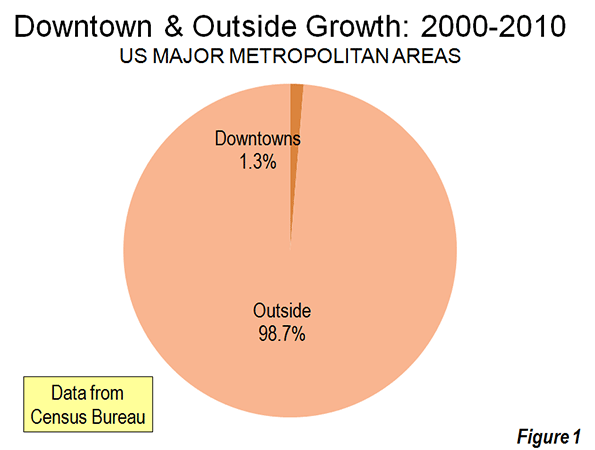
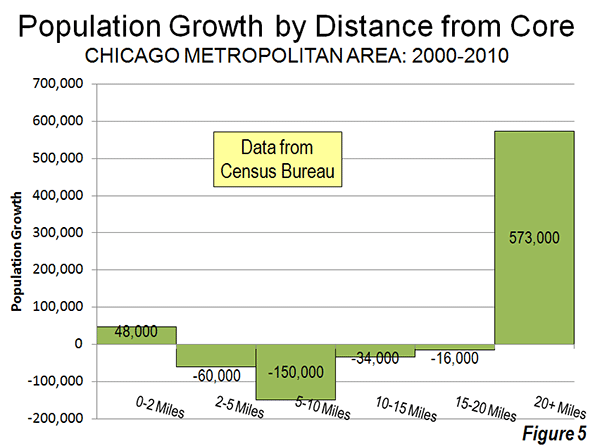
    However, to characterize the trend since 2000 as reflective of any "flocking" to the cities is to exaggerate the trend of downtown improvement beyond recognition. Among the 51 major metropolitan areas (those with more than 1 million population), nearly 99 percent of all population growth between 2000 and 2010 was outside the downtown areas (Figure 1).

    There was population growth in 33 downtown areas out of the 51 major metropolitan areas. As is typical for core urban measures, nearly 80 percent of this population growth was concentrated in the six most vibrant downtown areas, New York, Chicago, Philadelphia, Washington, Boston and San Francisco.

    If the next six fastest-growing downtown areas are added to the list (Dallas-Fort Worth, Houston, Los Angeles, Portland, San Diego and Seattle), downtown growth exceeds the national total of 205,000 people, because the other 39 downtown areas had a net population loss. Overall, the average downtown area in the major metropolitan areas grew by 4000 people between 2000 and 2010. That may be a lot of people for a college lacrosse game, but not for a city. While in some cases these increases were substantial in percentage terms, the population base was generally small, which was the result of huge population losses in previous decades as well as the conversion of old disused office buildings, warehouses and factories into residential units.

    Trends in the Larger Urban Cores: The downtown population gains, however, were not sufficient to stem the continuing decline in urban core populations. Among the 51 major metropolitan areas, the aggregate data indicates a loss of population within six miles of city hall. In essence, the oasis of modest downtown growth was more than negated by losses surrounding the downtown areas. Virtually all the population growth in the major metropolitan areas lay outside the six mile radius core, as areas within the historical urban core, including downtown, lost 0.4 percent.

    Even when the radius is expanded to 10 miles, the overwhelming majority of growth remains outside. Approximately 94 percent of the aggregate population growth of the major metropolitan areas occurred more than 10 miles from downtown (Figure 2). Figure 3 shows that more than one-half of the growth occurred 20 miles and further from city hall. Further, the population growth beyond 10 miles (10-15 mile radius, 15-20 miles radius and 20 mile and greater radius) from the core exceeded the (2000) share of population, showing the continuing dispersal of American metropolitan areas (Figure 4).

    Chicago: The Champion? The Census Bureau press release highlights the fact that downtown Chicago experienced the largest gain in the nation. Downtown Chicago accounted for 13 percent of the metropolitan area’s growth with an impressive 48,000 new residents. However, while downtown Chicago was prospering, people were flocking away from the rest of the city. Within a five mile radius of the Loop, there was a net population loss of 12,000 and a net loss of more than 200,000 within 20 miles (Figure 5). Only within the 36th mile radius from city hall is there a net population gain.

    Cleveland: Comeback City and Always Will Be? In view of Cleveland’s demographic decline (down from 915,000 in 1950 to 397,000 in 2010), any progress in downtown Cleveland is welcome. But despite the frequently recurring reports, downtown Cleveland’s population growth was barely 3,000. Despite this gain, the loss within a 6 mile radius was 70,000 and 125,000 within a 12 mile radius. Beyond the 12- mile radius, there was a population increase of nearly 55,000, which insufficient to avoid a metropolitan area population loss.

    Other Metropolitan Areas: A total of 30 major metropolitan areas suffered core population losses, despite the fact that many had downtown population increases.

    • Five major metropolitan areas suffered overall population losses (Buffalo, Cleveland, Detroit, Pittsburgh and Katrina ravaged New Orleans).
    • St. Louis, with a core city that holds the modern international record for population loss (from 857,000 in 1950 to 319,000 in 2010), experienced a population decline within a 27 mile radius of city hall. Approximately 150 percent of the growth in the St. Louis metropolitan area was outside the 27 mile radius. Even so, there was an increase of nearly 6,000 in the population of downtown St. Louis.
    • There were population losses all the way out to a considerable distance from city halls in Memphis (16 mile radius), Cincinnati (15 mile radius) and Birmingham (14 mile radius). The three corresponding downtown areas also lost population.
    • Despite having one of the strongest downtown population increases (12,000), population declined within a 10 mile radius of the Dallas city hall. This contrasts with nearby Houston, which also experienced a strong downtown increase (10,000) but no losses at any radius of the urban core.
    • Milwaukee experienced a small downtown population increase (2,000), but had a population loss within an11 mile radius.

    The other 21 major metropolitan areas experienced population gains throughout. Even so, most of the growth (77 percent) was outside the 10 mile radius. San Jose had the most concentrated growth, with only 24 percent outside a 10 miles radius from city hall. All of the other metropolitan areas had 60 percent or more of their growth outside a 10 mile radius from city hall.

    As we have observed before, 2000 to 2010 was, unlike the 1970s and other decades, more friendly to the nation’s core cities, although less so than the previous decade. Due to the repurposing of old offices and other structures, sometimes aided by subsidies, small downtown slivers may have done better than at any time since before World War II. But the data is clear. Suburban growth was stronger in the 2000s than in the 1990s. The one percent flocked to downtown and the 99 percent flocked to outside downtown.

    Population Loss Radius: Major Metropolitan Areas
    Miles from City Hall of Historical Core Municipality*
    Major Metropolitan Areas (Over 1,000,000 Population Share of Metropolitan Growth Population Loss Radius (Miles)
    "Outside Downtown" (2- Mile Radius) Outside 5-Mile Radius Outside 10-Mile Radius
    MAJOR METROPOLITAN AREAS: TOTAL 98.7% 100.4% 93.5% 6
    Atlanta, GA 99.6% 101.1% 99.9% 9
    Austin, TX 98.1% 96.7% 81.9% 0
    Baltimore, MD 106.5% 118.7% 99.5% 9
    Birmingham, AL 104.2% 132.5% 124.9% 14
    Boston, MA-NH 90.8% 76.9% 67.3% 0
    Buffalo, NY Entire Metropolitan Area Loss
    Charlotte, NC-SC 99.1% 97.4% 75.0% 3
    Chicago, IL-IN-WI 86.7% 103.3% 144.6% 35
    Cincinnati, OH-KY-IN 105.1% 126.8% 135.2% 15
    Cleveland, OH Entire Metropolitan Area Loss
    Columbus, OH 100.5% 104.3% 86.9% 7
    Dallas-Fort Worth, TX 99.0% 101.0% 100.7% 10
    Denver, CO 98.0% 100.3% 89.8% 5
    Detroit,  MI Entire Metropolitan Area Loss
    Hartford, CT 99.2% 92.7% 67.2% 0
    Houston, TX 99.2% 99.5% 98.0% 0
    Indianapolis. IN 102.1% 112.1% 89.6% 8
    Jacksonville, FL 100.2% 106.3% 85.3% 8
    Kansas City, MO-KS 99.5% 109.0% 113.3% 12
    Las Vegas, NV 101.4% 98.0% 63.6% 4
    Los Angeles, CA 97.3% 102.2% 97.6% 8
    Louisville, KY-IN 102.5% 108.5% 90.9% 8
    Memphis, TN-MS-AR 101.2% 118.5% 143.5% 16
    Miami, FL 99.4% 93.0% 91.3% 0
    Milwaukee,WI 95.9% 109.0% 107.5% 11
    Minneapolis-St. Paul, MN-WI 97.4% 99.2% 100.1% 7
    Nashville, TN 100.0% 101.4% 92.4% 7
    New Orleans. LA Entire Metropolitan Area Loss
    New York, NY-NJ-PA 93.5% 81.7% 68.9% 0
    Oklahoma City, OK 100.1% 96.8% 83.5% 2
    Orlando, FL 99.7% 99.4% 84.2% 0
    Philadelphia, PA-NJ-DE-MD 92.6% 98.8% 96.3% 7
    Phoenix, AZ 100.7% 101.8% 93.6% 6
    Pittsburgh, PA Entire Metropolitan Area Loss
    Portland, OR-WA 95.0% 91.5% 62.7% 0
    Providence, RI-MA 96.2% 91.7% 70.1% 0
    Raleigh, NC 99.6% 93.0% 67.7% 0
    Richmond, VA 95.7% 91.7% 70.2% 0
    Riverside-San Bernardino, CA 99.5% 97.2% 85.8% 0
    Rochester, NY 146.9% 149.3% 82.5% 9
    Sacramento, CA 99.9% 94.4% 79.5% 0
    Salt Lake City, UT 98.9% 95.1% 84.1% 0
    San Antonio, TX 101.1% 102.5% 86.7% 7
    San Diego, CA 96.3% 94.1% 90.1% 0
    San Francisco-Oakland, CA 90.7% 87.6% 82.2% 0
    San Jose, CA 95.1% 79.1% 24.3% 0
    Seattle, WA 96.5% 91.9% 81.4% 0
    St. Louis,, MO-IL 94.8% 119.7% 148.9% 27
    Tampa-St. Petersburg, FL 98.6% 97.8% 83.7% 0
    Virginia Beach-Norfolk, VA-NC 93.1% 90.1% 82.3% 0
    Washington, DC-VA-MD-WV 97.5% 94.5% 87.9% 0
    Calculated from Census Bureau data
    *Except in Virginia Beach-Norfolk, Where Virginia Beach is used


    ——-

    Notes:

    Population Weighted Density: In its report, the Census Bureau uses "population-weighted density," rather than average population density to compare metropolitan areas. The Census Bureau justified this use as follows:

    "Overall densities of CBSAs can be heavily affected by the size of the geographic units for which they are calculated. Metropolitan and micropolitan statistical areas are delimited using counties as their basic building blocks, and counties vary greatly across the country in terms of their geographic size. With this in mind, one way of measuring actual residential density is to examine the ratio of population to land area at the scale of the census tract, which—of all the geographic units for which decennial census data are tabulated—is typi­cally the closest in scale to urban and subur­ban neighborhoods".

    The Census Bureau rightly points out the problem with comparing metropolitan area density. However, it is a problem of the federal government’s making, by virtue of using metropolitan area building blocks (counties) that are sometimes too large for designation of genuine metropolitan areas. These difficulties have been overcome by the national census authorities in Japan in Canada, for example, where smaller building blocks are used (such as municipalities or local government authorities).

    Further, the Census Bureau already has a means for measuring population density at the census tract level, which is "the closest in scale to urban and suburban neighborhoods." This is the urban area.

    "Population-weighted density" is an interesting concept that can provide an impression of the density that is perceived by the average resident of the metropolitan area. Unfortunately, in its report, the Census Bureau is less than precise with its terminology and repeatedly fails to modify the term density with the important "population-weighted" qualification. This could lead to considerable misunderstanding.

    The Census Bureau did not provide average population densities based for the mileage radii. Because of large bodies of water (such as Lake Michigan in Chicago can reduce land areas, it was not possible to estimate population densities by radius.

    Census Bureau Revision of Incorrect Report: We notified the Census Bureau of errors in its press release and report on September 27. The problems included substitution of San Francisco population data for Salt Lake City as well as metropolitan population in the supporting spreadsheet file. On September 28, the Census Bureau issued a revised press release and report to rectify the errors. Later the erroneous spreadsheet was withdrawn and had not been re-posted as of October 1. We have made corrections to the spreadsheet for this analysis.

    Note: Larger "Downtown" Populations in Smaller Metropolitan Areas: Because of the broad 2-mile radius measure used by the Census Bureau, most of the population increase characterized as relating to downtown occurred outside the major metropolitan areas. This is simply because in smaller metropolitan areas, such an area (12.6 square miles) will necessarily contain a larger share of the metropolitan area. Further, many smaller metropolitan areas are virtually all suburban and had experienced little or no core population losses over the decades that have been so devastating to many large core municipalities. On average, 2.7 percent of the population of major metropolitan areas was within a two-mile radius of city hall in 2010. By comparison, in smaller metropolitan areas, approximately 12.7 percent of the population was within a two mile radius.

    Photograph: Chicago Suburbs: (where nearly all the growth occurred), by author