Blog

  • Ryerson University Research Cites Urban Containment Policy as Major Factor in Toronto House Price Escalation

    A Globe and Mail article on April 25 cites Ryerson University research found that Ontario’s urban containment based growth controls have "spurred soaring increases in house prices in the Toronto region by limiting construction of new low-rise family homes…" This effect was predicted by a number of analysts when the program was being formulated more than a decade ago and has been associated with huge price increases relative to incomes in such widely distributed metropolitan areas as Vancouver, San Francisco, Portland, Seattle, Sydney, Auckland, Melbourne and others.

    According to reporter Janet McFarland, the Centre for Urban Research and Land Development report identified “’a marked mismatch” between the types of units completed and the types demanded, according to the report from the Centre for Urban Research and Land Development at Ryerson University in Toronto." The report concludes that "The public discussion on the fundamental causes behind the rise in prices of ground-related housing (singles, semis and townhouses) in the GTA over the past decade by ignoring or downplaying the role played by the shortfall of serviced sites available to build new homes misses the only viable solution to dealing with deteriorating longer-term affordability – significantly increasing the number of new ground-related housing units built."

    Over the 13 years of the Demographia International Housing Affordability Survey, Toronto’s housing affordability has substantially worsened, with median prices at 3.8 times median incomes in 2004 (before the growth controls were fully implemented) to 7.7 times in 2016. This measure, the "median multiple," had changed little between 1970 and 2004, when land use regulations were more liberal in the Toronto area.

    Without liberalization of the housing market to permit supply that meets demand (not only in numbers but also in preferred type of housing), Toronto can expect its house prices to rise even more. Already, Vancouver and Sydney, for example are more than 50 percent higher (at median multiples of 11.8 and 12.2 respectively).

  • Reason #1 to End Transit Subsidies: It’s the Most Costly Transportation We Have

    Fifty-three years ago, the transit industry was mostly private and earned a net profit. Today, it’s almost entirely publicly owned, and subsidies have grown out of control. It’s time to take a stand and say all transportation subsidies are bad, but transit subsidies are the worst.

    The National Transit Database says agencies spent more than $64 billion in 2015 yet collected less than $16 billion in fares. They carried about 55 billion passenger miles, for an average cost of $1.15 per passenger mile, of which 87 cents was subsidized. No other major mode of passenger transportation is anywhere near this expensive.

    Americans spent about $1.1 trillion buying, operating, repairing, and insuring cars and light trucks in 2015, but they also drove their autos nearly 2.8 trillion miles. At average auto occupancies of 1.67 people (see table 16), that’s 4.6 trillion passenger miles by auto, for an average cost of about 24 cents per passenger mile. We don’t have 2015 data yet, but in 2014, government agencies spent about $72 billion subsidizing roads (add the $98 billion in “other taxes and fees” to the minus $10 billion in “less amount for nonhighway purposes” and the minus $16 billion for “less amount for mass transportation”).

    This is more than was spent subsidizing transit, but those roads not only produced 70 times as much passenger travel, they were used to ship more than a quarter of the freight moved in this country. Ignoring the freight, the subsidy was about 1.6 cents per passenger mile, meaning the total cost of transit was more than four times the cost of driving.

    Airfares are about 14 cents a passenger mile, making air travel a bargain. Airline subsidies are only a couple of cents a passenger mile (subtract government expenditures from government revenues and divide by passenger miles). Amtrak subsidies are comparatively horrendous at 22 cents a passenger mile but are still only a quarter of transit subsidies.

    Transit is expensive because it is subsidized. Lacking any need to keep costs within revenues, transit agencies spend way too much money accomplishing far too little. It is time to stop all transportation subsidies, but as the most-heavily subsidized form of transportation, transit should be the priority.

    This piece first appeared on The Antiplanner.

    Randal O’Toole is a senior fellow with the Cato Institute specializing in land use and transportation policy. He has written several books demonstrating the futility of government planning. Prior to working for Cato, he taught environmental economics at Yale, UC Berkeley, and Utah State University.

    Photo: Robert Dyess, CC License

  • The Politics of Migration: From Blue to Red

    Democratic “blue” state attitudes may dominate the national media, but they can’t yet tell people where to live. Despite all the hype about a massive “back to the city” movement and the supposed superiority of ultra-expensive liberal regions, people are increasingly moving to red states and regions, as well as to suburbs and exurbs.

    This is the basic takeaway from the most recent IRS data and Census Bureau estimates, which have been widely ignored in the established media. Essentially, Americans are rejecting what Walter Russell Mead has labelled “the blue model,” and relocating to cities, states and regions that are less dense, less heavily taxed, and less regulated.

    This suggests not an intrinsic political calculation so much as a series of very personal decisions by individuals and families. People move for varied reasons — cheaper homes, lower  taxes, employment opportunities, better schools, more value to the paycheck — but the upshot is that they are settling in states that tend to be red or, at least, purple in political coloration.

    In 2016 alone, states that supported Donald Trump gained 400,000 domestic migrants from states that supported Hillary Clinton. This came on top of an existing advantage in net domestic red state migration of 1.45 million people from 2010 through 2015. Contrary to popular perception, these blue state emigres aren’t all fleeing economically challenged places such as upstate New York or inland California. Mostly, they have left the  biggest cities, which are the electoral base of the Democratic Party. Metropolitan New York has led the way in out-migration, followed by Los Angeles and Chicago. Since 2000, these metropolitan areas have lost a net 5.5 million domestic migrants to other parts of the country.

    Even economic boom conditions have failed to reverse this trend. Overall, many big blue core cities now have overall population growth rates well below the somewhat tepid national average of 0.7 percent. So, who’s growing? Last year, all 10 of the top gainers in domestic migration were Sunbelt metropolitan areas: Austin, Tampa-St. Petersburg, Raleigh, Jacksonville, Las Vegas, Charlotte, Orlando, Nashville, Phoenix and San Antonio.

    Perhaps most surprising, given the almost universal dismissal of their prospects, has been a shift to smaller cities, a more Trump-oriented part of the urban archipelago. Domestic migration has accelerated to cities between 500,000 and 1 million population, while declining in those above 1 million.

    The Suburban Resurgence

    More important still has been the revival in the suburbs, particularly in Sunbelt metropolitan areas. The most recent estimates suggest that last year was the best for suburban areas since the Great Recession. In 2012, the suburbs of the major metropolitan areas (over 1 million) attracted barely 150,000 more people than core counties, an edge that grew to 556,000 last year. Between 2010 and 2015, suburban counties of major metropolitan areas added 825,000 net domestic migrants, while the urban core counties lost nearly 600,000.

    Critically, since 2010 more than 80 percent of all new jobs in our 53 leading metropolitan regions have been created in suburban locations. Many of the leading tech areas of the country –from Silicon Valley and Raleigh-Durham to tech centers surrounding the big Texas cities — are primarily suburban. The economic future, contrary to the common media memes, will be primarily occurring in the periphery of the hip urban cores.

    This trend may accelerate as millennials begin to enter their 30s and look for safe, affordable places to live. We already see this in the behavior of their predecessors, the X generation. Using census data of those 35-49 as our measurement, since 2000 the percentage of Gen-Xers living in the urban core has dropped by one percentage point, while the percentage living new suburbs and exurbs has grown by six percentage points. The latest estimates indicate over 80 percent of Xers in the 53 largest metropolitan areas lived in suburban areas.

    Gen-Xer shares grew most dramatically in the affordable Sunbelt, like almost completely suburban Raleigh, which saw a 50 percent growth in the share of Xers relative to the national rate. Rapid growth also took place in Las Vegas, Charlotte, Phoenix, Orlando and Salt Lake City as well as the big four Texas cities: Austin, Houston, Dallas-Fort Worth, and San Antonio.

    In contrast the Gen-X population share has remained stagnant in the San Francisco and San Jose areas, while the Los Angeles, New York, Boston, Chicago and Philadelphia areas have all seen declines in their Xer shares both since 2000 and since 2010.  This could be a harbinger of millennial behavior. Like the Xers, millennials are beginning to move into the suburbs, contradicting all predictions to the contrary. Since 2010, the biggest gains in millennial share have been in heavily suburban Orlando, Austin and San Antonio.

    Generally speaking, notes economist Jed Kolko, the peak years for living in higher density multi-family neighborhoods take place between ages 18 and 30. Kolko calculates that while almost a quarter of these under-30 urban dwellers live in these higher density neighborhoods, by age 40 this drops well below 20 percent, and stays there until people are into their 70s. Given that the 30-something population is destined to grow far faster than 20-somethings in the coming decades, the move to suburbia, with its detached housing — particularly in regions with lower home prices — is expected to continue for the foreseeable future.  

    This shift is likely to be driven in large part by unsustainable housing costs. In the San Francisco Bay Area, techies are increasingly looking for jobs outside the region, and some companies are offering cash bonuses for those willing to leave. A recent poll indicated that 46 percent of millennials want to leave the Bay Area. Meanwhile, these “best and brightest” have been gravitating to lower cost areas such as Austin, Orlando, Houston, Nashville, and Charlotte.

    The basics that drive people to the suburbs remain: cheaper real estate, a preponderance of single family housing, better schools, a poverty rate  roughly half  that of core municipalities as well as far lower incidence of violent crime  than in urban cores. This trend will be accelerated, as a recent policy analysis released by the consulting firm Bain shows, by services such as Uber or Lyft, the appeal of working at home as well as the development of automated vehicles.

    Political Implications

    Ultimately, the key political battlegrounds for the future will not be in blue cities but in purple suburbs, particularly in the booming periphery of major cities in red states. No matter how loud and pervasive the voices emanating from the urban core, or for that matter, ungentrified countryside, Trump won the election by taking by a significant five percentage point suburban margin nationally, improving on Romney’s two-point edge, and by more outside the coastal regions.

    This contradicts the confident assertions by the New York Times and other establishment voices that Trump would get his clock cleaned in suburbia, particularly among college-educated voters in upscale communities. Suburban voters made the difference in the crucial Midwestern states of Michigan, Wisconsin and Pennsylvania, and Trump came close to winning in supposedly deep blue Minnesota.

    In Michigan, Trump lost Wayne County (including Detroit) by more than 2-1, but captured four of the five surrounding suburban counties by margins that greatly exceeded that of Michigan native Romney. The pattern was similar in Pennsylvania where Clinton won in the Philadelphia metropolitan area – and Pittsburgh’s urban Allegheny County, while Trump was flipping the state with majorities in nearly every other county. Much the same can be said about Wisconsin and Ohio, states critical as well to the Trump win and the GOP future.

    This pattern is not set in stone. Trump, as the New York Times recently enthused, does suffer from continuing problems with educated suburban voters. Perhaps even more threatening to the GOP is that minorities now account for more than 40 percent of all suburban and exurban residents, growing far faster in the periphery than non-Hispanic whites. Trump lost traditionally right-leaning but rapidly diversifying places such as Orange County, Calif., and Fort Bend County outside of Houston.

    Yet, winning over suburbia in the long run may not be easy for the Democrats. As millennials and Xers, as well as minorities, begin to own property and earn more money, their attitudes on taxes tend to shift to a more conservative perspective, notes a recent Reason poll. Similarly many first-generation Asian immigrants tend to be far more conservative than second- or third-generation Chinese- or Korean-Americans, many of whom have been through college indoctrination and are comfortably ensconced in the generally Democratic-leaning high-end professional class.

    Perhaps the biggest problem for the left lies in their embrace of policies that reject suburban lifestyles and, as we see in California, make housing hard to build and all but unaffordable. Most millennials and Xers, not to mention minorities, cannot afford to live in places like brownstone Brooklyn or San Francisco. In adopting policies to curb “sprawl,” blue state politicians are assaulting the suburban lifestyles clearly preferred by the clear majority. This leftist urban policy does not constitute an ideal strategy to appeal to those, including minorities, who want nothing more than to live comfortable lives on the periphery.

    Right now, the demographic trends do not clearly favor either party. The new generation now forming families — and heading towards the red states — may not be as conservative as boomers but their politics are less lock-step progressive than many believe, even on gender-related issues. They may want health-care reform, good schools, and cleaner environments. But they also want jobs, would like to hold onto more of their paychecks, and cherish the same suburban amenities they enjoyed as children.

    Ultimately, it’s a matter of which politicians can delineate the best path toward greater opportunity and homeownership for middle-class families. The political party that addresses these aspirations is likely to be the one that wins the race in the long run.

    This piece first appeared on Real Clear Politics.

    Joel Kotkin is executive editor of NewGeography.com. He is the Roger Hobbs Distinguished Fellow in Urban Studies at Chapman University and executive director of the Houston-based Center for Opportunity Urbanism. His newest book, The Human City: Urbanism for the rest of us, was published in April by Agate. He is also author of The New Class ConflictThe City: A Global History, and The Next Hundred Million: America in 2050. He lives in Orange County, CA.

    Wendell Cox is principal of Demographia, an international public policy and demographics firm. He is a Senior Fellow of the Center for Opportunity Urbanism (US), Senior Fellow for Housing Affordability and Municipal Policy for the Frontier Centre for Public Policy (Canada), and a member of the Board of Advisors of the Center for Demographics and Policy at Chapman University (California). He is co-author of the “Demographia International Housing Affordability Survey” and author of “Demographia World Urban Areas” and “War on the Dream: How Anti-Sprawl Policy Threatens the Quality of Life.” He was appointed to three terms on the Los Angeles County Transportation Commission, where he served with the leading city and county leadership as the only non-elected member. He served as a visiting professor at the Conservatoire National des Arts et Metiers, a national university in Paris.

    Photo: Mark Turner (Own work) [Public domain], via Wikimedia Commons
  • Leaving California? After slowing, the trend intensifies

    Given its iconic hold on the American imagination, the idea that more Americans are leaving California than coming breaches our own sense of uniqueness and promise. Yet, even as the economy has recovered, notably in the Bay Area and in pockets along the coast, the latest U.S. Census Bureau estimates show that domestic migrants continue to leave the state more rapidly than they enter it.

    First, the good news. People may be leaving California, but, overall, the rate of leaving is about three-quarters less than that experienced in the first decade of the millennium. In the core, booming San Francisco metropolitan area, there was even a shift toward net domestic migration after 2010, something rarely seen since the 1980s.

    Outmigration dropped with the initial economic slowdown of the last recession, particularly as housing prices in some areas, notably the Inland Empire and the Sacramento area, drifted toward the national norm of three times incomes by 2010, having been twice that high or more in the boom times. The initial recovery after 2010 may also have encouraged people to stay as well.

    Back to mounting outmigration

    The San Francisco Bay Area lost more than 600,000 net domestic migrants between 2000 and 2009 before experiencing a five-year respite. Now, sadly, the story seems to be changing again. Housing prices, first in the Bay Area and later in other metropolitan areas, have surged mightily, and are now as high as over nine times household incomes. In 2016, some 26,000 more people left the Bay Area than arrived. San Francisco net migration went from a high of 16,000 positive in 2013 to 12,000 negative three years later.

    Similar patterns have occurred across the state. Between 2010 and 2015, California had cut its average annual migration losses annually from 160,000 to 50,000, but that number surged last year to nearly 110,000. Losses in the Los Angeles-Orange County area have gone from 42,000 in 2011 to 88,000 this year. San Diego, where domestic migration turned positive in 2011 and 2012, is now losing around 8,000 net migrants annually.

    The major exceptions to this trend can be found in the somewhat more affordable interior regions. Sacramento has gained net migration from barely 1,800 in 2011 to 12,000 last year. Even some still-struggling areas, like Modesto and Stockton, have seen some demographic resurgence as people move farther from the high-priced Bay Area.

    Read the entire piece at The Orange County Register.

    Joel Kotkin is executive editor of NewGeography.com. He is the Roger Hobbs Distinguished Fellow in Urban Studies at Chapman University and executive director of the Houston-based Center for Opportunity Urbanism. His newest book, The Human City: Urbanism for the rest of us, was published in April by Agate. He is also author of The New Class ConflictThe City: A Global History, and The Next Hundred Million: America in 2050. He lives in Orange County, CA.

    Wendell Cox is principal of Demographia, an international public policy and demographics firm. He is a Senior Fellow of the Center for Opportunity Urbanism (US), Senior Fellow for Housing Affordability and Municipal Policy for the Frontier Centre for Public Policy (Canada), and a member of the Board of Advisors of the Center for Demographics and Policy at Chapman University (California). He is co-author of the “Demographia International Housing Affordability Survey” and author of “Demographia World Urban Areas” and “War on the Dream: How Anti-Sprawl Policy Threatens the Quality of Life.” He was appointed to three terms on the Los Angeles County Transportation Commission, where he served with the leading city and county leadership as the only non-elected member. He served as a visiting professor at the Conservatoire National des Arts et Metiers, a national university in Paris.

    Photo: Marco Varisco, CC License

  • The 37 Megacities and Largest Cities: Demographia World Urban Areas: 2017

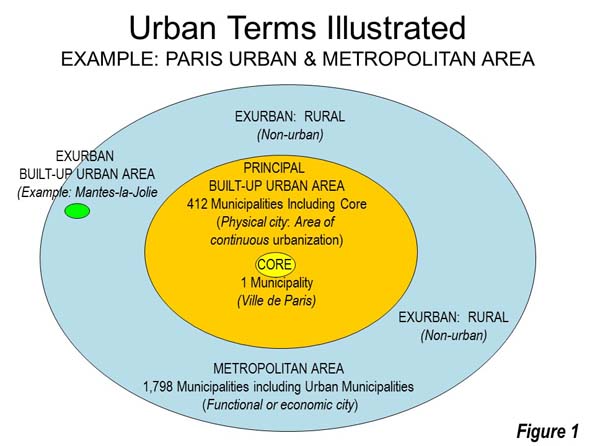
    Many of the world’s biggest cities are getting bigger still. In 2017, the number of megacities — urban areas with better than ten million people —   increased to 37 in 2017, as the Chennai urban area entered their ranks. Chennai becomes India’s fourth megacity, along with Delhi, Mumbai and Kolkota. These are among the major findings in the just released 13th annual edition of Demographia World Urban Areas, which provides population, land area and population density estimates for the 1,040 identified built-up urban areas (cities) in the world. Built-up urban areas are the physical form of the city, a definition which separates out the urban, or constructed form of the city from the rural and smaller town areas with which they form a metropolitan area or labor market (Figure 1).

    The World’s Largest Cities

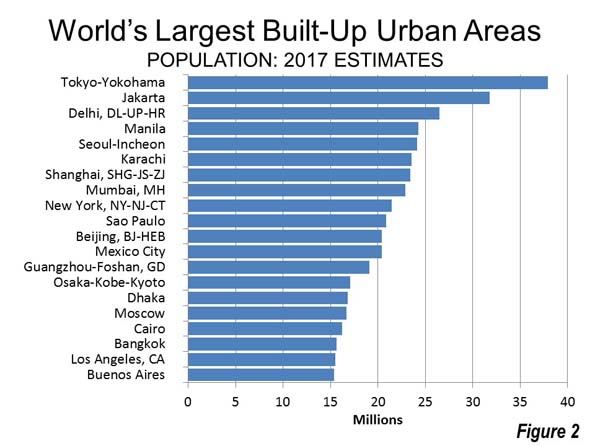
    Asia increasingly dominates the ranks of the world’s most populous cities. Tokyo-Yokohama continues to be the largest urban area in the world (Figure 2), a ranking it has held for more than six decades. It is estimated the Tokyo Yokohama house a population of 37.9 million, living in approximately 3300 square miles (8,500 square kilometers) with a population density of 11,500 per square mile (4,400 per square kilometer).

    Jakarta is the second largest urban area, with a population of 31.8 million 9,600 per square kilometer). Delhi, India’s capital held onto third position, with a population of 26.5 million. Delhi has now opened up a more than 3.5 million lead on 8th ranked Mumbai, which had been India’s largest urban area before and which some experts had considered likely to become the world’s largest city. This prediction, like a similar ones made with respect to Mexico City in the 1980s has not come to fruition and it seems unlikely that either urban area will ever be, the world’s largest.

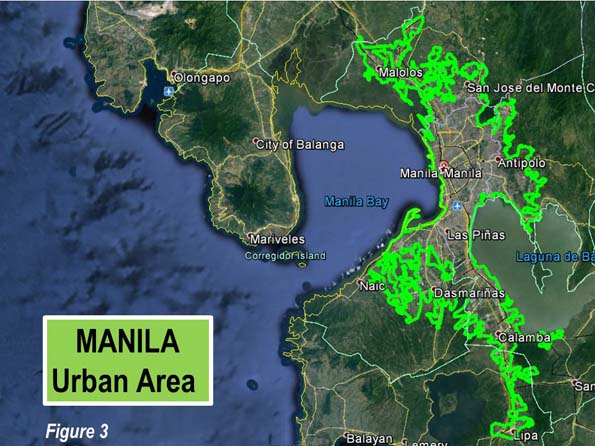
    Manila moved up from fifth position to fourth position, passing Seoul-Incheon (Figure 3). Manila’s population is estimated at 24.3 million, in an area of 690 square miles (1,790 square kilometers) in a population density of 35,100 per square mile (13,600 per square kilometer), the highest density among the top five built-up urban areas.

    Seoul-Incheon remains the only high income city, besides Tokyo,  in the top five. Seoul-Incheon is estimated to have a population of 24.1 million and an urban population density of 22,700 per square mile (8800 per square kilometer).

    The second five includes Karachi, Shanghai, Mumbai, New York and Sao Paulo, with only New York in the high income world. Thus, seven  of the largest 10 cities in the world are now outside the high income world. New York was the largest city in the world from the 1920s until the mid-1950s. London, which was the largest city in the world from the early 19th century to the 1920s is now ranked 34th, while Beijing, which preceded London as largest ranks 11th. Among the next ten largest urban areas, only two — Osaka-Kobe-Kyoto, at 14th and Los Angeles, at 19th are in the high-income world.  Formerly rapidly growing Los Angeles seems likely to drop out of the top 20 before long.

    Dhaka’s High Density

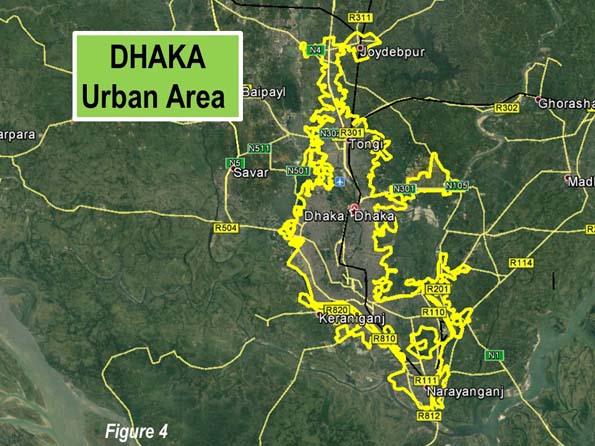
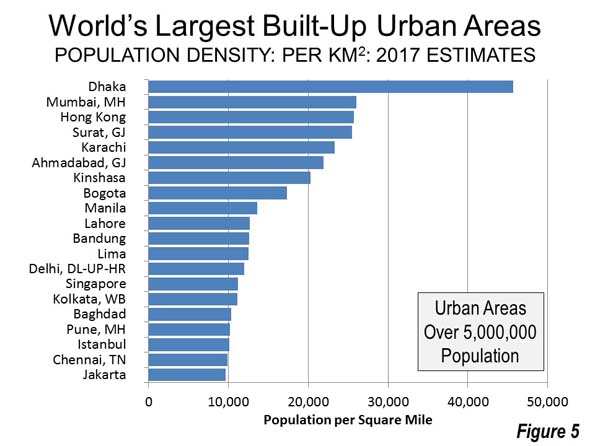
    Dhaka (Figure 4) remains far and away the highest density built-up urban area in the world (Figure 5), Dhaka has an urban density of 118,500 per square mile (45,700 per square kilometer). No other urban area exceeds 70,000 per square mile (27,000 per square kilometer). Yet, Dhaka is not dense enough for some critics, who perceive it to sprawl too much. Notably, Dhaka is about 50 percent denser than Mumbai or Hong Kong (the high income world’s densest city) and more than 30 times as dense as international densification model Portland, Oregon. Portland ranks 963rd in population density out of the 1040 built-up urban areas.

    A Half Urban World?

    In recent years, the population of the world has become majority urban for the first time. Yet, most people do not live in the largest urban areas. For example, only 15 percent of the urban population resides  in the 37 megacities. The middle of the urban population distribution is at a population of approximately 680,000. People who live in urban areas such as Shizuoka (Japan), Mangalore (India), not to be confused with Bangalore, Qitaihe (China) and Allentown (United States) are the average. The population of the urban areas that are larger have half of the urban population, while the smaller includes the other half.

    Distribution of the Population

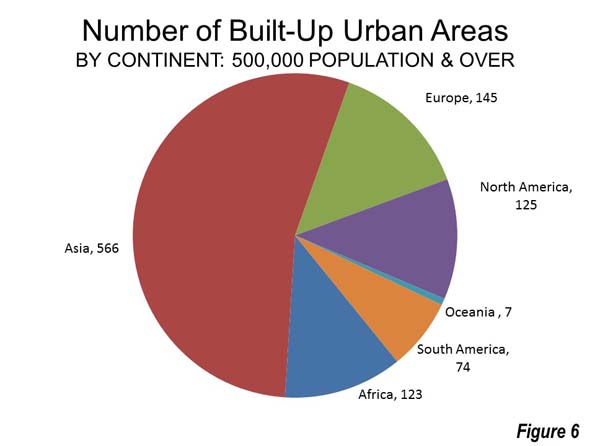
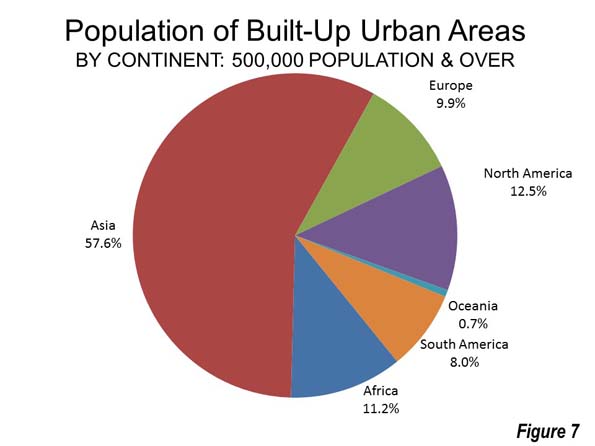
    World urbanization is dominated by Asia, which has a majority (54 percent) of the built-up urban areas with at least 500,000 population. Asia’s dominance is even greater in population, with 58 percent of the residents in urban areas of 500,000 or more. North America has the second largest share of urban area population, at 12.5 percent, followed by Africa (11.2 percent) and Europe (9.9 percent). By contrast, Europe has the second largest number of urban areas of 500,000 population or more, reflecting the generally smaller population of its cities (Figures 6 and 7).

    Concentration of Future Growth in Asia and Africa

    The latest data underscores the substantial changes that have occurred in urbanization in recent decades. In 1950, 11 of the 20 largest cities were in the high income world, according to the United Nations. On average these cities had 5 million population. Today, only five of the 20 largest cities are in the high income world and their average population is 21.5 million.

    In the decades to come, Asia  seems likely to continue its dominance, while Africa will capture an increasing share of urban population growth. By 2050, the United Nations projects that approximately 1.2 billion residents will be added to Asian urban areas, while nearly 900 million will be added to the urban areas of Africa. This would leave only about 125 million, or five percent of total urban growth for the rest of the world. Of course, projections can be wrong, but the strength of current trends make these forecasts all the more credible.

    Note: Demographia World Urban Areas uses base population figures, derived from official census and estimates data, to develop basic year population estimates within the confines of built-up urban areas. These figures are then adjusted to account for population change forecasts, principally from the United Nations or national statistics bureaus for a 2016 estimate.

    Built-up urban areas are continuously built-up development that excludes rural lands. Built-Up urban areas are the city in its physical form, as opposed to metropolitan areas, which are the city in its economic or functional form. Metropolitan areas include rural areas and secondary built-up urban areas that are outside the primary built-up urban area. These concepts are illustrated in Figure 1 (above), which uses the Paris built-up urban area (unité urbaine) and metropolitan area ("aire urbaine") as an example.

    Wendell Cox is principal of Demographia, an international public policy and demographics firm. He is a Senior Fellow of the Center for Opportunity Urbanism (US), Senior Fellow for Housing Affordability and Municipal Policy for the Frontier Centre for Public Policy (Canada), and a member of the Board of Advisors of the Center for Demographics and Policy at Chapman University (California). He is co-author of the “Demographia International Housing Affordability Survey” and author of “Demographia World Urban Areas” and “War on the Dream: How Anti-Sprawl Policy Threatens the Quality of Life.” He was appointed to three terms on the Los Angeles County Transportation Commission, where he served with the leading city and county leadership as the only non-elected member. He served as a visiting professor at the Conservatoire National des Arts et Metiers, a national university in Paris.

    Photo: Cover of Demographia World Urban Areas: 13th Annual Edition.

  • Former Hawaii Democratic Governor Urges Trump to Stop Funds for Honolulu Rail

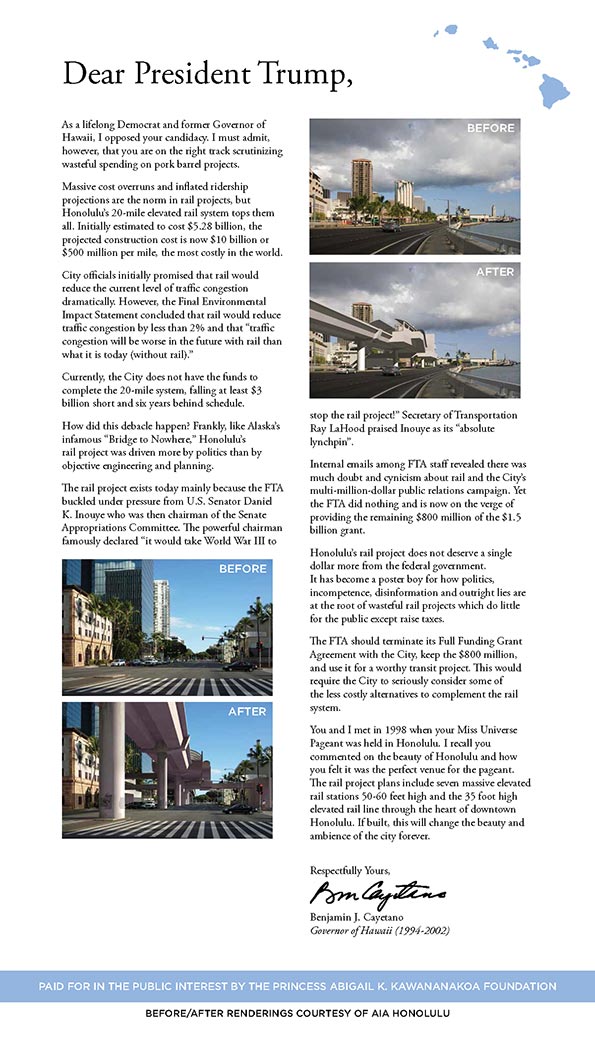
    A full page ad in today’s Washington Post (April 21, 2017) featured former Democratic Governor Benjamin J. Cayetano asking President Trump to stop further funding for the Honolulu rail project. The project has ballooned in cost from $5 billion to $10 billion, with most of the funding coming from local sources. There are serious concerns about the ability of Honolulu or Hawaii to afford completion of the project. Cayetano says that the line will be the most costly in the world. A proof of the ad is below and a pdf is available here.

    Several Newgeography.com articles have followed this issue:
    http://www.newgeography.com/content/005156-live-honolulu-hart-rail-a-megaproject-failure-making
    http://www.newgeography.com/content/002316-honolulu-mega-rail-project-a-micro-city
    http://www.newgeography.com/content/005410-honolulu-rail-from-46-b-86-b-eight-years-now-what
    http://www.newgeography.com/content/005257-honolulu-rail-it-just-keeps-getting-worse
    http://www.newgeography.com/content/002719-honolulu%E2%80%99s-money-train
    http://www.newgeography.com/content/001912-honolulu-rail-costs-balloon-ridership-projections-called-high

  • California’s Tribal Politics

    To my fellow residents, and particularly fellow taxpayers of California, I have a special message: Your concerns don’t matter much anymore. Rather than a functioning democracy, California has become a one-party state dominated by a series of tribes whose special priorities are sacrosanct, however much they might hurt the rest of us.

    In Gov. Jerry Brown’s California, the ruling tribes include the unions, the greens, the racial warlords and urban land speculators. All of these have flourished under Brown’s rule, and, as he and his occasional bouts with reality leave the scene, the tribes will only be further emboldened.

    The steady erosion of the Republican Party has eliminated the need for Democrats to even feign moderation. Over time, moderate Democrats get purged, even in the interior of the state, as gentry liberals like Tom Steyer work to assure that the San Francisco agenda is imposed on Fresno.

    Unions uber alles

    Even by the standards of California politics, the California Teachers Association wields enormous power, and uses its massive political war chest to prevent serious reform of our low-functioning education system, which just received an impressive C-minus from a recent Education Week survey. Our system may have failed many of our young people, particularly in minority districts, but the union has done well by its members, guaranteeing them the maximum time off, virtual protection from being fired, and, of course, lavish pensions.

    Now the teachers, aided by their “Mini-Me” legislators, have their eyes on a virtual exemption from paying income taxes. One rationale is to make up for high housing prices, although many of the “veteran educators” targeted by this legislation bought their homes long before the recent inflation of real estate prices. And, if teachers are special, why not firemen, policemen, sanitation workers or, for that matter, people who work in restaurants and hotels?

    It seems odd that people who earn higher salaries — and have far better pensions — than the ordinary Californian, would be privileged in a move likely to worsen the state’s declining finances. Yet, the teachers are not alone in this ravenous feeding at the trough. Now we have legislation proposed in the form of Assembly Bill 199 that would force builders, even on small projects on private property, to hire only workers paid based on union wage levels, increasing labor costs for housing by an additional 30 percent, or something like $90,000 for a 2,000-square-foot home.

    Read the entire piece at The Orange County Register.

    Joel Kotkin is executive editor of NewGeography.com. He is the Roger Hobbs Distinguished Fellow in Urban Studies at Chapman University and executive director of the Houston-based Center for Opportunity Urbanism. His newest book, The Human City: Urbanism for the rest of us, was published in April by Agate. He is also author of The New Class ConflictThe City: A Global History, and The Next Hundred Million: America in 2050. He lives in Orange County, CA.

    Photo: U.S. Army Corps of Engineers, CC License.

  • Deindustrialisation in Sydney

    According to property analysts CoreLogic, the Sydney median vacant land selling price has hit $450,000, a massive 20.5 per cent higher than the same time last year. This follows the New South Wales Valuer-General’s January announcement that in the 12 months to July 2016, land values across the city’s north-western and south-western corridors rose by around 25 per cent. Yet a general reluctance to identify out-of-control land values as the prime cause of our housing crisis is matched by a strange indifference to their distorting effects on Sydney’s economic structure. One exception is Michael Cook of Investa Property Group, who recently captured the essential problem. “South Sydney, once the domain of the industrial juggernaut Goodman, is now dotted with high-density Meriton apartments,” he writes. “Where once ‘office’ or ‘industrial’ was the highest and best use, residential is now commanding the big bucks.”

    Cook’s observations are consistent with this account of classic “deindustrialisation” from land economist Alan Evans of Reading University, applicable in many respects to conditions in Sydney:

    It has already been argued that the high price of land will have led to the substitution of other factors for land where this is possible. Where substitution is more difficult, industries will face higher costs, and competition from countries where land or other prices are lower will force them to contract. The net result will have been a shift of production and employment away from some activities which use a lot of space, primarily in manufacturing industry, and towards activities which use relatively little space, primarily services. In this way the planning system will have contributed to the so-called de-industrialisation of Britain over the last 30 years or so.

    While most of our civic and opinion leaders contemplate a “truly global city” for the world’s best and brightest, processes of contraction and dislocation are reshaping Sydney’s industrial base. “The broad trends being observed within Metropolitan Sydney, amplified over the past two years”, said Sass J-Baleh of Colliers International in March, “has been the shift in preference for industrial users, particularly those large users within the manufacturing and logistics industry sectors, to locate further west of Sydney, and the urban renewal of industrial-zoned land in pockets of inner and middle ring areas.” By ‘urban renewal’ she means the conversion of industrial land for residential and ‘mixed use’ purposes, and ‘pockets of inner areas’ means, mostly, the old industrial transportation axis of South Sydney, stretching from Sydney Harbour down to Central Station, Alexandra Canal, Kingsford-Smith Airport and Port Botany.

    In a 2015 report to the NSW Department of Planning, consultancy Urbis note that “industrial land users traditionally located around Sydney’s East and South subregions (ie Botany, Mascot, Banksmeadow etc) have progressively moved west as the city’s population and urban footprint expanded and competition from alternative land uses increases.” Urbis found that in the east and south industrial development has been “priced out … because of their diminishing industrial base (a function of increased inner-city residential densities and planning pressures).” South Sydney industrial land values for larger sites reached $700 per square metre in 2012, say Urbis, while south west and outer south west values were as low as $300 and $250. In the case of industrial development that differential has a large impact, since it’s “delivered at lower margins than development for other land uses.” In other words “land value has a greater role in determining the overall feasibility of development.”

    Colliers report that South Sydney land and capital values achieved a record growth rate of 19.4 per cent over 2016.

    Across metropolitan Sydney, 35 hectares of industrial land was rezoned for other uses in 2013, of which 18.3 hectares was rezoned for medium-density housing. Unsurprisingly a high 79 per cent occurred in Botany Bay LGA (Local Government Area), the lower sector of the old South Sydney hub closest to the port, encompassing Mascot, Botany and Banksmeadow (renamed Bayside LGA in September 2016). While local industrial land values reached $850 per square metre in 2014, the equivalent figure for residential values in Mascot was $1,385. Hence the observation by Colliers’ Edward Princi in 2015, that “residential approvals and rezoning have reduced the traditional industrial base of the city’s south by about 2 million square metres.” CBRE Research estimate that South Sydney will lose 210,000 square metres of industrial stock over the next 5 years. In contrast, the residential populations of Botany Bay LGA and City of Sydney LGA were forecast to grow by 23 and 30 per cent respectively.

    From the gentrified, inner-city band around the CBD, City of Sydney LGA extends down to the industrial zone’s northern Alexandria-Waterloo-Zetland sector. Here residential land values are more than triple those of Botany Bay, as much as $4,751 per square metre in the old factory suburb of Waterloo, just 4 kilometres south of the CBD. “Greater high density development and ongoing gentrification are underpinning the evolution of South Sydney from a blue collar, industrial working class area to an upmarket, mixed-use precinct with a rapidly growing local population”, say agents Jones Lang Lasalle. In June 2015, City of Sydney Council rezoned what are officially called the Southern Employment Lands (“employment lands” are roughly equivalent to industrial lands in NSW planning jargon) to allow for a range of other business activities and housing (parts like Green Square were already the subject of special arrangements). This may just be a case of responding to pressure from landowners, but Lord Mayor Clover Moore’s “green, global and connected” administration would have needed little encouragement.

    By the 1940s, Alexandria/Waterloo was the “largest industrial municipality in Australia”, 415 hectares crowded with 550 smokestack factories churning out products as diverse as soap, tallow, fertilisers, springs, brushes, aircraft, storage batteries, furniture, sporting goods, glass, matches, industrial gases, paper containers, paints and varnishes. “The Birmingham of Australia”, was its nickname. Today Alexandria, Waterloo and Zetland converge on a very different landscape. “One of the largest urban renewal projects undertaken in Australia”, Green Square is a complex of towers providing 20,000 new apartments around a Town Centre with two public plazas, at least one park, an ‘urban stream’, an aquatic centre, a library, and an underground railway station. With an estimated 2030 population of 61,000 packed into 2.78 square kilometres, it will be the country’s most densely populated urban area. The economic principle, elaborated by Evans and others, that “capital is substituted for land in the production of space as land becomes more expensive”, is thus borne out.

    Other parts of industrial South Sydney are being similarly transformed. In 2015 alone, no less than 1,701 apartments were planned or being built amidst the derelict factories and workingmen’s bungalows of neighbouring Rosebery.

    While South Sydney was the heartland of the old industrial zone, it also branched off along the south shore of the harbour west of the CBD, where waterfront sites attracted bulk commodity processing industries reliant on seaborne transportation. Among them the woolstores at Darling Harbour, timber sawing at Rozelle Bay, coal-fired power generation at White Bay, sugar refining at Pyrmont, then further west as Sydney Harbour becomes the Parramatta River, livestock slaughter at Homebush Bay, iron ore smelting at Rhodes, coal-fired gasworks at Mortlake, and oil refining at Camellia. Over the decades, these industrial hubs were uprooted by rising land values and rents, and factors like the availability of motorised transportation. For instance, Urbis point out that between 1993 and 2012 (before the most recent explosion in prices) standard residential land values within a 15 kilometre radius of Sydney CBD rose at double the rate of small industrial land values, by 8.38 per cent and 4.44 per cent respectively.

    Mostly, the old waterfront sites were rezoned for residential, commercial or recreational purposes, but not other industrial uses. Darling Harbour is now a convention, exhibition and entertainment precinct. Rozelle Bay and White Bay, along with Johnston Bay and Blackwattle Bay, are part of The Bays Precinct, an urban renewal plan for mixed use and 16,000 new dwellings on 95 hectares of derelict waterfront land. The small peninsula of Pyrmont is currently Australia’s most densely populated suburb following the completion of Jacksons Landing, a planned community featuring five massive high-rise apartment blocks. Redeveloped as the site of the Sydney Olympics, Homebush Bay is the subject of a 2030 Master Plan for several 45-storey residential towers housing 21,000 more people in 10,700 new apartments. At Rhodes, a project allowing up to five 25-storey buildings will take the expected population to 11,000, “making it one of the most densely populated areas of Sydney outside the CBD.” And Camellia has its own government Land Use and Infrastructure Strategy, proposing “a town centre … public plazas, high-rise apartments and parks.”

    Dislocating land values are having an impact beyond the traditional zones, however. Now they are rippling out to the secondary or middle ring of industrial sites in Sydney’s central west region. From the 1960s and 1970s, places like Blacktown, Holroyd, Rydalmere, Rosehill, Silverwater, Chullora, Villawood, Milperra, Smithfield, Moorebank and Wetherill Park emerged as industrial centres in conjunction with the shift of working class population to the western suburbs and highway upgrades. Urbis identify Smithfield, Wetherill Park and Chullora, along with South Sydney, as locations from which industrial operators are relocating to the outer west and south west.

    Ray White Commercial’s head of research Vanessa Rader explains that “the market extending from Enfield to Moorebank, taking into account regions such as Milperra, Villawood and Chullora in recent years, has been contracting due to competition from other uses such as retail and residential, resulting in increases in land value …” She describes the region as “home to manufacturing, fabrication and wholesale type uses.” Similar analysis came from CBRE’s Raj Chaudhary, who said “the withdrawal of about 100,000 square metres from the central west industrial market, due to rezoning and conversion to residential, is reducing supply in an already tight market …” Last year’s sale of 3 warehouse units in Holroyd for a price equivalent to more than $3,000 per square metre was “the highest industrial per square metre building rate ever achieved in the area.”

    These processes of contraction, dislocation and relocation have transformed Sydney’s industrial geography. According to the NSW Department of Planning’s last Employment Lands Development Program (ELDP) report, 79 per cent of Greater Sydney’s total zoned employment lands, and 93 per cent of the 22 per cent zoned but not yet developed, are now in the central west, south west and outer west subregions. This is up from 60 per cent of all employment lands in 1991, say Urbis. The question is whether planning authorities are supplying enough zoned land serviced with water, sewerage, electricity and road connections on the western periphery to meet demand from new operators and those driven out of other locations, and to relieve pressure on land values generally. While this will receive more detailed treatment on another occasion, the evidence suggests they are failing. “Under the average take-up rate of 163 hectares per annum there is only 2.8 years of supply”, says the ELDP report, “this does not meet the supply standard for undeveloped and serviced land (5-7 years supply).” Malcolm Tyson of Colliers warns that Sydney could run out of industrial land in just 6 years. Dreaming of “global city” amenities like dense housing, commuter rail, walkability and bike paths, our planning elites may be occupied elsewhere. But this is a crisis in the making.

    John Muscat is a co-editor, along with Jeremy Gilling, of The New City, a web journal of urban and political affairs.

    Photo: Derelict White Bay Power Station, Rozelle, Sydney, 2014

  • Should Transit Fares Cover Operating Costs?

    Maryland has long had a state law requiring transit systems to collect enough fares to cover at least 35 percent of their operating costs. While it is admirable to set a target, this particular target is disheartening for two reasons.

    First, 35 percent is a pretty low goal. The 2015 National Transit Database lists 48 transit operations that cover between 100 and 200 percent of their costs, including New York ferries, the Hampton Jitney, several other bus lines, and a bunch of van pooling systems. No rail lines cover 100 percent of their operating costs, but BART covers 80 percent, Caltrains covers 72 percent, New York and DC subways cover 64 percent, and New York commuter trains cover 60 percent. On average, commuter bus and commuter rail systems earn half their operating costs. So 35 percent lacks ambition.

    Even worse, most Maryland transit operations don’t come close to meeting the target. Maryland commuter trains cover 45 percent of their costs. But Baltimore’s light rail only covers 17 percent, and its heavy rail covers a pathetic 13 percent. Standard bus service also covers just 13 percent of its costs, though commuter buses come closer to the target, reaching 28 percent.

    Maryland lawmakers have figured out a solution to the second problem, if not the first. They simply passed a bill abolishing the target. Now, transit advocates hope, the state can spend even more money building obsolete transit systems that won’t be able to afford to maintain because they can’t even cover a third of their operating costs.

    Transit is “not profitable,” said one advocate, “but it’s essential for an economically competitive region.” Just how economically competitive has Baltimore been since it sunk billions of dollars into light- and heavy-rail lines that don’t cover even a fifth of their operating costs? Maryland certainly won’t make itself more economically competitive by increasing the tax burden still further so they can build more obsolete transit lines.

    Failing to cover costs isn’t a symptom that you are economically competitive. It is a symptom that you’ve failed to provide things that people need and want. The Antiplanner can understand why people think we need to subsidize food stamps or other aid to low-income people. I can’t understand why people think nothing of throwing huge amounts of money towards marketable operations like transit.

    C. Northcote Parkinson, the author of Parkinson’s Law, said that organizations that set goals low so they would be easy to meet were suffering from a disease he called injelititis. The transit industry has been suffering from this disease since the mid-1960s, when it discovered it could live off the public trough rather than actually have to provide services that people want. Once this disease reached its late stages, he said, the only cure required “a change of name, a change of site, and an entirely different staff.”

    There’s still a chance that Maryland’s governor may veto the bill. Let’s hope he does.

    Randal O’Toole is a senior fellow with the Cato Institute specializing in land use and transportation policy. He has written several books demonstrating the futility of government planning. Prior to working for Cato, he taught environmental economics at Yale, UC Berkeley, and Utah State University.

    Photo: By AndrewHorne (Own work) [Public domain], via Wikimedia Commons
  • Universal Basic Income: A “Social Vaccine” for Technological Displacement?

    John Kenneth Galbraith once said that the beginnings of wisdom were to never trust an economist. Those of us that spent most of our adult lives in deindustrialized communities understood his point.

    As the mills and factories closed in working-class communities like Youngstown, an array of business and academic economists suggested that economic devastation was part of the natural economic order known as “creative destruction.” Disinvestment, technological displacement, downsizing, and outsourcing were all necessary for corporate efficiency and dynamism, regardless of the “temporary” harm to individuals and communities. Capital, they explained, was simply being shifted from old to new investments, and new jobs would magically appear. Of course, workers would have to move or gain new skills in order to claim those jobs. Unfortunately, those predictions were wildly overstated. Capital was not reinvested in productive ways or moved offshore, many workers never found comparable employment, communities deteriorated. Over time, appeals to “creative destruction” were recognized not only as erroneous, but as a cover for capital getaway.

    We should remember this story as we enter a fourth industrial revolution that will merge technologies and blur the lines between digital and biological spheres. In the process, these digital transformations will spread unemployment and increase precarity. As in the past, the digital revolution has been sold as part of modernity and progress, but increasingly technological change is proving more destructive than positive. The New York Times reports that some top researchers have already acknowledged that automation and robotics in manufacturing have resulted in a large net of loss of employment, declining wages, and disruption of working-class communities. The Times concludes that given unemployment levels, “there is no clear path forward, — especially for blue-collar men without college degrees.”

    But it is not just working-class men in industrial jobs who are suffering. Automation also affects jobs in other economic sectors. In fact, 38% of all US jobs are at risk due to automation, including service sector work in fields such as finance, transportation, education, and food services. Nor is technological displacement limited to the working class. Middle-class workers also stand to lose jobs and wages.

    Many corporate executives embrace this change, viewing automation solely in terms of profitability and suitability and ignoring the human costs. As Andrew F. Puzder, chief executive of CKE Restaurants and Donald Trump’s original choice for Secretary of Labor, summed up this attitude in explaining why he would prefer robots over human workers: “They’re always polite, they always upsell, they never take a vacation, they never show up late, there’s never a slip-and-fall, or an age, sex or race discrimination case.” To paraphrase, Harry Braverman, technology is not neutral. Rather, it enters the workplace as “the representative of management masquerading in the trappings of science.”

    Technology leaders understand that their work contributes to displacement and inequality. In “The Disruptors: Silicon Valley Elites’ Vision of the Future,” Greg Ferenstein reports on a survey of tech leaders. He found that most agreed with Paul Graham, the highly influential web leader, that it is the “job of tech to create inequality…You can’t prevent great variations in wealth without preventing people from getting rich, and you can’t do that without preventing them from starting startups.” This view reflects the self-interests of the industry, of course, but it also suggests deep-seated beliefs in technological determinism and the benefits of creative destruction.

    At the same time, working people have become increasingly resistant to the uncritical acceptance of workplace technology, and this contributes to the populist backlash we’re seeing in the U.S. and across Europe. The Brexit vote, the rise of right wing parties in Europe, and Trump’s election all reflects people’s doubts about older economic paradigms and technological determinism, especially in older working-class communities. Alongside racism and xenophobia, these movements also reflect the anxieties of those who are being left behind by economic development.

    Technological and political elites have good reason to worry about the potential for class rebellion, and some have started to rethink their faith in technology or, at least, to ask about how to mitigate the outcomes of technological change. For example, a group of science and technology leaders have established Singularity University (SU), which touts itself as a global community whose mission is “to educate, inspire, and empower leaders to apply exponential technologies to address humanity’s grand challenges.” It holds ‘summits” around the world, underwritten by large international firms, such as Deloitte, that bring together researchers, entrepreneurs, institutions, and governments – most of whom believe deeply in the power of robotics, nanotechnology, artificial intelligence, and powerful computing to transform work and improve lives. Yet SU’s approach is remarkable because it emphasizes the impact of technology on people’s lives. While SU takes a positivist and entrepreneurial approach, arguing that the world’s biggest problems are world’s biggest business opportunities, it clearly understands that any technological advance must take into account its impact on communities.

    Silicon Valley firms also see themselves as potential leaders in developing strategies for a future where many workers will be displaced by technology. Some envision a more direct approach: the universal basic income, which Scott Santens describes as a social “vaccine” for the 21st century. Y-Combinator, a Silicon Valley incubator firm, has begun experimenting with this idea by providing a basic fixed income to 100 families in Oakland, California. Give Directly, a Silicon Valley non-profit, is testing the idea as a way of eliminating poverty by giving each individual in a small village in Kenya $22 a month for 12 years. The New York Times describes the project “as first true test of a universal basic income. Not just given to individuals but to a whole community for an extended period.” Of course, these approaches are not considered socialism; they are defined as providing an “income floor.”

    The potential of these experiments has not been not lost on developed nations, where some see a universal basic income as strategy for ameliorating the impact of automation. The European Parliament, Korea, France, Canada, Finland, Netherlands, and Scotland are all considering a basic income as a strategy for managing a future without work. In the US, growing economic inequality, the rise of contingent work, and the defeat of the Republicans’ alternative to Obamacare had the unexpected consequence of restarting the discussions of expanding the social safety net. For example, the National Academy of Social Insurance is discussing the expansion of Social Security and Medicare and extending unemployment insurance, workers’ compensation, and unemployment and disability insurance as tools to balance the volatility of jobs and income as long-term, full-time, traditional jobs become ever more scarce due to corporate restructuring and technological change. Importantly, these initiatives are gaining public and political support, especially single payer health care.

    The economic displacement of the era of deindustrialization caused great harm to working-class people and their communities. Decades later, as technological displacement threatens not only the working class but many in the middle class as well, business and political leaders alike recognize that it is in their interest to pay attention to the consequences of economic change. Private and legislative initiatives around the universal basic income may not succeed, and some are meeting clear resistance. The European Parliament rejected a report urging them to “seriously consider” basic income as a response to “the economic consequences of automation and artificial intelligence.” Nonetheless, as political unrest grows as a result of technological change such discussions lay the foundation for the new social policies we will need for a future without good jobs.

    John Russo is a visiting fellow at Kalmanovitz Initiative for Labor and Working Poor at Georgetown University and at the Metropolitan Institute at Virginia Tech. He is the co-author with Sherry Linkon of Steeltown U.S.A.: Work and Memory in Youngstown (8th printing).

    Photo: elycefeliz, CC License