Blog

  • Chicago Tribune Joins the Ranks of High-speed Rail Critics

    Last year, in congressional testimony before the House Transportation and Infrastructure Committee hearing on high speed rail, we cited the Chicago-to-St.Louis "high-speed rail" project as an example of the Administration’s wasteful use of its economic stimulus money. We pointed out that the $1.4 billion program of track upgrades will allow top speed of 110 mph but will raise average speeds of Amtrak trains between Chicago and St. Louis by only 10 miles per hour, from 53 to 63 mph. The four-and-a-half hour trip time will be cut by a mere 48 minutes, to three hours and fourty minutes. In France, TGV trains between Paris and Lyon cover approximately the same ditance (290 miles) in a little under two hours, at an average speed of 150 mph. Yet, federal officials did not hesitate proclaiming the Chicago-St. Louis project as "historic" and hailing it as "one giant step closer to achieving high-speed rail passenger service."

    Now, a Chicago Tribune story, linked here and excerpted below, confirms just how "ridiculously expensive" and "uneconomical"  this project is turning out to be.  As the editorial points out, the project stands to "drain funding from mundane projects that could make a much bigger difference." Something that the California High Speed Rail Authority has belatedly recognized in diverting almost half of the initial $10 billion stage of its bullet train project to upgrading "mundane" commuter rail services in Los Angeles and the Bay Area. 

    In recent years, under the banner of economic stimulus, the federal government has spent a ton of money getting the tracks ready for those speedy locomotives. In the Chicago-St. Louis corridor, for instance, Uncle Sam has poured at least $1.4 billion into crossing improvements and other upgrades. Between Chicago and Detroit, more than $400 million has been spent.

    How would you feel, taxpayer, if we told you that some of the work might need to be torn up and redone?

    Angry? You bet.

    A debate over just how fast high-speed trains should operate could turn very costly very soon.

    The issue comes down to 15 miles per hour.

  • Baseball Vs Basemall: Goodbye to the Games of Summer

    Even if the best-seller Fifty Shades of Grey did draw more fans than the Olympics (both sports involve “play parties” and metallic neckwear), the nominal American summer game is baseball. But that celebration of agrarian mythology and fields of dreams has descended to the level of a cable infomercial: white noise blended with car sales promotions, insurance deals, and breakfast cereals.

    As conceived and refined on nineteenth century sandlots, baseball was the symbol of the settled frontier, rules and regulations brought to a chaotic landscape populated with prehistoric giants (the Babe, Cobb, Teddy Ballgame, etc.). Now, in the twenty-first, it’s a video billboard; a familiar backdrop of sights and sounds orchestrated with the idea of selling something. The scores are incidental. The game has been lost to the vendors, and players are best understood less as pitchers, more as pitchmen.

    Fans used to watch baseball in a kind of meditative silent reflection, trying to put themselves into the mindsets of the manager or the players. Now they go to games as cash cows, to be milked in corporate barns.

    I came to these conclusions while sitting behind third base with my father at an AA minor league game between the Altoona Curve (a Pittsburgh Pirates franchise) and the Trenton Thunder (of the New York Yankees). The Curve were ahead 4-0, but the Thunder had the bases loaded and one of their sluggers, the larger-than-life Luke Murton, was at bat. The count was full, and this was the chance for Trenton to make the game close. A double would clear the bases.

    At such a moment of high drama, I expected from the fans either wild cheering for Luke or silent tension, as the pitcher looked in for the payoff pitch. Instead, Waterfront Stadium never skipped a beat of its consumerism.

    From the sound speakers around the stadium came the familiar game Muzak, a medley of charge bugles and recycled Top 40 hits. Around the stands fans stood in small clusters, holding beers, eating and chatting, as if at a barbecue. Luke’s at-bat felt little different from the transient images in a sports bar—something that you glance at while getting something to drink. No wonder Mighty Luke struck out. He was a footnote to the occasion.

    The reason that baseball is now little more than mall television has to do with the national passion for oligopoly. When the game was a sport, freely conceived and played across the country, every village, town, and city had a local team, and above them were the professional leagues. Stadiums were fields or parks, in the best sense of the words. Crowds watched the game from folding chairs, cheap bleachers, or grassy hillsides. There was an endless nationwide demand and supply for baseball, the American pastime.

    The problem with grassroots baseball, at least to the owners, was that there was too much supply of the product. Who needed to drive seventy miles to watch a dreadful team play in Kansas City, when Topeka had a good local team, with a few recognized stars and lots of bunting, sliding, and inside-the-park home runs.

    Beginning with the grant to professional baseball of an anti-trust exemption in the 1920s, the inside pitch of the owners has been to restrict the game to a handful of large American cities. Baseball as a club sport among towns and smaller cities has been snuffed out.

    Once baseball was in the hands of monopolists, players were no longer in it for the love of the game, and the winners were those who could dictate the prices of stadium box seats, cable subscriptions, and jersey sales. Think of Major League Baseball as a medieval guild, with the trade devoted to squeezing the fans on the rack.

    Because baseball became such a scarce commodity (doled out and protected by the commissioner, according to congressional fiat), team owners could threaten to move teams away from their home cities, unless given multi-million dollar stadiums, funded by taxpayers. Who would care about this carpetbagging if other baseball teams were nearby?

    Into the modern era, municipalities from New York to Altoona meekly complied with these ransom notes, and in the process have run up billions in debts and subsidies for a nominally privately-owned business that only provides jobs for ushers and shortstops.

    No edifice better illustrates the folly of baseball economics than the “new” Yankee Stadium, built adjacent to the old one for about $1.5 billion. The new one is a field of corporate and political schemes—for contractors, sky-box lessors, local politicos, season-ticket holders, and concessionaires. For fans interested just in watching a baseball game, the old and new stadiums are a wash.

    Although I am a Yankees fan, I find the new stadium to be a cross between former owner George Steinbrenner’s mausoleum and the sporting equivalent of Nuremberg’s rally fields. Pretentious columns of light now illuminate the façade, and around the interior are kitsch photographs of Yankee greats. The new stadium’s success can be measured in that it can cost a family of four $600 (parking is extra) to take in a game.

    Even at Yankee Stadium, the actual baseball game feels like a sideshow. There are giant video screens on the scoreboard, MTV commercials everywhere, the lure of $9 beer, and vast souvenir emporiums. No wonder fans at baseball games wander the stadiums as if they were at the mall.

    Another example of baseball’s descent into the service of online catalogues and corporate sponsorship can be seen, on a sports channel near you, in Williamsport, PA at the Little League World Series.

    Little Leaguers used to look like the kids playing baseball in the street, who would jump for joy when they scored a winning run and wear odd-fitting uniforms that they had snatched from their brothers’ closets.

    Now Little League is a Major League Baseball clone, and its World Series is a tournament of Mini-Me-isms. Batters stride grimly to the plate wearing hundreds of dollars of endorsed gear, from elbow pads and batting gloves to expensive helmets and space-age metal bats. Nearby are the disapproving scowls of enraged coaches and reproving parents. Whatever the score, joy has struck out.

    Contrast the morose business of Little League—chasing the same television revenue as the Red Sox and Dodgers—with the decline and fall of sandlot baseball, the felicitous schoolyard game that gave us the national pastime.

    In my travels around America, usually by car but often by train and bike, I despair at the absence of boys and girls playing informal baseball on local fields. Most baseball diamonds around the United States are as idle as Ohio steel mills. On Long Island, I recently passed dozens of fields with weeds growing up in the infield. Never once did I see kids choosing up sides or shagging fly balls.

    One reason so few American kids play baseball, I am sure, is because they associate it with the rigid hierarchy of parent-trapped Little League, not the pick-up games of summer I knew as a child. Those games began in the afternoon and only ended at darkness, when mothers rang the dinner bell, or we lost the ball in the woods.

    During the course of a pickup game, everyone got to pitch, catch, switch-hit, bunt, and field. Winning mattered less than playing hard and sliding across home plate. Nor were there coaches, parents, television announcers, sponsors, beer commercials, or umpires. As I recall those eternal games of summer, the only spectators were the fireflies that showed up at dusk.

    Flickr photo by LA Wad, ‘Giant Coke Bottle and Baseball Glove’, AT&T Park, San Francisco.

    Matthew Stevenson, a contributing editor of Harper’s Magazine, is the author of Remembering the Twentieth Century Limited, a collection of historical travel essays. His next book is Whistle-Stopping America.

  • Housing: How Capitalism and Planning Can Co-Habit

    Did Britain’s New Labour party conspire against land development? Is it responsible for outdated, “socialist” land planning policies?

    The British Conservative Party’s favourite think tank, Policy Exchange, would have us think so. Its latest report aims to demonstrate that the British planning system is socialist rather than capitalist. Why Aren’t We Building Enough Attractive Homes? – Myths, misunderstandings and solutions, by Alex Morton takes on the British planning system that dates from the 1947 Town and Country Planning Act.

    That law was enacted in 1948, when farmers gave up their right to build on their own land in exchange for a continuation of guaranteed food prices. In a genuine legal innovation, government cancelled the right of landowners to build freely on their own property, without nationalising the property itself. By 1954, Prime Minister Winston Churchill had made sure that the owners of land given permission to build by the State, through the agency of a Local Planning Authority, would be able to profit from the “betterment” or planning gain in land value. While land limited to agricultural uses was of low value, the artificial scarcity of land that was granted permission for development was then worth many times that value. Local Planning Authorities negotiated a share of that gain.

    It is significant that this post-war measure survives today. The negotiation over planning gain between landowner, developer, and Local Planning Authority is big business still. Farmland in proximity to urban areas can be turned from £4,047 an acre (£10,000 a hectare) to be worth 100 times that in a development deal. Much land within the planning-approved area of Britain is worth over 1000 times the value of land without any planning approval prospect.

    Nevertheless, for Alex Morton, the Senior Research Fellow for Housing and Planning at Policy Exchange, ‘… the 1940s system is “socialist” as it requires councils create a “socially optimal” plan then impose it on everyone. But we know in reality such changes impose clear costs and benefits on specific individual existing residents.’ Seeing this as a misunderstanding of Churchill’s creation of an artificial scarcity of land that could be selectively inflated in value for profitable development after a negiotiation over the share of the gain, I wrote to Morton and suggested the obvious: that the existing planning system was capitalist rather than socialist. He wrote back, a bit huffed:

    ‘The current system is nothing to do with capitalism. Possibly corporatism (the use of state power to enrich a small business elite through involuntary confiscation of property rights), definitely socialism (at least in original intent given how land uplift was originally to be taken by the state).’

    “Nothing to do with capitalism” … This is a myth from the self-proclaimed “myth-buster” think-tank. The 1947 Act made an entirely new beginning for post-war capitalism by repealing all previous town planning legislation, re-enacting some important provisions salvaged from previous law, and innovating significant legal principles.

    His is a propagandist’s mistake, made before in his 2011 report, Cities for Growth – Solutions to our Planning Problems. At no point does Morton on behalf of Policy Exchange call for the repeal of the 1947 planning law. He knows that no British Planning Minister in any government will argue for repeal of the 1947 law. The Treasury could never allow it, and the members of the Council of Mortgage Lenders would probably have such a Minister hung over the Thames under Westminster Bridge for even thinking about it. To repeal the Churchillian planning law would mean financial disturbance on a scale far more disturbing than events in 2008.

    Fresh-faced Nicholas Edward Coleridge Boles was appointed Planning Minister on September 6th, 2012, and was expected to tear up the planning law. Nick Boles knows the planning system through his time with and close links to Policy Exchange, but he will no doubt conclude that the 1947 planning law must be sustained. He has the Planning Minister’s job now. In contrast, Morton’s inspiration and predecessor, Oliver Marc Hartwich, has imagined a New Labour conspiracy against development:

    ‘The planning system in the UK has been intended to restrict physical development, reducing economic growth as a result. In particular, Labour have made it a matter of policy that 60% of any new housing should be built on so-called “brown field sites”. This policy depends on, and results in, both high house prices and higher land prices.’

    New Labour did not conspire against development. Yes they rejected “sprawl” and planned to contain development. Urban compaction reinforces the effect of the planning law. However, it is the law that planning relies upon that is having unintended consequences since it was innovated in 1947.

    Planning facilitated the New Labour expansion of the fund of mortgage lending up to 2008, so that even in 2012 there is £1,200,000,000,000 of live mortgage debt generating interest. This is a volume of lending made possible by, rather than causing, house price inflation. Inflation caused by the fact that the planning system explicitly prevents people from buying a field cheaply and building a house on it, with a rate of planned new house building lower than at any time since the First World War, not the Second. The effect, by Morton’s own measure, is that in England a median priced home now costs seven times the median salary. Averages conceal other realities, but the general trend is clear. House price inflation, highest in the South and deflating unevenly in parts of the North, is inextricably linked to the planning law. Planning equals mortgage security in housing equity. For that £1.2 trillion of debt there is at least £2.4 trillion of equity variously distributed among households.

    Rather than question how the planning system intersects with the contemporary character of the desperate attempt to augment low household income, or look closely at the capitalist activities of a development sector consolidated around Local Planning Authorities, Morton sees only “socialism”. In our view, the British predicament is a triangulation, characterised as:

    A) Social dependence on substantial house price inflation in Britain’s political economy
    B) Securitisation of mortgage lending by government through the planning system
    C) Public acceptance of the low quality of an ageing and dilapidated housing stock

    Capitalism in Britain depends on this being a stable triangulation, what we have called the Housing Trilemma. It is not a socialist conspiracy, as Policy Exchange imagines. It is a predicament for British capitalism that is having serious consequences for the population.

    Ian Abley is a Project Manager for audacity, an experienced site Architect. He has produced a discussion paper for the 250 New Towns Club to argue the obvious: that planning is capitalist. It can be downloaded from www.audacity.org/IA-20-09-12.htm. He is also co-author of Why is construction so backward? (2004) and co-editor of Manmade Modular Megastructures (2006). He is planning 250 new British towns.
    Flickr Photo by Green Alliance: Nick Boles, Conservative Party MP and brand new Planning Minister

  • Census Bureau Finds 3.2 Million More People in Salt Lake City?

    Today the US Bureau of the Census released a fascinating report on metropolitan area population growth by radius from the corresponding city halls. The report provides summary tables indicating the metropolitan areas that had the greatest and least growth, for example, near the downtown areas.  I was surprised to find that Salt Lake City had done so well, having seen is population rise from 336,000 to 355,000 within a two mile radius of city hall (Table 3-7). That struck me as odd. A two mile radius encompasses an area of only 12.6 square miles, for a density of about 28,000 per square mile. Only the city San Francisco has densities that high over such a large area in the West. Moreover, all of the municipality of Salt Lake City is within two miles of city hall, and the 2010 census counted only 186,000 people in the entire  city of more nearly 110 square miles.

    In reviewing the backup file, Worksheets “Pop2000″, Pop2010”, “Density2000” and “Density 2010”), I discovered that Salt Lake City’s data was actually that of San Francisco and that metropolitan Salt Lake City was credited with 3.2 more people than it had Another surprise was that the San Francisco metropolitan area was reported with 260,000 people, less than one-third the population reported for the core city of San Francisco in 2010. Santa Fe had a reported population 3.4 million people, about 1.4 million people more than live in the entire state of which it is the capital. Further, in at least 35 cases, the populations for metropolitan areas did not correspond to those reported in the 2010 census.

    Obviously this is the kind of automated (computer) error that can happen to anyone or any agency. Nonetheless, an immediate correction would be appropriate.

    With considerable effort, we were able to get through to the public information office at the Bureau of the Census to notify them of the error.

    Until a corrected report is issued, any analysis of the report will need to be very cautious indeed. We look forward to the revision.

  • Here’s Why People Don’t Think We’re in a Recovery

    The most recent jobs report was again below consensus.  With fewer than 100,000 new jobs, unemployment fell only because people continue to leave the labor force in huge numbers.  People are discouraged, and many don’t believe we are in a recovery.  Why would they think that we aren’t in a recovery?  After all, GDP is above its pre-recession high, and we hear all the time about how many jobs have been created over the past couple of years.

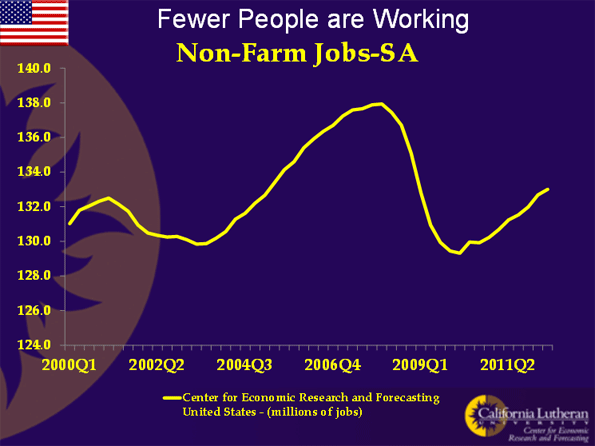
    People think we’re still in a recession because fewer of them have jobs than prior to the recession.  Below is a chart showing total non-farm U.S. jobs since 2000.  Today, we have millions fewer working than we did in 2007:

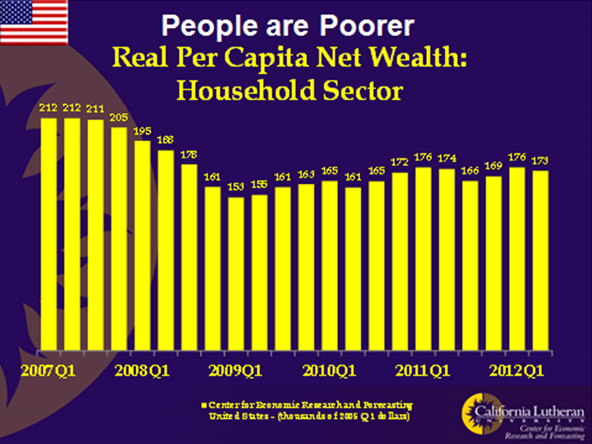
    People think that we are in a recession because they are poorer than they were prior to the recession.  As the following chart shows, Americans’ wealth is down a lot.  The average American’s wealth is down $39,000 or about 16 percent from its pre-recession high in 2005 dollars.  That is on average every man, woman, and child is $39,000 poorer than they were at the beginning of the recession.  An average family of four is $156,000 poorer than it was just a few years ago.

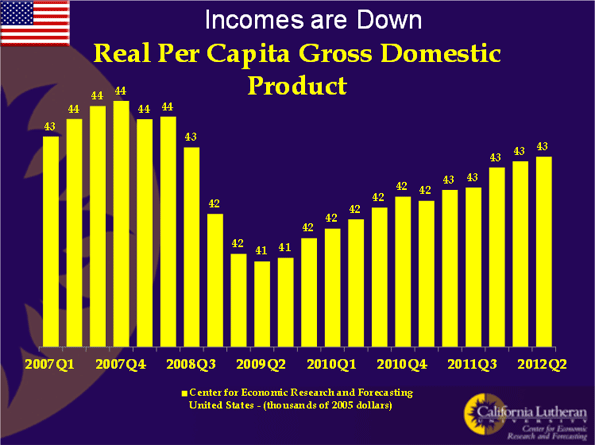
    Not only are Americans poorer than they were at the beginning of the recession, their income is down too.  Real (inflation adjusted) GDP may be climbing, but all of those gains are a result of increased population.  Real-per-capita GDP (the source of income) is still down more than $1,000 in 2005 dollars.

    Americans are poorer than they were, and their income is lower, and they are out of work or they know someone who is out of work.  Of course they don’t believe we are in a recovery.  The real question is that why, when things are this bad, does the chattering class spend its time debating trivial topics, such as which of the presidential candidates mistreats dogs the most?

    I think the answer is that the chattering class isn’t out of work, and they don’t know anyone who is out of work.  Maybe they know a banker who lost her job, but being a banker, she was probably evil.  So, no worries.

    This recession has hit sectors like construction and manufacturing disproportionally hard, and people who work in these sectors are not well represented in the chattering class.  Small businesses have also been badly hurt, and they too are poorly represented in the chattering class. 

    Other sectors have been hurt far less.  Education, healthcare, government, and professional services have each faced challenges, but these sectors’ job losses have been small compared to the most hard-hit sectors.

    One result of the different patterns of job losses across sectors is that we’ve seen an increase in income inequality.  Even worse, the increased inequality may be accompanied by declining upward mobility.  Income inequality without upward mobility is prescription for social trouble and slower economic growth.  Calls for income redistribution are only the beginning.

    Huge numbers of young people have failed to find jobs.  Many are living with their parents at ages far beyond what was normal just a few years ago.  Unemployed and disillusioned young people are another prescription for social trouble.

    What are our leaders doing?  Not much.  Congress is gridlocked and the President is campaigning.  The republicans call for tax cuts and spending cuts.  The democrats call for increased spending and tax increases.  Neither plan will work.

    The FED is trying to help.  It has instituted QE3, promising to purchase $40 billion in mortgage backed securities every month until economic conditions improve, whatever that means.  This will not do anything.  The FED has run out of bullets.  Policy now is all about convincing themselves and everyone else that they are doing something.

    Our deficit is huge.  It’s so large that if we were to cut all defense spending and cut all social security spending, we would just about eliminate the deficit.  But at what a cost!  We’d get rid of every soldier, gun, ship, and airplane.  We’d cut Granny off from her monthly check.

    We’re not going to do that.  We’re not going to cut the budget enough to get rid of the deficit.  So, give it up.  Budget battles on this scale are disastrous for democracies.  Best not to do it.

    Government spending is a problem.  That’s for sure, but you can’t fix it by cutting the spending.  That sounds wrong, I know, but the dynamics of democracy won’t let it work.

    Tax policy won’t do it either.  You can’t tax yourself to prosperity, and cutting taxes won’t help without a whole slew of complementary policies.  Increased spending won’t help.  The problem is that government is already too big relative to the economy. 

    Government at all levels is now about 37 percent of the economy.  This is higher than it was during World War Two.  It needs to become smaller as a percentage of the economy, but not by cutting.

    What we have to do is cap government spending on a real-per-capita basis.  We just keep spending what we’re spending per person, even after adjustment for inflation.  That way, there are no losers.  It should be relatively easy to gain support for a simple cap.

    Then, you grow your economy.  How to do that is another big topic.  But, we know the outlines:  Increase immigration.  Evaluate regulations for efficiency and economic impact.  Restructure the tax code to maintain productive incentives.  Restructure the safety net to improve incentives.  Restore incentives to education.  Remove barriers to trade.

    That is a big task, but it is a lot easier than cutting the budget as much as would be required.  It’s also a lot easier than suffering through a decade of anemic growth.  The benefits would be big too.  We’d be setting the stage for persistent prosperity.

    Bill Watkins is a professor at California Lutheran University and runs the Center for Economic Research and Forecasting, which can be found at clucerf.org.

    Unemployment photo by BigStockPhoto.com.

  • The Hollow Boom Of Brooklyn: Behind Veneer Of Gentrification, Life Gets Worse For Many

    After a decade of increasingly celebrated gentrification, many believe Brooklyn — the native borough of both my parents — finally has risen from the shadows that were cast when it became part of New York City over a century ago.  Brooklyn has gotten “its groove back” as a “post-industrial hotspot,” the well-informed conservative writer Kay Hymowitz writes, a perception that is echoed regularly by elements of a Manhattan media that for decades would not have sullied their fingers writing about the place.

    And to be sure, few parts of urban America have enjoyed a greater public facelift — at least in prominent places — than New York’s County of Kings, home to some 2.5 million people. The borough is home to four of the nation’s 25 most rapidly gentrifying ZIP codes, notes a recent Fordham study. When you get a call from the 718 area code these days, it’s as likely to be from your editor’s or investment bankers’ cell as from your grandmother.

    Yet there’s a darker side to the story. This became clear to me not long ago when driving with my wife and youngest daughter to a friend’s house in the Ditmas Park section of Flatbush, one of the finest exemplars of urban renaissance in the country. We encountered a huge traffic jam on the Belt Parkway, so we exited on Linden Boulevard. For the next half hour we drove through an expanse of poverty, public housing and general destitution that hardly jibes with the “hip, cool” image Brooklyn now projects around the world.

    A look at the numbers shows this was not an isolated experience. Despite the influx of hipsters and high-income sophisto professionals, Brooklyn is home to one of New York State’s poorest populations, with over one in five residents under the official poverty line, roughly 50 percent above the state average. This likely understates the problem since the cost of living in the borough is now the second-highest in the nation to Manhattan, surpassing even high-tone San Francisco.

    Overall, despite some job gains, the borough’s unemployment rate stood at 11 percent this summer, up from 9.7 percent a year ago and well above the national average. Much of recent job growth has been in lower-wage industries, notes Martin Kohli, chief regional economist with the Bureau of Labor Statistics in New York City. Despite a much celebrated start-up scene, some 30,000 of the 50,000 jobs created since the recession have been in the generally low-wage health care and social assistance sector, with another 9,000 in the hospitality industry.

    Poverty citywide, meanwhile, has been rising for three years running and the real Brooklyn, roughly half non-white, remains surprisingly poor. Brooklyn’s median per capita income in 2009 was just under $23,000, almost $10,000 below the national average.

    So what’s going on here? Urban historian Fred Siegel, a longtime Brooklyn resident, sees a classic tale of two cities. “Brownstone and Victorian Brooklyn is booming,” he says, due in part to uncle Ben Bernanke‘s inflationary policies, which have bailed out the Wall Street banks whose profits are the bedrock of New York City’s prosperity. This money has now spread to those parts of “Manhattanized” Brooklyn closest to the core of the Big Apple, with bankers, lawyers and the like opting to settle in more human-scale neighborhoods.

    But lower middle-class Brooklyn “is pockmarked with empty stores,” Siegel notes. With its once robust industrial- and port-based economy shrunken to vestigial levels, opportunities for Brooklynites who lack high-end skills or nice inheritances are shrinking. Some other areas, like Bensonhurst and Sheepshead Bay, have been revived through immigration.

    Jonathan Bowles, president of the New York-based Center for an Urban Future, sees a divide between, on the one hand, “the creative class” and some immigrant neighborhoods, and on the other, “the concentrated poverty” in many other struggling areas like Brownsville (where my mother grew up) and East New York. “There are clearly huge swaths of Brooklyn where you don’t see gentrification and there won’t be anytime soon,” Bowles observes.

    Part of the problem is structural. Many of Brooklyn’s working-class commuters — particularly in the eastern end of the borough — depend on a transit system designed to funnel people into the giant office clusters of Manhattan. Those left looking for work in the borough, often in low-paid service jobs, face long commutes or have to get a car, a big expense in a city with ultra-high rents, taxes and insurance costs.

    Mayor Michael Bloomberg’s administration identifies itself closely with Manhattan’s “luxury city” economy. Focused on finance, media and high-end business services, this approach does not offer much to blue-collar Brooklyn. New York over the past decade has suffered among the worst erosions of its industrial base of any major metropolitan area. Brooklyn alone has lost 23,000 manufacturing jobs during that time.

    Inequality in the Bloombergian “luxury city” is growing even faster than in the nation as whole. In fact, the gap between rich and poor is now the worst in a decade. New York’s wealthiest one percent earn a third of the entire city’s personal income — almost twice the proportion for the rest of the country.

    So while artisanal cheese shops serve the hipsters and high-end shops thrive, one in four Brooklynites receives food stamps.

    We see similar patterns across even the most vibrant of the nation’s urban regions. San Francisco gets richer with trustifarians, hedge fund managers and, for now at least, social media firms. Yet Oakland, just across the bay, suffers severe unemployment, rising crime and high vacancies. The cool bars and restaurants frequented by the creatives get the media attention, but as demographer Wendell Cox notes, roughly 80 percent of the population growth in the nation’s largest cities over the past decade consisted of people living below the poverty line.

    High costs and regulatory burdens make changing this reality ever more difficult; what can be borne by Manhattan or an upscale Brooklyn neighborhood like Park Slope can devastate a grittier locale like East New York. A well-heeled banker or trust-funder may find the costs of higher taxes and regulation burdensome but still relatively trivial; such factors more strongly impact a struggling immigrant entrepreneur, or a small manufacturer, construction firm or warehouse operation. Upzonings and subsidies for real estate developers — such as those around the new Nets arena — tend to work to the benefit of high-end chains, rather than smaller, often minority-owned businesses.

    Finally for all the talk, in Brooklyn and elsewhere, of a “great inversion” sending the well-to-do to cities, and what my mother would call shleppers to the suburbs, this is not the reality. Immigration and new births have supported Brooklyn’s population numbers, up 40,000 over the past decade, but as rapid outflow of Brooklynites has continued: over 460,000 more residents left than other New Yorkers or Americans moved in between 2001 and 2009, the largest loss of any borough.

    These phenomena can be seen in almost every American city; anyone traveling from west Los Angeles to the east side can see the divide between the posh shops and restaurants nearer the beach and greater commercial vacancies, abandoned factories and empty offices further inland. That this is happening as well in “booming” Brooklyn is rarely acknowledged, but worth confronting. We need to learn not only how to hype “hip” cities, but think about how to restore them as aspirational places for those who aren’t members of the privileged and cool set.

    Joel Kotkin is executive editor of NewGeography.com and is a distinguished presidential fellow in urban futures at Chapman University, and contributing editor to the City Journal in New York. He is author of The City: A Global History. His newest book is The Next Hundred Million: America in 2050, released in February, 2010.

    This piece originally appeared in Forbes.

    Brooklyn row houses photo by Bigstock.

  • A Look at Commuting Using the Latest Census Data

    Continuing my exploration of the 2011 data from the American Community Survey, I want to look now at some aspects of commuting.

    Public Transit

    Public transit commuting remains overwhelmingly dominated by New York City, with a metro commute mode share for transit of 31.1%. There are an estimated 2,686,406 transit commuters in New York City. All other large metro areas (1M+ population) put together add up to 3,530,932 transit commuters. New York City metro accounts for 39% of all transit commuters in the United States.

    If one were to guess the #2 city for transit commuting, another older, pre-auto, centralized city on the lines of New York (say Chicago) might be the obvious guess. It would also be wrong. It’s actually Washington, DC that has the second highest transit commute share among large metros at 14.8%. Here’s the complete top ten:

    Rank

    Metro Area

    2011

    1

    New York-Northern New Jersey-Long Island, NY-NJ-PA

    2,686,406 (31.1%)

    2

    Washington-Arlington-Alexandria, DC-VA-MD-WV

    439,194 (14.8%)

    3

    San Francisco-Oakland-Fremont, CA

    299,204 (14.6%)

    4

    Chicago-Joliet-Naperville, IL-IN-WI

    503,535 (11.6%)

    5

    Boston-Cambridge-Quincy, MA-NH

    267,568 (11.6%)

    6

    Philadelphia-Camden-Wilmington, PA-NJ-DE-MD

    251,285 (9.3%)

    7

    Seattle-Tacoma-Bellevue, WA

    137,858 (8.1%)

    8

    Portland-Vancouver-Hillsboro, OR-WA

    66,619 (6.3%)

    9

    Los Angeles-Long Beach-Santa Ana, CA

    355,811 (6.2%)

    10

    Baltimore-Towson, MD

    80,472 (6.1%)


    Not only are New York and Washington top two cities for public transit commuting, they are also the two cities that have been dominant in increasing transit’s market share. Both cities showed material share gains since 2000, over three and a half percentage points each, for transit. Among large cities, Seattle was the only one that managed to post a share gain of even one percent.

    Rank

    Metro Area

    2000

    2011

    Change in % of Workers Age 16 and Over

    1

    New York-Northern New Jersey-Long Island, NY-NJ-PA

    2,181,093 (27.4%)

    2,686,406 (31.1%)

    3.74%

    2

    Washington-Arlington-Alexandria, DC-VA-MD-WV

    278,842 (11.2%)

    439,194 (14.8%)

    3.61%

    3

    Seattle-Tacoma-Bellevue, WA

    106,784 (7.0%)

    137,858 (8.1%)

    1.17%

    4

    Orlando-Kissimmee-Sanford, FL

    12,601 (1.6%)

    24,901 (2.5%)

    0.91%

    5

    Hartford-West Hartford-East Hartford, CT

    15,755 (2.8%)

    21,794 (3.7%)

    0.91%

    6

    Charlotte-Gastonia-Rock Hill, NC-SC

    9,532 (1.4%)

    19,227 (2.3%)

    0.91%

    7

    San Francisco-Oakland-Fremont, CA

    278,207 (13.8%)

    299,204 (14.6%)

    0.81%

    8

    Los Angeles-Long Beach-Santa Ana, CA

    287,392 (5.6%)

    355,811 (6.2%)

    0.67%

    9

    Miami-Fort Lauderdale-Pompano Beach, FL

    67,685 (3.2%)

    95,536 (3.8%)

    0.61%

    10

    Nashville-Davidson–Murfreesboro–Franklin, TN

    5,574 (0.8%)

    10,705 (1.4%)

    0.55%


    Vaunted Portland only managed to eke out a share gain of 0.07%, which could be entirely statistical noise. Its performance lagged even auto-centric cities like Charlotte and Nashville.

    Bicycling

    Every city out there seems to be vying to be the bike friendliest city in the world. Yet bicycling has yet to make much of an impact on commuting. Only 7 out of 51 large metros even post 1% mode share for cycling:

    Row

    Geography

    2011

    1

    Portland-Vancouver-Hillsboro, OR-WA

    23,941 (2.3%)

    2

    San Francisco-Oakland-Fremont, CA

    38,419 (1.9%)

    3

    San Jose-Sunnyvale-Santa Clara, CA

    16,013 (1.9%)

    4

    Sacramento–Arden-Arcade–Roseville, CA

    15,804 (1.8%)

    5

    Austin-Round Rock-San Marcos, TX

    8,847 (1.0%)

    6

    New Orleans-Metairie-Kenner, LA

    5,307 (1.0%)

    7

    Phoenix-Mesa-Glendale, AZ

    18,007 (1.0%)

    8

    Seattle-Tacoma-Bellevue, WA

    15,949 (0.9%)

    9

    Denver-Aurora-Broomfield, CO

    12,052 (0.9%)

    10

    Los Angeles-Long Beach-Santa Ana, CA

    50,080 (0.9%)


    Portland grew bicycle mode share by 1.51% Perhaps this explains its poor transit performance. Cycling is canabalizing transit growth.

    Walking

    The low level of bicycling can perhaps best be illustrated by comparing it to walking. Even in Portland more people walk to work than ride bikes.


    Rank

    Metro Area

    2011

    1

    New York-Northern New Jersey-Long Island, NY-NJ-PA

    540,733 (6.3%)

    2

    Boston-Cambridge-Quincy, MA-NH

    121,537 (5.3%)

    3

    San Francisco-Oakland-Fremont, CA

    87,409 (4.3%)

    4

    Philadelphia-Camden-Wilmington, PA-NJ-DE-MD

    101,107 (3.7%)

    5

    Seattle-Tacoma-Bellevue, WA

    62,238 (3.7%)

    6

    Pittsburgh, PA

    36,857 (3.4%)

    7

    Portland-Vancouver-Hillsboro, OR-WA

    35,242 (3.4%)

    8

    Rochester, NY

    15,573 (3.2%)

    9

    Washington-Arlington-Alexandria, DC-VA-MD-WV

    94,698 (3.2%)

    10

    Chicago-Joliet-Naperville, IL-IN-WI

    134,399 (3.1%)


    Working from Home

    Looking at telecommuting gives a much different list of top cities, this one dominated by “wired” metros like Austin and Raleigh. The share of telecommuters in these cities is bigger than walking or biking, or even transit in many cities. This is an oft-overlooked part of the green transport agenda. The most green commute possible is the one you never have to make.

    Rank

    Metro Area

    2011

    1

    Austin-Round Rock-San Marcos, TX

    62,593 (7.1%)

    2

    Raleigh-Cary, NC

    37,030 (6.6%)

    3

    Portland-Vancouver-Hillsboro, OR-WA

    67,223 (6.4%)

    4

    San Francisco-Oakland-Fremont, CA

    131,029 (6.4%)

    5

    San Diego-Carlsbad-San Marcos, CA

    89,547 (6.3%)

    6

    Denver-Aurora-Broomfield, CO

    76,025 (5.9%)

    7

    Phoenix-Mesa-Glendale, AZ

    105,570 (5.8%)

    8

    Sacramento–Arden-Arcade–Roseville, CA

    52,143 (5.8%)

    9

    Atlanta-Sandy Springs-Marietta, GA

    132,979 (5.5%)

    10

    Seattle-Tacoma-Bellevue, WA

    87,839 (5.2%)


    Commute Times

    Unsurprisingly, large cities – including New York and Washington again at the top – feature the longest average commute times. Larger cities tend to have worse congestion and feature longer commutes. As transit commutes are generally longer than driving, the high transit mode share helps to drive up commute times in those cities.

    Rank

    Metro Area

    2011

    1

    New York-Northern New Jersey-Long Island, NY-NJ-PA

    34.9

    2

    Washington-Arlington-Alexandria, DC-VA-MD-WV

    34.5

    3

    Riverside-San Bernardino-Ontario, CA

    31.0

    4

    Chicago-Joliet-Naperville, IL-IN-WI

    30.9

    5

    Atlanta-Sandy Springs-Marietta, GA

    30.6

    6

    Baltimore-Towson, MD

    30.3

    7

    Boston-Cambridge-Quincy, MA-NH

    29.2

    8

    San Francisco-Oakland-Fremont, CA

    29.2

    9

    Los Angeles-Long Beach-Santa Ana, CA

    28.6

    10

    Philadelphia-Camden-Wilmington, PA-NJ-DE-MD

    28.5


    Whether New York might prefer a more auto-oriented layout in order to reduce commute times is a different matter. There’s no precedent for such a huge region having anything less than terrible congestion and commute times. And clearly New York would not be New York with such a radical change. The same forces that drive up commute times in places like New York and Washington are some of the same forces that sustain them as centers of elite economic production.

    Note: An early version of this piece contained an incorrect version of “Working from Home” table.

    Aaron M. Renn is an independent writer on urban affairs and the creator of Telestrian, a data analysis and mapping tool. He writes at The Urbanophile.

    Light trails photo by Bigstock.

  • USC Extorted by the City of Los Angeles

    With California State Redevelopment Agency money gone, the city of Los Angeles ought to welcome new large-scale private development, and the economic stimulus and job creation it brings, with open arms. City Hall, faced with an anemic municipal budget, could also use the increased tax revenue. One such project that would help abate the city’s budget woes and create new jobs for the city is the University of Southern California’s proposed $1.1 billion “The Village at USC” project.

    Surprisingly (or perhaps not), the city’s Planning and Land Use Management Committee delayed approval of the project for the second time last week, citing a need for more time to digest data regarding the project’s gentrifying effects on the surrounding community. The city is not fooling anyone – the delay amounts to nothing short of extortion – an attempt to ensure that committee members receive their proper concessions.

    The site for “The Village at USC” is located directly north of the campus on University-owned land. Currently a dilapidated retail center, the new project calls 350,000 square feet of retail and will add up to 5,200 much needed student beds. The project would also create 12,000 new jobs for the city (8,000 permanent and 4,000 construction-related).

    Comprehending the short-sightedness of delaying the project requires an understanding of USC’s role in its surrounding neighborhood (full disclosure: this writer is a graduate of USC). The university was founded in 1880, when LA was nothing more than a far outpost of western American expansion. Situated just 2 miles south of downtown, the city grew outward around the campus. Once an upscale neighborhood, the area immediately adjacent to USC lost its luster with the development of the city’s Westside, including Hollywood and Beverly Hills. Post WWII suburban expansion and the construction of the 110 and 10 freeways further eroded the area.

    Today the area surrounding USC’s campus is racially and economically polarized. Part of LA’s notorious South Central (now more politically correct referred to as “South LA”), the area was hard hit by the riots of 1992. Yet while crime is still an issue, the area has markedly improved since the riots. Much of the improvement is thanks to a shift in the University’s relationship to its surrounding neighborhood post-1992. Rather than continuing to see itself as an island fortress in a sea of urban chaos, USC reached out to the local community, sponsoring programs for community members and supporting local businesses. The University’s extensive community outreach efforts led it to be named TIME magazine’s “University of the Year” in 2000.

    As Los Angeles developed, USC had several opportunities to relocate its campus to other parts of the city and even Orange County, but its commitment to staying in the city’s center stood the test of time. The University is the largest private employer in Los Angeles and serves as a wellspring of knowledge and talent for the city. Given these contributions to LA, it is unfortunate and even appalling that the city’s Planning and Land Use Management Committee would question the University’s intentions and delay its plans to develop on land it owns with its own money (and without any handouts from the city or state).

    Adam Nathaniel Mayer is an American architectural design professional. In addition to his job designing buildings he writes the China Urban Development Blog. Follow him on Twitter: @AdamNMayer.

  • The Road Less Understood

    The Economist confuses ends (objectives) and means in its current number examining the peaking of per capita automobile use in the West in two articles ("The http://www.economist.com/node/21563327" and "Seeing the Back of the Car"). In congratulating metropolitan areas for trying "to change the way people move around," The Economist reminds that Portland (Oregon) has developed light rail and that policy supports transit in Los Angeles. So much for the means, but what about the ends?

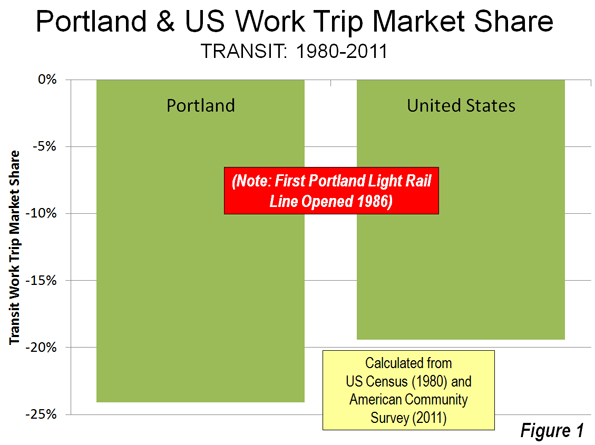
    In Portland: Transit Loses Ground and a Skeptical Public: Portland, for example, has had anything but stellar performance. Transit has not kept up with growth, having lost 25 percent of its commuting (work trip) share since before the first light rail line was opened in 1986 (Note 1). With five new light rail lines, transit in Portland not only fell short of attracting its previous bus only share of commutes, but also sustained losses greater than the national rate (Figure 1).

    The people of the Portland area may not share The Economist’s ardor. Just last week, The Oregonian headlined "Clackamas County anti-rail measure passes comfortably; effect could resonate for decades," reporting on a 60-40 vote to require referenda for future rail expenditures. As if that were not enough, a similar measure passed by a similar margin in King City, a municipality in Washington County and Tigard, one of the area’s largest municipalities, has placed the matter on the November ballot.

    But Portland does have a substantial success missed by The Economist. Working at home is growing rapidly. From 1980 to 2011, working at home (mostly telecommuting) increased by 55,000. This is more than three times the growth in rail transit commuting (17,500). During the last decade, working at home passed transit as a work access mode in Portland, and with virtually no public expenditures (as opposed to the billions for new rail lines). There has been a 375,000 increase in car use by one-way commuters since 1980, and, not surprisingly, a quadrupling of excess travel time in peak period traffic (based upon Texas Transportation Institute data). In the end, Portland built an extensive rail system and the riders have not come. Portland didn’t expand its highway system, and they came anyway (National 2010-2011 journey to work data is summarized here.).

    In Los Angeles: Long on Rail Lines, Short on Passengers: The Economist rightly points out that Los Angeles has implemented policies to get people out of cars. Indeed, Los Angeles has been the poster child for transit development. In little more than two decades, 11 metro, light rail, and suburban rail lines have been opened. Probably no metropolitan area in the world has opened more miles of new rail service in that period. Matthew Yglesias, writing in Slate was so impressed that he called Los Angeles "America’s next great mass transit city."

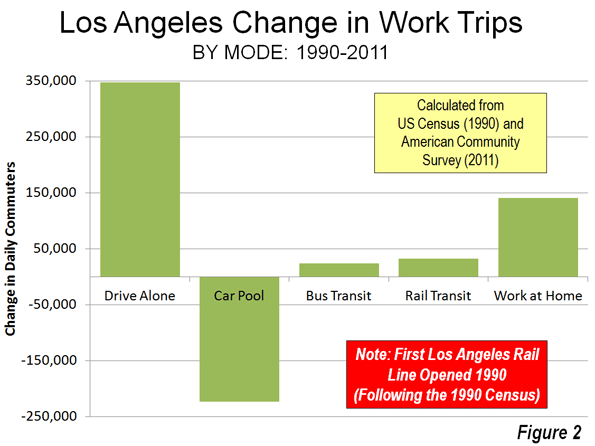
    The results are less convincing. The total daily one-way commutes on the 11 rail lines is only 32,000, smaller than the number of people carried daily on a single lane of the San Diego Freeway (I-405) where it crosses over Wilshire Boulevard. Meanwhile, working at home has risen more than four times that of rail commuting since 1990 (Figure 2). Los Angeles may be better described as “America’s next great telecommuting city." However, the auto is still king. From 1990 to 2011, solo automobile commuting increased 340,000, two percentage point gain, three times that of transit.

    Younger People: Driving More to Work and Telecommuting More

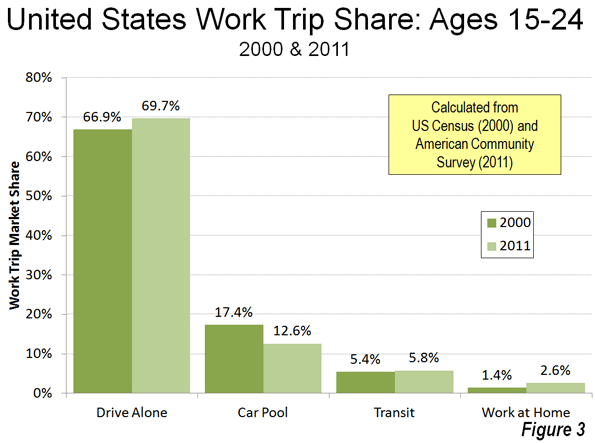
    The Economist also jumps on the "young people forsaking driving" bandwagon, a subject that has attracted the attention of others. But, young people are driving more, at least to work. Since 2000, the increase in driving alone to work by people aged 15 to 24 was nearly 260,000, compared to a 4,000 loss in transit commuting. Working at home was up almost as much as driving, at 200,000. Even so, with the declining size of the younger work force, transit’s share was up. From 2000 to 2011, the share of 15-24 year old workers rose from 5.4 percent to 5.8 percent (Figure 3), virtually the same as the overall increase in transit market share of from 4.6 percent to 5.0 percent (Note 2). As with Portland and Los Angeles, the last 11 years saw a much larger increase in working at home, from 3.3 percent to 4.3 percent.

    Further, to the extent working at home, social media and online shopping replace the need for driving among younger adults (and everyone), all the better.

    The Fantastical Claim: 50,000 Passengers Per Hour

    The Economist repeats the specious claim that rail lines can carry 50,000 passengers per hour in each direction. If your world is limited to Paris between Chatelet and Gare de Lyon and the handful of similar places, maybe so. But in most of the rest of the world, it is the stuff of fairy tales.

    The 2011 data shows the extent of the illusion.  The fantastical rail line carrying 50,000 per hour would carry the equal of all the daily rail commuters in Dallas or Miami in less than 20 minutes. It would take only about five minutes to handle the daily rail transit commuting volume in Minneapolis or Salt Lake City.

    Further, some of the new systems have been manifestly unsuccessful in attracting commuters. For example, in Charlotte, there was a strong increase in transit commuting between 2000 and 2011, with transit’s market share rising 64 percent. Yet, more than 60 percent of the new commuters were on buses, rather than on light rail, reflecting a long overdue increase in artificially low service levels. In Phoenix, 85 percent of the transit commuting increase was on buses, rather than the light rail line. The fantastical 50,000 per hour line would take only handle this load in about two minutes.

    Where Rail Works and Why

    None of this is to suggest that rail transit does not have its place. As I pointed out in a Hong Kong Apple Daily commentary, rail transit makes all the sense in the world where appropriate (see: "Hong Kong’s Rail Expansion: Avoiding Western Pitfalls"). Appropriate circumstances include huge central business districts with high employment density and radial rail transit service from throughout the metropolitan area. American Community Survey data indicates that just six municipalities (not metropolitan areas) account for 93 percent of the nation’s rail commuting destinations. The city of New York, alone is the destination of 65 percent of national rail commuters. Another 28 percent commute to the cities of Chicago, Philadelphia, Washington, Boston and San Francisco. Within these six cities, the overwhelming share of transit commuting is to the downtowns (central business districts), which, combined, cover a land area less than half the size of Orlando’s Disney World.

    Why Driving Has Peaked

    Alan Pisarski told us in 1999 "(Cars, Women and Minorities: The Democratization of Mobility in America") that the demand for driving would soon peak. Women were driving nearly as much as men and cars were becoming the dominant mode of transport for low income people. Cars already carry the overwhelming majority of low-income commuters. A "love affair with the automobile" mentality misled many who should have known better into believing that people would eventually drive 24 hours per day. In fact, the huge increase in driving to the 2000s was more about democratizing mobility and access, and as the Washington Times recently put it, prosperity (see "A world without cars:
    The internal-combustion engine has freed mankind"). If home-based access can take up the slack, it would do more for the environment and people’s lives than all the expensive, largely ineffective rail system imagined by the media and the well-financed rail lobby.

    ——

    Note 1: The data in this article is largely taken from the journey to work reports of the US Census (1980, 1990 and 2000) and the American Community Survey (one year data 2011).

    Note 2: The overall 5.0 percent transit market share figure may be high. The USDOT National Household Travel  Survey (NHTS) indicates that people who commute by transit tend to use other modes (such as automobiles) often. NHTS data indicates that, overall transit accounted for 3.7 percent of commuters and an even lower 2.7% of commuting miles in 2009.

    Photo: Harbor Freeway (I-110), Los Angeles (by author)

  • America’s Last Politically Contested Territory: The Suburbs

    Within the handful of swing states, the presidential election will come down to a handful of swing counties: namely the suburban voters who reside in about the last contested places in American politics.

    Even in solid-red states, big cities tilt overwhelmingly toward President Obama and the Democrats, and even in solid-blue ones, the countryside tends to be solidly Republican.

    What remains contested are the suburbs, which—despite the breathless talk in recent years of an urban revival—have accounted for 90 percent of metropolitan growth over the past decade.

    But as the suburbs have grown—in large part by collecting families priced out of cities or seeking more space or better schools—they’ve shifted from reliably Republican territory to contested turf. Barack Obama won 50 percent of the suburban vote in 2008, a better performance than either Bill Clinton or John Kerry.

    Obama’s success resulted from demographic changes sweeping the periphery of most major cities. Long derided by blue-state intellectuals as stultifying breeders of homogeneous white bread, the suburbs increasingly reflect and shape the country’s ethnic diversification. The majority of foreign-born Americans now live in suburbs, and many suburban towns—like Plano, Texas, outside Dallas; Cerritos, south of Los Angeles; and Bellevue, near Seattle—have become more ethnically diverse than their corresponding core cities. Among the metropolitan areas with the highest percentage of suburban minority growth are swing state regions Des Moines, Iowa; Milwaukee; and Allentown and Scranton, Pa.

    Minorities, according to a recent Brookings study now represent 35 percent of suburban residents, similar to their share of overall U.S. population.

    The suburbs of Las Vegas in hotly contested Nevada are now minority-majority, as the number of Latinos living there has shot up. Nationwide, well over 5 million Latinos moved to the suburbs during the past decade—and many more Latinos now live in suburbs than core cities. In the past, Hispanic suburbanites tended to vote somewhat more Republican than their urban counterparts. But this year, they appear to be solidly Democratic—as Latinos have been repelled by the GOP’s ugly embrace of nativism ,and drawn to Obama’s clever election-year move to offer effective amnesty to young illegal immigrants.

    Asians—another group that’s strongly favored Obama—have moved even more quickly into the suburbs. While many immigrants hail from some of the world’s densest cities, few immigrants come to America dreaming of a small apartment near a transit stop.

    “Many Asian immigrants today are bypassing the city entirely and going straight to suburban neighborhoods first to fulfill their version of the American dream,” says Thomas Tseng, a founding principal at New American Dimensions, a Los Angeles–based ethnic marketing and research firm.

    Over the past decade the Asian population in suburbs has grown at nearly four times the rate of that in cities, with 2.7 million more Asians in suburbia compared to 770,000 in the core cities. In the northern Virginia suburbs around Richmond, the number of Asian suburbanites has doubled, as it has in the suburbs around Columbus and Cincinnati. The Asian suburban population nearly tripled in the Raleigh area and doubled around Charlotte. Even in Florida, there are now well more than 100,000 more Asians in the suburbs of the Sunshine State’s four major cities—Miami, Jacksonville, Orlando, and Tampa—than there were a decade ago.

    Obama also will likely receive significant backing from white professionals, who tend to cluster in the suburbs of cities such as Columbus or around Washington, D.C. Virtually all the 10-best educated counties in America are suburban; seven are in the greater Washington area. The fact that many of these professionals work directly or indirectly for the federal government that Obama has expanded dramatically will only help him in his bid to remain in the White House.

    So what about Romney? He’s clearly a product of the suburbs, growing up in the tony periphery of Detroit and now living in leafy Belmont, Mass., a comfy close-in commuter suburb that has seen little population growth since 1950.

    In the primaries, Romney did well in suburbs, particularly upper-class ones, and those voters played a critical role in putting him over the top against Rick Santorum.

    Romney continues to score roughly 50 percent support in polls with voters making at least $100,000, a group that tends to live in affluent commuter towns ringing cities. But to win, the Republican needs to reproduce his party’s wave of 2010, when they captured roughly 55 percent of the suburban vote on their way to retaking the House. But can Romney reach beyond his classic country-club GOP base to the middle- and working-class swing state suburban voters?

    On paper, he should do well in lower density suburban areas, in large part because they tend to have far larger concentrations of married families with children, a group that tilts Republican. But despite his own family, he’s been overshadowed by Obama’s better-marketed, albeit far smaller, domestic unit.

    Romney also may be missing a chance to appeal to suburbanites on the contentious issue of “smart growth.” Opposition to suburban housing has become a favorite cause among Democratic politicians, and widely praised by the Manhattan-centric national media.

    But Romney, in his term as governor of Massachusetts, was a classic patrician corporate modernizer, showing a penchant for the kind of planning that uses strict growth controls to constrain suburban expansion.

    In this sense Romney resembles other politicians from the gentry class—such as Al Gore, Arnold Schwarzenegger, and John Kerry—who, in the name of “rational” societal objectives, make it harder for middling-class people to achieve the suburban dream they’ve taken for themselves.

    So while they represent the majority of the nation, suburban voters have no real champion in this election. Taken for granted by conservatives and betrayed by Wall Street, they have few friends in high places—except at election time. They are also increasingly detested by progressives, a long way from the days when Bill Clinton keyed in on “soccer moms.” Instead the suburbs have evolved into a shapeless political lump, divided by income and race, cultural conflict, and regional rivalries.

    On balance, this all works to the president’s favor. If Obama can manage anything close to a split in suburbia, as he did in 2008, he will surely win a second term. Such a loss, at a time of economic hardship, may be enough to force even the dullards of the GOP back to the drawing board to confront their inability to win over enough of the suburban voters (homeowners, small businesspeople, parents of any races)—who should provide the GOP an electoral majority, but so far are not.

    Joel Kotkin is executive editor of NewGeography.com and is a distinguished presidential fellow in urban futures at Chapman University, and contributing editor to the City Journal in New York. He is author of The City: A Global History. His newest book is The Next Hundred Million: America in 2050, released in February, 2010.

    This piece originally appeared in The Daily Beast.

    Suburbs photo by Bigstock.