Blog

  • A Summary of 2011 Commuting Data Released Today

    The Census Bureau’s American Community Survey released its annual one-year snapshot of demographic data in the United States. As usual, this included journey to work (commuting data), which is summarized in the table below.

    American Community Survey Commuting Data
    2011, 2010 & 2000
    ESTIMATES of Total Commuters 2000 2010 2011
    Drive Alone 97.10 104.86 105.64
    Car/Van Pool 15.63 13.27 13.39
    Transit 5.87 6.77 6.96
    Bicycle 0.49 0.73 0.78
    Walk 3.76 3.80 3.89
    Motorcyle, Taxi & Other 1.24 1.60 1.63
    Work at Home 4.18 5.92 5.99
    Total 128.28 136.94 138.27
    In Millions
    MARKET SHARE
    Drive Alone 75.70% 76.57% 76.40%
    Car/Van Pool 12.19% 9.69% 9.68%
    Transit 4.57% 4.94% 5.03%
    Bicycle 0.38% 0.53% 0.56%
    Walk 2.93% 2.77% 2.81%
    Motorcyle, Taxi & Other 0.97% 1.17% 1.18%
    Work at Home 3.26% 4.33% 4.34%
    Total 100.00% 100.00% 100.00%
    Sources: 2000, 2010 Census &  2011 American Community Survey


    Trends Since 2010

    As estimated employment improved from 137.9 million in 2010 to 138.3 from 2010 to 2011, there was an increase of 800,000 in the number of commuters driving alone, which, as usual, represented the vast majority of commuting (105.6 million daily one way trips), at 76.40 percent. This was not enough, however, to avoid a small (0.17 percentage point) decline in market share.

    Car pooling experienced a rare increase of 120,000 commuters, which translated into a 0.1 percentage point loss in market share, to 9.68 percent. Transit increased 190,000 commuters, and had a 0.09 percentage point increase in market share, to 5.03 percent. This brought transit’s market share to above its 2008 share of 5.01 percent and near its 1990 market share of 5.11 percent.

    Working at home increased by 70,000, with a modest 0.1 percentage point increase from 2010.

    Trends Since 2000

    Even with declining falling household incomes and rising gasoline prices, single-occupant commuting continued to rise between 2000 and 2011. Solo drivers increased nearly 8 million, more than the total transit commuting in 2011. Car pooling continued its long-term decline, falling 2.2 million. Transit did well (as would be expected with unfavorable economic conditions and unprecedented gasoline price increases), as we noted last year, having added 1.1 million commuters. This was spread thinly around the country, though with a 70 percent concentration in New York and Washington, DC. Over the period, working at home experienced an increase of 1.8 million, the largest increase outside solo driving.

    Media Attention

    For the most part the commuting data was ignored by the media — and for good reason. The one year changes were predictably modest. However, the exception was USA Today, with a top of the webpage "Fewer Americans Driving Solo" headline. In fact, as noted above, the short term and long term trends reflected an increase in solo driving. Moreover, reading the story it would be easy to get the impression that a sea change had occurred in how people get to work. To its credit, however, USA Today appropriately labeled the likely reasons for the mountains it made into molehills — the economy and gasoline prices.

  • What to Look For in the Nordic Model

    The Nordic nations, and Sweden in particular, are seen by many as the proof that it is possible to combine innovative and entrepreneurial economies with high tax rates. It is often argued that nations such as the US can gain the attractive social features of Denmark, Sweden, Norway and Finland — such as low crime rates, high life expectancy, and a high degree of social cohesion — simply by expanding the welfare state. An in depth analysis, however, shows that this line of reasoning is flawed.

    To begin with, one should remember that free-markets have been at the core of the Nordic success stories. Sweden, for example, was an impoverished nation before the 1870s; one indication of that was massive emigration to the United States. As a capitalist system evolved out of the agrarian society, the country grew richer. Property rights, free markets, and the rule of law, in combination with large numbers of well-educated engineers and entrepreneurs, created an environment in which Sweden enjoyed an unprecedented period of sustained and rapid economic development. Globally famous companies such as IKEA, Volvo and Tetra Pak were founded during a period when Sweden was characterized by business-friendly economic reforms and relatively low taxes.

    However, during the late 1960s, policies steered sharply to the left and the overall tax burden rose significantly. The Swedish economist Magnus Henrekson has shown that the effective marginal tax rate (marginal tax plus the effect of inflation) that was levied on Swedish businesses could be more than 100 percent of the profits. The sharp left turn in Swedish economic policy did indeed affect entrepreneurship. Sten Axelsson, another Swedish economist, has shown that the period between the end of the 19th century and the beginning of the First World War was a golden age for the founding of successful entrepreneurial firms in Sweden. After 1970, the establishment of new successful firms almost stopped. The experiment of following a middle way between socialism and capitalism was not only unsuccessful, but also short-lived. In the 1990s and onward, a range of market reforms were implemented, paving the way for new entrepreneurial firms.

    Taxes still remain high in the Nordic nations, particularly in Denmark and Sweden. The high tax pressures create high costs for the societies. A report recently published by the European Central Bank finds that both Denmark and Sweden are on the tip of the Laffer curve when it comes to both taxes on income and on capital. This means that capital taxes are so damaging that reducing them by one Kronor would stimulate the economy to grow, so that more than one Kronor in additional taxation could be levied (at the lower tax level). Many entrepreneurs relocate their businesses to other countries in order to avoid Sweden’s high taxes. Skype, for example, was founded by a Dane and a Swede, but they chose to startup in free-market oriented Estonia, and later move the ownership to another free-market oriented nation, Luxembourg.

    So how come the Nordic nations are so prosperous? A key reason is that they, particularly since the 1980s, have compensated for high tax regimes by implementing a range of market reforms. These reforms range from Flexicurity — a combination of strategies to provide flexibility for employers and security for workers — in the Danish labor market, to partial abolition of rent-control in Finland, to school vouchers and partial privatization of the pension system in Sweden. Indeed, the Nordic nations have risen sharply in both the Heritage/WSJ and the Frasier Institute indexes of economic freedom over the years.

    It is also important to realize exactly why the Nordic nations have been able to implement large welfare states, and what the benefits have been. The cultural and economic systems in the Protestant Nordic nations have historically given rise to very strong norms related to work and responsibility. Coupled with uniquely homogeneous societies, these norms made it possible to implement larger welfare states in the Nordic nations than those in other industrialized countries. Since the norms relating to work and responsibility were so firmly rooted, Nordic citizens were not as likely as other Europeans or Americans to try to avoid taxes or misuse generous public support systems. Also, the “one-solution-fits-all” systems of the welfare state are typically less disruptive in a strongly homogeneous social environment, since most of the population has similar norms, preferences, and income levels.

    However, with time the norms have evolved. In the World Value Survey of 1981-84, almost 82 percent of Swedes responded that “claiming government benefits to which you are not entitled is never justifiable”, but in the survey of 1999-2004, only 55 percent held the same belief. It is no coincidence that much of the public policy debate in Norway, Sweden, Denmark and Finland has focused on curbing overutilization of welfare systems.

    Many of the favorable social outcomes in the Nordic nations relate to our unique culture, and the policies cannot simply be copied. In1950, long before the high-tax welfare state, Swedes lived 2.6 years longer than Americans. Today the difference is 2.7 years. The two researchers Jesper Roine and Daniel Waldenström have similarly shown in a new study that “most of the decrease [in economic inequality in Sweden] takes place before the expansion of the welfare state”, occurring during the period when the nation was characterized by low taxes, a small state and a flexible labor market.

    Clearly, the social success in the Nordic countries is not simply a result of welfare policies, but related to cultural and demographic factors. Therefore it would be difficult, if even possible, to achieve these results in nations such as the US simply by introducing a high tax regime. Why not instead be inspired by the fiscal conservatism and the free-market reforms that make the Nordic nations prosper today?

    Flickr Photo by ‘creating in the dark’ (Helen Harrop): Gate to the Mazetti Chocolate Factory, Malmö, Sweden

    Nima Sanandaji has published several books in Sweden relating to subjects such as entrepreneurship, integration and women’s career opportunities. He is the author of the study, “The surprising ingredients of Swedish success – free markets and social cohesion”, which has recently been published by the Institute of Economic Affairs.

  • Rethinking Brand Chicago

    So many Midwest places flail around looking for a brand image or identity. Not Chicago. In fact, the identity and stories of Chicago overflow the page. They are too numerous to be written in a mere blog posting.

    Yet Chicago has in effect decided to jettison that powerful, historic brand identity in favor of a type of global city genericism. This, I believe, is a mistake.

    One trend you can’t help but notice if you travel is the increasing homogenization of the urban culture and standard of urban development. Global markets demand standardized commodities that can be graded and traded. This includes cities. This forces cities increasingly into a standard model of what one expects.

    I’ve written in the past about the example of the Wallpaper guides to world cities. These travel guides, ostensibly a guide for the modern, sophisticated urban traveler to the best of each globally elite locale, often seem identical except for the name on the spine. One modern boutique hotel, one swank restaurant or bar, one fashion outlet, one bike share program, one piece of starchitecture is much the same as another in any city you visit around the world. The frosting might be different, but the cake is the same. And once you’re commoditized, you’re done.

    So it is too with Chicago. I noted in my review of the city’s street lighting what appears to be a deliberate downplaying of the city’s rough-edged, masculine past in favor of a feminized, generic, even suburban motif. You see this repeated throughout.

    It’s truly incredible. Travel anywhere in the world in mention that you’re from Chicago, and immediately the other person will mime a couple of pistols with their fingers and say, “Bang! Bang!” This is a sore spot with many local leaders, who hate the notion that it is still known more for gangsters than glitter. The city over the years has so tried to suppress its Al Capone heritage that it has obliterated many historic sites related to the mob. It’s like the city that wants to pretend it doesn’t exist.

    This sadly makes Chicago like all too many smaller cities that suppress their strongest brand assets out of embarrassment and a desire to be taken seriously by members of the cool kids club. Go talk to urban boosters in Indianapolis, and you probably won’t hear much about the Indy 500, for example. So too it is with Chicago. It’s as if to prove it’s a member of the club – i.e., is exactly like every other cool city – Chicago has to ignore its gritty past and essential culture.

    A friend of mine likes to say that “Chicago is a city that runs on testosterone.” It’s a rugged, manly city, a place where it was said high culture was just the ransom rich men paid to their waves. A place where people wore their shoe leather out trying to make a buck. The land of the hustler. A place of bellowing blast furnaces and brawny immigrants. A place where pedigree didn’t matter and crazy newcomers, dreamers, schemers, and gamblers could win or lose big. A place with audacious ambition and a relentless determination to demolish rivals, whether that be Cincinnati, St. Louis, or Milwaukee. A place that once dreamed to dethroning New York. A place of limitless imagination and inventiveness that brought us everything from the skyscraper to the futures market. A place with music like the blues made for and by the hard luck working man. And yes, a place of gangsters and crooked politicians.

    None of that is part of new Chicago, at least not the image the city wants to portray. The iconic architecture remains, but it has been drained of its cultural content. Listen to what the city tries to project of itself and see what it says. It says that Chicago has become just another way-station along the global city parade. Starchitecture (no longer architecture made in Chicago for the most part), microbrews and microroasts, culinary delights, high culture, boutique hotels, great shopping, bike infrastructure, digital startups (the exact same type every other “hub” is bragging about), music festivals by and for the high end educated hipster, global conferences, etc. Almost every box is checked, with a few exceptions like fashion and media as I highlighted earlier.

    All of this is good in a way and proof of a transformation in Chicago that is in many ways for the better. But something has been lost along the way. These items are all disconnected from the city in which they happen to reside. It’s as if they descended on the place out of the heavens like that flying saucer on top of Soldier Field. Drawing Room mixologist Charles Joly may have a Chicago flag tattooed on his arm, but his bar could be located anywhere.

    Saskia Sassen has written that the economies of global cities are not generic but are inherently linked to their histories. Chicago in the past was a great center of manufacturing, for example, and today is expert at providing global services to manufacturers. But where in underlying economic reality there may be distinctiveness, on the surface there is more homogenization. This may explain why people tend to assume all global cities are alike. To a visitor staying in the central core, the experience may well be quite similar in many ways.

    What’s more, the aspiration seems to be generic. The idea, again, is to demonstrate that you are part of the club by focusing on replicating all the same stuff everybody else is already doing and talking about yourself in much the same way. I’ve seen little in Chicago’s branding or global city rhetoric that is much different from anywhere else.

    Yet the differences remain, especially outside the rarefied precincts of the global elite. And much of that continues to inspire embarrassment to this day. Corruption and cronyism seem to continue unabated, for example.

    Yet there is good as well. Ask yourself what more than anything epitomizes Chicago. To me, it is none other than former Mayor Richard M. Daley. Listen to him speak. Barack Obama he is not. But character he had, lots of it, and what’s more, a fanatical dedication to making Chicago the best city it could possibly be. Was there a lot of corruption in Daley’s Chicago? No doubt. Did he desire to have maximum power over politics in his city? Of course. But nevertheless I get the impression of, as I said in my last piece, a guy who every morning wakes up and asked himself, “What can we do today to make Chicago a greater city?” This is a quality of leadership all too lacking in most Midwestern cities. The character of Chicago and the character of Mayor Daley himself seem to me to have so much in common.

    Ironically, under Mayor Daley, the city pursued that policy I mentioned of abandoning its past, of abandoning the image of the city as evidenced by the mayor himself. You walk down Michigan Ave., through Millennium Park, around the newly thriving neighborhoods, and you expect that city to be led by a Dr. Smooth type character, not a blunt, plainspoken man like the Mayor. But if only he had seen the value in a city that presented a face like his own. A city not ashamed but proud of its rough and tumble edge, of the fact that it was where generations of ne’er-do-wells and hustlers came to wear out their shoe leather trying to make it big, a city that both Al Capone and Paddy Bauler thought not ready for reform, a city that drew generations of farm boys off to its earthly delights, a city from Bridgeport not the Gold Coast. That’s Chicago. Not a genteel, refined metropolis, not a swank, sophisticated type of town, not a city on a hill. No, but a city of dreams nevertheless, where people came to get rich, to reinvent themselves, to change the course of world history. That’s Chicago.

    No, Chicago will never be the Chicago of Cyrus McCormick and Philip Amour and Aaron Montgomery Ward and all the rest. You can’t live off the past. That’s nostalgia and there’s no more corrosive force known to mankind. But you can know who you are, what you stand for, what your heritage is, and how it fits into the future. Not a clinging to the past, but letting your essential character be a guidepost to the future.

    The fifth Frank Gehry titanium Bilbao clone, the n-th swank restaurant or shop, the latest in Italian furniture – ultimately none of them will make Chicago Chicago. It’s going to take the real city, an expression of its own terroir and primal identity to do that.

    I happen to think Chicago can do it. If it changes course and gets way from following the trends to creating its own future. If it steps up and makes sure the world knows that Chicago, and not just yet another generic world city, is here, and determined to claim its rightful place.

    Chicago will only realize its potential for greatness if it is willing to let go of its insecurity and desire to be a member of the club, and dares once again to think of itself as it did back in the days of the Burnham Plan as a city destined to be the greatest in the world, a city proud of itself and not afraid to boldly chart its own course into the great unknown of the future.

    Is Rahm Emanuel is the person who can pull this off? He’s from the North Shore. He was a ballet dancer. He’s a man clearly most comfortable dealing with the elite. Yet he’s also got a rougher side. He’s supposedly Captain F-Bomb. He hates to lose. He mailed some dead fish to a someone once to show his displeasure with some polling. I’d say there’s more than a streak of authentic Chicago in there.

    Maybe the bigger question is whether he wants any change of course. The NATO Summit play suggests not. But it’s still early.

    I would strongly urge the city to rethink its brand and what it wants to be in the marketplace. Bottle up some that classic Chicago heritage and apply it liberally. This is a huge opportunity in the marketplace. With the vast bulk of cities trying to convince you they are all the same, this is in opportunity for Chicago to seize the advantage and stride forth with classic boldness and braggadocio, making other cities take real notice for a change. Want to actually put Chicago on the brand consciousness map? That’s the way to do it.

    In short, it’s time to stop aspiring to global city goo and instead give the world a punch in the face with a little old school Chicago.

    This is the fourth installment in my “State of Chicago” series. Read part one here, part two here, and part three here.

    Aaron M. Renn is an independent writer on urban affairs and the founder of Telestrian, a data analysis and mapping tool. He writes at The Urbanophile, where this piece originally appeared.
  • 2011 Census Sub-County Allocations Masquerade as Population Estimates

    This is by far the most difficult article I have ever had to write. I have been a fan of the US Bureau of the Census since I began following its numbers in the second grade. Much of my career has been spent analyzing these numbers and those of similar national statistical bureaus around the world. Yet, the 2011 sub-county estimates produced by the Census Bureau should never have been released, because they were not estimates, but they were rather "fair share" allocations of county population growth (or loss).

    Analysts believing the numbers to be estimates have spent considerable ink in explaining the results. Some articles noted that core cities were adding population faster than suburban areas, such as an article based on Brookings Institution research in The Wall Street Journal. Others, such as me noted that there was evidence of faster core growth in some metropolitan areas, but that core county migration data (the lowest geographical level available) continued to overwhelmingly show net domestic migration to the suburbs.

    In fact, however, it turns out that no-one knows that is happening to sub-county populations, in the historic cores or in the suburbs. Regrettably the results announced by the Census Bureau were virtually meaningless. This was revealed on newgeography.com by Chris Briem of the University of Pittsburgh just days after the release of the estimates. Briem reviewed the Census Bureau’s sub-county population estimation methodology for 2010-2011 and found that county populations had largely been allocated to sub-county jurisdictions based upon their share of the 2010 population. The result is that all sub-county jurisdictions in each country grew (or lost population) by nearly the same percentage. Obviously, this cannot be.

    Brownstown Charter Township: Rising Population in Reversal?

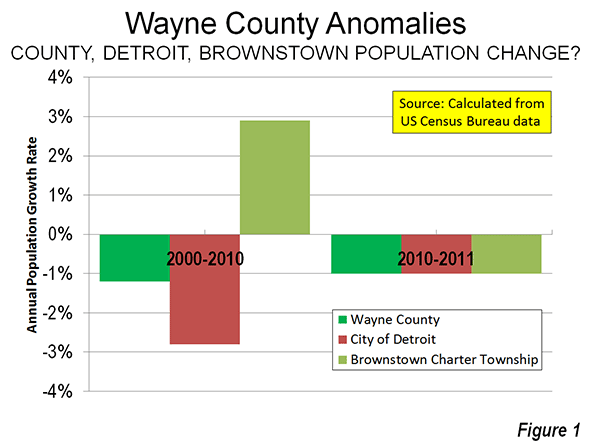
    This means, for example, that Brownstown Charter Township, a rare oasis of population growth (suburban or core city) in Wayne County, Michigan was apportioned virtually the same percentage population loss as occurred in the county. Like the city of Detroit, which since 1950 has managed to shed more people than live in all but two Canadian core cities, Brownstown is reported to have lost the same 1.0 percent that is reported to have occurred in the city and the county (Note). How different this is from the 2000s, when Brownstown grew an average of 2.9 percent annually, while Detroit lost 2.8 percent and Wayne County 1.3 percent annually (Figure 1). We hope Brownstown’s citizenry was not alarmed by this sudden turnaround.

    A One Year Change in Methodology

    The problem results because of a single year change in the way the Census Bureau estimates population below the County level. As the Bureau indicates in its methodology notes:

    "Our method of producing housing unit estimates is different this year than in years past. The Vintage 2011 housing unit estimates do not rely on the usual components of housing change (building permits, non-permitted builds, mobile home shipments, and housing loss), which we used last decade to produce the housing unit estimates. Instead, we created the Vintage 2011 estimates by extrapolating the average monthly change in housing units at the county level, then summing these estimates to create estimates for the states and nation. To produce subcounty housing unit estimates, we distributed the extrapolated county estimates down to each subcounty area within a county based on 2010 Census proportions."

    The meaninglessness of the estimates is evident in examinations of two metropolitan areas where the core cities were reported to have grown faster than suburban areas, Miami and Orlando.

    Miami Metropolitan Area

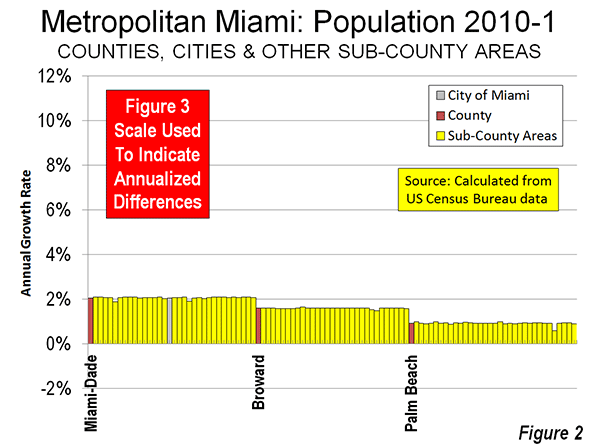
    Figure 2 shows that in the Miami metropolitan area, the many cities and towns in the core Miami-Dade County grew at virtually the same population rate as the county overall. This means, for example, that the core city of Miami also grew at the same rate, according to the Census Bureau figures. The same thing can be seen in suburban Broward County, where all of the cities grew at virtually the same rate as the county as well as in Palm Beach County. From Figure 2, it can be seen that the estimates show the city of Miami could have grown faster than all the suburbs in Broward County and Palm Beach County, and at virtually the same rate as the suburbs and Miami-Dade County. No judgments can be made about relative population trends where estimates simply allocate the change base upon the base year distribution of population.

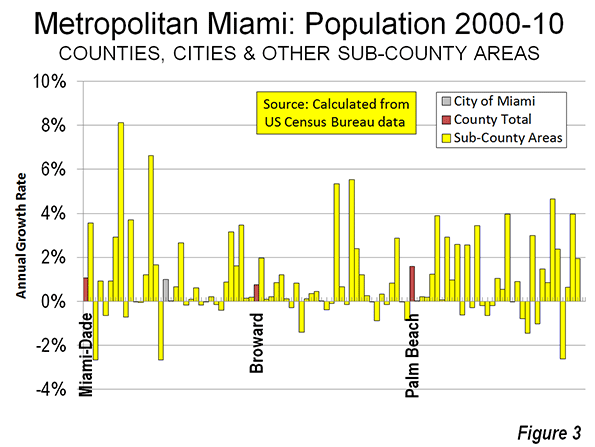
    Figure 3 indicates the extent to which this methodology varies with the more comprehensive "components of housing change" methodology previously used by the Census Bureau (above). These annual population increase rates, between 2000 and 2010 are for the very same sub-county jurisdictions in Figure 2. This kind of variation in population growth rate would be expected in any year, rather than the flat-lined Census Bureau allocations

    Orlando Metropolitan Area

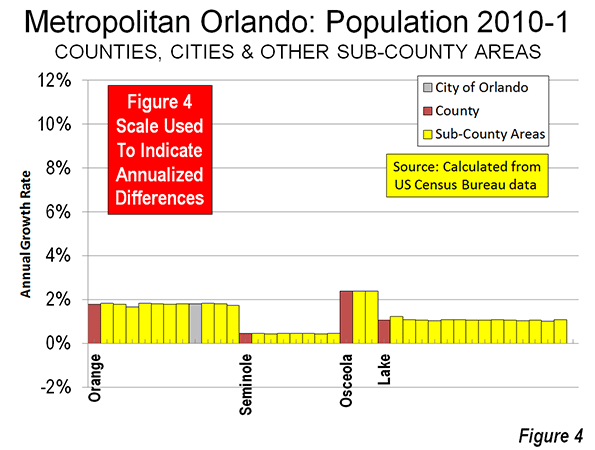
    Figure 4, covering the Orlando metropolitan area indicates the same situation. Each of the sub-county jurisdictions in the four metropolitan area counties is reported to have grown at approximately the same rate as its home county. Any conclusion that the city of Orlando grew faster than the suburbs, such as those in Lake and Seminole counties is invalid, since the city population growth is simply an allocation of the county growth.

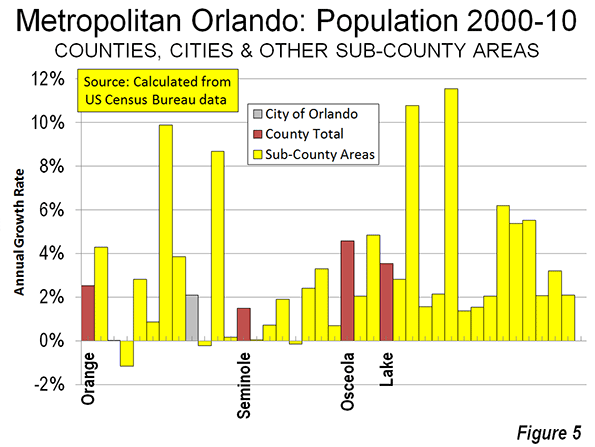
    Figure 5 shows of the annualized growth rate for the sub-county jurisdictions of the Orlando metropolitan area of between 2000 and 2011. Again, there was a huge variation in growth between the sub-county jurisdictions. A dispersion of growth rates would have had the "fair share" population estimation mythology been employed for 2010 to 2011.

    Justifying the One Year Change

    The Census Bureau indicates that it changed its methodology for the current estimation year because “we are presently evaluating the 2010 housing estimates relative to the 2010 Census results, and considering improvements to the existing housing unit method for the new decade." Fair enough. Calling allocations estimates, however, is not.

    Further, at least some at the Census Bureau perceive that these to be genuine estimates. The accompanying press release entitled "Texas Dominates List of Fastest-Growing Large Cities Since 2010 Census, Census Bureau Reports." Actually, the Census Bureau has no data on which cities grew the fastest between 2010 and 2011, nor does anyone else.

    Unfortunate Timing

    It is unfortunate that the Census Bureau determined to go forward with meaningless estimates at the very same time important statistical gathering programs such as the American Community Survey are under threat of defunding by the Congress.

    Beware: Make No Comparisons

    One of the purposes of sub-county population estimates is to provide information on the relative growth between jurisdictions. The estimates are also used in the Census Bureau’s challenge process, which allows cities to seek revision of their population estimates, leading to a greater allocation of federal funding. We assume that no population challenges will be accepted based upon these allocations. Indeed, based on the latest Census of Government counts, more than 35,000 municipalities and minor civil divisions would seem to have standing for challenges.

    Fortunately, there are plans to return to estimates rather than allocations for the 2012 round. The 2011 estimates should be withdrawn. Census Bureau should make it clear allocations did not represent genuine estimates of population change.

    We have redacted part of our article analyzing the 2011 sub-county population estimates.

    Postscript: Headline Illusions

    The misleading issue of historical core cities drawing people from suburban areas was raised anew by a recent article headlined "We’re In The Midst Of A Huge Migration From Suburbs To Cities" in The Business Insider. The article was attributed to Rolf Pendall, director of the Urban Institute Metropolitan Housing and Communities Policy Center, who said no such thing. Pendall’s article in Atlantic Cities was more appropriately headlined "The Next Big Question Facing Cities: Will Millennials Stay?" A good question.

    Wendell Cox is a Visiting Professor, Conservatoire National des Arts et Metiers, Paris and the author of “War on the Dream: How Anti-Sprawl Policy Threatens the Quality of Life.”

    —-

    Note:  There were minor variations in the second decimal digit of the growth rates because of the small group quarters portion (people in dormitories, prisons and other group housing) population change, for which the Census Bureau produced genuine estimates.

    Map photo by Bigstock.

  • The Rise of Telework and What it Means

    Teleworking (also known as telecommuting) has taken flight as a global trend. During July of 2002, European Union collectively decided on a shared framework agreement on telework, which regulates issues such as employment and working conditions, health and safety, training, and the collective rights of teleworkers. Following suit, the American the Telework Enhancement Act of 2010 served as a rallying call for federal agencies to encourage “work-at-home” employees. In the same year officials in China, eager to reduce gross national carbon emissions, chose the province of Hubei to undergo the country’s first telecommuting pilot program  

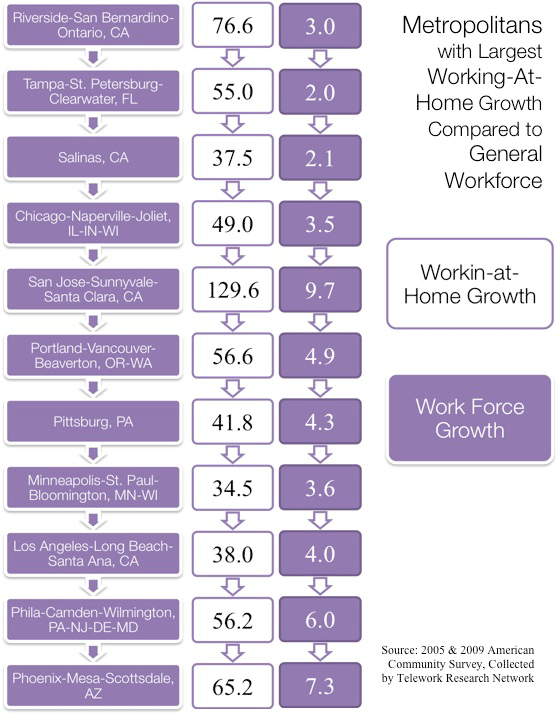
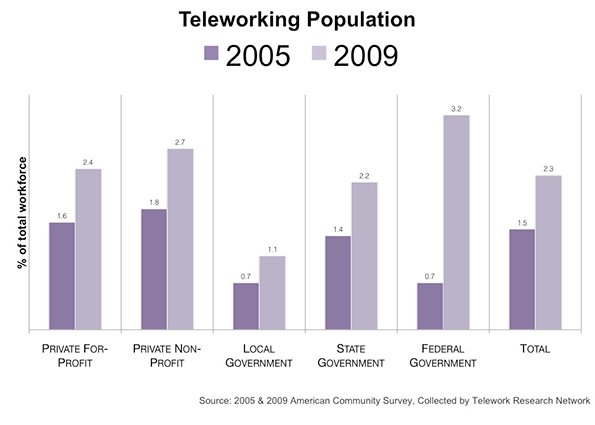
    In the United States, telecommuting is   on the clear increase.  Data from the American Community Survey estimate that the working at home population grew 61% between 2005 and 2009. The biggest increases in teleworking population compared to workforce was in Riverside-San Bernardino-Ontario, CA while the metro with the highest growth in teleworking was San Jose-Sunnyvale-Santa Clara, CA.


    Is the trend to telecommuting comparable between the private and public sectors? The 2009 American Community Survey gives a snapshot of the work-at-home population by class of worker in the years 2005 and 2009. Although the rise of teleworkers is across both sectors, a surge in government teleworkers indicates the public sector, notably the federal government, has made a huge effort keep staff at home to cut administrative costs.

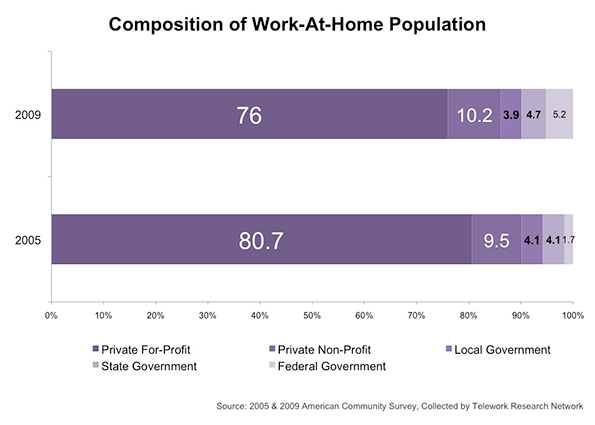
    After the federal government, the next largest increase in ratio of teleworkers is at the state level. Municipal government teleworkers showed the most modest growth and represent only 3.9% among those working at home. Though only 2.4% of private for-profit sector employees consider themselves teleworkers, by size alone they represent about three-fourths of the working-at-home population.

    Still, understanding of telework remains incomplete.   First, as President Obama’s Council of Economic Advisors stated in 2010, there remains a persistent “lack of data on the prevalence of workplace flexibility and arrangements which makes policy-making more difficult.” There are often ambiguities such as the issue of how to distinguish between part-time and full-time teleworkers. One also must separate paid work telework (such as an official flex-time work arrangement) from non-paid telework (such as a teacher grading papers at home during the weekend).   Telework’s definition is so broad that perceptions   can vary dramatically.

    New research attempts to bring clarity into whether employers should allow their employees to have a work-at-home option. Results from a recent study at Stanford partnered with Ctrip, an online travel-booking agency based in China, presented strong evidence to support the causal relationship between telework and productivity. With a turnover rate among Ctrip call center representatives hovering at around 50% per year (typical of the industry in China), retaining workers was a core objective of the experiment. Estimates by management say the typical costs of hiring and training a new representative is $2000, approximately 6 months of salary for an average employee.

    Despite initial doubt, the research provides stark insight on efficiency gains from telecommuting gains. An article from Slate summarizes the findings:

    Over the duration of the experiment, home workers answered 15 percent more calls, partly because each hour was 4 percent more productive, and partly because home office employees spent 11 percent more time answering phone calls. (Home workers took fewer breaks and sick days, rarely arrived late to their desks, and had fewer distractions.) … distractions of home life had no impact on the quality of service: The home-work group converted phone calls into sales at exactly the same rate as those in the office. And employees themselves liked the arrangement better… [and] reported less “work exhaustion,” a more positive attitude towards their jobs, and were nearly 50 percent less likely to say they were planning to quit at the end of the eight months.

    In the long run, telecommuting could generate massive changes in urban geography. As benefits of telework manifest in new research, city planners ought to observe how its impact on the geography of American cities.

    Teleworkers are more likely than not to live in the suburbs. Since teleworkers are often required to be tech-savvy with the latest mobile devices, one could expect a disproportionately high percentage of them working in hi-tech industries in sprawled tech hubs like the Silicon Valley. Most teleworkers choose to commute for a very practical reason: it would save them time and money. According to research by Kate Lister and Tom Harnish of the Telework Research Network, aside from housing preference the typical teleworker is a 49-year-old, college-educated, salaried, non-union employee in a management or professional role, earning $58,000 a year at a company with more than 100 employees. As of 2009, 76% of the total working-at-home population consists of the for-profit workers.

    Some industries will stay clustered around the city center but more jobs, especially service-oriented ones, will continue to migrate towards the suburbs.  

    Teleworking will increase the total amount of hours Americans work annually. Americans, infamous for overwork, can easily translate telework as “more work.” Data from the United Nations reports 86% of American males and 67% of American females working more than 40 hours a week. While technology has often been accused as a job-killer, it has also made jobs easier and, in some ways, more social. Employers using Cloud technology are utilizing personalized social networks in hopes of creating a more connected community in the work place. The point at which work begins and leisure ends is becoming increasingly hard to distinguish as hours spent “on the job” are elusive, and thus harder to limit.

    For urban planners, this signals new types of urban development to provide for a population of Americans that work longer hours but do so closer to home.  Food and retail establishments will be one of the first to address this trend. Coffee shops with Wi-Fi and casual dining franchises like Panera and Corner Bakery will become commonplace in middle-to-upper class suburban neighborhoods.

    These general locales could generate a privatized version of the Third Place, a milieu distinct from the two usual social environments of home and the workplace. Other urban innovations to anticipate include co-working offices, such as those offered by BLANKSPACES, and pay-as-you-go meeting services, like Liquidspace.

    The availability of affordable mobile technology has been the main contributor to the "any time, any place" lifestyle. Still, the trend is limited to a small percentage of American workers, mainly those that tend to work in service-oriented positions and, as the numbers in Silicon Valley suggest, in the service sector. As more interest and funding is directed towards nanotechnology and cloud networking, perhaps this lifestyle will propagate to become the new normal. If so, telework may someday be just a common way that people work that may change forever the urban landscape.

    Jeff Khau graduated from Chapman University with a degree in business entrepreneurship. Currently, he resides in Los Angeles where he is pursing his dual-masters in urban planning and public policy at the University of Southern California.

    Office or home signpost photo by Bigstock.

  • The Changing Geography of Asian America: To The South And The Suburbs

    “There’s nothing wrong with New York that a million Chinese couldn’t cure,” the urban geographer George Sternlieb once quipped. It may be an exaggeration, but rising Asian immigration has indeed been a boon to many communities and economies across the country.

    Over the past 30 years the number of Asians in America has quadrupled to 18 million, or roughly 6% of the total U.S. population. But their economic impact is much greater. They are far more likely to be involved in technology jobs than other ethnic groups, constituting over 20% of employees in the nation’s leading technology companies, four times their share of the overall U.S. workforce. And then there’s the line of connections to the most dynamic economies on the globe: India, South Korea, Singapore and, of course, China.

    Asia has become the nation’s largest source of newcomers, accounting for some 36% of all immigrants in 2010. Asian immigrants and their U.S.-born descendants tend to be better educated: half of all Asians over 25 have a college degree, almost twice the national average. They earn higher incomes, and, according to a recent study by the Pew Research Center, are more likely to abide by “traditional” values, with a stronger commitment to family, parenting and marriage than other Americans, and a greater emphasis on education.

    “Most Asian immigrants bring with them a healthy respect and aspiration for the American way of life, so I don’t think any immigration alarmists need to be anxious,” notes Thomas Tseng, founding principal at New American Dimensions, a Los Angeles-based marketing firm. “With a large influx of them, you will get a lot of their kids in the school system who are told that getting an education is the surest way for them to succeed in life, a great deal of entrepreneurial energy and new businesses in a region, and most certainly the local restaurant scene will improve.”

    To find out where Asians are settling, we asked demographer Wendell Cox to analyze the most recent decennial Census. As expected, the largest Asian communities are in the largest metro areas, led by New York and Los Angeles with almost 1.9 million Asians each — twice the magic number cited by Sternlieb — followed by Chicago.

    But our analysis found that in search of opportunity, Asians are increasingly headed to regions that, until recently, had very few Asian immigrants. And throughout the country, Asians, following a trend that has been developing over the past two decades, appear to be settling primarily in the suburbs.

    Similar to the pattern we found in a survey on the migration patterns of bachelor’s degree holders, Asians are increasingly settling not in the established hubs, but in younger, more vibrant and growing cities that are mostly in the middle or southern half of the country.

    Although greater New York’s Asian population grew by an impressive 500,000, up 40%, our analysis of the 2010 Census numbers found a higher rate of growth — more than 70% — in relatively new destinations, Dallas and Houston.

    “I think the Texas economy has offered robust job prospects and opportunities for many Asian families—immigrant and native born alike,”notes Tseng. “Another key attraction is the affordable cost of living in Texas, especially compared to places like California, which may be one of the places from where Houston and Dallas is getting Asians from.”

    Several smaller cities also saw bigger percentage gains during the 2000s: the Asian populations of Raleigh, N.C., Charlotte, N.C., Indianapolis and Phoenix all rose by 100% or more.

    Growth was much slower in traditional Asian centers: 57% in the Washington metro area, and 52% in Seattle. The Asian populations of the Los Angeles and San Francisco areas expanded less than 25%. Overall, it is clear that the Asian population, although still largest in the biggest metros, has been dispersing to other parts of the country.

    But that’s not the only way Asians are dispersing. We are witnessing a continued shift of Asians to suburbia in almost all regions. Increasingly, the real Chinatowns, Koreatowns and little Indias of America are in the inner and outer suburban rings, notes Tseng. The inner city is largely the province of the elderly and recent immigrants.

    For example in the New York area, the Asian population grew both in numbers and in percentage terms far more rapidly, 48%, in the suburbs than in the city, where growth was under 30%. This trend was even more stated nationwide. Nationwide over the last decade, the Asian population in suburbs grew by almost 2.8 million, or 53%, while that of core cities grew 770,000, or 28%.

    This trend is evident as well on the West Coast, the traditional hub of America’s Asian population. In Seattle, the core city added 11,000 Asians over the past decade while the surrounding suburban ring added 124,000. The big growth in diversity around the Puget Sound is taking place not in the city of Seattle, but in suburban hubs like Bellevue (population: 122,000). Asians have come to constitute over 27% of Bellevue’s population, twice their percentage in the city of Seattle.

    Similar patterns can be seen in other Pacific coast cities. In the San Francisco Bay region the suburban Asian population grew by 186,000 compared to 24,000 in the urban core; a growth rate, at 35%, almost three times that of the local core. An analysis of Asians working in Silicon Valley — where by some estimates they now constitute a majority of computer industry workers — finds this population moving further away from the urban core, particularly to areas with concentrations of single-family housing.

    In Los Angeles, the nation’s largest Asian region, the suburbs added roughly five times as many Asians as the core city. In, there are now roughly three Asian suburbanites for every core city dweller. These pattern are even more marked in cities that are just now becoming Asian hubs. For example, the city of Plano (population 270,000) in the northern suburbs of Dallas is almost 17% Asian; Dallas itself is only 3% Asian.

    Why is this dispersion occurring, given that so many Asians come from densely packed cities? “Many Asians head for the suburbs in search of a certain lifestyle for their families, “ suggests Tseng, whose father immigrated to central Los Angeles from Taiwan, and later settled in the heavily Asian suburban expanses east of the city. “The American dream of owning your own home is something many Asian immigrants are strongly compelled to — particularly a version that includes a single-family residence, with adequate space, private lot, plenty of trees, and a good school district. This can be a stark contrast from the dense, urban cities they came from — but that is what many are seeking to escape in the first place.”

    Joel Kotkin is executive editor of NewGeography.com and is a distinguished presidential fellow in urban futures at Chapman University, and contributing editor to the City Journal in New York. He is author of The City: A Global History. His newest book is The Next Hundred Million: America in 2050, released in February, 2010.

    This piece originally appeared at Forbes.com

    Photo “asian american” by flicker user centinel.

  • The Answer Is Urban Consolidation – What Was The Question?

    The New Zealand Green Party is perpetuating the claim that development beyond Auckland’s “city limits” imposes a high cost on ratepayers.  A spokesperson claims that the current Auckland plan, which allows for some new development outside the current urban area, “will cost ratepayers $42b billion to 2042, an annual levy of $200 per ratepayer” according to a report in the New Zealand Herald.   

    But is just so happens that study on which these calculations are based is a flawed commissioned report[1] rather than a peer reviewed academic study. 

    Oops – Contradictory Claims
    The authors of the Curtin report acknowledged at the outset that

    "The challenge …  is that infrastructure costs are so heavily dependent on area-specific values.  For instance, road costs among different prospective development areas may vary based on the necessity for major arterial roads, costs for sewerage and water infrastructure could vary immensely depending on terrain and trenching conditions, and many infrastructure components will differ depending on the level and degree of excess capacity” (p.4)

    So why did they try to develop a generic tool for estimating the cost of urban development in Australiancities based on a mishmash of evidence from different cities and suburbs in Australia and the United States?  And why would anyone even contemplate applying such “findings” to Auckland with its distinctive physical geography, so different from its Australian counterparts? 

    A Quick Critique
    The Productivity Commission actually considered the study, among others, in a brief review of housing costs and urban form (Appendix B of the final report).  It noted substantive differences in the physical and social settings behind the data assembled to support the study’s claim to some sort of universal cost relationship between development and distance from the city centre.

    And there are glaring methodological deficiencies:

    An obvious one is mixing discount rates (zero for infrastructure capital costs, 7% for transport-related costs, and 3% for health and emission costs), and omitting operating costs for some items (non-transport infrastructure) and not others (pp. 295-296)

    To these flaws can added the assumption of a cost of Aus$170/tonne for carbon emissions when the carbon floor price set by the Australian government (of $15) has since been rescinded and figures at or below $10.00 may be more appropriate based on today’s European prices.  So the environmental argument is seriously overstated.

    And the analysis fails to deal with the costs of expanding the capacity of ageing infrastructure in long-established urban areas, of remediating services designed for far lower loadings than they are now expected to sustain, of the health impacts of apartment living in an increasingly brown – not green – environment, and of reductions in the physical and social resilience of high density and often congested urban areas in the face of possible natural disasters or infrastructure failures.

    Penalizing the Household – is that Socially Sustainable, or Politically Justified? 
    Even if it can be proven that the balance of public benefits favours medium or high density living, is there any evidence that such savings will not be offset by the better affordability of traditional suburban housing and the benefits residents derive from living into it?

    Putting aside the flawed data and methodology for the moment, the results indicate that 70% of the differences in costs between decentralized and central locations is attributable to travel and transport.  Over half of these comprise travel costs and time carried by households.  If we take these private costs out of the equation the authors’ estimate of the difference between centralized and decentralized development falls by 40%.  

    The resulting "present cost" for the average household (whatever that might be) of A$22,000 is easily  justified by savings on land and housing in “outer” areas, the benefits households get  from  additional space, greater choice over housing style, and the security and community benefits of suburban environments.

    So who pays if we deny people the choice of living in medium to low density housing?  It’s new households due to exclusion from household ownership, or commitment to punitive mortgages, or through the insidious extension of housing poverty through ever higher income brackets. 

    So what about the Auckland case: where does the evidence really lie?
    Surprisingly, given the obstinacy of the planners and politicians pushing the consolidation barrow, no-one has actually done the analysis required to determine the relative economic benefits of different urban development paths for Auckland.  

    A technical analysis of the gaps in the Auckland Regional Growth Strategy made the point that the planning model that informed it was hardly up to the task.  The principal conclusion that came from using the Regional Councils land use and transport model was that there is “little [identified] economic difference between growth options”.[2]  

    The failure of the model to demonstrate economic differences between alternative urban forms was used to suggest that intensification imposes no additional costs than traditional decentralized development.  Of course, the converse is true – although it has been conveniently ignored – there were no demonstrable economic benefits from consolidation or net cost penalties to decentralization.  This suggests that it would make most sense to let the market prevail, subject to broad environmental standards and fiscal constraints.   

    The conclusion  that consolidation was the best option for Auckland ignores other shortcomings  in the  model that could  tip the balance  in favour of strategic decentralisation:

    • The failure to actually define realistic alternatives that would  clearly demonstrate economic differences;
    • A failure to the marginal rather than average impacts of differences in urban form;
    • Ambiguous measurement (both omissions and double counting);
    • The failure to identify the costs of implementation.

    To this list we can add underestimation of the high infrastructure and development costs associated with brownfield development and urban consolidation.  These are turning up today in high financial and development contributions for inner city projects.

    Calling for Consolidation – a Case of Artificial Intelligence
    So why is the Auckland Spatial Plan so fixated on consolidation –despite the begrudging lip service the final version pays to decentralization (and even that appears to have  upset so upsets the Green spokesperson)?

    I can only think it is "artificial intelligence": if enough people say the same thing, it must be right.  Consensus becomes an excuse for lack of evidence, critical analysis, or even common sense.  Groupthink prevails: a phenomenon defined by psychologist Irving Janis as:
    A mode of thinking that people engage in when they are deeply involved in a cohesive in-group, when the members’ strivings for unanimity override their motivation to realistically appraise alternative courses of action [3]

    Contrary evidence is dismissed while reports favouring an emerging consensus, such as the Curtin one, obtain a degree of currency which, while unjustified,  plays into the hands of policy makers looking for easy (or ideologically comfortable) answers to difficult problems.

    And so we blunder on, potentially building our cities on myth and misconception and reinforcing the gap between generations as we do it.

    Phil McDermott is a Director of CityScope Consultants in Auckland, New Zealand, and Adjunct Professor of Regional and Urban Development at Auckland University of Technology.  He works in urban, economic and transport development throughout New Zealand and in Australia, Asia, and the Pacific.  He was formerly Head of the School of Resource and Environmental Planning at Massey University and General Manager of the Centre for Asia Pacific Aviation in Sydney. This piece originally appeared at is blog: Cities Matter.

    Aukland harbour photo by Bigstockphoto.com.


    [1]         Roman Trubka, Peter Newman and Darren Bilsborough  (2008) Assessing the Costs of Alternative Development Paths in Australian Cities, Curtin University Sustainability Policy Institute, Fremantle, Report commissioned by Parsons Brinckerhoff Australia
    [2]         McDermott Fairgray Ltd (1999) Gap Analysis, Review and Recommendations: Auckland Regional Growth Strategy, Technical Report, Auckland Regional Growth Forum

    [3]        Janis, I L (1972). Victims of Groupthink Houghton Mifflin p.  9

  • 5000 Public School Teachers Could Lose Their Jobs in Chicago

    The Democratic Party in Chicago is at war. The one party town is seeing an important element of the coalition on strike. Rahm Emanuel is at war with a real adversary:  teacher’s union boss Karen Lewis. Last year Lewis began laying the groundwork for a strike as witnessed in this Chicago Magazine interview with reporter Carol Felsenthal:

    CF: So you have an issue with [Secretary of  Education, former CPS CEO] Arne Duncan?

    KL:Yeah, because he has a bachelor’s in sociology from Harvard and played basketball [he’s an education expert]? I think he’s completely and totally unqualified to do this job. And to me, it’s sort of indicative of how education is such a political tool now, as opposed to [his] having a real bent toward education. I think this is a way for Obama to try to make an olive branch with Republicans. There’s this mentality that outsiders and people with no education background are the… experts…. They want to privatize public education…. Arne’s policies here were a disaster.

    Karen Lewis, like Rahm Emanuel, isn’t shy about expressing her opinions. Conflict is in the air. For 25,000 teachers to be on strike weeks before a Presidential election is a major problem for Barack Obama and Rahm Emanuel. Karen Lewis has even organized children to chant slogans against Rahm Emanuel.  As veteran Chicago reporter Greg Hinz has said:

    Mr. Emanuel has loudly declared what he wants, issued his demands in what I hear was an f-bomb-filled meeting with Ms. Lewis, and moved to impose some items by fiat — i.e., enacting a longer school day and directing the board to rescind a negotiated 4 percent pay hike.

    Chicago is running out of money. There’s much blame to go around. The financial math is a threat to the status quo. The public school system has been a lucrative racket for some. Chicago Tribune columnist John Kass explains:

    Unfortunately, the system works just fine. It works for the teachers union that wins the big raises (the current offer: a 16 percent bump over the next four years) and for the bureaucrats who are creatures of patronage, and for the vendors who feed from the almost $6 billion budget.

    It works for Democratic politicians. They increase property taxes to pay for union raises and, in exchange, receive union support and political donations in election years. It’s been going on that way for years.

    But does it work for the kids? Not when nearly half don’t graduate.

    As New Geography readers remember, we warned that Chicago was on the downswing. The 2010 Census confirmed this decline. The difficult part of decline is the hardship that comes with layoffs. University of Chicago Professor Tim Knowles says 5000 Chicago Public School teachers could lose their jobs because of 100 schools may shut. When you lose 6.9% of your population in 10 years, closures are inevitable.

    In conclusion, Karen Lewis has picked a perfect time to strike: right before a Presidential election. The Democratic party needs all the help it can get from unions to get out the vote in nearby battleground states. What if they don’t get out the vote in Ohio and other unions strongholds in November?

  • The End of the Road for Eds and Meds

    In the last few decades, as suburbanization and deindustrialization devastated so many cities, they turned to two sectors that seemed not only immune to decline, but were actually growing: universities and hospitals. The so-called “eds and meds” sectors, often related through university affiliated hospitals, became a great stabilizer for many places. For example, the fabled Cleveland Clinic cushioned the blow of manufacturing decline in that city.  Après steel, a city like Pittsburgh practically saw themselves as defined by an eds and meds economy, with the new economic pillars being the University of Pittsburgh Medical Center and Carnegie-Mellon University.

    Perhaps unsurprisingly, these sectors have come to dominate so many cites’ economic development strategies. It’s harder to find a major city that isn’t touting some variation of a life sciences “cluster” as a strategic industry than one who is, and local medical schools and hospital complexes feature prominently in this. Similarly, technology transfer from schools is supposed to power startups, while in many cities growth in the number of students itself is supposed to be an engine of growth. For example, there are 65,000 students in the so-called “Loop U” collection of colleges in downtown Chicago, and education growth has been a bulwark of the Loop economy.

    Yet in reality, overreliance on eds and meds is problematic. Firstly, these tend to be non-profit, and thus reduce the tax base in cities that are dependent on them. In danger of bankruptcy, Providence, Rhode Island was forced to ask for special contributions from Brown University and RISD, for example. Also, as quasi-public sector type entities, eds and meds are seldom a source to dynamism in communities in and of themselves.  Indeed, universities are among the most conservative of institutions in many respects.  Witness the firing and re-hiring of University of Virginia president Teresa Sullivan, for example, or faculty protests against the appointment of Indiana Governor Mitch Daniels as Purdue University’s next president due to his lack of an academic background.

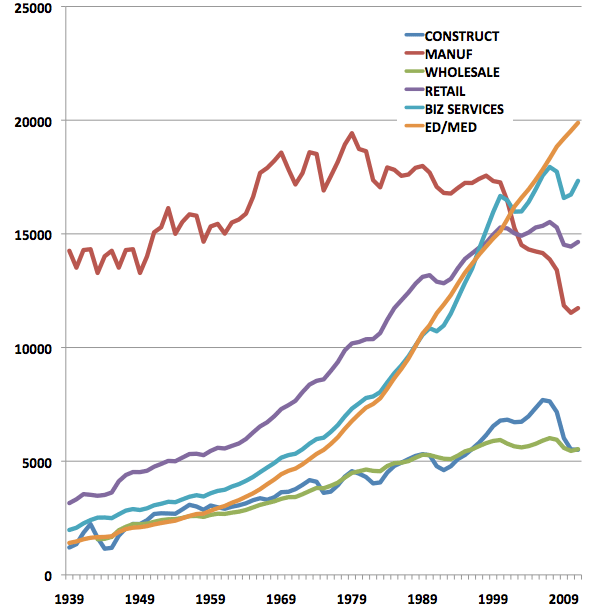
    But for cities hanging their hat on eds and meds growth, a more fundamental problem now looms: these industries are at the end of their growth cycle. Spending on healthcare and college tuition costs has been skyrocketing at rates greater than inflation for years.  Here’s a chart, via Atlantic Cities, showing job creation by sector since 1939:


    If eds and meds employment has been going up continuously since 1939, what’s the problem?  None, so long as it started from a low base at a time when other productive sectors of the economy were likewise growing strongly. But as sectors like manufacturing went into decline or stagnated, eds and meds has continued to increase relentlessly, accounting for an ever larger  portion of total growth.  For example, between 1990 and 2008, eds, meds, and government accounted for about 50% of all national job growth.

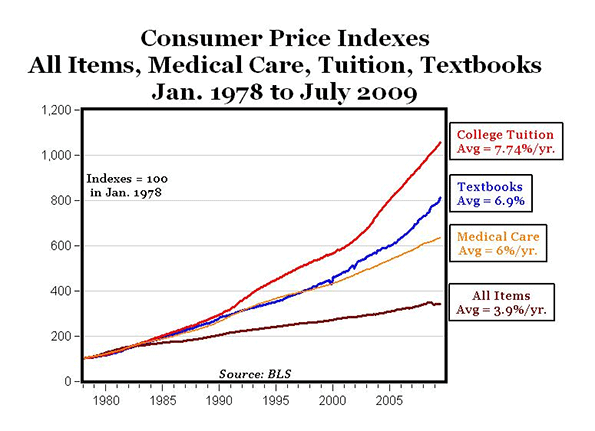
    Unsurprisingly, with growth in jobs exploding, costs have followed. Medical costs and tuition have been growing at twice the rate of inflation, and at an increasingly divergent rate, as this chart from Carpe Diem shows:

    Clearly, such a trend cannot go on indefinitely. As the US starts to groan under the weight of spending on health care and higher education, it’s clear that, as a society, we need to be spend less, not more on these items as a share of national output.  Some cities with unique strengths, like Boston, with its many specialized biotech firms, or Houston, with the world’s largest medical center, may thrive in this environment, but the vast majority of cities are likely to be very disappointed in where eds and meds growth will take them.

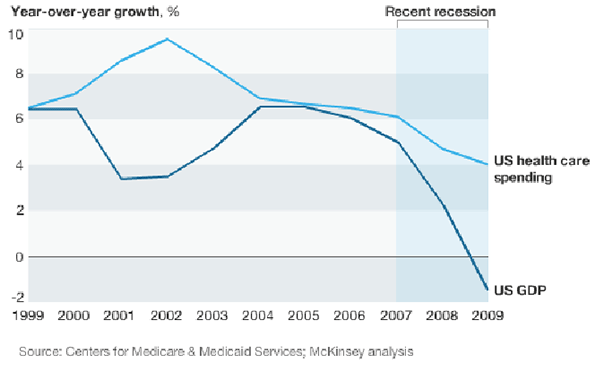
    The problem with health care is most obvious. Aggregate spending on health care has been exceeding the inflation rate for many years. According to a report by McKinsey, spending on health care has consistently grown faster than GDP:


    The net result is a sector that has been consuming an increasing portion of the national economy.  Health care spending is projected to consume fully 20% of the entire US economy by 2021.

    The health care reform act will do little to nothing to rein in this cost. It’s difficult to see how in fact the trend will slow. But with the federal government (especially through Medicare) accounting for more and more total health care coverage, $16 trillion in national debt, and large deficits and unfunded entitlements, one can safely assume that whatever can’t go on forever, won’t. Eventually the government will be forced to take action to stabilize health care spending.

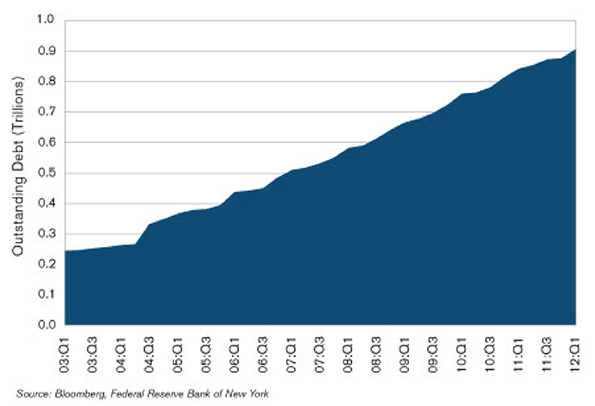
    If the health care cost crisis has long been known, the public is just waking up to the crisis in higher education costs.  Skyrocketing tuition has driven the cost of many colleges through the roof.  This traditionally didn’t bother students, who were assured that a college education the key to a good job that would easily allow loans to be repaid.  In a global age where even knowledge economy jobs are subject to offshore competition, and a recession that’s kept many young people — including many now deeply in debt — unemployed or underemployed.  There is now about $1 trillion of it outstanding, much of it non-dischargeable in bankruptcy:


    This student loan spike was created by many of the same dubious forces that led to the housing crisis. Indeed, some have said that student loans are the next subprime crisis, and commentators like Glenn Reynolds talk of a higher education “bubble”.

    The overall economy will come back at some point, but it’s clear that America is reaching the point at which it can no longer pile more debt onto the backs of students. This by itself will serve to moderate tuition increases at most institutions. There is also a significant amount of reform the current system obviously needs that, if implemented, would also tend to moderate tuition increases.  For example, it doesn’t seem unreasonable to suggest that colleges ought to have some skin in the game for these loans being repaid. Or that cheaper online education might substitute for physical classrooms in some cases.

    Regardless of how it plays out, when you look at spending in aggregate in America, it’s clear increases in health care and higher education spending cannot keep increasing at current rates.  This means that it just isn’t possible for all the cities out there dreaming of eds and meds glory to realize their dream. America simply can’t afford it.

    Whether the end of the great growth phase in eds and meds comes 1, 5, or 10 years from now can’t be predicted. But come in the reasonably near future it will, and that’s when the bulk of the cities that put all their chips in those baskets will receive a very rude awakening.

    Aaron M. Renn is an independent writer on urban affairs and the creator of Telestrian, a data analysis and mapping tool. He writes at The Urbanophile, where this piece originally appeared.
    Hospital photo by Bigstock.

  • The Evolving Urban Form: Zürich

    Zürich is the largest urban area in Switzerland. The core city (stadt) of Zürich is located at the northern end of Lake Zürich, which is glacial and similar to the "finger lakes" of upstate New York. Lake Zürich is approximately 25 miles/40 kilometers long and 1-2 miles/1.5-3 kilometers wide. The urban area extends south along most of the lake and over hills to the East and West and further North.

    Zürich, like larger Paris and Barcelona is a favorite among urban aficionados. Two reasons: the apparent compactness of its urban core and it has one of the world’s best transit systems. Yet, as is shown below, Zürich looks and feels denser than the reality experienced by its citizenry. Moreover the urban core is surrounded by a sea of anything-but-compact suburbanization, as is the case in Paris and virtually all other large Western urban areas. A visit confined to the smallish, but architecturally pleasing precincts of the core can lead to a profound misinterpretation of the urban form (See Louvre Café Syndrome: Misunderstanding Amsterdam and America).

    The City of Zürich (Stadt)

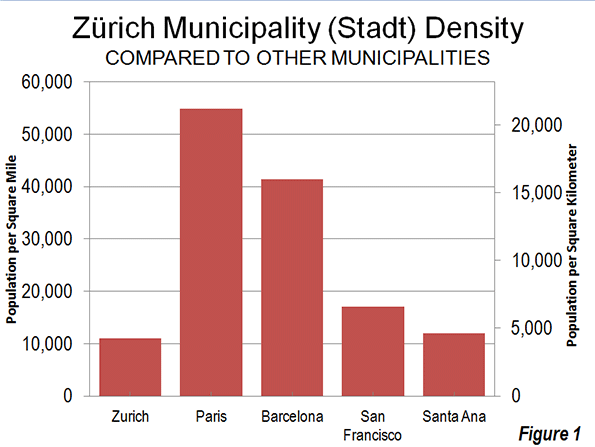
    Like virtually all European core cities that have not substantially annexed new land or consolidated with other jurisdictions, the city of Zürich has lost population. Zürich reached its population peak in 1960, with 440,000 people. Since that time, the population has fallen to 373,000, a loss of 15 percent. The city is not very dense despite its reputation to the contrary. The land area is 34 square miles/89 square kilometers, which yields a 2010 population density of 11,000 per square mile/4200 per square kilometer. This is less than two thirds the density of the city of San Francisco and similar to that of some Los Angeles suburbs, such as Santa Ana, Inglewood or Alhambra (Figure 1).

    The city is divided into nine districts. The densest, the 5th district, covers 1.1 square miles/2.9 square kilometers and has a density of 24,000 per square mile/9200 per square kilometer. By comparison, Westlake, the most densely populated community planning district in the city of Los Angeles covered three times as much land and had a population density of 34,000 per square mile/13,000 per square kilometer in 2000 (latest data available). This is 40 percent greater than the highest Zürich district density.

    The Urban Area

    According to the Federal Office of Statistics (FSO), the Zürich urban area (urban agglomeration) has a population of approximately 1.2 million and covers a land area of 420 square miles/1085 square kilometers. The population density is comparatively low, at 2800 per square mile/1075 per square kilometer.

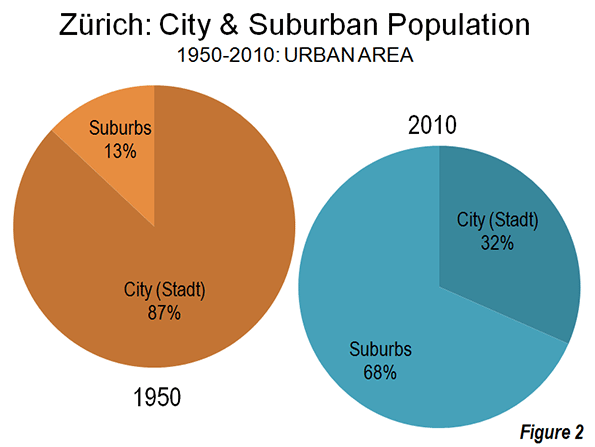
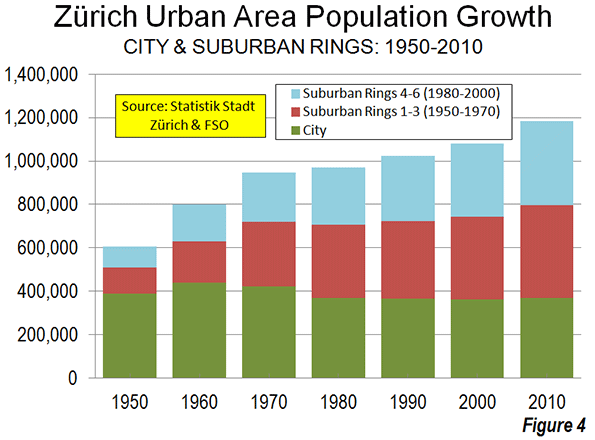
    Zürich’s development since World War II has mirrored the international trend towards suburbanization. In 1950, the urban area included the city of Zürich and 14 additional municipalities. The city, with a population of 390,000, contained more than 85 percent of the urban area population as defined at that time. Since 1950 all growth in the Zürich urban area has been in the suburbs. By 2010, the city of Zürich represented only 32 percent of the urban area population (Figure 2). Suburban areas account for 68 percent of the population and more than 90 percent of the urban land area.

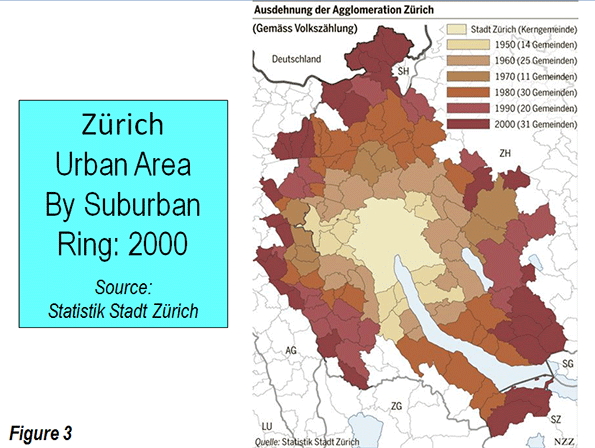
    At each decennial census year, FSO adds new municipalities to the urban area as appropriate. In 1950, the urban area included the city of Zürich as well as 14 additional municipalities. By 2000, the urban area included the city of Zürich and 130 other municipalities (Figure 3). FSO is reviewing 2010 census results and is likely to add more municipalities to the urban area within the next year. The population of the urban area as presently defined has nearly doubled since 1950. The population trend for the city of Zürich and the six suburban rings (as presently defined) is illustrated in the Table.

    Zürich Urban Area: Population of Core Municipality & Suburban Rings: 1950-2010
    1950 1960 1970 1980 1990 2000 2010
    Urban Area: (Agglomeration Zürich)   605,765   801,124   947,011   970,073   1,021,859   1,080,728   1,188,566
    City of Zürich (Stadt)   390,020   440,170   422,640   369,522      365,043      363,273      372,857
    1st Ring (1950)     59,324     97,124   132,014   136,787      135,777      138,936      153,674
    2nd Ring (1960)     45,989     73,560   120,492   140,088      154,226      168,812      192,469
    3rd Ring (1970)     13,396     19,135     44,178     59,823         67,567         73,364         82,693
    4th Ring (1980)     64,259     83,036   113,195   132,444      145,165      159,021      183,878
    5th Ring (1990)     32,777     41,483     52,329     60,240         72,402         82,862         94,244
    6th Ring (2000)     46,616     62,163     71,169         81,679         94,460      108,751
    1950 Population for 6th Suburban Ring (2000) Not Available
    Source: Statistik Stadt Zürich & FSO


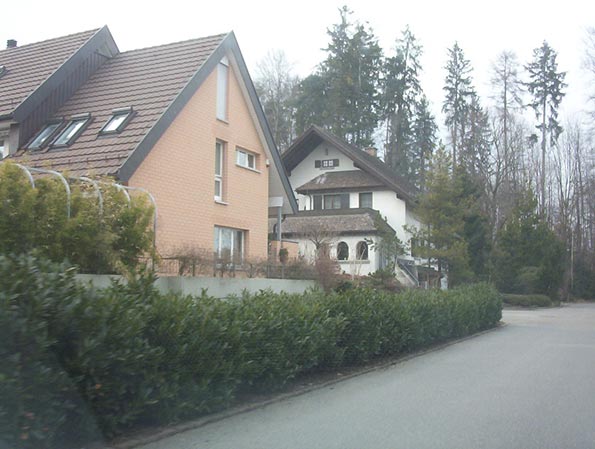
    In recent decades, population growth has gradually moved farther to the periphery of the urban area. This is illustrated by Figure 4, which shows a population trends for the city, the first three suburban rings (1950 to 1970) and the outer three suburban rings (1980 to 2000). By 2000, the three inner suburban rings exceeded the population of the city of Zürich. The outer three suburban rings passed Zürich in population by 2010 (Photo: Suburbs of Zürich).

    Suburbs of Zürich

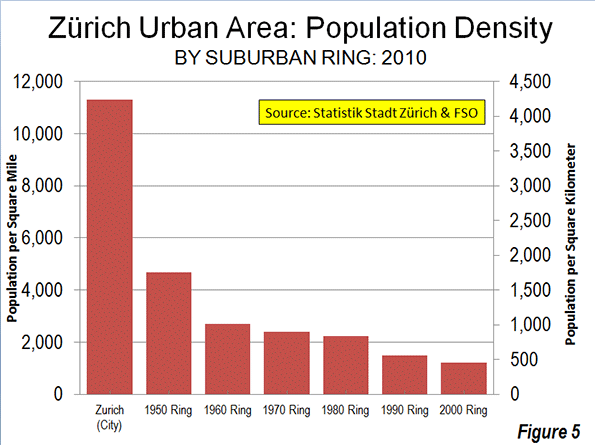
    Suburban densities are considerably lower than that of the city of Zürich. Suburban Zürich has an overall population density of approximately 2100 per square mile/800 per square kilometer. As would be expected, the population densities decline substantially with distance from the city of Zürich (Figure 5). The first ring suburbs (1950) have a population density of 4500 square mile/1800 per square kilometer. This is about a quarter higher than the aggregate suburban density of Portland or New York, but only two-thirds as dense as the Los Angeles suburbs. The lowest population density is in the sixth suburban ring (2000) at approximately 1200 per square mile/450 per square kilometer. This is slightly above the approximate 1000 per square mile/400 per square kilometer international standard used by national statistics agencies in designating urban areas (Note 1).

    Similarly, employment has become more dispersed as jobs follow residents toward lower density suburban areas. Less than 15 percent of the urban area’s employment is in the central business district, a figure similar to that the average of US, Canadian and Australian urban areas.

    Getting Around and To Zürich

    Zürich is served by one of the world’s most effective transit systems, which necessarily focuses on the central business district and provides an intense mesh of service in the core city. Among the approximately 90 urban areas of the world for which the Millennium Cities Database provides service information, Zürich ranked 22nd in transit service intensity (transit vehicle kilometers divided by urban area square kilometers), with a service-level approximately 15 percent that of Hong Kong (Note 3). Among the European urban areas surveyed, only Barcelona and Milan had more intense transit service.

    However, as is the case in all urban areas of Western Europe (as well as the United States, Canada and Australia), the overwhelming majority of motorized travel in the Zürich urban area is by car. Zürich’s automobile market share, in distance traveled, is approximately 75 percent, similar to that of Paris and approximately 15 percent below that of the New York, Toronto or Sydney urban areas.

    Zürich, as the nation’s largest urban area, is unique in not having been linked to its national freeway (motorway) system until recently. Only since 2009 has Zürich been connected to nearby Lucerne (only 30 miles/50 kilometers away) or beyond  through the St. Gotthard tunnel to Milan and the South. The new Uetliberg Tunnel (A4 motorway) connects to the exurb of Zug. For the first time Switzerland’s main north-south motorway connects to its principal route, the east-west A1 motorway   (Note 2).

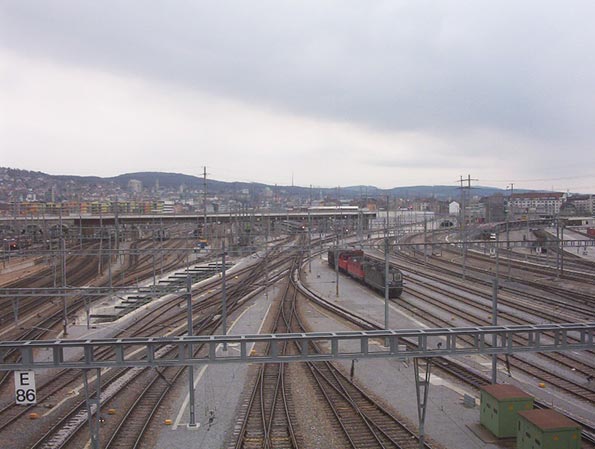
    No motorway dissects the city of Zürich. However, a swath is cut through the city of Zürich by the national railway system. Starting at Zürich Station and extending to the north city limits, the railway divide is from 150 to 450 meters/650 to 1500 feet wide (Photo: Zürich Railway Divide). This may be wider than any freeway in the world. For example, the 26-lane Katy Freeway in Houston, the 18-lane Autopista Panamericana in Buenos Aires and the 14-lane MacDonald Cartier Freeway in Toronto all have average widths of 150 meters/650 feet or less.

    Zürich Railway Divide (from Hardbrücke)

    Zürich: Compact Core, Suburban Reality

    Like urban residents throughout the high-income world, the residents of Zürich (and other Swiss urban areas) have chosen to live in larger, more comfortable houses, often with yards (gardens). At the same time, the historical urban core remains intact as a frequent or occasional destination for both tourists and residents, most of whom live in the suburbs.

    Wendell Cox is a Visiting Professor, Conservatoire National des Arts et Metiers, Paris and the author of “War on the Dream: How Anti-Sprawl Policy Threatens the Quality of Life.”

    —–

    Photo: Zürich Urban Core Street Scene (photos by author)

    Note 1: Such as INSEE (France), National Statistics (UK), Statistics Canada, United States Census Bureau, Census of India,

    Note 3: According to Millennium Cities Database information, only Manila had more intense transit service than Hong Kong (85 percent higher service intensity).

    Note 2: Switzerland speed limits are slow by European standards, but generally higher than those in the United States, Canada and Australia. The national speed limit on the motorway system is 120 kilometers per hour/75 miles per hour. Speed limits are higher in France and Italy at 130 kilometers per hour/81 miles per hour. In Germany, most of the autobahn system is not subject to speed limits. The highest speed limit in the United States is now planned for a new toll road (C-130) between San Antonio and Austin, at 85 miles per hour/137 kilometers per hour and on some other Texas and Utah roads at 80 miles per hour/129 kilometers per hour. Elsewhere in the United States, Canada and Australia, speed limits are lower than in Switzerland and nearly all Europe.