Blog

  • The State of Economy in the Swing States

    I was living in Pennsylvania, voting in my second presidential election when my mom asked me that question in the months leading up to Ronald Reagan’s defeat of Jimmy Carter: “Are you better off today than you were four years ago?” Four-year-ago comparisons are tricky when the worst financial collapse in my lifetime occurred four years ago. Comparing the swing states not to their conditions four years ago, but how they might feel compared to the rest of the nation, Virginia, Colorado and New Hampshire appear to be “better off” than the average American. But in North Carolina, Florida and Pennsylvania, prices for the basic necessities are above the national average while median incomes are lagging. If consumer confidence translates into voter confidence, then the elections in some of the key swing states will belong to the Republicans in 2012.

    Conditions as Percent of National Averages

    Contested State

    Dozen Eggs

    Gasoline

    Utilities

    Income

    Unemployment

    NC

    110%

    100%

    100%

    85%

    116%

    FL

    114%

    101%

    126%

    85%

    106%

    PA

    117%

    101%

    97%

    98%

    95%

    CO

    103%

    97%

    84%

    118%

    100%

    NV

    90%

    104%

    54%

    105%

    145%

    VA

    101%

    99%

    96%

    121%

    71%

    NH

    78%

    95%

    87%

    131%

    65%

    OH

    78%

    97%

    126%

    92%

    87%

    WI

    69%

    108%

    89%

    101%

    88%

    IA

    61%

    80%

    94%

    100%

    64%

    Prices for eggs, gasoline and utilities from www.numbeo.com. Unemployment rates from www.bea.gov. Median income from www.census.gov. Percent of national average calculated by author.  Contested states from www.brookings.edu.

    A presidential election year may be a bumper season for political professionals, but it’s also a time of worry for voters. In the months leading up to the 2000 election, we were wondering how long we could ride the upside of prosperity while the Federal Reserve was busy raising interest rates designed to keep inflation in check. Eighteen months before the 2004 election, tax cuts were battling with the cost of the Iraq war in the federal budget, unemployment was up and consumer confidence was at a 10-year low with stocks headed for their third straight annual decline. A Republican – in fact the same Republican – became president both times.

    Eighteen months before the 2008 election, the overall economy was very mixed according to a Federal Reserve Board report based on data collected from their twelve district banks. Economic activity through the summer was slowing down in five regions, while the other seven reported relatively steady – though not really growing – economic activity. That summer, with the election looming, most people were worried about inflation.

    Discussions of labor shortages showed up in the Federal Reserve reports before the 2008 election from some of the swing states –  states with a large number of unaffiliated voters-like Ohio (shortages in truck drivers), Wisconsin and Iowa (shortages in skilled manufacturing workers and engineers). Pennsylvania reported tight labor markets for both skilled and unskilled workers, suggesting that wages would rise in 2009 while prices were expected to hold steady – a sure way for consumers to feel prosperous. The onset of the financial crisis in September turned all that into a fantasy.

    The party that controlled the White House during the collapse got the blame – Democrats retained the control over the House of Representatives that they won in 2006, no incumbent Democratic senators lost their seats and a Democrat was elected to the White House in 2008. In the 2010 mid-term elections, Democrats retained control over the Senate despite the largest gains by the Republican Party since 1994, yet lost their majority in the House of Representatives. The House has constitutional responsibility for federal spending; a federal budget has not passed on time (meaning there were no threatened shut-downs of the federal government) since 2007. Neither Democrats nor Republicans in the House are doing the job we pay them for – hence, their current new-record-low well-deserved 12% approval.

    This time around, Wall Street has all of the Washington Democrats cheering for a rally. New Geography reader NellyHills put it succinctly (08/26/2012 comment on The Next Public Debt Crisis Has Arrived): “Unfortunately at this point we have 2 choices which are both bad: Continue to believe live with the inflation…, or, Pop the bubble and all suffer through a 10 to 20 year depression. Either way, the middle class loses.” Regular New Geograpphy readers know that having a choice of candidates does not always mean having a good choice. But presidential elections are not won at the national level – they are won in the states, thanks to the Electoral College process of assigning votes. Jobs are a subject every voter understands: Either you have one or you don’t. Again, some of the swing states are really not feeling it while a few – notably Iowa, New Hampshire and Virginia – are doing better than the rest of the nation.

    Contested State

    Unemployment as percent of national rate

    NV

    145%

    NC

    116%

    FL

    106%

    CO

    100%

    PA

    95%

    WI

    88%

    OH

    87%

    VA

    71%

    NH

    65%

    IA

    64%

    Unemployment rates from www.bea.gov. Percent of national average calculated by author.  Contested states from www.brookings.edu.

    Reviewing more recent Federal Reserve Board reports, it is clear that the uncertainty about U.S. fiscal policy and weak demand from consumers are being blamed for the conservative approach to hiring by most employers.

    District

    Contested States

    Jobs

    Wages

    Atlanta

    FL

    Flat to up slightly except in discount retailers where hiring is up significantly

    Positive growth, especially for highly skilled*

    Boston

    NH

    Mostly flat, but without layoffs

    (No comment provided)

    Chicago

    IA, WI

    Flat to up slightly

    Flat except for highly skilled*

    Cleveland

    OH + Pgh PA

    Little hiring except highly skilled

    Flat

    Philadelphia

    PA Ex Pgh

    Up slightly

    Steady to falling

    Kansas City

    CO

    Flat

    Flat except for highly skilled*

    Richmond

    VA, NC

    Temp-to-permanent transitions rising though demand for labor continues to weaken except in highly skilled

    Some widespread gains in wages.

    San Francisco

    NV

    High unemployment and tepid hiring except in highly skilled

    Limited upward pressure (mainly from cost of benefits)

    *Highly skilled workers include information technology, health care, transportation and some profession services, plus certain manufacturing jobs. Source: Federal Reserve Board Beige Book, July 2012

    Once voters have a source of income, the next concern has to be prices — Reagan’s exact words were “Is it easier for you to go and buy things in the store?” Despite lower input prices, consumer product prices are creeping higher across most of the nation.

    District

    Contested States

    Input Prices

    Consumer Prices

    Atlanta

    FL

    Lower energy prices, slightly higher input prices with expectation of future decline

    Higher (based on increased sales in discount stores).

    Boston

    NH

    Steady, but sluggish production

    Steady to slightly higher

    Chicago

    IA, WI

    Lower energy prices, lower retail and wholesale prices for cotton, lower steel and scrap metal prices.

    Food prices expected to rise as crop production deteriorates. Weak response to “sale” promotions.

    Cleveland

    OH + Pgh PA

    Steel and scrap metal price rises easing, some off-shore labor costs rising

    Steady

    Kansas City

    CO

    Steel and scrap metal price rises easing, increases in the cost of building supply materials

    Steady

    Philadelphia

    PA Ex Pgh

    Increases in the cost of building supply materials; otherwise, falling prices.

    Generally falling price levels. Limited ability to pass price increases to homebuyers.

    Richmond

    VA, NC

    Lower prices for cotton to retailers and manufacturers, increases in the cost of building supply materials

    Price increases passed on to homebuyers

    San Francisco

    NV

    Declining prices for raw materials and energy

    Upward pressure easing somewhat

    Source: Federal Reserve Board Beige Book, July 2012

    Back in 2000, Alan Greenspan’s Federal Reserve raised interest rates one time too many, Al Gore won the popular vote, George Bush became president and by March of 2001 we were in recession. In 2008, Bernanke considered making changes to the Fed’s policy to stop all the guessing and swooning that the markets do over Federal Reserve interest-rate changes by making a target known. Credit markets froze solid, Wall Street got bailed out in September, Barack Obama was elected in November. The Wall Street Reform Act passed in 2009 has yet to be enacted in any significant way. Changes in monetary policy – along with double-dip recessions and other economic problems overseas – have so far offset any predicted decline in the dollar that would result in measurable inflation. But that doesn’t matter if you are in Pennsylvania, Florida or North Carolina and struggling to put a roof over your head and food on the table.

    Susanne Trimbath, Ph.D. is CEO and Chief Economist of STP Advisory Services. Dr. Trimbath’s credits include appearances on national television and radio programs and the Emmy® Award nominated Bloomberg report Phantom Shares. She appears in four documentaries on the financial crisis, including Stock Shock: the Rise of Sirius XM and Collapse of Wall Street Ethics and the newly released Wall Street Conspiracy. Dr. Trimbath was formerly Senior Research Economist at the Milken Institute. She served as Senior Advisor on United States Agency for International Development capital markets projects in Russia, Romania and Ukraine. Dr. Trimbath teaches graduate and undergraduate finance and economics.

    States map image by Bigstock.

  • Brewster and Me: Photo Essay Exploring One of Detroit’s Notorious Abandoned Housing Projects

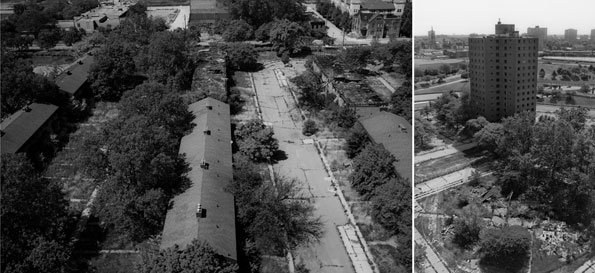
    This year marks the sixtieth anniversary of the Brewster-Douglass housing projects of Detroit Michigan and there is nothing to celebrate. More accurately, there is no one to celebrate. For several years now this section of the city, already infamous for its vacancy, has been completely abandoned. Rows of houses, full apartment blocks, schools empty.

    A cursory Google search will reveal many details regarding the architecture and planning employed at Brewster-Douglass . Diana Ross lived there. For my part, I didn’t want an explanation, but an experience.

    Throughout my years as an urban archeologist (an entirely fictitious title created to legitimate my somewhat antisocial tendencies), I have encountered and explored many beautiful and surreal derelict places. Churches, schools, insane asylums, power stations, you name it – many of these in Detroit itself. An entire abandoned neighborhood, though, had eluded my experience. Brewster-Douglass seemed like a good fit, the logical next step in my quest to photograph unseen urban space.  

    My online research regarding the Brewster-Douglass projects revealed almost nothing concerning the current internal state of the buildings. Friends would later tell me that even local explorers don’t venture inside the towers.  

    On my initial look over the massive property, I noticed that even the window-frames had been stripped from the four remaining 1952 brick towers. The roofs of the houses were torn to ribbons.  

    A car had to be stashed in some bushes, and where I would usually wait for traffic to die down before entry, I merely crossed the street. There were no other cars around. A maze of walkways made almost invisible by the overgrowth lead me past several rows of abandoned townhouses to a square, each corner marked by a virtually identical 14-storey red brick tower. Save for two benches, most of everything has been smashed to bits.

    "Great architecture has only two natural enemies: water and stupid men,” writes noted Chicago photographer Richard Nickel. The clouds in the sky that day were light, and there was no one around. So much for great architecture; this was Pruitt-Igoe without the wrecking ball.

    Let’s make a pilot for a television show here. We can call it ‘What Not to Plan’. I could see right through one house. Nature had made a convertible of its neighbor. Richard Nickel was buried alive when a section of a building he was documenting collapsed. I had better take care.

    From the roof of one of the towers, I gained a clearer view of the pathways below . In the middle sits the remains of a wooden playground, now splintered, scattered and sprayed. Here it is, Le Corbusier’s Radiant City — in ruins. I’ve found Paradise Lost, The Waste Land.   

    Visit this Flickr image set to view higher resolution versions of these photographs.

    If I were filling out a form for Brewster-Douglass, it would have many blank spaces, like the projects themselves — ‘not applicable.

    To understand Brewster-Douglass, one would have to understand Detroit. To understand Detroit, one would have to understand urban racial issues, the nature of the growth of cities, the nature of suburbs (‘sprawl’), and social demography. Economics might help as well. I do not pretend to understand any of these with any authority. I take photographs, and no, I don’t do weddings.

    Supposedly, plans for demolition of the Brewster-Douglass ruins have been set in order to make room for new housing developments. But like so much news from Detroit, I will believe it when I see it.  

    Visit this Flickr image set to view higher resolution versions of these photographs.

    Jonathan Castellino lectures on architectural photography at a school of restoration arts in Southern Ontario (CAN). His work has appeared in the Globe and Mail, Toronto Star, ToNight, Infiltration, Cardus’ Comment, and numerous city websites and publications.

  • Carmel, IN Named Best Small City in America to Live In But Can Others Follow?

    Money Magazine just named the Indianapolis suburb of Carmel as the top small city in America to live in. Fishers, another Indianapolis suburb, ranked #12.

    Any ranking survey, and particularly one done by a magazine, needs to be taken with a grain of salt. However, Carmel and Fishers (along with occasionally Noblesville), frequently show up high in various national rankings. For those interested in suburban living, these places offer a pretty strong combination of good schools, low real estate prices (Indianapolis is basically the cheapest big city housing market in America), low taxes, and fairly high quality of life. With populations of over 75,000 each, these communities also have the scale to efficiently provide quality public services.

    I personally think Fishers has long term sustainability issues. It has kept up with very rapid growth admirably, but it has really not done much to secure its long term future, and when it reaches buildout, I expect problems to set in.

    Carmel by contrast has invested heavily in building towards a future where greenfield growth is no longer the driver. It has invested in high quality public facilities, some of the best suburban transportation infrastructure in the nation, building new urbanist neighborhoods from scratch, upgrading utilities, improving the environment, etc. Dan McFeely of the Indianapolis Star covers Carmel and wrote a bit about this.

    I’ve covered Carmel extensively for years here on the blog, calling it the “next American suburb” and writing about its civic strategy, new urbanist approach, and various criticisms of its leadership.

    I think the Carmel story is an interesting one because it shows how a city, albeit an affluent one, in a very conservative state can fundamentally transform itself in a way that that demonstrates results. This includes urbanism standards and infrastructure standards that exceed those of the urban core of Indianapolis, with many of its public services being better as well.

    The results most notably show up in incomes. While incomes cratered relative to the US in both Indiana and metro Indianapolis, Carmel’s median household income actually inched up versus the US average despite starting from a higher base.

    In short, the strategy has been working, though obviously the national economy has had an effect. And I don’t necessarily support everything they have done. Their $150 million performing arts center, for example, all paid for with public funds, seems expensive for a city of this size, and has saddled the city’s redevelopment commission with debt. But on the whole, things seem to be paying dividends.

    This is part of the explanation for why Indianapolis as a region has done well while its urban core lags many other cities. The majority of people prefer suburbs, and Indy’s newer suburbs provide an exceptional value proposition.

    Ultimately to be successful, the region will have to fire on all cylinders. This means both urban and suburban, with each neighborhood and town bringing a unique approach and its A game to the table. It’s not an either/or situation. I want to build urban cores up, not tear suburbs down. (Downtown Indianapolis has its own game going. Despite some recent criticisms that I stand behind, downtown Indy has positive momentum in a lot of areas. For example, another 300 tech jobs were just announced yesterday).

    I previously highlighted Columbus, Indiana, which has accomplished something similar in a more blue collar environment. So positive stories based on different variations of the same playbook aren’t limited merely to upscale suburbs.

    In a state that has long lagged the nation in job and output growth, and where the very large decline in relative incomes has been a huge issue at all levels, you would think that leaders would be streaming in to study these successful models.

    Alas, that is not the case. Not only is there little interest in learning from models that are actually working (save perhaps for other Indy suburbs looking to Carmel), there’s actual hostility. It’s as I said in some recent posts: Indiana actively discourages the pursuit of excellence. They’d rather cut down the successful than bring up the failing. State level policy choices are trying to do just that.

    Start with school funding. As part of a property tax reform process, the state of Indiana took over 100% of all local school operating funding. However, they also changed the funding formula in a way that stuck well performing metro Indy districts at the bottom of the pile. Out of about 360 school districts statewide, Carmel is fourth from the bottom in per pupil funding from the state. Other regional districts like Fishers and Zionsville are also at the bottom. In effect, the state decided to starve fast growing and well performing suburban districts. Somehow this didn’t make the list of education reforms in that recent Economist article. For a state that claims to want to base its economic future on things like life sciences, this sure seems puzzling.

    The state has also sought to impose a one size fits all, least common denominator approach to services. While it didn’t affect Carmel directly since they already built their first class library, the state’s Department of Local Government Finance vetoed plans by the suburbs of Westfield and Greenwood to build new libraries (partially inspired by Carmel), even though the bonding plans survived a petition challenge. The state’s rationale was that the cost per resident was higher than the state average. It’s easy to see that a policy like this acts as a one way downward ratchet.

    The state also passed a law that not only capped property taxes as a percentage of assessed value – a measure I support – but also put in place a de facto spending freeze for all cities at current levels through a levy cap.* (This levy cap ignores growth in commercial tax base, so if a town built a 50 million square foot industrial park, it wouldn’t even be able to raise the revenues to provide services to it).

    This has left cities increasingly depending on gimmicks to finance anything. And every time a city figures something like that out, the state makes noises about shutting it down. The state has also refused to allow communities to even let their own citizens vote in favor of spending money on things like transit. Indiana has never particularly empowered municipalities, but recent years have seen a strong turn towards disempowerment, with the state’s General Assembly serving as a sort of uber-city council (and now uber-school board too).

    I’d be willing to venture that neither Carmel nor Columbus would be able to accomplish what they have if they were starting out on the journey today under the current state legal and political climate.

    This is not to say that spending money is a solution to problems. Actually, by national standards, places like Carmel and Columbus don’t spend very much money at all. With some exceptions like that performing arts center, they are actually quite frugal. They understood the concept of long term total cost of ownership, and as a result have kept taxes low by not being penny wise, pound foolish in the short term, while so many other places that thought only about the now have descended into a near death spiral of service cuts, tax increases, and abandonment. That’s the tragedy.

    In a rational world, one would think that we’d look at models that are producing population growth, job growth, corporate (including foreign) investment, high quality of services and quality of life, keeping incomes at or above US levels – and mostly importantly all while keeping taxes well below normal (at the bottom of the state in Carmel’s case) even by the standards of Indiana – and say to ourselves: how can we get more of that? Unfortunately, that’s not the case here. (Again, some other Indy suburbs excepted).

    Before proposing solutions to Indiana’s long term under-performing economy, I would suggest that the candidates for governor first take a look around the state to examine at the places that are already doing well and have been doing well over the last decade or more. Then ask the question: what are they doing different and right and what do we need to do to get other places doing those things? First among the places to visit would be suburbs like Carmel and industrial cities like Columbus. If you’re ranked #1 in America, you must be doing something right.

    * This is complicated, but my understanding is that the total property tax levy cannot grow faster than inflation + population growth. This has had many perverse incentives, including keeping entities like townships from lowering their tax levy even when possible because they’re afraid they’ll never be able to raise it again if needed.

    Aaron M. Renn is an independent writer on urban affairs and the creator of Telestrian, a data analysis and mapping tool. He writes at The Urbanophile, where this piece originally appeared.

    Carmel City Hall photo by Bigstock.

  • Tokyo: Population Swan Dive Predicted

    In a recent Evolving Urban Form article, we speculated that Tokyo, the world’s largest urban area (population more than 35 million) could be displaced by fast-growing Jakarta or Delhi as early as 2030. If the prediction of central jurisdiction administrators and academics come true, Tokyo could be passed by many other urban areas in population by 2100.

    The Japan Times reports forecasts that the population of the Prefecture of Tokyo, the central jurisdiction of the metropolitan area, could decline by nearly 50 percent (chart) between 2010 and 2100 (Note). Yet, while the overall population is dropping in half, the elderly population would increase by more than 20 percent. The resulting far less favorable ratio of elderly to the working population would present unprecedented social and economic challenges.

    The article provides no information on the population of the entire urban area in 2100. The Prefecture of Tokyo constitutes somewhat over one third of the present population of the urban area.

    During the last census period (between 2005 2010) the four prefecture Tokyo metropolitan area (Tokyo, Kanagawa, Saitama and Chiba), gained approximately 1,100,000 new residents, while the balance of the country was losing 1,400,000 residents. Japan is forecast to suffer substantial population losses in the decades to come. The United Nations forecasts that its population will decline from approximately 125 million in 2010 to 90 million in 2100. This is the optimistic scenario. The National Institute of Population and Social Security Research forecasts a drop to under 50 million, a more than 60 percent population reduction.

    There are serious concerns about the projected population decline. According to the Japan Times, the researchers said that " … it will be crucial to take measures to turn around the falling birthrate and enhance social security measures for the elderly,"  A professor the National Graduate Institute for Policy Studies, expressed concern that "If the economies of developing countries continue growing, the international competitiveness of major companies in Tokyo will dive."

    —-

    Note: the Prefecture of Tokyo government is called the Tokyo Metropolitan Government. This term can mislead, because the prefecture itself is not the metropolitan area, but only part of the four prefecture metropolitan area. The pre-– amalgamation predecessor of the current city of Toronto was called the Municipality of Metropolitan Toronto. Like the Prefecture of Tokyo, the Municipality of Metropolitan Toronto comprised only part of the Toronto metropolitan area. Confusion over these terms not only resulted in incorrect press reports, but even misled some academic researchers to treat these sub-metropolitan jurisdictions as metropolitan areas.

  • The Growing Number of Freelancers in Entertainment

    When people were preparing eulogies for the entertainment sector, Techdirt’s Mike Masnick popped out with his bold piece, “The Sky is Rising,” and poked holes in the gloomy forecast. His scrutiny of the numbers revealed that the entertainment industry is actually growing. Entertainment consumption per household increased from 2000 to 2008. Employment in the entertainment sector jumped 20% from 1998 to 2008. And the number of independent artists rose 43% over the same period.

    While the outlook for the sector might not be quite as sunny as Masnick indicates in his report (case in point: the share of household income spent on entertainment has declined every year since 2008), it’s true that entertainment employment is on the rise. Over the last decade-plus, the number of entertainment and sports-related jobs — a group of 10 occupations that includes actors, musicians, and dancers, as well as coaches and referees, etc. — has grown 30%.

    But much of this job growth, especially since the recession, is not of the traditional wage-and-salary variety. Instead, EMSI’s new class-of-worker data shows that proprietors account for 242,000-plus, or nearly 80%, of the jobs added since 2001 in the main entertainment and sports-related occupations. This includes workers whose main income comes from self-employment, and even more so those doing side gigs in addition to their day job (what EMSI labels as “extended proprietors” but might better be referred to as freelancers in this case).

    Note: EMSI’s employment estimates are a count of jobs, not a count of workers. One person can hold more than one job, and this is particularly the case with the types of worker activity tracked in our extended proprietor dataset.

    ENTERTAINMENT-RELATED JOBS (2001-2012)
    Source: EMSI 2012.2 Class of Worker
    2001 Jobs 2008 Jobs 2012 Jobs % Growth Since 2001 % Growth Since 2008 Avg. Hourly Wage
    Wage-and-Salary 492,960 549,333 556,765 13% 1% $19.32
    Self-Employed & Extended Proprietors 512,383 685,773 755,137 47% 10% $17.24
    Total 1,005,343 1,235,106 1,311,902 30% 6% $18.15


    Since 2001, employment in entertainment and sports among wage-and-salary workers (those who draw benefits and pay into the unemployment insurance program) has increased 13%. This is a solid gain, but consider that since ’08, the heart of the recession, the job gains have been minimal (1% growth, or 7,432 jobs added).

    But look at the self-employed and extended proprietors row in the above table: this part of the entertainment and sports-related workforce has mushroomed 47% since ’01, and 10% since ’08.

    The growth in proprietors makes sense when you think about the work being done in these fields — moms and dads coaching their kids (or serving as referees) in soccer, office workers moonlighting in a band that does local gigs, men and women working part-time for the local stage company as an actor or director. These are just a few examples. But it’s clear businesses that hire these types of workers require or prefer freelancers or part-timers; it’s just the nature of the work. And as families’ budgets get tighter or single people need extra (or any) income, these jobs are a welcomed option, at least in the short term.

    There are still more than a half million salaried jobs in these fields. But increasingly, freelance workers are becoming the norm in entertainment and sports.

    The Workforce Breakdown

    Overall, 58% of the “entertainers and performers, sports and related” workforce, as it’s classified by the Bureau of Labor Statistics, is made up of proprietors. That’s up from 51% in 2001 and 56% in 2008.

    The largest occupation in this sector, musicians & singers, is predominantly composed of those who do work on the side. Just over 265,000 of 440,000-plus musician jobs in the US fall under EMSI’s extended proprietor category, and there are nearly as many self-employed musicians (73,875) as traditional W-2 musicians (102,628).

    Musicians aren’t alone in this trend, of course. Of the 118,000-plus estimated actors in the US, almost half are extended proprietors and another 18,520 are self-employed. Dancers, coaches & scouts, and others have a similar labor force breakdown.

    The highest percentage growth since 2001 among these 10 occupations has come in coaches and scouts (51%). Second is actors at 42%; of the 34,706 new actors jobs in the last decade-plus, all but 2,230 have come in the self-employed and extended proprietor categories.

    SOC Code Description 2001 Jobs 2012 Jobs Change % Change Median Hourly Wage Education Level
    Source: EMSI 2012.2 Class of Worker – QCEW Employees, Non-QCEW Employees, Self-Employed, Extended Proprietors
    27-2011 Actors 83,451 118,157 34,706 42% $16.54 Long-term on-the-job training
    27-2012 Producers and Directors 126,576 124,670 -1,906 -2% $28.86 Bachelor’s or higher degree, plus work experience
    27-2021 Athletes and Sports Competitors 28,335 38,520 10,185 36% $27.30 Long-term on-the-job training
    27-2022 Coaches and Scouts 198,681 299,509 100,828 51% $13.89 Long-term on-the-job training
    27-2023 Umpires, Referees, and Other Sports Officials 25,547 34,447 8,900 35% $11.31 Long-term on-the-job training
    27-2031 Dancers 29,914 37,496 7,582 25% $14.70 Long-term on-the-job training
    27-2032 Choreographers 17,343 22,628 5,285 30% $18.30 Work experience in a related occupation
    27-2041 Music Directors and Composers 65,593 79,927 14,334 22% $19.31 Bachelor’s or higher degree, plus work experience
    27-2042 Musicians and Singers 324,934 441,882 116,948 36% $18.01 Long-term on-the-job training
    27-2099 Entertainers and Performers, Sports and Related Workers, All Other 104,970 114,665 9,695 9% $18.47 Long-term on-the-job training
    Total 1,005,343 1,311,902 306,559 30% $18.15


    Across the board, the job growth numbers look radically different if we take out proprietors. Looking just at EMSI’s QCEW dataset, which corresponds to published Quarterly Census of Employment and Wages data, only four of these occupations have had double-digit growth since ’01: coaches and scouts (39%); choreographers (32%); entertainers and performers, sports and related workers, all other (15%); and music directors and composers (13%).

    Top Metros for Entertainment

    We all know New York City and Los Angeles are major entertainment hubs. But EMSI’s data is still startling: The nation’s two largest cities account for nearly 1 out of every 5 entertainment and sports-related jobs in America. The New York City metro area has the most jobs in entertainment and sports-related fields of any MSA (with more than 116,000 estimated in 2012), followed by L.A. (112,528). These two have nearly four times the number of jobs as Chicago, which has the third-most in the US at nearly 37,000.

    Of the 50 most populous metros in the U.S., Los Angeles is also the most concentrated in entertainment and sports-related workers. With a location quotient of 2.06, L.A. is more than twice as concentrated as the national average of 1.0. Nashville, with an LQ of 2.02, is close behind, followed by San Francisco, New York, Las Vegas, and Austin, Texas.

    Since 2008, Austin has blown away every other big metro in terms of its job growth in entertainment and sports jobs (18.4%). Second is Richmond, VA (13.4%).

    ENTERTAINMENT-RELATED JOBS IN 50 LARGEST METRO AREAS
    Source: EMSI 2012.2
    MSA Name 2012 Jobs 2008-2012 Percentage Growth Median Hourly Earnings 2012 National Location Quotient
    Los Angeles-Long Beach-Santa Ana, CA 112,528 1.3% $26.22 2.06
    Nashville-Davidson–Murfreesboro–Franklin, TN 15,442 7.8% $22.12 2.02
    San Francisco-Oakland-Fremont, CA 30,667 5.6% $23.80 1.51
    New York-Northern New Jersey-Long Island, NY-NJ-PA 116,234 7.9% $23.81 1.43
    Las Vegas-Paradise, NV 10,242 5.0% $21.14 1.29
    Austin-Round Rock-San Marcos, TX 10,421 18.4% $16.51 1.27
    Orlando-Kissimmee-Sanford, FL 11,380 5.4% $17.42 1.22
    Portland-Vancouver-Hillsboro, OR-WA 11,953 6.2% $16.01 1.21
    Salt Lake City, UT 7,480 9.1% $18.46 1.20
    Boston-Cambridge-Quincy, MA-NH 26,143 5.1% $20.53 1.14
    New Orleans-Metairie-Kenner, LA 5,906 6.5% $15.85 1.13
    Seattle-Tacoma-Bellevue, WA 18,608 6.1% $19.06 1.13
    Minneapolis-St. Paul-Bloomington, MN-WI 17,912 4.0% $18.94 1.11
    Atlanta-Sandy Springs-Marietta, GA 24,329 12.9% $19.39 1.06
    Washington-Arlington-Alexandria, DC-VA-MD-WV 30,413 7.5% $19.64 1.06
    Milwaukee-Waukesha-West Allis, WI 7,385 -0.2% $16.21 1.05
    Denver-Aurora-Broomfield, CO 12,975 0.4% $18.08 1.04
    Hartford-West Hartford-East Hartford, CT 5,842 8.5% $19.33 1.02
    Indianapolis-Carmel, IN 8,184 11.3% $16.60 1.02
    Kansas City, MO-KS 9,226 10.7% $16.17 1.01
    Providence-New Bedford-Fall River, RI-MA 6,235 3.0% $16.47 1.00
    Raleigh-Cary, NC 4,897 8.7% $15.55 1.00
    Birmingham-Hoover, AL 4,713 5.6% $14.64 0.99
    Dallas-Fort Worth-Arlington, TX 28,900 13.2% $18.42 0.96
    Richmond, VA 5,363 13.4% $15.50 0.95
    Tampa-St. Petersburg-Clearwater, FL 10,409 9.5% $17.60 0.95
    St. Louis, MO-IL 11,182 2.7% $18.81 0.94
    Cleveland-Elyria-Mentor, OH 8,465 4.4% $14.95 0.93
    Sacramento–Arden-Arcade–Roseville, CA 7,844 1.2% $17.26 0.93
    San Diego-Carlsbad-San Marcos, CA 12,478 1.4% $21.90 0.93
    San Jose-Sunnyvale-Santa Clara, CA 7,991 8.2% $19.51 0.92
    Baltimore-Towson, MD 11,283 2.7% $18.28 0.91
    Jacksonville, FL 5,305 12.2% $17.98 0.91
    Charlotte-Gastonia-Rock Hill, NC-SC 7,130 5.4% $18.80 0.90
    Chicago-Joliet-Naperville, IL-IN-WI 35,828 4.8% $16.91 0.89
    Philadelphia-Camden-Wilmington, PA-NJ-DE-MD 21,974 7.3% $18.29 0.89
    Cincinnati-Middletown, OH-KY-IN 8,041 5.8% $17.61 0.88
    Columbus, OH 7,586 8.0% $16.84 0.88
    Miami-Fort Lauderdale-Pompano Beach, FL 20,187 5.4% $22.13 0.86
    Pittsburgh, PA 8,991 10.8% $17.61 0.86
    Louisville/Jefferson County, KY-IN 4,743 5.6% $15.98 0.85
    Detroit-Warren-Livonia, MI 13,422 0.0% $16.29 0.81
    Buffalo-Niagara Falls, NY 3,768 -0.2% $15.66 0.80
    Memphis, TN-MS-AR 4,531 7.0% $16.74 0.80
    Oklahoma City, OK 4,534 11.9% $15.62 0.79
    Virginia Beach-Norfolk-Newport News, VA-NC 5,814 4.8% $14.31 0.79
    Phoenix-Mesa-Glendale, AZ 13,194 6.7% $18.27 0.78
    Riverside-San Bernardino-Ontario, CA 9,203 1.6% $18.51 0.76
    San Antonio-New Braunfels, TX 6,732 11.2% $16.98 0.76
    Houston-Sugar Land-Baytown, TX 18,270 11.8% $18.87 0.69


    What About All MSAs?

    Among all MSAs in the US with at least 500 jobs in these fields, the highest concentration in the entertainment and sports-related sector belongs to Edwards, Colorado, which is just west of the resort community of Vail (home to the Vail Jazz Festival). The Edwards MSA has just 1,100 estimated entertainment and sports-related jobs. But with a location quotient of 8.42, it is more than eight times as concentrated as the national average in these fields.

    Next is an MSA that you’d probably expect to see this high on the list: Santa Fe, New Mexico (with an LQ of 4.01). Sante Fe is known for its art galleries, museums, and other tourist-friendly sites, and it has more than 2,000 entertainment and sports-related jobs.

    Joshua Wright is an editor at EMSI, an Idaho-based economics firm that provides data and analysis to workforce boards, economic development agencies, higher education institutions, and the private sector. He manages the EMSI blog and is a freelance journalist. Contact him here.

    Film crew photo by Bigstock.

  • Barack Obama’s New Chicago Politics Abandon Bill Clinton’s Winning Coalition

    While the Democratic convention this week celebrates the party’s new coalition, Bill Clinton will no doubt try to recapture the white middle class that’s largely deserted the Democrats since his presidency ended. But it’s likely his efforts will be a case of too little, too late for Barack Obama—who will have to look elsewhere for his electoral majority.

    The gentrification of the Democratic Party has gone too far to be reversed in this election. After decades of fighting to win over white working- and middle-class families, Democrats under Obama have set them aside in favor of a new top-bottom coalition dominated by urban professionals—notably academics and members of the media—single women, and childless couples, along with ethnic minorities.

    Rather than representing, as Chris Christie and others on the right suggest, the old, corrupt Chicago machine, Obama in fact epitomizes the city’s new political culture, as described by the University of Chicago’s Terry Nichols Clark, that greatly deemphasizes white, largely Catholic working-class voters, the self-employed, and people involved in blue-collar industries.

    The Chicago that Obama represents is more Hyde Park or the Gold Coast than the Daley family base in blue-collar Bridgeport; more faculty club, media shop or Art Institute than the factory culture of “the city of Big Shoulders”.

    The traditional machine provided him with critical backing early in his political career, but Obama owes his success to new groups that have taken center stage in the increasingly liberal post-Clinton Democratic party: the urban “creative class” made up mostly of highly-educated professionals, academics, gays, single people, and childless couples. It’s a group Clark once called “the slimmer family.” Such people were barely acknowledged and even mistreated by the old machine; now they are primary players in the “the post-materialistic” party. The only holdovers from the old coalition are ethnic minorities and government workers.

    As Clark suggests, the new political urban culture differs in both intent and content from the old one. In the past, say under Richard Daley Sr., Chicago was still a family city where schools, churches, and neighborhood associations were key local amenities. Patronage meant jobs for people who also owned homes, both inside and outside the city, and raised and educated their children, often in Catholic schools. The old Daley machine would no more take on the church on contraception than embrace North Korea as its political role model.

    The  Chicago that spawned Obama  has very different priorities. Clark gives perhaps the best definition—“the city as entertainment machine,” where citizens are preoccupied with quality-of-life issues, “treating their own urban location as if tourists, emphasizing aesthetic concerns.”

    This new city, built around the needs of largely childless and often single professionals, focuses primarily on recreation, arts, culture, and restaurants;  the resources valued by the newly liberated urban individual. The economy of such places focuses primarily on those jobs done by these professionals, either in the over-hyped social-media sector, traditional entertainment, or as service providers— waiters, toenail painters, dog-walkers—that cater to the gentry of the urban core.

    In this urban schema, family, long the basic unit of society, becomes peripheral. The new urban political  base—not only in the Windy City but in Boston, New York, Los Angeles, Seattle, Boston and other parts of the core Obama archipelago—is primarily childless, notes demographer Ali Modarres. A majority of residences in Manhattan, for example, are for singles; thus Mayor Bloomberg’s push for 300 square-foot “affordable” micro units that could cost as much as $2,000 a month. Gentrifying Washington, D.C., now boasts the highest concentration of childless adult females in the nation, a mind-boggling 70 percent of all adult women.

    With more than half of all American women now single and more than half of all births to women under 30 now occurring outside of marriage—both historic developments—Obama has targeted “single women” as a core constituency second only to African Americans. Democratic pollster Stanley Greenberg has dubbed them “the largest progressive voting bloc in the country.” Singles, though not the most reliable voting bloc, almost elected John Kerry, and helped put Obama over the top.

    The new urban political culture Nichols described in Chicago has gone national, essentially gentrifying  the Democratic Party and pushing away the predominately white working- and middle-class families whose goals centered around achieving home ownership, basic essentials, and the occasional luxury. These groups have been leaving both the core cities and the Democratic Party for generations. Bill Clinton, former governor of a poor southern state, connected with these voters through his political genius, natural empathy, and his own biography in ways that have proven difficult for President Obama.

    By all accounts, the inroads made among the group by Clinton, and, thanks to the economic crisis, Barack Obama in 2008, have largely dissipated now. Polling data suggests that these groups are now among the strongest backers of that eminent and hard-to-like patrician, Mitt Romney. 

    Recent Gallup polls show Obama’s strongest support, in terms of professions, coming from “professionals,” such as teachers, lawyers, and educators. He does worst among both small businesspeople and those who work in industries such as energy, manufacturing, transportation and construction, where Democrats from Roosevelt to Clinton often won significant support.

    The division between the new political culture and the older one can be seen in a host of issues, most notably policies that favor urban density over suburbs, and strict environmental policies that hurt basic industries. An agenda aimed at ending “sprawl,” cars, and carbon-generating industries appeals generally to the unmarried and childless, who don’t have to worry overmuch about the need for extra space, backyards, or mundane tasks like taking kids to school, or to Target.  

    Ironically, the other key component of the new political culture comes from the other end of the social order: generally poorer, urban-centered minority populations. For all the hype about gentrification of cities, over the past decade the poor accounted for about 80% of population growth in the urban cores of the nation’s 51 largest metropolitan areas. In suburban areas, by contrast, the poor accounted for just 32 percent of population growth.

    Ironically, these poor minorities continue to back the new political culture even though it favors policies, such as expensive “green energy” and tight regulations, that essentially force all but the highest value-added businesses from the urban core, leaving what Mayor Michael Bloomberg famously defined as “the luxury city.” As manufacturers and many service businesses leave either for the suburbs or less expensive regions, the historical working and middle class has also exited, leaving behind a largely entrenched poverty population, a post-materialist upper class, and little in-between.

    Focused on the “upstairs” part of the new political culture, the administration—confident in minority support—has done very little materially to improve the long-term prospects of those “downstairs.” Minorities, in fact, have done far worse under this administration than virtually any in recent history, including that of the hapless George W. Bush. In 2012, African-American unemployment stands at the highest level in decades; 12 percent of the nation’s population, blacks account for 21 percent of the nation’s jobless. The picture is particularly dire Los Angeles and Las Vegas, where black unemployment is nearly 20%, and Detroit, where’s it’s over 25 percent. 

    Latinos, the other major part of the Party’s “downstairs” coalition, have also fared badly under Obama. This is true even among the aspiring working- and middle-class. Overall, the gap in net worth of minority households compared to whites is greater today than in 2005. White households lost 16% in recent years, but African-Americans dropped 53% and Latinos a staggering 66% of their pre-crash wealth. 

    So how does the Democratic Party, in Chicago and elsewhere, maintain its support among these groups? Needlessly exclusionary Republican policies play a role, scaring off potential minority voters, particularly immigrants and their offspring. Obama also has used his own biography to appeal personally to these groups, most understandably African-Americans, as a way to divert them from his economic shortcomings. And well-timed election-year conversions on key social issues like gay marriage and amnesty for young undocumented immigrants have helped him outmaneuver the hopelessly clueless GOP.

    The fact that there are few decent middle-income jobs—in fact the jobs that have appeared during the recovery have been vastly worse than those lost during the meltdown—for the newly legalized or anyone else seems, at the moment at least, somewhat besides the point.

    Indeed  “besides the point” may be the real Democratic slogan for this year. The Democrats in Charlotte need to argue that results—fewer jobs and far fewer middle-income jobs—matter less than the blessings of green politics, urbanism, and racial-identity politics. In today’s  Democratic party, having  the “correct”  sentiments often seem to outweigh even the fundamentals of broad-based economic success.

    One can only wonder what Harry Truman would think of Obama’s approach, or perhaps even Bill Clinton in his private moments.

    Joel Kotkin is executive editor of NewGeography.com and is a distinguished presidential fellow in urban futures at Chapman University, and contributing editor to the City Journal in New York. He is author of The City: A Global History. His newest book is The Next Hundred Million: America in 2050, released in February, 2010.

    This piece originally appeared in The Daily Beast.

    Bill Clinton photo by Bigstock.

  • Obama Fuel Economy Rules Trump Smart Growth

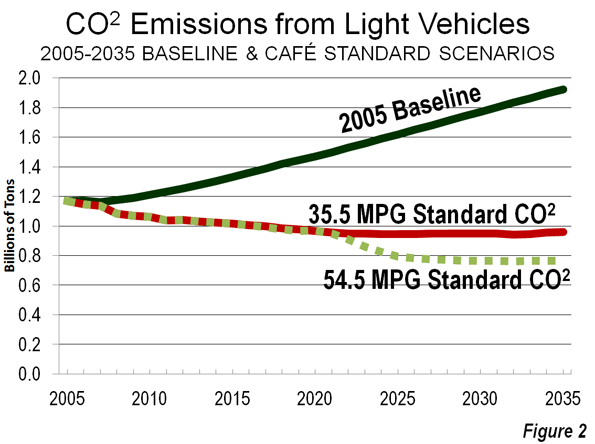
    The Environmental Protection Agency (EPA) has just finalized its regulation requiring that new cars and light trucks (light vehicles) achieve average fuel efficiency of 54.5 miles per gallon (MPG) by 2025 (4.3 liters per 100 kilometers). This increase in the "CAFE" standard (Corporate Average Fuel Efficiency) is the second major step in the Obama Administration’s program to improve light vehicle fuel efficiency. In 2010, EPA adopted regulations requiring 35.5 MPG average by 2016 (6.6 liters per 100 kilometers).

    The EPA standard is based upon carbon dioxide (CO2) grams emitted per mile of light vehicle travel, with an average of 163 grams per mile (101 per kilometer) to be achieved in 2025. This is slightly above the 2020 European Union standard of 152 grams per mile (95 grams per kilometer). Of course, the regulations have both supporters and detractors, with the automobile manufacturers being among the supporters.  

    Assuming the objectives are met, the reductions in CO2 emissions will dwarf the modest gains forecast from anti-suburban smart growth policies. For decades, this powerful movement has sought to limit or prohibit suburban expansion and even outlaw the detached housing that most people prefer. This includes railing against automobile use and seeking to coerce people out of their cars (as expressed by Secretary of Transportation Ray LaHood).

    The anti-suburban movement has many labels in addition to "smart growth," such as “densification policy," "compact cities," "growth management," "urban consolidation," etc. The origins can be traced back to just after World War II, with the enactment of the British Town and Country Planning Act. The policy origins of smart growth in the United States date from the 1960s (the state of Hawaii) and 1970s (the state of Oregon and California local jurisdictions).

    Forecast CO2 Emission Reductions from Smart Growth

    With concerns about greenhouse gas (GHG) emissions (principally carbon dioxide, or CO2), proponents saw the opportunity to force people back into the cities (from which most did not come) and turn smart growth into an imperative for "saving the planet." This is no exaggeration. As late as last month, this was claimed by fellow panelists at a Maryland Association of Counties conference. As is indicated below, the data shows no such association.

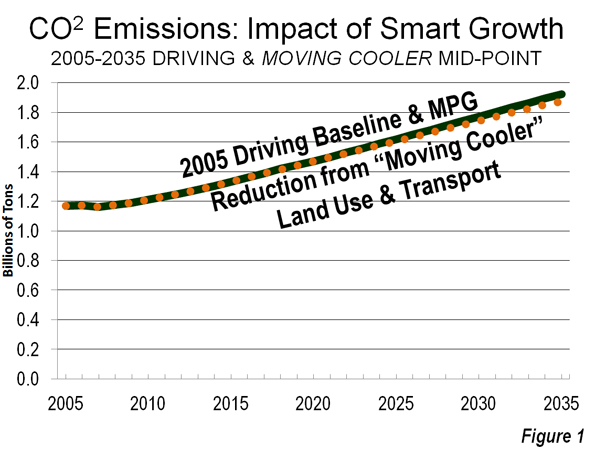
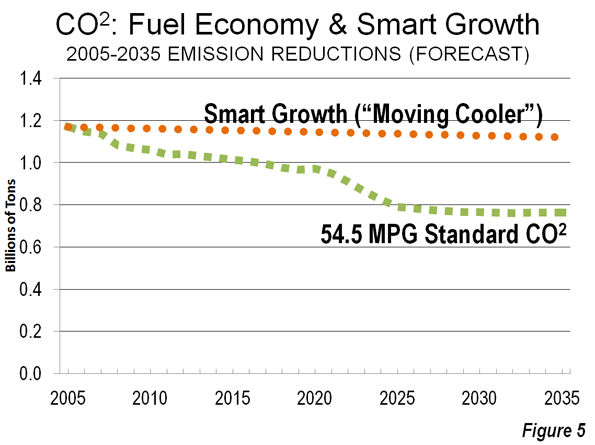
    Even forecasts by proponents fall short of demonstrating an apocalyptic necessity for smart growth. The Cambridge Systematics and Urban Land Institute Moving Cooler report attributed only modest reductions in CO2 emissions to smart growth’s land use and mass transit policies (Moving Cooler was criticized on this site by Alan Pisarski. See ULI Moving Cooler Report: Greenhouse Gases, Exaggerations and Misdirections). The data in Moving Cooler suggests an approximately 50 million ton reduction in CO2 emissions from these smart growth strategies by 2035 (interpolating between 2030 and 2050 figures).

    The more balanced Transportation Research Board Driving and the Built Environment: The Effects of Compact Development on Motorized Travel, Energy Use, and CO2 Emissions  produced similar figures, however it indicated skepticism about whether their higher range projections were "plausible."

    Comparing Smart Growth to the Previous Fuel Economy Standard

    At the 2005 fuel economy rate and the projected driving increase rate in the US Department of Energy Annual Energy Outlook:2008 (AEO), CO2 emissions from light vehicles would have increased 64 percent from 2005 to 2035 (Note 1). This could be called the "baseline" case or the "business as usual" case. This would have resulted in a CO2 emissions increase from light vehicles of approximately 0.75 billion tons.

    Using the more aggressive Moving Cooler forecast, the smart growth transport and land use strategies would only minimally reduce CO2 emissions from the baseline case (64 percent above 2005 levels) to 60 percent. This is "chicken feed" (Figure 1).

    Forecast CO2 Emission Reductions from the 54.5 MPG Standard

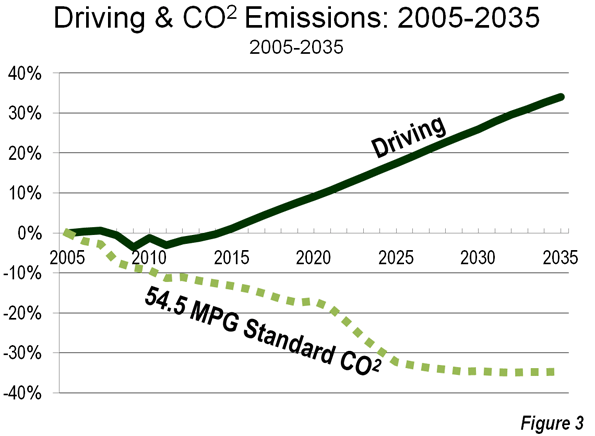
    Under the previous 35.5 MPG standard, AEO:2008 and AEO:2012,  a 19 percent reduction in CO2 emissions from cars and light trucks would occur from 2005 to 2035. We modeled the new regulations based upon AEO:2012 forecasts for the earlier regulation. This yielded a 2035 CO2 emission reduction of 35 percent from 2005 (Figure 2), despite a healthy one-third increase in driving volumes over the period. The calculation also includes an upward adjustment for the rebound effect, as lower costs of driving encourage people to drive more, which EPA estimates at 10 percent ("induced traffic"), which is indicated in Figure 3.


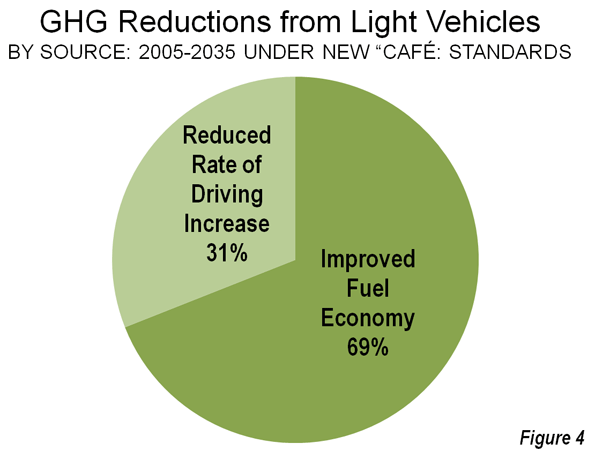
    Achievement of the 54.5 MPG standard would reduce CO2 emissions from light vehicles from 1.9 billion annual tons in 2035 under the 2005 baseline to approximately 0.750 billion metric tons in 2035. Approximately 70 percent of the decline in CO2 emissions would be from improved fuel economy, while 30 percent would be from slower annual increase in vehicle travel that has been adopted in AEO:2012 (Figure 4). The increase in driving is now forecast at 33 percent from 2005.

    The contrast between the potential CO2 emissions from smart growth and fuel economy is stark. By comparison, the annual overall reduction in CO2 emissions (from the 2005 baseline) would be virtually equal to the 30 year impact of smart growth (Figure 5).

    Comparison with Transit

    The 35.5 MPG standard would make cars and light trucks less CO2 intensive than transit. At work trip vehicle occupancy rates, the average new light vehicle would emit less in CO2 per passenger mile in 2016 than transit in all but eight of the nation’s 51 metropolitan areas over 1,000,000 population. The 2025 54.5 MPG standard would drop that number to two (Note 2). Even before these developments, there was only scant potential for replacing automobile use with transit (much less walking or cycling) because of its long travel times. According to data in a Brookings Institution report, less than 10 percent of jobs in the largest metropolitan areas can be reached by the average resident in 45 minutes on transit (Note 3).

    Smart Growth: Not Needed to "Save the Planet"

    Smart growth is an exceedingly intrusive policy that would attempt to enforce personal behaviors,    counter to people’s preferences, by attempting to dictate where people live and how they travel. This is expensive as well as intrusive. It is also detrimental to the economy, which is already taking a toll in lower household discretionary income (especially from higher house prices) and stunted economic growth.

    A report by The McKinsey Corporation and The Conference Board  indicated that sufficient CO2 emissions could be achieved with "…no downsizing of vehicles, home or commercial space and traveling the same mileage" and "…no shift to denser housing." Or, more directly, smart growth is unnecessary, in addition to producing little "gain" for the "pain."

    Wendell Cox is a Visiting Professor, Conservatoire National des Arts et Metiers, Paris and the author of “War on the Dream: How Anti-Sprawl Policy Threatens the Quality of Life.”

    —-

    Note 1: The 2030 to 2035 driving volume is estimated using the annual percentage increase from 2025 to 2030 in AEO: 2008, which has data through 2030.

    Note 2: Calculated from 2010 National Transit Database summary by Randal O’Toole of the Cato Institute. These calculations assume the 250 gram per mile standard for new light vehicles in 2016 and the vehicle occupancy ratio of 1.13 for work trips from the 2009 National Household Travel Survey.

    Note 3: Limited transit access is not just an American problem. In Paris, with arguably the best transit system in the western world, the average resident of a suburban new town on the regional metro (RER) can reach twice as many jobs by car as by transit in an hour, according to Fouchier and Michelon.

    Prius photo by Bigstock.

  • The Creative Destruction of Creative Class-ification

    Bits and pieces of ideal cities have been incorporated into real ones; traffic projects and housing schemes are habitually introduced by their sponsors as at least preliminary steps to paradise. The ideal city gives us the authority to castigate the real one; while the sore itch of real cities goads us into creating ideal ones. Jonathan Raban, from Soft City

    There’s a spot in Cleveland that is becoming what many had hoped for: a bit vibrant, a bit hip, with breweries, local retail, and farm-to-table restaurants turning that hard rawness of a disinvested Rust Belt city strip into a thing less raw.

    Actually, the current mix of grit and slight refinement works well on Cleveland’s W. 25th St in Ohio City. Characters abound. The racial and class mixing feels both natural and unforced. Place authenticity is there, aided no doubt by the presence of the 100-year old West Side Market anchoring what is an emerging neighborhood identity of an area where one can get a bite or sip of Cleveland amidst its architectural integrity. And the distinctive Cleveland-ness of it all is becoming ever more attractive, especially to those looking for something beyond that sea of cities sanitizing their urban terroir.

    West Side Market at night. Courtesy of the Plain Dealer

    I just wonder if the inevitable will happen.

    The inevitable, of course, is called “success”. Often, in the creative class-ification of the urban environment, “success” commonly proceeds this way: an area seeps in its own disability to achieve “highest and best use”—yet it’s cheap, intriguing even, particularly due to “the creative allure of urban grit”. Artists and bohemians make a home and create. A scene unfolds, thus laying the sluice gates toward beautification. Food and coffee places soon come to fill need. Retail locates near the foot traffic. Investment begets investment until all the dead buildings are freshly coated. The professional creative class eventually brings in the rear, effectively dictating a claim of “highest and best use”. Market studies by developers get corporate chains interested. Homogeneity ensues via the unforgiving force that is the economy of space, with income, race, and viewpoint converging into a slice of the urban electorate. This convergence is often presumed to result in the explosion of ideas via agglomeration of knowledge. But suppose it simply results in the deadening of insight via an agglomeration of group think.

    Take the case of Portland. It is a creative class darling, with the young and educated demographic inmigrating rapidly over the past decade. Proponents of the creative class suggest it is Portland’s place-based amenities—its density, its array of bike paths and coffee shops, its craft brews and locavore scene—that is attractive to the psychology of the mobile and modish. Let’s suppose this is true. No suppositions are necessary, however, when inferring what the decade-long demographic shift has done to the diversity of the city’s inner core.

    From an article entitled “In Portland’s heart, 2010 Census shows diversity dwindling”, the author writes:

    “Portland, already the whitest major city in the country, has become whiter at its core even as surrounding areas have grown more diverse…The city core didn’t become whiter simply because lots of white residents moved in…Nearly 10,000 people of color, mostly African Americans, also moved out…As a result, the part of Portland famous for its livability — for charming shops and easy transit, walkable streets and abundant bike paths — increasingly belongs to affluent whites.”

    Of course the irony here is that diversity and tolerance is said to attract a subgroup of forward-looking folks who then congregate using the grease of spatial economics to force said tolerance and diversity out. Given that diversity and tolerance have been argued to be key engines to idea production and subsequent economic growth, perhaps it’s no surprise Portland has not grown economically, regardless of the strained narrative stating otherwise.

    Diversity of people are not the only victims to creative class-ification, so is diversity of place. From a recent Atlantic Cities article, the former owner of the popular Mama’s Bar in the East Village talked about his taxes skyrocketing 380% as the reason he had to close. Later, the owner wonders about the cost of NYC’s decision to world-class the hell out of its urban intricacy and ambiguity:

    I think the thing that makes this city unique is it does have different neighborhoods that are specific and unique unto themselves. They have their own personality. What has happened — and I don’t want to blame the mayor, because it’s the evolution of the city — but things have become so expensive here…the only way businesses can survive in these neighborhoods is if they’re banks or corporate chains. These neighborhoods are being whittled down into carbon copies of each other.


    Mama’s Bar, now closed. Courtesy of community54.com

    Echoing this sentiment, the New York Times just ran an op-ed from the blogger at Vanishing New York about how the place-making standard bearer the High Line has created for a stretch of people lined like cattle amidst a neighborhood increasingly delineated into a pasture of consumption, not a hive of innovation. The author writes:

    [T]he idea was enticing: a public park above the hubbub, a contemplative space where nature softens the city’s abrasiveness…

    …My skepticism took root during my first visit. The designers had scrubbed the graffiti and tamed the wildflowers. Guards admonished me when my foot moved too close to a weed…

    …The neighborhood has since been completely remade. Old buildings fell and mountain ranges of glassy towers with names like High Line 519 and HL23 started to swell…

    Since the op-eds running, the blogger, Jeremiah Moss, has been derided as regressive, an obstructionist, with one commentator on his blog accusing Moss of being “a lazy critic” who is “not interested in either exploring the nature of our changing urban environment or discussing the merits of the [High Line’s] design”. But these critics miss Moss’s point, or that place-making is not simply about beauty, but so too the motive behind beautification. Often, that means economic gain, and often: that means at any cost. From a post in Art Info:

    The High Line — being such an alluring work of design — became, quite literally, a lure to attract groups powerful enough to steamroll socioeconomic diversity and reconstruct the neighborhood into a more glamorous version of New York.

    This was not how it was supposed to go. In a piece in Parks and Recreation, the author describes creative class theorist Richard Florida’s exemplifying of the High Line as an example of “communities transforming old industrial-age infrastructure into unusual and magnetic parks”. Florida explains many cities are figuring out that place has worth, and are prioritizing accordingly:

    The good news is that some cities have come to understand that great parks can rally citizens and hold communities together…and the most far-seeing mayors realize that.

    What is less discussed is how publicly-subsidized parks and other place-based jewels can be used as a hammer to polish out the vicinity around them; that is, how parks can be co-opted to break communities apart.

    Don’t get me wrong. I think place-making has its place. But its Frankenstein effects can’t be ignored. As—again—there is a contradiction at play in creative class theory; namely, that the preconditions of success: diversity, density, and tolerance, can create for a “success” that eats diversity and tolerance, particularly in those “special sauce” dense spots like East Village and downtown Portland that are harmonized to be vessels for new knowledge and thus new economies. In fact it can be argued that such outcomes deaden the long-term growth of cities in that traditional geographic and cultural hearts are being sold for the “gimme now” gains of taxation on objects from coffee to condos. And really: there is nothing much cool or creative about that. Rather, it’s selling your city to the highest bidder. It is mountains turned to coal.

    East Village Condo. Courtesy of http://cityofstrangers.net/

    Looking back, maybe this was all to be expected. Layering a cellophane of universal cool over the topography of distinct places to attract a slice of the urban electorate—many of which have no clue about the genius loci of each place—well, what would one expect?

    Still, there are lessons to be had here. Lessons for cities. Here’s hoping that those so-called failed and dead cities like Cleveland can resist getting their spots of raw locality from being entirely scrubbed out. In fact, in a world of inauthenticity it will be cities of realness that provide for environments fostering a stimulation of thought. It will be these cities collecting the hemorrhaging of thinkers and doers that can no longer stand the plasticity derived from the mold of “highest and best use”. It will be these cities providing for the creative destruction of creative class urbanity.

    Richey Piiparinen is a writer and policy researcher based in Cleveland. He is co-editor of Rust Belt Chic: The Cleveland Anthology. This piece originally appeared at his blog.

    Downtown Cleveland photo by Bigstock.

  • Travel Bans: Do No-Go Lists Fight Freedom?

    Had the 1789 constitutional amendments protected travel alongside the rights to freedom of the press, religion, and assembly, the United States might be a less xenophobic country. It might be less prone to treat arriving tourists as terror suspects, and more encouraging to those of its own citizens who want to explore the world’s darker corners. Instead, foreign travel in the age of terror feels more like an imperial favor than a constitutional right.

    Europe now has few internal border controls, and tourists routinely depart for Algeria and Myanmar. The American government, however, equates travel with a political endorsement, and seems to think that economic embargoes spread the doctrines of life, liberty, and the pursuit of happiness.

    How many departing despots, making their runs for the border, proclaim, “I’d still be in power if it wasn’t for that damned travel ban!” Who thinks keeping tourists from Syria will persuade Bashar al-Assad to abdicate? Nevertheless, dividing the travel world into gardens of good and evil is an increasing preoccupation of the American government.

    Despite President Barack Obama’s celebrated processions and feel-good speeches in Europe and the Middle East, his administration and that of George W. Bush are easily the most xenophobic since President Woodrow Wilson in 1919 unleashed A. Mitchell Palmer and the young J. Edgar on alien associations.

    If you have doubts, add stickers to your luggage from Iran, Somalia, Yemen, North Korea, Cuba, Iraq, Syria, Libya, Afghanistan, Sudan, Pakistan, or Kashmir. See what questions you get asked when returning from your next cruise.

    The ban on Cuban travel dates to October 1960, although the absence of KFC chicken in Havana has done nothing to dislodge the Communist regime. The net effect of the embargo has been to allow the Castros to govern harshly in splendid isolation from American goods and services.

    Would Fidel and his brother have lasted in power for fifty-four years if they had to contend with the landings of Carnival Cruise Lines, instead of those CIA operatives at the Bay of Pigs?

    The U.S. does not explicitly ban travel to countries like Iran and North Korea, although because it is easy to construe travelers checks as commercial relations or to equate Revolutionary Guard souvenirs bought in the Tehran airport as contraband, few Americans are empowered to book passage to Pyongyang or Isfahan.

    Myanmar, or Burma, is another country on the suspect travel list, it being felt that idling in places like Rudyard Kipling’s old Moulmein Pagoda implies support for the ruling military junta.

    Not only does the United States discourage its citizens from wandering the globe freely, it has confronted foreign travelers coming into the US with a nightmare of entrance requirements, including demands for conforming photographs, biometric passports, and thoughtful answers to edgy consular questions. Europeans not on the visa-waiver program have to jump through hoops just to spend money in Disneyland. (“Visit America: Your fingerprints are already here!”)

    President Obama claims credit for “bravely” reducing restrictions on Cuban travel (group visas are now easier to get; relatives can go more often), but maintaining all the other Cuban embargoes, including those on American medicine, hardly adds up to a profile in courage.

    To counter these dark perceptions, there is something new called Brand USA, whose public/private mission is to “encourage increased international visitation to the United States and to grow America’s share of the global travel market. In doing so, we aim to bring millions of new international visitors who spend billions of dollars to the United States, creating tens of thousands of new American jobs.” Needless to say, a worthy goal.

    The $12 million ad campaign includes Roseanne Cash singing “Land of Dreams,” and the assumption that most tourists to America are here for bungee jumping (unless the high wires in the trailer are serving the interrogation needs of Homeland Security).

    The more insecure a government, the more likely it is to impose travel restrictions. The People’s Republic of China had it borders closed for years. Cuba has all sorts of rules to regulate which of its citizens can go abroad (generally only those who leave behind hostages). North Koreans live behind the barbed wire, as did the inmates of Enver Hoxha’s Albania.

    The Iron Curtain and the Berlin Wall were other examples of the degree to which strutting regimes will go to keep their citizens from foreign travel or, as V.I. Lenin said, “voting with their feet.” Who would think the United States would become the heir to the tradition of telling its citizens where they can go, and with whom they can spend their free time?

    Who believes that travel bans and trade restrictions had a hand in bringing change to the Soviet Union, South Africa, Libya, or Rhodesia? Embargoes beggar the local population and enrich the sanction breakers. But they suit the American imperium that wants its laws to govern every corner of the globe. Witness that a British bank was fined $340 million for doing business with Iranians.

    If traveling freely was a constitutional right, Americans could make up their own minds about where to go and what to see, even if it included taking the measure of Beloved Leader’s North Korea or of Potemkin’s villages in Russia. How many Americans would believe the government propaganda about Iran or Cuba if they were free to inspect the poverty themselves, or to mix with local pro-American populations?

    In the last decade the United States has fought wars, directly or by proxy, from Morocco to Kashmir, yet few Americans have been to these countries and even fewer are encouraged to have a look.

    More often than not, Washington ends up in conflict with those countries that start out on its no-go lists, for example, Libya, Syria, Iraq, Iran, Yemen, or Sudan. A travel ban or economic embargo is often the first salute in the drum to war.

    In most of the Middle East, only professional diplomats and journalists are deemed worthy to offer their firsthand impressions, although I would put more stock in backpacker accounts of Iran than I would in a State Department white paper.

    Because I am a wandering contrarian, the travel that often engages me is to countries that belong in the dustbin of history. I am drawn more to the Axis of Evil than to the Magic Kingdom or Vegas floorshows, although I return from places like Albania, apartheid South Africa, or the Soviet Union, immune to the charms of strongman governments.

    Everything I know about Pakistan’s dysfunctional tribal areas I learned in Peshawar, near the border with Afghanistan. I gave up on the Soviet Union after going there on a student tour in the 1970s. The reason I believe little that is reported about the Syrian civil war is because I drove across that country—in a rental car with my teenaged son—something I recommend to anyone… although not just at this moment.

    Flickr Photo by By Sem Paradeiro : Myanmar Visa

    Matthew Stevenson, a contributing editor of Harper’s Magazine, is the author of Remembering the Twentieth Century Limited, a collection of historical travel essays. His next book is “Whistle-Stopping America”.