Blog

  • Livable China

    Recently, the McKinsey Global Institute published its report ‘The Most Dynamic Cities in 2025‘ in Foreign Policy, a highly respected US journal. On this list, 27 mainland Chinese cities as well as Hong Kong took top spots alongside Shanghai and Beijing, leaving many other world-renowned metropolises far behind.

    As a Chinese who has lived through China’s transformation over the past two decades, I was hardly surprised by the results of this report. What really shocked me was the doubt and controversy that this report generated in western media, especially the negativity in the heated discussions published in the very same issue of Foreign Policy.

    Among these, I was most taken aback by Mr. Isaac Stone Fish’s article ‘Unlivable Cities’. Having lived in several different Chinese cities over a 7-year period, Mr. Fish should be able to provide an objective prospective about China. Unfortunately, the takeaway from his article, in his own words is: ‘For all their economic success, China’s cities, with their lack of civil society, apocalyptic air pollution, snarling traffic, and suffocating state bureaucracy, are still terrible places to live.’

    First of all, when it comes to civilization, there are very few countries where civil society can be traced back 5000 years like China. Today’s China may be in some aspects less civilized compared with the more developed countries, but China has come a long way in creating a more civilized society in recent years. When the People’s Republic of China was founded in 1949, the illiteracy rate was more than 80% in China, but as of today, the illiteracy rate among Chinese born after 1980 is under 1%. In cities, 80% of students go on to post-secondary studies. These highly educated young Chinese will undoubtedly redefine China’s civilization. When it comes to parenting, the 80s generation, now mostly young parents, are studying how to be a parent, which would have been unheard of just a decade ago.

    The new Chinese parents are teaching their kids to use polite expressions like ‘thank-you’ and ‘sorry’, something generally neglected in the past. Pioneer cities like Shanghai and Guangzhou opened ‘Manner and Etiquette’ classes in most of their primary and high schools starting in 2006. Our education system is changing as well, gradually switching from being purely exam-oriented, to cultivating students with all around abilities. Our future generations will continue to bring China into a new era of civil society. It is ironic for Mr. Fish to call China ‘unlivable’ by describing China as having ‘lack of civil society’, yet in his own narration later he wrote: ‘Chinese cities have little crime, one can stroll safely through Beijing’s magnificent Temple of the Sun park at midnight’. How many of today’s ‘livable’ and ‘civilized’ North American cities can claim that?

    Air pollution is an issue in China, but no different than the smog that hung in the sky in Pittsburgh, London, or Los Angeles when those cities were going through their own vast development phases.   China is generating the greatest total greenhouse gas emissions in the world, but its greenhouse gas emission per capita in 2008 only ranks 78th of 214 countries in the world, while Australia ranks 11th, followed by USA (12th) and Canada (15th). China is manufacturing for the whole world, so in a sense it’s a scapegoat for countries that don’t want to or cannot make things for themselves. Yet even with that, air pollution in China never reaches the level described in Mr. Fish’s article. Take Nanjing (300 km northwest of Shanghai) as an example: in the one week Mr. Fish spent there, the only thing he saw was ‘smog the color of gargled milk’.

    Having lived in Nanjing for almost 10 years, I do not find Nanjing’s air quality unbearable. On the contrary, I love wondering on the streets of this ancient yet modern city, breathing the fresh air and enjoying the sweet scent given off by the Wutong Shu (Phoenix trees) erected on both sides of the streets. Every morning, citizens go outside to exercise in the mountains and parks. At night time, people take walks outside after dinner. Never would I suggest that Nanjing is an ‘unlivable’ city.
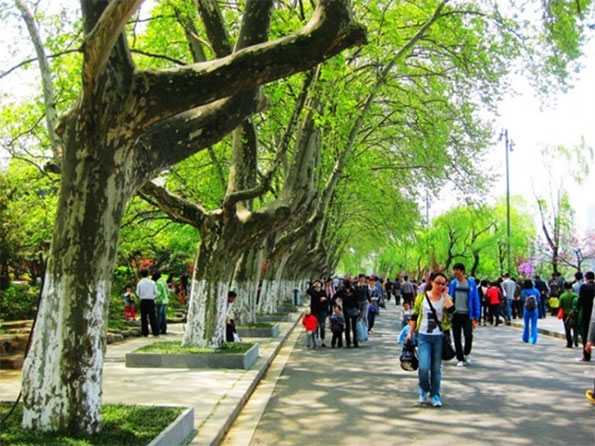

    Phoenix Trees in Nanjing

    In 2011, 14.5 million cars were sold in China. It has overtaken America as the largest automobile market. This has and will continue to cause significant traffic congestion, a worldwide issue most metropolises face today. However, China is very proactively providing solutions to this problem. In Beijing, Shanghai and Guangzhou, the local municipality limits the licenses plates issued every year in an attempt to relieve the burden caused by new traffic. Of course, China knows better than anybody that nothing will stop its citizens’ desire for car ownership as they get richer, so the only way to prevent future traffic problems is to invest in more quality highways, cleaner cars and better public transit systems.

    With China now spending approximately half a trillion dollars annually on infrastructure (9 percent of its GDP), visitors should not be surprised to see numerous highways and subways under construction in most Chinese cities. In 2010, Shanghai had the world’s most extensive subway system (429 km), followed by London (402 km) and then Beijing (372 km). By 2020, the total length of Shanghai’s subway lines will reach 877 km, more than double of New York’s current total length of subway lines. Meanwhile, China provides large subsidies to the taxi and bus industries. On top of that, with the world’s longest rail network, China’s high-speed rail system is changing the way people travel between Chinese cities. The newest bullet train from Beijing to Shanghai can bring passengers to their destination in less than five hours, while flying over the terrain at a maximum speed slightly over 300 km per hour.

    Bureaucracy has been rife in China literally for millennia, and the onset of a market economy has not changed that sad fact. Much of the criticism of China relates to censorship. Yet this is less an issue for most Chinese than for either westerners and some Chinese intellectuals. With the fast development of information science and the enormous variety of media available, people can freely choose what movie, play or art show they wish to watch, discuss anything they are interested in with their families and friends, and most importantly live the life styles they want. The ‘pervasive fear of censorship’ described by Mr. Fish literally does not exist for today’s average Chinese citizen.

    Mr. Fish also gave specific examples of ‘unlivable’ cities in China. Among them, Harbin, the capital city of Heilongjiang province, was voted the least livable metropolis mainly due to its cold winter. Personally, during my own time there, I was fascinated by Harbin’s characteristic Russian architecture, the massive and astonishingly beautiful ice sculptures, and the fun winter activities that were available. All these temperaments make Harbin an extraordinary city. I am currently studying in Canada, a country justly famous for freezing winters. Constantly hearing Canadians complain about their ‘unbearably cold’ winters makes me realize that if winter temperature is a key criteria to judge whether a city is livable or not, Winnipeg, Manitoba would probably be crowned the most unlivable city in the Western hemisphere. I can only imagine what Mr. Fish would have to say about cities like Oslo, Helsinki, Copenhagen, or Minneapolis.

    China clearly is no paradise, yet the world should recognize how significantly the quality of life has improved over the stereotypes of the past. Growing up in 40 square meter (430 square feet) ‘Dormitory Style Housing’ (as Mr. Fish put it), with my parents and grandparents, I remember vividly how our neighbors nearly burst through our door to see our newly purchased color TV, the first they had ever seen. My happiest moment was licking a popsicle to its last frozen drop in the summer heat. Considering my parents’ combined monthly salary about 20 USD in the 1980s, this popsicle was quite a treat. Two decades later, in the same summer heat, my husband and I moved into a brand new three-bedroom condo in Nanjing, fully equipped with the most modern electronic appliances. Our condo is surrounded by a beautiful pond, a gymnasium, a supermarket and a nearby subway station. We make 3400 USD a month, eat out often and travel every year. This is not atypical for most middle-class Chinese people now. The welfare system is improving, people are less worried about getting sick, a retirement fund is in place, people now travel not only domestically but also internationally, and many send their children abroad to receive higher education. Where we are now would have been unthinkable to most people only a few decades ago.
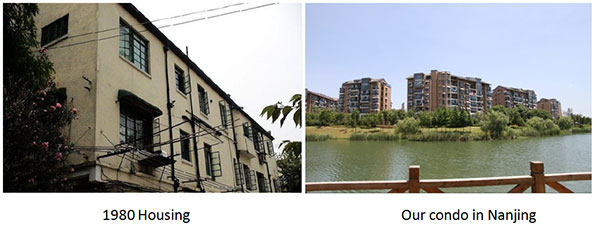
    I’m often deeply saddened by the way in which China is so often portrayed in western media. China’s growth and development over the past few decades has been vast, and it possesses potential for a more affluent future. Westerners may refer to China as ‘unlivable’ but for me, and hundreds of millions of people like me, China today is more than simply livable, and it will continue to improve as time goes by.

    Lisa Gu is a 28 year old Chinese national who lived in Nanjing, China. She is currently studying at Wilfrid Laurier University in Waterloo, ON, Canada.

    Photo by Wikicommons user shakiestone.
  • The Unseen Class War That Could Decide The Presidential Election

    Much is said about class warfare in contemporary America, and there’s justifiable anger at the impoverishment of much of the middle and working classes. The Pew Research Center recently dubbed the 2000s a “lost decade” for middle-income earners — some 85% of Americans in that category feel it’s now more difficult to maintain their standard of living than at the beginning of the millennium, according to a Pew survey.

    Blaming a disliked minority — rich business folks — has morphed into a predictable strategy for President Obama’s Democrats, stripped of incumbent success. But all the talk of “one percent” versus “the ninety nine percent” misses new splits developing within both the upper and middle classes.

    There is no true solidarity among the rich since no one is yet threatening their status. The “one percent” are splitting their bets. In 2008 President Obama received more Wall Street money than any candidate in history, and he still relies on Wall Street bundlers for his sustenance. For all his class rhetoric, miscreant Wall Streeters, particularly big ones, have evaded big sanctions and the ignominy of jail time.

    Obama enjoys great support from the financial interests that benefit from government debt and expansive public largesse. Well-connected people like Obama’s financial tsar on the GM bailout, Steven Rattner, who is also known as a vigorous defender of “too big to fail.”

    The “patrician left” — a term that might have amused Marx — extends as well to Silicon Valley, where venture capitalists and techies have opened their wallets wider than ever before for the president. Microsoft and Google are two of Obama’s top three organizational sources of campaign contributions. Valley financiers are not always as selfless as they or their admirers imagine: Many have sought to feed at the Energy Department’s bounteous “green” energy trough and all face regulatory reviews by federal agencies.

    The Republicans have turned increasingly to those patricians who depend on the more tangible economy. If you make your living from digging coal or exploring for oil wells, even if you don’t like him, Romney is you man. This saddles the GOP with the burden of being linked to one of America’s most hated interests: oil and gas companies. Almost as detested is the biggest source of Romney cash, large Wall Street banks. (In contrast, Democratic-leaning industries, such as Internet-related companies, enjoy relatively high public support.)

    With the patriarchate divided, the real action in the emerging class war is taking place further down the economic food chain. This inconvenient reality is largely ignored by the left, which finds the idea of anyone this side of Bain Capital supporting Romney as little more than “false consciousness.”

    Obama’s core middle-class support, and that of his party, comes from what might be best described as “the clerisy,” a 21st century version of France’s pre-revolution First Estate. This includes an ever-expanding class of minders — lawyers, teachers, university professors, the media and, most particularly, the relatively well paid legions of public sector workers — who inhabit Washington, academia, large non-profits and government centers across the country.

    This largely well-heeled “middle class” still adores the president, and party theoreticians see it as the Democratic Party’s new base. Gallup surveys reveal Obama does best among “professionals” such as teachers, lawyers and educators. After retirees, educators and lawyers are the two biggest sources of campaign contributions for Obama by occupation. Obama’s largest source of funds among individual organizations is the University of California, Harvard is fifth and its wannabe cousin Stanford ranks ninth.

    Like teachers, much of academia and the legal bar like expanding government since the tax spigot flows in the right direction: that is, into their mouths. Like the old clerical classes, who relied on tithes and the collection bowl, many in today’s clerisy lives somewhat high on the hog; nearly one in five federal workers earn over $100,000.

    Essentially, the clerisy has become a new, mass privileged class who live a safer, more secure life compared to those trapped in the harsher, less cosseted private economy. As California Polytechnic economist Michael Marlow points out, public sector workers enjoy greater job stability, and salary and benefits as much as 21% higher than of private sector employees doing similar work.

    On this year’s Labor Day, this is the new face of unionism. The percentage of private-sector workers in unions has dropped from 24% in 1973 to barely 7% today and in 2010, for the first time, the public sector accounted for an absolute majority of union members. “Labor” increasingly means not guys with overalls and lunch pails, but people whose paychecks are signed by taxpayers.

    The GOP, for its part, now relies on another part of the middle class, what I would call the yeomanry. In many ways they represent the contemporary version of Jeffersonian farmers or the beneficiaries of President Lincoln’s Homestead Act. They are primarily small property owners who lack the girth and connections of the clerisy but resist joining the government-dependent poor. Particularly critical are small business owners, who Gallup identifies as “the least approving” of Obama among all the major occupation groups. Barely one in three likes the present administration.

    The yeomanry diverge from the clerisy in other ways. They tend to live in the suburbs, a geography much detested by many leaders of the clerisy and, likely, the president himself. Yeomen families tend to be concentrated in those parts of the country that have more children and are more apt to seek solutions to social problems through private efforts. Philanthropy, church work and voluntarism — what you might call, appropriately enough, the Utah approach, after the state that leads in philanthropy.

    The nature of their work also differentiates the clerisy from the yeomanry. The clerisy labors largely in offices and has no contact with actual production. Many yeomen, particularly in business services, depend on industry for their livelihoods either directly or indirectly. The clerisy’s stultifying, and often job-toxic regulations and “green” agenda may be one reason why people engaged in farming, fishing, forestry, transportation, manufacturing and construction overwhelmingly disapprove of the president’s policies, according to Gallup.

    Obama supporters sometimes trace the loss of largely white working-class support — even to the somewhat less than simpatico patrician Romney — to “false consciousness.”  A recent Daily Kos article, charmingly entitled “The Masses are Asses,” chose to wave the old bloody shirt of racism, arguing that whites “are the single largest, and most protected racial group in this country’s history.”

    Ultimately this division — clerisy and their clients versus yeomanry — will decide the election. The patricians and the unions will finance this battle on both sides, spreading a predictable thread of half-truths and outright lies. The Democrats enjoy a tactical advantage. All President Obama needs is to gain a rough split among the vast group making around or above the national median income. He can count on overwhelming backing by the largely government dependent poor as well as most ethnic minorities, even the most entrepreneurial and successful.

    Romney’s imperative will be to rouse the yeomanry by suggesting the clerisy, both by their sheer costliness and increasingly intrusive agenda, are crippling their family’s prospects for a better life. In these times of weak economic growth and growing income disparity, the Republicans delude themselves by claiming to ignore class warfare. They need to learn how instead to make it politically profitable for themselves.

    Joel Kotkin is executive editor of NewGeography.com and is a distinguished presidential fellow in urban futures at Chapman University, and contributing editor to the City Journal in New York. He is author of The City: A Global History. His newest book is The Next Hundred Million: America in 2050, released in February, 2010.

    This piece originally appeared in Forbes.

    Mitt Romney image from Bigstock.

  • Evolving Urban Form: São Paulo

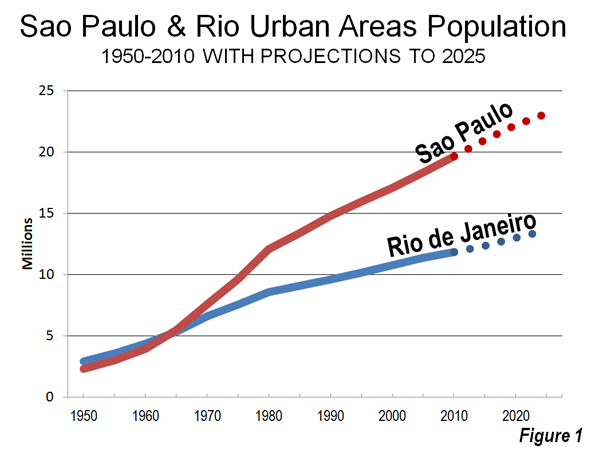
    São Paulo is Brazil’s largest urban area and ranks among the top 10 most populous in the world. Between 1950 and 1975, São Paulo was also among the globe’s fastest growing urban areas. For two decades starting in 1980 São Paulo ranked fourth in population among the world’s urban areas, but has been displaced by much faster growing urban areas like Manila and Delhi.

    São Paulo became Brazil’s largest urban area, displacing Rio de Janeiro, in the middle 1960s. There has been no looking back. By 2025, the United Nations forecasts that São Paulo will have 10 million more people than Rio (Figure 1).

    São Paulo is the capital of Brazil’s largest state, also called São Paulo. The 2010 census counted more than 41 million people in the state, more than live in California. The state of São Paulo is substantially more densely populated than California, occupying only two thirds of the land area (approximately the size of Oregon).

    There are other large urban areas in the vicinity of São Paulo. Campinas, an urban area of 2.5 million people, is located 60 miles (100 kilometers) north and San Jose dos Campos, an urban area of 600,000 is located 60 miles (100 kilometers) to the west.

    A 20th Century City

    Like many developing world megacities, São Paulo is a creation of the 20th century. In 1900, the population was 240,000. By 1950, the population had reached two million and now is approximately 20,200,000.

    São Paulo is located on a small plateau, over the mountains from the Atlantic Ocean 2500 feet (750 meters) above sea level, approximately the same elevation as Madrid. São Paulo is the world’s second largest urban area not located on an ocean or sea coast (Delhi is the largest).

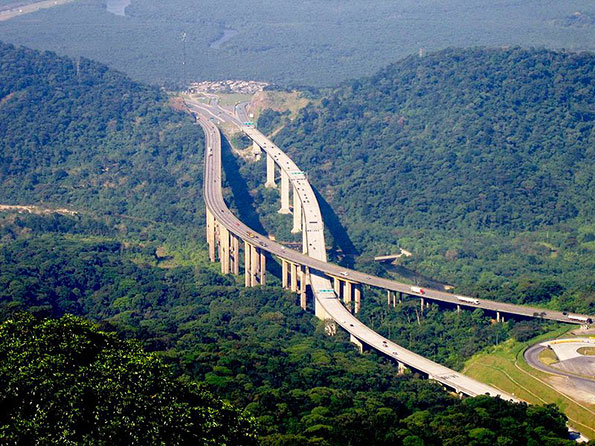
    São Paulo is located 50 miles (80 kilometers) from the seaport of Santos, which is an urban area of 1.7 million. Santos is reached by one of the world’s most spectacular freeways, the Rodovia dos Imigrantes, which winds down the mountainside, with the southbound lanes crossing over the northbound lanes like the Interstate 5 Grapevine north of   Los Angeles, the grade down from Puebla (Mexico) to the city of Orizaba on Autopista 150D and a section of the N205 approaching Chamonix-Mont-Blanc in France.

    São Paulo’s Urban Expanse

    São Paulo is a comparatively dense urban area, at 16,500 persons per square mile, or 6400 per square kilometer. This makes São Paulo somewhat less than double the density of Paris, but still one quarter the density of Hong Kong or Mumbai and one seventh the density of Dhaka. The urban area covers 1,225 square miles (3,175 square kilometers), similar in size to the Miami and Washington DC urban areas.

    São Paulo is hardly a "compact city." The urban area stretches nearly 60 miles/100 kilometers east to west and more than 30 miles/50 kilometers north to south. The core city covers nearly as much area as the core city of Houston.

    Recent Growth and Suburbanization

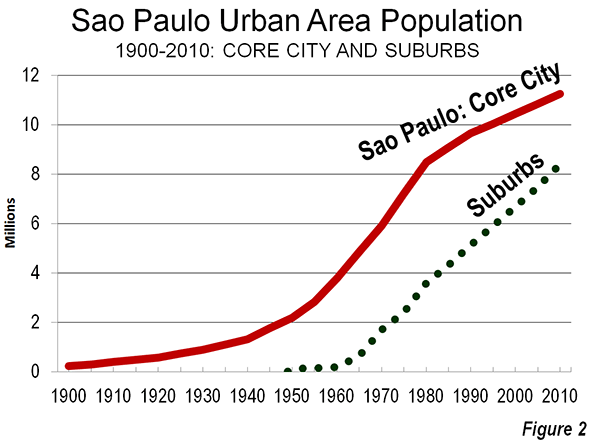
    The central city (municipio) of São Paulo continues to grow. In the last 10 years, São Paulo  has grown from 10.4 million to 11.2 million. A majority of the urban area population, 57 percent, continue to live in the central city. However there is much stronger growth in the suburbs, reflecting the trends in nearly all other major urban areas of the world. Since 1950, São Paulo’s suburbs have experienced an explosive   growth, rising from under 200,000 residents to 8.4 million. This exceeds the core city’s growth over the same period of 7.46 million (Figure 2).

    In the last 10 years, suburban São Paulo has grown from 6.7 million to 8.4 million people, capturing   more than two thirds of the population growth. Since 1950, when the suburbs had approximately 5 percent of the population, they have increased their share in every census. However, if the strong growth of the city and the suburbs continues at the rates of the last 10 years, it could be 30 years before a majority of the population lives in the suburbs.

    Deficient Transport

    Like most nations, Brazil has a freeway or motorway system. There is a freeway between São Paulo and Rio de Janeiro and a freeway from São Paulo to the nation’s third largest urban area, Belo Horizonte. These and other freeways emerge from the urban periphery, without traversing the core.

    Yet, there is no way for trucks to traverse the São Paulo urban area from East to West without getting tied up in São Paulo’s monumental central area traffic. Nor is there a freeway for port traffic to cross the urban area south to north toward Campinas. Thus, truck traffic from the affluent urban areas of the South, such as Curitiba and Porto Alegre and the port at Santos is forced on to the Avenida Marginal Tiete and Avenida Marginal Pinheiros, forging an overused route adjacent to the urban core on both the west and north sides. East-west and north-south commercial traffic is combined on this roadway.

    However, São Paulo is building a long overdue ring road, the Mario Covas Beltway. Less than one half of this route is now in operation and the whole circle will not be completed until 2015.

    São Paulo is also on the trouble fraught high speed rail route proposed to run from Rio de Janeiro to Campinas. The route was roundly criticized by The Economist, which noted the low-balled costs, the astronomical ridership projections and the likelihood that Brazilian taxpayers would have to foot quite a bill to make it happen. This line was covered in more detail in Private Investors Shun Brazil High Speed Rail and High Speed Rail in Brazil: The Need for Guarantees.

    From Monocentricity to Polycentricity

    A number of other megacities in the developing world have added new commercial cores, becoming more polycentric, as the old central business district becomes comparatively less important. This is evident in Istanbul, Mexico City and Manila. In recent decades, most of the core-type commercial development has occurred along Avenida Paulista (two miles/three kilometers west of Centro) and then later, Luis Berrini (another 6 miles/10 kilometers further to the southwest).

    The Shantytowns

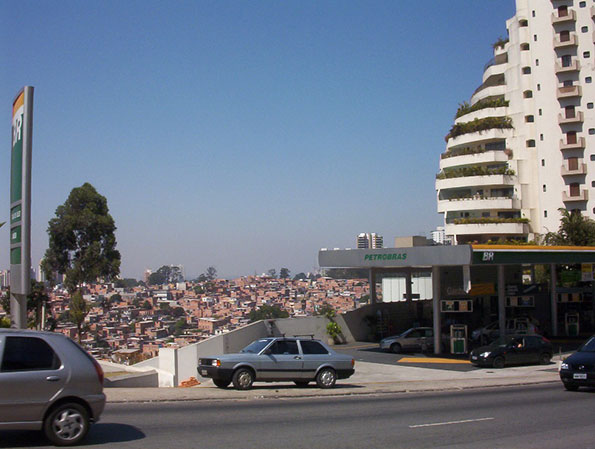
    As drivers travel on the Avenidas Marginal and the Mario Covas Beltway, they pass many shantytowns (favelas) close to the roadways. This can be a shocking site for North American rental car tourists. In more recent decades, favelas have developed not only on the urban fringe, but adjacent to affluent areas in the core (Photo). There are also corticos, which tend to be old subdivided houses and more centrally located. Both of these are increasingly interspersed through the urban area. A mid 1990s estimate placed the number of people living in this sub-standard housing at one quarter of the people in the central city of São Paulo.

    Favela and Affluence, core city of São Paulo


    City of Hope

    The origins of this movement to Sao Paulo are clear. People moved from the poor countryside, often from the sugar plantations of the Northeast. As bad as life may look to affluent northerners, things are much better here than back in the countryside. Otherwise they would go home, which occurs with no material frequency. São Paulo, like all big metropolitan areas, is a city of hope.


    Wendell Cox is a Visiting Professor, Conservatoire National des Arts et Metiers, Paris and the author of “War on the Dream: How Anti-Sprawl Policy Threatens the Quality of Life.”

    Lead Photo: Paulista Avenue (by author)

  • New Setbacks for the Beleaguered California Bullet Train

    A proposal by Senator Michael Rubio (SB 317) to loosen California’s landmark environmental protection law commonly known as CEQA, has been shelved. The proposed legislation was intended to exempt the Central Valley rail construction project from CEQA requirements, thereby removing the threat of environmental litigation against the project. The bill, if approved,  would have likely led to the dismissal of currently pending lawsuits against the California High-Speed Rail Authority (CHSRA), and specifically the challenges filed by the Merced and Madera Farm Bureaus, according to Gary Patton, a California attorney who has been involved in environmental litigation. With environmental protections remaining in place, CEQA-based challenges could seriously  delay the start of construction and jeopardize the Authority’s ability to complete the Central Valley project by the federally imposed deadline of September 2017. Missing the federal deadline would deprive the project of the balance of the $3.3 billion federal grant.

    The unexpected cancellation of Sen. Rubio’s bill is credited to the opposition of powerful environmental groups and local elected officials. The latter sent a letter to Senate President Pro Tempore Darrel Steinberg and Assembly Speaker John Perez opposing "any proposal to create significant new exemptions or otherwise re-write CEQA in the days ahead." The proposed bill, wrote the officials, contain major changes to the existing law that have not been properly vetted and are being pushed  by "special interests in an end of session power play." In the end, Sen. Steinberg chose to side with the objectors rather than with a fellow Democrat.   "This law for all its strenghts and faults," he said, "is far too important to rewrite in the last days of the session."

    What Lies Ahead?

    The announced schedule for the California HSR procurement process calls for proposals from the five qualified bidders due in September 2012, contract award in December 2012, and Notice to Proceed  (on the 60-mile Merced-to-Fresno section of the line) in January 2013. No schedule has been announced for the Fresno-to-Bakersfield segment whose final EIR/EIS is not expected until early 2013.  

    However, before construction can begin (initially on a 29-mile line segment  from Madera to south of Fresno), the necessary rights-of-way for the HSR track must be acquired. The acquisition  process will include appraisals, acquisition offers, negotiations with land owners and relocation assistance (if any). These actions could be delayed by any potential legal challenges filed against the project by members of the Merced and Madera Farm Bureaus. 

    "It’s going to be a long battle for the Rail Authority, said Amanda Carvajal, executive director of the Merced County Farm Bureau. "There is going to be opposition every step of the way."  "We feel that the evidence against the Authority’s environmental document being adequate or truthful is solid," echoed Tom Rogers, President of the Madera County Farm Bureau in announcing the filing of a class action environmental lawsuit against the Authority in early June. Anja Raudabaugh, executive director of the Farm Bureau added,   "…this lawsuit was necessary to protect the bedrock economy of agriculture in the Valley. … We are actively seeking support from the community, local businesses and anyone who feels the rail project is to the detriment of their livelihood and way of life."    

    The strength of opposition to the bullet train in the Central Valley has led some observers to conclude that the actual groundbreaking and start of construction on the initial segment of the line could be many months if not years away. 

    New Operating Cost Analysis Casts Doubt on the Project’s Profitability

    New doubts concerning the financial viability of the California bullet train have been cast by the August 22 publication  of a report by William Warren and William Grindley, two prominent critics of California’s HSR project. The report challenges the Authority’s claim that the bullet train’s revenues will cover its operating and maintenance (O&M) costs as required by the enabling Proposition 1A law. The 198-page report concludes that  the high-speed train "is in the untenable position of having to compete against the low costs of automobile travel  and intra-California airfares while simultaneously meeting AB 3034 (Proposition 1A) requirement to be profitable."    

    To successfully compete with the low costs of driving and flying, the authors contend the bullet train must keep the per passenger mile (PPM) fares somewhere in the 20 cent/PPM range.  The average PPM fare for existing HSR systems is more than twice what the Authority projects —47 cents versus 23 cents/PPM.

    The authors used the Northeast Corridor’s high-speed train Acela  for their comparison because its operating costs offer the closest equivalent to the California bullet train in terms of  labor, power, maintenance and employee benefit costs   The real life examples show that existing high-speed rail  operating costs exceed 30¢/ PPM, while the Authority claims operating costs of only 10¢/ PPM. 

    The authors conclude: "The difference between the reality of high-speed rail’s operating costs and the fares CHSRA says they will charge can only be made up by subsidies which are  prohibited by law.   That means hundreds of millions to several billions of dollars  will need to be found from California’s taxpayers every year." 
    The report has received  wide distribution in Sacramento and  can be found at  www.sites.google.com/site/hsrcaliffr,  It will be also available at www.cc-hsr.org.

    Ken Orski has worked professionally in the field of transportation for over 30 years.

  • Anorexic Vampires and the Pittsburgh Potty: The Story of Rust Belt Chic

    “Rust Belt Chic is the opposite of Creative Class Chic. The latter [is] the globalization of hip and cool. Wondering how Pittsburgh can be more like Austin is an absurd enterprise and, ultimately, counterproductive. I want to visit the Cleveland of Harvey Pekar, not the Miami of LeBron James. I can find King James World just about anywhere. Give me more Rust Belt Chic.” Jim Russell, blogger at Burgh Diaspora

    National interest in a Rust Belt “revival” has blossomed. There are the spreads in Details, Atlantic Cities, and Salon, as well as an NPR Morning Edition feature. And so many Rust Belters are beginning to strut a little, albeit cautiously–kind of like a guy with newly-minted renown who’s constantly poking around for the “kick me” sign, if only because he has a history of being kicked.

    There’s a term for this interest: “Rust Belt Chic”. But the term isn’t new, nor is the coastal attention on so-called “flyover” country. Which means “Rust Belt Chic” is a term with history–loaded even–as it arose out of irony, yet it has evolved in connotation if only because the heyday of Creative Class Chic is giving way to an authenticity movement that is flowing into the likes of the industrial heartland.

    About that historical context. Here’s Joyce Brabner, wife of Cleveland writer Harvey Pekar, being interviewed in 1992, and introducing the world to the term:

    I’ll tell you the relationship between New York and Cleveland. We are the people that all those anorexic vampires with their little black miniskirts and their black leather jackets come to with their video cameras to document Rust Belt chic. MTV people knocking on our door, asking to get pictures of Harvey emptying the garbage, asking if they can shoot footage of us going bowling. But we don’t go bowling, we go to the library, but they don’t want to shoot that. So, that’s it. We’re just basically these little pulsating jugular veins waiting for you guys to leech off some of our nice, homey, backwards Cleveland stuff.

    Now to understand Brabner’s resentment we step back again to 1989. Pekar–who is perhaps Cleveland’s essence condensed into a breathing human–had been going on Letterman. Apparently the execs found Pekar interesting, and so they’d book him periodically, with Pekar–a file clerk at the VA–given the opportunity to promote his comic book American Splendor. Well, after long, the relationship soured. Pekar felt exploited by NYC’s life of the party, with his trust of being an invited guest giving way to the realization he was just the jester. So, in what would be his last appearance, he called Letterman a “shill for GE” on live TV. Letterman fumed. Cracked jokes about Harvey’s “Mickey Mouse magazine” to a roaring crowd before apologizing to Cleveland for…well…being us.


    Think of this incident between two individuals–or more exactly, between two realities: the famed and fameless, the make-up’d and cosmetically starved, the prosperous and struggled–as a microcosm for regional relations, with the Rust Belt left to linger in a lack of illusions for decades.

    But when you have a constant pound of reality bearing down on a people, the culture tends to mold around what’s real. Said Coco Chanel:

    “Hard times arouse an instinctive desire for authenticity”.

    And if you can say one thing about the Rust Belt–it’s that it’s authentic. Not just about resiliency in the face of hardship, but in style and drink, and the way words are said and handshakes made. In the way our cities look, and the feeling the looks of our cities give off. It’s akin to an absence of fear in knowing you aren’t getting ahead of yourself. Consider the Rust Belt the ground in the idea of the American Dream.


    2012-06-29-toledo_rust_harticle_intro.jpg

    Photo credit: Sean Posey

    Of course this is all pretty uncool. I mean, pierogi and spaetzle sustain you but don’t exactly get you off. Meanwhile, over the past two decades American cities began their creative class crusade to be the next cool spot, complete with standard cool spot amenities: clubs, galleries, bike paths, etc. Specifically, Richard Florida, an expert on urbanism, built an empire advising cities that if they want creative types they must in fact get ahead of themselves, as the young are mobile and modish and are always looking for the next crest of cool.

    These “Young and the Restless”–so they’re dubbed–are thus seeking and hunting, but also: apparently anxious. And this bit of pop psychology was recently illustrated beautifully in the piece “The Fall of the Creative Class” by Frank Bures:

    I know now that this was Florida’s true genius: He took our anxiety about place and turned it into a product. He found a way to capitalize on our nagging sense that there is always somewhere out there more creative, more fun, more diverse, more gay, and just plain better than the one where we happen to be.

    After long–and with billions invested not in infrastructure, but in the ephemerality of our urbanity–chunks of America had the solidity of air. Places without roots. People without place. We became a country getting ahead of itself until we popped like a blowfish into pieces. Suddenly, we were all Rust Belters, and living on grounded reality.

    Then somewhere along the way Rust Belt Chic turned from irony into actuality, and the Rust Belt from a pejorative into a badge of honor. Next thing you know banjo bingo and DJ Polka are happening, and suburban young are haunting the neighborhoods their parents grew up in then left. Next thing you know there are insights about cultural peculiarities, particularly those things once shunned as evidence of the Rust Belt’s uncouthness, but that were–after all–the things that rooted a history into a people into a place.

    Take the Pittsburgh Potty. For recent generations it was about the shame of having a toilet with no walls becoming the pride of having a toilet with no walls. From Pittsburgh Magazine:

    We purchased a house with a stray potty, and we’ve given that potty a warm home. But we simply pretended as if the stray potty didn’t exist, and we certainly didn’t make eye contact with the potty when we walked past it to do laundry.

    The Pittsburgh Potty is basically a toilet in the middle of many Pittsburgh basements. No walls and no stalls. It existed so steel workers can get clean and use the bathroom without dragging soot through ma’s linoleum.


    2012-06-29-PghPotty.JPG

    Photo credit: Brookline Connection

    Authentic: yes. Cool? A toilet?

    Only in the partly backward Rust Belt of Harvey Pekar and friends. From the twitter feed of @douglasderda who asked “What is a Pittsburgh Potty?” Some responses follow:

    “I told my wife I wanted to put ours back in, but she refused. I threatened to use the stationary tubs.”

    “In my house, that would be known as my husband’s bathroom.”

    “It’s a huge selling feature for PGH natives. I’m not kidding. We weren’t so lucky in our SS home.”

    “We’re high class people. Our Pittsburgh Potty has a bidet. Well, it’s a hose mounted on the bottom, but still ….”

    Eventually, this satisfaction found in re-rooting back into our own Rust Belt history has become the fuel of wisdom for even Coastal elites. Here’s David Brooks recently talking about the lessons of Bruce Springsteen’s global intrigue being nested in the locality that defines Rust Belt Chic:

    If your identity is formed by hard boundaries, if you come from a specific place…you are going to have more depth and definition than you are if you grew up in the far-flung networks of pluralism and eclecticism, surfing from one spot to the next, sampling one style then the next, your identity formed by soft boundaries, or none at all.

    Brooks continues:

    The whole experience makes me want to pull aside politicians and business leaders and maybe everyone else and offer some pious advice: Don’t try to be everyman…Go deeper into your own tradition. Call more upon the geography of your own past. Be distinct and credible. People will come.

    And some are coming, albeit slowly, unevenly. But more importantly, as a region we are once again becoming–but nothing other than ourselves.

    Authenticity, reality: this was and always will be the base from which we wrestle our dreams back down to solid ground.

    American splendor, indeed.

    This is an excerpt from the forthcoming book Rust Belt Chic: A Cleveland Anthology. It first appeared at RustBeltChic.com.

  • Need Your Water Treated? In the Philippines, Call a Mom & Pop Shop

    “The history of cities can be described as the history of water.” — UK Urbanist Matthew Gandy, 2003

    In Cebu City, the second largest city in the Philippines, that particular history is being rewritten in a way never seen anywhere before. Contrary to the well-known major municipal water privatizations of the last two decades (including that of Manila), the existing utility in Cebu City is not functionally obsolete, nor has it been systematically de-funded in order to justify a contract with a private vendor. Here, the city’s individual entrepreneurs have bypassed the municipal provider on their own.

    Personal interviews with officials from the Philippine Department of Environmental Resources, the University of San Carlos Water Resources Department, the Metropolitan Cebu Water Department, residents, business owners, and other civic leaders reveal much about the water politics in this physically small but densely packed city of over two million people. In 2010, tests of well and municipal water showed both the saline intrusion and bacteriological contamination that have led to the private revolution.

    While water supply is certainly part of political discourse, the politics of water are rarely transparent. The public is seldom aware of the tradeoffs that are made. Governments are not about to implicitly offer a menu of choices when doing so might undermine a choice that has already been made. In the case of large scale water privatization, the money and complexity are such that contracts cannot be easily be broken without heavy losses and penalties. In 2002, the U.N. decreed that humans have a right to safe, sufficient and affordable water for personal domestic use. But this did not imply that it must be provided by the public sector. In fact, reaching international safe water goals is often the rationale used by international aid agencies to justify privatization.

    Private water systems were not uncommon historically, but a shift to public control took place in the United Kingdom and elsewhere beginning in the late 19th century, when private control did not result in safe water. During the 1990s, new privatization efforts were made. State failure replaced market failure as a conceptual framework on which this could be built. Under this rubric water is a private, tradable good, and scarcity is the result of mismanagement by government entities.

    Major privatization deals were made in Latin America and in Asia. Their large cities with a burgeoning middle class, and — often — failing utilities seemed to offer the perfect void for large multinational firms such as Bechtel and Suez to fill with modern and efficient delivery systems. But despite the promises of privatization, the areas least served by public regimes tended to remain so under private controls. The shift from government–as- provider back to dependence on the private sector was based on the assumption that government wastes resources because it lacks competition.

    Arguments on the issue come up against the inherent difficulties in applying market value to government works. Water pricing rarely takes into account the public health benefits of safe water. And externalities like pollution and disease are impossible to price and easy to undervalue.

    Cebu is one of several Asian mid-sized cities where small, private water providers thrive. These providers — hundreds of them — have taken ‘small scale’ to a new level: they are literally mom and pop operations. Where suppliers in other mid-sized Asian cities are part of a small network, in Cebu none of the private operations has a network. They do not complete with the Municipal Cebu Water Department, or extend its network cooperatively. Instead, all are relying on existing groundwater supplies, whether from a private well or a municipal connection.

    Cebu’s water has become contaminated with a combination of saltwater intrusion and bacteriological agents. The saltwater is a result of the pumping of more water than is being recharged; the pathogens stem from the lack of a sewerage system. The private suppliers that began to appear in the middle of the last decade are actually water purifying operations. As Cebu’s water quality deteriorated precipitously and the municipal water department did not respond adequately, these suppliers appeared in every barangay. Chlorination is the sole municipal method of treatment, and while it kills most pathogens, it does nothing to reduce salinity. The private purification operations handle both problems with aplomb. The systems cost about $4,500, and in many cases were staked by remittances from relatives living abroad. They distribute purified water in containers that range in size from a single cup (or baggie) up to five gallons.

    The local Carcar aquifer was once a richly productive treasure that offered a bountiful yield to the city above it. But what began with saltwater intrusion around 30 years ago has metastasized into a menace that has overwhelmed the water district’s ability to respond. In its place, the private sector has moved in to meet the needs of most, but this informal hodgepodge of private businesses is not in a position to obtain the additional water supply that this rapidly growing city needs. Cebu is currently at maximum production from the Carcar aquifer. This is the reason water runs out every evening. The beach resorts on neighboring Mactan Island are already desalinating water to meet their needs.

    The 2020 projection is sobering; demand in Cebu is expected to exceed twice the aquifer’s estimated maximum output. What is left out of the projections is the possibility that production from the overstressed aquifer will simply collapse, due to over-pumping and contamination.

    Amazingly, the humid Cebu City appears headed for the same fate as coastal locales in the arid Middle East. Ideally, sound management strategy would prevail, but absent the ability to monitor private groundwater withdrawals, this is not possible. Industrial and commercial users are already treating their water, even if they have a municipal connection. One thing is certain: Cebu City’s water supply rests on a precipice.

    Does Cebu foreshadow a paradigm shift, or is it just a historical curiosity? Only the future will tell. But it is undeniable that, right now, it has the dubious distinction that, due to its inaction, it is facing a tragic fouling of its primary water resource.

    As Cebu’s water supply degraded, a bureaucratic stalemate between the water district and city officials precluded action. Proposed joint public-private ventures designed to augment the water supply were never approved. It is imperative now that an additional supply is sourced, or that a large scale reverse osmosis project is undertaken without delay.

    In 2005, the controversial Japanese author Masaru Emoto wrote,“Usually we drink water without paying much attention to it. We know that water is important to our life, but because of its familiarity very rarely do we consciously appreciate it.” The proud citizens of Cebu are among that very rare few who appreciate every drop they drink.

    Chuck McGlynn is an assistant professor at Rowan University in Glassboro, New Jersey, whose research interests include water resources, Asian studies and aviation. He spent 15 years in aviation management at two US majors, and has worked with the University of San Carlos Water Resources Department on water supply and quality issues in Cebu City, Philippines. He resides in South Jersey with his wife, Jenny, and their six children.

    Photo by the author

  • High Speed Rail in Brazil: The Need for Guarantees

    In an article entitled Fourth Time Unlucky, The Economist wonders why Brazil, with "a long list of more worthwhile infrastructure projects", does not dismiss high speed rail "out of hand."

    After three unsuccessful attempts to attract international bidders to build its Rio de Janeiro to Sao Paulo and Campinas line for a bargain basement price, the nation has decided that taxpayers will foot some (probably all) of the bill.

    The Economist continues:

    "Everywhere, new-build rail projects are horribly likely to come in way over budget and to be used much less than expected. A 2009 paper by Bent Flyvbjerg of Oxford’s Saïd Business School, ominously entitled "Survival of the Unfittest: Why the worst infrastructure gets built—and what we can do about it."

    As Flyvbjerg and others have noted, promoters, whether private or public, often seem to have a simple goal: to get the line under construction. That positions the projects for taxpayer bailouts when they run into problems.

    With bidders able to call upon other people’s money (taxpayer’s money) this time, it seems likely there will be takers. And, based upon the experience with major infrastructure projects around the world, that will be just the start of the taking.

    If elsewhere provides any guidance, the winning bidder can be confident that, down the road, the captive customer (the taxpayers) will pay any cost overruns. At the same time, the routine could be repeated in which a government kicks and screams, claiming it had no warning.

    They did. In this day and age, a link to the Economist’s warning is forever. A wise government will obtain the unlimited guarantees any company involved in the winning joint venture. Only then will Brazil’s taxpayers be protected.