Blog

  • Regionalism: Spreading the Fiscal Irresponsibility

    Stanley Kurtz’s new book, Spreading the Wealth: How Obama is Robbing the Suburbs to Pay for the Cities describes political forces closely tied to President Obama who have pursued an agenda to “destroy” the suburbs for many years. He expresses concern that a second Obama term will be marked by an intensification of efforts to destroy the suburbs through eviscerating their independence thought the imposition of "regionalism". The threat, however, long predates the Obama administration and has, at least in some cases, been supported by Republicans as well as by Democrats.

    America is a suburban nation. Nearly three-quarters of the residents of major metropolitan areas (over 1,000,000 population) live in suburbs, most in smaller local government jurisdictions. Further, outside the largest metropolitan areas most people live in suburbs, smaller towns or smaller local government jurisdictions.

    Smart Growth

    The anti-suburban agenda has more than one dimension. The best known is smart growth, known by a variety of labels, such as compact development, growth management, urban consolidation, etc. Smart growth, from our research, also is associated with higher housing prices, a lower standard of living, greater traffic congestion and health threats from more intense local air pollution.

    Regionalism

    Another, less well-known anti-suburban strategy is regionalism, to which Kurtz grants considerable attention. Regionalism includes two principal strains, local government amalgamation and metropolitan tax sharing. Both of these strategies are aimed at transferring tax funding from suburban local governments to larger core area governments.

    Social welfare and differing income levels are not an issue at this level of government. Local governments, cities, towns, villages, boroughs and townships, finance local services principally with their own local taxes. The programs aimed at social welfare or providing income support are generally administered and financed at the federal, state or regional (county) level. Any suggestion that local suburban jurisdictions are subsidized by core local governments simply reveals a basic unfamiliarity with US municipal finance.

    Local Government Amalgamation

    Opponents of the suburbs have long favored amalgamating local governments (such as cities, towns, villages, boroughs and townships). There are two principal justifications. One suggests "economies of scale" — the idea that larger local government jurisdictions are more efficient than smaller governments, and that, as a result, taxpayers will save. The second justification infers that a larger tax base, including former suburbs, will make additional money available to former core cities, which are routinely characterized as having insufficient revenues to pay for their services. Both rationales are without foundation.

    Proponents of amalgamation incessantly refer to the large number of local governments in some states, implying that this is less efficient. The late Elinor Ostrum put that illusion to rest in her acceptance speech for the Nobel Prize in economics in 2009:

    Scholars criticized the number of government agencies rather than trying to understand why created and how they performed. Maps showing many governments in a metropolitan area were used as evidence for the need to consolidate.

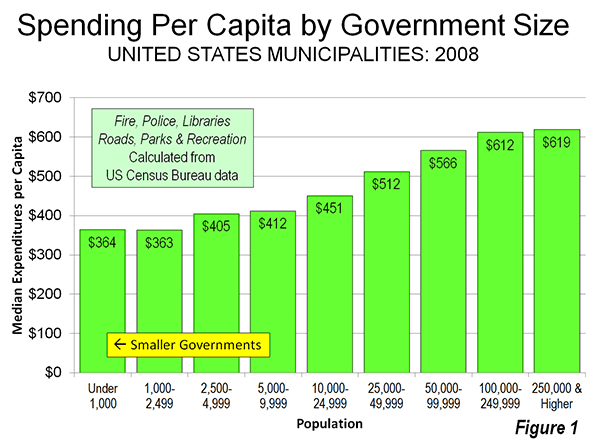
    The reality is that there is a single measure of efficiency: spending per capita. Here there is a strong relationship between smaller local government units and lower taxes and spending. Our review of local government finances in four states (Pennsylvania, New York, Indiana and Illinois) indicates that larger local governments tend to be  less efficient, not more. Moreover, the same smaller is more efficient dynamic is evident in both metropolitan areas as well as outside. "Smaller is better" is also evident at the national level (Figure 1).
    Yet the "bigger is better" faith in local government amalgamation remains compelling to many from   both the Right and Left. Proponents claim that smaller local governments are obsolete, characterizing them as being from the horse-and-buggy era. The same logic could be used to eliminate county and even state governments. However, democracy remains a timeless value. If people lose control of their governments to special interests (which rarely, if ever, lobby for less spending), then democracy is lost, though the word will still be invoked.

    Support of local government amalgamation arises from a misunderstanding of economics, politics and incentives (or perhaps worse, contempt for citizen control). When two jurisdictions merge, everything is leveled up, from labor costs to service levels. The labor contracts, for example, will reflect the wage, benefit and time off characteristics of the more expensive community, as the Toronto "megacity" learned to its detriment.

    Further, special interests have more power in larger jurisdictions, not least because they are needed to finance the election campaigns of elected officials, who always want to win the next election. They are also far more able to attend meetings – sending paid representatives – than local groups. This is particularly true the larger the metropolitan area covered, since meeting are usually held in the core of urban area not in areas further on the periphery. This greater influence to organized and well-funded special interests – such as big real estate developers, environmental groups, public employee unions – and drains the influence of the local grassroots. The result is that voters have less influence and that they can lose financial control of larger local governments. The only economies of scale in larger local government benefit lobbyists and special interests, not taxpayers or residents.

    Regional Tax Sharing

    Usually stymied by the electorate in their attempts to amalgamate local governments, regional proponents often make municipal tax sharing a priority. The idea is that suburban jurisdictions should send some of their tax money to the core jurisdictions to make up for the claimed financial shortages of older cities. Yet this ignores the fact, as Figure 1 indicates, that larger jurisdictions generally spend more per capita already and generally tax more, as our state reports cited above indicate. Larger jurisdictions also tend to receive more in state and federal aid per capita.  A principal reason is that the labor costs tend to be materially higher in larger jurisdictions. In addition to paying well above market employee compensation, many larger jurisdictions have burdened themselves with pension liabilities and post employment health benefits that are well above what their constituencies can afford. The regionalist solution is not to bring core government costs in line with suburban levels but force the periphery to help subsidize their out of control costs.

    Howard Husock, of Harvard University’s JFK School of Government (now at the Manhattan Institute) and I were asked to evaluate a tax sharing a plan put forward by former Albuquerque mayor David Rusk for Kalamazoo County, Michigan (The Kalamazoo Compact) more than a decade ago. Our report (Keeping Kalamazoo Competitive)found no justification for the suburban areas and townships of Kalamazoo County to share their tax bases with the core city of Kalamazoo. The city already spent substantially more per capita, received more state aid per capita and had failed to take advantage of opportunities to improve its efficiency (that is, lower the costs of service without reducing services).  We concluded that the "struggling" core city had a spending problem, not a revenue problem. To the credit of the electorate of Kalamazoo County, the tax sharing proposal is gathering dust, having been made impractical by suburban resistance.

    Spreading the Financial Irresponsibility

    The wanton spending that has gotten many larger core jurisdictions into trouble should not have occurred. The core cities are often struggling because their political leadership has "given away the store," behavior that does not warrant rewarding. Elected officials in the larger jurisdictions had no business, for example, allowing labor costs to become higher than necessary or granting rich pension benefits paid for by private sector employees (taxpayers), most of whom  enjoy only  much more modest pension programs, if at all (See note below).

    The voters are no match for the spending interests with more efficient access to City Hall. The incentives in such larger jurisdictions are skewed against fiscal responsibility and the interests of taxpayers. Making an even larger pool of tax revenues available can only make things worse.

    At the same time, the smaller, suburban jurisdictions around the nation are often the bright spot in an environment of excessive federal, state and larger municipal government spending. Their governments, close to the people, are the only defense against the kind of beggar-the-kids-future spending that has already captured the federal government, state governments and some larger local jurisdictions.

    Either Way the Threat is Very Real

    Even if President Obama is not re-elected or if a second Obama Administration does not pursue the anti-suburban agenda, the threat to the suburbs will remain very real. This is not just about the suburbs, and it is certainly not some secret conspiracy. What opposing regionalism means is the preservation of what is often the last vestige of fiscal responsibility. It is not that the elected officials in smaller  jurisdictions are better or that the electorate is better. The superior performance stems from the reality that smaller governments are closer to the people, and decision-making tends more to reflect their interests more faithfully than in a larger jurisdictions.

    Ed. note: This piece was corrected to add quotation marks around the word “destroy” in the first paragraph. That clause is included in reference to Kurtz’s characterization, not the author’s.

    ——

    Note: A report by the Pew Charitable Trusts (Promises with a Price) indicated that "… in general, the private sector never offered the level of benefits that have been traditionally available in the public sector." The report further indicated that 90 percent of state and local government retirees are covered by the more expensive defined benefit pension programs, compared to 20 percent in the private sector. The median annual pension in the state and local government sector was cited at 130 percent higher than in the private sector. While 82 percent of state and local government retirees are covered by post-employment medical benefits, the figure is 33 percent in the private sector. According to the Bureau of Labor Statistics, after accounting for the one-third higher wages per hour worked among state and local government workers, employer contribution to retirement and savings is 160 percent higher than in the private sector (March 2012). A just published Pew Center on the States report (The Widening Gap Update) indicates that states are $1.3 trillion short of the funding required to pay the pension and post employment medical benefits of employees. This does not include programs administered by local governments.

    Wendell Cox is a Visiting Professor, Conservatoire National des Arts et Metiers, Paris and the author of “War on the Dream: How Anti-Sprawl Policy Threatens the Quality of Life.”

    Lead Photo: Damascus City Hall (Portland, Oregon metropolitan area) by Wiki Commons user Tedder.

  • Texas High Speed Rail: On the Right Track?

    The Central Japan Railway (Note 1), which operates one of only two high-speed rail segments (Tokyo Station to Osaka Station) in the world that has been fully profitable (including the cost of building), proposes to build a line from Dallas to Houston, with top speeds of 205 miles per hour. This is slightly faster than the fastest speeds now operated. This line is radically different from others proposed around the nation and most that have been proposed around the world. The promoters intend to build and operate the route from commercial revenues.

    There is the understandable concern that eventually, the promoters will approach the state or the federal government for support. Not so, say Texas Central High Speed Railway officials. According to President Robert Eckels, not only is there no plan for subsidies, but "investors would likely walk away from a project that couldn’t stand on its own." He also told the Texas Tribune “If we start taking the federal money, it takes twice as long, costs twice as much,” Eckels said. “My guess is we’d end up pulling the plug on it.”
    Eckels is a former Harris County Judge (Houston), a position the equivalent of a county commission or county board of supervisors chair in other parts of the nation. Eckels developed a reputation for fiscal responsibility during his tenure at the county courthouse.

    The Texas project is in considerable contrast the California High Speed Rail project, which if built, is likely to require a 100 percent capital subsidy and perhaps subsidies for operations. It is also different from the Tampa to Orlando high speed rail project, which would have required a 100 percent capital subsidy and was cancelled by Florida Governor Rick Scott. The Texas project can also be contrasted with the Vegas to Victorville, California XpressWest high speed rail line that would require at least a $5.5 billion federal loan and a subsidized interest rate. Our recent Reason Foundation report predicted that XpressWest would not be able to repay its federal loan from commercial revenues and could impose a loss on federal taxpayers of up to 10 times the Solyndra loan guarantee loss (see The Washington Post, "Solyndra Scandal Timeline").

    From the horrific record of private investment in startup high speed rail lines and the huge losses that have been typical, I am certainly skeptical. The Taiwan high speed rail private investors have lost two-thirds of their capital investment and debts are guaranteed by the government. The Channel Tunnel rail line to St. Pancras station has been bailed out by British taxpayers. However, if any company can make money at high speed rail in the United States, it would be the Central Japan Railway.

    So far the Texas Central High Speed Railway seems to be doing it right. Like the other intercity modes, the airlines system and the intercity highway system (Note 2), this project would be paid for by people who use it.

    Without government subsidies or loans, the Texas Central High Speed Railway will certainly have an incentive to get the sums right. If they are not, it sounds like the plug will be pulled. If they are, high speed rail could be on the right track in the United States for the first time. More power to them.

    ——

    Note 1: Central Japan Railway, and other companies purchased the assets of the Japanese National Railway in the late 1980s. The nationalized railway had run up a debt of nearly $300 billion, which was eventually transferred to taxpayers.

    Note 2: There is a small subsidy to the airline system from the Federal Aviation Administration. Intercity highways have been financed by users until contributions from the federal general fund in recent years. However these contributions have been far less than diversions over the past 30 years from highway user fees, principally to mass transit a major transfer of highway trust fund interest to the general fund and now ongoing interest transfers.

    Photograph: Central Japan Railway corporate headquarters at Nagoya Station (by author)

  • Congratulations to America: Huge Greenhouse Gas Emission Reduction

    Congratulations to America. According to the US Department of Energy, Energy Information Administration, carbon dioxide (CO2) emissions were reduced 526 million tons from 2005 to 2011. This is no small amount. It is about the same as all the CO2 emissions in either Canada or the United Kingdom. Only five other nations emit more than that.

    The bigger news is that this was accomplished without any of the intrusive behavioral modification proposed by planners, such as by California’s anti-detached housing restrictions, Plan Maryland, or the state of Washington’s mandatory driving reduction program.

    Of course, part of the national reduction was due to the economic difficulties since 2005. However, even with 1.8 percent gross domestic product growth in 2011, EIA shows that CO2 emissions fell 2.4 percent in 2011.

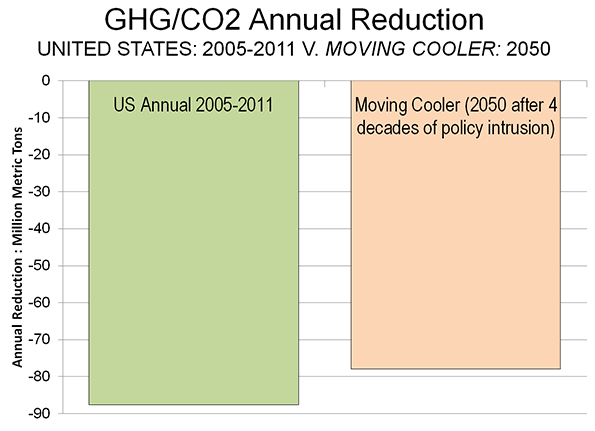
    The magnitude of the decline over six years is impressive. Actual GHG/CO2 emissions were reduced more annually between 2005 and 2011 than smart growth proponents claim for their strategies after 45 years of draconian policy intrusions.Modeled smart growth forecasts in Moving Cooler’s middle scenario (by Cambridge Systematics and the Urban Land Institute) show the annual GHG/CO2 emission reduction in 2050, calculated from 2005, to be less than the emissions reduction in the average year between 2005 and 2011.

    This is despite what would be four decades of trying to force people to live where they don’t want, in housing they don’t prefer, while trying to drive them out of the cars that required to sustain economic growth in modern metropolitan areas.

    Moving Cooler’s forced densification and anti-automobile strategies were so radical that the Transportation Research Board authors of Driving and the Built Environment, could not agree that a similar approach was feasible, because it would be prevented by public resistance to the personal and political intrusions (Note 1). They would also be hideously expensive, as the Moving Cooler authors ignored the much higher costs of housing associated with smart growth’s behavioral strategies.

    This comparison demonstrates the conclusion of a recent Cambridge University (United Kingdom) led study (see "Questioning the Messianic Conception of Smart Growth", which stated:

    In many cases, the potential socioeconomic consequences of less housing choice, crowding, and congestion may outweigh its very modest CO2 reduction benefits.

    Government policies have had little to do with the reductions, except to the extent that they precipitated the greatest economic downturn since the Great Depression (such as by encouraging loose lending standards and the smart growth housing policies that drove house prices up so much that the housing bust became inevitable).

    Market forces have made a substantial contribution to the reduction. There was a substantial shift to the use of natural gas from coal, a conversion that is really only starting. There was also a modest improvement in automobile fuel efficiency (though much more is to come).

    In 2007, the McKinsey Corporation and The Conference Board published a study (co-sponsored by the Environmental Defense and the Natural Resources Defense Council), which said that sufficient GHG emissions reductions (Note 2) could be achieved without driving less or living in more dense housing. Our more recent Reason Foundation report showed that the potential for GHG emission reduction from more fuel efficient cars and carbon neutral housing far outweighed any potential for reductions from smart growth’s behavior modification.

    ——

    Note 1: Transport consultant Alan E. Pisarski evaluated Moving Cooler in an article entitled ULI Moving Cooler Report: Greenhouse Gases, Exaggerations and Misdirections.

    Note 2: Most of GHG emissions are CO2.

  • Infographics: The Decongestion of Manhattan, New York Walking Commutes

    Jim Russell pointed me at an interesting article about densification vs. de-densification over at the Urbanization Project at NYU Stern. It contains this very interesting map of the change in census tract densities in Manhattan over the century between 1910 and 2010:


    Walking Related Commutes

    Streetsblog, in an article covering the annual NYC DOT scorecard, included this graphic of the percentage of commutes that include walking as a core component (e.g, transit) in various parts of New York:

    This post originally appeared at The Urbanophile.

  • Utah Up, Chicago Down: Why Mitt Romney Should Embrace His Mormonism

    In his run for the Republican nomination, Mitt Romney downplayed his Mormonism—referring only to “faith” or “shared values”—in the face of small-minded members of the Christian right and the occasional cackle from the Eastern cultural avant-garde. But with his party’s nod in hand, Romney has been “coming out” in the run-up to the Republican convention, letting pool reporters join him and his family at a church service, and even choosing a member of the church to deliver the invocation on the night he addresses the Republican convention.

    The church’s appeal can be seen, in part, in the contrast between booming Utah and Salt Lake City and President Obama’s adopted home state of Illinois and hometown of Chicago.

    Utah netted 150,000 new arrivals from other states in the last decade, while Illinois lost a net of 70,000 people each year to other states. And Utah’s new arrivals include more than Mormons returning to Zion; Salt Lake County is now only 54% Mormon. Twenty-six percent of the county’s residents are minorities, mostly Hispanic immigrants.

    Romney himself reflects the enormous changes in the fast-growing and highly successful Church of Jesus Christ of Latter-day Saints (LDS), the official name of the religion, since the church (which continues to have an all-male clergy), opened itself to black members in 1978. Mormons now enjoy levels of education and wealth well above those of the average American.  Some 53.5% of LDS males have a post–high-school education, compared to 36.5% of the total U.S. population. And 44.3% of LDS females have a post-high-school education, compared to a national average of 27.7%. More impressive still, unlike mainstream churches, Mormonism is thriving; the church membership in North America grew 45 percent over the past decade to more than 6 million members—roughly matching the number of American Jews

    This is not Romney’s father’s—and certainly not his grandfather’s—LDS.

    A recent Gallup survey ranked Utah first in terms of quality of life, in part because of its citizens’ “low smoking habits, ease of finding clean and safe water, having supervisors who treat workers like a partner rather than a boss, learning something new or interesting on any given day, and perceptions that your city or area are ‘getting better’ rather than ‘getting worse.’”

    While Illinois competes with California for the nation’s worst credit ranking, Utah stands at the AAA apex. The job-growth rate in Salt Lake City and the state rank near the top while Chicago and Illinois have sunk relentlessly toward the bottom. Forbes recently ranked Utah “the best state for business and careers” for the second straight year; Illinois ranked 41st.

    While Utah undoubtably owes some of its success to its low-tax, low-regulation culture, and to smart incentives to draw in businesses, it’s also benefitted from a Mormon culture that promotes not supply-side but investment-driven growth.

    From its origins in the great Mormon migration in the late 1840s, the state and the church have built a legacy of careful planning. Brigham Young was many things, control freak and city planner among them, laying out the streets of the towns with exacting detail. The Mormons, wrote Wallace Stegner, a “gentile” who lived among them, “were the most systematic, organized, disciplined, and successful pioneers in our history.”

    Today this legacy is evident in the excellent infrastructure the state is building, including new highways that shame the pot-holed roads that people on the coasts commonly endure. Utahans have invested mightily in their universities, public and private, and are positioning themselves to be major players in fields from energy and agriculture to composite manufacturing, science, and engineering. They are not merely waiting around to ransack the intellectual capital of other states; for the last two years the University of Utah has ranked No. 1 in forging startups, besting institutions like MIT and Columbia.

    It is a bit distressing for a Californian to ride down Highway 15 south from Salt Lake City towards Provo and see buildings, often just finished, from some of Silicon Valley’s signature companies including Intel, Adobe, Twitter, eBay, and Fairchild Semiconductor. These are jobs that used to stay in California, but for a host of reasons—regulation and housing prices chief among them—have moved east to Utah.

    And most of the former Californians I’ve met in Salt Lake like the place, even if they sometimes feel uncomfortable with the Mormon aversion to such habit as drinking. Over the past 30 years, the city has changed for the better. Good food now proliferates—even if the elegantly dressed young Mormons still don’t order wine, much less vodka. The local arts and culture scene has evolved to, if not world-class levels, at least those seen in other similarly-sized cities.

    But what’s most impressive about Utahans may be their devotion to family. Although they make much noise about their dedication to “working families,” the Democratic Party increasingly relies on singles and the childless as its core base, particularly among white voters. In contrast, GOP-dominated Utah (which is largely white, but increasingly diverse) has the highest birth rate and youngest population in the nation. Families thrive there, including those who are not Mormon. It is almost like another America—one where most people raise their children, and push education and enterprise. If you’re getting deep into your 50s like me, you might remember that country.

    True, Salt Lake City now has some high-rise residential areas and some local planners, largely from the University of Utah, who push “smart growth.” But the big growth along the Highway 15 corridor is mostly single-family home communities, affordable and large enough to accommodate several offspring. They seem a lot like the places Long Island and the San Fernando Valley once were.

    Like the church around which it is built, the Mormon Zion in Salt Lake Valley has also changed. It has what may be the largest concentration of multilingual people in the country. With 55,000 missionaries at 340 mission sites across the globe, native English-speaking Mormons have learned more than 50 languages. Former Utah governor and Romney rival Jon Huntsman gained respectability—even among sophistos—for his fluent Mandarin.

    On the business side, Mormons’ linguistic skills have attracted loads of big international companies, such as Goldman Sachs, who need people capable of conversing in Lithuanian, Chinese, or Tongese. Goldman has 1,400 employees in Salt Lake City, making it the investment bank’s sixth largest location in the world.

    In contrast to the antediluvian nonsense sometimes expressed by right-wing evangelical Christians, the LDSers have become more cosmopolitan as their faith has expanded. Once a peculiarly American creed, with the vast majority of its faithful living in the Western United States, Mormonism has morphed into a global religion with over 11 million members—more than half of them outside the United States. Once narrowly white, the church’s biggest growth now is in Brazil, the Philippines, and the Pacific Islands. Even in the U.S., converts have made for an increasingly diverse church, with blacks and Hispanics accounting for one in five new Mormons, according to Pew.

    It’s not likely that the church will be portrayed by the Obama campaign and its associated media outlets in this way. They also are sure to continue portraying millionaire Mitt as the greedy capitalist devil incarnate. Perhaps to avoid getting drawn into a discussion of his faith, Romney rarely mentions that he tithes 10 percent of his substantial income to support church activities. Such tithing, expected of all church members, helps explain why Utahans are easily the nation’s most charitable citizens, according to The Chronicle of Philanthropy—contributing two and a half times more of their income than Illinoisans.

    Yet most appealing about Mormons is their focus on self-help and community outreach, and the church’s highly structured and efficient relief organization—something Romney has never communicated well. Mormons are remarkable for their ability to rise to the occasion during natural disasters like Hurricane Katrina and the earthquake in Haiti.

    “Mitt may not be Bill Clinton or Barack Obama—he’s a boring guy, but he’s not the jerk people think he is,” says Joe Cannon, the former publisher of the Deseret News, the church-owned paper. “When you are a bishop,” as Romney was in Boston, says Cannon, “you are running a huge welfare state on your own. You spend a lot of time helping the poorest and most dysfunctional congregants.”

    In the end, Utah’s Mormon-created reality is bigger than one relentlessly ambitious man’s foibles and tax dodges; Mormonism is the enterprise that transformed a desert province into a productive garden. That’s the story that Romney needs to share between now and November. If he fails, we might see a more appealing Mormon, Jon Hunstman, remind us of this success story in 2016.

    Joel Kotkin is executive editor of NewGeography.com and is a distinguished presidential fellow in urban futures at Chapman University, and contributing editor to the City Journal in New York. He is author of The City: A Global History. His newest book is The Next Hundred Million: America in 2050, released in February, 2010.

    This piece originally appeared in The Daily Beast..

    Mitt Romney photo by BigStockPhoto.com.

  • America’s Baby Bust: How The Great Recession Has Jeopardized Our Demographic Health

    At the turn of the century, America’s biggest advantage was its relatively vibrant demographics. In sharp contrast with its major competitors — the E.U., Russia, China, Japan — the United States had maintained a far higher birthrate and rate of population growth.

    But the 2010 Census showed that in the past decade America’s birthrate slipped below at least one European country (France) and under the pace necessary to replace our current population. Immigration, both legal and illegal, is also slowing, in part due to plunging birthrates in Mexico and other Latin American countries. As one National Geographic report from Brazil has it, women there, too, are saying: “A fábrica está fechada.” The factory is closed.

    America’s sinking birthrate is in great part a function of our wobbly economy. The decline, notes the Pew Research Center, largely coincides with the onset of the 2007 real estate crash and the financial crisis the following year.

    The recession had a disproportionate impact on people of child-bearing age, who suffered higher unemployment and steeper income declines than their elders. In the process, the U.S. fertility rate dropped from over 2.1 births per woman in 2007 to 1.9 last year, below replacement rate for the first time since the mid-1980s. The 2010 Census found that the number of households that have children under age 18 was 38 million, unchanged from 2000, despite a 9.7% growth in the U.S. population over that period.

    Of course many environmentalists would celebrate these numbers, and some nativists as well. But the problem is not that we need more people per se — we need an increase in younger, working-age people to make up for our soon to be soaring population of retirees. Young people are the raw capital of the information age and innovation, and new families are its ballast and growth market.

    Yet many developed countries are facing dramatic labor force deficits. By 2050, according to Census projections, there will be 40% fewer workers in Japan then there were in 2000, 25% less in Europe and 10% fewer in China; only projections of higher birthrates and immigration allowed demographers to suggest the U.S. workforce would keep growing.

    Without these future workers our already tottering pension system will become even more untenable, as is occurring in Europe and Japan. The bad part about slow population growth is that it depresses the economy, which in turn works against family formation.

    Of course, there are others ways to deal with this imbalance of too many retirees and too few workers. One is to raise taxes. The billionaire philanthropist Pete Peterson estimates that most developed countries will need to increase their spending on old age benefit promises from 9% to 16% of GDP over the next 30 years. This would require an increase in taxes of 25% to 40% — even in the already high-tax countries of northern Europe.

    Raising taxes to transfer funds to the older generation is already happening in some of the most rapidly aging countries. Japanese lawmakers just voted to double the country’s sales tax by 2015 precisely for this reason. Due in large part to low birthrates and soaring numbers of seniors, Japan is now the most heavily indebted high-income country in the world.

    Germany likewise is now considering a special tax on younger workers to fund the pensions of the growing ranks of oldsters. Chancellor Angela Merkel has proposed the 1% income tax as a “demographic reserve” for a workforce that is expected to shrink by 7 million by 2023. “We have to consider the time after 2030, when the baby boomers of the ‘50s and ‘60s are retired and costing us more in health and care costs,” explained Gunter Krings, who drafted the new proposal for Germany’s ruling Christian Democrats.

    Higher taxes, or its evil twin, austerity, are unlikely to solve this dilemma. Other issues may constrain family growth — high urban population densities, women’s growing role in the workforce, declining religiosity — but one critical precondition for spurring family growth is to expand the economy. Without growth, the long-term decline of most high-income countries, including the United States, is all but assured.

    This turns on its head the commonplace assumption that societies reduced their birthrates as they got wealthier. This pattern was seen in the United States and Europe by the 1960s and, even more so in East Asia, whether governments adopted baby-suppressing (notably China) methods or, more recently, as in Singapore, have tried to promote family formation.

    But more recently it appears that declining economics — and strong public perceptions that things will get worse — can also convince people not to have children. In 2010, according to Gallup, most European countries have been expecting harder times; pessimism was particularly strong in Spain, Italy, Greece, the Czech Republic and the United Kingdom. Stories about divorced Spanish or Italian young fathers sleeping on the streets or in their cars is not exactly a strong advertising for parenthood.

    In 2011, birthrates fell in 11 of the 15 European countries that have reported numbers. Among the countries reporting declines were Finland and Denmark, where rates had been ticking slightly upwards.

    The impact has been even greater in countries like Spain and Greece, where overall joblessness has hit one in four and youth unemployment is roughly 50%. Some of these countries face the prospect of considerable de-population in the coming decades.

    “A more pessimistic economic outlook” is one key reason that European birth rates have been depressed and family formation so slow, confirms Austrian demographer Wolfgang Lutz. Overall fertility has fallen to roughly 1.5, well below replacement rate and all but guaranteeing a demographic-based economic crisis a decade or two sooner. Some eastern countries like Latvia now have fertility rates approaching 1.2. Lutz believes that once birthrates fall to these levels, there is no turning back.

    Yet it is Japan that perhaps shows this renewed relationship between economics and birthrates most clearly. In 1991 many economists predicted that Japan would overtake the U.S. economy; instead U.S. GDP grew much faster and China supplanted Japan in 2010 as the world’s second-largest economy. As prices deflated and opportunities shriveled, Japanese grew less interested in either starting or growing families.

    It could get even worse: Japanese teens seem not only less interested in work but in each other. In what seems an enormous reversal of adolescent nature, 36% of Japanese males 16 to 19 years old have admitted to pollsters having no interest in sex, and some even despise it. The figure is even higher (59%) for females in the same age category. For many, notes Japanese sociologist Mika Toyota, hobbies, vacations, food and computer games are often more alluring than pursuing the opposite — or the same — sex.

    It may well be that American birthrates have been more impacted than Europe’s by the recent recession due to the relative weakness of the country’s social safety net. Finnish demographer Anna Rotkirch has pointed out that Europeans have tried to mitigate the impact of recession through generous transfer payments to young families. This may account as well for the fact that France’s birthrate last year surpassed that of the United States.

    But without strong economic growth, it seems likely that family formation and birthrates will continue downward everywhere, particularly as economic realities force reductions in state aid. A mindlessly ever-expanding welfare state, trying to enlist more clients, even tiny ones, will diminish private sector growth and usher in even more quickly the onset of “demographic winter.” A lethal demographic cocktail of high taxes, low growth and fewer babies could set the stage for an even greater financial crisis in the decades ahead.

    Joel Kotkin is executive editor of NewGeography.com and is a distinguished presidential fellow in urban futures at Chapman University, and contributing editor to the City Journal in New York. He is author of The City: A Global History. His newest book is The Next Hundred Million: America in 2050, released in February, 2010.

    This piece originally appeared in Forbes.

    Childhood kids photo by BigStockPhoto.com.

  • Form Follows Zoning

    When Louis Sullivan, purveyor of modern American high-rise architecture, said more than 100 years ago that ‘Form Follows Function’, he perhaps didn’t realize the extent to which building form would not be determined only by building type and the laws of physics, but by zoning laws, building safety codes, real estate developer balance sheets and even vocal neighborhood groups.

    For every new building project, an architect’s role is to balance these opposing forces, while also delivering a scheme that is aesthetically pleasing and appropriate for its surroundings. This can be a challenge, but also an opportunity for designers to find creative solutions working within constraints.

    Following are just a few of the many parameters an architect must work with when designing this type of project:

    Form Follows Zoning

    Zoning is a term with broad implications, used to describe the set of regulations put forth by local governments that dictate what type of building can be built where. For each land plot, zoning laws also indicate floor area ratio (FAR, or how much area of building can be constructed), allowable building height, bulk limits, site density, setbacks, and parking requirements, among other constraints.

    The FAR number is of paramount importance: it is the magic number used as a multiplier of a site’s area, resulting in the allowable gross floor area. The higher the FAR number, the more area is allowed to be built on a given plot. In most U.S. cities FAR numbers are difficult to amend except through cumbersome political and legal processes. On the other hand, in developing countries such as China, FAR numbers change on an almost daily basis as zoning regulations remain malleable in order to meet of the moment economic growth needs.

    For high-density commercial and multi-family residential buildings, real estate developers typically seek to maximize FAR to get the highest return on investment. For tall buildings, that means building to the height limit, and then asking for a variance to exceed the height limit if it does not max out the FAR.

    Bulk limits deal with the ascending bulk of skyscrapers, mandating setbacks in the building form as the tower rises up to mitigate shadow impact. That is how you end up with ‘wedding cake’ buildings like the Chrysler Building and the GE Building at Rockefeller Center, both of which were a result of setback mandates in New York City’s 1916 Zoning Resolution. These Art Deco masterpieces are prime examples of how architects cleverly worked within zoning laws to design handsome buildings.

    Form Follows Parking Requirements

    While parking requirements are indicated in zoning laws, this constraint warrants its own category. It is remarkable how much influence the personal automobile has in shaping the modern city, not only in terms of road infrastructure but also in the space required for parking when cars are stopped. Parking requirements are responsible for urban design situations like the ubiquitous linear strip mall setback a great distant from the street, separated by a sea of parking spaces.

    Even in dense urban environments, parking is usually a requirement for new buildings. This means that when designing a multi-story building, the parking layout is what sets the structural column grid that stacks vertically throughout the entire height of the building. A typical 30 ft. column bay (measured from center to center) will accommodate 3 parking spaces, which then results in the building’s entire structure being based on the 30’ column grid.

    Parking garages are either below grade or above grade (above lobby level), and usually do not count towards FAR. There are various reasons (including geological/topographical) for placing a parking garage either below or above grade, but in either case, structure is ultimately designed to accommodate the needs of automobiles.

    Form Follows Rentable/Saleable Area

    In addition to zoning requirements, architects must also meet the needs of their developer clients. This entails realizing in form what real estate bean counters calculate to be the appropriate mix of area for what is to be built.

    If it is commercial office space, developers follow the Building Owners and Managers Association (BOMA) standards of measurement to calculate how much ‘rentable area’ can be squeezed out of a building’s floor given a building’s envelope. Of utmost importance in this calculation is the ‘load factor’ or ratio of rentable area to usable area, determining how much building owners can charge their tenants.

    Also important is the ‘lease span’, with a 45 ft. clear span from service core to exterior wall being the ideal. This allows flexibility in office layout and also ensures enough natural light penetrates deep enough into the office space.

    In residential buildings, saleable are is what developers are after and that determines the mix of unit types (studios, 1 bedrooms, 2 bedrooms, etc…) in a given market. This can frequently change during the design process based on changing market conditions

    For towers with a mix of uses, designing a functional building places tremendous onus on the architect to balance competing forces of different building types consolidated into one vertical structure. With financial rewards ultimately more important than aesthetic outcome, architects have to struggle to create a beautiful building within these constraints.

    Form Follows NIMBY Demands

    In the U.S., and other democratic countries with strong property rights, new building projects are subject to the scrutiny of local neighborhood and vocal environmental groups. Often derided as NIMBYs (Not-In-My-Back-Yard) by those on the pro-development side of a new project, these groups usually have predictable objections, the most common being    increases in traffic. Yet if these NIMBYs, especially in urban settings, have objections to traffic, rather than protest individual projects, they should write their local city councilman suggesting a change in zoning to modify parking requirements.

    Even after the approval of extensive traffic and environmental studies, NIMBYs may criticize a building’s appearance in a last ditch effort to prevent construction. Objections include obscure criticisms such as a design does not fit in with ‘neighborhood character’. This criticism reflects a fundamental misunderstanding that even in historic neighborhoods, a well designed counterpoint or contrast can be a suitable proposal. After all, cities are not static museums frozen in time but dynamic and evolving organisms.

    Unfortunately, the NIMBY victory can often be a final blow to what would’ve otherwise been a successful, beautiful design.

    Conclusion

    For architects, designing a building is more like solving a puzzle rather than an exercise in unrestrained creativity. Surprisingly, there is little discussion of the real world constraints in architecture schools. This is perhaps due in part to the fact that regulations vary greatly from place to place, but the fundamental importance of planning and zoning should be emphasized more often.

    For all stakeholders involved in new building projects (developers, local officials and planning departments, the design team, concerned neighbors) what is written in the local zoning code provides the basis for every decision made. For those interested in making better, more informed planning decisions, individuals and governments should focus less on singular building projects and more on easing the process of making changes to local zoning codes.

    Adam Nathaniel Mayer is an architectural design professional from California. In addition to his job designing buildings he writes the China Urban Development Blog.

    Follow him on Twitter: AdamNMayer

    Chicago skyline photo by Bigstockphoto.com.

  • German Renewable Power: Making Sustainability Unsustainable?

    Der Speigel reports that Germany’s rushed program to convert to renewable energy is already imposing an economic burden. Part of the problem is the inherent instability of power produced by renewable sources such as wind and solar:

    The problem is that wind and solar farms just don’t deliver the same amount of continuous electricity compared with nuclear and gas-fired power plants. To match traditional energy sources, grid operators must be able to exactly predict how strong the wind will blow or the sun will shine.

    A national energy expert said:

    "In the long run, if we can’t guarantee a stable grid, companies will leave (Germany). "As a center of industry, we can’t afford that."

    An important principle of the international impetus to reduce greenhouse gas emissions is that there be little or no economic loss. Certainly, an industrial powerhouse like Germany cannot subject itself to such risks.

    At the same time, other locations would be similarly threatened by implementation of renewable power mandates whose "time has not yet come." Not only is there the potential to inflict economic harm on industry (and consumers through higher prices), but higher electricity prices would reduce discretionary incomes and could lead to greater poverty rates. The eradication of poverty has recently been declared to be a virtual prerequisite to sustainability at the Rio conference.

    eradicating poverty should be given the highest priority, overriding all other concerns to achieve sustainable development.

    Environmental sustainability requires economic sustainability. A litany of failures could do serious damage to GHG emission reduction efforts.