Blog

  • Cities of Aspiration

    Drew Klacik’s recent post on how he ended up in Indianapolis got me thinking about the unique status of what I’d describe as “cities of aspiration.” Pretty much all cities seem to be reasonably good at attracting people in the following cases:

    1. Recruiting someone to a specific career or other opportunity. In this case, the value of the opportunity is really the question at stake. The attractiveness of the community itself is generally a secondary consideration though may have an impact pro or con.

    2. Luring residents based on a family connection. This would often be the case for “boomerang migration” – people who left and came back, ordinarily after marriage and children. More broadly we could think of this as retaining or attracting those with a historic connection to a place, such as being born there.

    3. Drawing people from a city’s natural catchment area. The size of this area depends on a variety of factors, but pretty much every city has some natural hinterland from which it draws people.

    I call this the “normal model” of attraction. Clearly, a place like Indianapolis does well on all of these types of attraction, as do most similar sized cities I’d argue. That’s how Drew ended up in Indy.

    However, there’s another basis of attraction. This is what I call “aspirational attraction” – it’s people deciding to move or desiring to move to a city from outside of its natural catchment area despite a lack of a job offer or historical connection. I see this as based in one of three primary motivations:

    1. Desire to work in a particular industry that is centered in a particular location. Want to be a country musician? Moving to Nashville helps. Similarly, if you want to be an actor, New York, LA, or Chicago are basically your only options.

    2. Desire to live in a particular city for lifestyle reasons. Portland would be the paradigmatic example here. People sure don’t move there for its job market.

    3. Desire to live in a city because of its reputation for a rapidly growing economy or superior job market. Many of the Sun Belt boomtowns might fall into this category. They’ve got similar quality of life to many other places, but their robust job markets (and perhaps a bit of nicer weather) draw people in.

    Clearly, there are comparatively few places that function as a aspirational cities in a meaningful sense.

    Back to Drew’s piece, I don’t want to put words into his mouth, but my impression was that he sees Indianapolis having a strong “normal model” of attraction but not functioning as an aspirational city. I agree. More than 80% of Indy’s net domestic in-migration comes from elsewhere in Indiana, the city’s natural catchment area, and it isn’t hard to believe that specific opportunities and boomeranging account for almost all the rest. Perhaps the implication of his notion of tradeoffs is that if a city like Indy isn’t aspirationally attractive, you have the luxury of compromise since you probably already have a lock on the market you’re currently capturing. That’s a perfectly valid conclusion to reach, IMO.

    A very serious question cities that function nearly exclusively as normal attractors need to ask themselves is whether they desire to become aspirationally attractive. If so, then some exploration of the basis of that, and a realistic assessment of whether or not it is possible is important to undertake. Included in this would be the implications of not becoming aspirationally attractive. It seems to me that not having some type of aspirational component to your city’s attractiveness ultimately puts a ceiling on what it can achieve. On the other hand, it is far from clear that it’s easy to consciously create an aspirational value proposition where none currently exists.

    Aaron M. Renn is an independent writer on urban affairs and the founder of Telestrian, a data analysis and mapping tool. He writes at The Urbanophile, where this piece originally appeared.

    Photo: sparktography

  • Why I Do Live in Indianapolis

    When a friend constantly tells you how much he or she likes you and then one day says, “But I’d never live with you,” the predictable reaction is to feel hurt and angry. That’s how I felt when The Urbanophile posted “Why I Don’t Live in Indianapolis.”

    But last night, while riding my bike on one of Indianapolis’ many bike trails (yes, we have them), I started thinking about why I do live in Indianapolis. The answer surprised me.

    While I honestly buy into the quality-of-life, amenity-based strategies that are all the rage these days, that’s not how I arrived here. I live in Indianapolis because I grew up in the Indiana part of Chicago and my late wife grew up near Fort Wayne. We chose Indianapolis because it was close to our families and we had job offers – simple as that. This decision is even more stunning because just a few years earlier, I’d visited Indianapolis for the first time and went home convinced that I would never live in a city that only had one tall building and appeared to be virtually empty at night.

    When I moved to Indianapolis, I had no idea that the new mayor had a vision that Indianapolis could rebuild its downtown, obtain an NFL team and one day host a Super Bowl. I had no idea whether the city wanted to be great or accepted mediocrity. And I certainly didn’t base my decision on the architectural design of a parking garage.

    I also didn’t grow up dreaming of life in a specific city. When I asked some friends (admittedly not a big or random sample), I found only one who dreamt of living in a specific place. That place: New York City. That friend’s current residence: Nashville, Tenn. Turns out my friend lives in Nashville because it’s reasonably close to family and he had a job offer. Most everyone I talked with told me the same story. Maybe this is because we grew up Midwesterners—and as ESRI’s human tapestry data tells us, we are more likely than those who live elsewhere to value family, tradition and stability. But the key point is our choices weren’t predicated on urban amenities or ambitions. They were all about location and employment. I’d wager that most of us – yes, even us pro-amenity types – are less idealistic in our choices than we profess to be.

    This is not to argue that high-quality amenities and bold visions are unimportant. But for those who initially decide where to live based on more practical and personal considerations, it may mean that urban amenities and ambitions are more important to retention than they are to attraction. If so, then a key issue is what residents – rather than potential residents – value in a community. Prior to reading The Urbanophile post about Indianapolis, I wouldn’t have thought that.

    Cities, in a way, are like households: What’s our priority? For most of us mortals (maybe not global cities or the “one percenters,”), the answer involves compromise. I might choose to buy a great TV and a nice driver for my golf game. A neighbor might choose a fast car. Another might choose to travel. What we choose doesn’t determine whether we’re striving. We might all be striving, yet we can’t have it all. The same holds true for a community.

    So how did Indianapolis advance from that city with one tall building to a city able to dazzle and delight as Super Bowl host? Choices. Compromises. We chose to focus our ambitions and our resources on a sports-based, downtown-festival-marketplace strategy. It’s worked – repeatedly – with the Super Bowl being the latest and greatest sign of success.

    Now it’s time to build on what’s working, and to turn our sights to what’s next. Part of moving on likely will be to sustain, enhance and further capitalize on a great downtown – one that’s more appealing to current and prospective urban dwellers. That’s where the new parking garage comes into play – the one the Urbanophile and others so dislike.

    The garage, as best I understand, is being developed to rid us of three large asphalt surface lots in the heart of downtown. Good riddance! That, in turn, will clear space for an additional downtown grocery store and more downtown housing. Good additions!

    I’m all for quality design. But given a choice – the kind of compromise required of cities and households – the developers of these three blocks chose to focus on the grocery store and the housing without stressing a world-class garage.

    In a world of limited means and compromise, does the design or lack of design in a parking garage indicate an entire city’s failure to strive? Or does it reflect a practical desire to balance ambition, cost, and progress? Put another way: If the choice was a nicer garage and a less-grand grocery and housing development, would that be better? If some think the garage should have first-floor retail space, but there is already a glut of unused retail space nearby, should one include it in the design for design’s sake, knowing it likely would sit empty?

    While most responses to The Urbanophile article were about design, another key point was urban aspiration. On that point, Indianapolis and many other Midwestern cities have reached a critical moment as they seek to balance the notion of striving with the realities of living within their means. As they choose and compromise, it doesn’t mean that Indianapolis and its counterparts are lacking in ambition any more than a family balancing the cost of a Caribbean cruise vs. sending the kids to college.

    Sure, some in Indianapolis would let the lack of resources limit ambition. Others would have us aspire without considering cost. Still others will realize that finding the money – even in the toughest economies – is a measure of our city’s commitment to aspire.

    In all likelihood, though, compromise will be necessary. While many look down on the notion of compromise, I think of it as the key component of incremental progress and the failure to compromise as the enabler of inaction. When choices must be made, it’s critical that incremental progress be viewed from two perspectives: How far have we come and how our progress compares with that of other communities.

    In the final analysis, each city is likely to make different compromises. Ideally, those compromises reflect the current demands and long-term aspirations of their citizens and institutions. Some may choose well-designed parking garages. Others will focus on neighborhoods, parks, schools or some combination of services and amenities. Those with internal perspectives will view progress as change over time. Those who think more globally will choose to measure progress relative to other cities.

    Is Indianapolis perfect? Nope. Could and should it try harder? Yes. Should it seek to get more people and, thus, more perspectives involved? Of course. Should, it keep in mind that it is competing globally for human capital and private investment? Yes again.

    But like many, non-global Midwestern cities, Indianapolis will have to make choices and compromises. In so doing, it will pursue a strategy that’s different from other places, and those differences won’t appeal to all.

    Ricky Nelson once sang, “You can’t please everyone, so you got to please yourself.” I’m pleased to look at it this way: For some, Moby Dick was just a whale; for me, the parking garage is just a parking garage, but a new urban grocery and more downtown housing that is incremental progress.

    Drew Klacik is a Senior Policy Analyst at the Indiana University Public Policy Institute.

    This piece originally appeared at The Urbanophile. It is a response to “Why I Don’t Live in Indianapolis” by Aaron M. Renn.

  • Toronto’s Greenbelt: Pushing up Congestion, Local Air Pollution and House Prices

    I had the pleasure of participating on Jerry Agar’s program on Newstalk 1010 in Toronto, with host Tasha Kheiriddin on August 15. The subject was a new report by the David Suzuki Foundation lauding the benefits of Toronto’s greenbelt greenhouse gas (GHG) emission reduction role as a carbon sink.

    Ms. Kheiriddin was interested in the other side of the issue, which I was happy to summarize. First and foremost, for all of their claimed benefits, greenbelts around growing cities have serious consequences. They force population densities up, which makes traffic more congested. This is because as densities rise, traffic volumes increase. There are various estimates of the increase in traffic congestion from a doubling of density, from (for example) 61 percent (Sierra Club) to 96 percent (Ewing and Cervero). The greater congestion produces more intense local air pollution, with the predictable health effects. Beyond that, as any Economics 101 student should know, rationing anything (such as land) tends to be associated with higher prices. It is no wonder that house prices have skyrocketed since the greenbelt was established.

    It is important to understand the dynamics of GHGs. It doesn’t matter whether they occur in the Toronto greenbelt or Patagonia. This means that there is no reason for GHG reduction to emanate from the Toronto greenbelt. It would be far better to forest some of the 7.5 million acres of disused farmland in Ontario (since 1951). This is many times as much land as the Toronto greenbelt. In other words, from a global (or local GHG emission perspective), the Toronto greenbelt is irrelevant (Note).

    The purpose of the city (metropolitan area) should be to facilitate higher discretionary incomes for its residents, while minimizing poverty, all within the constraints of sufficient environmental protection. The greenbelt reduces discretionary incomes by restricting mobility (more traffic congestion) and raising house prices. It increases poverty by raising costs and preventing job creation. The greenbelt’s claimed GHG emission benefits can readily be replaced by strategies elsewhere that do not reduce economic growth.

    Note: Large portions of the farmland in Ontario and Quebec have been taken out of production since 1951, as production has been transferred to the Prairie provinces (Alberta, Saskatchewan and Manitoba). Meanwhile, the real value of agricultural production in Canada increased 160 percent from 1961 to 2005.

  • Is California the New Detroit?

    Most Californians live within miles of its majestic coastline – for good reason. The California coastline is blessed with arguably the most desirable climate on Earth, magnificent beaches, a backdrop of snow-capped mountains, and natural harbors in San Diego and San Francisco. The Golden State was aptly named. Its Gold Rush of 1849 was followed a century later by massive post-war growth.

    There is no mystery why California’s population and economy boomed after the Second World War. Education in California became the envy of the world. California’s public school system led the nation in innovation with brand new schools and classrooms. The Community College system that fed its universities was free for its students. A college education at the UC and Cal State systems was inexpensive. UC-Berkeley, with its graduate schools, was arguably the greatest in the world while Stanford developed into the Harvard of the West. An efficient highway system moved California’s automobile driven commerce while fertile soil of the Central Valley became the fruit and vegetable basket of the world.

    The next wave hit in the 80s as former orchards south of San Francisco morphed into the Silicon Valley. Intel and other chip manufacturers led the computer and software revolution bringing high tech jobs and immense new wealth to the Golden State. The dot-com revolution of the 90s brought more gold to California. Innovators like Google and Apple cashed in by nurturing the Internet era. The next decade heralded the greatest housing and mortgage boom in the nation’s history. Developers from Orange County, south of Los Angeles, invented creative financing vehicles that drove home sales, and profits, to record heights by 2006.  
     
    This success has created a problem: Californians, due to their golden history, live unreflective lives. The Tea Party movement generated a political tsunami that swept more than 60 incumbents from political office in 2010, but the wave petered out at California’s state line as Democrats take every elected office in the state.

    The state budget, mandated to balance by law, has been billions in the red for ten straight years. Yet Californians re-elect the same politicians, year after year, who produce budgets with multi-billion dollar deficits. California voters rejected Meg Whitman, the billionaire founder of Ebay, in favor of Jerry Brown. California now has a $16 billion deficit which “assumes” that California voters will pass massive tax increases on themselves. If they do not, the 2013 deficit becomes a mind numbing $20 billion. Yet despite the red ink, Governor Brown signed into law a “high speed rail” bill that will spend $6 billion on a train between Fresno and Bakersfield – not LA and San Francisco as promised. Polls turned against the choo-choo, but there remain no outcry from California voters.

    California voters rejected Carly Fiorina, who ran Hewlett Packard, for Barbara Boxer in the 2010 Senate race. To protect the endangered Delta Smelt, a fish known better as bait, water has been diverted from Central Valley farms to the Pacific Ocean. Orchards in the Central Valley were allowed to wither and die resulting in unemployment in the Central Valley as high as 40%. Imagine Californians on food stamps, living in what was the fruit basket of American.  

    California’s business climate now ranks dead last according to 650 CEOs measured by Chief Executive Magazine. Apple will take 3,600 jobs to its new $280,000,000 facility in Austin Texas – jobs that California would have had in the past. Texas ranked first in the same survey. California’s unemployment rate is consistently higher than 10% of its work force, and there are few jobs for college students who graduate with as much as $100,000 in student loans. Despite overwhelming evidence that bad public policy is chasing away jobs, the same state politicians are sent back to Sacramento every two years.

    California’s public education system, once the envy of the world, now ranks 46th in the nation in per pupil spending and faces a $1.4 billion cut in the fall. In the last month, three California cities declared bankruptcy. More will follow. Take Poway for example. Its school board borrowed $100,000,000 (for 33,000 students) through a Capital Appreciation Bond. The politicians told the voters there would be no payments for 20 years. What they did not explain was the residents must pay back $1 billion dollars on their $100 million loan. Beginning in 2021, tiny Poway will be forced to pay $50 million per year in bond payments. Huge property tax assessments will be required if homes do not appreciate 400% by then, which is unlikely under foreseeable circumstances.   

    Rather than stare at themselves in the mirror, Californians should take a look at Michigan. In the 50s greater Detroit was the fourth-largest city in America with 2 million inhabitants and the world’s most dominant industry: the automobile.

    Most people had a good paying job. Its burgeoning middle class was the model of the world with excellent public schools and universities. Detroit in 2012 is a shadow of that once great metropolis. Its population has shrunk to 714,000. The average price of a home has fallen to $5,700. Unemployment stands at 28.9%. It has a $300,000,000 deficit. There are 200,000 abandoned buildings in the derelict city. Its public education system, in receivership, is a disgrace producing more inmates than graduates. In 2006, the teacher’s union forced the politicians to reject a $200,000,000 offer from a Detroit philanthropist to build 15 new charter schools. Jobs long ago abandoned Detroit for places like South Carolina and Alabama, with their “right to work” laws and low taxes.

    Now Detroit’s Mayor has proposed razing 40 square miles of the 138 square miles of this once great American city returning 70,000 abandoned homes to farmland. Even such a draconian plan may not be enough to save the city. If a hurricane had hit Detroit, more of us would know of this tragedy in our midst, but this fate was man-made and not wrought by nature. Detroit has had one party rule for more than fifty years. Louis C. Miriani served from September 12, 1957 to January 2, 1962 as Detroit’s last Republican mayor. Since that time the Democrats have ruled the Motor City.  John Dingell has served region since 1956. His father was the Congressman from 1930 to 1956. Despite the disastrous decline of their city, Detroit voters send him back to Congress twenty-two times.

    Like Detroit, California now has one party rule. The Democrats of California did not need a single Republican vote to pass their budget. Governor Brown’s plan is to address the nation’s largest deficit by raising taxes instead of cutting spending. If passed, the deficit would drop from $20 billion to a mere $16 billion. The budget does nothing to cure the systemic problems of a bloated bureaucracy. It does not eliminate one of California’s 519 state agencies.  

    Caltrans stopped building highways under Brown’s first term, but the people kept coming. Now 37 million Californians are locked in traffic jams each day. Brown was rewarded for such prescience with re-election as Governor. California’s egotistical politicians passed the Global Warming Solutions Act in 2006 (AB32) to “solve” climate change. Dan Sperling, an appointee to the California Air Resources Board (CARB) and a professor of engineering and environmental science at UC Davis, is the lead advocate on the board for a “low carbon fuel standard.” The powerful state agency charged with implementing AB 32 and other climate control measures, claims the low carbon fuel standard will “only” raise gasoline prices $.30 gallon in 2013. The California Political Review reported implementation of these the policies will raise prices by $1.00 per gallon.

    Detroit was once the most prosperous manufacturing city in the world, a title later secured by California.    Will California follow Detroit down a tragic path to ruin? In 1950, no one could imagine the Detroit of 2010. In 1970, when foreign imports started to make a foothold, the unions and their bought and paid for politicians resisted any change. In the 1990s as manufacturers fled to Alabama and South Carolina, the unions and their political minions held firm, even as good jobs slipped away. No one in Detroit envisioned their future.

    Today, California is following Michigan’s path with exploding pension obligations, a declining tax base, and disastrous leadership. Housing prices have fallen 30 to 60% across the state, evaporating trillions of dollars of equity and wealth. Unemployment remains stubbornly high and under-employment is rife. Do our politicians need any more signs?

    Governor Brown’s budget will first slash money to schools and raise tuition on its students while leaving all 519 state agencies intact. He apparently will protect political patronage at all costs. Jobs, and job creators, are fleeing the state. Intel, Apple, and Google are expanding out of the state. The best and brightest minds are leaving for Texas and North Carolina. The signs are everywhere. Meanwhile, the voters send the same cast of misfits back to Sacramento each year – just as Detroit did before them.

    The beaches are still beautiful. The mountains are still snow capped and the climate is still the envy of the world. Detroit never had that. But will California’s physical attributes be enough? If the people of California want to glimpse their future, they need look no farther than once proud City of Detroit and the once wealthy state of Michigan.

    It can happen here.

    Robert J Cristiano PhD is the Real Estate Professional in Residence at Chapman University in Orange, CA, a Senior Fellow at the Pacific Research Institute in San Francisco, CA and President of the international investment firm, L88 Companies LLC in Denver – Newport Beach – Washington DC – Prague. He has been a successful real estate developer for more than thirty years.

  • Could a Las Vegas Train Produce Losses 10 Times More Than Solyndra? (Report Announcement)

    The Reason Foundation has released our "Xpress West" (formerly "DesertXpress") analysis. This high speed rail train would run from Victorville (90 miles from downtown Los Angeles) to Las Vegas. Promoters predict high ridership and profits. They are seeking a subsidized federal loan of more than $5.5 billion, which is within the discretionary authority of the US Department of Transportation to fund.

    Our analysis concludes the following:

    1. There is serious question whether there is a market for Las Vegas travel that would require driving one-third of the way and transferring to the train. If there is no such market, as seems likely from the international experience, ridership could be as low as 97 percent below projections. The reality can be known only after the line is running.

    The balance of the report is based upon the assumption that there is a market for driving to Victorville and boarding a train to Las Vegas.

    2. The ridership and revenue projections (by URS Corporation) are based upon data that is more than 7 years old and predates the Great Financial Crisis. There have been significant downward demand trends in the travel market and Las Vegas tourist market since that time, especially in the share of the market from the Los Angeles Basin. It is inappropriate to use such old data in projecting system performance (Certainly no private company would rely on such old data in a due diligence analysis).

    3. Even after adjusting the obsolete data (which our report does), the ridership projections are implausibly high — at four times the Amtrak Acela ridership between Washington, Baltimore, Philadelphia and New York.

    4. Over 24 years (the forecast period in the project document), we project that expenditures will exceed revenues by between $4 billion and $10 billion. This would mean that there would be insufficient revenues to pay the federal loan. This could result in a taxpayer loss approximately 10 times that of the Solyndra federal loan guarantee.

    5. The free use by the private Xpress West project of the Interstate 15 median could preclude cost effective expansion of this roadway. Even assuming the implausible Xpress West assumptions about the diversion of drivers to the train, the overwhelming majority of growth in the corridor would be on the highway, not on the train. This includes not only the heavy truck traffic, but also car traffic.

    Related: The Las Vegas Monorail

    Wendell Cox was also author of  "Analysis of the Proposed Las Vegas LLC Monorail," which indicated that ridership and revenue projections were extremely optimistic and that the project was likely to fail  financially. Subsequently the project filed bankruptcy and defaulted on bonds. The actual ridership on the Monorail was within the range predicted in "Analysis of the proposed Las Vegas LLC Monorail," and far below the level forecast by project consultant URS Greiner Woodward Clyde.

    Also see this letter from other consultants reviewing the project (Thomas A. Rubin, Jon Twichell Associates, Professor Bernard Malamud  and Wendell Cox).

    The Las Vegas Monorail case is described in the Reason Foundation report.

  • The Evolving Urban Form: Istanbul

    Istanbul is unique in straddling two continents. The historical city was concentrated on the European side of the Bosporus, the wide, more than 20 mile long strait linking the Sea of Marmara (Mediterranean Sea) in the south to the Black Sea in the north. Nearly all of the historic city was located on a peninsula to the south of the Golden Horn, an inlet off the Bosporus. By 1990, the urban area had expanded to occupy large areas on both sides of the Bosporus.

    The Urban Area

    Istanbul, like many other developing world urban areas, has grown rapidly since World War II. In 1950, the urban area contained a population of less than 1,000,000. That is similar to the present population of urban areas like Edmonton, Adelaide and Raleigh. By 2012, the urban area had   a population of nearly 12.7 million.

    Few of the world’s cities boast a more storied history than Istanbul. It started as the Greek colony of "Byzantium," in the 7th century, BCE. By the fourth century, CE, Byzantium , taking advantage of Rome’s decline, was designated capital of the Roman Empire by the Emperor Constantine. The city was subsequently renamed "Constantinople." The final name change, to "Istanbul," was finalized in the early years of the post-Ottoman Empire Republic in the 1920s.

    Constantinople became capital of the Eastern empire. Constantinople eventually emerged as the seat of Eastern Christianity (Easter Orthodoxy) and remains so today, despite more than 500 years of Islamic predominance under the Ottomans and later, the Republic of Turkey.

    Like many ancient cities, Constantinople experienced wide swings in population, reaching 400,000 in 500 C.E. then dropping to under 50,000 by the time of the Ottoman conquest (1453). But the conquest proved a boon to the city.

    By 1550, the population had risen to 660,000. At the time only Beijing was larger (690,000). At that point, the city walls (the present district municipality of Fatih) and urbanization north of the Golden Horn amounted to an estimated six square miles (15 square kilometers), for a population density of approximately 110,000 per square mile (42,500 per square kilometer). Such hyper-densities were typical of pre-1800 cities, when walking was the predominant mode of transport. Some older cities were even more dense:  17th century, Paris approached 175,000 per square mile (67,000 per square kilometer (Note: Walking Cities)
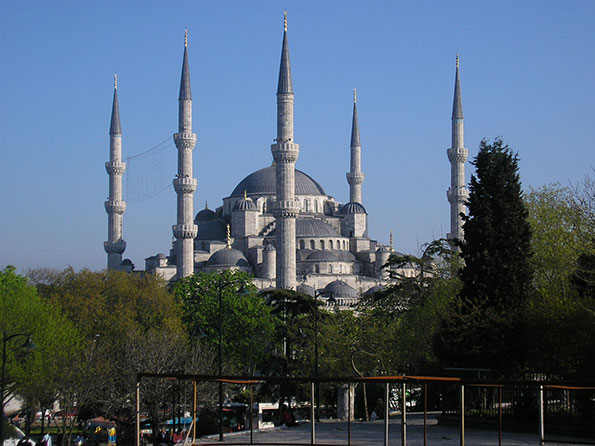

    Caption: Sultan Ahmed Mosque (Blue Mosque), 17th Century, CE

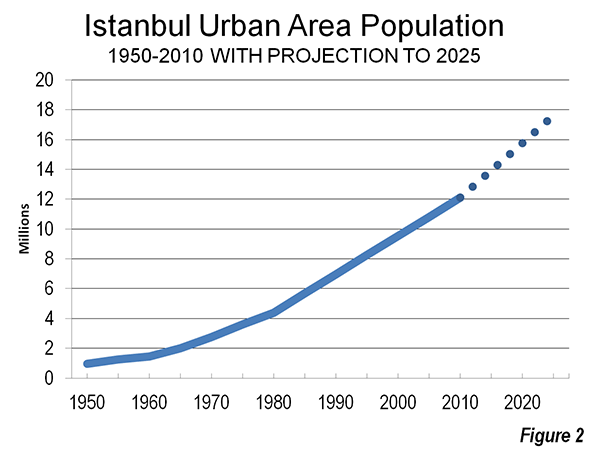
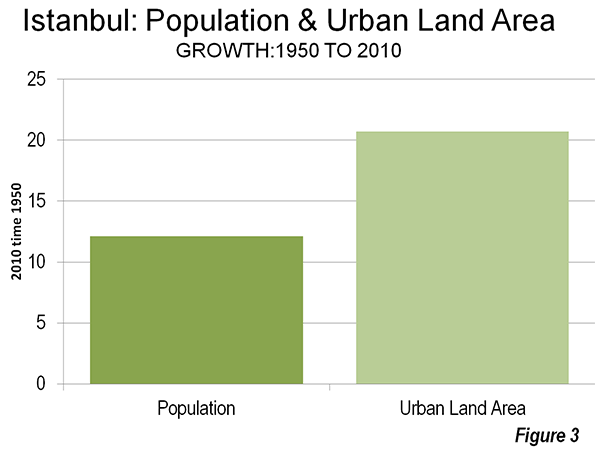
    In the ensuing centuries, the urban area grew modestly to less than 1,000,000 in 1950, when the urban population density fell to 40,400 per square mile (15,600 per square kilometer). Rapid growth was to follow to today’s more than 12 million, along with a further drop in urban density, to 24,300 per square mile or 9,400 per square kilometer (Note: The Density of Istanbul). The physical expansion of the urban area now stretches north all the way to the Black Sea (Figure 1 shows the present extent of the urban area and the 1950 urban area). Over the 60 years, the urban area population grew more than 12 times, but the urban land area grew nearly 21 times (Table 1). Istanbul demonstrates the near universal truth that as cities grow, they become less dense  (Figure 2).
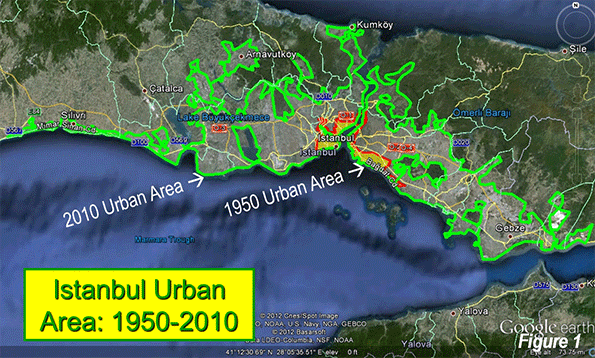
    Table 1          
    Istanbul Urban Area: Population & Density from 1550    
    Year Population in Millions Land Area: Square Miles Land Area: Square Kilometers Density:Square Mile Density: Square Kilometer
    1550 0.66 6 16 110,000 42,500
    1950 0.97 24 62 40,400 15,600
    2012 12.66 520 1,347 24,300 9,400
               
    Change: 1550-1950 47% 288%   -63%  
    Change: 1950-2010 1205% 2073%   -40%  


    At United Nations projected growth rates, the urban area should approach 18 million by 2025 (Figure 2). There are reports of increased migration to Istanbul from Asian Turkey, which if continued, could make the 2025 figure even higher.
    The Metropolitan Metropolis and Province

    Istanbul is a both a metropolitan municipality and a province and can be considered a metropolitan area (labor market area). The province, most of it rural, covers land area of more than 2,100 square miles (5,300 square kilometers) and had a population of approximately 13.5 million according to the 2011 census. The urban area (area of continuous urban development) is much smaller, at only 520 square miles (1,347 square kilometers). Nearly all the population is concentrated in the urban area.

    Since 1985, the metropolitan area’s growth largely has been outside the core. The historic core, on the peninsula (Fatih), lost 27 percent of its population, while the balance of the core, district municipalities to the north of the Golden Horn and to the west, lost 5 percent. Such core area losses have frequently occurred in many  major metropolitan areas   (for example, Osaka, Seoul, Mumbai, Chicago, Milan, Buenos Aires, and Mexico City).

    The inner ring, including district municipalities further to the west and north of the core on the European side and municipalities on the Asian side have captured nearly all the growth. From 1985 to 2011, inner ring district municipalities added 5,000,000 residents. The outer ring of suburban district municipalities gained 2.5 million residents with the greatest percentage growth, at nearly 250 percent. There has also been growth in exurban district municipalities (beyond the urban area), though it has been much more modest (Figure 4 and Table 2).
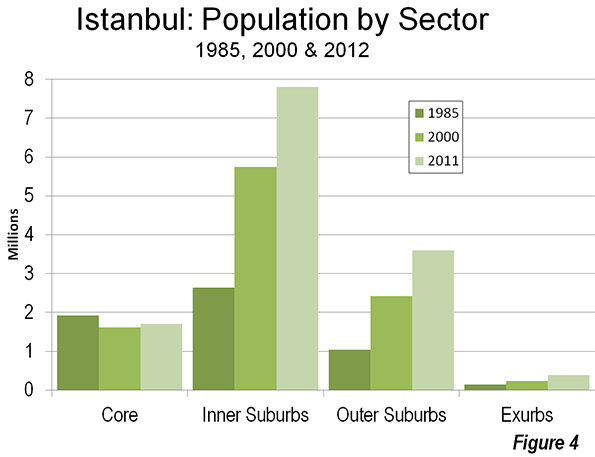
    Table 2          
    Istanbul: Population Growth by Sector: 1985-2012  
               
        1985 2000 2011 Change: 1985-2011
     Historic Core: Fatih             591          459          429 -27%
     Balance of Core          1,336      2,175      1,270 -5%
     Inner Ring          2,635      5,747      7,800 196%
     Outer Ring          1,044      2,424      3,598 245%
     Exurbs               147          240          386 162%
     Total            5,753    11,045    13,483 134%
               
     Population in 000s         


    Ascendant Asia

    While European Istanbul has been dominant for millennia, it is perhaps fitting that Asian Istanbul is on the rise, with nearly 40 percent of the population, up from 31 percent in 1985. Asian Istanbul was made substantially more accessible by the first bridge over the Bosporus (1973).

    Linking Istanbul

    Istanbul is served by two major east-west freeways. Each (the O-1 and O-2) both have their own crossings of the Bosporus. Other freeways feed these both in Europe and Asia. The development of the mass transit system is somewhat curious. The inner Fatih area and Beyoğlu contain the historically most important commercial centers. However, they are being fast replaced by new skyscraper developments in Levent and Maslak. This is similar to the emergence of newer commercial cores that have become more important the older cores, such as in Mexico City, Sao Paulo, Beijing, and Manila, where multiple, large cores have grown.

    Yet, Istanbul’s urban rail system keys on the old commercial centers. Both Levent and Maslak are located on a single Metro line, which makes them less convenient than if radial lines were being built to these centers instead. Both centers have good road access. Levent is located between the O-1 and the O-2 motorways, while Maslak is located just north of the O-2.

    A passenger rail tunnel between Asia and Europe, the first, is scheduled for opening to Fatih in 2015. Local authorities predict that this and other pending projects could increase the share of trips by rail in Istanbul from 3.6 percent to as much as 27.6 percent. No such market share increase has ever occurred in the world since automobiles have become widely available. Further, like Istanbul’s transit system in general, the project will not provide direct service to Levent or Maslak.

    Becoming Europe’s Largest Urban Area

    Istanbul has always been considered European and remains so even with its huge suburbs in Asia. Istanbul trails Moscow as Europe’s largest urban area, but by 2025 should be the largest. Indeed, it seems likely that Istanbul will be the only European urban area to reach a population of 20 million, as much of Europe faces stagnant or even declining population.

    Wendell Cox is a Visiting Professor, Conservatoire National des Arts et Metiers, Paris and the author of “War on the Dream: How Anti-Sprawl Policy Threatens the Quality of Life.”

    ——————–

    Note: Walking Cities: Walking constrained the physical expansion of cities, and thus the population. As result, few pre-1800 cities reached 1,000,000 population and most were not able to sustain that level. The great expansion of urban areas followed, as walking was replaced by the more efficient transport modes of transit and automobiles, both of which permitted a sizeable expansion of urban footprints and labor markets. The subsequent economic growth is legendary and accounts for having attracted so many people from the countryside. In 1800, estimates suggest that urban areas contained under 10 percent of the world population. Today, the figure is 52 percent, according to the United Nations. This includes all urbanization, from the largest cities to the smallest towns.

    Note: The Density of Istanbul. The province, most of it rural, covers land area of more than 2,100 square miles (5,300 square kilometers) and had a population of approximately 13.5 million according to the 2011 census. The urban area (area of continuous urban development) is much smaller, at only 520 square miles (1,347 square kilometers). This article highlights the urban density of Istanbul, which is the population per square mile or square kilometer. Other sources cite much lower figures, for the province/metropolitan municipality (metropolitan area). However, metropolitan area densities are not urban area densities. Metropolitan areas virtually always have more rural land than urban land, so their population cannot be included in calculations of urban density. The population and density noted above is based upon the 2011 census and will be reflected in the next edition of Demographia World Urban Areas.

    Photo: Hagia Sophia (Santa Sophia) Church (now museum) built by Justinian (6th Century CE). Photos by author.

  • Sex (Or Not) And the Japanese Single

    Back in June 2011, British prime minister David Cameron backed proposals tackling the sexualisation of British children, in a bid to dilute the culture of sex that has swept western nations. The rhetoric goes that the ‘oversexualisation’ of society, as represented in everything from ‘lads mags’ to advertising boards promoting shampoo, has fuelled a surplus of sexual desire that is thought to have contributed to the rise of teenage pregnancy and rape cases in the UK.

    Compare this to Japan, a country where, according to a recent survey, a third of young men have no interest in sex. Moreover, 50% of young women are not dating. Could this be an ‘undersexualised’ society? Has this impacted Japan’s population geography?

    In 2007, Japans population reached a tipping point. It was the first year in its history (excluding 1945) where the number of deaths exceeded the number of births. In 2007 there were 2,000 more deaths than births. In 2011 that figure rose to approximately 204,000, and it’s a figure that is accelerating. Indeed, at 23.1%, Japan has the highest proportion of over-65s in the world, and at 13.2%, the world’s lowest proportion of under 14s. Japan’s population peaked at 127.7 million in 2007, and is forecast to shrink to a mere 47 million by 2100. What are the economic and social forces behind this?

    Too much work, too little sex: Japan is a country where sales of adult diapers exceed child diapers, and where more public money is spent on healthcare than defence. It’s also one of the world’s most industrialised countries, with an agricultural sector comprising 1.5% of its GDP and services sector comprising 75.7% of GDP. For Japanese society, this means that a white collar lifestyle predominates. High salaries with high workloads in an already expensive country has meant that starting a family has become a low priority, if a priority at all, on a Japanese professional’s wish list. The little available data on the reasons why indicates that raising a child is too expensive, and that the pressure of work leaves little time available to look after anyone other than themselves.

    Compounding this battle between a high flying job versus a family is a culture somewhat void of sexualisation. It is unlikely that, on a stroll through Tokyo, you will come across much imagery that is overtly sexual. In contrast with the west, sex doesn’t sell in Japan. Among males 16 to 19 year old, 36% have no interest in sex, and some even despise it. The figure is even higher (59%) for females in the same age category. These respondents often cite greater interest in comics, computer games and socialising through the internet. A low level of cultural sexualisation is not without its benefits; the rape rate is one of the lowest in the world.

    However, the net result of these socio-cultural and economic factors is that the fertility rate is astonishingly low. According to the UN the figure is 1.27.

    Japan is therefore facing a demographic crisis. The number of dependents per active member of the labour force is increasing, and in an unusual situation, there are more jobs available than people to do them. Furthermore, in future decades Japan may have an oversupply of infrastructure relative to the amount of people who can use it.

    Several policy options could be under consideration by Japan’s decision makers. Not all of these are practical or even advisable, but we may see them looked at in years ahead:

    Encourage Fertility – This would help ensure that the labour market and services such as transport are not undersupplied. It can be done in at least three ways. The first is through pro-natal incentives, such as child tax breaks for couples who desire children. The second is to restrict or even ban abortion (Japanese abortion laws are some of the most liberal in the world). For example, restrict abortions to the first trimester only. Laws such as these will inevitably conflict with women’s and couples rights. The third, and perhaps the most untried, is to sow the seeds for a more sexualised Japanese culture, one with more lust and desire, in an attempt to situate relationships as more desirable than the latest computer game.

    Encourage Migraton – Japanese immigration and emigration have both been low. The ethnic mix of Japan is not diverse. 98.5% of Japan’s population is ethnically Japanese, with only a few other ethnic groups. In order to prevent an undersupply of labour, the country may have to encourage mass immigration. Given the unique culture and language of Japan, will foreigners want to come and live there? Would immigration cause ethnic tensions in this peaceful country?

    Raise the Retirement Age – It has been calculated by United Nations researchers that the retirement age in Japan would have to be raised to 77 from 65 in order to rebalance its crippling dependency ratio. This would shorten the average amount of retirement years from 14 years to two for men, and from 19 years to seven for woman.

    A blueprint for the rest of the world? Is Japan’s pattern of rising, peaking, and falling gross population going to be a defining demographic trend in the 21st century? In Japan, Germany, Russia, Czech Republic, Estonia and several more countries it already is, with several other low growth European countries, such as Italy, forecast to head the same way.

    Low sexualisation is unlikely to be an important factor of low growth in Europe. The worldwide trends of continued urbanisation, the growth of white collar jobs, and the decline of blue collar jobs as an overall percentage of the economic makeup have acted as the most effective mass contraception.

    Given a course of continued social and economic development around the world, the ‘tipping point’ for world population could be as near as 2050, a date that many of the readers of this article could be witnessing.

    The rhetoric of overpopulation doomsday scenarios should really be reversed. The warnings today should be about the unsustainable dangers of a shrinking population. This will no doubt be one of the key issues in sustainable development discourse for years to come.

    Edward Morgan is a 4th Year Human Geography student at the University of St Andrews, Scotland.

    Photo by Kevin Poh: Night Life @ Shinjuku, Tokyo