Blog

  • The U.S. Cities Getting Smarter The Fastest

    It’s a commonplace among pundits and economic developers that smart people flock to “smart” places like sparrows to Capistrano. Reflecting the conventional wisdom, The New York Times recently opined that “college graduates gravitate to places with many other college graduates and the atmosphere that creates.”

    Yet an analysis of Census data shared with Forbes by demographer Wendell Cox tells a different story. In the past decade, the metropolitan areas that have enjoyed the fastest growth in their college-educated populations have not been the places known as hip, intellectual hotbeds.

    Perhaps the myth most devastated by the study, which looked at the change in the number of people with bachelor’s degrees in the 51 largest metropolitan statistical areas from 2000-2010, is that there is, as the Atlantic’s Derek Thompson has insisted, a “bipolar population shift” in which the educated go to the expensive blue regions while families and dummies (often conflated as the same thing) flock to the brain-dead reaches of the Sunbelt. In fact, during the first decade of the 21st century, the number of college graduates in Las Vegas increased by a remarkable 78%, the biggest jump in the nation over the period, while in second place Riverside-San Bernardino, Calif., the college-educated population expanded by 60%. Other surprise cities in the top 10 — Charlotte, N.C. , (No. 5) ; San Antonio (No. 6); Jacksonville, Fla. (No. 7); Orlando (eighth); and Nashville, Tenn. (ninth) — all saw 40% to 50% increases in their college-educated population.

    Among the more conventional “brain” cities, the biggest winners from 2000 to 2010 tended to be lower-cost metropolitan areas with less dense cores, such as Raleigh–Durham, N.C. (No. 3), and Austin, Texas (No. 4). In contrast, the more expensive places celebrated for being smart expanded their populations of college grads at roughly half that rate, such as San Francisco (48th), San Jose (43rd), Boston (45th) and New York (39th).

    This is not to say that these cities don’t boast huge concentrations of educated people. The largest metro areas, led by New York, Los Angeles and Chicago, have the biggest populations with bachelor’s degrees. And on a per capita basis, Washington D.C. (aka “parasite city”), San Francisco, Boston, Denver and Minneapolis lead the way, with a share of college grads 20% or more above the national average.

    But other metro areas are catching up. In Tampa-St. Petersburg, Fla., for example, the share of the population that’s college-educated grew from 21.7%  to 26.2%, a gain of 21%. This is roughly twice the increase in the Washington, San Francisco and Seattle metropolitan areas.

    This trend  doesn’t extend to all lower-cost regions. The Sunbelt has generally gained, but some Rust Belt towns have not fared as well. Cleveland, for example, ranked 50th in terms of its growth of its college-educated population, Detroit 49th and Buffalo 48th. Low costs, not surprisingly,  don’t compensate for poor economic conditions, decayed infrastructure and bad weater.

    Yet the pattern is clear: brainpower is spreading out. The notion that companies seeking skilled labor have to go to one of the “hip” cities — an idea relentlessly marketed by the New York and D.C.-based press — appears greatly overstated. In reality, skilled, college-educated people are increasingly now scattered throughout the country, and often not where you’d expect them. For example, Charlotte, N.C., Columbus, Ohio, Kansas City and Atlanta now boast about the same per capita number of college grads as Portland and Chicago, and have higher per capita concentrations of grads over the age of 25 than Los Angeles.

    These trends also suggest that, in many ways, the highly educated are not so different from Americans who never went to college or never graduated. The factors that have driven economic outperformance by some cities over the past decade — lower home prices, better business climate, job opportunities — also attract people with bachelor’s degrees.

    Atlanta, Houston and Dallas each have added 300,000 college grads in the past decade. This is far more than Boston’s increase of 240,000 or San Francisco’s 211,000. Once considered backwaters, these Sunbelt cities now all enjoy a critical mass of educated people.

    Houston boasts a percentage of college grads over 25 somewhat above the national average. Dallas-Fort Worth is just about at the national average. The total Houston increase in college grads over the past decade amounts to three times that of the capital of Silicon Valley, San Jose, Calif., twice that of San Diego and more than Philadelphia. Since hipness is not a well-known Houston trait (though it did place first this year on Forbes’ list of America’s Coolest Cities), and climate can hardly be seen as a positive, one has to imagine this growth has something to do with a job machine that has created over 100,000 new positions between 2006 and 2011.

    The addition of college grads leads to changes on the ground that tend to make cities even more attractive to future graduates. In the case of Houston, there’s been a proliferation of more sophisticated restaurants, clubs and bars in growing inner-city districts like Houston Heights, Montrose and Midtown.

    In the past, executives often turned up their noses at the prospect of relocating to the Gulf Coast metropolis, says Chris Schoettelkotte, founder of the Houston-based recruiting firm Manhattan Resources. Now, particularly given the weak national economy, Houston is increasingly competitive in the race to recruit skilled, educated labor, he says. This is particularly true with people at the beginning of their career. “I don’t get the pushback I used to get,” Schoettelkotte says. The message to recruits: “ You try to find a city with a better economy and better job prospects than us.”

    A democratization and dispersion of educated workers bodes well for the U.S. economy. When highly skilled labor is concentrated in a few places, such as Boston or the Bay Area, opportunities for growth tend to be limited by extremely high business and housing costs. Having more places with educated workers gives employers and entrepreneurs more options for where to start a business or relocate.

    Looking ahead, we can expect this trend to continue, particularly as the current bulge of millennial graduates mature and start to look for affordable places to live and work. Regions that maintain strong job growth, and keep their housing costs down, are likely to keep gaining on those metropolitan areas celebrated for being the winners of the race for educated people.

    Metropolitan Growth in Age 25+ Population with Bachelor Degrees
    Rank Region Total Growth Percent Growth
    1 Las Vegas 122,304 78.4%
    2 Riverside 187,406 60.0%
    3 Raleigh 107,075 55.2%
    4 Austin 147,341 52.3%
    5 Charlotte 126,226 51.7%
    6 San Antonio 111,739 48.1%
    7 Jacksonville 77,102 46.8%
    8 Orlando 125,299 46.6%
    9 Nashville 92,823 42.4%
    10 Phoenix 216,585 42.1%
    11 Tampa 145,675 39.6%
    12 Houston 300,952 39.5%
    13 Louisville 61,312 37.6%
    14 Portland 134,935 37.2%
    15 Dallas 336,993 36.9%
    16 Atlanta 308,306 36.1%
    17 Sacramento 108,151 35.8%
    18 Denver 169,553 35.2%
    19 Indianapolis 90,001 34.5%
    20 Oklahoma City 56,117 33.5%
    21 Richmond 67,012 33.4%
    22 Columbus 96,905 33.2%
    23 Miami 262,394 31.7%
    24 Virginia Beach 73,110 31.2%
    25 Seattle 205,977 31.2%
    26 Kansas City 103,527 31.0%
    27 Salt Lake City 46,205 30.5%
    28 Washington 410,679 30.5%
    29 Minneapolis 189,209 29.9%
    30 Baltimore 146,285 29.6%
    31 San Diego 154,845 29.6%
    32 St. Louis 128,617 29.5%
    United States 13,115,437 29.5%
    33 Cincinnati 90,374 28.3%
    34 Los Angeles 559,904 27.7%
    35 Memphis 45,141 27.4%
    36 Philadelphia 281,686 27.2%
    37 Birmingham 41,436 26.3%
    38 Chicago 429,001 25.5%
    39 New York 905,618 24.4%
    40 Milwaukee 63,508 24.3%
    41 Providence 59,926 24.1%
    42 Rochester 44,268 23.6%
    43 San Jose 102,609 22.5%
    44 Pittsburgh 88,370 22.3%
    45 Boston 240,426 22.0%
    46 Hartford 49,225 20.8%
    47 Buffalo 36,578 20.1%
    48 San Francisco 211,835 19.2%
    49 Detroit 109,429 16.2%
    50 Cleveland 51,259 14.9%
    51 New Orleans 19,307 10.1%

    Data source: U.S. Decennial Census 2000 and 2010.

    Joel Kotkin is executive editor of NewGeography.com and is a distinguished presidential fellow in urban futures at Chapman University, and contributing editor to the City Journal in New York. He is author of The City: A Global History. His newest book is The Next Hundred Million: America in 2050, released in February, 2010.

    This piece originally appeared in Forbes.

    Graduation image by BigStockPhoto.com.

  • Why I Don’t Live In Indianapolis

    It’s no secret that Indianapolis has been a huge focus of my blog over the years. One of the biggest criticisms I get here, especially when I ding some other city, is that I’m nothing more than a mindless booster for Indy. While I like to think I’ve given the city a lot of tough love over the years, it’s definitely true that I’ve had many, many good things to say, and I have no problem saying that I’m a big fan of the city overall.

    Why then, might one ask, don’t I actually live in Indianapolis?

    The answer is multifaceted, but without a doubt one key reason is that I simply can’t sign up to what the city is doing in its urban environment. Indy is going one direction, I’m going another. It’s as simple as that.

    Let me give you an example of what I’m talking about. The city recently announced a plan to subsidize a mixed used development on a parcel in the core of downtown, a project called “Block 400.” It would include apartments, retail, etc – all good. While the concept is great, the design is another matter. I could go into depth on the monotony of the structure and other matters, but what I want to show you instead is a parking garage that will house employees from One America insurance. Here was an initial rendering of the garage:

    It’s about as boring a garage as can be imagined. It’s on a prime block just steps from Monument Circle, but has no street level retail or other interest. It’s just a dead parking garage.

    Various folks took umbrage at this, so the developer decided to tack on some awnings, which got them approved by the city’s hearing examiner. Here’s their updated design:

    Let’s be honest: this isn’t a garage, it’s urban design garbage. And guess what? The city of Indianapolis itself is paying to build it.

    I don’t want to let the perfect be the enemy of the good. I can certainly understand that there are economic constraints, tradeoffs to be made, etc. And not every project can be a home run.

    But this isn’t unusual at all – this is standard operating procedure for Indianapolis. This is par for the course. This is just what Indianapolis builds. I cannot name another major city in the United States where the city’s own developer community (including Flaherty and Collins, the developer of this property), own architectural firms (including CSO Architects, who designed this) and own city government so consistently produce subpar development.

    I’m not exaggerating at all. And this isn’t even the worst offender. For example, here’s another downtown development that not only sucks out loud, but the state fire marshal condemned it and forced residents to move out:

    While I’ve named the names of the folks involved in the parking garage and they certainly deserve it, let’s not focus overly on them. This trend goes back a really long way, and is pervasive. The previous city administration, which was of a different political party, behaved no differently. Partially it’s a result of a lack of good urban history of the type that exists in other places. So there isn’t a good template ingrained in the city to follow.

    But ultimately, as I’ve written before, it’s a crisis of values.

    Indianapolis is the place where, as a rule, not good enough is more than good enough for most people, even community leadership.

    That’s why I don’t live there. Because that’s not good enough for me. I may not be perfect, but I aspire to more than mediocrity. I don’t expect any city to be perfect or all the way there yet. You can inspire people, including me, to join your army to take hamburger hill or to get behind the rock and push, if you provide a vision of what can be. That’s one reason people are planting their flag in Detroit. It’s the hope of the possible.

    But when it’s clear that the city itself – and I mean that in the broadest sense – has decided it wants to go march off in a different direction, it’s a lot harder to enlist in that army, no matter how much you might want to.

    Alas, it seems lots of people agree with me – on the actions if not the reasons – as Center Township (the urban core) lost another 24,000 people in the 2000s. They voted with their feet – just like tens of thousands of others have been continuously voting with their feet since 1950 – to go build a better life for themselves somewhere else.

    And in a decade where downtowns made strong residential comebacks, with young people streaming in to live in them, Indianapolis was an exception. Its downtown* added less than a 1000 residents, and their distribution suggests that almost all of that might be a result of jail population expansion. Even downtown Cleveland did better.

    I’m sure Indy’s boosters will be happy to talk about world class parts of downtown like Monument Circle, the Cultural Trail, Georgia St., etc. And these are legitimately first rate. Actually, that makes it worse. It shows that Indianapolis can compete with the best if it wants to, but most of the time it just doesn’t care to. It’s not ignorance. The city knows that to do, it just doesn’t want to do it.

    For some reason locals seem to think that doing it right should be reserved for a handful of special places and occasions. But the mark of at great city isn’t how it treats its special places – everybody does that right – but how it treats its ordinary ones. Indy is like the guy who thinks he can get away with wearing the same old dirty clothes fives days in a row and not taking showers, as long he slaps on a little top shelf cologne before he leaves the house. I’ve got news for you, people are going to notice.

    Indianapolis retains a very compelling regional story to tell. There are tons of reasons for people to come to or build a business in, metropolitan Indianapolis. But the real story there is mostly in the suburbs.

    Yet I believe even the urban core of this not very historically urban city could be compelling as well – if it wanted to be. Indianapolis has all the potential in the world. Indy is like the up and coming star at a company whose boss pulls him aside one day and says, “You’ve got all the potential in the world, but if you want to get that big promotion, you need to stop doing/start doing X, Y, or Z.” Anybody who has made it to the top was fortunately enough to have somebody give them one or more of those good kicks in the pants along the way.

    Indy, unfortunately, has heard the message many times before from many different people, and has elected not to do anything about it.

    Locals love to make excuses for why things can’t be better. F&C’s development director for the project said of the garage, “Some things aren’t achievable.” What is so different about Indianapolis that makes that true there but no where else? What miracle of economics allowed similar cities like Nashville or Cincinnati or Columbus to build many urbanistically correct new developments in those places while somehow it is impossible in Indianapolis? Maybe it’s time to recruit some out of town developers and architectural firms who have a different attitude towards the possible.

    I would encourage Indy’s leaders to take a short hour and a half drive to downtown Cincinnati and take a look around what’s there. Not the old buildings, but the new ones. Most of them are candidly quite bland architecturally, but from an urbanism perspective – and be sure to take someone with you know what’s what they are talking about on this so that they can point it all out – even the bottom quartile of new buildings in downtown Cincinnati beat most of the top 5% of what’s been build in downtown Indy.

    I’ve listened to various civic leaders of late talk about how rebuilding the urban core is now a big priority of the city. If that’s true, and business as usual has been leading to a catastrophic population collapse for some time, wouldn’t you think that you might, you know, try something different? Apparently not.

    When people in Indy want to do something, they can. That’s why they built an amazing franchise in events hosting, particularly sports. They understand what world class is there, they understand the competitive marketplace, and they do what it takes to succeed – including building world class venues, districts, and capabilities to make it happen. So why hasn’t it happened elsewhere?

    I was involved in a discussion about building a high tech industry in Indianapolis a few years ago. Someone boldly said that since Indy had been able to pull off building the sports cluster, it should be very capable of equally pulling off a high tech cluster to rival top hubs in the country. A friend of mine was very dubious about this, and said insightfully, “Sports succeeded because sports is consistent with the state of mind (i.e, the culture, values, and patterns of life) of Indiana. But high tech is more consistent with the state of mind of other places and not so much with Indiana.” Indianapolis is #1 in sports. And while it’s done well in some parts of tech, I don’t see how you could really rate it as more than the middle of the pack nationally on that.

    “State of mind” makes a big difference. That’s ultimately a question people ask themselves these days, whether it is a company and a prospective employee sizing each other up, a consultant and client, or a city and a prospective resident or business. The most important question is always, “Is there a cultural fit?”

    In an era where an ability to attract talent is perhaps the defining characteristic of urban success over the long term, Indy needs to ask itself the hard questions. How competitive is it? I’d have to say right now that it does a great job for people who want to live in a suburban environment like Carmel or Fishers. That’s very, very important and not to be minimized.

    But there are people out there that want more, who prefer different types of environments. Right now Indy is simply not very competitive in that market. And if it keeps on its current path, it never will be. Convince yourself otherwise by finding the exceptions to the rule and getting them to gush about how great things are. But the numbers don’t lie.

    Like that young up and coming employee who’s got the goods but has a few problem areas that will, if not fixed, hold him back, Indy needs to take a serious gut check about the things that hold it back – and an embrace of mediocrity and lack of seriousness in its approach to urban core development are chief among them.

    Ultimately as I said it’s a question a values. There’s nothing wrong with being happy about where you are. Most people don’t have that burning ambition to make it higher, nor a passion for excellence. In this competitive world a lax attitude will probably undermine your performance in the end, but if that’s what you want be, go for it. I won’t judge a place for that. Just don’t expect those who want better for themselves to sign up for it.

    In any choice a city makes, somebody is going to be unhappy. Any branding choice is, in a sense, a choice to exclude by focusing on something rather than something else. There’s nothing wrong with setting down a marker of what you’re going after – and being comfortable with fall out from that.

    Ultimately it’s not about me or any other specific individual. I’m under no illusion that I’m someone who is personally important to future of any city I might find myself. But it about people generally, and being able to attract enough of them – particular of those that are critical to the 21st century economy – to make the city successful and indeed sustainable over the long term.

    Just remember, talented, ambitious people – those with big dreams and hopes for themselves and their societies – want to live in a place where the civic aspiration matches their personal aspiration.

    What do you aspire to, Indianapolis?

    * Downtown defined as the area inside the inner freeway loop and the White River.

    Aaron M. Renn is an independent writer on urban affairs and the founder of Telestrian, a data analysis and mapping tool. He writes at The Urbanophile, where this piece originally appeared.

  • Evolving Urban Form: Dhaka

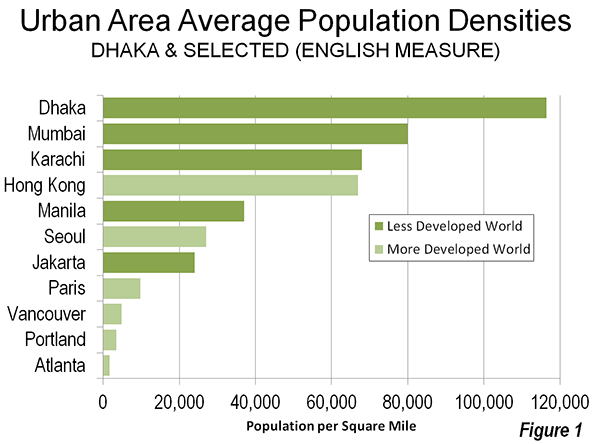
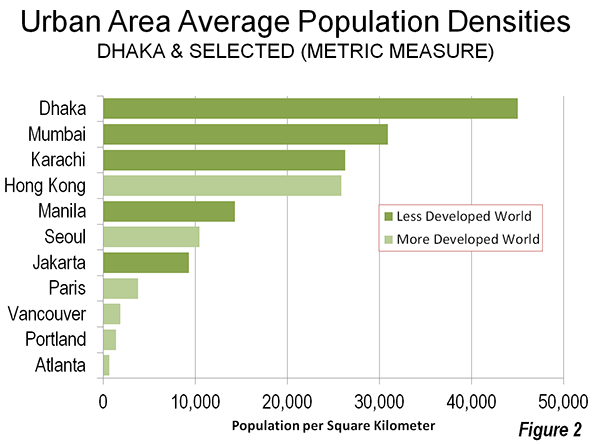
    A few weeks ago, we suggested that Hong Kong was the "smart growth" ideal, for having the highest urban population density in the high income world. But, if you expand the universe to the poorer, developing countries, Hong Kong barely holds a candle to Dhaka. Dhaka’s 14.6 million people live in just 125 square miles (325 square kilometers). At more than 115,000 people per square mile (Figure 1), or 45,000 per square kilometer (Figure 2), the capital of Bangladesh is nearly 75 percent more dense than Hong Kong.

    The Ultimate in Average Urban Area Density

    None of the world’s megacities comes close to Dhaka’s population density. Mumbai is about one-third less dense, despite its reputation as crowded and congested. The only other megacity (minimum 10 million population) more than one-third as dense as Dhaka is Karachi. Twenty three other megacities fall at least two-thirds short of Dhaka’s density (such as Jakarta, Seoul and Paris). New York’s core, Manhattan, is 40 percent less dense, and the New York urban area does not reach 1/20th of Dhaka’s density


    No city in the world uses land so efficiently as Dhaka. But this comes at a price. With an urban area ranked among the 20 most populous in the world, Dhaka’s average income is so low that it does not even place in the top 100 metropolitan area economies as measured by the Brookings Institution. Thus, the world’s most dense urban area is among the least economically productive. Brookings rated the principally suburban and exurban Hartford metropolitan area number one, with an urban density approximately 1/100th that of Dhaka, Hartford includes the old core city; but as well as the much more substantial primarily suburban or even exurban areas.. Hartford is among the least dense urban areas in the world, at half as dense as Portland and one-fourth as dense as Los Angeles. So much for the illusion that urban density and productivity are joined at the hip.

    Despite Dhaka’s hyper-density, critics complain about Dhaka’s urban sprawl. If Dhaka is "urban sprawl," then the term is meaningless. Perhaps the critics would prefer the rural poor to live in even more crowded shantytowns, or maybe better yet, that they go back home to even more desperate rural poverty. Aspiration is not a bad thing, and if that means cities with more people, covering more land area, so be it.

    Not only does Dhaka have the highest average urban density, but it also has some of the highest neighborhood densities: some slum (shantytown) population densities reach 4,200 per acre, which converts to more than 2,500,000 per square mile or more than 1,000,000 per square kilometer. Estimates of the slum population vary, ranging from a quarter to 60 percent of the area population.

    Dhaka in the Neighborhood

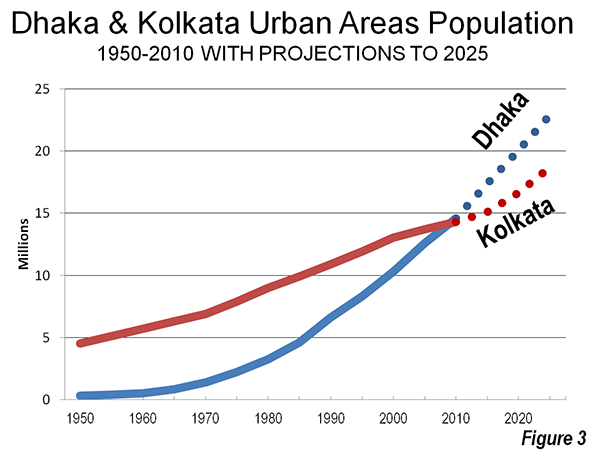
    Dhaka is only 150 miles (250 kilometers) from Kolkata. Both cities were located in the province of Bengal for all but six years of the centuries long period of  British rule. After the division of India and Pakistan in 1947, Dhaka was located in East Pakistan. Kolkata became the capital of the Indian state of West Bengal. For most of their histories, Kolkata was larger than Dhaka. But the Dhaka urban area has just overtaken Kolkata in population. By 2025, the United Nations forecasts that Dhaka will reach 23 million, well ahead of Kolkata’s projected 19 million (Figure 3).

    Dhaka’s growth has been spectacular. In 1970, just before East Pakistan separated from Pakistan to become Bangladesh, the urban area had a population of 1.3 million. Its population grew by more than 10 times, Dhaka growth over four decades trails only Shenzhen among the megacities, which expanded by 30 times over the same period.

    The Metropolitan Area

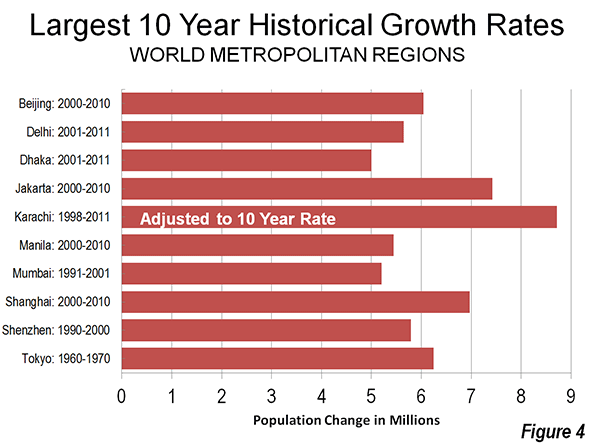
    Dhaka’s metropolitan area (which includes the urban area and economically integrated rural environs) added approximately 5,000,000 new residents between 2001 and 2011. Dhaka added at least a 50 percent to its population, rising from just under 10 million population to just over 15 million during the decade (Note 1). Few, if any of the world’s largest metropolitan areas or urban areas have achieved such a large percentage population increase in a period of 10 years. Even so, Dhaka’s population added fewer people than some larger metropolitan areas over a similar period, such as Karachi, Jakarta and Shanghai (Figure 4).

    Spatial Expansion

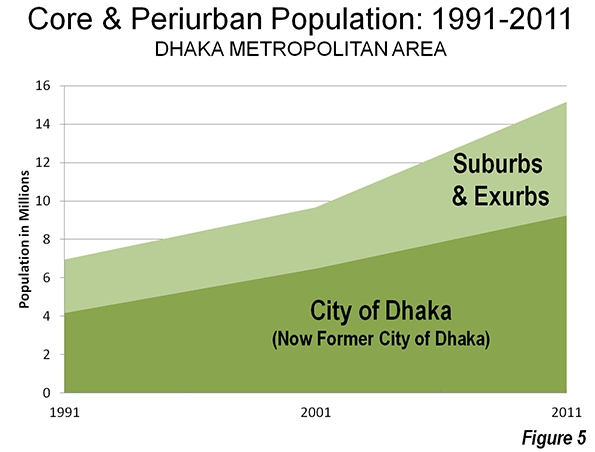
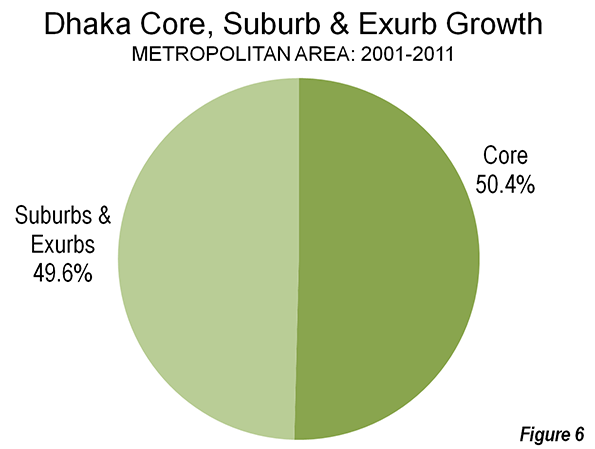
    Consistent with the trend since cities escaped walls, Dhaka has been expanding spatially as its population has increased. Over the past decade, the core municipality, Dhaka, increased its population 45 percent. The suburban and exurban population increase was nearly twice as great, at 85 percent (Figure 5). The core city of Dhaka managed to capture just over one-half the population growth, but because of its larger size, the slower percentage growth rate still resulted in half the additional population being in the city (Figure 6). Dhaka thus further confirms the axiom that as cities become larger, they become less dense.


    River City

    Dhaka may be the worst situated urban area in the world. Dhaka is located in wetlands and virtually surrounded by rivers, some of the greatest in the world.

    • Dhaka is 20 miles (32 kilometers) east of the Padma River, which is the main course of the Ganges River.
    • Only a few miles north of this point, the Padma is joined by the Jamuna River, which is the main course of the Brahmaputra River.
    • The Meghna River, the secondary Brahmaputra River course is 15 miles (25 kilometers) to the east of Dhaka.
    • Little more than 30 miles (50 kilometers to the south is the confluence of the Padma River and the Meghna River, which flows the last few miles to the Bay of Bengal as the Meghna.

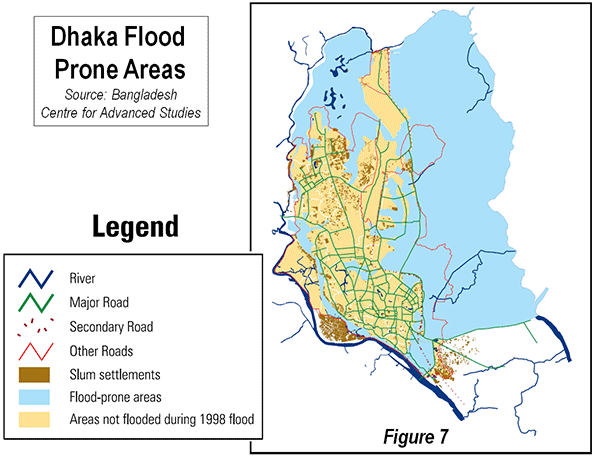
    Though Dhaka is 100 miles (160 kilometers) from the Bay of Bengal (the Indian Ocean), the lowest parts of the city are little more than five feet (two meters) above sea level. This means serious flooding. The risk is illustrated in Figure 7. The extent of the risk is illustrated by the fact that the areas not prone to flooding cover less land than the urban area. That means that the necessary urban expansion will be very expensive. With the understandable exodus from rural areas to the city, the problems of high density and, particularly slums could become more acute.

    A City Designed for a Metro?

    The river courses and wetlands have forced Dhaka into a generally north-south orientation. The urban area averages from three to seven miles east to west (five to 11 kilometers) and is nearly 30 miles (50 kilometers north to south. The more circular development that would be expected for an inland urban area is precluded by the rivers and wetlands.

    This unusual city form could serve the city well, however, as it builds its first Metro line. Stations on the planned north to south line will be within a long walk of a much of the urban area. It is hard to imagine an urban form and density more suited for a Metro. Construction is supposed to begin within the next two years.

    Not only is Dhaka the largest world urban area without an urban rail system, it is also the largest without a motorway (freeway). That too will soon change, as two should be under construction soon.

    Political Reform and the Future

    Meanwhile, in an attempt to improve city services, the national government has divided the city of Dhaka into two. The Dhaka City Corporation has now been replaced by the Dhaka North City Corporation and the Dhaka South City Corporation. There is an increasing body of literature suggesting that smaller municipalities perform better (and spend less) than larger municipalities. The Dhaka demerger may be the first significant such move since the 1986 breakup of the Greater London Council by the Thatcher government (Note 2).

    Dhaka begins the next decade undertaking significant challenges in infrastructure, economic growth and government reform. However, perhaps the biggest challenge will be to figure out where to put the additional five million people expected by the 2021 census.

    Wendell Cox is a Visiting Professor, Conservatoire National des Arts et Metiers, Paris and the author of “War on the Dream: How Anti-Sprawl Policy Threatens the Quality of Life.”

    —–

    Note 1: There was an undercount in the 2011 census, ranging from 3.8 percent in rural areas to 5.3 percent in urban areas. This complicates comparison between the 2001 and 2011 census data.

    Note 2: Even after the subsequent creation of the Greater London Council, by the Blair government, most local functions were not transferred, remaining in the 32 local boroughs. A forced amalgamation of Montréal with suburbs was partially reversed by voter referenda in the early 2000s.

    —-

    Photograph: Farmview Supermarket Transit Transfer Center, on one of the urban area’s few north-south arterial  roadways. (by author)

  • Swing State Geography: The I-4 Corridor

    Overheated presidential politics have done few favors to Florida, except to put 132 miles of hot asphalt on everyone’s lips:  Interstate 4.  Completed in the late 1960s, this interstate (in fact, the only interstate highway to be entirely contained within one state) is known by millions who have  visited there at least once on vacation.  But the social and political reality in the world  around Interstate 4 is little known outside of Central Florida.  Like Ypres, the Flemish town continually under assault during World War 1, I-4 will receive the brunt of both side’s forces.  It deserves to be known a bit for its quirky uniqueness,   even if, like Ypres, it will recede to obscurity once the election is over.

    America’s other single-digit interstate, I-5 in southern California, has such a singular personality that its users refer to it as “the five.” Not so I-4, although many users spit when they say it. With the third highest accident rate in the nation with 1.58 fatal accidents per mile 2004-2008 , Interstate 4 is notorious   for its congestion, dangerous drivers and bad karma. A section of it is even rumored to be haunted.

    I-4 begins rather inauspiciously in Tampa, at a highway interchange with I-275 that even the state Department of Transportation calls “malfunction junction.”   Tampa itself is a brew of German, Italian, Spanish, and Cuban immigrants largely supplanted in the 1980s by in-migration from other states. With a port poised to take advantage of Tampa’s proximity to the Panama Canal, Tampa, and its sister city, St. Petersburg, offer a fantastic coastal setting for urban development. 

    Unfortunately, the two cities now squabble eternally over what has recently been diminishing economic opportunity, often leaving their geography a large, low-grade commercial wasteland. With little to offer except beaches and waterfront real estate, Tampa and St. Pete struggle for their existence. Their airport,  considered the world’s best in the 1980s and 1990s, has been overtaken by newer, better facilities in Orlando, Denver, and other international cities, and like Tampa in general, it suffers as a has-been. No matter; Tampa’s feisty nightlife has turned Ybor City from a quaint, vacant historic district into a wet-zoned bar district that still houses the best music scene in Central Florida.

    Over the bay, St. Petersburg features lovely waterfront sidewalk life with delightful galleries and museums, but it remains “God’s waiting room” with shuffleboard courts and early bird specials at local diners. Beautiful older neighborhoods surround both downtowns, but the outer-ring growth that reaches out beyond these prewar suburbs seems unremarkable and bland. The area, once a diverse mix of blue-collar industry and office workers, has lost a lot of both.

    St. Petersburg is set in Pinellas County, a peninsula that reaches downward just as the San Francisco bay area’s peninsula reaches upward.  But as San Francisco took off  Pinellas did not.  Even the gulf coast of Pinellas County, with beautiful beaches, fails to reach its potential, housing gritty, second-rate motels and paint-peeled condos catering to vacationers unable to afford Sarasota further on down the shore.

    Downtown Tampa these days possesses the sad, romantic air of places once important but now in a state of vanished grandeur. The sidewalks are harsh, bricky, and hot; almost no one traverses the sun-grilled open space at noon. Vacant, boarded-up storefronts are prevalent, punctuated by sleazy, vacant eateries. Channelside, a redeveloped area between downtown and the historic district, has suffered the blight of new, cheesy-looking condominiums built over storefronts, awaiting the throngs of young singles seeking an urban lifestyle but never quite arriving. Channelside looks like an empty stage set, et, “for lease” signs flapping in the breeze.

    Beltways like Interstate 4 can be dividers or uniters, and this one is both and neither at the same time.  East of Tampa, it makes little difference which side of I-4 you reside on; north of Interstate 4 is Temple Terrace and the University of South Florida, and south of Interstate 4 lies Brandon, an unincorporated town. Interstate 4 presents no barrier between the two sides, with fluid movement suggesting that in this section, I-4 presents no obstacle or defining boundary.

    Further east, however, one encounters the city of Lakeland, hanging like a pendulous fruit just south of the freeway. There is a rather fascinating notion that Florida’s urban areas are all aspects of one very large, complex web of urban settlement  most of whom are net consumers, taking in more than they produce. Unlovely Lakeland, the agro-industrial capital of central Florida, is just the opposite. Rich with phosphate, one of Florida’s only natural resources, Lakeland mines and processes this mineral for fertilizer and soap additives. It sends the phosphate by truck and by rail to the Port of Tampa for export.  Lakeland also processes orange juice and a variety of Florida’s agricultural products, and has clusters of food-packaging industries to support this activity. Lakeland, in the heart of what locals call “Florida Cracker country”, works hard and is definitively blue collar.

    North of I-4, Lakeland quickly fades into suburbs and ranchlands. Here, one passes through the Green Swamp, a wetlands that remains undeveloped and remote. An aviation museum reminds you that you are in Central Florida indeed, but little else of man’s handiwork is evident until US 27, an old, pre-war highway that runs along a nice, high ridge which brought so many people to Florida before the interstates came.

    As a boundary, Interstate 4 here is still largely symbolic, with a truck-stop cluster of gas stations and fast-food restaurants that eke out a living. On either side, however, the population remains rural and at this juncture, US 27 unites both sides of I-4, negating its myth as a boundary between red and blue Florida. By now, the alert traveler may have noticed that he is trending more northerly than easterly, and indeed Interstate 4 is slowly turning one to the north into the fringes of greater Orlando.

    At one time, Interstate 4 had seasonally fluctuating traffic. In the late summer heat, one could hit stretches of I-4 where no other cars could be seen on the horizon. Today, however, it frequently slows to parking-lot crawl on the outskirts of Lake Buena Vista. For this is the pleasantly named region in which Disney resides, and I-4 straddles this region. On the left side is Walt Disney World.  On the right side, Celebration:  Disney’s tribute to high-design community living.  Both sides lie within the Reedy Creek Improvement District, a self-governing singularity cleverly established by Walt Disney to prevent annoying regulation.

    The first time one arrives to this section of I-4, no matter what age, is special.  Little things like the power line pole artfully shaped like a Mickey Mouse or the words “Magic Kingdom” on the big green signboards.  Here, I-4 is a conduit of anticipation, a rim from which one anxiously departs to plunge into  a fantasy world.

    Flipping conventional wisdom on its head, cosmopolitan Orange County is mainly to the north of I-4, while Osceola County to the south is pretty much…well, country, in a Silver Spurs Rodeo sort of way. Osceola County houses a great deal of the service industry that maintains the machines of tourism. It also contains a large immigrant population, and the mix has raised tensions in this region. Presidential politics must intimately understand the problems of this county, or risk alienation of its voters over gaffes.

    As I-4 finally turns due north you pass through an area once considered Orange County’s back door, the county jail, large sewage treatment facilities, and Lockheed Martin all sit, surrounded now by development pressures and the occasional stray theme park. Universal Studios is surrounded by residents so close they can hear the screams from the roller coasters in their back yards. Holy Land is isolated, crammed against I-4’s huge wall; and the spectacle of International Drive, one of the most interesting and unstudied urban conditions ever, is visible from much of I-4 as one trends northward towards downtown.

    After twisting and turning through more blah suburbia, I-4 finally ascends to an elevated, straight bridge and threads its way past downtown Orlando.  This is actually, when traffic is flowing, a terrific urban experience, especially at night. To the right, Orlando’s small collection of meek towers, marked by the Captain Crunch hat of a failed condominium; to the left, the Magic’s basketball arena.  This drive continues northward through Orlando’s mosaic of adjacent towns. Younger than Florida’s average population, and largely from somewhere else, this region seems to be perpetually seeking itself, but never quite finding it. The allure of New York and Chicago seem to pick off the best and the brightest, but these folks are always backfilled with newcomers. With the leftist firebrand Alan Grayson   counterbalanced by the Tea Party’s right wing voice, Daniel Webster, the area will be critical in  this election season.

    Past Orlando’s heat and light, Interstate 4 traverses one last stretch of Florida’s untamed wilds, the Tomoka wetlands. This is the stretch that is rumored to be haunted, for traffic fatalities seem more common than normal as one traverses through region here. Perhaps the proximity of Cassadega , home to many spiritualists, has something to do with it, or perhaps the vengeful souls from a graveyard  supposedly under the roadbed are to blame. Either way, one is relieved to see signs of civilization when one finally reaches the end of Interstate 4 as it tees into I-95 near Daytona, Florida.

    One of many cities trying to reinvent itself, Daytona’s allegiance to Nascar and motorcycles is legendary, but it has suffered heavy joblessness and unsettlement in this Millennial Depression. With its share of overbuilt beachfront condos, an unusually blighted amusement park in the center of town, and a restless, angry inner-city population, Daytona’s dire straits resembles, in some ways, Detroit or other hard-hit areas. 

    And so, Interstate 4 begins and ends. Like Ypres, it may come to represent the battleground of an ugly war. The front at one end of I-4, St. Petersburg, represents genteel poverty, at the other the angry poor are looking for answers. In the middle, Orlando has the two extremes of political viewpoints personified by real candidates with passionate followers. Interstate 4, in the Orlando area, was a recipient of a new congressional district, thanks to population growth that continues into the state. What this population growth brings, and how it changes the character of this interesting, complex corridor, will be revealed after the election in November.

    Richard Reep is an architect and artist who lives in Winter Park, Florida. His practice has centered around hospitality-driven mixed use, and he has contributed in various capacities to urban mixed-use projects, both nationally and internationally, for the last 25 years.

    Interstate 4 sign photo by Bigstockphoto.com.

  • Characteristics of the Self-Employed

    With EMSI’s new data categories, we can now more closely parse data on the major classes of workers in the labor market. This is a significant shift in how we present employment data, and one of the valuable applications is being able to track and analyze self-employed workers — those whose primary job, their chief source of income, is working on their own.

    In this piece, we’ll use EMSI’s self-employment data to dig into a segment of the workforce that has previously been hard (or impossible) to get at for local researchers and planners. But first, it’s important to distinguish between EMSI’s two proprietors datasets and why we’re only focusing here on the self-employed, the third of our four class of workers.

    We also track what we call extended proprietors. This is distinct, miscellaneous set of workers/income earners, and the fourth category included for subscribers to our web-based labor market research tool. Extended proprietors do side gigs or earn income through a sole proprietorship or partnership, most often (but not always) in addition to their primary job. If surveyed, they would not list this extra work as their main source of income. On the other hand, our self-employed dataset uses the American Community Survey and other publicly available sources to track proprietors who work for their own unincorporated business, practice, or farm. (People with incorporated businesses are considered wage and salary workers for their own companies, and are thus not considered proprietors).

    In short, EMSI’s self-employment data gives an estimate of the true self-employed in the workforce (i.e., those who are primarily self-employed and consider themselves as such). And it does so at the county, ZIP code, MSA, and state level.

    A Note on Monitoring Entrepreneurial Activity

    EMSI’s two new proprietor datasets offer a window into entrepreneurial activity for any level of geography, but we caution against labeling all workers in the self-employed or extended proprietor classes as entrepreneurs. More accurately, inside the extended proprietors dataset are those who pursue extra work opportunities while maintaining their day job, while the self-employed dataset includes those who have taken the additional step and are primarily on their own. Once start-up owners incorporate their business, they fall under the traditional wage and salary worker datasets.

    Another thing to keep in mind: As you compare EMSI’s self-employment numbers at the national level with other sources, you might find higher estimates of the self-employed workforce than EMSI’s. The Current Population Survey, for example, tracks workers’ primary and secondary self-employment, while the ACS — which again is what EMSI uses — keeps tabs on only primary self-employment. A teacher who mows lawns in the summer could fall in the secondary self-employed category in the CPS, but for the purposes of EMSI data, that teacher’s lawn mowing would be found in extended proprietors because if you asked him what he does for a living, he would say teacher.

    Overview

    • There are an estimated 10.6 million self-employed jobs in the US, a 14.4% increase from 2001. From 2006-2008, this group of workers declined nearly 5% before employment mostly leveled off.
    • Self-employed workers make on average $26,921 — more than half the annual average of the total workforce ($56,053).
    • The self-employed population includes a large segment of older workers. Over 30% (3.25 million workers) are 55 or older; this includes more than a million workers who are at least 65. Another 28.2% of self-employed workers are 45-54.
    • Nearly 20% of all self-employed jobs are in the construction industry. Another 15% are classified under “other services (except public administration),” which includes repair & maintenance, personal & laundry services, religious and civic organizations, and private households. The next-largest industry is professional, scientific, and technical services (11% of self-employed jobs).
    • The largest self-employed occupations in the US are child care workers (an estimated 556,523 jobs in 2012), carpenters (459,116 jobs), maids & housekeeping cleaners (441,551), farmers & ranchers (437,999), and construction laborers (380,226).

    Note: The data in this post is from EMSI’s 2012.2 Class of Worker dataset.

    Proportion of All Workers

    Self-employed workers account for 7.1% of all U.S. workers, up from 6.4% in 2001. This percentage is lower that what the Current Population Survey reports, but again, we are looking at those who are primarily self-employed. Note that this proportion does not include peripheral proprietor activity through our extended proprietor dataset.

    Among major sectors, the share of self-employed jobs is greatest in administrative and support services (particularly landscaping and janitorial services); agriculture, forestry, fishing and hunting; construction; and transportation and warehousing. In each of these sectors, 20% or more of the workforce is classified as self-employed.

    As shown in the chart below, agriculture, forestry, fishing and hunting has made the biggest jump in the proportion of self-employed workers since 2001 (from 19.3% to 26%), followed by transportation and warehousing (16.2% to 20.2%).

    While just over 10% of all jobs in the real estate industry are categorized as self-employed, nearly 70% of jobs (more than 5.5 million) in this sector are in the extended proprietors dataset. In this case, extended proprietors include part-time agents or people drawing income in a real estate partnership. The 11% in the self-employed category encompasses those who would list their real estate work as their main source of income.

    Top and Bottom States for Self-Employed

    Driven by a larger-than-average proportion of self-employed jobs in the arts and entertainment sector (as well as in forestry and logging), Vermont has the highest share of self-employment (11.6% of all workers) among all states and the District of Columbia. Maine (10.3%) and Montana (10.1%) are grouped closely together in the second and third spots, followed by California (9.7%), South Dakota (9%), and Idaho (9%).

    By far the smallest share of self-employment is found in Washington, D.C. (2.1%), which is no surprise given that governments workers — regardless of the industry or agency — are considered wage and salary workers. After D.C., Delaware (4.4%), Virginia (5.4%), and New Jersey (5.4%) have the next-smallest shares.

    The following table also shows 2001-2012 self-employment job growth and decline, and no state has expanded its self-employed workforce more than Arizona (36%). The growth of entrepreneurs has also been impressive in Texas (31%), Nevada (31%) and Florida (25%), while Nebraska has lost the largest percentage of self-employed workers (-11%, a loss of almost 9,000 jobs).

    Since the heat of the recession in 2008, Vermont (8%) and Arizona (7%) have led the way in growth among the self-employed.

    State Name 2012 Self-Employed Jobs 2001-2012 % Change 2012 Avg. Annual Wage Proportion of Self-Employed (2012) Rank
    Source: Self-Employed – EMSI 2012.2 Class of Worker BETA
    Vermont 41,529 15% $28,064 11.60% 1
    Maine 69,533 6% $24,717 10.30% 2
    Montana 49,910 -4% $25,834 10.10% 3
    California 1,660,324 21% $28,851 9.70% 4
    South Dakota 42,105 5% $27,093 9.00% 5 (tie)
    Idaho 64,217 13% $24,718 9.00% 5 (tie)
    Oregon 166,412 5% $25,820 8.90% 7
    New Hampshire 59,565 9% $31,172 8.60% 8
    Tennessee 245,723 15% $27,071 8.20% 9
    New Mexico 73,347 9% $23,181 8.10% 10 (tie)
    Colorado 209,822 16% $25,616 8.10% 10 (tie)
    Alaska 30,459 1% $29,248 7.90% 12 (tie)
    Arizona 215,044 36% $24,549 7.90% 12 (tie)
    Texas 934,704 31% $27,079 7.70% 14
    Wyoming 24,575 9% $28,311 7.60% 15 (tie)
    Oklahoma 134,732 0% $24,850 7.60% 15 (tie)
    Washington 251,891 18% $26,057 7.60% 15 (tie)
    Hawaii 55,097 16% $28,896 7.60% 15 (tie)
    Arkansas 97,671 8% $22,687 7.50% 19 (tie)
    Iowa 124,166 5% $24,728 7.50% 19 (tie)
    Florida 589,416 25% $23,508 7.20% 21
    North Dakota 33,105 -4% $27,753 7.10% 22 (tie)
    Kansas 106,887 9% $26,231 7.10% 22 (tie)
    Connecticut 126,400 4% $32,882 7.00% 24
    Nebraska 71,650 -11% $26,269 6.90% 25 (tie)
    Rhode Island 34,567 18% $31,344 6.90% 25 (tie)
    North Carolina 305,895 18% $24,667 6.80% 27 (tie)
    Mississippi 84,600 5% $25,426 6.80% 27 (tie)
    New York 644,061 13% $28,829 6.80% 27 (tie)
    Minnesota 198,691 4% $25,460 6.70% 30 (tie)
    Massachusetts 241,911 13% $31,106 6.70% 30 (tie)
    Louisiana 143,407 17% $26,258 6.70% 30 (tie)
    Missouri 196,695 8% $24,634 6.70% 30 (tie)
    Georgia 288,876 13% $25,189 6.60% 34 (tie)
    Alabama 137,245 14% $26,014 6.60% 34 (tie)
    Michigan 284,673 12% $23,305 6.60% 34 (tie)
    South Carolina 133,602 17% $24,769 6.50% 37
    Kentucky 128,914 -1% $23,896 6.30% 38
    Pennsylvania 378,801 8% $28,930 6.10% 39
    West Virginia 47,775 3% $29,347 6.00% 40 (tie)
    Wisconsin 176,142 -1% $24,811 6.00% 40 (tie)
    Ohio 331,482 5% $25,331 6.00% 40 (tie)
    Maryland 168,572 13% $29,691 5.90% 43
    Indiana 178,485 7% $26,669 5.70% 44 (tie)
    Nevada 70,034 31% $28,109 5.70% 44 (tie)
    Illinois 353,135 12% $26,511 5.70% 44 (tie)
    Utah 75,480 18% $25,027 5.60% 47
    New Jersey 226,039 10% $32,994 5.40% 48 (tie)
    Virginia 223,509 12% $26,574 5.40% 48 (tie)
    Delaware 19,935 4% $28,018 4.40% 50
    District of Columbia 16,680 13% $44,523 2.10% 51
    Total 10,567,489 14% $26,921

    A Look at MSAs

    For the largest metropolitan statistical areas, Riverside, California has the highest percentage of self-employed workers (12.4%), followed by Los Angeles (10.5%). None of the other 30 largest MSAs has a double-digit presence of self-employed workers. Just missing that mark is Miami (9.7%), while San Francisco (9.3%) is also close.

    New York City is right at the national average — 7.1% of its workforce is self-employed. Chicago is at 5.7%.

    For all MSAs regardless of size, Guymon, OK (35.4%) and Rio Grande CIty-Roma, Texas (21.4%) have the largest percentage of self-employed workers. The lowest are Williston, North Dakota (2.6%) and Hinesville-Fort Stewart, Georgia (2.9%).

    Takeaways

    1. Recession’s Toll

    There are almost 400,000 fewer self-employed jobs in the U.S. than in 2006, and the proportion of self-employed workers to the entire workforce is below pre-recession levels.

    2. Highest-Paying Industries are Declining in Self-Employment

    Of the 20 highest-paying industries with at least 100 self-employed jobs at the start of the recession, 17 have fewer self-employed workers in 2012 than in 2008. This includes offices of physicians and offices of dentists, both of which have declined 3%. Almost as pronounced is the drop in self-employment in legal services. In 2008, more than 214,000 self-employed jobs were classified under offices of lawyers; in 2012, it’s estimated to be 209,494, a 2% decline.

    Meanwhile, the largest self-employed occupations tend to be lower-skilled, lower-paying jobs — construction laborers, child care workers, etc.

    3. Older Americans are Working for Themselves

    In 2009, Dane Stangler of the Kauffman Foundation wrote, “Contrary to popularly held assumptions, it turns out that over the past decade or so, the highest rate of entrepreneurial activity belongs to the 55-64 age group.” While our self-employed dataset does not solely contain entrepreneurs (see note above), EMSI data backs up Kauffman’s research. As we showed earlier, over 30% of all self-employed workers are over 55, and another 28% are 45-54.

    4. Majority of Self-Employed are Men

    Of the estimated 10.6 million self-employed jobs in the US, more than 6.6 million (63%) are held by men. This is in contrast to a much more even male/female breakdown (51% male/49% female) when we consider all wage and salary and self-employed jobs.

    Joshua Wright is an editor at EMSI, an Idaho-based economics firm that provides data and analysis to workforce boards, economic development agencies, higher education institutions, and the private sector. He manages the EMSI blog and is a freelance journalist. Contact him here.

  • The Uncertain Future of the California Bullet Train

    On July 18, at a site pregnant with symbolism — the future location of what HSR advocates hope will become San Francisco’s terminus of the state’s bullet train — California Gov. Jerry Brown signed a bill to fund construction of the first section of the high-speed line. Earlier in the day, Brown had traveled for a similar ceremony to Los Angeles, the other "bookend" of the project. The bill signing ceremonies followed the state Senate’s approval (by a single vote) earlier in the month of nearly $8 billion in state and federal money to build the initial section of the line in the Central Valley and to make  a series of  transportation infrastructure improvements in the LA and Bay Area. 

    According to sources at the California High Speed Rail Authority (CHSRA), the total infrastructure commitment now involves:

    *  $6 billion for construction of the first section of the high-speed line in the Central Valley ($2.7B of state HSR bonds and $3.3B of federal ARRA funds);

    *  $1.2 billion for electrification of Caltrain, the commuter rail line in the SF Peninsula (half from state HSR bonds and half from local funds);

    *  $1 billion for San Francisco’s Central Subway (of which $61M is in HSR "connectivity" funds and $930M in federal New Starts money);

    *  $1.5 billion in other connectivity improvements (BART car replacements, LA Metrolink upgrades, LA regional connector, grade separation improvements) funded by the remaining "connectivity" funds, which must be matched ; and

    *  $1 billion in other SoCal projects ($500M from state HSR funds which must be matched).

    As can be seen from the above summary, almost half the funding is for upgrades to conventional transit/commuter rail services in LA and the Bay Area. Much to the chagrin of high-speed purists, the project has morphed into a statewide transportation program much of which is totally unrelated to the high-speed rail initiative approved by the voters in Proposition 1A.

    Whether this shift in emphasis represents "a giant fraud perpetrated on the voters who passed Proposition 1A and voted for a true HSR system;" or whether this is a "victory for common sense, a decision that wisely places greater value on satisfying present-day needs than on promises and conjectures of distant-in-time benefits" depends on one’s point of view (both are direct quotes from our interviews.) While bullet train visionaries will view the "bookends" strategy as a betrayal of the original Prop 1A pledge, pragmatists will hail it as a prudent and realistic move to gain political support and a  hedge against  the uncertainties facing the high speed rail project. Just what obstacles confront the project in the months ahead can be gleaned from the discussion below.

    Obstacles and Uncertainties

    Despite the celebratory and self-congratulatory tone of the Governor’s speech, the project faces a number of impediments that could delay it for years if not put an end to it altogether. As a headline in a Wall Street Journal article put it, "For Now, the Bullet Train May Go Nowhere." (WSJ, July 8, 2012). The hurdles the project must overcome include:

    *   A major lawsuit asserting that the Central Valley line project as proposed and approved by the Legislature does not comply with various provisions of the enabling Proposition 1A. According to the plaintiffs, the deficiencies include:(1) no electrification, (2) lack of a "useable segment" (the 130 mile section in the Central Valley by itself is claimed not to satisfy the requirements of an operable segment); (3) lack of adequate committed funding; (4) trip times above the promised 2 hrs 40 min; (5) the need for an operating subsidy; (6) inability to meet the Federal requirement to complete project by September 2017; and (7) inability to meet the promise of a "one-seat ride" from LA to SF (the "blended" approach would require at least one transfer). (John Tos, Aaron Fukuda and County of Kings v. California High Speed Rail Authority). The suit is moving toward trial sometime in 2013.

    *   A lawsuit filed by the Madera County and the Madera and Merced County Farm Bureaus asking for a preliminary injunction to block rail construction in the Central Valley, slated to begin later this year. The suit asserts that the rail line would disrupt 1500 acres of fertile land by cutting off irrigation canals. Officials of the two bureaus say more than 500 farmers whose land lies in the path of the rail line plan to fight any attempts by the state to seize their properties by eminent domain. "It’s going to be a long battle for the Rail Authority," said executive director of the Merced County Farm Bureau. "There is going to be opposition every step of the way."

    *   Several lawsuits challenging the Program level EIR for the Bay-Area-to-Central-Valley section of the statewide project. A victory by the challengers of the Program EIR would "undo" the project level EIRs for the Central Valley construction project, according to Gary A Patton, an attorney who has been involved in the litigation.

    *   Several environmental lawsuits charging the HSR project with violations of the state environmental law (CEQUA) and the Endangered Species Act. The Governor, under pressure from environmentalists, has recently withdrawn his threat  to waive CEQUA requirements.

    *   The possibility of a legal challenge that Proposition 1A money is being used "unlawfully," i.e. for non-HSR projects, in the "bookend" areas.

    Any of the above actions could delay the issuance of the bonds and/or land acquisition, potentially delaying the start of construction and threatening the Authority’s ability to complete the Central Valley section by the federally imposed deadline of September 2017.

    When asked about the potential impact of litigation on the Authority’s schedule, Chairman Dan Richard observed that "simply filing a lawsuit does not means they will win, nor if they do win does it automatically mean injunctive relief." In other words, the litigation may or may not delay construction in the Central Valley. It’s California, so there will always be lawsuits," Richard added with a chuckle.

    The "Bookends" Approach 

    Chairman Richard’s approach is two-pronged. While supportive of the distant vision of linking the Southern and Northern portions of the state with a high-speed rail line, he sees a need to show signs of near-term service improvements in order to gain crucial political support of skeptical local officials and the public. The dollars spent on the "bookends" could have "an immediate and dramatic effect" he told us.

    Improving the metropolitan "bookends" of the system will make it possible to increase the speed of local commuter trains and thus bring immediate travel benefits to large segments of California’s urban population. Will Kempton, chief executive of the Orange County Transportation Authority (OCTA) and chairman of the Independent Peer Review Group advising the High Speed rail Authority agrees. It will be a good investment whether or not the overall $68 billion high-speed rail project ever gets completed, he said. Sensing a promise of new money, planning and transportation agencies in Southern California and the Bay Area have thrown their support to the Authority’s "bookend" strategy.

    The Long-Term Strategy

    As for implementing the high-speed rail project itself, Richard is convinced that its various pieces will eventually fall into place, one step at a time. "What we’re doing is building a high-speed rail line," he told us, "that will connect to the existing tracks and allow passenger-only service between the town of Madera (north of Fresno) and Bakersfield. It will cut significant time off the trip from Oakland/Sacramento to Bakersfield.. At the same time we will be upgrading Metrolink from LA/Union Station up to Palmdale and we have our sight set on the next phase, which is Bakersfield to Palmdale. Once that gap is closed, we’ll have an intercity rail line from LA to northern California, albeit one with a couple of transfers, but we think that is when private sector investment will come in and help upgrade the entire line to full high speed rail. Even our critics agree that if we get to Palmdale, everything changes. We’re not that far away, in terms of either miles or dollars. … Richard summed up, "We took great pains to make sure the investment is not stranded. The point is that we have an effective beachhead for a true advanced passenger rail system."

    Exactly how does the Authority propose to fund the $8-11B cost to close the gap from Bakersfield and the Central Valley to Palmdale and down to LA (assuming the project does not go over budget)? Richard remains serene and confident. "We will have about $4 billion of our bonds left," he said." They must be matched. We will be looking for federal funding, to be sure, arguing that this can help free up freight capacity, assist goods movement through the Central Valley and enhance the efficiency of ports. … We will also be pushing hard to look at other private sources…If all of that fails, we have the prospect of state cap-and-trade revenues."

    These are heroic assumptions. Future federal support is highly uncertain. Congress, by eliminating Title V of the Senate transportation bill (the National Rail System Preservation, Expansion and development Act of 2012) from the final version of the surface transportation reauthorization (MAP-21) and by denying Administration requests for high-speed rail funds three years in a row, could not have sent a clearer message that states should not count on continued congressional funding of high speed rail, Transportation Secretary Ray LaHood’s bluster notwithstanding ("We will not be dissuaded by the naysayers in Congress…High speed rail is alive and well in America…The Administration is keeping high-speed rail on track…") "The President’s high-speed rail program is "a vision disconnected from reality," members of the Democratic-controlled Senate Budget Committee lectured Secretary LaHood at a recent hearing.

    Private sector funding is equally problematic. "We see no evidence that private investors are taking serious interest in this project at this time," a financial consultant knowledgeable in public-private partnerships told us. As for cap-and-trade revenues, their use to bail out HSR is expected to meet with opposition from the state legislature, according to several sources.

    For the backers of high speed rail, the implications are grave. Absent further federal funds and absent private capital, the State will be obliged to seek a fresh infusion of public money as early as 2014 if it is to continue pursuing its $68 billion train project. Will California voters be willing to approve new bonds for this venture, given recent surveys indicating dwindling popular support? Can the Governor and the Authority keep the faith alive by dangling a vision of a bullet train that few voters (and politicians) can hope to see deployed in their lifetime? There is reason to be skeptical.

    Ken Orski has worked professionally in the field of transportation for over 30 years.

    CA route map by Wikipedia user CountZ.

  • How Marketing Could Boost Land Development

    Zoning ordinances, land use maps and comprehensive plans used by cities to guide growth rarely provide the kind of insight required to make informed decisions about what will truly be best for the city and its residents in the long run. Unfortunately, by failing to incorporate market analysis and financial modeling in the beginning stages of the planning process, too many cities find themselves facing the results of misallocated resources and fiscal difficulties that could have been easily prevented.

    For the past 22 years I have been involved in the market analysis of land development from the private developer’s perspective. The public sector could benefit greatly from utilizing the same sort of informed decision making tools currently used by much of the private land development industry.

    Comments from urban planners and city officials seem to indicate that it is rare for city officials to actually consider market data in their decision making on issues such as transportation thoroughfares, land-use determination, building code changes, and comprehensive city planning.

    As the owner’s representative, or as a market consultant in numerous design charrettes for master planned communities and urban infill projects, I’ve often observed an air of tension between those oriented toward design (urban planners and architects), and those who believed good design pays for itself through the value it creates for the end-user (the property owner and/or property developer).
    In all of the situations where this tension was detected, no one considered including someone in the process to relay market information to the designers who were attempting to provide a product. Using readily available market data and a flexible, accurate financial model, input could have been given to the design consultants so that they could focus on land uses and products that would truly serve the local market, and to assure the success of the project.

    It’s difficult to design profitable private development projects in a vacuum. The same principle applies to cities. The proper planning of cities — plans that meet the needs of both present and future inhabitants in a fiscally responsible manner — cannot be done properly without considering the needs of the market, and the impact that serving those needs will have on the fiscal health of the city.

    Typically, land uses are based upon residents’ comments, the planning commission and/or council vision, and the planning consultant or staff leading the meetings. All of these suggestions stem more from emotion, or from the ease of finding a boiler-plate solution, than from an analysis of what the market wants or needs. Using market data, city leaders could be provided with reasonable projections concerning the near-term and long-term demand for different types of uses for property within their communities.

    This projected data could then be compared to the existing supply and quality of these property types, and a reasonable projection for demand could be provided to the community. Community leaders could then decide how to proceed, based upon the values of the community. Once the initial decision was made, a framework could be put into place to evaluate future decisions on zoning, transportation, and infrastructure improvements.

    However, this process would only address current and future levels of demand. The real issue is the likelihood of whether or not the projected demand will actually be met. This is where financial modeling techniques very similar to those created for large-scale development can be modified for use by the city.

    In projecting future results, the trick is to not get caught up in trying to be exactly right. It’s not necessary, and any attempt to be exactly “right” leads to what I refer to as a deceptive level of precision, since you can’t possibly know exactly what is going to happen anyway. Using projected demand, market pricing and cost estimates, though, a model can be developed that can test the reasonableness of municipal policies and plans. Examples?

    • A market study performed for a rapidly growing city reveals that affordable housing will be an even greater issue in the near future than it is currently, but the local school district needs additional funding. A per-lot impact fee to pay for new school construction seems like a reasonable idea, until the financial model proves that it will eliminate all hope of affordable housing being constructed.

    • Street ordinances written long ago were originally intended to allow two fire trucks to pass each other while going in opposite directions. Even though the premise has now been proven to be absurd (how often are fire trucks assigned to different fires on the same street!), and, even though the rules produce large, ugly residential streets, the rules are not changed for years…until the long-term cost of maintaining those streets is accounted for in the city financial model. Once the high cost of the future maintenance and repair of the oversized streets is quantified and then compared to their “benefits,” the street ordinance is immediately amended.

    • The opportunity to acquire water rights presents itself, with significant upfront costs involved. City leaders are understandably concerned, even though there will be long-term revenues from water sales. But the city market data and financial model indicates that the real benefit to the city is tax revenue generated as a result of having a stable, diverse source of potable water. After considering both the direct and indirect benefits of acquiring the water, the city decides to make the purchase. And the analysis of the economic benefits proved invaluable in selling the bond program to the voters in order to build the required infrastructure to utilize the water rights.

    Consideration of market demand — and the intersection of that demand with public policy decisions — should be an integral part of the decision making process for the public sector. When used to provide input for financial projections, it can be an invaluable tool in land use planning for communities.

    Skip Preble, MAI, CCIM is a real estate analyst and land development consultant specializing in market analysis, feasibility studies, project value optimization and market value opinions. He can be reached through his website at landanlytics.com

    Flickr Photo by Toban Black: Prime Development Site, Oshawa, Ontario.

  • State of Chicago: Explaining the 1990s Versus the 2000s

    In my article “The Second-Rate City?” I noted Chicago’s very strong economic and demographic performance in the 1990s and contrasted it with the very poor performance in the 2000s. Then I outlined several problems with Chicago I thought helped drive the struggles. A few people asked a very fair question, saying, “All the negative factors you cite about Chicago (e.g., clout, business climate) were equally as true in the 1990s as in the 2000s, so what really made the difference?” I want to try to respond to that today.

    First, let’s ask ourselves, why did Chicago decline into its Rust Belt malaise? Was it some unique to Chicago factor? No, clearly not, as a broad swath of the industrial United States experienced a similar collapse. Likewise, lots of big cities (I mentioned New York before) seemed to be on the fast track to oblivion in the 1970s. In a sense, the city was a victim of outside macro-economic forces and secular trends.

    Next, why did Chicago come back? Saskia Sassen helps us understand why. Globalization, which enabled the global distribution of many functions of production, also simultaneously created the demand for new types of functions to help control and manage these far flung networks, especially new types of financial and producer services. These require very specialized, high skill workers operating in dense knowledge networks, which led to agglomeration effects and the emergence of so-called “global cities.”

    So, in a sense, the rise of global cities is simply an emergent property of the new global economy. The global transformation that renewed Chicago, New York, London, etc. had little to do with good leadership or great mayors, and everything to do with a historical context that was ripe for repositioning in a new world economy that demanded it. In other words: outside forces again. This includes other secular changes like the start of a new wave of people who prefer urban to suburban living. These forces laid the cities low and they brought them back.

    So as I’ve said before, when it comes to Chicago’s transformation, the city was the artifact, not the architect.

    The 1990s were a great decade nationally. Combine that with these forces I mentioned, and Chicago really had the wind at its back. It’s easy to do well in that environment. However, when the national economy took at turn for the worse in the 2000s and we experienced a “lost decade,” things were very different. It’s when the tide goes out that, as Warren Buffett likes to put it, you get to see who’s been swimming naked.

    In a sense, the 2000s tough times exposed the weaknesses of Chicago in the same way that the financial meltdown blew up so many Ponzi schemes.

    Also, I believe there were some particular characteristics about the way the markets changed in the 1990s and 2000s that particularly benefited Chicago in the 1990s and hurt it in the 2000s. I can’t claim to have done a rigorous study on it (though I think there is some good research to be done), but working in the industries affected and living it myself – and having some personal knowledge of various firm employee counts during the period – I feel somewhat qualified to state this as a hypothesis.

    I’ve outlined this before, particularly in a very extensive post called “A Better Tomorrow” but I’ll restate it in part here.

    There were two main forces that converged on Chicago in the 1990s: the tech revolution and the nationalization of industry. Note that I consider the 1990s really the prelude to globalization, which was the dominant force of the 2000s.

    Consider the technology world of 1990. It was an era dominated by staid mainframe shops. By the end of the decade, the world was completely transformed. Just think of some of what we went through: the client/server revolution, the emergence of the web and the dot com boom, the ERP revolution, the Y2K retrofit problem, and the emergence of mobile telephony and laptops as ubiquitous. These were all huge, gut wrenching changes that required not just incredibly large numbers of people skilled in new technologies themselves, but also with tremendous business, functional, and people skills so they could be deployed effectively.

    At the same time, the 1990s was the Great Rollup era. Back in the 1980s most cities had their three big local banks, their local electric and gas companies, their local retailers, even their local manufacturers. Only AT&T seemed to be a true national player of the type we know today. Fast forward through the 1990s and industry after industry was subject to national rollups. First was the emergence of “super-regional” banks, which led to today’s huge giants. (It was also when Glass-Steagall fell, arguably to our chagrin). Utilities merged, department stores merged, and major big boxes and category killers like Wal-Mart, Target, Walgreens, Best Buy, and Home Depot developed national footprints. Integrating these businesses, and building scalable processes and technology to manage these huge enterprises, was another gigantic effort.

    Both of these worked enormously to Chicago’s benefit. Chicago had always been the dominant location in the interior for professional services, with core sub-industries including: management consulting (e.g., McKinsey), technology consulting (e.g., Accenture), IT/business process outsourcing (e.g., TCS), accounting (e.g., KPMG), and law (e.g., Mayer Brown).

    Both the technology and nationalization trends generated huge amounts of demand for new people to manage them, which drove a huge increased demand generally for consultants and other service providers. What’s more, unlike the old back office “data processing” mainframes, the new technology was directly embedded into the fabric of the business. This meant that people working with it needed industry knowledge like never before. Clearly, to help executives merge and manage large national firms, consultants and such needed a lot of industry expertise as well, and needed to be able to serve their clients on a national, not just local basis.

    This led to a sea change in the organization of professional services firms. Historically they had been organized by local office practice. But in the 1990s they reorganized along industry lines, with national practices. Instead of a Chicago consultant serving Chicago clients primarily, you’d have, for example, a retail consultant serving retailers where ever they might be nationally.

    If you need to fly consultants all over the country to work with clients, where do you want to do it from? The two best options are Chicago and Dallas. So Chicago, with its huge labor market, its urban environment hitting at the emerging youth trend, its status as a major air hub, its central location, and its head start through its already robust professional services sector, became the best location in America for professional services overstaffing. That is, hiring people into a city with the idea that they’ll fly around the country servicing clients coast to coast. I believe this explains why Chicago boomed like nobody’s business during the 1990s. I suspect most major professional services companies doubled or tripled employment in Chicago in this period.

    The 2000s were very different. First, the dotcom bust deflated demand for tech generally and Chicago as a hub got blasted. Second, the 2000s really didn’t see the same sorts of technology revolutions that we saw in the 1990s. I believe that things like Web 2.0 were mostly evolutionary. (Smart devices and such may be leading us through another fundamental revolution, but that wasn’t mostly a 2000s phenomenon). Third, the rise of the global age led to the emergence of offshore software development and business process delivery. Thus, much of the new demand, and existing demand, could be satisfied offshore, and didn’t require an army of expensive onshore consultants anymore. This new competition caused traditional firms to have to revamp themselves to become much more efficient internal business operators. (Law seems to be the last holdout, and is in the early stages today of a major shakeup in how legal business gets done).

    This hurt Chicago badly. You didn’t need to overstaff in Chicago because you could do it in India. When there was recovery from the dotcom bust, much of it was offshore. I suspect that even 12 years later, there isn’t a single technology consultancy that employs as many people in Chicago as it did in 2000, new companies excepted. Consider that major firms like Arthur Andersen and Whitman-Hart don’t even exist anymore. Many smaller sized internet era firms also experienced the same fate, and Chicago’s “Silicon Prairie” ambitions more or less got wiped out, which cost a huge number of telecom jobs. Also, industries like finance have been subject to increasing centralization in global hubs. Chicago went from being #2 nationally as a financial hub to something further down the chart in a global hierarchy. Chicago retains great strengths in derivatives and risk management generally, but second tier financial hubs like Chicago and Boston have been feeling the pinch.

    This, in a nutshell, is what I think explains the difference in performance. The general “wind at the back” of Chicago and big cities in a boomtime economy papered over a multitude of civic sins in the 1990s that the lean years of the 2000 exposed. And the tech/nationalization era of the 1990s particularly benefited Chicago, helping to explain why it rated so highly in that decade.

    I’ve got one more piece in my “current conditions” segment of State of Chicago. Then I’ll turn to articulating my rationale for some of the structural weakness factors I outline in the article, then move on to a series of proposed fix-its.

    This is the third installment in my “State of Chicago” series. Read part one here and part two here.

    Aaron M. Renn is an independent writer on urban affairs and the founder of Telestrian, a data analysis and mapping tool. He writes at The Urbanophile, where this piece originally appeared.

  • Let L.A. Be L.A.

    Victor’s Restaurant, a nondescript coffee shop on a Hollywood side street, seems an odd place to meet for a movement challenging many of Los Angeles’s most powerful, well-heeled forces. Yet amid the uniformed service workers, budding actors, and retirees enjoying coffee and French toast, unlikely revolutionaries plot the next major battle over the city’s future. Driving their rebellion is a proposal from the L.A. planning department that would allow greater density in the heart of Hollywood, a scruffy district that includes swaths of classic California bungalows and charming 1930s-era garden apartments. The proposal—which calls for residential towers of 50 stories or more along Hollywood Boulevard, where no building currently tops 20 stories—has been approved unanimously by the city council and will now probably be challenged in court.

    That proposal isn’t the only densification plan making its way through city hall. Another is a “wholesale revision” of L.A.’s planning code that would strip single-family districts of their present status and approve the construction of rental units in backyards and of high-density housing close to what are now quiet residential neighborhoods. “We are going to remake what the city looks like,” Mayor Antonio Villaraigosa told the New York Times in March. Richard Abrams, a 40-year Hollywood resident and a leader of SaveHollywood.Org, puts it differently: “They want to turn this into something like East Germany. This is all part of an attempt to worsen the quality of life—to leave us without backyards and with monumental traffic.” The rebels gathered at Victor’s note that many of the density scheme’s most tenacious advocates, such as councilman and mayoral aspirant Eric Garcetti, live in leafy residential areas removed from the traffic nightmare that the new development would bring.

    Despite public outcry, Los Angeles’s political, labor, and real-estate elites almost unanimously support what Villaraigosa calls “elegant density,” pushing for the transformation of the city’s low-rise, multipolar, and moderate urban form into something more like vertical, transit-oriented New York. Dissenters from this view are often called “antiurban.” But to activists like Susan Swan, who leads the Hollywood Neighborhood Council, it’s really about letting L.A. remain L.A. As she notes, New York and Los Angeles have evolved in radically different ways. New York, particularly its urban core, was built largely before the automobile age. Manhattan and the surrounding boroughs are transit-dependent: 56 percent of commuters take public transportation. By contrast, L.A. remains overwhelmingly car-oriented, with only 11 percent of commuters using public transit, despite the $8 billion invested in rail lines over the past two decades. Los Angeles’s downtown is nowhere near as important as New York’s; just over 2 percent of L.A. metropolitan-area employment is downtown, compared with about 20 percent in greater New York. Instead of revolving around one mega-center, L.A. boasts commercial centers in each of its major neighborhoods, many of which are close to single-family homes and low-rise apartments.

    This dispersion creates an aesthetic rarely appreciated by density boosters, enabling residents to enjoy fully L.A.’s unique ambience—its superb Mediterranean climate, lush foliage, tall trees, and, most of all, magnificent light. Even when you walk down Hollywood Boulevard, what’s most striking is not the skyline but the steep hills, framed by palms, rising toward a clear blue sky. For a glimpse of the Hollywood imagined by Villaraigosa and his confederates, take a look at the much-reviled Hollywood and Highland Center, home of the Dolby Theatre, which hosts the Academy Awards. Instead of brilliant light and blue sky, visitors confront a boxy hulk that obscures the hillside views.

    Swan and other activists deny that opposing mass densification is synonymous with opposing development. With many nearly abandoned blocks and downscale businesses around its core, Hollywood certainly could use a face-lift. But local community activists want development to be congruent with the area’s architectural traditions. “There is real dismay in our community that the opportunity to make Hollywood a world-class destination is slipping away to these ‘Manhattanization’ fantasies,” says Swan, a retired bookbinder. “We have always said that we love Manhattan—in New York.”

    Demographics also make a mockery of the densification argument. With the exception of downtown, most of the central parts of Los Angeles have either stagnated or lost population over the last 20 years. Hollywood, for example, shrank from 213,000 residents in 1990 to 198,000 today. Within the last decade, Los Angeles County’s growth slowed to barely 3 percent—roughly one-fifth the rate that it enjoyed during the go-go 1980s, a period of extraordinary prosperity in the region. Yet Garcetti, Villaraigosa, and their allies continue to base their grands projets, as the French would call them, on outmoded assumptions of exploding economic and population growth. Particularly revealing is the experience of the Residences at W Hollywood, a luxury-condo project located a stone’s throw from the proposed new high-rise towers in Hollywood. According to recent reports, only 29 out of 143 units have sold since the project opened in May 2010, despite prices that have been slashed by more than half. The market, in short, is unwilling to embrace density here, “elegant” or otherwise.

    Yet the city keeps planning big, as though hordes of the well-heeled were eager to move to L.A. It has offered massive subsidies, accounting for nearly $640 million in tax breaks, to three hotel projects. Public bonds are also underwriting expansion of L.A.’s convention center and a new football stadium, which received unheard-of exemptions from state and local environmental laws even though the city currently has no football team. “Everything we are doing, like the mass build-out of transit and density, provides an excuse for creating things people don’t want,” says Cary Brazeman, founder and president of L.A. Neighbors, a citywide alliance of neighborhoods, and a candidate for city controller in 2013. “To build this city back, you have to approach things in ways that enhance the gloriousness of L.A. Sunshine, it’s transcendental. You take away the sun, hell, I’m leaving my condo.”

    Without backing from rent-seekers or unions, Brazeman’s campaign runs on a shoestring. His better-funded opponent, former police officer Dennis Zine, epitomizes L.A.’s dysfunctional political system, drawing both his generous police pension and a city council salary of $178,000, the highest in the nation. Though he represents a largely residential area in the San Fernando Valley, Zine has proved a reliable vote for the elaborate “incentives” that encourage large, often uneconomic, building and ever-greater spending on transit projects. A more serious challenge to the existing order could come from Zev Yaroslavsky, a member of the Los Angeles County Board of Supervisors. Yaroslavsky hasn’t declared his candidacy for mayor yet, but he is known to be skeptical of the proposed remake of L.A. The question is whether he’s too comfortable with the status quo to take on the “elegant density” agenda.

    For now, the best hope for Los Angeles resides with the activists who meet at Victor’s. They may not scare the political incumbents or the real-estate developers, but they do represent a motivated opposition to the effort to recast the city. “Los Angeles started because people want to live here,” Abrams says. “We are not a cut-rate New York and don’t want to be. The developers and the politicians want to take away all that makes us unique and get rid of us tomorrow. It won’t be so easy.”

    Joel Kotkin is executive editor of NewGeography.com and is a distinguished presidential fellow in urban futures at Chapman University, and contributing editor to the City Journal in New York. He is author of The City: A Global History. His newest book is The Next Hundred Million: America in 2050, released in February, 2010.

    This piece originally appeared in The City Journal.