Blog

  • Houston’s Walled Garden

    My friend Neal and I were in a tall building recently looking out over the city, and noted that there is an interesting phenomenon in Houston.  There are now enough tall buildings to almost outline a new zone.  If you go from the Medical Center up to Downtown, west along Allen Parkway/Memorial, south along 610/Post Oak, back east to Greenway Plaza, and then southeast to return to the Medical Center (here’s a satellite map of the area – sorry I’m not skilled enough to overlay an outline) there is an almost continuous – well not continuous – but a substantial line of skyscrapers.  And it’s pretty green within that zone, as least from an elevated viewpoint.  And we named it "The Walled Garden".  Somewhat similar aesthetically to New York’s Central Park or Chicago’s Millennium Park, but much larger and, of course, not a public park.  It does, in my stretched definition, contain the key parks of central Houston: Hermann, Discovery Green, Eleanor Tinsley/Buffalo Bayou, and Memorial (my concept, my boundaries ;).  It also contains such key areas as the Galleria, Highland Village, River Oaks, Upper Kirby, Montrose/Neartown, Midtown, the Museum District, Rice University and the Rice Village.

    "Inside the Loop" is a very common phrase you’ll hear in Houston.  I’d like to think "The Walled Garden" could be a similar such phrase describing a narrower zone where young singles want to live (as evidenced by the explosion in apartment construction within it) vs. more family-oriented areas like West U, Bellaire, The Heights, or the various neighborhoods of the east side.  It could also be used for branding and attracting young talent to Houston, like the way people talk about the Near North Side/Lincoln Park in Chicago or Santa Monica in LA or Manhattan in NYC.  By having a unifying label over the area, it’s easier to promote it.  And I think "Houston’s Walled Garden" has a pretty appealing ring to it.

    Now if only they could only fill in the gaps a bit, maybe with a tower somewhere near Ashby and Bissonnet?… 😉

    I’ll end with a few small misc items to close out the post:

    Finally, I completely agree with the recent op-ed in the Chronicle advocating to keep the Battleship Texas at the San Jacinto battlefield (WSJ story).  They attract far more visitors as a combination than separate.  Trying to get kids to go see an empty battlefield?  Boring.  Oh, there’s a real battleship there too.  Cool!

    This piece first appeared at Houston Strategies blog.

  • The Rise of The 1099 Economy: More Americans Are Becoming Their Own Bosses

    While the economy has been miserable for small business, and many larger ones as well, the ranks of the self-employed have been growing. According to research by Economic Modeling Specialists International, the number of people who primarily work on their own has swelled by 1.3 million since 2001 to 10.6 million, a 14% increase.

    This rise is partially reflective of hard times, and many of the self-employed earn only modest livings in fields such as childcare and construction. However the shift to self-employment is likely to accelerate in the future, and into higher-paying professions, for reasons including the ubiquity of the Internet, which makes it easier for some types of business to use independent contractors, as well as the reluctance of large firms to hire full-time employees with benefits.

    Urban analyst Bill Fulton, who has looked into this issue, concludes we may be seeing a fundamental change in how the economy operates. “Even though there may not be jobs in the conventional sense, there is still work,” Fulton notes. “That’s the whole idea of the 1099 economy. It’s just a different way of organizing the economy.”

    If the 1099 economy is the wave of the future, which regions and industries are currently at the forefront? We turned to EMSI for the data. We looked at the change in self-employment numbers for the nation’s 30 largest metropolitan statistical areas from 2001 to the present, and also from 2008, when the economy first nosedived and people started to scramble.

    The results of EMSI’s research are fascinating, and somewhat surprising, perhaps giving us a glimpse of where the future of economic growth may be taking shape. The biggest changes have taken place in four metro areas where the number of self-employed workers expanded over 10% growth between 2008 and 2012. Two of them, Houston and Seattle, have done very well in our previous rankings of economic performance, and the other two, Phoenix and Riverside– San Bernardino, Calif., suffered grievously from the housing bubble.

    In the case of Houston, its 12% rise in the number of self-employed workers reflects not only widening economic opportunity, but also structural changes in the energy industry, the metro area’s prime economic driver. Since 2005, self-employment in the energy industry has grown 35% (and a remarkable 75% for support activities for oil and gas operations). At least part of this influx, EMSI suggests, could be attributed to land owners cashing in on royalties after leasing their property for drilling, but also to the demand for the increasingly specialized, and often high-tech, services required by that industry.

    The entrepreneurial drive in Houston is clearly not a response to economic disaster – the city has a culture that encourages striking out on your own, and low costs and lighter regulation make it easier. Indeed over the past decade, the Texas powerhouse also led the nation in the growth of its 1099 economy, which expanded by a remarkable 51%.

    Like the energy industry, the burgeoning high-tech sector also has become more dependent on the 1099 economy. Encompassing people writing apps, doing technical consulting,  and working in the information sector, the numbers have surged over the past five years. This may help explain the double-digit increase in self-employment over the past five years in Seattle (up 10%) and San Jose (up 11%). In some cases this may be young people working on their own; in others it could be older techies who may have lost full-time jobs but are now consulting.

    Perhaps the most intriguing shift to the 1099 economy can be found not in hotspots like Silicon Valley, but in areas pummeled in the “housing bust” that are only now showing signs of recovery. This includes two areas, Phoenix and San Bernardino-Riverside, Calif., usually disdained by “creative class” pundits as backwaters, that have seen their number of self-employed grow 12% since 2008.

    One contributing factor may be the migration of people to these areas from Southern California, says Rob Lang, a leading expert on economic trends who teaches at the University of Nevada-Las Vegas. For much of the second half of the 20th century, Southern California was, as historian Fred Siegel of the Manhattan Institute aptly put it, the nation’s “capitalist dynamo.” Unlike Houston with energy, or Seattle and San Jose with technology, the Southern California economy was broad based, spanning everything from aerospace and garments to homebuilding  and fast-food restaurants.

    Over the past generation, many heirs to this entrepreneurial tradition have decamped to the Sonoran Desert region, which stretches from California into Arizona, Lang says.

    Of course, Lang notes, Phoenix has long been disdained by urban aesthetes as environmentally “unsustainable”and doomed to economic decline. Its fate, according to accounts during the worst of the housing crash, was to be surrounded by “zombie sub-divisions” that would remain empty for years, perhaps permanently as the desert encroached.

    Yet as the strong self-employment numbers demonstrate, Phoenix may well be on its way to recovery. Brookings recently estimated its rebound since the Great Recession to be the fifth best of the nation’s 100 largest metro areas. Its unemployment rate has dropped from 12% in 2010 to around 7.5% in May 2012. Bankruptcies have fallen dramatically and the housing market is clearly on the mend.

    One clear sign of improvement is foreclosures have dropped 53% over the past year and are now below the national average.   Meanwhile net migration into Phoenix as well as the rest of Arizona is once again on the rise.

    This recovery, notes local economist Elliot Pollack, follows the typical cycle for Phoenix, led by entrepreneurial activity.  “Greater Phoenix is a small business town,” notes Pollack. ”Historically, during periods of growth, there is substantial new business and self employment formation.”

    Phoenix’s self-employment boom suggests that the Valley of the Sun is primed for a comeback. But not all of the top 30 metro areas are seeing anything like this level of new entrepreneurial activity. The 1099 economy has grown at less than half Phoenix’s rate in such “creative”  hotbeds as New York, Los Angeles, San Francisco and Boston. Self-employment is flat in many cities, including St. Louis, Cincinnati and Cleveland, and as actually declined in Kansas City, Chicago and Atlanta.

    It may be too early to declare which economies will finally rebound fully from the ravages of the Great Recession. But for my money, I’d look to those places where people are taking the leap to go out on their own as the ones most likely to reinvent themselves when the economy begins expanding robustly again.

    Rank Region Growth in Self-employed, 2008-2011
    1 Houston-Sugar Land-Baytown, TX 12.2%
    2 Riverside-San Bernardino-Ontario, CA 11.8%
    3 Phoenix-Mesa-Glendale, AZ 11.5%
    4 Seattle-Tacoma-Bellevue, WA 10.0%
    5 Baltimore-Towson, MD 8.6%
    6 San Antonio-New Braunfels, TX 8.1%
    7 Tampa-St. Petersburg-Clearwater, FL 6.5%
    8 Dallas-Fort Worth-Arlington, TX 6.3%
    9 Boston-Cambridge-Quincy, MA-NH 5.6%
    10 Miami-Fort Lauderdale-Pompano Beach, FL 4.9%
    11 Detroit-Warren-Livonia, MI 4.7%
    12 New York-Northern New Jersey-Long Island, NY-NJ-PA 4.6%
    13 Orlando-Kissimmee-Sanford, FL 4.4%
    14 San Francisco-Oakland-Fremont, CA 4.2%
    15 Sacramento–Arden-Arcade–Roseville, CA 4.2%
    16 Los Angeles-Long Beach-Santa Ana, CA 4.1%
    17 San Diego-Carlsbad-San Marcos, CA 4.1%
    18 Portland-Vancouver-Hillsboro, OR-WA 4.1%
    19 Pittsburgh, PA 2.9%
    20 Denver-Aurora-Broomfield, CO 2.9%
    21 Philadelphia-Camden-Wilmington, PA-NJ-DE-MD 2.8%
    22 Washington-Arlington-Alexandria, DC-VA-MD-WV 1.3%
    23 Cleveland-Elyria-Mentor, OH 0.6%
    24 Cincinnati-Middletown, OH-KY-IN 0.5%
    25 St. Louis, MO-IL 0.3%
    26 Las Vegas-Paradise, NV 0.3%
    27 Minneapolis-St. Paul-Bloomington, MN-WI 0.2%
    28 Kansas City, MO-KS -0.7%
    29 Chicago-Joliet-Naperville, IL-IN-WI -2.4%
    30 Atlanta-Sandy Springs-Marietta, GA -6.5%


    Joel Kotkin is executive editor of NewGeography.com and is a distinguished presidential fellow in urban futures at Chapman University, and contributing editor to the City Journal in New York. He is author of The City: A Global History. His newest book is The Next Hundred Million: America in 2050, released in February, 2010.

    This piece originally appeared in Forbes.

    Self employment photo by BigStockPhoto.com.

  • The Tribal Election: Barack Obama Turns to the Karl Rove Playbook

    Move over, Iraq. Tribal politics have arrived at home.

    It’s not like our tribes will arm themselves, but American politics is developing a disturbing resemblance to Mesopotamia’s ever-feuding Sunnis, Shiites, and Kurds as the 2012 election rapidly devolves into a power struggle between irreconcilable factions rather than a healthy debate among citizens.

    The blame here falls in large part on President Barack Obama, who after four years of economic lethargy needs to recast the election as anything other than what it naturally is: a referendum on the incumbent and the state of the nation.

    To turn the page, he has revived the kind of divisive 50 percent–plus–one politics Bush political guru Karl Rove successfully championed in 2004. As former George W. Bush strategist Mark McKinnon has observed, Obama is now following the same playbook used in 2004 against another Massachusetts faux blueblood, Sen. John Kerry. Like Obama, Bush was a polarizing president of meager accomplishments and modest popularity. And like Bush, Obama is hoping to rally his base and demonize his opponent to achieve a fairly comfortable reelection.

    To do that, Obama is offering an array of appeals based on tribal totems—gay marriage, contraception, cheap loans for kids, charges of racism by his opponents. Every “grand” statement is aimed at specific groups, either to offer them something or to show how Romney would threaten their interests.

    It’s a self-perpetuating dynamic: as he’s aimed his appeal at targeted groups to cobble together a winning coalition, he’s consistently lost ground with middle- and lower-income white Americans. That in turn compels him to double down on his appeals to single women, gays, youth, and minority voters—which in turn further alienates working and retired white voters.

    Obama’s gambit creates an election in which turnout and mobilization—a fittingly military concept—of the faithful may be more important than the art of persuasion. It also guarantees a very ugly campaign, filled with even more than its usual share of innuendos, smears, and outright lies aimed at enthusing his base or—particularly for the GOP—discouraging members of unfriendly tribes from showing up to vote.

    Obama starts off with natural advantages in the tribal sweepstakes. He’s black, he’s got a “creative class” university pedigree, and he’s hip and cool, not to mention the first post-boomer president. It’s a powerful base for an electoral win.

    While Romney‘s core tribe, the Mormons, constitute less than 2 percent of the nation’s population. That’s a lot less than the Alawites who have constituted the core of strongman Bashar al-Assad’s support in Syria. (Of course, part of why Obama needs to cobble together a more complicated coalition is that Romney can also count on winning most white voters, who last favored a Democratic candidate in 1964.)

    But Obama and his party have been playing the race card with the aplomb of a Jim Crow Democrat. Assaults on the president or his attorney general, Eric Holder, are immediately blamed on “racism” by groups like the Congressional Black Caucus and “leaders” like the Rev. Al Sharpton—who compared the investigation into the Fast and Furious gun-running case to the stop-and-frisk policies in urban police departments.

    This appeal to race makes sense with African-American unemployment at its worst level in more than three decades and enthusiasm for the first black president understandably diminished since 2008. Tribal politics help cover up economic failings, as the old Dixiecrats did by using racism as a screen for the then-backward condition of their region.

    More recently, Obama has also directed his tribal charm at Latinos. Hispanic families, according to the census, have done the worst of all groups in the recession, losing 66 percent of their household wealth. Unemployment in the group hovers near 11 percent, and more than 6 million Hispanic children live in poverty—exceeding for the first time the number of black children living in poverty.

    Despite those sobering numbers, Obama is favored among Latinos by better than 2 to 1. This is in part because of Mitt Romney’s pivot to a hardline immigration stance during the Republican primary, as well as Obama’s election-year decree effectively giving mass amnesty to a large number of undocumented youth. Obama’s policy conversion is a seminal triumph for Latino politics, marking the group’s ascension into the first rung of American tribes. For many Hispanics, this was seen as an issue of family as well as identity.

    Obama has also worked hard to cultivate culture and gender-oriented tribes. The most obvious example of special-interest pandering was his well-timed “evolution” favoring gay marriage. Perhaps more important in terms of votes, the president’s conflict with the Catholic Church over contraception could appeal to single women, who now constitute a critical part of his base. Recent polling shows single women opting for the president by as much as 2 to 1.

    Then finally there are the millennials. In 2008, Obama could count on both their votes and their enthusiasm. Now amid hard times—particularly for the “screwed generation”—he has to appeal by offering lower interest rates for student loans and expanded aid to education.

    Against these powerful alliance of tribes, what can ultra-white-bread Romney do in response? No doubt he can win the majority of white evangelicals—the largest tribe in the GOP base—but it’s hard to see how they will be much energized for a man whose religion is widely considered a cult among some prominent evangelical preachers. As late as this month, Romney still has to pour time and resources into what has been in recent years a solidly GOP bulwark. At the same time, his other natural “base,” high-income earners in the private sector, is simply not numerous enough to push him even near the electoral requisite.

    To counter Obama’s tribal strategy, Romney has to move the discussion away from issues of race, gender, or immigration to the economy and unemployment, which, according to Gallup, remains far and away the dominant issue—with three times more voters calling it their primary concern than those for all social issues combined.

    Perhaps the most inviting tribal group for Romney to contest is the “youth vote,” whose members of course shift dramatically every four years as voters age in and out of the cohort. The poor performance of the current economy has already blunted the once widespread youthful enthusiasm for Obama; in 2008 turnout reached 64 percent among young people, the highest in 16 years. This year the portion of 18- to 24-year-olds who say they’ll definitely vote has fallen to 47 percent, according to polls conducted by Harvard University’s Institute of Politics.

    Overall, Democrats’ support among millennial voters has dropped from 66 percent in 2008 to close to 54 percent in 2010. Part of this may be because a vast majority of millennials, like other Americans, rank the economy as by far their greatest concern. Obama is already trailing the GOP candidate among white millennials by more than 20 points.

    Due in large part to the heavy minority cohort among millennials, Obama still should win this group in November, but the margin may be somewhat lower and the vote totals much reduced due to rising apathy, something that was notable in the 2010 election. Perhaps more troubling for Democrats, in the critical Scott Walker recall race in Wisconsin, more than 45 percent of voters between 18 and 29 voted for the GOP governor, who had garnered barely 40 percent of their support in his first race against Democrat Tom Barrett two years earlier.

    Other tribes could also be targeted, particularly American-born Latinos, who constitute about half the Hispanic adult population. They have been hard-hit by the recession and, according to a recent University of Arkansas study, tend to be somewhat more hardline on border control than their foreign-born counterparts.

    And even after his amnesty move, Obama’s support among Hispanics is only 57 percent compared with 67 percent four years ago.

    Of course, there are dangers to an ugly tribal win. While Bush significantly moderated his policies in his second term, he received little credit for that shift from the half of the country he’d alienated in 2004 and during his first four years in office.

    Another politician who’s recognized the dangers of tribalism? Barack Obama, circa 2007:

    "You’ve got to break out of what I call the 50-plus-1 pattern of presidential politics, which means you have nasty primaries where everyone’s disheartened, then you divide the country 45 percent on one side, 45 percent on the other, 10 percent in middle, all of whom live in Florida and Ohio," Obama told the Concord Monitor.

    "Then maybe you eke out a victory of 50 plus one. [But] you can’t govern."

    Joel Kotkin is executive editor of NewGeography.com and is a distinguished presidential fellow in urban futures at Chapman University, and contributing editor to the City Journal in New York. He is author of The City: A Global History. His newest book is The Next Hundred Million: America in 2050, released in February, 2010.

    This piece originally appeared in The Daily Beast.

    Barack Obama photo by BigStockPhoto.com.

  • London’s Olympic Whingers

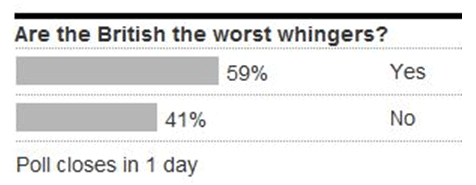
    Busted. “Even in the best of times, whinging, as Britons call the persistent low-grade grousing that is their default response to life’s challenges, is part of the national condition”, Sarah Lyall writes in the New York Times, about Londoners’ failure to embrace the Olympic Spirit. If a British newspaper mocked America there would be a flood of patriotic remonstrance right back at us. But when The Guardian asked its readers whether it was true that Britons were whingers, this is how the poll went:


    There is a lot to complain about with the Olympics. The police have been heavy-handed, pushing around people who have argued with the Olympic hype. The Olympic Park has been forcibly cleared of its official and unofficial tenants.

    Dave Renton, author of Lives; Running, who believes in the Olympics but not in the corporate hype and security that comes with it explains:

    Already the park is enclosed by a sky high fence, topped by razor wires and electronic sensors, with CCTV every few metres and security patrols inside the fence, all to protect the Park from intruders. But in addition the towpath was closed to public access 23 days before the Olympics even began. All across London on the edge of Olympic venues there have been similar restrictions imposed. (see his Olympics-and-other sports blog, http://livesrunning.wordpress.com/)

    Most shockingly, the army has put surface to air missiles on the roofs of local tower blocks, to the outrage of the residents, who see them as a threat against London’s rioting youths rather than any imagined Al Qaida attack. Pointedly, the one estate that has welcomed the installation is the Bow Quarter, a super-rich gated community in the heart of impoverished East London (the site, ironically, of the re-birth of British trade union struggle in the nineteenth century, the Bryant and May match factory).

    There are special Olympic lanes painted on the roads, like those that the old Soviet bureaucracy had for the Zil limousines carrying officials. We are warned that spectators wearing the wrong logo will be barred from the stadium, as will Tibetan flags and any kind of political slogan.

    There is much to complain about, but Sarah Lyall is right: scoffing is the British way. Poor Sebastian Coe, goody-two-shoes of the 1980s track, has a hard job selling the Olympics to the British public. This coming Saturday radicals of the counter Olympics network will meet at noon to protest in Mile End Park.

    Of course Briton’s have not been big on public celebration since they lost that last toe-hold on world domination, as subalterns to the United States in the Cold War. The Falklands War against Argentina (oh, the shame!) was the last that drew out a jingo crowd. Ever since the Berlin Wall came down, we only come out on the streets to object or mourn. That is why the Millennium celebrations drew such a vicious reaction from the intelligentsia here, and why the most recently celebrated Queen’s Jubilee was such a damp squib. By contrast, hundreds of thousands mourned the death of Princess Diana, and perhaps a million marched against the war in Iraq.

    It is not easy to be a British sporting star. Jaded Britons willed Wimbledon tennis finalist Andy Murray to lose with the fervour that in years gone by they would have willed him to win. England’s soccer captain, John Terry, is better known for swearing at Anton Ferdinand than for his defending skills (after a failed prosecution for racial abuse, the press, unwilling to accept the jury’s decision, found him guilty anyway). The mood behind team GB in London right now is markedly downbeat. Londoners’ main interest has been whether they could make any money letting out their homes (no, it turns out, the market was flooded).

    The mood is not helped by the downbeat promotion. Filmmaker Danny Boyle is in charge of the opening ceremony. He says he will not follow the Beijing triumphalism, but instead threatens a mawkish recreation of the English countryside, complete with sheep and even a mob of countercultural festival hippies. On television, Britons follow not the hype, but a mockumentary satire of the hype, Twenty Twelve.

    ******

    The London that Britain will showcase to the world is at a difficult crossroads. It is the centre of the financial services sector, Britain’s most successful export since deregulation in the 1980s, but currently mired in successive crises, most recently the manipulation of the LIBOR rate by Barclays (with the apparent connivance of not only shamed Chief Exec Bob Diamond, but the Governor of the Bank of England, too). There is little doubt that Britain’s economy is dangerously skewed in favour of its financial sector, which buys influence from out-of-touch and cash-hungry politicians. Sadly, the one occasion when the financial sector might have been reined in, the crash of 2008, led to a massive bailout instead. Advice from financiers that the banks were ‘too big to fail’ was accepted with much the same gullibility as advice from the securocrats that Iraq’s weapons of mass destruction could strike London in 15 minutes. In the manner of a naïve maiden aunt, the press and the politicial establishment here were repeatedly surprised that the billions the government gave the bankers went straight into bonuses, instead of being passed on as loans to businesses. Did no one ever tell them that banks are in the business of making money, not giving it away?

    The problem with the banks, in any event, is misunderstood. The febrile financial sector is more symptomatic than causal. It has been fuelled for some years by the surplus capital that British and European industry fails to reinvest in its manufacturing base. Europe’s risk-averse business leaders are reluctant to disturb their cozy relations with each other and government by innovating new processes or products. Where their forebears ploughed profits back into the business, our business leaders prefer to put them in the bank, hunting around for some fantasy of high yield investments that do not entail any relationship more demanding than a phone-call. It is not that bankers steal the cash from business so much as that business that is falling over itself to give it up.

    High on the list of London’s problems is its house-building industry, which has systematically failed to meet the expanding demand for homes. Characteristic of the institutional prejudice against development here, house-building has been stymied by a planning system that restricts building to brownfield sites, and is strangling London’s growth with a ‘green belt’.

    Predictably, the limit on building new houses has forced up prices, and priced poorer Londoners out of central London. According to a study by Tom MacInnes and Peter Kenway for the City Parochial Foundation:

    … more than half (54%) London’s low income population live in Outer London. This is an increase compared to the late 1990s, when London’s low-income population was split equally between Inner and Outer London. Reflecting this relatively bigger population, a larger number of children in low-income households live in Outer London (380,000) than Inner London (270,000). (London’s Poverty Profile, 2009, p 29)

    The impact of high prices on where people live, the gentrification of the inner city, and the exodus of the poor, has been dramatic. For poorer residents to carry on living in London gets more and more difficult. That is particularly so because the rise in rents mirrors the rise in house prices. For too many families living in London means accepting less and less space. Meanwhile, in Caledonian Road, a local developer bought up local shops to convert into flats, and then realised that the cellars could be made into houses, too.

    With some cheek, London’s former Mayor, Ken Livingstone, architect of the London plan that put the dampeners on development is now protesting that ‘rents have soared beyond people’s ability to pay’. But it was Livingstone’s policy, with its mantra of building up, not out, on brownfield, not greenfield land, that created the scarcity of homes that is forcing up prices and rents. All of Livingstone’s solutions are about redistributing the limited housing stock available, without understanding that the real problem is in the realm of production.

    The Olympics, of course, are supposed to have a lsting and positive effect on the London’s housing. But that will not happen unless there is a cultural shift in favour of development that is not engulfed in precautionary regulations and political indecision.

    So let’s hope that Londoners do cheer up before the games start, and enjoy the sight of people giving their all. It ought to be a good antidote to the dog-in-the-manger attitude that is wrecking the prospects of recovery. Londoners have to choose between Olympic spirit, or Olympic whinging.

    Photo by BBC World Service: Homeless Hostel, East London

    James Heartfield’s latest book The Aborigines’ Protection Society: Humanitarian Imperialism in Australia, New Zealand, Fiji, Canada, South Africa, and the Congo, 1836-1909 is published by Columbia University Press, and Hurst Books in the UK.

  • The Evolving Urban Form: London

    The 2011 census results show that London (the Greater London Authority, which is Inner and Outer London) experienced its greatest percentage population growth in more than 100 years (1891 to 1901). London added nearly 1,000,000 new residents since 2001. That growth, however, is not an indication that "people are moving back to the city." On the contrary, National Statistics data indicates that London lost 740,000 domestic migrants between 2001 and 2011. The continuing core net domestic migration losses have been replicated in other major European metropolitan core areas, such as Milan, Vienna, Stockholm and Helsinki.

    Instead as typical in major European core municipalities, the vast majority of the growth in London has come from net international migration. London added 690,000 residents between 2001 and 2010. This pattern has become more prevalent since European Union enlargement, when Eastern Europeans began moving in much larger numbers to the United Kingdom and other richer areas of the old EU-15.
    London first became the world’s largest urban area in the first quarter of the 19th century, displacing Beijing. At that time, London was approaching 1.4 million residents, living in an urban area of approximately 15 square miles. Today, Inner London, the Outer London suburbs and two rings of exurbs spread 10,500 square miles (27,000 square miles), with a population of 20.3 million. Beijing, meanwhile, has grown so fast that it may once again surpass London in the next decade. However, other metropolitan regions are much larger, such as Tokyo and Jakarta.

    Meanwhile, the urban area (the continuous built up area), circumscribed for more than one-half century by the Greenbelt, appears to have a population of 9.5 million, which would place it 27th in population in the world.

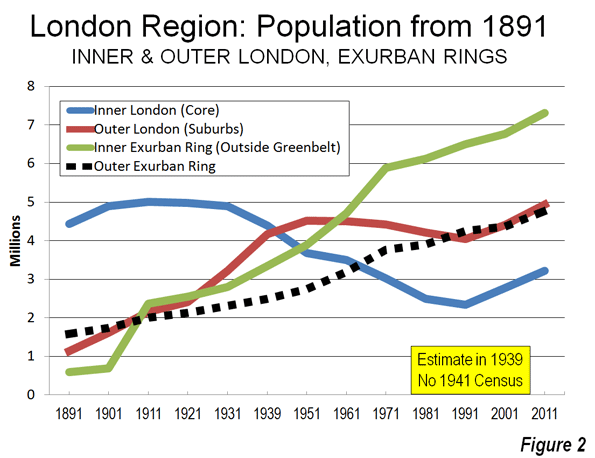
    Over the past century, London has experienced substantial ups and downs in its population and still remains below its 1939 population, even with the large gain over the past decade. Over the same period, Inner London lost millions of its residents and only recently has begun to gain some back, largely due to net international migration gains. Outer London gained in the first half of the 20th century, plateaued and then also gained strongly in the last decade. The exurban areas virtually monopolized growth for most of the post-World War II period (Table) until recently.

    London Region: Population 1891-2011
    Year London Region London (Greater London Authority) Inner London (Historical Core) Outer London (Suburbs) Exurbs (Outside Greenbelt) 1st Exurban Ring (Historical Counties Adjacent to Green Belt) 2nd Exurban Ring
    1891 7,752,000 5,574,000 4,432,000 1,142,000 2,178,000 595,000 1,583,000
    1901 8,931,000 6,507,000 4,898,000 1,609,000 2,424,000 691,000 1,733,000
    1911 11,526,000 7,162,000 5,002,000 2,160,000 4,366,000 2,365,000 2,001,000
    1921 12,071,000 7,386,000 4,978,000 2,408,000 4,684,000 2,553,000 2,131,000
    1931 13,229,000 8,111,000 4,898,000 3,213,000 5,119,000 2,805,000 2,314,000
    1939 8,617,000 4,441,000 4,176,000
    1951 14,832,000 8,193,000 3,680,000 4,513,000 6,635,000 3,891,000 2,744,000
    1961 15,911,000 7,997,094 3,492,881 4,504,213 7,918,000 4,720,000 3,198,000
    1971 17,028,000 7,453,000 3,031,000 4,422,000 9,659,000 5,894,000 3,765,000
    1981 16,644,000 6,713,000 2,498,000 4,215,000 10,035,000 6,127,000 3,908,000
    1991 17,139,000 6,393,000 2,343,000 4,050,000 10,746,000 6,497,000 4,249,000
    2001 18,313,000 7,172,000 2,766,000 4,406,000 11,141,000 6,773,000 4,368,000
    2011 20,256,700 8,164,000 3,222,000 4,942,000 12,092,700 7,318,700 4,774,000
    Sources
    Census except 1939
    Greater London Authority, 1939


    The London Region

    The London region is composed of the Greater London Authority (GLA), which includes Inner London, the historical core municipality, covering approximately the same geographical area as the old London County Council from the 1890s to the 1960s and Outer London, the great suburban expanse consisting of detached and semi-detached housing.

    GLA is surrounded by the Greenbelt, established to contain the expansion of the urban area after World War II, and, at least at first, to decentralize London’s unhealthy and overcrowded conditions. Beyond the Greenbelt are the East of England and the Southeast, which are composed of a first exurban ring of historical county areas, adjacent to the Greenbelt, and a second ring of historical county areas in the East and Southeast, beyond the first ring. Virtually all new urban expansion in the London region was forced into the exurbs by the Greenbelt. As a result, all of the London region’s growth (6 million) since World War II has been outside the Greenbelt (Figure 1).

    Inner London

    Inner London has been a population growth miracle over the past two decades. The 2011 population was 3.2 million, up more than 450,000 from 2001 and nearly 900,000 since 1991. However, the 1991 figure of 2.3 million was more than one-half below the 5,000,000 peak reached in 1911. Even though historical core city losses are typical (where geography is held constant), Inner London’s loss was huge, at more double those sustained in Chicago (since 1950) and Paris (since 1921). The core of Inner London was developed as a walking city and expanded substantially with the coming of transit.  At approximately 26,000 residents per square mile (10,000 per square kilometer), Inner London is less than one-half the density of the ville de Paris and far less dense not only than Manhattan but even less dense than the New York City boroughs of Brooklyn and the Bronx.

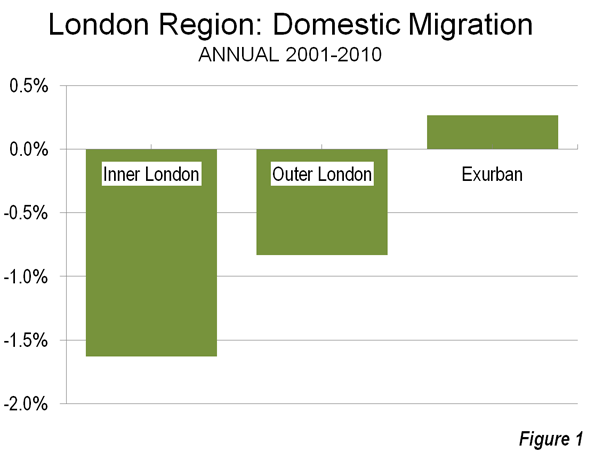
    Yet despite the recent increases, inner London’s 2011 population is lower than counted in the 1861 census (yes, 1861) Even  with the population increase Inner London lost 390,000 domestic migrants (Figure 2) to other parts of Great Britain between 2001 and 2010 (the detailed 2011 data is not yet available at this level).

    Tower Hamlets, one of London’s 32 boroughs, is an example of this population roller-coaster. Tower Hamlets is located just to the east of the Tower Bridge in Inner London on the north bank of the Thames. It is home to substantial new development spurred by the rapid growth of the financial services industry both in the "square mile" ("city of London) and Canary Wharf. Tower Hamlets grew to 254,000 in 2011, a nearly 80 percent increase from the 142,000 registered in 1981, less than its 1801 population (Note: London Boroughs). But like Inner London, Tower Hamlets used to be much more populous, reaching a record for a London borough at 597,000 residents in 1901. It then lost more than 75 percent of its population over the next 80 years.  

    Outer London

    Outer London, which was combined into the Greater London Council in 1965 (and the Greater London Authority in 2000) also grew strongly, from 4.4 million to 4.9 million and is now at its peak population. Outer London’s population density is 10,000 per square mile (4,000 per square kilometer), approximately the same as the District of Columbia. Like Inner London, Outer London also lost domestic migrants, with a net 310,000 residents leaving for other parts of the United Kingdom (Figure 2).

    The Greenbelt

    Since World War II, the London urban area (principally composed of Inner and Outer London) has been surrounded by the Greenbelt on which development is not permitted. The Greenbelt ranges from 10 to 20 miles wide (25 to 50 kilometers) and covers more than three times the size of the Greater London Authority. The Greenbelt has been cited, along with related policies, with substantially raising house prices and contributing to London’s longer commutes than Paris, where there is no greenbelt.

    Exurban London

    Despite their more modest growth in the last decade, the exurbs have been effective in attracting net domestic migration. From 2001 to 2011, three was a net inflow of domestic migrants of 320,000 (Figure 2). Much of this appears to be people leaving London. During the last year, more than 50,000 residents of London moved to the exurbs. Net international migration to the exurbs had been fairly small earlier in the decade, but increased substantially in the later years. By 2009-2010, two thirds of the London region’s net international migration was to the exurbs, and only one-third to London.

    First Exurban Ring

    The first exurban ring includes the historical counties that border on the outside of the Greenbelt. These areas added approximately 550,000 residents between 2001 and 2011 and reached a new population peak, at 7.3 million.

    Second Exurban Ring

    The second exurban ring includes the counties of the East of England and the Southeast that are outside the first ring. These areas added more than 400,000 new residents, and reached a new peak population of 4.8 million.

    London and England

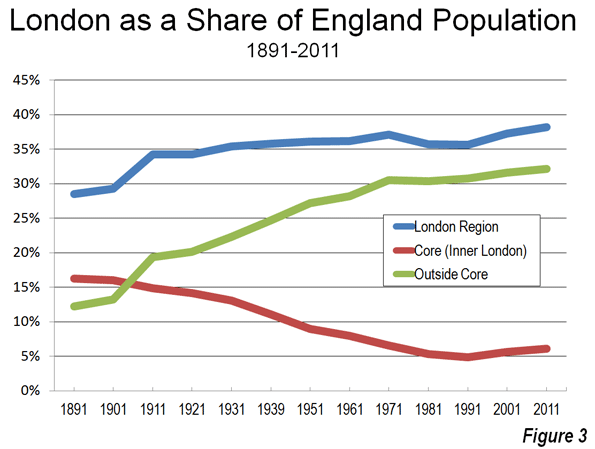
    In contrast to the 1991-2001 decade, the 2001-2011 decade indicated a significant slowdown in the share of England’s population growth in the London region. In the previous decade, all of England’s growth occurred in the greater London region. In the last decade, 50 percent of England’s growth took place around the capital. Overall, the core of London (Inner London) population has steadily fallen relative to the rest of England England’s while the suburbs and exurbs have grown to include one-third of England’s residents (Figure 3). So as Japan is moving to Tokyo, England is still moving to London, but not nearly so fast.

    Wendell Cox is a Visiting Professor, Conservatoire National des Arts et Metiers, Paris and the author of “War on the Dream: How Anti-Sprawl Policy Threatens the Quality of Life.”

    —-

    Note: London Boroughs: The 32 boroughs of London were defined after the creation of the Greater London Council in 1965 (which was abolished in 1986). The Greater London Authority provides data to show the historical population figures for the boroughs, going back to the initial census (1801). The new Greater London Authority was established in 2000, with less power than the previous Greater London Council. The 32 boroughs continue to operate, providing local public services.

    Photograph: London Suburbs (Outer London) by author

  • London Olympics 2012: Let the Games End

    Why does anyone persist with the Greek mythology that the Olympics are an engine of economic development, sportsmanship, or peace on earth? London is spending $15 billion on the hope that it can sell enough tickets to synchronized swimming, and earn enough from television ads, to cover the costs of the 30,000 rent-a-cops and military personnel being deployed in the spirit of Olympic harmony.

    Even though the Games break few economic records, except those for non-performing sovereign debts, governments around the world scramble madly every four years for the right to act as host, as if influence peddling were an Olympic sport.

    The original cost estimate, sold to the British public to convince them to get behind the bid for the 2012 Games, was about $4 billion. Those budget forecasts imagined that, after the event, Olympic sites would be recycled for use as schools, homes for the aged, and handicapped parking, even though earlier Olympic cities have found little use for their table tennis stadiums and aquatic centers.

    In 2005, London beat out Paris (narrowly), New York, Madrid, and Moscow for the right, if not the privilege, to spend billions of dollars (that no one has) on a temporary Olympic village, a badminton complex, and swimming pools suitable for the American relayers to lap swimmers from places like Albania and Costa Rica.

    Those who advocate Olympian edifice dreams include smiling politicians who can dole out sweetheart construction contracts; national sports associations, whose budgets are commensurate with gold-medal production; the International Olympic Committee, which in the past has been something of a Dream Team for backhand payments; and the television networks, which use the Games to fill the dog days of August and to develop various story-lines around medal-gobbling athletes (see Michael Phelps) or mildly voyeuristic content (women’s beach volleyball comes to mind).

    Everyone wins at the Olympics: stadium contractors, strutting central governments, and athletes who place high enough to be crowned with the laurels of corporate sponsorship. Well, everyone except the bondholders, who are left with little more than folded tents when the circus leaves town after three weeks of breathless commentary about women’s weightlifting.

    By chance, I have been to many of the cities that have hosted recent summer Games — Barcelona, Moscow, Beijing, Athens, and Seoul. In nearly each locale the thought crossed my mind that city residents have little more to show for their indebted billions than a few light-rail lines, perhaps an airport facelift, and impractical buildings that can be converted only into minimum-security prisons.

    Beijing still has its iconic Bird’s Nest and Water Cube, although neither stadium is used now for anything more than tourist photography and an aqua park.

    My son Charles and I spent a week driving around Greece after the 2004 Games. As best as we could tell, all Athens got for its now-bad loans were signs pointing the way to the Olympic Sailing Center (we even found these billboards miles from the sea), and a light-rail connection to Piraeus. Weeds covered the infield of the softball stadium.

    Barcelona, the 1992 host, ended up with some new apartment buildings — since the Olympics were played in downtown areas — a few marinas, and of course light-rail. Many cities, however, have successfully put up apartment blocks without staging a field hockey tournament.

    Nor did Moscow get the political bounce it had angled for when it hosted the 1980 summer Olympics. In protest over the Russian invasion of Afghanistan, the United States and many allies refused to send teams, giving the Games the feel of a Warsaw Pact scout jamboree. The paint peeled off the Olympic village faster than some of the times in the marathon. (In London, the US has decided against boycotting its own invasion of Afghanistan.)

    In theory, politics have nothing to do with the Games, although by organizing teams according to countries, the Olympic Committee has ensured that the spectacle is best understood as the continuation of war by other means, including archery and (in 1900) live pigeon shooting.

    When the modern Olympics were revived in 1896, individual athletes paid their own way to Athens to compete as amateurs. Now, nearly all nations field the equivalent of the East German swim team, a squad bred in laboratory test tubes to demonstrate a triumph of the will.

    The reason terrorists have the Games on their hit lists (Munich in 1972 was the worst example) is because the governments that they revile enter the stadiums with such wild displays of flag waving, as though the opening ceremony were a bullfight. At the London Games, security contracts are worth more than gold medals. For example, the British army is deploying surface-to-air missiles near the Olympic Stadium (apparently javelins no longer do the trick), and the FBI, in theory an exclusively domestic US Agency, is sending over about 500 agents, even though it was the Secret Service that won the regional escort trials in Cartagena.

    Does the corporate business of the Olympics negate the achievements of the athletes? Am I so cold-hearted that I cannot admire Joan Benoit Samuelson coming home in 1984 with the gold or Fosbury’s flop? Not at all. I enjoy watching Moldova lose at water polo as much as the next American. At the same time, there is something cartoonish about NBA All-stars dunking over a Latvian small forward.

    Were the decision mine, I would let the Olympics go the way of Nuremberg rallies. The Games strike me as ruinous to city finances and bad for sport. Should not the goal of the Olympic movement be to encourage more players and fewer spectators? Instead, the Games are a celebration of reclining consumerism. At least the athletes get to go through 100,000 condoms in 17 days.

    Nor does any sporting event that requires the protection of thousands of soldiers, surface-to-air missiles, and 24/7 cable coverage strike me as the spiritual heir of the Games first contested in a Greek sanctuary.

    Several school vacations ago, I took my younger daughter to Olympia, located in the western Peloponnese. We were tracking down the ancient wonders of the world, and Olympia once had a huge gold statue of Zeus, until “promoters” stripped it for parts and carted off the gold to Aleppo on donkeys.

    We strolled around the original Olympic stadium, which even today could be built for about $200,000. The “seats” are slopes of grassy lawn, and the field of dreams is covered with dirt. The rest of the Olympic village is a few pine trees and some worn temples, but it’s magical.

    Even during times of conflict, from 700 BC to 400 AD athletes came to Olympia from the contours of the Greek world, and left for home, if successful, only with olive branches in their hair. Along with paying honor to Zeus, the ancient Olympics celebrated athletic achievement, not prime-time nationalism or Coca-Cola. To show modesty, athletes were naked for their competitions. The Games ended only when Christianity moved to wipe out what it viewed as a pagan ritual.

    At the end of three weeks of the London Games, even if the British army has had to shoot off a few of its surface-to-air missiles, TV commentators will pronounce the Games an immortal success, a triumph of Spartan proportions, and an epic not seen since Jason came back with the golden fleece.

    Then, in three years, if not sooner, London will get the $15 billion invoice for its fun summer, and all it will have to show for it will be a few used diving boards and, with luck, some new light-rail. In the words of George Best, the great Northern Irish footballer: “I spent a lot of money on booze, birds and fast cars. The rest I just squandered.”

    Flickr photo by Jesse Scott / twowaystairs – Wenlock, the 2012 Olympic mascot.

    Matthew Stevenson, a contributing editor of Harper’s Magazine, is the author of Remembering the Twentieth Century Limited, a collection of historical travel essays. His next book is Whistle-Stopping America.
  • State of Chicago: The New Century Struggle

    This is the second installment in my “State of Chicago” series. Read part one here.

    Last time I looked at Chicago’s 70s and early 80s horrible struggles followed by rebirth and robust out-performance during the 1990s. Today we turn our attention to the first decade of the 21st century. During the 2000s, Chicago experienced a bit of a two-track performance. Parts of the urban core continued to grow robustly, fueled by the real estate bubble and perhaps the greatest urban condo building boom in America. The culinary, cultural, and other scenes in Chicago only improved. Yet while there was a solid core of health at the center, the overall city and region stumbled badly with aggregate statistics that were, bluntly, awful in most respects. I’ve detailed these elsewhere already so won’t go in depth, but let’s review. These are metro area statistics unless otherwise noted.

    Population

    I already discussed how Chicago got shellacked in the 2010 Census. It was the only one of the 15 largest municipalities in the United States as of 2010 to lose population. The cities of New York, Los Angeles, and San Francisco hit all time record high populations. Philadelphia and DC grew for the first time since 1950, and Boston continued growing. But Chicago has now rolled back its population clock a hundred years and stands at its lowest population since 1910.

    Chicago’s metro population growth of 4% was less than half the national average, and virtually all of that came at the exurban fringe. Chicagoland ranked 40 out of 51 large metros for population growth, though it did beat New York, LA, and Boston on a regional basis, which is positive.

    International Population

    This previous data was all from previous writings. I want to highlight a couple of other areas of demographic weakness though. First is international population. Chicago’s percentage of foreign born residents is 17.6%, which beats the national average, but trails New York and LA by over ten percentage points. It ranked 5 out of the 10 largest US metros. On a growth basis in foreign born population, Chicago did beat New York and LA. Those three were at the bottom in the percentage growth category, most likely because they all started from relatively high bases of total foreign born population. On a total change basis Chicago ranked 7th, with New York #1, but sick man LA brought up the bottom, a stunning change of fortunes for them.

    The city of Chicago itself seems to have lost its allure to immigrants. The foreign born population of the city actually declined during the 2000s. Even during a decade of huge Hispanic population growth nationally, Chicago barely grew its Hispanic population. The city of Indianapolis, about a third of Chicago’s size, added nearly twice as many total Hispanic residents. To the extent that immigrants now see Chicago as an opportunity zone, it appears to be suburban Chicago.

    Education

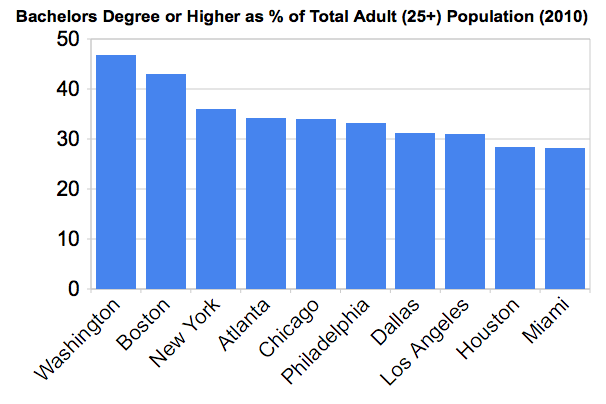
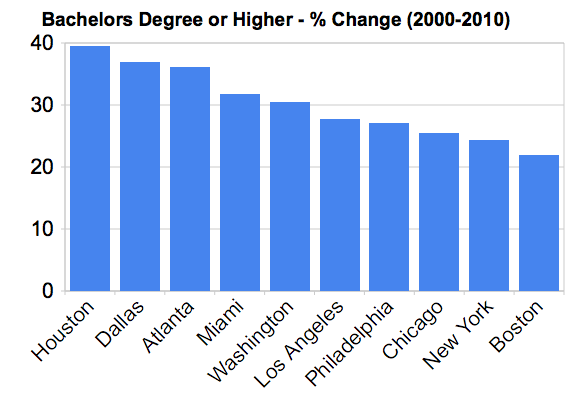
    Chicago’s college degree attainment is in the middle of the pack for the top 10, ranking #5. Considering it came from an industrial heritage, I think this is pretty good.


    However, Chicago only ranked 8th out of the top 10 in the growth in population with bachelor’s degrees.


    This hardly suggests that metro Chicago is a talent magnet. If you look at the numbers vs. other large Midwest metros, Chicago is healthy, but not looking like it is pulling away from the pack. I don’t see anything to suggest that Chicago is hoovering up all the college grads in the Midwest.

    Economy

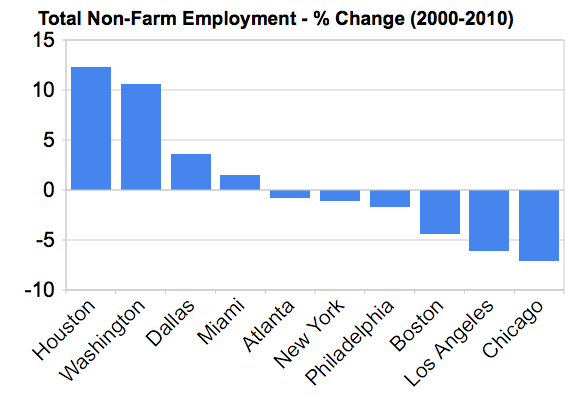
    Chicago lost 323,000 jobs during the 2000s, or 7.1%. The was the worst performance on a percentage basis of any of the 10 largest US metros:


    One of the stats that took some flak from my City Journal piece was that private sector employment in the Loop had dropped by 18.6% during the 2000s. This seems at odds with the massive skyscraper boom and other improvements. This wasn’t my stat. It came from a Chicago Loop Alliance report, and they commissioned a credible analytics firm to do the work, and the data was also reported by the Chicago Sun-Times, so I believe it is solid. A few things to consider:

    – This figure is for the Loop, not the Central Area (a bigger construct). The Loop does have the majority of the Central Area jobs, however.
    – Much of the construction was residential, not commercial. Also, things like the booming Loop U probably brought in more students than jobs.
    – Keep in mind that 2000 was the peak of the dotcom bubble. For reasons I’ll explore later, I believe this hurt Chicago badly. So there’s a tough comp (also why the Bay Area and to a lesser extent Boston look bad on comps vs 2000).
    – Consider major Chicago companies that totally went out of business: Arthur Andersen and Whitman-Hart come to mind.
    – Also consider that pledges of added jobs generally are trumpeted to the sky, while jobs are often cut silently as much as possible.

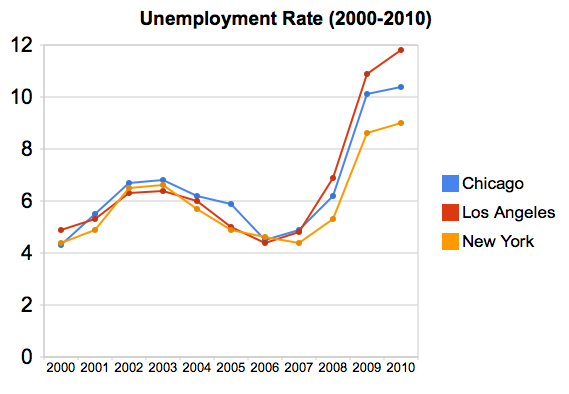
    Looking at unemployment rate in our Chicago vs. NYC/LA chart from before, we now see that Chicago is no longer winning, though is beating LA:


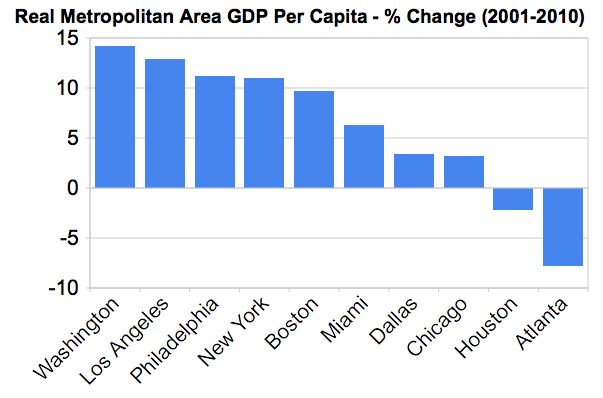
    Chicago is a large economy, but not a particularly high value added one. Out of the ten largest metros, Chicago ranks 8th in per capita GDP. (Chicago is 3rd among large Midwest metros on this figure)


    Chicago also ranked eighth in real per capita GDP growth over the decade.


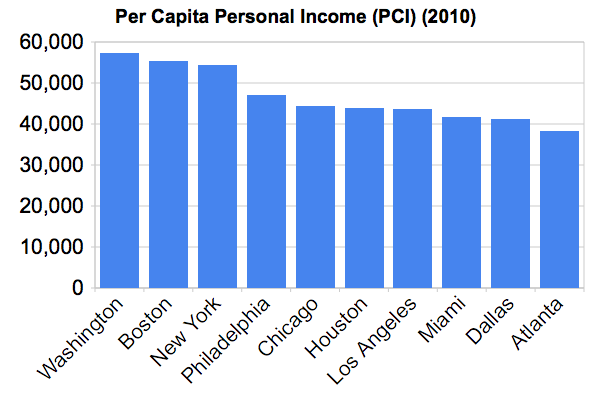
    Chicago ranked 5th out of 10 in per capita personal income, beating LA:


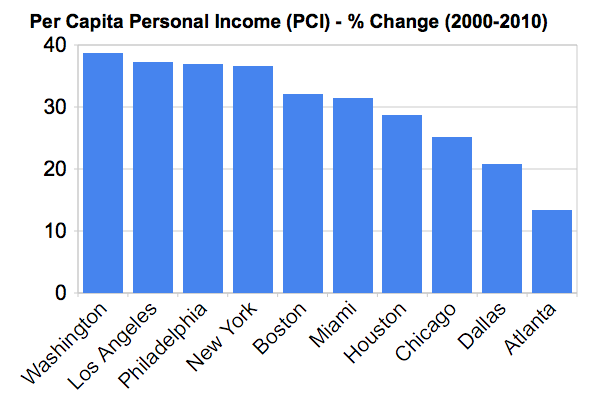
    But Chicago ranked only 8th out of 10 in PCPI growth:


    On the whole, this is a rather uninspiring collection of economic statistics for the Windy City, particularly after it did so well in the 1990s.

    Fiscal Crisis

    No discussion of Chicago’s problems in the 2000s would be complete without a review of its fiscal problems. However, as I already gave the numbers in my City Journal article, I won’t repeat them here. If anything, the problem has only gotten worse since that went to press. While Chicago may not be the worst municipality in terms of fiscal issues, Illinois is the worst state, and that will continue to be a drag until it’s addressed.

    Crime

    Among the biggest complaints about my article was that I didn’t address the crime problem in Chicago. Without a doubt, crime is a problem. Murders are up 38% or so just in 2012. The city of Chicago has a much higher murder rate than the cities of New York or Los Angeles. There has also been a national headline grabbing series of high profile attacks in affluent areas like the Gold Coast and Streeterville. The strength of the Chicago Police Department is somewhere between 500-1000 officers short of where it should be.

    I’m not the best equipped person to talk about crime, but I actually think the crime problem is overstated. Yes, it’s serious. The murder rate especially is troubling. But analyses I’ve read suggest that overall crime isn’t spiraling out of control in Chicago. Also, flash mob type attacks are happening across the country, in places ranging from Philadelphia to Portland. This isn’t a unique to Chicago situation. So I don’t want to claim that Chicago’s crime problems are uniquely bad, though they shouldn’t be minimized.

    Without a doubt the incredible collapse in crime in New York perhaps more than any other single factor fueled that city’s comeback, and it wouldn’t surprise me if it were a big factor in that city’s out performance in the 2000s. Mark Bergen cited some interesting research that suggested that for every murder in your city, 70 people move out. If Chicago had matched New York’s crime performance, it would have held steady or even gained population based on this relationship. If true, wow.

    Regardless, public safety is job #1 for any mayor, so Rahm Emanuel is rightly feeling the heat on this even if he can’t necessarily be blamed for what’s going on.

    Schools

    Others have cited Chicago’s poor public school system. Again, I’m not sure Chicago’s schools are any worse than any other big city system, and there are a number of magnet and neighborhood schools that are now attracting the children of the well-off. I’d have to see something that suggested Chicago took a turn for the worse on schools in the 2000s on a comparative basis.

    Conclusion

    There are more statistics that could be given, and if you want them, I suggest reading the very data rich OECD Territorial Review of Chicago.

    On the whole I think it’s pretty clear that there was trouble in Chicago during the 2000s – and more trouble than most large cities experienced during what was a tough decade nationally.

    Some rightly noted that I discuss the divergent performance of Chicago in the 1990s vs the 2000s, but that my structural factors that weaken Chicago were probably the same in both decades. So why the difference? I want people to know I plan to address that in a future post shortly, but next up we’ll have a look at Chicago’s present day strengths before moving on.

    Read part 1 in this series.

    Aaron M. Renn is an independent writer on urban affairs and the founder of Telestrian, a data analysis and mapping tool. He writes at The Urbanophile, where this piece originally appeared.

    Photo by smik67.

  • Transportation for Tomorrow: Driverless Cars

    Economist Clifford Winston of the Brookings Institution outlines the surface transportation system of the future in a Wall Street Journal commentary, "Paving the Way for Diverless Cars." Winston notes "a much better technological solution is on the horizon" than high speed rail "as an effective way to reduce highway congestion" as the Obama administration in Washington and the Brown administration in Sacramento contend. Indeed, not even the voluminous planning documentation used to justify high speed rail provides evidence that the 21st century edition of an early 19th century technology can materially reduce traffic congestion.

    Already Google has conducted experiments with the automated car that have been so successful that they are now permitted in Nevada. Winston suggests that by automating cars, it will be necessary to separate automobile traffic from truck traffic, which will make it possible to provide additional traffic lanes within the existing road footprint. Non-automated cars and trucks would continue to operate in conventional, wider lanes on the same right-of-way. Another advantage would be that with the automated control, more cars could be accommodated in each lane. The need for highway expansion would be largely displaced by substantially improving capacity by upgrading highways with 21st century technology.

    Winston has been a critic of overly expensive urban rail systems and transit subsidies. Driverless cars were also the subject of a Wall Street Journal commentary by Randal O’Toole in 2010.

  • The New Geography Of Success In The U.S. And The Trap Of The ‘New Normal’

    This year’s presidential election is fast becoming an ode to diminished expectations. Neither candidate is advancing a reasonable refutation of the conventional wisdom that America is in the grips of a “new normal” — an era of low growth, persistently high unemployment and less upward mobility, particularly for the working class.

    Certainly recent economic news of slowing growth and job creation bolster the pessimists’ case. But Americans may face far better prospects than portrayed by our dueling presidential mediocrities. Let’s look at those states that have found their own way out of the “new normal,” in some cases reversing all the losses of the Great Recession and then some.

    The states that have added the most jobs since 2007 — Texas, North Dakota, Louisiana, Oklahoma and Alaska – are located in a vast energy and commodities corridor extending from the western Gulf to the northern tip of the Continent. New York and Washington, D.C., prime beneficiaries of monetary easing and a growing federal government, have also clawed back.

    But the big winners are in the central energy corridor. Since 2007, Texas has created almost five times as many jobs as New York; California is still down almost 900,000 jobs and Illinois is off close to 300,000.

    This should represent what Walter Russell Mead calls “a new geography of power,” the anointing of new places Americans and business go to find opportunity. One example: five of the six best cities for starting over in 2012, according to TheStreet.com, were in the Dakotas, Utah, Iowa and Nebraska.

    Why the energy and agriculture states? Since the onset of the new century, much of the sustained growth in the world has taken place not in the financial or information capitals, but in regions that produce basic commodities like energy and food. In the high-income world, the consistently best-performing countries since 2008 have also tended to be resource-rich ones such as Norway, Australia and Canada.Blue social policies work best when financed by petro-dollars and minerals sales.

    Domestic and European demand may fall in the next few years, but increasingly global commodity and energy markets are driven by the expanding needs of the major developing countries. This has helped keep energy prices high, particularly for oil. Being good at exploration and drilling has been more profitable than social media. Texas alone has added nearly 200,000 jobs in its oil and gas sector over the past decade and Oklahoma some 45,000. The Lone Star energy sector created twice as many jobs as exist in the software sector in San Jose and San Francisco combined. These jobs have been an outstanding driver of high-wage employment, with an average salary of upwards of $75,000, and located usually in less expensive areas.

    Choice plays an important part in the growth. The energy boom has supercharged the economies of the states that have welcomed this growth, including Texas, Oklahoma, Louisiana, North Dakota, Wyoming and Alaska. It has not been much help to New York and California, which are reluctant to crack rocks to extract even relatively cleaner carbon-based fuels like natural gas. In contrast, long-suffering Ohio and Pennsylvania, where there have been significant new finds of shale oil and gas, appear to have decided that Texas, not California, is the model for spurring growth.

    The energy-producing states can look forward to a bright future in the long run. U.S. oil and Canadian reserves now stand at over 2 trillion barrels and constitute more than three times the total estimated reserves of the Middle East and North Africa. Observers such as the New America Foundation’s Michael Lind believe that new discoveries, particularly of natural gas, mean that we might actually be living in an era of “peak renewables,” and at the onset of a “very long age of fossil fuels.”

    Growth of these sectors — along with construction and manufacturing — could prove critical to our beleaguered working class. There’s not much respect among the university-dominated pundit class for people who work with  their hands or have specific tangible  skills. Instead they need to lower their expectations and seek, as Slate recently suggested, to find work “in the service sector supporting America’s innovative class.”

    In this neo-Victorian society, the “new normal” means a society dominated by  “innovative” or “creative” masters and their chosen, lucky servants. Leave your job and family in the Midwest or Nevada to become a toenail painter in Silicon Valley, San Francisco or Boston. Besides losing any sense of one’s independence, it’s hard to see how a barber or gardener can live decently, particularly with a family, in such expensive places.

    This bleak reality may not inevitable, though. In many places construction employment is on the rise from its nadir in 2010. This recovery has been a nationwide phenomena but is, not surprisingly, most evident in growth states like Montana, Colorado, Indiana, Iowa, Nebraska, Tennessee and Utah.

    At the same time over the last two years the nation has added more than 400,000 manufacturing jobs, led by the industrial states hit hardest by the recession. Though these gains are small compared to the losses earlier in the decade, the growth is encouraging; automakers and other industries already are complaining about severe shortages of skilled labor. Maybe, after all, life as a dog-walker and hostel denizen in Palo Alto is not the best one can hope for if you can make enough to afford a nice suburban house outside Columbus or Detroit.

    The pundit class may be ready to write off the American dream but many Midwest states are working to restore it. Over the past two years Michigan and Ohio have experienced the biggest drop in unemployment of any states in the union; Michigan leads the way with a drop of almost five percentage points, while Ohio comes in second with a nearly three-point decline. Other key Great Lakes battlegrounds—Wisconsin, Indiana and arguably Missouri—have also seen two-point drops in their unemployment numbers.

    Why is this happening? A lot of it has to do with business-friendly state regimes. Unlike Illinois, increasingly the sad sack  of the Midwest, these states have cut taxes, worked to increase the availability of skill training and streamlined regulations. This has allowed them to take advantage of new opportunities.

    Improving the business climate represents the third critical element for overcoming the new normal. Most rundowns of the states with consistently favorable business and tax climates – as judged by executives — start with Texas, Utah and South Dakota. Many states that are recovering best from the recession, like Louisiana, Wisconsin, Florida, Ohio, Michigan and Arizona, all have been improving their rankings in business surveys over recent years.

    But this should not be seen as an exclusively red state phenomenon. Some blue states as well, notably Washington, have worked hard to keep taxes tolerable and have promoted a rapid expansion of their  industrial sector. Democratic-leaning Colorado, under the leadership of pragmatic Gov. John Hickenlooper, has also strived to main a good business climate and promote growth.

    What works, it appears, is not the mindless embrace of GOP or Democratic ideology, but a model that drives economic growth. It’s not rocket science: sensible regulation, moderate taxes and investments to spur job creation and productivity. “There is no Democratic or Republican way to sweep streets,” legendary New York City Mayor Fiorello LaGuardia once remarked and the same is true of economic growth.

    The stories of the successful states tell us the key to success lies  in promoting basic industries like energy, agriculture and manufacturing — which then create business service and high-skilled jobs — combined with a broad agenda favorable to entrepreneurs of all kinds. If only one of our presidential candidates would get the message.

    For more about how states are defying the "new normal," read the 2012 Enterprising States: Policies that Produce report, authored by Joel Kotkin and Praxis Strategy Group.

    Joel Kotkin is executive editor of NewGeography.com and is a distinguished presidential fellow in urban futures at Chapman University, and contributing editor to the City Journal in New York. He is author of The City: A Global History. His newest book is The Next Hundred Million: America in 2050, released in February, 2010.

    This piece originally appeared in Forbes.

    Auto manufacturing photo by BigStockPhoto.com.

  • Housing Affordability Protests Occurring in “Livable” Hong Kong, Not “Sprawling” Atlanta

    The Economist has published another in its city rating series, under the headline "The Best city in the World." This one was the result of a contest examining ways to elaborate on its rating system. The winner, Filippo Lovato, added a spatial dimension to the ratings, which included a 5 point rating of "sprawl," a pejorative term for the natural expansion of cities (which in this article means urban areas, areas of continuous urban development). Much of the urban planning literature is pre-occupied with combating urban sprawl, though urban expansion continues virtually everywhere around the world, as cities add population and become more affluent.

    Livability for Whom?

    As Jon Copestake, the Editor of the Economist Intelligence Unit’s Cost of Living and Livability surveys and I discussed in front of a Property Institute of Western Australia meeting, The Economist livability ratings are not aimed at average resident households, but rather at an international audience, such as corporate executives and corporate relocation services. This distinction can be important.

    Hong Kong was top ranked for livability in the new Economist list. Doubtless this is accurate for well paid executives posted temporarily, who are granted substantial housing allowances by their employers and who can live in luxury condominiums within a short walk or taxi ride to their jobs in Central (the core of the Hong Kong central business district).

    For local residents, livability is measured differently than for jet-setters or corporate executives.

    Hong Kong: Smart Growth Model

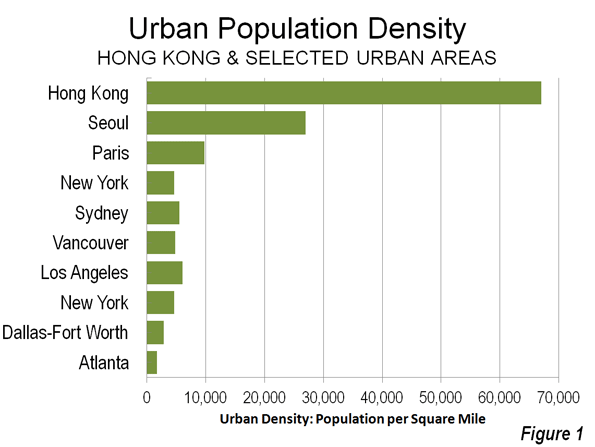
    With the developed world’s highest urban area density and lowest automobile market share, Hong Kong beguiles anti-sprawl "smart growth" crusaders, for whom these two characteristics are the "two great commandments."

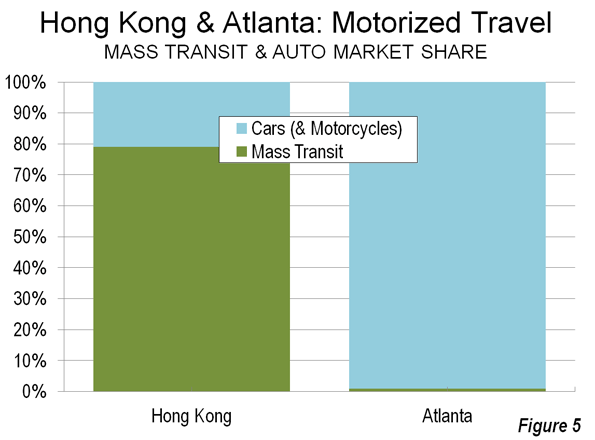
    The entire  Hong Kong urban form (urban area) is as dense as Manhattan at 67,000 per square mile (25,900 per square kilometer), but is more than twelve times the density of the New York urban area: the city and its “sprawling” surrounding suburbs (5,300 per square or 2,100 per square kilometer). Similarly, Hong Kong is somewhat more dense than the ville de Paris, but seven times the density of the Paris urban area (9,800 per square mile or 3,800 per square kilometer). This hyper-density combined with one of the world’s strongest central business districts give Hong Kong a nearly 80% mass transit share of motorized travel, nearly 10 times that of the New York urban area and more than three times that of the Paris urban area (Figure 1).

    "Livable" Hong Kong?

    To its permanent and unsubsidized residents, though, Hong Kong’s spatial Nirvana does not provide much in terms of livability.

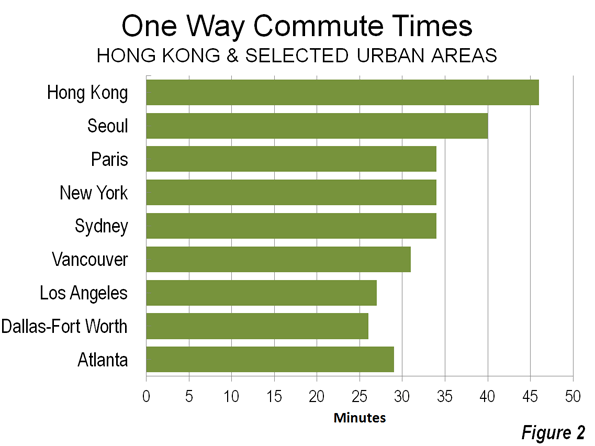
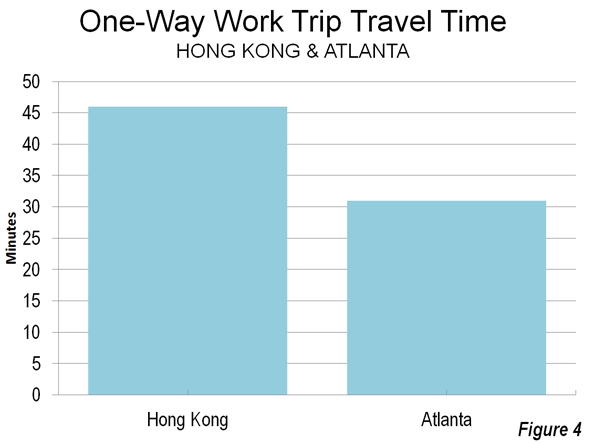
    Excessively Long Commutes Hong Kong’s high density indicates that jobs and houses are relatively close to one another, which should indicate that commute times would be short. Not so. Commutes are among the longest in the developed world – only Tokyo residents take more time to get to work. (Figure 2)

    The average one way commute is 46 minutes in Hong Kong, well above the developed world average of 33 minutes for urban areas over 5,000,000 population. By comparison, commuters in similarly sized Dallas-Fort Worth (26 minutes) and "gridlocked" Los Angeles (27 minutes) get to work much faster. Commuting also takes longer in Hong Kong than in Paris (34 minutes) and London (37 minutes).  Lengthy commutes impose an economic price and make Hong Kong less livable.

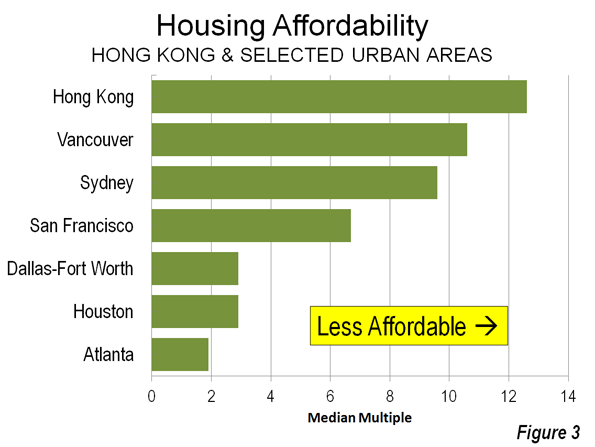
    Exorbitant House Prices: Hong Kong’s housing, the largest household budget item, is profoundly unaffordable. The 8th Annual Demographia International Housing Affordability Survey rates Hong Kong as the most costly out of 325 metropolitan areas. The median house price in Hong Kong’s is 12.6 times the median annual gross household income (the "median multiple"), which leaves little more than a pittance in discretionary income for many households. Perhaps this is why Hong Kong’s fertility rate has fallen to rock bottom levels near the lowest on the planet – people cannot afford kids.

    Even during the housing bubble, coastal California never became so unaffordable. Hong Kong housing is nearly twice as costly as San Francisco (6.7 median multiple) and more than four times as costly as Dallas-Fort Worth (2.9), Houston (2.9) or Atlanta (Figure 3).

    Concern about housing affordability has become so intense that it is an issue in public protests, which The Economist reports to have drawn up to 400,000 people earlier this month (link to photo). Exorbitant house prices make Hong Kong less livable.

    "Sprawling" Atlanta

    Things are much different in "sprawling" Atlanta, which The Economist’s spatial list ranks as the worst among the US entries. Atlanta is at the opposite end of the density spectrum from Hong Kong, with the lowest urban population density of any major developed world urban area.

    Short Commutes: Atlanta’s low density would suggest that jobs and houses must be so far apart that commute times are very long. Again, not so. Atlanta commuters have among the shortest travel times (29 minutes) in the world among urban areas of similar size (see Note: Jobs-Housing Balance). Shorter travel times make Atlanta more livable (Figure 4).

    Other similarly sized US urban areas do even better, such as Dallas-Fort Worth (26 minutes) and Atlanta’s leaders know that traffic congestion need to be eased to improve Atlanta’s competitiveness. But the political process politics has offered a dysfunctional plan that would spend more than half of a new tax on mass transit, which is used by only the one percent. Less than one half of the money would be spent on the roads that the 99 percent use (Figure 5). Any strong growth will overwhelm the stingy highway improvements, and if the voters approve the July 31 referendum, Atlanta’s travel time advantage over Hong Kong could narrow.

    Affordable House Prices: Despite being the bane of planning orthodoxy, Atlanta’s has far better housing affordability than Hong Kong. The median multiple is 1.9, compared to Hong Kong’s 12.6. Hong Kongers pay six times as much of their income for their houses (which are also two-thirds smaller than in Atlanta). So far, there have been no protests against Atlanta’s low house prices. Better housing affordability makes Atlanta area more livable.  

    The Hong Kong Model

    Hong Kong’s high density (more than double that of any other large developed world urban area) is an accident of history, the result of geo-politics, not urban planning. Further, China’s impressive new cities are being built at a small fraction of Hong Kong densities. Yet, Hong Kong has given much to the world. Not least is the fact that its market oriented economy served as the model for economic reform which has radically improved livability for hundreds of millions of people in China.

    Further, Hong Kong is attractive as one of the world’s premier tourist destinations. For aficionados of cities, like me, Hong Kong is intensely interesting. It is the ultimate in urbanization. It is a wonderful place to visit and to live – if someone else is paying the bills.

    However, the interplay between Hong Kong’s hyper-dense urban form and its transportation system burdens Hong Kong residents dearly, both in time and money. For them, Hong Kong is hardly a model of livability.

    ——————-

    Note: Commuting in Dallas-Fort Worth: Larger Dallas-Fort Worth has faster average work trip travel times than Atlanta, at 26 minutes, which are principally are aided by its much superior freeway (motorway) systems and arterial street (non-freeway boulevard) systems. Transit carries about one-half the share (0.6%) of travel in Dallas-Fort Worth as in Atlanta.

    Note: Jobs-Housing Balance: One of urban planning’s principal goals is to achieve a jobs-housing balance, wherein jobs and housing are so close that people can walk to work or use transit, minimizing travel times and distances. Hong Kong is best in this, with its small urban footprint. Yet, despite having achieved the ultimate, it takes Hong Kongers much longer to get to work than Atlantans. The comparison of Hong Kong and Atlanta shows this theoretical measure to be of little importance. A better indicator of the jobs-housing balance is practical – how long it takes to get to work.

    Note: Travel Times by Car and Transit: Mass transit has substantially longer average work trip travel times than cars in nearly all of the world metropolitan areas for which data is available. In Atlanta, the average work trip by car (single-occupancy) was 29 minutes in 2007, compared to 54 minutes for mass transit.

    ———-

    Wendell Cox is a Visiting Professor, Conservatoire National des Arts et Metiers, Paris and the author of “War on the Dream: How Anti-Sprawl Policy Threatens the Quality of Life.”

    Photograph: Kowloon, Hong Kong (by author)