Blog

  • Trump’s Choice: Populism or Corporatism

    The real division in American politics today is no longer right or left, but rather between populism and an increasingly dominant corporate ruling class. This division is obvious within the Trump administration, elected on a nationalist and populist program but increasingly tilting toward a more corporatist orientation.

    This matters far beyond the personality conflicts within the White House between the incendiary nationalists, led by “chief strategist” Steve Bannon, and a coterie of Wall Street insiders allied with Trump family advisers. The real question is not whether Trump dumps Bannon, who seems to lack the proper temperament for government, but if he is seen as betraying the Middle America constituency that elected him.

    Most traditional conservatives reliably serve large corporate interests, and can be counted on to ignore the basic interests of middle- and working-class voters. This has been clear in the recent health care vote and on internet privacy legislation, and may also soon be obvious in the GOP’s tax reform efforts. Oftentimes, the move to the “center” is really about who is pulling the strings, notably the ubiquitous Goldman Sachs, whose alumni control top posts at both the U.S. Treasury and the National Economic Council. Unlike many Trump voters, these people have reason to be satisfied with the current state of Davos capitalism.

    The origins of the new political order

    The re-emergence of class and geography as primary political determinatives stems from numerous factors: increasing inequality, decline in middle-class jobs, immigration and regulations connected to climate change. These all place Main Street businesses, particularly in the Heartland, at a disadvantage to ever more concentrated, globalist and politically connected larger corporate interests.

    In the primaries, the corporatist worldview generally was embraced by most major GOP candidates, with the notable exception of Trump. Similarly, the race for the Democratic nomination pitted former Secretary of State Hillary Clinton, a legendary magnet for corporate cash and favor-granting, against Sen. Bernie Sanders, a crusty septuagenarian with openly socialist leanings. That Trump won, and Sanders, against determined opposition in the Democratic establishment, almost beat Clinton, reveals just how strong the populist strain has become across the political spectrum.

    Sanders didn’t openly attack then-President Barack Obama, but he assaulted policies tied to the Obama-allied postindustrial corporate elite. He denounced, without naming names, Obama’s remarkable forbearance with the financial titans who engineered the housing bust. Sanders did best not among the affluent or aggrieved minorities, the base of the gentry Democratic Party, but rather among white voters, particularly the younger cohorts, many of whom are swelling the ranks of the precariat of part-time, conditional workers.

    Read the entire piece at The Orange County Register.

    Joel Kotkin is executive editor of NewGeography.com. He is the Roger Hobbs Distinguished Fellow in Urban Studies at Chapman University and executive director of the Houston-based Center for Opportunity Urbanism. His newest book, The Human City: Urbanism for the rest of us, was published in April by Agate. He is also author of The New Class ConflictThe City: A Global History, and The Next Hundred Million: America in 2050. He lives in Orange County, CA.

    Photo: Gage SkidmoreCC License

  • Welcome to South Chicago

    If you’ve been reading my stuff here long enough, you probably know that cringe when I hear people talk about Chicago’s South Side as a monolith, as code for black and poor.  The truth is, there are many facets to the South Side.  It is largely black, but not exclusively so; it is less wealthy than other parts of the city and region, but with pockets of wealth also.  It has its very troubled spots, but it has places of promise.  I’ve written about one part of the South Side here, and recently wrote about a nearby but very different part of the South Side too.  With that in mind, I’m adding another entry into my “Welcome To” series.  Today, I’ll talk about one of the oldest parts of the South Side, and indeed Chicago — the neighborhood of South Chicago.

    Others in the “Welcome To” Series:
    Welcome To Mount Greenwood
    Welcome To Rosemont
    Welcome To The South Side, JRW Style

    South Chicago does indeed fit one image of the South Side: it is a classic late 19th/early 20th century industrial neighborhood, and that sense is captured in the image above.  Virtually from its inception, steel production, port activities and rail transportation defined the community.  Situated at the mouth of the Calumet River as it enters Lake Michigan, the neighborhood was well suited to produce manufactured goods and deliver them to the entire nation. 

    Had things gone a little differently, South Chicago could’ve been at the center of Chicagoland, rather than on the periphery.  The Calumet is in fact a larger river than the Chicago River, closer to the centerpoint for today’s metropolitan area.  There are historical reports that suggest that the early U.S. government nearly established Fort Dearborn where the river empties into Lake Michigan, but later opted for the less flood-prone area further north. 

    The swampy areas around South Chicago may have inhibited early development but never diminished its importance.  Settlement of the area began in the 1830’s, and happened independently of Chicago’s settlement and growth, ten miles to the north.  The Chicago Fire (1871), the establishment of the South Works steel mill (1880), annexation into Chicago (1889), the acquisition of South Works by U.S. Steel (1901), and the creation of the Calumet Harbor/Port of Chicago (1921) all served as catalysts for growth that started in South Chicago and spread to its surrounding communities.   

    South Chicago has a unique physical and demographic character derived from its growth independent of Chicago and relative isolation because of the surrounding swampy land.  To the north, west and south of South Chicago, most residential and commercial development consists of structures built between about 1925-1955.  But within South Chicago itself, you can find plenty of blocks that look like this:

    92nd and Brandon, South Chicago

    or like this:

    90th and Houston, South Chicago

    that have much more of the 1890’s/1900’s/1910’s-era construction that could be found in places much closer to the Loop, like Bucktown or Bridgeport.  When driving into the area, it gives a sense of stepping back in time. 

    South Chicago’s commercial heart, the aptly named Commercial Avenue, also has the rather dusty appearance.  Here’s the primary commercial intersection of 91st and Commercial (presumably scrubbed of all cars and pedestrians just for this Google Earth pic):

    South Chicago is also served by a spur of the Metra Electric line that provides transit service to much of the South Side.  The South Chicago branch begins (or ends, I guess, depending on your perspective) at 93rd and Baltimore, just east of the Commercial Avenue view you see above.  The only electrified train line in Metra’s transit system, and the only one that does not share its tracks with freight lines, South Chicago has regular service that connects it to the Loop within 35 minutes.

    I had the pleasure of working with the South Chicago Chamber of Commerce during my time with the City of Chicago about 25 years ago.  It was then that I found out another unique characteristic of the community — a substantial and long-established Latino community, mostly Mexican, that’s been based in South Chicago for more than 100 years.  Significant Mexican immigration to Chicago began around 1910, with immigrants drawn (or recruited) to the city to work in steel plants and packinghouses, and also pushed by the upheaval of the Mexican Revolution that began around the same time.  Steel mill jobs were plentiful at the time, but so were worker strikes.  Mexican workers were often cast as strike breakers, putting them at odds with recent European immigrants.  By 1960 Latinos made up more than one-third of South Chicago’s population, even as it was less than ten percent citywide.  Today, blacks are the largest racial/ethnic group in the community, but Latinos still make up nearly one-fourth of the population there.

    Developers are trying to bring South Chicago into the 21st century by parlaying its lakefront location into new development.  The former U.S. Steel South Works site, closed in 1992, is the single largest vacant site on the Chicago lakefront.  A development team is working out the details of a purchase of the 430-acre site to build as many as 12,000 residential units and new retail on the site.  This effort comes on the heels of a failed joint venture attempt by U.S. Steel and a developer that fell apart in 2004, and considerable infrastructure investment by the city into the area (remediation of the U.S. Steel site, an extension of Lake Shore Drive, and the creation and upgrade of lakefront parks). 

    I’m guessing that there will come a time when South Chicago sheds its industrial past and embraces its potential.  A key lakefront location, with nearby parks and excellent transit options, and a funky, authentic building stock that might appeal to urban pioneers might mean that South Chicago could get discovered.  We’ll see.

    Pete Saunders is a Detroit native who has worked as a public and private sector urban planner in the Chicago area for more than twenty years.  He is also the author of “The Corner Side Yard,” an urban planning blog that focuses on the redevelopment and revitalization of Rust Belt cities.

    Lead photo: A freighter leaves Lake Michigan and enters the Calumet River Turning Basin in South Chicago, near 95th Street and Lake Shore Drive.  Source: still from youtube.com

  • Bay Area Residents (Rightly) Expect Traffic to Get Worse

    In a just released poll by the Bay Area Council a majority of respondents indicated an expectation that traffic congestion in the Bay Area (the San Jose-San Francisco combined statistical area) is likely to get worse.

    It is already bad enough. The Bay Area includes two major urban areas (over 1,000,000 population), with San Francisco ranked second worst in traffic congestion in the United States, closely following Los Angeles. In San Francisco, the average travel time during peak travel hours was reported to be 41 percent worse due to traffic congestion, according to the 2015 Annual Mobility Report from the Texas A&M Transportation Institute. That means a trip that would normally take 30 minutes without congestion stretches to 42 minutes. Los Angeles is only slightly worse, where the travel time congestion penalty is 43 percent. In the adjacent and smaller San Jose urban area, congestion adds 38 percent to travel times, tying with Seattle as third worst in the nation.

    According to a Mercury News article by George Avalos, “The Bay Area’s traffic woes are so severe that more than two-thirds of the region’s residents surveyed in a new poll are demanding a major investment to fix the mess — even if that means stomaching higher taxes.” Residents perceive the problem as an “emergency that requires drastic solutions,” and 70 percent of those asked support a “major regional investment” to improve traffic.

    Those who expect traffic congestion to get worse are probably right. Public policies in California and the Bay Area virtually require it. For example, the state has proposed a “road diet” program that would place significant barriers in the way of highway capacity expansion. Without capacity expansion, traffic is likely to only get worse.

    The regional transportation plan (Plan Bay Area), adopted by the Association of Bay Area Governments and the Metropolitan Transportation Commission, seeks significant densification (called “pack and stack” by critics). Should the plan succeed, you can bank on traffic congestion getting even worse. It is no coincidence that Los Angeles, San Francisco and San Jose have the worst traffic congestion in the nation. They are also the nation’s three densest urban areas. Indeed, higher densities are associated with greater traffic congestion.

    There are, of course, things that can be done. But no one in the Bay Area should suspect that California, with its present policies, is up to the job.

    Take, for example, the newly announced plan by Governor Brown and legislative leaders to spend $52 billion over the next 10 years on transportation, much of it on roads. The program would require the largest increase in the state’s gasoline tax and vehicle fees in history. It will all go to repairs and maintenance, which are necessary, and to transit, walking and bike infrastructure. Yet, according to press reports, it contains nothing for the highway capacity expansions required for serious congestion relief.

    It is a sad commentary that the state has been deferring maintenance on the roads that carry more than 98 percent of the state’s surface (non-airline) travel, while continuing to pursue a mixed conventional-high- speed rail proposal that, at the moment, is set to cost $64 billion. If ever finished, it will probably cost much more and will be lucky to carry even one percent of California travel (See note).

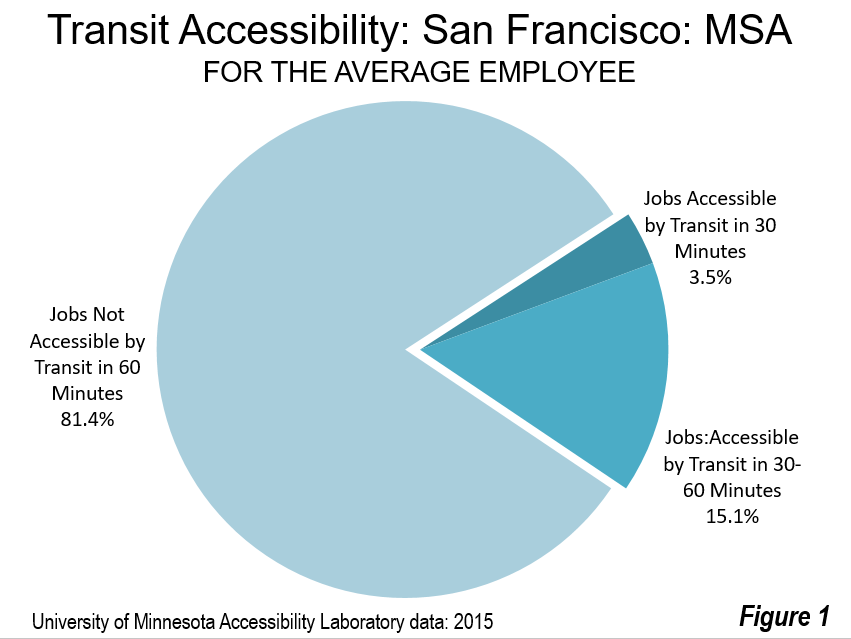
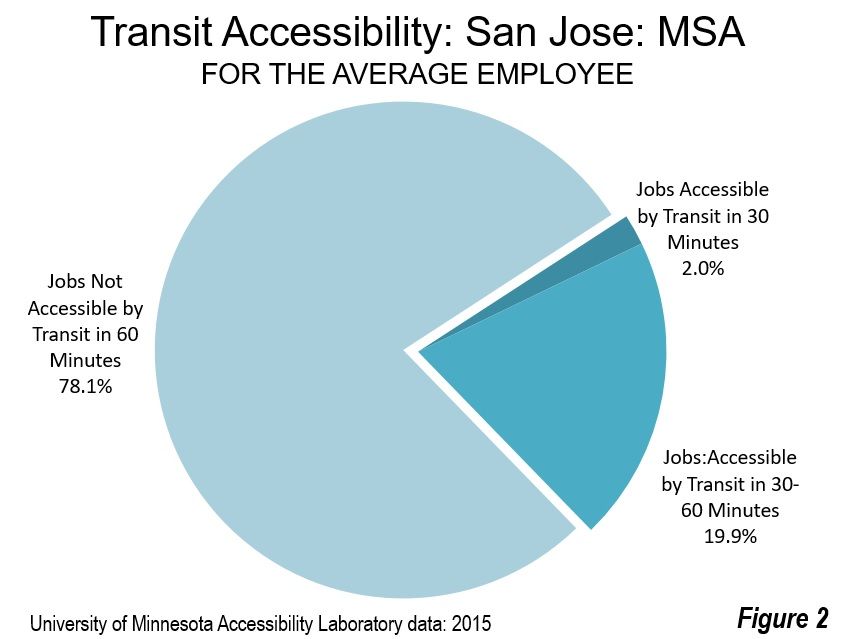
    Some may romantically anticipate that transit can substitute for the automobile and reduce traffic congestion. This is fantasy, as the US experience with urban rail proves. For the most part, transit cannot get you from here to there in the modern metropolitan area. In the Bay Area, the average commuter using transit can reach only 3.5 percent of the jobs in 30 minutes in the San Francisco metropolitan area and 2.0 percent of the jobs in the San Jose metropolitan area (according to the University of Minnesota Accessibility Laboratory). Even with a 60-minute commute, the share of jobs accessible in both areas is only about 20 percent. Even where transit is most intense in the San Francisco Bay Area, the average commuter can reach 16 times as many jobs in 30 minutes and eight times as many in 60 minutes (Figures 1 and 2). That is not to minimize the value of transit, which carries 50 percent of commuters to the nation’s six largest downtown areas (New York, Chicago, Philadelphia, San Francisco, Boston and Washington). But in each of these metropolitan areas the overwhelming percentage of jobs are outside downtowns, where the overwhelming share of commuting is by car.

    The hope of some planners that traffic will get so bad people will switch to transit requires service that takes people where they want to go. They must still be wondering why people persist in driving their cars that take them where they need to go instead of switching to transit that takes them where planners would like them to go. Of course, the reality is that transit provides little mobility beyond the urban core and cannot be made to do so at any reasonable cost.

    The bottom line is that traffic congestion can get considerably worse. In Bangkok and Mexico City, traffic congestion is at least 70 percent worse than in the Bay Area, according to the Tom Tom Traffic Index. This is despite much lower automobile ownership rates.

    The survey indicated another alternative for those who really cannot stand the Bay Area’s unbearable and worsening traffic congestion. Move. The Bay Area Council found that 40 percent of respondents and 46 percent of Millennials are considering moving from the area in the next few years.

    Indeed, that is beginning to happen. After a five-year respite in the Bay Area’s substantial net domestic out-migration, 26,000 more people left than arrived in 2016. The big loser was Santa Clara County (a net loss of 21,000), while San Francisco County (city) lost 7,000. Between 2000 and 2009, the Bay Area had lost more than 500,000 net domestic migrants.

    For the millions who will remain in the Bay Area, however, moving is not a solution. Of course, a dawn of reason could occur among the leadership of California and the Bay Area, in which ideologically preferred solutions are replaced by practical strategies that work. Things will probably have to get much worse for the public to demand that.

    Note: See my co-authored reports with Joseph Vranich, The California High Speed Rail Proposal: A Due Diligence Report (2008), and California High Speed Rail: An Updated Due Diligence Report (2012).

    Wendell Cox is principal of Demographia, an international public policy and demographics firm. He is a Senior Fellow of the Center for Opportunity Urbanism (US), Senior Fellow for Housing Affordability and Municipal Policy for the Frontier Centre for Public Policy (Canada), and a member of the Board of Advisors of the Center for Demographics and Policy at Chapman University (California). He is co-author of the “Demographia International Housing Affordability Survey” and author of “Demographia World Urban Areas” and “War on the Dream: How Anti-Sprawl Policy Threatens the Quality of Life.” He was appointed to three terms on the Los Angeles County Transportation Commission, where he served with the leading city and county leadership as the only non-elected member. He served as a visiting professor at the Conservatoire National des Arts et Metiers, a national university in Paris.

    Photo: City of San Francisco (by author)

  • Urban leaders should plan for the public transit of the future

    Self-driving, automated cars are coming. There will be teething pains in many forms: Some people will want highly automated vehicles while others will fear them. Some will be privately owned, and others will be taxis and shuttles for use by different people every day.

    What’s largely unappreciated yet important is that leaders in urban regions need to prepare for two separate, competitive streams of vehicle automation. One stream lets automation assist the driver. A second stream has no driver. Not recognizing the distinction can result in confused predictions and ineffective public policy.

    Stream 1, the advanced self-driving car that still has a human driver at the wheel, will be in auto dealerships around 2020. Early innovative versions in high end cars, such as Tesla with Autopilot, or Volvo with Pilot Assist, can be purchased now. In the early 2020s, driver assistance technology in all price ranges will be astonishing, making driving on limited-access highways safer, more comfortable, and safely supportive of a lower but still mindful focus of attention while operating a car. On urban streets with crossings, signals, left turns, driveways, double parking, bicycles, and pedestrians, automated driving will arrive later.

    Sophisticated assistance to drivers is mostly what vehicle automation represents for the next decade: cruise control on steroids. Automatic, radar-activated braking will reduce collisions with pedestrians, bicycles, and other motor vehicles. Making collisions impossible is today’s engineering goal as older cars are retired from the consumer fleet.

    The Highway Loss Data Institute (HLDI) has already found that today’s very early versions of front crash prevention systems lead to insurance claim rates that are 10 to 16 percent lower for vehicles equipped with both driver alerting and automated braking, and 7 to 22 percent lower for vehicles equipped with a warning system only.

    Stream 1 automation for many more years will still require that a human driver remain awake and responsible for the inevitable situations that automated control fails to handle, such as new roadway sinkholes that electronic maps and in-car sensors do not notice and behavior of other motorists that is unusual, sudden, and irrational.

    However, levels of driver distractions like those that now commonly occur –– looking away from the road for over two seconds, for example — will be more safely tolerated in future semi-automated cars. This level of distraction is so pervasive a human condition, indeed, that meeting zero fatality goals will be impossible without robotic autonomy that compensates for the error of insufficient driver attention. Rear-end collisions and drifting out of lane—commonplace with today’s smart phone distractions—are going to be snuffed out via automated driver assistance as older cars are retired from service.

    Stream 1 promotes continued vehicle ownership, and is not particularly disruptive to existing patterns of vehicle use. It’s merely a nicer version of your current car. Government oversight of motor vehicle safety should not constrain, but rather encourage the roll out of the new safety features.

    The current regulatory framework can be successfully managed within existing processes of government departments of transportation, vehicle and operator licensing authorities, and urban planners. In general, instead of new regulations, only fine-tuning of today’s rules is needed.

    Stream 2—the completely automated car—is not a consumer purchase now and may never be. Having no driver is its essence. The fully automated driverless vehicle will inevitably evolve toward these vehicles having commercial and other institutional owners for the purpose of providing on-demand ride service for any passengers, with or without a drivers’ license. Passengers would have no responsibility for operating the vehicle, like with a bus or taxi today, but now without a human driver.

    Stream 2 represents a widening path of disruption in automobility already begun by the likes of Uber and Lyft, Car2Go and ReachNow. This disruption will decisively arrive in the form of cars and mini-buses without a steering wheel and foot pedals.

    To get into service quickly and safely, the first street-legal Stream 2 versions will be traveling on limited, pre-defined routes on public streets and roads with government regulatory clearances following months of planning. In what’s called by the U.S. Federal Government a limited “operational design domain,” these vehicles will provide new opportunities for local mobility. Dozens of local officials throughout the first world’s urban regions have already begun to discuss with consultants and vendors where and how Stream 2 services would be usefully deployed.

    Government oversight should not discourage deployment of automated vehicles without drivers. Rather it should accelerate the potential for reducing the percentage of single occupant vehicles (SOVs) on streets in all kinds of low speed environments, from congested areas within the densest city centers to suburban residential areas where public transit is now impractical.

    Uber’s semi-robotic taxis in Pittsburgh and Arizona are still Stream 1 technologies, but are trying to make the jump to Stream 2. They are beginning with drivers in the usual position keeping watch on not-quite-ready automation systems, and who are always ready to take over control. So far, human driver intervention remains frequent, around once per mile on average.

    The future date for successful transition of early trial semi-robotic deployments to completely driver-less operation on even a small portion of a metropolitan street grid is uncertain –– although several manufacturers promise by the early 2020s. Operating a region-wide commercial service without drivers may take years of testing and safety certification. Slow-moving mini-bus shuttles staying under 25 mph in a curb lane are easiest to deploy first, and are being tested already in Asia and Europe. A limited version is just now being tested in Las Vegas ahead of passenger service said to be coming within months.

    Stream 2 requires a combination of impeccable up-to-date digital mapping, well-maintained lane markings and signage, all within bounded operating areas. There will be remote human oversight. Governments at all levels are most unlikely to allow autonomous vehicles to roam unmonitored. That’s sensible public policy.

    In contrast, because human driving remains available, vehicle owner-drivers in the less controversial and high-momentum Stream 1 of driver assistance will be able to travel on all types of roads, a practically unlimited operating domain. The auto industry is trying to enable drivers to gain swaths of time to do limited non-driving tasks on limited access highways. Less attentive driving has the potential to become safer, with crashes from driver error less common. The inevitable years ahead for roads that mix automated and non-automated vehicles will challenge and delay the full potential for mitigating distraction.

    Stream 1 drivers with automated assistance will more easily tolerate longer distance commutes that let them access lower-cost housing and closer proximity to outdoor recreation. The daily grind of congested commuting from suburbs to downtowns could be significantly eased for drivers of highly-automated vehicles, who can then focus on non-driving activities.

    By making car travel easier, Stream 1 will be a force of unknown magnitude for making urban areas spread outward. Traffic could increase but would move more smoothly because of automated control assistance. Many consumers will embrace Stream 1, so it will not initially reduce parking demands in our residential areas, employment centers, or shopping districts in the way the slower-arriving Stream 2 promises.

    Stream 1 automated driver assistance appeals to the sense of autonomy and control that comes with car ownership. The driverless Stream 2 supports the rising attraction of efficient ride hailing, ride sharing and taxis. Both are coming, with Stream 1 having the advantage now. But which path of innovation will dominate in the 2020s?

    Stream 1 automated driver assistance has no deployment barriers. It’s simply your next car purchase or the one after. It conforms to every purpose and role that your family vehicle now plays: habit, status, privacy, security, and the sense of assurance you get from owning a car as you and your parents long have.

    The full automation in Stream 2 faces a series of obstacles to everyday use, with gaps in technological capability an even bigger issue than regulatory barriers. For Stream 2 to be realized, drivers must become completely redundant in all circumstances within a geographic range of service. Even with machine learning in computer algorithms, that’s a tough goal. Reaching a near-error-free level of robotic motor vehicle operations over a broad geographic region at the human level of 100 million miles between fatal incidents may be inevitable, but the number of years to get Stream 2 cars to be this safe is still uncertain.

    Eventually, Stream 2 will become the taxicab, the Uber, the Lyft, the ReachNow, and the city bus of the future, reducing operating cost by eliminating drivers. Stream 2 will be battery-electric powered for operation that is quiet, non-polluting, and energy-efficient. Optimists for the automated vehicle’s future are enthusiastic about their potential for making car ownership unnecessary for many people.

    But wait. Consumers will shift away from car ownership only as new Stream 2 on-demand mobility services emerge as suitable for the wide range of personal desires and needs that exist within any typical family. That will require new levels of affordable vehicle availability, range, responsiveness, convenience, choice, comfort and personalization not currently available today, and also not easily reached in the early years of Stream 2 robo-cabs.

    Stream 1 is familiar and can be safely left to new car dealers and existing motor vehicle regulations policy. Stream 2 breaks with current practice, however, providing the biggest opportunity for congestion reduction in the long run. This is where regional and local governments need to focus now by encouraging, facilitating, and funding demonstration projects of the driverless vehicles available now.

    John Niles lives in Seattle. He is a principal with the automated vehicle consultancy Grush Niles Strategic, and is also the Research Director at Center for Advanced Transportation and Energy Solutions (CATES) and a Research Associate at Mineta Transportation Institute at San Jose State University. This essay builds upon a report that his Toronto colleague Bern Grush prepared for The Residential and Civil Construction Alliance of Ontario (RCCAO), issued October 2016,”Ontario Must Prepare for Vehicle Automation.”

    Photo: Flckr user jurvetson (Steve Jurvetson). Trimmed and retouched with PS9 by Mariordo [CC BY-SA 2.0], via Wikimedia Commons

  • To Reunite America, Liberate Cities to Govern Themselves

    Time magazine’s 2016 Person of the Year was elected president, as the magazine’s headline writer waggishly put it, of the “divided states of America.”

    Donald Trump did not, of course, cause America’s long-standing divisions of class, culture, education, income, race, and politics, which have been baked into our geography and demography for a long time. But he has certainly brought them into stark relief. As the social psychologist Jonathan Haidt remarked, “We have to recognize that we’re in a crisis, and that the left-right divide is probably unbridgeable. … Polarization is here to stay for many decades, and it’s probably going to get worse, and so the question is: How do we adapt our democracy for life under intense polarization?”

    The answer lies not in enforcing uniformity from left or right but in embracing and empowering our diversity of communities. The best way to do that is by shifting power away from our increasingly dysfunctional federal government and down to the local level, where partisan differences are more muted and less visible, and where programs and policies can actually get things done.

    This is hardly the first time the United States have been so divided. Yet with the exception of the Civil War, America has always been able to surmount its differences and change as needed over time. Often the most powerful and lasting innovations—from both the left and right—have percolated up to the national level from the grassroots politics of state and local governments, the places Justice Louis Brandeis famously called “the laboratories of democracy.”

    Far from promoting unity, centralizing power at the national level drives us further apart. This is something that the Founders recognized at the very outset of the American experiment when they designed a federalized system, and it is very much in tune with our current national mood. Almost half (49 percent) of Americans view the federal government as “an immediate threat to the rights and freedoms of ordinary citizens,” according to a 2015 Gallup poll. And nearly two-thirds (64 percent) believe that “more progress” is made on critical issues at the local rather than the federal level, according to a separate 2015 Allstate/National Journal Heartland Monitor poll.

    The issue isn’t just the dysfunction of our national government, but how we can best and most efficiently address our economic needs and challenges. The United States is a geographically varied place. No top-down, one-size-fits-all set of policies can address the very different conditions that prevail among communities. Back when he was governor, Bill Clinton understood that “pragmatic responses” by local governments to key social and economic issues were critical in “a country as complex and diverse as ours.”

    Until recently, local empowerment was mostly a theme of the right, for example when Yuval Levin characterized President Obama’s use of executive orders as intrusions on local rights. Now some progressives, horrified about the orders that might come down from a Donald Trump administration, are also seeing the light. Progressives have not always been hostile to local control, as anyone who’s studied the grassroots radical movements of the 1960s well knows. But now a growing chorus of them, including Benjamin Barber and Bruce Katz, are on board with the idea. Indeed, strange times make for strange bedfellows, and we have come to a pass where conservatives and progressives can work together to reinvigorate our federalist state.

    The United Kingdom, long a highly-centralized country, has been making moves in this direction—even before the Brexit vote showed widespread opposition to meddling from an even more distant government in Brussels. In 2015, a blue-ribbon panel of British business leaders, policymakers, economists, and urbanists outlined four key steps to empower cities, including shifting decision-making authority from the national government to cities and metropolitan areas; giving cities greater tax and fiscal authority; placing city leaders on national representative bodies and giving them a permanent seat on the national cabinet; and creating new mechanisms to coordinate major investments in infrastructure, talent, and economic development across metro areas. We would be wise to follow their cue.

    It is time for American mayors and community leaders—from small towns, suburbs and midsized ‘burgs to great metropolitan capitals like New York City, LA, and Chicago to press for a similar devolution of power. Such a strategy recognizes both the advantages that come from local innovation and problem solving and the substantial variations in local capabilities and needs. This need for devolution and local empowerment does not just apply to the federal government; it applies to the relationship between the states and municipalities as well. A greater recognition of local differences may be particularly helpful for suburbs, which often have little voice in regional decision-making compared to either big city mayors or the rural and small town interests that dominate many statehouses.

    In the America that emerged after the Second World War, unity of purpose was the watchword. In the more geographically-varied world of today, it makes sense to allow for a greater variation of policy approaches. Rather than pursuing a single vision of “national greatness,” it’s time for us to embrace and empower the country’s wondrous local diversity of cities, suburbs and communities of all kinds.

    Vive le difference!

    Joel Kotkin is executive editor of NewGeography.com. He is the Roger Hobbs Distinguished Fellow in Urban Studies at Chapman University and executive director of the Houston-based Center for Opportunity Urbanism. His newest book, The Human City: Urbanism for the rest of us, was published in April by Agate. He is also author of The New Class ConflictThe City: A Global History, and The Next Hundred Million: America in 2050. He lives in Orange County, CA.

    Richard Florida is author of The New Urban Crisis, University Professor at the University of Toronto, Distinguished Visiting Fellow at NYU, and editor-at-large of The Atlantic’s CityLab.

  • Transit Ridership Down 2.3% in 2016

    With little fanfare, the American Public Transportation Association (APTA) released its fourth quarter 2016 ridership report last week. When ridership goes up, the lobby group usually issues a big press release ballyhooing the importance of transit (and transit subsidies). But 2016 ridership fell, so there was no press release.

    The report showed that light-rail ridership grew by 3.4 percent, probably because of the opening of new light-rail lines such as Seattle, where the opening of the University line increased ridership by 60 percent. In the past, light-rail ridership has grown with the addition of new lines, but the number of passengers per mile of light rail has fallen, indicating diminishing returns to new rail construction.

    Commuter-rail ridership grew by 1.6 percent, mostly due to growth in New York City. Trolley bus ridership grew by 1.8 percent, almost all of which was in San Francisco. Demand-response (paratransit) grew by 0.7 percent.

    The two most important modes, however, both declined: heavy rail fell by 1.6% and buses by 4.1 percent. Since these two modes together carry 86 percent of transit riders, their decline swamped the growth in other modes. “Other,” which includes ferries, monorails, and people movers, also fell by 0.2 percent.

    In some cases, the decline in bus ridership more than made up for increases in rail ridership. Phoenix light-rail ridership grew by 10.6 percent, but for every light-rail rider gained, Phoenix transit lost nearly four bus riders. Los Angeles light-rail ridership grew by 8.7 percent, but for every light-rail rider gained, Los Angeles lost nearly six bus riders. Ridership on Nashville’s Music City Star grew by 2.6 percent, but the city lost more than 30 bus riders for every new rail rider. Denver opened a new rail line to the airport but lost more than 1-1/2 bus riders for every rail rider gained. Charlotte lost more than 15 bus riders per new rail rider, while Portland lost nearly 2 bus riders per new light-rail rider.

    Other major rail systems couldn’t even record gains. Washington’s Metrorail fell by 10.4 percent; Atlanta fell by 4.7 percent; and the biggest shock of all, New York City subways fell by 0.8 percent. Heavy-rail ridership also feel in in Baltimore (-13.2%), Chicago (-1.3%), Miami (-3.8%), and Philadelphia (-4.5%), among other places.

    Ridership on Boston’s aging subway lines fell by 0.2 percent. As in Washington, the Boston subway is experiencing maintenance problems, including smoke in the tunnels. MBTA has ordered new rail cars, one of which was put on display this week. As columnist Teresa Hanafin noted on Tuesday in the Boston Globe,

    Governor Charlie Baker and state transpo and T officials tour the new Orange Line trains at noon in Medford. The new cars are terrific: They come equipped with sneakers that riders can borrow when the trains break down and they have to walk to the next station, paperbacks to read during the daily delays, hair dryers so riders can help T workers warm up the tracks during cold weather, tasers to ward off gropers, vomit bags, nose plugs, hand sanitizer, and cheese vending machines so riders can feed the rats. Isn’t technology great?

    Light-rail ridership declined in, among other places, Buffalo (-6.1%), Cleveland (-4.7%), Dallas (-1.7%), Minneapolis (-0.2%), Philadelphia (-6.0%), Pittsburgh (-4.3%), St. Louis (-4.6%), and Sacramento (-3.5%). Commuter-rail ridership fell in Albuquerque (-7.7%), Austin (-3.5%), Dallas-Ft. Worth (-6.1%), Los Angeles (-4.3%), Maryland (-1.9%), Miami (-1.6%), Orlando (-8.5%), and Philadelphia (-5.9%), among other places.

    Salt Lake City has been getting more federal transit funding per capita than any other urban area, but the region seems to be losing its bet on light rail and commuter rail. Except for paratransit, every mode of transit in the region declined. The same thing happened in Dallas-Ft. Worth, which has built more light rail than any region in the country. Transit in San Jose, home of one of the nation’s worst-managed transit agencies, took a real nosedive, losing 10.0 percent of light-rail riders and 8.5 percent of bus riders.

    APTA will no doubt blame these declines on low gasoline prices. Prices for regular gasoline in 2016 averaged $2.14, about 12 percent less than 2015’s $2.43. Prices in 2016 were also less variable, which might have given people more confidence in driving. Perhaps more important, per capita incomes grew by 3.5 percent, which probably contributed more to near-record auto sales than low gas prices (though the low fuel prices influenced people’s choices of what vehicles to buy).

    The transit industry bills itself as providing necessary transportation for low-income riders and alternative transportation for choice riders. Whether because of low gas prices, rising incomes, or growing shared-car services, low-income commuters are buying cars and higher-income travelers are making a choice not to use transit. In the face of these choices, transit agencies that want to spend hundreds of millions or billions on fixed-guideway transit, either rail or dedicated bus lanes, are wasting peoples’ money.

    Randal O’Toole is a senior fellow with the Cato Institute specializing in land use and transportation policy. He has written several books demonstrating the futility of government planning. Prior to working for Cato, he taught environmental economics at Yale, UC Berkeley, and Utah State University.

    Photo: Wade Rockett, CC License.

  • The other California: A flyover state within a state

    California may never secede, or divide into different states, but it has effectively split into entities that could not be more different. On one side is the much-celebrated, post-industrial, coastal California, beneficiary of both the Tech Boom 2.0 and a relentlessly inflating property market. The other California, located in the state’s interior, is still tied to basic industries like homebuilding, manufacturing, energy and agriculture. It is populated largely by working- and middle-class people who, overall, earn roughly half that of those on the coast.

    Over the past decade or two, interior California has lost virtually all influence, as Silicon Valley and Bay Area progressives have come to dominate both state politics and state policy. “We don’t have seats at the table,” laments Richard Chapman, president and CEO of the Kern Economic Development Corporation. “We are a flyover state within a state.”

    Virtually all the polices now embraced by Sacramento — from water and energy regulations to the embrace of sanctuary status and a $15-an-hour minimum wage — come right out of San Francisco central casting. Little consideration is given to the needs of the interior, and little respect is given to their economies.

    San Francisco, for example, recently decided to not pump oil from land owned by the city in Kern County, although one wonders what the new rich in that region use to fill the tanks of their BMWs. California’s “enlightened” green policies help boost energy prices 50 percent above those of neighboring states, which makes a bigger difference in the less temperate interior, where many face longer commutes than workers in more compact coastal areas.

    The new Bantustans

    Fresno, Bakersfield, Ontario and San Bernardino are rapidly becoming the Bantustans — the impoverished areas designed for Africans under the racist South African regime — in California’s geographic apartheid. Poverty rates in the Central Valley and Inland Empire reach over a third of the population, well above the share in the Bay Area. By some estimates, rural California counties suffer the highest unemployment rate in the country; six of the 10 metropolitan areas in the country with the highest percentage of jobless are located in the central and eastern parts of the state. The interior counties — from San Bernardino to Merced — also suffer the worst health conditions in the state.

    This disparity has worsened in recent years. Until the 2008 housing crash, the interior counties served, as the Kern EDC’s Chapman puts it, as “an incubator for mobility.” These areas were places that Californians of modest means, and companies no longer able to afford coastal prices, could get a second shot.

    But state policies, notably those tied to Gov. Jerry Brown’s climate jihad, suggests Inland Empire economist John Husing, have placed California “at war” with blue-collar industries like homebuilding, energy, agriculture and manufacturing. These kinds of jobs are critical for regions where almost half the workforce has a high school education or less.

    Read the entire piece at The Orange County Register.

    Joel Kotkin is executive editor of NewGeography.com. He is the Roger Hobbs Distinguished Fellow in Urban Studies at Chapman University and executive director of the Houston-based Center for Opportunity Urbanism. His newest book, The Human City: Urbanism for the rest of us, was published in April by Agate. He is also author of The New Class ConflictThe City: A Global History, and The Next Hundred Million: America in 2050. He lives in Orange County, CA.

    Photo: Michael Patrick, CC License.

  • The Ghost of Mamie Eisenhower

    There’s a certain amount of nostalgia these days for 1950’s suburbs when men were men and ladies mopped linoleum floors in white pumps and pearls. I’m not entirely sure that world ever really existed precisely the way it was portrayed on black and white television, but we seem to want it to be true.


    Here are examples of the most common version of 1950’s suburban homes. Soldiers returning from World War II eagerly bought them with heavily subsidized mortgages. They were based on the Levittown model of modest mass produced houses stamped out by the tens of thousands in potato fields all across North America. 875 square feet. Three small bedrooms. One bath. A little eat in kitchen. No garage. No air conditioning. And this kind of home was a spectacular improvement over the accommodations most families had experienced during the Great Depression of the 1930’s and wartime rationing of the 1940’s.

    Screen Shot 2016-07-13 at 1.49.17 PM

    Screen Shot 2016-06-04 at 9.43.05 PM

    But by today’s standards these homes are often considered substandard. In fact, in many communities homes like these are now illegal to build because they’re so cheap and unimpressive that they might attract “the wrong element.” This subdivision has been in decline for years. The manufacturing jobs that once supported these families dried up long ago. The next generation who managed to get university degrees and work their way up the economic food chain moved to more exclusive locations farther away from the old city center. The population of this tract has contracted by 17% since the 2000 census. Today the largest segment of the remaining population in this neighborhood earns $10,000 or less per year. Many are elderly pensioners or people on public assistance. Some of these homes languish on the market and eventually sell for as little as $25,000. Homes in better condition consistently sell for $50,000 to $60,000 – largely because banks won’t write mortgages for less.

    If you take a ten minute drive out along the aging 1950’s commercial corridors that compliment these residential subdivisions you quickly discover the scope of the problem. The most common criticism of this environment is that it’s soul crushingly ugly. The presumed remedy is to make it “pretty” by planting flowers, mandating more attractive signage, and flying American flags everywhere. There’s a concerted effort to replace the dead drive-thru burger joints and empty muffler shops with shiny new drive-thru burger joints and muffler shops. But ugliness isn’t the problem and newness isn’t any kind of solution.

    Insolvency is the problem. This landscape doesn’t generate enough value to support the required infrastructure that supports it. The majority of the land along this commercial strip is surface parking lots, landscaped berms, and storm water retention ponds. None of that pays taxes, employs people, or adds value to the town. The best discount tire shop in the world can’t spin off enough revenue to carry the public burden of suburban roads, sewers, water systems, schools, police, and so on. Ugly is just the icing on the cake.

    But then I discovered this bit of Dwell Magazine style new construction. The fashionable Mid Century Modern lines are a kind of Walter Gropius meets Mies Van Der Rohe meets Frank Lloyd Wright homage to Mamie Eisenhower’s bygone Atomic Ranch America with all the latest “green” bells and whistles. So why did someone spend so much money on this property in this location? Well…

    It’s a peculiar sweet spot if you’re paying attention. The schmaltzy 1950’s tract homes are built right on the edge of an old 1890’s neighborhood. When the subdivision was new people were eager to escape the cramped apartments and run down housing stock of traditional urbanism and reveled in the privacy, personal space, and greenery of the fresh suburban living arrangement. They drove away from Main Street on the newly widened highways toward a glorious Jiffy Lube and Dairy Queen future. Meanwhile, the old neighborhood suffered institutional neglect and was abandoned to slumlords and marginalized minority populations for decades.

    Today there’s a renewed appreciation for historic districts. The economic and cultural pendulum is swinging back again, particularly among post college Millennials. The center of this traditional neighborhood is a five minute bicycle ride from those cheap 1950’s tract homes. As prices for venerable properties rise and availability tightens the little tract homes may seem a lot more viable. This is especially true as Millennials begin to have children and start looking for affordable property close to civilization, but with a little patch of garden. Zoning regulations and building codes make it almost impossible to alter existing homes in the older neighborhood. But the small homes and large lots of the suburban subdivision are significantly easier to add on to and modify. These homes can turn away from the depressing sprawl along the highway and turn back toward Main Street. Given enough time and incremental investment this could be one of the more desirable places to live in the years to come.

    And there’s one more aspect to these homes that I find particularly appealing. There’s a significant amount of land that lends itself to serious gardening and a conspicuous lack of Home Owners Association rules and regulations. Combined with the close-in location and genuinely affordable price point these homes are ideal for varying degrees of suburban homesteading. This sort of thing may seem peculiar to most people at the moment, but it could be a prominent selling feature in the future. Time will tell.

    John Sanphillippo lives in San Francisco and blogs about urbanism, adaptation, and resilience at granolashotgun.com. He’s a member of the Congress for New Urbanism, films videos for faircompanies.com, and is a regular contributor to Strongtowns.org. He earns his living by buying, renovating, and renting undervalued properties in places that have good long term prospects. He is a graduate of Rutgers University.

    All photos by Johnny Sanphillippo

  • The Sad State of the University Degree for Planners & Designers

    For the past four decades, technology has improved nearly all aspects of our life – except for the physical land development patterns of our cities. The 1960’s suburban pattern, still in use today, is unsustainable. However, the ‘architectural’ answer to the ‘planning’ problem of sprawling subdivisions has been to simply go backwards to the gridded past.

    Without a high degree of architectural and landscaping detail, this model, known as New Urbanism, does not work. As such, there are few (if any) affordable New Urbanist non-subsidized developements. The Congress of New Urbanism (CNU) boasts of their success in gentrification, but instead of reinventing ‘design’ to address the problems, the architect’s answer is to make site plan function as if it as a simplistic rectangular floor plan.

    The CNU objective is to create a pedestrian oriented society and do everything possible to do away with car ownership. To combat suburban sprawl, they attack those who invest in suburban homes even though they represent 80 percent of the housing market growth. Even with the nearly three decades New Urbanists have promoted this singular solution, there are relatively few actual CNU projects.

    One of the largest groups of CNU followers are university professors who teach young, impressionable minds that suburbia is terrible and only high density is the answer. These students go deep into debt thinking that they will be part of a vast new era of change, however, when they look for employment in the real world, they are miserably unprepared. The technical skills taught in Urban Planning and GIS (Geographic Information Systems) revolve around software and training supplied by ESRI, and for architectural or civil engineering students, most likely an AutoCAD targeted module like Civil3D or Revitt, the current industry-leading software products.

    To understand why this is a problem, I will share experiences with graduate students hired as interns, not mentioning the school. I am based in Minneapolis.

    I interviewed a graduate from the Urban Studies program a few years ago who did not understand what an easement or a right-of-way was. He had no classes on how a plan or plat was put together, along with no design courses, no knowledge of surveying or civil engineering which is the basis of all redevelopment and growth. I decided to take on the challenge and hired the student to teach him basic things you would think would be taught to a graduate student.

    A few months ago, I took an intern (same university) graduating this spring in GIS and mapping. Again, you would think the basic premise of mapping would be an intricate knowledge of surveying and subdivision planning, at least. But nay, nay – none was taught. I asked, why a career in GIS? He said that his first intention was to become a civil engineer, but they immediately placed him in the mathematically demanding structural side of civil engineering, which proved too much for him. Instead of having a dedicated civil ‘site’ engineering course with simplistic math to learn, he made the choice to become a GIS technician. Again, going massively into student debt. These interns were both taught a targeted social engineering agenda that ignored where most of the growth was, and will continue to be, the suburbs.

    Four decades ago, before software and New Urbanism existed, students were taught design. Slowly, a metamorphosis occurred from a hands-on approach to one where the designer is limited by the functions of the technology being taught. I began developing software four decades ago and within a decade began to realize software was not actually about design. It is about how fast the end user can produce that architectural or civil engineering plan, which is slowly but surely destroying design.

    This is why it seems like every new apartment building or commercial center looks as if the same architect was used – in a way it is, because the architect is more software, not a person. Today’s CAD and GIS software has reduced design to replicable keystrokes in predetermined software functions, which dumbs down design and promotes the cookie-cutter monotony typical of all suburban subdivisions and urban redevelopments.

    For the past 26 years, in order to remedy this situation, our studio developed pioneering technology enabled methods to design over 1,000 land developments in 47 states and 18 nations to date. These methods have a demonstrated average reduction of infrastructure by 27 percent, without a density loss or reduced existing regulatory minimums, as compared to conventional design methods.

    When compared to the New Urbanism taught in universities, we have seen examples where infrastructure is reduced by up to 60 percent with our methods. Reduced right-of-way can provide a density increase without sacrificing space and privacy – valued by the suburban dweller. The increased open space allows better models for vehicular and pedestrian connectivity and efficiency, as well as a coordination of architecture and site design to enhance views, curb appeal, value and livability, while reducing environmental impacts.

    By curing the ills of suburbia, we deflate the CNU agenda, so it is no surprise few professors embrace the reinvention of planning, both in design and in regulation writing.

    A dozen years ago we began investing heavily in creating a new form of technical solution. Software in the form that exists today simply automates past methods. We needed to develop a product that would educate the advanced design methods and not rely on the ‘paint by numbers’ solution that limits possibilities. Software is a tool. The saying – “If you only have a hammer, you tend to see every problem as a nail”, is true of the CAD and GIS products being taught. We needed to teach our market-proven design discoveries and develop a completely different kind of a tool that would not limit the art of design.

    As the architect Frank Gehry stated: “Creativity is about play and a kind of willingness to go with your intuition. It’s crucial to an artist.” Art cannot happen with the current ‘paint by numbers’ approach. Nor can growth be functional when graduates today have only a singular skill – either architecture, engineering, mapping, or social engineering (i.e. what used to be known as planning). Design must function better, and without a general knowledge of all these skills there cannot be progress for the masses who cannot afford nor desire to live in overly dense gentrified neighborhoods.

    To tear down this roadblock to sustainability, design education and technology needed to merge engineering, surveying, architecture, and planning to eliminate the barriers to sustainability in the current uncollaborative design industry. This is why we called our new system LandMentor.

    Planning commissions routinely approve and deny submittals by developers in the exact same form as 60 years ago – a two dimensional plan projected on a screen. To solve this problem we incorporated the first application using virtual reality for public land development approval which harnesses video gaming that can be mastered in minutes, eliminating the high costs and complexity of CAD and GIS that discourage 3D use. No longer will planning commissions and council members need to imagine what the development will look like when completed – with VR they will see and feel it.

    Students spend years learning complex CAD and GIS technology that have made these software giants billions of dollars. There is little time left for the students to learn how to be leaders in design and decision making. Our all-inclusive core system (no modules or options) eliminated cumbersome commands harnessing a patented user interface. Our goal was to educate the use of software, the land development process, innovative design methods, as well as the use of 3D and VR, in less than two weeks.

    To enter a market saturated with CAD and GIS software is a daunting and seemingly impossible task. A few months ago I came across PlanningTank.com, a blog frequented by urban study and GIS students who were complaining that their education was not going to empower them to change the world. I contacted this group and asked them, what if we could provide the technology and training that would change the world? What if we provided this system (marketed at the time for $50,000 a seat) exclusively to students at no charge for a one year license? What if we provided a second free year to the top 33% of the students who demonstrated the most dedication to learn and experiment?

    Today, through PlanningTank.com, we hope to create a grassroots movement that will empower the future leaders of growth to make sustainability something real. Students in urban studies, civil engineering, surveying, planning, architecture, landscape architecture, real estate, and construction have a single system to learn that can replace or supplement other technologies. Those who dedicate the time and effort will not need to go further into debt and will be highly desirable and functional as they enter the employment marketplace.

    Rick Harrison is President of Rick Harrison Site Design Studio and Neighborhood Innovations, LLC. He is author of Prefurbia: Reinventing The Suburbs From Disdainable To Sustainable and creator of LandMentor. His websites are rhsdplanning.com and LandMentor.com

  • Seven Ways Life Has Gotten Better in Rural America

    Rural America is taking a beating in the news. Part of it is deserved. I grew up in rural Indiana and am shocked at some of what is going on there: severe hard drug problems, HIV outbreaks, serious crime, etc.

    Things are a long way from when I was a kid there in the 70s and 80s and people not only left their doors unlocked, they left their keys in the car.

    While I don’t want to minimize the challenges facing rural America, there’s a lot that has flat out gotten better since I first moved to Harrison County in first grade around 1976.

    The county where I grew up got a casino that spins off huge amounts of cash. So it’s not the norm. But even excluding everything that happened after the casino arrived, here are seven ways life has gotten better there.

    1. Water service. I laugh when urbanites brag about watering their flowers with runoff they caught in their “rain barrel.” That’s what we drank growing up. No city water service was available, so you had no choice but to dig a well or have a cistern. We had a cistern that was filled with rainwater from our roof. In your cistern raw low, there was an actual industry of people who would come refill it from a tanker truck. Today, people where I grew up have access to water service if they want it.

    2. Trash service. Similar to water service, there was no public or commercial trash pickup when I was a kid. You had to throw food scraps to animals and burn your trash in a 55 gallon drum. When it filled up with tin cans and the like, or if you needed to dispose of a larger item like a TV, lots of people had their own dumps on their property. Today you can get commercial trash pickup if you want it.

    3. Private telephone lines. Believe it or not, when I was a kid we had a party line. That means multiple families shared the same phone line. If you needed to make a call, you’d pick up the phone and find out if your neighbors where using the line before dialing. You couldn’t get a private line unless somebody who had one died first. Somewhere along the way, the phone company put in an upgrade and you could get a private phone line. (On the downside, it’s no longer possible to dial people in town using just four digits anymore).

    4. Paved roads. The road we lived on was gravel when I first moved there. Most roads in the county were paved, but quite a few were still gravel. Today the roads are all in amazing shape because of the casino, but even before then my road and others were paved using a technique called “chip and seal.” Basically this involves spraying some kind of tar on the road, then covering it in fine gravel, which is compacted into a paving surface. No more massive clouds of dust.

    5. Satellite TV. When I was in high school in the 80s, cable was starting to get big. People where I lived might have wanted their MTV, but they couldn’t get it. There was maybe cable TV in the county seat (I’m not sure). But most folks were stuck with 4-5 over the air channels showing I Love Lucy reruns. Today, thanks to satellite TV, people in rural America have access to every channel you can get in town.

    6. Internet Service. The web hadn’t even been invented back in the 70s and 80s. The internet was a small, government and academic network. Today, there’s pretty wide broadband availability through either some kind of DSL type service or satellite internet. My father has satellite internet and it works pretty good if you ask me.

    7. Amazon, Apple and Netflix. Speaking of the internet, this provided access to everything from designer clothing to pretty much every book ever published. The days of needing to be in a big city with a cool indie record store in order to get good tunes is over. You can now get access to products people in Chicago couldn’t dream of when I was a kid.

    Actually, I could list a whole bunch more things besides these, but I want to be sure not to include anything that might have come from casino money. And I see all kinds of interesting things that were probably never there before in other small towns I visit, such as good coffee shops.

    Not that long ago you were in a sense cut off from the world if you lived in a rural area. Today that’s not the case in many places. I’m not going to claim life is perfect in these areas. They have big, serious challenges. But in a number of ways life has just plain gotten better in rural America in the past two to three decades.

    Aaron M. Renn is a senior fellow at the Manhattan Institute, a contributing editor of City Journal, and an economic development columnist for Governing magazine. He focuses on ways to help America’s cities thrive in an ever more complex, competitive, globalized, and diverse twenty-first century. During Renn’s 15-year career in management and technology consulting, he was a partner at Accenture and held several technology strategy roles and directed multimillion-dollar global technology implementations. He has contributed to The Guardian, Forbes.com, and numerous other publications. Renn holds a B.S. from Indiana University, where he coauthored an early social-networking platform in 1991.

    Photo: The house Aaron grew up in.