Blog

  • The Economist on the Costs of London’s Green Belt

    The Economist reminds readers of the economics of housing (or for that matter, oil or any other good or service): constraining the supply of a good or service in demand raises its price. In a 14-page feature on London, The Economist decries the high cost of housing in London. And, for good reason, the 8th Annual Demographia International Housing Affordability Survey showed London to have a median multiple (median house price divided by median household income) 6.9 in the fourth quarter of 2011. This figure, which would be more like 3.0 in a normally functioning market, is exceeded by few other major metropolitan areas, though Hong Kong, Vancouver, Sydney are more unaffordable.

    The Economist noted that:

    … perhaps the biggest constraint on development in London is the Green Belt. Established after the war, it runs (with perforations) all around London, to a depth of up to 50 miles, and bans almost all building on half a million hectares of land around the city.

    Not only has this constraint led to higher house prices, but it has resulted in greater urban expansion and imposed greater costs, in time and money on commuters.

    … it has pushed it into the greater south-east, thus spoiling the countryside across a bigger area. It has also raised the cost of housing and forced workers to travel farther. Commuting costs in London are now higher than in any other rich-world capital.

    One alternative is to relax the Green Belt controls. The Economist points out that allowing development one mile into the Green belt would add one-sixth to the developable area of London. The Economist also notes that "far more than would be needed to make a huge difference to housing availability" and that opening the Green Belt "might not be an environmental disaster."

    The Economist calculates that "the average London worker can buy half an average home." Britain would gain if the interests of those with a stake in a poorer middle class and greater poverty were to finally give way to the general welfare.

  • Religion and the City

    Seek the welfare of the city where I have sent you into exile, and pray to the LORD on its behalf; for in its welfare you will have welfare. – Jeremiah 29:7

    Religion is another one of those topics seldom discussed in urbanist circles. Though Christianity was originally an urban religion, modern Christianity has always had a bit of a problem with cities, with their licentious ways, anonymity, and the little bit of Babylon and Sodom they all contain.

    The religious in the US are often associated with the political right and conservative stances on social issues – just the type of people who don’t like cities or city dwellers much, and vice versa. In particular, the strident opposition of many to abortion and homosexuality puts religion on the wrong side of what are also litmus test issues for many urbanists.

    Yet urbanists should take religion much more seriously than they often do. That’s because it plays a much bigger role in the city and civic health than currently believed, and because many urban congregations have mastered the art of outreach and conversion in a way that transit and density advocates can only dream out.

    The Importance of Religion

    Churches have always been important institutions in cities. Even today, the only reason many families with children are confident enough to stay in the city is because they can enroll their kids in Catholic or other religious schools. I can only imagine what a place like Chicago would look like if its religious school network wasn’t there. Religious institutions are also heavily involved in poor relief and other social service activities that help reduce the tax burden. And regardless of what you personally think about any particular religion, if someone is able to use faith to help them get over serious personal dysfunction like criminal behavior or alcoholism, more power to them.

    For ethnic and minority communities, churches have long been key community institutions and support organizations. In a video I’ll get to shortly, Tim Keller notes as one example how the Jewish community of New York City has built extensive institutions there that made it much easier for Jewish families, not just young Jewish singles, to stay in the city. Churches have long been important in black communities that are often neglected and underserved by government, and many black pastors are seen not only as religious, but very important community or political leaders as well. I suspect religious institutions play a particularly key role in fostering community networks for what are niche minorities in many cities – Muslims, Sikhs, etc.

    This is an urban world that doesn’t feature much in the landscape of the traditional affluent white bobo demographic that dominates urbanist discussion. But even in that group, I see many examples of how religious minded urbanists types have helped boost and build a better future for their city.

    For example, in Indianapolis, the Earth House Collective, a “group of peace activists, conservationists, artists, musicians, Methodists, teachers and many more dedicated to peace, wellness, community and culture” is based in the heart of downtown Indianapolis at Lockerbie United Methodist Church. Similarly, the Harrison Center for the Arts, one of the city’s most important arts venues, is housed at Redeemer Presbyterian Church. Both of these are taken seriously by even the most hardened atheists in the city.

    The Harrison Center’s executive director, Joanna Taft, was one of the people who helped found the church as well (and the charter Herron High School and lots of other things). She explained how her Christian motivation propels her work in city revitalization:

    I have been Presbyterian my whole life and my worldview has been influenced by the protestant reformed concept of the cultural mandate. This is the idea that humankind has been called to continue God’s work of creation–building cities, restoring broken neighborhoods, creating beauty, raising children, planting gardens, etc…..While some of our Christian friends would feel guilty doing this work because it was not “full-time Christian service”, understanding the cultural mandate gave us the freedom to pursue what some would see as secular work.

    There’s a lot more to religion in the city than just abortion protests. It’s time urbanists took religion and religious institutions a lot more seriously, even if they don’t agree with the religious in many cases.

    Learning from Evangelism

    Not all religions seek out converts, but Christianity and Islam, two of the big kahunas, do. Since in most countries you can’t force someone to belong to a religion or have a particular set of beliefs, this requires the ability to persuade, and really speak to the people you are trying to convert.

    If you really are trying to save souls, then it isn’t enough just to be right, you have to also be effective. That’s the part of the message that’s too often lost on urbanists of various stripes. They are pushing transit, density, sustainability, etc. largely based on a belief that these are self-evidently correct policies. I find that often their ability to sell them to people who are skeptical or come from a different worldview is poor. When people don’t sign on to the latest carbon reduction scheme, rather than blaming a bad sales job, the blame is almost always put on the people rejecting it, such as by calling them idiots, intellectually dishonest, shills for corporations, or “deniers.” I’m sure there are some of these types out there, but I believe the vast bulk of people don’t fall into these categories.

    Not all, but a good chunk of religious evangelists actually care about what works. Their mandate doesn’t allow them to simply write off unbelievers as a hopeless sinners. As a result, you often see a lot more analysis of what they think they need to do to be successful in their mission.

    As an example, I highly recommend watching the following 18 minute video of a speech by Rev. Tim Keller of Redeemer Presbyterian Church in New York City. (If the video doesn’t display, click here). If you aren’t familiar with the Redeemer story, this New York Times article from 2006 is good background. Keller’s speech is called “God’s Global Urban Mission,” and this segment discusses Contextualization. He gives 10 ways that urban churches are different from suburban or rural churches, and what they need to do differently to be successful in urban environments. Almost all of these are very relevant to urbanism.

    He talks about items ranging from multicultural sensitivities to taking the arts serious to “being famous for helping the poor.” The latter was an item that jumped out at me because, as I’ve noted before, too many urbanist arguments are basically arguments for what I call “Starbucks urbanism.” If called on this, people will say, “But of course transit will benefit the poor too.” But that’s not how it’s sold. Urbanists ought to be famous for the way they design, implement, and talk about their policies as instruments for helping the poor and facilitating upward economic and social mobility. There’s a lot of other good stuff in the video that’s relevant to urbanism.

    For those who prefer reading, Keller also wrote a paper called “Our New Global Culture: Ministry in Cities, which says of itself: “This paper surveys the rise of global cities, the culture and dominant worldviews within these cities, and a framework for ministering in them.”

    You may think Keller’s analysis and framework is bunk, but at least he’s trying to look at the city as it is, and figure out what he’s got to do to adapt his ministry to it, not trying to make the city adapt itself to his ministry.

    By the way, Keller is excited about immigration from places like Africa or China where Christianity is a lot more alive and expanding than it is in the US and especially Europe. I was clicking around Wikipedia and found this picture of a Chinese evangelical Christian church in Madrid is that is a perfect example of this trend and how it is changing the face of cities.


    If you prefer a more purely secular example, Saul Alinsky also believed in understanding the worldview of people he was trying to organize. Even people he thoroughly disagreed with, he refused to hold in contempt, instead trying to see things from their perspective on their own terms. In “Rules for Radicals” (1971), he had this to say:

    To bring out this reformation requires that the organizer work inside the system, among not only the middle class but the 40 percent of American families – more than seventy million people – whose incomes range from $5,000-$10,000 per year. They cannot be dismissed by labeling them blue collar or hard hat.
    ….
    Many of the lower middle classes are members of labor unions, churches, fraternal, service and nationality organizations. They are organizations and people that must be worked with as one with work with any other part of our population – with respect, understanding, and sympathy. To reject them is to lose them by default. They will not shrivel and disappear. You can’t switch channels and get rid of them. This is what you have been doing in your radicalized dream but they are here and will be.

    Wise words indeed.

    Thanks to Pastor Kevin Bruursema at New Life Community Church in Lakeview, Chicago for the Tim Keller video reference.

    Aaron M. Renn is an independent writer on urban affairs and the founder of Telestrian, a data analysis and mapping tool. He writes at The Urbanophile, where this piece originally appeared.

    City Church photo by BigStockPhoto.com.
  • Portland Mixed-Use Condo Converts to Rentals, Mixed Use Nixed

    The Oregonian reports that suburban Hillsboro’s first mixed use condominium development is no more. Washington Street Station, was built near the suburb’s small but historic downtown (see Note on Hillsboro).

    The project was opened in 2009, one block from the Hillsboro Central station on Portland’s Max (photo) light rail line. The four floor building, located in a generally low-rise residential area with detached housing, was to have had commercial development on the street floor and owner occupied condominiums on the top three floors. But the market was not there. As 2012 began, none of the 20 units had been sold.

    At that point, new owners decided to convert the condominiums to rental units and to convert the first floor commercial space into apartments as well.

    Local planning officials indicate no concern about converting the condominium development to rental units, or the loss of the first planned mixed use development in the city. The Oregonian article indicates, however, that a soon to be built development, located just blocks away, will be required to remain mixed use for at least 30 years.

    ——

    Note on Hillsboro: Hillsboro is typical for a mid-20th century exurb that has been engulfed by the expansion of a growing urban area. In 1950, the Portland urban area had a population of 500,000 (density 4,500 per square mile or 1,750 per square kilometer ), and Hillsboro was a compact exurb with less than 5,000 population, located outside the urban area. Today, the Portland urban area has approximately 1,850,000 residents (density 3,500 per square mile or 1,350 per square kilometer). Hillsboro, which is inside the urban area has more than 90,000 residents, most of whom are beyond walking distance from downtown and have much more convenient access to the big box stores (including the claimed largest "Costco" in the world), shopping centers and strip malls that do most of the retail business. Hillsboro is also the heart of "Silicon Forest" with its information technology manufacturing (such as Intel). As a result, the jobs-housing balance in Hillsboro now exceeds that of Portland according to 2010 American Community Survey data (1.48 jobs per resident worker in Hillsboro compared to 1.45 in the city of Portland).

  • Gentrification? Brixton’s Angell Town Story

    In the US, urban planners talk about the ‘redevelopment’ of a neighborhood. In the UK, ‘regeneration’ is heard more often. What is the difference, from both the planner and the resident perspective? Are they both synonyms for ‘gentrification’? Angell Town , a UK ‘estate’ in Brixton — it would be called a ‘public housing project’ by Americans — provides a good example of how these questions are answered in practice.

    In theory, meanwhile, the answers are… yes, and no. They overlap quite a bit, but the terms are not the same. In its simplest form, to redevelop is to develop again, which implies doing it over completely. Regeneration most directly means “rebirth or renewal”, implying that the entity remains throughout the process.

    The American Planning Association (APA) defines redevelopment as “public actions that are undertaken to stimulate activity when the private market is not providing sufficient capital and economic activity to achieve the desired level of improvement…. such as direct public investment, capital improvements, enhanced public services, technical assistance, promotion, tax benefits, and other stimuli including planning initiatives such as rezoning.”

    The Royal Town Planning Institute (RTPI) defines regeneration as “a holistic process which aims to reverse the economic, social and physical decline of places where market forces alone will not suffice… balancing community, business, environmental and individual needs… as well as changes to the physical environment.”

    So — redevelopment focuses on monetary investment and physical changes. Regeneration focuses on the existing community and the “social decline” of a place, as well as economic and physical factors. Even further, it aims to “holistically,” address “individual needs.” Of course many redevelopment projects address the community, but because the APA distinctly says that “the private sector may initiate redevelopment projects without any active public involvement beyond the government’s traditional regulatory role,” I would argue that it involves less social investment than regeneration.

    Perhaps the distinct difference between the responsibility to act directly on behalf of existing residents versus the responsibility to investors stems from a large English planning system that is more politicized (and therefore receives more federal funding.)

    While in America, gentrification might be seen as an inevitable side effect of redevelopment, in England it is seen as a sometimes inevitable and therefore tragic side effect of regeneration.

    To illustrate this point, look at a true regeneration project: Angell Town, Brixton, London

    Problem (courtesy of Rudi):

    • Lack of public space for social interaction – derelict communal areas were unused.
    • The garages provided were dark and un-surveyed, and therefore, never used.
    • The estate was perceived as crime ridden, as the multiplicity of bridges and walkways provided ideal escape routes for criminals, often from outside the estate itself.
    • Litter accumulation resulted from removing the bridges (which gave access to the waste removal pick-up points), in an attempt to reduce crime
    • The estate came to epitomize neglect and decline
    • The estate became stigmatized a sink estate.

    Solution – A summary of simple urban design changes:

    • The first main part of the scheme involved re-orientating the existing deck-access housing into a more “normal” street format, based on terraced dwellings which related to the street through individual entrances.
    • Each dwelling was given an individual, recognized identity — surveillance on the street was improved, as windows now faced directly out
    • Terraced housing replaced the monotonous, unsafe corridors of entrances.
    • The pedways, which were perceived as unsafe, were removed so that the houses could be extended to face on to the street.
    • New central grassed areas were defined as focal points for the houses. These areas were separated from the new vehicular perimeter roads by railings, enabling children to play, away from the danger of traffic and dogs.
    • The unused garages on the ground floors were replaced with shops and community facilities, such as a bar, cafe, workshops, and even a recording studio in one area, to provide the previously, much lacked social amenities. This design measure also helped transform dark and bleak spots into animated facades of street level activity.

    Instead of only seeing Angell Town’s problems, the urban designer, planners, and architects looked at them as opportunities to build on the strong community that had lived there for decades. The project improvements didn’t eradicate every trace of the place that had become their home, but committed a large investment to renovate the buildings they could, and design the new ones to compliment the existing ones so well that you had to look hard to tell the difference between the two.

    Members of the community could still see where they came from. In other words, it still felt like home. Most importantly they could look again a little harder and see their bright futures. This might sound like I’m laying it on a little thick, but the success of this regeneration stunned so many, both nationwide and on the European continent, that it provoked intense project documentation. Residents who were interviewed realized what planners so often don’t: they looked to their physical environment to define their identity. With the existing bones of the original Angell Town Estate still in existence, they easily identified the physical improvements to be improvements in themselves.

    This outstanding result came from an intense and time-consuming community consultation process, a term that is distinctly different than public involvement. The lead urban designer was so involved with the community that he actually lived there on the weekends in a flat. While this is rare in any country, it certainly is to be commended.

    Perhaps the most powerful items in Angell Town now are the benches that, poetically, are made from the rubble of demolished parts of the old buildings, caged, with stone seats on top. People can actually sit on the physical representation of what was destroying their community. This was recited by residents often as what made the biggest difference to them. Don’t ever underestimate the power of poeticism!

    I would love you to share you comments on this story. I’ll also suggest: Consider the many similar public housing projects in America that have been completely razed and rebuilt to look like another place. How does it make people feel to have their homes be deemed so worthless that they are torn down and completely replaced, often with architectural rubbish?

    So, what will it be — redevelopment or regeneration?

    Photo: UK Government Web Archive: Angell Town – “Many residents also have private outdoor space.” Building for Life is run by CABE and the Home Builders Federation with Design for Homes.© Commission for Architecture and the Built Environment (CABE)

    A different version of this post appeared on Erin Chantry’s blog, At the Helm of the Public Realm. Chantry is an Urban Designer in the Urban Design and Community Planning Service Team with Tindale-Oliver & Associates

  • Core Cities Growing: Available Data Indicates Domestic Migration Losses


    Redaction Notice: September 17, 2012

    Part of this article from June 28, 2012 has been redacted because of difficulties with the US Census Bureau’s 2011 sub-county population estimates. In fact, these were not genuine population estimates at all, but were largely "fair share" allocations of county population change rates based upon the share of population in each jurisdiction. This issue is further described at was revealed on newgeography.com by Chris Briem and our new URL.

    However, the fact remains that domestic migration trends continue to be from historical core cities to the suburbs, as the unredacted data below indicates.


    Just released United States Bureau of the Census estimates indicate that the urban cores of major metropolitan areas (over 1,000,000) grew slightly faster than their suburbs between July 2010 and July 2011. Overall, the historical core municipalities grew 1.03 percent, compared to the suburban growth of 0.93 percent. Among the 51 metropolitan areas, 26 urban cores grew at a faster percentage rate than their suburbs (Note 1). However, suburban areas continued to add many more people. Over suburban areas grew 1,150,000, compared to 462,000 for the urban cores, indicating that approximately 75 percent of new residents were in the suburbs. Suburban areas had greater population growth in 43 of the 51 metropolitan areas (Table 1).

    Table 1
    DELETED


    As was noted in Still Moving to the Suburbs and Exurbs, the core counties of US metropolitan areas, which contain the greatest portion of the historical core municipalities (Note 2) also grew faster than suburban counties between 2010 and 2011. However, that is not an indication of an exodus from the suburbs to urban cores.
    Migration Continues from Cores (County Data)
    There was net domestic migration (people moving between counties of the United States) of minus 67,000 in the core counties, while a net 121,000 domestic migrants moved into suburban areas between 2010 and 2011. The stronger core growth was driven by stronger international migration and a larger natural growth rate (births minus deaths).
    Limited City Data Confirms the Trend
    Migration data is not reported below the county level. As a result, historical core municipality migration data is not available, except where cities and counties are combined. A review of such cases confirms the finding from Still Moving to the Suburbs and Exurbs(Table 2). Among the 12 combined city/counties, there was a net domestic migration loss of 49,000 in the historical core municipalities, while there was a much smaller net domestic migration loss of 1,000 in the corresponding suburban areas.

    Note: Table 2 is retained since the Census Bureau produced genuine population estimates for counties. Table 2 includes only municipalities that are coterminous with counties, and thus were not subject to the "fair share" population growth allocation method inappropriately applied at the sub-county level.


    Table 2
    Historical Core Municipality Domestic Migration 2010-2011
    (Where Cities and Counties are Combined)
      Central City/County Suburban Counties
    PRE-1950 CITY/COUNTIES (55,441) (21,306)
    Baltmore (3,638) 2,297
    Denver 8,281 11,284
    New York (56,982) (41,993)
    Philadelphia (5,466) (7,667)
    San Francisco 416 5,464
    St. Louis (4,959) (5,301)
    Washington 6,907 14,610
     
    POST-1950 CITY/COUNTIES (4,119) 20,179
    Indianapolis (3,401) 5,341
    Jacksonville (1,485) 4,396
    Louisville 18 1,868
    Nashville 749 8,574
     
    NOT CLASSIFIED (Due to Hurricane Katrina)
    New Orleans 10,243 (90)
     
    TOTAL (49,317) (1,217)


    • Among the seven combined city/counties formed before 1950 (excluding New Orleans), the historical core municipalities had a net domestic migration loss of 55,000, while the suburban areas had a smaller net domestic loss of 21,000. In four cases, the historical core municipalities had domestic migration losses. In the three cases in which cities had domestic migration gains, there were also domestic migration gains in the suburbs. In this group, New York had a domestic migration loss of 57,000 despite having an overall population gain of 55,000 (the gain resulting from international migration and natural growth)
    • Among the four combined city/counties formed after 1950, the historical core municipalities had a net domestic migration loss of 4,000, while the suburban areas had a net domestic migration gain of 20,000. In two cases, the historical core municipalities had domestic migration losses. In the two cases in which cities had domestic migration gains, there were also domestic migration gains in the suburbs.
    • New Orleans is a special case, by virtue of the fact that it is "still rebounding from the effects of Hurricane Katrina," according to the Bureau of the Census and remains 20 percent below its 2005 population. New Orleans is the only case that meets the requirement of historical core net domestic migration gain and suburban net domestic migration loss to demonstrate the likelihood of movement from the suburbs to the city. The historical core municipality had a net gain of 10,000 domestic migrants, while the suburbs lost 90, which could indicate that a very small number of people moved to the city from the suburbs (Note 3).

    Moreover, the county data indicates that in 25 of the 49 metropolitan areas with suburban counties, core counties lost domestic migrants between 2010 and 2011.

    The Effect of "Staying Put"

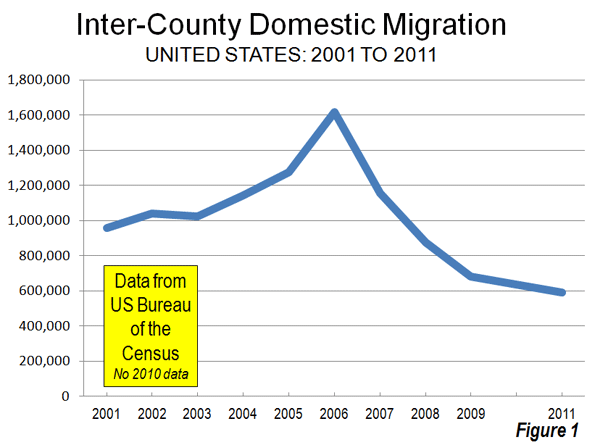
    As with the previously released county population estimates, the city data that is available indicates that Americans are staying put in the difficult economy. Domestic migration has fallen substantially. Over the past year, 590,000 people moved between the nation’s counties. This domestic migration compares to an annual average of 1,080,000 between the 2000 and 2009 (Figure 1). This reduction in domestic migration has made international migration and natural growth more prevalent, and as a result, core growth has been stronger.


    Note 1: An article in this morning’s Wall Street Journal contains information different from this article. The Wall Street Journal article classifies some cities as urban core that this article defines as suburbs (such as Fort Lauderdale [Miami], Aurora [Denver] and Arden-Arcade [Sacramento]). This article defines urban cores as historical core municipalities.

    Note 2: All historical core municipalities are principally in one county, except for New York (city), which is five counties.

    Note 3: The Bureau of the Census domestic migration data is limited to a net number for each county, so it is not possible to determine where people are moving to or moving from.

  • Questioning the Messianic Conception of Smart Growth

    A new analysis from the United Kingdom concludes that smart growth (compact city) policies are not inherently preferable to other urban land use policy regimes, despite the claims of proponents."The current planning policy strategies for land use and transport have virtually no impact on the major long-term increases in resource and energy consumption. They generally tend to increase costs and reduce economic competitiveness." The article goes on: "Claims that compaction will make cities more sustainable have been debated for some time, but they lack conclusive supporting evidence as to the environmental and, particularly, economic and social effects."

    These would not be surprising findings to Newgeography.com readers, who are accustomed to similar analyses rooted in economic, demographic, and environmental data. However, this article appeared in the Spring 2012 issue of the Journal of the American Planning Association, under the title, "Growing Cities Sustainably: Does Urban Form Really Matter?"

    Moreover, the authors are urban planning insiders, including Marcial H. Echenique, a land use and transport professor at Cambridge University, Anthony J. Hargreaves from the Martin Centre for Architectural Studies at Cambridge, Gordon Mitchell from the Faculty of the Environment at the University of Leeds and Anil Namdea of the School of Engineering at the University of Newcastle.

    Smart Growth Criticisms

    Many of the British critiques parallel those made by critics of smart growth for years. They focus particularly on the concern that smart growth generally has neglected economic and social costs. For example, smart growth policies lead to higher house prices by rationing land (such as with urban growth boundaries). Higher house prices lead to less discretionary income for households, so that there is less money for other goods and services, lowering employment levels. The resulting densification leads to more intense traffic congestion, with resulting economic losses and more intense air pollution, which is less healthful.

    The Research

    The authors modeled land use and travel behavior in three areas of England, subjecting them to three land use alternatives: compact development (smart growth), planned development (which I would label "smart growth light") and dispersal, the generally liberal approach common in United States, Canada, Australia and New Zealand for decades after World War II (and still in many US and some Canadian markets).

    Echenique et al analyzed the London metropolitan region (Greater London Authority, Southeast England and East England), which has a population of 20 million and the Newcastle (Tyne and Wear) metropolitan region, which has a population of 1,000,000. They also analyzed a sub-region within London metropolitan region, Cambridge, with a population of 500,000.

    Their model projected little difference in outcomes between the three land use regulatory regimes to 2031. Predictably, land consumption was less under the compact development, but the variation in land consumed varied no more than plus or minus one percent from the trend (base case) in the London area, where only 11 percent of the land is in urban or transport use. Other factors, such as the change in transport energy use, greenhouse gas (GHG) emissions from transport and residences and air pollution varied little between the three regulatory regimes.

    Economic costs in 2031 were projected to be the lowest (best) for the dispersed option and the highest for the compact development option, both in the London and Newcastle metropolitan regions. Planned development ranked second.

    The compact development option scored best in the Cambridge sub-region, while the planned development option was the highest cost. The dispersed option ranked second. The researchers attributed the better result for compact development in the Cambridge area to its uniqueness as a low-density, centrally oriented, high-tech, university community and further noted that densification could "reduce its attractiveness over the longer term."

    Smart Growth Claims: Setting the Record Straight

    Based upon their research and review of the literature, the authors proceed to undermine some of smart growth’s most sacred foundations.

    Smart Growth Claim: Smart growth has little or no impact on house prices:

    Echenique et al: "…restrictions on the supply of development land have led to property price increases, penalizing city dwellers by leading to less dwelling space…”

    Smart Growth Claim: Smart growth increases housing choice:

    Echenique et al: "One downside of this policy is a substantial reduction in choice of dwelling types, with new dwellings being mainly apartments."

    Smart Growth Claim: Smart growth does not increase traffic congestion:

    Echenique et al: The authors cite research indicating that high average density is the main cause of highway congestion in Los Angeles. They also cite Reid Ewing (University of Utah) and Robert Cervero (University of California) who reviewed studies of household travel behavior finding that a doubling of density would lead to only a 5 percent reduction per person, or an increase of 90 percent in travel (Note 1). The authors add: "The obvious conclusion is that an increase in density will increase traffic congestion."

    Smart Growth Claim: Smart growth reduces air pollution:

    Echenique et al: "It can also increase the overall respiratory disease burden as exposure to traffic emissions is increased.

    Smart Growth Claim: "Empty nesters" (aging households with no offspring at home) will seek smaller houses in the urban core: 

    Echenique et al: "There is, however, no substantial evidence that older couples leave their spacious houses and gardens…"

    Smart Growth Claim: Smart growth improves the jobs-housing balance.

    Echenique et al: "One of the main arguments for the dispersed city is that there is no longer a single center where most jobs and services occur. Urban areas, rather, exhibit a dispersed and often polycentric structure, bringing jobs and services closer to residents with a more complex movement pattern not readily served by public transport.

    The authors suggest the following "takeaway:"

    "Urban form policies can have important impacts on local environmental quality, economy, crowding, and social equity, but their influence on energy consumption and land use is very modest; compact development should not automatically be associated with the preferred spatial growth strategy."

    Thus, the Echenique et research contradicts the thesis that compact development or smart growth should replace (make illegal) other regulatory regimes, including the more liberal dispersed pattern.

    "Smart growth principles should not unquestioningly promote increasing levels of compaction on the basis of reducing energy consumption without also considering its potential negative consequences. In many cases, the potential socioeconomic consequences of less housing choice, crowding, and congestion may outweigh its very modest CO2 reduction benefits."

    The British research is an important step toward focusing urban policies on objectives, rather than means. Cities are economic organisms. They have increased their share of the population 10 fold in just two centuries and been pivotal to unprecedented economic growth and affluence. People moved to the cities for economic opportunity, not to sample particular urban forms. Cities best serve their principal purpose and their residents best when they encourage economic growth. The fundamental objective is to maximize the discretionary income of residents, and this can be done while reasonable environmental standards are maintained. Yet, as Echenique et al and others have shown, smart growth tends to retard economic growth. In an age of teetering national economies, failing pension funds and the most uncertain fiscal environment in at least 80 years, the world needs cities to be unleashed for the economic growth. Urban policies that ignore economics need to be replaced with wholistic approaches strongly focused on the key reason that cities exist: to enrich their citizens.

    Wendell Cox is a Visiting Professor, Conservatoire National des Arts et Metiers, Paris and the author of “War on the Dream: How Anti-Sprawl Policy Threatens the Quality of Life.”

    ——

    Photo: Letchworth Garden City, London metropolitan region (by author).

    Note 1: Calculation: According to the research, doubling the density of an area reduces vehicle travel per capita by 5 percent. With 200 percent of the previous population (double the density), vehicle travel would be increased 90 percent (200% [x] 95% [=] 190%).

  • U.S. Desperately Needs a Strategy to Attract the Right Skilled Immigrants

    President Obama’s recent “do it myself” immigration reform plan, predictably dissed by conservatives and nativists, reveals just how clueless the nation’s leaders are about demographics. Monday’s Supreme Court ruling on Arizona’s immigration crackdown also broke down along predictable lines, with both parties claiming ideological victories.

    Yet the heated debates are missing the reality of immigration and its role in America’s future. In reality America needs more immigrants, but with a somewhat different mix.

    Rather than an issue of “values” or political sentiment, we need to look at immigration as a matter of arbitrage, a process by which rapidly aging countries bid for the skills and energies of newcomers to keep their economies afloat.

    Nowhere is this immigration arbitrage clearer than in the world’s most rapidly aging region, Europe. By 2050 the workforce there is expected to decline by as much as 25%. Yet this diminishing resource is now increasingly on the march as young Greeks, Italians and Portuguese flee to stronger economies in Europe’s Nordic belt and elsewhere. An estimated half million left Spain last year alone. Ireland, which in recent decades actually attracted new migrants, was exporting a thousand people a week last year. In recession-wracked Britain, a 2010 poll found nearly half of the population would like to move elsewhere.

    Germany, with its ultra-low birthrate and rapidly aging population, has emerged as a primary migration beacon. Germany needs about 200,000 new migrants ever year to keep its economic engine humming. For decades, newcomers from Turkey and other Islamic countries have flocked there, but this migration has failed to deliver much added value due to their general lack of skills and divergent cultural values. So the Germans — as they did back in the 1960s — look to harvest the diminishing pool of skilled workers from equally aging states on the EU’s southern periphery.

    But it’s not simply a matter of a one-way south to north flow. Other EU countries, such as Italy, are playing the immigration arbitrage game by importing young workers from rapidly depopulating southeastern Europe. Milan, for example, added 634,000 foreign residents in just eight years (2000 to 2008), the largest share from Romania, followed by Albania. Over the period, more than 80% of Lombardy’s growth has come as a result of international immigration.

    But immigration arbitrage is more than a simple numbers game. As Europe learned through its bitter experience with immigration from North Africa and the Middle East, importing populations without necessary skills and attitudes useful for the modern economy can produce unhappy results. The key issue is how to attract and select immigrants likely to contribute to the national well-being and economic competitiveness.

    Almost everywhere in the world, there are shortages of skills ranging from construction to advanced engineering. Much of contemporary immigration to East Asia reflects the need for workers — largely from India, Bangladesh, Indonesia and Sri Lanka — to perform tasks considered “dirty, dangerous and difficult” (or 3-D).  Singapore and Hong Kong also have a bull market for high-end workers in order to maintain their increasingly financial and technology-oriented economies.

    But skills should not be conflated merely with university degrees. Education is no longer a guarantor of productivity; the degree, once a sign of distinction, has become a commodity. Many disciplines have little net positive economic impact. Few countries likely suffer shortages of post-modernist literature graduates, performance artists or lawyers.

    Opening the doors to undocumented high school graduates, many with no real marketable skills, as President Obama just did, may not have a great positive long-term effect on the economy. Perhaps it would be better if our immigration policies were less about politics, and ethnic constituencies, and more about gaining specific skills and abilities from other countries, including from Mexico’s growing ranks of educated and skilled workers.

    Some countries, such as Canada, Australia and Singapore, already have made major accommodations favoring skilled or entrepreneurial immigrants. The United States, to its great disadvantage, has been slow in this regard. In 2011 barely 13% of all American immigrants came as a result of employment-based preferences, down from 18% 20 years ago. Family reunification should remain a cornerstone of immigration but needs to give way substantially to a more skills-oriented policy.

    America’s approach is particularly baffling given our looming skills shortages. The reviving auto industry is already running short of craftspeople such as numerical machine tool operators. In fact, David Cole, chairman of the Center for Automotive Research, predicts that as the industry tries to hire upwards of 100,000 workers, they will start running out of people with the proper skills as early as next year.

    This shortage is also intense in many engineering and technically oriented fields. The Pittsburgh area alone has 1,500 engineering job openings. The Great Lakes Metro Coalition, covering 12 states, is advocating for a federal immigration policy focused on attracting highly skilled talent. Government and business leaders in economically healthy parts of the Great Plains, Texas and Utah now consider persistent skilled labor shortfalls — particularly in science and technical fields — as the greatest barrier to continued growth.

    Immigration policy should also look to bring in more entrepreneurs. As business start-ups overall have slowed, immigrants continue to launch new businesses. Today fully one-fifth of all American businesses are owned by immigrants, up from 12% two decade ago. Many of these are located in suburbs and small towns, where together a majority of immigrants see opportunities and a better quality of life.

    These qualitative distinctions may be lost on many in the pundit class. As a decline in Mexican immigration has driven overall immigration down below 2009 levels, the number of Asian newcomers is once again growing. Their share of annual new arrivals has risen over the past two years from 36% to 42%.

    Asians increasingly do not come for just economic opportunity — there’s often more of that at home — but to attain things almost impossible in their native countries  such as a single-family homes with a backyard and less congested, tree-shaded neighborhoods. For some, like migrants from China, political and religious freedom also is often a major attraction.

    This is good news for the future. As a Pew report recently pointed out, Asian immigrants tend to possess many of the characteristics this country sorely needs: a commitment to education, family and entrepreneurship. McKinsey suggests China and India will produce 184 million new college graduates over the next 10 years; this provides a vast pool of which the U.S. has only to pick up a small portion to boost its economy.

    This is not to argue for a policy based on ethnicity or geography. There are hard-working, skilled immigrants to be had from the poorest countries in Latin America or Africa. If you want to see this, go to any strip mall around Houston, Los Angeles or northern New Jersey.

    We need to target immigrants most likely to help our advanced industries, start businesses and families, and whose descendants will provide critical demographic vibrancy. There may soon be many such people looking to move from places like the Middle East, particularly Christians or liberal Muslims threatened by rising Islamism. There also should be policies to welcome restless young Europeans who may be seeking more opportunity elsewhere.

    The age of immigration arbitrage will require critical shifts in all advanced countries to provide many more openings for skilled immigrants and entrepreneurs. But ultimately the best way to attract these people lies in boosting the kind of economic growth and opportunity that can attract this most valuable resource to a country.

    Joel Kotkin is executive editor of NewGeography.com and is a distinguished presidential fellow in urban futures at Chapman University, and contributing editor to the City Journal in New York. He is author of The City: A Global History. His newest book is The Next Hundred Million: America in 2050, released in February, 2010.

    This piece originally appeared in Forbes.

    Immigration rally photo by BigStockPhoto.com.

  • Despite Obama’s Policies, The Rust Belt’s Revival Could Save His Campaign

    Barack Obama’s political base always has been more “creative class” than working class—and his policies have favored that base, seeming to cater to energized issue and identity constituencies including African-Americans, Hispanics, gays, and greens, often at the expense of blue-collar workers.

    Yet improving conditions for those workers—particularly in the industrial heartland—could save his flagging presidency.

    The industrial zone’s four key states—Michigan, Ohio, Wisconsin, and Pennsylvania—constitute the most critically contested territory in this year’s contest. Fifty-four electoral votes are at play here, with Pennsylvania’s 20 votes alone equaling all those at stake in the much-ballyhooed battleground of the Intermountain West (Colorado, Nevada, and New Mexico).

    The Midwest is also home to the two states with the biggest drops in unemployment over the past two years. Michigan leads the way with an almost five percentage point drop, while Ohio comes in second with a nearly three–point decline. Other key Great Lakes battlegrounds—Wisconsin, Indiana and arguably Missouri—have also seen two-point drops in their unemployment numbers.

    “Rust Belt” no longer seems like a pejorative, as the northern industrial states now boast unemployment rates well below those in once-booming states including California, Nevada, Florida, and South Carolina.

    In the last two years the nation has added more than 400,000 manufacturing jobs, led by states in the upper Midwest. Between 2010 and 2011, Michigan led the nation by creating 25,000 new industrial jobs with a heady 5 percent growth rate second only to Oklahoma. Wisconsin came in second with 15,000 new positions, and a growth rate of more than 3 percent.

    These gains may not come to close to making up the losses suffered over the past decade, but the growth is encouraging. Manufacturing employment brings higher wages to regional economies. In the Cincinnati area, the average factory job pays $61,000 a year—$15,000 more than the city’s average wage. This creates an outsized impact on the rest of the economy, from housing and retail to demand for business services. There are already significant shortages of skilled workers such as welders and machinists.

    Midwestern employers are projecting an 18.5% jump—the largest of any region—in the number of college graduates that will be hired this year.

    The new industrial economy creates considerable demand for those who can fill STEM (science, technology, education, and mathematics related jobs). Between 2009 and 2011, Michigan enjoyed the second strongest rate of STEM growth in the nation, just behind Washington, D.C.

    Much of what generated the heartland recovery—and much of what could slow or even reverse it—lies outside of the president’s control. But if the momentum holds through November, the political winds there will be at Obama’s back, helping him sell Great Lakes voters on the idea that the nation is moving in the right direction under his leadership. The key here lies with the revived auto industry.

    Obama’s “decision to rescue GM and Chrysler was exceedingly popular in auto manufacturing dependent states like Michigan and Ohio,” says former Michigan Democratic Party chair Morley Winograd. “The rise in manufacturing employment since has buoyed housing prices, boosted workers’ morale, and allowed Obama, in these states anyway, to be able to claim he delivered on the campaign’s promise of hope and change. "

    Mitt Romney is now effectively even in the polls in Michigan (one of his three “home” states), but he may have trouble explaining his opposition to the auto bailouts if the economic tide is rising.

    “Obama will win Michigan in a walk, “ predicts Winograd. “Outside of a nostalgic visit to his boyhood home, Romney won’t be seen in the state after Labor Day.”

    One state both candidates are sure to spend time in is Ohio, which has already emerged once again as a bellwether in the race.

    Rick Platt, an industrial development official in Newark, an industrial city of 50,000 in the central part of the state, sees the Ohio race as a struggle between “two narratives” about Obama.

    The first is the positive one, a reflection of industrial gains of more than 10,000 jobs last year and falling unemployment. The other narrative builds around fear over a second Obama term.

    Those concerns are especially pronounced in traditional swing regions like the Utica Shale in the eastern part of Ohio and the coal-producing swaths of western Pennsylvania (nearly half of the businesses in the booming gas and oil extraction field are based in the industrial heartland) that have long been resentful of Washington regulators. Business owners are concerned—as are many of their employees—that a second Obama term could mean the EPA shutting down the nascent natural gas boom that’s begun to generate both energy and high-wage industrial jobs. Some businesses have postponed investment due to uncertainty about the election and the prospect of aggressive regulation.

    “There’s a lot of things in play,” says Platt, who has been active in Republican politics. Not surprisingly, he credits much of the region’s recovery to the economic policy of Republican governors like John Kasich in Ohio, Michigan’s Rick Snyder, and Wisconsin’s Scott Walker—all states he notes that are lapping Illinois.  The Land of Lincoln, Obama’s Democrat-controlled home state, suffers the region’s highest unemployment rate and is competing with California for the nation’s worst credit rating. “It’s not clear right now which of the two narratives will win out.”

    The health of the manufacturing economy may prove even more important to the president’s reelection than the Dow Jones index. If industrial growth softens or goes into reverse—for instance, if Europe’s economic troubles cross the Atlantic—the Midwest will feel the effects first.

    And if the Rust Belt suffers, Obama’s path to a second term gets that much tougher.

    Joel Kotkin is executive editor of NewGeography.com and is a distinguished presidential fellow in urban futures at Chapman University, and contributing editor to the City Journal in New York. He is author of The City: A Global History. His newest book is The Next Hundred Million: America in 2050, released in February, 2010.

    This piece originally appeared in The Daily Beast.

    Oklahoma City photo by BigStockPhoto.com.

  • The Collapse of Chicago Media

    When the satirical humor weekly The Onion announced it was moving its editorial staff from New York to Chicago it was considered quite a coup by boosters of the Windy City. Yet the hoopla surrounding revealed more about Chicago’s decline as a media center than any significant uptick. This includes news of a staff rebellion at the Onion in which writers attempted to scotch the move, with some ultimately deciding not to come. The strong celebration of a relatively small relocation in the grand scheme of things also shows a city looking hard for good media news where there has been so much bad recently.

    The biggest blow of the all has been the end of the Oprah Winfrey show and her departure for Los Angeles to start a new network. She was the one legitimate mega-star who came from Chicago and built an empire recognizably Chicago-based. When she left, her network, which has struggled to obtain distribution and viewers, carried a Rosie O’Donnell talk show based in Chicago that ultimately folded as well. Similarly, Playboy, another iconic Chicago media brand, also departed for LA.

    Some of this reflects national trends that have led to a greater concentration of media in New York and, to some extent, Washington. All across America, local media has struggled. The Tribune, Sun-Times, and alt-weekly Chicago Reader all went bankrupt, and while they continue to publish, they have become in many respects shadows of their former selves. New mayor Rahm Emanuel, while still engaging with local media, has frequently decided to bypass it, going directly to major national media to get the city’s story out. For example, he hosted New York Times columnist Tom Friedman, resulting in a fawning profile.

    Daley also had occasional good luck with the national media, getting glowing stories in publications like the Economist and the New Yorker. Many of these read like classic Sunday travel section pieces in their boosterism. One possible reason for that is that they are travel pieces. Chicago never had a huge number of national bureaus, and the number has shrunk in the past few years because of the difficulty in supporting a national footprint generally. For example, the Washington Post closed all of its bureaus, and the Chicago bureau was a casualty. Today most national news outlets don’t have a boots on the ground perspective of the city, and thus are open to being spun by clever locals.

    This lack of out of town and foreign media means that what coverage Chicago does get is often positive, but the flip side is that Chicago doesn’t have a built in platform for getting its message out nationally or globally. New York is America’s media center. DC, LA, and the Bay Area all have a robust out of town media presence because of the industries based there (government, entertainment, and tech respectively). They have a megaphone to the world that Chicago doesn’t. That’s perhaps one reason Emanuel made what many consider an ill-advised play for the NATO summit: it was a rare opportunity to showcase Chicago to global journalists.

    Chicago also falls short in new media. In many cities, the decline of the daily paper has been offset by a robust new media infrastructure. This includes sites like Crosscut in Seattle or MinnPost in the Twin Cities.  Major national sites like Gawker or the Huffington Post have tended to be based in traditional media center like New York or Washington. Chicago has been curiously absent here. An attempt at a non-profit online new site, the Chicago News Cooperative, failed due to financial difficulties, despite seven figures in funding from the MacArthur Foundation and a contract with the New York Times.  

    Where major platforms have arisen in Chicago, they’ve often left in order to pursue their ambitions. For example, music site Pitchfork, which started out of a music festival in Chicago, moved its editorial staff to Brooklyn. Statistical journalist Nate Silver likewise moved to New York.

    The challenge facing media and journalists in Chicago was best perhaps summed up by JC Gabel, a die hard fan of the city.  He relaunched the historic Chicagoan magazine in an effort to rebuild the sort of infrastructure the city once had. He wrote in the launch issue:

    By all accounts, it should be an exciting time to live and work in Chicago. But there is little well-paid creative work available for the hungry freelancers—the writers, artists, photographers, editors and designers—who call Chicago home. Locally, what work there is pays a pittance; nothing that could sustain the kind of long-form storytelling we were discussing.

    This might help explain the mass exodus from Chicago of creative minds of our generation throughout the last few years. Opportunities on either coast—or overseas—eventually come calling, and although they retain pride in their erstwhile Midwestern hearts, they cease to be Chicagoans by physical address.

    Stop Smiling, the magazine I co-edited and co-published for more than a decade from Chicago, ultimately couldn’t have made it without also keeping a New York office and a strong West Coast presence. By and large, a majority of stories were executed in Los Angeles or New York, and all the money we raised through ad sales came right out of the agency machines on either coast. But Chicago was always our inspiration, a place where we retired to—first to brood, then to get our work done.

    I know firsthand how difficult it is to carve out a national niche audience in a city that many still consider fly-over country, despite its rich history and inventive spirit.

    Part of the challenge for Chicago lies in the ongoing changes being wrought by the internet and globalization. These are both spreading around some activities and ever more concentrating others. Media is among those undergoing further centralization into the handful of fortress hubs, notably New York and DC. This has hit Chicago, always a second-tier media center, hard.

    But the good news is that Chicago is full of talented folks like Gabel with a passion for their city. Chicago actually does have the critical mass of talent to support a far stronger media ecosystem than it has today. And with the low barriers in the internet age, there’s no insurmountable obstacles to making that happen. But clearly anyone trying to make a go of it in media in Chicago today is swimming upstream against a fast flowing current of decline.

    Aaron M. Renn is an independent writer on urban affairs and the founder of Telestrian, a data analysis and mapping tool. His writings appear at The Urbanophile.

    Tribune tower photo by Bigstockphoto.com.