Blog

  • America’s Two Economies

    Surely you’ve seen it in your own neck of the woods: great contrasts between prosperity and wealth on the one hand, and hardship and despair on the other. I have certainly seen it in every place I have been over the last four years. FDR described the Great Depression as “one-third of a nation ill-housed, ill-clad, ill-nourished.” Yet do we not today have one-third of a nation either unemployed, underemployed, underwater on their one greatest asset (their homes), in crushing debt (which I define as unserviceable from current income), insolvent/bankrupt, on food stamps, unemployment or disability payments, or otherwise dependent on government? The diminishing of the middle class is daunting, but most disturbing is the diminishing of its prospects.

    Perhaps you attribute this state of affairs to the “rich get richer, poor get poorer” meme. But there’s something else, something more going on. I have written about this before (unraveling, stagnation, middle America, middle class is the future), but here bring a fuller picture.

    In the years since the Great Recession started (and ended?) in 2008-2009, the US has been characterized by two economies. One of these American economies is thriving, as are the economic actors part of it. The other economy is miserable, as are its inhabitants. The divergence between these two economies is growing more pronounced. Why is this so, how did it happen, and what does it portend?

    I have been debunking the “rich get richer, poor get poorer” theme for 30 years, maintaining that the relative income gap did not matter as long as absolute income growth was widespread, and economic growth was providing opportunities to all (which was the case). But now those caveats have come into play: middle-income, middle-class earnings, wealth and opportunities are under immense pressure. This is not because the rich get richer, or that redistribution is the answer (I find the debate over austerity vs. growth pretty stupid, when growth too often just means growth of government). It is because of fundamental, structural economic trends which may be with us for a long time to come.

    Divergent Sectors, Divergent Fortunes
    Perhaps you have heard of the manufacturing “renaissance” in America and the exporting “boom.” Both are true. American exports are booming, measuring in at about $180 billion each month (up from $140 per month two years ago). Exports account for about 14% of GDP, and are growing about 16% a year. American manufacturing employment has been hurt by globalization, but manufacturing output continues to grow and exporters are thriving.

    American manufacturing and export prowess are likely to continue into the foreseeable future, as large American companies use innovation and technology to become more productive, and as the growing global middle class demands more American goods (including energy in the form of oil and natural gas).

    The bad news is that exports and manufacturing do not translate into more jobs or even higher wages. Our new job growth has been in health care, education, services and government, areas that do not produce great income and wealth. This holds down the potential income gains of all wage-earning Americans.

    But the income and potential of those in management, finance, high technology and the professions are not adversely affected. The benefits of productivity, manufacturing, exports and economic dynamism generally, therefore, accrue to the already well-situated capitalists, managers and properly skilled. Sure, the internet will continue to make it easier for many small businesses to survive (and some even to thrive), but they cannot be great founts of sustainable jobs.

    Two-tiered economies are well-known and expected in developing countries – an export/manufacturing or raw material sector and a weak domestic service sector – but we’re not used to seeing it in an advanced, technologically sophisticated country like the United States. It actually could mean that the rich will get richer, but the economy will be missing its traditional ladder for those in the middle and below to climb.

    Where will enough employment growth come from to maintain the middle class? Many analysts tell us it will come from the innovation sector, or the innovation economy. But again, the benefits of innovation seem now to accrue to the companies and individuals   already in a position to exploit it, increasing productivity and profitability without a concomitant increase in employees.

    Dystopian Economics
    This is getting perverse, isn’t it? We have high unemployment and underemployment, huge debts and deficits, but companies are profitable and share prices continue to rise. There seems to have been a breakdown in the correlation between employment and GDP, between the housing market and overall economic strength, and between GDP growth and stock market valuations.

    Statistics say we are in a low-inflation environment, but living expenses seem to be rising for food, energy, healthcare and education (the things on which the middle class must spend). Those with jobs and income in sectors that are doing well don’t seem to be as affected. That would certainly help explain the contrasts of wealth and hardship that one sees around the country.

    In other words, what we seem to have created is a winners-take-all economy. Large companies with global exposure, highly skilled workers, and high net worth individuals are the main beneficiaries of current economic policy. Job creation, most small businesses, and low- and medium-end housing are not.

    What if a rising tide no longer lifts all boats?
    We now have the lowest percentage of Americans working or looking for work in 30 years. That really is devastating because the only way out of our fiscal and entitlement nightmare is to have more people working more hours and more years. Is the opposite our future?

    The trends that are creating and sustaining two economies in the US have been building for years and seem to me to be so strong as perhaps impervious to amelioration. The “two economies model” meets my test of sustainability: being supported and reinforced by other fundamental social, demographic, political and technological trends (or at least not being incompatible with them). It is hard to foresee how the “two economies model” can be reversed or even tempered, though it is a path that will leave tens of millions of Americans behind even as the “working” economy improves.

    I have been analyzing, writing and speaking on trends for 30 years. My audiences are often businesses or organizations looking for a picture of the future environment. I usually get a laugh from the observation that the future will be bright for some, dismal for others, and therefore recommend being in the first group. I don’t think I’ll make that joke anymore; somehow it’s no longer funny.

    Dr. Roger Selbert is a trend analyst, researcher, writer and speaker. Growth Strategies is his newsletter on economic, social and demographic trends. Roger is economic analyst, North American representative and Principal for the US Consumer Demand Index, a monthly survey of American households’ buying intentions.

    Finding a job photo by Bigstockphoto.com.
  • How To Build a Culture of Bike Safety

    As I’ve settled into life in Florida, I’ve found myself for the first time using a bicycle as a form of transportation instead of as a form of leisure activity. And, as an urban designer involved in a team that designs bicycle and pedestrian master plans, I’ve become increasingly aware of the factors that make urban bike use a feasible — or not so feasible — choice.

    The Risk & Fear Factors: While I might actually be safe riding my bike down a neighborhood collector road on a dedicated bike lane, when I’m alongside two 10-foot lanes of traffic I do not feel safe. Therefore, I don’t ride there. It’s a question of perceived risk vs actual risk. As it turns out, I am not unique. Linda Baker in Scientific American has suggested that, when cycling, women are more adverse to risk than men.

    The Gender Gap: Baker has also suggested that cycling to work impedes a woman’s ability to conform to social norms, including makeup, dress, and hairstyles. That issue would be a big bite to chew, so I’ll put aside addressing it here. But consider: While cycling has become a big grass roots movement through organizations like Pro Walk/ Pro Bike and The National Center for Bicycling and Walking, there is an enormous gender gap among users. Planner Jan Garrard states, “If you want to know if an urban environment supports cycling, you can forget about all the detailed ‘bikeability indexes’—just measure the proportion of cyclists who are female.” I personally can’t remember the last time or if I’ve ever seen a woman on a bicycle on the Tampa streets.

    Nearly all the new riders on US roads in the last 20 years have been men between the ages of 25 and 64. Taking into account the national demographics, this means that we are currently designing bike-friendly streets for a relatively small constituency.

    How can we provide cycling options in a way that reaches out to more users?

    The Infrastructure Factor: Substantially lowering the risk of cycling can be best accomplished through a change in infrastructure. Cycle tracks, like the one in New York City, are becoming more popular. Because of the complete physical separation from the threat of cars, all users perceive — and experience — a lower threat to their safety. The problem, besides the constant challenge of funding, is finding the right-of-way to accommodate bikes, especially in a car-centric culture like Florida. There has to be evidence of a high enough level of ridership to justify cutting out a lane from a congested street. It’s a chicken and the egg conundrum: there is not the required ridership now because a majority of 50% of the population doesn’t feel safe.

    A good compromise might be to allow room for a physical separation between a one-way bike lane and car traffic. Creative use of medians and plantings, as in Denver, is one example of this. Simply placing parallel parking between car traffic and the bike lane is another.

    The Get-More-Riders Factor: Building a bike culture is more than just infrastructure, but building appropriate spaces is an integral piece. As Billy Hattaway, a Florida DOT official pointed out to me, if we don’t create bike lanes that cater to a larger part of the population we might lose the justification to have bike lanes at all.

    At the Congress for the New Urbanism annual conference, Wesley Marshall showed evidence proving that the more cyclists there are, the more safe it is to bike. There is a belief by some transportation planning engineers that more cyclists and users in the road make it unsafe, but “safety in numbers” is true. It’s partly because drivers are more aware of cyclists when they see them more often; they’re on the lookout for them.

    The Land Use Factor: People will only choose cycling as a mode of transportation if it is convenient and efficient. Ridership in parts of the city without mixed-uses and with low density will be low compared with more urban areas with many commercial/residential/institutional uses nearby and close together. Riding to a local grocery store to get a gallon of milk is realistic. Riding to a Wal-Mart for your weekly shopping is not. But Marshall’s research showed that the biggest aspect of achieving bike safety is intersection density. The more intersections there were in a development, the safer it was for riders. At first thought this seems to go against common sense, because intersections are the sites of many crashes, but more connectivity = slower speeds = more awareness. Connectivity also allows for more mixed-uses and higher densities. Many cities put their resources into developing recreational cycling trails. While this is admirable, as a “wanna-be” cyclist, I’m a proponent of putting those funds into street design, instead. Putting the infrastructure on routes where people go in their everyday lives will lead to the biggest increase in ridership.

    A lot of factors need to come together to increase ridership and bridge the gender gap in cycling. I’m someone who would love to ditch my car in favor of my bike on my daily commute, but risk aversion holds me back. Providing a lane along the side of the road is not enough: we must examine the evidence and psychology behind riding in order to make it a real choice for the majority of the population. Otherwise, we will find ourselves losing the justification to provide cycling options at all.

    Erin Chantry is an Urban Designer in the Urban Design and Community Planning Service Team with Tindale-Oliver & Associates. She is also the author of the blog At the Helm of the Public Realm.

    Photo: Protected / Separated bicycle lane on Dunsmuir Street, downtown Vancouver, Canada, by Paul Krueger

  • Facebook’s False Promise: STEM’s Quieter Side Of Tech Offers More Upside For America

    Facebook‘s botched IPO reflects not only the weakness of the stock market, but a systemic misunderstanding of where the true value of technology lies. A website that, due to superior funding and media hype, allows people to do what they were already doing — connecting on the Internet — does not inherently drive broad economic growth, even if it mints a few high-profile billionaires.

    Of course Facebook is a social phenomenon that has affected how people live and interact, but its economic impact — and future level of profitability — is less than clear. This stands in sharp contrast to Apple‘s iTunes, which has become a new distribution platform for small software companies and musicians, not to mention the role of Amazon in the distribution of books and other products.

    From the standpoint of economic development, it’s time to focus on the growing divergence between two different aspects of technology. One is largely an information sector that focuses on such things as information software (think Facebook or Google), publishing and entertainment. For most journalists and urban theoreticians, this is the “sexy” sector, particularly since it tends to employ people just like them: younger, products of elite college educations, often living in “hip and cool” places like San Francisco, Manhattan or west Los Angeles.

    Then there’s a larger, less-heralded group of workers that my colleague Mark Schill at Praxis Strategy Group has focused on: those in STEM (science-, technology-, engineering- and mathematics-related) jobs. These workers perform technology work across a broad array of industries, including but not limited to computers, media and the Internet, representing some 5.3 million jobs in the nation’s 51 largest metropolitan areas. This compares to roughly 2.2 million jobs classified as in the information sector in these 51 regions.

    These STEM occupations are about harnessing technology to improve productivity in mundane traditional industries and the service sector. STEM workers are as likely, if not more so, to be working for manufacturers, retailers or energy producers as for software firms. These workers epitomize the notion of technology, as the French sociologist Marcel Mauss once put it, as “a traditional action made effective.”

    The information sector may be increasingly important, but it is STEM workers, working in a diverse set of industries (including information), who hold the broader hope for the U.S. economy. Over the past decade, the information sector has created many stars, but about as many flameouts. Overall information employment peaked in 2000 at 3.6 million jobs; by 2011 this number had dropped by almost a million. Things have not much improved even in the current “boom”; between February and May this year, the sector lost over 8,000 jobs.

    Essentially the information sector has created a huge amount of churn, as the nature of its employment changes with shifts in technology. For example, the software sector within information has seen real growth, adding some 10,000 jobs the past two years, while other parts of the information sector have suffered significant drops. These include, sadly for aged scribblers, traditional publishing, such as newspapers and book publishing, which has gone from nearly 1 million jobs in 2002 to under 740,000 in May of this year.

    With Facebook stock in the tank, and other major social media sites languishing, the current “boom” may prove among the shortest-lived in recent memory. Shares of less well-anchored companies — meaning those with only a vague outlook for long-term profits — such as Zynga and Groupon have fallen dramatically. The market for the next round of ultra-hyped IPOs also seems to be dissipating rapidly. The carnage has led at least one analyst to suggest Facebook’s fall could “destroy the U.S. economy.”

    Fortunately the overall picture in technology is more hopeful than you’d understand from reading about social media startups. STEM employment has grown 3% over the past two years, more than twice the national average. In the 51 largest metros areas, 150,000 STEM jobs were added from 2009 through 2011. More important still, this reflects a long-term pattern: Over the past decade, STEM employment — despite a drop during the recession — expanded 5.4%.

    These two different classifications underpin geographical differences between and within regions. Sometimes the “hot” areas don’t look so great when it comes to actual job creation in these generally well-paying fields.

    Silicon Valley’s social media boom, for example, may have propelled it once again, at least temporarily, into the ranks of the fastest-growing employment centers. Yet it’s not seeing the gains in STEM jobs that took place during earlier Valley booms in the ’80s or ’90s that were broader based, encompassing manufacturing and industry-oriented software. Indeed STEM employment in the Valley still has not recovered from the 2001 tech bust — the number of STEM jobs is down 12.6% from 10 years ago.

    Metropolitan STEM Job Growth, Sorted by 10-year Growth
    MSA Name 2001-2011 Growth 2009-2011 Growth 2011 Concentration
    Las Vegas-Paradise, NV 25.5% -3.4% 0.51
    Washington-Arlington-Alexandria, DC-VA-MD-WV 20.8% 4.4% 2.16
    San Antonio-New Braunfels, TX 20.1% 3.0% 0.82
    Nashville-Davidson–Murfreesboro–Franklin, TN 18.5% 3.1% 0.74
    Riverside-San Bernardino-Ontario, CA 18.3% -1.6% 0.55
    Seattle-Tacoma-Bellevue, WA 18.1% 7.6% 1.95
    Salt Lake City, UT 17.5% 4.5% 1.17
    Jacksonville, FL 17.4% 3.0% 0.88
    Baltimore-Towson, MD 17.2% 3.9% 1.36
    Raleigh-Cary, NC 14.9% 1.4% 1.56
    Houston-Sugar Land-Baytown, TX 14.3% 3.6% 1.25
    Orlando-Kissimmee-Sanford, FL 14.2% -1.4% 0.90
    San Diego-Carlsbad-San Marcos, CA 13.1% 6.5% 1.38
    Austin-Round Rock-San Marcos, TX 8.8% 2.4% 1.75
    Charlotte-Gastonia-Rock Hill, NC-SC 8.1% 2.1% 0.97
    Columbus, OH 7.8% 3.8% 1.32
    Buffalo-Niagara Falls, NY 7.7% 2.4% 0.96
    Virginia Beach-Norfolk-Newport News, VA-NC 7.5% -3.1% 1.05
    Miami-Fort Lauderdale-Pompano Beach, FL 7.5% 2.8% 0.73
    Indianapolis-Carmel, IN 7.5% 1.2% 1.06
    Oklahoma City, OK 7.3% 2.9% 0.89
    Dallas-Fort Worth-Arlington, TX 6.2% 3.7% 1.21
    Cincinnati-Middletown, OH-KY-IN 6.1% 4.6% 1.08
    Sacramento–Arden-Arcade–Roseville, CA 6.0% -1.6% 1.19
    Louisville/Jefferson County, KY-IN 5.6% 4.3% 0.77
    Phoenix-Mesa-Glendale, AZ 5.4% 1.5% 1.00
    Portland-Vancouver-Hillsboro, OR-WA 5.2% 4.2% 1.24
    Atlanta-Sandy Springs-Marietta, GA 4.8% 4.3% 1.10
    Denver-Aurora-Broomfield, CO 4.0% 2.8% 1.47
    Richmond, VA 3.8% 0.4% 1.14
    Providence-New Bedford-Fall River, RI-MA 3.6% 2.4% 0.90
    Pittsburgh, PA 3.1% 3.6% 1.07
    Hartford-West Hartford-East Hartford, CT 3.1% 1.2% 1.18
    Minneapolis-St. Paul-Bloomington, MN-WI 2.6% 3.1% 1.37
    Tampa-St. Petersburg-Clearwater, FL 2.4% 2.0% 0.88
    Philadelphia-Camden-Wilmington, PA-NJ-DE-MD 2.2% 0.3% 1.19
    Kansas City, MO-KS 1.9% -2.6% 1.15
    New York-Northern New Jersey-Long Island, NY-NJ-PA 1.2% 2.9% 1.00
    San Francisco-Oakland-Fremont, CA 0.8% 3.7% 1.60
    Memphis, TN-MS-AR 0.0% 0.7% 0.56
    Boston-Cambridge-Quincy, MA-NH 0.0% 4.8% 1.64
    Los Angeles-Long Beach-Santa Ana, CA -2.2% 1.7% 0.98
    Milwaukee-Waukesha-West Allis, WI -2.3% 0.2% 1.04
    St. Louis, MO-IL -3.5% -1.4% 1.05
    Birmingham-Hoover, AL -3.9% -3.4% 0.70
    Cleveland-Elyria-Mentor, OH -4.9% 1.2% 0.93
    Chicago-Joliet-Naperville, IL-IN-WI -5.2% 1.1% 0.96
    New Orleans-Metairie-Kenner, LA -6.7% 3.6% 0.71
    Rochester, NY -8.9% 2.1% 1.19
    San Jose-Sunnyvale-Santa Clara, CA -12.6% 4.9% 3.09
    Detroit-Warren-Livonia, MI -14.9% 8.8% 1.42
    Total in Top 51 Regions 4.2% 3.0%

    Data source: EMSI Complete Employment, 2012.1. The “2011 Concentration” figure is a location quotient. That’s the local share of jobs that are STEM occupations divided by the national share of jobs that are STEM occupations. A concentration of 1.0 indicates that a region has the same concentration of STEM occupations as the nation.


    Joel Kotkin is executive editor of NewGeography.com and is a distinguished presidential fellow in urban futures at Chapman University, and contributing editor to the City Journal in New York. He is author of The City: A Global History. His newest book is The Next Hundred Million: America in 2050, released in February, 2010.

    This piece originally appeared in Forbes.

    Computer engineer photo by BigStockPhoto.com.

  • The Atlanta Transportation Tax: Too Much for Too Little

    On July 31, voters in a 10 counties of the 28 county Atlanta metropolitan area will vote on whether to raise the sales tax by one cent for $8 billion in transit and highway projects over 10 years. The measure is highly tilted towards transit spending. Sadly, this would do virtually nothing to reduce Atlanta’s traffic or its travel times.

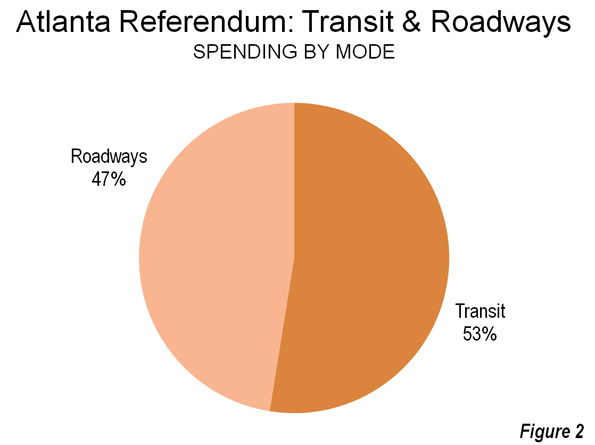
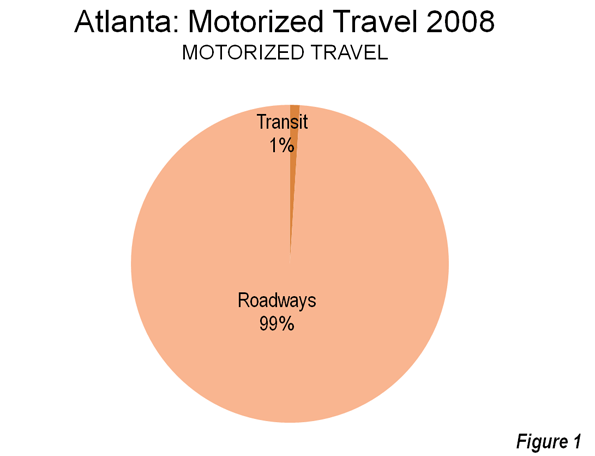
    In a metropolitan area in which barely one percent of travel (Figure 1) and less than five percent of work trip travel is by transit, the tax measure devotes more than 50 percent of the funding to transit (Figure 2).   Yet in reality, the focus of any transportation revenue issue should be on reducing travel times, whether by transit or highways. This is how transportation improves an urban economy. The reality is that with nearly all travel by highways and transit’s inherently slower travel times, much of the tax money would have virtually no impact on reducing travel times or traffic congestion.


    Atlanta’s Traffic Congestion: Promoters of the tax claim that the highway projects will reduce traffic congestion. Atlanta is well known for its serious traffic congestion. There are two reasons for this:

    1. Atlanta’s sparse freeway system is limited to little more than a belt route (I-275) and three radial freeways (I-20, I-75 and I-85) that converge into two in the one place more capacity is needed, the core. Trucks are not permitted on freeways inside the beltway, which concentrates the considerable interstate traffic on a single roadway, I-275. If Atlanta had the higher freeway density (freeway mileage per square mile) of Los Angeles or Minneapolis-St. Paul, traffic congestion would be far less of a problem.
    2. Atlanta’s regional arterial (high capacity streets) system is virtually non-existent. For this reason, I proposed (in 2000) development of a one-mile terrain constrained grid of arterials. The Atlanta Regional Council (ARC), the local metropolitan planning organization, has included a somewhat more modest (but useful) arterial grid in is regional plan.

    Yet despite its reputation, Atlanta’s traffic congestion could be worse. The latest INRIX National Scorecard rates the Atlanta metropolitan area as having the 15th worst traffic congestion in the nation, behind Portland, which is nearly 60 percent smaller and twice as dense, with its compact city policies. Among high-income world metropolitan areas with more than 5 million population, only Nagoya outside the United States may have a shorter work trip travel time (Note 1). Atlanta’s world-competitive work trip travel time of 29 minutes is faster than that of far more transit-dependent Toronto (33 minutes), smaller Sydney (34 minutes) and much smaller Vancouver (31 minutes), despite their compact city policies.

    The Transit Projects: So Much for So Little: The proposed transit projects have virtually no potential to reduce work trip travel times and traffic congestion. Approximately one-fifth of the transit funding would be used to rehabilitate and upgrade the MARTA subway system, a need that should have been legitimately funded from the existing MARTA sales tax. Another nearly 20 percent of the transit funding would be spent on the "Belt-Line" streetcar project in central Atlanta. The role of the Belt-Line is more "city building" (read "real estate speculation") than it is transportation. It will do nothing to reduce work trip travel times. Further, it is exceedingly costly. The extravagance of this project is illustrated by an annualized capital cost alone (principally construction) high enough to pay the lease on a new mid-sized car for each new regular passenger (Note 2). Moreover, that is before the likely capital cost escalation and the substantial operating subsidies (Note 3).

    Transit’s problem in Atlanta (and elsewhere) lies outside its core downtown job market (Note 4). Most destinations in a metropolitan area cannot be reached by transit in a way remotely competitive with the car. The transit tax would only modestly increase transit ridership. ARC projects the transit projects will boost daily transit ridership less than 10 percent. If all of the forecast new passengers were to be taken from cars (which is not likely), the net reduction in traffic volumes over ten years would be equal to less than three months of traffic growth. Put another way, at the best, the transit proposals would mean that the traffic congestion expected on January 1, 2025 would not occur until March of 2025. That’s less than 90 days of traffic relief for 10 years of taxation.

    The Road Projects: In a metropolitan area in which personal mobility predominates, roadway improvements, such as expansions, an arterial grid in Atlanta’s case and completion of the GA-DOT HOT (high occupancy toll) system provide far greater  potential for reducing travel times. There is another significant benefit to highway investments. As traffic speeds increase fuel efficiency improves and both air pollution and greenhouse gas emissions are reduced.

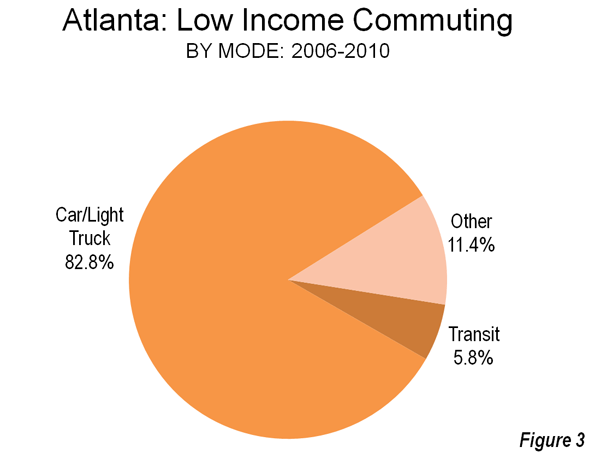
    Under the tax referendum, a significant opportunity to improve mobility would be missed, to the detriment of the vast majority of Atlantans; over 88 percent of all commuters in Atlanta travel by car, but the figure is only slightly less (83 percent) among low income commuters (Figure 3).

    What’s Right About Atlanta: For all its problems, Atlanta has much to be proud of. Former World Bank principal planner Alain Bertaud said of Atlanta in a 2002 study:

    While income and population were rising very fast, Atlanta managed to keep a very low cost of living. A worldwide cost of living survey conducted by the Economist Intelligence Unit in 2002 found that Atlanta had the lowest cost of living among major US cities and ranked 63rd among major cities around the world. This achievement is remarkable in view of the rapid rate of growth of the metropolitan area over the last 20 years. It shows that while demographic and economic growth has certainly contributed to generate pollution and congestion, the various actors responsible for the management of metropolitan Atlanta must have done a lot of things right. High income growth and high demographic growth combined with a low cost of living suggests that labor markets are functioning well and that housing does not encounter important supply bottlenecks (Note 5).

    As successful as local land use policies have been in making Atlanta livable by making it affordable (the first principle of livability is affordability), local leaders need to start over with a proposal primarily designed to reduce traffic congestion, reduce travel times and grow the economy.

    Politics Trumps Reducing Traffic Congestion: Traffic congestion is most effectively addressed by projects that reduce work trip travel times, since it is the concentration of work trips at peak hours that   causes the worst congestion. The long-suffering commuters of Atlanta would have been far better served by a program that selected projects based upon their effectiveness in reducing travel times. A simple cost per hour of delay measure would have been appropriate. Atlanta deserves a much better deal.

    Wendell Cox is a Visiting Professor, Conservatoire National des Arts et Metiers, Paris and the author of “War on the Dream: How Anti-Sprawl Policy Threatens the Quality of Life.”

    —————–

    Note 1: Based upon 109 metropolitan areas for which data is available. Japanese data is reported as median work trip travel time. Nagoya’s median work trip travel time (27 minutes) is less than Atlanta’s (29 minutes). The excessively long rail commute times of many Japanese commuters could make Nagoya’s average work trip travel time as great or greater than Atlanta’s. Dallas-Fort Worth has the shortest work trip travel time of any metropolitan area over 5 million population (and the lowest transit work trip market share)

    Note 2: A team led by Oxford University professor Bengt Flyvbjerg found that passenger rail systems typically have cost overruns of 45 percent. If the average increase is experienced, the Belt-Line cost could escalate to $1 billion.

    Note 3: The capital cost is discounted at 4 percent over 35 years, which equals more than $5,500 annually. A new Ford Fusion, Toyota Camry, Honda Accord or Nissan Altima could be leased for less than $5,000 annually, with no down payment, according to internet sources (such as http://www.leasecompare.com/)

    Note 4: More than 93 percent of metropolitan Atlanta’s employment is outside downtown (and Mid-Town). Downtown’s share of employment declined from 2000 to 2009 (latest data available from the US Census Bureau, County Business Patterns).

    Note 5: Atlanta was most affordable major metropolitan area in the US, UK, Canada, Australia, Ireland, New Zealand and Hong Kong in the 8th Annual Demographia International Housing Affordability Survey.

    ——

    Photo: Atlanta Freeway (by author)

  • It Can Happen Here: The Screwed Generation in Europe and America

    In Madrid you see them on the streets, jobless, aimless, often bearing college degrees but working as cabbies, baristas, street performers, or—more often—not at all. In Spain as in Greece, nearly half of the adults under 25 don’t work.

    Call them the screwed generation, the victims of expansive welfare states and the massive structural debt charged by their parents. In virtually every developed country, and increasingly in developing ones, they include not only the usual victims, the undereducated and recent immigrants, but also the college-educated.

    Nowhere is this clearer than in the European Union’s Club Med of Spain, Greece, Portugal, and Italy, the focal point of the emerging new economic crisis. There’s a growing sense of hopelessness in these places, where debt is turning politics into an ugly choice between austerity, which reduces present opportunities, or renewed emphasis on public spending, which all but guarantees major problems in the bond market, and spending promises that can’t be kept.

    “We don’t know what to do now,” Jaime, a Madrid waiter in his late 20s told me last week. “My wife lost her auditor’s job, and I can’t support the whole family. Maybe we have to move somewhere like Dubai or maybe Miami.”

    Many young Greeks, Italians, Portuguese, and Spaniards already have made their moves, with a half million leaving Spain alone last year. But it’s not just Club Med youths who are contemplating greener pastures. Ireland, which in recent decades actually attracted new migrants, is exporting a thousand people a week. In recession-wracked Britain, nearly half of the population say they would like to move elsewhere.

    Driving this exodus is a growing perception that this collapse is not cyclical but secular. Increasingly, young Europeans are deciding not to start families—the key to future growth—in reaction to the recession. The stories about divorced Spanish or Italian young fathers sleeping on the streets or in their cars are not exactly a strong advertising for parenthood.

    Even in once-rigidly Catholic Spain, marriage and fertility rates have been falling for decades, and family structure weakening. Spaniards are having fewer children now than they did during the brutal civil war of the late 1930s. Alejandro Macarrón Larumbe, a Madrid-based management consultant, in his 2011 book, El Suicidio Demográfico de España, points out that the actual number of Spanish newborns has declined to an 18th-century level.

    This demographic implosion makes sense given the legacy left behind by the boomers, who have held on to generous jobs and benefits but left little opportunity for their children, not to mention a high tax burden on what opportunities they do find. For a generation academics have sold higher education—the more the better—as the cure for unemployment and the great guarantor of success. Yet rising education rates in places like Spain have not created jobs for the rising generation, but only expanded unemployment and falling wages among the ranks of the educated.

    Even America, traditionally a beneficiary of European woes, seems to have turned on its young. College debt is crushing many young people with degrees—particularly those outside the sciences and engineering—that are not easily marketable. The spiking number of people in their 30s working as unpaid interns reflects this erosion of opportunity. This has happened even as the price tag for college has shot up; 94 percent of students who earn a bachelor’s degree now owe money for their educations, compared to 45 percent two decades ago. Here’s a tribute to futility: today a majority of unemployed Americans age 25 and older attended college, something never before seen.

    Governmental priorities here continue to favor boomers and seniors over the young. For a generation, transfer payments have favored the elderly, a trend likely to accelerate as the boomers continue retiring and demand their due. According to Brookings, America spends 2.4 times as much on the elderly as on children. 

    Forced to take lower wages if they can find work at all and facing still-expensive housing in those markets where many of the jobs are, roughly one in five American adults 25 to 34 now live with their parents—almost double the percentage from 30 years ago. Increasingly both Wall Street and green “progressives” urge young people to abandon homeownership for a poorer, more crowded life in expensive, high-density apartment blocks.

    Across the developed world, wages are being cut for young Americans, Europeans, and Japanese as politicians prefer to offer less to the young than to take anything away from those already ensconced in employment, particularly if organized into unions. In the U.S., everything from government jobs to employment in auto factories and even supermarkets is now on a two-tier track, with older workers’ guaranteed pensions and higher salaries not shared by newer hires.

    Pensions represent a bigger generational issue than salaries do. The European welfare state makes America’s seem Scrooge-ish. Their lifetime guarantees are so extensive, and unsustainable, that even the über-frugal Germans are calling for a special tax on younger workers to fund their parents’ pensions.

    This generational transfer will likely be accelerated by an aging electorate. In Spain, notes Larumbe, voters over 60 now make up more than 30 percent of the electorate, up from 22 percent in 1977; in 2050 they will constitute close to a majority. The same patterns can be seen in other European countries and, although less dramatically, in the U.S. as well.

    As a result, boomer- and senior-dominated parties, both right and left, generally end up screwing young people. This occurs even as they proclaim their fulsome concern for “future generations.”

    Politicians on the right, in Europe and elsewhere, scapegoat immigrants in part to hold on to their share of older votes. Left-wing analysts rightly point out that the boomer- and senior-dominated Tea Party here is not likely to cut their own entitlements, preferring instead to push cutbacks in education and other disbursements that aid the young while fighting spending on job creation and productive forms of infrastructure investment.

    Politicians on the left, meanwhile, tend to favor redistribution and “sustainability” over the new wealth creation critical for youthful advancement. Many boomers seem to suspect economic growth itself, as when John Holdren, now President Obama’s senior science adviser, back in the 1970s called for the “de-development” of high-income countries. A cynic might conclude that since the progressive boomers already got theirs, it’s fine for the young to live in an era of limits.

    With the kind of tax and regulatory regime advocated by today’s regressive progressives—already largely adopted in my home state of California—greens and their allies many not have to worry about too much new growth. Only those connected with the government, or able to ride asset inflation, will do well in the new “progressive” order.

    In Europe, east Asia, and America alike, the left and the right have both proven unprepared or unwilling to address the fundamental growth crisis facing the next generation. Neither austerity nor a “progressive” focus on greater government spending and “sustainability” can create the jobs and new opportunities so sorely lacking on the streets of Athens and Madrid and increasingly in American cities as well.

    The developed world’s youth shouldn’t expect much help from an older generation that has preserved its generous arrangements at the cost of increasingly stark prospects for its own progeny. Instead the emerging generation needs to push its own new agenda for economic growth and expanded opportunity.

    Joel Kotkin is executive editor of NewGeography.com and is a distinguished presidential fellow in urban futures at Chapman University, and contributing editor to the City Journal in New York. He is author of The City: A Global History. His newest book is The Next Hundred Million: America in 2050, released in February, 2010.

    This piece originally appeared in The Daily Beast.

    Unemployed woman photo by BigStockPhoto.com.

  • Vermont: The Cost of Joining the Gentry Class

    There’s nothing particularly modern about traditional rural gentrification. The English roots of successful upper-middle-class urbanites retiring to newly acquired country estates with large houses and small livestock flocks are 18th century or older. Perhaps its earliest American example is Alexander Hamilton’s flight from below-Wall-Street-New York City to the Haarlem that was then the farm country of northern Manhattan Island. There, with wealth accumulated from professional career and governmental service, in 1802 he bought 32 acres of tiny Dutch farms and built his McMansion, “The Grange”, on a viewshed-surrounded hilltop where he could maintain (or not) connections with power and commerce a half-day’s coach travel to the south.

    Modern rural gentrification differs somewhat from its academic definition, in that it is not exclusively enabled by the power of a passive-income economic base. It is, though, at least in the theoretical model of most of those who now practice it, a near-Jeffersonian mix of productive and profitable small-scale farming coupled with a remunerative non-farm occupation most typically in the information sector or the consulting professions, commuting to work electronically from a home office or physically on a convenience and client-driven schedule.

    And there’s nothing particularly modern about gentrification’s economic clout. In both its urban and rural models, it is enabled by the newcomers’ advantages in wealth and skills, whereby they can readily afford to out-bid the locals for property and can equally readily cope with whatever regulatory barriers might be erected against their unwelcome (particularly in urban re-gentrification of down-scale neighborhoods) incursions. Particularly in recent academic (and sometimes polemical) studies of supposed violations of economic and social justice, much has been made of the new-comers’ ability and readiness to price the old-timers out of their former neighborhoods, although never (to Humble Scribe’s knowledge, anyway) have there been accusations that take-overs of Georgetown, DC: Roxbury, Boston: Brooklyn Heights, NYC; or Darien Street, Philadelphia, intentionally raised the overall local “cost-of-stay” so as to, in the phrase used against realtors during the white-flight episodes of the ‘60’s, “use high-bid block-busting to stimulate old-timer departure”.

    In contrast, there’s at least some evidence that the recent rural gentrification pattern in Vermont is partially connected with broad-based efforts to use a policy-based raising of the state-wide cost-of-stay in pursuit of a desired state-wide (limited and controlled) low-density and esthetically-nostalgic development pattern. The Vermont anomaly, if you will, is more than just the readiness of mostly-urban newcomers to buy into a rural/small-town state, their advantage based on above-average levels of wealth, past achievement, political skills, and business acumen. The pre-existing Green Mountain State taxation, regulatory, and general business climate, as shown in numerous state rankings and analyses, is exactly the motivating set of governmental and grass-roots forces typically responsible for the out-migration of just such folks from (perhaps more normal) states like California, Illinois, Maryland, or New Jersey. In those places, the same factors that are a draw in Vermont have been causally linked to just the opposite phenomenon: upper-middle-class exodus patterns.

    Historically, in-migration of just such urbanites and suburbanites to a once-truly-rural Vermont goes back to the arrival, in the late Victorian decades, of railroad magnates like Billings (to Woodstock) and Webb (to Shelburne), but is more typically illustrated by a later generation, exemplified by the Depression-era “back-to-the-land” migration of Helen and Scott Nearing from the high-rise apartments of NYC to a small farm in Jamaica, Vermont, where they grew some green beans and wrote books about “living off the land” when not on the lecture circuit. The publishing royalties for such as “Living the Good Life,” 1954, were their major but unpublicized source of active income, and, as was unrevealed until a post-mortem biography, multi-million-dollar (in today’s currency) trust funds held by both were the major source of real passive income.

    The wave of back-to-the-land immigrants changed Vermont’s demographics and politics irreversibly in the decades from 1960 on, changing a then-predominantly-rural/farm population of some 360,000 with near-zero natural increase to a predominantly-urban/jobs population of some 620,000, most having chosen to migrate in from the cities and suburbs of the East Coast megapoli to practice their own best approximations of the Nearing mix of small-scale ag, commercial enterprise, and trust-fund-check-in-the-mailbox economics ever since. Despite the pretense at making a living from the land, in economic reality the critical cash flow is pension or trust-fund-based.

    That quibble notwithstanding, the socio-economics of rural gentrification haven’t changed significantly (except for average age) since the first communes and hippie-yuppie colonies sprang up across Vermont in the ‘60s. Then, their members were typically college kids taking a few years off between the undergrad and grad-school years to grow veggies organically and supposedly meet cash expenses by selling them in ad hoc farmers’ markets to locals who were already quite self-sufficient, thank you, as well as to dabble in non-farm activities ranging from sex to politics. By any sociological measure, these young adults were both wealthier (family, mostly) and more educated than the rural natives they came to live amongst. Today, the new rural gentrifiers are older but similarly well situated.

    Those now selecting attractive rural counties and small towns where they can settle into the Nearing model choose places like Vermont, or like Virginia’s Shenandoah Valley, both attractively small enough (in the 9000 square mile range) to enable some degree of political control. If there’s a difference between Vermont and the others, it’s only that the 34000 square miles of Virginia, say, wouldn’t tolerate a state-wide raise-the-cost-of-stay as a keep-it-bucolic-and-nostalgic strategy. The Vermont incomers, having ascended to political power in a much smaller state, have indeed put in a range of policies — some covert, like raising housing costs while depressing business prospects via regulatory opacity, and some overt, like the present campaign to reduce power supplies by a third by shutting down the state’s only nuclear power generator — aimed at dissuading “growth” in favor of sustainability. A half-century earlier, Middlebury College environmentalist/advocate Douglas Burden explained it in terms of keeping the prices of residency high enough to dissuade middle-class residency, while using land use controls and similar devices to insure “keeping Vermont unattractive to additional people.” Those willing and able to pay the heightened cost-of-stay — the Vermont anomaly — would then enjoy their rarified bucolic/ nostalgic surroundings, as Charles, Murray writes, “…in a neighborhood filled with people as rich and smart as possible” much like themselves.

    There’s one other aspect of the Vermont anomaly worth noting. Neither those in state government, having watched the advance of rural gentrification and now beginning to claim credit for it and offer various “project funding” vote-purchase devices, nor those actually practicing their own modified versions of “Five Acres and Independence” (the perennial USDA best-seller text for rural-gentry wannabe aspirants for over a century) have addressed the basic conceptual conflict between two ideologies dear to up-scale exurban hearts and minds.

    One is “smart-growth”, which requires a small-house/small-lot in-town, walk-to-shopping trolley-to-work urban development pattern (think Portland OR), with no housing beyond the last water and sewer lines. The other is, of course, rural gentrification, which requires at least a few acres in the countryside to grow and sell veggies while using the home office to conduct electronic non-farm profitable business that actually pays for the family’s health care and the kids’ college as arugula and cilantro almost never can. It takes a certain amount of cognitive-dissonance skill to embrace both ideologies simultaneously, but, interestingly, most of the new rural gentry are up to that intellectual task. In simplified form, rural gentrification — the farmette in the country — is for them and their similarly-situated peers and neighbors; “smart-growth” is for everyone else, dissuading those of lesser standing who might otherwise actually presume to come in alongside them to raise their own few acres of apples (and generate crop-shipping truck noises which necessitated a Vermont Supreme Court challenge) and thereby spoil not only the early morning silence but the no-visible-farm-machinery viewshed. But, when smart-growth and rural gentrification finally meet on the field of political and legal combat, practitioners of the latter will be up to the challenge. George Mason Law School professor F. H. Buckley explains why and how:

    “Burdensome tax and regulatory policies will be of relative advantage to the rich and powerful, who can employ specialists to work through the maze of rules that impose traps for unwary members of the middle class.” And he doesn’t even touch on Vermont’s own preferred-ten-acre-lot recent (post-‘60s and pre-smart-growth) history, the rural development policy of choice until a new ideology came along. That’s a whole ‘nother Vermont anomaly calling for a whole ‘nother commentary.

    Flickr photo: Chard in the Montpelier, Vermont State House Garden, by Waldo Jaquith.

    Martin Harris is a Princeton graduate in architecture and urban planning with a range of experience in fields ranging from urban renewal and air-industrial parks to the trajectory of small-town planning and zoning in states like Vermont.

  • How the Tobacco Companies Should Spend Their Money

    Once again, in the debate over California’s Proposition 29, the tobacco companies seem to have all the money in the world, even though relatively few people smoke nowadays. Under the circumstances, I don’t shed much of a tear for them.

    1. They could put on their packs, in type as large as the health warning, “DISPOSE OF PROPERLY – PUT BUTT BACK IN PACK”. Or, they could include a little plastic bag with each pack, of the kind that we insist dog walkers carry – no one crusades against dogs as a health hazard, and the way we deal with solid dog waste is the way we should deal with cigarette waste. It’s amazing, in a society where so few people supposedly smoke, how much litter is composed of butts. In fact, one reason I took up smoking cigarettes at the advanced age of 59 is precisely that I wanted to be able to practice what I preach, and show that it could be done. A stupid reason for starting smoking? Well, is there an intelligent reason for starting smoking? I don’t think so. I mean, if the beer companies can put on their cans “Dispose of Properly” so can Altria, or whatever it’s called.
    2. They could take back filters and recycle them into something, paying us a penny per filter, like we already do with certain kinds of glass bottles and cans. Surely all those filters can be used for something. And surely the tobacco companies have enough money to be able to support some research on this subject. And, for those who wish to keep the penny in circulation (the Canadians are phasing out theirs, and no coin in common use in Europe is worth that little) here’s a use for it.
    3. Tobacco taxes could be used to support the supplemental health insurance system, for those who have trouble affording health insurance, because their product does burden the health care system. I’m not in favor of a “public option,” necessarily, so I don’t know how it is to be worked out. Maybe an “assigned risk pool” like with auto insurance. Anyhow, tobacco should not be the cash cow for everybody’s favorite cause, as it seems to be now. Cigarette smokers and rich people – not much overlap between the two nowadays – are the “other people” or “not me” whom we feel free to tax heavily.
    4. I never want to go back to the days of indoor smoking, with the possible exception of some bars (not restaurants) in colder or more extreme climates. (I still find the idea of smoking with food, or with anything but water, beer, coffee, or bourbon, disgusting.) The companies could chart and promote “smoking patios,” which are places where you can have your alcoholic drink and smoke at the same time, as people like to do. Amusing to British people are the restrictions on taking one’s drink outside; if you can’t smoke inside, and can’t drink outside, only on these patios do the two universes intersect. Here in my own community, the individual bars are allowed to choose whether their “patios” (which you have to enter from inside, not from the street) allow smoking, or not; some do, some don’t, depending on their clientele.) And, apartment complexes that ban smoking in their apartments could have an outdoor space in the courtyard, where you can also take your drink. It encourages certain people to leave their rooms and their video games and come out into the courtyard or street and be reasonably social. Another reason why I don’t want to return to indoor smoking. Public and street life is encouraged by banning it. The New Urbanists ought to take a note of this. And if people are trained to not drop their butts on the ground, the aesthetic and litter aspects of the vice can be minimized. Smoking cigarettes, given the hazards, is something of an extreme sport; I have no problems with it being mainly an outdoor one.
  • Latin America’s Demographic Divergence

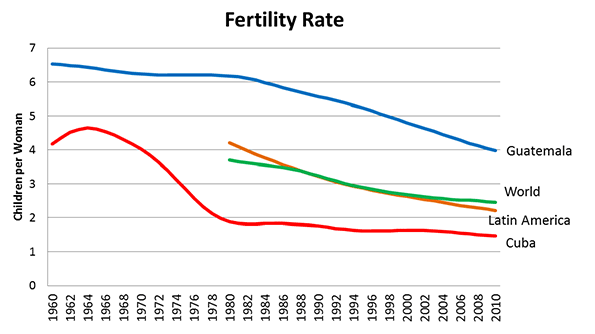
    Increasingly, the debate over plummeting world birth rates is shifting to the developing world. This includes Latin America where on the whole rates are dropping quickly from 5.98 children per woman in 1960 to 2.20 children per woman in 2010.

    Yet these aggregate numbers do not reflect the variation in birthrates between various Latin American countries. Even as countries such as Brazil, Argentina, and Mexico head to rates at or even below replacement rates, there remain extreme examples of both higher and lower rates throughout the region. The most extreme variation can be found in Cuba and Guatemala which respectively have the lowest and highest fertility rates in Latin America.

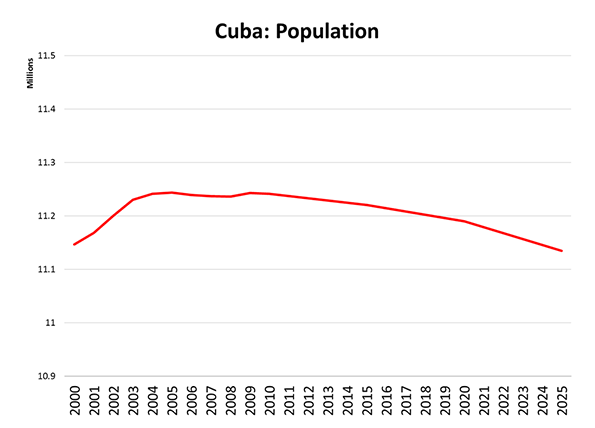
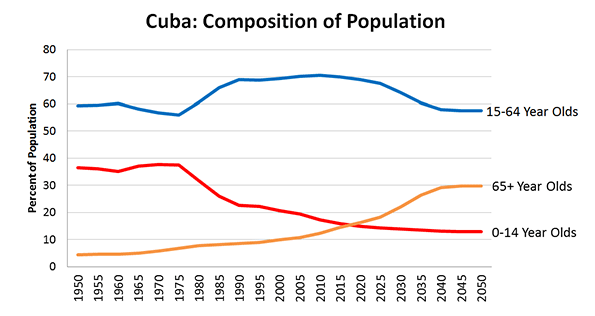
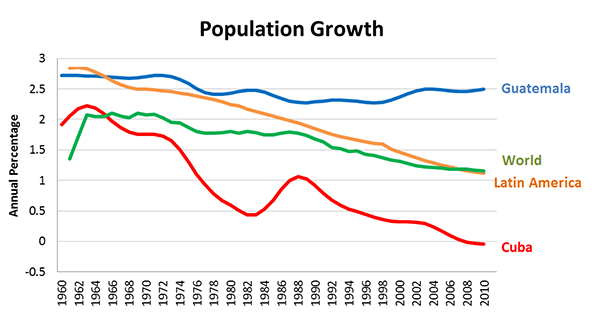
    Cuba is estimated to have a current fertility rate of 1.47 children per woman, well below replacement level of 2.1 children per woman. This extremely low rate is not new to Cuba; rather, it reflects changing population dynamics that have been developing since the rise of communism on the island. The effects of low fertility have already begun to manifest themselves in the population of Cuba. For example, between 2005 and 2008, Cuba’s population actually decreased. Although it did increase slightly again from 2008 to 2011, the trend of decreasing population is projected to continue as time goes on.

    Source: Oficina Nacional Estadística de Cuba

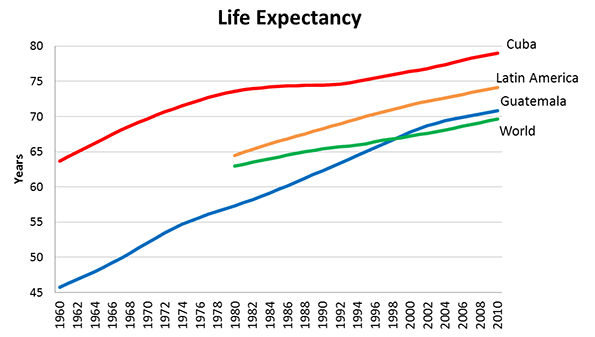
    Cuba’s population by 2025 is supposed to be lower than its population 25 years earlier in 2000 (11,146,203 people in 2000 and only 11,134685 people 2025). Although this decrease of 110,000 people does not seem to be too much of an issue, it will have a severe effect on the country’s workforce and rapid aging. This rapid aging may also reflect the ubiquity of Cuba’s medical care system, which may allow for much of its population to live longer and healthier lives. Cuba’s life expectancy, 78.96 years at the time of birth, is much greater than other countries such as Guatemala and Bolivia, whose life expectancies are 70.83 and 66.27 respectively.

    Source: Oficina Nacional Estadística de Cuba

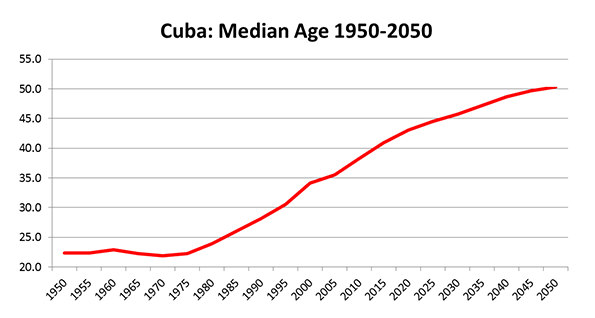
    In 100 years, the median age of the population of Cuba is predicted to more than double from its 1950 rate. Children compose a smaller and smaller proportion of the population while the adult population continues to grow.

    Source: Comisión Económica para América Latina y el Caribe (CEPAL) División de Población (CELADE)

    In this sense Cuba, although a relatively poor country with a Gross National Income per capita of $5,460 in 2008 has demographics more widely associated with far more affluent countries such as Japan, Germany, Italy and Spain. Sometime between 2015 and 2020, Cuban men and women aged 65 and older will outnumber the amount of children in the country, something that has never happened before. The mid 1960s to 1980s saw a major decrease in fertility rates in Cuba, which is shown in the graph above. From 1960 to about 1975 the percentage of children in the population was steady, but then it plummeted dramatically until the mid-1990s, which also saw a massive rise in the share of adults.

    At the other Latin extreme stands  Guatemala, estimated to nearly double its population by 2050, from 14,740,000 in 2011 to 27,444,000 in 2050 (a growth of 86.2%). This is a staggering statistic considering the many issues already facing Guatemala. Guatemala has the highest fertility rate of any Latin American, beating out some of the poorest countries in the region. Its current fertility rate is 3.98 children per woman. This is nearly double the replacement level, which is quite divergent from Cuba’s fertility rate.  

    Source: World Bank
    Guatemala’s fertility rate has been steadily declining since 1960; it still has an extremely high fertility rate that is nearly double replacement level. This means that its population will continue to increase due to a large number of births; however, that is not the only reason for population growth in Guatemala. Like the general trend the world is experiencing, life expectancy in Guatemala is continuing to increase and will only increase more as time goes on.

    As women have on average 3.98 children during their lifetime and the entire population begins to live longer and longer, a major increase in population will occur. Like Cubans, Guatemalans now have longer life expectancies than the world average.

    Source: World Bank

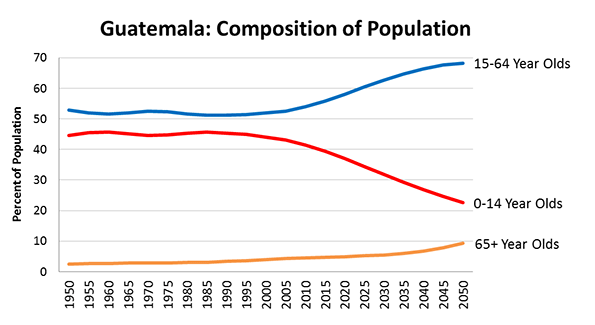
    Guatemala reflects a strange mix of underdevelopment and modernism, which together could drive the major population increase over the next 40 years. The underdevelopment keeps the fertility rate high, while the modernism is driving life expectancy upwards. While the fertility rate is decreasing, it will take a very long time for it drop below replacement level. Similarly, life expectancy will continue to increase until it begins to level off many decades into the future. Not only will its population be affected, but the structure of the population will change with time too.

    Source: Comisión Económica para América Latina y el Caribe (CEPAL) División de Población (CELADE)

    Ultimately, Guatemala has the healthier population trend. Cuba’s decreasing population will begin to pose major problems. Not only will the population continue to decrease, but the population will also continue to age. Causing significant strain on a government that already has some of the highest rates of social safety net spending. Looking at the average growth rates for Cuba and Guatemala, it seems that Guatemala may be on a healthier trajectory when it comes to population.

    Source: World Bank

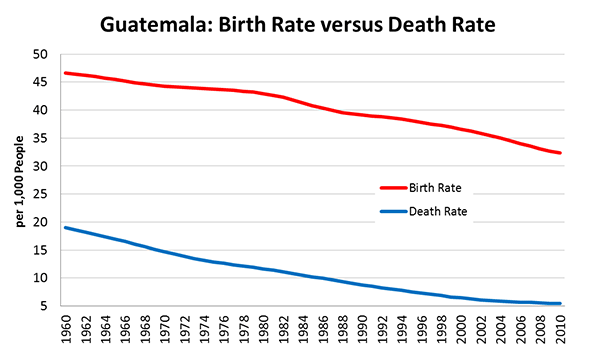
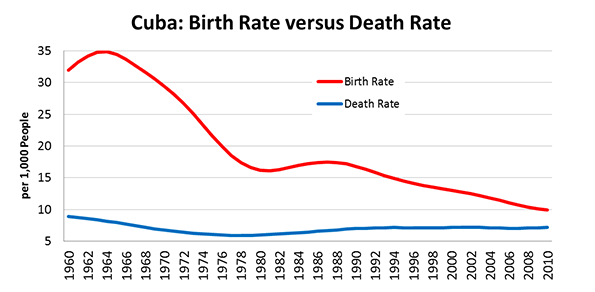
    This is also expressed in the representation of birth and death rates per 1,000 people in the country. Guatemala has a general decrease of both factors over time, which is a fairly common trend in developing countries; however, Cuba has quite erratic behavior in its population’s manifestation of birth and death rates per 1,000 people.

    Source: World Bank

    Source: World Bank

    The 1959 revolution in Cuba caused major shocks to the population both in terms of births and deaths. Immediately following the revolution in 1959, the death rate decreased, while the birth rate actually increased for a few years, only to drop drastically over the next 15 years or so. Cuba’s exceptional government structure – with its welfare state and poor economy – has caused a strange population phenomenon that does not occur in Latin Countries. Guatemala, in contrast, reflects a strange confluence of underdevelopment and modernism. It seems likely that Cuba will soon face a major fiscal and economic fallout from too low fertility while Guatemala will have a population explosion, with a whole different set of challenges.

    Population and its dynamics fuel a constant policy debate in every country throughout the world. In Latin America, these divergent fertility rates will not only affect the region but also the world as a whole. Guatemala’s population trajectory could mean increased emigration from the country to the Northern Hemisphere, while Cuba’s population trajectory could mean a collapse of the system and a restructuring of the entire Cuban life. Overall, Latin America has many significant challenges that other regions in the world do not face, and it seems that the divergent population trajectories of different countries in Latin America will ultimately drive major social, political, and economic changes in the region.

    Sam Schleier is a senior Peace Studies major and Latin American Studies minor at Chapman University in Orange, CA. He is originally from Phoenix, AZ.

    Central America map by Bigstockphoto.com.
  • China’s Top Growth Centers

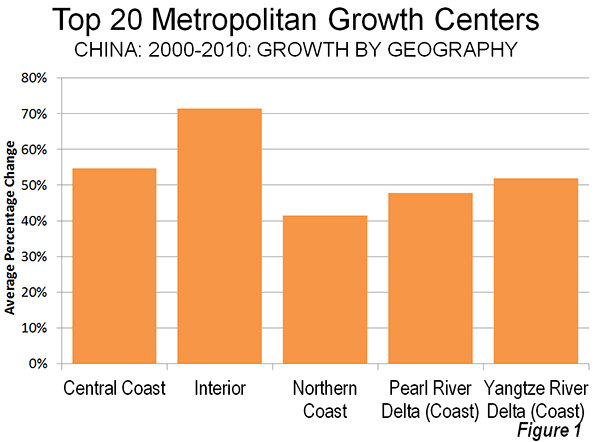
    Hefei, the capital of historically poor Anhui province emerged as China’s top growth center among major metropolitan areas over the past 10 years. Metropolitan areas from the interior, the Yangtze Delta and the central and northern coast were the fastest growing, displacing Guangdong’s Pearl River Delta, long the growth center for the country.   (Figure 1).

    China’s Trends in Context: China’s growth rate has fallen substantially and the United Nations has projected that the nation will experience population decline starting between 2030 and 2035. However, China’s urban areas have grown strongly as people have continued to move to cities for better opportunities. According to World Bank research, China’s economic progress since 1981 has lifted more people out of poverty than ever before in the world.

    Never before in history have so many people moved to urban areas in such a short period of time.

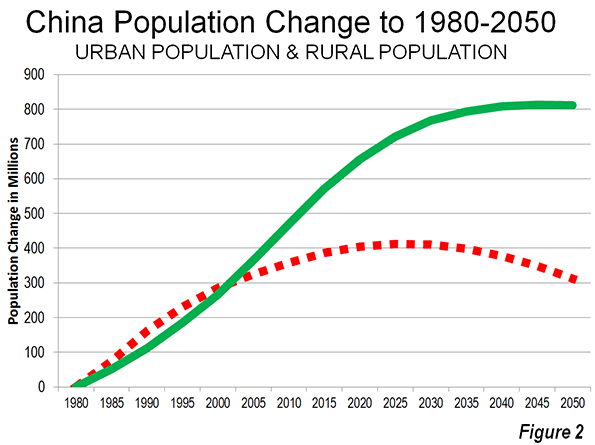
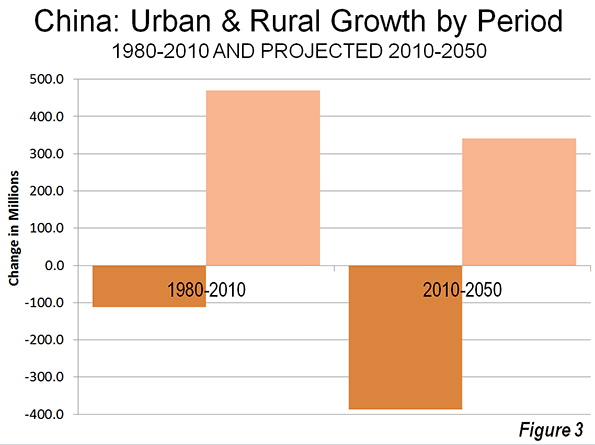
    Since the reforms began in approximately 1980, all of China’s population growth has been urban. Rural areas lost approximately 110 million people between 1980 and 2010. That is approximately equal to the population of Mexico and more than each of the nations in the world except for 11. Over the same three decades, 470 million people were added to the urban areas. That is more than 1.5 times the population of the United States.

    China’s Metropolitan Areas: This article provides an analysis of the urban districts (qu) of Chinas urban regions (routinely mislabeled "cities"). These districts are designated by regional officials as urban for urban development. Since the peripheral urban districts are principally rural, the combination of urban districts (Shi Shixiaqu)in a region are akin to a metropolitan area (labor market area).

    Among the metropolitan areas that began the decade (2000) with more than 1,000,000 inhabitants, the slowest 10 year growth rate was 36 percent. In comparison, among the 51 US metropolitan areas with more than 1,000,000 population, only three (Las Vegas, Raleigh and Austin) would have placed in China’s top 20, and not higher than 14th (Table). As in the US, the most rapid urban growth is taking place in smaller metropolitan areas with less than 5 million in 2010.  

    Top 20 Metropolitan Growth Centers in China: 2000-2010
    Rank Metropolitan Area 2000 Population 2010 Population Change % Geography
    1  Hefei, AN        1,659,000    3,352,000       1,693,000 102.0%  I 
    2  Xiamen, FJ        2,053,000     3,531,000       1,478,000 72.0%  C 
    3  Zhengzhou, HEN        2,560,000     4,254,000       1,694,000 66.2%  I 
    4  Suzhou, JS        2,473,000     4,074,000       1,601,000 64.7%  Y 
    5  Wenzhou, ZJ        1,916,000     3,040,000       1,124,000 58.7%  Y 
    6  Ningbo, ZJ        2,201,000     3,492,000       1,291,000 58.7%  Y 
    7  Urumqi, XJ        1,753,000     2,744,000          991,000 56.5%  I 
    8  Weifang, SD        1,380,000     2,044,000          664,000 48.1%  N 
    9  Shenzhen, GD        7,009,000   10,358,000       3,349,000 47.8%  P 
    10  Hangzhou, ZJ        4,243,000     6,242,000       1,999,000 47.1%  Y 
    11  Beijing, BJ      12,874,000   18,827,000       5,953,000 46.2%  N 
    12  Changsha, HUN        2,123,000     3,094,000          971,000 45.7%  I 
    13  Chengdu, SC        5,268,000     7,677,000       2,409,000 45.7%  I 
    14  Shanghai, SH      15,758,000   22,315,000       6,557,000 41.6%  Y 
    15  Hohhot, NM        1,407,000     1,981,000          574,000 40.8%  I 
    16  Nanjing, JS        5,098,000     7,166,000       2,068,000 40.6%  Y 
    17  Shijiazhuang, HEB        1,970,000     2,767,000          797,000 40.5%  N 
    18  Fuzhou, FJ        2,124,000     2,922,000          798,000 37.6%  C 
    19  Qingdao, SD        2,721,000     3,719,000          998,000 36.7%  N 
    20  Tianjin, TJ        8,146,000   11,090,000       2,944,000 36.1%  N 
     Metropolitan areas with more than 1,000,000 population in 2000.  
     Metropolitan areas consist of urban districts (qu) 
    Geographical Codes
     C   Central Coast 
     I   Interior 
     N   Northern Coast 
     P   Pearl River Delta (Coast) 
     Y   Yangtze River Delta (Coast) 
     Data from National Bureau of Statistics of China 


    The Interior: Six of the top 20 gainers were in the interior, including fastest growing Hefei. This reflects the appeal of   lower labor costs and perhaps also that rural migrants often prefer to work in regions   closer to their homes and families in agricultural regions. These six metropolitan areas had an average growth rate of 71 percent, the largest rate of any geographical grouping.

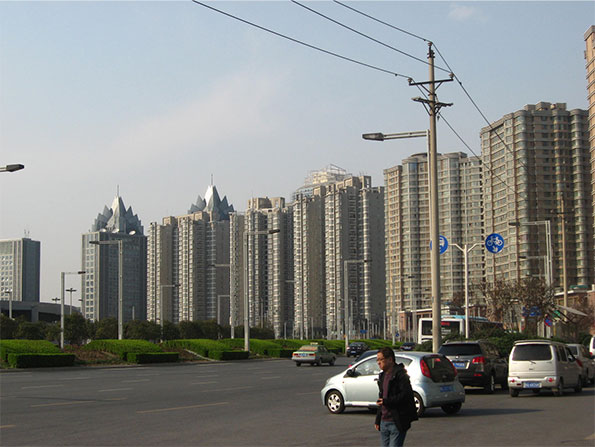
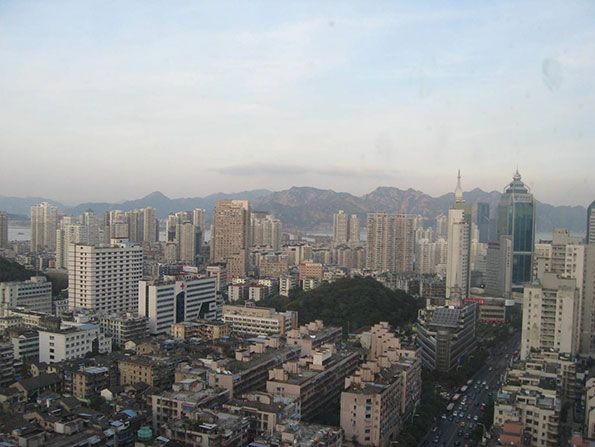
    • The capital of Anhui province, Hefei (photo), had the largest gain, at 102 percent. Hefei grew from 1.659 million to 3.352 million. Hefei is developing one of the most dispersed urban forms among China’s metropolitan area and there continues to be considerable construction. Hefei’s population growth rate was nearly one-half more than of second place Xiamen. Anhui is one province removed from the coast and Hefei is only 115 miles (185 kilometers) from the Yangtze Delta’s Nanjing.
    • The third ranked metropolitan area was Zhengzhou (photo), the capital of Henan province (also separated from the coast by one province), which experienced a 66 percent population gain.
    • Urumqi, the capital of China’s large northwestern province of Xinjiang ranked 7th with a gain of 57 percent. Urumqi is by far the most remote from the East Coast of the large gainers (2,000 miles or 3,250 kilometers from Tianjin, near Beijing).
    • Other interior fast growers were Changsha, capital of Hunan (12th, with 46 percent growth), Chengdu, the capital of Sichuan ranked 13th, with 46 percent growth and Hohhot, capital of Nei Mongol (Inner Mongolia), ranked 15th, with a growth rate of 41 percent.


    Hefei


    Zhengzhou

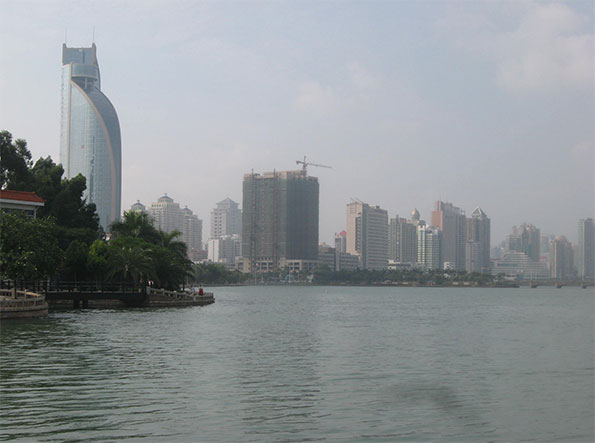
    Central Coast: Xiamen (photo), one of the first special economic zones designated after Shenzhen and placing 2nd in growth, added 72 percent to its population. This metropolitan area is centered on an island in Fujian province on China’s central coast, less than 10 miles from to Jinmen (Quemoy), an island controlled by Taiwan. Fuzhou, the capital of Fujian province was another central coastal metropolitan area among the top 20 growth centers (18th, at 38 percent). The average growth rate of these metropolitan areas on the central coast was 55 percent.


    Xiamen

    Yangtze River Delta: Like the interior, the Yangtze River (Changjiang) Delta also placed six metropolitan areas among the top 20 growth centers. The average growth rate was 52 percent. The Yangtze River Delta is a large area with a population greater than that of the Pearl River Delta, but with urban regions that are separated from one another by considerable rural territory (unlike the Pearl River Delta). The exception is the Shanghai-Suzhou-Wuxi corridor (Note), where the urbanization is continuous in limited corridors.

    • Suzhou (Photo), part of which (Kunshan qu) abuts Shanghai ranked as the third fastest growing metropolitan area, with a growth rate of 65 percent. Suzhou added 1.6 million people and is nearing 4.1 million. As the growth of Shanghai continues to spill westward and northward, Suzhou is likely to continue its strong growth.
    • The other three top 10 metropolitan growth areas in the Yangtze River Delta were in the province of Zhejiang, including Wenzhou at 5th, growing 59 percent (Photo), Ningbo, one of the nation’s largest ports was 6th, at 59 percent and Hangzhou, the provincial capital, which Marco Polo claimed was the largest city in the world in his Travels was 10th, at 47 percent.
    • Shanghai, the nation’s largest metropolitan area, placed 14th in growth, at 42 percent. Shanghai had the largest numeric growth, adding 6.6 million to its population, more people than live in Toronto.
    • Nanjing, the capital of Jiangsu province ranked 16th in growth, at 41 percent.


    Suzhou


    Wenzhou

    Northern Coast: Five northern coastal metropolitan areas were among the top 20 metropolitan gainers, with an average growth rate of 42 percent.

    • Weifang, in the province of Shandong ranked 8th in growth, the highest rating among metropolitan areas in the northern coastal area. Weifang added 48 percent to its population.
    • Beijing ranked 12th in growth, at a 46 percent rate. Beijing’s numeric growth was second only to Shanghai, at 6 million.
    • The other northern coastal growth centers were Shijiazhuang, the capital of Hebei (17th, at 41 percent) and 175 miles (280 kilometers), south of Beijing. Qingdao, of brewing fame ("Tsingtao" beer) ranked 19th, with a growth rate of 37 percent, while Tianjin, which is close enough to be Beijing’s port, ranked 20th, with a growth rate of 36 percent.

    Pearl River Delta: In contrast the Pearl River Delta, the home of so much urban growth over the past 30 years, placed only one metropolitan area among the top 20 growth centers, Shenzhen. Shenzhen placed 9th, with a growth rate of 48 percent. This is in stark contrast to 1990 to, when Shenzhen and adjacent Dongguan both more than doubled in population.

    Missing Giants: Chongqing was not among the top growth centers. Chongqing has been routinely mischaracterized as China’s largest metropolitan area (because of semantic confusion over the word "city"). Chongqing’s metropolitan districts grew only 22 percent and the region (a provincial equivalent) lost population. Neighborhood rival Chengdu, capital of Sichuan province from which Chongqing was separated in 1996 more than doubled its growth rate. Manchuria, China’s "Dongbei" (Northeast) also failed to place any areas among the fastest growing. Shenyang, the center of China’s Rust Belt, grew less than 10 percent, though Harbin, capital of Helonjiang grew nearly 30 percent.

    More Growth to Come: Despite an overall population that is just peaking, urban population growth is expected to be substantial. In addition to the 470 million people that have moved to urban areas since 1980, the United Nations projects that another 340 million people will be added to the urban areas by 2045 (after which a modest decline is expected). Over the same 35 years, China’s rural population is expected to fall by 387 million (Figures 2 and 3). Where these new migrants move and how they make do will be among the most important urban stories of the next decade.


    Wendell Cox is a Visiting Professor, Conservatoire National des Arts et Metiers, Paris and the author of “War on the Dream: How Anti-Sprawl Policy Threatens the Quality of Life”.

    ——-

    Note: Includes Kunshan, part of the Suzhou metropolitan area, but a separate urban area (between the Suzhou urban area and the Shanghai urban area).

    Note: Corrected Hefei data on 6/3/2012.

    Top photo: Hefei: All photos by author.

  • Thoughts on High-speed Rail and Buses

    I’m back from a California trip – beautiful state, beautiful weather, completely dysfunctional government.  For example, even with massive fiscal problems it’s still trying to build a vastly expensive high-speed rail line from San Francisco to San Diego. On a related note, a private group is exploring building a Houston-Dallas HSR line with no subsidies of any kind. I’m totally okay with private efforts.  I’m probably even okay with a little eminent domain to get the right of way at a fair price. I hope they can make it work.

    Here’s a great alternate perspective on HSR: a TED talk on the value of perception and psychology vs. economics and technology.  Go to the 6:12 point to see a great example of the Eurostar train, where they spend a vast amount of money to reduce travel times by 40 mins, when for 90% or 99% less money they could have improved the experience instead and actually gotten higher rider satisfaction.  I believe the absolute same principle applies to bus vs. rail, whether intra- or inter-city: spend 1% or 10% of the same money improving the bus service and get higher customer satisfaction than the rail line would generate.  (hat tip to Karl)

    And Greyhound is doing just that, learning from Megabus and upgrading their service with wifi, power plugs, and nicer seats with more leg room.  With that kind of service option available at say $30 one-way within the Texas Triangle, how many people do you think would pay $150+ to go on HSR?  On second thought, maybe nobody should mention this possibility to the Texas HSR group…  😉