Blog

  • Declining Birthrates Key to Europe’s Decline

    The labor demonstrators, now an almost-daily occurrence in Madrid and other economically-devastated southern European cities, lambast austerity and budget cuts as the primary  cause for their current national crisis. But longer-term, the biggest threat to the European Union has less to do with government policy than what is–or is not–happening in the bedroom.

    In particular, southern Europe’s economic disaster is both reflected — and is largely caused by — a demographic decline that, if not soon reversed, all but guarantees the continent’s continued slide. For decades, the wealthier countries of the northern countries — notably Germany — have offset very low fertility rates and declining domestic demand by attracting migrants from other countries, notably from eastern and southern Europe, and building highly productive export oriented economies.

    In contrast, the so-called Club Med Countries– Greece, Italy, Portugal and Spain–have not developed strong economies to compensate for their fading demographics outside pockets of relative prosperity such as Milan. Spain was once one of Europe’s star performers, buoyed largely by real estate speculation and growing integration with the rest of the EU.  Six years ago the country was building upwards of 50% as many houses as the US while having 85% less population. Roughly six million immigrants came to work in the boom, even as roughly seven to eight percent of Spaniards preferred to remain unemployed.

    When the real estate bubble broke, there was only limited productive industry to step into the breach. In Spain, private sector credit has dropped for a remarkable eighteen straight months while industrial production has fallen precipitously–7.5 percent in March alone. Spain’s unemployment rate has scaled over 23%, more than twice the EU average. Unemployment among those under 25 in both Spain and Greece now reaches over fifty percent.

    After decades of expansion, even fashionable Madrid is littered with store vacancies and  ubiquitous graffiti; many young people can be seen on the street in the middle of the week, either doing nothing or trying to pick up an odd Euro or two performing for tourists.

    ‘A Change In Values’

    Economists tend to explain this decline in terms of budget deficits and failed competitiveness, but some Spaniards believe the main cause lies elsewhere. Alejandro MacarrónLarumbe, a Madrid-based management consultant and author of the 2011 book, Elsuicidiodemográfico de España, says today’s decline is “almost all about a change in values.”

    A generation ago Spain was just coming out of its Francoist era,  a strongly Catholic country with among the highest birth rates in Europe, with the average woman producing almost four children in 1960 and nearly three as late as 1975-1976. There was, he notes, “no divorce, no contraception allowed.” By the 1980s many things changed much for the better better, as young Spaniards became educated, economic opportunities opened for women expanded and political liberty became entrenched.

    Yet modernization exacted its social cost. The institution of the family, once dominant in Spain, lost its primacy. “Priorities for most young and middle-aged women (and men) are career, building wealth, buying a house, having fun, travelling, not incurring in the burden of many children,” observes Macarron. Many, like their northern European counterparts, dismissed marriage altogether; although the population is higher than it was in 1975, the number of marriages has declined from 270,000 to 170,000 annually.

    Falling Births, Falling Fortunes

    Now Spain, like much of the EU, faces the demographic consequences. The results have been transformative. In a half century Spain’s fertility rate has fallen more than 50% to 1.4 children per female, one of the lowest not only in Europe, but also the world and well below the 2.1 rate necessary simply to replace the current population. More recently the rate has dropped further at least 5 percent.

    Essentially, Spain and other Mediterranean countries bought into northern Europe’s liberal values, and low birthrates, but did so without the economic wherewithal to pay for it. You can afford a Nordic welfare state, albeit increasingly precariously, if your companies and labor force are highly skilled or productive. But Spain, Italy, Greece and Portugal lack that kind of productive industry; much of the growth stemmed from real estate and tourism. Infrastructure development was underwritten by the EU, and the country has become increasingly dependent on foreign investors.

    Unlike Sweden or Germany, Spain cannot count now on immigrants to stem their demographic decline and generate new economic energy. Although 450,000 people, largely from Muslim countries, still arrive annually, over 580,000 Spaniards are heading elsewhere — many of them to northern Europe and some to traditional places of immigration such as Latin America. Germany, which needs 200,000 immigrants a year to keep its factories humming, has emerged as a preferred destination.

    Declining Population

    As a result Spain could prove among the first of the major EU countries to see an actual drop in population. The National Institute for Statistics (INE) predicts the country will lose one million residents in the coming decade, a trend that will worsen as the baby boom generation begins to die off. The population of 47 million will drop an additional two million by 2021. By 2060, according to Macarron, Spain will be home to barely 35 million people.

    This decline in population and mounting out-migration of young people means Spain will experience ever-higher proportions of retired people relative to those working. This “dependency rate”, according to INE, will grow by 57 % by 2021; there will be six people either retired or in school for every person working.

    If Spain, and other Mediterranean countries, cannot pay their bills now, these trends suggest that in the future they will become increasingly unable or even unwilling to do so.  As Macarron notes, an aging electorate is likely to make it increasingly difficult for Spanish politicians to tamper with pensions, cut taxes and otherwise drive private sector growth. Voters over 60 are already thirty percent of the electorate up from 22 percent in 1977; in 2050, they will constitute close to a majority.

    Without a major shift in policies that favor families in housing or tax policies, and an unexpected resurgence of interest in marriage and children, Spain and the rest of Mediterranean face prospects of a immediate decline every bit as profound as that experienced in the 17th and 18th Century when these great nations lost their status as global powers and instead devolved into quaint locales for vacationers, romantic poets and history buffs.

    Long before that happens, today’s Mediterranean folly could drive the rest of Europe, and maybe even the world, into yet another catastrophic recession.

    Joel Kotkin is executive editor of NewGeography.com and is a distinguished presidential fellow in urban futures at Chapman University, and contributing editor to the City Journal in New York. He is author of The City: A Global History. His newest book is The Next Hundred Million: America in 2050, released in February, 2010.

    Girl with Spanish flag photo by BigStockPhoto.com.

  • From Connection to Dispersal: Urbanisation in the 21st Century

    Commentators have long studied connections between cities and how these influence their development. The city is the natural focus of trade-based theories of growth. Exporting a surplus, based on local resources and specialisation was – and is – considered the way to city wealth.

    In this world, transport is the key to the trade portal. The cities that dominated world trade in the 19th and 20th centuries were those best connected, initially through their ports and sea links complemented later through strong ties over the airways. Mega-ports and airport hubs were marks of city success. 

    This model may be changing, and we need to change our thinking about the future of our cities with it.

    Connectedness and concentration
    Connectedness is a mantra for the new urbanists: through international connection cities exploit the economies assumed to arise from ever-increasing concentration of people and business. Hence, the city seeking to make its mark globally must invest in ever increasing transport infrastructure. Acknowledging the information age, it may add high-speed broadband to the mix and perhaps, in a symbolic move, an international convention centre.

    But is this the right model for 21st century urbanisation?

    Aviation – moving on
    Think for a moment about what has happened in aviation. The last decade saw a quantum shift from a model whereby a few powerful hubs concentrated movement between a few major centres from which passengers and goods could, in turn, be distributed along local spokes – by regional aircraft, train, coach or car. Airlines based themselves overwhelmingly at these hubs.  The large, twin isle jet reigned supreme. The Airbus A380 is the latest conveyor of that model, but most likely the last.

    Because late in the 20th century there was a divergence between an ageing hub and spoke model and a growing model based on  dense networks connecting more and more cities directly. The single aisle, medium-haul jet took off.  And now the long-haul, highly efficient, medium-sized jet is further expanding this capacity to directly connect former spokes – smaller cities – without the need to hub through major cities.

    And all of this has been supported by the productivity leap brought about by the low cost airline model. More people, more cities, more directly connected than ever before with the capacity to transform economic, political and social relations among them.  [1]

    From transport to logistics
    The transport sector was about moving goods from A to B as cost effectively as regulation allowed; and all too often regulation kept costs up to protect old technology and incumbent operators, whether by surface, air, or sea. That, though, is changing as international transport is liberalised.    

    And today transport is itself transforming into the business of logistics. And logistics is about distribution – through a production chain, between producers and consumers, and among places.  Goods move seamlessly through integrated operations that can deliver almost anything almost anywhere in a matter of days. 

    An informational world
    As the capacity to transport goods went up and the cost went down, academics trying to explain the differential growth of cities appealed to a new notion that dominating the exchange of information was the new key to prosperity.  Knowledge and expertise were concentrated in key informational hubs where they became the centres of capitalist power, the hearths of globalisation.  [2]

    Well that’s changing, too. Information and expertise is becoming dispersed, knowledge ubiquitous.  This is not just about the internet – although it obviously plays a huge part.  It’s also about the explosion of personal mobility as informational cities give way to an informational world.  (It may also be about the potential for implosion as a result of over-concentration, a threat still lingering in the financial centres of the world). 

    Linked cities are giving way to networked communities.

    From consolidation …
    The lesson? Those of us involved in planning the city cannot assume the same structures will prevail in the future as those we inherited from the past.  We tend to plan, though, by looking for repeat patterns, seeking generalisation, extracting principles, predicting the unpredictable.  And because infrastructure – roads, rail, ports – are large scale, expensive, and enduring they become the bones around which we construct our futures. 

    Infrastructure, particularly transport infrastructure, shapes our presumptions about how the city will function and the form it will take. Hence, urban planning is preoccupied with how to consolidate existing structures, increasing their capacity by building up rather than out and moving to mass transit, among other things.

    … to dispersal
    Yet the shifts in 21st century logistics and information technology support dispersal.  And it might just be that dispersal is the key to 21st century urbanisation.
    Light rail systems, dedicated bus lanes, smaller, more fuel efficient vehicles, lower housing costs, more intimate localised but inter-connected sub-urban communities, common information and mobile expertise cutting across diverse tastes, experiences, and places – these may be the way of the future.

    In the developing world where urbanisation is most rapid they may be the only way.  Here dispersal is already the dominant reality. While urbanisation may be exemplified in a few megacities in Asia, these account for only a small part of the total. And even they are marked by rapid peripheral expansion, with distinctive, sprawling, dense and diverse communities on the edge. Democraticised, localised self help institutions and NGOs may be the way to improved sanitation and health care in this environment, and micro-commerce the way to sustainable prosperity. 

    And in the slower-growing cities of the west, the maturing of sub-urban life, a return to lifestyle-focused localism, ageing in place, and the growing importance of community-based care point to a future in which dispersal rather than concentration could be the dominant mode of social and spatial organisation. Central structures may still have a role, but a diminishing one.

    More generally we may have to think of cities themselves as comprising networks of connections, within and across boundaries. The stronger these networks, perhaps, the more resilient the city. But this does not translate to physical density. Proximity is not the issue. Well connected, dense networks will support, if not encourage, dispersal. 

    This is contrary to the currently favoured model in places like my city of origin – Auckland – but it is not at all contrary to the centre within that city that I call home.

    Getting it wrong
    More than ever as we try to plan for the very long-term, we need to open our minds to alternatives. You only need to look at the list of bankrupt airlines (or in and out of Chapter 11 in the US) to appreciate the consequences of overinvesting in the current model on the assumption that it will prevail indefinitely.

    Phil McDermott is a Director of CityScope Consultants in Auckland, New Zealand, and Adjunct Professor of Regional and Urban Development at Auckland University of Technology.  He works in urban, economic and transport development throughout New Zealand and in Australia, Asia, and the Pacific.  He was formerly Head of the School of Resource and Environmental Planning at Massey University and General Manager of the Centre for Asia Pacific Aviation in Sydney. This piece originally appeared at is blog: Cities Matter.

    Aircaft photo by BigStockPhoto.com.


    [1]            See, for example, Centre for Asia Pacific Aviation (2003) Low Cost Airlines in Asia Pacific: A Force for Change and (2009) Global Low Cost Carrier Report
    [2]           E.g. Castells M (1990) The Informational City: Economic Restructuring and Urban Development Blackwell; Sassen S (1991) The Global City, New York, London, Tokyo, Princeton University Press

  • Here Come the Plurals!

    This month America’s destiny as a pluralistic democracy took a new and unprecedented turn. First, early in May, USA Today asked Americans what name they thought would be appropriate for the country’s newest generation now moving into grade school classrooms with its unique behavior and perspectives. Plurals is the name suggested by communications research and consulting firm, Frank N. Magid Associates, with only the Apple product related notion of an iGeneration getting more votes. 
     
    Plurals will be different from Millenials. For one thing they will be the first generation in America that will be majority “minority”, as evidenced by the recent U.S. Census Bureau announcement  that more babies born in America in the 12 months between July 2010 and July 2011, were non-white than white. The event occurred about eight years earlier than demographers had predicted it would just a few years ago. The 21st Century pluralistic American society that had often been talked about has arrived. But the question remains whether or not the country’s institutions, and its leadership, will be up to the challenge such a polyglot democracy presents.
     
    The Census Bureau predicts that by 2042 the entire population will be less than 50% Caucasian and America will literally be a pluralistic society.

    This prediction is based upon the current trends for births among different minority groups compared to whites. Racial and ethnic minorities accounted for 91.75% of the nation’s population growth in this century, with Hispanics comprising a majority of this increase. Rather than immigration flows, which are dropping, this growth will be driven largely by higher rates of fertility among non-whites. Based upon the American Community Survey results in 2010, Hispanics have a fertility rate of 2.4 live births per woman compared to only 1.8 among whites. The only other ethnic group to be having babies at a rate greater than what is needed to replace its current numbers is African-Americans with a 2.1 fertility rate.

    This difference is likely to persist and the gap could easily become wider because of the differences in the age of each population. Twenty-five percent of Hispanic women are in the prime child bearing ages of 20-34, compared to only 19% of non-Hispanic whites. (For both African-Americans and Asians, the percentage is twenty-two). The increasing diversity of both of America’s youngest generations is also reflected in the average age of each population. The average age of America’s white population is 42.3, a full five years older than the overall age of the country’s population. The average age of Hispanics is almost fifteen years younger, 27.6, with the other two population groups closer to the average age of the entire population—blacks at 32.9 and Asians at 35.9.

    Magid’s research indicated that a majority of Americans were “hopeful and proud” of the country’s increasing diversity, but it was the younger generations, most markedly Plurals, who were more likely to say they were “pleased and energized” by this development. Many older Americans, particularly Baby Boomers and senior citizens, are resisting the changes this dramatic shift is bringing to American society. Already states, such as Arizona, with populations that have the widest disparity between the racial and ethnic makeup of their oldest and youngest generations have experienced bitter political battles over issues such as immigration and education that reflect these divides. The good news is that both Plurals and members of the Millennial generation, born 1982-2003, are positive about this inevitable trend toward a pluralistic society, reflecting their comfort with the diversity in the social circles in which they have grown up.

    But that doesn’t mean that Plurals look forward to the nation’s future with equanimity. Most Plurals have been raised by parents from the often cynical and consistently skeptical Generation X. This may explain why Magid found a much greater degree of pessimism about living out the American Dream among them than among their older Millennial Generation siblings, a generation that, despite their current challenges, was brought up in the prosperous Reagan-Clinton era and remains characteristically optimistic. The attitudes of Plurals may also reflect the polarized, bitter politics that have characterized the period of Fear, Uncertainty and Doubt (FUD) that has dominated the news during their young life.

    Whatever the reason, the pessimism of the Plurals must be answered by the nation’s leaders in ways which improve prospects for the nation’s future. One way for this to happen quickly would be for those currently holding power to begin to turn the reins of leadership over to those generations more in tune with the nation’s demographic future. If Plurals’ Xer parents and their Millennial siblings are given the opportunity to shape America’s destiny sooner rather than later, the country just might deliver on the promise of the American Dream for its newest generation.  

    Morley Winograd and Michael D. Hais are co-authors of the newly published Millennial Momentum: How a New Generation is Remaking America and Millennial Makeover: MySpace, YouTube, and the Future of American Politics, named by the New York Times as one of their ten favorite books of 2008.

  • Top Manufacturing Sectors For 2011

    There has been lots of data indicating that domestic manufacturing is regaining some vigor after years of wasting away. Brookings’ Martin Neil Baily and Bruce Katz, writing in the Washington Post, noted:

    Manufacturing employment, output and exports are headed in the right direction: In April, the number of U.S. manufacturing jobs was up 489,000 from the January 2010 low of 11.5 million. The Institute of Supply Management’s manufacturing index has shown 33 consecutive months of expansion.

    Some of this growth may be due to re-shoring efforts. This CNBC article mentions Chesapeake Bay Candle, which outsourced much of its manufacturing workforce 17 years ago and is starting to bring them back. Here is an excerpt:

    A survey by the Boston Consulting Group in February found more than one-third of U.S.-based manufacturing executives at companies with sales greater than $1 billion are either planning or considering bringing production back to the United States from China.

    To inform the discussion a bit more, we tapped into our database and pulled all of the 4-digit NAICS manufacturing sectors (86 in all) to learn more about the recent growth. From the end of 2010 to the end of 2011, our data tells us that the 4-digit manufacturing sectors added just over 200,000 jobs. NOTE: This is less than the Brookings research shows, but we are likely looking at slightly different timeframes and datasets.

    Job Winners

    The industries that gained the most jobs in one year didn’t necessarily go through the roof, but considering what they went through over the previous nine or 10 years, it is safe to say that the trends we are seeing now are pretty significant. Prior to 2010, pretty much every manufacturing sub-sector experienced significant decline. Domestic machinery manufacturing especially stands out. Several sub-sectors gained a healthy number of jobs last year.

    1. Ag, construction and mining machinery manufacturing (NAICS 3331) gained nearly 14,000 new jobs (7% employment growth) and now employs 218,000. From 2001 to 2009, this industry declined by 3%, shedding 7,500 jobs.
    2. Other machinery manufacturing (NAICS 3339, a catch-all industry) gained 12,000 new jobs (5% employment growth) and now employs 237,000. From 2001 to 2009, this industry declined by 26%, shedding 85,000 jobs.
    3. Metalworking machinery manufacturing (NAICS 3335) gained 11,000 new jobs (7% employment growth) and now employs 166,000. From 2001 to 2009, this industry declined by 37%, shedding 91,000 jobs.

    All told, these three sectors added some 37,000 jobs in one year, which is great considering that they actually lost 184,000 over the previous nine years.

    Of all the 4-digit sectors, machine shops (NAICS 3327) gained the most new jobs in one year — about 22,000 jobs or 7% employment growth. There are now some 330,000 employed in this sector. From 2001 to 2009, this industry declined by 11% and shed 38,000 jobs.

    Motor vehicle part manufacturing (NAICS 3363) added 20,000 jobs, which was 3% growth. There are now 435,500 employed in this industry. From 2001 to 2009, this industry declined 46% (a loss of 356,000 jobs).

    Semiconductor manufacturing (NAICS 3344) did well by adding 17,000 new jobs, which represents 4% growth. There are now 386,000 jobs in this sector. From 2001 to 2009, this industry declined by 41% (a loss of 266,000 jobs).

    Finally, aerospace products manufacturing (NAICS 3364) gained 13,000 jobs, which is 3% growth. The current job count stands at 488,000. From 2001 to 2009, this industry declined by 3% (a loss of 14,000 jobs).

    The big thing to note here is how much of this is related to advanced manufacturing.

    Fastest-Growing

    Audio and visual equipment manufacturing (NAICS 3343) had the fastest overall growth from 2010-2011. The big thing to note is that from 2001-2009 the industry actually lost more than half (53%) of its total workforce, a total of 25,000 jobs. During 2011, it managed to gain back 12% or 2,360 jobs. We’d say that a one-year rebound like that is great news after such a huge loss.

    After that, steel product manufacturing (NAICS 3312), which lost 17,000 jobs (-25%) since 2001, had 10% employment growth and added over 5,000 jobs from 2010-11, and foundries (NAICS 3315), which lost 86,000 jobs (-43%), grew by 9% and added nearly 10,000 jobs.

    Highest-Paying

    With an average industry earnings level of $140,000 per year (keep in mind this is averaging the wages and salaries of all workers in the industry together), computer and peripheral equipment manufacturing (NAICS 3341) has the highest earnings. From 2001 to 2009, the industry lost 41% of its workforce or 118,000 jobs. In 2011, it grew by 6%, adding 9,400 jobs.

    After that comes pharmaceutical and medicine manufacturing (NAICS 3254) and petroleum and coal products manufacturing (NAICS 3241), which both average about $102,000 per year. Neither of these final two sectors grew last year.

    Biggest Losers

    Despite the overall growth, some industries are still in decline.

    Printing and related support activities (NAICS 3231) lost 21,000 jobs in one year (-4%), which was the biggest loss of any 4-digit sector. The biggest loser in percent terms was apparel knitting mills (NAICS 3151), which lost 10% of its workforce.


    Below is the complete data table of all 86 sectors.

    Description 2010 Jobs 2011 Jobs Change % Change 2011 Avg. Annual Wage
    Total
    11,487,828
    11,690,458
    202,630
    0.02
    $59,138
    Machine Shops; Turned Product; and Screw, Nut, and Bolt Manufacturing
    311,123
    332,817
    21,694
    7%
    $48,785
    Motor Vehicle Parts Manufacturing
    415,180
    435,493
    20,313
    5%
    $55,050
    Semiconductor and Other Electronic Component Manufacturing
    369,879
    386,407
    16,528
    4%
    $88,772
    Agriculture, Construction, and Mining Machinery Manufacturing
    203,837
    217,594
    13,757
    7%
    $70,602
    Aerospace Product and Parts Manufacturing
    475,009
    487,886
    12,877
    3%
    $87,430
    Other General Purpose Machinery Manufacturing
    225,257
    237,315
    12,058
    5%
    $61,266
    Metalworking Machinery Manufacturing
    155,031
    166,188
    11,157
    7%
    $53,903
    Foundries
    111,056
    121,031
    9,975
    9%
    $50,014
    Computer and Peripheral Equipment Manufacturing
    158,879
    168,224
    9,345
    6%
    $140,228
    Other Fabricated Metal Product Manufacturing
    245,850
    254,972
    9,122
    4%
    $55,840
    Architectural and Structural Metals Manufacturing
    319,567
    327,843
    8,276
    3%
    $46,489
    Coating, Engraving, Heat Treating, and Allied Activities
    121,460
    128,481
    7,021
    6%
    $43,415
    Beverage Manufacturing
    167,187
    173,497
    6,310
    4%
    $51,120
    Ventilation, Heating, Air-Conditioning, and Commercial Refrigeration Equipment Manufacturing
    125,870
    132,160
    6,290
    5%
    $49,587
    Ship and Boat Building
    123,574
    129,773
    6,199
    5%
    $56,065
    Industrial Machinery Manufacturing
    97,824
    103,848
    6,024
    6%
    $71,912
    Motor Vehicle Manufacturing
    152,736
    158,707
    5,971
    4%
    $79,407
    Engine, Turbine, and Power Transmission Equipment Manufacturing
    90,970
    96,758
    5,788
    6%
    $72,697
    Motor Vehicle Body and Trailer Manufacturing
    108,962
    114,439
    5,477
    5%
    $44,994
    Forging and Stamping
    88,269
    93,647
    5,378
    6%
    $52,770
    Steel Product Manufacturing from Purchased Steel
    52,287
    57,449
    5,162
    10%
    $57,738
    Nonferrous Metal (except Aluminum) Production and Processing
    58,036
    62,360
    4,324
    7%
    $61,286
    Plastics Product Manufacturing
    501,678
    505,984
    4,306
    1%
    $45,499
    Other Electrical Equipment and Component Manufacturing
    117,847
    122,012
    4,165
    4%
    $58,774
    Boiler, Tank, and Shipping Container Manufacturing
    84,588
    88,693
    4,105
    5%
    $57,507
    Converted Paper Product Manufacturing
    281,187
    284,673
    3,486
    1%
    $53,341
    Alumina and Aluminum Production and Processing
    54,054
    57,539
    3,485
    6%
    $58,638
    Medical Equipment and Supplies Manufacturing
    303,297
    306,341
    3,044
    1%
    $61,515
    Electrical Equipment Manufacturing
    134,318
    136,968
    2,650
    2%
    $63,766
    Audio and Video Equipment Manufacturing
    20,042
    22,402
    2,360
    12%
    $79,151
    Basic Chemical Manufacturing
    140,942
    143,045
    2,103
    1%
    $88,113
    Fabric Mills
    54,021
    56,110
    2,089
    4%
    $41,628
    Other Miscellaneous Manufacturing
    263,116
    265,031
    1,915
    1%
    $46,223
    Iron and Steel Mills and Ferroalloy Manufacturing
    85,954
    87,603
    1,649
    2%
    $73,636
    Cut and Sew Apparel Manufacturing
    125,398
    126,937
    1,539
    1%
    $36,150
    Manufacturing and Reproducing Magnetic and Optical Media
    25,002
    26,425
    1,423
    6%
    $85,820
    Other Transportation Equipment Manufacturing
    33,191
    34,547
    1,356
    4%
    $63,123
    Railroad Rolling Stock Manufacturing
    18,402
    19,752
    1,350
    7%
    $62,647
    Office Furniture (including Fixtures) Manufacturing
    96,048
    97,283
    1,235
    1%
    $44,807
    Commercial and Service Industry Machinery Manufacturing
    92,184
    93,335
    1,151
    1%
    $64,827
    Bakeries and Tortilla Manufacturing
    276,593
    277,718
    1,125
    0%
    $35,578
    Rubber Product Manufacturing
    121,591
    122,587
    996
    1%
    $51,487
    Resin, Synthetic Rubber, and Artificial Synthetic Fibers and Filaments Manufacturing
    89,107
    90,092
    985
    1%
    $78,720
    Footwear Manufacturing
    13,148
    13,863
    715
    5%
    $35,261
    Cutlery and Handtool Manufacturing
    40,141
    40,830
    689
    2%
    $54,144
    Paint, Coating, and Adhesive Manufacturing
    55,883
    56,555
    672
    1%
    $64,627
    Pharmaceutical and Medicine Manufacturing
    278,781
    279,434
    653
    0%
    $102,299
    Pesticide, Fertilizer, and Other Agricultural Chemical Manufacturing
    35,755
    36,407
    652
    2%
    $73,502
    Other Leather and Allied Product Manufacturing
    10,934
    11,557
    623
    6%
    $35,423
    Animal Food Manufacturing
    51,602
    52,172
    570
    1%
    $52,176
    Spring and Wire Product Manufacturing
    42,338
    42,813
    475
    1%
    $45,935
    Electric Lighting Equipment Manufacturing
    45,298
    45,750
    452
    1%
    $52,943
    Sugar and Confectionery Product Manufacturing
    66,412
    66,834
    422
    1%
    $46,306
    Hardware Manufacturing
    23,529
    23,867
    338
    1%
    $53,447
    Dairy Product Manufacturing
    130,203
    130,532
    329
    0%
    $50,968
    Leather and Hide Tanning and Finishing
    4,015
    4,311
    296
    7%
    $44,342
    Soap, Cleaning Compound, and Toilet Preparation Manufacturing
    100,840
    101,045
    205
    0%
    $63,366
    Other Nonmetallic Mineral Product Manufacturing
    65,438
    65,575
    137
    0%
    $49,114
    Other Chemical Product and Preparation Manufacturing
    84,148
    84,261
    113
    0%
    $62,910
    Grain and Oilseed Milling
    58,689
    58,669
    -20
    0%
    $61,858
    Sawmills and Wood Preservation
    82,512
    82,459
    -53
    0%
    $38,074
    Textile and Fabric Finishing and Fabric Coating Mills
    36,210
    36,151
    -59
    0%
    $41,847
    Lime and Gypsum Product Manufacturing
    13,483
    13,408
    -75
    -1%
    $55,548
    Clay Product and Refractory Manufacturing
    40,381
    40,289
    -92
    0%
    $47,440
    Other Food Manufacturing
    163,346
    163,230
    -116
    0%
    $51,728
    Other Furniture Related Product Manufacturing
    36,427
    36,300
    -127
    0%
    $39,650
    Pulp, Paper, and Paperboard Mills
    111,661
    111,144
    -517
    0%
    $74,825
    Glass and Glass Product Manufacturing
    78,991
    78,420
    -571
    -1%
    $51,877
    Apparel Accessories and Other Apparel Manufacturing
    13,699
    12,973
    -726
    -5%
    $35,757
    Tobacco Manufacturing
    16,251
    15,510
    -741
    -5%
    $95,669
    Petroleum and Coal Products Manufacturing
    110,968
    110,014
    -954
    -1%
    $101,861
    Fiber, Yarn, and Thread Mills
    29,142
    28,113
    -1,029
    -4%
    $34,390
    Household Appliance Manufacturing
    58,658
    57,563
    -1,095
    -2%
    $53,698
    Other Textile Product Mills
    61,833
    60,658
    -1,175
    -2%
    $32,955
    Fruit and Vegetable Preserving and Specialty Food Manufacturing
    173,410
    172,057
    -1,353
    -1%
    $42,885
    Animal Slaughtering and Processing
    485,619
    484,061
    -1,558
    0%
    $33,217
    Apparel Knitting Mills
    18,521
    16,702
    -1,819
    -10%
    $35,513
    Cement and Concrete Product Manufacturing
    169,820
    167,189
    -2,631
    -2%
    $46,464
    Veneer, Plywood, and Engineered Wood Product Manufacturing
    63,204
    60,319
    -2,885
    -5%
    $40,514
    Navigational, Measuring, Electromedical, and Control Instruments Manufacturing
    407,365
    404,342
    -3,023
    -1%
    $89,109
    Other Wood Product Manufacturing
    193,833
    190,791
    -3,042
    -2%
    $34,431
    Textile Furnishings Mills
    57,300
    54,100
    -3,200
    -6%
    $36,515
    Seafood Product Preparation and Packaging
    36,471
    33,132
    -3,339
    -9%
    $37,983
    Communications Equipment Manufacturing
    115,861
    111,978
    -3,883
    -3%
    $98,379
    Household and Institutional Furniture and Kitchen Cabinet Manufacturing
    223,590
    218,463
    -5,127
    -2%
    $34,868
    Printing and Related Support Activities
    485,717
    464,657
    -21,060
    -4%
    $43,810


    State-by-State

    As is our custom in posts like this, we like to provide a state-by-state breakdown. To do this we aggregated all 86 industries together and looked at the distribution of these jobs by state. Here are the results.

    The good news is that 40 out of 51 states (including Washington, D.C.) gained manufacturing jobs.

    Oklahoma had the best single year percentage growth (9%) for manufacturing and added nearly 11,000 new jobs. Its current tally of manufacturing jobs is 133,500. Texas added the most new jobs, 23,000, and Michigan was second with 21,000. Current employment levels in each state are 833,000 and 497,000, respectively.

    California employs the most, 1.2 million, and grew by 1% or 10,000 jobs in 2011.

    Indiana and Wisconsin have the highest concentration of manufacturing jobs. Both are nearly twice the national average, and both employ roughly 450,000 manufacturing workers.

    D.C. has the highest pay (averaging nearly $100,000 per year) but very few manufacturing jobs (about 1,000). Massachusetts, which has 260,000 manufacturing jobs and grew by 2% last year, has the second highest average industry earnings ($78,000).

    Ten states lost jobs. New Jersey was the biggest loser with -8,100 jobs (3% decline). After New Jersey comes Arkansas, which lost 5,100 jobs (-3%) and New York, which dropped 3,500 jobs (-1%).

    The data for each state is below.

    State Name 2010 Jobs 2011 Jobs % Change 2011 Avg. Annual Wage 2010 National Location Quotient (Average is 1.00)
    Total
    11,487,828
    11,690,458
    0.02
    $59,138
    Oklahoma
    122,790
    133,524
    9%
    $47,547
    0.91
    Utah
    110,240
    116,542
    6%
    $50,210
    1.07
    Louisiana
    137,263
    145,003
    6%
    $61,321
    0.83
    South Carolina
    207,789
    219,353
    6%
    $51,111
    1.3
    Washington
    254,839
    266,538
    5%
    $68,111
    1
    Michigan
    475,226
    496,576
    4%
    $61,671
    1.42
    Missouri
    243,033
    253,599
    4%
    $50,367
    1.05
    Arizona
    147,905
    154,034
    4%
    $68,224
    0.7
    Iowa
    200,797
    207,870
    4%
    $50,659
    1.57
    South Dakota
    36,963
    38,208
    3%
    $40,746
    1.04
    Idaho
    53,103
    54,797
    3%
    $51,351
    0.97
    Kansas
    159,776
    164,868
    3%
    $51,944
    1.35
    Nebraska
    91,598
    94,376
    3%
    $43,020
    1.13
    Texas
    810,074
    833,421
    3%
    $65,352
    0.89
    Kentucky
    209,263
    215,162
    3%
    $50,610
    1.33
    Wisconsin
    429,233
    439,887
    2%
    $51,403
    1.83
    Ohio
    620,422
    635,427
    2%
    $54,371
    1.42
    Pennsylvania
    560,428
    572,069
    2%
    $55,099
    1.15
    Vermont
    30,796
    31,431
    2%
    $54,094
    1.17
    Illinois
    559,975
    570,941
    2%
    $61,073
    1.14
    Massachusetts
    254,462
    259,117
    2%
    $78,315
    0.91
    Wyoming
    8,710
    8,858
    2%
    $53,439
    0.35
    Tennessee
    298,290
    303,357
    2%
    $52,828
    1.31
    Florida
    307,489
    311,391
    1%
    $52,500
    0.48
    Minnesota
    292,048
    295,448
    1%
    $57,855
    1.28
    North Dakota
    22,548
    22,803
    1%
    $43,695
    0.68
    Indiana
    447,514
    452,536
    1%
    $55,692
    1.85
    Alabama
    236,259
    238,796
    1%
    $49,608
    1.44
    Virginia
    229,864
    231,927
    1%
    $52,845
    0.7
    California
    1,235,043
    1,244,965
    1%
    $75,079
    0.95
    Oregon
    163,179
    164,466
    1%
    $60,036
    1.14
    North Carolina
    431,536
    434,259
    1%
    $52,551
    1.24
    New Mexico
    29,019
    29,194
    1%
    $53,901
    0.41
    West Virginia
    49,066
    49,307
    0%
    $51,340
    0.79
    Georgia
    343,354
    344,947
    0%
    $51,640
    1.01
    Connecticut
    165,636
    166,385
    0%
    $76,876
    1.17
    New Hampshire
    65,760
    66,055
    0%
    $62,446
    1.23
    Colorado
    125,494
    126,028
    0%
    $61,496
    0.63
    Delaware
    26,137
    26,120
    0%
    $57,090
    0.72
    Rhode Island
    40,328
    40,216
    0%
    $50,621
    1.01
    Hawaii
    12,913
    12,873
    0%
    $40,153
    0.23
    New York
    455,654
    452,083
    -1%
    $61,365
    0.61
    Maine
    50,672
    50,234
    -1%
    $50,836
    0.98
    Mississippi
    135,901
    134,099
    -1%
    $41,709
    1.39
    Maryland
    115,097
    113,196
    -2%
    $66,776
    0.51
    Montana
    16,386
    15,942
    -3%
    $42,569
    0.43
    New Jersey
    255,906
    247,809
    -3%
    $75,142
    0.77
    Arkansas
    160,159
    155,012
    -3%
    $40,584
    1.57
    Nevada
    37,888
    36,329
    -4%
    $51,492
    0.38
    Alaska
    12,735
    11,912
    -6%
    $42,559
    0.42
    District of Columbia
    1,272
    1,168
    -8%
    $97,287
    0.02


    Conclusion

    Folks who watch the economy tend to pay a lot of attention to manufacturing. This is because manufacturing of all types and sizes produces a lot of jobs and, as export-based sectors, bring much-needed dollars into the economy.

    This data offers some glimmers of hope for a very large sector that has been the constant bearer of bad news for as long as anyone can remember. More companies are opting for domestic production and the products they produce (like heavy machinery) are seeing good domestic and worldwide demand.

    In this analysis some of the big winners appear to be machine shops, machinery manufacturers, audio/visual products, aerospace, foundries, metal working, and computer related manufacturing. Let us know if you’d like to learn more about any of the states or sectors we covered.

    Rob Sentz is the marketing director at EMSI, an Idaho-based economics firm that provides data and analysis to workforce boards, economic development agencies, higher education institutions and the private sector. He is the author of a series of green jobs white papers. For more, contact Rob Sentz (rob@economicmodeling.com). You can also reach us via Twitter @DesktopEcon.

    Illustrations by Mark Beauchamp.

  • Architecture Critic Paul Goldberger on Silicon Valley, San Jose, and Apple

    Last week Paul Goldberger, Pulitzer Prize winning architecture critic for the New Yorker and Vanity Fair, sat down with Allison Arief of the San Francisco Planning and Urban Research Association (SPUR) in downtown San Jose to discuss the state of 21st Century urbanism with a focus on Silicon Valley. Though admired the world over as the preeminent center for technological innovation, Silicon Valley has never been known for its great architecture. Goldberger suggested that this reputation could’ve improved had Apple not missed the mark with the design of their proposed Apple Campus 2 building in Cupertino.

    While acknowledging that Apple is probably the best design company at the moment, Goldberger asserted that the company’s design abilities end with small consumer gadgets and fail spectacularly at the urban level. Calling the Norman Foster designed building for the new Apple Campus a ‘beautifully designed donut or spaceship’, he lamented the lack of context and connection to anything around it. Speaking to an audience that included members of San Jose’s city government, Goldberger suggested that Apple missed the opportunity to take the reins to help transform San Jose by relocating at least some of its operations to help its long struggling (and subsidized) downtown.

    The reality is that most of the big tech companies in the Valley, not just Apple, have an extreme indifference to place-choosing to locate operations in suburban office parks. This has much to do with the history of Silicon Valley planning as it does with the nature of tech companies, which tend to employ legions of introverted computer engineering types and go to great lengths to remain insular and secretive (Apple taking this to the extreme). Perhaps it also makes perfect sense that rather than even acknowledging the true urban environment, companies whose primary business is creating the virtual world in which we increasingly experience public life take an active stance on turning their backs on the city.

    Yet for those still interested in experiencing the delights of pre-Information Era, pre-21 Century urbanism, there is always San Francisco not far up the road.  Goldberger made the point that the handful of tech companies who do choose to locate their operations in the city probably have a different mindset than those that stay in the Valley. Twitter being the prime example of the moment- the micro blogging site just leased 400,000 square feet of space on a long-maligned section of Market Street. Up in Seattle, Amazon recently announced its plan to build three new 37-story towers in the downtown area, which the proposal’s architect said is “not about building a corporate campus, it’s about building a neighborhood.”

    So even though not every tech company is averse to the city, the Richard Florida argument that high urban density is a prerequisite for innovation and creativity is a bit of a stretch, as the economic success of suburban Silicon Valley continually disproves. Near the end of the discussion, Goldberger suggested that deliberately designing space for innovation might be a bit too self-conscious. This implies that rather than design, factors such as human resources, access to capital and a culture with openness to trial-and-error matter more than the traditional urban hardware of cities.

    Adam Nathaniel Mayer is an American architectural design professional currently based in China and California. In addition to his job designing buildings he writes the China Urban Development Blog. Follow him on Twitter: @AdamNMayer.

  • Midcentury Modern

    Midcentury modern tours now are taking place in cities all over the country. Renewed interest in this era capitalizes on the millennials’ interest in design from a time that seems almost impossibly optimistic compared to today’s zeitgeist. Most cities around the country boast a healthy building stock from this postwar period, nicknamed “the suburbs,” although these are ritually condemned – and designated for annihilation – by academics, urban land speculators and the urban clerisy.

    Yet the new interest in the mid-century modern form reflects its basic and enduring appeal. As the curious and the trendy take bus tours of these inner-ring neighborhoods, the forms of this era evoke a sense of great confidence and faith in the future, both of which seem to be lost in the obsession with neo-traditional forms that hearken to the pre-car era or to the cartoonlike, sculpture-as-architecture one sees in many urban centers.

    Suburban expansion after World War II reached out beyond the streetcar systems that created the traditional neighborhoods of the late 19thand early 20th Century. The returning GIs wanted something simple and affordable to begin their lives after serving their country. Confidence surged in America’s know-how and ability to solve even the deepest social problems. The triumph of science and technology was a palpable presence. The dark side, of course, was the atomic threat, restraining our enthusiasm but only a little.

    In this midcentury era, planning and design began to be car-based. Residences were designed to show off the car, putting it out front for display – and some home plans even had tailfinned beauties in the living room


    Living Garage, photo from Populuxe by Thomas Hine

    Consumer goods were no longer accessed on foot; a new form of luxury consisted of driving up to the front door of a shop with parking in front. Front-loading houses and stores became unquestionably more efficient as a means to accommodate the new American lifestyle.

    Yet despite the auto-orientation, the architecture of this era retained the pedestrian scale and intimate feel that marked Main Street before World War 2. This both/and aesthetic marks the form of the 1940s and 1950s, with streamlined design styles like Art Deco Revival and materials like glass and stainless steel. Gentle angles suggested motion, and the theme of mobility was everywhere in the architecture.  Wider streets and lower, longer horizontal lines accommodated this theme and even today the architecture reinforces a feel of motion when driving past these structures.

    Modernism also formed a certain ethic. To be modern was more than a lifestyle choice; it was an acceptance of science, knowledge, and technology, free from preconceptions.  At the time, modernism elevated architecture above the style debate, and was considered even a shedding of styles. The politics of the time was similarly marked by Truman’s “straight talk”, and there was a shedding of rhetoric and posturing that lasted up until Joe McCarthy began once again a divide-and-conquer campaign against people.

    Translated to the suburbs, modernism meant practical homes, without the adornment that marked Victorian architecture. Instead, modernist residences were marked by deep horizontals and large picture windows, providing a sense of openness that was a hallmark of modernist thought. Floor plans also were open, allowing free movement through space, rather than cutting the house up into cluttered little parlors, dining rooms, or nooks. 

    Today, midcentury modern design is fetishized for mass consumption in magazines like Dwell that emphasize acquisitiveness over ethics. But back then, the design meant something else, something cleaner and more powerful. In the 1950s, modernism meant consumption, but even more, the modernism defined the quest for the inner self and a new, forward looking outlook.

    By reducing modernism to a sofa style or wallpaper pattern, we risk losing all that this era stood for.  Buildings from the 1950s have sustained themselves through multiple recessions, the rise of the internet, cultural acceleration, massive city growth, and globalism. So perhaps they point towards a real definition of sustainability by having good bones and adapting through all these changes.

    The current millennial generation seeks a practical domestic situation, much like returning GIs. Most would prefer to reduce car-trips, but are realistic about this goal, given the range of their travel. Most in this generation see right through car-free living claims; more than one of my students, when discussing walkability, stated that “I’m not gonna lug my groceries even a block in this heat.” The battle with the car is chiefly about making the car more efficient, and less ubiquitous through the use of telecommuting and on-line shopping. It is not about removing it from the scene entirely.

    So as McMansions have swollen to represent a kind of architectural obesity, they have made many midcentury neighborhoods unfashionable, for typically these older homes have one parking space, often in a carport, not a true garage. They also are front-loaded, a much more efficient planning concept than alleys, but then the car becomes part of the front façade. Millennials have a hard time understanding what’s wrong with that. Again, as one 28-year-old student put it to me, “It’s just a house, after all…what’s the big deal?”

    Developers seeking first-time homebuyers, however, respond to the regulatory climate, which favors solutions like garages on alleys, big homes on tight lots, and neotraditional styling.  Bonus density and other zoning incentives rig the game in favor of this highly regulated development pattern, even in the exurbs.  Here in Central Florida, the development zone nicknamed Horizon West has been codified to enforce these form-based principles, with stiff permitting fees and a highly participatory government staff to keep things on the straight-and-narrow.

    Keeping prices low with all this overburden requires developers to cut the cost of the home drastically, likely reducing lifespan of components and systems. Ironically, the house meeting these tortured standards of today is less sustainable than the house built in 1953, with better bones and an adaptable floor plan.

    Meanwhile, these 1950s neighborhoods are under attack for their very form. Cities, persuaded by planners to heal the effects of the car, cannot do so in a granular manner, so ordinances are passed  forbidding front-facing garages, or garages set back arbitrarily from the house front. These 1950s homes, with their carports, couldn’t be built today, and so are reduced to the status of heritage sites from a bygone era. In Winter Park, garages are banished to the rear on new homes, and if you are adding a garage to your midcentury home, it must be arbitrarily set back at least four feet from your front wall whether or not your lot can accommodate this arbitrary, and seemingly pointless, ordinance.

    Of course mid modern tours allow people to rediscover the essence of the 1950s, and these overlooked neighborhoods could be the springboard for a new era in modern planning.  Front-loaded neighborhoods can be successful when the architecture is designed at a human scale, and fine-grained integration of residential and commercial uses point to a future of home-office, cottage-industry, people-based industry once again.

    The Victorian era ended rather abruptly in the 1890s with a series of economic catastrophes that changed America’s middle class. Architecture switched to a more streamlined, Edwardian style – simple, flexible, and utilitarian forms that quickly gave rise to modernist design.  This current economic transition may well bode a similar outcome – design styles, often labeled “contemporary,” reduce the amount of architectural gingerbread and fussiness, reducing cost and maintenance, and may be favored by the coming generation for its cleanliness and utility.

    A new era that manages the car at a human scale, forgives people for wanting mobility and efficiency, and allows for contemporary exploration of style and design can and should inform new neighborhood planning. Midcentury suburbs, rediscovered by popular interest, can point the way to a middle ground between mcmansion-style subdivisions and neotraditional fussiness, and maybe even help us rediscover our confidence and faith once again.

    This essay is a summary of Richard Reep’s talk “Populuxe and the Atomic Bungalow” given at the 3rd annual Colloquium on Historic Preservation, hosted by Friends of Casa Feliz, Winter Park, Florida in April 2012.  Richard and his wife, Kim Mathis, hosted a midcentury modern tour in their own 1950s home for the colloquium.

  • The Evolving Urban Form: Shenzhen

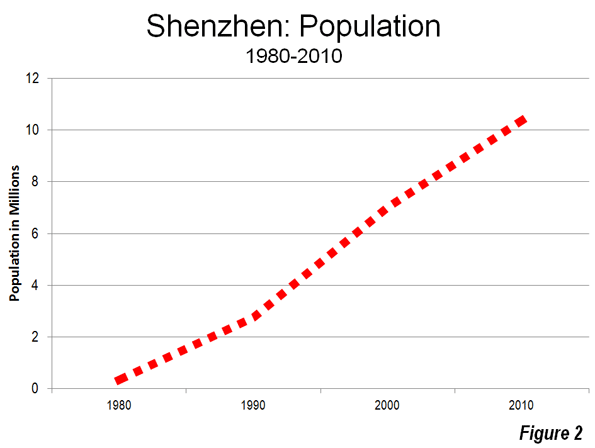
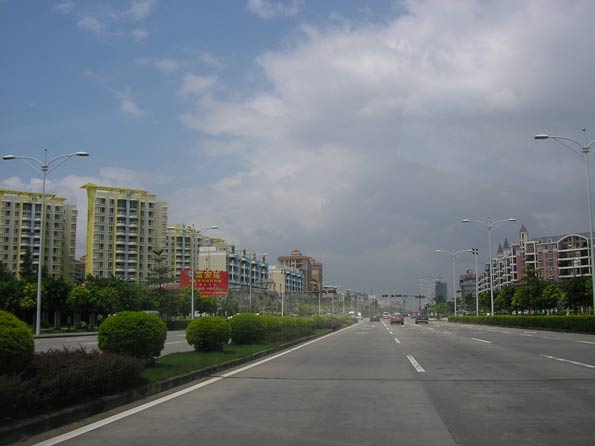
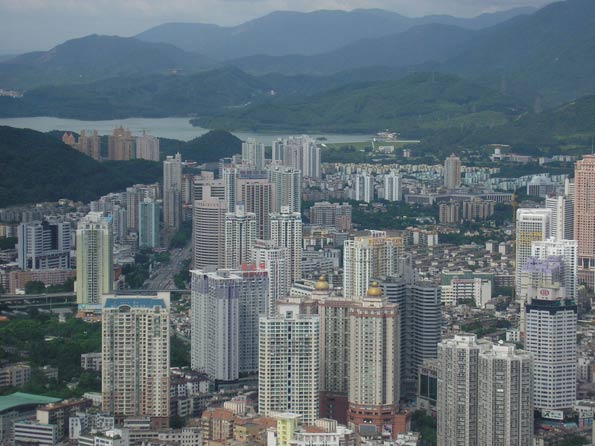
    No urban area in history has become so large so quickly than Shenzhen (Note 1). A little more than a fishing village in 1979, by the 2010 census Shenzhen registered 10.4 million inhabitants. It is easily the youngest urban area to have become one of the world’s 26 megacities (Figure 1). Most other megacities were the largest urban areas in their nations for centuries (such as London and Paris) and a few for more than a millennium (such as Istanbul and Beijing). Shenzhen’s primitiveness can be seen in this 1980 internet photo, and shows the beginnings of construction. A 2006 photograph of one of Shenzhen’s principal streets (Binhe Avenue) is above.

    Pearl River Delta Location: Shenzhen is located in Guangdong Province adjacent to Hong Kong’s northern border. Shenzhen is China’s fourth largest urban area, following Shanghai, Beijing, and Guangzou-Foshan.

    Along with Dongguan, Guanzhou, Foshan and smaller neighbors, Shenzhen forms the Pearl River Delta,   the world’s largest manufacturing center. The Pearl River Delta, along with Hong Kong and Macau, constitutes the world’s largest populated extent of urbanization, with nearly 50 million people. They live in a land area of just over 3,000 square kilometers (7,800 square kilometers. By comparison the world’s largest urban area, Tokyo-Yokohama, has a population of 37 million and covers 3,300 square miles (8,500 square kilometers). I recall from a Hong Kong to Guangzhou trip on the Canton-Kowloon Railway in 1999 that there was plenty of rural territory on the 100 mile (170 kilometers) route. Today,   development takes place along virtually the entire route (Note 2).

    The Special Economic Zone: Shenzhen was established as China’s first special economic zone by Deng Xiaoping in the period of liberalization after the death of Mao Zedong. The special economic zones allowed for alternative, generally market oriented reforms, with the end of improving economic growth. The result was economic progress far greater than anyone expected. The special economic zone program was eventually extended to several other urban areas in the nation.

    Some governmental officials preferred the previous state dominated approach, despite its greater poverty and sought to roll back the reforms. This threat reached its peak in the early 1990s, after Deng Xiaoping had retired from his government positions. In response, Deng undertook his renown "southern tour" to Shenzhen, Guangzhou and other parts of Guangdong province to promote the new economic approach and the progress that had been made. During the southern tour, Deng is reputed to have said that "to be rich is glorious." Three decades before he had said “I don’t care if it’s a white cat or a black cat. It’s a good cat as long as it catches mice." He committed to results rather than to ideology, in a sense Shenzen and its environs are the engines of non-state owned prosperity. Eventually, the publicity from Deng’s southern tour overwhelmed the opposition and China accelerated its move toward a more open economy.

    Shenzhen’s Core: Unlike the fast growing, but much smaller new urban areas of the United States (for example Phoenix, which is largely a low rise, dispersed expanse of suburbanization), Shenzhen has developed a dense central business district. Even though Shenzhen started the decade of the 1990s with little more than 1,000,000 residents, by 1996 it had the fourth tallest building in the world, the Shun Hing Tower. Only the Sears Tower in Chicago and the two World Trade Center Towers in New York were taller.

    In 2011, the Shun Hing Tower lost its local tallest building title to the Kingkey Financial Tower, at 1,449 feet (447 meters) is the 10th tallest building in the world. Now, the world’s second tallest building is under construction in Shenzhen, the Ping An International Financial Center, which is reported to reach 2,125 feet or 655 meters, with 116 floors. Only the Burj Khalifa (2,717 feet, 828 meters, 163 floors) in Dubai would be higher. Like Shanghai and Chongqing (and unlike most Chinese urban areas), Shenzhen has a highly concentrated central business district. As a result deserio.com rates Shenzhen’s skyline as 9th in the world (Note 3).

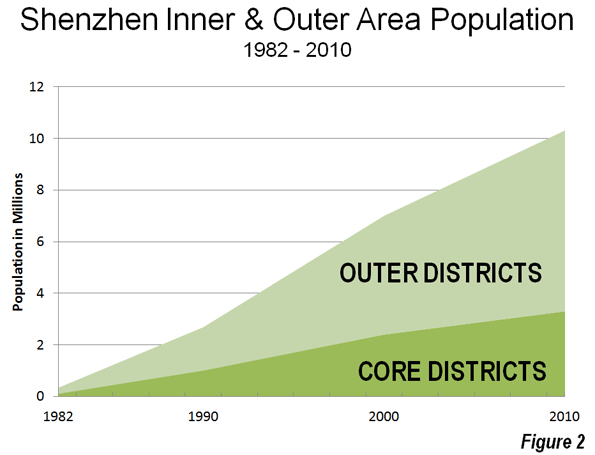
    Outer Areas Growing Faster: The three central districts (the qu of Futian, Luohu and Nanshan) grew from 2.4 million to 3.3 million population between 2000 and 2010, a rate of 38 percent. However, as is natural for a growing urban area, most of the growth was in the outer districts (Photo: Suburban Shenzhen), which grew from 4.6 million to 7.0 million, a growth rate of 52 percent. Thus, nearly three-quarters of the growth was on the periphery (Figure 2). Population growth in the earlier 1990 and 2000 period was slightly less concentrated in the outer area (68 percent). But overall  population growth has begun to slow down, with Shenzhen added 3.3 million new residents, compared to 4.3 million between 1990 and 2000.  


    Photo: Suburban Shenzhen (Longgang)

    The Urban Area: Overall, it is estimated that the Shenzhen urban area (area of continuous development) has a 2012 population of 11.9 million, with a land area of 675 square miles (1,745 square kilometers). The urban area has now crossed the border into the Huiyang district of the Huizhou region, to the east. The population density is estimated at 17,600 per square mile, or 6,800 per square kilometer,  approximately 10 percent less dense than the average urban area in China. Shenzhen is about one quarter the density of Hong Kong and double the density of Paris.

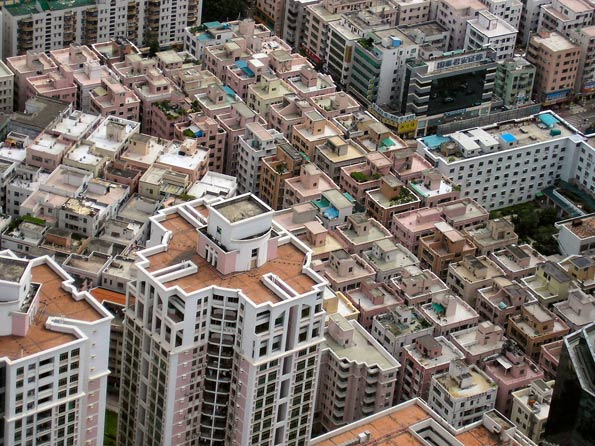
    Rich and Poor in Shenzhen: Like all urban areas, Shenzhen is a mixture of rich and poor. Shenzhen is generally considered one of the most affluent urban areas in China, yet it also has a very large low income population. Approximately one-sixth of China’s residents are considered to be temporary migrants; many work in boomtowns like Shenzhen. Seven million of these 220 million migrants live in Shenzhen,  considered the largest migrant population of any region in the nation. Migrants are attracted to Shenzhen for the same reasons people have moved to cities from early on: to get ahead. At the same time, their remittances sent back home are contributing to improved living conditions far beyond Shenzhen. It is expected that reforms to the "hukou" system of residence permits will allow many of the temporary migrants in Shenzhen and elsewhere obtain permanent residence status. Many of the migrants live in factory housing, or older, very densely packed buildings. At the same time, Shenzhen has a large number of world-class condominium buildings.


    Photo: Older Housing: Central Business District


    Photo: Newer Housing: Central Business District

    The Future of Shenzhen: Much of Shenzhen’s future will depend upon the economy of the Pearl River Delta and the extent to which migrants are able to obtain permanent residency status. There is still land enough in the region for substantial population growth. The longer term integration of the Hong Kong and Shenzhen economies could produce an even larger economic dynamo than the two that are currently separate. One thing is certain, however. Shenzhen has led China into a new economic and urban reality.

    Wendell Cox is a Visiting Professor, Conservatoire National des Arts et Metiers, Paris and the author of “War on the Dream: How Anti-Sprawl Policy Threatens the Quality of Life”.

    —–

    Note 1: Shenzhen is one of China’s regions, often called "cities," as translated from "shi."  "Shi" more resemble regions than "cities" in the non-Chinese sense, this article refers to "shi" as regions. "Shi" were formerly referred to in English as prefectures. A province is usually composed of "shis" and other "shi" level jurisdictions.

    Note 2: These combined regions are not a metropolitan area, for two reasons. First; there is little daily commuting between them and thus they are not a single labor market, which is the definition of a metropolitan area. Second, one of the regions, Hong Kong, has a border with Shenzhen that has international style customs and immigrant controls, which further precludes the two adjacent regions from being a single metropolitan area. In the longer run, greater affluence, greater mobility between the regions and relaxation of border controls could merge some or all of the now separate metropolitan areas.

    Note 3: Desiro.com, unlike some other skyline rating systems, places a premium on the density of buildings, rather than simply amalgamating building heights from throughout an urban area.

    Photo: Shenzhen:  Binhe Avenue from the Shun Hing Tower (by author)

  • Seattle Is Leading An American Manufacturing Revival – Top Manufacturing Growth Regions

    In this still tepid recovery, the biggest feel-good story has been the resurgence of American manufacturing. As industrial production has fallen in Europe and growth has slowed in China, U.S. factories have continued an expansion that has stretched on for over 33 months. In April, manufacturing growth was the strongest in 10 months.

    There are a number of reasons for this revival. Rising wages in China – up from roughly one-third U.S. levels to half that in a decade — and problems associated with protection of trademarks and other issues have led many U.S. executives to look back home. Some 22% of U.S. product manufacturers surveyed by MFGWatch reported moving some production back to America in the fourth quarter of 2011, and one in three said they were studying the proposition.

    Certainly how long this expansion can last is an open question, particularly given weakness in Europe and the slowdown in formerly fast-growing developing countries. But one thing is clear: the industrial resurgence is reshaping the economic and employment map in often unexpected ways.

    Now rather than being pulled down by manufacturing, our Best Cities For Jobs survey, conducted by Pepperdine University’s Michael Shires, found that many industrial regions are benefiting from their prowess.

    From 2010 through March, manufacturers added 470,000 jobs and enjoyed a rate of job growth 10% faster than the rest of the private economy. In the past many areas suffered from having too many industrial workers. Now it looks like we will have too few skilled ones, even in hard-hit sectors like the auto industry. In 2011 there were 50,000 unfilled U.S. job openings in industrial engineering, welding, and computer-controlled machine tool operating, according to the forecasting firm EMSI. If the revival continues, this shortage could worsen.

    To determine the cities that are leading the manufacturing revival, we assessed manufacturing employment growth in the 65 largest metropolitan statistical areas. Rankings are based on recent growth trends, as well as job growth over the past five and 10 years, and the MSAs’ momentum (see the bottom of this piece for the full rankings list).

    Where Technology Meets Manufacturing

    In an era of excitement over the Internet, it is often forgotten that a majority of the country’s scientists and engineers work for manufacturers, and that industrial companies account for 68% of business R&D spending, which in turn accounts for about 70% of total R&D spending.

    Nowhere is this linkage between technology and industry more evident than in the Seattle-Bellevue-Everett area, which ranks first on our list of the metropolitan areas leading the manufacturing revival. Over the past year the region was No. 2 in the nation in manufacturing growth, with employment expanding 7.9%. The aerospace sector, led by Boeing, accounted for roughly half this expansion.

    The growth in aerospace and high-tech employment creates precisely the kinds of high-wage jobs, including for blue-collar workers, that are lacking in many parts of the country. In 2010 the average factory wage in the area was $64,925, up 9% from 2007. Most critically, manufacturing activity drives growth in other sectors of the economy. About one in six of all private-sector jobs depend on the manufacturing sector, and every dollar of sales of manufactured products generates $1.40 in output from other sectors, the highest of any industry.

    As manufacturing employment overall has dropped, the percentage of higher-wage, skilled industrial jobs has been climbing over the last decades, particularly in high-technology related fields Overall, according to EMSI data, the average American factory worker earned $73,000 in 2011, $20,000 more than the average job.

    Seattle is not alone in creating high-tech-oriented industrial jobs. Over the past two years Salt Lake City, Utah, which ranks third on our list, has seen significant growth in both electronics and aerospace employment, including a new Northrop Grumman facility. Firms connected to the medical device industry such as Biomerics are also expanding in the area.

    Manufacturing is also rebounding in Austin-Round Rock-San Marcos, Texas, which ranks eighth on our list and No. 1 on our overall list of Best Big Cities For Jobs. Last year industrial employment in the Texas state capital area jumped 5%. Semiconductor firms are a big force, employing over 10,000 workers. Although more known for its high-tech electronics, Austin has also enjoyed an expansion in automobile-related employment as well as medical devices.

    Energy Capitals

    The largest grouping of manufacturing stars have emerged from the Texas-Oklahoma energy belt. With the shale drilling boom unlocking ample supplies of natural gas and lowering prices, petrochemical companies have undertaken major expansions. The rise in drilling and exploration has also sparked greater demand for industrial products such as pipes, drill rigs and other machinery. No surprise that the biggest backers of shale gas exploration are prominent CEOs of industrial firms. A recent study by PwC suggests that shale gas could lead to the development of 1 million industrial jobs.

    The shale drilling revolution is making an impact across the country, in places like North Dakota and Youngstown, Ohio, but the epicenter of this boom remains firmly in the oil patch. The Thunder you hear in Oklahoma City is not just on the basketball court — energy growth has propelled a 1,500 person jump in manufacturing employment, a 6.1% increase, with another 1,000 new jobs expected this year. Oklahoma City ranks second on our list.

    Other energy capitals are also thriving on the industrial front, including Houston (fourth place), San Antonio (seventh) and Ft. Worth-Arlington (ninth). Although energy is the main driver, manufacturing has been on the rise in a broad array of areas, including aerospace, biomedical and food processing. The surging export economy — Texas is easily the nation’s number one exporter — has further bolstered this growth.

    Rustbelt Rebounders

    The high-tech and energy economies may be fast-breaking in terms of industrial growth, but manufacturing’s comeback has put some new bounce in the step of many long forlorn parts of the nation’s “rustbelt.” Warren-Troy-Farmington Hills, Mich., epitomizes this trend. Unlike Detroit, which has suffered mass disinvestment, this more suburban area a half hour drive away has become the epicenter of a new, more tech-oriented auto industry.

    The Warren-Troy area’s rich concentration of skilled tradespeople and industrial engineers has been described as America’s “automation alley.” It continues to attract high-industrial firms from abroad such as Brose, a German car parts manufacturer, which has recently announced a $60 million investment in the area. Even housing is on the rebound, with rents rising at the fourth highest clip in the country, just behind such standouts as San Francisco and Miami.

    Nor is the Midwest manufacturing rebound limited to Michigan. Over the past year sixth-ranked Cincinnati enjoyed 5.4% growth in industrial employment. Manufacturing growth was also strong in Milwaukee-Waukesha-West Allis, Wisc., a center for the production of machine tools and other precision equipment that ranks 10th on our list.

    Who’s Falling Behind

    Of course not all regions have benefited from the industrial resurgence. For example, the nation’s largest industrial area, Los Angeles, ranks a miserable 49th. The area lost some 20% of its industrial jobs since 2006, and the losses continued over the past year. This goes a long way to explain the area’s continued underperformance before, during and, now, in the early days of recovery from the financial crisis.

    Some other large regions did even worse, including such one-time industrial powerhouses as Philadelphia (55th) and New York (59th). Some may argue that these, and other areas, which have been losing manufacturing jobs for decades, no longer need to engage in the messy business of making stuff. But that long fashionable way thinking may be outdated itself, as seen by the improving fortunes of our industrial top 10.

    Top Large Regions for Manufacturing Growth

    Rank Area 2012 Weighted INDEX 2011 Manuf. Employment (000s)
    1 Seattle-Bellevue-Everett, WA Metropolitan Division 81.2 164.3
    2 Oklahoma City, OK 74.8 33.6
    3 Salt Lake City, UT 74.7 55.1
    4 Houston-Sugar Land-Baytown, TX 74.6 229.8
    5 Warren-Troy-Farmington Hills, MI Metropolitan Division 74.4 135.3
    6 Cincinnati-Middletown, OH-KY-IN 71.7 109.3
    7 San Antonio-New Braunfels, TX 70.3 46.3
    8 Austin-Round Rock-San Marcos, TX 69.3 50.9
    9 Fort Worth-Arlington, TX Metropolitan Division 68.3 89.1
    10 Milwaukee-Waukesha-West Allis, WI 67.9 118.5
    11 San Jose-Sunnyvale-Santa Clara, CA 67.3 157.9
    12 Buffalo-Niagara Falls, NY 65.8 52.3
    13 Kansas City, MO 65.2 40.5
    14 Omaha-Council Bluffs, NE-IA 64.7 31.8
    15 Minneapolis-St. Paul-Bloomington, MN-WI 63.5 178.7
    16 Fort Lauderdale-Pompano Beach-Deerfield Beach, FL Metro. Division 63.1 27.1
    17 Bergen-Hudson-Passaic, NJ 62.8 63.3
    18 Cleveland-Elyria-Mentor, OH 61.7 121.2
    19 Portland-Vancouver-Hillsboro, OR-WA 61.1 110.0
    20 Santa Ana-Anaheim-Irvine, CA Metropolitan Division 60.0 154.9
    21 Columbus, OH 58.0 65.2
    22 Charlotte-Gastonia-Rock Hill, NC-SC 57.4 67.9
    23 Boston-Cambridge-Quincy, MA NECTA Division 56.9 94.6
    24 Detroit-Livonia-Dearborn, MI Metropolitan Division 55.8 72.9
    25 Atlanta-Sandy Springs-Marietta, GA 55.2 147.9
    26 Chicago-Joliet-Naperville, IL Metropolitan Division 54.4 322.4
    27 Hartford-West Hartford-East Hartford, CT NECTA 54.1 57.0
    28 Pittsburgh, PA 53.3 87.8
    29 San Diego-Carlsbad-San Marcos, CA 52.8 92.0
    30 Dallas-Plano-Irving, TX Metropolitan Division 52.8 167.4
    31 St. Louis, MO-IL 52.8 111.4
    32 Rochester, NY 51.7 61.1
    33 Virginia Beach-Norfolk-Newport News, VA-NC 51.3 52.0
    34 Denver-Aurora-Broomfield, CO 51.0 61.2
    35 Nassau-Suffolk, NY Metropolitan Division 50.4 72.8
    36 Providence-Fall River-Warwick, RI-MA NECTA 48.8 51.8
    37 San Francisco-San Mateo-Redwood City, CA Metropolitan Division 47.4 36.8
    38 New Orleans-Metairie-Kenner, LA 45.8 31.3
    39 Northern Virginia, VA 43.7 23.0
    40 Orlando-Kissimmee-Sanford, FL 43.4 37.8
    41 Tampa-St. Petersburg-Clearwater, FL 43.3 60.0
    42 Memphis, TN-MS-AR 42.9 44.3
    43 Phoenix-Mesa-Glendale, AZ 42.9 112.3
    44 Oakland-Fremont-Hayward, CA Metropolitan Division 42.3 78.2
    45 Raleigh-Cary, NC 41.5 27.3
    46 Birmingham-Hoover, AL 39.7 35.2
    47 Louisville-Jefferson County, KY-IN 38.8 63.5
    48 Nashville-Davidson–Murfreesboro–Franklin, TN 38.3 62.8
    49 Los Angeles-Long Beach-Glendale, CA Metropolitan Division 38.2 359.7
    50 Indianapolis-Carmel, IN 37.9 80.8
    51 Las Vegas-Paradise, NV 37.1 19.7
    52 Newark-Union, NJ-PA Metropolitan Division 35.2 68.8
    53 Jacksonville, FL 34.5 26.7
    54 Bethesda-Rockville-Frederick, MD Metropolitan Division 34.1 16.1
    55 Philadelphia City, PA 33.3 23.1
    56 West Palm Beach-Boca Raton-Boynton Beach, FL Metropolitan Division 32.4 15.0
    57 Sacramento–Arden-Arcade–Roseville, CA 31.9 32.5
    58 New York City, NY 30.9 73.3
    59 Miami-Miami Beach-Kendall, FL Metropolitan Division 28.9 35.4
    60 Camden, NJ Metropolitan Division 27.5 36.2
    61 Washington-Arlington-Alexandria, DC-VA-MD-WV Metro. Division 27.1 33.6
    62 Riverside-San Bernardino-Ontario, CA 25.5 86.6
    63 Putnam-Rockland-Westchester, NY 24.8 24.6
    64 Edison-New Brunswick, NJ Metropolitan Division 24.3 58.2
    65 Richmond, VA 18.7 30.9

    The index is calculated using the same methodology as our Best Cities for Job Growth, but using only manufacturing employment in each region.

    Joel Kotkin is executive editor of NewGeography.com and is a distinguished presidential fellow in urban futures at Chapman University, and contributing editor to the City Journal in New York. He is author of The City: A Global History. His newest book is The Next Hundred Million: America in 2050, released in February, 2010.

    Seattle waterfront photo by BigStockPhoto.com.

  • Populate or Perish?

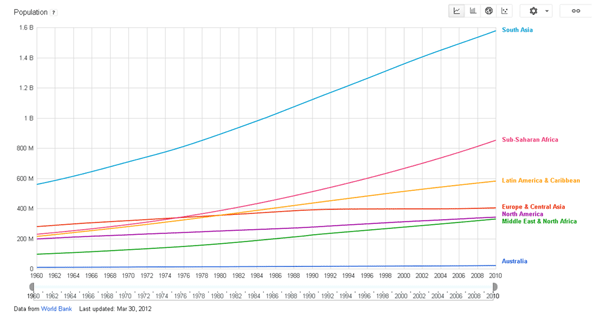
    Many global population projections point to the current world population of roughly seven billion people peaking at around nine to ten billion in 2050, after which numbers will slowly decline. In the midst of this growth, Australia’s current population of 23 million is predicted to rise to around 30 or 35 million in the same period. This low growth outlook has been called ‘big Australia.’ We are kidding ourselves, aren’t we?

    ‘Populate or perish’ was a rallying cry of post-World War II Labor Immigration Minister Arthur Calwell as he sought to overcome domestic resistance to immigration. For Calwell, immigration was the key to quickly boosting Australia’s population numbers in the interests of economic and military security. An avowed supporter of the ‘white Australia policy’ he sought immigrants from European backgrounds. Asia was, back then, regarded as the enemy.


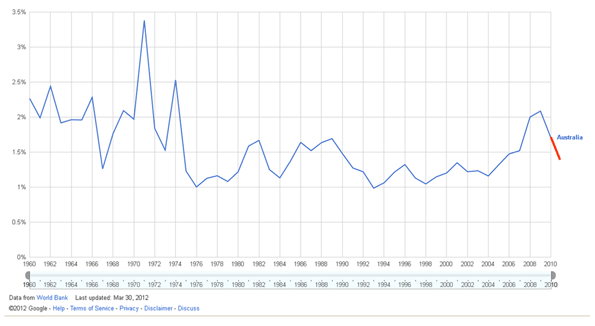
    Above: world populations since 1960. Below: Australia’s rate of population growth since 1960. Source: World Bank.

    How things change, yet stay the same. In 2012, it’s arguably just as much in Australia’s interests to boost its population numbers, in the interests of economic security and (according to some) military security also. And again, immigration – not an accelerated breeding program of naturalised Australians – is the only way this can realistically occur. As domestic industries increasingly surrender to global competition and as energy, agriculture and services industries increasingly depend on foreign markets for their long term survival, the issue of Australia’s relatively small population – despite its huge continental mass – raises little by way of public debate. A larger domestic population might provide markets for domestic industries, for local employment and for community wide infrastructure.

    In contrast the planning fraternity’s dreams of Parisian, London, or New York standards of public transport, for example, will never succeed. Our cities are simply too small to make this work.

    But talk of a ‘big Australia’ has become ‘persona non grata’ in public policy circles. We have a Federal Population Minister, but he hasn’t issued a single statement on population policy this year.  Our Prime Minister has other things on her mind, but even if her government was on more solid ground her antipathy to a ‘big Australia’ is well known and a matter of public record. And such is the apparent public hostility to the notion of a bigger population, intermixed as it is with a blend of doomsday environmentalism and references to failed Malthusian or Paul Ehlrich ‘Population Bomb’ scenarios and  myths (suggesting that Australia is running out of room and resources), that few political or public policy leaders want to take up the debate in favour of growth.

    With that in mind, I thought some very simple reality checks might prove helpful to stimulate your thinking about Australia’s population capacity relative to the rest of the world. Wendell Cox, author of the global housing affordability study ‘Demographia’ recently published his Demographia World Urban Areasreport with this summary on New Geography. I want to take just two examples and interpose them into the Australian context.

    First, let’s look at Los Angeles, California.  Often cited as a region with similarities to the Australian urban context (both in a positive and negative sense), this city popularly known for its ‘sprawl’ actually has a very high level of population density. The total population of the Greater Los Angeles area is around 15 million people. Put into context, that’s roughly two thirds of the entire population of Australia living in the Greater Los Angeles ‘sprawl.’


    Above: The greater Los Angeles area and below, the same area superimposed in south east Queensland.

    Put into a visual context, the contrast is even more apparent. At LA levels of population density, roughly the area we know of as south east Queensland could accommodate some 15 million people comfortably. Yet the conventional “wisdom” is that with just 3 million people it’s bursting at the seams and can’t possibly take any more

    A more extreme example, just to stretch the imagination further, is worth thinking about. Jakarta, Indonesia (our nearest large foreign neighbour) has a population of 26 million people. That’s more than the entire population of Australia, living in one (very crowded) city – at the rate of 9,400 people per square kilometre.

    Now, I’m not wishing that sort of urban density (and in large part, misery) on anyone in Australia, but the hypothetical comparison still applies, for the sake of discussion only. The footprint of greater urban Jakarta, home to 26 million people, easily fits within the boundary of south east Queensland.  In fact, it doesn’t even require the Gold or Sunshine Coasts to do it. Imagine this: the entire population of Australia, crammed as it would be into this super-compact urban footprint, and not a single soul living anywhere else on the entire continent?


    Above: Jakarta’s footprint and below, the same footprint – home to 26 million people – superimposed on south east Queensland.

    The argument that Australia is somehow incapable of supporting substantially larger population relies on a myth that we short of room. Nor can it rely on suggestions that we would exhaust our energy stocks (we are a net exporter and would remain so at much larger population numbers), nor our food production capacity (again, we are a net exporter and would remain so even with much higher levels of population). In fact, in terms of food production, a lack of domestic market scale poses a significant problem for producers. The efficiency gains of primary production (livestock to cropping) have outpaced the growth in population.

    There is an argument regularly raised that Australia has insufficient water supply to support much larger population numbers but this argument doesn’t hold water (sorry, couldn’t help that) either. What we do lack is water storage by way of dams, but the environmental lobby has vigorously opposed almost every proposed dam in the last 30 years whether for domestic supply, agriculture or hydro energy. The lack of water storage has been a policy decision made by successive governments for varying political reasons.   

    Think also for a moment how cities like Mexico City (population nearly 20 million people) or Cairo (population 18 million) or even countries like Morocco (population 32 million in 500,000 square kilometres on the edge of the Sahara compared with Australia’s 7.6 million square kilometres) manage for water? For Australia to claim it cannot support more people due to water limitations is a bit of joke.

    Above: arable land area in hectares per person. Australia is well ahead of the field.

    Infrastructure deficits are the other vexed issue raised by by those concerned with population growth. They have pointed out that infrastructure investment has not kept pace with population, and they’re right. The problem though is largely that strategic infrastructure investment in this country is something really only talked about. Instead, what typically happens is that billions are doled out on pet projects in marginal seats or designed to win over particular interest groups that some focus group or other suggests could hold the key to winning the next election. Politically motivated rail projects (especially in NSW), home insulation schemes, TV set box boxes, green energy schemes… the list of our nation’s capacity to waste vast sums quickly is pretty impressive. Our deficient national road network, our inadequate domestic water storage (in many areas), our looming potential energy problems (not just in price thanks to a carbon tax but also in terms of power generation shortages according to some experts) – the bigger and more strategic infrastructure priorities which would support growth seem to get the least attention. Witness the latest Federal Government budget. (Read what Infrastructure Partnerships Australia, among others critical of the budget, had to say here).

    So the capacity to fund and deliver strategic infrastructure isn’t the issue. Inept public policy is.

    Instead, do we have some other more deep seated aversion to a bigger population? And is this race based? Despite being a successful nation of immigrants (  are we fearful for our culture if we had more immigration? Environmental impacts are often publicly cited as the reason to oppose more people, but if the examples of Los Angeles or Jakarta are remembered, we could in theory house a great deal more people without encroaching on vast areas of natural terrain.

    Another big reason to reconsider objections to a ‘big Australia’ is the ticking clock on Australia’s ageing population. Even the Federal Government’s own ‘Tax Reform Roadmap’ released with the May budget warned that:  “The proportion of working age people is projected to fall markedly over the coming decades. Today there are about 4.8 people of traditional working age for every person aged 65 and over. This is expected to fall to around 4 people within the next 10 years and to around 2.7 people by 2050.”

    Australia’s current rate of population growth is hovering around 1.4%. We are just shy of 23 million people. We say we’re concerned about getting to 35 million by 2050, by which time the world population will have increased by 2 billion people. We know that our ageing population will struggle to be supported by a diminished workforce  and that we lack sufficient critical mass to sustain a variety of industries in the face of global competition. Yet we consistently refuse to confront the question of a larger population and the consequences of failing to have one.

    Ultimately even if we agree collectively to prefer to remain a small nation of less than 30 million, it’s a discussion we need to be having. Pretending the issue isn’t there won’t do anyone any good.

    Ross Elliott has more than 20 years experience in property and public policy. His past roles have included stints in urban economics, national and state roles with the Property Council, and in destination marketing. He has written extensively on a range of public policy issues centering around urban issues, and continues to maintain his recreational interest in public policy through ongoing contributions such as this or via his monthly blog The Pulse.

    Australia graphic by Bigstockphoto.com.