Blog

  • 84% of 18-to-34-Year-Olds Want To Own Homes

    A survey by TD Bank indicates that 84 percent of people 18 to 34 years old intend to buy homes in the future. This runs counter to thinking that has been expressed by some, indicating that renting would become more popular in the future. Much of the "home ownership is dead or dying” comes from short sighted trend analysis in which home ownership data begins with the start of the housing bubble in the late 1990s. The latest data from the Bureau of the Census indicates that the home ownership rate in the first quarter was 65.4 percent, the lowest rate since 1997. In fact, however, before the housing bubble, homeownership hovered generally at 65 percent or below, after having increased strongly from 44 percent in 1940 to 61 percent in 1960. The increase in homeownership during the bubble was the result of profligate lending policies that were not sustainable. The decline from the artificially high housing bubble peak in no way diminishes the successful expansion of homeownership in the nation during the decades that reason prevailed in home lending.

  • How “Public” Is the Public Sector?

    You may have heard the old joke about the convenience store with a neon sign blaring, “Open 24 Hours”. A customer stops in one morning for coffee, and confronts the store’s owner, “Your sign says ‘Open 24 Hours’, but I stopped by last night at midnight for a pack of smokes and you were closed.” The owner replies, “Oh, we’re open 24 hours…just not in a row.”

    I’ve been reminded of this exchange during one of the more intriguing battles over what “public ownership” means in California’s state parks. Governor Brown has designated 70 of them (out of 278) for closure in an effort to help close the state’s chronic multi-billion dollar budget deficit. In response, a Marin County Democratic Assemblyman, Jared Huffman, offered AB 42. The measure, which has now been signed into law, makes it easier for non-profits to enter into operating agreements with at least 20 of the parks on the chopping block. The law cuts the typical red-tape involved in forming such a “public-civic partnership”, including greater freedom in hiring and providing some added legal protections. And AB42 has been written specifically to hold local governments harmless from possible shoddy work, so lawsuits aren’t an issue. Over the last six months a number of parks have started making such arrangements and will continue to operate. But this is not without some consternation.

    The first AB42-enabled contract has recently been signed between the previously closed Jack London State Park in Sonoma County and the Valley of the Moon Natural History Association, which will handle staffing and maintenance for this $500,000 annually budgeted facility. The Association plans to cover expenses through a mix of fundraisers, volunteer labor, and creative marketing.

    Asked for her opinion on these new public-civic partnerships, state Sen. Noreen Evans (D-Coastal Northern CA) recently told The Huffington Post why she disliked the legislation: “My own philosophy is that a state park should be owned and operated by the public. Any time you turn even a portion of a state park away from public control, you always have the problem that the park’s interest becomes inconsistent with serving the public.” But this leaves open the question of what the senator means by ‘owned and operated by the public’?

    Of course a state park is ‘owned by the public’ in the broadest sense, but what control do I, as a Californian, really have over how my state parks are run? In many of these AB 42 relationships between state parks and local organizations, the public is far more involved in the maintenance and running of these places than they were before.

    In another issue I’ve written about, a group of parents and community volunteers were threatened with a union lawsuit if they persisted in their efforts to assume administrative tasks in a San Francisco Bay Area junior high school that had been hit with several years of budget cuts.

    The local chapter of the California Service Employees’ Association (CSEA), sought to prevent parents and residents from volunteering as playground supervisors and back office staff. Said CSEA local president, Loretta Kruusmagi, “As far as I’m concerned, they never should have started this thing. Noon-duty people [lunchtime and playground assistants]—those are instructional assistants. We had all those positions. We don’t have them anymore, but those are our positions. Our stand is you can’t have volunteers, they can’t do our work.”

    Notice the sense of ownership over these public sector positions. Even in the face of dire municipal fiscal situations, with stark choices between whether or not to continue services everywhere from parks to libraries, public sector unions are increasingly challenging local volunteers who are attempting to fill the gap. It is easy to wonder whom are the real “public servants” – the employees or the parents? As to complaints about the quality of volunteers, I’m not sure unprofessional behavior by volunteers outnumbers – even per capita – that by unionized/fulltime employees.

    A similar story is being written currently in the West Los Angeles area Culver City Unified School District. Here, in an interesting twist on the aforementioned tale, a service union in a local elementary school is seeking to force willingly lower paid classroom attendants to unionize, and demanding that a local charity pay for these unionized positions. The El Marino Language School has been a dual language (Spanish and Japanese) immersion program for more than two decades.

    A “blue-ribbon” school in California, the students of El Marino have scored exceedingly high in a number of categories . In order to keep the students “immersed”, the school began hiring native language-speaking “adjuncts” to work in classrooms for a few hours each day – usually a couple of days per week. An additional element to what the district usually supports, these positions – often filled by parents of current or former students with teaching experience – are supported by a group of local booster clubs.

    The longtime program apparently escaped the watchful eye of the Association of Classified Employees (“ACE”), which represents service employees in the district. Upon learning that these non-unionized “adjuncts” were working at El Marino, ACE gave the district an ultimatum: force them to unionize or allow us to bring in our own “adjuncts”.

    The current battles over how “public” libraries will be run in California casts a bright light on the use of this rhetoric by municipal unions seeking to keep out competition from private organizations. The city council of Santa Clarita, voted to withdraw from the Los Angeles County system, and contract out their three libraries to LSSI (Library Systems and Services), a private company based in Germantown, Maryland.

    The response from some residents and the library employees’ union was an outcry at the supposed “privatizing” of the public library. As the New York Times reported, protest signs at the council meeting declared, “keep our libraries public”, as if access to their libraries was going to be constrained by LSSI. As then-mayor pro tem, Marsh McLean responded, “The libraries are still going to be public libraries. When people say we’re privatizing libraries, that is just not a true statement, period.”

    Faced with the prospect of more communities deciding to offer library services through contracted firms, California’s SEIU lobbied the Legislature for passage of AB 438, which adds extra hurdles to city councils making these decisions. Proclaiming that they had “beat the privatization beast in California”, LA County Community Library Manager and SEIU Executive Board Member, Cindy Singer said, “By signing AB 438, Governor Brown put taxpayers and the public ahead of the profits of privately held corporations.” But, once again, knowing exactly what “public” Ms. Singer is referring to requires some circuitous thinking.

    Her statement is patently untrue in Santa Clarita, where, as Atlantic Cities describes, “Hours have increased. The library is now open on Sundays. There are 77 new computers, [and] a new book collection dedicated to homeschooling parents and more children’s programs.” It appears Santa Claritans have come out “ahead”.

    The macroeconomic term “crowding out” is broadly used to describe the adverse impact on private investment created by government action. The phrase also applies to the negating influence government-delivered services can have on the actions of non-profits and businesses. This is not to say that volunteers and businesses can (or should) fill all the gaps exposed by the fiscal crisis, but it may be time to consider a new phrase, as Americans assume an old role: “crowding in” anyone?

    Pete Peterson is Executive Director of the Davenport Institute for Public Engagement and Civic Leadership at Pepperdine University’s School of Public Policy.

    Flickr Photo by robinsan, Parking Volunteer

  • Sydney’s Long and Lengthening Commute Times

    The New South Wales Department of Transport Housing and Transportation Survey reports that the average one way work trip in the Sydney metropolitan area (statistical division) reached 34.3 minutes in 2010. As a result, Sydney now has the longest reported commute time in the New World (United States, Canada, Australia and New Zealand), except for the New York City metropolitan area (34.6 minutes).

    Longer Commutes than in Dallas-Fort Worth or Los Angeles: Sydney’s average work trip travel time has increased approximately 10 percent since 2002. The 34.3 minute one way travel time is approximately 30 percent higher than that of larger Dallas-Fort Worth, which about half as dense. Part of the reason for the longer commute time in Sydney is its far greater transit dependence. Approximately 24 percent of work trip travel is on transit (which is slower for most trips). This compares to approximately 2 percent of travel in Dallas-Fort Worth.

    Even Los Angeles, with its reputation for "gridlock" has a shorter average commute time, at 28.1 minutes. This is made possible by the extensive Los Angeles freeway system, greater use of automobiles and more dispersed employment patterns (despite the higher density of Los Angeles relative to Sydney). The average Sydney commuter spends nearly an hour longer traveling to work each week than the average Los Angeles commuter.

    Even Longer Commutes Ahead? Sydney’s densification policies (urban consolidation policies) seem likely to lengthen commute times even more in the future, given the association between higher densities and greater traffic congestion.
  • CNU20: New Urbanism’s Young Adult Angst

    Possibly the most earnest folks in the real estate development industry assembled for the 20th anniversary of the founding of the Congress of the New Urbanism in West Palm Beach, Florida this month. Among the excellent accomplishments of CNU20 attendees: a credible car/pedestrian strategy, some fine looking new communities, and perhaps best of all, a body of hard-won knowledge about town-making for citizen education.

    Officially, CNU20 was optimistic and confident, but an undercurrent of negativism marred the event. More than one New Urbanist questioned the validity of what by now should have been a transformative movement. But the imposition of form-based codes and regulations on city growth has become a stress point in the movement’s evolution.

    Three hundred communities now boast New Urbanist town planning, over a dozen communities have adopted form-based zoning, and urban design schools are teaching the New Urban principles all over the country, facts triumphed during the opening plenary session. Form-based zoning uses a hierarchy of increasingly dense districts with defined boundaries, rather than land-use (or Euclidian) zoning to regulate growth. These principles are exquisitely defined in a model code nicknamed the Smart Code, which defines street width and sidewalk width, and provides fine-grained guidance on the form of a building on a given lot. Participants in early work sessions were taught how to work the code, and walked the hot, humid streets of West Palm Beach to interpret its many nuances and subtleties.

    In 2003, Downtown West Palm Beach was redeveloped, and it should be a proud example of the earliest New Urban efforts. Instead, conference participants spoke of the result with open distaste. The main outdoor plaza features a noisy fountain, which a group of attorneys, architects, and land planners belittled as “a mini Bellagio”; a pale imitation of the huge Las Vegas hotel’s water feature. Andrés Duany, one of the founders of the CNU, stated during the conference that “much of the architecture of the downtown zone was junk.” The movement’s most flamboyant spokesman, James Howard Kunstler, cited the “cartoonish, low quality finish of the buildings” as a failure. The distance New Urbanists have put between themselves and one of their finest achievements is dismaying.

    When not complaining about West Palm Beach, many practitioners wandered the somewhat sparse exhibit hall of booths sponsored by municipalities, attorneys, and consultants. Conversations often hit notes of personal suffering. Few new communities of any scale are being funded, so just as the supply of highly trained New Urbanists has hit the market, demand has dwindled to a trickle of infill projects here and there. Morale at the ground level was quite low, given the effort New Urbanists have put forth.

    Pedestrian-based urban form is a science that New Urbanists can offer to every community, and it has been a win for them where it has been implemented. Our monocultural vehicular transport model of car-dominated cities has made people work hard to carve out social space. The New Urbanist critique of the aesthetics of transportation is right on target. Armed with plenty of real data about how pedestrian environments work, New Urbanists have succeeded at softening the city and allowing pedestrians to compete.

    New Urbanists can also point to successes in the real estate market. In one study session, three single-family residential New Urbanist communities were analyzed, and the developer’s financial models were revealed. Each of the three communities fared better than their competitive set through the 2008-2012 cycle, in terms of net present value, appraisals, and foreclosure rate. New Urbanists claimed credit for this, although the affluent demographics and in-town locations tilted the plate in their favor. Still, New Urbanists have created a strong model that works for a segment of the population.

    Perhaps New Urbanism’s most potent contributions are to the art and science of traditional town planning. A solid body of knowledge that is based upon beautiful real places— Charleston, South Carolina and Savannah, Georgia, to name just two — now informs much of the theory behind place-making. We Americans are notably unsentimental about our cities, tearing down landmarks and whole districts in the quest for efficiency and betterment. New Urbanists have made it fashionable once again to care about history and good design, and our cities are the better for it.

    The CNU’s 20th anniversary marks a curious point in the life of this laudable and lasting movement. Because there isn’t any new development occurring, government effortshave turned towards adding form-based code overlays to existing cities. Already, Miami and Philadelphia have passed these codes to regulate growth. Many other cities like Orlando operate a standard zoning code by ordinance, while enforcing a form-based code as well. Property owners, developers, and design teams must now satisfy the intricacies of two local codes, rather than one, to get a building permit.

    While de-regulation is a term on everyone’s lips, this quiet up-tick in regulation has occurred largely under the radar screen. Those pushing for form-based code are largely consultants, who argue that the code will make for a better city by protecting us from ourselves. Municipal officials are amenable to, it, too.Both groups see the job security it promises them. Developers see profit if their communities can boast adherence to a strict code that promises a better lifestyle.

    Developers would normally scream loudly at any new regulation, no matter how trivial, but they are passively allowing form-based code because of the effect it can have on their bottom lines.
    If these codes tend to increase cost, well, the financial investors don’t complain, because the more money that’s borrowed to complete these structures, the more interest income they earn. So — form-based codes benefit all the interest groups that advocate their implementation.

    At CNU20 we witnessed the coming of age of a new regulatory regime. Place-making, once an activity trusted to individual citizens, has become codified; a vision enforced by authorities and interpreted by high priests who have special training to understand how to make a proper city. Maybe we have so abused our power as individuals that we deserve to have this power taken away. Perhaps our city form is so ugly, and so dysfunctional, that we cannot rescue it without serious intervention.

    Or, perhaps not. The American Dream is not about freedom from sprawl, as suggested in the movement’s seminal manifesto, “Suburban Nation”. Rather, it’s about freedom to choose. New Urbanists might be able to provide this freedom within the confines of a new institution, the Smart Code, as long as the Smart Code produced good results. But if the critique at CNU20 of their own Downtown West Palm Beach is any indication, the Smart Code ain’t so smart after all.

    American town planning needs less regulation, not more. Let’s use CNU’s body of knowledge to educate citizens and provide a path forward, not with the manacles of a new code, but with the freedom to create a new urban form that suits the lifestyles of the 21st century.

    Flickr photo by Eric Alix Rogers, New Urban, in Six Corners, Chicago. New houses, all facing a common sidewalk, with garages on alleys behind. Off of Kilbourn, just south of Irving Park.

    Richard Reep is an architect and artist who lives in Winter Park, Florida. His practice has centered around hospitality-driven mixed use, and he has contributed in various capacities to urban mixed-use projects, both nationally and internationally, for the last 25 years.

  • CNU20: Shootout at the New Urbanism Congress

    I knew there was the possibility that this month’s Congress of New Urbanism — CNU20 — in West Palm Beach would be an exercise in brainwashing. While I was excited to be meeting some of the thinkers at the forefront of my profession, I certainly was aware that the founders of the movement were opinionated and outspoken. The number of attendees has way outgrown the close dinner group that began New Urbanism more than 20 years ago, but heavy hitters like Andres Duany, Elizabeth Plater-Zyberk, Ellen Dunham-Jones, and John Norquist, to name a few, still have a big hand in the direction of the movement.

    I was pleasantly surprised to find just the opposite. The first session was a debate on theology between two very prominent urban designers, Daniel Solomon and Andres Duany, which set the tone of challenging our own and each other’s beliefs in what New Urbanism is and should be.

    During what is hopefully the worst economic downturn I will ever see there has been almost no New Urbanism development. The movement, along with the rest of the housing market, has stalled. When the market picks back up will developers and planners condemn the stringent LEED-ND framework, a prescriptive guide for sustainable development developed in part by the CNU?

    Daniel Solomon thinks so. In Solomon’s lecture, which he humorously titled “My Dinner with Andres,” he challenged the prescriptive and code-based turn New Urbanism had taken, saying that the movement’s implementation guide, particularly LEED-ND, “strangles and sucks the life out of the American economy.” He blamed Duany’s Smart Code and Manual, describing Duany as a man who was rigorous and defiant in his beliefs, and simultaneously as a man who questioned his own ideas constantly, saying “Andres Duany creates an intellectual straightjacket that others wear, but that he won’t even put one arm in.”

    I think I understand why people gravitate towards concrete codes and manuals. We live in a time that is full of challenges for our built environment. People feel comforted by a set of rules: Here’s a problem, and if I follow this, I can fix it. This equals confidence and control for urban designers and planners.

    But perhaps Solomon’s most striking argument was to call the New Urbanist code a “reductive certitude” that was no different than Le Corbusier’s Athens Charter. For the uninitiated: Just the mention of this document makes planners shudder. It is blamed for some of the biggest idealistic planning screw-ups ever. Solomon’s argument was that, like Duany’s Smart Code, Le Corbusier’s plan was written with certainty, and with little room for questioning. It was a quite a slam to compare Andres Duany, the founder of the very movement to which all in attendance subscribe, to Le Corbusier, often cited as the destroyer of city life. Man, were we in for a rebuttal.

    And we got one.

    I was eagerly watching the first row for the response of some of the New Urban heavies. Ellen Dunham-Jones leapt up immediately, cheering and loudly applauding. It was obvious that there was a divide in this union, but it existed in a context that welcomed it.

    Duany came out on fire in defense of his “straightjacket,” saying that the code allows for local calibrations and adaptations. His argument focused on the fact that the real world is a world of laws, not a world of opinions and ideas, and that the same system that was used to destroy the urban form can be responsible for fixing it. Disputing the notion that without a code planners will be free, he made the case that the building code is the default setting for US municipalities, it is not going away, and that we need to use it to make change. In short, don’t fight the system; use it to your advantage.

    Interestingly, Duany also defended those who love traditional suburbs. He described research exercises where people were shown a picture of an ideal New Urbanism development, and a picture of typical suburban scenario. The former usually contained a compact, dense cottage with a picket fence and beautiful streetscape. The latter contained a plain house with garage alongside the front door, sitting on a large, empty street. Despite the obvious attempt to sway opinion, 30% of people still chose the suburban scenario as their optimal place to live. He takes the stance that these people’s freedom to choose older-style suburbs must be protected, and that his smart code provides for that.

    I challenge you to watch the session here and ask yourself the same questions about New Urbanism that these men do. I look forward to sharing my response to the other sessions at CNU20. Stay tuned….

    Erin Chantry is an Urban Designer in the Urban Design and Community Planning Service Team with Tindale-Oliver & Associates, and the author of At the Helm of the Public Realm. A different version of this post appeared there. With a BA in Architecture, an MA in Urban Design, and an MSc in Urban Planning, she has served Florida Community Loan Fund, Townhouses at Henrietta, West Palm Beach, FL. Developed by New Urban League CDC / Urban League of Palm Beach County.

  • Facebook’s IPO Testifies to Silicon Valley’s Power but Does Little for Other Californians

    The  $104 billion Facebook IPO testifies to the still considerable innovative power of Silicon Valley, but the hoopla over the new wave of billionaires won’t change the basic reality of the state’s secular economic decline.

    This contradicts the accepted narrative in Sacramento. Over five years of below-par economic performance, the state’s political, media, and business leadership has counted on the Golden State’s creative genius to fund the way out of its dismal budgetary morass and an unemployment rate that’s the third highest in the nation. David Crane, Governor Schwarzenegger’s top economic adviser, for example, once told me that California could easily afford to give up blue-collar jobs in warehousing, manufacturing, or even business services because the state’s vaunted “creative economy” would find ways to replace the lost employment and income. California would always come out ahead, he said, because it represented “ground zero for creative destruction.”

    Schwarzenegger’s successor, Jerry Brown, and his economic team have been singing the same song, hoping, among other things, that the Facebook offering, and other internet IPOs, might bring in enough money to stave off the state’s massive, growing deficit, now estimated at more than $16 billion. Yet even as the new IPO wave has risen, California’s fiscal situation has worsened while state tax collections around the nation have begun to rise.

    Of course, Facebook’s public offering will help, but only so much. According to the legislative analyst’s office, the Facebook gusher should put an additional $1.5 billion into the state coffers this year, roughly one tenth of the state deficit, with perhaps another billion in the following few years. This constitutes a nice win, but barely enough to sustain the state even over the short—not to mention the long—run.

    The problem lies in large part in the nature of the economy epitomized by Facebook. Being based in cyberspace and driven entirely by software, such companies employ almost exclusively well-educated workers from the upper middle and upper classes. In the past “a booming tech economy created all kinds of jobs,” notes Russell Hancock, president and CEO of Joint Venture Silicon Valley, a key industry research group. “Now we only create these rarefied jobs.”

    As Hancock suggests, this contrasts with previous California booms. Back in the ’80s or even the ’90s, California’s tech booms were felt broadly in Orange and other Southern California counties and appeared to be moving inland to places like Sacramento. Anchored by its then dominant aerospace industry, Los Angeles remained a tech power on its own while enjoying employment from a burgeoning fashion industry, the nation’s dominant port and, of course, Hollywood. 

    In contrast, today’s job surge has been largely concentrated in a swath from San Francisco down to Sunnyvale. These firms create the kind of outrageous fortunes celebrated in the media, but their overall employment impact has not been enough to keep California even at parity with the rest of the country. Over the past decade, the state has created virtually no new STEM jobs (science, technology, engineering and math-related employment), while the U.S. experienced a 5.4 percent increase. Arch rival Texas enjoyed a STEM job gusher of 13.6 percent. More important still, mid-skill jobs grew only 2 percent, one third the rate nationally and roughly one fifth the expansion in the Lone Star State.

    Even the Bay Area itself has enjoyed less than stellar growth. Indeed, even now overall unemployment in the Valley remains at 9.3 percent, below the state average of more than 11 percent but higher than the national average. The Valley now boasts 12 percent fewer STEM jobs than in 2001; manufacturing, professional, and financial jobs also have shown losses. Overall, according to research by Pepperdine University economist Mike Shires, the region at the end of last year had 170,000 fewer overall than just a decade ago.

    Today’s Valley boom is also very limited geographically as well, with most of the prosperity concentrated in the Peninsula area, particularly around places like Mountain View (headquarters of Google), Menlo Park (headquarters of Facebook) and in pockets of San Francisco. Meanwhile, San Jose, which fancies itself “the capital of Silicon Valley,” faces the prospect of municipal bankruptcy, a fate increasingly common among cities across the state.

    The magnetic pull of the current tech boom is even weaker across the bay in the Oakland area, where unemployment scales to 14.7 percent. According to the recent rankings of job growth Shires and I did for Forbes, Oakland ranked 63rd out of the nation’s 65 largest metropolitan areas, placing between Cleveland and Detroit.

    Outside of San Diego, which has continued to gain jobs, the echoes of the tech “boom” are even fainter elsewhere in the state. Sacramento placed 60th in the job creation study, just behind Los Angeles, by far the largest region in the state. Former high-flier Riverside-San Bernardino ranked 50th, while the once booming “OC,” Orange County, could do no better than a mediocre 47th.

    These economies have also become technological laggards. According to a study on tech job creation by my colleague Mark Schill, greater Los Angeles, Sacramento, and Riverside-San Bernardino, three large regions, now rank  in the bottom third in tech growth. The Los Angeles area, once the global center of the aerospace industry, now has a lower percentage of jobs in tech-related fields than the national average.

    Beyond the big coastal cities, in places few reporters and fewer venture capitalists travel to, things are often worse. Fresno, Modesto, and Merced have among the weakest employment numbers in the nation. They may be partying in Palo Alto, but things are becoming increasingly Steinbeckian just 50 miles inland.

    This is happening even as there has been an ominous decline in the overall quality of California’s talent pool. For residents over age 65, the state ranks 2nd in percentage of people with an AA degree or higher, but among workers 25 to 34 it falls to 30th. Even worse, according to National Assessment of Educational Progress, California eighth graders now rank 47th in science-related skills, ahead only of Mississippi, Alabama, and the District of Columbia.

    None of this seriously affects the new wave of Valley firms. A Google, Apple or Facebook can cream the top not only of the California workforce, but the most gifted drawn from around the world. The old Valley depended on engineers and technicians cranked out in unheralded places like San Jose State and the junior colleges; the new Valley simply mines Stanford, CalTech, Harvard and MIT for its most critical raw material.

    This reflects the contradiction inherent in California’s emerging economy.  High-end, massively financed tech firms like Facebook can endure the Golden State’s weak general education, insanely tough regulations, high energy costs, and rising tax rates. Silicon Valley software firms generally tend to support, or certainly don’t oppose, the draconian energy, land use, and other state regulations widely opposed by other, less ethereal industries.

    The main reason: costs cannot be so well sustained outside the favored zones. This explains why people are not flocking in large numbers to California anymore. Last year, according to IRS data, California ranked 50th ahead of only Michigan–for rate of in-migration. So as the most gifted young nerds cluster around Palo Alto, middle-class families leave; between 2000 and 2009, 1.5 million more domestic migrants left the state than came. Even the Bay Area–the epicenter of the boom—has been losing 50,000 domestic migrants a year, due to unsustainably high housing prices and a narrower range of employment options for all but the best educated.

    Many of these people–and companies—are moving to places that are far less attractive in terms of climate or culture, such as Utah, Texas, or even Oklahoma. The migrants may miss the beach or the temperate climate but reap huge benefits from lower home prices, lower taxes, and much better business environments. 

    Of course, any state would welcome the windfall that is coming from Facebook and other dot.com phenomena. But the celebration over IPOs and rich payouts obscures the greater danger that threatens the future of the Golden State. The current boom demonstrates that Californians can no longer count on the prosperity of a few as the harbinger of better things for the rest of us. Instead Californians now inhabit, as a recent Public Policy Institute of California study    suggests, a society that is increasingly class divided, far more so than the national average.

    Ultimately, one should not expect Facebook, or any company, to solve these vast problems. To expect this tech wave to reverse California’s decline is nothing short of delusional. 

    Joel Kotkin is executive editor of NewGeography.com and is a distinguished presidential fellow in urban futures at Chapman University, and contributing editor to the City Journal in New York. He is author of The City: A Global History. His newest book is The Next Hundred Million: America in 2050, released in February, 2010.

    This piece originally appeared in The Daily Beast.

    Facebook photo by BigStockPhoto.com.

  • The Best Cities For Tech Jobs

    With Facebook poised to go public, the attention of the tech world, and Wall Street, is firmly focused on Silicon Valley. Without question, the west side of San Francisco Bay is by far the most prodigious creator of hot companies and has the highest proportion of tech jobs of any region in the country — more than four times the national average.

    Yet Silicon Valley is far from leading the way in expanding science and technology-related employment in the United States.

    To determine which metropolitan areas are adding the most tech-related jobs, my colleague Mark Schill at Praxis Strategy Group developed a ranking system for Forbes that measures employment growth in the sectors most identified with the high-tech economy (including software, data processing and Internet publishing), as well as growth in science, technology, engineering and mathematics-related (STEM) jobs across all sectors. The latter category captures tech employment growth that is increasingly taking place not just in software or electronics firms, but in any industry that needs science and technology workers, from manufacturing to business services to finance. We tallied tech sector and STEM job growth over the past two years and over the past decade for the 51 largest metropolitan statistical areas in the United States. We also factored in the concentration of STEM and tech jobs in those MSAs. (See the end of this piece for a full rundown of our methodology.)

    Anyone who has followed tech over the past 30 years or more understands the cyclical nature of this industry — overheated claims of a “tech-driven jobs boom” often are followed by a painful bust. This is particularly true for Silicon Valley. The remarkable confluence of engineering prowess, marketing savvy and, perhaps most critically, access to startup capital may have created the greatest gold rush of our epoch, but the Valley at the end of 2011 employed 170,000 fewer people than in 2000.

    Most of the job losses came in manufacturing, and business and financial services, sectors with a significant number of STEM workers. Even though the current boom has sparked an impressive 8% expansion in the number of tech jobs in the San Jose-Sunnyvale-Santa Clara metropolitan statistical area over the past two years, and 10% over the past decade, the area still has 12.6% fewer STEM jobs than in 2001. Overall, the recent growth and concentration of tech and STEM jobs remains good enough for the San Jose metro area to take seventh place in our ranking of the Best Cities For Tech Jobs. Next-door neighbor San Francisco, ranked 13th, has enjoyed similar tech and STEM growth over the past two years, but over 2001-2011, its total STEM employment inched up only a modest 0.8%.

    The Established Winners

    So which areas offer better long-term, broad-based prospects for tech growth? The most consistent performer over the period we assessed is the Seattle-Tacoma-Bellevue, Wash., metro area, which takes first place on our list. Its 12% tech job growth over the past two years and 7.6% STEM growth beat the Valley’s numbers. More important for potential job-seekers, the Puget Sound regions has grown consistently in good times and bad, boasting a remarkable 43% increase in tech employment over the decade and an 18% expansion in STEM jobs. Seattle withstood both recessions of the past decade better than most regions, particularly the Valley. The presence of such solid tech-oriented companies as Microsoft, Amazon and Boeing — and lower housing costs than the Bay Area — may have much to do with this.

    Our top five includes two government-dominated regions: the Washington-Arlington-Alexandria MSA places second with 20.6% growth in tech employment since 2001 and 20.8% growth in STEM jobs; and Baltimore-Towson, Md., places fifth with 38.8% growth in tech jobs in the same period and 17.2% growth in STEM. Over the past two years, their tech growth has been a steady, if not spectacular 4%. One key to the stability may be the broadness of the tech economy in the greater D.C. area; as the Valley has become dominated by trends in web fashion, the Washington tech complex boasts substantial employment in such fields as computer systems design, custom programming and private-sector research and development.

    Diversity in tech may also explain the success of other tech hotspots around the country. No. 3 San Diego-Carlsbad-San Marcos, Calif., has ridden growth in such fields as biotechnology and other life and physical sciences research. Over the past decade, tech employment has grown by almost 30% and STEM jobs by 13% in this idyllic Southern California region, and over the past two years, by 15.7% and 6.5%, respectively. Like San Diego, No. 11 Boston is also a well-established tech star, enjoying 11.3% tech growth over the last decade and nearly 10% over the past two years, with a diversified portfolio that includes strong concentrations in biotechnology, software publishing and Internet publishing. STEM employment, however, has remained flat over the past 10 years though.

    New Tech Hotspots

    Which areas are the likely “up and comers” in the next decade? These are generally places that have been building up their tech capacity over the past several decades, and seem to be reaching critical mass. One place following a strong trajectory is Salt Lake City, No. 4 on our list, which has enjoyed a 31% spurt in tech employment over the past 10 years. Some of this can be traced to large-scale expansion in the area by top Silicon Valley companies such as Adobe, Electronic Arts and Twitter.

    These companies have flocked to Utah for reasons such as lower taxes, a more flexible regulatory environment, a well-educated, multilingual workforce and spectacular nearby natural amenities. Perhaps most critical of all may be housing prices: Three-quarters of Salt Lake area households can afford a median-priced house, compared to 45% in Silicon Valley and about half that in San Francisco.

    Several other top players with above average shares of tech jobs are emerging as powerful alternatives to Silicon Valley. Like Salt Lake City, eighth-place Columbus, Ohio, boasts above-average proportions of tech and STEM jobs in the local economy, and benefits from being both affordable and business friendly. The Ohio state capital has enjoyed 31% growth in tech jobs over the past decade and 9.5% in the past two years. Raleigh-Cary, N.C., ranked ninth, is another relatively low-cost, low-hassle winner, expanding its tech employment a remarkable 32.3% in the past decade and STEM jobs 15%.

    Possible Upstarts

    Several places with historically negligible tech presences have broken into our top 10. One is No. 6 Jacksonville, Fla., which has enjoyed a 72.4% surge in tech employment and 17.4% STEM job growth since 2001, mostly as a result of a boom early in the decade in data centers, computer facilities management, custom programming and systems design. Another surprising hotspot: No. 10 Nashville, Tenn., where growth in data processing and systems design fueled tech industry growth of 43% along with 18.5% STEM employment growth over the past decade.

    Who’s Losing Ground

    Some mega-regions with established tech centers have been falling behind, notably No. 47 St. Louis, No. 45 Chicago, No. 41 Philadelphia and No. 39 Los Angeles. These areas still boast strong concentrations of STEM-based employment and prominent high-tech companies, but have suffered losses in fields such as aerospace and telecommunications. Remarkably despite the social media boom, the country’s two dominant media centers — L.A. and No. 33 New York — have also performed poorly enough that their STEM and tech concentrations have fallen to roughly the national average.

    Valley Uber Alles?

    Silicon Valley may be churning out millionaires like burritos at a Mexican restaurant, but looking into the future, one has to wonder if its dominance will diminish. Limited developable land, an extremely difficult planning environment, high income taxes and impossibly stratospheric housing costs may lead more companies and people to relocate elsewhere, particularly if the big paydays needed to make ends meet wind down. Mark Zuckerberg and company can bask in their big IPO this week, but the Valley may soon need to consider what it must do to compete with the many other regions that are inexorably catching up with it.

    Best Metropolitan Areas for Technology Jobs Rankings

    Region Rank Index Score
    Seattle-Tacoma-Bellevue, WA 1 76.0
    Washington-Arlington-Alexandria, DC-VA-MD-WV 2 66.4
    San Diego-Carlsbad-San Marcos, CA 3 66.0
    Salt Lake City, UT 4 58.5
    Baltimore-Towson, MD 5 57.7
    Jacksonville, FL 6 57.6
    San Jose-Sunnyvale-Santa Clara, CA 7 57.2
    Columbus, OH 8 52.9
    Raleigh-Cary, NC 9 51.9
    Nashville-Davidson–Murfreesboro–Franklin, TN 10 51.7
    Boston-Cambridge-Quincy, MA-NH 11 51.4
    San Antonio-New Braunfels, TX 12 50.7
    San Francisco-Oakland-Fremont, CA 13 48.5
    Houston-Sugar Land-Baytown, TX 14 47.6
    Cincinnati-Middletown, OH-KY-IN 15 47.4
    Austin-Round Rock-San Marcos, TX 16 46.8
    Atlanta-Sandy Springs-Marietta, GA 17 46.5
    Portland-Vancouver-Hillsboro, OR-WA 18 46.3
    Detroit-Warren-Livonia, MI 19 46.0
    Dallas-Fort Worth-Arlington, TX 20 44.2
    Denver-Aurora-Broomfield, CO 21 42.9
    Pittsburgh, PA 22 42.9
    Buffalo-Niagara Falls, NY 23 42.3
    Charlotte-Gastonia-Rock Hill, NC-SC 24 42.1
    Indianapolis-Carmel, IN 25 41.5
    Minneapolis-St. Paul-Bloomington, MN-WI 26 41.0
    Providence-New Bedford-Fall River, RI-MA 27 40.5
    Miami-Fort Lauderdale-Pompano Beach, FL 28 40.1
    Richmond, VA 29 39.1
    Phoenix-Mesa-Glendale, AZ 30 38.7
    Louisville/Jefferson County, KY-IN 31 38.6
    New Orleans-Metairie-Kenner, LA 32 38.0
    New York-Northern New Jersey-Long Island, NY-NJ-PA 33 37.8
    Hartford-West Hartford-East Hartford, CT 34 37.6
    Tampa-St. Petersburg-Clearwater, FL 35 36.0
    Oklahoma City, OK 36 35.7
    Orlando-Kissimmee-Sanford, FL 37 35.0
    Riverside-San Bernardino-Ontario, CA 38 33.8
    Los Angeles-Long Beach-Santa Ana, CA 39 33.7
    Las Vegas-Paradise, NV 40 33.4
    Philadelphia-Camden-Wilmington, PA-NJ-DE-MD 41 33.3
    Sacramento–Arden-Arcade–Roseville, CA 42 33.2
    Cleveland-Elyria-Mentor, OH 43 29.9
    Rochester, NY 44 29.5
    Chicago-Joliet-Naperville, IL-IN-WI 45 26.0
    Memphis, TN-MS-AR 46 25.8
    St. Louis, MO-IL 47 24.9
    Kansas City, MO-KS 48 24.4
    Virginia Beach-Norfolk-Newport News, VA-NC 49 24.3
    Milwaukee-Waukesha-West Allis, WI 50 24.1
    Birmingham-Hoover, AL 51 11.3


    Joel Kotkin is executive editor of NewGeography.com and is a distinguished presidential fellow in urban futures at Chapman University, and contributing editor to the City Journal in New York. He is author of The City: A Global History. His newest book is The Next Hundred Million: America in 2050, released in February, 2010.

    Mark Schill is Vice President of Research at Praxis Strategy Group, an economic development and research firm working with communities and states to improve their economies.


    Rankings Methodology

    Our Best Cities for Technology Jobs ranking is a weighted index measuring growth and concentration of technology-related employment in the nation’s 51 largest metropolitan regions. The 51 regions are scored against each other on a 1-to-100 scale. The index includes both tech industry employment data and occupation-based employment data. Our technology industry component covers 11 six-digit NAICS sectors covering information industries such as software publishing, Internet publishing, data processing, and tech-related business services such as computer systems design, custom programming, engineering services, and research and development. The technology industry data covers 4.5 million jobs nationally. The occupation-based component includes 95 science, technology, engineering, and mathematics (STEM) occupations as classified by the federal Standard Occupation Classification system. This covers 8 million STEM workers that could be employed in any industry. Employment data in our analysis is courtesy of EMSI, Inc. and is based upon over 90 federal and state data sources.

    The index comprises four weighted measures: 50% STEM occupation growth, 25% technology industry growth, 12.5% STEM occupation concentration, and 12.5% technology industry concentration. Growth measures are evenly balanced between the 2001-2011 growth rate and the 2009-2011 growth rate, while the concentration measure are job location quotients from 2011.

    Note that there is likely to be some double-counting of STEM workers working in tech industries. The tech industries are also obviously employing others, such as salespeople, managers, janitors, etc.

    Though these types of rankings typically include only industry data, we felt the STEM jobs data captured “tech” more cleanly so we weighted it higher. However we felt it still important to include the data covering the industries that most identify with the high-tech economy.  The heavier weight on STEM helps minimize the effect of a double-counted STEM worker in a tech company.

    Seattle photo courtesy of BigStockPhoto.com.

  • A Free Range Life

    Some may have never heard of the term exurbia before now. According to the free on-line dictionary it means: The exurbs collectively; the region beyond the suburbs.

    Exurbia to me is an expression that defines a free range lifestyle. Where I live there is space, nature surrounds my house, I can play music as loudly as I care to, trails connect me to beautiful places, when a recipe calls for lemons or rosemary, I can walk outside and collect whatever I need, and a seasonal garden provides all the abundance I require to make healthy and organic meals.

    Getting around town is easy and I usually find everything I need in one trip. I used to live in an urban area and now feel grateful that I don’t have to cope with the inconveniences of that lifestyle any more. More on that later!

    It takes about 20 minutes for my husband to commute to work every day. When the day is over and he comes home, he looks forward to propping up his legs, reading and smoking a cigar. We have neighbors and we like waving to them from across the way. Recently, we have been getting together to make wine.

    We did not always have the privilege to live in this atmosphere of peaceful, quiet living. When we lived in the city, we were constantly fighting for parking spaces, we had to traipse up and down stairs to do laundry and then dry clothes on a line outside and risk icicles on the sleeves of our shirts and the bottom of our pants.  The traffic was exhausting and the noise from the neighbors below us, behind us, and on top of us was annoying and distracting. Raising kids in this environment was tedious and kept us constantly vigilant.

    The day we finally moved into our house in the exurbs was a great day! Unfortunately, our dream of retiring in this home, developing the orchard and the garden, and enjoying our new quality of life, may be directly impacted by a new trend in planning called sustainable development and smart growth.

    As I research these new planning trends I have learned that what this force of change really means is a whole life plan. Sustainable development seeks to change the way we live, how we interact with nature, how we choose to use our land and our property (all property–even your own person!!), where we live and how we live! It is a massive propaganda piece to change our behavior and how we think.

    We must educate ourselves about the truth behind the ‘green’ agenda, the urban consolidation agenda, the livability agenda, and any and all agendas having to do with sustainable development.

    In order to recognize this whole life plan when you see it, you must understand the words they are using and the methods they are using to implement it. The planners, environmentalists, social activists, city, state and federal officials, media, and public relations firms are telling us what these plans are. We are not educated yet.

    I want to share my exurban quality of life.

    Check out Mary Baker’s new blog, Exurbia Chronicles.

  • Toward More Competitive Canadian Metropolitan Areas

    The Federation of Canadian Municipalities (FCN) and the Canadian Urban Transit Association (CUTA) have expressed serious concern about generally longer commute trip times making Canadian metropolitan areas less competitive. Each has called for additional funding for transit at the federal level to help reduce commute times and improve metropolitan competitiveness.

    The Right Concern

    The concern over commute times is well placed. Economic research generally concludes that greater economic and employment growth is likely where people can quickly reach their jobs in the metropolitan area. Five of the nation’s six major metropolitan areas (Toronto, Montréal, Vancouver, Ottawa-Gatineau and Calgary) have average one-way work trip travel times that are among the highest in their size classes among 109 metropolitan areas in the more developed world for which data is available. Only Edmonton has an average commute time that is among the shortest (Table 1).

    Table 1
    Average One-way Commute Times: Major Metropolitan Areas
    Compared with International Major Metropolitan Areas
    Major Metropolitan Area One-way Commute Time (Minutes) Overall One-way Commute: Rank out of 109 One-way Commute: Rank in Population Class
    Population Size Class
    Toronto 33 97th  Over 5,000,000 11th out of 19
    Montréal 31 90th  2,500,000 – 5,000,000 19th out of 23
    Vancouver 30 86th  1,000,000 – 2,500,000 60th out of 67
    Ottawa-Gatineau 27 60th  1,000,000 – 2,500,000 55th out of 67
    Calgary 26 58th  1,000,000 – 2,500,000 50th out of 67
    Edmonton 23 15th  1,000,000 – 2,500,000 15th out of 67


    The Wrong Answer

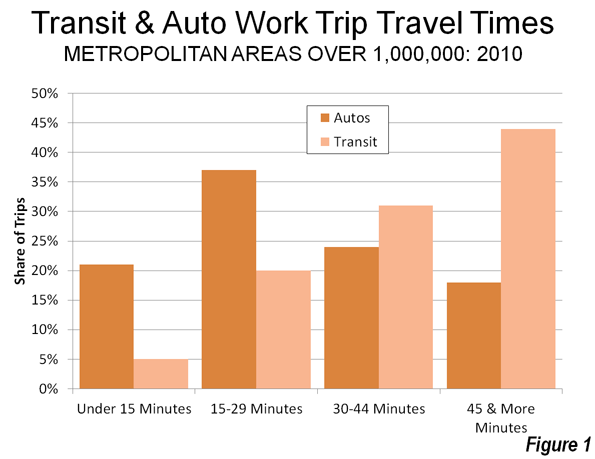
    Yet the solution – more transit and funding for transit – misses the mark. Transit does many things well, but it does not reduce commute times (Figure 1). According to Statistics Canada, average commute times by transit in the Toronto, Montréal and Vancouver metropolitan areas are from 30 per cent longer to nearly double those of average automobile commuters (Note 2). Some 58 percent of car users (drivers and passengers) reach their work locations in under 30 minutes, something accomplished by merely y 25 percent of transit commuters. Overall Toronto commute times are longer than either Los Angeles – famed for its traffic – as well as much less dense, and far less transit dependent, Dallas-Fort Worth. In Toronto, 21 percent of commuters take transit, compared to two percent in Dallas-Fort Worth. Among Montréal commuters, 20 percent use transit and spend more time commuting than their counterparts in more decentralized Phoenix, where less than two percent take transit. Commute times in transit-focused Vancouver are worse than much larger Los Angeles and indeed longer than nearly American metropolitan area, including Dallas-Fort Worth, Houston, and Philadelphia (Table 2).

    Given this pattern, transferring car travel to transit likely would increase commute times and make metropolitan areas even less competitive.

    Table 2
    30- and 40-minute Commute Shares:
    Representative Metropolitan Areas
    Population Classification Work Trip Under 30 Minutes Work Trip 30 to 44 Minutes Work Trip Under 45 Minutes
    5,000,000 and Over      
    Dallas-Fort Worth 59% 24% 83%
    Los Angeles 55% 24% 79%
    Toronto 48% 25% 73%
    Paris 45% 22% 67%
    2,500,000 – 5,000,000      
    Phoenix 57% 26% 83%
    Montréal 47% 27% 74%
    1,000,000 – 2,500,000       
    Edmonton 68% 20% 88%
    Indianapolis 66% 22% 88%
    Ottawa-Gatineau 65% 21% 86%
    Tampa-St. Petersburg 62% 22% 84%
    Calgary 54% 29% 83%
    Vancouver 55% 21% 76%
    Source: Statistics Canada, U.S. American Community Survey, National Institute of Statistics and Economic Studies (France)


    The Geography of Transit

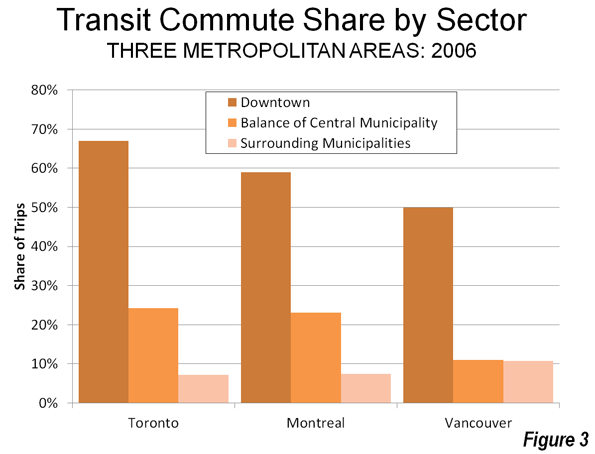
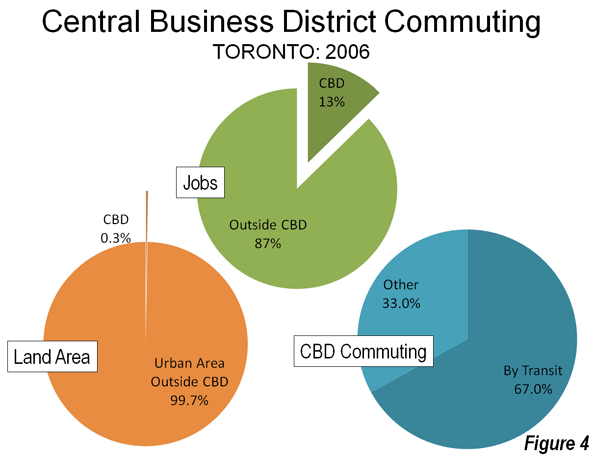
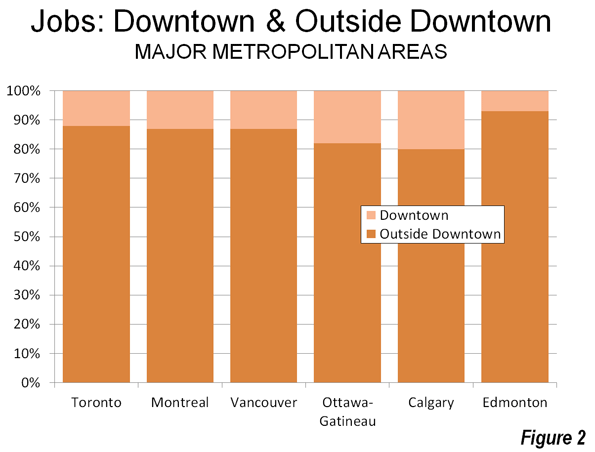
    Rational Transit and Downtown:Transit’s greatest strength is in providing access to the largest downtown areas. These areas have the greatest job densities (jobs per square kilometre) in their metropolitan areas and are typically well served by frequent, rapid and convenient transit service from throughout the metropolitan area. This combination of high employment density and superior transit service attracts one-half or more of all downtown commuters in Canada’s major metropolitan areas to transit (Figure 2). Transit is meets the needs of people who commute to downtown and is the rational choice for many, if not most. However, downtowns contain only a relatively small share (14 per cent) of metropolitan area jobs (Figure 3).

    Rational Personal Mobility Elsewhere: Areas outside downtown lack any such intense concentration of jobs. The area outside downtown, accounting for 6 out of every 7 jobs (Figure 4), maintain much lower employment densities and generally lacks transit service. This is illustrated by the nation’s largest employment center, which surrounds Pearson International Airport in Toronto. Its more than 350,000 employees are spread around an area the size of city of Vancouver (or the city of San Francisco) at a density so low that quick and efficient transit is simply impossible.

    For the overwhelming share of work trips to outside the downtown area, the car does the job and transit accounts for less than 10 percent of commuters. Thus, the automobile is the rational choice for most people who commute to locations outside downtown. And things are not getting better for transit. According to Statistics Canada, employment has been growing much faster outside of downtown than in the high density core areas suited for transit. The 2011 census indicated a continuing dispersion of population as well.


    Transit’s Robust Funding Growth and Declining Productivity

    Strongly Rising Transit Subsidies: Transit subsidies have been growing strongly. According to Transport Canada data, from 1999 to 2008 subsidies grew 83 percent (adjusted for inflation), which is more than three times the 26 percent ridership growth rate and 3.5 times the rate of general inflation. Transit’s declining productivity could indicate a substantial potential for improved cost effectiveness and service expansion within the generous present funding levels.

    Declining Transit Productivity: At the same time, there are concerns about transit productivity. The Conference Board of Canada has documented a 1.2 percent annual decline in productivity for two decades. The same analysis found productivity in other transport sectors to be generally improving. Transit costs have risen well in excess of inflation, service levels and ridership. Rising costs seriously limit transit’s ability to increase its share of travel in metropolitan areas and limits the important role that it is called upon to play in providing door-to-door mobility for the transportation-impaired, such as disabled citizens, the elderly, and students.

    Land Use Strategies that Retard Metropolitan Competitiveness

    Policies that Could Make Metropolitan Areas Less Competitive: While the prospects for improving transit commute times are discouraging, some current land use strategies further increase traffic congestion and lengthen commute times and make metropolitan areas and make metropolitan areas less competitive . Compact cities (also called smart growth) policies have been adopted across Canada in an effort to reduce automobile use and increase urban densities. The planning expectation is that housing should be placed near rail stations. Yet job locations throughout metropolitan areas remain highly dispersed, and with the rise of working at home, are becoming more so. The potential for transit systems (or walking or cycling) to materially impact commuting is very limited in the least.

    International data indicate that higher densities are associated with greater traffic congestion. Further, higher traffic densities are strongly associated with higher levels of air pollution. Improvements in vehicle technology will make reductions in automobile use to reduce greenhouse gas emissions unnecessary, according to U.S. research by McKinsey & Company. Finally, smart growth type policies have been found to retard metropolitan economic growth in the Netherlands, the United Kingdom and the United States (Note 2).

    Improving Metropolitan Competitiveness

    Strategies that reduce commute times can improve metropolitan competitiveness. Expanded telecommuting reduces average commute times by its very nature (though the reported commute times routinely exclude the working at home sector, both in Canada and the US). There are also lessons to be learned from Edmonton and the international metropolitan areas that have been more successful in maintaining shorter commutes: more dispersed employment, lower population densities and a larger share of travel by car (Table 3).

    Table 3
    Comparison of Canadian and U.S. Major Metropolitan Areas
    Average One-way Commute Times and Urban Area Densities
     
    CANADA Canada Metropolitan Areas United States: Metropolitan Area Size Classes
    Commute Time Principal Population Centre Density (per KM2) Average Commute Time Average Principal Population Centre Density (per KM2)
    5,000,000 and Over        
    Toronto 33 2,900 28 1,400
    2,500,000 – 5,000,000        
    Montréal 31 2,200 26 1,200
    1,000,000 – 2,500,00        
    Vancouver 30 1,900 23 1,100
    Ottawa-Gatineau 27 1,900
    Calgary 26 1,600
    Edmonton 23 1,100
    Principal Population Centre: Largest population centre (Statistics Canada term for urban area) in the metropolitan area.


    Focusing on Objectives: To become more competitive, Canada’s metropolitan areas need to improve their average commute times. This requires focusing on strategies that have the highest potential to reduce traffic congestion.

    Residents and businesses in metropolitan areas would be best served by goal-oriented and objective policies squarely directed toward getting people to work faster. The focus should be on what makes commutes shorter, regardless of transport mode, rather than on idealistic notions of how a city should look or how people should travel.

    Wendell Cox is a Visiting Professor, Conservatoire National des Arts et Metiers, Paris and the author of “War on the Dream: How Anti-Sprawl Policy Threatens the Quality of Life”.

    –––

    Note: This article is based upon the recently released Frontier Centre for Public Policy report Improving the Competitiveness of Metropolitan Areas by Wendell Cox, who also serves as a senior fellow at the Centre.

    Note 1: Data not provided for other metropolitan areas.

    Note 2: On a related note, the Bank of Canada (the central bank) and others have indicated a concern about rising house costs relative to incomes. This is to be expected in metropolitan areas adopting green belts, urban growth boundaries and other land rationing policies. Huge housing price increases have occurred in Vancouver, Toronto, Montréal and Calgary (for example), in response to such policies (This is evident from the annual editions of the Demographia International Housing Affordability Survey, sponsored in Canada by the Frontier Centre for Public Policy). The Bank of Canada may be virtually powerless to slow this loss of housing affordability, since its cause (constraining metropolitan land supply) is beyond the reach of the Bank’s monetary policies.

    Photo: Suburban Montreal (by author)