Blog

  • Infographic: Growth of All Occupations by Industry & Education, 2001-2011

    We recently partnered with Catherine Mulbrandon at VisualizingEconomics.com to create a series of treemaps that illustrate important aspects of the labor market. In this post we provide a sneak peek at two of the graphics she created. The remainder will be posted in An Illustrated Guide to Income in the United States, a booklet from Catherine set to be released this summer.

    These two graphics are based on EMSI’s labor market database, which is a combination of over 80 public and private data sources. More specifically, the first table shows job change for all occupations by industry (based on 2-digit supersectors, as defined by the North America Industry Classification System) and the second shows occupation change by education level. The data is from 2001-2011.

    Red indicates decline and blue indicates growth.

    Each square on the graphic indicates a specific 5-digit occupation classified by the Standard Occupational Classification system. There are over 800 unique squares present on the charts. Large squares, like the ones on the upper right and in the retail trade sector, indicate a lot of jobs for the specific occupation code. Smaller squares indicate occupations with less jobs.

    In the graphic above we have pulled together occupation data related to all 20 NAICS supersectors. Government, health care, and retail trade have the largest employment. Utilities, mining, and management of companies have the fewest jobs. Also note the size of the squares within each industry sector. Here are a few observations:

    • Broad momentum. It is interesting to note how each broad industry sector tended to either be dominated by growth or decline. For instance, with very few exceptions, almost every occupation within the manufacturing sector declined from 2001-2011. The same holds true for construction, information, agriculture, and, to a certain extent, retail trade. Conversely, sectors like health care, educational services, professional/scientific/technical services, accommodation and even arts tended to show occupational growth.
    • Mixed sectors. Other industry sectors like finance, administrative, real estate, wholesale trade, and government were much more mixed.

    The graphic above shows the distribution of jobs across all levels of educational attainment. We use the same 5-digit SOC codes and group them according to what their typical educational attainment is. Where possible, occupation titles are included so you can get a sense of where certain jobs fall. Here are a few quick observations:

    • The OJT sectors (on-the-job training) are huge. This includes short-term OJT (lower right), moderate-term OJT (upper left), long-term OJT (middle right), and work experience in a related field (center). Also notice how the occupations in these sectors are less stable than the others. This is consistent with what was observed in the latest recession — jobs with higher education levels tend to perform better in tough economic times.
    • Advanced degrees showed growth. Over the past 10 years, every occupation associated with a more advanced degree (master’s, doctoral, professional) showed some sort of growth.
    • The other sectors have mixed results. Bachelor’s degrees showed more stability over the past 10 years, but there are a handful of occupations that declined since 2001. The same holds true for associate’s, postsecondary vocational awards, and degrees plus work experience.
  • Australian Elections: A Comeback for Pro-growth Policy?

    The latest local government elections in Queensland, along with the by election for former Premier Anna Bligh’s state seat of South Brisbane, may point to a fundamental shift in popular mood back in favour of growth and development. After many years of anti-growth policy paranoia, it’s a refreshing wind if it lasts.

    Was the electoral storm that swept ‘Can Do’ Campbell Newman and the conservative LNP to power only a few weeks ago something more than a direct reaction to a failed state Labor government? Subsequent local government election results state-wide may point to a more fundamental shift in community attitude. Why? Because one month after a resounding rejection of the state government, voters once again lined up to sink the knife into incumbent mayoral candidates who have presided over needless bureaucracy, excessive red tape and anti-growth policies disguised in political or media spin.

    Those who expected a bounce back to Labor from voters recognising the very large mandate of the new LNP state government were proven badly wrong. Even Labor’s stronghold state seat of South Brisbane, narrowly held by the former Premier at the last election, barely got over the line to Labor this time in a by election.

    Is this a sign that anti-growth and anti development policies, manifesting themselves in all manner of precautionary principles, red tape and green tape and which effectively ground the Queensland economy to a standstill, are on the nose? Maybe it’s not just the Labor ‘brand’ but bad public policy per se which is being rejected.

    The real economy – undisguised by the statistical support of the booming resources sector – has been suffering, with construction activity across the board falling to record lows, interstate migration and population growth slowing to record lows, and house prices and personal balance sheets under stress. Rising utility costs, partly or largely (depending on your view) driven by green-tinged policy settings, have hurt average families. New housing costs have risen and proven a barrier for a generation of young families wanting to enter the market without having to sacrifice everything in exchange for a mortgage they can’t afford. Overall, the people are clearly pissed off. And they showed it.

    In Brisbane, Lord Mayor Quirk – a prominent anointee of ‘Can Do’ Campbell Newman – was returned with an increased majority. And elsewhere, pro-growth candidates replaced incumbents whose administrations had presided over growth in regulatory process with little by way of measureable outcomes. In Redlands, a reputedly notorious local authority in terms of its hostile attitude to growth and development, Mayor Melva Hobson was turfed out in favour of pro-growth candidate and new Mayor, Karen Williams, (Williams scoring 69% of the primary vote to Hobson’s 31%).

    On the Gold Coast, pro-growth candidate and Chamber of Commerce President Tom Tait won resoundingly with 37% of the primary Mayoral vote. The next closest candidate was Eddie Saroff – a long serving Gold Coast Councillor and former Labor federal candidate, on 17.5%.

    On the Sunshine Coast – another Council which became notorious for being difficult to deal with and consumed with red tape and pointless administrative process – the pro growth and pro business candidate Mark Jamieson (33%) scored more than double his nearest two rivals, each on 17%.

    In Ipswich, popular Mayor Paul Pissale increased his majority, with almost 88% of the primary Mayoral vote. You would be hard pressed to find a more passionate, pro-growth and pro-development Mayor than Pissale, especially when it comes to his beloved Ipswich. This is a man who proudly proclaimed that he welcomed development and developers to his city.

    In Cairns, another region fast developing a reputation for an economy strangled in anti-development red and green tape and excessive planning controls, prominent local business identity and pro growth candidate Bob Manning picked up 56% of the primary vote, well ahead of his nearest rival, the incumbent Val Schier on 20%.

    The South Brisbane by-election result adds weight to the argument that this is part of a widespread and deep seated mood for change. Labor, in what is billed as a stronghold inner city seat, expected some solid bounce back as South Brisbane voters were encouraged not to give the LNP another seat in Parliament. They didn’t listen to the party line, and only one in three (33%) put the new Labor candidate Jackie Trad first. By contrast 38% of South Brisbane voters put LNP candidate Clem Grehan first. Labor had to survive on the preferences of the green vote, which drew 19.4% of the primary vote in that seat.

    Now take these most recent results and put them back to back with what happened in the state election just over a month ago. The LNP picked up a staggering 50% of the primary vote state wide, giving them 78 of the 89 seats. Labor picked up just over one in four primary votes, at 26%. The Greens only picked up 7.5% – less than their result in the previous election. The Greens in fact were outpolled by Katter’s ‘Australia Party’ which scored 11.5% of primary votes state wide. (I’m not sure whether to describe Katter’s party as pro growth but its connections to pro development rural interests suggests it is).

    That state election was a clear cut choice between a ‘Can Do’ Campbell Newman and a Labor machine which ran heavily on anti-development messages in its campaign, alleging that an LNP Government would be hostage to developers and hostile to the environment. There was no confusion in voter’s minds when they rejected the latter and firmly chose the former. You don’t get much more pro-growth than a candidate and a party which uses ‘Can Do’ as its rallying cry.

    The point of all this is that the new political mandate for growth shouldn’t be dismissed as some isolated reaction to the past government’s failings. The community seem to be making their views clear: bring back growth, bring back economic prosperity, restore the state’s balance sheet and with it, restore some health to personal balance sheets. The anti-growth movement will never be silenced by majority views but hopefully in this clear message from the people, it will take a backseat and keep a low profile, for a while at least.

    For Labor, aligning itself with anti-growth movements might prove even more damaging in the long run. Average workers on average wages left the Labor Party in Queensland in no doubt they were on the nose. It’s not just an issue of a damaged brand, and much more than a failed campaign strategy. If Labor stands in people’s minds as a party which objects to progress, which imposes punitive taxation on even humble endeavours, which is responsible for excessive intrusion of regulation into people’s lives, and which is hostage to fringe interest groups in a bid to win preference deals, it may be left in a political wilderness for a long time to come. Labor’s reconnection to working families and their values and interests is as surely the key to the revival of their fortunes, just as John Howard achieved and as Campbell Newman and a host of newly elected Mayors in Queensland have proven.

    Ross Elliott has more than 20 years experience in property and public policy. His past roles have included stints in urban economics, national and state roles with the Property Council, and in destination marketing. He has written extensively on a range of public policy issues centering around urban issues, and continues to maintain his recreational interest in public policy through ongoing contributions such as this or via his monthly blog The Pulse.

    Brisbane photo by Bigstockphoto.com.

  • World Urban Areas Population and Density: A 2012 Update

    The latest edition of Demographia World Urban Areas has just been released. The publication includes population estimates, urban land area estimates and urban densities for all nearly 850 identified urban areas in the world with a population of 500,000 or more. These urban areas account for approximately 48% of the world’s urban population. Overall, data is provided for approximately 1500 urban areas, comprising approximately 1.9 billion people, or 52% of the world’s urban population.

    Urban areas (or urban agglomerations) are areas of continuous urban development within a metropolitan area (labor market area), and are the physical form of that constitutes the essence a city. Generally, urban areas can be identified by the lights one would see from an airplane at night or in a satellite photograph. Urban areas are not metropolitan areas, which represent the economic or functional form of a city. Urban areas are a component of metropolitan areas, the other component of which is non-urban or rural territory. A metropolitan area is the combination of the urban area(s) and rural areas, which together comprise the economic region or labor market (commute shed).

    Over the last year, new census reports have become available in such nations as India, Indonesia, China, Canada, Bangladesh, the United States and South Korea. The new data has resulted in a number of ranking changes from before.

    The Megacities: In 2012, 26 urban areas qualify as megacities (Rental Car Tours for 24 of the megacities are available), with populations of greater than 10 million people (Table). As has been the case for nearly six decades, Tokyo remains the largest urban area in the world, with approximately 37 million. New York, which Tokyo displaced in 1955, has fallen to seventh largest and has the lowest population density of any megacity, at 4600 per square mile or 1800 per square kilometer (Note 2). London, which New York displaced in the 1920s never became a megacity due to the imposition of its greenbelt. Instead urbanization leapfrogged into the exurbs of southeast England, where all of the London area’s net population growth has occurred since World War II (London ranked third as late as 1960).  

    Table 1          
    LARGEST URBAN AREAS IN THE WORLD (MEGACITIES): Estimated 2012
    (Over 10,000,000 Population)          
             
    Rank Geography Urban Area Population Estimate Land Area: Square Miles Density Land Area: Km2 Density
    1 Japan Tokyo-Yokohama 37,126,000 3,300 11,300 8,547 4,300
    2 Indonesia Jakarta 26,063,000 1,075 24,200 2,784 9,400
    3 South Korea Seoul-Incheon 22,547,000 835 27,000 2,163 10,400
    4 India Delhi, DL-HR-UP 22,242,000 750 29,700 1,943 11,500
    5 Philippines Manila 21,951,000 550 39,900 1,425 15,400
    6 China Shanghai, SHG 20,860,000 1,350 15,500 3,497 6,000
    7 United States New York, NY-NJ-CT 20,464,000 4,495 4,600 11,642 1,800
    8 Brazil Sao Paulo 20,186,000 1,225 16,500 3,173 6,400
    9 Mexico Mexico City 19,463,000 790 24,600 2,046 9,500
    10 Egypt Cairo 17,816,000 660 27,000 1,709 10,400
    11 China Beijing, BJ 17,311,000 1,350 12,800 3,497 5,000
    12 Japan Osaka-Kobe-Kyoto 17,011,000 1,240 13,700 3,212 5,300
    13 India Mumbai, MAH 16,910,000 211 80,100 546 30,900
    14 China Guangzhou-Foshan, GD 16,827,000 1,225 13,700 3,173 5,300
    15 Russia Moscow 15,512,000 1,700 9,100 4,403 3,500
    16 Bangladesh Dhaka 15,414,000 134 115,000 347 44,400
    17 United States Los Angeles, CA 14,900,000 2,432 6,100 6,299 2,400
    18 India Kolkota, WB 14,374,000 465 30,900 1,204 11,900
    19 Pakistan Karachi 14,198,000 300 47,300 777 18,300
    20 Argentina Buenos Aires 13,639,000 1,020 13,400 2,642 5,200
    21 Turkey Istanbul 13,576,000 540 25,100 1,399 9,700
    22 Brazil Rio de Janeiro 12,043,000 780 15,400 2,020 6,000
    23 China Shenzhen, GD 11,885,000 675 17,600 1,748 6,800
    24 Nigeria Lagos 11,547,000 350 33,000 907 12,700
    25 France Paris 10,755,000 1,098 9,800 2,844 3,800
    26 Japan Nagoya 10,027,000 1,475 6,800 3,820 2,600


    Jakarta (Jabotabek) has emerged as the world’s second largest urban area, with a population of 26 million. This is a larger population than reported by the United Nations, since its estimates include little more than DKI Jakarta, the national capital district and beyond which urbanization stretches for a considerable distance. Continuing suburban growth in Seoul-Incheon secured that urban area a ranking of third, with approximately 22.5 million people. As was reported last year, new estimates indicate that Delhi has emerged as India’s largest urban area, with a population of 22.2 million and a growth rate that should result in its passing Seoul-Inchon in a matter of a few years. Mumbai, which like Mexico City in the 1980s has often been promoted as being destined to become the largest urban area in the world, was passed by Delhi over the past decade and has become the second largest urban area in India.

    Manila is ranked as the fifth largest urban area in the world, with 22.0 million people. In Manila, as in Jakarta, the population reported to the United Nations is far below that of the genuine urban area. The reported population is for the National Capital Region (popularly and misleadingly called "Metro Manila), which represents approximately one-half of the population of the urban area, which stretches into four additional provinces (Cavite, Laguna, Rizal and Batangas). If the population of the Washington urban area were reported in the same manner, it would be 600,000 – the population of the District of Columbia – rather than the 4.6 million indicated in the 2010 census for the entire urban area.

    Los Angeles, until recent years one of the fastest growing urban areas in the world, has dropped to 17th largest in the world and seems destined to drop out of the top 20 in the next decade or two. Fast growing Karachi, Istanbul, Lagos and others could become larger than Los Angeles. Los Angeles reached its peak ranking of 6th largest in the world from 1965 through 1980 and entered the top ten by 1950.

    Over the past decade, Paris became a megacity, reaching a population of 10.7 million. Paris has been Western Europe’s fastest growing large urban area since World War II. All of its growth since 1921 has been in the suburbs, which stretch over more than 1,000 miles (2,600 square kilometers).  This is more land area than Houston’s suburbs, but more densely populated. Since 1921, the historical core municipality (the ville de Paris) has dropped in population from 2.9 million to 2.2 million.

    By world standards, the Paris urban area has grown slowly, having fallen from being the world’s third largest in 1965 to its current ranking of 23rd. However, over the past census period, Paris added 600,000 residents, compared to less than 200,000 in the previous period, indicating a decline in out-migration and a higher natural population rate increase.

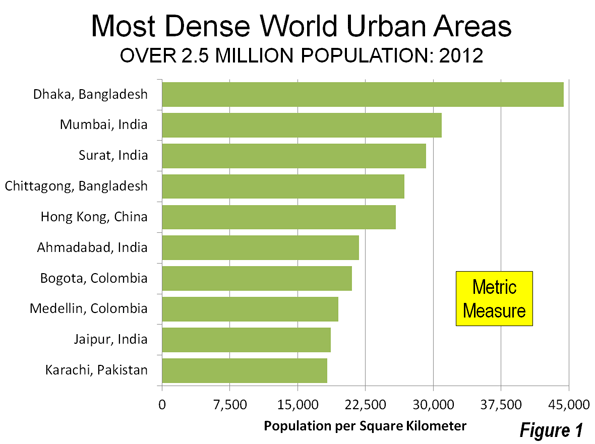
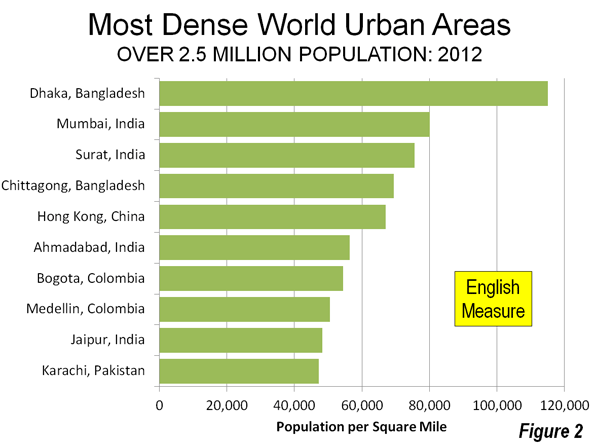
    Urban Area Densities: Dhaka, the capital of Bangladesh grew strongly between 2001 and 2011 and is by far the most densely populated urban area in the world. Dhaka’s density is estimated at 115,000 per square mile or 44,000 per square kilometer, with slum (informal dwelling) densities reported report up 4,210 per acre, or 2.7 million per square mile (1 million per square kilometer). At this density, all of the world’s 3.7 billion urban residents could be accommodated in an area approximately equal to that of the Washington (DC-MD-VA) urban area. All of Dhaka’s urban population of 15.4 million fits into a land area equal to that of the city (municipality) of Portland (population less than 600,000). Nonetheless, analysts have referred to this example of the ultimate of urban density to be "sprawling."

    Among the urban areas with more than 2.5 million population, the second-most dense is Mumbai, at 80,100 per square mile or 30,900 per square kilometer. The most dense high income world urban area is Hong Kong, at 67,000 persons per square mile or 25,900 per square kilometer. Of course, Hong Kong’s density is the result of an accident of history, which resulted in huge migration to the former British colony following World War II. Hong Kong is more than twice as dense as the second most dense high income world urban area, Busan, Korea. The smaller nearby, yet historically similar enclave of Macau (560,000) has an even higher density than Hong Kong, at 70,000 per square mile (27,000 per square kilometer).

    Seven of the densest urban areas with more than 2.5 million population are on the Asian subcontinent. These include Dhaka and Chittagong in Bangladesh, Mumbai, Ahmedabad, Surat and Jaipur in India and Karachi, in Pakistan. Colombia has two of the densest, Bogota and Medellin. Hong Kong is the only high income nation urban area among the 10 densest (Figures 1 & 2).


    The least dense urban areas with more than 2.5 million population are all in the United States. The least dense is Atlanta, with 1800 people per square mile or 700 per square kilometer. The second least dense is, perhaps surprisingly, Boston, despite its reputation for high density. Boston’s population density is 2200 per square mile or 800 per square kilometer. Also, perhaps surprisingly, Philadelphia is the least dense urban area in the world with more than 5 million population, while Chicago is the least dense urban area of more than 7.5 million. The lower density of US urban areas is illustrated by the fact that Portland, with its reputation for higher density and densification planning, would have ranked 11th least dense, if it had reached the 2.5 million threshold used in this ranking.

    Most Extensive Urban Areas: New York covers the most land area of any urban area at nearly 4500 square miles or 11,000 square kilometers. Tokyo covers 3300 square miles or 8500 kilometers. Chicago is the third most expansive urban area, at 2,600 square miles (6,900 square kilometers). Los Angeles, which has long been perceived as the most sprawling of world urban areas, ranks fifth, covering 2400 square miles or 6,300 square kilometers. Atlanta and Boston, the world’s least dense major urban areas, rank 4th and 6th, covering 2,600 and 2,100 square miles respectively (6,900 square kilometers and 5,400 square kilometers).

    The Continuing Exodus from Rural Areas: Around the world, people continue to seek the promise of better economic outcomes in urban areas. United Nations forecasts indicate that another 2.5 billion people will be added to urban areas by 2050, while rural areas (which contain all population not urban) will be reduced in population by 300 million. The world’s urban population is expected to rise from today’s nearly 53 percent to 67 percent. More than 90 percent of the urban growth is expected to be in less developed nations.

    Wendell Cox is a Visiting Professor, Conservatoire National des Arts et Metiers, Paris and the author of “War on the Dream: How Anti-Sprawl Policy Threatens the Quality of Life”.

    ——

    Note 1: Demographia World Urban Areas uses national census authority urban area population and land area data in the few nations designating urban areas on a basis generally consistent with that of the United States Census Bureau. Elsewhere, land area estimates are determined using satellite photography (Google Earth). Population estimates are also obtained from a variety of sources, such as United Nations data, where it is reflective of the urban area population (some data reported to the United Nations is for jurisdictions that are only a part of the urban area and in other cases, metropolitan area data is reported), estimates relying on a "build-up" of local authority data from national census authorities and other sources. Demographia combines some adjacent urban areas when they are contained within the same metropolitan area or consolidated area, such as in New York and Los Angeles (for a complete list see Demographia World Urban Areas). Also see: Urban Terms Defined.

    Note 2: Exceptions: In some cases, continuous urbanization does not constitute a single urban area because they are not within a single labor market (metropolitan area). This can be the case within a nation, such as in the Pearl River Delta of China, where Shenzhen, Dongguan, Zhongshan, Jiangmen, Huizhou, Zhuhai, Guangzhou-Foshan and Hong Kong, which are separate labor markets. International borders (and the Hong Kong-Shenzhen border) also define separate urban areas if free movement of labor is not permitted. Thus Detroit and Windsor or San Diego and Tijuana are separate urban areas because free movement of labor is not permitted. On the other hand, treaties permit virtual free movement of labor between the French and Belgian sides of the Lille urban area and between the Swiss and French components of the Geneva urban area.

    —-

    Photo: Recent migrants to Dhaka slum in NGO school (photo by author)

  • The Best Cities for Jobs 2012

    Throughout the brutal recession, one metropolitan area floated serenely above the carnage: Washington, D.C.  Buoyed by government spending, the local economy expanded 17% from 2007 to 2012. But for the first time in four years, the capital region has fallen out of the top 15 big cities in our annual survey of the best places for jobs, dropping to 16th place from fifth last year.

    It’s a symptom of a significant and welcome shift in the weak U.S. economic recovery:  employment growth has moved away from the public sector to private businesses. In 2011, for the first time since before the recession, growth in private-sector employment outstripped the public sector. More than half (231) of the 398 metro areas we surveyed for our annual study of employment trends registered declines in government jobs, with public-sector employment dropping 0.9 percent overall. Meanwhile, private-sector employment expanded 1.4 percent.

    Read about how we selected the 2012 Best Cities for Job Growth

    Instead of government, the big drivers of growth now appear to be three basic sectors: energy, technology and, most welcome all, manufacturing. Energy-rich Texas cities dominate our list — the state has added some 200,000 generally high-paying oil and gas jobs over the past decade — but Texas is also leading in industrial job growth, technology and services. In first place in our ranking of the 65 largest metropolitan areas is Austin, which has logged strong growth in manufacturing,  technology-related employment and business services. Houston places second, Ft. Worth fourth, and Dallas-Plano-Irving sixth. Another energy capital, Oklahoma City, ranks 10th, while resurgent New Orleans-Metairie places 13th among the largest metro areas.

    To determine the best cities for jobs, we ranked all 398 current metropolitan statistical areas based on employment data from the Bureau of Labor Statistics covering November 2000 through January 2012. Rankings are based on recent growth trends, mid-term growth, long-term growth and the region’s momentum. (Here is a detailed description of our methodology.) We also broke down rankings by size — small, medium and large — since regional economies differ markedly due to their scale.

    The strong growth of the energy sector, and Texas, is even more evident in our overall ranking, which includes many small and medium-sized metropolitan areas. The top 10 fastest growers overall include such energy-centric places as No. 1 Odessa, Texas; second-place Midland, Texas;  Lafayette, La. (fourth place); Corpus Christi, Texas (sixth), San Angelo, Texas (seventh); and Casper, Wyo. (10th).

    The shift from public to private can be seen in the falling rankings of many of the most government-dependent economies. Outside of Washington, D.C. (where federal employment actually has continued to grow), Bethesda-Rockville-Frederick, Md., took an even more dramatic tumble in our big city table,  dropping 34 places to No. 46.There were sizable relative declines in the rankings of many state capitals such as Springfield, Ill. and Madison, Wisc. College towns, which had previously done well in the face of the recession, have also moved sharply lower in our rankings, due to a combination of state budget cuts and better performance elsewhere. College Station, Texas, plummeted from fourth last year on our overall list to 167th; Fairbanks, Alaska, slid from 15th place to 165th, Corvallis, Ore., tumbled from 40th place to 203rd place; and Cedar Rapids, Iowa, dropped from 81st to 246th.

    Budget constraints have also hurt military towns, which previously had been largely immune to the recession. Last year’s overall No. 1, Killeen-Ft. Hood, Texas, slid to 43rd place; Jacksonville, N.C., home to Camp Lejeune, fell to 102nd from 19th last year; and Lawton, Okla., home to Fort Sill, slipped to 274th from  No. 20 last year.

    In addition to energy, the technology sector has been on a tear. After a decade of tepid growth and some years of job losses, Silicon Valley has blown itself another huge tech bubble, this time driven by the social media craze and a surge in private-equity investment. In the San Jose-Sunnyvale-Santa Clara metro area, the number of information sector jobs is up 36 percent over the past five years; this year the epicenter of Silicon Valley jumped 22 places to No. 5 among the 65 biggest metro areas. The social media boom has also been very good for the San Francisco-San Mateo-Redwood City area, which rocketed 16 places to a solid 17th this year.

    But much of the tech growth in the country has continued to flow to more affordable regions less dependent on venture investment. At the head of the pack is Austin, where Apple recently announced a large expansion,  and Salt Lake City, No. 2 on our big cities list, which is a major destination for expansion for Silicon Valley firms such as Adobe, Twitter and  Electronic Arts. Other big players benefiting from the tech boom include seventh-place Raleigh-Cary, N.C., which has been a consistent top 15 performer for the past seven years; Seattle, which rose 18 places to 14th, and Denver at No. 15.

    Perhaps most encouraging of all has been the expansion of the manufacturing sector. In 2011 manufacturing expanded at three time the rate of overall GDP, according to Mark Perry of the University of Michigan-Flint, and the sector added 425,000 jobs, also outpacing the national average.

    As a result, the fortunes of some of America’s hardest-hit manufacturing regions are improving. Columbus, Ind., rose from 235th overall last year to No. 3 on our list this year.  Michigan is beginning to see some signs of new life: perennial cellar dweller Holland-Grand Haven rose a remarkable 202 places to 19th on the overall list. A slew of other Michigan cities rose more than 100 places, including Grand Rapids (64th place), Bay City (136th), Warren-Troy-Farmington Hills (199th), Muskegon-Norton Shores (219th), and Jackson (233th).  It is a glimmer of hope in a region that has lurked near the bottom of our Best Places rankings for as long as we have published it.

    Another group of big cities that may be seeing light at the end of the tunnel are some of the metro areas hit hardest by the bursting of the housing bubble. Miami, Fla., which ranks 21st among the 65 largest metros, Tampa-St.Petersburg-Clearwater, Fla.  (33rd), Phoenix (45th), Riverside-San Bernardino, Calif. (50th), and even Las Vegas (56th) began to show some signs of new life this past year.

    So amidst all the good news, which big cities are still doing badly, or even relatively worse? Sadly, many of the places still declining are located in our home state of California, including Los Angeles (59th place among the biggest metro areas), Sacramento (60th), and, and just across the Bay from Silicon Valley, Oakland (63rd). Only the old, and to date still not recovering,  industrial towns of Providence, R.I. (64th), and Birmingham-Hoover, Ala. (dead last at No. 65), did worse.  And the glad tidings in manufacturing have not touched all the Rust Belt cities: Camden, N.J. (57th), Newark, N.J. (58th), Cleveland, Ohio (61st), and Detroit (62nd) still feature prominently near the bottom.

    Read about how we selected the 2012 Best Cities for Job Growth

    This piece originally appeared in Forbes.

    Joel Kotkin is executive editor of NewGeography.com and is a distinguished presidential fellow in urban futures at Chapman University, and contributing editor to the City Journal in New York. He is author of The City: A Global History. His newest book is The Next Hundred Million: America in 2050, released in February, 2010.

    Michael Shires, Ph.D. is a professor at Pepperdine University School of Public Policy.

    Austin photo by Bigstockphoto.com.

  • 2012 How We Pick the Best Cities For Job Growth

    We seek to measure the robustness of a region’s growth both recently and over time. We look at all of the metropolitan statistical areas (MSAs) for which the Bureau of Labor Statistics reports monthly employment data. They are derived from three-month rolling averages of U.S. Bureau of Labor Statistics “state and area” unadjusted employment data reported from November 2000 to January 2012.

    This year’s rankings use four measures of growth to rank all 398 metro areas for which full data sets were available from the past 10 years. “Large” areas include those with a current nonfarm employment base of at least 450,000 jobs. “Midsize” areas range from 150,000 to 450,000 jobs. “Small” areas have as many as 150,000 jobs. This year’s rankings reflect the current size of each MSA’s employment. Only one MSA, Lafayette, La., changed size categories, moving from the “Small” to “Midsize” category, so this year’s rankings can be directly compared to the 2011 rankings. In the instances where the analysis refers to changes in ranking order within the size categories, Lafayette, La., is reported as if it had been included in the “Midsize” category last year.

    The index is calculated from a normalized, weighted summary of: 1) recent growth trend: the current and prior year’s employment growth rates, with the current year emphasized (two points); 2) mid-term growth: the average annual 2006-2011 growth rate (two points); 3) long-term trend and momentum: the sum of the 2006-2011 and 2000-2005 employment growth rates multiplied by the ratio of the 2000-2005 growth rate over the 2006-2011 growth rate (two points); and 4) current year growth (one point).

    The data reflect the North American Industry Classification System categories, including total nonfarm employment, manufacturing, financial services, business and professional services, educational and health services, information, retail and wholesale trade, transportation and utilities, leisure and hospitality, and government.

  • All Cities Rankings – 2012 Best Cities for Job Growth

    Read about how we selected the 2012 Best Cities for Job Growth

    2012 Overall Ranking
    Area
    2012 Weighted INDEX
     
    2011 Nonfarm Employment (1000s) 
    2011 Overall Rank 
    Overal Movement
    1
    Odessa, TX
    99.4
    68.3
    11
    10
    2
    Midland, TX
    99.0
    75.3
    5
    3
    3
    Columbus, IN
    95.6
    47.7
    235
    232
    4
    Lafayette, LA
    92.5
    156.3
    34
    30
    5
    Austin-Round Rock-San Marcos, TX
    91.6
    798.5
    6
    1
    6
    Corpus Christi, TX
    90.4
    184.0
    12
    6
    7
    San Angelo, TX
    89.2
    46.7
    32
    25
    8
    Houston-Sugar Land-Baytown, TX
    88.7
    2637.3
    14
    6
    9
    Blacksburg-Christiansburg-Radford, VA
    87.8
    73.9
    273
    264
    10
    Casper, WY
    84.8
    40.9
    186
    176
    11
    Williamsport, PA
    83.7
    55.4
    73
    62
    12
    Glens Falls, NY
    83.0
    55.6
    77
    65
    13
    Lubbock, TX
    82.6
    131.4
    102
    89
    14
    Laredo, TX
    82.1
    95.0
    74
    60
    15
    Columbia, MO
    82.1
    96.7
    29
    14
    16
    Cumberland, MD-WV
    82.0
    41.7
    42
    26
    17
    Gainesville, GA
    81.9
    75.8
    68
    51
    18
    Portsmouth, NH-ME NECTA
    81.7
    56.0
    45
    27
    19
    Holland-Grand Haven, MI
    80.9
    113.1
    221
    202
    20
    McAllen-Edinburg-Mission, TX
    79.7
    232.3
    27
    7
    21
    Bismarck, ND
    79.2
    65.7
    2
    -19
    22
    Salt Lake City, UT
    79.1
    637.3
    110
    88
    23
    Houma-Bayou Cane-Thibodaux, LA
    78.8
    95.1
    87
    64
    24
    State College, PA
    78.5
    76.4
    65
    41
    25
    Fargo, ND-MN
    78.4
    127.3
    38
    13
    26
    Ocean City, NJ
    78.0
    36.8
    79
    53
    27
    El Paso, TX
    77.8
    283.1
    3
    -24
    28
    Owensboro, KY
    77.6
    51.8
    88
    60
    29
    Charleston-North Charleston-Summerville, SC
    77.4
    296.4
    90
    61
    30
    Charlottesville, VA
    77.0
    102.3
    116
    86
    31
    Tyler, TX
    76.9
    96.0
    85
    54
    32
    Cheyenne, WY
    76.8
    44.7
    145
    113
    33
    Knoxville, TN
    76.5
    334.8
    94
    61
    34
    Barnstable Town, MA NECTA
    76.2
    94.4
    95
    61
    35
    Longview, TX
    76.1
    98.0
    23
    -12
    36
    Hanford-Corcoran, CA
    76.0
    36.6
    217
    181
    37
    Fort Worth-Arlington, TX Metropolitan Division
    76.0
    872.3
    84
    47
    38
    San Jose-Sunnyvale-Santa Clara, CA
    75.9
    891.6
    181
    143
    39
    Dallas-Plano-Irving, TX Metropolitan Division
    75.9
    2077.9
    18
    -21
    40
    Raleigh-Cary, NC
    75.9
    514.5
    83
    43
    41
    Kennewick-Pasco-Richland, WA
    75.8
    99.0
    25
    -16
    42
    Victoria, TX
    75.6
    50.6
    140
    98
    43
    Pittsburgh, PA
    75.2
    1157.7
    61
    18
    44
    Killeen-Temple-Fort Hood, TX
    74.6
    129.0
    1
    -43
    45
    Nashville-Davidson–Murfreesboro–Franklin, TN
    74.0
    759.6
    48
    3
    46
    Grand Junction, CO
    73.8
    60.5
    232
    186
    47
    Provo-Orem, UT
    73.7
    185.8
    98
    51
    48
    Oklahoma City, OK
    73.6
    575.7
    124
    76
    49
    New York City, NY
    73.5
    3816.0
    52
    3
    50
    Northern Virginia, VA
    73.5
    1342.3
    43
    -7
    51
    Bakersfield-Delano, CA
    72.8
    234.5
    194
    143
    52
    St. Joseph, MO-KS
    72.8
    60.6
    159
    107
    53
    Lafayette, IN
    72.4
    95.6
    157
    104
    54
    Pueblo, CO
    72.4
    58.7
    99
    45
    55
    Sherman-Denison, TX
    72.2
    43.6
    184
    129
    56
    Boulder, CO
    72.1
    164.3
    150
    94
    57
    Erie, PA
    72.1
    131.2
    130
    73
    58
    Fayetteville, NC
    71.7
    132.0
    144
    86
    59
    Fort Collins-Loveland, CO
    71.6
    135.9
    50
    -9
    60
    Morgantown, WV
    71.0
    66.5
    33
    -27
    61
    Crestview-Fort Walton Beach-Destin, FL
    70.8
    81.0
    311
    250
    62
    New Orleans-Metairie-Kenner, LA
    70.8
    529.3
    7
    -55
    63
    Waterloo-Cedar Falls, IA
    70.7
    90.9
    126
    63
    64
    Grand Rapids-Wyoming, MI
    70.6
    375.7
    183
    119
    65
    Texarkana, TX-Texarkana, AR
    70.6
    58.1
    59
    -6
    66
    Peoria, IL
    70.5
    182.5
    151
    85
    67
    Baltimore City, MD
    70.1
    364.9
    259
    192
    68
    Seattle-Bellevue-Everett, WA Metropolitan Division
    70.0
    1416.3
    211
    143
    69
    Utica-Rome, NY
    69.8
    133.1
    177
    108
    70
    Amarillo, TX
    69.7
    113.1
    89
    19
    71
    Brownsville-Harlingen, TX
    69.6
    129.5
    28
    -43
    72
    Palm Coast, FL
    69.6
    19.0
    133
    61
    73
    Rapid City, SD
    69.5
    60.5
    97
    24
    74
    Denver-Aurora-Broomfield, CO
    69.3
    1219.8
    164
    90
    75
    Asheville, NC
    69.2
    172.0
    158
    83
    76
    Columbus, GA-AL
    69.1
    120.6
    199
    123
    77
    Winchester, VA-WV
    69.0
    56.4
    139
    62
    78
    Washington-Arlington-Alexandria, DC-VA-MD-WV Met. Div.
    68.7
    2451.8
    41
    -37
    79
    Greeley, CO
    68.7
    80.3
    193
    114
    80
    Mankato-North Mankato, MN
    68.7
    53.5
    168
    88
    81
    Lincoln, NE
    68.6
    174.9
    101
    20
    82
    Oshkosh-Neenah, WI
    68.5
    94.3
    44
    -38
    83
    Haverhill-North Andover-Amesbury, MA-NH  NECTA Div.
    68.3
    78.1
    55
    -28
    84
    Framingham, MA  NECTA Division
    68.2
    158.0
    210
    126
    85
    San Francisco-San Mateo-Redwood City, CA Metropolitan Div.
    67.8
    959.1
    218
    133
    86
    Kansas City, KS
    67.7
    435.2
    242
    156
    87
    Sioux Falls, SD
    67.4
    135.6
    96
    9
    88
    Greenville-Mauldin-Easley, SC
    67.2
    305.3
    225
    137
    89
    Trenton-Ewing, NJ
    66.9
    243.4
    170
    81
    90
    Canton-Massillon, OH
    66.9
    164.7
    337
    247
    91
    Rochester, NY
    66.7
    514.4
    92
    1
    92
    Durham-Chapel Hill, NC
    66.7
    276.8
    136
    44
    93
    Ames, IA
    66.0
    48.2
    114
    21
    94
    Johnson City, TN
    65.9
    79.9
    154
    60
    95
    Dubuque, IA
    65.8
    56.6
    8
    -87
    96
    Charlotte-Gastonia-Rock Hill, NC-SC
    65.7
    830.0
    204
    108
    97
    Logan, UT-ID
    65.6
    54.4
    13
    -84
    98
    Danbury, CT NECTA
    65.6
    67.8
    264
    166
    99
    San Antonio-New Braunfels, TX
    65.4
    854.0
    17
    -82
    100
    Altoona, PA
    65.4
    61.5
    93
    -7
    101
    Peabody, MA  NECTA Division
    65.3
    101.4
    247
    146
    102
    Jacksonville, NC
    65.3
    47.8
    19
    -83
    103
    Auburn-Opelika, AL
    65.1
    53.6
    30
    -73
    104
    Wenatchee-East Wenatchee, WA
    64.7
    38.4
    47
    -57
    105
    Harrisonburg, VA
    64.4
    63.7
    53
    -52
    106
    Lowell-Billerica-Chelmsford, MA-NH  NECTA Division
    64.0
    117.5
    191
    85
    107
    Fayetteville-Springdale-Rogers, AR-MO
    63.8
    204.3
    63
    -44
    108
    Ann Arbor, MI
    63.7
    202.4
    128
    20
    109
    Evansville, IN-KY
    63.6
    175.6
    176
    67
    110
    Allentown-Bethlehem-Easton, PA-NJ
    63.5
    340.2
    125
    15
    111
    Miami-Miami Beach-Kendall, FL Metropolitan Division
    63.2
    1019.5
    234
    123
    112
    Columbus, OH
    62.7
    924.0
    108
    -4
    113
    Burlington-South Burlington, VT NECTA
    62.6
    114.2
    69
    -44
    114
    Coeur d’Alene, ID
    62.5
    53.0
    147
    33
    115
    Poughkeepsie-Newburgh-Middletown, NY
    62.4
    253.0
    156
    41
    116
    Santa Barbara-Santa Maria-Goleta, CA
    62.3
    165.5
    306
    190
    117
    Clarksville, TN-KY
    61.9
    84.2
    31
    -86
    118
    Reading, PA
    61.8
    171.0
    153
    35
    119
    Omaha-Council Bluffs, NE-IA
    61.7
    462.6
    118
    -1
    120
    Nassau-Suffolk, NY Metropolitan Division
    61.5
    1248.0
    100
    -20
    121
    York-Hanover, PA
    61.4
    177.7
    106
    -15
    122
    Joplin, MO
    61.4
    80.0
    24
    -98
    123
    Rochester-Dover, NH-ME NECTA
    61.3
    56.3
    138
    15
    124
    Baton Rouge, LA
    60.9
    369.2
    198
    74
    125
    Shreveport-Bossier City, LA
    60.8
    178.1
    86
    -39
    126
    Danville, VA
    60.5
    40.0
    299
    173
    127
    Lansing-East Lansing, MI
    60.5
    220.5
    123
    -4
    128
    Iowa City, IA
    60.5
    91.4
    54
    -74
    129
    Olympia, WA
    60.4
    99.4
    263
    134
    130
    Sandusky, OH
    60.2
    35.2
    78
    -52
    131
    St. Cloud, MN
    60.2
    99.6
    72
    -59
    132
    Louisville-Jefferson County, KY-IN
    60.1
    605.8
    230
    98
    133
    Putnam-Rockland-Westchester, NY
    59.8
    564.6
    195
    62
    134
    Jackson, MS
    59.8
    255.5
    190
    56
    135
    Richmond, VA
    59.6
    613.1
    246
    111
    136
    Bay City, MI
    59.3
    36.9
    334
    198
    137
    Portland-Vancouver-Hillsboro, OR-WA
    59.3
    993.2
    233
    96
    138
    Hinesville-Fort Stewart, GA
    59.3
    19.8
    67
    -71
    139
    Boston-Cambridge-Quincy, MA NECTA Division
    59.2
    1689.9
    71
    -68
    140
    Las Cruces, NM
    59.2
    69.8
    56
    -84
    141
    Springfield, IL
    59.0
    111.8
    37
    -104
    142
    Napa, CA
    59.0
    60.7
    344
    202
    143
    Salinas, CA
    59.0
    123.0
    335
    192
    144
    Lewiston-Auburn, ME NECTA
    58.8
    48.7
    166
    22
    145
    Burlington, NC
    58.8
    58.0
    262
    117
    146
    Jonesboro, AR
    58.3
    49.2
    36
    -110
    147
    Kankakee-Bradley, IL
    58.1
    43.3
    127
    -20
    148
    Greenville, NC
    58.0
    75.9
    122
    -26
    149
    Springfield, MO
    57.9
    194.1
    161
    12
    150
    Fort Wayne, IN
    57.9
    208.3
    303
    153
    151
    Manchester, NH NECTA
    57.8
    98.7
    180
    29
    152
    Hartford-West Hartford-East Hartford, CT NECTA
    57.6
    543.1
    175
    23
    153
    Tulsa, OK
    57.3
    412.9
    226
    73
    154
    Decatur, IL
    57.1
    52.7
    189
    35
    155
    Appleton, WI
    57.0
    116.7
    117
    -38
    156
    Green Bay, WI
    56.9
    166.9
    112
    -44
    157
    Atlanta-Sandy Springs-Marietta, GA
    56.9
    2323.4
    329
    172
    158
    Columbia, SC
    56.8
    349.7
    276
    118
    159
    Bellingham, WA
    56.5
    80.4
    333
    174
    160
    Bowling Green, KY
    56.4
    59.8
    62
    -98
    161
    Anchorage, AK
    56.4
    170.0
    22
    -139
    162
    Goldsboro, NC
    56.1
    43.2
    287
    125
    163
    Lebanon, PA
    56.0
    49.8
    21
    -142
    164
    Indianapolis-Carmel, IN
    56.0
    883.5
    188
    24
    165
    Fairbanks, AK
    56.0
    37.4
    15
    -150
    166
    Worcester, MA-CT NECTA
    55.9
    243.9
    141
    -25
    167
    College Station-Bryan, TX
    55.8
    95.9
    4
    -163
    168
    Sebastian-Vero Beach, FL
    55.5
    45.8
    378
    210
    169
    Des Moines-West Des Moines, IA
    55.4
    318.0
    178
    9
    170
    Scranton–Wilkes-Barre, PA
    55.3
    256.6
    148
    -22
    171
    Tampa-St. Petersburg-Clearwater, FL
    55.2
    1145.7
    327
    156
    172
    Hagerstown-Martinsburg, MD-WV
    55.0
    99.3
    248
    76
    173
    Merced, CA
    54.9
    56.4
    155
    -18
    174
    Warner Robins, GA
    54.9
    59.2
    46
    -128
    175
    Ogden-Clearfield, UT
    54.8
    193.8
    149
    -26
    176
    Minneapolis-St. Paul-Bloomington, MN-WI
    54.8
    1729.0
    294
    118
    177
    Dover, DE
    54.8
    64.3
    109
    -68
    178
    Elkhart-Goshen, IN
    54.8
    107.9
    258
    80
    179
    Kingston, NY
    54.7
    61.6
    187
    8
    180
    Charleston, WV
    54.7
    148.1
    197
    17
    181
    Springfield, OH
    54.7
    49.9
    129
    -52
    182
    Little Rock-North Little Rock-Conway, AR
    54.4
    339.4
    82
    -100
    183
    Buffalo-Niagara Falls, NY
    54.3
    542.7
    104
    -79
    184
    Gulfport-Biloxi, MS
    54.3
    105.9
    26
    -158
    185
    Myrtle Beach-North Myrtle Beach-Conway, SC
    54.2
    109.7
    51
    -134
    186
    Farmington, NM
    54.1
    48.8
    272
    86
    187
    Niles-Benton Harbor, MI
    54.0
    59.3
    121
    -66
    188
    Elizabethtown, KY
    54.0
    47.0
    16
    -172
    189
    El Centro, CA
    54.0
    45.3
    251
    62
    190
    Calvert-Charles-Prince George’s, MD
    53.8
    382.2
    209
    19
    191
    La Crosse, WI-MN
    53.2
    73.9
    163
    -28
    192
    Naples-Marco Island, FL
    53.2
    117.5
    370
    178
    193
    Grand Forks, ND-MN
    53.1
    54.0
    39
    -154
    194
    Honolulu, HI
    52.9
    441.9
    105
    -89
    195
    Vineland-Millville-Bridgeton, NJ
    51.6
    59.3
    331
    136
    196
    San Diego-Carlsbad-San Marcos, CA
    51.6
    1241.6
    236
    40
    197
    Decatur, AL
    51.3
    54.4
    266
    69
    198
    Yakima, WA
    51.1
    75.9
    66
    -132
    199
    Warren-Troy-Farmington Hills, MI Metropolitan Division
    51.1
    1086.4
    369
    170
    200
    Panama City-Lynn Haven-Panama City Beach, FL
    51.1
    71.4
    162
    -38
    201
    Monroe, LA
    51.1
    76.7
    289
    88
    202
    Memphis, TN-MS-AR
    51.0
    606.0
    392
    190
    203
    Corvallis, OR
    50.9
    37.8
    40
    -163
    204
    Jacksonville, FL
    50.9
    595.7
    253
    49
    205
    Cincinnati-Middletown, OH-KY-IN
    50.8
    992.7
    313
    108
    206
    Vallejo-Fairfield, CA
    50.2
    120.1
    322
    116
    207
    Santa Fe, NM
    50.1
    61.0
    227
    20
    208
    Orlando-Kissimmee-Sanford, FL
    50.0
    1018.3
    167
    -41
    209
    Punta Gorda, FL
    50.0
    42.4
    238
    29
    210
    Salisbury, MD
    49.9
    52.9
    275
    65
    211
    Philadelphia City, PA
    49.7
    657.3
    58
    -153
    212
    Kansas City, MO
    49.7
    548.1
    290
    78
    213
    Florence, SC
    49.6
    82.7
    281
    68
    214
    Binghamton, NY
    49.4
    109.9
    228
    14
    215
    Santa Cruz-Watsonville, CA
    49.4
    87.8
    347
    132
    216
    Sioux City, IA-NE-SD
    49.2
    73.3
    208
    -8
    217
    Jefferson City, MO
    49.2
    76.9
    119
    -98
    218
    Madison, WI
    49.1
    344.3
    107
    -111
    219
    Muskegon-Norton Shores, MI
    48.8
    60.2
    393
    174
    220
    Bergen-Hudson-Passaic, NJ
    48.6
    878.3
    254
    34
    221
    South Bend-Mishawaka, IN-MI
    48.6
    135.7
    345
    124
    222
    Harrisburg-Carlisle, PA
    48.5
    321.6
    205
    -17
    223
    Albany-Schenectady-Troy, NY
    48.4
    437.8
    245
    22
    224
    Bangor, ME NECTA
    48.1
    64.6
    271
    47
    225
    New Haven, CT NECTA
    47.9
    268.5
    222
    -3
    226
    Kokomo, IN
    47.8
    41.6
    215
    -11
    227
    Phoenix-Mesa-Glendale, AZ
    47.8
    1739.9
    339
    112
    228
    Cape Coral-Fort Myers, FL
    47.7
    205.4
    382
    154
    229
    Waco, TX
    47.6
    104.4
    49
    -180
    230
    Bethesda-Rockville-Frederick, MD Metropolitan Division
    47.3
    561.1
    70
    -160
    231
    Yuba City, CA
    47.3
    37.5
    356
    125
    232
    Gary, IN Metropolitan Division
    47.2
    268.5
    328
    96
    233
    Jackson, MI
    47.2
    54.6
    391
    158
    234
    Tacoma, WA Metropolitan Division
    47.0
    265.8
    223
    -11
    235
    Boise City-Nampa, ID
    47.0
    256.8
    309
    74
    236
    Lexington-Fayette, KY
    46.5
    249.1
    103
    -133
    237
    Syracuse, NY
    46.4
    314.4
    172
    -65
    238
    Wheeling, WV-OH
    46.0
    66.7
    34
    -204
    239
    Macon, GA
    45.9
    96.6
    279
    40
    240
    Idaho Falls, ID
    45.6
    48.7
    216
    -24
    241
    Lewiston, ID-WA
    45.5
    26.0
    305
    64
    242
    Santa Ana-Anaheim-Irvine, CA Metropolitan Division
    45.4
    1382.6
    317
    75
    243
    Johnstown, PA
    45.4
    60.0
    57
    -186
    244
    Athens-Clarke County, GA
    45.4
    84.1
    132
    -112
    245
    Chicago-Joliet-Naperville, IL Metropolitan Division
    45.2
    3657.9
    250
    5
    246
    Cedar Rapids, IA
    45.1
    136.2
    81
    -165
    247
    Virginia Beach-Norfolk-Newport News, VA-NC
    45.0
    733.5
    244
    -3
    248
    Lancaster, PA
    45.0
    226.8
    192
    -56
    249
    Chattanooga, TN-GA
    45.0
    233.4
    203
    -46
    250
    Dayton, OH
    44.9
    377.9
    336
    86
    251
    St. George, UT
    44.9
    46.3
    324
    73
    252
    Florence-Muscle Shoals, AL
    44.8
    55.1
    131
    -121
    253
    Rockford, IL
    44.2
    146.8
    308
    55
    254
    Pascagoula, MS
    44.1
    56.1
    10
    -244
    255
    Huntsville, AL
    44.0
    205.6
    113
    -142
    256
    Bloomington-Normal, IL
    43.9
    89.8
    142
    -114
    257
    Kingsport-Bristol-Bristol, TN-VA
    43.7
    117.5
    265
    8
    258
    Deltona-Daytona Beach-Ormond Beach, FL
    43.5
    156.9
    359
    101
    259
    Winston-Salem, NC
    43.3
    207.2
    358
    99
    260
    Colorado Springs, CO
    43.2
    247.5
    243
    -17
    261
    Mobile, AL
    42.9
    174.7
    165
    -96
    262
    New Bedford, MA NECTA
    42.8
    64.8
    75
    -187
    263
    Topeka, KS
    42.5
    106.9
    185
    -78
    264
    Abilene, TX
    42.5
    64.7
    160
    -104
    265
    Augusta-Richmond County, GA-SC
    42.3
    207.8
    179
    -86
    266
    Battle Creek, MI
    42.1
    56.0
    207
    -59
    267
    Fresno, CA
    42.0
    281.2
    310
    43
    268
    Huntington-Ashland, WV-KY-OH
    42.0
    114.3
    292
    24
    269
    Manhattan, KS
    41.9
    54.5
    9
    -260
    270
    Beaumont-Port Arthur, TX
    41.8
    157.6
    115
    -155
    271
    Hot Springs, AR
    41.7
    36.9
    146
    -125
    272
    Brockton-Bridgewater-Easton, MA  NECTA Division
    41.6
    87.2
    76
    -196
    273
    Portland-South Portland-Biddeford, ME NECTA
    41.5
    187.0
    152
    -121
    274
    Lawton, OK
    41.2
    42.4
    20
    -254
    275
    Mount Vernon-Anacortes, WA
    40.9
    43.6
    213
    -62
    276
    Riverside-San Bernardino-Ontario, CA
    40.7
    1147.6
    362
    86
    277
    Anderson, IN
    40.6
    39.7
    284
    7
    278
    Eau Claire, WI
    40.1
    79.3
    60
    -218
    279
    Redding, CA
    40.1
    58.1
    353
    74
    280
    Oxnard-Thousand Oaks-Ventura, CA
    39.8
    275.9
    283
    3
    281
    Billings, MT
    39.3
    76.6
    137
    -144
    282
    Edison-New Brunswick, NJ Metropolitan Division
    39.2
    978.3
    249
    -33
    283
    Fond du Lac, WI
    39.2
    45.2
    302
    19
    284
    Rochester, MN
    39.0
    101.0
    202
    -82
    285
    Lima, OH
    38.8
    52.5
    326
    41
    286
    Stockton, CA
    38.8
    189.6
    361
    75
    287
    Tuscaloosa, AL
    38.7
    93.2
    134
    -153
    288
    Tucson, AZ
    38.6
    358.4
    332
    44
    289
    Tallahassee, FL
    38.3
    169.5
    201
    -88
    290
    Springfield, MA-CT NECTA
    38.3
    285.4
    224
    -66
    291
    Fort Lauderdale-Pompano Beach-Deerfield Beach, FL Met. Div.
    38.1
    715.9
    342
    51
    292
    North Port-Bradenton-Sarasota, FL
    38.0
    242.6
    354
    62
    293
    Albuquerque, NM
    38.0
    371.0
    278
    -15
    294
    Hattiesburg, MS
    37.9
    58.6
    80
    -214
    295
    Alexandria, LA
    37.9
    62.6
    174
    -121
    296
    Akron, OH
    37.8
    318.1
    298
    2
    297
    Pocatello, ID
    37.6
    36.2
    341
    44
    298
    Spartanburg, SC
    37.4
    118.0
    231
    -67
    299
    Savannah, GA
    37.3
    149.6
    200
    -99
    300
    Muncie, IN
    37.2
    50.1
    314
    14
    301
    Toledo, OH
    37.2
    301.8
    277
    -24
    302
    St. Louis, MO-IL
    37.2
    1289.9
    206
    -96
    303
    Great Falls, MT
    36.9
    34.2
    64
    -239
    304
    Ithaca, NY
    36.7
    62.7
    35
    -269
    305
    Bridgeport-Stamford-Norwalk, CT NECTA
    36.4
    397.0
    196
    -109
    306
    Saginaw-Saginaw Township North, MI
    36.3
    85.0
    282
    -24
    307
    Milwaukee-Waukesha-West Allis, WI
    36.3
    808.8
    143
    -164
    308
    West Palm Beach-Boca Raton-Boynton Beach, FL Met. Div.
    36.3
    509.1
    346
    38
    309
    Bloomington, IN
    36.1
    81.2
    135
    -174
    310
    Roanoke, VA
    36.0
    155.4
    316
    6
    311
    Lake County-Kenosha County, IL-WI Metropolitan Division
    35.7
    373.4
    304
    -7
    312
    Wilmington, NC
    35.5
    134.3
    214
    -98
    313
    Las Vegas-Paradise, NV
    35.4
    813.2
    376
    63
    314
    Flint, MI
    35.3
    136.6
    390
    76
    315
    Bremerton-Silverdale, WA
    35.3
    81.8
    286
    -29
    316
    Lawrence, KS
    34.5
    50.3
    270
    -46
    317
    Elmira, NY
    34.4
    39.0
    91
    -226
    318
    Salem, OR
    34.2
    141.0
    269
    -49
    319
    Spokane, WA
    34.0
    202.9
    261
    -58
    320
    Youngstown-Warren-Boardman, OH-PA
    33.8
    222.9
    318
    -2
    321
    Danville, IL
    33.7
    29.2
    371
    50
    322
    Valdosta, GA
    33.1
    52.1
    295
    -27
    323
    Parkersburg-Marietta-Vienna, WV-OH
    33.1
    69.2
    315
    -8
    324
    Camden, NJ Metropolitan Division
    33.1
    502.8
    301
    -23
    325
    Pensacola-Ferry Pass-Brent, FL
    33.0
    157.6
    171
    -154
    326
    Lake Charles, LA
    32.6
    88.2
    267
    -59
    327
    San Luis Obispo-Paso Robles, CA
    32.1
    96.0
    319
    -8
    328
    Greensboro-High Point, NC
    31.9
    345.3
    385
    57
    329
    Dothan, AL
    31.7
    57.7
    397
    68
    330
    Pittsfield, MA NECTA
    31.6
    34.9
    120
    -210
    331
    Missoula, MT
    31.4
    53.8
    252
    -79
    332
    Mansfield, OH
    31.2
    52.5
    383
    51
    333
    Gainesville, FL
    30.8
    125.9
    257
    -76
    334
    Newark-Union, NJ-PA Metropolitan Division
    29.8
    974.2
    343
    9
    335
    Visalia-Porterville, CA
    29.5
    104.5
    320
    -15
    336
    Atlantic City-Hammonton, NJ
    29.4
    135.2
    349
    13
    337
    Bend, OR
    29.1
    60.1
    363
    26
    338
    Jackson, TN
    28.9
    58.3
    297
    -41
    339
    Wilmington, DE-MD-NJ Metropolitan Division
    28.8
    331.7
    364
    25
    340
    Medford, OR
    28.6
    75.1
    321
    -19
    341
    Gadsden, AL
    28.6
    35.6
    291
    -50
    342
    Palm Bay-Melbourne-Titusville, FL
    28.2
    193.2
    351
    9
    343
    Reno-Sparks, NV
    27.9
    190.3
    372
    29
    344
    Lynchburg, VA
    27.8
    102.1
    237
    -107
    345
    Ocala, FL
    27.2
    90.9
    377
    32
    346
    Port St. Lucie, FL
    26.9
    120.5
    293
    -53
    347
    Davenport-Moline-Rock Island, IA-IL
    26.5
    177.2
    229
    -118
    348
    Racine, WI
    26.5
    74.8
    296
    -52
    349
    Nashua, NH-MA  NECTA Division
    26.4
    124.0
    312
    -37
    350
    Wichita, KS
    26.4
    282.0
    288
    -62
    351
    Lakeland-Winter Haven, FL
    26.4
    195.4
    323
    -28
    352
    Madera-Chowchilla, CA
    26.4
    31.8
    280
    -72
    353
    Norwich-New London, CT-RI NECTA
    26.3
    125.7
    268
    -85
    354
    Flagstaff, AZ
    26.2
    59.0
    111
    -243
    355
    Los Angeles-Long Beach-Glendale, CA Metropolitan Division
    26.1
    3822.4
    373
    18
    356
    Modesto, CA
    25.9
    142.5
    241
    -115
    357
    Wausau, WI
    25.8
    66.5
    355
    -2
    358
    Sacramento–Arden-Arcade–Roseville, CA
    25.8
    801.3
    367
    9
    359
    Montgomery, AL
    25.7
    164.3
    338
    -21
    360
    Michigan City-La Porte, IN
    25.4
    42.3
    350
    -10
    361
    Cleveland-Elyria-Mentor, OH
    24.7
    985.0
    307
    -54
    362
    Lake Havasu City-Kingman, AZ
    24.5
    45.6
    375
    13
    363
    Detroit-Livonia-Dearborn, MI Metropolitan Division
    24.3
    699.8
    384
    21
    364
    Duluth, MN-WI
    24.1
    125.9
    173
    -191
    365
    Chico, CA
    23.3
    67.8
    239
    -126
    366
    Waterbury, CT NECTA
    23.3
    62.5
    330
    -36
    367
    Cape Girardeau-Jackson, MO-IL
    22.7
    43.3
    240
    -127
    368
    Hickory-Lenoir-Morganton, NC
    21.7
    142.9
    388
    20
    369
    Wichita Falls, TX
    20.7
    57.8
    274
    -95
    370
    Terre Haute, IN
    20.6
    69.7
    220
    -150
    371
    Prescott, AZ
    20.5
    53.3
    379
    8
    372
    Cleveland, TN
    20.3
    38.5
    285
    -87
    373
    Sumter, SC
    20.0
    36.7
    260
    -113
    374
    Oakland-Fremont-Hayward, CA Metropolitan Division
    19.4
    953.6
    395
    21
    375
    Longview, WA
    19.2
    35.0
    348
    -27
    376
    Yuma, AZ
    19.1
    49.1
    365
    -11
    377
    Leominster-Fitchburg-Gardner, MA NECTA
    18.3
    47.2
    182
    -195
    378
    Anderson, SC
    18.1
    58.2
    212
    -166
    379
    Eugene-Springfield, OR
    17.8
    138.7
    380
    1
    380
    Providence-Fall River-Warwick, RI-MA NECTA
    17.7
    539.3
    256
    -124
    381
    Pine Bluff, AR
    17.3
    36.6
    398
    17
    382
    Brunswick, GA
    17.2
    39.2
    368
    -14
    383
    Anniston-Oxford, AL
    15.8
    47.7
    352
    -31
    384
    Birmingham-Hoover, AL
    14.9
    487.3
    374
    -10
    385
    Fort Smith, AR-OK
    13.6
    110.2
    255
    -130
    386
    Kalamazoo-Portage, MI
    13.3
    133.7
    300
    -86
    387
    Rome, GA
    13.2
    37.1
    381
    -6
    388
    Rocky Mount, NC
    12.4
    59.6
    325
    -63
    389
    Santa Rosa-Petaluma, CA
    11.4
    168.0
    357
    -32
    390
    Sheboygan, WI
    11.1
    57.2
    360
    -30
    391
    Steubenville-Weirton, OH-WV
    10.3
    43.1
    386
    -5
    392
    Monroe, MI
    9.3
    37.0
    387
    -5
    393
    Albany, GA
    7.0
    59.3
    340
    -53
    394
    Champaign-Urbana, IL
    6.0
    103.4
    219
    -175
    395
    Carson City, NV
    5.1
    27.7
    366
    -29
    396
    Janesville, WI
    4.4
    60.0
    396
    0
    397
    Morristown, TN
    2.8
    43.6
    389
    -8
    398
    Dalton, GA
    0.5
    62.8
    394
    -4
  • Homebuilding Recovery: How CAD Stifles Solutions

    The Recovery Blueprint is a multipart series on homebuilding. Part II addresses how a reliance on CAD software and a lack of collaboration stifle sustainable land development solutions.

    The front cover of Engineering News-Record on March 12th, 2012 was about a technology survey conducted a few weeks earlier. Of 18 issues surveyed, the need for better software was mentioned most frequently. Under the heading “Software Shortfall – Better, Simpler, Cheaper”, the editors noted that ‘dissatisfaction with current products cuts across all responses,’ and labeled the area, ‘Needs Improvement’.

    Better Software: Until a few decades ago the development of the world was represented by a hand drawn plan. Computer Aided Drafting (CAD) did not exist. There was an intimacy between the design of buildings and the land development task at hand. Since the introduction of CAD, the typical American city has seen few technology changes in the ways that housing is designed. There is virtually no advancement in the design of land development that can be associated with this new era of software-enabled design. If anything, it could be argued that CAD technology resulted in worse design of the cities in which we dwell.

    During a recent lunch with a prominent architect, he explained to me how easy it is to do multifamily design. Simply create one interior unit and one end unit, and then repeat with minor modifications for the first floor units. There was no mention on how to increase the views, or of perceived space (versus actual space), or of efficiencies that could help make everyday living better for the residents. Only that CAD made things so much faster and ‘easier’ for the architect.

    Several software solutions companies boast in their literature about how the development of hundreds of lots can be generated in a minute. The attitude that technology is a tool for speed, instead of for quality, feeds complacency and dumbs down design to series of ‘typicals’ or ‘blocks’ that can be instantly duplicated.

    CAD was intended as a drafting tool to serve hundreds of purposes within a multi-billion dollar software industry. To serve all industrial usages, CAD has become a ‘jack of all trades but master of none’. This is most apparent in land-based design, which requires calculations based upon coordinate geometry. CAD requires a separate data structure to perform these calculations. As an industry core technology, CAD compromises and limits land development design. To do land based calculations for environmental and economic reporting requires precision spatial analysis, and CAD technology fails to deliver. If CAD were a spatial platform there would be no need for a separate GIS technology (another industry problem) for analytical data.

    CAD Saturation: The hand drafting tools used just a few decades ago simply do not exist today. In a saturated market, CAD companies must generate fees through updates, support and training. If these systems were easy (see above complaints) and quick to learn the support and training income would plummet. Thus, intentional complexity assures CAD an income stream for companies at the expense of limiting progress and stifling design advancements.

    Pre-packaged software results in pre-packaged solutions. For example, imagine that an engineer schooled in the use of a particular software is given the task of designing a storm sewer on a 100-acre subdivision. To design and create the required drawings and reports for the multi-million dollar storm sewer system using add-on software to CAD, it might take only a day or so. A more natural alternative using surface flow is likely a viable option, potentially reducing infrastructure expense by tens of thousands, and in some cases millions, of dollars. However, there is no ‘button press’ for surface flow. If consulting fees are based upon a percentage of construction costs the situation becomes worse.

    Many Architects intelligently use technology that is not possible through CAD. Some of these more intelligent software solutions have even been acquired by leading CAD companies. GIS (Geographic Information System) technology is generally based upon polygons, that is, a series of straight lines forming a shape. Typically, it’s useless for precision engineering and surveying irregular, real-world sites.

    Technology Inhibited Collaboration: Architects, engineers, surveyors and planners — the group of consultants that are given responsibility to design and produce plans for our world’s growth — have been, historically, un-collaborative. Technology has done little to change this and foster collaboration.

    Only a few decades ago, it was a given that hand drawn sketches would need to be calculated for construction. Today, a planner using CAD could ‘sketch’ thousands of inaccurate lines and arcs that look like a finished plan, but would be useless for engineering and surveying. Data transferred to the CAD system of an engineer or surveyor does not magically become accurate, and therefore usable. The way CAD has been utilized destroys collaboration instead of building it.

    This isn’t the fault of CAD technology, which actually can create precise drawings. The blame falls on those that teach its use. One way to build collaboration would be for schools in engineering, architecture, planning, and surveying to work on common projects, teaching the needs of each other in a way that reduces time and workload, allowing more time for better decision making.
    Unsustainable Sustainability: It’s human nature to find comfort at a certain stage of equilibrium. What does this mean? We relent to the flow of everyday life. In the case of land development issues, methods and technology that go with the flow lead to an unsustainable path.

    Those involved in the development industry, whether working for private or for public entities, know our growth is not sustainable. Instead of seeking better methods, we have reduced planning to either mindlessly automating design, or to creating stricter design models that promise progress by providing a better architectural façade.

    Instead of being more efficient and reducing the physical elements required for development, we have added solutions that often increase installation and maintenance costs. An example is permeable paving, which is a wonderful idea: pavement that allows rainwater to pass into the ground, instead of running off the pavement’s end and flooding the surrounding area. The problem is not the pavement, but the fact that the under layer supporting the paving must also be permeable. To do this is often prohibitively expensive. If it’s not done properly, it traps water that can freeze (in colder climates) and then expand, and may not hold up to the weight of heavy loads.

    Despite the promise of permeable pavement, design innovations that can reduce the volume of street surface by 30% or more without reducing functionality make more sense. Eliminating an excessive amount of street surface is an efficient solution that costs less to install and maintain than permeable pavement.

    Funding Sources For Innovation: Would it be possible for someone to discover a way to create an affordable base for permeable pavement? Probably. There are hundreds of millions of dollars available from private foundations and government grants for solutions leading to sustainable growth. However, foundation grants fund only 501c non-profits. Should future solutions to development be tied only to non-profit or politically connected entities, or to private firms which may be more capable of innovation?

    There is no technology that can create a better design; we can only create better designers. Instead of educating CAD users on how to automate design, we need to create a generation of designers who use technology to create wonderful neighborhoods instead of quick subdivision plans.

    The consultant needs to concentrate on the best solution, not just the solution that is a mere button press away. Today, there is no excuse for creating designs that are not precise. Architects, engineers, planners, and surveyors need to learn to fulfill each other’s basic needs. This would go a long way towards creating a new era of collaborative design.

    Rick Harrison is President of Rick Harrison Site Design Studio and Neighborhood Innovations, LLC. He is author of Prefurbia: Reinventing The Suburbs From Disdainable To Sustainable and creator of Performance Planning System. His websites are rhsdplanning.com and pps-vr.com.

    Flickr Photo: Designing tools by evrenozbilen.

  • The New Class Warfare

    Few states have offered the class warriors of Occupy Wall Street more enthusiastic support than California has. Before they overstayed their welcome and police began dispersing their camps, the Occupiers won official endorsements from city councils and mayors in Los Angeles, San Francisco, Oakland, Richmond, Irvine, Santa Rosa, and Santa Ana. Such is the extent to which modern-day “progressives” control the state’s politics.

    But if those progressives really wanted to find the culprits responsible for the state’s widening class divide, they should have looked in a mirror. Over the past decade, as California consolidated itself as a bastion of modern progressivism, the state’s class chasm has widened considerably. To close the gap, California needs to embrace pro-growth policies, especially in the critical energy and industrial sectors—but it’s exactly those policies that the progressives most strongly oppose.

    Even before the economic downturn, California was moving toward greater class inequality, but the Great Recession exacerbated the trend. From 2007 to 2010, according to a recent study by the liberal-leaning Public Policy Institute of California, income among families in the 10th percentile of earners plunged 21 percent. Nationwide, the figure was 14 percent. In the much wealthier 90th percentile of California earners, income fell far less sharply: 5 percent, only slightly more than the national 4 percent drop. Further, by 2010, the families in the 90th percentile had incomes 12 times higher than the incomes of families in the 10th—the highest ratio ever recorded in the state, and significantly higher than the national ratio.

    It’s also worth noting that in 2010, the California 10th-percentile families were earning less than their counterparts in the rest of the United States—$15,000 versus $16,300—even though California’s cost of living was substantially higher. A more familiar statistic signaling California’s problems is its unemployment rate, which is now the nation’s second-highest, right after Nevada’s. Of the eight American metropolitan areas where the joblessness rate exceeds 15 percent, seven are in California, and most of them have substantial minority and working-class populations.

    When California’s housing bubble popped, real-estate prices fell far more steeply than in less regulated markets, such as Texas. The drop hurt the working class in two ways: it took away a major part of their assets; and it destroyed the construction jobs important to many working-class, particularly Latino, families. The reliably left-leaning Center for the Continuing Study of the California Economy found that between 2005 and 2009, the state lost fully one-third of its construction jobs, compared with a 24 percent drop nationwide. California has also suffered disproportionate losses in its most productive blue-collar industries. Over the past ten years, more than 125,000 industrial jobs have evaporated, even as industrial growth has helped spark a recovery in many other states. The San Francisco metropolitan area lost 40 percent of its industrial positions during this period, the worst record of any large metro area in the country. In 2011, while the country was gaining 227,000 industrial jobs, California’s manufacturers were still stuck in reverse, losing 4,000.

    Yet while the working and middle classes struggle, California’s most elite entrepreneurs and venture capitalists are thriving as never before. “We live in a bubble, and I don’t mean a tech bubble or a valuation bubble. I mean a bubble as in our own little world,” Google CEO Eric Schmidt recently told the San Francisco Chronicle. “And what a world it is. Companies can’t hire people fast enough. Young people can work hard and make a fortune. Homes hold their value.” Meanwhile, in nearby Oakland, the metropolitan region ranks dead last in job growth among the nation’s largest metro areas, according to a recent Forbes survey, and one in three children lives in poverty.

    One reason for California’s widening class divide is that, for a decade or longer, the state’s progressives have fostered a tax environment that slows job creation, particularly for the middle and working classes. In 1994, California placed 35th in the Tax Foundation’s ranking of states with the lightest tax burdens on business; today, it has plummeted to 48th. Only New York and New Jersey have more onerous business-tax burdens. Local taxes and fees have made five California cities—San Francisco, Los Angeles, Beverly Hills, Santa Monica, and Culver City—among the nation’s 20 most expensive business environments, according to the Kosmont–Rose Institute Cost of Doing Business Survey.

    Still more troubling to California employers is the state’s regulatory environment. California labor laws, a recent U.S. Chamber of Commerce study revealed, are among the most complex in the nation. The state has strict rules against noncompetition agreements, as well as an overtime regime that reduces flexibility: unlike other states, where overtime kicks in after 40 hours in a given week, California requires businesses to pay overtime to employees who have clocked more than eight hours a day. Rules for record-keeping and rest breaks are likewise more stringent than in other states. The labor code contains tough provisions on everything from discrimination to employee screening, the Chamber of Commerce study notes, and has created “a cottage industry of class actions” in the state. California’s legal climate is the fifth-worst in the nation, according to the Institute for Legal Reform; firms face far higher risks of nuisance and other lawsuits from employees than in most other places. In addition to these measures, California has imposed some of the most draconian environmental laws in the country, as we will see in a moment.

    The impact of these regulations is not lost on business executives, including those considering new investments or expansions in California. A survey of 500 top CEOs by Chief Executive found that California had the worst business climate in the country, and the U.S. Chamber of Commerce calls California “a difficult environment for job creation.” Small wonder, then, that since 2001, California has accounted for just 1.9 percent of the country’s new investment in industrial facilities; in better times, between 1977 and 2000, it had grabbed 5.6 percent.

    Officials, including Governor Jerry Brown, argue that California’s economy is so huge that it can afford to lose companies to other states. But for the local economy to be hurt, firms don’t have to leave entirely. Business consultant Joe Vranich, who maintains a website that tracks businesses that leave the state, points out that when California companies decide to expand, often they do so in other parts of the U.S. and abroad, not in their home environment. Further, Brown is too cavalier about the effects of businesses’ departure. As Vranich notes, many businesses leave California “quietly in the night,” generating few headlines but real job losses. He cites the low-key departure in 2010 of Thomas Brothers Maps, a century-old California firm, which transferred dozens of employees from its Irvine headquarters to Skokie, Illinois, and outsourced the rest of its jobs to Bangalore.

    The list of companies leaving the state or shifting jobs elsewhere is extensive. It includes low-tech companies, such as Dunn Edwards Paints and fast-food operator CKE Restaurants, and high-tech ones, such as Acacia Research, Biocentric Energy Holdings, and eBay, which plans to create 1,000 new positions in Austin, Texas. Computer-security giant McAfee estimates that it saves 30 to 40 percent every time it hires outside California. Only 14 percent of the firm’s 6,500 employees remain in Silicon Valley, says CEO David DeWalt. The state’s small businesses, which account for the majority of employment, are harder to track, but a recent survey found that one in five didn’t expect to remain in business in California within the next three years.

    Apologists for the current regime also claim that the state’s venture capitalists will fund and create new companies that will boost employment. It’s certainly true that in the past, California firms funded by venture capital tended to expand largely in California. But as Jack Stewart, president of the California Manufacturing and Technology Association, points out, a different dynamic is at work today: once a company’s start-up phase is over, it tends to move its middle-class jobs elsewhere, as the state’s shrinking fraction of the nation’s industrial investment indicates. “Sure, we are getting half of all the venture capital investment, but in the end, we have relatively small research and development firms only,” Stewart argues. “Once they have a product or go to scale, the firms move [employment] elsewhere. The other states end up getting most of the middle-class jobs.”

    Radical environmentalism has been particularly responsible for driving wedges between California’s classes. Until fairly recently, as historian Kevin Starr says, California’s brand of progressivism involved spurring economic growth—particularly by building infrastructure—and encouraging broad social advancement. “What the progressives created,” Starr says, “was California as a middle-class utopia. The idea was if you wanted to be a nuclear physicist, a carpenter, or a cosmetologist, we would create the conditions to get you there.” By contrast, he says, today’s progressives regard with suspicion any growth that requires the use of land and natural resources. Where old-fashioned progressives embraced both conservation and the expansion of public parks, the new green movement advocates a reduced human “footprint” and opposes cars, “sprawl,” and even human reproduction.

    The Bay Area has served as the incubator for the new green progressivism. The militant Friends of the Earth was founded in 1969 in San Francisco. Malthusian Paul Ehrlich, author of the sensationalist 1968 jeremiad The Population Bomb and mentor of President Obama’s current science advisor, John Holdren, built his career at Stanford. Today, more than 130 environmental activist groups make their headquarters in San Francisco, Berkeley, Oakland, and surrounding cities.

    The environmentalist agenda emerged in full flower under nominally Republican governor Arnold Schwarzenegger, who initially cast himself as a Milton Friedman–loving neo-Reaganite. On his watch, California’s legislature in 2006 passed Assembly Bill 32, which, in order to cut greenhouse-gas emissions, imposes heavy fees on using carbon-based energy and severely restricts planning and development. One analysis of small-business impacts prepared by Sacramento State University economists indicates that AB 32 could strip about $181 billion per year, or nearly 10 percent, from the state’s economy. At the same time, land-use regulations connected to the climate-change legislation hinder expansion for firms.

    Another business-hobbling mandate is the law requiring that 30 percent of California’s electricity be generated by “renewable” sources by 2020. The state’s electricity costs are already 50 percent above the national average and the fifth-highest in the nation—yet state policies make the construction of new oil- or gas-fired power plants all but impossible and offer massive subsidies for expensive, often unreliable, “renewable” energy. The renewable-fuel laws will simply boost electricity costs further. The cost of electricity from the new NRG solar-energy facility in central California, for instance, will be 50 percent higher than the cost of power from a newly built gas-powered facility, according to state officials. For providing this expensive service, NRG will pay no property taxes on its facilities. By some estimates, green mandates could force electricity prices to rise 5 to 7 percent annually through 2020.

    The renewable-fuel regulations are driving even green jobs out of the state. Cereplast, a thriving El Segundo–based manufacturer of compostable plastic, last year moved its manufacturing operations to Indiana, where electricity costs are 70 percent lower. Fuel-cell firm Bing Energy cited cost and regulatory factors when announcing its move from California to Florida. “I just can’t imagine any corporation in their right mind would decide to set up in California right now,” the firm’s CFO, Dean Minardi, told the Inland Valley Daily Bulletin. Still more rules, aimed at improving water quality and protecting endangered species, could have a devastating effect on the construction and expansion of port facilities, which tend to sustain high-wage blue- and white-collar jobs.

    The political class largely ignores the economic consequences of these policies. Indeed, Governor Brown and others insist that they will create jobs—upward of 500,000 of them—while establishing California as a green-energy leader. To turn Brown’s green dreams into reality, the state has approved enormous subsidies and tax breaks for solar and other renewable-energy producers to supplement those dispensed by the Obama administration. Yet for all this, California has barely 300,000 “green jobs,” many of which are low-wage positions, such as weather-stripping installers. And the solar industry, in California and abroad, is imploding.

    Bill Watkins, head of the economic forecasting unit at California Lutheran University, notes that California’s green policies affect the very industries—manufacturing, home construction, warehousing, and agribusiness—that have traditionally employed middle- and working-class residents. “The middle-class economy is suffering since there is no real opposition to the environmental community,” says Watkins. “You see the Democrats, who should worry about blue-collar and middle-income jobs, give in every time.”

    Progressives and many Occupy protesters mourned the death of high-tech innovator and multibillionaire Steve Jobs. They also tend to view social-networking firms like Facebook more as allies than as class enemies. This embrace of Silicon Valley is nearly as strange as the Occupy movement’s decision to target the ports of Los Angeles and Oakland—large employers of well-paid blue-collar workers. Activists portrayed the attempted port shutdowns as attempts to “disrupt the profits of the 1 percent,” but union workers largely saw them as impositions on their livelihood. As former San Francisco mayor and state assembly speaker Willie Brown wrote in the San Francisco Chronicle: “If the Occupy people really want to make a point about the 1 percent, then lay off Oakland and go for the real money down in Silicon Valley. The folks who work on the docks in Oakland or drive the trucks in and out of the port are all part of the 99 percent.”

    The explanation for the progressives’ hypocritical friendliness to Silicon Valley is simple: money and politics. Venture capitalists and highly profitable, oligopolistic firms like Google (with its fleet of eight private jets) invest heavily in green companies; they were also among the primary bankrollers of the successful opposition to a 2010 ballot initiative aimed at reversing AB 32. The digital elite has become more and more involved in local politics, with executives from Facebook, Twitter, and gaming website Zynga contributing heavily to the recent campaign of San Francisco mayor Ed Lee, for example. Lee has, in turn, been extremely kind to the digerati, extending a payroll-tax break to Twitter and a stock-option break to Zynga and other firms that may soon go public.

    Hollywood manages to outdo even Silicon Valley in its class hypocrisy. Former actor Schwarzenegger doesn’t let his green zealotry stop him from owning oversize houses and driving fuel-gorging cars. Canadian-born director James Cameron, who contents himself with a six-bedroom, $3.5 million, 8,300-square-foot Malibu mansion, talks about the need to “stop industrial growth” and applauds the idea of a permanent recession. “It’s so heretical to everybody trying to recover from a recession economy—‘we have to stimulate growth!’ ” says Cameron. “Well, yeah. Except that’s what’s gonna kill this planet.”

    According to the Tax Foundation, California residents already pay the nation’s sixth-highest state tax rates, and they are likely to keep rising. Three tax-raising measures have already been proposed for the November 2012 ballot. Governor Brown’s proposal, which would boost both income and sales taxes, stands a good chance of passage. Hedge-fund manager Tom Steyer, an investor in environmental firms, has floated a measure that would raise taxes on out-of-state companies that conduct any operations in California and use some of the revenue to subsidize green-friendly building projects. And Molly Munger, a civil rights attorney and daughter of Warren Buffett’s longtime business partner, is pressing a measure to raise income taxes to fund schools. The so-called Think Long proposal, financed by nomadic French billionaire Nicolas Berggruen and overseen by a committee including Google’s Schmidt and billionaire philanthropist Eli Broad, proposes a mild cut in income-tax rates for the highest earners (like themselves) but new taxes on services provided by architects, accountants, business consultants, plumbers, gardeners, and others—the sole proprietors and microbusinesses that represent the one growing element in the state’s beleaguered private-sector middle class.

    More money for social services or education might help alleviate some of the recession’s impact, but it cannot break the vicious cycle from which California currently suffers: weak growth leading to low tax revenues, government boosting taxes to make up the shortfall, and those higher taxes driving businesses and jobs away, resulting in continued weak growth. What California’s middle and working classes need above all is broad, private-sector job growth—and that, fortunately, is a goal still well within reach. The Golden State may be run stupidly, but it retains enormous assets: its position on the Pacific Rim, large numbers of aspiring immigrants, unparalleled creative industries, fertile land, and a treasure trove of natural resources.

    The most promising opportunity is in the contentious area of fossil-fuel energy, a mainstay of the state’s economy since the turn of the twentieth century. California still ranks as the nation’s fourth-largest oil-producing state. Traditional energy has long provided good jobs; nationally, the industry pays an average annual salary of $100,000. And elsewhere, from the Great Plains to eastern Ohio, an oil and gas boom is driving growth.

    But California has thus far excluded itself from the party. Even as production surges in other parts of the country, California companies like Occidental Petroleum report diminishing oil production. The drop-off proves, some environmentalists say, that “peak oil” has been reached, but the evidence shows otherwise: the last few years have seen a fourfold increase in applications for drilling permits in California, largely because of the discovery of the massive Monterey shale deposits—containing a potential 15 billion barrels of oil—and of an estimated 10 billion barrels near Bakersfield. The real reason for the reduced production is that California has rejected most of the drilling applications since 2008. “I asked Jerry Brown about why California cannot come to grips with its huge hydrocarbon reserves,” recalls John Hofmeister, former president of Shell Oil’s U.S. operations. “After all, this could turn around the state. He answered that this is not logic, it’s California. This is simply not going to happen here.”

    The anti-fossil-fuel stance, according to the Los Angeles County Economic Development Corporation, has placed some $1 billion in investment and 6,000 jobs on hold. The sense of wasted opportunity can be palpable. If you travel to Santa Maria, a hardscrabble town near the Monterey formation, you pass empty industrial parks and small, decaying shopping centers. As economist Watkins put it at a recent conference there: “If you guys were in Texas, you’d all be rich.”

    California doesn’t even need to abandon its progressive tradition to narrow the class divide. Homebuilding, manufacturing, and warehousing could expand if regulatory burdens other than those associated with fighting climate change were merely modified—not repealed, but relaxed sufficiently to make it possible to do business, put people to work, and make a profit. New energy production could take place under strict regulatory oversight. Future industrial and middle-class suburban development could be tied to practical energy-conservation measures, such as promoting home-based businesses and better building standards. California’s agriculture industry—currently thriving, thanks to exports—could be less burdened by the constant threat of water cutbacks and new groundwater regulations.

    Even from an environmental perspective, increased industrial growth in California might be a good thing. The state’s benign climate allows it to consume fossil-fuel energy far more efficiently than most states do, to say nothing of developing countries such as China. Keeping industry and middle-class jobs here may constitute a more intelligent ecological position than the prevailing green absolutism.

    More important still is that a pro-growth strategy could help reverse California’s current feudalization. The same Public Policy Institute of California study shows that during the last broad-based economic boom, between 1993 and 2001, the 10th percentile of earners enjoyed stronger income growth than earners in the higher percentiles did. The lesson, which progressives once understood, is that upward mobility is best served by a growing economy. If they fail to remember that all-important fact, the greens and their progressive allies may soon have to place the California dream on their list of endangered species.

    This piece originally appeared in The City Journal.

    Joel Kotkin is executive editor of NewGeography.com and is a distinguished presidential fellow in urban futures at Chapman University, and contributing editor to the City Journal in New York. He is author of The City: A Global History. His newest book is The Next Hundred Million: America in 2050, released in February, 2010.

    Los Angeles aqueduct photo by BigStockPhoto.com.

  • Attack on the Suburbs: California Senate Republican Caucus Report

    Differing views on the future of California urban areas are the subject of a California Senate Republican Caucus report (Briefing Report: Attack On The Suburbs: SB 375 And Its Effects On The Housing Market).

    The report details differing views on the future of California urban areas as described by University of Utah Professor Arthur C. Nelson in a report for the Urban Land Institute with those of newgeography.com authors Joel Kotkin and Wendell Cox in recent editions of The Wall Street Journal.

    Nelson’s view is largely that the market for detached housing in California is in decline. Senate Bill 375’s planning mandates are being interpreted to virtually ban further construction of detached housing in the state’s metropolitan areas.

    However, if Nelson’s analysis were right, there would be no need for legislative intervention since people would not buy detached housing. In fact, however, the demand for detached housing remains strong. Between 2000 and 2010, detached housing accounted for 80 percent of new housing additions in California’s major metropolitan areas.

    Critics of Senate Bill 375 market interventions that would seek to steer the market toward hyper density housing (20 to 40 and more housing units to the acre) would increase traffic congestion, increase the intensity of air pollution and make California and encumber an already laggard economy.

    The report concludes: "Clearly, before the California Legislature decides to take over the community planning duties of local governments and engage in social experimentation with the housing market, it should perhaps look at both sides of the argument to see if the experiment will be successful."