Blog

  • Understanding Chongqing and the Fall of Bo Xilai

    The demise of Bo Xilai, the former Party Secretary of Chongqing, has turned into one of the biggest political scandals in China in recent memory and now includes allegations that Bo’s wife Gu Kailai is connected to the murder of a British businessman close to Bo’s family. It is even rumored the businessman, Neil Heywood, may have had an affair with Gu.

    Yet the international espionage drama has not shed much light on the peculiar politics and evolution of Chongqing, the western Chinese city which has become its unlikely setting. As a three year resident of Chengdu, a city two hours northwest by train and a traditional economic rival, I have been fascinated by Chongqing’s unique history and political culture.

    1940-1946: China’s Wartime Capital

    In many ways, Chongqing is China’s version of the Wild West. Known for the rough and tumble nature of its locals, the city, divided by the mighty Yangtze River, has carried with it a crude reputation since the days of Chiang Kai-Shek when his Kuomintang (KMT) held the city as their capital. Even after the remainder of the KMT fled from the Mainland to Taiwan after defeat, the atmosphere of gangsterism and corruption nurtured by Chiang Kai-Shek and the KMT remained deeply imbedded.

    China might’ve taken a different path had the American forces succeeded in getting the KMT and the Communist Party to unite against the common Japanese enemy. It was in Chongqing at the KMT compound where U.S. General Joseph Stilwell arranged a meeting between Chiang-Kai Shek and Mao Zedong to try to broker the deal that ultimately failed. On an official tour of the city last year, Joel Kotkin and I had the opportunity to visit the site of the meeting- a leafy hillside compound which is now a museum and a must see for visitors to the city.

    1997: The Creation of Chongqing ‘Direct-Controlled Municipality’

    After breaking from Sichuan province 15 years ago, Chongqing direct-controlled municipality became by some measures the biggest city in the world.

    Though the specific reasons for the creation of Chongqing municipality were never officially articulated, general consensus is that the decision was to administratively abate the negative effects of Three Gorges Dam project and the resulting destruction of nearby villages. Incorporating these villages as part of Chongqing was an easy way to solve the administrative problem of transferring household registration (‘hukou’) status and mobility for the hundreds of thousands of residents who had to relocate.

    Separating Chongqing from Sichuan also had the added benefit of removing competition with the provincial capital of Chengdu. Under the administration of the Central Government, Chongqing could now move forward with unfettered development without having to deal with the demands of Chengdu. This would also provide Bo Xilai a far greater stage to promote his career ambition.

    2007 – 2012 : The Reign of Bo Xilai

    Bo landed in Chongqing in late 2007 with what some analysts saw at the time a demotion from his previous position as China’s Minister of Commerce. Prior to working for the Central Government, Bo was governor of north China’s Liaoning Province and Mayor of Dalian- the second largest city in the province.

    A port city of about 3 million people, Dalian sits on the Liaodong Peninsula that juts out into the Bohai Sea. It is here where Bo proved himself as an adept politician, serving the city as Mayor from 1992 – 2000. Bo was noted for his progressive urban planning policies, putting emphasis on modernizing the city, improving the environment, adding greenbelt corridors and preserving architectural gems from Russian and Japanese colonial periods. For his progressive urban planning policies, Bo was even awarded a UN-HABITAT “Scroll of Honour” award in 1999.

    To this day, Dalian still often ranks as one of China’s most ‘livable’ cities, a title that the city’s residents attribute to the work of Bo. Yet, if top-down urban planning initiatives were a popular success in Dalian, the same could not be said as unequivocally for Chongqing. While some applauded Bo’s efforts, others saw his overly aggressive methods as detrimental to the existing urban fabric.

    Chongqing and Dalian couldn’t be further apart in character or its stage of economic development. Whereas Dalian is a pleasant seaside town based on tourism, banking and IT, Chongqing is a rough manufacturing megalopolis, known for its craggy mountains chopping through the city and unbearably hot summers.

    Perhaps Bo thought he get away with a more strong-arm approach given Chongqing’s history of being a city on the frontier far away (both physically and psychologically) from Beijing. When he became Party Secretary of the municipality, he came in with guns blazing, initiating a bloody campaign to crack down on organized crime. He and Wang Lijun (his former right-hand man and police chief who would later try to defect to the U.S. Consulate in Chengdu) took down the previous police chief, Wen Qiang, sentencing him to death for corruption.

    Initially many locals were pleased with Bo’s very public display of taking down the gangs, but not everyone was as easily convinced. As one of my friends who is a native of the city once said to me “Bo Xilai just replaced the previous mafia with his own mafia”. If this is ultimately discovered to be the case, then it is perhaps not surprising for a city with a history of such internal struggles.

    In Chongqing, Bo also initiated similar strategies he employed in Dalian by promoting greenbelts, the development of public transportation networks (including monorails to traverse the unforgiving topography), and an ambitious affordable housing program. Yet these urban planning projects were overshadowed by Bo himself, who wanted to be seen both by the residents of Chongqing and the decision-makers in the Communist Party headquarters in Beijing as the new star in China’s political firmament.

    In addition to the organized crime crackdown, Bo also initiated the now well-documented ‘red’ campaigns, promoting the singing of Mao-era songs in public parks and converting the local television stations into 24-hour commercial free broadcasts of red propaganda. He even went so far as to establish a museum at the city’s Public Security Bureau (PSB) displaying his crackdown on crime to show off to visiting delegations.

    Somewhat unnervingly, Kotkin and I were taken to the PSB as the last stop on our visit to the city. The compound, a huge Stalinist piece of architecture, features two quarter-mile long covered colonnades extending out in front of each side of the building. We were led down the first wing by an attractive young woman shouting into a microphone, introducing us first to pictures of the ‘great leader’ Bo shaking hands with China’s top leaders, Hu Jintao and Wen Jiabao, as well as with visiting foreign officials.

    Immediately following, we were bombarded with gruesome images of Bo and Wang’s campaign to oust crime, showing the horrors committed by the gangs. Dead, mutilated bodies filled the walls, as well as photomontage of images from the execution of Wen Qiang. Inside the PSB main building, the contraband seized from Wen Qiang and his associates was on display, including every kind of narcotic you can think of, weapons including AK-47s and gigantic machetes, and millions of dollars worth of historic Chinese art pieces that were used for money laundering.

    The exhibit was meant to show the righteous power of Bo, and belittle the previous group who ruled Chongqing. Afterwards, we were invited to coffee in the opposite wing, where prominent images of Josef Stalin, Vladimir Putin, and Mao Zedong were displayed next to imaged of Bo. The experience was so bizarre that by the time we made it onto the high-speed train to Chengdu both Kotkin and I breathed a sigh of relief to make it out of the city alive.

    All of that is gone now, and Chongqing moves on without Bo. The Bo Xilai saga is a very telling narrative about where China is today. On the political side of things, Bo’s takedown is a message to Chinese citizens and the world that nothing will get in the way of the country’s urban development program, especially a rogue politician who draws too much attention to himself.

    It also means that, for commentators in the West who think that China needs to urgently reform to a more democratic system of free elections, the individuation of high-level charismatic politicians required for this kind of style of government cannot be tolerated at this stage in development. Unfortunately at this stage, popular elections run the risk of choosing someone who cultivates a personality cult.

    From the urban development standpoint (which is actually inextricably linked to the political realm, both in China and in the West), the more top-down local government policies are, the more there is the risk that those in power will abuse those powers in other ways. Finding a balance is key. Many of Bo’s initiatives both in Dalian and Chongqing have their merit in improving urban life, but the manner they were initiated, and the authoritarian, self promoting style, appear now to have been a cover for something more sinister.

    Adam Nathaniel Mayer is an American architectural design professional currently living in China. In addition to his job designing buildings he writes the China Urban Development Blog. Follow him on Twitter: AdamNMayer.

    Chongquing at Night photo by Wiki Commons user Jonipoon.
  • As California Collapses, Obama Follows Its Lead

    Barack Obama learned the rough sport of politics in Chicago, but his domestic policies have been shaped by California’s progressive creed. As the Golden State crumbles, its troubles point to those America may confront in a second Obama term.

    From his first days in office, the president has held up California as a model state. In 2009, he praised its green-tinged energy policies as a blueprint for the nation. He staffed his administration with Californians like Energy Secretary Steve Chu—an open advocate of high energy prices who’s lavished government funding on “green” dodos like solar-panel maker Solyndra, and luxury electric carmaker Fisker—and Commerce Secretary John Bryson, who thrived as CEO of a regulated utility which raised energy costs for millions of consumers, sometimes to finance “green” ideals.

    Obama regularly asserts that green jobs will play a crucial role in the future of the American economy, but California, a trend-setter in the field, has yet to reap such benefits. Green jobs, broadly defined, make up only about 2 percent of jobs in the state—about the same proportion as in Texas. In Silicon Valley, the number of green jobs actually declined between 2003 and 2010. Meanwhile, California’s unemployment rate of 10.9 percent is the nation’s third highest, behind only Nevada and Rhode Island.

    When Governor Jerry Brown predicted a half-million green jobs by the end of the decade, even The New York Times deemed it “a pipe dream.”

    Obama’s push to nationalize many of California’s economy-stifling green policies has been slowed down, first by the Republican resurgence in 2010 and then by his reelection considerations. But California’s politicians, living in what’s become essentially a one-party state, have doubled down on green orthodoxy. As the president at least tries to cover his flank by claiming to support an “all-in” energy policy, California has simply refused to exploit much of its massive oil and gas resources.

    Does this matter? Well, Texas has created 200,000 oil and gas jobs over the past decade; California has barely added 20,000. The state’s remaining energy producers have been slowing down as the regulatory environment becomes ever more hostile even as producers elsewhere, including in rustbelt states like Ohio and Pennsylvania, ramp up. The oil and gas jobs the Golden State political class shuns pay around $100,000 a year on average.

    Instead, California has forged ahead with ever-more extreme renewable energy mandates that have resulted in energy costs roughly 50 percent above the national average and expected to rise substantially from there. This tends to drive out manufacturing and other largely blue-collar energy users.

    Over the past decade the Golden State has grown its middle-skilled jobs (those that require two years or more of post-secondary education) by a mere 2 percent compared to a 5.3 percent increase nationwide, and almost 15 percent in Texas. Even in the science-technology-engineering and mathematics field, where California has long been a national leader, the state has lost its edge, growing just 1.7 percent over the past 10 years compared to 5.4 percent nationally and 14 percent in Texas.

    A recent Public Policy of California study shows that since the recession, the gap between rich and poor has widened more in California than in the rest of the nation. Lower-income workers have seen their wages drop more precipitously than those of the affluent. And the middle class is proportionately smaller and has shrunk more than elsewhere. Adjusted for cost of living, it stands at 47.9 percent in California compared to nearly 55 percent for the rest of the country.

    Meantime, many Californians have been departing for more affordable states, with a net loss of four million residents to other states over the past 20 years (while continuing, of course, to attract immigrants.) Of those who remain, nearly two-in-five Californians pay no income tax, and one in four receive Medicaid.

    There are some people are prospering in California, including many of the affluent supporters who Obama courts on his frequent fundraising forays here. Tenure-protected academics from the University of California constitute his third-largest donor base, while Google ranks fifth and Stanford twelfth, according to Open Secrets.

    Silicon Valley may emerge as the biggest source of campaign cash for Obama and the Democrats in the years ahead. After losing 18 percent of its jobs earlier in the decade, the Valley has resurged, along with Wall Street, aided by the cheap-money-for-the-rich policies of Federal Reserve Chairman Ben Bernanke. But while California’s high-tech job growth, largely in software, has been significant, the rate of increase has been less than half that of key competitors such as Utah, Washington, and Michigan.

    The IPO-lottery, Hollywood, and inherited-wealth crowds can afford the state’s sky-high costs, especially along the coast, but most California businesses can’t. Under Brown and his even less well-informed predecessor, Arnold Schwarzenegger, the official mantra has been that the state’s “creative” entrepreneurs would trigger a state revival. This is very much the hope of the administration, which trots out companies like Facebook, Apple, and Google as exemplars of the American future. “No part of America better represents America than here,”  the president told a crowd at the Computer History Museum in Mountain View last fall.

    Yet Silicon Valley represents just a relatively small part of the state’s economic base. Although the Valley—particularly the Cupertino to San Francisco strip—has recovered from the 2008 market meltdown, unemployment in the blue-collar city of San Jose hovers around 10 percent. The Oakland area, just across the Bay, ranked 63rd out of 65 major metropolitan in terms of employment trends, trailing even Detroit according to a recent analysis done by Pepperdine University economist Michael Shires. Other major California metros, including Los Angeles, Orange County, Riverside-San Bernardino, and Sacramento all ranked near the bottom.

    The newer companies that can afford the sky-high costs of coastal California, and can pay their employees adequately to do the same—places like Google, Apple, Facebook, and Twitter—employ relatively few people compared to older, manufacturing-oriented technology firms such as Hewlett-Packard and Intel. While cherry picking highly educated professionals, the new firms create few local support positions that would spread some of the wealth. What middle-income jobs they do create tend to be located in lower-cost, more business-friendly American cities like Salt Lake City or Austin, or, increasingly, overseas.

    Elite institutions like Stanford still thrive, but the state’s once-great educational system is creaking under reduced funding, massive bureaucracy, and skyrocketing pensions. Once among the best-educated Americans, Californians are rapidly becoming less so. Among people over 64, California stands second in percentage of people with an associate degree or higher; among those aged 25 to 34, it ranks 30th.

    For devoted Californians, accustomed to seeing their state as a national and global exemplar, these trends are deeply disturbing. Yet the key power groups in the state—greens, public employees, and rent-seeking developers—seem intent on imposing ever more draconian regulations on energy and land use, seeking for example, to ban construction of the single-family houses preferred by the vast majority of Californians.

    The increasingly delusional nature of the state’s politics is best captured by the urgent political push to build a fantastically expensive—potentially costing as much as $100 billion—high-speed rail line that would eventually connect the Bay Area, Los Angeles and the largely rural places in between. Obama has aggressively promoted high-speed rail nationally, but has been pushed back by mounting Republican opposition. Yet in one-party California, Jerry Brown mindlessly pushes the project despite the state’s huge structural deficits, soaring pension obligations, and decaying general infrastructure. He’s continued doing so even as the plan loses support among the beleaguered California electorate.

    It’s hard to see how these policies, coupled with a massive income tax increase on the so-called rich (families, as well as many small businesses, making over $250,000), can do anything other than widen the state’s already gaping class divide. Yet given the power of Californian ideas over Obama, one can expect more such policies from him in an electorally unencumbered second term. California’s slow-motion tragedy could end up as a national one.

    This piece originally appeared in The Daily Beast.

    Joel Kotkin is executive editor of NewGeography.com and is a distinguished presidential fellow in urban futures at Chapman University, and contributing editor to the City Journal in New York. He is author of The City: A Global History. His newest book is The Next Hundred Million: America in 2050, released in February, 2010.

    Barack Obama photo by BigStockPhoto.com.

  • Staying the Same: Urbanization in America

    The recent release of the 2010 US census data on urban areas (Note 1) shows that Americans continue to prefer their lower density lifestyles, with both suburbs and exurbs (Note 2) growing more rapidly than the historic core municipalities.  This may appear to be at odds with the recent Census Bureau 2011 metropolitan area population estimates, which were widely mischaracterized as indicating exurban (and suburban) losses and historical core municipality gains. In fact, core counties lost domestic migrants, while suburban and exurban counties gained domestic migrants. The better performance of the core counties was caused by higher rates of international migration, more births in relation to deaths and an economic malaise that has people staying in (counties are the lowest level at which migration data is reported). Nonetheless, the improving environment of core cities in recent decades has been heartening.

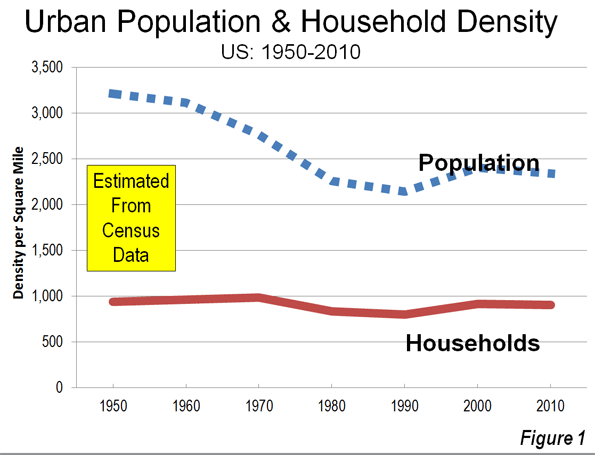
    The urban area data permits analysis of metropolitan area population growth by sector at nearly the smallest census geography (census blocks, which are smaller than census tracts). Overall, the new data indicates that an average urban population density stands at 2,343 per square mile (904 per square kilometer). This is little different from urban density in 1980 and nearly 10 percent above the lowest urban density of 2,141 per square mile (827) recorded in the 1990 census. Thus, in recent decades, formerly falling US urban densities have stabilized .

    Urban density in 2010, however, remains approximately 27 percent below that of 1950, as many core municipalities lost population while suburban and suburban populations expanded. This resulted in the substantial expansion of urban land area reflecting the preference for low-density lifestyles among Americans and most people in other high-income areas of the world.   Between the 1960s and 2000, nearly all of the growth in the major metropolitan regions of Western Europe and Canada has taken place in suburban areas, as these nations’ urban areas have dispersed in a manner similar to that of the United States. The trend continued through 2011 in Canada and domestic migration data in Western Europe shows a continuing movement of people from the historical cores to the suburbs and exurbs.

    This dispersion, pejoratively called "urban sprawl" has been routinely linked with everything from obesity and global warming to "bowling alone." In fact, while population densities have fallen, households densities have remained steady, barely droppping at all. Average household size has fallen dramatically, as fewer children have been born and divorce rates have soared. New households have been formed at more than 1.5 times the rate of population growth. The result is that a 27 percent decline in urban density since 1950 translated into a much more modest 4 percent decline in household density. A more genuine target for anti-suburban crusaders would be household sprawl rather than urban sprawl (Figure 1).

    Smaller Urban Areas Growing Faster

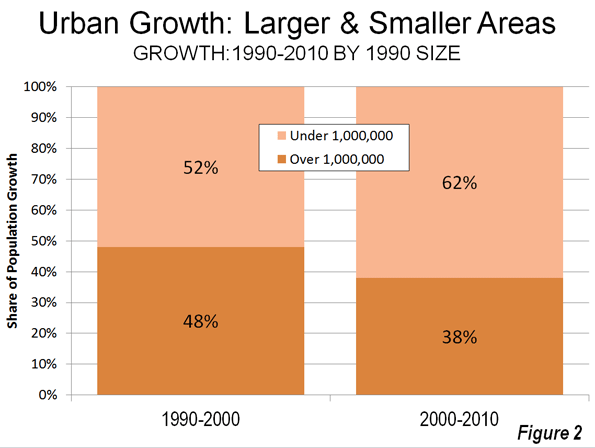
    Even as urban densities have reached a floor, Americans still continue to move to areas of lower density and smaller populations. For example, the urban areas of more than 1 million population in 1990 attracted 48 percent of the nation’s urban growth between 1990 and 2000. Between 2000 and 2010, these areas attracted a smaller 38 percent of urban growth (Figure 2).

    The Exurbs: A Two-Way Exodus

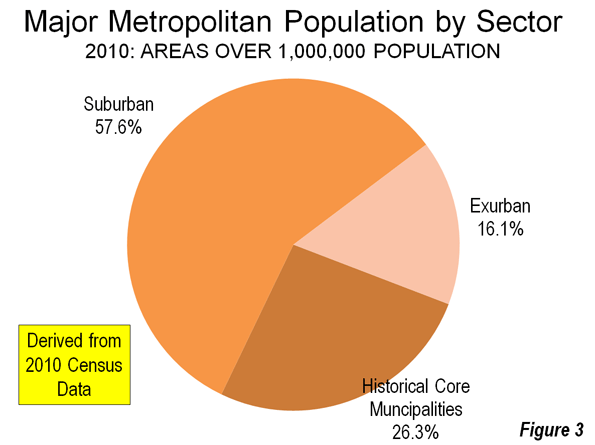
    For much of the last decade (and even before), the media has been heralding an epochal “return” to core cities. This idea is fundamentally misleading since most suburbanites actually came not from core cities but smaller towns and rural areas. The census results have made it clear that the urban focus of population growth was largely anecdotal, although  small inner city areas of some core cities (such as small sections of  St. Louis, Chicago, Dallas, Seattle, San Diego and Portland)  have experienced uncharacteristic growth. But overall, most growth continued to be in the suburbs and exurbs.  Measured at the census block level, exurbs are constantly at risk of being converted into suburbs as they become a part of the continuously developed area. Even so, as of 2010, exurban areas accounted for 16.1 percent of the population in the 51 major metropolitan areas. The historical core municipalities accounted for 26.3 percent of the population, while suburban areas housed 57.6 percent of the population (Figure 3).

    It should be considered, however, that in many urban areas — such as Houston, Los Angeles, Phoenix, Portland, Seattle and Orlando — many historic city neighborhoods were developed as and remain suburban in their form, being dominated detached homes and automobiles. It is unlikely that exurban areas (measured at the census block level) will exceed the historical core cities in population, since they are at constant risk of being merged with suburbs (as the urban area expands).

    Smaller Urban Areas: Where the Sprawl Is

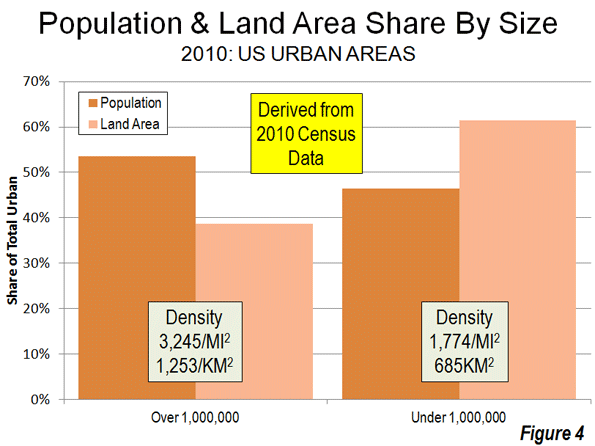
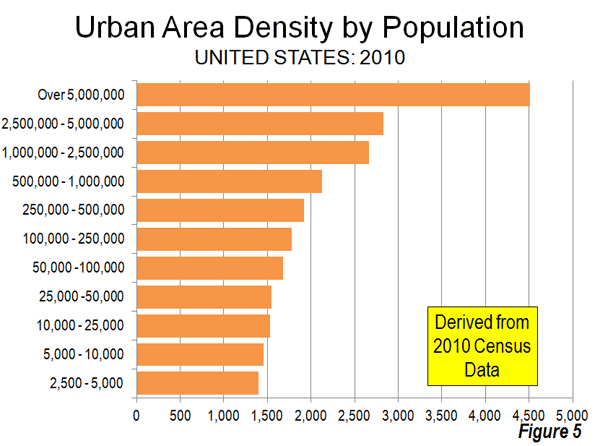
    The principal urban areas of the major metropolitan areas are nearly twice as dense as the rest of America’s urban areas. These urban areas have 53 percent of the urban population, but occupy only 39 percent of the urban land area. By contrast, the smaller urban areas have 47 percent of the urban population, while occupying 61 percent of the urban land area (Figure 4). It seems odd  that the fury of urban planners is directed at the larger, more dense urban areas rather than the smaller, much less dense urban areas, that sprawl to a far greater degree (Figure 5).

    Most and Least Dense Major Urban Areas

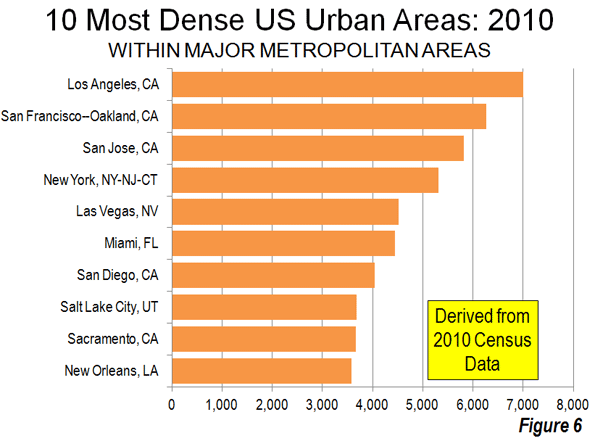
    Among the major metropolitan areas, the most dense urban area is Los Angeles, at a density of 6,999 per square mile (2,702 per square kilometer). This is a 32 percent denser than fourth ranked New York whose  hyper-dense core is offset by its low density suburbs. In fact, San Jose, which is virtually all suburban in its urban form and was a small urban area in 1950 (link to 1950-2010 data), ranks third and also is more dense than the New York urban area. Second ranked San Francisco is also more dense than New York (Figure 6). New Orleans ranked 10th most dense, however experienced a reduction in density of more approximately 30 percent due to the devastation of Hurricanes Katrina

    It may be surprising that Portland, with by far the most radical densification policies in the nation, does not even rank among the 10 most dense urban areas. Portland ranked 13th, behind urban areas like Las Vegas, Salt Lake City, San Diego, Sacramento, Denver and exclusively suburban Riverside-San Bernardino (and even the much smaller urban areas of Fresno, Bakersfield, Turlock and Los Banos in California’s San Joaquin Valley). However Portland did densify, reaching one-half the density of Los Angeles.  Portland will catch Los Angeles in density by 2120 at the current rate.   

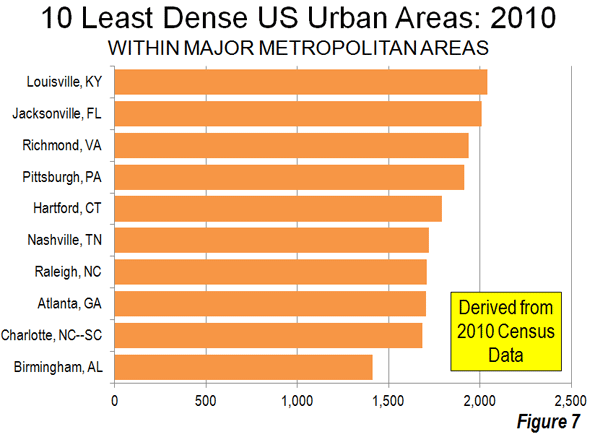
    The least dense urban area is Birmingham, with a population density of 1,414 per square mile (546 per square kilometer). Atlanta, the least dense urban area of more than 3 million population in the world right is the third least dense at 1,707 per square mile (659 per square kilometer). The second least dense urban area, Charlotte, had a density of 1,685 per square mile (651 per square kilometer), while increasing its land area over the decade at twice the rate of Atlanta (Figure 7).

    Staying the Same

    Urbanization in the United States over the last decade can be characterized by the old French proverb that "the more things change the more they stay the same."

    As in Europe and elsewhere (see the Evolving Urban Form series), when they move, Americans go to less dense areas such as to suburban and exurban areas within the larger metropolitan areas as well as smaller, lower density urban regions. The extent to which they move, however, will depend more upon economic improvement than the lure of core areas that, in reality, continue to lose younger people in their thirties while continuing not attracting their boomer parents as they get older.

    Wendell Cox is a Visiting Professor, Conservatoire National des Arts et Metiers, Paris and the author of “War on the Dream: How Anti-Sprawl Policy Threatens the Quality of Life

    —-

    Note 1: Urban Areas and Metropolitan Areas: An urban area is the area of continuous development and as Sir Peter Hall put it, is thus the "physical" urban form. The urban area is a similar, but fundamentally different concept than a metropolitan area and analysts routinely confuse the terms. The United States Census Bureau calls urban areas over 50,000 population "urbanized areas." The metropolitan area is larger, and includes one or more urban areas as well as economically connected rural areas. . The metropolitan area is the "functional" urban form. There is no rural territory within urban areas, but there can be substantial rural territory in a metropolitan area (For example, the US defines metropolitan areas by counties. This can lead to artificially large metropolitan areas. For example, the Riverside San Bernardino metropolitan area, in the West where counties tend to be larger, covers 27,300 square miles (a land area larger than Ireland). The Cleveland metropolitan area, with a principal urban area similar in population to Riverside-San Bernardino, covers only 2,000 square miles, because it is located in Ohio, where counties are smaller. At the same, the far lower population density of the Riverside-San Bernardino metropolitan area is despite the fact that the urban area is approximately 50 percent more dense than the Cleveland urban area

    Note 2: Historical Core Municipalities, Suburbs and Exurbs: For the purposes of this article, an area outside a historical core municipality is considered a suburb if it is in the urban area and an exurb if it is in the corresponding metropolitan area, but outside the principal urban area. Urban areas are delineated at a small census geographical area (the census block), which makes more precise analysis possible than is available at the county level, the lowest level at which domestic migration data is available.

    Note 3: Principal Urban Areas: The principal urban area is the urban area within a metropolitan area that has the largest population. For example, in the Riverside-San Bernardino metropolitan area, the Riverside-San Bernardino urban area is the principal urban area. Other urban areas, such as Murrietta, Hemet and Indio (Palm Springs) would be secondary urban areas.

    —-

    Photograph: Exurban St. Louis (photo by author)

  • Best Cities for Jobs 2012

    Best Cities for Jobs 2012 Rankings

  • 2011 How We Pick the Best Cities For Job Growth

    The methodology for the 2011 rankings largely corresponds to that used last year, which emphasizes the robustness of a region’s growth both recently and over time. It allows the rankings to include all of the metropolitan statistical areas (MSAs) for which the Bureau of Labor Statistics reports monthly employment data. They are derived from three-month rolling averages of U.S. Bureau of Labor Statistics “state and area” unadjusted employment data reported from November 1999 to January 2011.

    “Large” areas include those with a current nonfarm employment base of at least 450,000 jobs. “Midsize” areas range from 150,000 to 450,000 jobs. “Small” areas have as many as 150,000 jobs. This year’s rankings reflect the current size of each MSA’s employment, unlike last year when some were “held over” in size categories to facilitate comparisons.

    This year’s rankings use four measures of growth to rank all areas for which full data sets were available from the past 10 years. Because of the expanded availability of data since last year, we were able to include another small MSA (Manhattan, KS) in this year’s rankings for a total of 398 regions. Generally, this year’s rankings can be directly compared to the 2010 rankings for MSAs for the large and midsize categories, although there are eight MSAs that are reported in the Small size category that were Medium last year and one (Honolulu, HI) that was large that is now reported as medium-sized. In instances where the analysis refers to changes in ranking order, these adjustments are made accordingly, reporting the changes in ranking as if they had been categorized in their current category last year.

    The index is calculated from a normalized, weighted summary of: 1) recent growth trend: the current and prior year’s employment growth rates, with the current year emphasized (two points); 2) mid-term growth: the average annual 2005-2010 growth rate (two points); 3) long-term trend and momentum: the sum of the 2005-2010 and 1999-2004 employment growth rates multiplied by the ratio of the 1999-2004 growth rate over the 2005-2010 growth rate (two points); and 4) current year growth (one point).

    The data reflect the North American Industry Classification System categories, including total nonfarm employment, manufacturing, financial services, business and professional services, educational and health services, information, retail and wholesale trade, transportation and utilities, leisure and hospitality, and government.

  • Large Cities Rankings – 2012 Best Cities for Job Growth

    Read about how we selected the 2012 Best Cities for Job Growth

    2012 New Geography Rankings – Large (> 450k employment)

    2012  Rank Among Large Cities
    Area
    2012 Weighted INDEX
     

    2011 Nonfarm Employment (1000s) 
    2011 Size Ranking
    Size Movement
    1
    Austin-Round Rock-San Marcos, TX
    91.6
    798.5
    1
    0
    2
    Houston-Sugar Land-Baytown, TX
    88.7
    2637.3
    3
    1
    3
    Salt Lake City, UT
    79.1
    637.3
    20
    17
    4
    Fort Worth-Arlington, TX Metropolitan Division
    76.0
    872.3
    15
    11
    5
    San Jose-Sunnyvale-Santa Clara, CA
    75.9
    891.6
    27
    22
    6
    Dallas-Plano-Irving, TX Metropolitan Division
    75.9
    2077.9
    5
    -1
    7
    Raleigh-Cary, NC
    75.9
    514.5
    14
    7
    8
    Pittsburgh, PA
    75.2
    1157.7
    11
    3
    9
    Nashville-Davidson–Murfreesboro–Franklin, TN
    74.0
    759.6
    8
    -1
    10
    Oklahoma City, OK
    73.6
    575.7
    22
    12
    11
    New York City, NY
    73.5
    3816.0
    9
    -2
    12
    Northern Virginia, VA
    73.5
    1342.3
    7
    -5
    13
    New Orleans-Metairie-Kenner, LA
    70.8
    529.3
    2
    -11
    14
    Seattle-Bellevue-Everett, WA Metropolitan Division
    70.0
    1416.3
    32
    18
    15
    Denver-Aurora-Broomfield, CO
    69.3
    1219.8
    24
    9
    16
    Washington-Arlington-Alexandria, DC-VA-MD-WV Met. Div.
    68.7
    2451.8
    6
    -10
    17
    San Francisco-San Mateo-Redwood City, CA Met. Div.
    67.8
    959.1
    33
    16
    18
    Rochester, NY
    66.7
    514.4
    16
    -2
    19
    Charlotte-Gastonia-Rock Hill, NC-SC
    65.7
    830.0
    30
    11
    20
    San Antonio-New Braunfels, TX
    65.4
    854.0
    4
    -16
    21
    Miami-Miami Beach-Kendall, FL Metropolitan Division
    63.2
    1019.5
    36
    15
    22
    Columbus, OH
    62.7
    924.0
    19
    -3
    23
    Omaha-Council Bluffs, NE-IA
    61.7
    462.6
    21
    -2
    24
    Nassau-Suffolk, NY Metropolitan Division
    61.5
    1248.0
    17
    -7
    25
    Louisville-Jefferson County, KY-IN
    60.1
    605.8
    34
    9
    26
    Putnam-Rockland-Westchester, NY
    59.8
    564.6
    29
    3
    27
    Richmond, VA
    59.6
    613.1
    39
    12
    28
    Portland-Vancouver-Hillsboro, OR-WA
    59.3
    993.2
    35
    7
    29
    Boston-Cambridge-Quincy, MA NECTA Division
    59.2
    1689.9
    13
    -16
    30
    Hartford-West Hartford-East Hartford, CT NECTA
    57.6
    543.1
    26
    -4
    31
    Atlanta-Sandy Springs-Marietta, GA
    56.9
    2323.4
    52
    21
    32
    Indianapolis-Carmel, IN
    56.0
    883.5
    28
    -4
    33
    Tampa-St. Petersburg-Clearwater, FL
    55.2
    1145.7
    51
    18
    34
    Minneapolis-St. Paul-Bloomington, MN-WI
    54.8
    1729.0
    46
    12
    35
    Buffalo-Niagara Falls, NY
    54.3
    542.7
    18
    -17
    36
    San Diego-Carlsbad-San Marcos, CA
    51.6
    1241.6
    37
    1
    37
    Warren-Troy-Farmington Hills, MI Metropolitan Division
    51.1
    1086.4
    59
    22
    38
    Memphis, TN-MS-AR
    51.0
    606.0
    64
    26
    39
    Jacksonville, FL
    50.9
    595.7
    42
    3
    40
    Cincinnati-Middletown, OH-KY-IN
    50.8
    992.7
    49
    9
    41
    Orlando-Kissimmee-Sanford, FL
    50.0
    1018.3
    25
    -16
    42
    Philadelphia City, PA
    49.7
    657.3
    10
    -32
    43
    Kansas City, MO
    49.7
    548.1
    45
    2
    44
    Bergen-Hudson-Passaic, NJ
    48.6
    878.3
    43
    -1
    45
    Phoenix-Mesa-Glendale, AZ
    47.8
    1739.9
    53
    8
    46
    Bethesda-Rockville-Frederick, MD Metropolitan Division
    47.3
    561.1
    12
    -34
    47
    Santa Ana-Anaheim-Irvine, CA Metropolitan Division
    45.4
    1382.6
    50
    3
    48
    Chicago-Joliet-Naperville, IL Metropolitan Division
    45.2
    3657.9
    41
    -7
    49
    Virginia Beach-Norfolk-Newport News, VA-NC
    45.0
    733.5
    38
    -11
    50
    Riverside-San Bernardino-Ontario, CA
    40.7
    1147.6
    57
    7
    51
    Edison-New Brunswick, NJ Metropolitan Division
    39.2
    978.3
    40
    -11
    52
    Fort Lauderdale-Pompano Beach-Deerfield Beach, FL Met. Div.
    38.1
    715.9
    54
    2
    53
    St. Louis, MO-IL
    37.2
    1289.9
    31
    -22
    54
    Milwaukee-Waukesha-West Allis, WI
    36.3
    808.8
    23
    -31
    55
    West Palm Beach-Boca Raton-Boynton Beach, FL Met. Div.
    36.3
    509.1
    56
    1
    56
    Las Vegas-Paradise, NV
    35.4
    813.2
    62
    6
    57
    Camden, NJ Metropolitan Division
    33.1
    502.8
    47
    -10
    58
    Newark-Union, NJ-PA Metropolitan Division
    29.8
    974.2
    55
    -3
    59
    Los Angeles-Long Beach-Glendale, CA Metropolitan Division
    26.1
    3822.4
    60
    1
    60
    Sacramento–Arden-Arcade–Roseville, CA
    25.8
    801.3
    58
    -2
    61
    Cleveland-Elyria-Mentor, OH
    24.7
    985.0
    48
    -13
    62
    Detroit-Livonia-Dearborn, MI Metropolitan Division
    24.3
    699.8
    63
    1
    63
    Oakland-Fremont-Hayward, CA Metropolitan Division
    19.4
    953.6
    65
    2
    64
    Providence-Fall River-Warwick, RI-MA NECTA
    17.7
    539.3
    44
    -20
    65
    Birmingham-Hoover, AL
    14.9
    487.3
    61
    -4
  • Midsized Cities Rankings – 2012 Best Cities for Job Growth

    Read about how we selected the 2012 Best Cities for Job Growth

    2012 New Geography Rankings – MEDIUM (150k – 450k employment)

    2012  Rank Among Medium Cities
    Area
    2012 Weighted INDEX
     

    2011 Nonfarm Employment (1000s) 
    2011 Size Ranking
    Size Movement
    1
    Lafayette, LA
    92.5
    156.3
    34
    33
    2
    Corpus Christi, TX
    90.4
    184.0
    2
    0
    3
    McAllen-Edinburg-Mission, TX
    79.7
    232.3
    6
    3
    4
    El Paso, TX
    77.8
    283.1
    1
    -3
    5
    Charleston-North Charleston-Summerville, SC
    77.4
    296.4
    8
    3
    6
    Knoxville, TN
    76.5
    334.8
    9
    3
    7
    Provo-Orem, UT
    73.7
    185.8
    30
    23
    8
    Bakersfield-Delano, CA
    72.8
    234.5
    43
    35
    9
    Boulder, CO
    72.1
    164.3
    26
    17
    10
    Grand Rapids-Wyoming, MI
    70.6
    375.7
    40
    30
    11
    Peoria, IL
    70.5
    182.5
    65
    54
    12
    Baltimore City, MD
    70.1
    364.9
    60
    48
    13
    Asheville, NC
    69.2
    172.0
    31
    18
    14
    Lincoln, NE
    68.6
    174.9
    10
    -4
    15
    Framingham, MA  NECTA Division
    68.2
    158.0
    50
    35
    16
    Kansas City, KS
    67.7
    435.2
    57
    41
    17
    Greenville-Mauldin-Easley, SC
    67.2
    305.3
    54
    37
    18
    Trenton-Ewing, NJ
    66.9
    243.4
    11
    -7
    19
    Canton-Massillon, OH
    66.9
    164.7
    79
    60
    20
    Durham-Chapel Hill, NC
    66.7
    276.8
    22
    2
    21
    Fayetteville-Springdale-Rogers, AR-MO
    63.8
    204.3
    5
    -16
    22
    Ann Arbor, MI
    63.7
    202.4
    21
    -1
    23
    Evansville, IN-KY
    63.6
    175.6
    37
    14
    24
    Allentown-Bethlehem-Easton, PA-NJ
    63.5
    340.2
    20
    -4
    25
    Poughkeepsie-Newburgh-Middletown, NY
    62.4
    253.0
    29
    4
    26
    Santa Barbara-Santa Maria-Goleta, CA
    62.3
    165.5
    66
    40
    27
    Reading, PA
    61.8
    171.0
    55
    28
    28
    York-Hanover, PA
    61.4
    177.7
    46
    18
    29
    Baton Rouge, LA
    60.9
    369.2
    45
    16
    30
    Shreveport-Bossier City, LA
    60.8
    178.1
    12
    -18
    31
    Lansing-East Lansing, MI
    60.5
    220.5
    68
    37
    32
    Jackson, MS
    59.8
    255.5
    41
    9
    33
    Springfield, MO
    57.9
    194.1
    24
    -9
    34
    Fort Wayne, IN
    57.9
    208.3
    68
    34
    35
    Tulsa, OK
    57.3
    412.9
    37
    2
    36
    Green Bay, WI
    56.9
    166.9
    16
    -20
    37
    Columbia, SC
    56.8
    349.7
    62
    25
    38
    Anchorage, AK
    56.4
    170.0
    3
    -35
    39
    Worcester, MA-CT NECTA
    55.9
    243.9
    59
    20
    40
    Des Moines-West Des Moines, IA
    55.4
    318.0
    38
    -2
    41
    Scranton–Wilkes-Barre, PA
    55.3
    256.6
    28
    -13
    42
    Ogden-Clearfield, UT
    54.8
    193.8
    19
    -23
    43
    Little Rock-North Little Rock-Conway, AR
    54.4
    339.4
    15
    -28
    44
    Calvert-Charles-Prince George’s, MD
    53.8
    382.2
    49
    5
    45
    Honolulu, HI
    52.9
    441.9
    13
    3
    46
    Madison, WI
    49.1
    344.3
    33
    -13
    47
    Harrisburg-Carlisle, PA
    48.5
    321.6
    48
    1
    48
    Albany-Schenectady-Troy, NY
    48.4
    437.8
    59
    11
    49
    New Haven, CT NECTA
    47.9
    268.5
    44
    -5
    50
    Cape Coral-Fort Myers, FL
    47.7
    205.4
    89
    39
    51
    Gary, IN Metropolitan Division
    47.2
    268.5
    76
    25
    52
    Tacoma, WA Metropolitan Division
    47.0
    265.8
    39
    -13
    53
    Boise City-Nampa, ID
    47.0
    256.8
    71
    18
    54
    Lexington-Fayette, KY
    46.5
    249.1
    14
    -40
    55
    Syracuse, NY
    46.4
    314.4
    18
    -37
    56
    Lancaster, PA
    45.0
    226.8
    62
    6
    57
    Chattanooga, TN-GA
    45.0
    233.4
    47
    -10
    58
    Dayton, OH
    44.9
    377.9
    78
    20
    59
    Huntsville, AL
    44.0
    205.6
    17
    -42
    60
    Deltona-Daytona Beach-Ormond Beach, FL
    43.5
    156.9
    85
    25
    61
    Winston-Salem, NC
    43.3
    207.2
    47
    -14
    62
    Colorado Springs, CO
    43.2
    247.5
    58
    -4
    63
    Mobile, AL
    42.9
    174.7
    63
    0
    64
    Augusta-Richmond County, GA-SC
    42.3
    207.8
    39
    -25
    65
    Fresno, CA
    42.0
    281.2
    72
    7
    66
    Beaumont-Port Arthur, TX
    41.8
    157.6
    18
    -48
    67
    Portland-South Portland-Biddeford, ME NECTA
    41.5
    187.0
    41
    -26
    68
    Oxnard-Thousand Oaks-Ventura, CA
    39.8
    275.9
    80
    12
    69
    Stockton, CA
    38.8
    189.6
    78
    9
    70
    Tucson, AZ
    38.6
    358.4
    58
    -12
    71
    Tallahassee, FL
    38.3
    169.5
    16
    -55
    72
    Springfield, MA-CT NECTA
    38.3
    285.4
    77
    5
    73
    North Port-Bradenton-Sarasota, FL
    38.0
    242.6
    89
    16
    74
    Albuquerque, NM
    38.0
    371.0
    64
    -10
    75
    Akron, OH
    37.8
    318.1
    67
    -8
    76
    Toledo, OH
    37.2
    301.8
    95
    19
    77
    Bridgeport-Stamford-Norwalk, CT NECTA
    36.4
    397.0
    44
    -33
    78
    Roanoke, VA
    36.0
    155.4
    51
    -27
    79
    Lake County-Kenosha County, IL-WI Metropolitan Division
    35.7
    373.4
    71
    -8
    80
    Spokane, WA
    34.0
    202.9
    31
    -49
    81
    Youngstown-Warren-Boardman, OH-PA
    33.8
    222.9
    93
    12
    82
    Pensacola-Ferry Pass-Brent, FL
    33.0
    157.6
    45
    -37
    83
    Greensboro-High Point, NC
    31.9
    345.3
    90
    7
    84
    Wilmington, DE-MD-NJ Metropolitan Division
    28.8
    331.7
    72
    -12
    85
    Palm Bay-Melbourne-Titusville, FL
    28.2
    193.2
    75
    -10
    86
    Reno-Sparks, NV
    27.9
    190.3
    92
    6
    87
    Davenport-Moline-Rock Island, IA-IL
    26.5
    177.2
    56
    -31
    88
    Wichita, KS
    26.4
    282.0
    64
    -24
    89
    Lakeland-Winter Haven, FL
    26.4
    195.4
    70
    -19
    90
    Montgomery, AL
    25.7
    164.3
    52
    -38
    91
    Santa Rosa-Petaluma, CA
    11.4
    168.0
    88
    -3
  • Small Cities Rankings – 2012 Best Cities for Job Growth

    Read about how we selected the 2012 Best Cities for Job Growth

    2012 New Geography Rankings – SMALL (< 150k employment)

    2012  Rank Among Small Cities
    Area
    2012 Weighted INDEX
     

    2011 Nonfarm Employment (1000s) 
    2011 Size Ranking
    Size Movement
    1
    Odessa, TX
    99.4
    68.3
    8
    7
    2
    Midland, TX
    99.0
    75.3
    4
    2
    3
    Columbus, IN
    95.6
    47.7
    143
    140
    4
    Lafayette, LA
    92.5
    156.3
    111
    107
    5
    San Angelo, TX
    89.2
    46.7
    23
    18
    6
    Blacksburg-Christiansburg-Radford, VA
    87.8
    73.9
    168
    162
    7
    Casper, WY
    84.8
    40.9
    119
    112
    8
    Williamsport, PA
    83.7
    55.4
    55
    47
    9
    Glens Falls, NY
    83.0
    55.6
    59
    50
    10
    Lubbock, TX
    82.6
    131.4
    74
    64
    11
    Laredo, TX
    82.1
    95.0
    56
    45
    12
    Columbia, MO
    82.1
    96.7
    20
    8
    13
    Cumberland, MD-WV
    82.0
    41.7
    32
    19
    14
    Gainesville, GA
    81.9
    75.8
    52
    38
    15
    Portsmouth, NH-ME NECTA
    81.7
    56.0
    34
    19
    16
    Holland-Grand Haven, MI
    80.9
    113.1
    138
    122
    17
    Bismarck, ND
    79.2
    65.7
    2
    -15
    18
    Houma-Bayou Cane-Thibodaux, LA
    78.8
    95.1
    65
    47
    19
    State College, PA
    78.5
    76.4
    49
    30
    20
    Fargo, ND-MN
    78.4
    127.3
    29
    9
    21
    Ocean City, NJ
    78.0
    36.8
    61
    40
    22
    Owensboro, KY
    77.6
    51.8
    66
    44
    23
    Charlottesville, VA
    77.0
    102.3
    78
    55
    24
    Tyler, TX
    76.9
    96.0
    64
    40
    25
    Cheyenne, WY
    76.8
    44.7
    99
    74
    26
    Barnstable Town, MA NECTA
    76.2
    94.4
    70
    44
    27
    Longview, TX
    76.1
    98.0
    15
    -12
    28
    Hanford-Corcoran, CA
    76.0
    36.6
    135
    107
    29
    Kennewick-Pasco-Richland, WA
    75.8
    99.0
    17
    -12
    30
    Victoria, TX
    75.6
    50.6
    96
    66
    31
    Killeen-Temple-Fort Hood, TX
    74.6
    129.0
    1
    -30
    32
    Grand Junction, CO
    73.8
    60.5
    142
    110
    33
    St. Joseph, MO-KS
    72.8
    60.6
    105
    72
    34
    Lafayette, IN
    72.4
    95.6
    104
    70
    35
    Pueblo, CO
    72.4
    58.7
    73
    38
    36
    Sherman-Denison, TX
    72.2
    43.6
    117
    81
    37
    Erie, PA
    72.1
    131.2
    87
    50
    38
    Fayetteville, NC
    71.7
    132.0
    98
    60
    39
    Fort Collins-Loveland, CO
    71.6
    135.9
    38
    -1
    40
    Morgantown, WV
    71.0
    66.5
    24
    -16
    41
    Crestview-Fort Walton Beach-Destin, FL
    70.8
    81.0
    191
    150
    42
    Waterloo-Cedar Falls, IA
    70.7
    90.9
    84
    42
    43
    Texarkana, TX-Texarkana, AR
    70.6
    58.1
    45
    2
    44
    Utica-Rome, NY
    69.8
    133.1
    114
    70
    45
    Amarillo, TX
    69.7
    113.1
    67
    22
    46
    Brownsville-Harlingen, TX
    69.6
    129.5
    19
    -27
    47
    Palm Coast, FL
    69.6
    19.0
    90
    43
    48
    Rapid City, SD
    69.5
    60.5
    72
    24
    49
    Columbus, GA-AL
    69.1
    120.6
    125
    76
    50
    Winchester, VA-WV
    69.0
    56.4
    95
    45
    51
    Greeley, CO
    68.7
    80.3
    123
    72
    52
    Mankato-North Mankato, MN
    68.7
    53.5
    110
    58
    53
    Oshkosh-Neenah, WI
    68.5
    94.3
    33
    -20
    54
    Haverhill-North Andover-Amesbury, MA-NH  NECTA Division
    68.3
    78.1
    42
    -12
    55
    Sioux Falls, SD
    67.4
    135.6
    71
    16
    56
    Ames, IA
    66.0
    48.2
    77
    21
    57
    Johnson City, TN
    65.9
    79.9
    102
    45
    58
    Dubuque, IA
    65.8
    56.6
    5
    -53
    59
    Logan, UT-ID
    65.6
    54.4
    9
    -50
    60
    Danbury, CT NECTA
    65.6
    67.8
    159
    99
    61
    Altoona, PA
    65.4
    61.5
    69
    8
    62
    Peabody, MA  NECTA Division
    65.3
    101.4
    149
    87
    63
    Jacksonville, NC
    65.3
    47.8
    12
    -51
    64
    Auburn-Opelika, AL
    65.1
    53.6
    21
    -43
    65
    Wenatchee-East Wenatchee, WA
    64.7
    38.4
    36
    -29
    66
    Harrisonburg, VA
    64.4
    63.7
    40
    -26
    67
    Lowell-Billerica-Chelmsford, MA-NH  NECTA Division
    64.0
    117.5
    122
    55
    68
    Burlington-South Burlington, VT NECTA
    62.6
    114.2
    53
    -15
    69
    Coeur d’Alene, ID
    62.5
    53.0
    101
    32
    70
    Clarksville, TN-KY
    61.9
    84.2
    22
    -48
    71
    Joplin, MO
    61.4
    80.0
    16
    -55
    72
    Rochester-Dover, NH-ME NECTA
    61.3
    56.3
    94
    22
    73
    Danville, VA
    60.5
    40.0
    186
    113
    74
    Iowa City, IA
    60.5
    91.4
    41
    -33
    75
    Olympia, WA
    60.4
    99.4
    158
    83
    76
    Sandusky, OH
    60.2
    35.2
    60
    -16
    77
    St. Cloud, MN
    60.2
    99.6
    54
    -23
    78
    Bay City, MI
    59.3
    36.9
    205
    127
    79
    Hinesville-Fort Stewart, GA
    59.3
    19.8
    51
    -28
    80
    Las Cruces, NM
    59.2
    69.8
    43
    -37
    81
    Springfield, IL
    59.0
    111.8
    28
    -53
    82
    Napa, CA
    59.0
    60.7
    209
    127
    83
    Salinas, CA
    59.0
    123.0
    206
    123
    84
    Lewiston-Auburn, ME NECTA
    58.8
    48.7
    109
    25
    85
    Burlington, NC
    58.8
    58.0
    157
    72
    86
    Jonesboro, AR
    58.3
    49.2
    27
    -59
    87
    Kankakee-Bradley, IL
    58.1
    43.3
    85
    -2
    88
    Greenville, NC
    58.0
    75.9
    83
    -5
    89
    Manchester, NH NECTA
    57.8
    98.7
    115
    26
    90
    Decatur, IL
    57.1
    52.7
    121
    31
    91
    Appleton, WI
    57.0
    116.7
    79
    -12
    92
    Bellingham, WA
    56.5
    80.4
    204
    112
    93
    Bowling Green, KY
    56.4
    59.8
    47
    -46
    94
    Goldsboro, NC
    56.1
    43.2
    178
    84
    95
    Lebanon, PA
    56.0
    49.8
    14
    -81
    96
    Fairbanks, AK
    56.0
    37.4
    10
    -86
    97
    College Station-Bryan, TX
    55.8
    95.9
    3
    -94
    98
    Sebastian-Vero Beach, FL
    55.5
    45.8
    228
    130
    99
    Hagerstown-Martinsburg, MD-WV
    55.0
    99.3
    150
    51
    100
    Merced, CA
    54.9
    56.4
    103
    3
    101
    Warner Robins, GA
    54.9
    59.2
    35
    -66
    102
    Dover, DE
    54.8
    64.3
    75
    -27
    103
    Elkhart-Goshen, IN
    54.8
    107.9
    155
    52
    104
    Kingston, NY
    54.7
    61.6
    120
    16
    105
    Charleston, WV
    54.7
    148.1
    124
    -12
    106
    Springfield, OH
    54.7
    49.9
    86
    -20
    107
    Gulfport-Biloxi, MS
    54.3
    105.9
    18
    -89
    108
    Myrtle Beach-North Myrtle Beach-Conway, SC
    54.2
    109.7
    39
    -69
    109
    Farmington, NM
    54.1
    48.8
    167
    58
    110
    Niles-Benton Harbor, MI
    54.0
    59.3
    82
    -28
    111
    Elizabethtown, KY
    54.0
    47.0
    11
    -100
    112
    El Centro, CA
    54.0
    45.3
    151
    39
    113
    La Crosse, WI-MN
    53.2
    73.9
    108
    -5
    114
    Naples-Marco Island, FL
    53.2
    117.5
    224
    110
    115
    Grand Forks, ND-MN
    53.1
    54.0
    30
    -85
    116
    Vineland-Millville-Bridgeton, NJ
    51.6
    59.3
    203
    87
    117
    Decatur, AL
    51.3
    54.4
    161
    44
    118
    Yakima, WA
    51.1
    75.9
    50
    -68
    119
    Panama City-Lynn Haven-Panama City Beach, FL
    51.1
    71.4
    107
    -12
    120
    Monroe, LA
    51.1
    76.7
    179
    59
    121
    Corvallis, OR
    50.9
    37.8
    31
    -90
    122
    Vallejo-Fairfield, CA
    50.2
    120.1
    198
    76
    123
    Santa Fe, NM
    50.1
    61.0
    139
    16
    124
    Punta Gorda, FL
    50.0
    42.4
    145
    21
    125
    Salisbury, MD
    49.9
    52.9
    170
    45
    126
    Florence, SC
    49.6
    82.7
    173
    47
    127
    Binghamton, NY
    49.4
    109.9
    140
    13
    128
    Santa Cruz-Watsonville, CA
    49.4
    87.8
    211
    83
    129
    Sioux City, IA-NE-SD
    49.2
    73.3
    129
    0
    130
    Jefferson City, MO
    49.2
    76.9
    80
    -50
    131
    Muskegon-Norton Shores, MI
    48.8
    60.2
    239
    108
    132
    South Bend-Mishawaka, IN-MI
    48.6
    135.7
    210
    78
    133
    Bangor, ME NECTA
    48.1
    64.6
    166
    33
    134
    Kokomo, IN
    47.8
    41.6
    133
    -1
    135
    Waco, TX
    47.6
    104.4
    37
    -98
    136
    Yuba City, CA
    47.3
    37.5
    218
    82
    137
    Jackson, MI
    47.2
    54.6
    238
    101
    138
    Wheeling, WV-OH
    46.0
    66.7
    25
    -113
    139
    Macon, GA
    45.9
    96.6
    171
    32
    140
    Idaho Falls, ID
    45.6
    48.7
    134
    -6
    141
    Lewiston, ID-WA
    45.5
    26.0
    189
    48
    142
    Johnstown, PA
    45.4
    60.0
    44
    -98
    143
    Athens-Clarke County, GA
    45.4
    84.1
    89
    -54
    144
    Cedar Rapids, IA
    45.1
    136.2
    63
    -81
    145
    St. George, UT
    44.9
    46.3
    199
    54
    146
    Florence-Muscle Shoals, AL
    44.8
    55.1
    88
    -58
    147
    Rockford, IL
    44.2
    146.8
    190
    20
    148
    Pascagoula, MS
    44.1
    56.1
    7
    -141
    149
    Bloomington-Normal, IL
    43.9
    89.8
    97
    -52
    150
    Kingsport-Bristol-Bristol, TN-VA
    43.7
    117.5
    160
    10
    151
    New Bedford, MA NECTA
    42.8
    64.8
    57
    -94
    152
    Topeka, KS
    42.5
    106.9
    118
    -34
    153
    Abilene, TX
    42.5
    64.7
    106
    -47
    154
    Battle Creek, MI
    42.1
    56.0
    128
    -26
    155
    Huntington-Ashland, WV-KY-OH
    42.0
    114.3
    181
    26
    156
    Manhattan, KS
    41.9
    54.5
    6
    157
    Hot Springs, AR
    41.7
    36.9
    100
    -57
    158
    Brockton-Bridgewater-Easton, MA  NECTA Division
    41.6
    87.2
    58
    -100
    159
    Lawton, OK
    41.2
    42.4
    13
    -146
    160
    Mount Vernon-Anacortes, WA
    40.9
    43.6
    131
    -29
    161
    Anderson, IN
    40.6
    39.7
    175
    14
    162
    Eau Claire, WI
    40.1
    79.3
    46
    -116
    163
    Redding, CA
    40.1
    58.1
    216
    53
    164
    Billings, MT
    39.3
    76.6
    93
    -71
    165
    Fond du Lac, WI
    39.2
    45.2
    188
    23
    166
    Rochester, MN
    39.0
    101.0
    127
    -39
    167
    Lima, OH
    38.8
    52.5
    201
    34
    168
    Tuscaloosa, AL
    38.7
    93.2
    91
    -77
    169
    Hattiesburg, MS
    37.9
    58.6
    62
    -107
    170
    Alexandria, LA
    37.9
    62.6
    113
    -57
    171
    Pocatello, ID
    37.6
    36.2
    208
    37
    172
    Spartanburg, SC
    37.4
    118.0
    141
    -31
    173
    Savannah, GA
    37.3
    149.6
    126
    -8
    174
    Muncie, IN
    37.2
    50.1
    193
    19
    175
    Great Falls, MT
    36.9
    34.2
    48
    -127
    176
    Ithaca, NY
    36.7
    62.7
    26
    -150
    177
    Saginaw-Saginaw Township North, MI
    36.3
    85.0
    174
    -3
    178
    Bloomington, IN
    36.1
    81.2
    92
    -86
    179
    Wilmington, NC
    35.5
    134.3
    132
    -47
    180
    Flint, MI
    35.3
    136.6
    237
    57
    181
    Bremerton-Silverdale, WA
    35.3
    81.8
    177
    -4
    182
    Lawrence, KS
    34.5
    50.3
    165
    -17
    183
    Elmira, NY
    34.4
    39.0
    68
    -115
    184
    Salem, OR
    34.2
    141.0
    164
    -43
    185
    Danville, IL
    33.7
    29.2
    225
    40
    186
    Valdosta, GA
    33.1
    52.1
    183
    -3
    187
    Parkersburg-Marietta-Vienna, WV-OH
    33.1
    69.2
    194
    7
    188
    Lake Charles, LA
    32.6
    88.2
    162
    -26
    189
    San Luis Obispo-Paso Robles, CA
    32.1
    96.0
    195
    6
    190
    Dothan, AL
    31.7
    57.7
    242
    52
    191
    Pittsfield, MA NECTA
    31.6
    34.9
    81
    -110
    192
    Missoula, MT
    31.4
    53.8
    152
    -40
    193
    Mansfield, OH
    31.2
    52.5
    232
    39
    194
    Gainesville, FL
    30.8
    125.9
    154
    -40
    195
    Visalia-Porterville, CA
    29.5
    104.5
    196
    1
    196
    Atlantic City-Hammonton, NJ
    29.4
    135.2
    213
    17
    197
    Bend, OR
    29.1
    60.1
    220
    23
    198
    Jackson, TN
    28.9
    58.3
    185
    -13
    199
    Medford, OR
    28.6
    75.1
    197
    -2
    200
    Gadsden, AL
    28.6
    35.6
    180
    -20
    201
    Lynchburg, VA
    27.8
    102.1
    144
    -57
    202
    Ocala, FL
    27.2
    90.9
    227
    25
    203
    Port St. Lucie, FL
    26.9
    120.5
    182
    -21
    204
    Racine, WI
    26.5
    74.8
    184
    -20
    205
    Nashua, NH-MA  NECTA Division
    26.4
    124.0
    192
    -13
    206
    Madera-Chowchilla, CA
    26.4
    31.8
    172
    -34
    207
    Norwich-New London, CT-RI NECTA
    26.3
    125.7
    163
    -44
    208
    Flagstaff, AZ
    26.2
    59.0
    76
    -132
    209
    Modesto, CA
    25.9
    142.5
    148
    20
    210
    Wausau, WI
    25.8
    66.5
    217
    7
    211
    Michigan City-La Porte, IN
    25.4
    42.3
    214
    3
    212
    Lake Havasu City-Kingman, AZ
    24.5
    45.6
    226
    14
    213
    Duluth, MN-WI
    24.1
    125.9
    112
    -101
    214
    Chico, CA
    23.3
    67.8
    146
    -68
    215
    Waterbury, CT NECTA
    23.3
    62.5
    202
    -13
    216
    Cape Girardeau-Jackson, MO-IL
    22.7
    43.3
    147
    -69
    217
    Hickory-Lenoir-Morganton, NC
    21.7
    142.9
    235
    -1
    218
    Wichita Falls, TX
    20.7
    57.8
    169
    -49
    219
    Terre Haute, IN
    20.6
    69.7
    137
    -82
    220
    Prescott, AZ
    20.5
    53.3
    229
    9
    221
    Cleveland, TN
    20.3
    38.5
    176
    -45
    222
    Sumter, SC
    20.0
    36.7
    156
    -66
    223
    Longview, WA
    19.2
    35.0
    212
    -11
    224
    Yuma, AZ
    19.1
    49.1
    221
    -3
    225
    Leominster-Fitchburg-Gardner, MA NECTA
    18.3
    47.2
    116
    -109
    226
    Anderson, SC
    18.1
    58.2
    130
    -96
    227
    Eugene-Springfield, OR
    17.8
    138.7
    230
    -11
    228
    Pine Bluff, AR
    17.3
    36.6
    243
    15
    229
    Brunswick, GA
    17.2
    39.2
    223
    -6
    230
    Anniston-Oxford, AL
    15.8
    47.7
    215
    -15
    231
    Fort Smith, AR-OK
    13.6
    110.2
    153
    -78
    232
    Kalamazoo-Portage, MI
    13.3
    133.7
    187
    -45
    233
    Rome, GA
    13.2
    37.1
    231
    -2
    234
    Rocky Mount, NC
    12.4
    59.6
    200
    -34
    235
    Sheboygan, WI
    11.1
    57.2
    219
    -16
    236
    Steubenville-Weirton, OH-WV
    10.3
    43.1
    233
    -3
    237
    Monroe, MI
    9.3
    37.0
    234
    -3
    238
    Albany, GA
    7.0
    59.3
    207
    -31
    239
    Champaign-Urbana, IL
    6.0
    103.4
    136
    -103
    240
    Carson City, NV
    5.1
    27.7
    222
    -18
    241
    Janesville, WI
    4.4
    60.0
    241
    0
    242
    Morristown, TN
    2.8
    43.6
    236
    -6
    243
    Dalton, GA
    0.5
    62.8
    240
    -3
  • Homebuilding: Recovery & Red Tape

    The Recovery Blueprint is a multipart series of articles that offers suggestions on how to recover from the homebuilding recession.

    Since the recession began, there haven’t been any significant changes in how regulations could be improved to energize the housing market and foster innovation. Three areas where big regulation changes are needed? Environmental subsidies, density requirements, and zoning laws.

    Environmental Incentives: Repeating the mistakes of the Carter era, federal and state governments have thrown vast sums of tax money at ‘green’ solutions likely to fail. A massive amount of our nation’s total energy use seeps out of inefficient housing, draining families of income at a time when they can least afford it. The subsidization of inefficient construction that incorporates energy saving alternatives is as flawed today as it was 25 years ago. Federal and state credits allow funding for improvements such as insulation, solar panels, wind generation, geothermal systems, and the like. These tax credits have to be balanced against taxes paid by families who are barely surviving this recession, if they are still in their homes making mortgage payments.

    Who benefits? Not the mortgage companies that repossess energy inefficient homes. Not the families in traditional homes burdened with high energy costs. Only those wealthy enough to need tax breaks can benefit. But a household at the income level where it makes financial sense to upgrade an existing home can easily afford the upgrade without burdening the already overtaxed public.

    In a low income, possibly downtrodden neighborhood, upgrading a home for energy efficiency results in an expense (even after tax breaks) not likely to be recovered at the sale of the home. It would make more sense to use the same amount of funds to replace older, inefficient homes with new construction. New construction essentially replaces homes with the least efficient HVAC (heating/ventilation/ air conditioning) and insulation with new ones that operate the most efficient systems. But new construction gets almost no tax benefits; only geothermal or solar systems on new construction are subsidized. Does that make sense?

    Density Targets: Making funds available to cities on the condition that certain higher densities are met is not a solution, either. What I hear most often is that we need to provide high-density housing and public transportation so that poor people can get to their jobs, assuming, of course, that all people of low income work downtown.

    Are multi-billion dollar light rail projects and heavily subsidized low-income high-rise towers justified by such rhetoric? A low-income family on the 6th floor of a high-density building will not have the same quality of living or the pride-of-place that a home with a yard would provide. Travel dependent on a train or bus schedule does not offer the independence of owning a vehicle and travelling on one’s own schedule. Travel by foot or bike makes perfect sense for some of those who live in San Diego, but in the rest of the world those alternatives are viable only for the few nice weather days.

    When the recession began, urban architects and planners celebrated the death of the suburbs and the coming advent of an urban rebirth. While the suburbs were certainly hard hit, urban areas did not receive the expected mass migration.

    There is a myth that sprawl was the result of large lots and low density in the suburbs. Over the past 20 years, the firm I founded has planned over 730 developments in 46 States and 15 countries. I would estimate the average density of our suburban developments at between four and five units per useable acre. Today’s suburban development must preserve wetlands, steep slopes, wooded areas, and most often contain a minimum percentage of the site in open space. None of those requirements were in place when our core cities were built. One simply gridded streets through swamps (the previous term for wetlands) and bulldozed slopes and woodlands. Had our existing core cities been built under today’s regulations, they would likely sprawl 30% or more beyond the areas they currently occupy.

    Density targets that must be hit in order to receive government financial assistance not only doesn’t increase the quality of lower income life, it doesn’t result in more sustainable and affordable cities. Instead, most funding has resulted in displacing low-income neighborhoods with gentrified, wealthy development. Many of these projects were initial financial failures. The next developer — the one who picked up the project at bargain prices — realized the profit. Successful, affordable urban redevelopment remains elusive.

    Ordinances & Codes: The designer of any development, suburban or urban, will squeeze every inch out of the site to stay within the most minimal dimensions allowed by local ordinances. This effort to maximize the client’s profits can only result in monotonous, cookie-cutter development.

    Many city planning boards have been manipulated into believing the illusion that a ‘forms based’ or ‘smart-code’ approach is a solution. These new regulations simply increase the number of minimum standards, and restrict innovative solutions. What a ‘forms based’ or ‘smart’ code does accomplish is to significantly increase the consulting income of the firm that promotes this alternative.

    Many engineers and architects base their fees on a percentage of the final construction costs. A consultant who charges on a percentage of infrastructure costs has an incentive to introduce excessive sewer pipes, retaining walls, or other non-needed construction. A fee structure based upon increased profit derived on the least efficient design is a huge roadblock to developing sustainable cities.

    Innovations in land development and in methods of design now allow a reduction of both environmental and economic impact from 15% to over 50%, compared to conventional or New Urban planning methods. While these new methods take more time and effort to design, the reward is more attractive, affordable, and functional neighborhoods.

    What’s the blueprint for better planning? For starters, two ideas: government aid should be based on a ‘plan’ showing how the resulting development will enhance the living standards, and not be tied only to density levels. And agencies should reward contracts to the consultant with the best solution. This means creating a financial mechanism to increase – not decrease — profitability for sustainable planning and engineering solutions that require the least amount of construction costs.

    Photo by Stripey Anne: “I am an NHS Bureaucrat…These, dear friends, are the tools of my trade: red tape, pen, ink…”

    Rick Harrison is President of Rick Harrison Site Design Studio and Neighborhood Innovations, LLC. He is author of Prefurbia: Reinventing The Suburbs From Disdainable To Sustainable and creator of Performance Planning System. His websites are rhsdplanning.com and pps-vr.com.

  • Goodbye, Chicago

    Odd as it may seem for someone known as The Urbanophile, I actually grew up in the countryside. I spent most of my childhood on a country road about four miles outside the town of Laconia, Indiana, population 50.  I always used to get confused when John Cougar sang about living in a small town, because I knew he was from Seymour, and with over 15,000 people that seemed a big town in my book.

    Today I still laugh at these urbanites who brag about their green ways like having “rain barrels” to catch reclaimed rainwater from the roof for watering their yard.  For many years that’s what I drank growing up, as we didn’t have city water supplies and had to rely on our cistern.

    After graduating high school I went to Indiana University. Then armed with my bachelors it was on to Chicago, the result of an accident: that’s where my job offer came from.  I had no strong feelings on where to live other than that I didn’t want to go back to my home town. In Chicago I ended up, like many young professionals, in the Lincoln Park neighborhood on the North Side. Though this too was pretty much an accident. I had relatives who lived there and invited me to stay with them when looking for an apartment.

    For many people from small town or suburban environments, going to college is a time of tremendous personal transformation and growth. I didn’t have that experience. For me, the great transformation came from moving to Chicago. Exiting the L in the Loop on my first day going to work, wearing a suit, surrounded by tall buildings and crowds of people, I felt like I was on the set of a movie. It was an almost surreal experience.

    Though urban life was new to me, I fell in love with it. And I was transformed by the experience. I knew nothing about culture, food, fashion, architecture, actually relating to people with different backgrounds from me, traveling, or how to get around in anything other than a car.  Beyond merely learning how to go to work every day, living in Chicago provided a non-stop stream of stimulating and educational experiences that helped me grow as a person.

    But it wasn’t just me who was being  transformed. The urban renaissance of Chicago was underway by the time I arrived in 1992, but it was very early in the process. I recall recruiters for the company I worked for bragging about how Chicago was now an outpost of that uber-hip coffee chain Starbucks. The gentrified areas were still largely confined to a narrow strip along the north Lakefront. Many of the places that later became yuppie playgrounds were then ethnic enclaves or undeveloped. Some were still close to slums.  On the outer reaches of Lincoln Park itself, streetwalkers openly plied their trade along North Ave.

    The 90s were heady a heady decade for  Chicago. The city, like select other major urban metros around the country, exploded with new growth and attracted many new migrants. Chicago experienced perhaps the largest urban condo building boom in America, transforming huge tracts of the city.  The quality on offer improved radically.  The population increased, and the city even added more jobs than Houston. It was a great time to be a Chicagoan, and I enjoyed every minute of it.

    But come the 2000s, the condo boom continued but an economic and political malaise  had clearly set in. Even new mayor Rahm Emanuel has labeled it a lost decade. As the decade ended, I had increasingly made up my mind to leave the city, now the place where I’d spend nearly as many years as my native Indiana. Early this year, I left Chicago behind.

    What made me decide to leave?  There are a few factors, some more personal than others.

    The first is that I simply had done Chicago. The Chicago experience had been transformational when I got there, but after nearly 20 years it was getting stale. It was just more of the same. It was time for new challenges.

    I was also motivated by the bleak economy. I owned a condo, an  anchor that left me at great risk of getting marooned in the city, a phenomenon recently written about by Crain’s Chicago Business. I was willing to sell near the bottom of the market to avoid the risk of getting stranded. There is no clear sense of an imminent major turnaround. There are huge unfunded liabilities at all levels of government in the region and state. The city’s economy seems to have lost a clear raison d’etre. No longer the “city of big shoulders”, it is losing out to urban areas with stronger economic identities — New York, San Francisco, Los Angeles, Washington and, even emerging cities like Houston.  So in the end I decided it was worth paying a “breakup penalty” to get out. Interestingly, no one, not even my alderman, suggested I was wrong in this.

    Lastly, I no longer saw Chicago as a good platform for my personal ambitions. The city likes to see itself as occupying a “sweet spot” as a legitimate urban oriented big city with a lower price tag and higher quality of life. Yet for me Chicago was a “sour spot” that offered neither the opportunities of say a New York, Washington, or San Francisco, but still came with a high price tag. I would rather live in a small city that’s dirt cheap where I can have more impact, or in a place like New York where the cost of living might be greater, but the opportunities are matchless.

    That is ultimately where the city will stand or fall. I’m but one example, but it’s a decision repeated with various results day after day: is this where I’ll plant my flag, seek my fortune and dreams, raise my family, or build my business?  Chicago has to be seen as a success platform for both people and businesses. The demographic and economic results of the 2000s suggest it is losing that battle for the moment, though given the 90s results, it is certainly possible to think that might change again tomorrow.

    As for me, Chicago will always hold a special place in my heart and I’ll treasure my experiences there.   But for now it’s on to new adventures.

    Aaron M. Renn is an independent writer on urban affairs and the founder of Telestrian, a data analysis and mapping tool. His writings appear at The Urbanophile.

    Chicago skyline photo by Bigstockphoto.com.