Blog

  • Megalopolis and its Rivals

    Jean Gottman in 1961 coined the term megalopolis (Megalopolis, the Urbanized Northeastern Seaboard of the Unites States) to describe the massive concentration of population extending from the core of New York north beyond Boston and south encompassing Washington DC. It has been widely studied and mapped, including by me. (Morrill, 2006, Classic Map Revisited, Professional Geographer).  The concept has also been extended to describe and compare many other large conurbations around the world.

    Maybe it’s time to see how the original has fared?   And what has happened to other metropolitan complexes in the US, most notably Los Angeles, San Francisco, Chicago and should we say Florida?


    Table 1 summarizes the population of Megalopolis from 1950 to 2010 and Table 2 compares Megalopolis with other US mega-urban complexes.  Megalopolis grew fastest in the 1950s and 1960s, with growth rates of 20 and 18.5 percent. The  northeast has since been outpaced by the growth in other regions, but growth was still substantial in the last decade. Megalopolis added almost 3 million people, by 6.8 %, to reach an amazing 45.2 million.

    Table 1: Growth of Megalopolis 1950-2010
    Year Population Change % Change
    2010 45,357 2,983 7
    2000 42,374 5,794 15.8
    1990 36,580 2,215 6.4
    1980 34,365 360 1.2
    1970 34,005 5,436 18.5
    1960 29,441 4,910 20
    1950 24,534

    From Table 2 I note four major subregions of Megalopolis: Boston, New York, Philadelphia and Washington, DC. New York is still the biggest player, but the locus of growth over time has shifted South. This reflects the increasing world importance of Washington, DC. New York’s almost 20 million may not surprise, but the fact that greater Boston has grown to almost 9.5 million may be more surprising.  The Washington-Baltimore area grew by far the fastest at almost 15 percent (not much sign of shrinkage of government!). In contrast New York, Boston and Philadelphia’s growth was relatively paltry.

    Table 2: Megalopolis and Its Rivals
    Place
    2010 Pop
    2000 Pop
    Change
    % change
    Megalopolis
      New York 19,923 19,209 717 3.7
      Boston   9,445 8,967 478 5.3
      Philadelphia 8,415 76,781 773 9.5
      Baltimore-Washingt 7,403 7,681 960 14.9
    All 45,181 42,302 2,888 6.8
    Chicago 10,817 10,305 512 5
    Los Angeles 12,151 11,789 362 3.1
      Central 903 857 46 5.4
      North 928 634 294 46
      East 2,884 2,105 475 37
      South 3,543 3,210 337 10.4
    All Los Angeles 20,404 18,599 1,810 9.8
    San Francisco-Sacramento
      San Francisco 7,330 6,946 384 5.5
      Sacramento 3,171 2,604 572 22
    All San Francisco-Sacramento 10,501 9,550 951 10
    Florida
      Miami 6,027 5,311 716 13.5
      Tampa 4,818 3,894 974 25.3
      Orlando 2,915 2,193 722 33
      Jacksonville 1,483 1,191 2,242 24.5
    All Florida 15,243 12,544 2,699 21.5

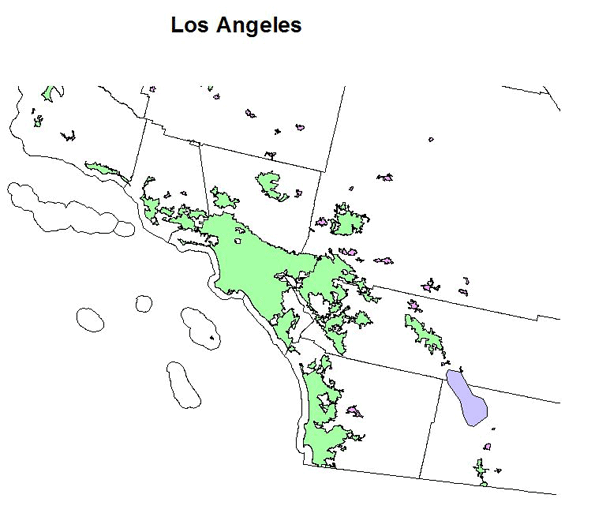
    Greater Los Angeles is the second largest conurbation, with some 20.4 million, growing by 1.8 million, and 10 percent from 2000. In the table I distinguish between the core Los Angeles urbanized area and the satellite urbanized areas west, north, south and east. The core LA area grew by only 3 percent, while the spillover areas to the north and east had astonishing growth, at 46 and 37 percent over the decade.  These include several places with a fairly long history, such as Riverside and San Bernardino, San Diego and Santa Barbara, but many are rapidly growing large suburbs and exurbs, a spillover of growth from the Los Angeles core. Much of the fastest growth has been in  Mission Viejo, Murietta-Temecula, Indio, Lancaster, Santa Clarita and Thousand Oaks.
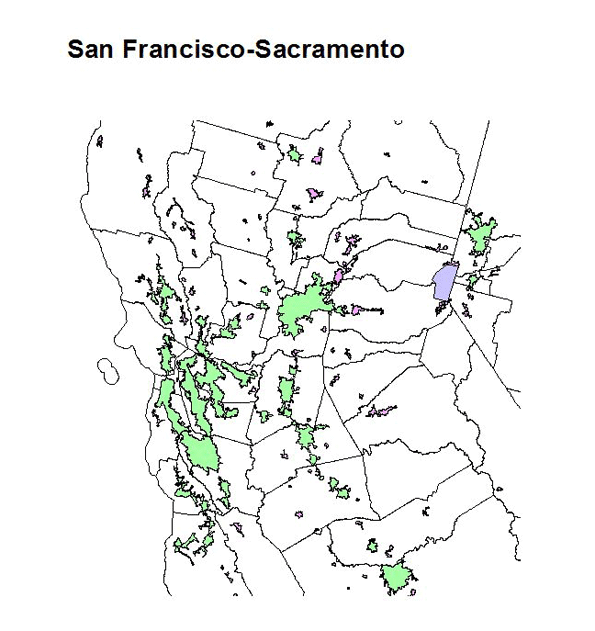
    For greater San Francisco, I distinguish two subregions, the Bay area of San Francisco-San Jose (west) and Sacramento (central valley).  Some might consider these totally distinct, but they have become one in a conurbation sense, as evidenced by commuting patterns. Many people live in the less costly Central Valley area but commute to the expensive Bay Area cities. Together, the conurbation is now 10.5 million, up 10 percent from 2000. The central valley (Sacramento) portion grew far more rapidly than San Francisco-San Jose (22 percent compared to 5.5 percent).  

    Compared to its rivals the Chicago conurbation has grown less rapidly but is still large, with a population of 10.8 million in 2010 , growing 512,000 (5 percent) since 2000.  Chicago and Milwaukee are the well-known core cities, but there are also less well known components with far faster growth such as Round Lake-McHenry and West Bend, WI.   
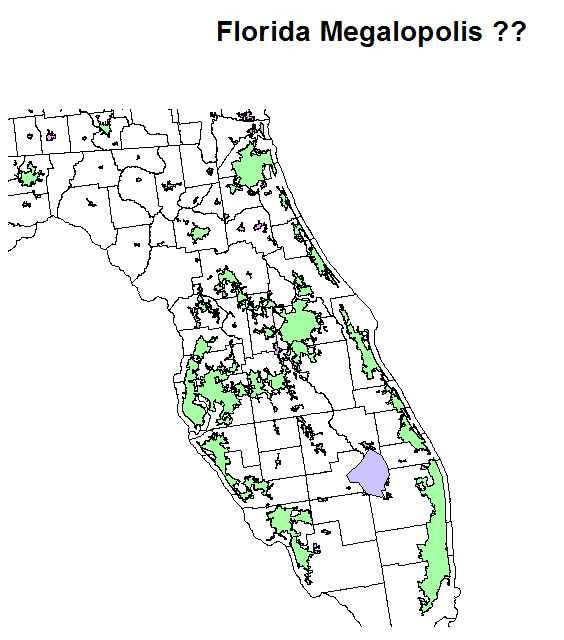
    Florida

    The more interesting and difficult conurbation to try to define is what might be called the Florida archipelago. Greater Miami has long been recognized as a conurbation, but I contend that virtually all the urbanized areas of the state are in effect a complex web of urban settlement, with little clear demarcation. This is in part a reflection of   rapid and expansive  growth.  Nevertheless it makes sense to recognize four sub-regions, centered on Miami, Tampa-St. Petersburg, Orlando and Jacksonville. 

    Together these areas have reached an astonishing 15.2 million, up 2.7 million or 21.5 percent in one decade.  Because settlement is spread across the state in such a web-like fashion with no single dominant center, they constitute a newish form of urban concentration. Besides the well-known centers such as   Miami, Tampa-St. Petersburg ), Orlando and Jacksonville,  there are many satellite cities, often quite large. These include North Port, Cape Coral  encompassing older Ft. Meyers, Bonita Springs, Kissimmee, Palm Bay-Melbourne, Palm Coast-Daytona, and Port St. Lucie.  An interesting but hard to answer question is how much of Florida’s phenomenal growth is a result of transfer of people and accumulated wealth from the North (and especially from the original Megalopolis).

    The United States is a large and diverse country, with many other giant cities and a vast countryside. But it is important to realize the importance of these megalopolitan areas, with an aggregate population of 102.6 million, one third of the nation’s population.

    What’s next? Look for the rise of now just somewhat smaller conurbations such as Houston, Dallas, Atlanta, Minneapolis, Seattle, Phoenix, and Denver. In terms of numbers and rates of growth Texas is a front runner, but its stars do not coalesce into a megalopolis, at least not yet. The belt of urban growth from Atlanta, through Greenville, SC, Charlotte to Raleigh-Durham is also a likely future conurbation candidate.

    Richard Morrill is Professor Emeritus of Geography and Environmental Studies, University of Washington. His research interests include: political geography (voting behavior, redistricting, local governance), population/demography/settlement/migration, urban geography and planning, urban transportation (i.e., old fashioned generalist).
  • Review: The Great Inversion and the Future of the American City

    Is gentrification the “fifth great migration,” that will fill old downtowns with upper-middle-class white folks, while the tract mansions of the outer ring become slums for immigrants? So suggests Alan Ehrenhalt, the former executive editor of Governing magazine. In The Great Inversion and the Future of the American City, he proposes that a demographic shift is under way that is reversing generations of suburbanization and white flight.

    This book will gain Ehrenhalt nothing but friends, admirers, and speaking engagements among the New Urbanist set, just as Richard Florida, perhaps today’s best-known urban theorist, has made a good living with his work. Ehrenhalt believes that “the massive outward migration of the affluent that characterized the second half of the 20th century is coming to an end.” Soon, he predicts, scarcely anyone “will be buying large, detached single family houses 30 miles from the city limits.” And, more specifically, “Chicago in 2030 will look more like the Paris of 1910 than like the Detroit of 1970.”

    As corroboration of this vision of the future, he notes the undeniable fact that the ’burbs have not been lily white for decades. Their good jobs, good schools, property values, and low crime rates continue to attract great numbers of hard-working, middle-class Africa Americans and immigrants. Meanwhile, as some inner-city neighborhoods become safer, they are drawing the market segment that developers refer to as “the risk oblivious.” Often, these are intrepid young white people without school-age children who recognize that it was always nuts to ignore the marvelous real estate near the old downtowns. Frequently, they are followed by the somewhat less adventurous and more affluent.

    For those of us who have long admired Ehrenhalt’s astuteness, however, this book’s theme is undercut by some real head scratchers: His “great inversion” thesis isn’t supported by the 2010 Census data, the location of high paying white-collar jobs, or the rise of the Internet as a social and economic force.

    As demographer Wendell Cox and others have noted, suburbs are capturing a growing share of the population increase in the nation’s major metropolitan areas. “Historical core municipalities accounted for nine percent of metropolitan area growth between 2000 and 2010,” Cox writes, “compared to 15 percent in the 1990–2000 period. Overall, suburban areas captured 91 percent of metropolitan area population growth between 2000 and 2010, compared to 85 percent between 1990 and 2000.”

    The old real estate mantra “location, location, location” applies to American jobs, too. If you imagined the map of the Washington, D.C., metropolitan area as a waiter’s tray, with each white-collar job assigned the same weight, you’d discover that the balance point was just east of the “edge city” of Tysons Corner in Fairfax County, Virginia. New residential areas such as wealthy Loudoun County, Virginia, are booming because of their proximity to concentrations of high-paying jobs around Dulles International Airport, Reston, Fair Oaks, and Tysons. People living in these areas can go years without visiting the District of Columbia, much less commuting to it.

    Because the Internet is, in effect, a transportation device, it is transforming the built environment. There are nearly 100 classes of real estate—including grocery stores, warehouses, and offices—from which cities are built, noted the late urban theorist William J. Mitchell of MIT. All are being transfigured more swiftly and dramatically than they were by the rise of the automobile.

    In addition, the Internet is, counterintuitively, putting a new value on face-to-face contact. This has led to the rise of village-like places where people can easily meet. Some are embedded in old downtowns—the sort of places Ehrenhalt cites, such as Chicago’s University Village. Some are part of what traditionally have been regarded as suburbs. But the fastest-growing segment consists of places such as Santa Fe, New Mexico. Home to a world-renowned opera, charming architecture, distinguished restaurants, quirky bookstores, sensational desert and mountain vistas, and a great deal of diversity, Santa Fe, with a population of 68,000, is also little more than a village, far from the nearest metropolis. It represents aggregation and dispersal.

    If and when real estate begins to increase in value, it may be instructive to look at the metropolitan areas that were appreciating fastest before the recent crash. Number one was Wenatchee, Washington. On the dry, east side of the Cascade Range, it has lots of sunshine, great skiing, and beautiful views, and thus attracted a lot of hip people who brought with them the arts, cafés and restaurants, and increased educational opportunities. Then came the Seattle-area software people, who extended their outdoorsy weekends using cell phones and laptops to stay in touch with the office, eventually moving there and starting their own businesses. Almost the entire top-20 list of fast appreciating metro areas similarly became urbane without really becoming urban.

    Ehrenhalt is absolutely correct that “we are moving toward a society in which millions of people with substantial earning power or ample savings will have the option of living wherever they want.” Whether that choice will amount to a great inversion, in which the roles of cities and suburbs “will very nearly reverse themselves,” remains to be seen.

    © 2012 Joel Garreau as first published in The Wilson Quarterly.

    Joel Garreau’s is the Lincoln Professor of Law, Culture, and Values at the Sandra Day O’Connor College of Law at Arizona State University and aFuture Tense Fellow at the New America Foundation. His books include Edge City: Life on the New Frontier (1991) and Radical Evolution: The Promise and Peril of Enhancing Our Minds, Our Bodies—and What It Means to Be Human (2005). He is Director of “The Prevail Project: Wise Governance for Challenging Futures.”

  • Why Emissions Are Declining in the U.S. But Not in Europe

    It wasn’t that long ago that the U.S. was cast as the global climate villain, refusing to sign the Kyoto accord while Europe implemented cap and trade. 

    But, as we note below in a new article for Yale360, a funny thing happened: U.S. emissions started going down in 2005 and are expected to decline further over the next decade, while Europe’s cap and trade system has had no measurable impact on emissions. Even the supposedly green Germany is moving back to coal.

    Why? The reason is obvious: the U.S. is benefitting from the 30-year, government-funded technological revolution that massively increased the supply of unconventional natural gas, making it cheap even when compared to coal.   

    The contrast between what is happening in Europe and what is happening in the U.S. challenges anyone who still thinks pricing carbon and emissions trading are more important to emissions reductions than direct and sustained public investment in technology innovation. 

    — Ted and Michael

    Yale 360

    Beyond Cap and Trade: A New Path to Clean Energy

    Putting a price and a binding cap on carbon is not the panacea that many thought it to be. The real road to cutting U.S. emissions, two iconoclastic environmentalists argue, is for the government to help fund the development of cleaner alternatives that are better and cheaper than natural gas.

    by Ted Nordhaus and Michael Shellenberger

    A funny thing happened while environmentalists were trying and failing to cap carbon emissions in the U.S. Congress. U.S. carbon emissions started going down. The decline began in 2005 and accelerated after the financial crisis. The latest estimates from the U.S. Energy Information Administration now suggest that U.S. emissions will continue to decline for the next few years and remain flat for a decade or more after that.

    The proximate cause of the decline in recent years has been the recession and slow economic recovery. But the reason that EIA is projecting a long-term decline over the next decade or more is the glut of cheap natural gas, mostly from unconventional sources like shale, that has profoundly changed America’s energy outlook over the next several decades.

    Gas is no panacea. It still puts a lot of carbon into the atmosphere and has created a range of new pollution problems at the local level. Methane leakage resulting from the extraction and burning of natural gas threatens to undo much of the carbon benefit that gas holds over coal. And even were we to make a full transition from coal to gas, we would then need to transition from gas to renewables and nuclear in order to reduce U.S. emissions deeply enough to achieve the reductions that climate scientists believe will be necessary to avoid dangerous global warming.

    But the shale gas revolution, and its rather significant impact on the U.S. carbon emissions outlook, offers a stark rebuke to what has been the dominant view among policy analysts and environmental advocates as to what it would take in order to begin to bend down the trajectory of U.S. emissions, namely a price on carbon and a binding cap on emissions. The existence of a better and cheaper substitute is today succeeding in reducing U.S. emissions where efforts to raise the cost of fossil fuels through carbon caps or pricing — and thereby drive the transition to renewable energy technologies — have failed.

    In fact, the rapid displacement of coal with gas has required little in the way of regulations at all. Conventional air pollution regulations do represent a very low, implicit price on carbon. And a lot of good grassroots activism at the local and regional level has raised the political costs of keeping old coal plants in service and bringing new ones online.

    But those efforts have become increasingly effective as gas has gotten cheaper. The existence of a better and cheaper substitute has made the transition away from coal much more viable economically, and it has put the wind at the back of political efforts to oppose new coal plants, close existing ones, and put in place stronger EPA air pollution regulations.

    Yet if cheap gas is harnessing market forces to shutter old coal plants, the existence of cheap gas from unconventional places is by no means the product of those same forces, nor of laissez faire energy policies. Our current glut of gas and declining emissions are in no small part the result of 30 years of federal support for research, demonstration, and commercialization of non-conventional gas technologies without which there would be no shale gas revolution today.

    Starting in the mid-seventies, the Ford and Carter administrations funded large-scale demonstration projects that proved that shale was a potentially massive source of gas. In the years that followed, the U.S. Department of Energy continued to fund research and demonstration of new fracking technologies and developed new three-dimensional mapping and horizontal drilling technologies that ultimately allowed firms to recover gas from shale at commercially viable cost and scale. And the federal non-conventional gas tax credit subsidized private firms to continue to experiment with new gas technologies at a time when few people even within the natural gas industry thought that firms would ever succeed in economically recovering gas from shale.

    The gas revolution now unfolding — and its potential impact on the future trajectory of U.S. emissions — suggests that the long-standing emphasis on emissions reduction targets and timetables and on pricing have been misplaced. Even now, carbon pricing remains the sine qua non of climate policy among the academic and think-tank crowds, while much of the national environmental movement seems to view the current period as an interregnum between the failed effort to cap carbon emissions in the last Congressand the next opportunity to take up the cap-and-trade effort in some future Congress.

    And yet, the European Emissions Trading Scheme (ETS), which has been in place for almost a decade now and has established carbon prices well above those that would have been established by the proposed U.S. system, has had no discernible impact on European emissions. The carbon intensity of the European economy has not declined at all since the imposition of the ETS. Meanwhile green paragon Germany has embarked upon a coal-building binge under the auspices of the ETS, one that has accelerated since the Germans shut down their nuclear power plants.

    Even so, proponents of U.S. emissions limits maintain that legally binding carbon caps will provide certainty that emissions will go down in the future, whereas technology development and deployment — along with efforts to regulate conventional air pollutants — do not. Certainly, energy and emissions projections have proven notoriously unreliable in the past — it is entirely possible that future emissions could be well above, or well below, the EIA’s current projections. But the cap-and-trade proposal that failed in the last Congress, like the one that has been in place in Europe, would have provided no such certainty. It was so riddled with loopholes, offset provisions, and various other cost-containment mechanisms that emissions would have been able to rise at business-as-usual levels for decades.

    Arguably, the actual outcome might have been much worse. The price of the environmental movement’s demand for its “legally binding” pound of flesh was a massive handout of free emissions allocations to the coal industry, which might have slowed the transition to gas that is currently underway.

    Continuing to drive down U.S. emissions will ultimately require that we develop low- or no-carbon alternatives that are better and cheaper than gas. That won’t happen overnight. The development of cost-effective technologies to recover gas from shale took more than 30 years. But we’ve already made a huge down payment on the technologies we will need.

    Over the last decade, we have spent upwards of $200 billion to develop and commercialize new renewable energy technologies. China has spent even more. And those investments are beginning to pay off. Wind is now almost as cheap as gas in some areas — in prime locations with good proximity to existing transmission. Solar is also close to achieving grid parity in prime locations as well. And a new generation of nuclear designs that promises to be safer, cheaper, and easier to scale may ultimately provide zero-carbon baseload power.

    All of these technologies have a long way to go before they are able to displace coal or gas at significant scale. But the key to getting there won’t be more talk of caps and carbon prices. It will be to continue along the same path that brought us cheap unconventional gas — developing and deploying the technologies and infrastructure we need from the bottom up.

    When all is said and done, a cap, or a carbon price, may get us the last few yards across the finish line. But a more oblique path, focused on developing better technologies and strengthening conventional air pollution regulations, may work just as well, or even better.

    For one thing should now be clear: The key to decarbonizing our economy will be developing cheap alternatives that can cost-effectively replace fossil fuels. There simply is no substitute for making clean energy cheap.

    © 2010 Yale Environment 360

  • As Filmmaking Surges, New Orleans Challenges Los Angeles

    For generations New Orleans‘ appeal to artists, musicians and writers did little to dispel the city’s image as a poor, albeit fun-loving, bohemian tourism haven. As was made all too evident by Katrina, the city was plagued by enormous class and racial divisions, corruption and some of the lowest average wages in the country.

    Yet recently, the Big Easy and the state of Louisiana have managed to turn the region’s creative energy into something of an economic driver. Aided by generous production incentives, the state has enjoyed among the biggest increases in new film production anywhere in the nation. At a time when production nationally has been down, the number of TV and film productions shot in Louisiana tripled from 33 per year in 2002-2007 to an average of 92 annually in 2008-2010, according to a study by BaxStarr Consulting. Movies starring Leonardo DiCaprio, Morgan Freeman, Harrison Ford are being made in the state this year.

    Of course many states and cities have thrown money at the film industry, hoping to establish themselves as cultural centers. Texas, Georgia, British Columbia, Toronto and Michigan all wagered millions in tax dollars to lure producers away from Hollywood and the industry’s secondary hub of New York. There were 279 movies shot in New York State in 2009 and 2010. For all its gains, Louisiana still trails far behind the Empire State with 95 film productions in that period.

    Yet New Orleans and Louisiana possess unique assets which make its challenge far more serious than that of other places. A Detroit, Atlanta or Dallas might be a convenient and cost-efficient place to make a film or television show, but they lack the essential cultural richness that can lure creative people to stay. The Big Easy is attracting that type, plus post-production startups, and animation and videogame outfits, giving a broader foundation to the nascent local entertainment industry.

    “This is different,” notes Los Angeles native and longtime Hollywood costumer Wingate Jones, who started Southern Costume Co. last year to cash in on the growth in production in the state. “It’s the combination of the food and the culture that appeals to people. It must have been a lot like what Hollywood was like in the ’20s and ’30s. It’s entrepreneurial and growing like mad.”

    Critically, Jones adds, Louisiana’s unique culture comes without the fancy New York or Malibu price tag. This is a place where small roadside cafes serve up bowls of gumbo, crayfish and shrimp that would cost three to five times as much in New York, the Bay Area or Los Angeles. Excellent music — from rap to jazz to blues and gospel — can be found simply by walking into a bar and paying the price of a couple of beers. And then there are housing costs, roughly half as high, adjusted for income, than the big media centers.

    This mixture of affordability and culture is attracting young people — the raw material of the creative economy — as well as industry veterans like Jones. In 2011, we examined migration patterns of the college-educated and found, to our surprise, that New Orleans was the country’s leading brain magnet. New Orleans was growing its educated base, on a per capita basis, at a far faster rate than much-ballyhooed, self-celebrated places like New York or San Francisco. In fact, its most intense competition was coming from other Southern cities such as Raleigh, Austin and Nashville, the last two of which also share a strong, and unique, regional culture.

    Another sure sign of the city’s growing appeal has been a torrent of applications to Tulane University, the city’s premier institution of higher education. In 2010 the school received 44,000 applications, more than any other private university in the country. The largest group, more than even those from Louisiana, came from California, with New York and Texas not far behind.

    Increasingly, the Big Easy merits comparison not only to the Hollywood of the 1920s but also Greenwich Village of the ’50s, Haight-Ashbury in the ’60s and “grunge” Seattle in the mid-’80s. These, too, were once appealing places that were less expensive, less predictable and more open to cultural outsiders. Now they’re increasingly too pricey and yuppified for creative people bereft of large trust funds.

    Ironically, Katrina provided the critical spark for this transformation. It devastated the torpid, corrupt political and business culture that viewed the arts as quaint and fit only as a selling point for tourists. In its place came more business-minded administrations in New Orleans and in Baton Rouge, the state capital. In both places, economic developers seized on motion pictures, television, commercials and videogames as potential growth industries that fit well with the state’s expanding appeal to this generation’s creators.

    This piece originally appeared in Forbes.com.

    Joel Kotkin is executive editor of NewGeography.com and is a distinguished presidential fellow in urban futures at Chapman University, and contributing editor to the City Journal in New York. He is author of The City: A Global History. His newest book is The Next Hundred Million: America in 2050, released in February, 2010.

    New Orleans Jazz Band photo by BigStockPhoto.com.

  • Census Estimates: Slowing Metropolitan Growth and the Future of the Exurbs

    Recently the Census Bureau released 2011 county and metro area population estimates that showed overall slowing population growth and particularly showing slow to halting growth in exurban counties.

    Someone once said to me about Chicago’s Mayor Daley that if he did something you liked, he was a visionary genius leader, but if he did something you hated, he was a corrupt machine dictator.

    That seems to be how too many urbanists view the Census Bureau.

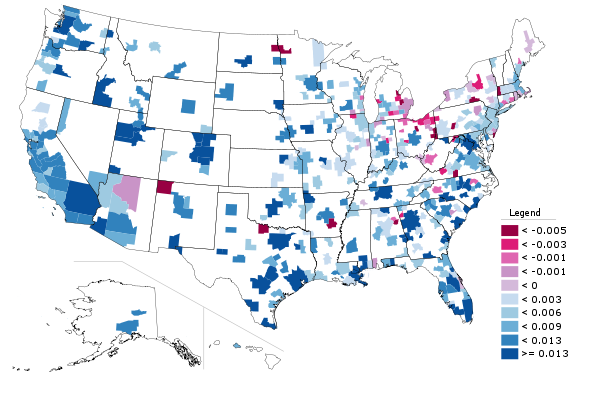
    I’ll come back to the exurbs in a minute, but first a look at a map of metro area growth last year:


    Metro area percent change in population, July 1, 2010 to July 1, 2011. Source: Census Estimates via Telestrian

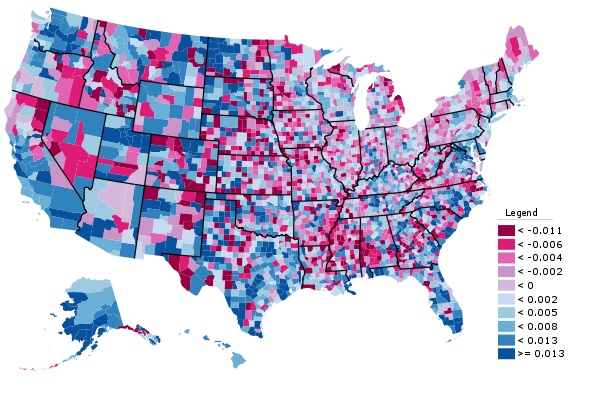
    Here’s the county map:


    County percent change in population, July 1, 2010 to July 1, 2011. Source: Census Estimates via Telestrian

    Someone once said to me about Chicago’s Mayor Daley that if he did something you liked, he was a visionary genius leader, but if he did something you hated, he was a corrupt machine dictator.

    That seems to be how too many urbanists view the Census Bureau.

    Back in the 90s when the Census estimates showed cities growing more slowly than boosters believed, they pressured the Census Bureau into adjusting the estimates to provide higher values. As it turned out, in most cases even the original estimates for cities proved inflated. In fact, the 90s were actually better for a lot of major cities than the 2000s were (e.g, New York, Los Angeles, and Chicago). This led to a new narrative that the Census had undercounted cities somehow.

    Now this new data shows slowing exurban growth. All of a sudden, the Census Bureau has become once more a source of Gospel Truth, and I’ve seen many articles suggesting that the exurbs are dead, killed by rising gas prices and new Millennial preferences.

    Let’s not get ahead of ourselves here.

    Yes, exurban growth slowed recently. While cities on the whole fared more poorly than expected in the last census, we did see strong growth in downtowns and adjacent areas. I myself wrote about improving migration trends for core cities. That’s good news worth celebrating for cities. But don’t overstate the case.

    I have a different though admittedly speculative take on the exurbs. I think a chunk of the fringe migration was from very low end home builders skipping out beyond established jurisdictions into unincorporated territory with few buildings restrictions. They threw up dirt cheap homes there and often sold them to people with marginal credit and income who had no business buying homes, using a variety of gimmicks to do so. (I know someone who sold homes for one of these builders, so I heard about some of these). Loose credit policies and government guarantees fueled this. The housing crash killed this market. Now that subsidies for this type of growth aren’t available, so that market is probably never coming back.

    But when the economy improves and the market normalizes, I’d expect some level of suburbanization to resume. Part of the logic is simple math. If you add up the population of the municipalities of New York City, Los Angeles, Chicago, Philadelphia, San Francisco, Boston, Seattle, Washington, Portland, and Miami you only get 20 million people. That’s only about 20% of what the Census Bureau is projecting for just population growth by 2050. With the difficulties of building in urban areas, there’s no way to accommodate just the new growth even if everybody wanted into the city. In other words, there’s just no way there is going to be some massive back to the city movement. I hate to break it to you, but that’s reality.

    Here’s the full list of large metros, sorted by population growth percentage:

    Row Metro Area 2010 2011 Total Change Pct Change
    1 Austin-Round Rock-San Marcos, TX
    1,728,247
    1,783,519
    55,272
    3.20%
    2 Raleigh-Cary, NC
    1,137,297
    1,163,515
    26,218
    2.31%
    3 Dallas-Fort Worth-Arlington, TX
    6,400,511
    6,526,548
    126,037
    1.97%
    4 San Antonio-New Braunfels, TX
    2,153,891
    2,194,927
    41,036
    1.91%
    5 Houston-Sugar Land-Baytown, TX
    5,976,470
    6,086,538
    110,068
    1.84%
    6 Charlotte-Gastonia-Rock Hill, NC-SC
    1,763,969
    1,795,472
    31,503
    1.79%
    7 Denver-Aurora-Broomfield, CO
    2,554,569
    2,599,504
    44,935
    1.76%
    8 Washington-Arlington-Alexandria, DC-VA-MD-WV
    5,609,150
    5,703,948
    94,798
    1.69%
    9 Miami-Fort Lauderdale-Pompano Beach, FL
    5,578,080
    5,670,125
    92,045
    1.65%
    10 Oklahoma City, OK
    1,258,111
    1,278,053
    19,942
    1.59%
    11 Salt Lake City, UT
    1,128,269
    1,145,905
    17,636
    1.56%
    12 Seattle-Tacoma-Bellevue, WA
    3,447,886
    3,500,026
    52,140
    1.51%
    13 New Orleans-Metairie-Kenner, LA
    1,173,572
    1,191,089
    17,517
    1.49%
    14 Orlando-Kissimmee-Sanford, FL
    2,139,615
    2,171,360
    31,745
    1.48%
    15 Riverside-San Bernardino-Ontario, CA
    4,245,005
    4,304,997
    59,992
    1.41%
    16 Nashville-Davidson–Murfreesboro–Franklin, TN
    1,594,885
    1,617,142
    22,257
    1.40%
    17 Atlanta-Sandy Springs-Marietta, GA
    5,286,296
    5,359,205
    72,909
    1.38%
    18 Portland-Vancouver-Hillsboro, OR-WA
    2,232,896
    2,262,605
    29,709
    1.33%
    19 Tampa-St. Petersburg-Clearwater, FL
    2,788,151
    2,824,724
    36,573
    1.31%
    20 Phoenix-Mesa-Glendale, AZ
    4,209,070
    4,263,236
    54,166
    1.29%
    21 San Jose-Sunnyvale-Santa Clara, CA
    1,841,787
    1,865,450
    23,663
    1.28%
    22 San Diego-Carlsbad-San Marcos, CA
    3,105,115
    3,140,069
    34,954
    1.13%
    23 San Francisco-Oakland-Fremont, CA
    4,343,381
    4,391,037
    47,656
    1.10%
    24 Indianapolis-Carmel, IN
    1,760,826
    1,778,568
    17,742
    1.01%
    25 Sacramento–Arden-Arcade–Roseville, CA
    2,154,583
    2,176,235
    21,652
    1.00%
    26 Minneapolis-St. Paul-Bloomington, MN-WI
    3,285,913
    3,318,486
    32,573
    0.99%
    27 Columbus, OH
    1,840,584
    1,858,464
    17,880
    0.97%
    28 Jacksonville, FL
    1,348,702
    1,360,251
    11,549
    0.86%
    29 Las Vegas-Paradise, NV
    1,953,927
    1,969,975
    16,048
    0.82%
    30 Los Angeles-Long Beach-Santa Ana, CA
    12,844,371
    12,944,801
    100,430
    0.78%
    31 Richmond, VA
    1,260,396
    1,269,380
    8,984
    0.71%
    32 Louisville/Jefferson County, KY-IN
    1,285,891
    1,294,849
    8,958
    0.70%
    33 Boston-Cambridge-Quincy, MA-NH
    4,559,372
    4,591,112
    31,740
    0.70%
    34 Kansas City, MO-KS
    2,039,766
    2,052,676
    12,910
    0.63%
    35 Memphis, TN-MS-AR
    1,318,089
    1,325,605
    7,516
    0.57%
    36 Baltimore-Towson, MD
    2,714,546
    2,729,110
    14,564
    0.54%
    37 New York-Northern New Jersey-Long Island, NY-NJ-PA
    18,919,649
    19,015,900
    96,251
    0.51%
    38 Philadelphia-Camden-Wilmington, PA-NJ-DE-MD
    5,971,589
    5,992,414
    20,825
    0.35%
    39 Chicago-Joliet-Naperville, IL-IN-WI
    9,472,584
    9,504,753
    32,169
    0.34%
    40 Milwaukee-Waukesha-West Allis, WI
    1,556,953
    1,562,216
    5,263
    0.34%
    41 Virginia Beach-Norfolk-Newport News, VA-NC
    1,674,502
    1,679,894
    5,392
    0.32%
    42 Birmingham-Hoover, AL
    1,129,068
    1,132,264
    3,196
    0.28%
    43 Cincinnati-Middletown, OH-KY-IN
    2,132,415
    2,138,038
    5,623
    0.26%
    44 St. Louis, MO-IL
    2,814,722
    2,817,355
    2,633
    0.09%
    45 Pittsburgh, PA
    2,357,951
    2,359,746
    1,795
    0.08%
    46 Hartford-West Hartford-East Hartford, CT
    1,212,491
    1,213,255
    764
    0.06%
    47 Rochester, NY
    1,054,723
    1,055,278
    555
    0.05%
    48 Providence-New Bedford-Fall River, RI-MA
    1,601,065
    1,600,224
    -841
    -0.05%
    49 Buffalo-Niagara Falls, NY
    1,135,293
    1,134,039
    -1,254
    -0.11%
    50 Detroit-Warren-Livonia, MI
    4,290,722
    4,285,832
    -4,890
    -0.11%
    51 Cleveland-Elyria-Mentor, OH
    2,075,540
    2,068,283
    -7,257
    -0.35%

    Aaron M. Renn is an independent writer on urban affairs based in the Midwest. His writings appear at The Urbanophile, where this piece originally appeared. Renn is the founder of Telestrian, a data analysis and mapping tool used to create the maps seen here.

  • California Declares War on Suburbia II: The Cost of Radical Densification

    My April 9 Cross Country column commentary in The Wall Street Journal (California Declares War on Suburbia) outlined California’s determination to virtually outlaw new detached housing. The goal is clear:    force most new residents into multi-family buildings at 20 and 30 or more to the acre. California’s overly harsh land use regulations had already driven housing affordability from fairly typical levels to twice and even three times higher than that of much of the nation. California’s more recent tightening of the land use restrictions (under Assembly Bill 32 and Senate Bill 375) has been justified as necessary for reducing greenhouse gas (GHG) emissions.

    It is All Unnecessary: The reality, however, is that all of this is unnecessary and that sufficient GHG emission reductions can be achieved without interfering with how people live their lives. As a report by the McKinsey Company and The Conference Board put it, there would need to be "no downsizing of vehicles, homes or commercial space," while "traveling the same mileage." Nor, as McKinsey and the Conference Board found, would there be a need for a "shift to denser urban housing." All of this has been lost on California’s crusade against the lifestyle most Californians households prefer.

    Pro and Con: As is to be expected, there are opinions on both sides of the issue. PJTV used California Declares War on Suburbia as the basis for a satirical video, Another Pleasant Valley Sunday, Without Cars or Houses? Is California Banning Suburbia?

    California’s Increasing Demand for Detached Housing? A letter to the editor in The Wall Street Journal suggested that there are more than enough single-family homes to accommodate future detached housing demand in California for the next 25 years. That’s irrelevant, because California has no intention of allowing any such demand to be met.

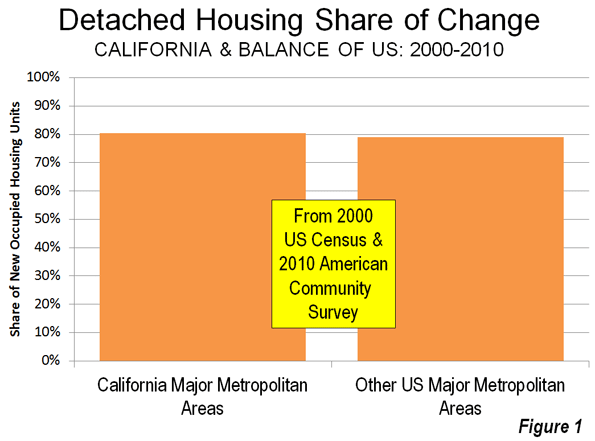
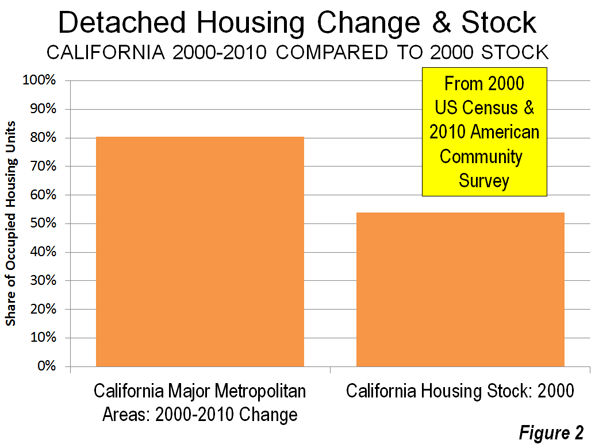
    The data indicates continuing robust demand. In California’s major metropolitan areas, detached houses accounted for 80 percent of the additions to the occupied housing stock between 2000 and 2010, which slightly exceeds the national trend favoring detached housing (Figure 1). If anything, the shift in demand was the opposite predicted by planners, since only 54 percent of growth in occupied housing in the same metropolitan areas was detached in 2000 (Figure 2).


    Watch What they Do, Not What they Say: It does no good to point to stated preference surveys indicating people preferring higher density living. Recently, Ed Braddy noted in newgeography.com (Smart Growth and the New Newspeak) that a widely cited National Association of Realtors had been "spun" to show that people preferred higher density living, from a question on an "unrealistic scenario," and ignoring an overwhelming preference for detached housing – roughly eighty percent – in other questions in the same survey. People’s preferences are not determined by what they say they will do, but rather by what they do.

    Off-Point Criticism: There was also "off-point" criticism, which can be more abundant than criticisms that are "on-point." Perhaps the most curious was by Brookings Institution Metropolitan Policy Program Senior Researcher Jonathan Rothwell (writing in The New Republic) in a piece entitled "Low-Density Suburbs are Are Not Free-Market Capitalism." I was rather taken aback by this, since none of these three words ("free," "market" or "capitalism") appeared in California Declares War on Suburbia. I was even more surprised at the claim that I defend "anti-density zoning and other forms of large lot protectionism." Not so.

    Indeed, I agree with Rothwell on the problems with large lot zoning. However, it is a stretch to suggest, as he does, that the prevalence of detached housing results from large lot zoning. This is particularly true in places like Southern California where lots have historically been small and whose overall density is far higher than that of greater New York, Boston, Seattle and double that of the planning mecca of Portland.

    Rothwell’s own Brookings Institution has compiled perhaps the best inventory of metropolitan land use restrictions, which indicates that the major metropolitan areas of the West have little in large lot zoning. Yet detached housing is about as prevalent in the West as in the rest of the nation (60.4 percent in the West compared to 61.9 percent in the rest of the nation, according to the 2010 American Community Survey). Further, there has been little or no large lot zoning in Canada and Australia, where detached housing is detached, nor in Western Europe and Japan (yes, Japan, see the Note below).  

    On-Point: Urban Growth Boundaries Do Increase House Prices: However, to his credit, Rothwell points out the connection between urban growth boundaries and higher house prices. This is a view not shared by most in the urban planning community, who remain in denial of the economic evidence (or more accurately, the economic principle) that constraining supply leads to higher prices. This can lead to disastrous consequences, as California’s devastating role in triggering the Great Recession indicates.

    The Purpose of Urban Areas: From 1900 to 2010, the urban population increased from 40 percent to 80 percent of the US population. Approximately 95 percent of the population growth over 100 years was in urban areas. People did not move to urban areas the cities for "togetherness" or to become better citizens. Nor did people move out of an insatiable desire for better urban design or planning. The driving force was economic: the desire for higher incomes and better lives. A former World Bank principal urban planner, Alain Bertaud stated the economic justification directly: "large labor markets are the only raison d’être of large cities."

    And for the vast majority of Americans in metropolitan areas, including those in California, those better lives mean living in suburbs and detached houses. All the myth-making in the world won’t change that reality, even if it pushes people out of the Golden State to other, more accommodating pastures.

    The performance of urban areas is appropriately evaluated by results, such as economic outcomes, without regard to inputs, such as the extent to which an area conforms to the latest conventional wisdom in urban planning.

    • Land use policies should not lead to higher housing costs relative to incomes, as they already have in California, Australia, Vancouver, Toronto and elsewhere. If they do, residents are less well served.
    • Transport policies should not be allowed to intensify traffic congestion by disproportionately funding alternatives (such as transit and bicycles) that have little or no potential to improve mobility as seems the likely outcome of radical densification. If they do, residents will be less well served.

    This gets to the very heart of the debate. The “smart growth on steroids” policies now being implemented in California are likely to lead to urban areas with less efficient personal and job mobility, where economic and employment growth is likely to be less than would otherwise be expected. The issue is not urban sprawl. The issue is rather sustaining the middle-income quality of life, which is now endangered by public policy in California, and for no good reason.

    Wendell Cox is a Visiting Professor, Conservatoire National des Arts et Metiers, Paris and the author of “War on the Dream: How Anti-Sprawl Policy Threatens the Quality of Life

    —-

    Note: Despite its reputation for high density living, Japan’s suburbs have many millions of detached houses. In 2010, 47 percent of the occupied housing in Japan’s major metropolitan areas was detached (Tokyo, Osaka-Kobe-Kyoto, Nagoya, Sapporo, Sendai, Hiroshima, Kitakyushu-Fukuoka, Shizuoka and Hamamatsu).

    Photo: An endangered species: Detached houses in Ventura County (Photo by author)

  • Making Waves on the Third Coast

    If you’re looking for some good news in the U.S. economy, you might want to head to the warm, energy rich Gulf Coast. You wouldn’t be alone in making that move; over the past decade the “Third Coast”—extending from south Texas to the Gulf of Mexico—enjoyed 12% job growth, or about twice the national average.

    This is remarkable given that the region was socked with several devastating hurricanes, including Katrina in 2005. New Orleans’ population, for instance, is still well below its pre-Katrina level, although now gaining steadily.

    New Orleans also demonstrates the possibilities. Film production is way up, and the city appears to be emerging as a magnet for video game, commercials, and special effects firms.

    Some of the biggest advances are further along the periphery from New Orleans, often somewhat closer to Baton Rouge. Nucor is constructing a massive new steel mill in Convent, located in St. James Parish about an hour away from New Orleans. Local chemical and oil refinery firms are also expanding and investing in new equipment.

    Yet it’s Houston’s star that is shining brightest. Over the past decade, when the country actually slightly lost jobs, the Houston-Sugarland-Baytown region expanded its employment by over 15%. Since 1990, the number of jobs has risen by 46%, more than twice the national average. Over a period of ten years, the region’s population has soared 26%, the most of any of the country’s largest metro areas, and again better than twice the national norm. Migrants are coming not only from other countries, but from much of the rest of the U.S., particularly the industrial Midwest, Northeast, and California.

    Optimism among businesspeople on the Third Coast is infectious, as can be seen in the expanding footprint of the Texas Medical Center, the world’s largest such facility. Much of the money for this amazing complex comes from a similar boom in oil and gas.

    If there’s a negative tone anywhere, it’s about politics. Concerns over continued federal obstacles to responsible expansions in oil and gas production are widespread. There’s a real concern that this year’s elections will lead to a slowdown in orders and future expansion. Let’s hope not.

    This piece first appeared at the National Chamber Foundation Blog.

  • The Myth of the Republican Party’s Inevitable Decline

    The map is shifting, and Democrats see the nation’s rapidly changing demography putting ever more states in play—Barack Obama is hoping to compete in Arizona this year, to go along with his map-changing North Carolina and Indiana wins in 2008—and eventually ensure the party’s dominance in a more diverse America, as Republicans quite literally die out.

    Ruy Teixeira and others have pointed to the growing number of voters in key groups that have tilted Democratic: Hispanics, single-member households, and well-educated millennials. Speaking privately at a closed-door Palm Beach fundraiser Sunday, Mitt Romney said that polls showing Obama with a huge lead among Hispanic voters “spell doom for us.”

    But, as the fine print says, past results do not guarantee future performance—and there are some surprising countervailing factors that could upset the conventional wisdom of Republican decline.

    Let’s start with Hispanics. Straight-line projections suggest an ever-increasing base, as the Latino population shot up (PDF) from 35 million in 2000 to more than 50 million in 2010, accounting for half of all national population growth over the decade. Exit polls showed Democrats winning the vote in each election cycle over that stretch, with Republicans never gaining more than 40 percent of the vote. And the problem is getting worse: a recent Fox News Latino poll showed Obama trouncing Romney, 70–14, among Hispanic voters—even leading among Latinos who backed John McCain in 2008.

    But longer term, Hispanic population growth is likely to slow or even recede, and Republicans are likely to do better with the group (in part because it would be hard to do much worse), as assimilation increases and immigration becomes less volatile an issue.

    Rates of Hispanic immigration, particularly from Mexico, are down and are likely to continue declining. In the 1990s, 2.76 million Mexicans obtained legal permanent-resident status. That number fell by more than a million in the 2000s, to 1.7 million, according to the Department of Homeland Security. A key reason, little acknowledged by either nativists or multiculturalists, lies in the plummeting birth rate in Mexico, which is mirrored in other Latin American countries. Mexico’s birth rate has declined from 6.8 children per woman in 1970 to about 2 children per woman in 2011.

    Plummeting birth rates suggest there will be fewer economic migrants from south of the border in coming decades. In the 1990s Mexico was adding about a million people annually to its labor force. By 2007 this number declined to about 800,000 annually, and it is projected to drop to 300,000 by 2030.

    These changes impacted immigration well before the 2008 financial crisis. The number of Mexicans legally coming to the United States plunged from more than 1 million in 2006 to just over 400,000 in 2010, in part because of the 2008 financial crisis here. Illegal immigration has also been falling. Between 2000 and 2004, an estimated 3 million undocumented immigrants entered the country; that number fell by more than two thirds over the next five years, to under 1 million between 2005 and 2009.

    Increasingly, our Latino population—almost one in five Americans between 18 and 29—will be made up of people from second- and third-generation families. Between 2000 and 2010, 7.2 million Mexican-Americans were born in the U.S., while just 4.2 million immigrated here.

    This shift could spur the faster integration of Latinos into mainstream society, leaving them less distinct from other groups of voters, like the Germans or the Irish, whose ethnicity once seemed politically determinative. A solid majority of Latinos, 54 percent, consider themselves white, according to a recent Pew study, while 40 percent do not identify with any race. Most reject the umbrella term “Latino.” Equally important, those born here tend to use English as their primary language (while just 23 percent of immigrants are fluent in English, that number shoots up to 90 percent among their children).

    To be sure, most Latinos these days vote Democratic. But they also tend to be somewhat culturally conservative. Almost all are at least nominally Christian, and roughly one in four is a member of an evangelical church. They also have been moving to the suburbs for the past decade or more—a trend that is of great concern to city-centric Democratic planners.

    A more integrated, suburban, and predominantly English-speaking Latino community could benefit a GOP (assuming it eschews stridently nativist platform). After all, it wasn’t so long ago that upward of 40 percent of Latinos voted for the likes of George W. Bush, who won a majority of Latino Protestants.

    More than race, family orientation may prove the real dividing line in American politics. Single, never-married women have emerged as one of the groups most devoted to the Democratic party, trailing only black voters, according to Gallup. Some 70 percent of single women voted Democratic in 2008, including 60 percent of white single women.

    While the gender gap has been exaggerated, a chasm is emerging between traditional families, on the one hand, and singles and nontraditional families on the other. Married women, for example, still lean Republican. But Democrats dominate in places like Manhattan, where the majority of households are single, along with Washington, D.C., San Francisco, and Seattle.

    In recent years Republican gains, according to Gallup, have taken place primarily among white families. Not surprisingly, Republicans generally do best where the traditional nuclear family is most common, such as in the largely suburban (and fairly affordable) expanses around Houston, Dallas, and Salt Lake City.

    To be sure, Democrats can take some solace, at least in the short run, from the rise in the number of singletons. Over the past 30 years the proportion of women in their 40s who have never had children has doubled, to nearly one in five. Singles now number more than 31 million, up from 27 million in 2000—a growth rate nearly twice that of the overall population. And only one in five millennials is married, half that of their parents’ generation.

    Yet as with Latino immigration, the trend toward singlehood is unlikely to continue unabated. Demographic analyst Neil Howe notes that living alone has been more pronounced among boomers (born 46–64) than millennials (born after 1980) at similar ages. Assuming marriage is delayed rather than dropped, it remains to be seen if the former singletons will maintain their liberal allegiance.

    Varying birth rates also suggest that the Democrat-dominated future may be a pipe dream. Since progressives and secularists tend to have fewer children than more religiously oriented voters, who tend to vote Republican, the future America will see a greater share of people raised from fecund groups such as Mormons and Orthodox Jews. Needless to say, there won’t be as many offspring from the hip, urban singles crowd so critical to Democratic calculations.

    And millennials are already more nuanced in their politics than is widely appreciated. They favor social progressivism, according to Pew, but not when it contradicts community values. Diversity is largely accepted and encouraged, but lacks the totemic significance assigned to it by boomer activists. They are environmentally sensitive but, contrary to new urbanist assertions, are more likely than their boomer parents to aspire to suburbia as their “ideal place” to live.

    Some economic trends favor Republicans. Households, for example, are increasingly more dependent on self-employment, and the number relying on a government job is dropping as deficits and ballooning pension obligations force cuts in government payrolls. Republicans would do well to focus on these predominately suburban, private-sector-dependent families.

    All this suggests that if they can achieve sentience, Republicans could still compete in a changing America continues changing. But first the party must move away from the hard-core nativist, authoritarian conservatism so evident in the primaries. Rather than looking backward to the 1950s, the GOP needs to reinvent itself as the party of contemporary families, including minority, mixed-race, gay, and blended ones.

    This piece originally appeared in The Daily Beast.

    Joel Kotkin is executive editor of NewGeography.com and is a distinguished presidential fellow in urban futures at Chapman University, and contributing editor to the City Journal in New York. He is author of The City: A Global History. His newest book is The Next Hundred Million: America in 2050, released in February, 2010.

    Voter sign photo by BigStockPhoto.com.

  • California Recovery: No, It Is Not East vs. West

    Every now and then, some East Coast based publication sends a reporter out to California to see how the West Coast’s economy is doing.  I think they write these things sitting at a restaurant patio overlooking the Pacific Ocean.  That can be seductive, and lulled into a comfortable sense that all is well with the world, the reporter always gets it wrong. 

    The most recent example is this New York Times article.  The second paragraph summarizes the article:

    Communities all along the state’s coastline have largely bounced back from the recession, some even prospering with high-tech and export businesses growing and tourism coming back. At the same time, communities from just an hour’s drive inland and stretching all the way to the Nevada and Arizona borders struggle with stubbornly high unemployment and a persistent housing crisis. And the same pattern holds the length of the state, from Oregon to the Mexican frontier.

    The next paragraph contains the mandatory quote from California’s favorite economic Pollyanna, Steve Levy:

    “This is really a tale of two economies,” said Stephen Levy, the director of the Center for Continuing Study of the California Economy. “The coastal areas are either booming or at least doing well, and the areas that were devastated still have a long way to go. The places that existed just for housing are not going to come back anytime soon.”

    The article is accompanied by a photo of a couple driving a red Ferrari convertible.  The caption says "Driving through Newport Beach in Orange County. Communities along the coast have largely rebounded from the recession."

    This is all nonsense.

    There are two reasonable measures of recovery, jobs and real estate values.  You can forget the real estate values measure.  Values throughout California are down from pre-recession highs.  They are down a lot.  Only San Francisco and Marin counties, with median home prices down 27.7 percent and 32.3 percent, respectively, have seen net median home price declines of less than 40 percent.  Monterey and Madera counties top the state in median home price declines, in excess of 67 percent.

    So let’s use jobs.  An area has recovered if it has as many jobs today as it had at the beginning of the recession, December 2008. 

    We monitor 37 California MSAs.  Combined they represent about 96 percent of California’s population.  By jobs, only one of California’s larger MSAs has recovered, and that county does not fit the story.  Not only is Kings County not on the ocean, it doesn’t even border or have a naturally occurring year-round piece of water.  Kings County, with 37,700 jobs, has about 900 more jobs than it had at the beginning of the recession.  Still, Kings County’s unemployment rate is 17 percent.  Some recovery!

    Orange County, which the New York Times article cites as largely rebounded, is down 127,800 jobs from its pre-recession high.  That’s an 8.5 percent decline.  Los Angeles County is down 337,000 or 8.1 percent of jobs.  The difference between unemployment rates, 8.0 percent in Orange County versus 12.1 percent in Los Angeles County, reflects different unemployment levels at the beginning of the recession and the high cost of living in Orange County.  Most people can’t afford to be unemployed long in Orange County.  You either find a job, or you leave.

    Here are the Counties that have lost, on net, less than 6 percent of jobs in the recession:


    County/MSA

    Job gain
    or Loss

    percent change

    Unemployment
    Rate

    Imperial

    -100

    -0.2%

    26.7%

    Kings

    900

    2.4%

    17.0%

    Merced

    -2,800

    -4.8%

    20.0%

    Monterey

    -5,600

    -4.3%

    15.3%

    San Diego

    -66,400

    -5.1%

    9.3%

    San Francisco
    San Mateo
    Marin

    -33,600

    -3.4%

    8.0%
    7.3%
    6.6%

    Santa Clara
    San Benito

    -19,900

    -2.1%

    8.8%
    18.3%

    San Luis Obispo

    -5,900

    -5.7%

    8.7%

    Santa Barbara

    -8,200

    -4.7%

    8.9%

    Santa Cruz

    -3,800

    -4.1%

    13.6%

    Solano

    -6,100

    -4.8%

    10.9%


    It’s hard to find real recovery here.  Three of the sub-10-percent-unemployment-rate counties (Marin, San Luis Obispo, and Santa Barbara) are home to the wealthy, those who serve them, and a very small middle class.  They have not had and will never have anything like robust economies.  Think of them as big Leisure Villages for the terminally fashionable.

    That leaves San Diego, San Francisco, San Mateo, and Santa Clara counties as potential vigorous economies.  Let’s look at these regions’ job creation last month.  Unfortunately, the data are only available by MSA.  San Diego County saw job growth of 1,300 jobs in February, an increase of about 0.11 percent.  Santa Clara/San Benito saw job growth of about 4,100, or 0.46 percent.  San Francisco/San Mateo/Marin saw growth of about 7,100 jobs, or 0.74 percent.

    It looks to me like there is a small island of relative prosperity: San Francisco, San Mateo, and Santa Clara Counties, but even these counties have not fully recovered.  This island is indeed on the coast, but it represents just a small fraction of the coastal county population. 

    The idea that there is some sort of Coastal resurgence in California is just absurd.  Certainly, the 593,800 still unemployed in Los Angeles — by far the state’s most populous — are not likely to agree that “The coastal areas are either booming or at least doing well…"

    Bill Watkins is a professor at California Lutheran University and runs the Center for Economic Research and Forecasting, which can be found at clucerf.org.

    California coast photo by BigStockPhoto.com.

  • Millennial Generation Safe at Home

    Each emerging American generation of adolescents and young adults tends to have a distinctive relationship with its parents. For the Baby Boomers of the 1960s and 1970s, that relationship was often conflicted, even adversarial. For Generation X in the 1980s and 1990s it was frequently distant and disrespectful. By contrast, the interactions with their parents of most of today’s Millennial Generation (born 1982-2003) are close, loving, and friendly. That’s a very good thing because, to a far greater extent than for the previous two or three generations, Millennials in their twenties live with their parents, and even grandparents, in multigenerational households.  To the surprise of many members of older generations, most Millennials—and their parents—believe the experience is beneficial and even enjoyable. It may even help America in the years ahead.

    A Pew survey conducted last December indicated that nearly two-thirds (63%) of young adults 25-34 knew someone who had recently moved back in with their parents.   Almost three in ten (29%) said that they were currently living with their parents. That is nearly three times the percentage of those of that age who lived with their parents in 1980 (11%). Multigenerational households, once seen as a lagging trend, have been growing as a share of households since 1980, rising from 12 to 16 percent over the past three decades.

    More recently, the powerful and disproportionately large impact of the Great Recession on young Americans appears to have further accelerated this trend toward multigenerational households. According to Pew, in 2011, the unemployment rate for 18-24 year olds (16.3%) and 25-29 year olds (10.3%) was well above that of those 35-64 (7%).

    But the growth in multigenerational households represents more than simply the result of economic stress. It also reflects how Millennials were raised and the value both they and their parents place on family life.  According to Pew, the large majority of young adults who now live with their parents are both satisfied with this arrangement (78%) and optimistic about their future (77%). In fact, more than a third (34%) of them actually believe that living with their parents at this stage of life has been good for their relationship with their parents, about twice the number who say it has been bad (18%). From the parents’ perspective, those who say an adult child of theirs has moved back home recently are just as satisfied with their family life and housing situation as are those parents whose adult children have not returned home. In this regard, these upbeat parents resemble Cliff and Clair Huxtable, the original TV role models for the proper rearing of Millennials on “The Bill Cosby Show,” who outwardly complained, but inwardly seemed pleased, every time one of their children (and sometimes grandchildren) “boomeranged” back to the family’s home.

    Furthermore, both the adult Millennials who are living with their parents as well as their parents seem to be benefitting from this arrangement. This contradicts the notion, popular among Boomers, that living with parents after one becomes an adult represents some sort of personal failure or lack of initiative. Nearly three-fourths (72%) of the adult children say that living with their parents has had a positive impact on their own personal finances. Young adults who live with their parents also contribute to the household in a variety of ways. Nearly all (96%) say they do chores around the house. Three-quarters contribute to paying household expenses such as groceries or utility bills. More than a third (35%) pay rent to their parents. Given all this, it is not surprising that multigenerational households have become increasingly common with so little complaint from any of the generations involved.

    However, many pundits have expressed a concern about what this trend means for America in the decades ahead. For example, in a recent New York Times article Todd and Victoria Buchholz wrote disparagingly of the “go-nowhere generation” that refuses to take risks, bestir itself from the insulation of home and “go on the road” to seek a better future. Along the way, the Buchholzes praise the Greatest Generation [which] “signed up to ship out to fight Nazis in Germany or the Japanese imperial forces in the Pacific,”  almost seeming to imply that the GI’s fought the battles of Normandy and Iwo Jima  simply to demonstrate their rugged individualism by leaving the parental home.

    History tells a different story. Like Millennials, the GI Generation (born 1901-1924) was of a type labeled “civic” by those who study generational change. Like the Millennial Generation, the GI Generation was raised in a protected manner by its parents and even tended to stay with their parents well into adulthood; multi-generational households according to Pew, after all, were far more common—nearly one in four in 1940—than today. This led to complaints about the generation that later became known as the Greatest Generation which sound strikingly like what is said about Millennials today. According to William Strauss and Neil Howe, the creators of generational theory, early in World War II, Army psychiatrists even fretted about “how badly Army recruits had been over-mothered in the years before the war.”

    Perhaps as a result of this protected upbringing, the GI Generation also was a “stay-at-home” cohort when its members were young adults. A Pew analysis of US Census data from 1940 indicates that when this generation were all 25-34 year olds about 28% of them lived in multigenerational households, a number almost identical to that of Millennials today. As a result, members of the GI Generation married and had children later than previous or subsequent generations, just as Millennials are doing today. However, once the pressures of depression and war were behind them, the GI Generation more than caught up. It parented the Baby Boom Generation, the largest in American history before Millennials came along. Aided by favorable governmental policies such as the GI Bill and the Federal Housing Administration, it grew the American economy to unprecedented heights, and expanded the American middle class, homeownership, and enjoyed en masse the chance to escape crowded cities for more bucolic suburbs.   

    There is every reason to expect achievements from America’s newest civic generation, just as we have seen from previous cohorts of this kind. As was the case with their GI Generation great-grandparents before them, almost all negative social indicators—youthful crime, substance abuse, and out of wedlock teen pregnancy—have fallen to some of the lowest levels in modern history. Meanwhile, positive indicators, such as school test scores and educational achievement, have risen to the highest levels in decades. No less than other generations, Millennials value being good parents, home ownership, having a successful marriage, and helping others in need.  Perhaps the alarmists are wrong. Maybe being “safe at home” especially during times of adversity, is a good thing for young adults, their parents, and the nation.

    Morley Winograd and Michael D. Hais are co-authors of the newly published Millennial Momentum: How a New Generation is Remaking America and Millennial Makeover: MySpace, YouTube, and the Future of American Politics and are fellows of NDN and the New Policy Institute.

    Mother and son photo by Bigstockphoto.com.