Blog

  • ‘Protestant Ethic’ 2.0: The New Ways Religion Is Driving Economic Outperformance

    In this season when most Americans are more concerned than usual with spiritual matters, it may be time to ask whether religion still matters. Certainly religiosity’s worst side has been amply on display in recent years, from the fanaticism of Islamic terrorists to the annoying sanctimoniousness of Rick Santorum.

    On the surface, religion appears to be losing some of its historic influence. For the first time in a decade, according to a survey by the Pew Research Center, more Americans — excepting the Santorum base — want their politicians to talk less about faith as opposed to more.

    Organized religion in particular may be losing its appeal, particularly among the young. According to recent surveys, religious affiliation in the United States appears to be declining somewhat and secularism is on the rise; over the past 40 years the percentage professing no religious affiliation has grown over 140 percent while the percentage of the deeply faithful dropped 15%. The share of the population who claim “no religion” has risen to 15% overall and 22% of those between 18 and 29, notes a 2009 study by researchers at Trinity College. If these trends continue, the non-affiliated could represent a larger part of our population than the largest denomination, the Catholic Church.

    In large parts of the high-income world, notably Europe and parts of East Asia, the decline of religion is even more pronounced. Half of all Europeans, for example, have never attended a religious service, compared to just 20% of Americans. Roughly 60% of Americans, notes the Pew survey, consider religion important, twice the rate of Koreans, Japanese, Britons or even Canadians.

    Given that some of these countries have performed about as well or better than the U.S. in recent years, one might conclude that the historic link between religious faith and material progress — so central to the work of Max Weber – has been irretrievably broken. Yet in reality, the religious connection with economic growth may be still far more important than is commonly supposed.

    Many in the pundit class identify religion as something of a regressive tendency, embraced by the less enlightened, the less skilled, intelligent and educated. Yet some scholars, such as Charles Murray, point out that religious affiliation is weakening most not among the middle and upper classes but among the poorer and less educated who traditionally looked to churches for succor and moral instruction. Secularism may have not hurt the uber-rich or the academic overclass so far, but it appears to have helped expand our lumpenproleteriat.

    Some might be surprised to learn that religious affiliation grows with education levels. A new University of Nebraska study finds that with each additional year of education, the odds of attending religious services increased by 15%. The educated, the study found, may not be eschewing religion, as social science has long maintained, even if their spiritual views tend to be less narrow, and less overtly tied to politics, than among the less schooled.

    Overall the most cohesive religious groups — such as Mormons and Jews — still outperform their religious counterparts both in educational achievement and income. Both Jews and Mormons focus on helping their co-religionists, providing a leg up on those who depend solely on the charity of others or the state. In countries with a substantial historical Protestant influence such as Germany, Denmark, Sweden and the Netherlands continue to outperform economic the heavily Catholic nations like Italy, Ireland and Spain, according to a recent European study. The difference, they speculate, may be in Protestant traditions of self-help, frugality and emphasis on education. None of this, of course, would have been surprising to Max Weber.

    Religious people also tend to live longer and suffer less disabilities with old age, as author Murray notes. Researchers at Harvard, looking at dozens of countries over the past 40 years, demonstrated that religion reinforces the patterns of personal virtue, social trust and willingness to defer gratification long associated with business success.

    But perhaps the most important difference over time may be the impact of religion on family formation, with weighty fiscal implications. In virtually every part of the world, religious people tend to have more children than those who are unaffiliated. In Europe, this often means Islamic families as opposed to increasingly post-Christian natives. Decline in religious affiliation — not just Christian but also Buddhist and Confucian — seems to correlate with the perilously low birthrates in both Europe and many East Asian countries.

    Singapore-based pastor Andrew Ong sees a direct connection between low birthrates and weakened religious ties in advanced Asian countries. As religious ideas about the primacy of family fade, including those rooted in Confucianism, they are generally supplanted by more materialist, individualistic values. “People don’t value family like they used to,” he suggests. “The values are not there. The old values suggested that you grow up. The media today encourages people not to grow up and take responsibility. They don’t want to stop being cool. When you have kids, you usually are less cool.”

    Religious people, prepared to be seen as uncool, are more likely to seek to produce more offspring. In the United States 47% of people who attend church regularly see the ideal family size as three or more children compared to barely one quarter of the less observant. Mormons have many more children than non-Mormons; observant Jews more than secular. “Faith,” the demographer Phil Longman concludes, “is increasingly necessary as a motive to have children.”

    This pattern is reflected in the geography of childbearing. Where churches are closing down, most particularly in core urban areas such as Boston or Manhattan, as well as their metropolitan regions, singletons and childless couples are increasing. In more religiously oriented metropolitan areas like Houston, Dallas-Fort Worth, Salt Lake City and Phoenix, the propensity to have children is 15% to nearly 30% higher (as measured by the number of children under the age of 5 per woman of child bearing age– 15-49).

    In the future, many high-income societies, whether in East Asia, Europe or North America, may find that religious people’s fecundity is a necessary counterforce to rapid aging and eventual depopulation of the more secular population . The increasingly perilous shape of public finance in almost all advanced countries — largely the result of rapid aging and diminished workforces — can be ascribed at least in part to secularization’s role in falling birthrates.

    There may be other positive fiscal effects of religiosity. Religious people donate on average far more to charities than their secular counterparts, including those unaffiliated with a religion. Nearly 15% of the religious volunteer every week compared to just 10% among the secular.

    Social networks, much celebrated among the single, might provide people with voices, but religious organizations actually do something about meeting real human needs. Organized religion provides a counterweight to the European notion that we must rely on government for everything. Poor people educated or fed by the charities of mosques, churches, and synagogues relieves some of the burden faced by our variously tottering states and shredding social welfare nets. Aging baby boomers, notes author Ted Fishman, may be forced to rely more on the “kindness of strangers” from religious backgrounds to take care of them in their old age.

    Sadly few prominent religious leaders deliver this message effectively, often preferring to scold non-believers. This is unfortunate since what the faithful do in the real world, at home and in their communities, may prove ever more crucial to the viability of our societies in the future.

    This piece originally appeared in Forbes.com.

    Joel Kotkin is executive editor of NewGeography.com and is a distinguished presidential fellow in urban futures at Chapman University, and contributing editor to the City Journal in New York. He is author of The City: A Global History. His newest book is The Next Hundred Million: America in 2050, released in February, 2010.

    Church near Wall Street photo by Flickr user Roger Schultz.
  • Smart Growth: The Maryland Example

    This is Part Two of a two-part series.

    Evidence that people just don’t like Smart Growth is revealed in findings from organizations set up to promote Smart Growth. In 2009, the Washington Post reported, “Scholars at the National Center for Smart Growth Research and Education found that over a decade, smart growth has not made a dent in Maryland’s war on sprawl.”

    Citing the “most comprehensive review to date” from the same Center, the Baltimore Sun in 2011 argued that Maryland had made “little progress with Smart Growth” despite adopting laws and policies hailed across the country as models for growth management.

    One of the innovative policies was the establishment of Priority Funding Areas (PFAs) where development was to be directed and incentivized with money for cash-strapped jurisdictions. Yet the representative bodies closest to the people continued to permit development outside the PFAs.

    Assessing the failure of incentives to concentrate development, the Center concluded: “As the Maryland experience suggests, without statutory requirements, tools that matter to the state are not always those that matter to local governments.”

    The anti-democratic outlook among Smart Growthers was evident in a comment by Gerrit Knapp, the director of the National Center for Smart Growth Research and Education, who said, “What makes incentives so politically attractive is that governments and individuals can choose to ignore them if they wish. Unfortunately, in Maryland over the last decade, that’s exactly what many have been doing.”

    This “unfortunate” behavior by free people is consistent with the conclusion of Robert Bruegmann, author of Sprawl: A Compact History, who found that low density development was “the preferred settlement pattern everywhere in the world where there is a certain measure of affluence and where citizens have some choice in how they live.”

    Deconstructing Density

    Under the new PlanMaryland, Priority Funding Areas essentially become urban growth boundaries. People still can choose to live outside PFAs, but new housing can be built at no greater than one unit per 20 acres, making such dwellings unaffordable to all but the extremely rich. Ninety percent of new development must be inside the PFAs at a minimum density of 3.5 units per acre.

    The impact of increased densities is hard to gauge when presented in this manner, but 3.5 units per acre converts to 2,240 units per square mile. Maryland averages 2.62 people per dwelling unit, so the minimum population density for almost all new development will be on a scale of 5,846 people per square mile, a density higher than Portland or San Francisco, and just shy of Copenhagen, Denmark.

    Furthermore, reviewing previous drafts of PlanMaryland leads one to believe that this minimum density will be the exception to the rule of even higher densities. The earliest draft available for public comment, April 2011, was unapologetic about the need for significantly higher densities, saying this “threshold for new development – a relatively low density of 3.5 units per acre – is not accommodating growth in PFAs as needed to minimize continued impacts on our rural and resource lands and industries.”

    A later draft, September 2011, established ranges for “medium density” (3.5 to 10 units per acre) and “high density” (10+ units per acre) and repeatedly showed a preference for the high density classification, which converts to a scale of at least 16,704 people per square mile.

    For example, on page 18 is the complaint that incentive-based planning “hindered high-density urban development,” and page 35 says there would be dramatic per capita savings “if 25 percent of the low-density development projected to be built from 2000 to 2025 was shifted to high-density development.”

    But a strange thing happened on the road to the final draft: high density was euphemized. The sixteen-page Executive Summary does not once mention density. “Low density” makes numerous appearances in the final draft in the context of wasteful land use patterns, and “high density” appears just once.

    Instead, PlanMaryland relies on the phrase “compact development”. A comparison table, laughably labeled “Low Density versus Compact Development,” steers clear of medium or high density labels even though, when converted to population per square mile, the “compact” living arrangement would be more than seven times Maryland’s current density.

    To discern the density thresholds that Maryland planners have in mind, consider, PlanMaryland claims that “Compact development leads people to drive 20 to 40 percent less, at minimal or reduced cost, while reaping fiscal and health benefits.”

    This appears to be lifted from the influential 2007 Growing Cooler report, sponsored by the National Center for Smart Growth Research and Education, Smart Growth America, and other advocacy organizations. The authors call on “all housing growth” to be built at an average density of 13 units per acre (21,798 people per square mile), in order to increase the overall metropolitan density to 9 units per acre (15,091 people per square mile) by the year 2025. There’s not a lot of room for detached single family homes in this scenario.

    PlanMaryland’s Best Practices section highlights White Flint in North Bethesda for redeveloping “an auto-dominated suburban strip into an environment where people walk to work, shops and transit.” This project puts 1,400 apartments on 32 acres, for a density of 44 units per acre.

    Hyattsville’s Arts District is recognized because “this mixed-use community features row homes, condominiums, live-work units, shops and a new community center,” but there is no room for detached, single family homes among the 500 dwellings crowded onto 25 acres, or 20 units per acre. Also featured is Carroll Creek Park that has 300 residential units, all multi-family, mixed among commercial and office space along a linear 1.3-mile strip.

    As a “Traditional Neighborhood Development,” Kentlands is closer to the norm, and features some single family housing among its mix of shops, apartments, and condos, but the 1,655 residential units on 352 acres is still 35 percent higher than the “minimum” densities mentioned in PlanMaryland, and thirteen times the state’s current density level.

    These places are architecturally striking and aesthetically attractive, but they are unaffordable to most of the state’s population. Furthermore, the dearth of detached single family housing, the predominance of multi-family dwellings mixed with (not nearby) other uses, and dramatically higher densities are not at all what an overwhelming majority of people want in Maryland or anywhere else.

    The emergence of Smart Growth in Maryland is indicative of the movement in general: For successful implementation, it would be necessary to replace incentives with mandates, and continue to rely on euphemistic language to avoid a candid discussion of density.

    In October, I spoke — along with Wendell Cox and a few others — at a technical forum on PlanMaryland, addressing many areas of concern including density. Signed into law by Governor Martin O’Malley in December 2011, PlanMaryland weakens the authority of local governments, eviscerates property rights, and expresses hope for declining interest in the single family home.

    Defenders will argue that most people support Smart Growth; after all, O’Malley and others like him were popularly elected. Yet these politicians never campaign on the specifics of Smart Growth, such as how many people per square mile they believe is necessary, or what kinds of restrictions they will impose on single family housing in the suburbs, or the impacts on affordability.

    The September draft of PlanMaryland said, “PlanMaryland, we believe, is what the public says it wants and deserves in government.” Tellingly, this statement is missing from the final report. That’s because what planners want and what people prefer are starkly different.

    Photo: New residential smart growth, from the state of Maryland’s, “Smart, Green, and Growing” site.

    Ed Braddy is the executive director of the American Dream Coalition, a non-profit organization promoting freedom, mobility and affordable homeownership. Mr. Braddy often speaks on growth management related issues and their impact on local communities or at ed@americandreamcoalition.org

  • Smart Growth and The New Newspeak

    It’s a given in our representative system that policies adopted into law should have popular support. However, there is a distinction to be made between adopting a policy consistent with what a majority of people want, and pushing a policy while making dubious claims that it harnesses “the will of the people.”
    The former is a valid exercise in democracy; the latter is a logical fallacy. Smart Growth advocates are among the most effective practitioners of Argumentum ad Populum, urging everyone to get on the bandwagon of higher densities, compact mixed-uses, and transit orientation because all the “cool cities” are doing it.

    Smart Growth advocates also claim this is what people prefer, even if it is not how they currently live. The two core features of Smart Growth land use — high densities and multi-family dwellings — are simply not preferred by most Americans in most places, despite the trendy push for Livability, New Urbanism, Resilient Cities, Smart Codes, Traditional Neighborhood Design, Transit Oriented Developments or any other euphemistic, clever name currently in fashion.

    Survey Says!

    In the internal data of the 2011 Community Preference Survey commissioned by the National Association of Realtors, no specific question was asked about density, but 52 percent of respondents said, if given a choice, they would prefer to live in traditional suburbs, small towns or the rural countryside. Another 28 percent chose a suburban setting that allowed for some mixed uses (Question 5). Taken together, this shows an overwhelming preference for low densities. Only 8 percent of the respondents favored a central city environment.

    As for vibrant urbanism, only 7 percent were “very interested” in living in a place “at the center of it all.” Most people wanted to live “away from it all” (Question 17). An astonishing 87 percent said “privacy from neighbors” was important to them in deciding where to live. One can reasonably infer that a majority of this majority would favor low density places with separated uses rather than crowded, noisy mixed use locations that blur the line between public and private.

    When presented with a range of housing choices, 80 percent preferred the “single-family detached house” (Question 6). Only eight percent chose an apartment or condominium. Furthermore, 61 percent preferred a place where “houses are built far apart on larger lots and you have to drive to get to schools, stores, and restaurants” over 37 percent who wanted a place where “houses are built close together on small lots and it is easy to walk to schools, stores and restaurants” (Question 8).

    So — absent the loaded terms and buzzwords that are central to Smart Growth — a large majority of randomly selected people from across the country showed a strong preference for the land use pattern derisively referred to as “sprawl.”

    Yet the press release from the National Association of Realtors proclaimed that “Americans prefer smart growth communities.” This is because on Question 13, respondents were given a description of two communities:

    Community A, a subdivision of only single family homes with nothing around them. Not even sidewalks!

    Community B: lots of amenities all “within a few blocks” of home. Of course, the description neglected to mention the population density and degree of residential stacking required to put all those dwellings in such close proximity to walkable retail. This was a significant omission, since the first housing option offered in Community B was “single family, detached,” on “various sized lots.”

    Community B received 56 percent support.

    So, with just one response to an unrealistic scenario, out of twenty answers that included many aversions to Smart Growth, the myth that people prefer Smart Growth was spread. The National League of Cities released a Municipal Action Guide to thousands of elected and appointed officials declaring the preference for Smart Growth, and the online network Planetizen, among others, uncritically helped spread the news.

    Missing from the triumphalism was this important caveat in the 98-page analysis of the results by the consultants who conducted the survey:

    “Ideally, most Americans would like to live in walkable communities where shops, restaurants, and local businesses are within an easy stroll from their homes and their jobs are a short commute away; as long as those communities can also provide privacy from neighbors and detached, single-family homes. If this ideal is not possible, most prioritize shorter commutes and single-family homes above other considerations.”

    In addition to spinning the results of preference surveys, Smart Growthers also ignore them. Maryland is a case study in how to disregard what people want while claiming the opposite. In drafting a statewide growth management plan that anticipated “increased demand for housing, an aging population, and diverse communities,” Maryland officials ignored a robust 55+ Housing Preference Survey from Montgomery County that specifically addressed this concern.

    The survey showed that most seniors planned to remain in their present homes upon retirement. Only 30 percent planned to move, and, of that group, only a small percentage would consider an apartment or condominium. This should have mattered to Maryland officials trying to gauge housing preferences for their senior population. Instead, the architects of PlanMaryland looked elsewhere to find studies that reinforced their assumptions.

    The Great Conflation

    There is an abundance of examples like these, and the key to understanding how they influence decision-makers lies in the conflation of specific amenities with the overarching concept of Smart Growth. For example, Todd Litman’s Where We Want to Be, published by the Victoria Transport Policy Institute, claims that “preference for smart growth is increasing due to demographic, economic and market trends such as aging population, rising future fuel prices, increasing traffic congestion, and increasing health and environmental concerns.”

    Does this mean most seniors – such as those in Maryland – want to live in high density, mixed use, transit-oriented apartments even when they say they don’t? Hardly. Litman concedes that “most Americans prefer single-family homes,” but finds “a growing portion want neighborhood amenities associated with Smart Growth including accessibility, walkability, nearby services, and improved public transport.”

    Those amenities are things like sidewalks, which evidently are now a Smart Growth invention, and shops that are close to (but not mixed into) residential areas. Litman’s clever construction – e.g., sidewalks equal walkability equal Smart Growth policy – is convincing to officials who mistakenly conclude that their constituents must want Smart Growth when, in fact, they do not.

    This has been Part One of a Two-Part Series on Smart Growth by Ed Braddy.

    Photo by W. Cox: Rail station in Evry, a suburb of Paris

    Ed Braddy is the executive director of the American Dream Coalition, a non-profit organization promoting freedom, mobility and affordable homeownership. Mr. Braddy often speaks on growth management related issues and their impact on local communities. He can be reached at ed@americandreamcoalition.org.

  • Commanding Bureaucracies & ‘The New Normal’

    Prior to the fifteenth century, China led the world in technological sophistication. Then, it went into a period of long decline. Here’s what Gregory Clark had to say about it in Farewell to Alms:

    … When Marco Polo visited China in the 1290s he found that the Chinese were far ahead of the Europeans in technical prowess. Their oceangoing junks, for example, were larger and stronger than European ships. In them the Chinese sailed as far as Africa.

    The Portuguese, after a century of struggle, reached Calicut, India, in the person of Vasco da Gama in 1498 with four ships of 70-300 tons and perhaps 170 men. There they found they had been preceded years before by Zheng He, whose fleet may have had as many as three hundred ships and 28,000 men. Yet by the time the Portuguese reached China in 1514, the Chinese had lost the ability to build large oceangoing ships.

    Similarly Marco Polo had been impressed and surprised by the deep coalmines of China. Yet by the nineteenth century Chinese coalmines were primitive shallow affairs, which relied completely on manual power. By the eleventh century AD the Chinese measured time accurately using water clocks, yet when the Jesuits arrived in China in the 1580s they found only the most primitive methods of time measurement in use, and amazed the Chinese by showing them mechanical clocks. The decline in technological abilities in China was not caused by any catastrophic social turmoil. Indeed in the period after 1400 China continued to expand by colonizing in the south, the population grew, and there was increased commercialization.

    China’s technological decline is a fascinating topic, with lessons for us today.

    Right now, the United States is approximately six million jobs short of our pre-recession high, even though we’re almost three years into a recovery. We have about the same number of jobs as we had in 2000. That is worth saying again. On net, the United States has seen no job growth in over a decade, even though we’ve recently seen some slow job growth — slow relative both to past recoveries, and to potential.

    Prospects for improved growth are not good. Already, the Federal Reserve has all but promised to keep I low interest rates through 2013. This is a sure sign that its 300+ economists don’t anticipate significant improvement soon.

    Some observers are claiming that this is ‘the new normal,’ and we have to get used to a future of slower growth. These people are doing us a disservice. The United States still has all of the economic potential it ever had. Our job growth is unacceptably low because of our policy choices.

    Bad policy is not a partisan issue. The disastrous Sarbanes-Oxley was passed during the George W. Bush administration, as was the irresponsible expansion (subsidizing prescription benefits) of the by-then-obviously-troubled Medicare program. The supposedly free-market administration instituted a tariff on steel imports, presided over an increase in government spending as a percentage of gross product, and ran persistent federal budget deficits. Finally, in a panicked reaction to the September 2008 financial crisis, it created the TARP program, a program that exacerbated our financial sector’s existing moral hazard problems.

    The current administration has dramatically expanded the size and scope of government. Today, total government spending is over 35 percent of gross national product. This exceeds that of World War II. Federal debt, as a percentage of GNP, will soon surpass that of World War II, and no decline is in sight. The Dodd-Frank Act does not address any of the problems that caused the 2008 financial crisis, while imposing huge regulatory burdens on financial firms. The healthcare restructure imposes another large regulatory burden while failing to address the fundamental problem: consumption of medical services and payment for medical services have become separated.

    Our bureaucracies are growing at the expense of the private sector. For evidence, look at Joel Kotkin’s piece on the relative prosperity of the Washington DC area, a region that has boomed throughout the recession. Similarly, the Sacramento Bee recently ran an article on the 200,000 plus people trying to get a job with the State government.

    When government bureaucracies become very large, they attract people directly through working conditions, benefits and pay packages, job security, and power. The bureaucracy becomes the place where important decisions are made, and talented people want to make important decisions. Dealing with bureaucracy also becomes a major growth industry. Financial institutions need more compliance officers to stay out of trouble with the regulators. Pharmaceutical companies need people to navigate the approval process for new drugs. Companies across America need specialists to help them comply with employment and environmental regulations. When profits become dependent on regulatory compliance, the best and brightest become employed in facilitating compliance, or finding ways around it. Production suffers as a result.

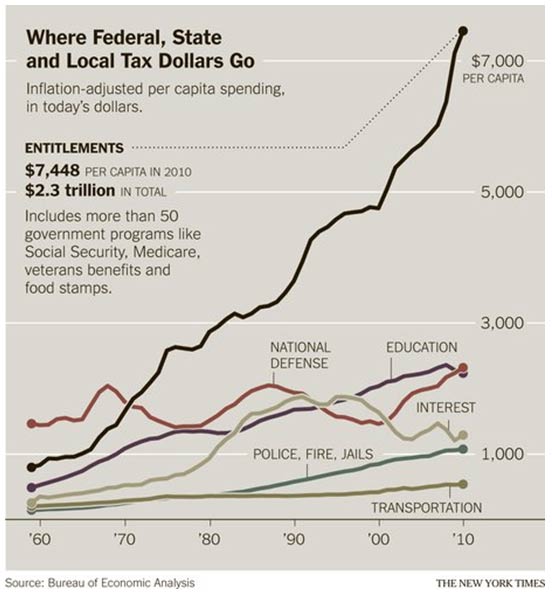
    Some would argue that government is the source of prosperity. Outside of the relatively small government necessary to ensure property rights, this is not true. As the following chart from the New York Times shows, most of government’s increased spending has gone to transfer payments.

    What’s to be done? I’ve argued elsewhere that legal immigration should be increased. That can be done immediately, and it would have immediate impacts. Repeal of Sarbanes-Oxley and Dodd-Frank would also have immediate benefits. Redoing healthcare in such a way that consumption of medical services would be tied to the payment of medical services would help, too. Increasing United States carbon-based energy production would provide an immediate boost.

    In the longer run, government’s share of the economy needs to decline. The least painful way would be to cap inflation-adjusted total government spending, and keep it capped while the economy grows, allowing governments share to decline to, say, 2000 levels. This would require changes to Social Security and Medicare benefits.

    Which brings us back to China. It appears that a large centralized bureaucracy was a significant contributor to China’s decline. It did this through three channels: Central bureaucracies imposed inefficiencies on the economy (just as we saw in the failed USSR). Bureaucracies are also risk averse, which limited China’s upside potential. And, like other bureaucracies, it attracted the best talent.

    This is not to say that the United States is 14th century China, and about to enter into an extended period of decline. But it is to say a cause of the United States sub-par economic performance is its large and growing central bureaucracy.

    Photo by IvanWalsh.com: Museum of Ancient Architecture, Beijing, China

    Bill Watkins is a professor at California Lutheran University and runs the Center for Economic Research and Forecasting, which can be found at clucerf.org

  • Buffalo, You Are Not Alone

    It hurts. When a bigtime Harvard economist writes off your city as a loss, and says America should turn its back on you, it hurts. But Ed Glaeser’s dart tossing is but the smallest taste of what it’s like to live in place like Buffalo. To choose to live in the Rust Belt is to commit to enduring a continuous stream of bad press and mockery.

    I write mostly about the Midwest, but whether we think Midwest or Rust Belt or something else altogether, the story is the same. From Detroit to Cleveland, Buffalo to Birmingham, there are cities across this country that are struggling for a host of historic and contemporary reasons. We’ve moved from the industrial to the global age, and many cities truly have lost their original economic raison d’etre. Reviving them requires the hard work of rebuilding and repositioning them for a new era, a daunting task to be sure.

    But beyond their legitimate challenges, these cities also face the double burden that they are unloved by much of America, and all too often by their own residents. They are forlorn and largely forgotten, except as cautionary tales or as the butt of jokes.

    These cities aren’t sexy. They aren’t hip. They don’t have the cachet of a Portland or Seattle. The creative class isn’t flocking. They are behind in the new economy, in the green economy. Look at any survey of the “best” cities and find the usual suspects of New York, Austin, San Francisco. Look at yet another Forbes “ten worst” list and see Cleveland and Toledo kicked again when they are down. They are portrayed as hopeless basket cases with no hope and no future.

    But I reject that notion. I do not believe in the idea that these cities are beyond repair and unworthy of attention—or affection.

    Someone asked me once why I bother. Why does it matter that these cities come back? Why not just let nature take its course? Why not let Buffalo die, and its people scatter to the winds?

    It’s because it doesn’t just matter to a few proud people in Buffalo, it matters to America. The idea of disposable cities is one that is incompatible with a prosperous and sustainable future for our country. Fleeing Rust Belt cities for neo-Southern boomtowns is nothing more than sprawl writ large. Rather than just abandoning our cores, we’ll now abandon entire regions in the quest for new greenfields to despoil. We can’t have a truly prosperous and sustainable America with only a dozen or so superstar cities that renew themselves from age to age while others bloom like a flower for a season, then wither away. An America littered with an ever increasing number of carcasses of once great cities is not one most of us want to contemplate.

    But beyond that, it’s because I believe we can make it happen. Look closely and the change is already in the air. Globalization taketh away—but it also giveth. Cities like Buffalo or St. Louis now have access to things that even people in Chicago didn’t not that long ago. Amazon, iTunes, and a host of specialty online retailers put the best of the world within reach. Where once you couldn’t get a good cup of coffee, there are now micro-roasters aplenty. Where once your choices were Bud, Miller, or Coors, an array of specialty brews are on tap, often brewed locally. Restaurants are better, with food grown locally and responsibly. Slowly but surely the ship is turning on sustainability, with nascent bike cultures in almost every city, LEED certified buildings, recycling programs, and more. House by house, rehab by rehab, neighborhoods in these cities are starting to come to life.

    Where once moving to one of these cities would have been likened to getting exiled to Siberia, it’s now shocking how little you actually give up. And for every high-end boutique or black tie gala you miss, you get something back in low-cost and easy living. The talent pool may be shallower, but it’s a lot more connected.

    Let’s not get ahead of ourselves. There’s still a long and hard journey ahead. And not every place is going to make it, particularly among cities without the minimum scale. We have to face that reality. But more of them will revive than people think.

    That’s because a new generation of urbanists believes in these cities again. These people aren’t bitter, burdened by the memories of yesteryear and all the goodness that was lost. The city to them isn’t the place with the downtown department store their mother used to take them to in white gloves for tea. It isn’t the place full of good manufacturing jobs with lifetime middle class employment for those without college degrees. The city isn’t a faded nostalgia or a longing for an imagined past. Most of them are young and never knew that world.

    No, this new generation of urbanists sees these cities with fresh eyes. They see the decay, yes, but also the opportunity—and the possibilities for the present and future. To them this is Rust Belt Chic. It’s the place artists can dream of owning a house. Where they can live in a place with a bit of an authentic edge and real character. Where people can indulge their passion for renovating old architecture without a seven-figure budget. Where they have a chance to make a difference—to be a producer, not just a consumer of urban life, and a new urban future. Above all, these people, natives or newcomers, have a deep and abiding passion and love for the place they’ve chosen—yes, chosen—to live.

    Still, it can get lonely, and often depressing. It so often seems like one step forward, two steps back. Making change happen can seem like pushing a rock uphill, like you are up there on some far frontier of the country alone, fighting a quixotic battle. Every historic building demolished, every quality infill project sabotaged by NIMBY’s, every massively subsidized business-as-usual boondoggle, every DOT-scarred transport project is a discouragement.

    But Buffalo, you are not alone. It’s not just you, it’s cities and people across across this country, from St. Louis to Pittsburgh to Milwaukee to Cincinnati to New Orleans to Birmingham, fighting to build a better future. There’s a new movement in all these cities, made up of passionate urbanists committed to a different and better path. Sometimes they are few in number, but they are mighty in spirit— and they are making a difference. Together, they and you can win the battle and make the change happen.

    It won’t be easy. The road will be long. Some, like the great cathedral builders of Europe, may never see completely the fruit of their labors. But the long-ago pioneers who founded these great cities never got to see them in their first glory either. We’ve come full circle. We are present again at the re-founding of our cities. This is the task, the duty, the calling that a new generation has chosen as its own, to write the history of their city anew.

    Go make history again, Buffalo.

    This article originally appeared in Buffalo Rising on June 14, 2010.

    Aaron M. Renn is an independent writer on urban affairs based in the Midwest. His writings appear at The Urbanophile.

    Taste of Buffalo photo by Bigstockphoto.com.

  • Gary Hustwit’s “Urbanized” Re-lighting Debate on Cities

    Gary Hustwit’s new film, “Urbanized,” is the third in his series of documentaries concerning design.  In his first two films, he looks at consumer product design and the global visual culture.  The existential problem of the city, an urgent one about which much of this website is concerned, is scarcely treated in our contemporary mainstream, and Hustwit’s effort is laudable. In this film, he tackles urban design, introducing ideas about how cities should – and should not – accommodate growth.  “Urbanized” tends to favor the big idea over the small, and airs the conventional wisdom of the urban design community.  In doing so, he brings to the public an important debate, but he misses some opportunities to explore change in the urban realm.

    In a visual feast of a film, interlaced with intriguing interviews of some of the luminaries of the 21st century design culture, “Urbanized” makes a case for elevating the environment to the same level of concern as architecture and mobility.  The documentary tends to reinforce, not question, notions of right and wrong growth that are promulgated by the urban intelligentsia, and he declines to explore the validity of most of these notions.  He also tends to focus on large, dramatic solutions to the urban growth dilemma, perhaps because they make for good cinema.  Flashy red Transmilenio buses in Bogatá; NASA-like control centers in Rio de Janiero; and Green Party clashes with the police in Stuttgart all imply that heroes must be at work to keep our cities livable and inspiring.

    To his credit, Hustwit does show local and small changes that are taking place in cities like New Orleans and Detroit.  He interviews urban agriculturalists, conceptual artists, and folks who spray-painted a graph of their power consumption on their street in Brighton, England.  Small moves like these are important, and tell us about how people are coping with unique urban challenges today.  But these stories are background to the larger profile stuff happening elsewhere on the globe.

    In Santiago, Chile, “Urbanized” shows the viewer how affordable housing is being developed on highly desirable land close to jobs.  The architect interviewed potential residents, giving them a choice between a water heater or a bathtub (all chose the bathtub, preferring to save up for the water heater).  Recognizing employment value over land value is exactly the kind of brave step that is much needed in our cities today, and this project provides a bold experiment to watch in this regard.  Even bolder is the strategy that assumes people, through their own devices, will prosper and increase the value of their home on their own – save up to buy a water heater, for example.  The documentary provides an interesting glimpse into an alternative approach to housing in this segment.

    Of course, no moviemaker could expect a good reception to a movie like this without paying homage to New York City, and Hustwit delivers us affectionate portraits of the Big Apple at the beginning, middle, and end of the film.  With the recent transformation of the city’s old elevated rail bridge, the High Line, Hustwit nicely showcases environmental awareness, historic preservation, and sustainability.  In a city that has effectively raised its hierarchy of needs to the ether, the issues of poverty and sanitation are worlds away.

    Which, in fact, they are in this film.  Over half the globe’s population lives in cities, so most—nearly one third of the globe’s population—live in urban  slums.  Hustwit exposes the pain of this reality.  Edgar Pieterse of the African Center for Cities describes the horrific conditions of urban poverty, and in Mumbai, architects discuss the government’s obstinacy in addressing these conditions in this famous slum.  Here, urban design is viewed as a strikingly pessimistic problem.  Density without modern technology violates basic hygiene and human dignity; and there appears to be no solution.

    The stereotype of Mumbai’s slums is reinforced, with a touch of Cape Town thrown in as well.  Yet, one wonders if the contemporary desperation of urban poverty in Western cities might be worth looking at, too; the vicious manner in which the Western poor vandalize their own city and strike out at their fellow citizens seems to be perpetually ignored, while the relatively mild behavior of the Mumbai slum dweller seems all too pitiable when viewed large on the big screen.  The poorest classes in the Western world, lacking access to education and upward mobility, are acutely aware of their neighbors’ material success, thanks to the ubiquitous media.  For fifty years, this tension has wrecked our inner cities, but has been ignored by urban designers.  “Urbanized” continues this trend.

    In the meantime, Hustwit interviews architects, urban planners, politicians, and academics who aspire to make cities walkable, compact, and connected.  Within this community, the car is deemed as a painful problem, and “Urbanized” takes us from Ebenezer Howard’s Garden City to modern day Phoenix.  The arc of the film begins with trains, and then showcases buses, cars, bicycles, and walking solutions.  By now, it is ritual to condemn the car and rejoice in the other options, and “Urbanized” follows this formula.

    Just as Mumbai is shorthand for slums, Phoenix is shorthand for sprawl.  Footage of traffic jams suggest that Phoenix is a worst-case scenario, even though the longest commutes by far take place in denser regions, such as New York and Los Angeles. Again, “Urbanized” does slip in a small, but important point, using Grady Gammage, Jr., a real estate attorney, academic, and political leader in Phoenix.  Gammage reminds the viewer that what is commonly labeled as “sprawl” is, in fact, the density level at which humanity has always dwelt.

    “Urbanized” serves as a timely milestone, bringing together voices and ideas that dominate our thinking about cities today.  While it deals with problems like the rebuilding of New Orleans, it also seems timeless by not mentioning some of the recent changes that affect our urban existence.

    The global recession cooled off the credit market, which has paused construction in all but a few places.  The impact this has had on our cities would be an interesting documentary to watch, for our built environment is much like a consumer product, as buildings go quickly obsolete and competition forces building owners to keep up.  Nimble private developers have already switched gears to repair and renovate; yet our municipal codes, fees, and processes are still geared to the boom.  This schism between private and public thinking is constraining our cities today.

    Affordable housing will sharply affect urban life in the near future, and western cities seem to be on a trajectory that increasingly looks headed towards Mumbai.  Ignoring the gap between the rich and the poor and heaping requirement upon requirement until prosperity is all but lost to the poor could negatively affect our cities.

    The last time city planning was earnestly discussed at the mainstream level was perhaps in Jane Jacobs’s heyday in the early nineteen sixties.  Since then, the arguments and theories seem to have been put away, having solved the problem at the time, and new solutions have not been eagerly considered. These solutions – born in the righteous indignation of Jane Jacobs’s – are a bit shopworn.  Much has changed since the 1960s:  Our population has increased by an order of magnitude; urban dwellers outnumber rural, and our image of the city has changed.  We acquired an internet.  It is time to take stock.

    The debate about how our cities will grow in the 21st century must reach the mainstream, and get out of academia and the professional specialists.    “Urbanized” is a timely examination of the problems of the city today – how to provide a sanitary and dignified urban form at the basic level, and how to inspire and rejoice in the sheer spectacle of the city at a higher level.  It has started to relight the much-needed fires of debate and conversation among citizens of cities today.

    Richard Reep is an Architect and artist living in Winter Park, Florida. His practice has centered around hospitality-driven mixed use, and has contributed in various capacities to urban mixed-use projects, both nationally and internationally, for the last 25 years.

  • The Next Public Debt Crisis Has Arrived

    In July of 2009, while the smoke from the global financial bonfire was still thick in the air, I wrote for this website about another crisis of massive proportions just looming on the horizon: the Global Crisis in Public Debt.

    Three years later, the news of defaults, bankruptcies, debt forgiveness requests, receiverships, and bailouts are in the news every day. Across the globe, sovereign entities – from US cities to European nations – are suffering under staggering debt loads, decimated revenues and intense pressure from the very capital markets that they should be able to turn to for refuge. Last month, Jefferson County, the largest in Alabama, moved forward with their bankruptcy proceedings over the objections of the Wall Street banks. Suffolk County in New York declared a financial emergency. The Financial Times has an interactive map showing all but 12 U.S. states with budget shortfalls for 2012. Eleven U.S. cities, counties and villages have filed bankruptcy since 2008, plus 21 municipal non-government entities (e.g., utilities, hospitals, schools, etc.), according to the Pew Center on the States.

    This crisis for cities, states and nations, like so many other financial crises, has its root in the free flow of credit that existed during the preceding economic boom years. The market prices of assets rose steadily. Rising valuations, especially based on improving revenues from robust economic activity, led to rising income streams for governments. This encouraged governments to borrow more, perhaps often to expand services – and the bureaucracy required to deliver them – and sometimes to improve infrastructure and make capital investments.

    At the same time, rising market prices for financial assets encouraged more savers and investors into the market. In the US, the flow of cash to Wall Street was further encouraged by favorable tax treatment for the earnings on retirement savings and municipal bonds. The steady influx of new money produced an increasing supply of investable funds, which drove demand for sovereign and municipal debt (in addition to the mortgage-backed securities).

    This process was driven more by the financial services industry than the real economy. As of March 5, 2012, the Federal Reserve Bank of New York reported more than $5,000,000,000,000 ($5 trillion) in overnight securities financing – that’s money that makes money but nothing else – that’s more than 20% of US GDP sitting around, not creating jobs, not building infrastructure, just sitting. Since the investment of securities financing is virtually all done electronically, it creates very few jobs. What it does produce is a boost in revenues for bankers – which they can translate into often lavish bonuses.

    The financial sector also adds to its profits from issuance fees, trading fees, underwriting fees, etc. Then there’s “Market Risk Trading,” a euphemism for letting anyone buy a contract to gamble on the probability that Greece won’t be able to repay their debt or that you will miss a mortgage payment. Anyone can buy that contract, even the arsonist next door who has a say in whether or not Greece gets access to capital. In the end it is the borrowers who will suffer the consequences because they will be unable to refinance their debt and the gamblers who will win by withholding financing in anticipation of the insurance payout.

    At the end of June 2009, only Italy, Turkey and Brazil were covered by more credit default swap contracts than JP Morgan Chase and Bank of America.   Goldman Sachs, Morgan Stanley, and Wells Fargo Bank all had more credit derivate coverage than the Philippines.   

    Entered the Top 1,000 for credit default swaps after 2009

    Reference Entity

    Debt as %GDP

    CDS* as %Debt

    Australia

    30.3%

    11.2%

    New Jersey

    7.8%

    11.2%

    New Zealand

    33.7%

    8.6%

    Illinois

    6.8%

    8.2%

    Texas

    3.4%

    6.6%

    Kingdom of Saudi Arabia

    9.4%

    3.8%

    Lebanese Republic

    137.1%

    2.4%

    Arab Republic of Egypt

    85.7%

    1.0%

    *CDS are credit default swaps, financial contracts that pay off if the named (reference) entity experiences a credit event like a ratings downgrade or a missed payment.
    [Abu Dhabi also appears in the 2012 list of the top 1,000 entities named in credit default swaps at DTCC, but debt and GDP data are not available.]

    What was a potential default problem in 2009 has become reality in 2012. In 2009, gross credit default swaps outstanding for the debt of Iceland were equal to 66 percent of GDP, and around 18 percent for Portugal. As these countries struggle with their debt, the global banks – primarily the US banks – sell credit derivatives and stand to collect enormous payments – whether or not the defaulting countries receive any support or bailouts from international donor organizations. The reason is that most credit derivatives contracts pay out on “credit events.” A “credit event” can be something as simple as a downgrade from Moody’s or Standard and Poor’s – whose managers testified before Congress that credit rating changes can be bought. Standard & Poor’s executives admitted in 2008 that they were being forced to relax rating requirements to improve revenues. If, for example, $69 billion worth of credit derivative payoffs are available on a Greek default then how much could the owner of a credit swap afford to pay for a rating change?

    The absurdity of rating Egypt more credit worthy than Australia is only part of the story. The sad fact is that Wall Street banks can sell more credit risk protection than there is credit risk. If all the public debt of a country is $1 billion, it means that country has borrowed $1 billion in public capital markets.  But   Wall Street banks are buying and selling more credit risk insurance than there is credit risk. This is the same problem I wrote about in 2008 that we saw in the Treasury bond market – when you sell more bonds than exist these trades are called “naked” sales or “phantoms”. A similar problem in stocks contributed to the 2008 crash.

    There are more cities, counties, states and nations in financial trouble   According to the Bank for International Settlements, there were $615 trillion in Over-The-Counter (OTC) derivatives contracts outstanding worldwide at the end of 2009. That’s about 9 times global GDP.  In other words, the entire world would have to work for 9 year just to produce enough to pay off the derivatives – before we had a dime left over to pay off the original debts.

    In this environment, the sovereign debt crises may produce something scarier than anything we have experienced in the past. The use of credit derivate products has increased the chance of a default turning into a global catastrophe. It won’t be enough to pay off the debt owed by one of these sovereigns. That payoff will be magnified by the value of the credit derivatives. These derivatives will have a multiplier effect on every sovereign debt default or “credit event.” The table at the end of this article only includes the credit derivatives warehoused with the Depository Trust and Clearing Corporation in the US – there is no source of information on the real magnitude.

    A crisis in sovereign debt would cause problems not just within those nations, states or cities but also for the global financial institutions who sell default protection through the credit derivatives markets. The bankruptcy of Jefferson County (AL) threatens to take down muni-bond insurer Syncora Guarantee (who, by the way, is suing JPMorgan Chase over losses in mortgage-backed securities saying that JPMorgan Chase misrepresented the loans to obtain the insurance). Another such institution was Ambac Financial Group, Inc., which I described in an article published here months before the original prediction of the global crisis in public debt. Ambac – like Berkshire Hathaway – was in the business of guaranteeing the payments of public debt (and mortgage backed securities). Ambac filed for bankruptcy in November 2010.  With Ambac gone, Berkshire is next in line to pay because of Warren Buffett’s credit default swaps.

    Policy makers have had few options available across the globe to combat this crisis. The European Union Commission is attempting to control the amount of credit insurance being sold by limiting the sale of “naked” credit default swaps.  A proposal was approved by the European Parliament on November 15, 2011 to restrict the sale of credit insurance to any buyer who “does not have ownership of the underlying government debt.”    The limited regulation passed by the EU Parliament allows the sale if the buyer has ownership in something vaguely related to the sovereign debt – like allowing the purchase of swaps on Italian government debt if the buyer owns shares of an Italian bank. French President Sarkozy said in January that he would propose “special levies on naked credit default swaps.”  The imposition of fines or taxes (levies) has not eliminated similar activity in stock and bond markets in the US, though it is at least a start which is more than US regulators have done.

    Meanwhile, Federal Reserve Chairman Ben Bernanke and Treasury Secretary Timothy Geithner continue to load the helicopter with dollar bills to finance the payouts with freshly-minted U.S. dollars. They sell us the fantasy of free-market capitalism while laying down a labyrinth of financial rules and regulations allowing a dozen or so politically connected banks to reap the rewards while avoiding the risk of failing, US financial institutions have been placing losing bets through unregulated derivatives markets only to be bailed out as “systemically important” – a euphemism for “too politically connected to fail.” The rest of the world is taking steps to stop the damage. When will the US government step up to the plate?

    Sovereigns named in most credit default protection*
    2009 2012 2009 2012
    Sovereign Entity Debt % GDP Debt % GDP CDS % Debt CDS % Debt CDS change 2008 to 2012*** Region
    REPUBLIC OF ICELAND 23.0% 130.1% 315.2% 40.4% -2,322,155,904 Europe
    REPUBLIC OF ESTONIA 3.8% 5.8% 206.7% 193.4% 844,012,716 Europe
    UKRAINE 10.0% 44.8% 194.5% 28.9% -23,102,981,592 Europe
    REPUBLIC OF KAZAKHSTAN 9.1% 16.0% 144.0% 57.5% -3,440,253,859 Europe
    REPUBLIC OF BULGARIA 16.7% 17.5% 100.6% 112.5% 4,163,215,975 Europe
    REPUBLIC OF LATVIA 17.0% 44.8% 92.4% 62.3% 3,369,945,521 Europe
    BOLIVARIAN REPUBLIC OF VENEZUELA 17.4% 38.0% 80.7% 45.9% 5,646,959,440 Americas
    STATE OF QATAR 6.0% 8.9% 76.4% 55.4% 5,040,787,988 Europe
    RUSSIAN FEDERATION 6.8% 8.7% 72.7% 55.7% 4,966,368,803 Europe
    REPUBLIC OF TURKEY 37.1% 42.4% 56.1% 32.5% -43,726,859,566 Europe
    REPUBLIC OF LITHUANIA 11.9% 37.7% 42.7% 28.8% 3,438,691,822 Europe
    REPUBLIC OF PANAMA 46.4% 41.7% 36.7% 37.1% 989,207,525 Americas
    REPUBLIC OF THE PHILIPPINES 56.5% 49.4% 36.6% 28.8% -10,157,402,334 Asia Ex-Japan
    REPUBLIC OF PERU 24.1% 21.9% 34.1% 41.1% 7,324,285,482 Americas
    ROMANIA 14.1% 34.0% 31.2% 20.6% 6,566,917,982 Europe
    REPUBLIC OF CHILE 3.8% 9.4% 30.9% 21.2% 2,719,694,915 Americas
    IRELAND 31.5% 209.2% 28.2% 22.5% 27,767,560,886 Europe
    UNITED MEXICAN STATES 20.3% 37.5% 23.7% 20.2% 50,658,161,703 Americas
    REPUBLIC OF SLOVENIA 22.0% 45.5% 22.5% 23.0% 3,206,639,043 Europe
    REPUBLIC OF HUNGARY 73.8% 76.0% 21.6% 47.1% 37,403,179,311 Europe
    REPUBLIC OF SOUTH AFRICA 29.9% 35.6% 21.5% 24.6% 17,010,145,334 Europe
    ARGENTINE REPUBLIC 51.0% 42.9% 18.7% 17.2% -2,448,737,614 Americas
    FEDERATIVE REPUBLIC OF BRAZIL 40.7% 54.4% 18.2% 13.0% 14,703,918,548 Americas
    PORTUGUESE REPUBLIC 64.2% 72.1% 15.9% 25.2% 39,897,746,989 Europe
    REPUBLIC OF COLOMBIA 48.0% 45.6% 15.9% 14.9% 1,221,052,625 Americas
    SLOVAK REPUBLIC 35.0% 44.5% 12.8% 19.3% 5,533,166,393 Europe
    KINGDOM OF SPAIN 37.5% 68.2% 11.9% 16.9% 101,554,412,387 Europe
    REPUBLIC OF KOREA 32.7% 22.9% 11.8% 20.0% 22,088,912,724 Asia Ex-Japan
    REPUBLIC OF CROATIA 48.9% 60.5% 11.5% 19.9% 5,612,474,098 Europe
    HELLENIC REPUBLIC (Greece) 90.1% 165.4% 11.1% 13.6% 34,488,989,840 Europe
    REPUBLIC OF INDONESIA 30.1% 24.5% 11.0% 16.1% 13,723,880,843 Asia Ex-Japan
    MALAYSIA 42.7% 57.9% 9.7% 7.8% 4,044,633,137 Asia Ex-Japan
    KINGDOM OF DENMARK 21.8% 46.9% 9.3% 17.2% 12,665,229,924 Europe
    STATE OF FLORIDA 3.2% 17.9% 8.1% 16.8% 2,787,096,121 Americas
    REPUBLIC OF AUSTRIA 58.8% 103.3% 7.9% 21.3% 38,904,764,846 Europe
    REPUBLIC OF ITALY 103.7% 120.1% 7.9% 14.6% 171,818,588,038 Europe
    KINGDOM OF THAILAND 42.0% 45.6% 7.1% 6.5% 1,675,447,429 Asia Ex-Japan
    SOCIALIST REPUBLIC OF VIETNAM 38.6% 54.5% 6.4% 5.9% 3,717,696,305 Asia Ex-Japan
    CZECH REPUBLIC 29.4% 39.9% 6.0% 11.5% 7,793,110,452 Europe
    REPUBLIC OF POLAND 41.6% 56.7% 5.9% 9.7% 25,523,188,448 Europe
    REPUBLIC OF FINLAND 33.0% 49.0% 5.7% 17.3% 12,868,084,419 Europe
    THE CITY OF NEW YORK ** 7.5% 4.3% 8.4% 3,555,950,000 Americas
    STATE OF NEW YORK 4.2% 24.8% 4.3% 5.3% 1,215,398,707 Americas
    KINGDOM OF SWEDEN 36.5% 36.8% 4.1% 15.0% 15,665,446,384 Europe
    KINGDOM OF BELGIUM 80.8% 99.7% 3.9% 15.1% 49,607,728,521 Europe
    STATE OF ISRAEL 75.7% 74.0% 3.4% 7.0% 7,093,224,168 Europe
    STATE OF CALIFORNIA 3.9% 18.3% 3.2% 12.7% 8,068,160,000 Americas
    FEDERAL REPUBLIC OF GERMANY 62.6% 81.5% 2.1% 4.5% 75,770,481,300 Europe
    KINGDOM OF NORWAY 52.0% 48.4% 1.6% 6.3% 5,953,647,323 Europe
    KINGDOM OF THE NETHERLANDS 43.0% 64.4% 1.6% 5.3% 19,494,129,128 Europe
    PEOPLE’S REPUBLIC OF CHINA 15.7% 16.3% 1.5% 3.7% 49,294,027,432 Asia Ex-Japan
    FRENCH REPUBLIC 67.0% 85.5% 1.5% 6.8% 108,226,300,245 Europe
    UNITED KINGDOM OF GREAT BRITAIN
    & NORTHERN IRELAND
    47.2% 79.5% 1.2% 3.6% 51,470,774,560 Europe
    JAPAN 170.4% 208.2% 0.1% 0.8% 67,160,972,268 Japan
    UNITED STATES OF AMERICA 60.8% 69.4% 0.1% 0.2% 19,471,174,892 Americas
    *List from Depository Trust and Clearing Corporation. [www.dtcc.com] Dubai was also on this list, but debt and GDP data were not available.
    **2012 GDP for City of NY was calculated by subtracting all other MSA output from state GDP.
    *** Lower totals may indicate that some credit default swap contracts have been paid off.
    Countries in Italics had not failed to meet their debt repayment schedules before 2008 (Reinhart and Rogoff 2008); Thailand and Korea received IMF assistance to avoid default in the 1990s.


    Susanne Trimbath, Ph.D. is CEO and Chief Economist of STP Advisory Services. Dr. Trimbath’s credits include appearances on national television and radio programs and the Emmy® Award nominated Bloomberg report Phantom Shares. She appears in four documentaries on the financial crisis, including Stock Shock: the Rise of Sirius XM and Collapse of Wall Street Ethics and the newly released Wall Street Conspiracy. Dr. Trimbath was formerly Senior Research Economist at the Milken Institute. She served as Senior Advisor on United States Agency for International Development capital markets projects in Russia, Romania and Ukraine. Dr. Trimbath teaches graduate and undergraduate finance and economics.

    Treasury Department photo by BigStockPhoto.com.

  • How A Baby Bust Will Turn Asia’s Tigers Toothless

    For the last two decades, America’s pundit class has been looking for models to correct our numerous national deficiencies. Some of the more deluded have settled on Europe, which, given its persistent low economic growth over the past 20 years and minuscule birth rates, amounts to something like looking for love in all the wrong places.

    More rational and understandable have been those who have looked for role models instead in East Asia. After all, East Asia has been the world’s ascendant power for the better part of past 30 years. It is home to both China and Japan, the world’s second and third largest economies, as well as the dynamic “tiger” economies of Korea, Taiwan, Hong Kong and Singapore.

    Thomas Friedman, long enamored by authoritarian leviathan China, recently praised the tiger countries as exemplars of forward thinking. He traces their strong emphasis on “highly effective teachers, involved parents and committed students” as keys to turning their resource-poor countries into first world successes.

    Yet for all their laudably good school test scores, these tigers could turn somewhat toothless in the future. Already Japan, which fashioned the first great Asian model, is beset by a series of massive challenges including a lack of technological competitiveness and disastrously declining demographics. They also face competition from places like China and India, behemoths which may not equal the Tigers’ spectacular per-capita education numbers, but which can marshal overwhelming numbers of ambitious, educated and skilled people.

    Many in the tiger nations recognize this competitive plight far more than their western cheerleaders. Some even wonder if they may even have been too rational and credential-obsessed for their own good. Like Japan after the Second World War, they invested heavily in educating their young people to excel on tests and work long hours . But this also fostered high levels of stress and hyper-competition that discourages both family formation and child bearing .

    Singapore (where I serve as Senior Visiting Fellow at the Civil Service College) is arguably the best planned and most cleverly conceived of all the Tigers. Singaporeans live well — their per-capita incomes surpass those of Americans — but this edge is largely blunted by extremely high costs. As in all the Tiger countries, consumer goods like cars are extraordinarily expensive (a modest Korean model can run upwards of $75,000 or more in Singapore) and housing costs far higher than experienced by most Americans. In Hong Kong, notes researcher Wendell Cox, an average apartment, usually quite small, costs roughly twice as much as one  in New York or San Francisco, two most elite metro U.S. markets, relative to income.

    These conditions, observes Vatsala Pant, a former Nielsen executive and long-time Singapore resident, create what amounts to an accounting-like mentality about their lives. “Singaporeans seem to be born with a calculator in their heads,” she notes. “Every decision seems to weighed in a cost and benefit analysis, including such things as family. If it’s not perfect, they don’t want it.”

    This turn from family represents a sharp break in these countries. All the “tiger” economies flourished based on a Confucian culture that places kinship at the top of the value pyramid. Parents are still widely revered, but Li Lin Chang, an associate director of the Lee Kuan Yew School of Public Policy, suggests that Singapore’s “Confucian roots may not be as evident and some may argue that it may have disappeared.”

    Certainly increasing number of Singaporeans and others from Tiger countries are opting out of marriage. In 2000, 14% of women between age 30-39 chose to remain childless, according to demographer Gavin Jones of the National University of Singapore. By 2009, this figure has gone up to 20%. Jones estimates in some east Asian societies up to a third of all women will remain childless.

    Japan, the original model for all these countries, is now leading the way off the demographic cliff. In Japan, notes researcher Mika Toyota, 20% of 50-year-old males have never married, up from 12 percent just a decade ago. By 2030, she estimates nearly 30% of 50-year-old males will have never wedded. And unlike the U.S. and Europe, very few people have children out of wedlock in East Asia, so no marriage means no children.

    This plunge in marriage and family formation is not entirely voluntary. Few of the 40 or more Singaporean younger adults I have interviewed in recent months celebrated singleness like some of their Western counterparts. Most still wanted children and linked their reluctance to wed or to have babies on the high cost of living, intense competition in their workplace and even increasingly crowded mass transit.

    “Most of my friends are not married,” one 35-year-old female civil servant told me. “They don’t want to be single but they are too busy with their work commitment. My friends are consumed by work. Money, status, prestige, climbing the ladder. You expect things to change when you get older but it doesn’t. The calculation just doesn’t work out”

    For many of these people, not having offspring makes sense in terms of concentrating on career goals and reducing financial pressure. But it could prove a social disaster in the long run. All Tiger nations now suffer fertility rates roughly half the 2.1 children per household needed to replace the current population. By 2030 these countries could have fewer people under 15 than over 60.

    Not surprisingly, many Tiger country policymakers place a priority on producing more cubs. Most offer highly generous packages of support offered to those willing to take the nativity plunge. Some who have children cope with entrenched male reluctance to share in child-raising by relying on low-cost maids, often from the Philippines and other poorer countries. A recent move by the Singapore government to require giving maids the day off elicited howls of protests from female professionals, who, as authors Teo You Yenn and Vivienne Wee put it, regard “care of one’s own offspring as tedious, beneath oneself and rightfully the responsibility of a hired woman.”

    Some professionals who desire children consider taking their finely honed skills elsewhere. A recent survey by the MRI China Group showed that a majority of professionals surveyed in Taiwan and some forty percent in Singapore, as well as roughly one-third of those in Hong Kong, were actively looking to relocate to another city. Most covet a move to less high-pressure, lower-density Australia or New Zealand. Others, particularly from Taiwan, are attracted to greater opportunities in China.

    There may not be too much the bureaucracies can do immediately to address these problems. Clearly adding more degrees per capita or bringing in more foreign expertise, as is common in Singapore and Hong Kong, has not addressed looming baby shortage. Instead, as one one young University researcher put it, “we need a new mindset.”

    Most particularly, these countries need to change the incentives that, albeit unintentionally, create unsustainable levels of singleness, childlessness and the prospect of massive, rapid aging of their societies. They may have to consider more flexible work-styles, the promotion of home based business and better use of their limited space. Individual entrepreneurship, more rooted in each country and able to meld with family life, could be stressed as a counterbalance to employment in often fickle multinational corporations who can always move to greener, or at least cheaper, locales.

    More difficult still will be shaping attitudes that restore the primacy of family that propelled these societies in the first place. This is an existential challenge that would have seemed unimaginable 40 years ago when these countries fretted about overpopulation and widespread poverty. But success in the future can not be purchased by simply continuing what has worked so well for a generation. To avoid a toothless future, the Tigers need to unlearn some of the secrets of their past success.

    This piece originally appeared in Forbes.com.

    Joel Kotkin is executive editor of NewGeography.com and is a distinguished presidential fellow in urban futures at Chapman University, and contributing editor to the City Journal in New York. He is author of The City: A Global History. His newest book is The Next Hundred Million: America in 2050, released in February, 2010.

    Singapore skyline photo by Bigstockphoto.com.

  • What Apple’s Supply Chain Says About US Manufacturing and Middle-Skill Training

    In January, The New York Times released a front-page report on the iEconomy, Apple’s vast and rapidly growing empire built on the production of tech devices almost exclusively overseas. The fascinating story created a wave of attention when it was published, and it’s back in the news after NPR’s “This American Life” retracted its story about working conditions at Foxconn, one of Apple’s key suppliers of iPhones and iPads.

    The end of the “This American Life” episode includes a discussion (audio | transcript) between host Ira Glass and Charles Duhigg, the NYT reporter who wrote the iEconomy piece, on Apple’s supply chain and the reason the tech giant doesn’t produce its insanely popular devices in the U.S. Perhaps you thought the main reason was labor costs; Apple would have to pay American workers much more than the estimated $17 a day (or less) many Chinese workers at Foxconn make. That’s part of it, but “an enormously small part,” Duhigg told Glass.

    Duhigg explained that, in terms of labor costs, producing the iPhone domestically would cost Apple an additional $10 (on the low end) to $65 (on the high end) more per phone. “Since Apple’s profits are often hundreds of dollars per phone, building domestically, in theory, would still give the company a healthy reward,” he wrote in the NYT piece.

    Instead, what matters is Apple’s intricate Chinese supply chain. Duhigg went into detail in his conversation with Glass:

    Compared to the cost of buying chips or making sure that you have a plant that can turn out thousands of these things a day or being able to get strengthened glass cut exactly right within, you know, two days of this thing being due, that’s what’s important. Labor is almost insignificant. What is really important are supply chains and flexibility of factories. You want to be able to be located right next to the plant that makes the screws so that when you need a small change to that screw factory, you can go next door and say, “Give it to me in six hours,” and they can say, “Here you go.” Because if that factory was in another state or on another continent, it would take two weeks. It’s the flexibility within the Chinese manufacturing system, that’s what you can do in Asia that you can’t do in the United States.

    Another major reason why Apple produces the iPhone and iPad abroad is the huge (and available) skilled workforce in China. When Apple needed 8,700 industrial engineers to oversee 200,000 assembly-line workers involved in making the iPhone, the firm looked at how long it would take to find that many workers in the U.S. Its answer: as long as nine months — compared to 15 days in China.

    This boils down, according to Duhigg’s report, to the lack of American workers with “mid-level skills that factories need, executives say.”

    Companies like Apple “say the challenge in setting up U.S. plants is finding a technical work force,” said Martin Schmidt, associate provost at the Massachusetts Institute of Technology. In particular, companies say they need engineers with more than high school, but not necessarily a bachelor’s degree. Americans at that skill level are hard to find, executives contend. “They’re good jobs, but the country doesn’t have enough to feed the demand,” Mr. Schmidt said.

    From Whose Bourn No Manufacturing Returns

    So, what does this mean for manufacturing in the U.S.?  For the most part there are no surprises here. These are known, core issues in the U.S. We’re well aware of the skilled worker drought. We’re aware that we’ve shipped much of our production process off-shore. But, we keep saying to ourselves, we’ve increased our productivity. We’re innovating and we’re keeping the profits, right? To answer that we can say “maybe” and “sorta.”

    There’s currently a debate raging about how we calculate our productivity. It’s a complex issue that we won’t get deep into here (check out this recent article in the Washington Post for more), but the gist is that our methodology for calculating productivity might be overstated. Like, a lot. Biases within this methodology have tended to convert a factory’s price savings through outsourcing into an increase in output. As Peter Whoriskey of the Post puts it:

    For example, suppose a U.S. factory decides to offshore the production of a part for which it used to pay $1. With the switch to an overseas supplier, it might pay 50 cents for the part. If U.S. statistics do not capture this drop in price, the savings by the U.S. factory can show up as a gain in output and productivity.

    Changes like these aren’t an increase in output due to innovation and greater productivity per worker. These are savings, which are certainly great for that factory, and certainly mean better profit margins, but which aren’t productivity increases that we get to point to as the silver-lining of our inky manufacturing cloud.

    That’s one element. The other element sits very near and dear to our heart here at EMSI. There’s a very basic theory at work in our impact studies and I/O model, and it’s that tight supply chains are good. The goal of any regional economy should be to develop complete supply chains. The less that an industry has to bring goods and services into the region from outside, the greater effects we see from increases in those industries. In other words, “Great job, China.” But this leaves the US at a disadvantage. Yes, low-cost Chinese manufacturing has facilitated growth in the US economy. However, this has happened at the expense of the US developing these complete supply chains.

    Maybe If We Ask Real Nice

    Now, this is an extremely complicated issue, and things have developed as they have for a reason. However, when we ask the question, “what would it take to manufacture iPhones in the US?” — a question tantamount to “what would it take to get all of those manufacturing jobs over here?” — if the supply chain is the deciding factor, then the answer might be something along the lines of “too late.” At this point, manufacturing supply chains are so thoroughly concentrated in China that bringing them back to US soil seems more or less impossible. There may be little we can do about manufacturing jobs leaving the US.

    The Data

    However, instead of simply offering some sound — albeit pessimistic — reasoning on the issue, let’s look at some data on manufacturing. Since jobs are in the spotlight, and productivity measures have received some heat, we’ll simplify the issue a little and just look at job growth in manufacturing.

    In terms of industry performance, 74 manufacturing industries saw growth from 2001-2006; 65 saw growth from 2006-2009; and 210 saw growth from 2009-2011. This is, of course, growth of any amount. This indicates a slight, recent uptick in the variety of industries experiencing some amount of growth.

    Typically, we look at net growth for industries. We combine growth and decline to show the overall growth and decline. Here’s net decline for manufacturing for three different periods:

    Net Change Average Annual Net
    2001-2006
    -2,211,513
    -368,586
    2006-2009
    -2,193,021
    -548,255
    2009-2011
    -99,250
    -33,083

    Job loss seems to slow in that 2009-2011 period.

    We’ll look at one more series of data, before we wrap up. What if we look at decline and growth separately instead of simply the net of both? This will allow us a discrete view of whether decline has slowed or growth has quickened, or perhaps a combination of both.

    First, decline:

    Decline Average Annual Decline
    2001-2006
    -2,481,385
    -413,564
    2006-2009
    -2,321,862
    -580,466
    2009-2011
    -300,690
    -100,230

    Manufacturing decline considered on its own appears to have slowed in the past few years.

    Now, growth:

    Growth Average Annual Growth
    2001-2006
    269,872
    44,979
    2006-2009
    128,841
    32,210
    2009-2011
    201,440
    67,147

    Gain in the manufacturing sector seems to have picked up pretty noticeably.

    This analysis is not nuanced. As other sources have made plain, this is a complex issue. However, it remains true here that job growth in manufacturing has picked up somewhat, and that decline has slowed. We’re still seeing net losses, so this isn’t evidence of recovery. However, it does mean that not absolutely every manufacturing job is moving offshore. At least not yet.

    Not to mention that there’s some support for the idea that we’re seeing some “reshoring” — manufacturing jobs coming back to the US. A recent report from The Boston Consulting Group claims that by the end of the decade we could see a reshoring of 600,000 to 1 million jobs. The report explores the seven broad industry sectors “most likely to reach a ‘tipping point’ over the next five years—a point at which China’s shrinking cost advantage should prompt companies to rethink where they produce certain goods meant for sale in North America.” Are we seeing the beginnings of this in our more recent industry data? Or do we stand to lose more manufacturing jobs to China? We’ll have to wait and see.

    Stevenson has worked at EMSI, an Idaho-based economics firm, since 2006. He’s a regular contributor to the EMSI blog. Contact him at josh@economicmodeling.com.

  • Transportation Aborted

    Like most Americans, I was bombarded by sound-bites and blog-bytes surrounding an amendment to an Act of Congress that would require a woman to submit to and review the results of a trans-vaginal ultrasound before receiving an abortion. This amendment was covered ad nauseam by everyone from the Huffington Post to the nightly news on broadcast television. I don’t mind admitting that I’m past the age where this Act of Congress would have an effect on me personally.

    What really bothered me was that no one talked about the core problem of how deranged our political process has become in Washington. The real issue here that impacts all of us is that this amendment was attached to a transportation funding bill – TRANSPORTATION, not a Health Care Bill or a Health Insurance Bill or even an Equal Opportunity Employment Bill but a TRANSPORTATION funding bill.

    All of these journalists are as at fault over the issue as the bunch of Congressmen who tried – once again – to slip one past the balance of powers and our democratic form of government. The guilty parties in Washington DC start with:

    In the House of Representatives, Mr. Fortenberry (NE), Mr. Boren (OK), Mrs. McMorris Rodgers (WA), Mr.Scalise (LA), Mr. Tiberi (OH), Mr. CONAWAY (TX), Mr. Lamborn (CO), Mr. Walberg (MI), and Mr. Lipinski (IL) who introduced  “H.R.1179 — Respect for Rights of Conscience Act of 2011” on March 17, 2011. By the time the bill was attached as an amendment to the highway funding bill, the number of co-sponsors had risen from 8 to 221.

    In the Senate, Mr. Blunt (MO), Mr. Rubio (FL), and Ms. Ayotte (NH)) introduced S. 1467 on August 2, 2011. The cosponsors in the Senate went from 2 to 37.

    That’s a total of 260 elected representatives who will be responsible for the continuing deterioration of highway infrastructure in the United States. The current Federal authorization for funding surface transportation programs ends March 30, 2012.

    The current funding authorization is just the most recent in a long line of temporary extensions that have been strung together since the last 5-year plan expired in 2009. The highway funding bill in question – to which this healthcare amendment is being attached – would authorize funding of $109 billion over 2 years. If nothing is done by March 30, if no action is taken to fund US highway infrastructure, the Department of Transportation (DoT) will have to furlough workers and stop paying contractors, according to Humberto Sanches of Roll Call. Last summer, DoT sent home 4,000 FAA employees and 70,000 private-sector workers because Congress failed to act on funding.

    The process for highway funding is already convoluted and inefficient – watching the current Congress add abortion amendments to the funding bill gives us a peek into how it got that way. In the meantime the United States’ infrastructure is crumbling and the rest of the world is getting ahead of us. No wonder we’re deranged.