Blog

  • The Evolving Urban Form: Osaka-Kobe-Kyoto

    Osaka-Kobe-Kyoto is Japan’s second largest urban area and ranks as the 12th largest urban area in the world. With a population of approximately 17,000,000 and a land area of 1240 square miles (3200 square kilometers), Osaka-Kobe-Kyoto has a population density of 13,700 per square mile (5,200 per square kilometer), making it the most dense major urban area in Japan and among the denser urban areas in the high income world. The larger metropolitan region includes four prefectures, Osaka, Kyoto, Kyoto and Nara (Figure 1).
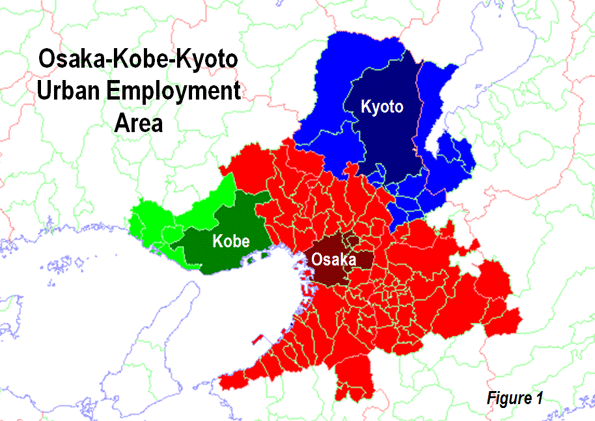

    Adapted from WikiCommons user Kzaral

    World’s Largest Conurbation

    Osaka-Kobe-Kyoto is a conurbation, an urban area that has grown together from multiple cores (here, the urban areas of Osaka, Kobe and Kyoto). Most urban areas grow concentrically from a single core. In the process their suburban growth can engulf and incorporate smaller urban areas (such as Gifu in Nagoya, Bogor in Jakarta or Newark in New York), However, conurbations — such as  Rhine-Ruhr region in Germany (Essen, Dortmund, Duisburg, and Bochum), Katowice-Gliwice-Tychy (upper Silesia) in Poland, Dallas-Fort Worth and Minneapolis-St. Paul in the United States — develop when major urban areas grow together (or merge), forming a larger urban area.  

    The municipality of Osaka, the largest in the region, long had been Japan’s second municipality exceeded by Yokohama (in the Tokyo region) in 1980; in the 17th century it was the country’s commercial capital. Kobe, across Osaka Bay (20 miles or 32 kilometers), was one of the most cosmopolitan cities and was the site of the devastating 1995 earthquake, from which it has recovered remarkably. Kyoto is the former, historic, imperial capital as is 35 miles (55 kilometers) north of Osaka. The previous imperial capital, the historic municipality of Nara is also located in the region. Both cities are well known for its historic temples.

    Post-War Growth

    Between 1950 and 1970, the Osaka-Kobe-Kyoto region experienced extraordinary growth, adding nearly 5.7 million residents. The increase from 9.8 million to 15.5 million exceed that of all urban areas in the world except Mexico City (approximately 6 million) and Tokyo (11 million). Tokyo’s 20 year increase was the largest numerically in history for a metropolitan region. By comparison, Los Angeles, the Western world’s fastest growing metropolitan region between 1950 and 1970, added 5.0 million new residents. In 1970, only the Tokyo and New York urban areas were larger than Osaka-Kobe-Kyoto.

    The region grew quickly after the Second World War but experienced an even higher growth rate — well in excess of two percent during Japan’s great economic takeoff in the 1960s. During the 1970s, the annual growth rate dropped to 1.5%, still well above the current experience of most high income urban areas.

    Stagnating Growth, Presaging Decline

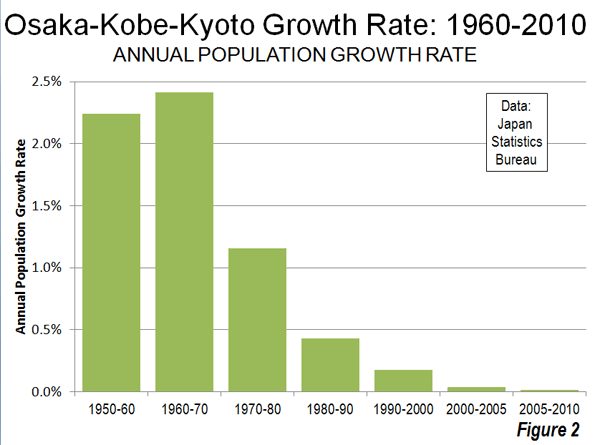
    As it turned out, the 1970s represented the conclusion of Osaka’s strong growth. From then on, growth fell quickly and   has since virtually stopped. It  appears likely that Osaka-Kobe-Kyoto will become the world’s first megacity (over 10 million population) to fall into population decline (see  end note).

    According to the 2010 census, the metropolitan region’s population of approximately 18,500,000 barely grew, adding only 13,000 residents from 2005. This represents  an annual growth rate of 0.014%, a decline of 60% from its anemic  0.036% growth rate between 2000 and 2005 (Figure 2).
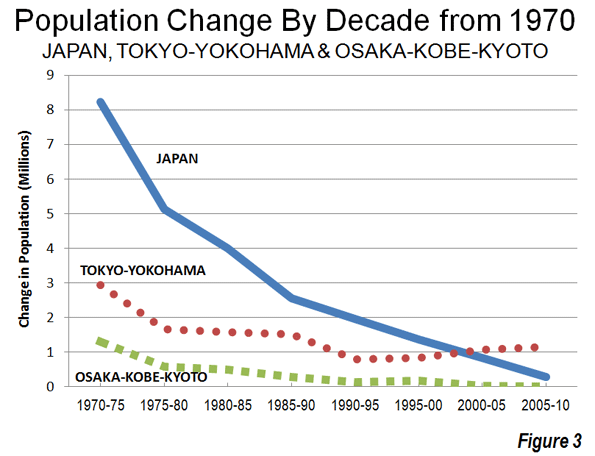
    Osaka-Kobe-Kyoto’s is falling behind even Japan’s slow growth pace, being 2005 to 2010 expanding by  less than one third of the national rate. One reason for this lies in continued concentration in the Tokyo metropolitan region (Figure 3). The Tokyo area captured 56% of the growth between 1970 and at 2010. Over the past five years Tokyo has added 1.1 million people, while the balance of the nation lost 1.4 million people. Japan’s population has stabilized and is expected to fall into decline in the years to come.
    Suburban Expansion

    As is typical of major metropolitan regions in the world virtually all of the growth in Osaka-Kobe-Kyoto since 1950 has been outside the historically core municipalities. Only 150,000 of the 6,250,000 population increase from 1950 to 2010 was in the municipalities of Osaka, Kobe or Kyoto. The suburbs accounted for nearly 98% of the region’s growth.

    As growth came to a virtual stop, however, the historical core municipalities have done better. Between 2000 and 2010, the municipalities of Osaka, Kobe and Kyoto had added 125,000 people, while suburban areas lost 79,000. The net result was a 46,000 population increase between 2000 and 2010 (Table).

    Osaka-Kobe-Kyoto Metropolitan Region
    Population Trend: 1920-2010
    Historical Core Municipalities
    Year Osaka Kobe Kyoto Total Suburban Region
    1920 1,253 609 591 2,453 4,289 6,742
    1930 2,114 765 788 3,667 4,668 8,335
    1940 3,252 1,090 967 5,309 5,056 10,365
    1950 1,956 765 1,102 3,823 5,941 9,764
    1960 3,012 1,114 1,285 5,411 6,774 12,185
    1970 2,980 1,289 1,419 5,688 9,780 15,468
    1980 2,648 1,367 1,473 5,488 11,866 17,354
    1990 2,623 1,477 1,461 5,561 12,556 18,117
    2000 2,599 1,494 1,468 5,560 12,883 18,443
    2005 2,629 1,525 1,475 5,629 12,847 18,476
    2010 2,666 1,545 1,474 5,685 12,804 18,489
    In 000s
    Data from Census of Japan


    Transport in Osaka-Kobe-Kyoto

    With its high density, Osaka-Kobe-Kyoto has a high level of traffic congestion. Osaka-Kobe-Kyoto ranks 19th highest road traffic density out of more than 90 urban areas for which data is available in the Millennium Cities database. This traffic density is despite the fact that Osaka-Kobe-Kyoto has the highest mass transit market share of any high-income world megacity outside Tokyo. In 2007, 57 percent of trips in the metropolitan region were by mass transit, compared to Tokyo’s 65 percent. By comparison, mass transit’s market share is approximately 30 percent in the Paris region and 10 percent in greater New York. The annual number of transit trips in Osaka-Kobe-Kyoto alone is more than one-half the total US ridership, despite having a population only 6% of the US.

    However, lest any conclude that Osaka-Kobe-Kyoto (or Tokyo) might be a model for US or European metropolitan areas, it must be noted that transit’s market share has dropped from 80 percent in the late 1980s.   Osaka-Kobe-Kyoto (as well as Tokyo and Nagoya) also demonstrate the "mass transit cannot be profitable" claim is a myth. In each of these three metropolitan areas, the vast majority of transit travel is on profitable private suburban railways.

    Osaka-Kobe-Kyoto: The Future?

    Very few large metropolitan areas have experienced population declines, and none with the vast scale and historic importance of Osaka-Kobe-Kyoto. Smaller metropolitan areas like Pittsburgh, Cleveland, Liverpool, Manchester and Genoa have stagnated and even experienced periods of population decline. But none have faced a future bleaker  than likely for Osaka-Kobe-Kyoto. United Nations population projections indicate that Japan will decline in population by 20 percent between 2010 and 2050. As the nation’s economic activity continues to centralize in Tokyo, this could be particularly be ominous for Osaka-Kobe-Kyoto. The trains could get less crowded.

    Wendell Cox is a Visiting Professor, Conservatoire National des Arts et Metiers, Paris and the author of “War on the Dream: How Anti-Sprawl Policy Threatens the Quality of Life

    —–

    Note: New York is reputed to have become the first megacity in the world in the 1920s. As late as 1980, there were only five urban areas in the world with more than 10 million residents. In 2010 there were 25 megacities.


    Photo: Himeji Castle, Kobe Prefecture. By Jean Love

  • Inequality and Economic Growth

    There has been news and conversation about economic inequality and economic growth lately, mostly because the former is increasing steadily and the latter has been less than stellar.

    Of course, there is always a tension between economic growth and equality.  Economic growth implies at least some inequality.  That’s because most people need incentives to create things people value.  They need a reward.  Creating perfect equality necessarily eliminates incentives.

    The reward for innovation or effort doesn’t have to be the full value of an innovation or effort.  The person who invented the wheel did not collect the present value of the innovation.  Similarly, Bill Gates, rich as he is, or the late Steve Jobs, or George Mitchell, the man who helped developed “fracking” did not collect the full value of their innovations.  The fact that people voluntarily agree to pay income taxes demonstrates that they don’t have to consume the full value of their effort.  So, there is room for some redistribution.

    Still, there has to be some reward, some incentives to work or innovate.  That incentive naturally will create inequality. 

    Call incentive the supply side.  If there is a supply side, there must be a demand side.  There is, and that comes from people, but it is not what you might think.

    Economic theory is based on the concept that people are happier when they consume more or better products.  That turns out to not be true.  People are no happier than they were 100 years ago, and we consume a lot more than our great-great grandparents.

    The fact is that since the 1950s in America, and now in many parts of the world, people have been free of the worst Malthusian constraints.  We have plenty to eat and on some measures we don’t really need any more.  Especially with current low birth rates, not just in advanced countries but also in much of the developing world, consumption growth is unnecessary. 

    So, why do we need economic growth?

    We need economic growth because people need more than consumption.

    The great cartoonist Al Cap, the creator of Li’l Abner, understood this.  Li’l Abner, his wife Daisy Mae, and the other residents of Dogpatch sometimes benefitted from the presence of a creature called a Shmoo.  Shmoos bred prolifically, and could create or serve as anything humans wanted.  They were perfectly happy, ecstatic in fact, to be dinner.  With Schmoos around, all human consumption needs were fulfilled, with no effort on the part of the humans.  It didn’t work out so well.  The Shmoos were eventually killed by extermination teams to save humanity and the economy, except for two saved by Li’l Abner and returned to repopulate the Valley of the Shmoon.

    We have similar real-world examples, and it doesn’t work out so well here either.  It turns out that when all consumption needs are provided with little or no effort on the part of the recipient, something is lost.  Drug and alcohol abuse abounds in these populations.  Traditional families are destroyed.  Crime is high.  Violence, including domestic violence, is high.  Morals are abandoned.   Relationships are fluid, frequently violent, and always temporary.  Health is poor, even when healthcare is provided.

    It turns out that when people are provided everything they need, self-destructive behavior is the norm.  It’s almost as if they have no reason to live, and it is a terrible price to pay for consumption. 

    It turns out that a job costs less than dependency, and that’s why we need economic growth.  Jobs and opportunity provide us with some things that consumption can’t.  I think those are pride, dignity, and purpose.

    That doesn’t mean we should abandon the effort to provide a safety net.  People are different, and few of us would be comfortable with the how the least endowed would live without a safety net.  It is also true that the gods of chance can be cruel to even the most capable.  Most of us would like to see some protection provided the unlucky.

    A safety net reduces inequality, and is redistributive.  The trick is to maintain incentives.

    If we are to offer people jobs and opportunity, and we must, we need economic growth.  To realize economic growth, we need to maintain incentives for the most productive and innovative.  Punitive marginal tax rates are counterproductive.

    How support is delivered to the recipients is also extraordinarily important.  The incentive issue should be paramount.  We owe it to the recipients to provide the support in a manner that preserves dignity and pride and always provides a healthy incentive to work.  Far too many existing programs have effective marginal tax rates near, at, or exceeding 100 percent.  This easily happens on means-tested programs, where the next dollar in income could cost the benefit plus the taxes on the new income.  Here’s a quote from a report by the Employment Policies Institute:

    “As an example, in states with ostensibly generous welfare benefits, Professor Shaviro shows that a single mother with two children could increase her earned income from $10,000 per year to $25,000 per year and actually find herself with 2,540 fewer dollars once she accounts for lost tax credits and benefits. Though her earned income more than doubles, she is worse off financially.” 

    It makes no sense to have 100 percent marginal tax rates on high-income individuals.  It makes even less sense to have 100 percent effective marginal tax rates on the least advantaged.

    Bill Watkins is a professor at California Lutheran University and runs the Center for Economic Research and Forecasting, which can be found at clucerf.org

  • New US Urban Area Data Released

    This morning the US Bureau of the Census released data for urban areas in the United States. The urban population of the US rose to 249.3 million in 2010, out of a total population of 308.7 million. Urbanization covered 106,000 square miles, representing 3.0 percent of the US land mass. Overall urban density was 2,342 per square mile (905 per square kilometer).

    The Los Angeles urban area was again the nation’s most dense, at 6,999 per square mile (2,702 per square kilometer), a slight reduction from the 7,068 figure (2,729 per square kilometer) in 2000. The most dense urban areas with more than 1,000,000 population were Los Angeles, San Francisco, San Jose, New York and Las Vegas (in that order).

    Overall, the 41 major urban areas had an average density of 3,245 per square mile (1,253 per square kilometer). The table below provides data for the major urban areas and overall data.

    United States Urban Area Data: 2010 Census
    Major Urban Areas  & Summary
    Rank Urban Area
    Population
    Land Area (Square Miles)
    Density
    Density per Square KM
    1 New York–Newark, NY–NJ–CT
    18,351,295
    3,450
    5,319
    2,054
    2 Los Angeles–Long Beach–Anaheim, CA
    12,150,996
    1,736
    6,999
    2,702
    3 Chicago, IL–IN
    8,608,208
    2,443
    3,524
    1,361
    4 Miami, FL
    5,502,379
    1,239
    4,442
    1,715
    5 Philadelphia, PA–NJ–DE–MD
    5,441,567
    1,981
    2,746
    1,060
    6 Dallas–Fort Worth–Arlington, TX
    5,121,892
    1,779
    2,879
    1,112
    7 Houston, TX
    4,944,332
    1,660
    2,979
    1,150
    8 Washington, DC–VA–MD
    4,586,770
    1,322
    3,470
    1,340
    9 Atlanta, GA
    4,515,419
    2,645
    1,707
    659
    10 Boston, MA–NH–RI
    4,181,019
    1,873
    2,232
    862
    11 Detroit, MI
    3,734,090
    1,337
    2,793
    1,078
    12 Phoenix–Mesa, AZ
    3,629,114
    1,147
    3,165
    1,222
    13 San Francisco–Oakland, CA
    3,281,212
    524
    6,266
    2,419
    14 Seattle, WA
    3,059,393
    1,010
    3,028
    1,169
    15 San Diego, CA
    2,956,746
    732
    4,037
    1,559
    16 Minneapolis–St. Paul, MN–WI
    2,650,890
    1,022
    2,594
    1,002
    17 Tampa–St. Petersburg, FL
    2,441,770
    957
    2,552
    985
    18 Denver–Aurora, CO
    2,374,203
    668
    3,554
    1,372
    19 Baltimore, MD
    2,203,663
    717
    3,073
    1,187
    20 St. Louis, MO–IL
    2,150,706
    924
    2,329
    899
    21 Riverside–San Bernardino, CA
    1,932,666
    545
    3,546
    1,369
    22 Las Vegas–Henderson, NV
    1,886,011
    417
    4,525
    1,747
    23 Portland, OR–WA
    1,849,898
    524
    3,528
    1,362
    24 Cleveland, OH
    1,780,673
    772
    2,307
    891
    25 San Antonio, TX
    1,758,210
    597
    2,945
    1,137
    26 Pittsburgh, PA
    1,733,853
    905
    1,916
    740
    27 Sacramento, CA
    1,723,634
    471
    3,660
    1,413
    28 San Jose, CA
    1,664,496
    286
    5,820
    2,247
    29 Cincinnati, OH–KY–IN
    1,624,827
    788
    2,063
    796
    30 Kansas City, MO–KS
    1,519,417
    678
    2,242
    865
    31 Orlando, FL
    1,510,516
    598
    2,527
    976
    32 Indianapolis, IN
    1,487,483
    706
    2,108
    814
    33 Virginia Beach, VA
    1,439,666
    515
    2,793
    1,078
    34 Milwaukee, WI
    1,376,476
    546
    2,523
    974
    35 Columbus, OH
    1,368,035
    510
    2,680
    1,035
    36 Austin, TX
    1,362,416
    523
    2,605
    1,006
    37 Charlotte, NC–SC
    1,249,442
    741
    1,685
    651
    38 Providence, RI–MA
    1,190,956
    545
    2,185
    844
    39 Jacksonville, FL
    1,065,219
    530
    2,009
    775
    40 Memphis, TN–MS–AR
    1,060,061
    497
    2,132
    823
    41 Salt Lake City–West Valley City, UT
    1,021,243
    278
    3,675
    1,419
    Total
    133,490,862
    41,139
    3,245
    1,253
    Other Urban Areas
    115,762,409
    65,247
    1,774
    685
    Total Urban
    249,253,271
    106,386
    2,343
    905
    Rural
    59,492,267
    3,431,052
    17
    7
    Total Population
    308,745,538
    3,537,439
    87
    34
    Share Urban
    80.7%
    3.0%
  • The Great Reordering of the Urban Hierarchy

    A delegation from Chicago is in Brussels this week to sell the city as a tourist destination in advance of the forthcoming NATO Summit. A Phil Rosenthal column explains that the city has a long way to go:

    "I don’t think most people in the U.K.have any idea where Chicago is," said Rowan Bridge, a BBC Radio producer who last year spent six months based in Washington D.C. "Most people in England think the United States consists of three cities — New York, Washington D.C., and Los Angeles — because they’re the ones that run the media, they’re the ones where the celebrities hang out, they’re the ones where the politicians are."

    Rosenthal notes that Chicago has long worried about its image, and it has never been a top global tourist destination, but a recent drop in international visitors highlights the challenge even a colossus like Chicago faces in getting its word out in a competitive global economy.

    Reading this, it once again strikes me that the old urban hierarchy is being reordered by globalization and the dramatic expansion of the US federal government, to the disadvantage of Chicago and other cities. This, I believe, helps account for its recent struggle.

    Joel Kotkin has tirelessly documented the remorseless rise of Washington, DC, rain or shine, in a manner defiant of business cycles. Washington, once a sort of commercial backwater, is now becoming much more a national capital of the type other countries have had.

    Meanwhile, back in the "spiky world," the peaks thrive while the valleys suffer. But it is the highest peaks that thrive most of all. Hence we’ve seen the emergence of a robust NYC post-9/11. It seems to have become if anything more the center of the universe, a huge financial center, media center, fashion center, cultural center, etc. – and adding to it new strength such as its emergence as America’s #2 tech startup location after Silicon Valley. New York is at an all time population high and even withing about 60,000 jobs of its all time peak employment.

    So we have New York entrenched as America’s first city, and Washington, DC increasingly its new "Second City." Los Angeles, which seems to have never quite recovered from the early 90s defense draw down, and Chicago with its 2000s malaise, seem to be the victims of DC’s rise. Another loser is Boston, which has seen its status as a financial hub decline and whose Route 128 corridor of tech, having first lost out to Silicon Valley, now appears to be losing out to NYC.

    Second tier cities in developed countries may indeed suffer as globalization proceeds. Zipf’s Law has historically governed the hierarchy of urban population (and thus proxied for overall urban importance) within particular geographies. Richard Florida and his colleagues showed that Zipf’s Law does not apply on a global basis, possibly because of the difficulty of migration between countries.

    But many other migration type barriers have declined over time, and it’s easy to conceptualize that many types of activities that once operated largely in purely domestic hierarchies now complete in global ones. If true, this would suggest that some cities, like LA, Chicago, and Boston, which ranked high in a national hierarchy might be pretty far down the list in a global one. Those cities with the greatest advantages of talent, high end specializations, and the greatest global connections would be best positioned to succeed in making the transition. We can also note the rise of new cities of importance in the BRIC counties, the Middle East, and other parts of the "developing world" that would bring new competition to traditional developed world power players, particularly for those that were already secondary centers in their own country.

    To see this playing out, contrast the differing life histories of Chicago and Hong Kong, which were effectively founded at the same time.

    I would describe this as a mix of observation and hypothesis at this point, but would love to see more formal analysis. And of course we’ll see how the trends play out. Even if true, we may not be at the end of this Great Reordering. With Washington continuing to soar, we are seeing shifts in the balance of power even with New York, such as the increasing importance of Washington as a media center. Though the inexorable mathematical logic of the budget may crimp Washington at some point, it’s certainly not impossible that some time in the future it may take its place as a London-like truly dominant national capital.

    Aaron M. Renn is an independent writer on urban affairs based in the Midwest. His writings appear at The Urbanophile.

    Photo by Doug Siefken

  • The House Home Savings Built

    After doing his duty for the Navy in Washington D.C. during World War II, my father returned to Los Angeles, and my parents moved into the Talmadge Apartments between Western and Vermont. They’d been married for 17 years without having any children. So my father informally adopted his two nephews.

    Around 1949, those nephews, who were students at UCLA, threw a party at the apartment. It was apparently a night to remember. The management decided to not renew my father’s lease. Shortly after that, my father’s wife announced, after nearly two decades of a childless marriage, that she was with child. (Full disclosure: that child was none other than this writer.)

    So my dad leased a house facing the Wilshire Country Club in Hancock Park. Then, in 1959, he formed a corporation to buy a nearby Tudor house, hire domestics, and rent the house back to him with domestic services. This was the man who founded the largest savings and loan in America, who in those years probably enabled more Californians to become homeowners than anyone else. But he was technically a renter all his life. Those were the days of the 70-percent and 90-percent top tax brackets, and byzantine legal structures were common.

    In mid-century Los Angeles, anything on Wilshire Boulevard was considered more prestigious than anything on the side streets. On the eastern end near Lafayette Park was the Bullocks Wilshire department store. Several miles west were the Miracle Mile department stores, which had beautiful shop windows facing the boulevard, even though most people entered the stores through portes-cochères in the rear. Many of the major liberal establishment churches—the PCUSA, the United Methodists, St. Basil’s Cathedral, and the Wilshire Boulevard Temple, Rabbi Magnin’s huge reform synagogue—lined the street. The Ambassador Hotel was one of the great hotels of the city. And then there was The Brown Derby Restaurant, which gave us the Cobb Salad.

    My father was originally from Omaha, Nebraska, but he moved west, graduating from the University of Southern California in 1927 and emerging from the Great Depression as a successful insurance underwriter. During the war, he heard talk among the military that Southern California was going to take off, so he bought a one-branch thrift downtown called Home Savings and Loan. Soon, it grew to be a multi-branched empire in four counties: Los Angeles, Orange, San Bernardino, and Riverside.

    Partly to get involved in philanthropy and partly to set up an estate plan, my father set up The Ahmanson Foundation. The idea was that The Ahmanson Foundation, after my father’s death, would inherit and control the for-profit companies. This was a common legal arrangement at the time, offering a way for wealthy families to preserve more of the family fortune. (I recommend the novel God Bless You, Mr. Rosewater, by Kurt Vonnegut, for a sense of how it worked.)

    Apparently, my father wasn’t a full member of the downtown establishment, for he chose to base his business several miles west of the establishment thoroughfares of Flower and Figueroa. He recruited the artist Millard Sheets to design for him a corporate headquarters on the north side of Wilshire Boulevard, between Serrano and Oxford Streets, in the early 1950s. Then he conceived of a fancier project for that site and hired Edward Durell Stone to design it. A model of it was in our house during my later high school years. It featured two buildings next to each other, with concave faces toward a courtyard. A third, taller building was to stand in back. But that part was never built.

    My father died suddenly on June 17, 1968, before ground was broken on the project. Fifteen months later, the U. S. Congress passed, and President Nixon signed, a bill called the Tax Reform Act of 1969. It rendered my father’s estate plan obsolete, for a non-profit foundation could no longer own a controlling interest in a for-profit corporation. Instead of remaining under the control of the The Ahmanson Foundation, Home Savings of America would have to go public. In the meantime, my father’s nephew Robert Ahmanson wound up overseeing construction on the pair of buildings. They were finished in 1973.

    The interest rate spike of the early ’80s was hard on Home Savings of America, and they sold off the Ahmanson Center on Wilshire at that time. Still, Home Savings coasted through the savings and loan crisis of the end of the ’80s, thanks to maintaining the conservative policies that my father had instituted.

    The area changed a lot in these years. After the Watts Riots of 1965, and in the 10 or 15 years after that, the upper and upper-middle classes of Pasadena, San Marino, Arcadia, and Hancock Park relocated en masse to the Newport Beach area in what I call the secessio patriciorum, or the secession of the patricians. Los Angeles Magazine featured an article in 1977 called “The Ripening of Orange County: Is It Stealing the L.A. Dream?” Indeed, a lot of the life seemed to get sucked out of Los Angeles at that time. One consequence of the secessio was that finance and retail and new construction tended to concentrate either downtown or west of central Beverly Hills. That left the Wilshire corridor in between down at the heels.

    Later, that part of Wilshire recovered and reinvented itself. New immigrants from Korea and Latin American countries moved in, and, for many years, such gentrification as took place in the area was done by these immigrants and not so much by white Anglos. After 1990, previously uncool areas like Pasadena, Santa Monica, and parts of downtown began to recover, and the Wilshire district became the heart of Koreatown. I now think of Los Angeles as being similar to San Francisco and Oakland. The West Side up to Hancock Park is like San Francisco, while the parts east of it are like Oakland and the East Bay. London and Berlin have the same sort of east-west-ness.

    Koreatown is a wonderful neighborhood, and the Ahmanson Center is still beautiful. But I can’t help feeling a touch of melancholy that my dad’s vision was never fulfilled. He’d hoped to make that part of Wilshire Boulevard one of the great financial and retail corridors of America. Today, the big players are concentrated downtown or in Beverly Hills and westward.

    If you walk up the Oxford Street side of the Ahmanson Center, you can see a travertine block with a Latin inscription. Translated, it says, “Robertus and Mauritius, two virtuous men, dedicate this stone to themselves.” Robertus is Robert Ahmanson, who supervised the construction of the center. Mauritius is Maurizio Bufalini, owner of a marble quarry in Carrara, Italy. Bufalini was a good friend of our family, and he provided the Italian and Greek marble that decorates the center. Both these men are “late,” as they say in Botswana English, meaning dead. The stone is dusty now, but the words can still be read. I wonder if anybody notices it, or wonders what it means.

    This piece first appeared at Zocalo Public Square.

  • The Leveraged Buyout of the GDR

    Until the European Central Bank purchased a call option on the future assets of the Greek government (which remains out-of-the-money), the largest leveraged buyout of a sovereign state had taken place in 1990, when the West German government acquired the German Democratic Republic (GDR), thought at the time to consist largely of liabilities. By most accounts the Bonn government paid over the odds for East Germany, estimated to have cost the West more than $1 trillion.

    The resulting peaceful unification of Germany has been one of the great achievements of postwar European integration. In recent months, Germany has faced the opportunity for another buy-out of a European neighbor, this time of Greece, but it has showed little appetite for the purchase. Does East Germany provide a model for the Greek bailout? ,

    To take stock of what the West Germans got for their investment, my son Charles, aged 16, and I recently biked around the principle cities of the East—Dresden, Leipzig, Weimar, Potsdam, and East Berlin—that for a long time fell on the dark side of the Iron Curtain.

    Berlin is unified and elegant, Dresden is a restored cultural monument, and Leipzig (where J.S. Bach lived) is a city of vast commercial and artistic ambitions. If our bike ride along the ragged edges of the Iron Curtain taught us anything, it was that the GDR was worth the money.

    To get to Dresden, we loaded the bikes onto an overnight express from Basel to Prague and slept until the train joined the River Elbe, historically the frontier between Western and Eastern Europe. In the last days of World War II, American and Russian armies met on its riverbanks at Torgau, just north of Dresden.

    At the end of the Cold War, the city synonymous with World War II fire bombings was a tired European backwater, with only a fraction of its royal splendors rebuilt and a trickle of Bulgarian tourists.

    Starting with the main railroad station in the early 1990s, the German government has transformed Dresden into a showroom for tourists and industry. The station is elegant and grand, a hybrid of the classical and the new, and Charles and I toured an ultramodern Volkswagen plant where the VW Phaeton, a bourgeois saloon car, is assembled largely by hand.

    We steered our bikes around the revived cathedral square, rolled past the elegant opera house, and wandered around the grounds of the royal palace. The city museum—like Kurt Vonnegut’s novel Slaughterhouse Five (a reference to his prisoner-of-war location, from which he witnessed the February 13, 1945 bombings)—tells how the city was engulfed in fireballs, the effect of detonating explosives detonated at an altitude of 2000 feet, which then sucked the air and life out of Dresden.

    To get to Leipzig, we biked northwest along the River Elbe, through industrial suburbs, apartment complexes, shopping centers, and finally a pristine landscape of orchards, villages, and river scenes. Only occasionally did we see the remnants of the GDR, the crumbling concrete so synonymous with the central committee’s five-year plans. Otherwise, the East has been gentrified.

    The 1989 revolution that brought down the Berlin Wall and the East German government started in Leipzig, with vigils in front of the Stasi headquarters and with larger rallies at the St. Nikolai Church.

    The Stasi building has been preserved as a memorial to its victims. The display cabinets are arranged around the offices of the secret police, complete with exhibits of wigs, tape recorders, phone taps, uniforms, typewriters, metal desks, maps, shoe phones, and devices suitable to steam open letters.

    Were its practices and legacies not alive and well in Homeland America, I would consign the Stasi to some dead-letter file, to be archived with Hitler’s SA in the dark nights of German history. The Stasi museum had the feel of an amateur theater production that had opened in East Germany and, after 9/11, moved to Broadway.

    From the museum director, I bought Anna Funder’s memoir of the GDR, Stasiland. She writes: “In Hitler’s Third Reich it is estimated that there was one Gestapo agent for every 2000 citizens, and in Stalin’s USSR there was one KGB agent for every 5830 people. In the GDR, there was one Stasi officer or informant for every sixty-three people.”

    In the U.S., the ratio of Homeland Security employees to the general population is one for every 1500 citizens.

    Weimar is the path not taken in German history—toward representative government and the celebration of intellectual enlightenment over what Bismarck called “iron and blood.”

    Charles and I found the assembly hall that lent its name to the post-World War I governments that were wiped away in the 1923 currency inflation. We rode to the houses of the poets Goethe and Schiller, each of whom found artistic freedom in the city that has the feel of a small university town, with libraries and parks. Nevertheless, the choreographers of Nazism and Communism arranged their own Weimar stage sets to tell the story that democracy leads to weakness, chaos and bankruptcy.

    Potsdam and East Berlin are monuments to vanished empires. Prussia’s Hohenzollern dynasty settled on Potsdam for its imperial palaces and amusements (one ballroom we saw is lined with thousands of seashells), and East Berlin was the people’s court of Stasiland.

    Funder writes of her visit to the condemned East German parliament: “Like so many things here, no one can decide whether to make the Palast der Republik into a memorial warning from the past, or to get rid of it altogether and go into the future unburdened of everything, except the risk of doing it all again.”

    Riding along the remnants of the Berlin Wall, which is preserved as an art gallery in several sections, I was curious about “ostalgie”—nostalgia for the simpler ways of the GDR, absent unified Germany’s cult of material ambition.

    Funder quotes a conversation about the Wall’s legacy: “It was an historical necessity. It was the most useful construction in all of German history! In European history…. Because it prevented imperialism from contaminating the east. It walled it in.”

    The highlight of the ride came between Leipzig and Weimar, where we spent much of our time exploring the Napoleonic battlefields of Jena and Auerstädt, where in 1806 France doomed Prussia to the fate of a second-rate European power until Bismarck redeemed the nation in the 1870 Franco-Prussian war.

    In tracking down the routes of Napoleon’s marshals, we rode through farm villages, towns, and small cities, many of which are rebuilding town squares or repainting important buildings—all part of the East German renovation. When Erich Honecker was the East German party chief, buildings were only painted up to the first floor, allegedly because that’s all he could see from the backseat of his limousine.

    It was just up the road in Leipzig where Napoleon lost his empire, in the 1813 Battle of Nations. It was perhaps the first attempt at a European Union. But Austria, England, Prussia, and Russia all decided that Napoleon was a nuisance on the continent, and sent him packing to Elba—even if they had to repeat the exercise at Waterloo.

    A similar coalition has tendered its offer to keep Greece in the grand alliance. Having East Germany in the money should give the EU confidence in its convictions, proof that it can be more cost effective to buy a nation than to put one through liquidation.

    Photo by Matthew Stevenson. Near Leipzig, formerly in East Germany, a railroad station that will soon be renovated.

    Matthew Stevenson is the author of Remembering the Twentieth Century Limited, a collection of historical essays. He lives in one of the wine regions of Switzerland. His next book is Whistle-Stopping America.
  • Addressing Workforce Shortages in the Dakotas

    While not immune to the recession, the upper Great Plains is in a different economic situation from the rest of the nation. Growth coupled with low unemployment means more strain on the region’s workforce, making it tougher for employers to find the workers they need. It’s not so much about jobs anymore, but about finding the right workers.

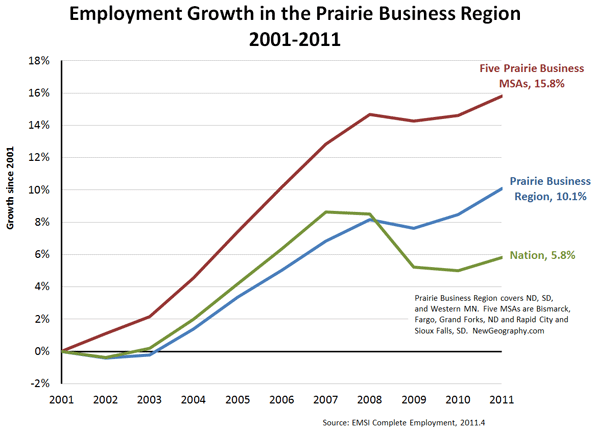
    Since 2008, the region covered by Prairie Business Magazine – North Dakota, South Dakota and western Minnesota – has grown its employment by 1.8 percent, compared to a loss of 2.5 percent across the country. In addition to that growth, North Dakota alone has 21,000 unfilled jobs.

    To determine some of the toughest jobs to fill in the region in the past year we used data compiled by EMSI, Inc., a model that includes a combination of over 90 state and federal sources and includes estimates of independent contractors and others. We looked at a number of metrics, including the number of openings in the region due to growth, retirements, and turnover; the number of openings compared to the total jobs in an occupation; and the regional concentration of a job here compared to the rest of the nation.

    The occupations are separated into five groups: construction, extraction, transportation and material moving; business, finance and office; heath care; science, mathematics, engineering and computer; and manufacturing occupations.

    The construction, resource extraction and transportation category is not surprisingly dominated by the ongoing energy boom in western North Dakota. Roustabouts lead the way with 917 new jobs and 979 total openings in the past year. Other oil-related jobs such as service unit operators (781 openings), derrick operators (511), rotary drill operators (479), extraction helpers (335) and wellhead pumpers (295) all have openings above 40 percent of its 2010 employment level. We read a lot about the stress on the labor force in that region, but the numbers are astounding.

    The overall leader in total job openings across the region is heavy truck drivers, with 1,973 openings from 2010-2011. The need is most acute in oil country, but the entire region has a 70 percent higher concentration of heavy truck drivers than the national average. Of the 152 counties in our analysis, 138 have a higher concentration of heavy truck drivers than the national average.

    The national media has credited the oil boom for the economic growth. The economic benefits of the energy boom have spread across the region, but there is more to the story. While the entire region trailed the nation in job growth until 2007, the region’s five largest metropolitan areas – Bismarck, Grand Forks, Fargo, Sioux Falls and Rapid City – were well ahead of the nation through the entire decade. Now containing 39 percent of the regional jobs, these five metropolitan areas beat the nation in job growth over the decade by 10 points, 15.8 to 5.8 percent.

    It’s not just growth in retail and food service jobs. Over the past decade the five metropolitan areas added 8,000 jobs in professional, technical, and scientific services, nearly 18,000 in health care, and 8,000 in finance, with each sector paying roughly $50,000 per year. The region also added 1,500 jobs at management offices and corporate headquarters making an average of $80,000 per year. It’s time that parents in our region stop telling their kids, “you need to leave the state to find a good job.” We need to improve efforts to help students and displaced workers understand the emerging options available in the region.

    The Prairie Business region has also become a growth center for science, math, engineering and computer occupations, adding nearly 18 percent to its technical workforce in the past decade, compared to just 3.6 percent growth in the rest of the nation. The growth rate in the five metropolitan areas was more than 27 percent. Some of the most in-demand jobs include industrial engineers (91 openings), mechanical engineers (87), geological engineers (52), petroleum engineers (50) and geoscientists (45). A new program for petroleum engineers at the University of North Dakota School of Engineering and Mines may help address the shortages in these fields.

    This strong growth in engineering and technical jobs is tempered somewhat because the region still lags the nation in these occupations. The biggest gaps are in bachelor’s degree level information technology and software fields, where the region trails the nation by 25 to 40 percent in many occupations. While the region’s high growth rates are encouraging, there is still plenty of ground to make up. At the same time the region is highly concentrated in many two year level technical jobs, creating a solid foundation for technical industries to build on.

    The region’s manufacturing economy was hit hardest by the recent recession, but was booming in the six years prior and is now recovering. In demand production occupations include welders (677 openings), assemblers (604), supervisors (194), machinists (156), computer-controlled machine tool operators (107), and engine assemblers (88).

    Across the region, 52 of the 152 counties hold an above average number of production jobs. Hot spots in the region include Jerauld, Yankton and Brookings counties in South Dakota; Roseau, Nobles and Kandiyohi in Minnesota; and Sargent and Richland in North Dakota.

    Workforce and economic development agencies, educators and trainers, and the business community need to continue to actively collaborate to share information and create partnerships across state lines. Private businesses must be open to working with training and placement agencies to communicate their needs, and regional governments must be open to creating more flexible funding sources for specialized training. Educational institutions are beginning to use the ample labor market data available to tailor programs to fit the need of the region’s economy.

    Ultimately, the talent narrative in the region needs to shift away from “retaining our young people” towards recruitment of young families. Demographic data confirms the greatest shortage across the region is those age 35 – 44, and employers are reporting troubles recruiting mid-career professionals. Migration data shows that the net loss from North and South Dakota to the Minneapolis region has stopped in the past two years. The Prairie Business region is showing signs of turning the economic and demographic corner. It is now time to act to sustain the region’s long-term future.

    This piece originally appeared in Prairie Business Magazine.

    Mark Schill is Vice President of Research at Praxis Strategy Group, an economic development and research firm working with communities and states to improve their economies. He is Managing Editor of NewGeography.

    Fargo photo by David Kohlmeyer.

  • The Evolving Urban Form: Ho Chi Minh City (Saigon)

    Vietnam may be the next China. With a nominally communist government, Vietnam has liberalized its markets and is prospering from an increased reliance on exports. Vietnam’s gross domestic product per capita is still only about $3000, but has been among the faster growing economies over the past 10 years. Vietnam is well positioned to capture any growth that might be diverted from China’s east coast urban areas as labor costs there rise and concerns increase about the influence of that country’s powerful state-owned corporations.

    Political power in Vietnam may lie in Hanoi, but the economic heart of Vietnam is Ho Chi Minh City, the former Saigon. Ho Chi Minh City is the core of Viet Nam’s largest urban area, which is headed toward a population of 9 million, including exurban areas beyond the municipal boundaries.

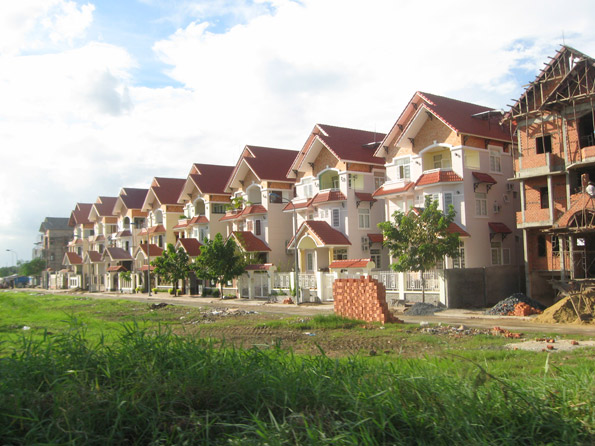
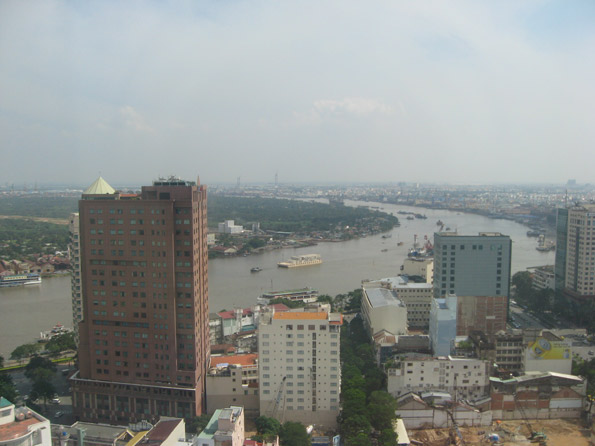
    For planning purposes, the area has been divided into five subregions. The urban development trends in the Ho Chi Minh City area are similar to those of high income world urban areas. The core is experiencing little or no population growth, while peripheral areas are growing much more strongly (Photo: Core and Saigon River).


    Core and Saigon River

    Suburbanizing Ho Chi Minh City: Historical data for the districts of Ho Chi Minh City are difficult to obtain. However, the last five years provide a representative view of urban development trends, especially when combined with population projections through 2025 as reported in transportation planning documentation from the Ho Chi Minh City master plan.

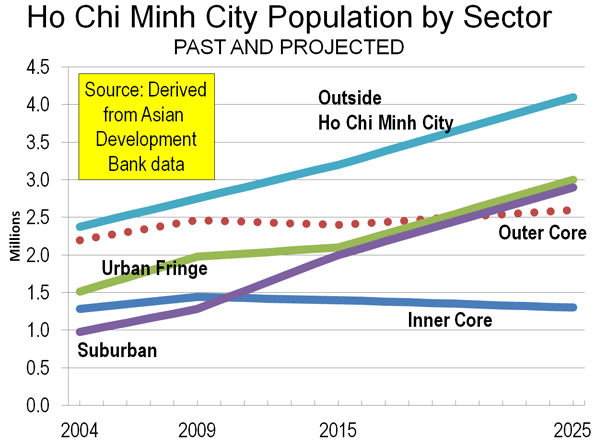
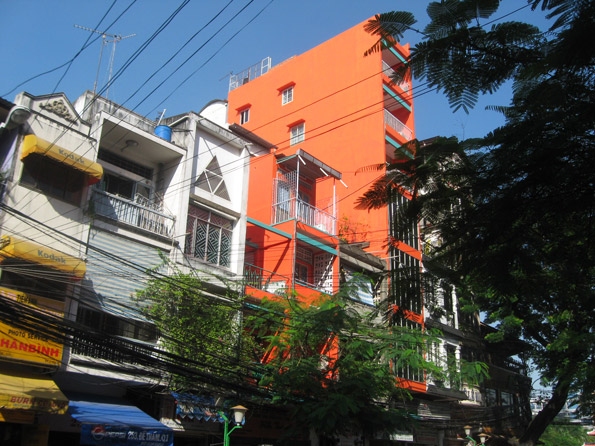
    The inner core area has a population of approximately 1.4 million, with little growth expected, and is expected to decline in population by 2025. At the same time, the inner core is particularly dense, with more than 100,000 residents per square mile or 40,000 residents per square kilometer. This is approximately 1.5 times as dense as Manhattan or the ville de Paris. By 2025, the inner core will decline further to a population of 1.3 million. One unusual distinguishing characteristic of the core is very thin buildings, the result of taxation based upon building width (Photo: Tax induced thin buildings)


    Tax induced thin buildings

    Growth is stronger, but still limited in the outer core area (adjacent to the core, but differentiated because of its lower density). Over the past five years, the outer core grew from approximately 2.2 million to 2.5 million, which is strong growth in most high income world urban areas but not as notable for a rapidly growing urban area in the developing world. This growth is expected to moderate even further by 2025, when the population is expected to reach only 2.6 million. The population density in the outer core area is 60,000 per square mile or 23,000 per square kilometer.

    In contrast, almost all  the growth is expected outside the core, with both less formal development and very attractive housing (Photo: New suburban housing).


    New suburban housing

    The urban fringe areas, or the second ring of development beyond the inner core grew from 1.5 million in 2004 to 2.0 million in 2009, a 31% growth rate. By 2025, the urban fringe is projected in transportation planning documentation to grow to 3.0 million. The population density of the urban fringe is 14,500 per square mile or 5,500 per square kilometer, nearly as dense as the city (municipality) of San Francisco.

    The suburban areas within the municipality of Ho Chi Minh City grew from 1.0 million in 2004 to 1.3 million in 2009, again approximately a 30% growth rate. By 2025, the suburban areas are expected to experience the greatest growth, adding 1.6 million population, rising to 2.9 million residents.

    Comparable data for the exurban areas outside the Ho Chi Minh City municipality are not as readily available. However, it is projected that from 2007 to 2025 the population in these areas will rise from 2.6 million to 4.1 million.

    Overall, the municipality grew from 6.1 million population in 2004 7.2 million in 2009, for an 18% growth rate. Including the municipality and the exurbs, it is expected that there will be an increase from 9.1 million population in 2007 to 13.9 million in 2025. At least 95% of this growth is expected to be outside two core areas (Figure 1).

    Employment growth is also projected to be dominated by areas outside the two core areas. Between 2007 and 2025, it is expected that 80% of the new employment will be in peripheral areas.

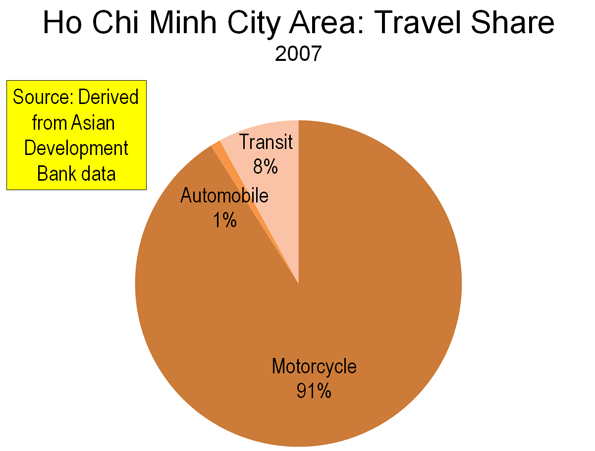
    Building a Metro: Ho Chi Minh City may have the highest personal transportation market share outside North America. The personal vehicle (motorcycle and car) share of travel is 92%, leaving just 8% for transit (one estimate indicates an even lower 5%). Most of this travel by motorcycle, which sometimes carry three or more people.  As Ho Chi Minh City becomes more prosperous, the share of travel by automobile will likely increase. Automobile ownership is rising at 20 percent annually, more than twice the rate for motorcycle ownership.

    The government would like to change this pattern and has embarked on building a Metro in hopes of increasing transit’s market share to between 40% and 50% by 2025. This huge capital investment will be largely limited to feed and serve the core areas that will account for virtually none of the population increase and little of the new employment.

    There is no precedent for an increase in transit usage remotely of the magnitude that is sought in Ho Chi Minh City. In fact, consultants for the Asian Development Bank were so concerned that they provided an alternative projection for the system, indicating a 2025 transit market share of 22%, instead of the official goal of 40% to 50%. The consultants indicated:

    As noted earlier, the above demand models were adjusted to reflect the Government “policy” objective of achieving 40-50% PT mode share by 2025. This will entail a massive shift in travel behaviour and introduction of some very strong transport and policy initiatives. Clearly there is a risk that this may not happen as quickly or to the extent targeted. Therefore forecasts were developed for a “trend” scenario – still based on major PT transport improvements and strong policy initiatives, but with parameter values based on the consultants’ experience of what has been achieved in other cities.

    However, virtually tripling transit’s market share to 22% seems little less doubtful than increasing it to 40% to 50%. The consultant provided no examples to indicate that such an increase had "been achieved in other cities."

    Personal Mobility in Ho Chi Minh City: One of the challenges for a pedestrians in Ho Chi Minh City – like Hanoi – is dodging the swarm of motorcycles in crossing streets. Even with the Metro, more and more will buy motorcycles and cars. Traffic congestion is likely to worsen. This is principally because, even in congested urban areas, door to door travel tends to be more rapid by personal modes than by transit.

    Fortunately, the authorities are allowing the urbanization to expand, which will limit the growth of traffic congestion. They would do well to follow the advice of urban planners like Shlomo Angel (of New York University and Princeton University), who recommends building a grid of arterials streets to accommodate the growth on lower cost peripheral lands.   Strategies such as these provide Ho Chi Minh City the potential to suburbanize gracefully, maintain its high level of personal mobility and contribute substantially to its continued economic progress.

    Wendell Cox is a Visiting Professor, Conservatoire National des Arts et Metiers, Paris and the author of “War on the Dream: How Anti-Sprawl Policy Threatens the Quality of Life

    Top photo: Typical transport in Ho Chi Minh City

    All photos by author

  • Data Spotlight: Ranking States by Their Dependence on Manufacturing

    A recent Brookings paper makes a clear case from the start: “Manufacturing matters to the United States …” Other economists and econ bloggers aren’t so sure.

    What’s clear, however, is certain states (think Indiana, Wisconsin, and Arkansas) depend on manufacturing to fuel their economies more than others. One way to measure just how dependent states are on manufacturing – rather than simply looking at total jobs or exports – is by looking at a common concentration measure known as location quotient (LQ).

    Here is an overview of the 10 states most dependent on manufacturing, with the top five subsectors for each based on their concentration compared to the nation. (We also have data on all 50 states and Washington, D.C. below.) A location quotient of 1.00 is the national average, and an LQ of 1.20 and above indicates the industry is specialized in the state.

    Industries with a high LQ are typically (but not always) export-oriented industries, which are important because they bring money into the region, rather than simply circulating money that is already in the region (as most retail stores and restaurants do). Industries that have both high LQ and relatively high total job numbers typically form a region’s economic base. Economic developers and government officials need to pay particular attention to these industries not only for the jobs they provide, but also for their multiplier effect – the jobs they create in other dependent industries like retail trade and food services.

    As you scan through this list, also pay attention to industries with rapidly declining or growing LQs. For example, Michigan’s concentration in auto manufacturing declined 15% from 2001 to 2011 (not a good sign because it’s the second-largest manufacturing industry in the state and employment has plummeted). On the flip side, Alabama’s concentration in auto manufacturing grew more than 466% in the last decade, indicating that the state is now taking up a much larger share of national employment (third most among states, up from 14th in ’01). Keep in mind that growing employment paired with declining LQ indicates that the industry is not growing as fast in the state as it is in the national economy.

    Note: All 2011 jobs and LQ figures are estimates because of lags in federal and state data sources. The numbers cited come from EMSI’s 2011.4 Covered Employment dataset.

    1. Indiana (LQ: 1.86; 2001-11 Job Change: -26%)

    Indiana is 86% more concentrated in manufacturing than average and just nudges Wisconsin for the top spot in our analysis. Auto manufacturing, with an LQ of 10.79 (or almost 11 times more concentrated in the state that nationally), is a big reason why. Iron and steel mills (9.94) and engine, turbine and power transmission equipment manufacturing (5.27) also factor prominently on our list.

    NAICS Code Industry 2011 Jobs 2011 Average Earnings 2001 LQ 2011 LQ LQ % Change
    3362 Motor Vehicle Body and Trailer Manufacturing 25,555 $48,295 8.22 10.79 31.3%
    3311 Iron and Steel Mills and Ferroalloy Manufacturing 18,766 $85,497 9.79 9.94 1.5%
    3336 Engine, Turbine, and Power Transmission Equipment Manufacturing 10,539 $85,387 5.49 5.27 -4.0%
    3363 Motor Vehicle Parts Manufacturing 47,592 $55,973 5.09 5.25 3.1%
    3325 Hardware Manufacturing 2,304 $61,647 3.84 4.50 17.2%

    2. Wisconsin (LQ: 1.85; 2001-11 Job Change: -21%)

    Wisconsin is significantly more concentrated in manufacturing than the next state on the list, Iowa. Leading the way are other transportation equipment manufacturing (7.15) and dairy product manufacturing (6.24), the latter of which is certainly not a surprise to see high on this list. Notice the big increase in foundries (5.83, up 26.5%) compared to the nation, and the substantial decline in pulp and paper mills (5.82, an 17.6% decline).

    NAICS Code Industry 2011 Jobs 2011 Average Earnings 2001 LQ 2011 LQ LQ % Change
    3369 Other Transportation Equipment Manufacturing 4,905 $86,543 7.78 7.15 -8.1%
    3115 Dairy Product Manufacturing 16,749 $45,295 6.02 6.24 3.7%
    3315 Foundries 14,157 $51,783 4.61 5.83 26.5%
    3221 Pulp, Paper, and Paperboard Mills 13,353 $64,630 7.06 5.82 -17.6%
    3353 Electrical Equipment Manufacturing 13,729 $71,270 4.62 4.86 5.2%

    3. Iowa (LQ: 1.55; 2001-11 Job Change: -15%)

    Like the two states above it, Iowa has seen a marked increased in manufacturing concentration over the last decade (see the state-by-state table below). Only a few states, in fact, have grown more in concentration percentage since 2001 than Iowa. The most concentrated manufacturing subsectors are related to agriculture (grain and oilseed milling) and animal food or slaughtering. Household appliance manufacturing, meanwhile, has dropped precipitously in concentration, at least partly because of the loss of Maytag in Newton.

    NAICS Code Industry 2011 Jobs 2011 Average Earnings 2001 LQ 2011 LQ LQ % Change
    3112 Grain and Oilseed Milling 6,664 $68,252 9.58 10.09 5.3%
    3331 Agriculture, Construction, and Mining Machinery Manufacturing 20,157 $66,849 7.80 8.34 6.9%
    3111 Animal Food Manufacturing 3,219 $58,734 5.20 5.52 6.2%
    3116 Animal Slaughtering and Processing 28,599 $37,843 4.95 5.23 5.7%
    3352 Household Appliance Manufacturing 3,388 $36,761 7.07 5.05 -28.6%

    4. Arkansas (LQ: 1.51; 2001-11 Job Change: -30%)

    Arkansas has lost nearly a third of its manufacturing employment base in the last decade, and it’s the top state in the top four of our list to see its concentration retreat during that time. Nearly one in out of every five manufacturing job in Arkansas is classified under animal slaughtering and processing (7.01 LQ), an industry that was more concentrated in the state 10 years ago.

    NAICS Code Industry 2011 Jobs 2011 Average Earnings 2001 LQ 2011 LQ LQ % Change
    3162 Footwear Manufacturing 1,182 $25,910 8.37 9.65 15.3%
    3116 Animal Slaughtering and Processing 30,480 $27,262 7.88 7.01 -11.0%
    3211 Sawmills and Wood Preservation 3,941 $35,606 5.93 5.34 -9.9%
    3112 Grain and Oilseed Milling 2,333 $41,828 4.40 4.44 0.9%
    3212 Veneer, Plywood, and Engineered Wood Product Manufacturing 2,398 $44,969 3.23 4.32 33.7%

    5. Michigan (LQ: 1.46; 2001-11 Job Change: -39%)

    No state in the country has lost the largest a bigger percentage of manufacturing jobs than Michigan since 2001. That’s no surprise. Nor is the fact that the most-concentrated industries in the state (and the ones that have seen the biggest drops in concentration) are related to car manufacturing.

    NAICS Code Industry 2011 Jobs 2011 Average Earnings 2001 LQ 2011 LQ LQ % Change
    3361 Motor Vehicle Manufacturing 37,171 $96,951 9.51 8.06 -15.2%
    3363 Motor Vehicle Parts Manufacturing 90,140 $70,296 7.77 7.10 -8.6%
    3335 Metalworking Machinery Manufacturing 31,170 $61,097 5.80 6.52 12.4%
    3372 Office Furniture (including Fixtures) Manufacturing 14,435 $54,897 4.73 5.14 8.7%
    3328 Coating, Engraving, Heat Treating, and Allied Activities 12,445 $44,369 3.20 3.30 3.1%

    6. Alabama (LQ: 1.45; 2001-11 Job Change: -27%)

    Alabama is in the top 10 of our list largely because apparel/textile manufacturing, a subsector that’s taken a mammoth hit over the past decade but is still heavily concentrated in Alabama and other Southern states. Also notice motor vehicle manufacturing, which had a relatively small presence in 2001 (3,400 jobs) but has since become a big player in the state (10,400 jobs in 2011, 466% increase in LQ).

    NAICS Code Name 2011 Jobs 2011 Average Earnings 2001 LQ 2011 LQ LQ % Change
    3151 Apparel Knitting Mills 2,630 $27,506 13.15 10.32 -21.5%
    3131 Fiber, Yarn, and Thread Mills 3,420 $34,075 6.74 8.15 20.9%
    3346 Manufacturing and Reproducing Magnetic and Optical Media 2,296 $40,704 3.88 6.51 67.8%
    3221 Pulp, Paper, and Paperboard Mills 8,754 $85,485 4.81 5.56 15.6%
    3361 Motor Vehicle Manufacturing 10,404 $73,961 0.83 4.70 466.3%

    7. Ohio (LQ: 1.41; 2001-11 Job Change: -34%)

    Ohio has the third most manufacturing jobs of any state and has actually expanded slightly since 2010. The rest of the previous decade, however, was filled with heavy job loss. Household appliance manufacturing (4.12) is the most concentrated subsector in the state; it grew 3.1% from 2009 to 2011.

    NAICS Code Industry 2011 Jobs 2011 Average Earnings 2001 LQ 2011 LQ LQ % Change
    3352 Household Appliance Manufacturing 9,435 $41,793 3.45 4.12 19.4%
    3312 Steel Product Manufacturing from Purchased Steel 7,852 $56,654 4.31 3.69 -14.4%
    3363 Motor Vehicle Parts Manufacturing 56,185 $58,032 3.27 3.39 3.7%
    3335 Metalworking Machinery Manufacturing 19,972 $52,477 3.04 3.19 4.9%
    3361 Motor Vehicle Manufacturing 19,153 $74,595 3.16 3.18 0.6%

    8 (tie). Kansas (LQ: 1.35; 2001-11 Job Change: -17%)

    In terms of overall jobs and concentration, no manufacturing industry means more to Kansas than aerospace product and parts manufacturing. But the industry’s presence has already started to wane (27% decrease in LQ since 2001), and the decline will escalate with Boeing’s departure from Wichita by 2013.

    NAICS Code Name 2011 Jobs 2011 Average Earnings 2001 LQ 2011 LQ LQ % Change
    3364 Aerospace Product and Parts Manufacturing 32,443 $73,447 9.09 6.58 -27.6%
    3111 Animal Food Manufacturing 3,065 $51,185 4.18 5.79 38.5%
    3159 Apparel Accessories and Other Apparel Manufacturing 597 $45,359 0.22 4.39 1895.5%
    3116 Animal Slaughtering and Processing 17,830 $38,746 3.54 3.59 1.4%
    3342 Communications Equipment Manufacturing 3,768 $63,272 1.03 3.16 206.8%

    8 (tie). Mississippi (LQ: 1.35; 2001-11 Job Change: -33%)

    With a huge ship and boat building presence (13.60 LQ), Mississippi slips into the top 10 of our list. But its overall manufacturing concentration is declining (see large state table below) and the state lost 33% of its manufacturing jobs from 2001 to 2011.

    NAICS Code Industry 2011 Jobs 2011 Average Earnings 2001 LQ 2011 LQ LQ % Change
    3366 Ship and Boat Building 14,444 $62,441 10.11 13.6 34.5%
    3117 Seafood Product Preparation and Packaging 2,593 $22,329 10.59 8.37 -21.0%
    3371 Household and Institutional Furniture and Kitchen Cabinet Manufacturing 15,611 $29,742 6.66 8.35 25.4%
    3211 Sawmills and Wood Preservation 4,001 $36,627 6.06 5.71 -5.8%
    3212 Veneer, Plywood, and Engineered Wood Product Manufacturing 2,227 $41,643 3.76 4.22 12.2%

    10. Kentucky (LQ: 1.33; 2001-11 Job Change: -27%)

    Aluminum production/processing and motor vehicle manufacturing are the top two concentrated manufacturing industries in Kentucky. In terms of jobs, auto parts manufacturing is easily the largest (24,000-plus jobs).

    NAICS Code Industry 2011 Jobs 2011 Average Earnings 2001 LQ 2011 LQ LQ % Change
    3313 Alumina and Aluminum Production and Processing 4,739 $62,568 3.91 6.07 55.2%
    3361 Motor Vehicle Manufacturing 11,997 $77,590 5.32 5.54 4.1%
    3122 Tobacco Manufacturing 1,115 $46,030 3.84 5.07 32.0%
    3352 Household Appliance Manufacturing 4,105 $70,294 3.47 5.00 44.1%
    3363 Motor Vehicle Parts Manufacturing 24,292 $44,799 3.07 4.08 32.9%

    Other Notable States

    We should mention that several other states rely on manufacturing to drive their economy – even if they don’t show up in our top 10. For example, Pennsylvania has a sizable advanced manufacturing presence, and Nebraska is also focusing on light and advanced manufacturing, particularly in producing plastic products.

    Manufacturing numbers for each state and Washington, D.C. are included below. Three Southern states – South Carolina, Tennessee, and North Carolina – didn’t make the above list but sit between 11 and 15 on our list.

    Notice that Alaska is the only state in which manufacturing grew in the last decade. Despite the 7% increase, Alaska still is in the bottom 10 in terms of concentration.

    Ranking (by 2011 LQ) State 2011 Manufacturing Jobs 2001-11 % Job Change 2001 Job Concentration (LQ) 2011 Job Concentration (LQ) 2001-11 LQ % Change
    Source: EMSI Covered Employment (2011.4)
    1 Indiana 454,542 -26% 1.70 1.86 9.4%
    2 Wisconsin 444,824 -21% 1.64 1.85 12.8%
    3 Iowa 204,560 -15% 1.33 1.55 16.5%
    4 Arkansas 157,813 -30% 1.58 1.51 -4.4%
    5 Michigan 499,462 -39% 1.47 1.46 -0.7%
    6 Alabama 238,711 -27% 1.38 1.45 5.1%
    7 Ohio 631,252 -34% 1.40 1.41 0.7%
    8 Kansas 161,122 -17% 1.14 1.35 18.4%
    9 Mississippi 133,634 -33% 1.40 1.35 -3.6%
    10 Kentucky 213,869 -27% 1.31 1.33 1.5%
    11 South Carolina 214,569 -32% 1.37 1.32 -3.6%
    12 Tennessee 299,974 -34% 1.37 1.30 -5.1%
    13 Minnesota 297,278 -21% 1.15 1.28 11.3%
    14 North Carolina 435,580 -38% 1.45 1.24 -14.5%
    15 New Hampshire 66,707 -32% 1.27 1.23 -3.1%
    16 Vermont 31,798 -30% 1.21 1.19 -1.7%
    17 Connecticut 166,861 -26% 1.08 1.16 7.4%
    18 Oregon 167,264 -22% 1.08 1.15 6.5%
    19 Pennsylvania 571,520 -31% 1.18 1.15 -2.5%
    20 Illinois 570,811 -30% 1.10 1.14 3.6%
    21 Nebraska 94,233 -15% 0.98 1.13 15.3%
    22 Utah 114,459 -6% 0.91 1.08 18.7%
    23 Missouri 250,231 -27% 1.02 1.07 4.9%
    24 South Dakota 38,239 -7% 0.87 1.06 21.8%
    25 Georgia 348,258 -30% 1.02 1.02 0.0%
    26 Washington 260,471 -16% 0.91 1.00 9.9%
    27 Rhode Island 41,040 -39% 1.13 1.00 -11.5%
    28 Idaho 54,184 -21% 0.94 0.98 4.3%
    29 Maine 51,449 -31% 0.99 0.98 -1.0%
    30 California 1,253,988 -30% 0.94 0.96 2.1%
    31 Oklahoma 131,477 -23% 0.91 0.95 4.4%
    32 Massachusetts 256,398 -34% 0.95 0.90 -5.3%
    33 Texas 825,002 -20% 0.87 0.88 1.1%
    34 Louisiana 141,356 -18% 0.72 0.84 16.7%
    35 West Virginia 49,544 -31% 0.83 0.78 -6.0%
    36 New Jersey 251,872 -37% 0.82 0.75 -8.5%
    37 Delaware 26,267 -33% 0.75 0.72 -4.0%
    38 Arizona 150,102 -26% 0.71 0.70 -1.4%
    39 Virginia 231,793 -32% 0.76 0.70 -7.9%
    40 North Dakota 23,378 -3% 0.58 0.67 15.5%
    41 Colorado 126,837 -30% 0.65 0.63 -3.1%
    42 New York 453,679 -35% 0.67 0.60 -10.4%
    43 Maryland 113,766 -33% 0.54 0.51 -5.6%
    44 Florida 307,020 -29% 0.48 0.48 0.0%
    45 Alaska 13,303 7% 0.33 0.43 30.3%
    46 Montana 16,114 -25% 0.43 0.42 -2.3%
    47 New Mexico 28,826 -30% 0.43 0.40 -7.0%
    48 Nevada 36,156 -17% 0.33 0.36 9.1%
    49 Wyoming 8,846 -12% 0.33 0.35 6.1%
    50 Hawaii 13,134 -20% 0.22 0.23 4.5%
    51 District of Columbia 1,209 -65% 0.04 0.02 -50.0%

    Joshua Wright is an editor at EMSI, an Idaho-based economics firm that provides data and analysis to workforce boards, economic development agencies, higher education institutions, and the private sector. He manages the EMSI blog and is a freelance journalist. Contact him here.

    Lead illustration by Mark Beauchamp

  • The Expanding Wealth Of Washington

    Throughout the brutal and agonizingly long recession, only one large metropolitan area escaped largely unscathed: Washington, D.C. The city that wreaked economic disasters under two administration last year grew faster in population than any major region in the country, up a remarkable 2.7 percent. The continued steady growth of the Texas cities, which dominated the growth charts over the past decade, pales by comparison.

    Boom times in the capital — particularly amidst a weak recovery elsewhere — are driving this growth. Since 2007, notes Stephen Fuller at George Mason University, the D.C. region’s economy has expanded 14 percent compared to a mere 3 percent for the rest of the country. Washington’s unemployment never scaled over 7 percent, well below the national average, and is now down to around 5.5 percent, about the lowest of any major metropolitan area. Unemployment of course is much higher, reaching 25 percent, in some of the district’s poorer neighborhoods.

    This prosperity is rooted largely in the steady growth of the federal workforce, as federal spending accounts for one-third of the region’s economy. Over the past decade 50,000 bureaucratic jobs have been added in the area while local federal spending grew 166 percent. The D.C. region, with but 5 percent of the nation’s population, garners more than three times that percentage in payroll and more than four times that percentage in procurement dollars.

    This debt-financed gusher has helped expand the economy beyond simply federal workers. You think California is the biggest beneficiary of the current tech boom? Think again. Washington’s tech sector employment , according to an analysis by Economic Modeling Systems Inc., has expanded by over 5 percent since 2009, more than twice the national and California average of barely 2 percent. California may have Facebook, Google and Apple, but Washington tech has federal agencies, the defense establishment, a growing media sector and the lobbying industry to feed upon.

    Washington also ranks fourth in middle-income job growth, with employment in that category expanding at four times the national average over the past two years. The relatively higher salaries — and far better benefits — propel even modestly educated workers into middle incomes. The recession may have been brutal for the middle class, but not those who work for Uncle Sam. Not surprisingly, according to Gallup, Washingtonians are the most optimistic in the country about the improvements in the economy.

    This, of course, did not start with the Obama administration’s relentless expansion of federal power. The Washington region has been growing steadily — well ahead of all major eastern regions — for a generation. The expansion of defense spending under President Ronald Reagan and then again under George W. Bush helped create wealthy suburbs around the city; four of the nation’s five wealthiest counties (the other is in suburban New Jersey) and nine of the top 15 are located in the Virginia and Maryland suburbs around the capital. These counties all enjoy median house incomes over $100,000, twice the national average.

    But the biggest change has occurred in the district itself, which last led the nation in population growth in the early 1940s. The hopelessly dysfunctional, crime-ridden city of the era of four-term Mayor Marion Barry in the 1970s and ‘80s has been left behind like the much-maligned 19th century swamp town that aspired to be the next Paris but was widely regarded by diplomats as a hardship posting. Barely three decades after its founding, the city had “not a single great mercantile house,” a foreign dignitary observed in 1811-12, according to “The Age of Federalism,” by Stanley Elkins and Eric McKittrick, and had “a total absence of all sights, smells, or smells of commerce.”

    Washington may still not be a great center of real commerce, where people make things or risk their livelihoods on ideas. But it thrives as the marketplace for the collusional capitalist state that has been growing for decades and may now be at its apex. Offices fill with well-paid lobbyists and lawyers, and their service help, as they protect the interests of investment banks, real estate interests and unions that are increasingly influenced by Washington. The central area has been revived by new condo, hotel and office developments. It may still not be Paris, or even Chicago’s Gold Coast, but it’s a fair bit better than the drab, dangerous place of 30 years ago.

    No one should ever disparage the success of a region, but there is something disturbing in D.C.’s recent rise. Most expansions of the federal region came to meet a perceived national challenge: the Depression, the Second World War, the Cold War, the Space Race and the Civil Rights movement. Since the Depression, Washington’s “good times” usually have paralleled that of the rest of the country. Only now do we see a “new normal” where Washingtonians, like the pigs in Orwell’s Animal Farm, seem “a bit more equal” than the rest of us.

    Will this trend continue? The outcome of the election may prove determinative. In a second Obama term – which should bolster the power of agencies such as the EPA, Energy and Justice – the federal grip on daily life will expand. This could greatly expand the appeal of being close to the capital. When everything from zoning and the location of industrial plants and healthcare is under Washington’s control, the capital could conceivably even emerge as a challenger to New York’s two century reign as the country’s most important city.

    Yet as the Washington Post’s Steve Pearlstein points out, this ascendency could be curtailed. Even under a second Obama administration, he notes, “the federal gravy train” could be derailed, with inevitable cuts in spending. Steve Cochrane at Moody Analytics suggests that the Washington as “the leader in terms of job growth and economic strength are really over.”

    The election certainly will determine which part of the Washington ox get gored. If Democrats rule, one can expect these cuts to come in large part at the expense of defense firms, which, after all, now tilt to the Republicans. This could be particularly tough on the suburbs, where many military contractors reside.

    More dangerous still would be a Republican sweep, which would bring a budget-cutting mentality back to the White House, particularly on the social spending and regulatory apparatus dear to many Democrats . These jobs tend to be in the district. Even a renewal of the current balance of power threatens federal expansion since the House still holds the appropriation purse strings. The oxygen that sustains Washington seems likely to be cutback in any case.

    None of this, however, means that D.C. is about to slip back to its dystopian past, much less its swampy roots. The region boasts the nation’s wealthiest and best-educated population. This could give it a leg up on other areas in the tech and business service job markets. Many millennials may find a steady career in the bureaucracy safer, and even more satisfying, than finding places in a slow-growing, hyper-regulated private sector economy.

    Yet the key lies to Washington’s future may lie with the fate of the national economy. Eighty years of relentless federal expansion has created a relentless parasite that knows how to feed on its host. But if that host weakens, so too will the federal state. To sneak an early pick for this scenario, hop a flight to Madrid, Rome or Athens, where being tied to the bureaucracy no longer provides exemption from the vicissitudes of economic struggle.

    This piece originally appeared in Forbes.com.

    Joel Kotkin is executive editor of NewGeography.com and is a distinguished presidential fellow in urban futures at Chapman University, and contributing editor to the City Journal in New York. He is author of The City: A Global History. His newest book is The Next Hundred Million: America in 2050, released in February, 2010.

    Washington, DC photo by Bigstockphoto.com.