Blog

  • Floribec : Quebec in the Tropics

    Floribec has been part of the collective imagination of the Quebecois for nearly 50 years. Over time, a movie, a novel, advertisements and news reports played an important part in establishing the greater Miami region as the destination of choice for Quebec tourists. Floribec began as a result of tourism and it later evolved into a transnational community. After visiting southeast Florida, some Quebec tourists decided to take up permanent residence there and to make their living providing services in French to other French-speakers. Motels, restaurants, convenience stores, lawyers, and other services for winter residents appeared, creating a Floribecois community, where the lifestyle and economy were largely based on the ever-present Quebecois tourists, visiting for a week or for several months. The result was a French-speaking community outside Quebec, distinct from other French-speaking communities in North America. However, the survival of the declining community is now in jeopardy.

    The Origins of Floribec 
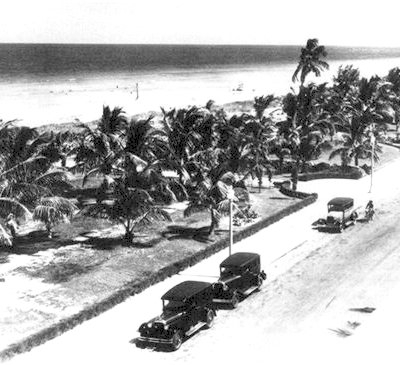
    Ocean Drive (Miami) sometime in the 1940's

    Ocean Drive (Miami) sometime in the 1940’s

    It is hard to pinpoint the origin of the word "Floribec" but it appears to have been adopted in the 1970s by Quebec residents wintering in Florida and made official in a study by Louis Dupont in the 1980s. According to him, French Canadians began immigrating to Florida in the 1930s. This immigration came in the wake of spending by the United States government, which, in an effort to resolve the 1929 economic crisis, undertook to build a network of canals through the marshland in southeast Florida and, notably, to open the Intercoastal Waterway, a navigable canal hundreds of kilometres long. At the same time, the government was also attempting to develop the infrastructure for tourism. Thousands of Americans travelled to the "Sunshine State" to work on this vast construction site. Among them were Franco-Americans from New England, some accompanied by their French-Canadian cousins. Once the construction work was completed, rather than going home, many of the French-Canadian workers took up permanent residence in the Miami region, particularly in Surfside, on the Atlantic coast, and in North Miami. After the Second World War, there were 67,000 French-Canadian and Franco-American families living in the State of Florida. These new permanent residents of Surfside and North Miami and of Sunny Isles generally found work in the tourist industry because Florida, especially Miami, was the holiday destination of a growing number of wealthy French-Canadians. This initial wave of Quebecois mass migration to Florida began at the end of the war and continued until 1960.

    Establishment of the Floribecois Community 
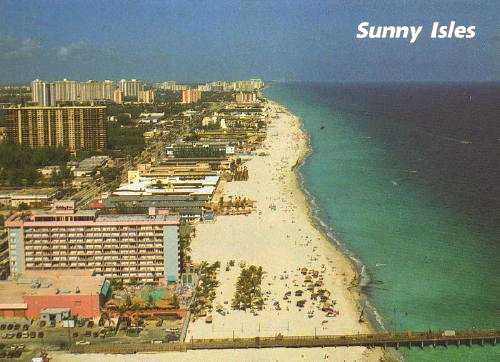
    Postcard of Sunny Isles, before the arrival of the giant hotels

    Postcard of Sunny Isles, before the arrival of the giant hotels

    The period from 1960 to 1970 saw a second wave of French-Canadian, mainly Quebecois, migration to the Miami region, with the appearance of a new type of immigrant: the investor. Two of the factors contributing to increased immigration were the liberating effect of the Quiet Revolution and the growth of wealth in Quebec. The fact that these two phenomena occurred simultaneously appears to have encouraged the people of Quebec to look beyond their borders. Expo 67 and a number of other Quebec cultural events made the rest of the world more aware of the province and, as well, the people of Quebec used this period of cultural vitality to increase their travel to foreign destinations. 

    At the same time, the tourist industry was experiencing rapid development in Florida with the arrival of the major airlines, the construction of the United States freeway system, and the north-south shift of economic and political power, which sparked phenomenal growth in the cities of the Sun Belt, including Miami. Miami Beach and its suburbs of Surfside and Sunny Isles became the favourite seaside destinations of the Quebecois. Recognizing the opportunity the situation presented, the Floribecois set up businesses in the area to cater mainly to Quebecois tourists, building French-language motels, restaurants, bars, convenience stores, and various other services to meet their needs. 

    Gemma Cossette with popular singer Michel Louvain

    Gemma Cossette with popular singer Michel Louvain

    From the 1970s onward, most businesses were established in Surfside and Sunny Isles, especially along Collins Avenue, whose location less than a kilometre from the beach offered increased customer traffic. The favourite tourist destination of the Quebecois was now affordable and there was no longer any language barrier. During this period, the Thunderbird, Suez, Waikiki and Colonial hotels were familiar to any Quebecois who travelled regularly to Florida, and even to those who were merely thinking of going there. Cultural life was vibrant because of the continued presence of such artists as Gilles Latulippe and other popular Quebec comedians and singers, who performed to sold-out audiences in the most popular hotels. The localization of these cultural activities in the gathering places of Quebecois tourists would serve to establish the physical boundaries of Floribec as a transnational tourist community.

    Floribec’s Shift Northward 
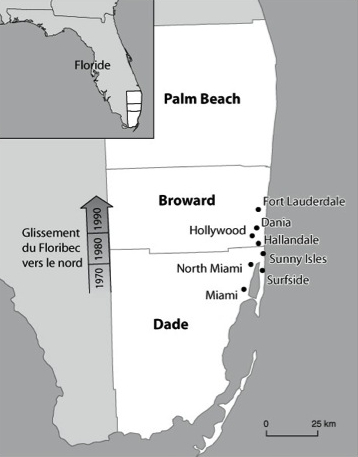
    Map showing location of concentrations of Quebec residents in Florida


    Map showing location of concentrations of
    Quebec residents in Florida

    The Floribecois communities in Surfside and Sunny Isles moved in the 1980s because, as had been the case in the Mafia era of 1920-1930, Miami once again became an international money-laundering centre for the drug trade, as well as being the scene of major racial conflicts. The city gained the status of unofficial capital of Latin America, not only because it had become a hub of the Latin-American banking system, but also because its downtown attracted hundreds of thousands of Cubans, Nicaraguans, Columbians and others. This continual influx of migrants led to a major exodus of WASP’s (White Anglo-Saxon Protestants), who moved north to the neighbouring counties of Broward and Palm Beach, leaving Dade County to the Hispanic population. Many Quebecois tourists and immigrants also left Dade County at that time.

    Floribec’s Glory Years 
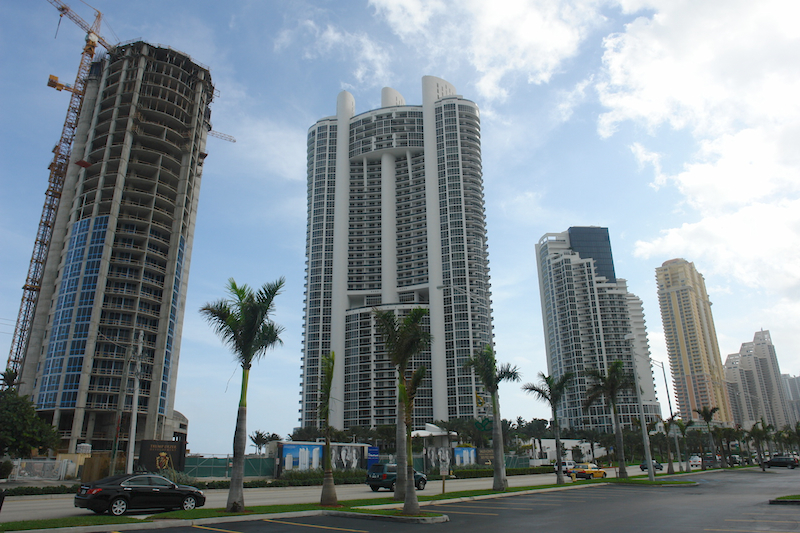
    Giant hotels replaced small motels

    Giant hotels replaced small motels

    For all intents and purposes, the Floribecois areas in Surfside and Sunny Isles disappeared in the early 1990s. The small, modest hotels, motels, and apartment buildings, where many Quebecois lived, were torn down and replaced by luxury high-rise condominiums up to 30 storeys high, some of them owned by Donald Trump. 

    The changes to that area explain why the neighbouring cities of Hallandale, Hollywood and Dania experienced such considerable growth during this period. They had not suffered from the demolition associated with urban sprawl and, for this reason, they became the southernmost destinations to which Quebecois tourists could travel affordably. The small, reasonable motels so popular with the majority of Quebecois tourists remained. It was here, in a well-defined area, that the Floribecois community really took root again and where it continued to be possible to carry on everyday life in French.

    Floribec’s Current Configuration
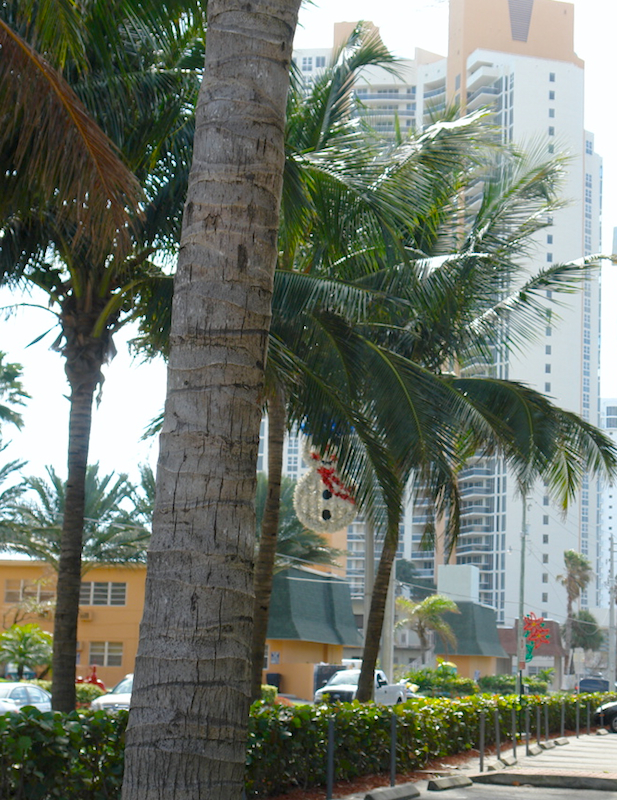
    Christmas decoration hanging discreetly from a palm tree

    Christmas decoration hanging discreetly from a palm tree

    Like numerous other seaside resorts, Floribec has a recreational business district (RBD) where the main tourist services are located. In the Floribecois RBD, there is a pedestrian walkway along the beach, the Broadwalk, and perpendicular to it, a main artery, Johnson Street. Depending on the season, restaurants, specialty food stands, candy shops and souvenir shops line these two streets in the RBD. The beach is the location of the sites most vital to Floribec life, namely the Broadwalk itself and the Johnson Street stage, as well as social institutions like the famous Frenchie’s Café.  Only a few kilometres from the RBD, other very popular Floribecois motels, including Richard’s Motel, branches of the Caisse populaire Desjardins and the National Bank of Canada, Lacroix Real Estate AgencyAu Coq restaurant, and other services are grouped together along U.S. Highway 1. Beyond the Hollywood-Dania-Hallandale corridor, the Floribecois population and its landmarks are soon swallowed up by the greater community. 

    It is important to note that Quebec is an integral part of the Floribecois community. The ongoing relationship with Quebec is sustained by the seasonal influx of thousands of tourists, often called "snowbirds", and the ready access in Florida to Quebec newspapers and radio, the main Quebec television programs, and the Internet, which also makes on-line banking possible. All of the regular and ongoing media and tourist contact between Quebec and Floribec make the latter a "transnational community" whose existence is largely dependent on the many connections it maintains with Quebec.

    Floribec in Decline? 
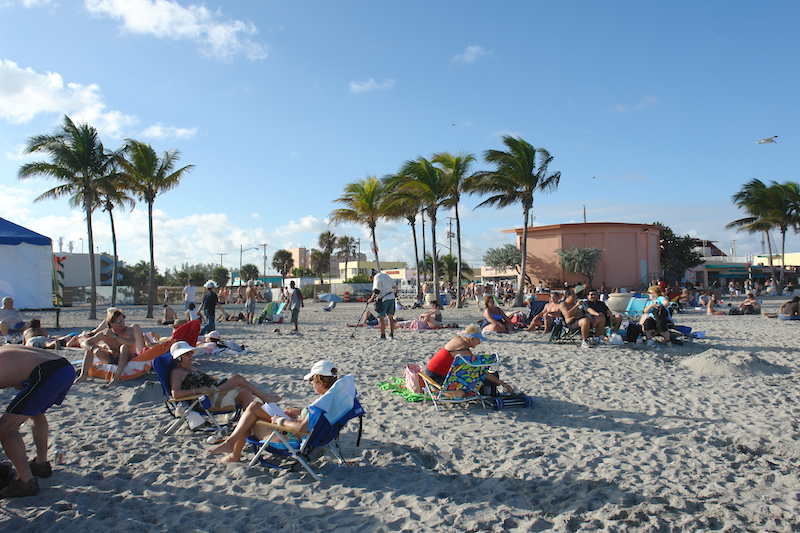
    Enjoying the beach...

    Enjoying the beach…

    Floribec has changed considerably since 2000. While Quebecois tourists continue to travel to southeast Florida, and the Quebecois culture and everyday living in French no longer dominate the scene around Johnson Street, as they did in the 1990s. People still gather on the beach but the tourists and immigrants live elsewhere, often at some distance from the ocean. Three factors may explain this erosion: 1) pressure from Miami’s continuing urban sprawl; 2) the negative image local political authorities have of the Floribecois; 3) competition from numerous tourist destinations that are as affordable as Florida, such as the Dominican Republic, Mexico and Cuba, which attract an increasing number of Quebecois.

    Miami‘s urban sprawl

    The purchase and demolition of Floribecois motels by rich local and Latin-American land developers has expanded beyond the cities of Surfside and Sunny Isles. Due to the shortage of available land, the trend has now reached Hollywood. For example, a huge luxury hotel complex was built only a few kilometres from the Broadwalk, which is also being rebuilt, and Floribecois motels located on Hollywood Beach have been demolished to build luxury condominiums. It is Hollywood’s turn to face the phenomenon of urban high-rise construction and tourist gentrification; it may be fighting a losing battle. 
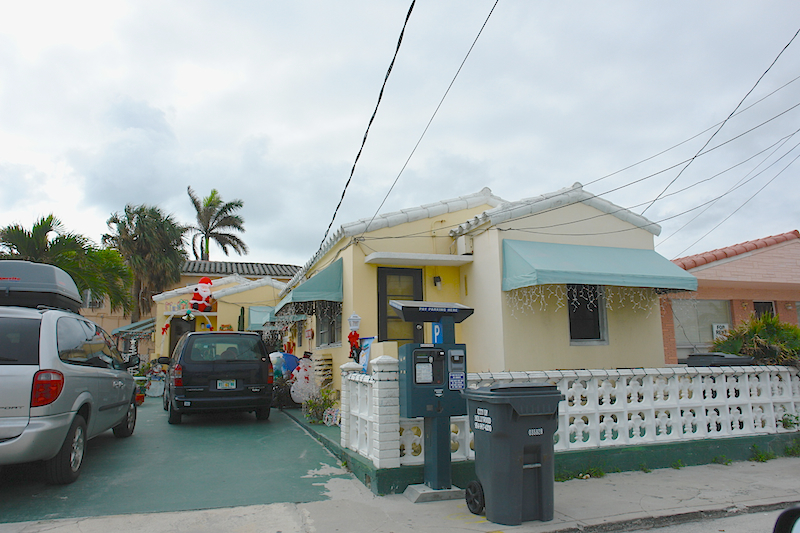
    A veritable Quebecois


    A veritable Quebecois

    Negative image of the Floribecois

    The socio-economic class to which the Floribecois belong troubles Hollywood City Hall. In strictly economic terms (daily spending, property taxes, etc.), it is not in the municipality’s interest to encourage the Floribecois to remain in the area. Nor does the caricature of the Floribecois presented in Quebec films and the local media help to reassure the city councillors. While the City of Hollywood welcomed the economic benefits associated with French-speaking residents in the 1980s, it now fears that these same people may tarnish the city’s image and it feels that Hollywood should follow the example of neighbouring municipalities who are moving to attract a higher class of tourist. The city has already taken the first step by demolishing one of Floribec’s most significant institutions, Frenchie’s Café, at the corner of the Broadwalk and Johnson Street, along with the adjacent small businesses. Since the demolition, the Floribec atmosphere, so appreciated by tourists, is much less vibrant than it was in the 1990s. Although there are still many Quebec tourists on the beach, fewer services are available to them in French, quite a different situation that in Floribec’s glory days. The only time that the Floribecois now flock to this subtropical area of the country is in January, when the annual festival, Canada Fest, brings together Floribec businesses and Quebec singers. Annual attendance at this cultural event is about 100,000 visitors. However, it is increasingly difficult to find signs of Floribec’s existence. While some insist that all is well, it would appear that Floribec’s days are numbered. At the very least, it seems that Floribec has lost its heart and soul.

    Competition in the tourist trade

    The increased number of affordable tourist destinations adds to the pressure on Floribec. Because those who love Florida enjoy temperatures of 25º C or above, the West Indies, the Caribbean and Mexico are harming the Floribecois economy. Le Soleil de la Floride, a monthly newspaper established in 1983, has reason to continually boast the merits of the Sunshine State, pointing out how familiar and safe a destination it is. However, there is no doubt that sun-seekers, especially those who do not travel south by car (single people or couples), are being lured away by the Dominican Republic, Cuba or Mexico. Direct flights from Montreal and Quebec to Cancun, Acapulco, Punta Cana, Varadero, and many other destinations are rapidly growing in number to meet demand, making vacations in these tropical and exotic areas accessible, often at a lower cost than an extended stay in Florida.

    Heritage in Danger? 
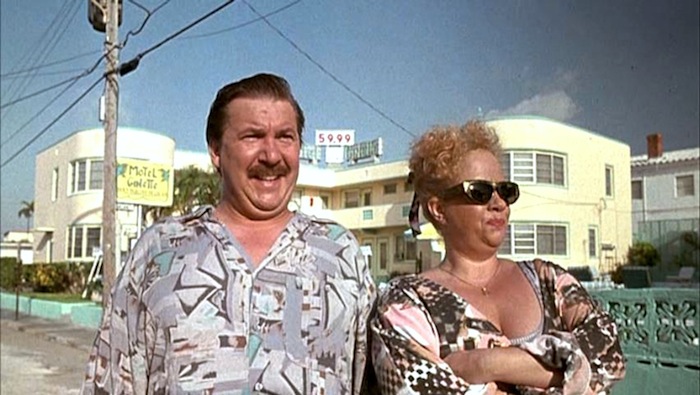
    Image from the movie «La Florida» (George Mihalka, 1993) starring Rémy Girard and Pauline Lapointe

    Image from the movie «La Florida» (George Mihalka, 1993) starring
    Rémy Girard and Pauline Lapointe

    Floribec constitutes an interesting chapter in the history of modern Quebec and it represents an intriguing and unique pocket of French-speaking America. This transnational community came into being as a result of people patronizing numerous businesses and other community-building venues situated in a relatively small geographical area on the Atlantic coast. These sites played an essential role as centres of community life for French-speakers who were living in or visiting the greater Miami area. Today, certain community practices formerly associated with Floribec can still be found; however, they are dispersed over a much wider area and signs of any Quebecois presence in the Florida landscape are increasingly difficult to discern.

    Rémy Tremblay is Canada Research Chair on Knowledge Cities, Université du Québec à Montréal

    ——–

    This piece is courtesy of the Encyclopedia of French Cultural Heritage in North America.

    ——–

    Bibliography

    CORTÈS, G. E FARET, L. (dir) (2009) Les circulations transnationales. Paris, Armand Colin, 244 p.

    DUPONT, L. (1982). Le déplacement et l’implantation de Québécois en Floride. Vie française, 36 (10-11-12), p. 23-33.

    GILBERT, A., LANGLOIS, A. et R. TREMBLAY (à paraître) Habiter Floribec. Voisinage et communauté. Revue internationale d’études canadiennes.

    LEVITT, P. (2001). The Transnational Villagers, Berkeley et Los Angeles, University of California Press.

    MORISSONNEAU, C. (1983). « Le peuple dit ingouvernable du pays sans bornes: mobilité et identité québécoise », dans Dean Louder et Éric Waddell (dir.), Du continent perdu à l’archipel retrouvé: le Québec et l’Amérique française, Sainte-Foy, Presses de l’Université Laval.

    TREMBLAY, R. (2003) « Le déclin de Floribec », Téoros, 22 (2).

    TREMBLAY, R. (2006). Floribec. Espace et communauté, Ottawa, Presses de l’Université d’Ottawa.

    TREMBLAY, R. (2008) Le Floribec éphémère, dans Dean Louder et Éric Waddell (dir.), La Franco-Amérique : traces et enracinement, Québec, Septentrion.

    TREMBLAY, R et O’REILLY, K (2004) « Les communautés touristiques transnationales. » Revue de Tourisme/Tourism Review, 59 (3).

  • The Use and Misuse of Glaeser’s Triumph of the City

    Appeals to authority are now the stock-in-trade of progressive pundits across a range of public controversies. In the face of popular discontent bubbling up from forums on the net and elsewhere, their fall-back posture is heavy-handed ‘expertism’. Policymaking is the prerogative of those with the right qualifications and credentials. Ordinary citizens should butt-out, no matter how self-interested the experts may seem. So too in the field of urban policy, encumbered as it is with a green-compact-city orthodoxy, do appeals to authority hold sway.

    Over the course of 2011 a book title kept cropping up in some of the media coverage of urban issues – Triumph of the City by Harvard economist and New York Times blogger Edward Glaeser. Arguing that successful cities should be “urban theme parks” or “playgrounds” for the benefit of “smart inhabitants” – as progressives like to conceive themselves – while the energy-wasting populace must be brought to heel, Glaeser is, for the pundits, an authority figure from central casting.   

    The Sydney Morning Herald’s urban critic, Elizabeth Farrelly, claimed the book “instantly became flavour of the month amongst the cognoscenti”. Proceeding to deliver another full-throated hymn in praise of density, she abridged Glaeser’s argument in typically hyperbolic terms. If only we lived in “dense urban centres”, miracles would abound: cheaper housing, better transport, protected wildernesses, no climate change, decent coffee and “a choice of walk-to tapas”. 

    Her colleague Ross Gittins, the paper’s economics editor, was equally impressed. “Glaeser’s observations seem of obvious relevance to Sydney”, he wrote.  “Our sky-high house and unit prices are partly the product of … excessive government restrictions on development”, wrote Gittins, before adding, without a hint of irony, “there are limits to how far Sydney can be allowed to sprawl”. He resolves this contradiction with the phrase “Sydney needs to go up”, echoing a warning of Glaeser’s which serves as the new slogan of green urbanism: “If cities can’t build up, then they will build out”.  

    This is sweet music to the green-tinged intelligentsia, for whom there is no worse crime against the planet than a bulging ‘human footprint’. Before weighing-up the merits of Glaeser’s build-up-not-out pitch, though, it should be said that many of his Australian fans either misrepresent or misunderstand his position. Farrelly’s diatribes against developers and suburbs are commonplace. She is all in favour of rigid ‘urban growth boundaries’, prescriptive urban consolidation and other features of the anti-sprawl agenda adopted by state and local governments over recent decades. So apparently is Gittins.

    Glaeser’s views are more complex. “The government should not be in the business of enforcing lifestyles that we happen to find appealing”, writes Glaeser, “[t]he government’s job is to allow people to choose the life they want …” He takes care to explain that this perspective accords with sound economic thinking:

    “[A]t the heart of economics is the belief that businesses work best by competing furiously in a market that the government oversees as impartial umpire. The same is true for cities. Competition among local governments for people and firms is healthy … The national government does no good by propping up particular places, just as it does no good by propping up particular firms or industries.”

    Identifying this principle as ‘spatial neutrality’, Glaeser is indifferent to the type of ‘growth boundaries’ so popular with Australian town planners and their green theorists, commenting at one point that “greenbelts may serve to check urban growth – which may or may not be desirable”. Indeed, it’s hard to see how any form of coercive zoning can be consistent with his position.

    Glaeser’s core argument is that the principle of neutrality has been systematically violated in the United States. “Cities [by which he means inner-cities] can compete on a level playing field”, he says, “but over the past sixty years, America’s policies have slanted the field steeply against them”. These policies include inner-city development controls, especially height restrictions, the home mortgage interest deduction, the Interstate Highway system, inferior inner-city schools administered by local school boards and inadequate gasoline (petrol) taxes. Remove such “artificial barriers” and “everybody, not just the privileged few, can enjoy the pleasures of Manhattan or Paris or Hong Kong”.

    Lurking behind Glaeser’s sedate prose, but never quite breaking out, is some kind of ultra-centripetal theory of human settlement. Human beings maximise their satisfaction by living in the centre of the world’s leading city, measured by size, wealth and amenity. It’s just that economic and legal barriers fix most of them in various grades of less desirable places. If the whole world could, in other words, they would pack up and move to Manhattan (“New York is still a paradigm of urbanity”, says Glaeser). In the years between 1880 and 1920, when millions of people from all over Europe swarmed into the crowded tenements of New York’s lower east side, such a theory might have had some plausibility. But the world changed. Since at least the middle of the twentieth century, the statistical and historical evidence points in the opposite direction. Countries like the US and Australia saw massive population shifts to the suburbs and attracted millions of immigrants hoping for their own suburban lot and house.

    However much Glaeser’s “artificial barriers” may have contributed to suburbanisation in the United States, the key issue is how important they were relative to one of the great transformations of the twentieth century: the unremitting growth of motor vehicle ownership and motorised commercial transportation. Even Glaeser concedes that “transportation technologies shape our communities, and modern sprawl is the child of the automobile”, though he insists the convenience of car ownership can be diminished.  

    The problem is that the trend towards urban dispersion started well before Glaeser’s so-called barriers came into existence. In his book  Downtown: Its Rise and Fall 1880-1950, Robert Fogelson writes that “by the mid and late 1920s, however, some Americans had come to the conclusion that the centrifugal forces were beginning to overpower the centripetal forces – or, in other words, that the dispersal of residences might well lead in time to the decentralization of business”. And the trend shows no sign of abating. Having analysed the 2010 US census, Joel Kotkin and Wendell Cox find that during the 2000s, just 8.6 per cent of the population growth in metropolitan areas with more than a million people took place in the core cities, the rest took place in the suburbs. “America continues to suburbanize”, they say. This is despite the financial crash, which would have blunted some of Glaeser’s pro-suburban incentives. Could it be that most people just prefer space over density?

    As for Australia, Glaeser’s core argument simply doesn’t hold. Most of his “artificial barriers” have no direct equivalents here. Our advanced motorways are intra-urban rather than interstate networks, and attract significant toll charges, our schools are subject to state rather than local board control and home mortgage interest is not tax deductible. No reasonable person would claim that our governments have “slanted the field” in favour of suburbs over recent decades. The very notion of spatial neutrality has been anathema. Urban consolidation is all the rage, suppressing land releases while driving up values to the point that Australian houses are consistently ranked ‘severely unaffordable’ in the annual Demographia survey, due in no small measure to a crushing mix of developer and infrastructure contributions and utility levies.  

    Still, Australian Bureau of Statistics figures show that four of the five strongest growing Sydney Local Government Areas (LGAs) in the year to 30 June 2009 were in the outer west: Blacktown, Parramatta, The Hills Shire and Liverpool, which offer home buyers the best prospect of owning a detached house and provide many industries with the cheap land, low rents, extensive space and proximity to major road junctions they need to thrive. According to the Department of Finance, 90 per cent of the containers passing through Sydney’s Port Botany originate in or are destined for the city’s outer western region. In its recent decision to abandon some of the previous state government’s residential zoning restrictions on Sydney’s fringe, the current government is just coming to terms with reality.

    Following Glaeser’s logic, if, in conditions of “a level playing field”, or even a “field slanted” against outer suburbs, residents and businesses still “choose” to locate on the periphery, government officials have no right to interfere, and will cause economic damage if they attempt to restrain these choices. Contrary to the impressions of his green-tinged admirers, Glaeser offers, in the Australian context, a powerful argument in favour of hands-off planning, decentralisation, suburbanisation and urban growth. 

    John Muscat is a co-editor of The New City, where this piece first appeared.

    Chicago photo by Storm Crypt / Flickr

  • The Slippery Slope of Corporate Culture

    Greg Smith’s resignation lament in the New York Times, Why I Am Leaving Goldman Sachs, has rightly caused an uproar. He writes, “I can honestly say that the environment now is as toxic and destructive as I have ever seen it,” implying that it has been toxic and destructive all along. Tell us something we don’t know.

    Twenty years ago when I worked at JP Morgan, the public bond underwriters and pension managers complained that they were at a disadvantage when competing for business with Goldman because they weren’t allowed to “pay to play”, i.e. make political contributions in exchange for business.

    Those two banks had long been at opposite ends of the spectrum. A century ago, the original J. Pierpont Morgan told counsel for a Congressional committee investigating the money trust that the most important criterion for supplying commercial credit was character, “Because a man I do not trust could not get money from me for all the bonds in Christendom.” Language, I must add, that distinguished him in ways large and small from moneylenders like Mr. Goldman and Mr. Sachs. Fifteen years ago an unnamed executive summed up the difference in business practices between the two banks to a Times reporter: “Morgan will show up with 20 people for a three-hour presentation to a client. Goldman Sachs will just send two people to sketch out a deal on a napkin at the golf club bar.”

    With Robert Rubin, Henry Paulson, and Jon Corzine among the ranks of Goldman’s recent former CEOs who have distinguished themselves in government and finance, you learn almost everything you need to know about the contemporary Goldman ethic, good and bad. Current honcho Lloyd Blankfein has said they are doing “God’s work.” For a Goldman investment banker to evoke the almighty as justification, he has to feel real heat.

    Mr. Smith feels let down by corruption in Goldman’s corporate culture:

    “It might sound surprising to a skeptical public, but culture … revolved around teamwork, integrity, a spirit of humility, and always doing right by our clients…. I am sad to say that I look around today and see virtually no trace of the culture that made me love working for this firm for many years.”

    A closer look at that culture would reveal something besides always doing right by the client. Corporate culture is really a nice way of moving people with a variety of motives in lockstep. One man’s client service is another man’s rapacious self-interest. Given the profitability of modern finance, rapacious self-interest has had an inexorable pull. The habits ingrained through a strong corporate culture are merely instruments for moving the herd along. Call it conformism, and in this, as in so many other areas, there’s no question that Goldman is a leader.

    Upon reading Smith’s op-ed, I opened an excellent reference volume, The Wiley Book of Business Quotations, to the Goldman Sachs entry for corporate culture. (Okay, maybe that isn’t quite accurate—I compiled the book myself and knew what was there.) I found Theresa M. Potter’s New York Metropolitan Diary column of November 13, 1996:

    Dear Diary:
    Overheard on the elevator at Goldman Sachs on a recent “dress-down Friday,” a conversation between a long-time partner and a smartly attired young analyst.
    Partner (sternly): It’s Friday. You’re not supposed to be wearing a tie.”
    Analyst (crestfallen): “But it’s not silk.”

    It’s a slippery slope.

  • Rick Santorum’s Ugly Appeal to Rural Voters

    Not all of them are “clinging to guns and religion,” as Barack Obama famously said in 2008, but Rick Santorum has catapulted to the top of the Republican field by connecting with a bitter streak among rural voters. This is bad news for the Republican party and for rural America, which in fact has some pretty good reasons to be optimistic.

    Urbanites, Santorum told South Carolinians in January, have “a whole different value structure…They’re not going to be participating in small-town life. They’re not going to be connected to mainstream America or to God and his creation.”

    Those voters have returned the contempt, with Mitt Romney consistently winning in larger metropolitan areas. Rick Santorum, by contrast, has from his campaign’s modest beginnings in the small towns of Iowa drawn the bulk of his support from the least-populated counties.

    “I kept saying, you just stick with us, you go out and vote for your values and trust what you know,” Santorum said after his victory in the Kansas caucuses in March. “Because you don’t live in New York City. You don’t live in Los Angeles. You live like most Americans in between those two cities, and you know the values you believe in.”

    Santorum—who last I checked lived in swank, suburban Washington—has become the candidate of rural and small-town inertia, representing the isolated, aging, often modestly educated and overwhelming white residents nostalgic for a fading past. The Santorum worldview, following a tradition that well precedes Sarah Palin, portrays a wholesome, small-town middle America fighting a desperate battle against corrupt coastal big-city “elites.”

    The problem for the party if he somehow emerges as the Republican nominee is that most voters live in metropolitan areas. Just 16 percent of Americans live on farms, small hamlets, and villages. The problem for those rural Americans is that Santorum’s campaign of complaint appeals to and reinforces the worst stereotypes of rural life, while overlooking the brighter future already emerging in much of the hinterland.

    Rural America, particularly the vast region known as the Great Plains, appears to be on the verge of an economic and cultural renaissance. I live in Los Angeles, but have witnessed a remarkable change in both on the ground reality and mood during numerous visits to and studies of rural areas over the past decade. When I first starting going to Fargo, North Dakota, it seemed just a listless prairie town; today it is full of high-tech firms and boasts a downtown bustling with a vibrant, youthful population of attractive, largely Nordic revelers.

    To be sure, many small towns in the Plains and elsewhere are shrinking and some will disappear entirely in the coming decades. But larger towns like Fargo, Bismarck, Sioux Falls, Omaha, as well as many smaller ones, now boast the strongest economies in the country—with low unemployment and strong job and income growth. Most of these cities enjoy positive in-migration not only from the rural hinterland, but from the densely packed coastal areas. The Plains’ population growth is already outpacing the national average, and is even further ahead of the urban core cities so celebrated in the media.

    Santorum seems to have missed something in his travels back in time. He may appeal to an imagined, largely self-contained rural Eden—but he’s mostly ignored the global economics that have fueled the rural resurgence.

    Start with the basics: the production of food and fiber, which is fundamental not only to the Plains but to the Midwest, central California and the cotton-growing regions of the Southeast, Arizona, and west Texas. It’s the global demand for these products that has created good times in small towns. In 2011, the U.S. exported a record $135 billion in food and fiber, with a net positive balance of $47 billion, the highest in nominal dollars since the 1980s. Santorum as a senator opposed NAFTA and now talks about engaging in a trade “war” with China. Yet developing countries constitute rural America’s fastest-growing market. Many nations lack the water and land resources to feed themselves at a higher per-capita level of consumption; Beijing has acknowledged this by effectively dropping the old Maoist goal of self-sufficiency.

    Foreign investment flows have also benefited rural communities, particularly in the Southeast and the Plains. Firms are investing in critical sectors such as manufacturing and energy that benefit rural communities. Industrial investment rose $30 billion just between 2009 and 2010, while investment in the energy sector more than tripled to $20 billion.

    Japanese, German, and Korean manufacturers are primary players laying the foundation for a rural and small-town resurgence across the long-suffering rural Southeast.  Last year, Mercedes, whose largest U.S. plant is in Tuscaloosa, Ala., invested $350 million in the facility. Arch competitor Volkswagen last year announced it will build a new assembly plant in Chattanooga, Tenn. Nissan, Toyota and Kia have all announced major new plant openings or expansions in the region, mostly in small rural towns (and, it’s worth mentioning, in “right-to-work” states that don’t allow closed union shops). When Toyota recently announced plans to establish a plant for the Prius near Tupelo, Mississippi (the birthplace of Elvis), they received 35,000 applications for 1,300 positions.

    At the same time, increased fossil-fuel demand in global markets has sparked energy giants from China, France, and Spain to take up stakes in fields in Ohio, Mississippi, Colorado, and Michigan. A smart, globally minded Republican would be pushing these investments, which are already creating boom from North Dakota to south Texas. President Obama’s urbane academician’s obsession with subsidizing renewable energy and barely disguised disdain for fossil fuels represents a threat to the continued prosperity of many rural communities and small towns.

    Critically, Santorum’s regressive social views—his tone of resentment as much as the particulars—belies the kind of openness needed for a full-scale rural revival. In the real world, rural America is becoming increasing diverse and dependent on immigrant labor.

    Plains towns like Grand Island, Nebraska, are filling up with Mexican or Honduran restaurants. The percentage of foreign-born Nebraskans has more than tripled since 1990. The GOP electorate in the Cornhusker State may be overwhelmingly white, but the demographic trends suggest this won’t always be the case—so long as the party can avoid alienating these new arrivals.

    In many places Hispanics constitute the major counterforce to wholesale depopulation. Every county except one in the western half of Kansas suffered depopulation of non-Hispanic whites during the past decade, while Hispanics have offset or even exceeded the decline in white population—filling schools and opening businesses in the process. Hispanic residents have pushed from hubs like nearby Dodge City, Garden City, and Liberal into ever smaller communities, buying property on the cheap, enticed, many say, by the opportunity to live quiet lives in communities more similar to those in which they were raised. 

    Of course many people—notably some of the older white voters flocking to Santorum—are hostile to these realities.  And in the short run, appealing to anti-immigrant sentiments may pay off in the Republican primary. But over time, if they are to survive, many rural communities will either adjust to diversity or simply disappear.

    But perhaps the worst betrayal of rural America lies in denying the aspirations of these places to shed off the historic isolation and overdependence on natural resources that have long dogged them. Santorum may consider a college education “elitist,” and see public schools as akin to “factories,” but in many parts of the Great Plains and elsewhere excellent public schools are cherished by Republicans and Democrats alike. A core competitive advantage of many rural states lies in their surplus of  highly educated young people. Students in Nebraska, the Dakotas, Montana, and Idaho tend to perform better in school than those in more metropolitan ones (as measured by graduation rates, college attendance, and enrollment in upper-level science and education programs).

    These educational advantages are being bolstered by in-migration now tilted toward younger families seeking opportunity, affordable housing, greater social cohesion and better schools. And with generally stronger fiscal balance sheets, due largely to the booming agriculture and energy sectors fueled by international demand, many rural states are expanding their public university systems even as states like California are cutting theirs.

    By appealing to perceived deficiencies in rural communities, Rick Santorum downplays all these positive forces. Much of rural America is already booming, and, connected by the Internet, investment, and trade, can play an important role in the American future. Appealing to nostalgia about a past fading into history is not the way to get there.

    This piece originally appeared in The Daily Beast.

    Joel Kotkin is executive editor of NewGeography.com and is a distinguished presidential fellow in urban futures at Chapman University, and contributing editor to the City Journal in New York. He is author of The City: A Global History. His newest book is The Next Hundred Million: America in 2050, released in February, 2010.

    Rick Santorum Image by Bigstockphoto.com.

  • The Sorry State of American Transport

    We constantly read about the infrastructure crisis in America. I’ll have more to say on this at a future date, but it is pretty clear that we need to spend more money in a whole lot of areas: airports, roads and bridges, public transportation, and more.

    Yet it’s very easy to see that so much of what ails transport has nothing to do with a lack of funds and everything to do with a lack of will. I took a train ride on the Northeast corridor last week that really drove it home to me.

    Start with the sorry state of Penn Station in New York City, America’s busiest train station. (In fact, it’s the busiest transportation facility of any type in the United States, if Wikipedia can be believed). Yes, the place is a depressing underground dump. Yes, there used to be a glorious train station there that was demolished in the 1960s. Yes, we probably need to invest many billions in upgrades.

    Yet is it a lack of funds that make the three agencies that call it home – Amtrak, New Jersey Transit, and the Long Island Railroad – act as though the others don’t exist? The three railroads have completely separate ticketing areas, signage systems, etc. This is hardly the only case in America. For some reason, Amtrak seems to despise sharing ticket agents with other carriers. There are separate windows for Amtrak and commuter lines everywhere I’ve been. Given that many journeys include both commuter and inter-city segments, this seems crazy. If you can’t have integrated ticketing (and actually, I don’t see why you can’t), at least you should be able to have a single agent help you.

    The worst example of this I know is in Providence, where Amtrak monopolizes the four ticket windows. If you want to buy an MBTA T ticket, you have to go to a cafe next door. This tiny little coffee shop found a way to sell both pastries and train tickets (albeit from separate registers), so why can’t Amtrak figure out how to sell two kinds of tickets?

    Also, as near as I can tell, there’s no way to actually get your Amtrak ticket online. You can book a reservation, but then you need to get a physical ticket printed at the station, either from a kiosk or an agent. (If there’s a way to avoid this, please let me know).

    I decided to get my ticket at the window. The line was very short and I was early in any case. When I got there, some guy with his kids was at the window screaming at the agent about a problem with their tickets. I chalked this up to one of those cases where the frustrations of travel just cause somebody to snap. But then as I walked up to the window, the person next to me was also having a similar problem with their ticket and was having an animated discussion with an agent who didn’t seem to care. Fortunately, I had no such issues, but the agent I had to talk to was extremely surly and kept asking me to repeat myself over and over. Who would want to put themselves through such an experience? Customer service is clearly something that should also be within Amtrak’s control.

    Amtrak markets themselves as having wi-fi. But on the train itself, as anyone who has ridden the NEC knows, the wi-fi is basically unusable. How much capital investment would it take to get working wi-fi?

    In short, though the facilities can somewhat be excused as resulting from insufficient capital funding and bad decisions decades ago, there’s so much that could be done right now to upgrade the passenger experience it’s not even funny.

    It’s the same with airports. While a few American cities like Indianapolis and Detroit have upgraded their terminals, too many key gateways remain depressingly dreary and non-functional. While some overseas places like Heathrow certainly would give any American airport a run for its money in the Hall of Shame, the general experience of flying to someplace like Madrid, Singapore, or Tokyo is like night and day versus the US.

    Key among the worst offenders again is New York City, especially LaGuardia. Matt Chaban at the New York Observer recently wrote a piece that is a good overview of the depressing state: “Terminal Condition – How New York’s Airports Crashed and Burned.”

    This is certainly not news to anyone who has flown to New York. But again, the vast billions it would take to replace these decrepit facilities is only part of the problem. Nobody forces America to put its passengers through the “TSA experience.” Last time I flew I was delayed at security while agents patted down some guy that looked like he was around 85 years old who apparently hadn’t stripped down quite far enough to go through the full body scanner. Somehow other advanced nations manage to run safe air travel systems without resorting to this.

    While we are waiting around for funding issues to be resolved, wouldn’t it be nice if our governments and various travel companies actually focused on fixing some of these straightforward problems with coordination, ticketing, and customer service? It’s hard to take their capital requests seriously if they aren’t going to do what they can now.

    Aaron M. Renn is an independent writer on urban affairs based in the Midwest. His writings appear at The Urbanophile.

    Photo By Kyle Gradinger, Amtrak Keystone Snowstorm I. Amtrak AEM-7 locomotive 904 leads a Keystone Corridor train through the snow in Rebel Hill, King of Prussia, PA.

  • Metro Job Recovery in 2011

    The latest BLS release for metro area unemployment has full year averages for 2011 available, so we can see which cities added the most jobs last year. On the whole, it was a much better year for metros than we’ve seen in the recent past. The national economy added jobs, and all but two large metros did as well. New York City added the most jobs of any region, but given that it is far and away the biggest city in America, it should do so. NYC ranked only the middle of the pack on a percentage growth basis. On that measure, Austin, Texas was number one.

    The top percentage gainer in the Midwest region? Detroit, Michigan. Perhaps this shouldn’t be surprising either, as manufacturing is pro-cyclical.

    Here is the performance of the metro areas in the United States with more than one million people, ranked by percentage change. The data is also available in spreadsheet form.

    Rank Metro Area 2010 2011 Total Change Pct Change
    1 Austin-Round Rock-San Marcos, TX 769.5 791.4 21.9 2.85%
    2 San Jose-Sunnyvale-Santa Clara, CA 855.2 878.2 23.0 2.69%
    3 Houston-Sugar Land-Baytown, TX 2528.1 2593.1 65.0 2.57%
    4 Charlotte-Gastonia-Rock Hill, NC-SC 807.5 826.7 19.2 2.38%
    5 Nashville-Davidson–Murfreesboro–Franklin, TN 734.3 751.7 17.4 2.37%
    6 Salt Lake City, UT 608.1 622.0 13.9 2.29%
    7 Detroit-Warren-Livonia, MI 1737.1 1775.3 38.2 2.20%
    8 Dallas-Fort Worth-Arlington, TX 2860.9 2921.7 60.8 2.13%
    9 Raleigh-Cary, NC 498.1 508.6 10.5 2.11%
    10 Pittsburgh, PA 1125.3 1148.6 23.3 2.07%
    11 Oklahoma City, OK 558.5 569.6 11.1 1.99%
    12 Tampa-St. Petersburg-Clearwater, FL 1112.0 1132.3 20.3 1.83%
    13 Portland-Vancouver-Hillsboro, OR-WA 968.8 986.1 17.3 1.79%
    14 Minneapolis-St. Paul-Bloomington, MN-WI 1697.1 1727.1 30.0 1.77%
    15 Baltimore-Towson, MD 1274.0 1293.5 19.5 1.53%
    16 Seattle-Tacoma-Bellevue, WA 1641.2 1666.1 24.9 1.52%
    17 Denver-Aurora-Broomfield, CO 1193.5 1211.6 18.1 1.52%
    18 Columbus, OH 903.3 916.9 13.6 1.51%
    19 Miami-Fort Lauderdale-Pompano Beach, FL 2185.6 2218.3 32.7 1.50%
    20 Phoenix-Mesa-Glendale, AZ 1688.9 1712.8 23.9 1.42%
    21 Atlanta-Sandy Springs-Marietta, GA 2272.6 2302.9 30.3 1.33%
    22 New Orleans-Metairie-Kenner, LA 519.1 526.0 6.9 1.33%
    23 San Antonio-New Braunfels, TX 843.0 853.2 10.2 1.21%
    24 Richmond, VA 602.4 609.5 7.1 1.18%
    25 New York-Northern New Jersey-Long Island, NY-NJ-PA 8306.8 8403.9 97.1 1.17%
    26 Indianapolis-Carmel, IN 871.1 881.2 10.1 1.16%
    27 Jacksonville, FL 583.1 589.6 6.5 1.11%
    28 Rochester, NY 503.1 508.7 5.6 1.11%
    29 Washington-Arlington-Alexandria, DC-VA-MD-WV 2962.9 2995.5 32.6 1.10%
    30 Hartford-West Hartford-East Hartford, CT – Metro 533.2 538.9 5.7 1.07%
    31 Chicago-Joliet-Naperville, IL-IN-WI 4246.6 4291.4 44.8 1.05%
    32 Milwaukee-Waukesha-West Allis, WI 805.8 814.1 8.3 1.03%
    33 Louisville/Jefferson County, KY-IN 592.9 599.0 6.1 1.03%
    34 Kansas City, MO-KS 971.6 981.4 9.8 1.01%
    35 Orlando-Kissimmee-Sanford, FL 1001.1 1011.0 9.9 0.99%
    36 Memphis, TN-MS-AR 589.8 595.4 5.6 0.95%
    37 Cincinnati-Middletown, OH-KY-IN 980.8 989.4 8.6 0.88%
    38 Buffalo-Niagara Falls, NY 538.2 542.7 4.5 0.84%
    39 San Francisco-Oakland-Fremont, CA 1880.2 1894.3 14.1 0.75%
    40 Boston-Cambridge-Quincy, MA-NH – Metro 2426.5 2443.3 16.8 0.69%
    41 Los Angeles-Long Beach-Santa Ana, CA 5126.8 5162.2 35.4 0.69%
    42 San Diego-Carlsbad-San Marcos, CA 1222.8 1231.2 8.4 0.69%
    43 St. Louis, MO-IL 1286.9 1295.4 8.5 0.66%
    44 Las Vegas-Paradise, NV 803.6 808.3 4.7 0.58%
    45 Riverside-San Bernardino-Ontario, CA 1125.9 1129.7 3.8 0.34%
    46 Philadelphia-Camden-Wilmington, PA-NJ-DE-MD 2697.0 2705.9 8.9 0.33%
    47 Providence-Fall River-Warwick, RI-MA – Metro 541.3 542.8 1.5 0.28%
    48 Virginia Beach-Norfolk-Newport News, VA-NC 735.2 736.8 1.6 0.22%
    49 Cleveland-Elyria-Mentor, OH 991.1 992.7 1.6 0.16%
    50 Birmingham-Hoover, AL 489.5 488.6 -0.9 -0.18%
    51 Sacramento–Arden-Arcade–Roseville, CA 809.9 802.0 -7.9 -0.98%

    This first appeared at Aaron’s blog, Urbanophile.com.

  • Historic Day in Corruption History: Two Governors From Same State in Jail at Same Time

    Today, history will be made. Rod Blagojevich is going to jail in Littleton, Colorado. Blagojevich will join his predecessor Governor George Ryan who’s in prison in Terre Haute, Indiana. America’s fifth largest state will now have two back-to-back Governors in federal prison at the same time. What other state in America can say that? Both Illinois Governors were convicted of major felonies. Have Illinois voters turned the corner on supporting corrupt politicians? It appears not. Recently, U.S. Attorney Patrick Fitzgerald has been busy. Long time Chicago Machine boss William Beavers was indicted on tax fraud. Tuesday, Illinois State Rep. Derrick Smith was arrested on a federal bribery charge.

    Here’s a report from WLS-TV:

  • The Republican Party’s Fatal Attraction To Rural America

    Rick Santorum’s big wins in Alabama and Mississippi place the Republican Party in ever greater danger of becoming hostage to what has become its predominate geographic base: rural and small town America. This base, not so much conservatives per se, has kept Santorum’s unlikely campaign alive, from his early win in Iowa to triumphs in predominately rural and small-town dominated Kansas, Mississippi, North Dakota and Oklahoma. The small towns and rural communities of states such as Michigan and Ohio also sheltered the former Pennsylvania senator from total wipeouts in races he would otherwise have lost in a blowout.

    If America was an exclusively urban or metropolitan country, Mitt Romney would be already ensconced as the GOP nominee and perhaps on his way towards a real shot at the White House. In virtually every major urban region — which means predominately suburbs — Romney has generally won easily. Mike Barone, arguably America’s most knowledgeable political analyst, observes that the cool, collected, educated Mitt does very well in affluent suburbs, confronting President Obama with a serious challenge in one of his electoral sweet spots.

    Outside the Mormon belt from Arizona to Wyoming, however, sophisticated Mitt has been a consistent loser in the countryside. This divergence between rural and suburban/metro America, poses a fundamental challenge to the modern Republican Party. Rural America constitutes barely 16 percent of the country, down from 72 percent a century ago, but still constitutes the party’s most reliable geographic base. It resembles the small-town America of the 19th century, particularly in the South and West, that propelled Democratic Party of Nebraska’s William Jennings Bryan to three presidential nominations.

    Yet like Bryan, who also lost all three times, what makes Santorum so appealing in the hinterlands may prove disastrous in the metropolitan regions which now dominate the country. Much of this is not so much particular positions beyond abortion, gay rights, women’s issues, now de rigueur in the GOP, but a kind of generalized sanctimoniousness that does not play well with the national electorate.

    We can see this in the extraordinary difference in the religiosity between more rural states, particularly in the South, and the rest of country. Roughly half of all Protestants in Mississippi, Alabama and Oklahoma, according to the Pew Center on Religion and Public Life, are evangelicals, not including historically black churches. In contrast, evangelicals make up a quarter or less of Protestants nationally and less still in key upcoming primary states such as Pennsylvania, New York, California and Connecticut, where the percentages average closer to 10 percent.

    Let me be clear: Urbanity is not the key issue here. Cities have become so lock-step Democratic as to be essentially irrelevant to the Republican Party. Instead it’s the suburbs — home to a record 51 percent of the population and growing overall more than 10 times as fast as urban areas — that matter the most. Much of the recent suburban growth has taken place in exurbs, where many formerly rural counties have been swallowed, essentially metropolitanizing the countryside.

    What accounts for the divergence between the suburban areas and rural areas? A lot may turn on culture. Small towns and villages may be far from the isolated “idiocy of rural life” that Marx referred to, but rural areas still remain someone more isolated and still somewhat less “wired” in terms of broadband use than the rest of the country.

    Despite the popularity of country music, rural residents do not have much influence on mainstream culture. Most Hollywood executives and many in New York still commute from leafy ‘burbs. Few of our cultural shapers and pundits actually live predominately in the countryside, even if they spend time in bucolic retreats such as Napa, Aspen or Jackson Hole.

    Until the recent commodity boom, much of rural America was suffering. And even today, poverty tends to be higher overall in rural areas than in urban and especially suburban countries. Some areas, notably in North Dakota and much of the Plains, are doing very well, but rural poverty remains entrenched in a belt from Appalachia and the deep South to parts of west Texas, New Mexico and California’s Central Valley.

    Rural areas generally do not have strong ties to the high-tech economy now leading much of metro growth. This remains a largely suburban phenomenon, urban only if you allow core cities to include their hinterlands. All the nation’s strongest tech clusters — Silicon Valley, Route 128, Austin, north Dallas, Redmond/Bellevue in Washington, Raleigh-Durham — are primarily suburban in form. High tech tends to nurture a consciousness among conservatives more libertarian than socially conservative and populist. Not surprisingly, libertarian Ron Paul often does best in these areas and among younger Republican voters.

    Another key difference: a lack of ethnic diversity. There are now many Hispanics living in rural areas, but they are largely not citizens and most are recent arrivals, attracted by jobs in the oil fields, slaughterhouses and farms. Many small towns, unlike suburbs, remain more homogeneous than suburbs, emerging as the most heterogeneous of all American geographies. Ethnic cultural cross-pollination occurs regularly in metropolitan suburbs; this is not so common in rural America.

    Equally important, environmental issues spin differently in rural areas than in suburbs. Energy development and agriculture drive many rural economies. In some areas, like Ohio and western Pennsylvania, shale oil and gas is bringing long moribund regions back to life. In the Dakotas, parts of Louisiana, Texas and Wyoming, it is ushering in a potentially long-term boom. In contrast, there aren’t many oil and gas wells located next to malls and big housing tracks.

    This does not mean that suburban voters share the anti-fossil fuel green faith of the urban core. But for them “drill baby drill” represents more a matter of price at the pump than a life and death issue for the local economy. Suburbanites feel the energy issue, but do not live it the way more rural communities do. One of the great ironies of American life is that those who live closest to nature are often less ideologically “green” than those, particularly urbanites, residing in an environment of concrete, glass and steel.

    Rural America, of course, is changing, with many areas, particularly in the Plains, getting richer and better educated. These areas are growing faster than the national average and attracting immigrants from abroad and people from other U.S. regions. Yet the influence of newcomers, new wealth and new technology is still nascent. The political pace in rural America today still is being set by an aging, overwhelmingly white and modestly educated demographic.

    Until the Republican nomination fight is settled, the party’s pandering to the sensibilities of such conservatives in rural areas could prove fatal to its long-term prospects. A Santorum nomination almost guarantees a replay of the Bryan phenomena; no matter how many times he runs, he will prove unlikely to win, even against a vulnerable opponent. Even in losing, his preachy, divisive tone — on contraception, prayer, the separation of church and state — has opened a gap among suburban voters that Obama will no doubt exploit.

    The suburbs, with its preponderance of white, middle income independent voters, gave the 2008 election to Obama, and that’s where the next contest will be decided. The countryside will rally to a GOP standard bearer like Romney, albeit somewhat reluctantly, for both economic and social reasons. The battle will then shift to the suburbs, including those urban areas, common in the vast cities of the South and West, that are predominately suburban in form.

    Most of the urban core, meanwhile, will vote lockstep for Obama. But the president, as thoroughly a creature of urban tastes and prejudice as to ever sit in the White House, could prove vulnerable in the suburbs, if the Republicans can deliver a message that is palatable to that geography’s denizens.

    This piece originally appeared in Forbes.com.

    Joel Kotkin is executive editor of NewGeography.com and is a distinguished presidential fellow in urban futures at Chapman University, and contributing editor to the City Journal in New York. He is author of The City: A Global History. His newest book is The Next Hundred Million: America in 2050, released in February, 2010.

    Rick Santorum Image by Bigstockphoto.com.

  • Federal Transit Administration Weighs In on Honolulu Mayor’s Race

    The Federal Transit Administration (FTA) has intervened in the Honolulu Mayor’s race against challenger and former Hawaii Governor Ben Cayetano. Governor Cayetano and Mayor Peter Carlisle are locked in a bitter contest that could determine whether the proposed $5.1 billion rail line is built. Mayor Carlisle is a strong supporter of the rail line. Challenger Cayetano has promised to "pull the plug" on the rail system. Recent polls show that the project’s former thin majority support among Honolulu residents has now turned to opposition.

    At a 1:30 p.m. press conference yesterday (March 13), Governor Cayetano released e-mails from the FTA indicating concerns about the rail project. According to Cayetano, "Not only it is apparent that FTA officials share some of our concerns, but it’s also apparent that they warned the city about pending litigation if certain things were not done."

    One of the FTA emails, obtained from the administrative record said “I do not think the FTA should be associated with their lousy practices of public manipulation and we should call them on it.”

    Reflecting a surprising ability to "turn on a dime," FTA quickly responded in an apparent attempt to diffuse Governor Cayetano’s point. According to KITV, "In response to the press conference, a spokesman for the Honolulu Authority for Rapid Transportation issued the following statement on behalf of the FTA:"

    There is no question that this project has overcome early obstacles because of a much improved Federal partnership with the City of Honolulu and State of Hawaii over the last several years. The Federal Transit Administration believes that this project will bring much needed relief from the suffocating congestion on the H-1 Freeway and provide a real transportation alternative for the people of Oahu as gas prices rise.

    Curiously, the FTA’s statement contradicted its own previous position on the traffic impact of the rail line. In its January 2011 "record of decision" for the project, FTA indicated:  "Many commenters [on the Draft EIS] reiterated their concern that the Project will not relieve highway congestion in Honolulu. FTA agrees…" Further, it is unusual for federal agencies to take part in local election campaigns.

    The Honolulu rail project was covered in more detail in a recent newgeography.com commentary, Honolulu’s Money Train.

    Clarification (March 15). The complete quotation above was not used because it was not necessary to the point, which was FTA agreed that highway congestion would not be relieved by rail in its record of decision, but in its statement on Tuesday appears to have reversed that view. We are unaware of any change in the technical documentation that would have justified such a change.

    The complete quotation was "Many commenters [on the Draft EIS] reiterated their concern that the Project will not relieve highway congestion in Honolulu. FTA agrees, but the purpose of the project is to provide an alternative to the use of congested highways for many travelers.” The "provide an alternative" clause was omitted because it was unrelated to the apparent change in position on traffic congestion by FTA.

    "FTA agrees." in the article above, has been changed to "FTA agrees…"