Blog

  • Measuring the Impact of Apple and the App Economy

    We all know about the explosion of Apple tech products, the ever-expanding number of mobile applications in the App Store — and the near $100 billion in cash that Apple is hoarding. Yet one question that has gone mostly unanswered is how many jobs Apple has generated (and supported) with its mind-boggling growth.

    Last week Apple released results of a study done by the Analysis Group of Boston — a firm commissioned by the tech giant — to measure its employment impact in the US. The results:

    • 47,000 current US jobs at Apple
    • 257,000 indirect (or support jobs) in manufacturing of components, transportation, professional services, etc.
    • 210,000 estimated iOS App Economy jobs, a figure derived using the same methodology as a study from Mike Mandel for TechNet.

    The total estimate — 514,000 jobs created or supported by Apple — has already been criticized by at least notable one economist. But the methodology appears to be fairly conservative, if only because the authors did not include an estimated 187,000 additional jobs from induced effects (i.e., those that come increased spending at grocery stores, restaurants, etc.).

    However, it’s the other component of Apple’s total job figure — the 210,000 for iOS developers — that warrants a further look.

    The App Economy

    Mandel’s in-depth study (PDF) on the App Economy was released in early February. Using want ads from The Conference Board Help Wanted OnLine database, Mandel and his colleagues estimated that 466,000 jobs in the US can be attributed to app firms and app-related jobs at companies such as AT&T, Electronic Arts … and of course Apple. Pretty remarkable considering that, as Mandel wrote, there were zero app jobs in the US prior to 2007. Apple looked at the study and:

    Using the same keyword search methodology employed by the study’s authors at the time of its release, we found that 45 percent of job postings in the app economy are specifically tied to iPhone and iOS, indicating that at least 210,000 jobs are driven by the iOS app economy.

    There’s a good reason why Mandel relied on want ads instead of conventional labor market data — app jobs only started cropping up in the last five years, making them hard to track down through the BLS and other sources. Concluded Mandel, “… the App Economy is far too new to show up in the government statistics.”

    Job posting (or real-time labor market) data is constantly updated and allows for full keyword searches. This is valuable to those who want a very recent look at the most in-demand skills needed by employers in a particular industry or field. But, as with all data, there are inherent shortcomings to analyzing want ads. And more to the point, using job postings to estimate employment in a sector can be problematic. Consider Mandel’s approach:

    Our procedure for estimating the number of App Economy jobs has several steps (see Table 1).

    1. We identified a set of keywords that characterize want ads for App Economy computer and mathematical occupations, which for convenience we will call ‘tech jobs’;

    2. We used historical relationships to estimate the ratio between the number of want ads for tech occupations and the actual level of tech employment [emphasis ours];

    3. We examined a sample of third-party app developers to estimate the ratio of tech jobs to non-tech jobs in the App Economy;

    4. We drew from the literature to derive a conservative estimate of the spillover effects to the broader economy;

    5. We used the location data in The Conference Board database to estimate App Economy jobs by metro area and by state.

    Mandel looked at four years of postings data, which suggested “that tech jobs and tech want ads tend to move together, except for anomalous periods such as 2009, at the bottom of the downturn.” So he took the roughly 3.5 million tech jobs (defined as computer and mathematical occupations) in fourth quarter 2011 and the 952,000 tech want ads over the same time to come up with a ratio of roughly 3.5 tech jobs for each non-duplicated tech want ad over a 90-day period.

    During the 90 days’ worth of want ads that Mandel examined, he and his colleagues identified 44,400 non-duplicated postings for tech workers that had at least one of the keywords they chose to look for — a list that included “Android,” “iOs,” “iPhone,” “Facebook API” and others. Using the 3.5 ratio, those 44,400 want ads result in 155,000 tech jobs in App Economy as of December 2011 (not including non-tech jobs in the App Economy).

    Perhaps this is an accurate estimate, but a few things should be mentioned here. If Mandel had used a different 90-day period, he might have gotten a larger or smaller number of tech want ads. And a different — or longer — time period might also have shifted the employment-to-want ad ratio up or down.

    Job posting data is volatile; it can change depending on the time of year, profession, hiring practices of employers, etc. Some employers post want ads to collect resumes for jobs they don’t intend to fill (or perhaps will fill internally). Also, the method of converting the text in want ads into generic job titles or standard occupation codes through keyword searches — a vital step for high-level analysis of real-time data — can cause discrepancies if not thoroughly vetted or fact-checked. A posting for a “team member” at a fast food joint can be misinterpreted as a “team assembler.” Things like this happen.

    Pinning down existing app developer jobs is particularly tricky. A software developer might devote only 30% of the workday to apps or might spend a few months developing an app and move on.

    More could be said here, but it’s clear that Mandel’s study provides insight into a burgeoning and heretofore unanalyzed part of the economy. Nonetheless, it’s helpful to have a lens with which to look through a study like this and real-time data in general.

    See also: Making a Key Distinction: Real-Time LMI & Traditional Labor Market Data

    Joshua Wright is an editor at EMSI, an Idaho-based economics firm that provides data and analysis to workforce boards, economic development agencies, higher education institutions, and the private sector. He manages the EMSI blog and is a freelance journalist. Contact him here.

  • Honolulu’s Money Train

    Honolulu is set to construct an ambitious urban rail project. It’s a $5.125 billion behemoth that this metropolitan area with less than a million residents may not be able to afford.

    Honolulu’s Beleaguered Residents

    Critically, there is plenty of competition for the scarce dollars that Honolulu residents have to spare. The city’s basic infrastructure is in bad shape.

    (Sewer) Water, Water Everywhere: A consent decree signed between local officials and the Environmental Protection Agency requires major upgrades to the sewer system. Sewer overflows are not unusual. Just a few days ago, 51,000 gallon raw sewage spilled into a local stream. The state issued a brown water alert for the entire island of Oahu (which is also the combined city and county of Honolulu), including Waikiki Beach and all other beaches. As of this writing, the brown water advisory has not been cancelled. Just in the last year, the state has reported 17 sewage spills and four brown water alerts. For this to happen in a highly tourist dependent economy is nothing short of astounding.

    More than Leaky Pipes: The city’s water system is in need of major upgrades. From 2004 to 2009, water main breaks were virtually a daily occurrence. In an effort to solve the problem, the city has raised water rates 60 percent in the last five years and plans another 70 percent increase over the next five years. How much more will be required after that is anyone’s guess. "How are people going to make it? I just don’t know" reacted City council Budget Chair Ann Kobayashi.

    Unfunded Government Employee Liabilities: In just three years, unfunded city and county employee pension and retiree benefits have risen from $15,000 to $21,000 per Honolulu household. The state’s actuarial consultant says things are going to get worse. The demographics are skewed against financial control, since people are living longer, and the number of retirees is rising relative to the workers who must pay (most of whom cannot even dream of such rich benefits).   All of this means higher tax bills for Honolulu households.

    High Cost of Housing, High Cost of Living: Honolulu residents already endure the most unaffordable housing  in the nation, with median house prices 8.7 times median household incomes. That is three times Dallas-Fort Worth.  Honolulu’s overall cost of living is also the highest in the nation, outside six metropolitan areas in the greater New York and San Francisco Bay Areas. Honolulu residents pay $1.41 to buy what $1.00 buys in St. Louis, 1.24 for each $1.00 in Austin and $1.21 for each $1.00 in Phoenix.

    Choices: This is not about easy choices. The sewer remediation, water system maintenance, government employee pension and government employee retiree health care benefits are mandatory. The rail expenditures are not.

    The Rickety Rail Project

    Yet the city of Honolulu would tax its residents even more to pay for a 20 mile rail line to empty farmland well beyond the urban fringe. This is a project not unlike the early 1900s land speculation schemes of Henry Huntington in Los Angeles and the Sweringens of Shaker Heights (Cleveland). There is, however, one important difference. The Huntington and the Swearingens bet their own money. Honolulu is betting the money of its taxpayers.


    End of the Honolulu Rail Line

    The city hopes to receive $1.55 billion from the federal government, with local residents left to pay a hefty 70 percent of the cost. This $3.575 billion local share would create the highest tax burden for any urban rail line ever built in the nation, at more than $10,000 per household. But residents should "thank their lucky stars" if that’s all they have to pay, given the history of cost overruns on such projects around the world.

    Stacking the Deck: The Federal Court Challenge: The planning process is being challenged in federal court. The plaintiffs argue that the rail selection process eliminated more cost effective options with biased analysis. This would not be the first time.

    Annie Weinstock, Walter Hook, Michael Replogle, and Ramon Cruz of the Institute for Transportation Development and Policy (with a foreword by Oregon Congressman Earl Blumenaur),  cited circuitous routing of a busway that biased ridership forecasts in favor of light rail for the suburban Washington Purple Line. Weinstock, Hook, Repogle and Cruz refer to a similar "deck stacking technique" that favored an expensive rail project over a busway in the suburban Washington Dulles corridor. They fault local officials more than federal:

    While there is no outright pro-rail bias at the FTA, there is indeed FTA complicity in the rail bias of city and state level mass transit project sponsors. The FTA, when evaluating New Starts and Small Starts project applications, tends to bow to political pressure to favor locally preferred alternatives and ignore certain forms of rail bias by the project sponsors

    Pulling the Plug on Rail? Former Governor Ben Cayatano has filed to run against Mayor Carlisle in the August 2012 election. In announcing his entry, Governor Cayatano said "I will pull the plug on rail." Polls show Mr. Cayetano ahead of both Mayor Carlisle and a third candidate.

    Capital Cost Escalation: A state report indicated that construction costs could rise well above forecast. Every penny above the $5.125 billion capital cost will be the responsibility of local taxpayers. Based upon the international experience, this could easily raise the per household cost from $15,000 to $20,000.

    Ridership Optimism Bias: Echoing general concerns raised by Weinstock, Hook, Repogle and Cruz (above), the state report indicated concern over an optimism bias in the ridership projections. For example, the city expects 60 percent of rail riders to use the bus to get to the train.  This is four times the rate of the largest new rail system built in the nation (Washington’s Metro).  Using the bus to connect to the train makes travel much slower and this factor has often been over-estimated by rail planners. This unrealistic assumption alone could qualify the Honolulu ridership forecast as among the most inaccurate in history.  Fewer riders. more money out of residents pockets.

    A Billion Here, A Billion There: As if all of this were not enough, a report for the Federal Transit Administration, obtained by the Star Advertiser through a freedom of information request, indicates that the operating costs of the transit system may be understated by as much as $1 billion over the next 20 years. That’s $3,000 per Honolulu household (Note 1).

    Federal Doubts: Federal Transit Administration Regional Administrator Leslie Rogers expressed concern about Honolulu’s ability to afford the project in a letter to local officials, noting that the funding program is insufficient. Local taxpayers likely will need to pony up more.

    Debt Limit Suspended: After having claimed it could afford the rail debt, the city suspended its debt limit — a fact discovered four months after the fact by the Star Advertiser.  Usually, breaches of trust like this become evident only much later in the rail construction process. A suspended debt limit means more money out of taxpayer pockets, or worse. Jefferson County, Alabama filed bankruptcy after not being able to afford payments on its sewer debt.

    How Would Rail Change Honolulu

    With rail, Honolulu there are two ways that Honolulu will be changed:

    What Will Change: Walling Off the Waterfront. The elevated design of the rail system is so intrusive that the local chapter of the American Association of Architects opposes the proposal. The elevated line would run directly in front of the waterfront. Its oppressive design would separate the rest of the historic Aloha Tower area from the rest of the city and could preclude future attractive "placemaking" development (see lead photo, courtesy of the Honolulu Chapter of the American Institute of Architects).

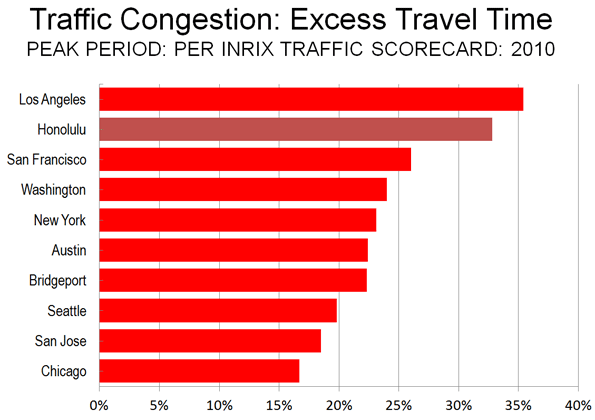
    No Traffic Relief: Despite being only the 52nd largest metropolitan area in the nation, Honolulu has the second worst traffic congestion in the nation (see figure), according to INRIX, the leading international reporting source. Honolulu and Los Angeles are the only US metropolitan areas ranked in the worst 25 out of 200 in Western Europe and the United States. Even with the rail system, local plans call for traffic congestion to get worse.

    Getting the Choices Right

    Incumbent Mayor Peter Carlisle recently returned from a Potemkin Village tour of Manila, raving about that city’s rail system. Governor Cayateno, whose familiarity with Manila extends well beyond a scripted tour, called Mayor Carlisle’s comparison with Manila "comedic," noting that most residents cannot afford a car or that Manila has more than 10 times as many people.  


    Manila Rail System: Part the Mayor Did not See

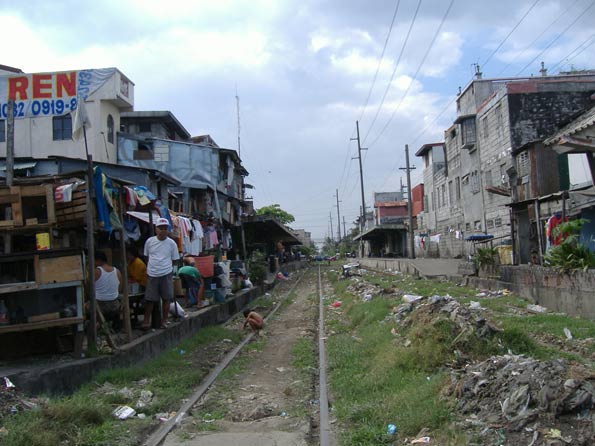
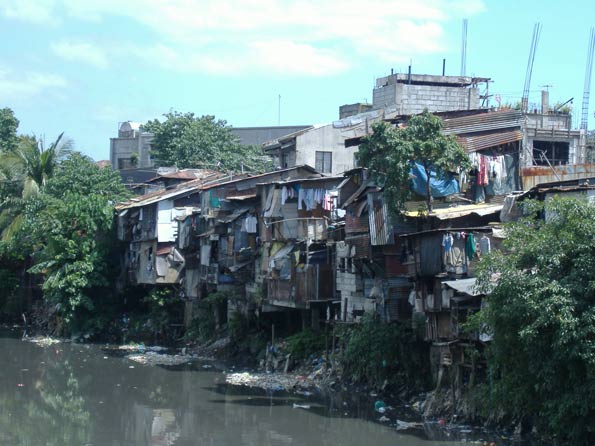
    The mayor may not have been aware that more than 4,000,000 – more than one-third – of Manila’s (National Capital Region) residents live in slums, shantytowns and informal settlements, where sewers are rare if not non-existent. Government projections indicate that the slum population will rise to 9,000,000 by 2050. More than one-half of Manila’s population will be in slums.


    Manila Slum

    In his recent "state of the city’" address, Mayor Carlisle mused "Manila without rail transit would be unthinkable." That may be the view of an itinerate visitor, but not of the majority who never ride it. For millions, a Manila with sewers is unimaginable. First world urban areas all have sewers. But many do not have rail systems. Honolulu could use some genuine prioritization and less contempt for the hard earned income of its residents.

    Wendell Cox is a Visiting Professor, Conservatoire National des Arts et Metiers, Paris and the author of “War on the Dream: How Anti-Sprawl Policy Threatens the Quality of Life

    —–

    Note 1: Illinois Senator Everett McKinley Dirksen, who was minority leader of the United States Senate in the 1960s is reported to have said: "A million here, a million there, pretty soon, you’re talking real money." The line has been often repeated, though the rise in government spending is indicated by the inflation from "millions" to "billions."

    Note 2: Manila’s rail system serves a very small market and represents a small share of transit ridership. The latest available data suggested that barely five percent of transit ridership was on rail.

    Top Photo: Visual of rail system in downtown Honolulu (courtesy of American Institute of Architects, Honolulu Chapter) 

    Photo credits: All others by author

  • The Ultimate Houston Strategy

    Last week was the 7th anniversary of my blog, Houston Strategies. After 947 posts (cream of the crop here), almost half a million visitors, and thousands of comments in an epic dialogue about Houston, I thought this would be a good time stand back, look at the big picture, and ask "What should be next for Houston?" while linking back to some of the gems from that archive.


    First, let’s look at where we are currently. Our foundation is in great shape. Houston has started the 21st-century with a set of rankings and amenities 99% of the planet’s cities would kill for: a vibrant core with several hundred thousand jobs; a profitable and growing set of major industry clusters (Energy, the Texas Medical Center, the Port); the second-most Fortune 500 headquarters in the country; top-notch museums, festivals, theater, arts and cultural organizations; major league sports and stadiums; a revitalized downtown; astonishing affordability (especially housing); a culture of openness, friendliness, opportunity, and charity (reinforced by Katrina); the most diverse major city in America; a young and growing population (fastest in the country); progressiveness; entrepreneurial energy and optimism; efficient and business-friendly local government; regional unity; a smorgasbord of tasty and inexpensive international restaurants; and tremendous mobility infrastructure (including the freeway and transit networks, railroads, the port, and a set of truly world-class hub airports). 

    To those I’d add:

    With all that, it’s really easy to get complacent. In fact, in some ways I think we might be coasting a bit now. But coasting is definitely not how we got here. Big initiatives are a proud tradition here: dredging the original port, founding the Texas Medical Center, establishing the Johnson Space Center, and being the first in the world to build a gigantic, futuristic, multi-purpose domed stadium – just to name a few examples. But what should be next? Where should the world’s Energy Capital put its energy, so to speak?

    I was recently inspired by the Urbanophile’s post on Indianapolis’ 40-year economic development and tourism strategy built around sports. Starting with nothing but the Indy 500 they’ve built a string of wins all the way up to hosting one of the most successful Super Bowls ever last month. We need that same sort of sustained, long-term strategy that goes beyond specific projects to a theme we can weave into everything we do over the decades ahead. We need to take the energy boom we’re currently enjoying and invest it to secure our long-term prosperity no matter how technology shifts in the future (most especially energy technology).

    In an unpredictable world, the only safe bet is a talent base that can adapt. With the Texas Medical Center, we concentrated health care talent in a district that has grown and adapted into the largest medical concentration in the world with an array of world class facilities. We’ve done the same on an even larger scale with energy and engineering talent. The next step is to take that strategy and generalize it to focus on being the global capital of applied STEM (Science/Technology/Engineering/Math) talent. We need to mobilize the city around a common purpose of building this human infrastructure. We need to embed it into our education, tourism, cultural and economic development strategies. It’s just a perfect fit for Houston on so many levels:

    In particular, I think we should focus on applied STEM – systems-based problem solving (engineering) over pure knowledge (where we are at a competitive disadvantage with many university clusters around the country). Facilitating man’s progress through innovative problem solving.

    Part of this strategy includes tourism, articulated in more detail here. We need the big tourism experience of other world class cities, and STEM is a unique niche we can build around, with a primary focus on families, schools, and STEM-related conferences. We already have some of the assets in place – JSC and Space Center Houston, the Natural Science Museum, the Health Museum, the Children’s Museum, Moody Gardens – and others with more potential, like the Texas Medical Center. But we need that signature attraction: the world’s largest institute/museum of technology. Not just a history-focused museum, but an institute actively involved in the community with a strong focus on the future. Local kids should spend frequent school days and summer camps there on fun and inspiring STEM activities. It could provide educational STEM experiences both online and on-site, helping to attract talented global youth to Houston for amazing experiences that draw them back later for college or after graduation. It should have the world’s largest hackerspace. It should be an inspiring space that attracts global academic and professional STEM-related conferences (building on the OTC) – groups trying to solve big problems and contribute to humanity’s progress (imagine a Davos or G8 of STEM…). Each conference could leave behind a new exhibit on its subject area, building the collections over time. And since it has the event space, we might as well open it up to festivals to expose more of our community to that same inspiration.

    The natural place for such an institute is clearly the Astrodome, our historic icon looking for a second life. We should embrace the Astrodome as Houston’s architectural icon like Paris does the Eiffel Tower, New York does the Statue of Liberty or Empire State Building, Rome does the Vatican or Coliseum, and San Francisco does the Golden Gate bridge. It can find a second life as our inspiring cathedral to man’s technological progress (along with some fun mixed in – Robot Rodeo anyone?). Most importantly, it has around a million square feet of space. Here’s how it compares to other top museums:

    But unlike every other museum in the world where exhibits are carved up into a series of halls, almost all of them could be visible in a giant 360-degree panorama while standing on the floor of the Astrodome.  How amazing would that space be?

    The cost, you ask?  Easily in the hundreds of millions.  But if LA can come up with $1.2 billion to build the Getty Museum, I have no doubt that Houston can muster the needed resources.  It’s a tiny fraction of the wealth of Houston’s 14 philanthropic billionaires, much less the broader base of wealth in this booming city.  We can come together to make this happen before the Astrodome’s 50th birthday in 2015, and it can put us on a path to greatness for our bicentennial in 2036 that Houston’s and Texas’ founding fathers could never have imagined.

    We, the citizens of Houston, aren’t the types to get complacent and rest on our laurels.  That’s not the legacy previous generations left us.  It’s time to step forward and tackle our next great challenge.  Are you in?

    Tory Gattis is a Social Systems Architect, consultant and entrepreneur with a genuine love of his hometown Houston and its people. He covers a wide range of Houston topics at Houston Strategies – including transportation, transit, quality-of-life, city identity, and development and land-use regulations – and have published numerous Houston Chronicle op-eds on these topics.

    Photo by telwink

  • Replaced by a Machine

    I love the Omaha World Herald – I read papers all over the world and this one is the best local paper I’ve seen. The bias is largely limited to the Opinion pages and they do original research on local topics. For national and world news, they have reporters outside the Omaha metro, but they also include the best of the news wire articles. The paper is a readable length, yet it contains enough stories that you know what’s going on but not so many that it’s a repeat of the nightly news from the national broadcast networks. Mostly, I like the way they let the reader connect the dots.

    A perfect example appeared on Sunday March 11, 2012 on page 10A in the print edition. Two stories occupy the three columns on the left side of the page. The story occupying the top of the three columns is about IBM’s Watson supercomputer (from Bloomberg news). Watson’s newest consulting client will be Wall Street bank Citigroup, Inc. “the third-largest U.S. lender.” Directly beneath that is a story from the Associated Press (AP) about Main Street abandoning Wall Street – seems that if individual “ordinary” investors do not start giving their money to Wall Street banks again soon, the re-inflated stock market bubble will deflate – bye-bye Dow 15,000.

    How do these two stories relate? Well, Citigroup is feeding information to Watson on “sentiment and news not in the usual metrics” like what you post on Facebook or search on Google. Citigroup will use Watson to “analyze customers’ needs” and process that with their client data to figure out how to get you to put your money back where it makes them the most money in fees and commissions.

    Watson doesn’t come cheap – according to the Bloomberg News article, banks spent $400 billion last year on “information technology,” helping to generate $107 billion in revenue for IBM. How can banks afford to spend billions of dollars to get consultations with a computer? The answer is in the AP article in the bottom of the same columns: “corporate America has racked up double-digit profit gains” since the official end of the Great Recession in 2009.

    These two articles make me a little happy. The first one pleases the economist in me because an American company with a real product is going to thrive by charging Wall Street billions of dollars for something. The second article pleases me because it means that Main Street got the message – don’t eat the hot dogs at the Wall Street party because the fuel for the weenie roast is your future. Let the machines do it.

    [NOTE: Omaha.com links are available without registration for up to 2 weeks after publication. Access to the archives requires email registration.]

    Susanne Trimbath, Ph.D. is CEO and Chief Economist of STP Advisory Services. Dr. Trimbath’s credits include appearances on national television and radio programs and the Emmy® Award nominated Bloomberg report Phantom Shares. She appears in four documentaries on the financial crisis, including Stock Shock: the Rise of Sirius XM and Collapse of Wall Street Ethics and the newly released Wall Street Conspiracy. Dr. Trimbath was formerly Senior Research Economist at the Milken Institute. She served as Senior Advisor on United States Agency for International Development capital markets projects in Russia, Romania and Ukraine. Dr. Trimbath teaches graduate and undergraduate finance and economics.

  • Mapping the College Culture Gap

    Although the television series “Mad Men” has yet to take up the subject of college applications, I could well imagine an episode in which ad man Don Draper spends his day consuming vast quantities of Scotch and cigarettes, only to come home and have his wife say (while ignoring the lipstick on his collar): “I spoke to Millie today, and she had some good things to say about Williams.”

    When Britain still had an Empire, what mattered most was to get your daughters married and your sons into a good regiment. In Homeland America, all that matters to middle-class and affluent parents is getting their children into the best colleges that money can buy or that the Standardized Aptitude Test will allow.

    Friends of mine who have college-bound children talk only about test schedules, AP credits, summer programs for gifted children, sports highlight reels, and the easiest routes to Duke or Pomona.

    They search family trees for ancestral connections or minority status, and make charts of other friends who might know someone at Yale. Editors at the New Yorker are consulted about personal statements. During school downtime, kids are dispatched to examine China’s terra-cotta warriors or Seattle’s soup kitchens, all with the goal of padding the college application.

    I say all this as a parent who is about to launch his third child in the direction of the ivory towers, with no better idea than what guided us in sending off the first two. For years my wife and I have talked about colleges the way other couples play canasta. We use it to fill the lazy hours in the car or after dinner, as each of us is already familiar with each other’s reading lists and views about Rick Santorum.

    What prolongs these familiar exchanges is that we are the parents of American children who have grown up in Switzerland, attending public schools in French. The college conversation has become a proxy for whether we are Europeans or Americans. Whatever decisions we make, they feel like the wrong ones.

    When the children stay in Switzerland, I feel they have missed out on what I had in the American liberal arts, although when they leave for the States, it feels far away, expensive, and obsessed with the cult of Goldman’s Sachs-ism.

    Swiss secondary education is roughly similar to U.S. high school, although collège, as it is called in French, has a thirteenth year and every year students are weeded out of the university track. Our daughter Helen was the only member of her sixth grade class to graduate from a Swiss university. Of the 350 students who started with her in the tenth grade at collège, only about 200 graduated; the rest were relegated to apprenticeships or trade schools.

    For anyone in Switzerland who earns their high school diploma (known as a maturité gymnasiale), the entire university system is an open door, and tuition is $1000 a year. The country has little college testing and applications. To attend law or business school, a student merely adds his or her name to a list. The trick to staying at university is maintaining a B average, and only about two-thirds of each class does.

    University in Switzerland is much closer to American graduate school than a U.S. liberal arts education. Students specialize in a branch of study, say, law, economics, literature, or engineering. Classes, at least in the first year, are large lectures, and the best grades are given to those students who write down what the professor has said and recall this wisdom on the final exam.

    Readings only supplement the lectures. In later years, there are more seminars and papers, but the system recalls the hierarchy of a German universität more than a Berkeley teach-in. Facts count far more than expressing your feelings about Siddhartha.

    In physical layout, Swiss universities look like inner-city high schools. Few offer social clubs, sports programs, psychological counseling, toga parties, or alumni gatherings. Their goal is to teach a specified curriculum. If the Ivy League is best understood as the first class ticket of higher education, a Swiss university is more like Southwest or easyJet—the seats are cramped and the champagne is extra.

    With another daughter at an American college, I am struck—in comparison with the Swiss system—by the engagement that the U.S. professors have with their students, and at their goal of inspiring undergraduates to think for themselves. One professor said to my daughter, early on in her studies: “Laura, you’ve written a Swiss paper. I want an American paper. Tell me what you think.”

    Of course, such independence of mind costs $200,000 over four years, so that your child can then spend another eighteen months as an unpaid intern at Sterling Cooper, gaining what the market, as well as Balzac, might call “experience.”

    With our nineteen-year-old son, now in his last year of collège, we decided to split the geographical and financial differences between the U.S. and Switzerland, and encouraged him to apply to British universities, which are a cross between America’s liberal arts and Europe’s narrow focus.

    Three years’ tuition in England is about $50,000, and London is only an hour’s flight from where we live. We liked the idea that he would be studying in English and in small tutorials with eccentric professors. When I went with my son to his interview at Cambridge (he did not get in), I was struck by how detached Britain is from the rest of Europe. Not a single Swiss student has been admitted to the university in three years, and the translation of Swiss transcripts into English grades makes it clear that it might be another decade before any more are admitted.

    Britain, like America, suffers from grade inflation, so everyone comes out of high school sounding terrific, with great marks and astonishing teacher recommendations. By contrast, the Swiss take great pleasure in grade deflation (the motto might be: “Every Child Left Behind”), and do a terrible job of promoting their students to the rest of the world.

    An excellent average in a Swiss collège gets reported to Britain or the U.S. as someone with C+ grades. My daughter finished third in her Swiss class, and her recommendation letter from the school, in its entirety, read: “Laura Stevenson has fulfilled all the requirements of Collège de Saussure.” Little wonder that she was turned down at many American universities.

    What do I want from a university for my children? I want them to be able to write clear, forceful English (or French) that is informed and, if they choose, amusing. I want them to have the intellectual ability to challenge accepted assumptions—for example, that the New Deal ended the Depression, George Washington had a great military mind, or Shakespeare wrote all his plays.

    I would like them to learn to read critically, so that can they scoff at cant and pretense: for example, to see that Yale man Bob Woodward writes in language that looks as if it has been translated from Slovakian. I would also like them to view their education as a plant that needs watering on most days following graduation.

    If my older son goes to college in England, we might be tempted to send our last child, also a son, to university in either France or Germany. That way, each of our children will have been educated in a different system. Then, in ten years, as we judge their successes or failures, we can rail about the rigidity of the Confederation of the Rhine, the British class system, Swiss banality, or U.S. careerism—or we can sing the praises of German rigor, the legacy of the English enlightenment, Swiss precision, or the iconoclastic American mind.

    Photo: Prof Believeau’s Yale University by Ina Centaur

    Matthew Stevenson is the author of Remembering the Twentieth Century Limited, a collection of historical essays. He lives in one of the wine regions of Switzerland. His next book is Whistle-Stopping America.
  • Owen McShane: 1941-2012

    Newgeography.com lost a one of its first columnists, a regular contributor and good friend with the passing of Owen McShane.

    Owen McShane (Robert Ivan Owen McShane) was born in 1941 and died on March 6, 2012. His long and successful career in public policy was built on a strong academic foundation. He graduated from the University of Auckland, earning degrees in architecture and urban planning.  He continued on to be awarded a masters degree in city and regional planning at the University of California, Berkeley. There he studied under fabled Aaron Widavsky, chairman of the Political Science Department. His master’s thesis dealt with a US federal program intended to reduce unemployment and promote business development in central cities.

    He joined the new City Development Division of Auckland City Council after graduating from the University of Auckland. After returning from America, Owen held positions in both the public sector and government. He was a columnist for the National Business Review  and has been published in many magazines and newspapers.

    In recent years, Owen directed the Centre for Resource Management Studies in New Zealand. The Centre seeks to promote "a heightened awareness and understanding" of the environment and is committed to the "the promotion of scientifically robust, research-based and rational decision-making processes at all levels in matters concerning the environment." Owen was also a regular participant and presenter at the annual American Dream Coalition conferences.

    Owen developed an understanding of economics, which assisted him in avoiding the disconnected romanticism that sometimes characterizes architecture and urban planning. Combining economics with architecture and urban planning made his contributions more effective by adding the crucial human element.

    From Owen’s perspective, rational urban policy was not determined by remote or theoretical visions of the city that he was trained to plan. The success of a city was rather judged by the standard of living experienced by its residents. For example, his How Can Cities with Unaffordable Housing be Ranked Among the Most Livable Cities in the World? (newgeography.com, June 9, 2009) may have been the first to point out that popular indexes of the quality of life in international urban areas routinely ranked the most unaffordable at the top. This kind of analysis led Owen to postulate that " genuine sustainable development" had to work from middle class people and families too" in The Disappearance of the Next Middle Class (newgeography.com, August 24, 2010).  

    Owen McShane was an untiring advocate of ordinary people, championing individual aspirations in a world that has increasingly been captured by bureaucratic theories that take little or no account of their preferences or their economic advancement.

    Owen will be greatly missed both in New Zealand and far from its shores.


    Photo: Courtesy of the Heartland Institute

  • Time for Real Solutions to Vancouver’s Housing Affordability Crisis

    Vancouver is in desperate need of new solutions to ease its worsening housing affordability crisis. The 8th annual Demographia housing affordability survey released by the Frontier Centre found that Vancouver has the second least affordable housing market next to Hong Kong. On average, and assuming zero interest, a house in Vancouver would cost the median family more than ten years income. Three years is the threshold after which a market is considered unaffordable.

    Mayor Robertson recently announced the launch of a new task force to tackle the housing affordability crisis. The only way to tackle this problem is to focus on getting more housing units on to the market.

    Much of the debate around housing affordability descends into discussions about manipulating housing prices by freezing out market mechanisms. Rent control used to be a popular remedy, until cities realized that the side effects of the cure were worse than the disease. Two common methods of attempting to tackle housing today are social housing and inclusionary zoning. Social housing has been responsible for creating some of the most crime ridden neighbourhoods in the Western world. There is a reason "the projects" have such a bad name. Yet politicians of all stripes tend to promise more "affordable housing" as they call it, knowing that it will at best benefit a narrow group of people who qualify. Inclusionary zoning—requiring developers to build a specific number of below market rate units in new developments—has been one of the methods that municipal governments have attempted to compensate for this shortcoming. It also misses the point. It fails to bring broad price levels down, since it increases prices substantially for market rate units in the same development. One study from San Jose State University economists found that inclusionary zoning increases the price of market of new homes by $22,000-$44,000 in the median city. That is simply how developers pass off the cost of losing money on affordable units.

    The policies mentioned above ignore the fundamental issue: houses are priced by supply and demand. In a desirable city like Vancouver, prices are bound to be higher than in Omaha, Nebraska, or Saskatoon. But the dramatic price escalation that started in the 90s isn’t beyond the city’s control. There are many ways to get more supply on the market. One of the commendable policies undertaken by the city has been the introduction of laneway houses. These are small units that are hived off from existing houses. They are essentially small secondary suites that back in to laneways. But it won’t be anywhere near enough on its own. Vancouver needs to develop more land. The land is there, but it is off limits to development because of the agricultural land reserve (ALR). That needs to change.

    The ALR serves two purposes. The first is to preserve agricultural land. The benefit from it is contingent on whether the benefits from local agriculture outweigh the costs of taking land off of the market. From a nutritional and an economic perspective that simply isn’t the case. Flash frozen foods are often more nutritious than "fresh" local food, and intensive farming is more economical and sustainable than small scale farming. We would not be able to accommodate anywhere near our current population without industrial agriculture. This justification simply fails.

    The second justification for the ALR is to prevent urban sprawl. In a sense this works, since there is no sprawl development in the ALR. On the other hand, this approach is conducive to "leap frog" development which takes place beyond the growth boundary. It happens anywhere that a growth boundary exists. People commute further for cheaper housing. This is as true in the smart growth Mecca of Portland as it is in Toronto or Ottawa. From an economic perspective, there are reasons to worry about sprawl. People who move out into cheaper housing on the urban fringe typically pay less property taxes, and often cost municipalities more per capita. But the ALR hasn’t solved this problem. Metro Vancouver outside of the city proper accounted for 87% of the metropolitan area’s growth between 2006-2001. Simply put, the ALR simply hasn’t prevented sprawl.

    In order to balance the concerns of housing affordability and urban sprawl, the city of Vancouver should strike a compromise: open portions of the ALR, but only to high density development. This may not be the optimum solution for families that would prefer to purchase single dwelling homes, but a significant influx of new units would be a countervailing force against runaway home prices. This would also put downwards pressure on housing in the rest of Greater Vancouver. Though opening up broad swaths of the ALR may be the ideal, this seems like a reasonable compromise.

    This type of solution would rile people on both sides of the political spectrum, but it would be a dramatic improvement over the status quo. High home prices can only be solved from the supply side. The choice between maintaining the ALR as constituted or opening up portions should be obvious. Infill development can only go so far towards solving Vancouver’s housing crisis.

    Steve Lafleur is a Policy Analyst with the Frontier Centre for Public Policy.

    Downtown Vancouver photo by runningclouds

  • No G-8 Summit for Chicago

    Veteran Chicago journalist Ben Joravsky explains why Chicago’s better off without the G-8 summit:

    One, we’re not equipped to handle it. Two, we can’t afford it. And, three, it has the potential to give the Republicans great campaign material for the coming election.

    President Obama has done Mayor Emanuel a great favor, because there’s no real upside to the summit for Chicago. Banks on La Salle Street were planning to close. Many major corporations located downtown were telling their employees to stay home. The fear of violence from the demonstrators was bound to dampen economic activity. There’s no real need to showcase Chicago, international travelers are well aware of the town.

    Some may view as an embarrassment to Emanuel. The Chicago Sun-Times reported to President Obama only gave Emanuel “an hour’s advance notice.”  But Emanuel is the lucky one. Violent demonstrations or not, the G-8 would have put the spotlight on Chicago. Do we want to shine a light on the recent loss of  200,000 people? The high retail sales tax? The bad public schools? The relentless legacy of public corruption?

    President Obama helped his former Chief of Staff dodge a major bullet.

  • The Evolving Urban Form: Hong Kong

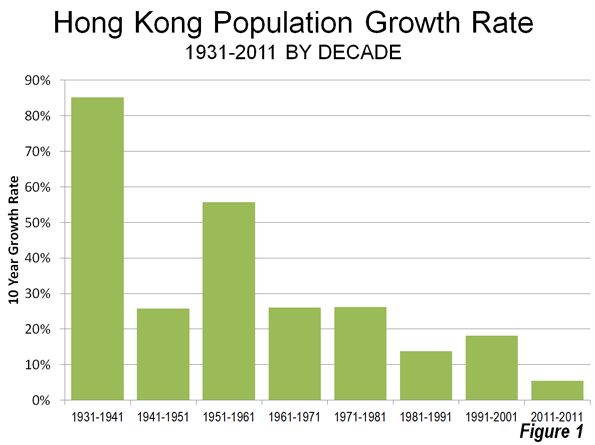
    Hong Kong has experienced its slowest decadal growth in at least 70 years, according to the results of the recently released 2011 census. Between 2001 and 2011, Hong Kong added only 5.4 percent to its population, a decline of more than two-thirds from its 1991-2001 rate. Hong Kong’s slowest growth rate since 1921-1931 was between 1981 and 1991, when 13.8 percent was added to its population. In previous decades growth had been much greater (Figure 1).

    Further, despite Hong Kong’s much larger population base today, the numeric growth from 2001 to 2011 was also the smallest since the 1921-1931 decade. Hong Kong added 363,000 residents for a total of 7,072,000 in 2011. The increase is barely one-third of the 1,034,000 residents added between 1991 and 2001. Much of Hong Kong’s population growth in the last 60 years had been driven by its better standard of living relative to mainland China. It seems likely that the growing prosperity of the past decade on the mainland has made Hong Kong less attractive for migrants.

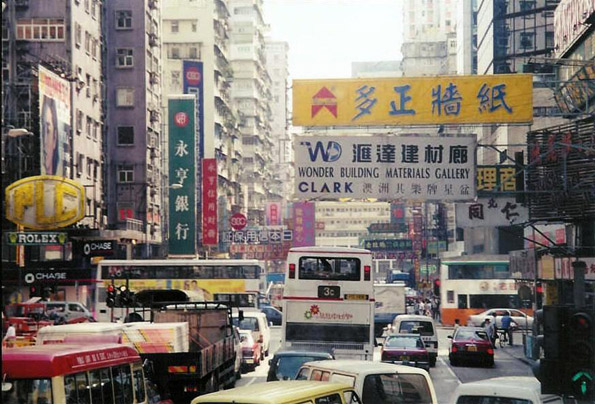
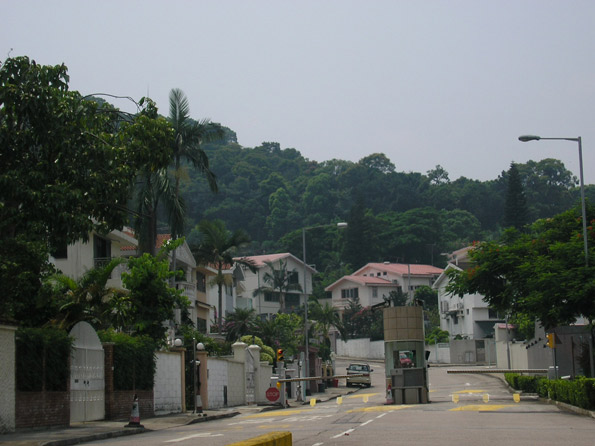
    High Income World’s Most Dense Urban Area: Hong Kong continues to be the densest major urban area in the high-income world. The present density is estimated at 67,000 per square mile (26,000 per square kilometer). At least one small area of Hong Kong has a population density exceeding 1 million per square mile (400,000 per square kilometer), though the much more dense Kowloon Walled City (estimated at up to 5,000,000 per square mile or 2,000,000 per square kilometer) was demolished in the 1990s. Even so, there are now detached housing developments, as Hong Kongers who can afford it choose these much more expensive accommodations, as Witold Rybczynski relates in a recent commentary (detached housing photo).

    Detached Housing

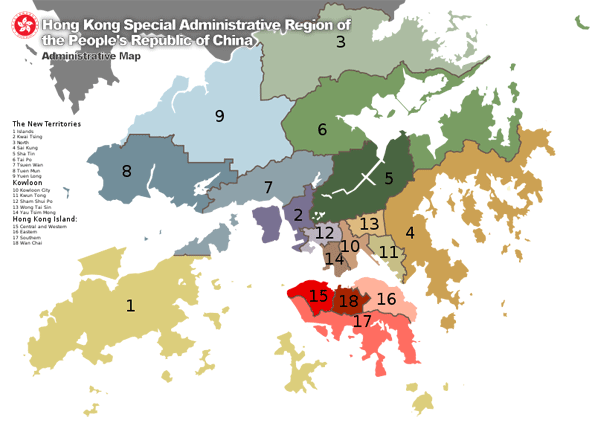
    Subdivisions of Hong Kong: The Hong Kong Special Administrative Region (HKSAR) is a unified government, with no local jurisdictions (such as cities or towns).  However, there are four broad regions and within each there are districts, are designated for statistical purposes.

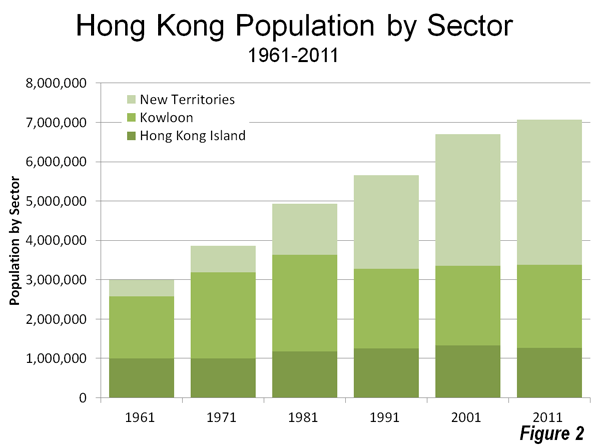
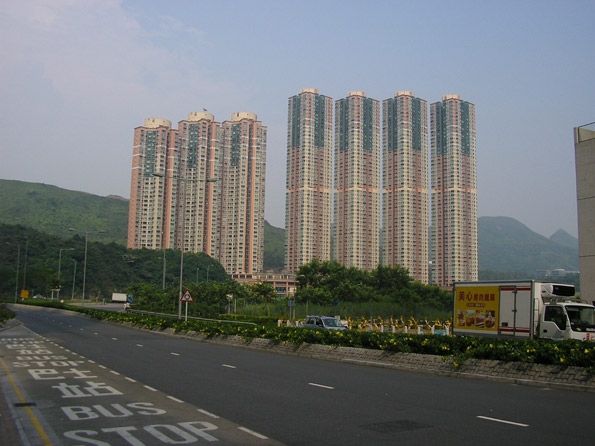
    Hong Kong’s growth — like that of most major metropolitan areas — has been shifting to the periphery for decades (Table 1). Between 1981 and 2011, all of the population growth was in the New Territories, the new (greenfield and high density) suburban areas beyond the Hong Kong Island-Kowloon core. While all of Hong Kong was adding 2.1 million residents in total between 1981 and 2011, the New Territories added 2.4 million (Table 2). This suburban dominance continued in the last census period, with 96 percent of growth in the New Territories. Before that, the bulk of the growth was in the outer areas of Kowloon, which were then the suburbs (Figure 2).

    Table 1
    Hong Kong Population by District: 1911-2011
    Year Total Hong Kong Kowloon New Territories Marine
    1911 456,700 244,300 69,400 81,200 61,800
    1921 625,200 347,400 123,400 83,200 71,200
    1931 840,500 409,200 263,000 98,200 70,100
    1941 1,600,000 Estimate: No complete census
    1951 2,013,000 Estimate: Census cancelled
    1961 3,129,600 1,004,900 1,578,000 409,900 136,800
    1971 3,936,600 996,200 2,194,800 665,700 79,900
    1981 4,986,600 1,183,600 2,449,100 1,304,100 49,700
    1991 5,674,100 1,251,000 2,030,700 2,374,800 17,600
    2001 6,708,400 1,335,500 2,024,000 3,343,000 5,900
    2011 7,071,600 1,270,900 2,108,400 3,691,100 1,200
    Sources:
    Government of Hong Kong
    www.cicred.org/Eng/Publications/pdf/c-c21.pdf
    Table 2
    Hong Kong Population by District: 1991-2011
    Region & District Population: 1991 Population: 2001 Population: 2011 % 2001-2011 Land Area KM2 Land Area MI2 Density KM2 Density MI2
    HONG KONG 5,674,114 6,708,389 7,071,576 5.4% 1,098 424 6,440 16,680
    HONG KONG ISLAND 1,250,993 1,335,469 1,270,876 -4.8% 80 31 15,827 40,991
      Central and Western 253,383 261,884 251,519 -4.0% 13 5 20,089 52,031
      Wan Chai 180,309 167,146 152,608 -8.7% 10 4 15,230 39,447
      Eastern 560,200 616,199 588,094 -4.6% 19 7 31,265 80,976
      Southern 257,101 290,240 278,655 -4.0% 39 15 7,154 18,529
    KOWLOON 2,030,683 2,023,979 2,108,419 4.2% 47 18 45,138 116,909
      Yau Tsim Mong 282,060 282,020 307,878 9.2% 7 3 44,946 116,409
      Sham Shui Po 380,615 353,550 380,855 7.7% 9 4 40,175 104,052
      Kowloon City 402,934 381,352 377,351 -1.0% 10 4 37,849 98,028
      Wong Tai Sin 386,572 444,630 420,183 -5.5% 9 4 44,891 116,268
      Kwun Tong 578,502 562,427 622,152 10.6% 11 4 56,303 145,826
    NEW TERRITORIES 2,374,818 3,343,046 3,691,093 10.4% 971 375 3,801 9,845
      Kwai Tsing 440,807 477,092 511,167 7.1% 22 8 23,427 60,675
      Tsuen Wan 271,576 275,527 304,637 10.6% 61 23 5,019 12,999
      Tuen Mun 380,683 488,831 487,546 -0.3% 84 33 5,773 14,953
      Yuen Long 229,724 449,070 578,529 28.8% 138 53 4,179 10,824
      North 165,666 298,657 304,134 1.8% 137 53 2,215 5,737
      Tai Po 202,117 310,879 296,853 -4.5% 147 57 2,014 5,215
      Sha Tin 506,368 628,634 630,273 0.3% 69 27 9,074 23,501
      Sai Kung 130,418 327,689 436,627 33.2% 136 53 3,201 8,291
      Islands 47,459 86,667 141,327 63.1% 175 68 807 2,091
    MARINE 17,620 5,895 1,188 -79.8% 0 0 0 0
    Data from Government of Hong Kong Special Administrative Region


    The Core: Hong Kong Island: Hong Kong Island, home to one of the world’s most dense central business districts (Central, Western and Wan Chai districts) lost 4.8 percent of its population. All five of the districts on Hong Kong Island lost population, with Wan Chi (of "The World of Suzy Wong" movie fame) suffering the greatest loss, at 8.7 percent).

    The Core: Kowloon: Across Hong Kong harbor (see Star Ferry photograph, top), Kowloon, also a part of the core, gained 4.2 percent, adding nearly 75,000 residents (photo). Even so, Kowloon’s population remains more than 10 percent below its 1981 population. Three of Kowloon’s  five districts gained population, including Yau Sim Mong and Sham Shui Po, which along with the north shore districts of Hong Kong Island are the most intensely developed in the HKSAR.

    Suburban: The New Territories: The New Territories added 10.4 percent to their population (348,000), with seven of the nine districts gaining. The largest gain (63 percent) was in the Islands district, which includes Hong Kong International Airport. Sia Kung, also grew strongly, at 33 percent (see photo). Sia Kung, like nearly built-out Sha-Tin, is conveniently located just over a narrow mountain range from Kowloon and contains considerable amounts of greenfield land for development.

    Kowloon

    Sia Kung

    Yuen Long, home of the new Shenzhen Bridge had the third highest growth rate, at 29 percent. The Islands, Sia Kung and Yuen Long all have all experienced much improved access from extensions to the Mass Transit Railway (MTR) and the former Kowloon-Canton Railway (KCR), which have now merged into the MTR.

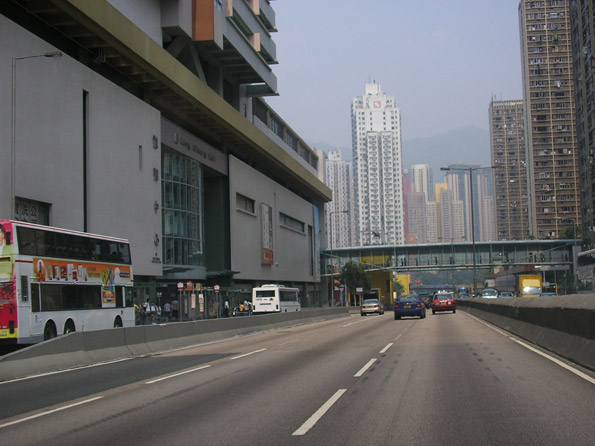
    Transportation in Hong Kong: Hong Kong is the most transit dependent major metropolitan area in the high-income world. Mass transit carries 72 percent of motorized trips. Even with the high residential and employment density, the average work trip is approximately five miles each way. Moreover, despite having one of the most effective mass transit systems in the world and extraordinarily high densities, the average one-way work trip travel time is 46 minutes, 18 minutes longer than Los Angeles or Houston. With the highest transit market share in the world and an automobile market share only 1/70th that of Houston, Hong Kong’s density still  produces among the highest levels of traffic congestion in the world — 1.5 times the traffic density of Los Angeles and three times that of Houston (photo).

    Hong Kong Traffic Congestion

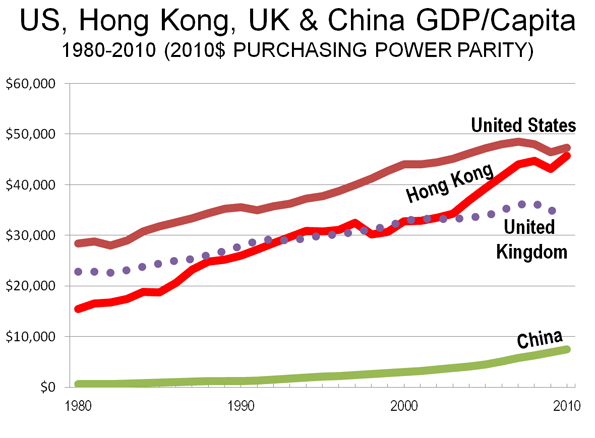
    Economic Growth: Hong Kong has experienced strong economic growth for  the last three decades. In 1981, Hong Kong’s gross domestic product (GDP) per capita was one-third below that of the United Kingdom, its then colonial master. Even by this time, Chinese leader Deng Xiao Ping had been so impressed by Hong Kong’s market based economic advance, that he had designated adjacent Shenzhen as a special economic zone. That area has since grown from a fishing village to a population exceeding 10 million, according to the 2010 census. In the intervening years, the Pearl River Delta has emerged as the most populous extent of urbanization in the world, stretching from Hong Kong, through Shenzhen, Dongguan, Guangzhou, Jiangmen, Zhongshan and Zhuhai to Macao. However, because of border controls and the low level of commuting, these remain separate metropolitan areas and  urban areas.

    Hong Kong’s economic growth continued strongly in the middle 1990s, when its GDP per capita exceeded that of the United Kingdom. Hong Kong fell behind in the late 1990s Asian economic crisis, but soon recovered. By 2010, Hong Kong’s GDP per capita had risen to 27 percent above that of the United Kingdom.

    Hong Kong’s economic performance relative to the United States may be even more impressive. In 1980, Hong Kong’s GDP per capital trailed that of the United States by 45 percent. As of 2010, Hong Kong trailed the US by only three percent and according to International Monetary Fund data should pass the United States early in the present decade. Between 2000 and 2010, Hong Kong’s per capita GDP (PPP-2010$) rose more than one-third — only South Korea and Singapore did better among high-income areas, according to International Monetary Fund data. China’s percentage growth rate was  nearly five times Hong Kong’s but in actual dollars Hong Kong’s GDP per capita rose at triple China’s rate. However, should China’s economy slow down, as some analysts suggest, it could be difficult for Hong Kong to sustain this strong growth rate (Figure 3).

    The People’s Republic of China has maintained Hong Kong’s free market economic system, helping assure strong growth. It seems unlikely that either Deng Xiao Ping or Margaret Thatcher imagined that such economic progress would be made when they signed the historic agreement to restore Hong Kong to China in 1984. Nor is it likely they imagined China’s meteoric rise.

    Unique Hong Kong: Hong Kong is the living model of compact development and transit dependence toward which urban planning wisdom strives. However, Hong Kong itself is the outlier of outliers. Hong Kong’s population density — double that of any other high-income world urban area of similar size or larger — would never have approached this level if it had not been separated from China itself by colonization and then the historical complexities of the post-World War II period. Even in its prosperity, the growing urban areas of mainland China are being built at densities averaging no more than one-quarter that of Hong Kong. Hong Kong may be more an accident of history than an exemplar.

    Wendell Cox is a Visiting Professor, Conservatoire National des Arts et Metiers, Paris and the author of “War on the Dream: How Anti-Sprawl Policy Threatens the Quality of Life

    —-

    Photo: Star Ferry, operating between Hong Kong Island (Central) and Kowloon (Yau Tsim Mong). All photos by author.

    Hong Kong district map by Wikipedia user Moddlyg.