Blog

  • Orléans, Ontario: A Franco-Ontarian Suburb

    In a mere forty years Orléans has gone from an overwhelmingly French-speaking village to a suburb of Ottawa where scarcely one-third of the population has French as its mother tongue. Nonetheless, the French presence remains vibrant and local francophones are exceptionally dedicated to preserving their language and culture and building on their achievements. No other place in Ontario boasts cultural programs and facilities like those that serve Orléans’ francophone community. The fight twenty years ago to have the provincial government spell “Orléans” with the accent on the “e” is an eloquent example of the community’s determination to stand up for its rights with regional and provincial authorities. 

    Orléans Today 

    Orléans has never been a municipality. Originally a village whose loosely defined limits overlapped Cumberland County and the town of Gloucester, it joined Ottawa in 2001. Today Orléans’ three neighbourhoods together form Ottawa’s largest eastern suburb. While not the only Franco-Ontarian suburb, Orléans is certainly the one where tradition and modernity are the most closely melded. The result is a very rich culture that has opened the doors of opportunity to the francophone minority at a time of profound change to the identities and sense of belonging of Franco-Ontarians.
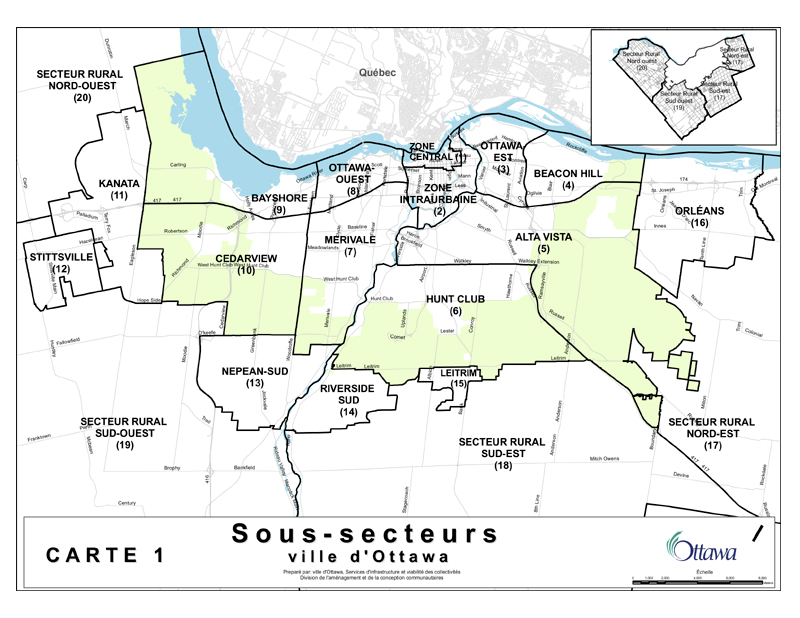
    Sub-areas of Ottawa

    Sub-areas of Ottawa

    From Village to Suburb 

    Since the 1970s, Orléans’ population has exploded: from 6,000 in 1971 it rose to 24,000 ten years later, and by July 1, 2010, the number exceeded 106,000. This dramatic growth transformed land use. Large tracts of farmland were snapped up by developers. They sold new houses to Ottawa residents who dreamed of having a home with a yard offering access to both their city­ workplaces and to a piece of nature on the outskirts of town. A highway link to downtown Ottawa and the sense of security that came with suburban life added to Orléans’ appeal.

    Orleans Fruit Farm, Ottawa, Ontario

    Orleans Fruit Farm, Ottawa, Ontario

    The small town of Orléans thus became a bedroom community much like the ones surrounding every major city in the country. The once varied townscape gave way to a suburban sameness: apart from the old village centre and a few taller buildings in the suburb’s outer reaches the same street design, housing style, and landscaping predominate. Despite developers’ best efforts to build “communities,” Orléans’ highly unified landscape reflects the socioeconomic homogeneity of its residents. This suburb is a paradise for middle and upper-middle class families who have found an environment in keeping with their aspirations. In 2005 the average household income in Orléans was $103,792 compared to $85,136 in Ottawa. 

    Francophones Lose their Majority Status 

    The recent population explosion altered Orléans’ linguistic makeup. Franco-Ontarians came from both nearby and further afield, drawn by the appeal of a French-speaking suburb. Orléans’ location midway between downtown Ottawa and the French-speaking outskirts of Prescott-Russell only made the area more attractive. Yet Orléans has also drawn anglophones in large numbers. Data from the 2006 census reveal the extent of the anglophone influx, with just 32.4% of the population reporting French as their mother tongue. Francophones and anglophones are spread evenly throughout Orléans: only the area around the former village centre, where institutions catering to francophones are concentrated, is noticeably more francophone than the rest. In a survey by University of Ottawa researchers in the 1990s, francophones stressed that their neighbourhoods were bilingual. In the eyes of its Franco-Ontarian residents, Orléans is a place where francophones and anglophones live side by side. There is no real evidence to suggest that this view has changed.
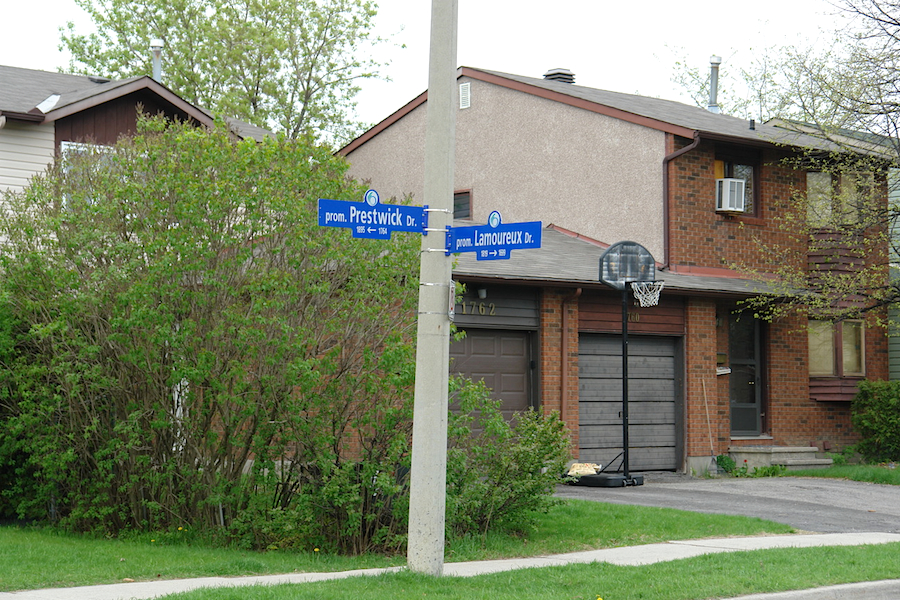
    Francophones and anglophones in peaceful coexistence: Prestwick and Lamoureux in the Fallingbrook neighbourhood

    Francophones and anglophones in peaceful coexistence: Prestwick and Lamoureux in the Fallingbrook neighbourhood

    New Institutions 

    In Orléans residents can live in French. The francophone community has established numerous institutions over the years to serve a wide range of community needs. Today Orléans is home to 12 French-language elementary schools, three high schools and a vocational institute that opened in September 2010, as well as many French-language daycare centres. Montfort Hospital will soon open the brand-new Orléans Family Health Hub offering a full range of primary and community healthcare services in both languages. Orléans’ francophones also enjoy access to a wide array of sports, leisure, culture or just plain fun activities en français. For example, around 150 francophone families register their children for soccer with Étoiles d’Orléans, either for the winter season (indoors in the gyms at Étoiles de l’Est and Béatrice Desloges schools) or for the summer (on the field at École les sentiers). This nonprofit organization expressly targets young francophones and offers them a complete team sports experience—including practices, games, tournaments and social gatherings for parents and volunteers—in their own language. Orléans also offers many French-language events at the new Shenkman Arts Centre, programmed by Mouvement d’implication francophone d’Orléans (MIFO). 

    Artist’s rendition of the Lower Lobby Reception Space of the Shenkman Arts Centre
    Artist’s rendition of the Lower Lobby Reception Space of the Shenkman Arts Centre

    MIFO was created in 1979 by a handful of francophone residents concerned by the influx of anglophones into the suburb. Since then the organization has become the focal point for the francophone community. The cultural centre founded on Carrière Street in 1983 remains MIFO’s nerve centre and home to most activities in addition to a theatre (Théâtre du Village), seniors’ centre (Centre Séraphin-Marion d’Orléans), and bookstore (Librairie du Vermillon). The organization also operates a music school: in 2011 it welcomed over 300 students of all ages and abilities for singing, piano, guitar, bass and recorder lessons. Throughout its existence MIFO has been unflagging in its commitment to promoting French-language culture and its expression in Orléans.

    Institutions both old and new—including a new parish of Sainte-Marie d’Orléans which was founded in 1987 and opened a new church in 1998—help shape the francophone social milieu. These institutions are critical to the survival of the francophone community as their surroundings and way of life undergo a fundamental shift. 

    A Divided Landscape 

    Saint-Joseph Church, the Chevaliers de Colomb, Caisse populaire Desjardins, and Orléans’ other francophone institutions line Saint-Joseph Boulevard. A good number of francophone professionals (lawyers, accountants, doctors, insurance brokers) also operate in “the village,” as do many francophone-owned businesses, some of which have served customers in French for generations. These businesses help maintain the “village” feel, a living bridge to the rich history of the local francophone community. 
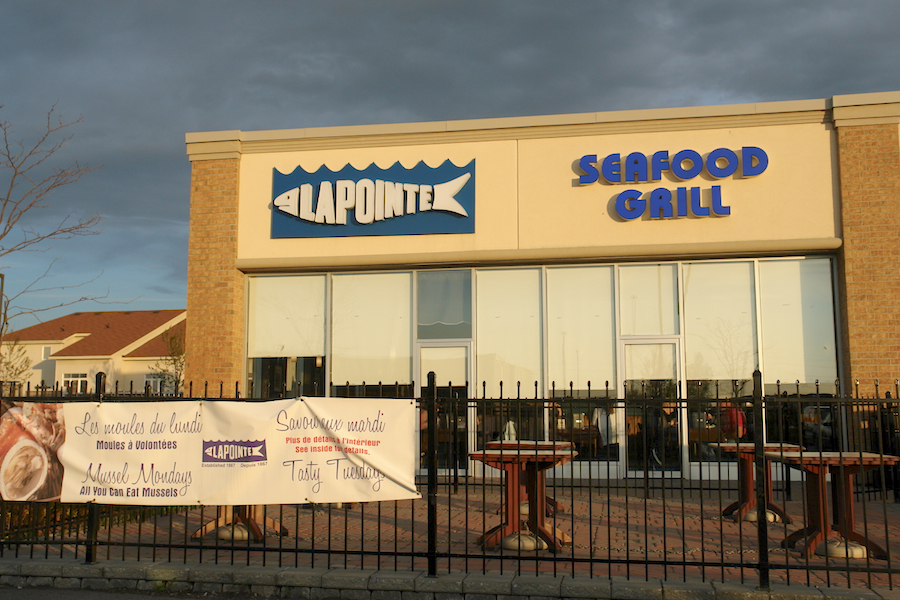
    The future for bilingual signs in Orléans looks bright: an example at Lapointe Seafood Grill

    The future for bilingual signs in Orléans looks bright: an example at Lapointe Seafood Grill

    Further south, though, a whole other Orléans can be found. Here the traditional and varied face of the older neighbourhoods gives way to the big box stores typical of North-American suburbs. New development is concentrated along Innes Road, a kingdom of mega malls stretching several kilometers from east to west. All the big name stores that have risen to national prominence in the last few years are there, from HomeSense to Rona, Winners to Future Shop. In contrast with the “old village,” the French language is much less visible in this “new Orléans.” Street names, parks and public buildings offer no hint of the French presence, an issue that concerns the newly minted Société franco-ontarienne du patrimoine et de l’histoire d’Orléans. Still, there is life in French on Innes Road, as shown by Caisse populaire Orléans’ decision to open a branch. Lapointe Fish, an Ottawa institution, has also opened a shop in the new Orléans. The Ste Marie Health Centre, home to a number of francophone doctors and pharmacists hailing from other countries, advertises itself as a bilingual facility. Finally, Empire Theatres, a major national chain, hosts the Festival du film francophone d’Orléans, while Objectif cinéma shows two French-language films per month year-round to large audiences.

    French Language Signage: An Ongoing Challenge 
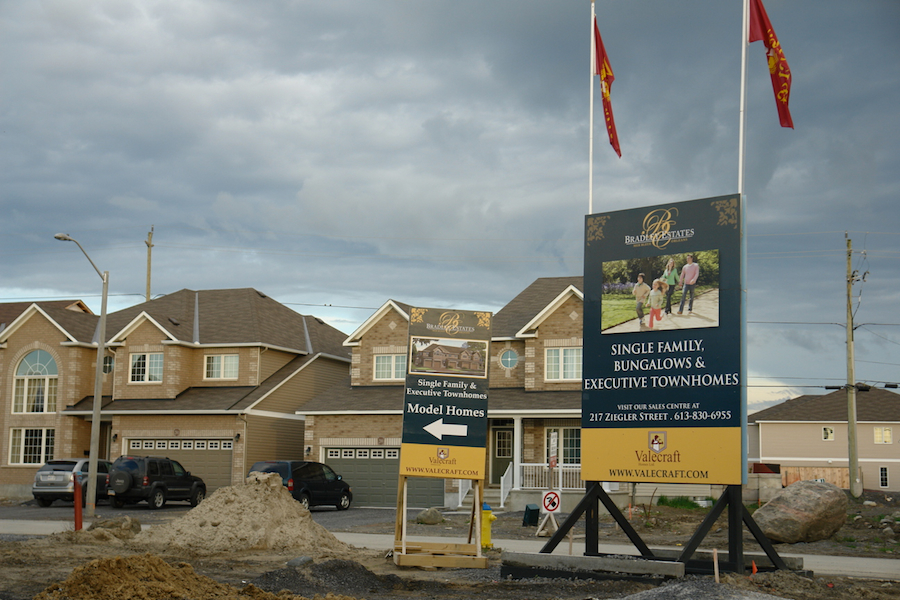
    New development

    New development

    Those who go looking for French-language signs in Orléans face disappointment. The studies are unanimous: French is largely absent from the face of this bedroom community. With the exception of the bilingual signs at federal, provincial and municipal institutions (in the last case, the result of the City of Ottawa’s bilingualism policy), and at various businesses in the old village, unilingual English signage predominates throughout Orléans. No sector is immune, from automotive services to furniture stores to interior decorators to sports and leisure centres—even personal services. The same goes for the stores at Place d’Orléans, a major mall adjacent to the village. Throughout the commercial landscape, only a few businesses (like oil companies) persist in showing a French face to the public.

    Not even the Orléans Chamber of Commerce or the developers who so avidly court new residents bother to include French on their signs. Their websites are also in English only, with the notable exception of Brigil, a well-known Gatineau contractor and developer. No one seems interested in promoting the concept of living en français. While many boast of Orléans “quality of life,” it appears that culture is not part of the equation—though some Franco-Ontarians may beg to differ.

    Poster promoting MIFO’s 2011–2012 programming
    Poster promoting MIFO’s 2011–2012 programming

    Living Together, Getting Along 

    Orléans’ francophones seem unphased by this linguistic imbalance in commercial signage. They have by and large adopted the same behaviours as Franco-Ontarians elsewhere, using French or English depending on the circumstances. Most are so bilingual that they can effortlessly and comfortably pass from one language to another in the course of a conversation. This behaviour attests to a veritable “bilingual identity” that has been described by studies on this community.

    While language may be an issue for a number of Franco-Ontarian organizations in Orléans, it is not a bone of contention for them, any more than it is for individual citizens. Orléans is a place where francophones and anglophones live, work and play together in harmony. MIFO, among other groups, has become much less confrontational since 2010 when its new status as a charitable organization forced it to sideline political actions. Orléans exemplifies a new way to live in French in Ontario, one characterized more by a desire to work together with the anglophone majority than to make demands and fight to achieve them.

    A Promising Future for a Thriving Franco-Ontarian Community 
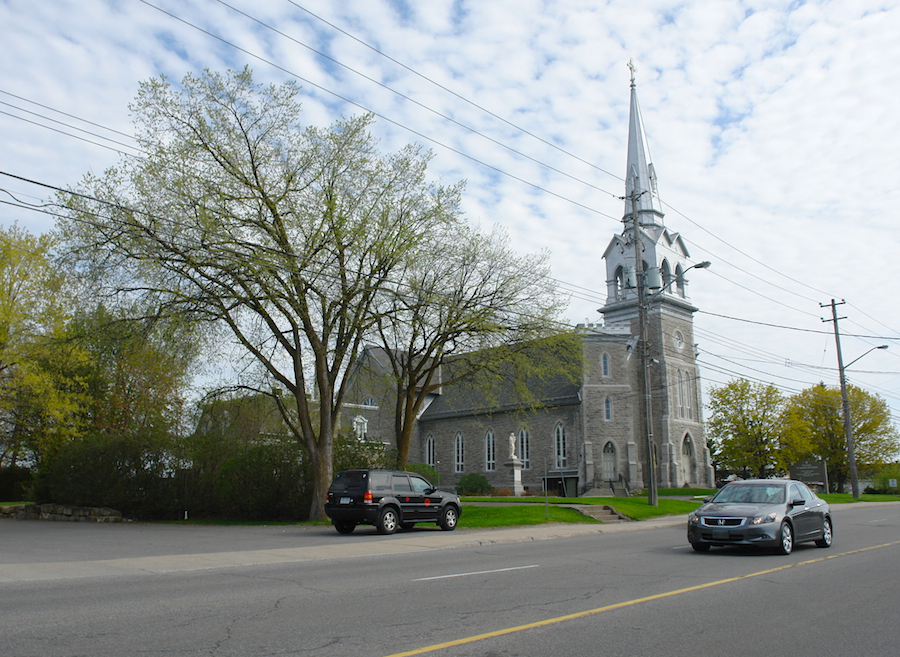
    St-Joseph Church in Orléans, a suburb of Ottawa

    St-Joseph Church in Orléans, a suburb of Ottawa

    Orléans is unusual for the diversity of opportunities and elements it makes available to the francophone community, like so many threads that can be woven into a new cultural fabric and identity. On the one hand the suburb abounds in geographical markers reminding francophones of the more traditional side of their identity: their French origins and Catholic past, as well as the sometimes epic battles their parents fought to establish the French-language institutions vital to living their everyday lives in their own language. On the other hand Orléans’ public spaces show the signs of a resolutely contemporary francophone culture and community characterized by openness to others (both francophone and francophile alike) and intercultural exchange. Orléans is attracting an increasing number of francophone immigrants, who in turn are transforming the culture from within. Today, the suburb that was once a village reconciles both sides of this identity, fuelling diverse manifestations of the Franco-Ontarian imagination. In this way Orléans plays an integral role in the renewal of the Franco-Ontarian community and constitutes a clear sign of its bright future.

    ——–

    This piece is courtesy of the Encyclopedia of French Cultural Heritage in North America.

    ——–

    Bibliography

    Farmer, Diane (1996) Artisans de la modernité : les centres culturels en Ontario français. Ottawa, Les Presses de l’Université d’Ottawa. Le chapitre 7 porte sur le MIFO, « entre francité et urbanité ».

    Gilbert, Anne (1999) Espaces franco-ontariens. Ottawa, Le Nordir.  Le chapitre 5, intitulé « Ville et banlieue » est consacré à une comparaison entre Vanier et Orléans.

    Gilbert, Anne, sous la direction de (2010) Territoires francophones. Études géographiques sur la vitalité des communautés francophones du Canada. Québec, Septentrion. Le chapitre 5 porte sur le paysage linguistique en Ontario français, avec des allusions à celui d’Orléans. Le chapitre 13 porte sur un éventail de communautés franco-ontariennes, dont Ottawa.

    Orléans, 150 ans d’histoire. 1860-2010. Comité du livre du 150e anniversaire d’Orléans, 2010.

    Orléans, Publi-reportage Le Droit, 24 novembre 2010

    Secteur Orléans, Cahier publicitaire Le Droit, 5 avril 2011

  • Local Chambers of Commerce: Not Born for Ourselves Alone

    Most people are more interested in organized crime than in organized business. Chambers of commerce do not often attract headlines except for the occasional, inevitable dustup with a public authority.  For that reason, this April’s 100 year anniversary of the founding of the U.S. Chamber of Commerce may pass without much public attention.  This would be a shame, as groups of companies have left their fingerprints all over the American civic landscape, and were busy even at the birth of Tom Donohue’s organization in 1912.

    President William Howard Taft, who called the U.S. Chamber into existence, was a frequent visitor to local chambers of commerce.  He once joked that even towns without any commerce had a chamber or a board of trade.  Indeed, during the Progressive Era these groups were proliferating wildly, and filled with excitement .

    Behind much of the excitement stood a man named Ryerson Ritchie.  Starting in 1893, he turned the Cleveland Chamber of Commerce into the most dynamic civic organization in the country.  One of its hundreds of activities was to vet the charities that approached its members, a policy that eventually led to its introduction of federated giving in 1913, which in turn led to Community Chests and the United Way.

    Ritchie, whose personality was as difficult as his ideas were brilliant, moved rapidly from chamber to chamber, becoming something of a Johnny Appleseed of the chamber movement.  Soon dozens of business organizations were proclaiming, Ritchie-like, that they weren’t old-fashioned boosters and “factory grabbers” any more.  Instead they were civic transformers, improving education, city government, city planning, you name it.  The Boston Chamber of Commerce even had a committee seeking a cure for the common cold.

    Chambers seized the innovations of commission government (initiated in Galveston in 1901 after the disastrous hurricane) and city manager administration (first set up in Staunton, Va. in 1908), spreading them into dozens, then hundreds, of communities.  These were seen as businesslike ways to improve the efficiency of local government .

    City planning was the rage, too.  The Washington Board of Trade was a prime mover in setting up a commission that, among other things, got the ugly railroad tracks removed from the Mall and helped set up the capital’s park system.  The Cleveland Chamber enlisted the eminent planner Daniel Burnham to help create the city’s Public Square.  And in Chicago, the Commercial Club and the Merchants Association united to fund and publish Burnham’s magnificent Plan of Chicago in 1909, considered by many to be the greatest achievement in this field for that era.

    Business organizations in this period were remarkably optimistic about their communities and their abilities.  The president of the San Francisco Chamber wrote after the earthquake and fire of 1906, “it could have been worse.”  In nearby Santa Rosa, a group of merchants formed a chamber after the quake and used the opportunity to widen streets for the new-fangled horseless carriages.  (The same chamber, including its founder, Frank Doyle Jr., would lead the push for the Golden Gate Bridge in the 1920s.)

    In the capital of commerce, the New York Merchants’ Association sprang up like a weed after Manhattan, Brooklyn, and nearby areas became an expanded New York City in 1898. The NYMA, which soon would have thousands of members, fought against everything from West Side “rowdies” to the common house fly.  It asked its members in bold print, “Are you doing your share?”   

    In 1906, a much older chamber, the New York Chamber of Commerce, explored fundamental changes to the nation’s financial system.  But because a New York-led banking reform movement would be a political nonstarter, the Chicago Association of Commerce (an aggressive new chamber, founded in 1904) was asked to set up the key lobbying organization.  The effort was then folded into the new U.S. Chamber of Commerce in 1912, and led to success:  the following year, President Woodrow Wilson signed into law the Federal Reserve Act.

    Small cities were active and innovative, too.  The chamber in Binghamton, N.Y., created a new bureau in 1911 to coordinate business, academic, and federal assistance for farmers.  Its “farm bureau” concept spread to the chambers in Watertown, Cortland, and elsewhere.  This movement soon became independent, although still calling itself the Farm Bureau, and by the 1920s involved more farmers than  did any other organization in the nation.

    Other chambers did much to change their communities.  With Galveston devastated by the 1900 hurricane, the Houston Chamber of Commerce redoubled its ancient efforts to beat a better path to the sea.  In order to get the needed money for its Houston Ship Channel, the chamber led one of the first major efforts to raise local matching funds to go with federal appropriations.  Meanwhile, one state away, the Oklahoma City Chamber of Commerce engineered a coup of its own:  getting the state to move the capital from Guthrie to Oklahoma City in 1910.

    Chambers were prime movers behind the “good roads” movement of this period.  Indeed, a U.S. Chamber expert, G. Grosvenor Dawe, noted in 1912 that an explosion in the number of chambers over the past 15 years had coincided with the growth of the good roads movement.  Why?  It was simple, he reported.  Towns had to have access to the nation’s road network or they would be bypassed by the new automobiles.  Business people were among the first to see the need for connection, and they organized into chambers so as to push, sometimes desperately, for the asphalt.

    Even in the do-gooder Progressive Era, the old chamber urge to promote and market the community never completely disappeared.  No one could top the Los Angeles Chamber’s Frank Wiggins, who would later be called by Life magazine “the greatest city booster who ever lived.”  It was his chamber that sent out the brochure – bragging about the community’s 350 days of sunshine per year – that caught the attention of Colonel William Selig in Chicago.  Selig in 1907 dispatched a team to Wiggins’s city that would bring a new industry to California: motion pictures.  Three years later, the Los Angeles Chamber grabbed another sun-loving field of enterprise, putting on the first major air show in the United States and thereby “virtually hijacked the newly developing aviation industry in its entirety to Southern California,” according to historian Kevin Starr.

    Wiggins was a genius, but the Honolulu Chamber of Commerce knew something about promotion, too.  For example, it seized on Mark Twain’s description of the territory as “the loveliest fleet of islands anchored in any ocean.”  Moreover, it set up a display on Atlantic City’s teeming boardwalk and showed off a drink that Chamber Trustee James Dole had just figured out how to bottle:  pineapple juice.  The drink was an instant sensation.  Dole produced 2,000 test bottles in 1909 and 2 million the following year, creating an effective liquid advertisement for Twain’s paradise.

    In this time of optimism, new horizons, and big dreams, one thing went terribly wrong.  On its maiden voyage, the New York-bound passenger ship Titanic struck an iceberg on April 14, 1912, sinking the next day.  One of those on the ship was Isidor Straus, a Macy’s executive and a member and former vice president of the New York Chamber.  Although offered a spot on a lifeboat, he decided to stay aboard the ship and let younger men or others live.  His wife Ida refused to leave him, and they went down together.

    The Straus’s deaths were perfectly in line with the motto of the New York Chamber:  “Not born for ourselves alone.”  Hundreds of poems were written about them (and indeed the couple was depicted in James Cameron’s movie, The Titanic).  Three other members of the chamber also died in the North Atlantic, including an Astor and a Guggenheim.

    One week after the Titanic sank, on April 22, 1912, 700 business people, led by Chicago banker Harry Wheeler, formed the Chamber of Commerce of the United States.  All of a sudden, the New York Chamber became the second most important business organization in the land.  It would still have great moments, such as in helping create the Port Authority of New York and New Jersey, but most of its greatest deeds were behind it.  It would no longer be the place where, as admirer President Theodore Roosevelt had written in 1902, “no [other] body of men can render a greater service.”

    Other local chambers, too, were giving something up. But unlike the separate states that came together to make up the United States, the local chambers did not lose any freedom of action. They did relinquish a bit of their call on the attention of the nation. From now on, for many Americans, “the chamber” meant the U.S. Chamber of Commerce. 

    For most chambers, this was a small price to pay for having an organization with the muscle to stand up to organized labor and even, occasionally, to Uncle Sam.  And over the succeeding century, the local business groups would cooperate frequently with their national organization. The project didn’t work out too badly:  the coming 100 years would bring American industry and commerce to unprecedented, almost undreamed-of levels of wealth and power.

    And what of all that ambitious, local civic spirit that animated so many people and groups and chambers of commerce in 1912?  Has it disappeared in pervasive national or international organizations and institutions and corporations?  Have we given up so much money and responsibility to governments that we are incapable of doing really ambitious things together, on a voluntary basis?

    Perhaps, for the next century, the big questions will not be about institutions, but about us.  The New York Chamber first confronted such issues at its founding in 1768.  Are we, indeed, not born for ourselves alone?  And if so, what will we do for the places where we live?

    –   –   –   –

    Chris Mead is senior vice president of the American Chamber of Commerce Executives (Alexandria, Va.), an association of 1,150 chambers of commerce.  He is working on a history of chambers, The Magicians of Main Street.

    Photo of the Albany, GA Chamber of Commerce building by Flickr user The Suss-man (Mike).

  • President Obama Courts Silicon Valley’s New Digital Aristocracy

    President Obama’s San Francisco fundraiser with the tech elites today, along with the upcoming IPO for Facebook, marks the emergence of a new, potentially dominant political force well on its way to surpassing Hollywood and even Wall Street as the business bulwark of the Obama Democratic Party.

    In 2008 the industry gave Obama more than $9 million, three times what it raised for any other politician; it was the first time the digerati outspent Hollywood. The numbers will surely go up this year.

    “The Facebook instant millionaires and billionaires are about all Democrats,” said Morley Winograd, a longtime California Democratic activist and chronicler of information-age politics. “There’s an enormous amount of power residing there—and it will only get greater.”

    Even when they’ve competed with and acted like more established power brokers, the digital ruling class are treated with kid gloves compared to other wealthy elites, rarely suffering the disdain aimed at amoral bankers and at Hollywood’s general venality. Instead, the creators of our iPhones, social networks and Twitter accounts are held up as tool makers and business titans. That esteem is most pronounced among millenials, 75 percent of whom use social media, more than twice the percentage for boomers, according to Pew. When asked what makes their generation “unique,” the most common answer to the open-ended question is technology.

    Those who will benefit most from Facebook and other IPOs resemble the “one percent” about as much as Wall Street.

    In effect, it’s OK to be in the “1 percent”—or even the .0001 percent—if you develop nifty devices and invest in green companies. "We live in a bubble, and I don’t mean a tech bubble or a valuation bubble. I mean a bubble as in our own little world," Google chairman Eric Schmidt recently told the San Francisco Chronicle. "And what a world it is: companies can’t hire people fast enough. Young people can work hard and make a fortune. Homes hold their value. Occupy Wall Street isn’t really something that comes up in daily discussion, because their issues are not our daily reality."

    For their part, the “Occupiers” who struggled mightily to shut down the blue-collar Port of Oakland seem to never have considered an action against the pampered techies at Facebook’s lavish campus.

    The new plutocrats are unburdened by the obligations that come with existing large institutions; with no union presence, they don’t have to worry about anxious retirees or redundant older workers. Green pet causes that align with their financial interests buy more cover from the left, while conservatives, who rarely see anything wrong with extreme wealth, seem somewhat unconscious about the political orientation of the emerging new elite. Ninety-two percent of Facebook executive donations so far this year went to Democrats. This exceeds even the rock-solid support the Democrats enjoy among more established firms like Google and Apple, where support for Democrats runs to the high 80s. Although its former CEO, Meg Whitman, ran as the Republican candidate for governor in 2010, 96 percent of eBay-associated donations went to Democrats. The Seattle area’s two top digital firms, Amazon and Microsoft make two thirds or more of their donations to Democrats.

    The Obama administration’s opposition to the anti-piracy bills SOPA and PIPA came despite intense lobbying for the bill by his party’s long-time allies in Hollywood. Whatever the bills’ failings, their defeat also formally introduced the new power of the digerati moguls and their millions of followers. The presence of Steve Jobs’s wife, Lauren, as Michelle Obama’s guest at the State of the Union speech further cemented the ever-closer ties between the valley’s upper echelon and the president’s party.

    In California, the alliance between progressive Democrats and high tech is palpable. The digital elite has been a consistent backer of Gov. Jerry Brown’s jihad on greenhouse gases, helping finance the campaign against a 2010 measure intended to reform state’s draconian and likely job-killing energy and land-use laws. Google has emerged both as a key backer of the state’s climate-change politics and sought to profit by investing nearly a billion dollars in renewable-energy companies. These firms in turn depend on the state’s strict mandates on utilities to use “green” electricity for their revenues. It’s no coincidence that prominent valley VCs have been particularly active in alternative-energy firms such as Solyndra.

    Brown and the Democratic Party increasingly have come to regard these companies as a potential source of fiscal salvation for the perennial cash-short state. As the Golden State has banked on the valley, the tech firms have become ever more indispensable and now are even dipping their toes in the grubby waters of municipal politics, helping finance the campaign of San Francisco Mayor Ed Lee—who generously concocted new tax breaks for local firms such as Twitter and Zynga.

    The leftward shift by tech firms is a fairly recent development. In the 1970s and 1980s, the formative period for Silicon Valley, the area was politically contested. Valley constituencies routinely sent to Congress moderate Republicans like Pete McCloskey, Ed Zschau, and Tom Campbell. Today the GOP is virtually absent from the valley at all levels of government.

    Some old-line companies, like Hewlett-Packard and Intel, still tend to be fairly evenhanded in their political donations, but they are increasingly rare. Long-time valley maven Leslie Parks explains that the shift came as the Valley’s economy changed. In the 1980s and 1990s—the area’s greatest period of growth—its roots stood solidly in high-tech manufacturing. Now it focuses almost exclusively on product design and information: software, search, and social media. Over the past decade the San Jose area lost one third of its industrial workforce while the neighboring San Francisco region lost some 40 percent—the largest consistent loser among the nation’s 51 metropolitan areas.

    High-tech firms once concerned themselves with many of the same things as other manufacturing companies. They worried about electricity rates, obtrusive environmental legislation, high housing prices, and dysfunctional public education. Many naturally supported Republicans, or business-oriented Democrats.

    But as tech separated from industry, the valley moved leftward.

    Today’s digital aristocrats manufacture virtually nothing here; anything made in volume is produced outside California and usually out of the country. Software-based firms don’t worry about energy costs, since they can simply place their heavy user server farms in places like the Pacific Northwest with low electricity rates. They do not use much in the way of toxic chemicals or groundwater, making it easier to avoid scrutiny and harassment from California’s hyper-aggressive environmental regulators. Because they rely on an increasingly narrow band of highly educated employees from elite schools, the secular decline of the state’s higher education system hardly impacts them. And as many of their employees are young and tend to buy houses after collecting the spoils of an IPO, even high housing costs and poor public K-12 education don’t matter much.

    The growing diversity of the valley has also helped the Democrats. Although relatively few Latinos or African-Americans work in the new companies, new immigrants from Asia and the Middle East and their offspring abound. “You had a big change in diversity, and let’s face it the Republicans do not do well with diversity,” said Parks, who is Japanese-American. “The Democrats, particularly Obama, recognized appealing to these people was a necessity.”

    Many who celebrate this emerging power elite are still slow to recognize that they are in these company’s sights. As we become more dependent on internet based news and entertainment, cultural power is migrating away from New York publishers and Los Angeles studios towards Palo Alto and Menlo Park. Old-line media firms such as newspapers, book companies and the major networks may find themselves overmatched.

    This growing power may do more to concentrate economic power than any development since the Second World War. With their stockpile of personal data on their hundreds of millions of users, firms like Google and Facebook could prove the biggest threat to privacy since Big Brother. As Jason Lanier, a scholar-at-large at Microsoft Research, noted in a recent New York Times op-ed piece, the same companies that led the fight to keep the Internet “free” want to sell hundreds of billions of dollars in advertising built from that free, user-provided information.

    While the old valley empowered people by supplying technology, says Chicago law professor Lori Andrews, social-media firms instead leverage our personal information into fodder for not just advertisers but people reviewing job applications, medical records, and more.

    What’s more, the dominant firms are rapidly becoming oligopolies. In the old days, valley companies battled over everything from semiconductor chips and disk drives to servers and operating systems. In contrast, today’s digital industry tends to gravitate to the best-financed (usually by venture capital) and most well-connected companies. Microsoft, for example, still controls 90 percent of the operating-system-software industry; Facebook is likely to continue with a 60 percent to 70 percent share of the social-media marketplace. Google enjoys a higher than 80 percent share in search.

    This is a degree of control that exists in few older industries. Like the railroads of the old robber barons, those few firms who control the limited number of digital platforms can limit the profitability of smaller would-be competitors—and could end up slowing the rate of innovation in order to maintain their own positions. They may wear T-shirts to work, but the tycoons of Silicon Valley are, in some respects, J.P. Morgan’s true heirs.

    Populism may now be de rigeur inside of the Democratic Party, but the world being created by the new digital haute bourgeoise is anything but social democratic. Parks notes that the lower end of the valley economy, like janitors or food-service workers, generally labor for flinty-eyed outside contractors so they share as little as possible of the wealth collected by higher-skilled employees.

    Even Silicon Valley’s geography is increasingly unfriendly to the mass middle class, much less the aspiring working class. Due largely to strict land-use regulations, median housing costs, even adjusted for income, are among the highest in the nation, more than twice as high as those in places like Raleigh, Salt Lake City, Houston. or Dallas. With a 2,300-square-foot home in Palo Alto going for nearly $1.8 million, the digital heartland is largely off limits for most of us.

    Those who will benefit most from Facebook and other IPOs resemble the “1 percent” about as much as Wall Street. They may see themselves as “progressive,” but they create few broad-based opportunities for members of the middle and working class. A bit of their wealth may trickle down to Democratic politicians, but the rest of us, as dependent as we have become on their technology, have reaped little financial benefit from them. Whatever the value of their creative efforts, the new digital aristocracy’s political ascendency threatens both the populist roots of the Democratic Party and perhaps the delicate social balance of our Republic as well.

    This piece originally appeared in TheDailyBeast.

    Joel Kotkin is executive editor of NewGeography.com and is a distinguished presidential fellow in urban futures at Chapman University, and contributing editor to the City Journal in New York. He is author of The City: A Global History. His newest book is The Next Hundred Million: America in 2050, released in February, 2010.

    Official White House Photo by Pete Souza.

  • Arlington and Shenzhen: A Tale of Two Cities

    Seven thousand miles separate Arlington, Virginia and Shenzhen, China. Two continents apart, these two cities could not be more different. Yet they are similar, geopolitically and globally. The characteristics of today’s globalization have united and connected cities like Arlington and Shenzhen.

    Arlington sits a stone’s throw from Washington, DC, just across the Potomac River. The city is adjacent to major technology service providers such as Booz Allen Hamilton, Northrop Grumman, and Lockheed Martin, along with a number of nationally ranked high schools and universities. Arlington is also the home of National Venture Capital Association (NVCA), the association that finances start-up businesses to promote innovation.

    Arlington’s strength also depends on its impact on regional, national, and global markets. According to Gregg Easterbrook, author of Sonic Boom, private sector industries, particularly those financed by the venture capitalist firms, created 10.4 million jobs in 2007, contributing $2.3 trillion, roughly 18 percent of GDP, to the U.S. economy that year. Further, a combination of low unemployment rate and close proximity to the nation’s capital has made Arlington one of the most lucrative counties in the U.S.

    Cities like Los Angeles, Miami, Phoenix, and Seattle took nearly 50 years to build, and another 50 to flourish in arts, culture, and finance. According to a New Economist report, the city of Shenzhen, by contrast, took 20 years to become one of the busiest commerce centers in the world. During that time, it built one of the top five seaports in the world. The city today is home to nine million people and the ninth tallest building in the world.

    Once a small fishing town in southern China, Shenzhen gradually has become a city to invest and live in because of its innovative tax and foreign investment policies. During the last 30 years its growth has skyrocketed. Compared with a national average growth of 9.8%, Shenzhen’s economy has grown at a rate of 25%. The city is home to the second largest battery producer in the world, and expects to become a leading global producer of electric cars.

    The idea of a free market in China has contributed to the evolutionary change of Shenzhen. China’s transformation from a one-party ruling country to a democratic one is arguable, but free market-style economies are spreading across cities in China.

    While China’s GDP has grown dramatically, the inequality between the rich and poor has also widened. Easterbrook asserts that China also has managed to reduce its poverty: Twenty years ago 260 million people lived in poverty, but by 2009 that number dropped to 40 million.

    Cities like Arlington and Shenzhen have become global centers by virtue of their strategic importance and adaptive capabilities. Resources, both human and technological, have converged, localized, and united to create a common global identity.

    Both Arlington and Shenzhen had much smaller populations 20 years ago; both cities thrived under the development of public transportation infrastructure. In Arlington, the “smart development” in transportation depended on its metro stations. Shenzhen thrived under the development of one of the largest ports in the world, which brings in commerce and supplies fuel for economic activities to the city.

    Technology was at the core of these developments, which brought people to the cities in search of employment and to build communities. Lewis Mumford, the renowned historian and political scientist, said that in order for cities to thrive an energetic mass of people must be assembled under a strong leadership “for regimenting men and mastering nature, directing the community itself to the service of the good.”

    Parag Khanna, a renowned author on urban issues, describes the effect of technology and globalization this way: “The world is getting both bigger and smaller: more people, more countries, more money, but also faster speeds, shorter distances, and less time to react. It is plain to see that no one is actually in control.”

    The 2008 recession hit cities across the world. But Arlington and Shenzhen weathered the ill effects grew, by virtue of their technology, and investment. With its energy efficient transportation system, nationally ranked educational institutions, and human capital, Arlington remained a robust city. It also has one of the most diverse and educated populations in the U.S. The residents of Arlington come from 125 different countries; 35% of its population, the highest in the country, hold graduate degrees.

    Arlington and Shenzhen are not two cities divided by their geographical boundaries. The confluence of innovation, technology, and competition has connected their two continents – Asia and North America.This interconnectivity redefines the nature of global relationships. According to Khanna, this new relationship is called “inter-imperial relations – not international or inter-civilizational,” and it is these relationships that shape the world.

    The two cities hold more similarities than differences. Both are thriving as a result of technological innovation, free market activities, and growth of their human capital. And both cities are now united under a common banner of globalization which promotes growth and prosperity. For cities across the globe to prosper, they must embrace innovative technologies. The adaptation requires continued investments in high-caliber educational institutions and a diverse population.

    Photo by Paul Keller – a billboard in Shenzhen.

    Iqbal Ahmed is a public policy graduate student at George Mason University, Arlington, VA. He studies global policies on technology, economy, politics, and social reform. He completed a study abroad program at Oxford University, UK in summer 2011 on European Union (EU) policies, and has written for Centre for Research and Globalization, Foreign Policy Journal, Journal of Foreign Relations, Foreign Policy in Focus, Global Politician, Eurasia Review, and NPR’s “This I Believe.”

  • Why Downtowns Fail and How They Can Come Back

    To many Florida developers in the last decade, downtown condo towers seemed to make a lot of sense. They were sold as the logical locale for active seniors and millennials, great affordable starter homes, and best of all, investments.  Reinvigorating downtowns became fashionable currency in many of Florida’s second and third tier cities. 

    Sadly, many of these new structures have turned into hulking shadows today in places such as Delray Beach, Tampa, and Orlando. Many of Florida’s core urban districts suffer the dark windows, unoccupied balconies, vacant storefronts and wide open sidewalks that signify the opposite of thriving urbanity.  Repairing this false renaissance in downtowns requires city leaders to see the central business district for what it really is: just another suburb needing attention to stay healthy, safe, and productive.

    Suburbs are heavily marketed by their developers with product launches, public relations campaigns and lavish sales centers.  Downtowns, on the other hand, produce websites, but rarely have more, relying instead on the desirability of a downtown address to fill up space.  Rental apartments in former condominiums are competing with the slickly marketed suburbs for people.

    In terms of buying, the suburbs are winning, with the more desirable single-family detached dwelling now suddenly affordable.  Suburbs are comfortable, safe, and familiar to most buyers.  Downtowns are seen as edgy, transitional, and alien to many people, but they are attracting adventurous renters and a few buyers here and there who want to create a new scene.  A scene is one thing; a stable social network and a feeling of safety and security is entirely another.

    What downtowns lack is the sense of neighborhood that many inner-ring suburbs have, and the outer-ring suburbs are effectively gaining.  Until downtowns start reinventing their identity, they will have a difficult time selling a sense of place among the empty lots and decaying infrastructure.  Touring the downtown residential properties today is like touring a movie set, with new developer inventory garishly contrasting with the older, grown-in building stock. Few dare to tread past the end of the fresh concrete sidewalk, and the urban infill efforts are sporadic and unconnected. But, unfortunately, this has always been the case.

    Central Florida’s downtowns have languished for years, raising the question of their reason for existence.  Competing with, and often losing to, suburban fringe developments like Westshore in Tampa, the decline of these downtowns began years ago.  Sanborn maps (fire insurance documents from the early 20th century) reveal that neither Orlando nor Tampa ever really had fully built-out downtowns.  Warehouses, garages, residences and small hotels have coexisted with empty lots forever in these cities.  While their potential has always been high, they have never realized it.

    Perhaps we ask too much from the current form of our cities.  Our urban core regulatory structure and property values are geared towards a level of development that never occurred, and might never occur, while the suburban fringe has no such constraint put upon it.  It is past time to think of our downtowns a bit differently, put aside our emotional ties to them as “centers”, and begin to look at them as neighborhoods.

    Compared to suburban tracts, Florida’s downtowns have a stiffer regulatory environment, with downtown development boards and aesthetic police to prevent all but the most deep-pocketed players from entering the game.  These citizen-led authorities may be emboldened with pure intentions, but they tend to focus on nitpicky, hair-splitting trivia.  Arguments about the size of a fence or the color of a stucco band seem absurd to most people who wonder when an empty lot might eventually boast thriving businesses once again.  Downtowns, with their guardians of taste, may be preventing the horror of chain link fence in the district, but are unconsciously slowing the growth of any real soul as well.

    Tampa’s “Channelside” expanded this city’s downtown eastward towards the Latin Quarter, Ybor City.  With one of Florida’s tiniest Central Business Districts at 1 square mile, Tampa saw grand marble bank lobbies go dark, repurposed to host blueprinters serving the local design and construction industry.  It was a post-apocalyptic experience to see industrial-size copy machines busy at work where a once proud bank traded money.  But such has been the fate of Tampa’s downtown, left behind by edge cities like Westshore and eastern fringe suburban development.

    The hard work of downtown redevelopment, however, took second priority to the easier work of condemning empty industrial warehouse tracts between Tampa’s downtown and its port.  Selling off large chunks to developers, Tampa created a new Channelside district, where a lovely two bedroom condominium can be had for $157,000 .

    Orlando’s downtown has no natural boundaries, but blends into 1920s historic neighborhoods, and it saw many condominium towers rise up as well.  Mostly rental units today, many of these have suffered through a phase when recent college graduates roomed together in granite countertop heaven, turning the luxury towers into post-college dormitories complete with drunken pool parties, busted drywall, and beer bottles littering the hallways.  Such behavior is characteristic of transitional residents, who have little investment in their surroundings and are for the most part barely past adolescence.  The downtown model isn’t working too well for adults, but it isn’t working too well for these post-adolescents, either.

    Downtowns would do well to reconsider their model, relax the beauty boards, and allow a greater variety of development, mixing in affordable residential ownership.  People who come to stay downtown for the longer term will be the ones who can turn them into neighborhoods. Currently, the downtowns of Central Florida only have business or commercial interactions, with a few still going to church downtown. The idea of a network of social interactions easily fits into a suburban neighborhood, where neighbors see each other, their kids play together, and they casually meet and converse. This model does not fit a downtown in Central Florida at the present moment.

    This function has to be transplanted into downtowns if they are to keep their relevance.  Rather than imagine the resurgence of the downtown as urban center – which never really took hold in much of Florida – cities need to realize that their next step is to start aggressively turning downtown into an alternative form of suburb.  Suburbs have consumer necessities like grocery and drug stores, conveniently accessible by driving; maybe in downtowns a bit of walking is OK.  Suburbs have consistent identities; maybe in downtowns a new set of sidewalks is in order.  Neighborhoods with loyal residents also have spontaneity and variety; maybe in downtowns the beauty police could give it a rest.  Suburbs have relative safety and security; in downtowns this must be provided also, and is non-negotiable.

    Such an idea may be anathema to many of Florida’s urban designers.  Yet, what downtowns need is what makes the suburbs so successful: safety, continuity, and ease of contact with neighbors.  Recasting a downtown as a suburb simply acknowledges the sense of neighborhood that most people now can only find on the suburban frontier.

    The exciting prospect of turning downtowns into neighborhoods may be the hard work of the next generation of urban residents. Achieving true neighborhoods again in the once-thriving cores of Florida’s cities means that the older building stock, mixed with the new, will begin to have meaning once again.   The heritage of these places and the stories these buildings tell is rich and vibrant. The ability to sustain them into the 21st century means that their contribution will not be lost.  Reintegrating our older centers with the rest of the city will make them some of the most interesting and varied places of all.

    Richard Reep is an Architect and artist living in Winter Park, Florida. His practice has centered around hospitality-driven mixed use, and has contributed in various capacities to urban mixed-use projects, both nationally and internationally, for the last 25 years.

    Photo courtesy of BigStockPhoto.com.

  • Special Report: Census 2011: Urban Dispersion in Canada

    Canada now has fastest-growing population in the G-8 (Note 1), according to the results of the 2011 census, released last week. Canada’s growth rate from 2006 to 2011 exceeded that of the United States by nearly one-third and is nearly one half greater than just a decade ago. The population rose from 31.6 million in 2006 to 33.5 million in 2011.

    The move west continues. For the first time in history, the provinces west of Ontario (Manitoba, Saskatchewan, Alberta and British Columbia) account for more population than the provinces east of Ontario (Quebec, New Brunswick, Nova Scotia, Prince Edward Island and Newfoundland). Two-thirds of the growth was due to immigration, a development cited in a census editorial by the Toronto Star as a solution to the nation’s fertility deficit.

    … we need to make more babies. But we are not, to the extent we need to. Canada’s birth rate of 1.67 children per woman is well below the minimum of 2.0 required. Therefore, we need to get more immigrants, which we are.

    The Major Metropolitan Areas

    Canada’s six major metropolitan areas (over 1,000,000 population) grew even half again as quickly as the nation — 9.3% over five years. Within these metropolitan areas, the pattern of urban dispersion continued, with 83% of the population increase in the largest metropolitan areas (Toronto, Montréal and Vancouver) occurring outside the central municipalities. For the first time, the population in the suburbs of "905" (so-called for its area code), exceeded the population of the amalgamated municipality of Toronto. Similarly, for the first time, the island of Montréal (this includes the ville de Montréal and other municipalities) had a smaller population than the rest of the metropolitan area. According to the The Gazette:

    Most of the people who leave the 514-area (the island -ed) for the 450 (off the island -ed) do so reluctantly. They are often young people with children (or who hope to have children). They enjoy the city’s stimulation and its proximity to workplaces, shopping and entertainment. But they leave because there’s not enough suitable housing in their price range. The taxes are also high and services spotty. Not the greatest place to to raise a family.

    Dispersion continued in Ottawa- Gatineau, Calgary and Edmonton, though not as obvious because most suburban areas are inside these proportionately larger central municipalities. Even so, 56% of the growth in the six major metropolitan areas was outside the central municipalities (Table 1).

    Table 1
    Metropolitan Area Population Trend:
    Central Municipalities & Peripheral Municipalities
    Population (000) Change (000)
    Central Muncipality Surrounding Muncipalities Metropolitan Area Central Muncipality Surrounding Muncipalities Metropolitan Area
    Toronto         2,615            2,968          5,583            112               358             470
    Montreal         1,650            2,175          3,824               29               160             189
    Vancouver            604            1,710          2,313               25               171             197
    Ottawa-Gatineau            883               353          1,236               71                 31             103
    Calgary         1,079               136          1,215               90                 28             118
    Edmonton            812               348          1,160               82                 43             125
    Total         7,643            7,689       15,332            410               791          1,201
    Change in Population Share of Growth
    Central Muncipality Surrounding Muncipalities Metropolitan Area Central Muncipality Surrounding Muncipalities Metropolitan Area
    Toronto 4.5% 13.7% 9.2% 23.8% 76.2% 100.0%
    Montreal 1.8% 7.9% 5.2% 15.3% 84.7% 100.0%
    Vancouver 4.4% 11.1% 9.3% 12.9% 87.1% 100.0%
    Ottawa-Gatineau 8.8% 9.8% 9.1% 69.4% 30.6% 100.0%
    Calgary 9.2% 25.5% 10.8% 76.7% 23.3% 100.0%
    Edmonton 11.2% 14.1% 12.1% 65.5% 34.5% 100.0%
    Average 6.6% 13.7% 9.3% 43.9% 56.1% 100.0%


    Urban Core Analysis

    Recent amalgamations and aggressive annexation policies make more difficult an analysis of the growth between urban cores and more suburban areas. Only one of the six central municipalities retains boundaries that reflect the core urbanization that preceded the explosive automobile-oriented suburban expansion (Table 2). The same situation exists in US metropolitan areas, where only 19 of the 51 largest metropolitan areas have central municipalities with boundaries that have remained relatively constant over the past 60 years (see Suburbanized Core Cities).

    Table 2
    Metropolitan Area Population Trend:
    Urban Core & Outside
    Change in Population Change (000)
    Urban Core Outside Metropolitan Area Urban Core Outside Metropolitan Area
    Toronto            703            4,880          5,583               45               425             470
    Montreal            930            2,894          3,824                 9               180             189
    Vancouver            604            1,710          2,313               25               171             197
    Ottawa-Gatineau            218            1,019          1,236                 7                 96             103
    Calgary            128            1,087          1,215                 4               114             118
    Edmonton            123            1,037          1,160                 2               123             125
    Total         2,705          12,626       15,332               92           1,109          1,201
    Change in Population Share of Growth
    Urban Core Outside Metropolitan Area Urban Core Outside Metropolitan Area
    Toronto 6.8% 9.5% 9.2% 9.5% 90.5% 100.0%
    Montreal 0.9% 6.6% 5.2% 4.6% 95.4% 100.0%
    Vancouver 4.4% 11.1% 9.3% 12.9% 87.1% 100.0%
    Ottawa-Gatineau 3.2% 10.4% 9.1% 6.6% 93.4% 100.0%
    Calgary 3.0% 11.8% 10.8% 3.1% 96.9% 100.0%
    Edmonton 2.0% 13.4% 12.1% 1.9% 98.1% 100.0%
    Average 3.4% 10.5% 9.3% 6.5% 93.5% 100.0%
    Urban core based upon federal electoral districts (see text)


    The core versus suburban trends are better illustrated by examining areas more representative of the historic cores. This following analysis uses federal electoral districts that roughly conform to the urban cores as they existed in the early 1950s, at the beginning of the automobile oriented expansion. Federal electoral districts generally had a population of approximately 100,000 in 2006.

    Toronto: The Toronto metropolitan area grew 9.5%, adding 470,000 new residents.

    The central municipality of Toronto contains considerable post World War II suburban development, as a result of a late 1990s municipal amalgamation imposed by the provincial government. Federal electoral districts (Note 2) that roughly match to the former municipality of Toronto’s early 1950s boundaries grew 45,000, from a population of 658,000 in 2006 to 703,000 in 2011. This 6.8% increase represents some of the strongest growth in 80 years, though the population of the former municipality tended to hover between 600,000 to 700,000. The core growth between 2006 and 2011 was concentrated in the Trinity-Spadina and Toronto Centre electoral districts, where the population rose 38,000 (16%). These two districts have grown strongly as a result of Toronto’s high rise condominium boom. The balance of the urban core grew only 2%.

    Areas outside the core added 425,000 population, nearly 10 times the increase of the core. The percentage increase was also stronger, at 9.5%. Approximately 85% of this region’s growth was outside the municipality of Toronto, which The National Post characterized as explosive.

    Montréal: Montréal was the slowest growing major metropolitan area, at 5.9%, adding 189,000 new residents.

    Like Toronto, expansion of Montréal’s municipality boundaries include considerable amounts of post-war development. Yet the core of the ville de Montréal has become considerably less dense. In 1951, the ville de Montréal had a population of 1,022,000 people in 131 square kilometers. By1996 (before an amalgamation), the population had dropped to 1,017,000 in 186 square kilometers. This represents a 30% loss in density. Between 2006 and 2011, nine federal electoral districts (Note 3) in the urban core experienced 0.9% population growth from 922,000 in 2006 to 930,000 2011. No significant densification was evident in these districts.

    The areas outside the core added 180,000 people, 95% of the population growth. Nearly 90% of this growth was outside the ville de Montréal.

    Vancouver: The Vancouver metropolitan area grew 9.3% between 2006 and 2011 and, despite all the popular literature about the city’s “smart growth” policies, most growth was dispersed. "The population of the City of Vancouver, the urban core, is flat-lining or even declining notes the Globe and Mail. In contrast, "Surrey, Coquitlam and … Port Moody are growing fast — shifting Metro Vancouver’s centre of gravity east." The Vancouver Sun reported that suburban Surrey would surpass the population of the municipality of Vancouver in the next decade (Note 4).

    The municipality of Vancouver has retained virtually its early 1950s boundaries. The municipality grew 4.4% from 2006 to 2011, adding 25,000 residents. One -half the growth was in the densifying Vancouver-Centre electoral district, which includes downtown and English Bay. The rest of the core municipality grew at only one-fourth the rate of downtown. Despite the downtown gains, the suburbs accounted for 87% of the metropolitan area growth. Seven new suburban residents were added for every new resident in the municipality of Vancouver.

    Ottawa-Gatineau:  The Ottawa-Gatineau metropolitan area straddles the Ontario-Québec border, with the national capital in Ottawa. Ottawa-Gatineau added 9.1% to its population between 2006 and 2011, rising to 1,236,000.

    A 1990s amalgamation brought much of the former suburban area into the central municipality. Two federal electoral districts (Note 5) that are representative of the urban core grew 3.2%, from 211,000 to 217,000. Areas outside this core grew 10.4%, from a population of 923,000 to 1,019,000. Non-core area growth accounted for 94% of the metropolitan area’s population growth.

    Calgary: The Calgary metropolitan area grew 12.6%, to a population of 1,215,000 (Note 6). Calgary is one of the world’s most successful post World War II metropolitan areas. Like Edmonton, Phoenix and San Jose, Calgary has virtually no pre-automobile core. However, uncharacteristic for a new metropolitan area, Calgary has developed one of the strongest central business districts – largely due to the oil industry – in North America, and Emporis ranks Calgary’s skyline as 57th in the world, just ahead of Seattle.

    The core federal electoral district (Calgary-Centre), the most dense in the Calgary metropolitan area, experienced growth of 3.0% from 2006 to 2011. This district is comparatively large in land area, but has a   population density one-third that of Vancouver-Centre. All of the electoral districts surrounding Calgary-Centre have much lower densities.

    Most of the growth occurred the northern and western portion of the municipality of Calgary and beyond. Overall, the population growth rate outside the core electoral district was 11.8%. Non-core areas of the Calgary metropolitan area accounted for 97% of the growth.

    Edmonton: Like Calgary, Edmonton is a post-World War II metropolitan area. The Edmonton metropolitan area added 12.1%, to its population, growing to 1,160,000. The core Edmonton-Centre electoral district, the most dense in the metropolitan area, grew only 2.0%, from 121,000 to 123,000. This district has less than one-quarter the density of Vancouver-Centre. Areas outside the core grew 13.4% from 914,000 to 1,037,000. The non-core areas accounted for 98% of the area’s growth. Some of the greatest growth was in the western half of the municipality of Edmonton.

    Suburban Gains Dwarf Core Densification

    Toronto and Vancouver are experiencing significant increases in downtown populations. But the base is so small that these gains are dwarfed by the scale of suburban population increases. At the same time, central municipality areas outside downtown have lagged. Thus, the 2011 census shows that across Canada, urban dispersion continues, results similar to recent results from the United States as well as a number of major metropolitan areas in the both the developed and the developing world. More than 93% of growth was outside the urban cores.

    Wendell Cox is a Visiting Professor, Conservatoire National des Arts et Metiers, Paris and the author of “War on the Dream: How Anti-Sprawl Policy Threatens the Quality of Life

    ————

    Note 1: The G-9 includes Canada, France, Germany, Italy, Japan, the Russian Federation, the United Kingdom, and the United States.

    Note 2: Toronto Centre, Toronto-Danforth, Trinity-Spadina, Parkdale-High Park, Davenport and St. Paul’s.

    Note 3: Westmount-Ville Marie, Mount Royal, Notre-Dame-de-Grâce – Lachine, Outremont, Papineau, Ahutsic, Jeanne-Le Ber, Laurier-Sainte-Marie and Rosemont-La Petite-Patrie

    Note 4: If Surrey exceeds Vancouver in population, it is to be wondered if Canada’s third largest metropolitan area will be called Surrey instead of Vancouver. A similar displacement of the historic core municipality occurred in the United States when the population of Norfolk was exceeded by suburban Virginia Beach, with the first name of the metropolitan area changing accordingly.

    Note 5: Ottawa-Centre and Ottawa Vanier

    Note 6: This 12.6% figure differs from the 10.8% in Tables 1 & 2, which is calculated using actual data reported by Statistics Canada. Statistics Canada indicates that the data "excludes census data for one or more incompletely enumerated Indian reserves or Indian settlements."

    Photo: Condominium buildings and the CN Tower, Downtown Toronto (by author)

  • The Geography of Investment Grade Wines

    The world produces more than eight billion gallons of wine each year (including those Algerian reds that taste like lighter fluid). All fifty American states, including Alaska, have thriving local wine industries. The eastern end of Long Island now looks like the Médoc, and one reason that the European Union is suffering its debt hangover is because of the huge subsidies that are paid each year to growers who produce wines that no one wants to drink. But perhaps the biggest success of the industry has been to ferment demand for an oversupply of these barrels.

    Wines have evolved into that most delectable of American tastes: an asset class. The châteaux of Bordeaux are best understood as option houses, existing to serve up financial swaps and derivatives as much as their enchanting blends of Cabernet Sauvignon and Merlot. The street value of a year 2000 case (six bottles!) of Lafite-Rothschild is about $20,000. In fine wines, you can have your subprime and drink it, too.

    I live amongst vineyards in western Switzerland, hard against the French border, but I didn’t understand the evolution of fine wine into a futures contract until I spent time in Shanghai and then went to Hong Kong. (Even though the drink of choice on the train from Shanghai was warm Budweiser served in plastic cups.)

    Once in Hong Kong, I learned that almost a third of the world’s fine wines are stored there in local warehouses, waiting for Chinese billionaires to order up another $12,000 case of Château Ausone, perhaps to wash down a bucket of KFC chicken. (‘Infanticide’ is the term used to describe the practice, prevalent in China, of pulling the cork way too early on wines that need to mature for eight to ten years.)

    The presence of so much Bordeaux wine washing around Chinese treaty ports pushed my curiosity about the direction of the elusive “wine market.” Through bike rides across the Loire Valley, and meetings in places like London and Burgundy, I encountered an industry that has more the bouquet of the petroleum standard, West Texas Intermediate, than of those charming Napa haciendas that get written up in Food & Wine.

    Even the fabled BRICs (Brazil, Russia, India, and China) have been laying out vineyards as though they were steel foundries. And some time back, in Kosovo, while looking at the ravages of war, I was driven to a field that, despite its legacy of atrocity, I was told “would be perfect for Chardonnay.”

    IGW (Investment-Grade Wine) is immune from the laws of supply and demand partly thanks to the genius and perseverance of Robert M. Parker, Jr., a former lawyer from Monkton, Maryland, who managed to transmute the world’s glutted wine market into something as easy to understand, and thus invest in, as municipal bonds rated by Standard & Poor’s.

    Parker, 64, who is officially the editor and publisher of the Wine Advocate magazine, has been described as having “the nose of a dog.” He is said to have tasted some 200,000 wines in his peripatetic career and boasts to his friends that he can remember each of the wines and the scores that he gave them on his scale of 50 to 100, the latter number representing perfection.

    Even if he sounds like the Wilt Chamberlain of wine, Parker has succeeded in translating obscure French and Californian wines into easily indexed numbers, insofar as most liquor stores will post on their shelves little markers that read: “Robert Parker…94.” There’s a New Yorker cartoon of a hesitant man in a wine shop with the punchline: “What do you have in investment-grade reds?”

    Neither Chinese mandarins nor traders from Goldman Sachs would be caught dead drinking anything less than a 90, and those now selling participations in listed fine-wine investment funds need to do little more research than thumb through Parker and scoop up wines listed between 95 and 100.

    Parker’s accomplished biographer, Elin McCoy, quotes the English wine writer Andrew Barr as saying that Parker’s scores are a “victory of American pragmatism over French mysticism;” it has also been said, that “Parker’s genius was to marry Americans’ love of numbers with their equal love of hedonism.”

    Parker started out as a wine consumer advocate, a Ralph Nader of corks, there to warn gullible Americans about the sleazy French châteaux that were unsafe at any sip. By securitizing the wine industry with his easy-to-comprehend scores, Parker enabled la place de Bordeaux, the secondary wine market that buys from the châteaux, to cash millions from futures that he helped to legitimatize.

    In part thanks to Parker’s scoring system, en primeur wine (new vintages still aging in barrels) is sold off each spring to investors and merchants, who pay in advance and only collect their bottles two years later. These sales are the IPOs of the wine industry, and prices are set by Parker’s nose and Asian front money.

    In the wake of Parker, numerous online trading platforms have developed, including one in London, ‘Liv-ex: The Fine Wine Exchange’, that could evolve into a legitimate futures market, like those for soybeans and sugar. For the moment it only matches spot buyers and sellers of fine wine, and benchmarks prices with its Liv-ex indices, which allow investors to see that fine wines were off 12 percent in 2011, but up 121 percent in the last five years.

    What keeps online traders from expanding the reach of their exchanges is the French word provenance, which is a calculation of a wine’s pedigree in the after-sales market. Parker or Wine Spectator can tell you that a 1982 St.-Emilion grand cru rates a 95-point score. But a connoisseur will not buy a bottle in the back-vintage market until he or she knows under what conditions the wine has been stored during the last thirty years.

    The ideal cellar has a consistent temperature of about 54 degrees, humidity of 60-65 percent, and neither vibration nor light. As charming as are those open racks in modern kitchens, they are death to fine wines.

    Another provenance black hole is China, which not only pays top prices for anything decent with a cork, but which has devoted familiar energy and resources to counterfeiting the best Bordeaux. As with Vuitton luggage and Rolex watches, a few Chinese wine masters have matured the fermentation of fraudulent vintages. An ersatz bottle of Château Petrus 2000, if undetected, could be sold for $5000.

    Although some of the world’s finest wines are made in California and Burgundy, investment hot money remains fixed on Bordeaux, which established its classification system in 1855 and, in that French way, decided it did not need to rush through an update in the intervening years.

    The problem with investing in Burgundy is that the vineyards are Byzantine, as a result of French inheritance laws and other arcane transactions, making it hard for inexperienced outsiders to know exactly what wine they are buying. The same estate might have dozens of producers, all bottling their wine with similar labels. In Bordeaux, all you have to do is pony up $1000 for a Château Haut-Brion 2000, and you will have something special now or in twenty years.

    Extraordinary wines made in California routinely place higher than the great French vintages in blind tasting contests. The most celebrated was the so-called “Judgment of Paris” that in 1976 humiliated the French, when the Californians ran the tasting tables. But Californian wines are not where the serious investment money is thrown, in part because it’s hard to get allocations from the exceptional vineyards, which prefer to place their bottles in the hands of Hollywood A-listers or San Francisco divorce lawyers, as opposed to Hong Kong middlemen or London hedge funders.

    Given that there is roughly $4 billion invested in fine wines around the world, does the top tier taste any better than that bottle of Mateus you bought to impress your high school girlfriend? Living for twenty years in a Swiss winemaking village, I can attest that at least our locally consumed wines have gotten dramatically better.

    When we first arrived in this region not far from Beaujolais, the Gamay and Chasselas tasted like something between astringent chalk and raclette cheese. Now there are interesting Pinot Noirs and Chardonnays, although I doubt Parker ever will put a number on the local Gamaret.

    Sadly, one side-effect of the investment capital swirling around grapes has been to “Parkerize” tastes and wines, to increase scores and returns-on-capital. I am sure Parker the oenophile loves the profusion of boutique winemakers that are flourishing around the world. But Parker the ratings agency has inbred his numismatic personal tastes onto an industry desperate for bankers’ acceptances.

    Simon Hoggart, the engaging London Spectator wine columnist and my friend, reports a telling comment made to him by a wine aficionado after a high-end business dinner: “All the wines had been scored 100 by Parker, and I could see why….Of course, they were quite undrinkable.”

    Flickr photo of a fine wine auction by LexnGer.

    Matthew Stevenson is the author of Remembering the Twentieth Century Limited, a collection of historical essays. He lives in one of the wine regions of Switzerland. His next book is Whistle-Stopping America.

    .

  • Sex, Singles And The Presidency

    By all accounts both President Barack Obama and his likely challenger, former Massachusetts Gov. Mitt Romney, are ideal family men, devoted to their spouses and their children. But support for the two men could not be more different in terms of the electorate’s marriage and family status.

    An analysis comparing the results of the 2008 election and the most recent Gallup surveys with data by demographer Wendell Cox   shows a remarkable correlation between the states and regions with the highest proportion of childless women under 45 –  the best indicator of offspring-free households — and the propensity to vote Democratic. Overall, the most child-free regions were nearly 85% more likely to vote for Obama in 2008. And according to the most recent Gallup survey, they are  similarly inclined to vote Democratic today.

    At the top of the list, with 80% of its women under 45 without children, stands the rock-solid blue District of Columbia. Just behind that taxpayer-financed paradise the six states with the highest percentages — Massachusetts, New York, Rhode Island, Hawaii, Vermont and California — also skew Democratic.  In each of these states the percentage of childless women exceeds 55%.

    The highest percentage of offspring-free women under 45 can be seen as well  in such Democratic metropolitan areas as Boston, San Francisco, Los Angeles, San Diego and New York In each of these metropolitan areas  the percentage of childless woman reached a minimum of 60%  well above the national average of 53%. In the urban cores of these regions the percentage can approach Washington’s 80% figure. To a large extent, childlessness correlates with high density and a less affordable housing stock.

    The top child-bearing regions are almost all deep-red Republican, both in 2008 as well as today. The top five child-bearing states — Mississippi, Idaho, Wyoming , Oklahoma and Arkansas — all generally tilt toward the GOP. So do the metropolitan areas that have the lowest percentages of childless women:  the Texas metros of Dallas-Fort Worth, San Antonio and Houston, Mormon stronghold Salt Lake City and Memphis.  The next five include right-leaning Indianapolis, Charlotte, Louisville, Riverside-San Bernardino and Oklahoma City.

    These numbers would be more striking if not for the somewhat higher propensity for child-bearing among African-Americans and Latinos, two core Democratic constituencies. As other surveys have shown, Republicans gains in recent years have come largely  from married white families. In contrast, Democrats have lost the support of married people overall  since 2008, even while gaining among the unmarried. If Republicans can lose their obsession with opposing homosexual families, they might even garner additional support.

    A growing part of the Democratic base — aside from ethnic minorities — consists of white, childless couples and, in particular, single women. There’s much good news for Democrats here. According to the pro-Democratic advocacy group Women’s Voices, Women Vote, almost two-thirds of this demographic group voted for John Kerrey in 2004; in 2008 they went for Obama by nearly 70%. In 2010, a generally unfavorable political climate for Democrats, unmarried women helped power Democratic victories, particularly in Colorado and California, in the latter case against female Republican candidates.

    Demographically, at least in the short and even medium term, betting of singles and the childless couples seems like a no-brainer. In the past 30 years the percentage of women aged 40 to 44 who have never had children nearly doubled to 19%. At the same time singletons of both sexes are on the rise, numbering over 31 million strong today, up from 27 million in 2000,a growth rate nearly double that of the overall population.

    The increasing role of the childless may already be shifting the Democratic Party toward the kind of post-familalistic secularism generally associated with Europe or parts of East Asia.  This could partly explain why the Obama Administration has been so willing to challenge the Catholic Church — a traditional home to many working class Democrats — on the issue of offering contraception to its employees. Simply put, in Democratic calculations, secular singletons may now outweigh religious Catholic Democrats.

    The importance of singlehood and childlessness is amplified by location. The greatest bastions of non-families are found in the centers of the country’s media, cultural and intellectual life. Single households already constitute a majority in Manhattan and Washington, and they are heading in that direction in Denver, Seattle and San Francisco.

    The growing self-confidence of these post-familial constituencies is evident  in recent articles and books hailing not only the legitimacy but even the preference of this lifestyle option. Kate Bollick’s much celebrated and well-argued portrayal in the Atlantic of attractive matchless, and childless, 40-something females celebrates the coming of age of this new perspective on family life.

    Bollick , citing the degraded condition of today’s males, openly embraces “the end of traditional marriage as an ideal.”  One of her heroines, California psychologist Bella DePaulo, dismisses the traditional family unit as a kind of mental malady she labels “matrimania.” Oh well, there goes the primary basis for four thousand years of civilization.

    The Atlantic piece serves as a kind manifesto for this key emerging  Democratic constituency. But it’s not just single women now swarming into the Democratic Party. NYU Professor Eric Klineberg’s recent ode to singleness in the New York Times follows a similar narrative, but has room for left-leaning male singletons as well. This  trend is even more pronounced in demographically disintegrating  Europe, a fact that only increases its appeal to the sophisticated denizens of the single zone.

    Are there any risks to Democrats — and advantages to Republicans — in this new post-familial tilt? Author and New America fellow Phil Longman argues that in the long run  the  “greater fertility of conservative segments of society” could allow the palpably brain-dead GOP to inherit the country. Childless singletons may be riding high now, he writes, but as non-breeders their influence ends with their own lifespans.

    To win the future, according Democratic activists and millennial chroniclers Morley Winograd and Mike Hais, Democrats must all appeal to the next generation of families. Many of today’s childless millennials are still under 30 and plan to have kids, according to Hais and Winograd’s survey research. Reflecting their own experience with divorce as children, 50% consider being a good parent their highest priority in life. A strong plurality also see themselves ending up in the suburbs.

    That means Democrats could pay a big price for disdaining homemakers, the often unaesthetic chores of child-raising and particularly suburbia, because that’s precisely the place where many of today’s urban millennials will likely end up in the next decade.

    To address the future millennials, Democrats don’t need to adopt the often Medievalist views of their Republican rivals. But they will have to craft a message that appeals to  a demographic that looks, at least somewhat, like the current First Family.

    This piece originally appeared in Forbes.com.

    Joel Kotkin is executive editor of NewGeography.com and is a distinguished presidential fellow in urban futures at Chapman University, and contributing editor to the City Journal in New York. He is author of The City: A Global History. His newest book is The Next Hundred Million: America in 2050, released in February, 2010.

    Official White House Photo by Lawrence Jackson.

  • Time to Rethink This Experiment? Delusion Down Under

    The famous physicist, Albert Einstein, was noted for his powers of observation and rigorous observance of the scientific method. It was insanity, he once wrote, to repeat the same experiment over and over again, and to expect a different outcome. With that in mind, I wonder what Einstein would make of the last decade and a bit of experimentation in Queensland’s urban planning and development assessment? 

    Fortunately, we don’t need Einstein’s help on this one because even the most casual of observers would conclude that after more than a decade of ‘reform’ and ‘innovation’ in the fields of town planning and the regulatory assessment of development, it now costs a great deal more and takes a great deal longer to do the same thing for no measureable benefit. As experiments go, this is one we might think about abandoning or at the very least trying something different.

    First, let’s quickly review the last decade or so of change in urban planning and development assessment. Up until the late 1990s, development assessment was relatively more straightforward under the Local Government (Planning and Environment) Act of 1990. Land already zoned for industrial use required only building consent to develop an industrial building. Land zoned for housing likewise required compliance with building approvals for housing. These were usually granted within a matter of weeks or (at the outset) months. 

    There were small head works charges, which essentially related to connection costs of services to the particular development. Town planning departments in local and state governments were fairly small in size and focussed mainly on strategic planning and land use zoning. It was the building departments that did most of the approving. Land not zoned for its intended use was subject to a process of development application (for rezoning), but here again the approach was much less convoluted that today. NIMBY’s and hard left greenies were around back then, but they weren’t in charge. Things happened, and they happened far more quickly, at lower cost to the community, than now.

    In the intervening decade and a bit, we’ve seen the delivery and implementation of an avalanche of regulatory and legislative intervention. It started with the Integrated Planning Act (1997), which sought to integrate disparate approval agencies into one ‘fast track’ simplified system. It immediately slowed everything down.  It promised greater freedom under an alleged ‘performance based’ assessment system, but in reality provoked local councils to invoke the ‘precautionary principle’ by submitting virtually everything to detailed development assessment. The Integrated Planning Act was followed, with much fanfare, by the Sustainable Planning Act (2009). Cynics, including some in the government at the time, dryly noted that a key performance measure of the Sustainable Planning Act was that it used the word ‘sustainable’ on almost every page. 

    Overlaying these regulations have been a constant flow of land use regulations in the form of regional plans, environmental plans, acid sulphate soil plans, global warming, sky-is-falling, seas-are-rising plans – plans for just about everything which also affect what can and can’t be done with individual pieces of private property.
    But it wasn’t just the steady withdrawal of private property rights as state and local government agencies gradually assumed more control over permissible development on other people’s land. There was also a philosophical change on two essential fronts.

    First, there was the notion that we were rapidly running out of land and desperately needed to avoid becoming a 200 kilometre wide city. Fear mongers warned of ‘LA type sprawl’ and argued the need for densification, based largely on innocuous sounding planning notions like ‘Smart Growth’ imported from places like California (population 36 million, more than 1.5 times all of Australia, and Los Angeles, population 10 million, roughly three times the population of south east Queensland).  The first ‘South east Queensland Regional Plan 2005-2026’ was born with these philosophical changes in mind, setting an urban growth boundary around the region and mandating a change to higher density living (despite broad community disinterest in density). It was revisited by the South East Queensland Regional Plan 2009-2031 which formally announced that 50% of all new dwellings should be delivered via infill and density models (without much thought, clearly, for how this was to be achieved and whether anyone particularly wanted it). Then there was the South East Queensland Regional Infrastructure Plan 2010-2031 which promised $134 billion in infrastructure spending to make this all possible (without much thought to where the money might come from) and a host of state planning policies to fill in any gaps which particular interest groups or social engineers may have identified as needing to be filled.

    The significant philosophical change, enforced by the regional plan, was that land for growth instantly became scarcer because planning permission would be denied in areas outside the artificially imposed land boundary. Scarcity of any product, particularly during a time of rising demand (as it was back then, when south east Queensland had a strong economy to speak of) results in rising prices. That is just what happened to any land capable of gaining development permission within the land boundary: raw land rose in price, much faster than house construction costs or wages. 

    The other significant philosophical change that took root was the notion of ‘user pays’ – which became a byword for buck passing the infrastructure challenge from the community at large, to new entrants, via developer levies. Local governments state-wide took to the notion of ‘developer levies’ with unseemly greed and haste. ‘Greedy developers’ could afford to pay (they argued) plus the notion of ‘user pays’ gave them some (albeit shaky) grounds for ideological justification. Soon, developers weren’t just being levied for the immediate cost of infrastructure associated with their particular development, but were being charged with the costs of community-wide infrastructure upgrades well beyond the impact of their proposal or its occupants. 

    Levies rose faster than Poseidon shares in the ‘70s. Soon enough, upfront per lot levies went past the $50,000 per lot mark and although recent moves to cap these per lot levies to $28,000 per dwelling have been introduced, many observers seem to think that councils are now so addicted that they’ll find alternate ways to get around the caps.

    So the triple whammy of ‘reform’ in just over a decade was that regulations and complexity exploded, supply became artificially constrained to meet some deterministic view of how and where us mere citizens might be permitted to live, and costs and charges levied on new housing (and new development generally) exploded.

    At no point during this period, and this has to be emphasised, can anyone honestly claim that this has achieved anything positive. It has made housing prohibitively expensive, and less responsive to market signals. Simply put, it takes longer, costs more, and is vastly more complicated than it was before, for no measureable gain.

    An indication of this was given to me recently in the form of the Sunshine Coast Council’s budget for its development assessment ‘directorate.’ (How apropos is that term? It would be just as much at home in a Soviet planning bureau).  Their budget (the documents had to be FOI’d) for 2009-10 financial year included a total employee costs budget of $17.4 million.  For the sake of argument, let’s assume the average directorate comrade was paid $80,000 per annum. That would mean something like more than 200 staff in total. Now they might all be very busy, but it surely says something about how complexity and costs have poisoned our assessment system if the Sunshine Coast Council needs to spend over $17 million of its ratepayer’s money just to employ people to assess development applications in a down market.

    If there had been any meaningful measures attached to these changes in approach over the last decade, we’d be better placed to assess how they’ve performed. But there weren’t, so let’s instead retrospectively apply some:

    Is there now more certainty? No. Ask anyone. Developers are confused. The community is confused. Even regulators are confused and frequently resort to planning lawyers, which often leads to more confusion. The simple question of ‘what can be done on this piece of land’ is now much harder to answer.

    Is there more efficiency? No. Any process which now takes so much longer and costs so much more cannot be argued to be efficient.

    Is the system more market responsive? No. Indeed the opposite could be argued – that the system is less responsive to market signals or consumer preference. Urban planning and market preference have become gradually divorced to the point that some planners actively view the market preferences of homebuyers with contempt.

    Are we getting better quality product? Many developers will argue that even on this criteria, the system has dumbed down innovation such that aesthetic, environmental or design initiatives have to fight so much harder to get through that they’re simply not worth doing.

    Is infrastructure delivery more closely aligned with demand? One of the great promises of a decade of ‘reform’ was that infrastructure deficits would be addressed if urban expansion and infrastructure delivery were aligned. Well it’s been done in theory via countless reports and press releases but it’s hardly been delivered in execution. And when the volumes of infrastructure levies collected by various agencies has been examined, it’s often been found that the money’s been hoarded and not even being spent on the very things it was collected for.

    Is the community better served? Maybe elements of the green movement would say so, but for young families trying to enter the housing market, the answer is an emphatic (and expensive) no. How can prohibitively expensive new housing costs be good for the community? For communities in established urban areas, there is more confusion about the impact of density planning, which has made NIMBY’s even more hostile than before.

    Has it been good for the economy? South east Queensland’s economy was once driven by strong population growth – the very reason all this extra planning was considered necessary. But growth has stalled, arguably due to the very regulatory systems and pricing regimes that were designed around it. We now have some of the slowest rates of population growth in recent history and our interstate competitiveness – in terms of land prices and the costs of development – is at an all time low. That’s hardly what you’d call a positive outcome.

    Is the environment better served? If you believe that the only way the environment can be better served is by choking off growth under the weight of regulation and taxation, you might say yes. But then again, studies repeatedly show that the density models proposed under current planning philosophies promote less environmentally efficient forms of housing, and can cause more congestion, than the alternate. So even if the heroic assumptions for the scale of infill and high density development contained in regional plans was actually by some miracle achieved, the environment might be worse off, not better, for it. 

    All up, it’s a pretty damming assessment of what’s been achieved in just over a decade. Of course the proponents of the current approach might warn that – without all this complexity, cost and frustration – Queensland would be subject to ‘runaway growth’ and a ‘return to the policies of sprawl.’ The answer to that, surely, is that everything prior to the late 1990s was delivered – successfully – without all this baggage. Life was affordable, the economy strong, growth was a positive and things were getting done. Queensland, and south east Queensland in particular, was regarded as a place with a strong future and a magnet for talent and capital. Now, that’s been lost.

    Einstein would tell us to stop this experiment and try something else if we aren’t happy with the results. To persist with the current frameworks and philosophies can only mean the advocates of the status quo consider these outcomes to be acceptable.  Is anyone prepared to put up their hand and say that they are?

    Ross Elliott has more than 20 years experience in property and public policy. His past roles have included stints in urban economics, national and state roles with the Property Council, and in destination marketing. He has written extensively on a range of public policy issues centering around urban issues, and continues to maintain his recreational interest in public policy through ongoing contributions such as this or via his monthly blog The Pulse.

    Photo by Flickr user Mansionwb

  • 2011 Canada Census: Strong Growth & Suburbanization Continues

    Statistics Canada has just released the first results of the 2011 census. The nation’s population rose to 33.5 million, from 31.6 million in 2006. This is a 5.9 percent growth rate, up from a 5.4 percent rate between 2001 and 2006 and nearly one-half above the 4.0 percent growth rate from 1996 to 2001.

    Suburbanization continued apace in Canada’s largest metropolitan areas. Overall, the suburbs accounted for 83 percent of the population growth in Toronto, Montreal and Vancouver, with 17 percent of the growth in the central municipalities. In the other major metropolitan areas (Ottawa-Gatineau, Calgary and Edmonton), the central municipalities themselves encompass nearly all of the suburban development, so that the core-suburban population increase proportion is masked.