Blog

  • Families: The New Demographic Mash-Up

    Look back a few weeks to the surprise success in Iowa for Republican presidential primary contender Rick Santorum. Today, there is increased scrutiny of the conservative values the hard-line social conservative so enthusiastically endorsed. Political discourse on both sides of the Atlantic has become more vocal about whether or not there is a need for a restoration of the ‘nuclear family’ as a platform for a successful society. And the questioning of the nuclear family is not just a debate about whether hardline conservatism is good for society. It has expanded to include another question: is it even possible for a society with relatively static demographics to be based around households of a mother, a father and children? Do long-term demographic forces allow for a nuclear family, or will the future hold a new set of family geographies?

    The Pre-Transitional Family

    Rewind demographic models back a few stages to the pre-transitional era, and it’s apparent that the lifespan, the important decisions, and the experience of the family resembles little of what we see or even imagine today. The overwhelming demographic force of the era was mortality. Death was never far away. It was the social norm for children to be lost in childbirth or infancy. Disease was prevalent, and life expectancy was short. The speed of the human life cycle ensured that it was rare for inter-generational relationships to exist. Child /grandparent relationships were rare, and even child/parent relationships were short, whereas horizontal relationships (between cousins, for example) were far more common. It has been argued that these high mortality rates caused emotional detachment from the immediate social networks, allowing phenomena such as the social acceptance of infanticide to prevail, sowing the seeds for the emerging gender crises in Asia.

    The Transitional Family

    The 20th century marked rapid changes in family structure. In demographic terms, each generation was less like the last. The subsequent fertility decline resulting from the gradual liberation of woman in society meant that there were a decreasing number of children in the household. In the United States, average household size fell from 5.6 in 1850 to 2.6 in 2000. Neil Howe’s interview with Social Intelligence outlined the consequences of this in countries with below replacement fertility:

    “…in two generations you end up with a society in which the typical young adult not only has no siblings, but also has no cousins, no aunts, no uncles. Most young people will have two living parents, and four grandparents, but no other blood relations. In China, they call it the 4-2-1 problem, where one child is meant to support all of them.”

    Of course, 4-2-1 is only a problem because of the unevenness of too many elderly and too few young. For many 21st century children with little extended family, the absence of siblings is a blessing in many ways. Greater emotional attachment from parents has given children access to a greater share of their parent’s resources, allowing them to enjoy healthier food and education compared with a family where parental resources were divided among several siblings. The net result of a society with a larger proportion of both adults and of children that have received relatively high levels of social capital investment is staggering in economic terms. South Korea is a testament to that, with fertility falling from 6.1 in 1960 to 1.2 in 2005. In those 45 years the South Koreans have managed to benefit from a greater per capita educational investment by building one of the most successful economies in the world.

    The Post-Transitional Family

    What defines a 21st century family? The Italian demographer Massimo Livi-Bacci describes the child as “the centre of family life”, referring to low fertility levels prevailing in the developed world, as well as the child being a bank of investment. However, in these austere times, a well-groomed child is becoming a less preferred option. Many couples have decided that no child is better than a poorly groomed child, and thus rates of childlessness have steadily been rising in the developed nations.

    Where does this society with fewer children leave marriage? The institution of marriage has been undergoing erosion from many angles. Urbanisation has widened social networks to a point where the family makes up only a small fraction of that network. Relationships of every kind are becoming shorter lived, with increased mobility and opportunities to contact more people. The rise in life expectancy has meant that married years extend for far longer, leading many people to become bored of the relationship or to simply end up regretting choosing the wrong partner.

    This has substantially boosted divorce rates. Indeed, the lure of a highflying career has either postponed or cancelled the ever-brittle marriage relationship, and informal relationships are becoming the preferred option. Men are recognising that the roles of father and household head are diminishing, with ever smaller and more informal households that network with friends, not family. Even in the Islamic theocracies there is evidence that pre-marital sex and informal unions are on the rise, giving increased weight to the question: Does marriage decline with development?

    The Politics of the New Family

    In Eastern Europe, declining marriage rates have been blamed on the collapse of Communism. The American Christian Right to this day blames marriage decline on ‘a lack of faith in God’. Needless to say, if the Christian Right were not opposed to homosexual marriage, the rate of marriage would increase significantly. In fairness however, increasingly secular attitudes are a strong argument for understanding marriage decline.

    Social attitude polls indicate a greater acceptance of gay marriage, abortion and equal rights towards women throughout the world, not to mention the explosion of secular attitudes among younger people. The gradual conservative to liberal attitude shift (that seems to be inline with demographic, social and economic forces) and its effect on marriage and demographics poses intriguing questions that have yet to be answered.

    My personal conviction is that it is the powerful underlying demographic forces that are breaking apart the cherished union, rather than any conscious tidal shift towards liberal attitudes. These are forces that cannot be pushed back in a free country. The more we urbanise and network, and the longer we live, the more marriage and the traditional notions of the nuclear family will erode. What will be left is a greater mix of smaller ‘traditional’ families, informal one child or childless unions where friends are more important than a formal family, and increasingly common polyamorous relationships. This leaves the family-centred ideal in disarray. It is something that will become less feasible with time, despite Rick Santorum’s best efforts to retain it.

    Photo from Bigstock

    Edward Morgan is a 3rd Year Human Geography student at the University of St Andrews, Scotland.

  • The Evolving Urban Form: Guangzhou-Foshan

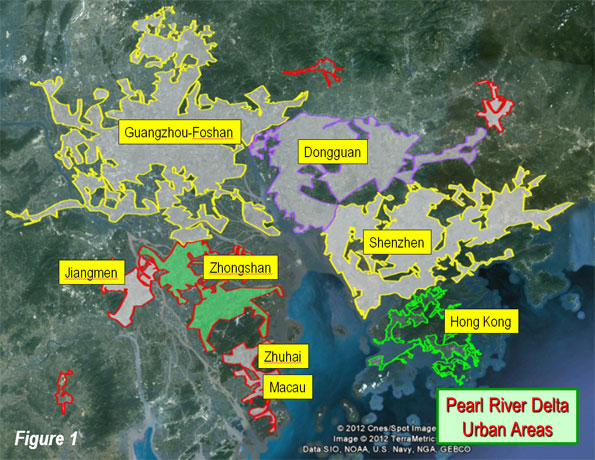
    The Pearl River Delta of China is home to the largest extent of continuous urbanization in the world. The Pearl River Delta has 55 million people in the jurisdictions of Hong Kong, Shenzhen, Dongguan, Guangzhou, Foshan, Zhongshan, Jiangmen, Zhuhai and Macau. Moreover, the urban population is confined to barely 10 percent of the land area. These urban areas are the largest export engine of China and reflect the successful legacy of Deng Xiaoping’s reforms which had their start with the special economic zone in Shenzhen and spread to the rest of the Delta and then much of the nation.

    Adjacent Metropolitan Areas: However, the Pearl River Delta today is not a metropolitan area, as is often asserted. Instead it is rather a collection of adjacent metropolitan areas or labor markets (Figure 1). Metropolitan areas are not created by a large number of people living close to one another. Metropolitan areas are labor markets, crudely delineating the geography of the jobs-housing balance. There is little commuting between the Pearl River jurisdictions. Moreover, as labor markets, metropolitan areas cannot be international unless there is virtual free movement of labor (Note). In the case of Hong Kong and Macau, commuting between the neighboring jurisdictions of Shenzhen and Zhuhai requires crossing the equivalent of an international border.


    Integrating Guangzhou and Foshan: Transportation integration has already come to two of the jurisdictions, Guangzhou and Foshan. The adjacent prefectures (confusingly interpreted into English as "cities") are now linked by a subway and unlike the other Pearl River Delta jurisdictions, the continuous urbanization does not narrow at the border (Figure 1). There are even proposals to merge the adjacent prefectures.

    Guangzhou and Foshan are separated by a tributary of the Pearl River, with a number of bridges that provide similar crossing capacity as exists in cross-river metropolitan areas like Portland (Willamette River), Cincinnati (Ohio River) and St. Louis (Mississippi River).

    Guangzhou itself is the capital of Guangdong, the largest province of China, with approximately 105 million people. Guangdong is the third largest state or province (sub-national jurisdiction) in the world, trailing the states of Uttar Pradesh (contains the eastern suburbs of Delhi) and Maharashtra (capital Mumbai) in India.

    Guangzhou is larger than Foshan. It is better known to many Westerners as Canton, and for many years served as China’s “window” on the west. Even in China, the alternative name is still used, for example in the annual Canton Fair, one of the largest trade fairs in the world.

    Canton was also a principal flashpoint of 19th century hostilities between the British and Chinese. The First Opium War (1839-42) began at Canton and led to the cession of Hong Kong to Great Britain and the establishment of British treaty ports at Fuzhou, Xiamen, Ningbo, Shanghai and Canton (Guangzhou). After the Second Opium War (1856-60), other treat ports were established and France, the United States, Russia, Germany, Japan and others gained similar rights to the British from a weakened Chinese government.

    In 2010, the metropolitan area county and district level jurisdictions of Guangzhou-Foshan had 18.3 million people. This is an increase of 4.4 million from 2000 and 11.6 million from 1982. This is surely a rapid rate of growth, but Shanghai and Beijing grew even faster over the last decade, each adding more than 6 million people.

    Distribution of Population Growth: In contrast to Shanghai and Beijing, where virtually all of the growth has been outside the core, the Guangzhou-Foshan core is growing robustly. From 2000 to 2010, the core districts increased from a population of 4,040,000 to 5,050,000. With a land area of 107 square miles (279 square kilometers), the core is similar in size to the city (municipality) of Sacramento, which has less than one-tenth the population. The core density is 46,800 per square mile (18,100 per square kilometer), up from 37,500 per square mile (14,500 per square kilometer) in 2000. This is about one-third less dense than Manhattan or the ville de Paris (the central city).

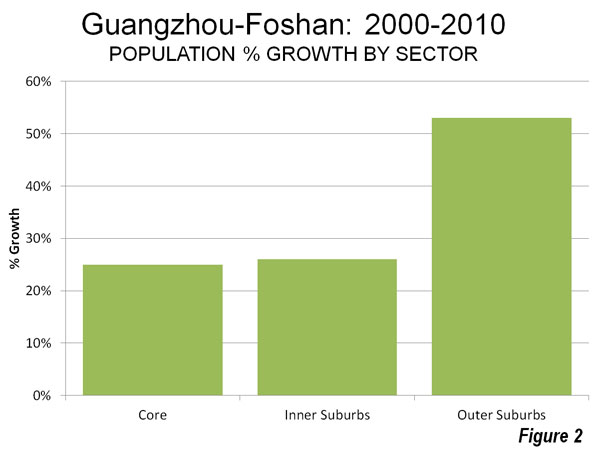
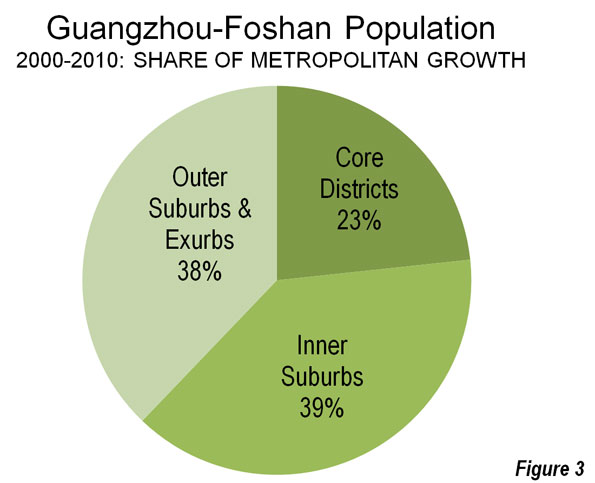
    However, as is typical for metropolitan areas around the world, Guangzhou-Foshan’s growth has been most concentrated in suburban areas. The core accounted for 23% of the population growth over the past decade, while the suburbs accounted for 77%.

    The inner suburbs grew from a population of 6,670,000 to 8,400,000. The density rose from 5,000 to 6,300 per square mile (1,900 to 2,500 per square kilometer), similar to that of the San Francisco urban area. The inner suburbs accounted for 39% of the growth and grew 26%.

    The outer suburbs grew from a population of 3,150,000 to 8,200,000 over the past decade. The population density rose from 2,000 to 3,100 per square mile (800 to 1,200 per square kilometer), slightly more dense than the Philadelphia urban area and slightly less dense than the Portland urban area. The outer suburbs accounted for 38% of the growth and grew at the greatest rate, 53% (Figures 2 & 3, Table).


    Guangzhou-Foshan Metropolitan Area & Urban Area
    2000 & 2010 Census
    Metropolitan Area Core Inner Suburbs Outer Suburbs Total
    2000         4,040,000        6,670,000            3,150,000         13,860,000
    2010         5,050,000        8,400,000            4,820,000         18,270,000
    Change         1,010,000        1,730,000            1,670,000           4,410,000
    % 25% 26% 53% 32%
    Share of Growth 23% 39% 38% 100%
    Area (KM2)                   279               3,429                   4,003                  7,711
    Area (Square Miles)                   108               1,324                   1,546                  2,977
    Density (KM2)              18,100               2,400                   1,200                  2,400
    Density (Square Miles)              46,800               6,300                   3,100                  6,100
    Urban Area  Core   Suburbs   Total 
    2010         5,050,000          11,225,000         16,275,000
    Area (KM2)                   279                   2,894                  3,173
    Area (Square Miles)                   108                   1,117                  1,225
    Density (KM2)              18,100                   3,900                  5,100
    Density (Square Miles)              46,800                 10,000                13,300
    Notes
    Boundary changes render district area data incomplete.
    Core: Yuexiu, Liwan, Haizhu, Tianhe 
    Inner Suburbs: Baiyun, Huangpu, Panyu, Nansha, Nanhai, Changcheng
    Outer Suburbs: Huadu, Luogang, Gaoming, Shunde, Shanshi 
    Nansha is in the inner suburbs because 2000 data is combined with Panyu (should be in the outer suburbs)

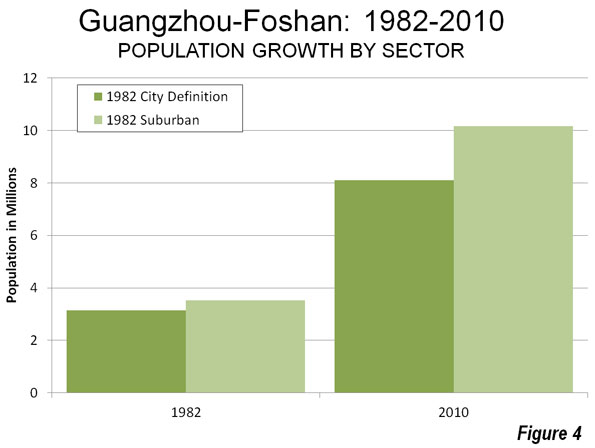
    Earlier data shows this suburban pattern has been a long term trend.  Between 1982 and 2010, the suburbs accounted for 57% of the growth outside the city of Guangzhou as then defined (Figure 4). District boundary changes limit a more precise analysis based upon a core that did not include large areas without development.

    The Guangzhou-Foshan Urban Area: The soon to be released 8th Annual Demographia World Urban Areas will show the Guangzhou urban area (area of continuous development within the metropolitan area) to have a population of approximately 16.275 million, with a land area of approximately 1,225 square miles (3,173 square kilometers). Barring later data from the multiple national censuses that will soon be reporting data, Guangzhou-Foshan is likely to be ranked the 14th largest urban area in the world. The population density is approximately 13,300 per square mile (5,100 per square kilometer), roughly comparable to the London or Barcelona urban areas. The suburbs of the urban area have a density of approximately 10,000 per square mile (3,900 per square kilometer). Most of the new residential development is multi-unit, such as high rise condominium buildings and work related housing, including dormitories. However, there is some detached housing, which is very expensive.

    A Larger Metropolitan Area: In the longer run a much larger metropolitan (and urban) area could result, if Chinese residents begin traveling to work over much longer distances between these jurisdictions and should the border restrictions at Hong Kong and Macau be eliminated. To achieve this end, there will need to be important local transportation improvements between the jurisdictions, such as more urban railways (which are planned) and wider automobile ownership, to use the already comprehensive (toll) freeway system.

    Wendell Cox is a Visiting Professor, Conservatoire National des Arts et Metiers, Paris and the author of “War on the Dream: How Anti-Sprawl Policy Threatens the Quality of Life

    ——

    Note: International metropolitan areas can now exist in the European Union, where there is free movement of labor across national borders. For example, the Lille metropolitan area is located in both France and Belgium. France and Switzerland (not a member of the European Union) provide another example, where treaty provisions permit international movement of labor with little difficulty in the resulting international metropolitan areas of Geneva (Switzerland-France) and Basel (Switzerland-France).

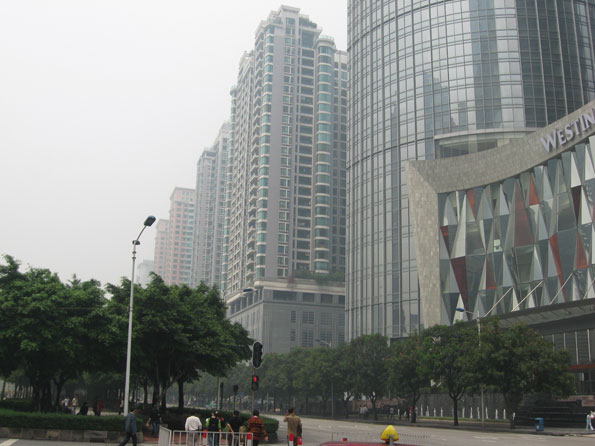
    Photo (top): Pagoda: Temple of the Six Banyan Trees, Guangzhou (all photos by author)

  • What to Do About Gang Violence in Salinas California

    Is there any connection between the fact that Salinas has the gang problem that it does, and the fact that Monterey County’s restrictions on the building of housing are very strict? I can see why the inhabitants of the Monterey Peninsula might want to protect the coastal strip. But if they apply their policies to the whole county, it becomes very difficult to build any housing. I saw a proposal 40 years ago from Ralph Nader’s think tank that would encourage the building of Italian style hill towns along the hills along both sides of the South Santa Clara Valley, thus leaving the lowlands along the river for agriculture; such a plan could be applied to the Salinas Valley as well. I don’t have the expertise to draw the connection between restricted housing and the gang situation in Salinas, but surely the situation is worth looking at. What kind of novels would a John Steinbeck write, if he were growing up in Salinas today?

  • Making Room for the Old and the New Economies

    The announcements by Sens. Ben Nelson (D-Neb.) and Kent Conrad (D-N.D.) that they would not run for reelection reflects what may be the last gasps of the Great Plains Democrats, much as California’s 2010 Democratic landslide assured that Republicans are soon to become endangered species in places like Los Angeles and Silicon Valley.

    The conventional explanation for these trends centers on culture or ideology, but the real cause may lie with an evolving conflict between two dueling political economies.

    On one side lies the information or “creative” economy, centered in coastal big cities and university towns. On the other lies the larger “basic” economy, which produces tangible items like food, manufactured goods and fossil-fuel energy.

    In the past, both political parties had liberals as well as conservatives and operated in both of these economies. Republicans thrived not only in the Heartland but also in information hubs like Silicon Valley, Southern California and even parts of Manhattan.

    Similarly, Democrats were influential in large swaths of the resource and agriculture-dependent parts of the country, including the Great Plains.

    However, this is increasingly no longer true. Plains Democrats, like former Sen. Byron Dorgan of North Dakota, struggled to sell the state’s remarkable energy-driven recovery to an administration hostile to fossil fuels. Many in his state, and other energy centers like Texas, view the Obama administration’s resistance to oil and gas development as an assault on economies that, over the past decade, have had the highest rates of job creation and per capita income growth in the nation.

    Dorgan, frustrated with Obama’s economic policy, chose not to run for reelection in 2010. But his House colleague, Earl Pomeroy, as well as Stephanie Herseth Sandlin (D-S.D.) were defeated. Nelson’s decision reflected a reaction to the strong GOP tide in the Plains. Registered Democrats in Nebraska have dropped from 38 percent to 33 percent just since 2008. The Republicans are at 48 percent.

    This is a remarkable fall from grace. As recently as 2006, Democrats held four of the six Senate seats representing the 650 miles of plains from Nebraska north to the Canadian border. If, as expected, Nelson’s seat is taken by the GOP, there will be only one — Sen. Tim Johnson (D-S.D.), who is up for what might a difficult reelection battle in 2014.

    Yet another energy-state Democrat, Sen. John Tester of Montana, is facing a tough reelection contest. If he is defeated, only a handful of Democrats from energy-producing states — Joe Manchin and Jay Rockefeller of West Virginia and Mary Landrieu of Louisiana — will be left in the Senate.

    For the most part, these Democrats are not being chased from office by cultural brawls over issues like gay rights or abortion — particularly in the socially moderate northern Great Plains. More damaging is the perception that Obama Democrats have little regard, even contempt, for the fundamental economics of basic industries.

    The battle over energy extends beyond the major oil-producing states. In places like eastern Ohio and western Pennsylvania, a nascent shale oil and gas boom is helping strengthen resurgence in industrial jobs lost decades ago. To many business people and workers in cities like Fort Wayne, Ind., looming Environmental Protection Agency regulations on mercury as well as carbon emissions could threaten this nascent revival. Reviving the Rust Belt, many believe, requires the cheap, reliable energy that, in the near future, can come only from fossil fuels.

    Instead, the Obama team reflects an urban, information economy bias. In contrast to President Bill Clinton, who supported industrial and agricultural development back when he was governor of Arkansas, Barack Obama represents an odd admixture of faculty lounge and urban bloc machine. He never developed any links to the basic economy; his worldview appears largely divorced from the realities of production. “It’s MoveOn.org run by the Chicago machine,” according to the mayor of a California farming town, a longtime Democrat.

    This tilt can also be seen in the widely touted strategy of conceding working-class white voters in states like Pennsylvania and Ohio in favor of what Democratic strategist Ruy Texeria calls “the mass upper middle class.”

    Today barely half of white union members, says researcher Alan Abramowicz, tilt Democratic compared with nearly two-thirds who supported them in the 1960s, when Democrats still identified strongly with the industrial and energy sectors.

    This trend may be further accelerated by the prospect of deep defense cuts. Many Plains and Southern states are dependent on defense-related expenditures. In the past, Plains Democrats and Southern Democrats, like retiring Sen. Jim Webb (D-Va.), were the product of or identified strongly with the military. But today, the Democratic Party’s hawkish traditions — extending from Harry S. Truman and Sen. Henry M. Jackson to Georgia’s Sam Nunn and Webb — is all but extinct.

    A parallel development can be seen in the information hubs of the Northeast and West Coast. As recently as the 1990s, Republicans could muster considerable numbers both in Silicon Valley and throughout the Los Angeles Basin. Manhattan’s “silk stocking district” regularly sent Republicans to the House.

    These exceptions barely exist today. Los Angeles County, home to nearly 10 million people, has only one Republican congressman. The Bay Area, which includes the district of House Minority Leader Nancy Pelosi (D-Calif.), and Manhattan each has none. The same pattern is evident at the state and local levels — where almost the entire delegation is now “progressive” Democrats.

    As in the Great Plains, this shift parallels changes in the political economy. Over the past decade, the Bay Area experienced the single largest decline in manufacturing in the country, and New York ranked second. Now the information sector — as well as related finance, health and education sectors — dominate these economies. Even business people in these areas share little in common with business people in the manufacturing or energy economies.

    With dense population and far less reliance on cheap energy like coal, greater metropolitan areas like New York or San Francisco find it easier to embrace the administration’s green (read expensive) energy agenda. Indeed, many companies, including Google and several investment banks, have invested in new renewable fuel and electric battery firms that have received large loans and other subsidies from Washington and sympathetic local governments, notably in California.

    The information economy is also dependent on international markets, capital and, most particularly, brainpower. This makes them more sensitive to the nativist pandering that has been de rigueur in GOP national politics. Republican politicians, who now usually cater to their religious right by campaigning against gay marriage and abortion, turn off even libertarian voters in information hotbeds, where such views are anathema.

    Sadly, these two economic visions exacerbate already existing cultural and political divisions. This also threatens the country’s ability to compete globally at a time of great opportunity. To overcome our competitors, particularly China, the United States needs a Washington that embraces both the information economy — where the United States still remains pre-eminent — and the basic economy — where we are seeing signs of a nascent renaissance.

    Only when both economies are appreciated and supported in both parties can we find the common ground necessary to succeed in the coming decade.

    This piece originally appeared in Politico.

    Joel Kotkin is executive editor of NewGeography.com and is a distinguished presidential fellow in urban futures at Chapman University, and contributing editor to the City Journal in New York. He is author of The City: A Global History. His newest book is The Next Hundred Million: America in 2050, released in February, 2010.

    Photo from BigStockPhoto.com.

  • On The Move

    Overall migration rates in America appear to be down in the wake of the Great Recession, reaching the lowest levels recorded since the 1940’s. While some statisticians argue that changes in data collection over time have led to an overstatement of such changes, there seems little doubt that “interstate migration has been trending downward for many years,” regardless of recent recessionary effects. That said, Americans remain a mobile people. Each year, millions of Americans make an interstate move. While overall migration rates may be down, “the commonly held belief that Americans are more mobile than their European counterparts still appears to hold true.” In good times and bad, the draw of opportunity in a new state still remains a siren call for many Americans.

    Adding a bit of information on current American migration patterns, Atlas Van Lines, a major American moving company, recently released it’s annual data on interstate moves. A plurality of states (24) had a balance between inbound and outbound moves. Magnet states included the upper south (TN and NC), the capital region (DC, VA, and MD), and hubs of energy production, including North Dakota, Texas, and Alaska. Many Midwest and Great Lakes states had more outbound movers than inbound. While the Atlas numbers don’t mesh completely with Census migration estimates, they may lend some support to Wendell Cox’s argument that domestic migration may be returning to some sort of normalcy. Simply put, people continue to go where they can find work, economic opportunity, reasonable costs of living, and good weather.

  • How Libraries and Bookstores Became the New Community Centers

    Bookstores and libraries have long played a central role in fostering a deeper appreciation of knowledge, and in lifelong learning. Increasingly, these places are also filling another critical need in our communities, by providing a haven for those seeking a communal connection in an ever-more isolated world.

    Ray Oldenburg, author of The Great Good Place, coined the term “third place” to describe any environment outside of the home and the workplace (first and second places, respectively) where people gather for deeper interpersonal connection. Third places include, for example, places of worship, community centers, and even diners or pubs frequented by the “locals.”

    Third places, according to Oldenburg, are vitally important to the social fabric of communities because they facilitate the healthy exchange of ideas and provide a public venue for civil debate and community engagement.

    Libraries and bookstores clearly are long-time ‘third places’ That shouldn’t be a surprise, given that books serve as the lingua franca of new ideas. Notice, though, that these establishments frequently provide coffee bars, meeting rooms, Wi-Fi access, public computer terminals, and other amenities. They serve as accessible retreats for community groups and clubs, offices for transitioning job-seekers or home-based business owners, logical meeting places for children’s literacy organizations, havens for latchkey kids, and bases of operation for homeless men and women as they try to reintegrate into the community. These are the features, probably more so than the rows of books and racks of periodicals, which grant libraries and bookstores their ‘third places’ status.

    Libraries have been hit hard by the proliferation of home-based Internet access and digitized material. The impact is exacerbated by state and local budget cuts that place some libraries in a vicious downward spiral — reduced foot traffic from those with other options often is held out as “evidence” of library irrelevance, leading to more budget and staff cuts and further reduced access for those who need it.

    Large libraries in major urban centers are particularly vulnerable, with their cavernous buildings and row upon row of books that are rarely touched. If libraries are to survive, city leaders and library boards must continue to explore creative solutions for the changing needs of their patrons. As economists would put it, they must “drive demand” for expanded library services.

    A great example of success with this approach is the Martin Luther King, Jr. Library (www.sjlibrary.org) in San Jose, California. It purports to be the only institution of its kind: It serves as the primary library for both a major university and a major city. This joint partnership between the city of San Jose and San Jose State University was announced in 1997, and the primary building opened in 2003. It boasts over 7 floors and 1.6 million books. There are also dedicated rooms for quiet study sessions, teen activities and multimedia access. In effect, SJSU students have access to all the popular features of a typical public library, while the public has access to all the academic resources of a university library. The entire community is well served by this far-sighted collaboration.

    It represents the convergence that is taking place between the traditional role that libraries have long played and the virtual world. According to a study funded by the American Library Association in conjunction with the Bill and Melinda Gates Foundation, the number of U.S. libraries nationwide offering public Internet access has ballooned from under 13% in 1994 to nearly 100% today. What this suggests is that the role of libraries as technology hubs is increasingly supplanting their function as simply a repository of books.

    The use of community space in libraries to access technology is particularly vital for low-income residents and for individuals in small towns where the library may be the only connection point for free Wi-Fi access.

    Bookstores are confronting the dual challenge of staying both vital and profitable. The most successful brick and mortar bookstores have evolved into third places. Once just exclusively retail outlets, they now are quasi-library/community gathering spots with onsite coffee shops and free Wi-Fi access. While bookstores have always attracted those who wish to browse and kill time, they now also draw others, laden with backpacks, to research, write, and study. Bookstore-based reading groups abound.

    But even when a bookstore embraces its role as a third place institution, its viability is not guaranteed. The bankruptcy and closure of more than 600 outlets of Borders Books nationwide is evidence of a shakeout in the retail book industry, amid the proliferation of electronic book portals such as Amazon, Apple and Google. Independent bookstores especially have struggled to maintain their niche in the marketplace (although they may have more flexibility to quickly embrace third place-related amenities).

    The lesson in this case is that capitalism can be harsh. For example, Amazon’s controversial price comparison tool allows shoppers to scan bar codes to check prices at rival brick and mortar and online stores. But capitalism also encourages differentiation. As every good business owner knows, becoming a commodity dealer and competing only on price usually is a recipe for failure.

    Rather, libraries should be more like bookstores, creating an inviting, leisurely environment. Bookstores should be more like libraries, providing community rooms and programs.

    Both should think creatively about how to provide the things that online sellers cannot. That includes, of course, the pleasures of shelf browsing as opposed to web-based browsing. But beyond that, the most successful libraries and bookstores will embrace the opportunities for relevance that their special third place status enables.


    Michael Scott is a speaker and co-host of the Internet radio show Bookmark Radio. He can be reached at michael@bookmarkradio.com. Photo by the author of the Tattered Cover bookstore in Denver, Colorado.

  • America’s Demographic Future

    Perhaps nothing has more defined America and its promise than immigration. In the future, immigration and the consequent development of what Walt Whitman (1855: iv) called “a race of races” will remain one of the country’s greatest assets in the decades to come.

    At a time when anti-immigrant fervor has been building, a number of states—including Arizona, Georgia, and Alabama—have enacted draconian laws aimed at apprehending undocumented immigrants. Those laws are widely seen even among legal immigrants and long-term residents as hostile to immigrants. Indeed, newcomers are already leaving those states. This Latino exodus has been happening in once-thriving neighborhoods in Gwinnett and Cobb counties in Georgia—as shown in business closures, arrest statistics, and declining church attendance—caused both by the economy and the increased immigration enforcement (Simmons 2010). Nationwide, there has been a declining number of unauthorized immigrants living in the United States, a decrease of 1 million from 2007 (Hoefer, Rytina, and Baker 2011).

    These laws and other similar efforts could have long-term negative effects for many communities, particularly for local enterprises in sectors such as agriculture, construction, transportation, and hospitality, which are highly dependent on foreign labor. Other industries that would be negatively affected include the professional and related industries, as well as the service industry (Shapiro and Vellucci 2010).

    But beyond specific industries, immigration may prove more important in the future than in the past. The three key elements behind this assessment are the global demographic slowdown, globalization of the world economy, and challenges to our own longterm economic and social sustainability. Immigration represents a key factor in determining whether the United States can avoid longterm stagnation and maintain its leadership role in the world economy. Overall we should be less concerned about too many newcomers than with the consequences of drastically reduced rates of immigration.

    New Global Demographics
    The developed world is entering an unprecedented era of largely unexpected demographic change. To the Baby Boomer generation, brought up on fears of overpopulation promoted in books such as Paul Ehrlich’s The Population Bomb, the idea of there being too few people seems almost absurd. Many xenophobes and anti-immigration activists still advocate a “national population policy” aimed at slowing population growth by strict limits on immigration.

    Yet in sharp contrast to Ehrlich’s predictions, global population growth has not increased but slowed considerably over the past few decades. Global population growth rates of 2 percent in the 1960s have dropped to less than half that rate, and past projections of the number of earth’s human residents in 2000 overshot the mark by more than 200 million.

    That pattern is likely to continue, with annual population growth rates declining to less than 0.8 percent by 2025, largely due to an unanticipated drop in birth rates in developing countries such as Mexico and Iran. Those declines can be attributed to increased urbanization, the education of women and their entrance into the workforce, and greater secularization. Close to half the world’s population, notes demographer Nicholas Eberstadt (2010), lives in countries with birth rates below the replacement level. Rather than out-of-control births, the world is experiencing a “fertility implosion.”

    Overall what author Phil Longman (2010) calls a “gray tsunami” will be sweeping the planet, with more than half of all of the population growth coming from the number of people over 60 while only 6 percent will be from people under 30. The battle of the future, including in the developing world, will be to maintain large enough workforces required for the economic growth needed to care for the elderly (Longman 2011).

    Those growth numbers could plunge further if slow economic growth, particularly in advanced countries, persuades couples to postpone having families, perhaps permanently. This factor may already have contributed to slow population growth in Europe and Japan, which have suffered low growth rates over the past two decades. In fact, the annual growth rate in the 2000s for eastern Europe was _0.1 percent and is expected to decline to _0.2 percent in the 2010s and _0.33 percent in the 2020s. For western Europe the same trend is projected—from 0.46 in the 2000s to 0.29 in the 2010s, and 0.18 in the 2020s. In the case of Japan, since 2010 the total population has begun to decline, with fewer births than deaths (U.S. Census Bureau 2011).

    But even in better economic conditions, the prospect is for continued slowing and even reversal of population growth, particularly in the most advanced countries in East Asia and Europe, where rapid aging, dramatically reduced marriage rates and low birth rates are now the norm (The Economist 2011).

    Today, among the major countries in the world, only the United States produces enough children to reach near replacement—a case of what demographer Eberstadt (2010) calls “demographic exceptionalism.”

    Although native-born Americans do not create enough children to sustain the population, immigrants and their offspring make up the difference. For example, the Mexican-American population grew more as a result of births (7.2 million) in the past decade than as a result of new immigrants (4.2 million) (Pew Hispanic Center 2011).

    In the next several decades, the fate of Western countries may well depend on their ability to make social and economic room for people most of whose origins lie outside Europe (Rifkin 2004: 256_57; Eberstadt 2001: 123). Yet given Europe’s current considerable problems integrating its immigrants, particularly Muslims, the continent seems ill-disposed to open its doors further; Denmark and the Netherlands are considering measures to sharply restrict immigration (Feller 2005). Even more dire may be the situation in countries such as China, Japan, and Korea, which are culturally resistant to diversity.

    In comparison, the U.S. record of healthy and sustained immigration marks a major competitive advantage. The largest immigrant population, Mexican American, is younger and has higher fertility rates than other groups. The median age of Mexican Americans in the United States is 25, compared to 30 for non-Mexican-origin Hispanics, 32 for blacks, 35 for Asians, and 41 for whites. The typical Mexican American woman has given birth to more children (2.5) than a similar aged non-Mexican Hispanic (1.9), black (2.0), white (1.8), or Asian (1.8) woman (Pew Hispanic Center 2011).

    Mexican and other immigrants are one key reason why America boasts a fertility rate 50 percent higher than Russia, Germany, or Japan, and well above that of China, Italy, Singapore, Korea, and virtually all of eastern Europe (The Economist 2002; United Nations 2005; Longman 2004: 60). Consequently, it is widely believed America’s workforce will continue to grow even as that of Japan, Europe, Korea, and eventually even China will start to shrink. Between 2000 and 2050, for example, the U.S. workforce is projected to grow by over 40 percent, while that of China shrinks by 10 percent, the EU by 25 percent and, most remarkably, Japan’s by over 40 percent (U.S. Census Bureau International Database).

    Over time the impact of an older population could prove ruinous to these economies both in terms of consumption and growth and perhaps more importantly in terms of their ability to support retirees.

    By 2050, barely one in five Americans will be over 60 while the proportion in Japan, Germany, and Korea will be closer to two in five (Longman 2004: 53).

    Lower birth rates in poorer countries such as Brazil can be seen as beneficial, offering significant short-term economic and social benefits (Gorney 2001). In advanced countries, however, a rapidly aging or decreasing population does not bode well for societal or economic health, whereas a still growing population offers the hope of expanding markets, new workers, and entrepreneurial innovation (Sheram and Soubbotina 2000).

    Too Few Immigrants?
    In public perception and in many state legislatures there has been a growing sense that the United States receives far too many immigrants. That view is particularly understandable during a period of deep economic pessimism and wrenching change. Yet in reality, under current conditions, the problem may soon be too little as opposed to too much immigration.

    Although the foreign-born population in the United States grew by 10 million over the past decade, few have noted that immigration has entered into what could be a secular decline. Take, for example, illegal immigration, which is most noxious to many policymakers, particularly on the right. According to the U.S. Department of Homeland Security (DHS 2011), an estimated net 3 million undocumented immigrants entered the country in the five-year period between 2000 and 2004, but that number fell by two-thirds, to under 1 million between 2005 and 2009 (Hoefer, Rytina, and Baker 2011).

    To some extent, stricter enforcement has been one reason for this drop-off (Cave 2011, Stevenson 2011). But a look at legal immigration also shows a decline. The number of Mexicans obtaining legal permanent resident status declined from the decade of the 1990s to 2000s by more than 1 million (2.76 million compared to 1.70 million), according to the Department of Homeland Security (DHS 2011). Indeed, since 2008 there has been a precipitous reduction in the number of naturalizations. In 2008 there were over 1 million naturalizations; in 2010 there were barely 600,000, a remarkable 40 percent drop (DHS 2011: Table 20).

    The reduction in immigration and naturalization extend well beyond Mexico, which accounts for roughly 30 percent of all U.S. immigrants (Grieco and Trevelyan 2010). Asian naturalization rates, for example, have been dropping since the mid-2000s, and in 2010 fell to 250,000 compared to 330,000 in 2008, a 24 percent drop. Similar falloffs can be seen across America and Europe (65 percent drop for North America, 31 percent for South America, and 28 percent for Europe). In fact the only place from which naturalizations are on the rise appears to be Africa, with an 18 percent increase (DHS 2011: Table 21).

    Why is this happening? One likely reason is that the world demographic slowdown has moved from advanced countries to traditional sources of immigrants such as China, India, Mexico, and the rest of Latin America. Mexico’s birth rate, for example, has declined from 6.8 children per woman in 1970 to roughly 2 children per woman in 2011 (The Economist 2010). Meanwhile, the number of Mexicans annually leaving Mexico for the United States declined from more than 1 million in 2006 to 404,000 in 2010, a 60 percent reduction (Pew Hispanic Center 2011).

    This trend means that the number of future job seekers will be greatly diminished. In fact, in the 1990s Mexico was adding about 1 million potential job seekers annually. By 2007, the new potential job seekers declined to about 800,000 annually, and it is expected to drop to 300,000 by 2030, which will likely further slow Mexican immigration (Cave 2011).

    A second major cause lies with the improved economy in many developing countries. In Mexico, employment and educational opportunities have improved since 2000. Both per capita gross domestic product and family income have climbed by more than 45 percent over the past 10 years. Not only are there fewer children to emigrate, but there is more opportunity for those who chose to remain (Magnini 2011).

    These factors apply even more to immigration from Asia. Not only are birth rates lower there, but Asia also boasts some of the world’s fastest growing economies, from China and India to a host of smaller states in East Asia. As a result, immigrants (many of them well educated and entrepreneurial) who, in earlier years, might have felt the need to come to the United States now can find ample opportunities at home. Not surprisingly, naturalizations dropped 51 percent between 2008 and 2010 for immigrants from South Korea, 35 percent from Taiwan, 15 percent from China, and 7 percent from India (DHS 2011: Table 21).

    The current economic crisis in the United States has contributed to the decision of Mexicans to stay in their country. That decision is particularly connected to troubles in housing and construction, industries that have been major sources of employment to both legal and illegal immigrants (Mataconis 2011). Hispanic immigrants have suffered a disproportionate share of job losses in the construction, agriculture, forestry, fishing, and manufacturing industries (Park 2009).

    Over time that trend could create a labor shortage, notes John Skrentny, director of the Center for Comparative Immigration Studies at the University of California San Diego (Aguilera 2011). Already 40 states, reported in the last census, have fewer children than in 2000. Those that did not, such as Texas, can attribute much of their growth to immigrants and their offspring. “The new engines of growth in America’s population are Hispanics, Asians and other minorities,” notes demographer Bill Frey (Yen 2011).

    Still the Multiracial Superpower?
    A continued decline in immigration could undermine American competitiveness in other ways. Immigration has driven America’s successful evolution toward a society that will eventually be majority nonwhite, a factor that could prove critical in U.S. relations with developing nations, who will dominate the world’s economic growth for the foreseeable future (Cannadine 2002: 23; Kennedy 1993: 23).

    Immigration represents much of what makes America different. This feature is particularly evident in relation to the Muslim world. In Europe, unemployment among immigrants from Muslim countries is often at least twice that of the native-born—and Muslims are deeply alienated. In contrast, American Muslims seem to be integrating with remarkably rapidity. More than four in five are registered to vote, a sure sign of civic involvement. Almost three-quarters say they have never been discriminated against (Manji 2007, MacFarquhar 2006, Valla 2007).

    Such well-educated and entrepreneurial newcomers constitute a unique asset in a shifting global economy that relies on skilled workers and is increasingly tied to developing countries. Even today, the United States is by far the largest recipient of educated immigrants from these countries and attracts twice as many foreign students as any other country, with nearly two out of three coming from Asia (Docquier and Marfouk 2004).

    Keeping a large portion of these immigrants should be a national goal and should not be difficult—given a proactive immigration policy, opportunities for advancement, better housing, political freedoms, and economic growth. Over the past two decades no country has proven as successful as the United States in retaining skilled foreign immigrants (Flora 2006; Sum, Harrington, and Khatiwada 2006; Anderson 2006).

    By far the majority of America’s immigrants, both undocumented and legal, come from developing countries: China, India, Mexico, the Philippines, and the Middle East. Since roughly four in five immigrants come from nonwhite countries, by the early 2000s the majority of new workers entering the labor force were nonwhite. By 2039, due largely to immigrants and their offspring, the majority of working-age Americans will be nonwhite (Fraser 2004, Roberts 2008).

    The role of America’s non-Western emigrants—Indian and Middle Eastern entrepreneurs, African intellectuals and scientists, Chinese technologists, and Mexican skilled workers—cannot be easily overestimated. Even as they return home, often as U.S. citizens, they retain strong familial and business ties to this country. Their ties here testify to America’s special ability to integrate all varieties of people into its society (Kurlantzick 2007: 9; Legrain 2007: 196).

    The Entrepreneurial Force of 21st Century America
    The greatest impact of immigration will be felt in the economy. Nowhere is this more critical than in the all-important entrepreneurial sphere. Immigrants by nature tend to be entrepreneurial as most come to America to find a better life for themselves and their families. The immigrant role in creating new business has been particularly critical during the current recession. According to a recent Kauffman Foundation report, the foreign-born were the one bright spot in the otherwise shell-shocked U.S. entrepreneurial sector. Overall, immigrants have boosted their share of new entrepreneurs from 13.4 percent in 1996 to nearly 30 percent in 2010 (Reedy 2011).

    Immigrant commerce manifests itself most visibly in the proliferation of small stores, restaurants, food-processing businesses, garment factories, and trucking lines, as well as in high-tech and financial services. Immigrants are more likely to start a new business than native-born Americans. The number of self-employed immigrants has grown even in New York City, where the number of self-employed among the native-born has dropped (Bowles and Colton 2007).

    Some of the country’s highest rates of entrepreneurship are found among immigrants from the Middle East, the countries of the former Soviet Union, Cuba, and Korea. These entrepreneurs can be found in a broad array of industries, including food and retailing as well as manufacturing and technology (Fairlie and Meyer 1996, Bowles and Colton 2007).

    Perhaps most remarkable has been the movement of Asians into the technology industry. Between 1990 and 2005, immigrants mostly from the Chinese diaspora and from India started one of every four U.S. venture-backed public companies. In California, they account for a majority of such firms, particularly in technology (Anderson and Platzer 2006). Although many of these companies are small, a significant number have also become sizable, including Sun Microsystems, Yahoo, AST Research, and Solectron.

    But it would be a mistake to see immigrant entrepreneurs as relevant largely to big cities and traditional technology hubs. Beginning in the 1990s, immigrants rapidly moved into regions once considered inhospitable to newcomers, particularly nonwhites—namely, the exurbs, Southeast, and Great Plains (Jacoby 2004: xxvii; Pickel and Clarke 2007).

    Like other Americans, they are finding opportunities increasingly in regions where home prices are low and the business climate more conducive to entrepreneurs (Millman and Pinkston 2001, Spivak 2010). Many of the areas with the rapidly growing entrepreneurial classes among minorities—places like Atlanta, Nashville, Houston, and Dallas—are regions with diffuse, multipolar and heavily suburbanized land patterns. The strip mall, much detested among urban aesthetes and planners, often serves as “the immigrants’ friend,” in the words of Houston architect Tim Cisneros (Kotkin 2011).

    Policy Prescriptions: Sustaining and Reforming the American Model
    Given their contributions to our overall economic and demographic vitality, the current downturn in U.S. immigration should be a major concern to American policymakers. Although steps to curb illegal immigration may well be justified, the United States needs to start devising policies that encourage legal immigrants to come here and stay. This is particularly true for skilled and entrepreneurial newcomers.

    Policymakers need to think much more about what happens to these potential immigrants. If there is a notion that America is not welcoming for newcomers, we could move toward a paradigm in which people come to the United States for relatively a brief stay, then head back home once they have achieved their educational or career goals—something already occurring with educated migrants, and even citizens, from booming economies such as China and India (Wadwha 2009). If this pattern becomes predominant, America would lose much of its competitive edge and its claims to still being an “exceptional” country.

    Economic growth is a prerequisite for many things, and continued strong immigration is one of them. But certainly more can be done to encourage college and graduate school students to become citizens. The United States should make efforts to keep entrepreneurs and all kinds of skilled workers, whom the country will need, particularly as the Baby Boom generation retires. The current recession has had a devastating effect on the long-term finances of Social Security and Medicare, now expected to run out of funds earlier than forecasted. This will affect the 78 million Baby Boomers retiring over the next two decades at a time when immigrants will play key roles in the U.S. economy as taxpayers, workers, consumers, and homebuyers (Ewing 2009).

    Ultimately how America approaches immigration will have much to do with future development. We could turn inward (Hanson 2002; Huntington 1996: 204–06), hoping to salvage the older notions of an Anglo-Saxon national identity from ethnic encroachment by those who, in Pat Buchanan’s phrase, are not “melting and reforming” (Buchanan 2002: 12). Or we could follow the welfare state model of Europe, as many on the left prefer, becoming a permanently slow growth country with a rapidly aging population.

    Neither of these scenarios is worthy of America. Our great genius as a country has been in our ability to integrate newcomers culturally as well as economically. Within a generation or two the overwhelming majority of Latinos lose their primary allegiance to their mother country and 97 percent consider America their home country (Winograd and Hais 2008: 95; Preston 2007b). They also embrace English—only 7 percent of second-generation Californian Latinos speak Spanish as their primary language (Hakimzadeh and Cohen 2007, Preston 2007a). Latinos also represent a growing portion of the U.S. military, hardly a sign of disaffection from the national culture (Rodriguez 2004, Porter 2002).

    If attitudes harden against immigration, America will sacrifice much of its demographic and cultural uniqueness. We would also suffer the loss of a major source of entrepreneurial growth and innovation.

    Essentially, the United States must remain an open economy and an open society if it wishes to retain its standing as the “land of the free.” A rational immigration policy would work against a scenario of rapid aging, stagnant population growth, labor shortages, and declining entrepreneurship, which are likely to afflict Europe and Asia. By remaining the world’s leading immigrant country, America would assure its future as the world’s beacon of liberty and prosperity.

    This piece originally appeared in The Cato Journal..

    Joel Kotkin is executive editor of NewGeography.com and is a distinguished presidential fellow in urban futures at Chapman University, and contributing editor to the City Journal in New York. He is author of The City: A Global History. His newest book is The Next Hundred Million: America in 2050, released in February, 2010. Erika Ozuna is a Research
    Fellow at Pepperdine University.

    Photo from BigStockPhoto.com.

    References

    Aguilera, E. (2011) “Illegal Immigration from Mexico Continues Decline.” Sign On San Diego. Available at www.signonsandiego.com/news/2011/jul/07/illegal-immigration-mexico-continuesdecline.

    Anderson, K. W. (2006) “A Decline in Foreign Students Is Reversed.” New York Times (13 November).

    Anderson, S., and Platzer, M. (2006) “American Made: The Impact of Immigrant Entrepreneurs on U.S. Competitiveness.” Arlington, Va.: National Venture Capital Association. Available at www.nvca.org/index.php?option=com_content&view=article&id=254&Itemid=103.

    Bowles, J., and Colton, T. (2007) “A World of Opportunity.” New York: Center for an Urban Future (February). Available at www.nycfuture.org/images_pdfs/pdfs/IE-final.pdf.

    Buchanan, P. (2002) The Death of the West: How Dying Populations and Immigrant Invasions Imperil Our Country and Civilization.New York: Thomas Dunne.

    Cannadine, D. (2002) Ornamentalism: How the British Saw Their Empire. New York: Oxford University Press.

    Cave, D. (2011) “Better Lives for Mexicans Cut Allure of Going North.” New York Times (6 July).

    Cohn, D., and Passel, J. S. (2009) “Mexican Immigrants: How Many Come? How Many Leave?” Pew Hispanic Center (22 July).

    Docquier, F., and Marfouk, A. (2004) “Measuring the International Mobility of Skilled Workers (1990–2000).” Policy Research Working Paper No. 3381. Washington: World Bank.

    Eberstadt, N. (2001) “The Population Implosion.” Foreign Policy (March/April).

    (2010) “The Demographic Future: What Population Growth—and Decline—Means for the Global Economy.” Foreign Policy (November/December).

    The Economist (2002) “Five Hundred Million Americans.” The
    Economist (22 August).

    (2010) “Mexico’s Population: A Falling Birth Rate, and What It Means.” The Economist (22 April).

    (2011) “Asia’s Lonely Hearts.” The Economist (20 August).

    Ewing, W. (2009) “Immigrants Could Soften Effects of Baby Boomer Retirement.” ImmigrationImpact.com (14 May). Available at http://immigrationimpact.com/2009/05/14/immigrantscould-soften-effects-of-baby-boomer-retirement.

    Fairlie, R. W., and Meyer, B. D. (1996) “Ethnic and Racial Self-Employment: Differences and Possible Explanations.” Journal of Human Resources 31(4): 757–93.

    Feller, B. (2005) “U.S. Immigrants Lag Behind in School, but Gaps Are Bigger in Other Nations.” Associated Press (15 May).

    Flora, C. B., (2006) “Immigrants as Assets.” Rural Development News 28 (3). Ames, Iowa: North Central Regional Center forRural Development, Iowa State University.

    Fraser, N. (2004) “The New Americans.” BBC News (2 April).
  • Welcome Back, Britain! Why The U.K. Doesn’t Need The E.U.

    To some, British Prime Minister David Cameron’s decision to demur from the new euro rescue plan has made the U.K. irrelevant on the world scene. Yet by moving away from the euro zone, Cameron did something more than reaffirm Britain’s opposition to a German-led Europe: He asserted Britain’s greater, historically grounded legacy as the center of the Anglophone world.

    This obstinacy could end up maintaining the U.K.’s global importance by shifting its focus away from “the declining and irritable nations of the old world” and toward its legacy as the center of the English-speaking world.

    Over time cultural ties generally prove more enduring than ideological or geographic ones. The 14th century Arab historian Ibn Khaldun once observed, “Only tribes held together by a group feeling can survive in a desert.” Throughout history, the most powerful, far-reaching cultures — namely the Greek, Roman, Arab, Chinese, Mongol and British empires — shared this intense kinship.

    Like the world’s two other primary global tribes, the Chinese and Indians, Anglo share ancient and deep-seated affiliations. In contrast to the profoundly insular Japanese or the Germans, global tribes are transnational and transcend mere geography. They share not only economic ties but “group feelings” shaped by commonalities of food, language, history, spiritual and political ideals .

    The British are “cousins” to Americans, Canadians, Australians and New Zealanders in ways the French, Germans and Italians are not. When young and educated British emigrate they generally head not to Germany or China but to other English-speaking countries. Retirees might seek out the Spanish or French Rivera, but those building careers go overwhelmingly to Anglophone countries.

    Equally important may be the British connection to other former colonies like India, South Africa and Nigeria that, although not racially Caucasian, function largely in English and retain close ties to the mother country. Any close look at British interests and personal ties reflect the enduring nature of its tribal essence. London’s status as the world’s financial center — the critical reason for Cameron’s break with the E.U. — lies not primarily with Europe, but with its scattered former colonies. Britain is the world’s fourth largest investor and the top investor in the United States, which in turn serves as the U.K.’s biggest export market. The U.K. also plays an outsized role in South Africa, Singapore and India, where it is by far the largest European investor.

    In this sense, the Anglosphere — including places like India — constitutes a kind of transnational family. Usually ignored or scoffed at by globe-trotting pundits and politicians who define the world by geographic proximity, these global linkages are more important than ever.

    Consider the fate of the insular Japanese, who, without a large diaspora, have no recourse but to fall back into the relative obscurity of their home islands. Similarly, the E.U., particularly in its post-Christian,phase has no common tribal essence. Instead the continent seems to be breaking into at least three tribes: an austere neo-Hanseatic Nordic core, a spendthrift and effectively bankrupt Mediterranean south, and a troubled, rapidly depopulating eastern rim.

    The drive to create a powerful European superstate lacks the girding of a common ideology and social norms that give the English-speaking world coherence. Whatever her ambitions, Germany’s Angela Merkel, Chancellor of a prosperous but rapidly aging and militarily weak country, seems more like a wily schoolmarm than an inspirational European leader. She’s no Caesar, Charlemagne or Napoleon who’s capable of uniting the continent by force of ideology, personality and power.

    Given these fundamental flaws, Britain’s best course would be to focus on linkages to her offspring. Taken together the Anglosphere represent more than a quarter of world GDP, and the Queen’s tongue remains the dominant language of international business, science and diplomacy, utterly supplanting French, Russian and German even on the continent. The E.U. may have been constructed largely by French visionaries, but English is spoken by 41% of Europeans, while only 19% speak French.

    More important still, the developing world is turning Anglophone. French schools have been closing even in former colonies such as Algeria, Rwanda and Vietnam, where students have protested against learning the old colonial tongue. English is being widely adopted in China, and it dominates the Gulf economy, where it serves as the dominant language of business in hubs such as Dubai. It is also, of course, the dominant language of India’s burgeoning middle class.

    The linguistic dominance propels the Anglosphere’s dominion over such critical growth industries as technology and culture. Britain may no longer be an industrial superpower, but its media, research institutions, investment banks, courts and culture remain globally relevant. Nearly half the world’s sales of audio-visual products, for example, come from the English speaking world, with Britain constituting the second-largest exporter behind the U.S.

    Technology follows a similar pattern. Three-fifths of global pharmaceutical-research spending comes from Britain and the U.S.; more than 450 of the top 500 software companies in the world are based in the Anglosphere. Out of the ten fastest-growing software companies, six are American and one is British.

    This brain power is backed up by a treasure trove of natural resources. The U.K. itself may lack sufficient raw materials — after all that was what the empire was all about — but its diaspora countries, notably in North America and Oceania, account for much of the world’s food exports and, increasing, its supply of fossil fuel energy.

    How about the thorny issue of politics? In the end, when there’s a crisis the Anglosphere countries can most rely on one another. Time and again, the British, Canadians and Australians have been the peoples who send troops and ships in concert with America. What country is a more American solid ally in Asia than the remarkable English-speaking enclave of Singapore?

    Conversely, when Argentina seized the Falklands, Prime Minister Margaret Thatcher could count on logistical help, first and foremost, from the United States. And as the Australians contemplate an expanding Chinese military presence in their backyard, they look to the Americans to send in the maritime cavalry.

    Sadly the critical nature of these linkages is not fully appreciated by the current U.S. administration. President Obama, the grandson of a Kenyan victimized by the brutal colonial regime, has dissed Britain repeatedly. Opposition to colonialism, of course, resonates with American tradition, but he perhaps went too far when he famously returned the bust of Winston Churchill sent by Tony Blair to President George W. Bush back to Britain.

    More recently Obama has even poisoned the well against Canada, our greatest trade partner and continental soul mate, by rejecting the Keystone XL project. It’s as if he were urging Canada to align itself with China. What’s next a move to ban the import of Australian uranium or Uggs?

    Yet the great strength of tribes, or families, lies in their ability to endure despite the most egregious family foolishness. Even a wayward president, or two, cannot tear asunder what has been hundreds of years in the making.

    This piece originally appeared at Forbes.com.

    Joel Kotkin is executive editor of NewGeography.com and is a distinguished presidential fellow in urban futures at Chapman University, and contributing editor to the City Journal in New York. He is author of The City: A Global History. His newest book is The Next Hundred Million: America in 2050, released in February, 2010.

    Creative Commons photo by Flickr User “angies”.

  • Housing Affordability and Public Policy

    Nothing in the world today affects citizens more directly than the home in which they live.  And when it comes to housing no piece of recent research opens more interesting avenues of investigation than the Demographia International Housing Affordability Survey.

    Individuals and families across the economic and social spectrum all over the world are eager to gain as much control as they can over the place where they live.  They wish to make sure it cannot be taken away from them arbitrarily; they wish to control who has access to it and who can benefit from it; and, as much as possible, they wish to protect it against negative influences in the larger community around it.   

    This combination of goals sets up some inherent conflicts in every society.   What is good for a given individual or family is not necessarily good for a society as a whole, and what is good for society as a whole is not necessarily good for any given individual or family.  From this fundamental tension has sprung a bewildering set of arrangements for allocating and regulating land and residential structures on it.   At one end of the political spectrum have been societies in which land is owned in common and is supposed to be allocated to individuals and families on the basis of merit or need.  Such has been the case with many Utopian and Socialist societies.  At the other end of the spectrum have been societies where the individual ownership of land and homes is considered a bedrock condition of a democratic society, where ownership is widely dispersed, and individual rights and preferences have been zealously safeguarded from all but the most necessary intervention.   One of the best examples of this would have been the United States, Canada or Australia in the nineteenth century.  The trend over the last fifty years has been a convergence toward the middle of this spectrum as Socialist countries have abandoned the dream of complete common ownership and societies that traditionally were loath to interfere with individual property rights have adopted layer after layer of regulation intended to secure the health, safety and wellbeing of the larger society.

    Given the fundamental importance of housing in all societies, it is remarkable how little we know about the results of housing policies in various parts of the world.   In my own field of architectural and urban history, for example, if you were to ask even some of the greatest experts to compare what an average house or apartment unit in any two given cities looked like at some date in the past or even the present, what it would cost to buy and to operate them and what regulations would affect them, it is very unlikely that the individual would have more than rudimentary hunches.  Historians can tell you in great detail about the palaces, townhouses and country estates of the powerful and wealthy, then and now, and about some of the efforts at reform housing by the government or charitable organizations, but at least until recently, the lack of information about how and where ordinary individuals live has been remarkable. 

    Part of this neglect is due to a discredited but lingering attitude that history is made overwhelmingly by the rich and famous and not by the decisions of millions of ordinary citizens.  Part of it is simply that real estate ownership is now so dispersed and so intensely affected by local conditions that it is hard to quantify in ways that allow for comparative analysis.  Partly it has been due to a widespread belief that commerce and industry are the driving forces in the world economy and that housing is a by-product of the larger economy. This attitude is, of course, obviously wrong-headed, as the central role of residential real estate in the recent economic downturn has proved.  Residential real estate plays a huge and increasingly important role in the economy of every nation. 

    Given the obvious importance of housing, what should public policy be and the role of the individual, the developer, governmental agencies?  Is there an optimal size for cities, for housing units?  How much land should housing occupy?  Should housing be separated from or integrated with other uses?  Should government promote one kind of residential tenure over another, individual home ownership over rental or various kinds of collective ownership over individual property, for example?   Have the citizens of a given city or nation underinvested or overinvested in housing?  Are housing prices in line or out of line with individual and family incomes?   Unfortunately there has been very little data for anyone trying to find answers to questions like these. 

    It was against this backdrop that the appearance, in 2004, of the first international housing affordability survey by Wendell Cox and Hugh Pavletich was such a revelation.  It provided some of most reliable information ever compiled for those who wished to compare nations around the world with quite different housing policies.   Cox and Pavletich had their own point of view.  It is fair to say that both of them tend to favor market solutions to many of the most difficult questions about housing and how it is allocated and regulated, but their compilation of data, like the data found on Cox’s demographia.com website generally can stand on its own as one of the most impressive and reliable collections of comparative urban statistics to be found anywhere.

    The issue that appears to have been the principle motivation to compile this data was the rise of various forms of “Smart Growth” policies around the world.  Whether these policies were intended to enhance the environment or limit sprawl, they clearly had an effect on the price of housing, but what these effects were was very much in dispute.  In the United States, for example, the question of whether the growth boundary around Portland, Oregon, has had an effect in raising housing prices, as some observers claim, or that the dual focus on development at the center and regulation at the edge has kept housing prices reasonable, has raged for a number of years now.  The same debate has been joined in many other places, for example in Australia where the recent rise in prices has been particularly sharp and, given the vast extent of the country, the urban containment policies particularly contentious.

    Cox and Pavletich went out in search of the data they felt could answer questions of this kind.  Their conclusion, that the land use policies in places like coastal California, Vancouver, Britain and Australia, have dramatically driven up the cost of housing, and that the less intrusive policies of places like Atlanta and Houston has kept prices down has been controversial, but I think it is fair to say that a growing number of people who have looked at the figures have tended to agree that a good many well-meaning policies involving housing may be pushing up prices to such an extent that the negative side-effects are more harmful than the problems the policies were intended to correct.   These observers have also noted that measures that restrict land supply, slow growth in the immediate area where the policies are in place and push up housing prices can be very attractive to individuals who already own their own homes.

    In any case, the figures presented in this survey, like the collection of data on demographia.com more generally, are endlessly fascinating and very important.  They provide some basis for exploring issues that will figure importantly in discussions of housing policy for decades to come.

    Robert Bruegmann is professor emeritus of Art history, Architecture and Urban Planning at the University of Illinois at Chicago.
    ____

    Note: This article appeared as the Introduction of the 8th Annual Demographia International Housing Affordability Survey, released January 22, 2012

  • Britain Fears a Developer’s Charter

    The UK Government’s Department for Communities and Local Government (DCLG) announced that there were only 127,780 new housing completions last year in Britain. British house building activity is down to levels of after the First World War, when reliable industrial records began, and still falling. In 1921 the British population was nearly back up to 43 million following the slaughter of the First World War. In 2011 the population of England, Wales, and Scotland is approaching 61 million people. By 2031 the British population is expected to be closer to 70 million. With such existing unmet and growing demand for new housing the DCLG, the Government department that runs the Planning System should be busy finding ways to allow developers to build.

    Many feared that the National Planning Policy Framework (NPPF), prepared by the DCLG for an expected release in January 2012 would be a developer’s charter. We wish it was a developer’s charter! The NPPF continues planning policies, supported by all Parliamentary political parties, which continue to frustrate volume housebuilding. Developers have to prove that their proposals for house building are not merely about building useful homes at a profit, but are “sustainable development” when measured against disputable social and environmental criteria. No developer is free to build on their own land without first having to obtain planning approval from an array of third party interests all insisting on their interpretation of the moral idealism of sustainability.

    This makes the NPPF an anti-development charter for all those who oppose house building and population growth. Anyone can claim that more house building and more households are unsustainable in their area, in the effort to stop a project which they don’t approve of.

    The NPPF will do nothing to challenge the power of contemporary anti-development campaigners, who are well known. Anne Power, Lord Richard Rogers and other members of New Labour’s Urban Task Force (UTF) have correctly identified themselves as allied to the “Hands off Our Land” campaign run by The Daily Telegraph, the Conservative supporting newspaper.  The UTF favors a continuing commitment to ‘… reclaiming brownfield sites and re-densifying cities.’ To build only on previously developed land is the green ideal of the UTF and the “Hands off Our Land” campaign.

    We all know where these policies lead. Not to a golden age of regeneration for all, but to lucrative property investment for those with access to sufficient capital and the right connections to steer themselves through the planning system to obtain approvals. The volume of Greenfield land developed declined dramatically under New Labour. The present Conservative led Coalition Government continues the practice of obstructing development on Greenfield land.

    Between 2000 and 2006 the total area of land built on for new housing fell by 23%, with a 42% fall in the annual amount of Greenfield land used. In 2010 76% of all housing was built on previously developed Brownfield land, a slight decrease from the 80% in 2009. Only 2% of housing was built on the Green Belts around major cities and towns. The Green Belt in England covers 13% of the land, or twice the area already developed for housing. Small wonder that the price of the shrinking supply of land with a prospect of being approved for sustainable development remains inflated.

    House building was only increased from the low point of 2001 by increasing the density of development in the cities. Average densities rose from 25 dwellings per hectare (dph) in 2000, to 43 dph by 2010. In London the average density for new housing is much higher, at 115 dph in 2010.

    Densification policies considered sustainable have meant that the majority of the working British public can no longer buy a new house with a garden, in ways that previous generations may have taken for granted. Instead the plan has been to squeeze more new households into less space. UTF supporters and the DCLG imagined they were regenerating cities and saving the planet for all of society. Like traditional Conservatives they mean to keep developers and the population off Britain’s ample supply of otherwise redundant farmland.

    The Daily Telegraph’s campaign, best articulated by the conservative anti-growth philosopher Roger Scruton, is clearly the flip side of the UTF’s densification argument. He is happy as long as the population is kept away from the countryside he loves. ‘Thank God for obstacles to economic growth,’ says Scruton.

    Scruton speaks for the comfortable who already enjoy plenty of space. The Daily Telegraph’s campaign is ultimately concerned that existing housing markets are protected, sustained through the division between Town and Country, and moralised as a concern for environment and heritage. New Labour supporters are more likely to read The Guardian, but its more middle-class readership finds nothing to object to in The Daily Telegraph’s campaign, in order to restrict the “sprawl” of suburbia and halt the imagined damage this will do to the environment and urban communities. The Guardian’s readership formed the bed-rock of New Labour’s support, and back Next Labour. The working class may have deserted Labour, but is depoliticized and passive. The Guardian and The Daily Telegraph – still supposed by many to be at opposite ends of the old-fashioned and defunct ideological spectrum of Left and Right – prove closer than either cares to think.

    Labour Members of Parliament have traditionally feared the “flight to the suburbs” lest they lose voters and the associated tax revenue. The planning system has proved very effective in maintaining the political geography of Britain. Labour politicians negotiate their political dependency on urban containment with a Red-Green stance in urban areas, without threatening the Blue-Green interests of those who want to keep development out of the countryside. All depend on the denial of development rights that date from the 1947 Town and Country Planning Act, and which the NPPF reinforces.

    Meanwhile working class families are squeezed into what little Twentieth Century suburbia is still affordable, competing unsuccessfully with the more affluent for ownership of this increasingly scarce and valued commodity. What new housing is built is at higher density, usually on the least attractive sites. That is land previously occupied by factories, old infrastructure, and utilities, or by council housing estates re-developed at higher densities. Yet even these unpopular sites enter the inflated British housing market, sustained through a chronic lack of house building.

    The working class is caught in a political crusher made manifest through the planning system. The Red-Greens, who may imagine themselves on a new Left, gentrify towns and cities with “sustainable redevelopment”, and the Blue-Greens, who persist with being on the Right, protect their landscape for their exclusive enjoyment. Meanwhile the majority of home owners have come to depend on the inflated and unaffordable housing market. New Labour needed this house price inflation to allow the owner occupying majority to supplement inadequate wages by withdrawing equity from their homes. So does the Coalition. Deliberate or not, The Daily Telegraph’s commitment to building fewer new homes will stabilise what we have called the Housing Trilemma.

    Our current predicament may be thought of as a Trilemma, in which house price inflation supports burdensome mortgage lending and private debt, while households in the owner occupied sector accept low quality housing conditions. High rents shadow private sector housing costs, and private rental housing quality is often of the lowest quality. Many in Britain, including the majority of the home owning middle class, are dependent on the Housing Trilemma remaining stable.

    The planning system serves well in protecting the interests of existing home owners. Behind the NPPF’s moral idealism of sustainability, the immediate instrumental objective is to restrict new housing supply to avoid destabilising housing markets.  Appearing as a moral mission to save the planet from developers, the NPPF and the denial of development rights sustains the Housing Trilemma. Debt is secured, but housing remains unaffordable, quality low, and house building activity is at an all time industrial low. This is not a conspiracy. It is a predicament.

    When Britain’s elites talk about wanting to revive economic growth, they don’t mean a massive surge in new house building or an expansion of infrastructure. What they have in mind is a revival of financial services in The City, subject to uncertainties in the fragmenting Euro Zone, and the maintenance of high housing prices in the hope of more inflation to come. Meanwhile the countryside is kept pristine for the few who can afford access to it as a weekend retreat for the wealthy, including the pro-urban intelligentsia, in all their Red-Green-Blue moral plumage.

    The Coalition could have challenged the Housing Trilemma. Instead they have reinforced it.

    The result is predictable. Planning applications are falling in number and ambition. Only 25,000 new homes were approved in the second quarter of 2011 compared to 32,000 in the second quarter of 2010. This will be read by The Daily Telegraph campaign members as “proof” that there is no demand for development, inverting the causality. Money is being made out of an environmentally sanctioned scarcity rather than through increased productivity and innovation in a sector like house building and the wider construction industry. Britain’s already backward construction industry is further retarded, and it is becoming commonplace for social elites, and not only crazed nationalists, to blame immigration for housing shortages.

    Britain’s economy needs growth, but is unlikely to get it from the house building sector. Britain too needs a dose of political reality while the pro-urban intelligentsia preen their green morality.

    The Coalition cannot afford to confront the political problem of the Housing Trilemma if it is to sustain its fragile political base. Increasingly, only the elderly bother to vote and this equity rich group will be mostly satisfied with modest house price inflation as a hedge against general inflation, while savings in banks attract little return. Meanwhile an influential propertied elite still enjoys sustained house price inflation at the top of the market. They are anxious that environmental and heritage designations operate to enhance the exclusivity and enjoyment of their investments. The unelected charities, agencies and Non-Governmental Organisations that were aligned against the draft of the NPPF in July 2011 represent these elite interests. They may now back the redrafted 2012 NPPF with all its demands for sustainability. Their “Hands off Our Land” campaign has worked for them.

    The NPPF means that house builders face a future in which building on Greenfield land is effectively considered an eco-crime. Only those who can develop Town Centre sites, perhaps as rental housing, or as luxury homes for the equity rich will thrive. Basically Britain is no longer building homes with gardens for sale to young working families on modest incomes.

    If you are in a young working family, or hope to start one, the question is: What are you going to do about the housing predicament you and your friends face?

    We have to face a stark reality. Sadly, there is no contemporary habit of young working families organising to demand housing collectively. Meanwhile the 2011 to 2012 production figures look set to be lower again, and the developmental uncertainties about to be articulated in a redraft of the NPPF in pursuit of sustainable development will further the decline in production.

    Anticipating this feature of Britain’s ratcheting austerity does not make for a Happy New Year. Much depends on what the people of Britain, and particularly the young, do to demand that family houses are built at modest prices in places they want to live together. At present Britain fears a developer’s charter, even though the National Planning Policy Framework is nothing of the sort. Parliament might yet instead be in fear of people demanding cheap land on which to build a better place to live.

    James Stevens is Strategic Planner at the Home Builders Federation, www.hbf.co.uk. Email him at james.stevens@hbf.co.uk. The views expressed are his own and not those of Home Builders Federation. Ian Abley is a site architect and runs the pro-development website audacity, www.audacity.org. Email him at abley@audacity.org. Together they organise the 250 New Towns Club, www.audacity.org/250-New-Towns-index.htm.