Blog

  • Things Aren’t that Bad in Saginaw

    Our 8th Annual Demographia International Housing Affordability Survey included the Saginaw, Michigan metropolitan area, which we noted had the lowest Median Multiple (median house price divided by median household income) among the included 325 metropolitan areas. This made Saginaw the most affordable metropolitan market, principally due to depressed economic conditions. Saginaw has been ravaged by the loss of manufacturing jobs and a generally declining economy because of its strong industrial ties to the Detroit metropolitan area.

    D. Robertson of Freeman’s Bay (Auckland, New Zealand) must think that things are much worse, as indicated by a letter to the editor in the New Zealand Herald on January 24 (The Herald does not post letters to the editor on its internet site). Robertson says that including and prominently reporting the result of Saginaw Michigan (population 297 in 120-odd dwellings) was inappropriate. Robertson makes a 99.9% error, having apparently confused Saginaw, Missouri (population 297) with Saginaw, Michigan. According to the 2010 US Census, the Saginaw metropolitan area has a population of 200,169. That would be substantial enough to qualify Saginaw as one of New Zealand’s largest metropolitan areas if it were there.

  • “Jaw-Droppingly Shameless:” Mother Jones on California High Speed Rail Projection

    Kevin Drum of Mother Jones reports on the highly questionable "cost of alternatives" that has been routinely repeated by proponents of the California high speed rail project, in an article entitled "California High Speed Rail Even More Ridiculous than Before."

    The mantra goes something like, "yes high speed rail is expensive, but it would cost even more to not build it." Yes, indeed, it is expensive, starting at the low estimate of $98.5 billion the press and proponents usually cite to the nearly $118 billion that the California High Speed Rail Authority itself indicates. Advocates then cite a $171 billion figure as what Californian’s would have to pay if they didn’t build the line.

    Joseph Vranich and I detailed the flaws in this "alternatives estimate" in a Wall Street Journal commentary on January 10 ("California’s High Speed Rail Fibs"). We noted that the claim "sets a new low for planning projections in a field that has been rife with abuse." This was a reference to "strategic misrepresentation” ("lying") that has characterized rail project forecasts, according to top European academics.

    Drum goes further, calling the claim "jaw-droppingly shameless," an appropriate characterization based upon the method and documentation. He goes on to suggest that "A high school sophomore who turned in work like this would get an F."

    Regardless of the views that officials or the public may have on high speed rail, they are entitled to a standard of professional (and taxpayer financed) analysis above "jaw-droppingly shameless."

  • The Last Patrician: Romney Falls From Favor as America Loses Faith in Old Money

    Mitt Romney’s collapse in South Carolina reflects the larger, long-term decline of the American patrician class he represents. That decline was accelerated by the 2008 financial meltdown that resulted in both the wave of populist anger now being channeled by Romney’s Republican competitors, and the rise of the new post-industrial elite championed by President Obama.

    Defined by inherited wealth, property and (like the original Roman patricians) a certain sense of propriety, Romney’s once dominant class has become increasingly marginalized as the bond between its interests and those of the rest of the nation has been effaced.

    The son of top corporate executive and former Michigan Governor George Romney, Mitt holds joint degrees from Harvard’s law and business schools and enjoyed a lucrative career in private equity—a pedigree that may prove a bigger liability in the increasingly working-class Republican Party than his supposed social moderation. Both Newt Gingrich, who bested Romney in South Carolina, and Rick Santorum, who edged Romney in Iowa, successfully stressed their middle-class roots in a way impossible for him to imitate.

    Romney’s Mormonism may be a departure from the old Protestant aristocracy, but the former Massachusetts governor epitomizes both the traditional strengths (a sense of modesty and self-control, a pristine personal life and lack of ostentation) and the weaknesses (an inability to personally connect with those less fortunate, less able or less educated) of the patricians. Perhaps nothing illustrates those weaknesses better than the inability of the richest major party candidate in a generation to comprehend how his scandalously low personal income tax rate and his use of offshore tax havens might offend voters, particularly in an economically ravaged state like South Carolina.

    In a general election, against a far more disciplined foe than his party rivals, Romney’s patrician values could pose a mortal danger to the Republican cause—although perhaps not as lethal as the weaknesses of his rather pathetic GOP opponents. But in the primary Gingrich, Santorum and even Ron Paul have the advantage of those with little to lose. They can demagogue the national media class as “elitist” in ways that would not come naturally to the refined Mitt, or play well in the general election.

    The decline of the patricians has been occurring slowly for decades as the interests of the wealthiest have diverged from those of ordinary Americans. In the country’s first two centuries, some common ground joined the traditional conservatives who made up the bulk of the moneyed class and who spearheaded the quest for national power and economic expansion with the muscular progressivism epitomized by the two President Roosevelts. The forgers of American preeminence in the business world—Henry Ford and Alfred Sloan, the Rockefellers, Thomas J. Watson of IBM, David Packard and Bill Hewlett—embraced the ideal of growth where enriching themselves meant creating unprecedented opportunities for hundreds of thousands of Americans. These men built and financed things—from oil wells and high-tech instruments to autos and suburban tract houses—essential to the prosperity of the working and middle classes they employed and depended on to purchase their products.

    But the last successful product of this class, John Kennedy, was elected more than a half century ago, to lead a nation that was ascendant, confident and economically vibrant. In the ensuing decades patrician politicians, particularly George W. Bush and his 2004 opponent, John Kerry, lacked the self-confidence and charisma to transcend their class. In contrast, the two most popular and accomplished politicians of recent decades, Ronald Reagan and Bill Clinton, were self-made men from the working class with a great facility for establishing a clear connection with a vast portion of the electorate.

    This patrician decline occurred at the state and local level as well. In New York, the old WASP establishment epitomized by Citibank’s Walter Wriston was deeply engaged in the fate of the region. Wriston once explained to me that before the 1980s banks had depended heavily on the New York public primary schools and especially the City University for employees; but as finance unmoored from the rest of the economy in its “go-go” period of derivatives and other abstract financial instruments it found itself less anchored to the rest of Gotham’s economy. In the new financial world, employers had little need for competent “ordinary” public school graduates as employees but rather courted “rocket scientists” with primarily Ivy League, Stanford or MIT pedigrees.

    A similar pattern can be seen in California. The founders of the Golden State’s great aerospace, semiconductor and computer firms, the great suburban developers and even Hollywood moguls employed tens of thousands of skilled workers. Now few new facilities are built in the state, and few well-paying jobs outside of government exist for those without an elite education. When tech firms create middle-income jobs, they are increasingly located abroad or in other, cheaper states. The winners of each tech “boom” tend for the most part to be graduates of elite schools like Stanford rather than places like San Jose State. The idea that captains of industry and common citizens were in a significant sense “in the same boat” has disappeared—one of the common complaints that seemed to bridge the Tea Party and the erstwhile Wall Street occupiers.

    Given how little the patrician class now provides to the rest of the country, it’s not surprising that public esteem for them has plummeted, particularly in the ongoing aftermath of the Wall Street meltdown of 2008. According to a recent Gallup survey, less than one in four Americans express any confidence in the primary institutions traditionally dominated by the patrician class—big business and the Wall Street banks. In contrast, roughly half or more expressed confidence in small business, the police and the military, areas where the patrician class is rarely present these days.

    Seen in that light, it’s no surprise then that Republican voters preferred a Pennsylvania working-class warrior like Rick Santorum in Iowa and even as unlikely a self-identified champion of the middle class as Gingrich in South Carolina over the refined resume of a private equity executive.

    The demise of the patrician class could be more palatable if it signaled the restoration of middle- or working-class political power in America. But the real winners here are not likely to be the largely suburban masses but a new, heavily urban littoral ruling class. Of course, the politically potent liberals who populate these urban areas live amidst far greater income inequality than the non-coastal, red-state “rubes.” Epitomized by Barack Obama, this ascendant force draws its strength largely from high reaches of academia, the media, the environmental lobby and, increasingly, the digital billionaires of Silicon Valley.

    Like the old patricians, this new group shares a basic ideology. Indeed they can be seen as something of a clerisy—members of a secular congregation whose shared faith is in a society run by experts such as themselves according to the dictates of accepted science. That those experts would profit from their own advice is seen as merely part of a virtuous circle, scarcely worth the notice of the high-minded citizens scientifically calculating the common good. For the most part, the clerisy believes not so much in economic growth but in enforcing an agenda of ever-increasing urban density, racial redress, cultural experimentation and “green” energy. Obama reigns largely as high priest of this class.

    The clerisy’s geographic base includes much of what was, a century ago, largely patrician-dominated turf: upper-income urban neighborhoods, high-end suburbs, and university communities. The difference now is that these areas have all expanded rapidly, due in large part to the growth of science-based industry and, perhaps more important, the money passed from patricians to their offspring. This money also funds many in the burgeoning nonprofit sector which employs many in the clerisy and often promotes their agenda.

    Not surprisingly, all five of the largest donors to the Obama campaign—Microsoft, Comcast, the University of California, Harvard University and Google—represent the clerisy’s bases in academe and the information sector. Not a manufacturing, construction or traditional energy company made the top of the list.

    The rise of this post-industrial ruling class may be the most tragic result of patrician decline. As bad or even evil as old patricians like Andrew Carnegie, Henry Ford and John Rockefeller could be, they were also generally nationalists who believed in economic growth and progress. Carnegie endowed not only concert halls and art galleries but libraries and institutes to help better middle- and working-class Americans even in small towns and rural hamlets. Teddy Roosevelt, a different sort of patrician, cleaned up New York’s police department, volunteered for the army and modernized the navy.

    Most important, as employers, the old patricians understood the need for basic education and training for their workers. In contrast, the clerisy has little needed for the basically educated, but only an approving claque and faithful servants. Many members of the rising new elite and their well-off employees depends on non-profits or family trusts for income so that their economic interests lie primarily in asset inflation, whether in real estate or equities. No surprise then that the businesses with which they most identify are media and social media companies that outside of the odd receptionist employ largely the best educated and affluent. Significantly, these companies’ stocks provide huge increases in wealth without causing any direct harm to their holders’ delicate environmental and aesthetic sensibilities. After all, the environmental impact of a computer company can easily be shifted out of the view of the Bay Area, as for instance Apple functions as an ideas company in the United States, and a manufacturer in China.

    In contrast, the clerisy generally feels indifferent or even contemptuous toward the basic industries—home building, fossil fuel energy, basic manufacturing—that still provide the best route to increased wealth and opportunity for the middle and working classes. The rejection of the XL Keystone project by Obama last week represents just the most obvious expression of this agenda. In a second term, we may see this approach amplified as the EPA and other government agencies seek to regulate any tangibly based economic growth.

    In this sense, then, the decline of the patrician class—like their antecedents in the late Roman Republic—represents something of a tragedy for the rest of us. With the middle and working classes divided by social and cultural issues and with no credible champion for their economic concerns, power may simply shift to the clerisy, supported by their media enablers. As the Who once famously put it: “Meet the new boss, same as the old boss.”

    No matter how much we might dislike Mitt Romney and his aristocratic ilk, we may someday look back at him and his class with something approaching nostalgia.

    This piece originally appeared at TheDailyBeast..

    Joel Kotkin is executive editor of NewGeography.com and is a distinguished presidential fellow in urban futures at Chapman University, and contributing editor to the City Journal in New York. He is author of The City: A Global History. His newest book is The Next Hundred Million: America in 2050, released in February, 2010.

    Photo from BigStockPhoto.com.

  • Preserving the “Ideal of a Property Owning Democracy:” Annual Demographia International Housing Affordability Survey

    Demographia and Performanceurbanplanning.org  have just released the 8th Annual Demographia International Housing Affordability Survey, with an introduction by Professor Robert Bruegmann of the University of Illinois at Chicago and author of Sprawl: A Compact History. The Survey is unique in providing cross-national housing affordability comparisons using the median house price data from leading indexes in Australia, Canada, Hong Kong, Ireland, New Zealand, the United Kingdom and the United States.

    The Demographia International Housing Affordability Survey employs the “Median Multiple” (median house price divided by gross annual median household income, before taxes) to rate housing affordability (Table 1). The Median Multiple is widely used for evaluating urban markets, and has been recommended by the World Bank and the United Nations and is used by the Harvard University Joint Center on Housing.

    Table 1

    Demographia Housing Affordability Rating Categories

    Rating

    Median Multiple

    Affordable

    3.0 & Under

    Moderately Unaffordable

    3.1 to 4.0

    Seriously Unaffordable

    4.1 to 5.0

    Severely Unaffordable

    5.1 & Over

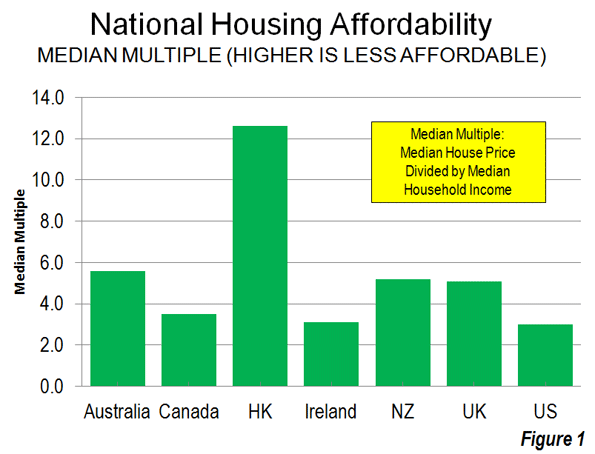
    Historically, the Median Multiple has been remarkably similar in Australia, Canada, Ireland, New Zealand, the United Kingdom and the United States, with median house prices having generally been from 2.0 to 3.0 times median household incomes (historical data has not been identified for Hong Kong). This affordability relationship continues in many housing markets of the United States and Canada. However, the Median Multiple has escalated sharply in the past decade in Australia, Ireland, New Zealand, and the United Kingdom and in some markets of Canada and the United States. There has also been a substantial loss in affordability in recent years in Hong Kong.

    Housing Affordability in 2011

    Housing affordability was little changed in 2011, with the most affordable markets being in the United States, Canada and Ireland. The United Kingdom, Australia, New Zealand and Hong Kong continue to experience pervasive unaffordability (Figure 1).

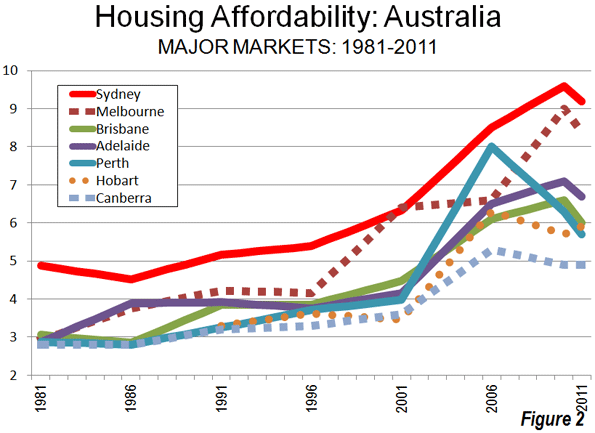
    The Survey covers325 metropolitan markets, including the 81 major markets with more than 1,000,000 population (Table and Chart Attached). There were 24 affordable major markets, 20 moderately unaffordable major markets, 13 seriously unaffordable major markets and 24 severely unaffordable major markets (Table 2). The severely unaffordable major markets were principally in the United Kingdom (8), the United States (6), and Australia (5). Hong Kong was severely unaffordable and there were three severely unaffordable major markets in Canada and one in New Zealand (Table 2). Australia had the highest major market Median Multiple outside Hong Kong (Figure 2).


    Table 2

    Housing Affordability Ratings by Nation: Major Markets (Over 1,000,000 Population)

     Nation

    Affordable (3.0 & Under) 

    Moderately Unaffordable (3.1-4.0)

    Seriously Unaffordable (4.1-5.0)

    Severely Unaffordable (5.1 & Over)

    Total

    National Median

     Australia

    0

    0

    0

    5

    5

    6.7

     Canada

    0

    3

    0

    3

    6

    4.5

     China (Hong Kong)

    0

    0

    0

    1

    1

    12.6

     Ireland

    0

    1

    0

    0

    1

    3.4

     New Zealand

    0

    0

    0

    1

    1

    6.4

     United Kingdom

    0

    0

    8

    8

    16

    5.0

     United States

    24

    16

    5

    6

    51

    3.1

     TOTAL

    24

    20

    13

    24

    81


    The most affordable major market was Detroit, with a Median Multiple of 1.4. This Median Multiple is artificially low, arising from the collapse of housing demand in the most severely depressed major market in the United States. There were another 22 affordable major markets, the most affordable of which were Atlanta, Phoenix, Rochester, Cincinnati, Cleveland and Las Vegas. The strong growth markets of Dallas-Fort Worth, Houston, Orlando, Jacksonville, Nashville, Oklahoma City, Sacramento and Indianapolis also achieved affordable ratings.

    All major markets in Australia and New Zealand, as well as Hong Kong were severely unaffordable.
    Hong Kong was the least affordable major market (ranked 81st), with a median multiple of 12.6. Vancouver was second most unaffordable, at 10.6 (ranked 80th). Sydney was the third most unaffordable, at 9.2 (ranked 79th).  Melbourne and Plymouth & Devon all had Median Multiples above 7.0.

    Among all 325 markets surveyed, there were 128 affordable markets, 117 in the United States, 9 in Canada and 2 in Ireland. There were 71 severely unaffordable markets, principally concentrated in Australia and the United Kingdom (Table 3). Honolulu and Bournemouth & Dorsett (8.7) were the least affordable outside the major markets.

    Table 3

    Housing Affordability Ratings by Nation: All Markets

     Nation

    Affordable (3.0 & Under) 

    Moderately Unaffordable (3.1-4.0)

    Seriously Unaffordable (4.1-5.0)

    Severely Unaffordable (5.1 & Over)

    Total

    National Median

     Australia

    0

    0

    7

    25

    32

    5.6

     Canada

    9

    19

    1

    6

    35

    3.5

     China (Hong Kong)

    0

    0

    0

    1

    1

    12.6

     Ireland

    2

    3

    0

    0

    5

    3.3

     New Zealand

    0

    0

    3

    5

    8

    5.2

     United Kingdom

    0

    1

    12

    20

    33

    5.1

     United States

    117

    64

    16

    14

    211

    3.0

     TOTAL

    128

    87

    39

    71

    325


    Preserving the "Ideal of a Property Owning Democracy"

    One of the principal accomplishments of high-income world societies has been the expansion of property ownership and home ownership to the majority of the population. At the same time, there are dark economic clouds on the horizon. Governments in high income nations are faced with some of the most challenging times in their history. In this environment, the property owning middle class is likely to face significant challenges in the longer run. Since housing is largest element in household budgets, unaffordable housing is a serious threat to the standard of living.

    At the same time, the economic evidence shows that more restrictive land use regulations, such as urban growth boundaries, have been an important factor in the deterioration of housing affordability. On this point, economist Anthony Downs of The Brookings Institution stressed the importance of maintaining the "principle of competitive land supply." The escalation of house prices relative to incomes, from Sydney and Vancouver to London and across California testify to the failure of planning to maintain that principle. The record shows that smart growth (urban consolidation and compact cities policies) is incompatible with housing affordability.

    But there are signs of hope. Florida repealed its growth management law ("smart growth") in 2011. Further, a recent New Zealand government report outlined the importance of a competitive land supply in restoring housing affordability to that nation.

    Four decades ago, urbanologist Peter Hall expressed concern about the threat of such policies to the "ideal of a property owning democracy." The Demographia International Housing Affordability Survey is dedicated to younger generations who have right to expect they will live as well or better than their parents. In large measure due to land use planning that has made housing unaffordable, they may not.

    Wendell Cox is a Visiting Professor, Conservatoire National des Arts et Metiers, Paris and the author of “War on the Dream: How Anti-Sprawl Policy Threatens the Quality of Life

    —-

    Note: The 8th Annual Demographia International Housing Affordability Survey is sponsored in Canada by the Frontier Centre for Public Policy.

    Photo: Suburban Montréal (by author)

  • Against Cosmopolitanism

    All science fiction agrees. History is leading to the unification of earth. The united world may be governed by benign world federalism or by a dystopian global tyranny. But the modern literature of prophecy is clear: the age of competing nation-states is coming to an end. There are no visions of the future in popular culture in which advanced technology is combined with the continued sovereignty and competition of nation-states like China, India, and the United States or blocs like the European Union. The only near-equivalent is George Orwell’s nightmare vision, in 1984, of endless rivalry among the three totalitarian blocs of Oceania, Eurasia, and Eastasia.

    Most educated people today are similarly in accord, associating historical progress with the increasing scale of our moral and political loyalties. Individuals are liberated from the communities into which they happened to be born. The tribe gives way to the nation and the nation gives way to humanity. History will soon culminate in a secular millennium in which emancipated individuals will be citizens of a postnational, global community.

    Since the late 19th century, hopeful visions of the future have almost always been identified with the transcendence of nation-states. In the early 1900s, many in the West looked forward to the fulfillment of Alfred Tennyson’s vision in "Locksley Hall" (1842) of "the Parliament of man, the Federation of the world." Wendell Willkie predicted in 1943 that World War II would be followed by a new age of unity given its title by his book: One World. The fall of the Berlin Wall triggered yet another wave of claims that a postnational epoch was dawning. These forecasts took crude forms, like Thomas L. Friedman’s inaccurate depiction of a global market compelling the convergence of national policies, or sophisticated ones, like the British diplomat Robert Cooper’s claim that premodern and modern societies would give way gradually to postmodern societies.1

    Although philosophical cosmopolitanism today is generally associated with secular elites, its roots are religious. The idea that all human beings belong to a single moral community was part of ancient Stoicism. But the Stoics did not believe in progress. Instead, they envisioned a cyclic universe, like that of Hinduism, in which the world was periodically incinerated and re-created. The combination of progress and cosmopolitanism comes from the apocalyptic tradition in Zoroastrianism, which influenced apocalyptic Second Temple Judaism, Christianity, and Islam. According to this school of thought, at some point probably in the near future, history would be brought to an end by God whose direct rule would replace the division of humanity among languages and nationalities that the Biblical tradition explained with the myth of Babel.

    The combination of moral cosmopolitanism with unidirectional progress constitutes Christianity’s greatest legacy to the secular intelligentsia. The idea that a moral person must not be a selfish localist or nationalist, but must take a personal interest in the well-being of poor, suffering, far-away people was a Christian notion long before it informed the view of secular intellectuals of themselves as world citizens who have transcended petty local loyalties and interests. In its secularized version, Providence takes the form of social forces like the economy and culture, but the result is the same: the formation of a single planetary community free from ethnocentrism, wars, and trade conflicts. This kind of secular providentialism informs the philosophies of numerous thinkers including Immanuel Kant, G.W.F. Hegel, Karl Marx, and more recently Martha Nussbaum, Ulrich Beck, Peter Singer, and Kwame Anthony Appiah.

    The underlying providential structure of cosmopolitanism explains the combination of certitude and moral fervor found among liberal and socialist one-worlders. In Christianity, to deny God’s providential plan for the world is a sin, as it is to obstruct the unfolding of that plan. The same is the case in secular providentialism. Globalist liberals and socialists predict that a single cosmopolitan society will inevitably be brought about by irresistible social forces and then condemn anyone­ — nationalist or capitalist — who resists those forces. Postnational liberals tell us that the nation-state is withering away and then condemn those who defend national sovereignty for delaying the allegedly inevitable postnational future. The sun will rise tomorrow precisely at 7:00 a.m., therefore we must help it rise and fight those who would prevent its rising.

    1.
    Contemporary cosmopolitanism, in defiance of Hume, combines an "ought" with an "is." The "ought" is the view that the nation-state is a parochial form of organization and should be replaced by broader, more inclusive loyalties. The "is" takes the form of the claim that the nation-state is destined to wither away because of irresistible technological or economic forces, whether we like it or not.

    But the trends proffered as evidence of a historic shift toward postnational cosmopolitanism are in fact consistent with the persistence of the nation-state as the main actor in world politics. Changes in the global economy, most significantly, are not signs of cosmopolitanism. The popular conception of globalization is overly simple and misleading. As Alan M. Rugman has pointed out, instead of a single global market there is today a somewhat Balkanized world economy organized around the "triad" of Europe, North America, and East Asia.2

    The emerging world economy is highly regionalized and remains connected to the nation-state. While some industries, like computer electronics manufacturing, are truly global, others, like the automobile industry, are dominated by corporations with most of their production and sales based in one of the three major blocs. New blocs might join the existing triad — India-centered South Asia, for example — but it is naïve to think that all barriers to the free flow of capital, goods, and labor among countries and regions will disappear.

    Even multinational corporations turn out to be not quite so multinational. The 100 largest multinationals in 2008 held 57 percent of their total assets and 58 percent of their total employment abroad, with foreign sales making up 61 percent of their total.3 But this merely means that most multinationals are half-global, at best. The typical multinational still has a distinct national identity, with around half of its assets, employment, and sales within its home market. In fact, very few multinational corporations conduct an overwhelming majority of their business outside of their home countries.

    The domination of global commerce by corporations based in the United States, Japan, and Germany — the three most populous industrial democracies — shows the importance of a large domestic market as a base for multinational sales and operations. Despite the celebration of global corporations by libertarians and their denunciation by leftists and populists, global companies possess national identities after all. Even financial globalization proved more superficial than advertised: major global banks turned to their national governments for bailouts following the 2008 financial crisis.

    The temporary influence of the Washington Consensus notwithstanding, the epoch of economic nationalism never ended. Outside of the Anglophone countries, this is the age of mercantilism. Instead of tariffs, post-1945 mercantilist nations have used subsidies (Europe and the United States); non-tariff barriers (Japan); and currency "tariffs," subsidies, and state-directed credit (China) to protect domestic markets and support export-oriented sectors of their economies. Mercantilism cannot work without a "patsy," and the United States agreed during the Cold War and post-Cold War period to play the role of consumer of first resort for mercantilist nations. This decision was based, partly on libertarian ideology, but mainly on national strategy, to encourage first Japan and West Germany and then China to become one-dimensional civilian manufacturing powers instead of rival military powers. In the long run, it is more likely that the United States — the world’s most protectionist nation before 1945 — will move back toward mercantilism than it is that China, Japan, and Germany will adopt the economics of the late Milton Friedman.

    Current trends in immigration do not support the cosmopolitan claim that national borders are breaking down. Neither the fact that a country like the United States chooses to admit large numbers of legal immigrants nor the fact that it chooses to tolerate large numbers of illegalimmigrants demonstrates that it is powerless to do otherwise. With respect to transnational flows of labor, all advanced industrial countries, including the United States, have undertaken actions — ranging from issuing national identity cards to building border fences — to secure their borders and airports against illegal immigrants. The assertion of effective state control over immigration is driven, in part, by fear of international terrorism, but also by a backlash against poor immigrants among native-born citizens of developed countries — a backlash that is likely to deepen if the Great Recession is prolonged over many years.

    At the same time that advanced countries are seeking to reduce unwanted immigration, many are competing for skilled immigrants. Britain, Australia, and Canada, for example, have adopted a "points system" in which educated immigrants are favored over the uneducated. When these trends are put together, the result is the opposite of the borderless world with free flows of labor predicted by prophets of globalization a decade ago. Most countries in the 21st century are likely to combine a tough attitude toward illegal immigration with selective legal immigration favoring skilled workers.

    What about the political trends of the 21st century? The historical pattern is clear. The breakup of the Habsburg and Ottoman empires after World War I produced many new nation-states and some new multinational states, like Yugoslavia. Following World War II, the decolonization of the European empires in Asia and Africa produced dozens of new states, some of them multinational (like Nigeria and Pakistan, which may themselves break apart like Yugoslavia). With the dissolution of the Soviet Union and Yugoslavia, new states were again added to the United Nations General Assembly. It is a safe bet that the maps of the world in 2050 and 2100 will show still more independent countries than exist today.

    The conventional wisdom of today’s cosmopolitans holds that ethnocultural nationalism is a barbaric relic of an earlier stage of civilization and that as enlightenment and prosperity spread, people become more cosmopolitan. But far from being moribund, nationalism — defined not as aggression or xenophobia, but as a preference for the nation-state as the unit of legitimate government — remains the most powerful force in global politics for the third century in a row.
    Thus nationalism is not atavistic; indeed, it is modern — just as modern as industrialism and urbanism. The trend of reorganizing a world of premodern dynastic empires and city-states into a world of nation-states, in which most (though not all) states are identified with a majority ethnocultural group, has paralleled the conversion, in the economic realm, of an agrarian world into an industrial world.

    As societies become urban and industrial, village societies give way to anonymous urban societies in which individuals identify with larger "imagined communities." These need not be national — Islamists, for example, identify with the imagined community of the Muslim ummah. But the community that has proven most effective in attracting the loyalty of individuals in modern, large-scale societies is the nation, which can be defined minimally in terms of shared language and customs, as in most liberal democracies, or maximally, in terms of shared "race" and/or religion, as in illiberal nationalism.

    It follows that as people become more educated and more prosperous they are more likely to prefer to be members of the majority in a nation-state rather than minorities in someone else’s nation-state or one of several squabbling nationalities in a multinational state. As the world grows richer, movements by stateless nations, from the Scots to the Kurds, to obtain nation-states of their own, whether by peaceful or violent means, are likely to increase, not decrease.
    Arguably, we are still in the early stages of the technological era in economics and the era of the nation-state in politics. In the most likely scenario, the 21st century will witness the completion of two trends that have been underway since the 18th — the conversion of all humanity from an agrarian lifestyle to an urban-industrial one, and the replacement of premodern forms of political organization almost everywhere by nation-states.

    2.
    In recognizing the continuing, and likely expanding, hegemony of the nation-state as the primary unit of global political, economic, and social organization, we need not deny the simultaneous expansion of cosmopolitan sympathies. Liberalization of government controls on trade and finance, greater cross-border immigration and global travel, and the constitution of something approaching a global public through mass media communication of serial cosmopol­itan "moments" all contribute to the spread of cosmopolitan sentiments. But those sympathies are likely to continue to exist alongside national identities and allegiances.

    To be sure, global initiatives such as the Millennium Development Goals and other antipoverty programs, as well as post-Cold War military interventions in the former Yugoslavia, Iraq, Afghanistan, and Libya have been justified, to some extent, on cosmopolitan grounds. The US intervention in Libya, to take one recent example, appears to have involved a protracted debate within the Obama Administration between advocates of the cosmopolitan notion of "Responsibility to Protect" (R2P) and pragmatists opposed to the application of US military power in conflicts where there is no clear national interest. In this debate, the cosmopolitans appear to have prevailed.

    But we should be careful not to read too much into these examples. In virtually every case, the nation-state remains the institution through which economic and military resources are deployed in service of cosmopolitan objectives. In many cases, it is often difficult to disentangle where national interest ends and cosmopolitan interest begins. The wars in the Balkans and the Middle East can just as easily be explained in terms of the national interests of the United States and its allies in defeating sponsors of terrorist attacks (Afghanistan), securing US regional military hegemony (Iraq and Libya), and averting destabilizing flows of refugees to Europe (a motivation behind European participation in the Balkan and Libyan wars), as through cosmopolitan ones. As such, even where cosmopolitan sentiments succeed in galvanizing national or international action in response to global and regional challenges, those responses are likely to only further establish the nation-state as the focal point for making those decisions and the primary institution through which such interventions are likely to be carried out.

    The resulting organization of global affairs is better explained by liberal internationalism than by cosmopolitanism. In this view, nation-states, rather than individuals, corporations, or non-governmental organizations (NGOs), will continue to be the main actors in world politics (though certainly not the only ones) for generations to come. Liberal internationalists maintain that all human beings have inalienable rights, which should be secured by governments resting on their consent. While those rights-securing governments may take various forms, the nation-state is the largest unit that has been able to combine effective government with a sense of solidarity among its citizens. The nation to which the state corresponds can be defined broadly, in terms of a shared culture and language, and it can be generous to minority nationalities that may share its territories. But there is a point at which linguistic and cultural diversity undermine the minimum of community needed to maintain a sense of shared citizenship. A global government would be a Tower of Babel which few would be willing to obey, to provide with taxes, or to support with military service.

    Liberal internationalism answers the question of how the world can be organized, if each people, however defined, has a right to its own sovereign, accountable nation-state. The alternative to both Hobbesian anarchy and global cosmopolitanism is cooperation by nation-states. This cooperation can take the form of international law, international arbitration, and international agencies, as well as military alliances and concerts of power. But international is not supranational. Countries may delegate powers to international agencies for some purposes, but as long as the delegations are revocable, they are not surrendering sovereignty.

    3.
    The most important distinctions in 21st century world politics will be based on scale. By the middle of this century, the greatest powers may eventually be those, such as China, India, and the United States, which combine (or will combine) at least moderately developed industrial economies with populations of half a billion people or more. 

    The US investment bank Goldman Sachs predicts that by 2050 China will have the largest economy in the world, followed by the United States and India. The next tier might be occupied by Russia, Brazil, and Japan, and a third tier would include Germany, Britain, and other once-mighty European economic powers.4 Just as the Italian city-states of the Renaissance were dwarfed and marginalized by the national monarchies north of the Alps in the 16th and 17th centuries, so the large nation-states of the past — Britain, France, Germany, Russia, and Japan — will be overshadowed by the titans of the 21st and 22nd centuries.

    The United States will owe its position in the club of titans to its immigration-fed population growth, which could produce an American population of 400-600 million by 2050. The 2010 medium fertility estimations of the United Nations suggested that in 2050 the most populous nations would be India (1.7 billion) and China (1.3 billion), followed by the United States (400 million), Nigeria (400 million), and Indonesia (300 million).5 It is Europe, not the United States, which faces a significant decline in relative population, wealth, and power. Europe, which accounted for 22 percent of the world’s population in 1945 and 12 percent in 2000, may have only 6 percent in 2050. Because GDP is based on working-age population and productivity, even though Europeans will grow richer, the European share of the global economy may decline from 22 percent today — roughly comparable to that of the United States — to only 12 percent in 2050.6

    In modern industrial societies, technology and politics combine in what Edward Luttwak has called "geoeconomics." Technological economies of scale reward big enterprises in large, unified markets. As champions of the global market ceaselessly point out, technological and commercial economies of scale are best realized at the global level. But psychological and political economies of scale are best realized by nation-states.

    In theory, both economic and political economies of scale could be realized by multinational blocs, but in practice this outcome is unlikely. As early as the 1840s, British and French observers speculated that the future would be dominated by two giant states, the United States and Russia. The imperialism of the industrial era, from the 1870s to World War II, was (among other things) an attempt by medium-sized nation-states like Britain, France, Germany, Italy, and Japan to create economic areas comparable in scale to those that existed inside the borders of the United States and Tsarist Russia (later the Soviet Union).

    After World War II, largely at the insistence of the United States, the international system outlawed old-fashioned empire building. But even if 20th century history had taken a different course, it is doubtful that multinational empires, held together by repression and, in the case of maritime empires like the British and Japanese, separated by oceans, could have competed in the long run with giant nation-states.

    The former Western European imperial powers have sought to achieve the same result by partially pooling their sovereignty in the European Union. But European countries retain their sovereignty in foreign policy, rendering a unified voice impossible in conflicts including the Balkan wars, the Iraq War, and the Libyan War. Meanwhile, the Greek financial crisis has proven that the European Union lacks the overarching central economic institutions, like a central bank with emergency lending capabilities, necessary to function as an efficient monetary and commercial union. Because of popular resistance to further political integration, the European Union is no more likely to be the successful equivalent of a giant nation-state than the former European empires proved to be.

    Psychological economies of scale favor nation-states with a strong sense of solidarity among their citizens that makes them willing to fight in wars, pay taxes, and tolerate redistribution for the common good. China, with its overwhelming Han majority, has a far greater sense of national identity and solidarity than much smaller multinational states like Canada and Belgium, which are in danger of breaking up along ethno-national lines as Yugoslavia and Czechoslovakia have done.

    It follows, then, that in the future, as in the past, the economic gains from scale will be reaped chiefly by entities with immense, free, internal markets congruent with political boundaries. Concerns about national security and domestic distribution will always constrain market integration among nation-states. In a post-imperial, post-dynastic world, the most successful great powers will be very big nation-states.

    4.
    Contrary to the claims of the prophets of cosmopolitanism, the world is likely to remain divided among great sovereign powers for ages to come. Sometimes they will compete, at other times they will collaborate, but they are unlikely to sacrifice their sovereignty by merging into a single global government; if one were established, by force or intimidation, it would probably break apart quickly.

    The ideas of postmodernity and second modernity appeal primarily to thinkers in European nations where it is necessary to transcend and pool sovereignty in order to compete with huge nation-states like the United States and China. Large nation-states, in contrast, are powerful on the basis of their internal populations, resources, and economies, so it is unsurprising that they see no benefit in surrendering their sovereign powers to supranational organizations dominated by smaller countries. In a world of sovereign nation-states, the biggest nation-states are more sovereign than the others. Unilateralism is natural for the great powers. Whales do not consult the barnacles on their sides or the schools of small fish who swim in their wake.

    The rise of the giants is likely to lead to less, not more, emphasis on international organizations like the United Nations and the World Trade Organization. If the United States, China, and India account for much of the world economy in fifty to a hundred years, then they may prefer setting the rules of world trade and investment by bilateral or trilateral negotiations. Why should giants consult with dozens or hundreds of pygmies before acting? International law has traditionally been championed by small- or moderate-sized, neutral countries (including the United States in the 19th century). Its influence may decline in an age in which a few titanic continental states have hundreds of millions or billions of inhabitants.

    Unfortunately, cosmopolitanism is not simply a quaint, harmless religious faith held by global elites. Confusing the cosmopolitan "ought" with the cosmopolitan "is" results in all sorts of disastrously wrongheaded policies. If, for example, the world really is on the verge of full economic and political integration, then outsourcing all US manufacturing capacity to China might make sense in the same way that it might be reasonable for a state like California to outsource all of its manufacturing capacity to other US states. They share the same tax, regulatory, and social welfare systems; they make shared national investments in infrastructure and education; and they share the same military and national security interests. But in a world in which nation-states are likely to continue to retain their sovereignty and in which economic nationalism continues to reign, trade and investment policies that presuppose a borderless world make no sense at all.

    The cosmopolitan error has similarly distorted international efforts to address global challenges. International climate policy has persistently foundered upon the basic realities of an international political economy that continues to be defined by the interests of national economies. International development and antipoverty efforts in recent decades have similarly failed to align themselves with the basic economic interests of donor economies. As such, the cosmopolitan error has had real consequences for both national efforts to build healthy, equitable economies and international efforts to address serious global problems and risks.

    The frequently-made argument that extensive supranational cooperation is necessary to solve global problems is incorrect. Without question, destructive, zero-sum national rivalries are a threat to a peaceful and prosperous world — on this point, liberal internationalists and liberal cosmopolitans can agree.

    Fortunately, most of the world-order goals of cosmopolitanism can be achieved by enlightened liberal internationalism without the need to sacrifice or weaken the democratic nation-state, the organization in which most of the progress toward equality and economic security over the last three centuries has taken place. Contrary to the commonly held views of pundits and science-fiction­­ writers, a world government or a true global market is unlikely to emerge in the foreseeable future. But a successful and enlightened liberal internationalism would permit us to enjoy the benefits of both without the costs of either. 

    This piece was first published by the Breakthrough Journal.

    Michael Lind is Policy Director of the Economic Growth Program at the New America Foundation and author of The Next American Nation.

    Photo by BigStockPhoto.com.

    ~~~~~~~~~~~~~~~~~

    1. Friedman, Thomas. 2005. The World is Flat: A Brief History of the Twenty-first Century. New York: Farrar, Straus and Giroux; Cooper, Robert. 2000. The Postmodern State and the World Order. London: Demos. (back)

    2. Rugman, Alan. 2001. The Myth of Globalization: Why Global Strategy is a Myth and How to Profit from the Realities of Regional Markets. AMACOM. (back)

    3. Nolan, Peter and Jin Zhang. 2010. "Global Capitalism After the Financial Crisis." New Left Review 64. July/Aug (102). (back)

    4. Wilson, Dominic and Roopa Purushothaman. 2003. "Dreaming with BRICS: The Path to 2050." Global Economics Paper Number 99. Goldman Sachs. October 1.(back)

    5. United Nations. 2010. Population Division of the Department of Economic and Social Affairs of the United Nations Secretariat. World Population Prospects: The 2010 Revision(back)

    6. Institut Francais des Relations Internationales (IFRI) 2002. "Le Commerce Mondiale au XXIe siecle [World Trade in the 21st Century] Scenarios for the European Union."; Walker, Martin. 2003. "French Study Says Europe Fading," UPI, May 14. (back)
  • Interactive Graphic: Ranking States By Competitiveness

    In a previous post we looked at which states have been most competitive in terms of job creation since the recession.

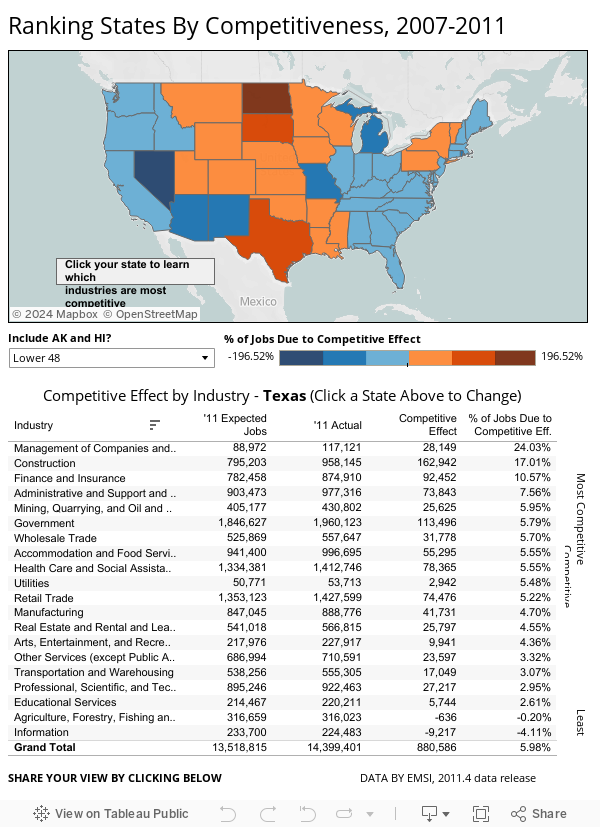
    In this post we teamed up with our friends at Tableau Software to produce the following interactive graphic, which details individual industries that are driving states to be more (or less) competitive. The graphic breaks down the performance of the 20 major sectors in every state in the contiguous US (plus Hawaii and Alaska) in terms of expected and actual job change from 2007-2011. Further explanation of the analysis is below.

    Rundown on the data

    We used shift share, a standard economic analysis method that reveals if overall job growth is explained primarily by national economic trends and industry growth or unique regional factors. Shift share analysis, which can also be referred to as “regional competitiveness analysis,” helps us distinguish between growth that is primarily based on big national forces (the proverbial “rising tide lifts all boats” analogy) vs. local competitive advantages.

    To generate our ranking, we summed the overall competitive effect for each broad 2-digit industry sector by state (e.g., agriculture, manufacturing, health care, construction, etc.) and added them together to yield a single statewide number that indicates the overall competitiveness of the economy as compared to total economy. We calculate the competitive effect by subtracting the expected jobs (the number of jobs expected for each state based on national economic trends) from the total jobs. The difference between the total and expected is the competitive effect. If the competitive effect is positive, then the industries within the state have exceeded expectations and created more jobs than national trends would have suggested. Those industries are therefore gaining a greater share of the total jobs being created. If the competitive effect is negative, then the industries are not gaining jobs as fast as what we would expect given national trends. In this case the state is losing a greater share of the total jobs being created.

    Observations On Most Competitive

    The big thing that stands out is that most of the competitive states tend to be in the middle of the country. This is tied to the growth in the oil and gas sector, yes, but in most cases better-than-expected performance in construction, government, and other miscellany sectors. In Alaska, North Dakota, and Nebraska, smaller states in terms of population and jobs, manufacturing, transportation, and construction are some of the most competitive industries. Louisiana also fares quite well in healthcare and accommodation & food services.

    Observations On Least Competitive

    For states that rank toward the bottom, the housing bust and subsequent construction downturn is the biggest culprit. For instance, in Nevada, which is last on the list, construction is nearly 50,000 jobs below what would be expected given national and industry trends. Florida, a much more populous state, is more than 130,000 jobs below what would be expected. For states like Michigan, Ohio, and Indiana, the poor performance in manufacturing and government weighed heavily in our ranking.

    Here is the original graphic that show the comparison between states.

    Please check out the graphic and let us know if you have any questions. Email Rob Sentz (rob@economicmodeling.com) or hit us via Twitter @DesktopEcon. Data and analysis comes from Analyst, EMSI’s web-based labor market analysis tool.

  • Why Housing is So Expensive in Metropolitan Washington

    Anyone familiar with housing affordability in the Washington (DC-VA-MD-WV) metropolitan area is aware that prices have risen strongly relative to incomes in the last decade.

    However, a recent Washington Post commentary by Roger K. Lewis both exaggerates the contribution of higher construction costs and misses the principal factor that has driven up the price of housing: more restrictive land-use regulations.

    Lewis compares construction costs in the early 1970s to current costs and finds that they are approximately 6 times as high. However, when the R. S. Means construction cost index for locations in the metropolitan area are adjusted for inflation, the increase is more like 15% (1970 to 2007).

    Lewis also indicates that construction costs have risen faster than the "relatively flat income curve." In contrast, Census Bureau data indicate that median household incomes in the Washington metropolitan area have increased more than 30% since the early 1970s, after adjustment for inflation. House construction costs are the flatter of the two, not incomes.

    While Lewis’ focus is affordable housing, costs in this low income sector are impacted by many of the same factors that drive overall housing affordability (overall house prices relative to incomes).

    Lewis does not consider the huge cost increase in the non-construction costs of housing. In the Washington metropolitan area, we have estimated that the land and the regulatory costs for a new house have been driven to more than 5.5 times the level that would be expected in a normal regulatory environment (see the Demographia Residential Land & Regulation Cost Index). The problem is that the restrictive land-use policies, such as the Montgomery County agricultural reserve, similar regulations in other metropolitan area counties and the large lot building restrictions in Loudoun County have driven the price of land up substantially, and with it, the price of housing. We estimate that more restrictive land use regulations have driven the price of a new house up approximately $75,000.

    Not surprisingly, Washington’s Median Multiple (median house price divided by median household income) remains more than a third above the 3.0 historic norm, at 4.0, even after the burst of the housing bubble. So long as governments in the Washington, DC area continue to strictly ration land for development, higher than necessary costs will continue to plague both housing affordability and affordable housing.

  • This Is America’s Moment, If Washington Doesn’t Blow It

    The vast majority of Americans believe the country is heading in the wrong direction, and, according to a 2011 Pew Survey, close to a majority feel that China has already surpassed the U.S. as an economic power.

    These views echo those of the punditry, right and left, who see the U.S. on the road to inevitable decline.  Yet the reality is quite different. A confluence of largely unnoticed economic, demographic and political trends has put the U.S. in a far more favorable position than its rivals. Rather than the end of preeminence, America may well be entering  a renaissance.

    Just survey the globe. The European Union’s prolonged crisis will likely end in further decline. Aging Japan has long passed its prime, its market share receding in everything from autos to high tech.  China’s impressive economic juggernaut has slowed down, and the Middle Kingdom faces increased social instability, environmental degradation and a creaky one-party dictatorship.

    While the U.S. has its challenges, it is positioned to achieve a more solid long-term   trajectory than its European and Asian rivals. What it lacks, however, is a strong political leadership capable of seizing this opportunity.

    Resources

    Energy constitutes the biggest ace in the hole for the U.S. For almost half a century, an enormous fossil fuel bill that still accounts for 40% of the nation’s trade deficit has hampered economic growth. Now that situation is changing rapidly.

    Due to vast new finds and improved technology to exploit them, the U.S. is now the world’s largest producer of natural gas and could emerge as the leading oil producer by 2017. Reserves of natural gas — a clean-burning fuel — are estimated at 100 years supply and could generate more than 1.5 million new jobs over the next two decades.

    The U.S. agricultural sector is also booming, with exports reaching a record $135.5 billion in 2011. With global demand increasing, sustained growth  will continue across America’s fertile agricultural regions.

    Manufacturing

    The other big game changer is manufacturing. As President Barack Obama recently acknowledged, this is America’s “moment” to seize the industrial initiative. U.S. manufacturers have expanded their payrolls for two straight years, and they have increased production while Japan, Germany, China and Brazil have scaled back.

    A recent survey of manufacturing CEOs revealed that 85% believed production could shift soon from overseas. Both foreign and domestic manufacturers are alarmed about rising wages and labor unrest in China. Some important Japanese, German and Korean companies also have concerns about China’s policies that favor local firms and abscond with investor’s technology.

    Foreign Investment

    Rising foreign investment reflects the new American competitiveness. Since 2008 foreign direct investment to Germany, France, Japan and Korea has stagnated; in 2009 overall investment in the E.U. dropped 36%.

    In contrast, in 2010 foreign investment in the U.S. rose 49%, mostly coming from Canada, Europe, and Japan. Industrial investment rose $30 billion just between 2009 and 2010, while investment in the energy sector more than tripled to $20 billion.

    The Information Sector

    In the information sector, American domination continues to mount, contrary to predictions of decline over the past two decades. Although high-tech manufacturing has shifted largely to Asia, Americans rule the increasingly strategic software sector.   American-based companies, who constitute more than two-thirds of the world’s 500 largest software companies, including  nine of the top ten.

    Outside the U.S., there are no significant equivalents of Apple, Google, Microsoft, Amazon and Facebook. Hollywood, for its part, rules the entertainment world, producing 40% of world’s audiovisual exports, a dominion that troubles China’s President Hu Jintao, who recently complained  that the “cultural fields” represent “the focal area” for Western “infiltration”.

    Demographics

    The Great Recessionhas slowed population growth everywhere, but the U.S. maintains the   youngest and most vibrant demographic profile of any advanced country. Between 1980 and 2010, the U.S population expanded by 75 million to over 300 million. In contrast many European countries, including Germany, have suffered stagnant growth, while in Russia and Japan populations have already started declining.

    The disastrous fiscal implications of slow or negative population growth are evident in Greece, Spain and Italy, all of which suffer among the world’s lowest fertility rates. Rapid aging also will soon catch up with Germany. By 2030, Germany will have 48 retirees for every 100 workers — that’s barely two workers per retiree. The numbers are even worse in Japan: 53 retirees for every 100 workers by 2030.

    Political Factors

    Given the ineptitude of the last two administrations, enthusiasm about America’s political system is hard to justify. But our constitutional systems of laws and checks on central power remain a critical advantage. Immigration has declined with the recession, but the U.S. can expect to welcome religious and political exiles — such as Middle Eastern Christians displaced by   the “Arab Spring” — as well as Greeks and Irish fleeing Europe’s economic decline.

    Many from Russia and China are seeking to immigrate to the United States, Canada or Australia in order to protect property or just live a freer life. Indeed, among the 20,000 Chinese with incomes over 100 million Yuan ($15 million), 27% have already emigrated and another 47% have said they were considering it, according to a report by China Merchants Bank and U.S. consultants Bain & Co. published in April.

    Needed from Washington: A New American Strategy

    Sadly no leading politician or political party seems ready to   embrace the country’s new strategic advantages.  Many on the left may find the very notion distasteful, having    swallowed declinism with their academic mother’s milk. The president himself dislikes the notion of American “exceptionalism.” Many key Obama backers like SEIU boss Andy Stern and former auto czar Steven Rattner, embrace the superiority of China’s authoritarian system. Others embrace Europe and even Japan as models for an aging superpower.

    Worse still: Some Obama policies work against the well springs of national resurgence.   Threats to raise income taxes on families making over $250,000 directly threatens the aspiring entrepreneurial class more than the real “rich” whose fortunes are protected by low capital gains taxes and family trusts. Most critical: The administration’s hostility to fossil fuel represents a direct threat to the country’s greatest new source of advantage and threatens to strangle America’s recovery in its infancy.

    Not that the Republicans are any less clueless. Many reject the infrastructure needed by an expanding economy — ports, roads, bridges as well as worker training and support for basic research — as mere “pork.” Budget restraint and fiscal discipline are important, but preparing the country for more rapid economic growth requires an active, supportive government.

    Republicans also tend to view immigration as something akin to a hostile invasion. Yet many key industries — notably manufacturing and high tech — rely heavily on immigrant entrepreneurship, intelligence and work values. Running against immigration constitutes an assault on the nation’s increasingly diverse demographics.

    So this is where we now sit.  With all the essential elements for a strong, sustained recovery place, the big question is whether we will find political leaders capable of tapping this country’s phenomenal potential.

    This piece originally appeared at Forbes.com.

    Joel Kotkin is executive editor of NewGeography.com and is a distinguished presidential fellow in urban futures at Chapman University, and contributing editor to the City Journal in New York. He is author of The City: A Global History. His newest book is The Next Hundred Million: America in 2050, released in February, 2010.

    Photo from BigStockPhoto.com.

  • In Keystone XL Rejection, We See Two Americas At War With Each Other

    America has two basic economies, and the division increasingly defines its politics. One, concentrated on the coasts and in college towns, focuses on the business of images, digits and transactions. The other, located largely in the southeast, Texas and the Heartland, makes its living in more traditional industries, from agriculture and manufacturing to fossil fuel development.

    Traditionally these two economies coexisted without interfering with the progress of the other. Wealthier gentry-dominated regions generally eschewed getting their hands dirty so that they could maintain the amenities that draw the so-called creative class and affluent trustifarians. The more traditionally based regions focused, largely uninhibited, on their core businesses, and often used the income to diversify their economies into higher-value added fields.

    The Obama administration has altered this tolerant regime, generating intensifying conflict between the NIMBY America and its more blue-collar counterpart. The administration’s move to block the Keystone XL oil pipeline from Canada to the Gulf of Mexico represents a classic expression of this conflict. To appease largely urban environmentalists, the Obama team has squandered the potential for thousands of blue-collar jobs in the Heartland and the Gulf of Mexico.

    In this way, Obama differs from Bill Clinton, who after all recognized the need for basic industries as governor of poor and rural Arkansas. But the academic and urbanista-dominated Obama administration has little appreciation for those who do the nation’s economic dirty work.

    NIMBY America’s quasi-religious devotion to the cause of global warming is the current main reason for their hostility to the basic economy. But it is all a part of a concerted, decades-long jihad to limit the dreaded “human footprint,” particularly of those living outside the carefully protected littoral urban areas.

    Oddly, in their self-righteous narcissism, the urbanistas seem to forget that driving production from more regulated areas like California or New York to far less controlled areas like Texas or China, may in the end actually increase net greenhouse gas emissions. The hip, cool urbanistas won’t stop consuming iPads, but simply prefer that the pollution making them is generated far from home, and preferably outside the country.

    The perspective in the Heartland areas and Texas, of course, is quite different. They regard basic industries as central to their current prosperity. Oil and gas, along with agriculture and manufacturing, have made these areas the fastest growing in terms of jobs and income over the past decade.

    Of course, the apologists for the NIMBY regions can claim that they, too, create economic value. And to be sure, Silicon Valley — now in a midst of one of its periodic boom periods — Wall Street and Hollywood constitute some of the country’s prime economic assets. Similarly, highly regulated cities such as New York, San Francisco, Seattle, Boston and Chicago offer a quality of life, at least for the well-heeled, that draws talent and capital from the rest of the world.

    But the NIMBY model suffers severe limitations. For one thing, these high cost areas generally lag in creating middle-skilled jobs; New York and San Francisco, for example, have suffered the largest percentage declines in manufacturing employment of the nation’s 51 largest metropolitan areas. Indeed with the exception of Seattle, the NIMBY regions have all underperformed the national average in job creation for well over a decade.

    These areas are becoming increasingly toxic to the middle class, especially families who are now fleeing to places like Texas, Tennessee, North Carolina and even Oklahoma. NIMBY land use regulations — designed to limit single-family houses — usually end up creating housing costs that range up to six times annual income; in more basic regions, the ratio is around three or lower.

    Ironically, America’s most ardently “progressive” areas turn out to be the most socially regressive, with the largest gaps between rich and poor. Even the current tech bubble has not been of much help to heavily Latino working-class areas like San Jose, where unemployment ranges around 10%, nor across the Bay in devastated Oakland, where the jobless rate surpasses 15%.

    To succeed, America needs both of its economies to accommodate the aspirations not only of its current population but the roughly 100 million more Americans who will be here by 2050. If the regions that want to maintain NIMBY values want to do so, that should be their prerogative. But stomping on the potential of other, less fashionable areas seems neither morally nor socially justifiable.