Blog

  • Mistaking an Aberration for the End of Home Ownership

    It is well known that home ownership has declined in the United States from the peak of the housing bubble. According to Current Population Survey data, the national home ownership rate fell 2.9 percentage points from the peak of the bubble (4th quarter 2004) to the third quarter of 2011.

    It is less well understood, however, that the spurt in home ownership was, like the housing bubble, an aberration. Looking over the data from the 2010 census, it seems clear that since 2000 the actual decline was a much smaller: 0.8 percentage points from the 2000 census. In fact the current home ownership rate tracks fairly well with that of the post 1960 and the entire pre-bubble period.

    The End of Home Ownership? Analysts such as Richard Florida suggest an end to the preference for home ownership, citing the losses from the bubble, which were, in fact, an aberration. Most recently, Xavier University’s Michael F. Ford wrote in the Washington Postabout home ownership having been driven to 69% by "guarantees" and "tax breaks," such as the mortgage interest deduction. He notes that this "spending spree" led to a loss of $6 trillion in US real estate value.

    Ford does not mention the fact that home ownership had hovered between 60% and 65% for more than three decades before the bubble, without suffering any such losses. Nor does he mention the roles played by Fannie, Freddie and Frank (D-Massachusetts), along with others in Washington, or the related "drunken sailor" mortgage policies concocted by lenders and Wall Street that anyone familiar with credit should have known could only lead to disaster. This was obvious to many observers, although shockingly not to the Federal Reserve Board, as recent reports indicate .

    There is no doubt that the "spending spree" led to the housing bust and triggered the Great Financial Crisis. However it was not the long-standing ownership support programs of the federal government that were primarily to blame. As late as the beginning of the decade, there was no bubble and the median multiple in major metropolitan areas averaged 2.9, within the maximum affordability rating of 3.0. The "spending spree" itself was a rational response to policies that turned housing into the equivalent of a speculative commodities market, with destructive results, in certain large markets. Critically the bubble did not appear in many others.

    Speculation and the "Bubble States:" The extent to which speculation fueled house price increases is the subject of a recent Federal Reserve Bank of New York paper by Andrew Haughwout, Donghoon Lee, Joseph Tracy and Wilbert van der Klaauw. The researchers examine investment, or speculation in real estate markets, during the housing bubble. Investors buy houses that they do not intend to live in for the purpose of making money. In normal times, this investment is principally for rental income or long term capital gains. However, in the highly charged housing markets that developed in some metropolitan areas, prices rose so rapidly, that "flipping" (short term ownership) became very profitable, at least for some.

    Pointing out that "The recent financial crisis—the worst in eighty years—had its origins in the enormous increase and subsequent collapse in housing prices during the 2000s," the New York Fed researchers show that speculative activity was much greater in California, Florida, Arizona and Nevada (which they label the "bubble states") than elsewhere. My analysis indicates that two-thirds of the house value drop in the nation before the Lehman Brothers collapse (September 15, 2008) occurred in the four "bubble states." According to the researchers, this greater speculative activity in these markets made the market more instable because unlike owner-occupiers, investors are far more likely to default on mortgage loans.

    Missing the Geography of Speculation (the Geography of "Smart Growth"): The New York Fed research, however, ignores the geography of speculation. Why was speculation was so much more rampant in the bubble states? There is no reason to believe that residents of California, Florida, Arizona or Nevada are any less interested in making money or, in general, any more greedy. Yet speculators largely stayed out of markets in high demand areas, such as Dallas-Fort Worth, Houston and Indianapolis. In fact, in large parts of the nation, there was little speculative activity. In these markets prices were not rising inordinately so speculators did not bother with them. Instead they focused on more volatile markets where prices were already rising strongly, further swelling local price increases.

    The geography of speculation corresponds largely to the geography of excessive land use restrictions, which created the shortage of land for housing that drove the prices up in the four bubble states (Note). It is a fundamental principle of economics that prices tend to rise where desired goods are in short supply.

    In California and Florida, restrictive land use policies (smart growth or growth management) created a shortage of land for new housing relative to demand. The largest metropolitan areas of Nevada (Las Vegas) and Arizona (Phoenix) are surrounded by government owned land that was auctioned for development at such a slow rate that prices rose by more than five times during the bubble.

    Astonishingly, having missed the geography of speculation, the New York Fed researchers suggest that a solution is to regulate speculation. There is a much simpler answer, which Florida has already implemented which is to repeal the restrictive land use regulations, without which inordinately speculative profits cannot occur.

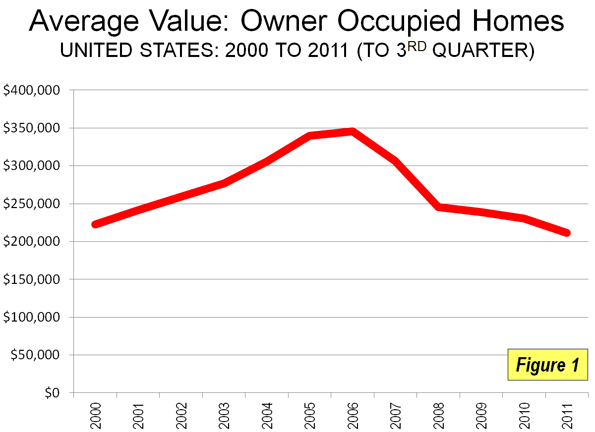
    Meanwhile, as the speculators have been driven out of the market, and despite federal government efforts to prop-up the artificially high house prices, values have fallen to below 2000 levels for the first time (Figure 1). Based upon Federal Reserve Board and Census Bureau data, it is estimated that the average owner-occupied house value in 2011 (three quarters) has fallen to $211,000, which is down from a peak of approximately $345,000 in 2006 and $222,000 in 2000 (adjusted for inflation).
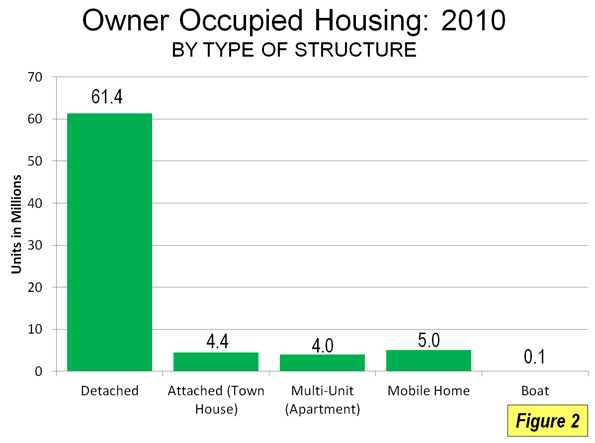
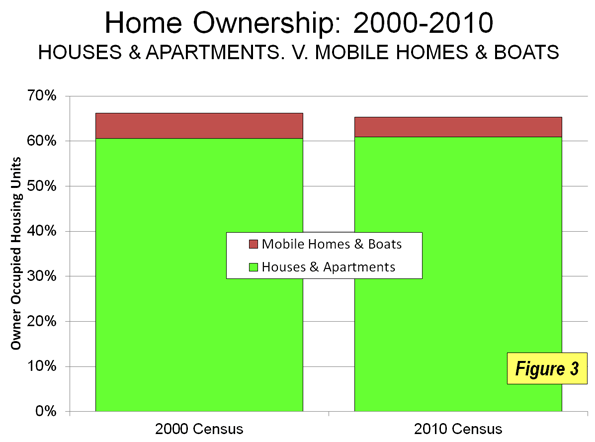
    So is Ownership now doomed? Yet the home ownership naysayers have little to cheer. Yes, home ownership dropped in the last decade. However, all of the loss was in mobile homes and boats. Even so, the number of mobile home owners remained greater than home owners living in apartments, including condominiums (Figure 2). In fact there was a slight increase in the share of households owning their own homes, if mobile homes and boats are excluded (Figure 3), with a rise from 60.6% in 2000 to 60.9% in 2010.
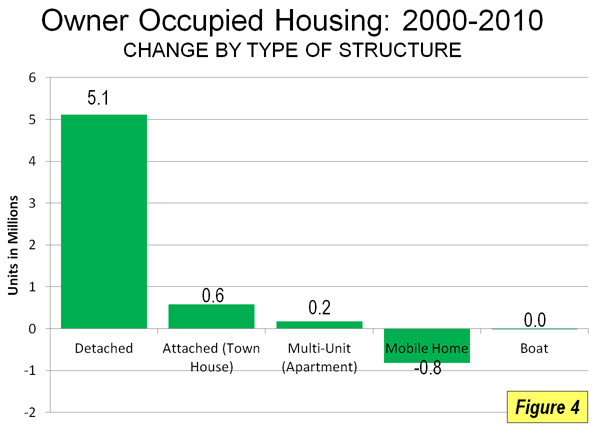
    There were 5,057,000 more home owners in 2010 than in 2000, and perhaps more surprisingly, 5,119,000 more home owners occupying detached housing. Detached, attached (town house) and apartment ownership each increased over the past decade (Figure 4). Contrary to new urbanist theoreticians, detached housing – not urban condos – overall accounted for the most housing growth, both owner-occupied and rentals.
    Xavier’s Ford calls the American Dream of home ownership a myth and even goes so far as to suggest that home ownership is "more important to special interests than it is to most Americans." In fact, Ford’s interpretation is delusional. That home ownership continued its advance, however modestly, in the face of the worst economic downturn in 80 years, reveals the durability and, indeed the reality of home ownership as an American Dream.

    Photo:  Preventing speculation (New Development, Dallas-Fort Worth suburbs)

    Note: Overall, the bubble states and other restrictively regulated metropolitan areas accounted for more than 90% of the pre-Lehman Brothers loss.

    Wendell Cox is a Visiting Professor, Conservatoire National des Arts et Metiers, Paris and the author of “War on the Dream: How Anti-Sprawl Policy Threatens the Quality of Life

  • Florida’s Quick Rebound

    Adding nearly 119,000 people in 2011, Florida has capped a decade of steady population increase  to see the state grow 19% since 2000.  Despite 2009, an historic year where more people left than arrived, the overall net growth of Florida has yielded two additional congressional seats, moving the state well on its way towards the becoming third most populous state in the nation.  This ascendancy brings new responsibility to the shoulders of the state’s leaders, and the direction this state takes in the coming years will depend upon how Florida reacts to this influx of new population.  It is time for true leadership to find appropriate voice for our state on the national scene.

    Contrary to the predictions of many within the urbanist intelligentsia, Florida’s farm counties grew the fastest. Osceola County, just south of bustling Orlando, grew by 55%; sleepy Sumter County, northwest of Orlando, grew by 75%; and Flagler County, home to historic St. Augustine, nearly doubled in population. Tampa, Orlando, and Miami have each seen their healthy share of immigration, but Florida’s rural areas have dramatically increased their appeal over a decade ago.

    At first this trend might be puzzling.  Lacking urban amenities such as museums, transit, and Starbucks, parts of rural Florida seem almost timeless.  Wildwood and Leesburg, nestled in the center of Florida, lack both beaches and theme parks.  They have one thing, however, that the urban areas do not have:  affordable housing.  And this is the elusive reality that must be turned around by Florida’s leadership if the state is to grow in a responsible manner.

    The Miami-Dade market has plenty of supply, but the average home lists for $509,000 .  Up in Wildwood, the home lists for $175,000, and you get a lot more house for your money.  People are voting with their feet for affordability.

    It’s not the price alone that seems to be putting people off, however.  Naples, which lists homes even higher than Miami, saw growth over the past ten years at a pace two and a half times that of Miami, and is expected to continue to grow at the same pace through 2015.  Anecdotally, it seems that newcomers have relocated to their vacation homes after selling off their other high-priced property, usually in the north. They sometimes reduced their expectations of what they can receive for their old houses and then permanently located where they prefer to live. If the buyers are older, they still likely made a nice profit over the past few decades.

    In Orange County, meanwhile, relieved realtors are finally starting to say goodbye to distressed properties.  Appraiser Lee Barnes commented that “foreclosures and short sales are 40% fewer, compared to this time last year,” and in an economy fueled by growth, the welcome sight of occupied rooftops means that commercial real estate is beginning to come back.  In fact, Orlando is near the top of the list in expected home price gains for 2012, a dramatic turnaround for the region.

    Florida’s comeback is timed with some key changes in regulating real estate development.  With state oversight all but vanquished by the governor, starving local counties welcome the property tax dollars associated with new growth.  No other revenue, apart from a sales tax, provides much cash to operate government in the Sunshine State. This makes growth a priority.

    But economic activity occurs in two forms:  growth (making more stuff) and development (making stuff better).  Quietly, in the past decade, Florida has added biomedical research clusters to its twin engines of growth and tourism, and this promises to increase greater resilience to the state economy.

    Some signs, however, point to Florida abandoning this strategy and continuing its boom-bust mentality.  The Governor, already warning the legislature of budget cuts in 2012, has expressed disappointment that the job creation return is poor on the State’s venture capital invested in bringing Scripps, Nemours, and other cutting-edge research organizations. He claims that are simply not adding jobs fast enough for his taste.  Abandoning these investments could mean that the organizations reduce their presence or even abandon the state.

    At the same time, Florida’s cities seem to be uncertain about how to tackle the problem of adding density without reducing affordability.  Land prices haven’t wavered much in the recession, with stubborn property owners holding on to assets that won’t sell, and they may benefit from this land-banking strategy in the long run.  Many who escape the Rust Belt and come to Florida express shock at the cost of living in the Sunshine State and are further dismayed over the quality of schools and surprising amount of congestion.  This mismatch between cost of living and quality of life may be part of the reason why Florida’s five largest cities were listed among the nation’s “saddest” in a recent Time poll .

    Casino gambling, a typical 1990s way to boost revenue, is being entertained by the Legislature, but other ideas should be considered as well.  For one thing, investment in the future means a better education system, perhaps a higher priority than ostrich food subsidies (currently exempt from state sales tax ).  Closing tax loopholes and fixing some long-broken parts of Florida’s tax code will help gain some badly-needed revenue.

    Very large infrastructure projects are also important to make Florida competitive.  On the east coast, NASA’s 60-year-old facilities need a major overhaul to continue providing America a spaceport for the 21st century and to pave the way for private space exploration.  This will maintain the deep investment in human capital of which Floridians were once justly proud.  The spaceport has a great deal of synergy with the National Simulation Center, located in Orlando, which is currently the country’s premier provider of military simulation and training.

    In more than one region, the Florida Venture Capital Act has brought world-class biomedical research laboratories, making dramatic advancements in cancer, diabetes, children’s health, and other key areas.  Already surging ahead and competing with area like Boston’s Research Center and the Silicon Valley, Florida must keep its edge in this field by continuing investment in the Venture Capital Fund.

    On the west coast, the Tampa Port Authority is already preparing for the widening of the Panama Canal, working in collaboration with ports of Mobile and Houston to partner with ocean carriers.  Continuing this investment and modernizing the logistics of truck and railroad traffic into the port is critical to make this economic engine prevail in the 21st century.

    Such infrastructure investment will improve Florida’s already existing assets, allowing for prosperity and upward mobility to occur within the state.  Competing with Texas will be difficult, given Florida’s lack of petrochemical resources, but the state’s native industry, tourism, has already made it a world-class destination. Florida’s leadership has already entered the national stage by saying “no” to high speed rail, but it has yet to define what it will say “yes” to.  Without intelligent citizen input, the state will likely fall back on its traditional pattern of being a passive receiver of investment and people, but not a creator of great new enterprises. 

    In contrast to states like California and Texas, Florida has been willing to be eternally passive; Disney World is a classic example.  Florida, a grateful recipient of this California enterprise, has benefitted secondarily, but the real power of this company still resides in Burbank.  This story is played out over and over again, with real estate developers from Dallas and Atlanta continuing to define the face of the state, aided and abetted by Wall Street investors who see Florida primarily as a waterfront real estate asset with some moderate margins available in between coasts.

    It is time for Florida to start doing, instead of being done to.  With investment in real infrastructure, good education and intelligent leadership, Florida can assume its responsibility as one of America’s new high-profile states, capable of exporting science, technology, and culture.  Our population growth contains within it the seeds of a bright future once we fix what is broken about our beautiful state.

    Richard Reep is an Architect and artist living in Winter Park, Florida. His practice has centered around hospitality-driven mixed use, and has contributed in various capacities to urban mixed-use projects, both nationally and internationally, for the last 25 years.

    Photo courtesy of BigStockPhoto.com.

  • The Hardest Job To Fill In 2012? A Look At The Supply of Web Developers

    Keith Cline at Inc.com has a fresh look at one of the enduring, and perplexing, stories of 2011 — the skills shortage. Even with 13.3 million Americans unemployed, and millions more underemployed, there are industries severely lacking in skilled talent.

    Cline provided five loose job titles/duties that employers will have a hard time filling as 2012 starts. Chief among them: software engineers and web developers.

    Writes Cline, “The demand for top-tier engineering talent sharply outweighs the supply in almost every market especially in San Francisco, New York, and Boston.  This is a major, major pain point and problem that almost every company is facing, regardless of the technology ‘stack’ their engineers are working on.”

    Exacerbating the apparent problem is that the four other job areas that Cline mentions are often related to high-tech industries and web development — creative design/user experience, product management (particularly of the consumer web/e-commerce/mobile variety), web-savvy marketing, and analytics.

    But is there really a skill shortage in these areas across the US, or is it a matter of firms not wanting to budge on wages? As Brian Kelsey recently pointed out, “A talent shortage, and a talent shortage at the wages you are willing to pay, are usually two separate issues.”

    Let’s focus on web developers, and see what job and wage trends show. Working with EMSI’s occupation data, which is based on classifications from the Bureau of Labor Statistics, there are three primary job codes for developers: 1) computer programmers; 2) software developers, applications; and 3) software developers, systems software.

    According to EMSI’s most recent figures, software developers have performed better in the job market than computer programmers. Software developer jobs have been steadily growing nationally in recent years — after a dip in 2008 — while computer programmer jobs (the blue line in the chart below) have been stagnant or in decline since the economic downturn.

    On average nationally, these jobs pay between $33 per hour (for programmers) and $44 per hour (for systems software developers). The top 10 percent of workers in these fields make on average $51 to $64 per hour. Among the largest 100 metro areas in the US, San Jose ($55.48), Bridgeport, Conn. ($49.48), and Boston ($46.58) pay the highest median earnings for developers.

    These are solid baseline figures. But what about the supply issue?

    One way to determine labor shortages is by analyzing historic wages, coupled with employment trends, for an occupation; if wages are increasing over time, that’s a good sign of unmet demand in the market and hence, a shortage. The reason: demand from employers for additional workers would be so great that it would push up wages.

    We looked at median earnings for programmers and computer software engineers from 2000-2010 using the BLS’ Current Population Survey (CPS) dataset, a monthly survey of US households. Adjusted for inflation, CPS data* shows programmers’ wages have essentially been flat (2% growth) since 2000. It’s a different story for software engineers; their wages increased 13% from 2000 to 2010.

    But for both programmers and software engineers, real wages have declined since 2004. This make sense given the stagnant employment picture for programmers. Yet for software engineers, employment has increased more than 6% since 2009 while wages have held steady in recent years.

    If there is indeed the major undersupply that Cline and others have argued, wages would not be stagnant but continuing to rise (and probably rising sharply). That appeared to happen in the early 2000s — but not recently.

    * Note: Current Population Survey wage estimates are different than the above-mentioned hourly earnings that EMSI reports in its complete employment dataset. EMSI’s figures, which include proprietors, come from the BLS’ Occupational Employment Statistics dataset and the Census’ American Community Survey.

  • Fresh Winds Blowing on California High Speed Rail

    For California’s beleaguered high-speed rail project, last week brought plenty of  surprises and challenges.  Dominating the headlines were the resignations of several top officials of the High-Speed Rail Authority (CHSRA). Among them were board chairman Tom Umberg, CEO Roelof van Ark, board member Matthew Toledo, Deputy Director (Environment) Dan Leavitt and press secretary Rachel Wall. Dan Richard, a respected and trusted advisor of Gov. Jerry Brown, appointed to the Board last year, is expected to assume chairmanship of the Board (Umberg remains as a member of the board).

    The past week also saw the release of a fresh critique of CHSRA’s business plan and an avalanche of criticism by influential commentators and analysts. The critique, entitled Twelve Misleading Statements on Finance and Economic Issue in the CHSRA’s Draft 2012 Business Plan, received wide distribution among state legislators and senior officials in Gov. Brown’s administration. It was authored by a group of independent experts who have closely followed the project over the past two years — Alain C. Enthoven, William C. Grindley, William H. Warren, Michael G. Brownrigg and Alan H. Bushell. The report challenges methodically one by one the credibility of the business plan’s key assumptions concerning the project’s construction costs and financing; revenues, ridership and operational costs; and societal benefits. (http://www.cc-hsr.org)

    Last week’s press commentaries added to the climate of skepticism that is increasingly engulfing the project. In close succession, there appeared a January 8 column by the well known Sacramento Bee columnist, Dan Walters (It’s Time to Kill California’s Bullet Train Boondoggle); a January 9 op-ed in The Washington Post by the newspaper’s editorial writer Charles Lane (California’s High-Speed Rail to Nowhere); and a January 10 piece in The Wall Street Journal by Wendell Cox and Joseph Vranich (California’s High-Speed Rail Fibs).

    An Orange County Register editorial on January 12 further underscored the widespread opposition to the project by the state’s newspapers. The editorial sounded alarm about legislative attempts to fast-track the HSR project by exempting it from environmental review (Rep. Feuer’s Assembly Bill 1444) Waiving environmental regulations can speed project approval and undermine legal challenges, pointed the editorial. The HSR project already faces multiple court challenges on environmental grounds, with more suits likely.

    Even the Sierra Club has turned critical."The draft business plan does not leave us feeling optimistic about the viability of the current high-speed rail program," wrote Kathryn Phillips, Director of Sierra Club California in a January 13 letter to the Authority. "We urge the HSRA to reconsider its business plan."

    Departure of key personnel could mark a new beginning

    The unexpected departure of the Authority’s top officials has added to a series of reversals experienced by the project in recent days. Most damaging has been a scathing report by the independent Peer Review Group that pronounced the Authority’s plan "not financially feasible" and warned of "immense financial risk."  Adding to it has been a growing chorus of skeptical lawmakers and further news of declining public support (a SurveyUSA news poll showing only 33% of voters in favor of the bond sale).

    The abrupt mass resignations of senior management are seen as a bid by Governor Brown to assert a tighter control over a project that is facing a critical first test later this spring when the legislature will be asked to vote the first $2.7 billion in bonds to start the initial 130-mile stretch of the line in the Central Valley. Last week, Brown also announced that he intends to fold the Authority into a new state transportation agency, thus placing the project under more direct supervision of the Governor.

    So far, Gov. Brown has maintained steadfast support of the project, but his recent actions suggest that he is sensitive to public opinion and to the political winds blowing from the state capitol. Many lawmakers, some from the Governor’s own party, counsel against rushing ahead with construction and suggest taking the time to thoroughly rethink the business plan. They include Sen. Alan Lowenthal (D), chairman of the select committee on high-speed rail; Sen. Mark DeSaulnier (D), chairman of the transportation committee; and Sen. Joe Simitian (D), chairman of the budget subcommittee overseeing transportation. The dim prospects for any further federal funds or for private money to support the project beyond the "Initial Construction Section" must also weigh heavily in the Governor’s assessment of the project’s long-term viability.  

    In the meantime, changes may be expected in the Rail Authority’s management style. Those who know the incoming chairman well look forward to an agency that will be less confrontational, more respectful of its critics and more attentive to the legislators. They hope the Authority will be more willing to reach out and build bridges to citizen groups and will assert more control over its contractors.

    Only time will tell whether last week’s events represent a true turning point for this divisive initiative. However, multiple signs coming out of Sacramento give people reasons to hope that real changes in direction are indeed underway.

    Ken Orski has worked professionally in the field of transportation for over 30 years.

    CA route map by Wikipedia user CountZ.

  • After Seven Billion

    An interview in Social Intelligence with Neil Howe on the changing nature of human population growth and its implications for politics, culture, and business.

    Headlines around the world are trumpeting the United Nations’ announcement that the world population is now hitting seven billion and may reach eight billion in another 14 years. Yet lost in much of the commentary is any understanding of how the dynamics of population growth are fundamentally changing and what this means for the composition of the workforce, consumption patterns, and the general direction of society. To glean insight into these questions, SI interviewed LifeCourse founder and president Neil Howe, who has spoken and published widely on these topics over the last three decades.

    SI: Neil, before we talk about the population outlook today, can you give us a brief primer on the demographic trends that got us here?
    NH: Sure. The first 500,000 years or so can be summarized in a sentence. Women generally had six or more kids, but many if not most of them died young, so human population hardly grew. For most people, life may not have been solitary—but it was poor, nasty, brutish, and short. Then, about 300 years ago, there arrived the so-called “first demographic transition,” an era when mortality rates began to decline. That sparked a great population surge, particularly in Europe, North America, and China, beginning in the 1700s. This population explosion gave rise, particularly by the time of the French Revolution, to thinkers like Thomas Malthus. He famously theorized that human population growth would inevitably lead to more and more competition for food and other natural resources so that mankind would always be gripped in a struggle for subsistence.

    SI: But it didn’t turn out that way…
    NH: No, it didn’t. Eventually people began to realize that they didn’t need to have so many children just to ensure that two or three survived. Thus began the so-called “second demographic revolution.” Birthrates began to decline in the late nineteenth and twentieth centuries, initially only in western societies. Meanwhile, markets and science and new notions of progress brought us the Industrial Revolution and dramatic improvements in the productivity of agriculture. Bottom line? Because the rate of population growth decelerated and per-capita living standards rose, the Malthusian nightmare never happened. Our higher living standards produced public health measures and medicines that drastically cut child mortality, which has kept the rate of population growth from falling as fast as it otherwise might have. Even so, even as the numbers of people on the planet continued to rise, global living standards have continued to rise even faster.

    SI: Then why did we hear so much alarm in the late 1960s and ‘70s about the coming “Population Bomb?”
    NH: You are referring to Paul Ehrlich’s bestseller, which back then achieved enormous influence throughout the world. Everyone pointed to the book-cover image of hordes of people being crowded off the edge of continents. Many who came of age reading Ehrlich simply assumed that this was our future. At that time, world population growth, having slumped in the 1930s and ‘40s, was again growing rapidly. Not only did it seem like the American postwar “baby boom” would go on forever, but dramatic declines in child and infant mortality in places like India and China were triggering an explosive acceleration in population growth throughout what was then known as the “Third World.”

    SI: So what happened?
    NH: Well, all these trends turned out to be temporary. What Ehrlich and many others missed was the dramatic further decline in birthrates that would soon come. The American baby boom turned into the baby bust, resulting in today’s smallish Generation X—whose much smaller numbers of native-born U.S. births per year were later hidden, to some extent, by higher rates of immigration. Birthrates fell even more dramatically in Europe, Asia, and the former Soviet Union, and unlike in the United States, those birthrates stayed low. In fact, they fell well below the level needed to sustain their populations over time. Russia is now experiencing the steepest sustained population decline of any society since the bubonic plague. Japan is now in its fourth year of depopulation. And in recent years, the phenomenon demographers call “sub-replacement fertility” has even spread to many developing countries, including Brazil and parts of the Middle East, including Iran.

    SI: But then why is the United Nations telling us that world population will grow from seven to eight billion in just the next 14 years?
    NH: Partly it’s because there are some regions where the birthrates are still comparatively high, such as sub-Saharan Africa. The U.N. believes these rates are sustainable. I believe they aren’t. Do you really think that Nigeria in 2050 will have twice the population of Western Europe? It’s also because we are still facing a population explosion of seniors around the world. As my LifeCourse colleague, Phil Longman, recently noted in an article for Foreign Policy magazine, the U.N. now projects that over the next 40 years more than half of the world’s projected population growth will come from increases in the number of people over 60, while only 6 percent will come from people under 30. In fact, the U.N. projects that, by 2025, the population of children under 5, already in steep decline in most developed countries, will actually start falling globally. And that’s even after assuming a substantial rebound in birth rates in the developed world.

    SI: So if remaining population growth doesn’t come from more children, that must mean we are all living much longer?
    NH: That’s part of the explanation. But it’s mostly because yesterday’s youth bulges, like a pig moving through a python, are now or soon will be swelling the ranks of the old, just as they once swelled the ranks of youth and later of the middle-aged. So population grows even without any increase in the number of children. After these aging Boomers pass on, however, we face the very real prospect that world population will begin to decline. It is easy to imagine that we may never get to that eight billionth person on earth.

    SI: What’s behind this global “birth dearth?”
    NH: There are a lot of theories. The main one is that the traditional motivations for childbearing are no longer as strong in modernizing societies. Children used to be an economic asset to their parents. They helped on the farm. Now, with more than half the world’s population living in urban areas, children are no longer an economic asset for most people, but an avoidable and increasingly expensive liability. Having lots of children also used to be a smart strategy to provide for one’s security in old age. The advent of Social Security and private pension plans has lessened that motive.

    SI: Yes, but we hear constantly these days about how pension plans are going broke.
    NH: That’s not a coincidence. Population aging means there are fewer workers to support each retiree, and that has all kinds of implications, not just for pension finance, but for the economy as a whole. In places like Greece, Spain, and Italy, we are looking at societies in which, by the mid-2030s, half the population will be over 50—and in which more people will be celebrating their 80th birthdays each year than will be born. How are things going to work out politically when a decisive majority of the voting age population will be retired or near retirement? Already, the inversion of the age pyramid is the underlying story behind most of the economic turmoil facing Europe today. Slow growing or shrinking workforces diminish consumer demand, forcing capital to take evermore risks in search of reasonable returns. While demography is not destiny, it’s the tide in which we all must swim.

    SI: How does this affect the family life?
    NH: If you have a society where fertility is half the replacement rate (like in Italy, Bulgaria, or South Korea), in two generations you end up with a society in which the typical young adult not only has no siblings, but also has no cousins, no aunts, no uncles. Most young people will have two living parents, and four grandparents, but no other blood relations. In China, they call it the 4-2-1 problem, where one child is meant to support all of them.

    SI: That raises interesting questions of what a society of single children will be like.
    NH: Extended families are one of the basic institutions that individuals rely on as a social safety net in times of trouble—unemployment, hunger, sickness, disease. It’s the basic institution for socialization. It’s interesting to think about a world where these nuclear families are incredibly small and often fatherless, and the extended family doesn’t exist at all. In America, our extended families remain strong—and are getting stronger, due to generational forces. But what about extreme low-fertility societies, where only-children are the established norm? By definition, the extended family will evaporate. Who will fill the void? Will government rush in to provide benefits the extended family can no longer provide? If so, how can government afford to step in when the supply of taxpayers is shrinking compared to the supply of dependent elders? In these societies, we may have to look for the evolution of new, informal institutions that will take the place of both the extended family and the welfare state.

    SI: In China, there’s the stereotype of the “Little Emperor.” What will be the dominant personality traits of a generation of only children?
    NH: Social science finds only-children and first-borns do tend to have specific personality traits. Some are positive. For example, only-children and first-borns are associated with higher achievement, higher measured IQ, and a higher sense of overall planning and drive. But there are negatives as well. Research on only-children shows they tend to be less attuned to the need to please others, and less willing to be team players. You can draw a portrait of a society made up mainly of only-children and first-borns as being a bit more self-absorbed and a bit less accustomed to reaching out to strangers.

    SI: Can we also expect that with fewer young people we’ll have fewer entrepreneurs?
    NH: Entrepreneurship is negatively correlated with age. New businesses and new ideas generally come from young adults. But that’s not the only aspect of economic behavior that will be affected. When you’re in your 20s and 30s, it’s easier to change jobs and move to new places, lowering what economists call “frictional unemployment.” Today, I have no doubt that unemployment in the U.S. would be lower if we didn’t have such a high percentage of the population that is middle-aged or older, and thus unwilling or unable to assume risks, move to a new location, and acquire the skills needed to adjust to a rapidly changing workplace.

    SI: What does that say for the overall picture, globally?
    NH: In some of Western Europe’s societies, the working-age population may be declining by a percent or a percent and a half a year by the 2030s and ‘40s. That may wipe out any gains from productivity growth, so you might find that real GDP stays flat even with robust innovation. The declining number of workers will cancel out whatever growth might come from automation, for example. So even at full employment, GDP no longer grows. We already see this prospect dawning in all the worries over the Euro, as EU leaders suddenly realize it’s very hard for nations like Italy to bring down their debt-to-GDP ratios if their projected GDPs are no longer expected to grow—even after the recession ends. But that’s not all. Economic historians often point to a broader dysfunction that typically overtakes zero-growth economies.

    SI: Are you talking about the 1930s, for example?
    NH: Yes. Or much longer eras, like the fifteenth century in Western Europe. Historians observe that in a world in which businesses are no longer carving out new markets and industry is no longer growing, leaders gravitate toward a psychology of risk aversion. Companies just want to protect their current revenue, and industries just want to protect their “given” customer base against encroachment. It’s a world that favors monopolies, guilds, cartels, sweetheart deals with political rulers, and protection against imports. This trend may be further reinforced by the predominance of single children and by the emergence of an older workforce. Of course, voters will also be older, leading policy makers to take fewer chances and be less enterprising with changes in public policies. The biggest challenge will be in very low-fertility societies—Japan, China, Southern Europe, and across the former Soviet Union.

    SI: You are painting a pretty gloomy picture here.
    NH: Yes and no. There are real challenges presented by global aging, particularly in the areas of pension and health care finance. And we’ll have to get used to lower rates of GDP growth. In the U.S., we’ll probably also see lower rates of immigration, both because of the sharp falloff in birthrates in Mexico and throughout Latin America, and because aging societies tend towards xenophobia. But there are real opportunities as well, not only for society, but also for firms and individuals who see these trends coming and know how to offer appropriate products and services. That means, for example, not just tapping into the exploding demand from older consumers, but understanding how tomorrow’s generation of seniors will have different needs, means, and preferences than seniors in the past.

    SI: So, you’re saying that just because we’ll have more old people, we shouldn’t expect an explosion in Oldsmobile sales?
    NH: That’s one way to think of it. Concretely, one needs to understand not just that the 65+ population will be the fastest-growing demographic group in most countries for decades to come. One also needs to understand that members of this older population belong to a particular generation. In the U.S., we call them Baby Boomers, and they have very particular ideas about the roles they want to play in later life, while their children and grandchildren also have particular ideas about the roles this generation of elders should play. People who understand how global aging and generational change intersect will do quite well in the world that’s coming, whether they are politicians, inventors of new technology, or creators of culture.  So when we discuss Boomers in SI, readers should keep in mind the larger context of global aging, which lends even greater weight to these generational trends.

    Social Intelligence v1, n6 (LifeCourse Associates, 2011).

  • Martin Luther King, Economic Equality And The 2012 Election

    In the last years of his life Dr. Martin Luther King expanded his focus from political and civil rights to include economic justice. Noting that the majority of America’s poor were white King decried the already huge gaps between rich and poor, calling for “radical changes in the structure of our society,” including a massive urban jobs program.

    If King were alive today, he would have plenty of reason to take pride in the success of his struggle for human rights. Yet he would surely be disheartened at the economic situation among African-Americans and other racial minorities. African-American unemployment, for example, is at its worst level in more than three decades. While African-Americans make up 12% of the nation’s population, they account for 21% of the nation’s unemployed. Unemployment for black men stands at a staggeringly high 19.1%, and the Economic Policy Institute estimates that overall black unemployment will remain well above 10% till at least 2014.

    The black middle class is also under siege. The gap in net worth of minority households compared with whites is greater today than in 2005. White households may have lost 16% of their net worth in recent years, but African-Americans have lost 53%, and Latinos 66%. The recent decline in public sector jobs across the country could deepen these negative trends; blacks are 30% more likely to be government employees.

    Some of these problems stem from the larger economic crisis. The collapse of the real estate bubble, for example, has disproportionally affected minority groups, particularly Hispanics. Yet many of them are tied to shifts in government policy. The Obama administration could help ameliorate some of the pain minorities are feeling in the jobs sector, but its focus on white-collar information jobs, academia and the green economy has done little to help this already underserved community.

    But will these failures have political consequences in 2012? It’s hard to say.

    Despite the poor economic news, approval of the current administration — headed by an African-American President, Barack Obama –  stands at 84% among African-Americans even as it has weakened among whites.

    The situation among Latinos, the nation’s largest ethnic minority, is somewhat more complex. Throughout the ’90s and the first seven years of the new millennium, Latinos enjoyed steady advances in everything from business formation to home ownership.  But the real estate collapse disproportionately devastated Latinos, whose net worth tended be tied to their houses as opposed to stocks and bonds. Latinos also were over-represented in the hard-hit construction and manufacturing sectors.

    Conceivably, hard times could help the GOP a bit with Latinos. In 2004 George W. Bush — a Texan with a seemingly simpatico attitude — captured more than 40% of their votes. But in 2008, Latinos strongly lined up behind Obama, who won roughly two-thirds of their vote. In 2010, Latinos shifted somewhat to the right, remaining strongly Democratic at 60% but significantly down from 69% in 2006. Recent polls have shown presidential approval levels barely above 50% among Latino voters.

    Perhaps a bigger problem, particularly with Latinos, will be getting them to vote in anything like the numbers seen in 2008. The Obama administration might recapture their support by pointing out that their economic calamities originated during the Bush administration. It can also make the point that in the short run ameliorative steps taken by the president and Congressional Democrats — such as extending unemployment benefits — have aided minorities disproportionately.

    But the biggest question is whether the current progressive agenda supports minority upward mobility. From its inception the Obama administration’s focus has been on the largely white information economy, notably boosting universities and the green-industrial complex based in places like Silicon Valley. The Obama team’s decision to surrender working class whites to appeal to what Democratic strategists call the “mass upper middle class” makes political sense but could lead to problems for an American working class that is itself increasingly minority.

    An emphasis on green industries and strong across-the-board regulation often works against traditional industries like heavy manufacturing, warehousing and fossil fuel development that historically have employed many minorities. Opposing development of new petrochemical plants and such things as the XL Pipeline — opposed by many greens and their allies in the Obama Administration — could reduce new opportunities for minority workers, many of them unionized, particularly in the heavily African-American, and increasingly Latino, Gulf region.

    Modern-day progressivism’s primary laboratory, California, tells a cautionary tale. The draconian green legislation enacted under former Republican Gov. Arnold Schwarzenegger has hit the state’s manufacturing and construction industries far more than the national average. Even more troubling: a new report from the Public Policy Institute of California found that this region’s affluent, largely white population has expanded far more quickly than the national average.

    More important is the dissatisfaction among some Latino and African American Democrats that the current progressive regime. Writing recently in the Los Angeles Business Journal, Roderick Wright, a Democratic state senator from south Los Angeles argues draconian environmental laws have seriously undermined job creation in his heavily minority, working-class districts.

    Congressman Dennis Cardoza, a Portuguese-American who represents a heavily Latino district in the San Joaquin Valley, also recently lambasted President Obama for neglecting the concerns of “real people.” Cardoza claimed that the president has been particularly deaf in addressing “the environmental, resources, housing and employment areas.” This frustration is understandable given that Cardoza’s Central Valley district suffers from among the nation’s highest unemployment rates.

    Sadly the GOP has done little to address these failings. Republican pandering to nativist constituencies will contain Latino willingness to hear the party’s message. Old links to racist groups (in the case of Ron Paul) or possession of a tin ear (Newt Gingrich) does neither the GOP nor the more important cause of political competition a great service.

    A hard focus on economic growth and opportunity by minorities might not win accolades from the mainstream press, academia or top party cadres. Yet if we wish to see Dr. King’s real dream extended beyond a relatively small number of the gifted few, minority voters should start challenging Obama’s and the other candidates’ economic agenda — or they can expect their support and their futures to again be taken for granted.

    This piece originally appeared at Forbes.com.

    Joel Kotkin is executive editor of NewGeography.com and is a distinguished presidential fellow in urban futures at Chapman University, and contributing editor to the City Journal in New York. He is author of The City: A Global History. His newest book is The Next Hundred Million: America in 2050, released in February, 2010.

    Photo from U.S. National Archives and Records Administration.

  • Three Cheers for Urban Sprawl

    “Hands off Our Land!” screams the Daily Telegraph, like some shotgun-toting red-faced farmer.  The newspaper, on behalf of the reactionary toffs who form the least pleasant section of its readership, has launched a campaign directed against ‘urban sprawl’ (ie. the rest of us).

    On a good day, the Telegraph serves up enlightened articles by progressive liberals like Janet Daley and Simon Heffer and Jeff Randal (I’m talking about real liberals here, not American Trotskyites).  But then it disappears under the desk, drinks some devilish, bubbling potion and emerges looking like Mr Hyde, all wonky teeth and messy hair.  “Hands off Our Land” is the Telegraph at its worst – a campaign to thwart the government’s all-too-modest suggestions to reform Britain’s vicious planning laws.  

    NIMBY (Not In My Back-Yard) is a misnomer.  As James Heartfield observes in his brilliant book Let’s Build! if it was their back-yard there wouldn’t be a problem.  By “Our Land”, the Telegraph’s Colonel Blimps do not mean “land owned by us”.  They mean “other people’s land”, over which they wish to continue to exercise control via the State. 

    The battle against suburbanisation (which the Greens these days clothe in the jargon of ‘sustainability’) has been going on for decades, and the success of the NIMBYs in keeping the bulk of Britain’s population locked inside towns and cities, has disfigured Britain and blighted the lives of millions of people.  As a result of State planning restrictions, Britons are stuffed into towns and cities like battery-farmed chickens.  We are among the most densely packed people in the world.  In Britain, 90 percent of people live in urban areas.  In Germany (which has a similar population density) only 75 percent of people live in urban areas, while only 68 percent of Italians live in urban areas, and only 62 percent of the Irish (is the Italian or Irish countryside so awful?).  In India only 30 percent of the people live in urban areas. 

    And to make matters much worse for the Brits, our urban areas constitute a mere 9 percent of total land use.  That’s right – 90 percent of the people crammed into 9 percent of Britain.  Compare that to the 13 percent of land devoted to ‘Green Belt’ (the stuff holding us in).  Even in the South East of England, by far the most densely crowded bit of the UK, woodland and farmland, absurdly, accounts for more than three quarters of land use. 

    Britain is not a crowded island – contrary to the frothing rants from the misanthropes at the Telegraph.  Viewers wrote in to express their incredulity when the BBC broadcast a series called ‘Britain from Above’.  The BBC helicopters filmed hour after hour of vast, unending tracts of flat, rectangular fields and giant swathes of green nothingness.  It was astonishing to the naïve urbanites watching to see how empty the place was.  (Just take a look on Google satellite images).  The reason why Britain feels, to most of us, like an overcrowded island, is because all most of us ever see are congested towns and cities (or a fleeting glimpse of industrial farmland out of a car window as we travel along ‘urban corridors’ between towns). 

    Hemming people into towns and cities with ‘Green Belts’, has acted like a pressure-cooker on property prices.  The planning system, by limiting the amount of land available to build on, has created an artificial shortage of living space, forcing up the prices of houses and flats to such astronomical heights that many young couples can only dream of affording one.  The less affluent dare not get a job for fear of losing housing benefit.  There are families in London where the children sleep three and four to a room – a tiny room in a dingy flat.  Children who have outgrown their cots are forced to stay in them, sleeping with their legs bent (I have direct knowledge of such cases).  It is impossible to document the sheer bloody misery caused by the planning system – countless examples of diminished lives.  Even well paid professional couples in London now struggle to afford dark, crumbling Victorian houses, in rough parts of town.  Houses built for costermongers and chimney sweeps in the late 19th Century.

    But it goes far beyond property prices. Soaring urban land values have a knock-on effect, raising the cost of everything, from cinema tickets to shoes.  The land and property shortage (artificially created remember) has pushed all prices up, reducing our quality of lives in a myriad of unseen ways.  Meanwhile, the few remaining patches of green in our towns and cities are fast shrinking and disappearing. Gardens are designated ‘brown-field’ sites to allow more flats and houses to be built.  Houses are horribly divided into tiny disfigured flats.  School fields, parks and squares are shrinking and disappearing at an alarming rate, extra blocks of flats spring up everywhere, like weeds in the cracks.  The shocking effect of Green Belts has been to empty our urban areas of green spaces, and yet, as State planners know fine well, these are the most cherished bits of green in Britain, giving far more people, far more pleasure than ‘the countryside’ (to which so few of us go).  Worryingly, the London Planning Advisory Committee has decided that London has room for 570,000 extra homes.  As James Heartfield pleads, ‘Do we really want every inch of London packed with houses, instead of parks, squares, playgrounds and other amenities?’  And of course transport in our congested urban areas has become a living hell.  They cram us in then prohibit us from parking anywhere and charge us for causing ‘congestion’.

    Nor is the misery confined to the towns. Green Belts have killed the countryside.  Although a gigantic amount of Britain’s land mass is reserved for agriculture, farming accounts for less than one percent of Britain’s economic activity (and even this is massively subsidised).  In the countryside itself, only 3 percent of people actually work in agriculture.  It is argued the countryside must be preserved in order to protect traditional communities and ways of life.  But there is nothing traditional about our countryside.  The vast, boring fields you see today bear no resemblance to the small, labour-intensive agriculture of old.  The landscape has changed, the ‘communities’ have changed, the economics has changed.  Nor should we idealise what went before … grovelling, impoverished tenant small-holders and agricultural labourers (and before them serfs) breaking their backs to maintain the idle gentry.   Life for the rural masses was poor, hard, dull and servile. 

    The NIMBYism of the new gentry (organised, for example, in the Council for the Protection of Rural England) has stunted and thwarted genuine economic development in the countryside.  The vast bulk of Britain is now a wasteland, a poorly attended heritage theme-park, fit for well-heeled second-homers to live out their naff rural fantasy every third weekend.  Ordinary folk in the countryside are reduced to working in National Trust postcard shops, and with their meagre wages, they struggle to afford small nasty-looking houses which face directly onto busy A-roads.  No wonder the young want to get the hell out. 

    But the battle over planning laws has nothing to do with the giant wide open spaces in Northumbria and wherever else, because no-one in their right mind wants to go and live there.   The land in dispute is in truth much smaller.  The desire for planning restrictions is really an expression of upper class disdain for suburbs, and the people who live in them and like them.  Peter Hall, the professor of planning at the Bartlett School of Architecture, in his book Cities of Tomorrow, exposes the motives behind ‘sustainable development’, which in effect means ‘pulling up the drawbridge to stop anyone else entering their well-healed enclaves (save a few select people like themselves, whom it would be quite fun to invite for drinks on Sundays) … pulling up the drawbridge against newcomers, especially if they lack the right income or right accent.’ 

    The snobbery and hatred of the suburbs dates back to the end of the 19th Century.  The railways allowed the first suburbs to flourish as the working and lower-middle-class ‘clerk’ class, experiencing prosperity for the first time, sought to escape the urban slums, to have a little house and a little garden.  The suburbs were considered vile because of the people who inhabited them. In a book called The Suburbans, written in 1905, the poet T.W.H. Crossland launched a vitriolic attack on the ‘low and inferior species’, the ‘soulless’ class of ‘clerks’ who were spreading into the new comfortable houses in the suburbs, eating tinned salmon.  He was disgusted by them, their aspiration to self improvement, offensively self-made and self-assured.

    Professor John Carey, in his magnificent book The Intellectuals and the Masses, describes the widespread upper class loathing of the newly enriched masses and their suburban ways.  In Evelyn Waugh’s Vile Bodies, two characters are leaving England in an airplane. They recall Shakespeare’s description of England, ‘This precious stone set in a silver sea’, but then they look out the window.  They see the ‘straggling’ suburbs, the hills sown with bungalows, the wireless masts and overhead power cables, and ‘men and women, indiscernible except as tiny spots’ who were ‘marrying and shopping and making money and having children.’  Then one of Waugh’s characters says, ‘I think I’m going to be sick.’

    HG Wells contemptuously describes suburbs as a ‘tumorous growth’ … ‘ignoble’ Croydon and ‘tragic’ West Ham.  Betjeman of course pleaded to the Nazis, ‘Come friendly bombs and land on Slough, it isn’t fit for humans now’.  The suburbs were “Bathed in the yellow vomit” of sodium lamps.  Carey describes Betjeman’s horror of the suburbs, ‘harbouring the mixed bag of atrocities with which Betjeman associates with progress – radios, cars, advertisements, labour-saving homes, peroxide blondes, crooked businessmen, litter, painted toenails and people who wear public-school ties to which they are not entitled.’

    The vile lower orders had to be stopped.  It is no accident that one of the key figures in post-war planning was Sir Patrick Abercrombie, founder and head of the Council for the Protection of Rural England.  Planners like Abercrombie knew that ordinary folk were itching to escape the grimy crowded towns.  But instead of the semi-detached houses with nice back gardens, which they craved, they would have to be stacked high in tower blocks.  The planners knew that it wasn’t what people wanted.  They knew that people wanted a little space of their own, with a little back lawn where they could keep an eye on their three-year old playing.  A fairly modest, basic human desire in this day and age, you might think, and yet one they would be deprived of.

    A system of Green Belts was devised to keep the proles locked in.  Professor Hall refers to Green Belts, correctly, as ‘the polite English version of apartheid’ … ‘a system of controlling and regulating the suburban tide to a degree that would have been unthinkable in the United States’.  The Town and Country Planning Act of 1947 effectively nationalised the right to develop land.  Hall describes how the containment of the lower orders in increasingly crowded urban areas, and the resulting inflation of land and property prices, led to distress on a vast scale.  Since land was so scarce and pricey, to build houses which people could actually afford, private builders were forced to build smaller and smaller homes, reducing the quality to make them less expensive.

    As the private housing market was strangled, it was decided that instead the State would build inner-city accommodation for the masses.  They were to be confined to urban areas, forced to live in high densities in high-rise blocks.  Rather than chose their own home in a free market, ordinary people had to apply to the State to be housed and would be allocated one (a very nasty State produced home).  By the 1970s around a third of the British population lived in State housing.  The State thus determined how and where we should live.  Over the years, it has become suffocating.  Green spaces inside towns have shrunk or disappeared as more and more nasty council blocks have been crammed in.  Early ‘leafy suburbs’ like Ealing have become more and more crowded and less and less leafy.  Now, they feel like part of the towns, only without the attractions of the bright lights.  In Britain, the dream of better living stopped in 1947.

    We have had enough of all this crap about ‘protecting the countryside’.  Planning (let us call it what it is: authoritarian State control of our lives) has always been primarily a tool of social prejudice.  Behind the cult of the British countryside, from Wordsworth and Ruskin onwards, has always been contempt for the masses.   Who are we protecting the ‘countryside’ for?   And from whom are we protecting it? 

    Let us be honest about ‘the countryside’.   These days it is largely made up of very big, very flat rectangular fields used for (largely pointless, subsidised) industrial farming … not at all beautiful and frankly the last place you would want to have a picnic. (Ironically most of the green rural fantasists in our midst tend to hang out in relatively crowded places like Southwold and Alderburgh (to enjoy the music festivals) and the ‘Wordsworth-country’ bit of the Lake District where Beatrix Potter lived.)

    Very few bits of the countryside look like it does in Postman Pat, and these bits are enjoyed by very few people indeed.   Let’s have more of them.  Wonderfully landscaped areas – big ones – not far from towns and suburbs, accessible to lots of people, with adjacent toilets and cafes and car-parks.  We do not want Green Belts, we want Green Patches – big parks and broad, lovely town squares, and large chunks of beautifully landscaped green spaces, close to where people live.  We want green everyone can enjoy.  And in between the green bits, we demand the freedom to build what we want, where we want. Three cheers for ‘Urban Sprawl’, the motor car, roads, supermarkets, golf courses and service stations.

    It’s time to get angry with the angry-brigade at the Telegraph.  To get angry with the organic, home-grown TV chefs and their agro-hobbyist friends, with the grungy middle class road protesters (imaging themselves to be radical), with the suburb-hating, supermarket-opposing, free-range chicken loving reactionaries, the metropolitan elite who can afford second-homes, yet who would deny first-homes to others, the heritage bores and bearded ramblers and people who drink cloudy expensive beer from local breweries and write bad guide books and erect plaques everywhere and think Ruskin had a point.  It’s time to get angry with Prince Charles – the Dark Lord, and his toady friend Richard Rogers, who thinks we should all live in shoe-boxes.  This collection of bigots are trying to keep us in our place.  They have damaged the lives of millions of people.  Now they must be stopped.

    Martin Durkin is a documentary film director and TV producer based in the UK.

    Photo from Bigstockphoto.com.

  • Urban Legend: Wei Ping Contemplates Motherhood

    Driving through the bustling Orchard Road in the heart of Singapore, Wei Ping stares at the shiny new Prada hoarding. Maybe she should ”invest” in a new Prada bag. She must watch out for the next big season sale. Her birthday is a distance away but ever since she and her husband had started talking about the baby, she needed some retail therapy to lift her mood.

    As she drives under the ERP (Electronic Road Pricing) barrier at Orchard Road at the heart of Singapore her mind shifts to the balance in her cash card and the fact that she should load it soon. Singapore, like many other cities trying to control car population, levies an entry tax every time you drive into the central business district. Every car comes fitted with a special electronic unit that can be read by the overhead ERP gantry. All that a car driver needs to do, is insert a cash card into the special unit and hope that the cash card has enough money in it to avoid being fined. The electronic gantry allows for manipulation of the ERP amount depending on the traffic. The amount to be deducted is prominently displayed on the gantry but once you are in the queue for entering the city, and realize that the balance in the cash card is lower than the entry tax you budgeted, you are in trouble with the LTA Local Transport Authority anyway in this “fine” city.

    The 30 year old prides herself in maintaining a smart yet frugal existence, the famous “kiasu” attitude of Singaporeans, which many outsiders interpret as “stinginess” but to Wei Peng is all about  getting the maximum out of a deal, the only way to go.

    Coming on top of inflated car and fuel prices as well as road tax, cost of living in one of the most modern cities in Asia tops the concerns for most people in Singapore. Worse, with rising prices, Singaporeans have to think twice before doing what they like best: upgrading housing and clothing to better housing and better clothing. In fact being kiasu, or looking out for the best deals in housing, clothing and food, is really the only smart way to survive in this expensive city. And that was the reason why Wei Peng had driven 45 minutes all the way from the heartlands (normally called suburbs) to the centre of town, braving the Friday evening crowds and struggling for 10 minutes for a parking slot, to check out the year-end deals in the shopping district.

    Wei Peng has a friend who had recently landed a job with a property developer. Fuelled by a real estate boom and resulting commissions, Diane has booked a swanky new condominium close to her current HDB (government provided) unit, significantly upgrading her lifestyle. Wei Peng would love to do the same, for that she would have loved to look for a job paying more than her current one of three years. However she knows it wouldn’t be possible, especially since her husband of two years had actively expressed interest in starting a family. The painful afterthought of financial implications of an expanding family was all she could think about lately.

    For years now, Singapore has been struggling with a declining birth rate. The government has tried to stem it with cash incentives, extended post-pregnancy leave and open immigration policies with limited success at best.

    The Singapore of today is faced with twin problems of slowing birth rate and ageing population. In 2000, 14% of women between age 30-39 chose to remain childless. By 2009, this figure has gone up to 20%. A similar trend was seen in the 40-49 year age group. In a country with a life expectancy of 81 years, the age support ratio or the ratio of working age population (15-64) to the elderly (65+) has declined from 9.9 in the year 2000 to 8.2 in 2009. (Source: Singstat.gov.sg)

    In human terms this translates into a no escape from cost of living even after retirement. There is no cheaper “hinterland” they can migrate to. The newspapers are full of stories of ungrateful children and abandoned elderly parents. A recent government campaign talks of family values and of children fulfilling their duties towards their parents. Wei Peng, who is an only child, knows she has to think of taking in her parents in to live with her someday. And for her husband, it means sharing the duties of “filial piety”, as the campaign calls it, with his younger siblings.

    Most of her friends were not keen to become parents anytime soon. The few who did relied on their retired mothers and fathers but she could not think of imposing on her parents’ lifestyle. She saw a close friend go through one child after another in quick succession and finally decided to quit her flourishing career in the private sector. Her friend’s life is now consumed with the tension of getting admissions into a reputed school, and hustling the children into “special classes” ranging from music to sports. They don’t talk on the topic but for Wei Peng the thought of giving up her own ambitions hurts. Not to mention the small sacrifices like giving up on the comforts of a car for the city’s clean, efficient but often very crowded public transport.

    After all, starting a family meant having to plan for one less income, at least for some time,  and additional expenses indefinitely. For instance, raising a child would mean hiring a full-time nanny. Finding a nanny is easy, thanks to Government policies that allow “domestic workers” to live and work in Singapore. However, keeping a nanny means paying the government two hundred odd dollars as tax, not including the worker’s salary and the cost of her upkeep. Having a baby would also drive a more disciplined lifestyle.

    Right now, she’s cooked in her kitchen precisely two times, once for Chinese New Year and the other when her husband’s parents had come over. It was simply more convenient and maybe even cheaper to eat out at the various hawker centers/food courts conveniently scattered across the city. Of course eating out came with the added attraction of hanging out with like-minded friends, especially over the weekend. She looked forward to scouring the papers for a new restaurant review that could potentially be the weekend outing.

    With a baby, the look of her pristine kitchen would definitely change. Was she ready to stop looking after that lovely coffee machine and the induction cooker which looked like it belonged in a show flat even after two years?

    No eating-out, no annual holiday, increased expenses, maybe missing that promotion she so wanted…where were the positives to motherhood?

    As she drove into the overcrowded car park filled with deal seeking crowd, her glance fell on the road tax sticker stuck to the windshield. The expiry date was within 15 days! Oh well, she sighs, another day, and another expense. Prada will have to wait for a while and the baby, a while longer.

    Note: Wei Peng is fictitious but Singapore’s baby problems are real.

    Vatsala Pant is a management graduate with several years of business leadership experience and a connoisseur of people, places and cultures. She currently lives in Singapore.

    Photo of Singapore ERP system by Flickr user choyaw99.

  • Urban Development: Playing Twister With The California Environmental Quality Act

    When it comes to environmental issues, emotions often trump reasoned argument or sensible reform, especially in California. In Sacramento at our state capitol, real world impacts are abstracted into barbed soundbites. It’s the dialogue of the deaf as environmental advocates rally around our landmark California Environmental Quality Act (CEQA) — and economic interests decry it as “a job killer.” Perhaps the polarization can be put aside to ask about a specific example in the real world. Why does an old K-Mart sit vacant on Ventura’s busiest boulevard despite initial City approval for a Walmart store? All the thunder and lightning surrounding whether a Walmart belongs in Ventura is behind us. A vigorous and contentious debate (and a failed citizen initiative) have rendered the verdict that filling an empty discount retail space with a different discount retailer is a function of the market, not government regulation.

    Nor can we directly blame the stalemate directly on the California Environmental Quality Act (CEQA). What keeps the store empty is not the controversial law itself, but the way it has been twisted like a pretzel into a tool to stop urban developments opposed by well-funded interests. Recently, the Los Angeles Times exposed the ironic way it has even been adapted by developers and big corporations to fend off their competition.

    The California Environmental Quality Act is the toughest state environmental protection statute in the nation. Passed more than 40 years ago in the wake of the first Earth Day (and signed by Governor Ronald Reagan), CEQA has spawned an industry of specialist consultants, attorneys and planners. Its original laudable goals for managing natural resources have been obscured by the hard ball tactics of litigators in our state.

    The vast majority of Californians support sensible environmental protections and are suspicious when business interests lobby to weaken them. They remember oil spills and toxic dumps and slash and burn hillside developments. Yet the case law that has grown up around CEQA is so burdensome that virtually any public or private project can be slowed or killed on bogus grounds that really have nothing whatever to do with protecting our natural environment.

    Yes, the law has protected stands of redwood trees from clear-cutting and sensitive habitat from suburban sprawl. And there are David and Goliath stories: a little band of neighbors stop a mega-developer from flooding their neighborhood with traffic (although this is a long stretch from protecting “natural resources”.) But it is now routine for special interests to hire high-powered law firms to exploit the law for their own economic interests.

    Here in Ventura, lawyers for construction unions combed over the Environmental Impact Report done for the new Community Memorial Hospital project with the goal of seizing on any technical errors or ambiguities. They fired off a thirty page “comment letter” which lays the groundwork for a lawsuit. The goal was certainly not “protecting the environment” — it was to pressure the hospital to use union labor for the construction. They were successful.

    The proposed Walmart at the old K-Mart site is stalled after initial city approval because the company knows that even something as simple as changing the facade on the building could trigger a lawsuit alleging inadequate “environmental review.” So the project sits in limbo while Walmart analyzes its legal options. What Walmart fears is exactly what happened to WinnCo grocery, which did see its proposed new signage and facade challenged by a CEQA lawsuit.

    There are lots of things not to like about development in a city. But that’s why we have planning commissions, public hearings and appeals to elected City Councils, along with detailed rules that must meet stringent legal guidelines for adoption and enforcement. But why have an elaborate land use entitlement and permit review process if it can be superseded by anyone with the resources to file a CEQA lawsuit? Democratic due process goes out the window, replaced by months or years of costly legal maneuvering.

    No sensible person advocates repealing CEQA. But after forty years, it is past time to return to its original, laudable purpose and intent: to protect our natural environment and sustainably manage our natural resources.

    Understandably, environmental advocates are skittish about tinkering with the law. There is precedent, however, for consensus reform. When the League of Conservation Voters pushed a bill to curb greenhouse gas emissions and promote sustainable regional planning, they won the support of both the League of California Cities and the Building Industry Association by incorporating a modest relaxation of onerous CEQA burdens on “infill development.” There’s lots more room for common sense consensus to separate environmental protection from a racket for special interest litigation.

    One of the worst ways to proceed is to pick out individual projects for favorable CEQA treatment. That’s what’s happened on a couple of controversial stadium projects that won legislative relief from the typical CEQA procedural hurdles. Having to lobby Sacramento to pass a special law is a brutally stark example of special interest litigation. Football stadiums are not the only or even the most important projects held hostage by CEQA abuse. Comprehensive reform is long overdue.

    In these economic times, the jobs lost to CEQA abuse aren’t offset by the ones created for CEQA experts and CEQA attorneys. California led the nation in protecting our state’s environment. If we can look past the symbolism that CEQA has assumed to both advocates and detractors, we’ll see that it’s urgent to restore the law’s original purpose and keep it from being hijacked for other agendas. That may be unlikely in today’s polarized political climate. That’s why it is crucial to bypass the soundbites and the symbolic posturing, and remember the real world fallout of failing to reform the way CEQA is administered in the Golden State.

    Rick Cole is city manager of Ventura, California, and recipient of the Municipal Management Association of Southern California’s Excellence in Government Award. He can be reached at RCole@ci.ventura.ca.us

    Photo: The vacant K-Mart in Ventura, California