Blog

  • The U.S. Needs to Look Inward to Solve Its Economy

    Over the past months as the global economy heads for another recession, U.S. lawmakers have done their best to deflect blame by focusing on various external forces including the most popular straw-man of the day: China’s currency.

    Almost every year for the last few years, Congress and the White House have pressed China to revalue its currency, the renminbi. And every time this happens, China responds that it will do what it always does: let it appreciate gradually, at about 5% per year as it has done for the last several years.

    With the APEC Summit in Honolulu last month, Obama and the White House strategically — and perhaps with an eye to the coming re-election campaign —prodded at China and also managed to further deflect America’s problems by focusing attention on the Eurozone Crisis. Timothy Geithner, tailoring his speech for the Asia-Pacific audience, said Europe needs to “move quickly as instability hurts the U.S. and Asia.”

    Geithner, the godfather of “too big to fail” from his days at the New York Fed, is an expert at delivering economic policy speeches that do not address America’s problems head-on. He is the mouthpiece of American weakness and misdirection, and has been recently seen so not only in China, but in Europe where people scoff, understandably, at the very idea of his giving advice to the bedraggled Eurozone.

    The fact is that, right now, the US cannot dictate the conditions of economic gain. Although still the world’s largest economy by far, the US can no longer impose its mantra of ‘free-trade’ on the rest of the world.  Instead it needs to take an honest look at the reality of the 21st Century global marketplace to better assess what it can do to improve its situation. The following suggestions might be a good start:

    Forget About Economic and Political Ideologies

    Many Americans, including politicians, are under the impression that certain ‘isms’ are magic bullets for prosperity while other ‘isms’ hold prosperity back. For instance, conservatives like to use the talking point that ‘socialism’ will destroy America. Similarly, many of those on the left protest against as what they see as ‘capitalism’ leading to widening inequality. Being for or against a particular ‘ism’ does nothing to improve the economic situation but only serves to inflame rhetoric and kill policies that could potentially help the U.S. economy.

    One example is domestic government investment. Conservatives detest any kind of public spending proposal as ‘socialism’, even if public funds would be used for practical things like improving roads or public schools. On the other side, those on the left confuse high-level collusion between the financial sector and federal government with free-enterprise, which it is not.  Geitner is not a capitalist, but a collusionist. He is no more a free-market capitalist than he is a Maoist.

    Stop Blaming China

    Nothing else debunks the validity of mainstream political and economic ideologies better than China’s rise to economic prominence. Still considered a ‘communist’ state by Cold-War minded individuals, China’s development would be best described as a gradual evolution in policy decisions rather than a static, ideologically-based approach. To be sure, the Communist Party desire to stay in power remains paramount. But this leads to policies designed to keep the economic engine humming as a way to maximize social stability.

    Despite its advances, China still has tremendous obstacles to overcome including a still very low per-capita GDP and an environment polluted from industrial development. Yet it is the height of hypocrisy for the U.S. government to call out China on its currency manipulation and intellectual property theft when U.S. companies have benefited enormously from China’s opening up of the past three decades. This also has allowed U.S. consumers buy coveted products at low prices.

    Of course, politicians at the Federal level (and even some Republican Presidential candidates) talk tough on China to score brownie points with voters. But meanwhile local state and city governments as well as prominent business leaders continue to send delegations to China in droves to promote cooperation and trade. Yes, China’s competitive cost of labor and lack of regulations has had a direct impact on the loss of jobs in the U.S. Unfortunately forcing China to float its currency will not reverse this trend as manufacturing jobs move to lower cost locales, and will continue to do so, perhaps to other countries.

    Acknowledge That Not All Regulation Is Created Equally

    Conservatives love to point the blame for economic malaise on government regulation. This argument is only half correct. For one thing there is not enough regulation on large banks in terms of how they divert investments when huge recent profits can be traced largely to fiscal largesse from Washington. Large banks received huge stimulus injections from the Federal Reserve during QE I and II, but did not invest enough of that money into the domestic economy. Instead, investment banks were free to take that money wherever maximum returns were to be had. That’s fine for an investor who has made his own way, but when the bank profits have stemmed from taxpayer largesse, some other priorities should creep in.

    At the state and local municipal levels, regulation is perhaps the greatest roadblock to restoring economic prosperity. Crippling state and local taxes, along with outdated zoning regulations – such as restrictions on something as simple as running a business from one’s own home – slow enterprise formation. This is not to mention the cost of obtaining permits from various authorities and the constant threat of lawsuits. Clearly the pendulum – at least in some states such as California – has swung too far in the wrong direction. Unfortunately, given ubiquitous budget shortfalls across state and local levels, it is unlikely that local governments will be willing to decrease taxes and fees when they are in desperate need of revenue generation.

    Reassess the American Social Contract

    Conservatives balk at any mention of social programs, yet they fail to acknowledge that American corporate institutions no longer play the role they once did in promoting social stability. Across the board, businesses are understandably cutting retirement and healthcare benefits just in order to survive. America’s broken social contract is perhaps the greatest obstacle to restoring prosperity and economic growth.

    Politicians are under the impression that high-taxes and runaway government spending are the primary cause for economic malaise. The reality is that America’s economy lags because individual spending is paralyzed due to increased costs of living across the board. The costs of housing, healthcare, and higher education have all increased in the past 10 years while wages and job opportunities have stagnated. This paralyzes risk-taking and investment in new businesses. Not only that, the presence of large oligopolies in everything from high-tech and cellular phones to food processing work to reduce competition from  entrepreneurial upstarts.

    Conclusion

    The U.S. needs to stop looking at external factors as the source of its problems. Instead, American leaders should look inwards and take an honest assessment of the current problems resulting from the changes in the world over the past 20 years.

    Unfortunately, no one on either side of the political aisle seems willing to step forward and lead the country out of its predicament. The Republican presidential contenders continue to waste time bickering about irrelevant social issues while President Obama jet sets around the world trying to allay doubts about the country’s decline.

    America needs a concrete plan to get up and running again. This will mean more regulation at the macro level and less regulation at the lower levels. It will mean that Americans need to be confident that basic needs like housing and healthcare are taken care of so they can get on with starting businesses and creating employment. Education needs to promote trade skills and remove the stigma that expensive college degrees are mandatory for future prosperity.

    Until these things happen, the U.S. economy will be stuck in its rut.

    Adam Nathaniel Mayer is an American architectural design professional currently living in China. In addition to his job designing buildings he writes the China Urban Development Blog.

    Photo courtesy of Bigstockphoto.com

    .
  • What Lies Ahead for Transportation in 2012?

    As befits this time of year, our thoughts turn to the events that await us in the days ahead. Putting aside the major imponderable — the outcome of the presidential and congressional elections that inevitably will impact the federal transportation program —what can the transportation community expect in 2012? Will Congress muster the will to enact a multi-year surface transportation reauthorization? Or will the legislation fall victim to election year paralysis? What other significant transportation-related developments lie ahead in the new year? Here are our speculations as we gaze into our somewhat clouded crystal ball.

    Will Congress enact a multi-year transportation bill?

    In 2011, the Senate Environment and Public Works (EPW) Committee passed a bipartisan two-year surface transportation bill (MAP-21) and the Senate Commerce Committee approved the measure’s safety, freight and research components. But at the end of the year, the bill’s titles dealing with public transportation, intercity passenger rail and financing were still tied up in their respective committees (Banking, Commerce and Finance). What’s more, the Senate bill ended up $12 billion short of meeting the $109 billion mark set by the EPW Committee as necessary to maintain the current level of funding plus inflation.

    Finance Committee Chairman Max Baucus (D-MT) has yet to publicly identify the offsets needed to cover the final $12 billion of the bill’s cost. Repeated assurances by EPW committee chairman Sen. Barbara Boxer (D-CA) that the necessary "pay fors" have been found, has met with widespread skepticism. "I’ll believe it when I see it" has been a typical reaction among congressional watchers. With the Republicans opposed to using "gimmicks" (Sen. Orrin Hatch’s words) to come up with the needed money, it’s not entirely clear that the bill, as approved on the Senate floor, will contain the full $109 billion in funding.

    On the House side, the fate of a multi-year bill remains equally clouded. In November, Speaker Boehner announced that he would soon unveil a combined transportation and energy bill, dubbed the "American Energy & Infrastructure Jobs Act" (HR 7). The bill would authorize expanded offshore gas and oil exploration and dedicate royalties from such exploration to "infrastructure repair and improvement" focused on roads and bridges.

    However, questions have been raised about this approach. Critics, including Sen. Barbara Boxer and Sen. James Inhofe (R-OK) EPW committee’s ranking member, judge the approach as problematical. They allege, along with many other critics, that the royalties the House is counting upon would fall billions of dollars short of filling the gap in the needed revenue (the gap is estimated at approximately $75-80 billion over five years). They further contend that the revenue stream from the royalties would not be available in time to fund the multi-year transportation program. What’s more, using oil royalties to pay for transportation would essentially destroy the principle of a trust fund supported by highway user fees. In sum, the House bill, if unveiled in its currently proposed form, will meet with a highly skeptical reception in the Senate.

    Assuming that both reauthorization bills in some form will gain approval in February, will the two Houses be able to reconcile their widely different versions by March 31 when the current program extension is set to expire? Or will the negotiations bog down in an impasse reminiscent of the current payroll tax stalemate? Given the importance that both sides attach to enacting transportation legislation and given the desire of both sides to avoid the blame of causing an impasse, we think the odds are in favor of reaching an accommodation — probably more along the lines of the Senate two-year bill than the still vague and unfunded House five-year version. If this simply kicks the can down the road a couple of years, that may be OK with Senate Republicans. As one senior Senate Republican confidently told us, by the bill’s expiration date the Senate will be in Republican hands and "the true long-term bill will be ours to shape."

    Will California lawmakers pull the plug on the high-speed train?

    In 2011 Congress effectively put an end to the Administration’s high-speed rail initiative by denying any funds to the program for a second year in a row. Does the same fate await the embattled $98 billion California high-speed rail project at the hands of the state legislature in 2012?

    At a December 15 congressional oversight hearing, witnesses cited a litany of reasons why the projects is a "disaster" (Rep. John Mica’s words). Among them: unrealistic assumptions concerning future funding; quixotic choice of location for the initial line section ("in a cow patch," as several lawmakers remarked); lack of evidence of any private investor interest in the project; eroding public support (nearly two-thirds of Californians would now oppose the project if given the chance, according to a recent poll); a "devastating" impact of the proposed line on local communities and farm land; unrealistic and out-of-date ridership forecasts; and lack of proper management oversight.

    More recently, the project came under additional criticism. The job estimates claimed by the project’s advocates ("over one million good-paying jobs" according to House Minority Leader Nancy Pelosi) have been challenged— and acknowledged by project officials— as grossly inflated. Four local governments in the Central Valley, including the City of Bakersfield, have formally voted to oppose the project, fearing harmful effect on their communities. And agricultural interests are gearing up for a major legal battle, according to the Los Angeles Times.

    But most unsettling for the project’s future is the inability of its sponsors to come up with the needed funding. To complete the "Initial Operating Segment" to San Jose (or the San Fernando Valley) would require an additional $24.7 billion. To finance this construction, the California Rail Authority’s business plan calls for $4.9 billion in Proposition 1A bonds and assumes $19.8 billion in federal contributions – $7.4 billion in federal grants and $12.4 billion in the so-called Qualified Tax Credit Bonds (QTCB). But the latter assumptions came in for sharp congressional criticism as so much wishful thinking, given the bipartisan congressional refusal to appropriate funds for high-speed rail two years in a row.

    Further challenges await the project early in 2012. A group of 12 congressmen led by House Majority Whip Kevin McCarthy (R-CA) has formally requested the Government Accountability Office (GAO) to review the project’s viability and "questionable ridership and cost projections." Also expected early in January are a critique of the Authority’s business plan by the Independent Peer Review Group and a follow-up report by the State Auditor.

    Meanwhile, the governor and state legislature, are being asked by the Rail Authority to approve a $2.7 billion bond issue authorized by Proposition 1A to fund and begin construction  of the initial Central Valley section of the rail line from Fresno to Bakersfield. Will they be swayed by the findings of the three respected reviewing bodies and by the increasingly negative editorial and public opinion? Or will they continue to hold on to the seductive vision of bullet trains zooming from northern to southern California in two and a half hours — however distant and uncertain that vision may be? At this point, we believe the decision could go either way. However, sharply critical reports by the Peer Review Group and the General Accountability Office could tip the scale against funding the Central Valley project.

    Will tolling join the gas tax as a mainstream source of highway revenue?

    With the possibility of a near-term gas tax increase "less than zero," attention has turned to alternative means of raising transportation revenue. The most prominent option appears to be tolling— and 2012 may be the year when tolling becomes accepted as a mainstream source of highway revenue.

    Recent toll increases on the nation’s highways attest to their growing use (if not popularity) as revenue enhancers. In New Jersey, tolls are set to rise by 53% on the New Jersey Turnpike and by 50% on the Garden State Parkway. The Port Authority of New York and New Jersey also has approved substantial toll increases on bridges linking the two states. These moves have provoked Sen. Frank Lautenberg (D-NJ) to sponsor a "commuter protection act" that would transfer toll setting powers to the U.S. Secretary of Transportation. But the Senator’s initiative does not appear to have obtained much support in Congress. IBTTA, the toll industry association, has lodged strong objections, arguing that federalizing toll rate setting would encroach on the states’ jurisdiction and interfere with their ability to use tolls as a tool of infrastructure financing, and Congress appears to be listening.

    A recent Reason Foundation poll has found that people are more willing to pay tolls than increased fuel taxes (by a margin of 58 to 28 percent.) Moreover, the formation of a new "U.S. Tolling Coalition" suggests a growing interest in tolling on the part of the states. Under a pilot program that allows up to three Interstate highways to be reconstructed with tolls, Virginia will add tolls along the I-95 corridor and Missouri will toll its stretch of I-70. Arizona and North Carolina have applied for the remaining slot in the pilot program. Other states are embracing tolling to finance new capacity. Washington State, for example, has begun tolling the SR-520 floating bridge over Lake Washington to help pay for its replacement. Nor is the practice of tolling confined just to a few states. All told, 35 states already depend on toll revenue to some extent.  

    The Tolling Coalition wants to expand the pilot program and give the states the flexibility to toll any portions of their Interstate and other federal highways, "whether for new capacity, system preservation, or reconstruction." So far, neither the Senate nor the House have agreed to relax existing prohibitions, but they are prepared to retain the current pilot program.

    However, the need to reconstruct and modernize the existing Interstates which are reaching the end of their 50-year design life, combined with the necessity to expand capacity of the Interstate highway system to meet the needs of an expanding population, may soften congressional opposition to relaxing the current Interstate tolling restrictions. With the gas tax no longer able to meet the nation’s transportation investment needs, and with the concept of a VMT (vehicle-miles travel) fee still a distant vision, the year 2012 could mark a turning point in the acceptance of tolling as a serious highway revenue enhancer.

    ###

    Note: the NewsBriefs can also be accessed at www.infrastructureUSA.org
    A listing of all recent NewsBriefs can be found at www.innobriefs.com

  • New Geography’s Most Popular Stories of 2011

    As our third full calendar year at New Geography comes to a close, here’s a look at the ten most popular stories in 2011. It’s been another year of steady growth in readership and reach for the site.  Thanks for reading and happy new year.

    10.  The Other China: Life on the Streets, A Photo Essay Argentinean architect and photographer Nicolas Marino offers a set of stunning photographs from the streets of Chengdu and Shanghai.

    9.  Six Adults and One Child in China Emma Chen and Wendell Cox outline the rising numbers of elderly and increasing age dependency ratios in China and across the globe.  Chen and Cox outline a number of solutions, including “extending work and careers into the 70s; means tested benefits; greater incentives for having children; and measures to keep housing more affordable and family friendly,” but conclude “the ultimate issue will be maintaining economic growth.”

    8.  The Texas Story is Real Aaron Renn takes a look at a number of broad-based economic measures of Texas over the past decade. He finds that “While every statistic isn’t a winner for Texas, most of them are, notably on the jobs front. And if nothing else, it does not appear that Texas purchased job growth at the expense of job quality, at least not at the aggregate level.”

    7.  Let’s Face it High Speed Rail is Dead and Obama’s High Speed Rail Obsession Aaron Renn and Joel Kotkin look at high speed rail in America from two angles, Renn from the practical and Kotkin from the political.  According to Renn: “In short, it’s time to stop pretending we are going to get a massive nationwide HSR rail network any time soon.  Advocates should instead focus on building a serious system in a demonstration corridor that can built credibility for American high speed rail, then built incrementally from there.” Kotkin’s piece also appeared at Forbes.com.

    6.  America’s Biggest Brain Magnets Joel Kotkin and Wendell Cox use American Community Survey data to estimate the biggest gainers of bachelor’s degree holders in U.S. regions.  The big winners:  New Orleans, Raleigh, Austin, Nashville, and Kansas City. This piece also appeared at Forbes.com.

    5.  The Next Boom Towns in the U.S. Joel Kotkin examines the U.S. regions most primed for future growth, based on my analysis of six forward-looking metrics.  “People create economies and they tend to vote with their feet when they choose to locate their families as well as their businesses.  This will prove   more decisive in shaping future growth than the hip imagery and big city-oriented PR flackery that dominate media coverage of America’s changing regions.” The piece also appeared at Forbes.com.

    4.  The Decline and Fall of the French Language Gary Girod wonders if the French language is declining in worldwide significance.

    3.  Census 2010 Offers a Portrait of America in Transition Aaron Renn’s summary of this spring’s new Census 2010 results includes eight county and metropolitan area level maps showing population change and shifts in racial group concentrations.

    2.  The Golden State is Crumbling In this piece, also appearing at The Daily Beast, Joel Kotkin blames California’s stagnancy on self-imposed policy decisions.  While the state has many assets and is rich in promise “the state will never return until the success of the current crop of puerile billionaires can be extended to enrich the wider citizenry. Until the current regime is toppled, California’s decline—in moral as well as economic terms—will continue, to the consternation of those of us who embraced it as our home for so many years.”

    1.  Best Cities for Jobs 2011 Our best cities rankings measure one thing: job growth.  This purposefully simple approach leaves out other less tangible measures of such as quality of life or other amenity indicators, leaving you with a tool to use creating policy for your region.

  • The Driving Decline: Not a “Sea Change”

    The latest figures from the United States Department of Transportation indicate that driving volumes remain depressed. In the 12 months ended in September 2011, driving was 1.1 percent below the same  period five years ago. Since 2006, the year that employment peaked, driving has remained fairly steady, rising in two years (the peak was 2007) and falling in three years. At the same time, the population has grown by approximately four percent. As a result, the driving per household has fallen by approximately five percent.

    There are likely a number of reasons for the driving decline, some of which are described below.

    Democratization of Mobility: The leveling off of driving is something analysts have expected for some time. More than ten years ago, Alan Pisarski noted that drivers licenses and automobility had saturated the market among the While-non-Hispanic population. For decades, driving had been increasing at a substantially faster rate than the population, as driving rates for women and minorities converged  upon the rate of White-non-Hispanic males.

    Clearly, the continued, extraordinary increase in driving of recent decades could not be expected to continue, since nearly all were already driving. Pisarski called this the "democratization of mobility" in a 1999 paper. At that time only African-Americans and Hispanics were still behind the curve. The recent economic difficulties have slowed the progress toward equal automobility for minorities. In 2009, American Community Survey data indicates that the share of Hispanic households without access to a car remained 40 percent above White-non-Hispanic Whites. The rate of African-American no-car households was 20 percent above that of White-non-Hispanics. The driving decline reflects in large part the failure of the economy to produce equal mobility opportunities for minority households.

    Higher Gasoline Prices and the Middle Class Squeeze: One of the most important factors has to be the unprecedented increase in gasoline prices. Over the past decade, gasoline prices have doubled (adjusted for inflation) and have remained persistently high. It has worsened in the last five years, with prices having risen more rapidly than in any period relative to the previous decade in the 80 years for which there are records. This has taken a huge toll on households. At average driving rates, budgets have increased by nearly $1,800 annually to pay for the higher gasoline prices. In a time (2000-2010) that median household incomes declined $3,700 (inflation adjusted), it is not surprising that people are driving less.

    Unemployment: Not Driving to Work: Today’s higher unemployment means that fewer people are driving to work. Employment peaked in 2006. Assuming average work trip travel distances, the smaller number of people working now would reduce travel per household by more than one percent (one-fifth of the household reduction).

    Shopping Less Frequently due to Higher Gasoline Prices: According to the Nationwide Household and Transportation Survey (2009), the average household makes 468 shopping trips annually. If shopping trips were reduced by one quarter in response to higher gasoline prices, the reduction in travel per household would be enough, along with the work trip reductions, to account for all of the decline over the past five years.

    Information Technology: Not Driving and Telecommuting Instead: Again, advances in information technology appear to have also added to the decline. Even while employment was falling, working at home (mainly telecommuting) increased almost 10 percent between 2006 and 2010 (latest data available) and telecommuting added six times as many commuters as transit. Working at home eliminates the work trip and is thus the most sustainable mode of access to employment. In just four years, in working at home removed as much automobile travel to work as occurs every day in the Salt Lake City metropolitan area.

    More Information Technology: Not Driving and Texting Instead? Adie Tomer at the Brookings Institution notes a decline in the share of people 19 years and under who have drivers licenses as potentially contributing to the trend. She cites University of Michigan research by Michael Sivak and Brandon Schoettle, who documented the decline. Sivak told The Michigan Daily that "a major reason for the trend is the shift toward electronic communication among America’s youth, reducing the need for ‘actual contact among young people.’"

    Still More Information Technology: Not Driving and Shopping On-Line Instead? And, as with electronic communication and telecommuting, there is also an information technology angle to shopping. The substantial increase in on-line shopping could be reducing shopping trips.

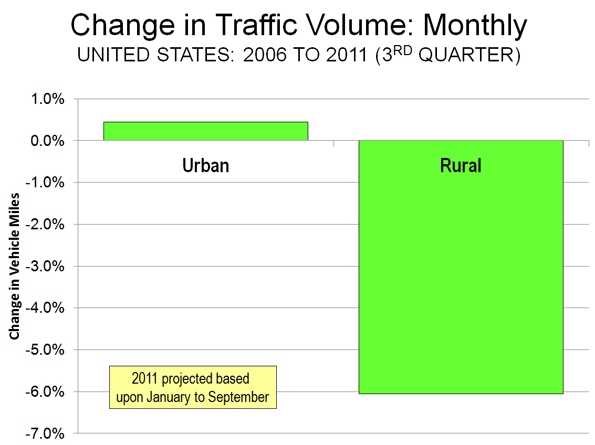
    Not Making Intercity Trips? All of the loss in driving has been in rural areas, rather than urban areas. Since the employment peak in 2006, urban driving has increased 0.4 percent (though driving per household has decreased). By comparison, rural driving has declined 6.0 percent (Note). This much larger rural driving decline could be an indication that people have reduced discretionary travel, such as longer trips that extend beyond the fringes of urban areas (Figure). As with transit, however, it would be a mistake to characterize Amtrak as having attracted much of the reduced rural travel (or for that matter from airlines, see If Wishes were Iron Horses: Amtrak Gaining Airline Riders?). Over the period, Amtrak’s gain (passenger mile) has been approximately one percent of the rural loss.

    Not Driving and not Transferring to Transit: Transit ridership trends have been generally positive over the past decade. Since 2006, transit ridership has risen 3.4 percent. This compares to the 1.1 percent decline in automobile use. However, it would be incorrect to assume attraction to transit as contributing materially to the decline in driving. Because transit has such a small market, even this healthy increase has budged its urban market share (now approximately 1.7 percent) up by barely 0.5 percentage points.

    Besides scale, there is another reason transit has not been the beneficiary of the driving reduction. Automobile competitive transit service is simply not accessible for most trips. For example, it is estimated that less than four percent of metropolitan jobs can be reached in 30 minutes by transit for the average metropolitan area resident. This compares to the more than 65 percent of automobile commuters who do reach their jobs in 30 minutes or less. In short, transit is not an alternative to the car for the vast majority of urban trips.

    It does no good to suggest this can be materially improved by increasing transit service. The most lucrative transit markets are already served, and new ones would be more expensive. This is illustrated by the exorbitant cost of adding ridership. Over the most recent decade, transit ridership increased 21 percent, which required an expenditure increase of 59 percent, nearly three times as much.

    Decentralization of Jobs and Residences: The 2010 census indicated that the American households continue to decentralize, increasingly choosing to live in single-family detached houses in the suburbs. The same trend has been occurring in employment locations, as Brookings Institution research indicates. Between 1998 and 2006, less than one percent of new employment was located within three miles of urban cores. Nearly 70 percent of the new jobs decentralized to outer suburban rings.

    The continuing dispersion of jobs and residences could dampen the increase rate of driving in the years to come, as households have greater opportunities to live in the suburban surroundings they prefer, while also commuting to the more proximate jobs that have moved to the suburbs.

    The Decline in Context: Among the potential causes, certainly the most important is the economic situation,with steeply declining household incomes and the worst economic situation since the 1930s. The longer term driving trends will be more apparent when (and if) prosperity restores healthy growth in employment. Moreover, with only a small part of travel being attracted to transit, a more significant shift could involve substitution of access by information technology (on-line). Even with the decline, however, there has been nothing like a "sea change" in how the nation travels.

    Note: The data on driving is estimated from Federal Highway Administration (FHWA) reports. FHWA produces monthly preliminary estimates, which are subsequently adjusted in annual reports.

    Wendell Cox is a Visiting Professor, Conservatoire National des Arts et Metiers, Paris and the author of “War on the Dream: How Anti-Sprawl Policy Threatens the Quality of Life

    Photograph: Harbor Freeway, Los Angeles

  • Central Florida: On the Cusp of Recovery?

    Central Florida is poised at the cusp of a major turnaround, and its response to this condition will either propel the region forward, or drag it backward.  This cusp condition is brought about by a train and a road; neither of which have begun yet but both of which appear imminent.  Sunrail uses existing 19th century railroad tracks as a commuter spine through Orlando’s disperse, multipolar city.  The Wekiva Parkway completes a beltway around Orlando, placing it with Washington DC, Houston and other ringed cities.  Before either gets built, the region deserves some analysis on their combined effect, and how they can be nudged onto a pathway to make the region better.

    Sunrail brings with it mythology  about how trains affect cities.  In what has now become the standard, tired kabuki dance between developer interests and municipal ones.

    Not surprisingly, heavy regulation has entered the scene, with the avowed goal of creating dense urban pockets along even largely rural  train stops. This has sparked rising property values which may end up  frustrating the dream of transit-oriented development (TOD).  Affordable dwellings and meaningful employment within a half-mile of a train stop must be created in order to make this development work, but unless Central Florida can spark this, the new train will likely suffer from the same fate as the vast majority of its sunbelt counterparts:  low ridership and increasing tax subsidies.

    Inserting TOD into 17 locations in Central Florida is a bold experiment. In order for it to work, the rising costs of housing will need to be addressed, and Central Florida can take advantage of this ambition to succeed.  Orlando home sales are coming back, thanks to the mild climate and desirable lifestyle. That is very different, however, from guaranteeing that the economics of the rail commuter will make it worth discarding the single-family detached American Dream in favor of a relatively new model that has an unproven track record.

    Orlando also seems to be blithely going about the business of creating another ring of traffic around itself, descending into the same level where Atlanta’s Perimeter, the DC Beltway, and other like-kind roads live.  The Wekiva Parkway, long considered unneeded, is now being designed to complete the ring around Orlando, and will cross 25 miles of pristine wetlands that is a vestige of once-vast water resources of the region. 

    The Expressway Authority proposes this ring as an alternative to existing roads to serve the “growth needs of this area,” it conceded recently that this road segment made little economic sense except as a toll road accessing a new suburban single-family home development carved out of the swamps by one of the Governor’s chief fundraisers .  The asset value of this ring road may be more private than in the public interest.

    Traditionally agricultural land interlaced with wetlands, The Wekiva area to the northwest of Orlando has avoided large-scale Florida style bulldozing.  All this will change if the Governor is successful in eliminating water management regulations , freeing up much of Florida, including this corner of Orlando, for speculation.

    The local press, quick to criticize Alaska’s Bridge to Nowhere and always ready to jump on environmental issues, meekly ponders  the need for this $2 billion highway.  Maybe the elevated design, intended to be more ecologically friendly, makes it OK, despite the safety problems and high maintenance associated with this design.  Florida’s history is littered with the drawings of many other elevated highways eventually built on grade to save cost.  Once approved, the Wekiva Parkway may quickly be brought down to earth as well, displacing wetlands and agricultural land.

    The Wekiva Parkway will open up land supply which indeed will allow for more growth.  Done right, the asphalt will make land available that could be useful to the area’s economy.  It will bring traffic to historic, but presently lonely Sanford, potentially infusing the economy of this once-vibrant rail town.  Using principles of scarcity, land values could reflect people’s high desire to live in rural areas with all the services and guarantees that 21st century suburban life offers: fire and police protection, state-of-the-art infrastructure, and free pizza delivery.  It could invigorate neighboring towns that are currently struggling for survival.

    The risk is that such a road will simply allow more investment into Florida real estate without giving Florida much back in exchange.  Florida, already strained to meet its current population needs, should not simply trade another commercial strip for water resources that benefit many species and contribute to the region’s resilience. Rather, development models should emulate the best of America’s conservation development happening in states where water rights are scarce.  Connecting local employers with residential areas will enhance the value of both, and strategically keeping rural agricultural areas intact will preserve the region’s present land use diversity.

    Well managed development that conserves resources and balances broader needs with private interests will elevate the state’s prospects at this critical juncture.  One more bit of the original subtropical wilderness represents an asset for both present and future generations. With the right approach, the Wekiva Parkway can provide an enlightened model of low-density development that respects the value of open space.

    In town, Sunrail presents denser development as an alternative.  The normal pathway, however, seems to pit the profit-seeking real estate developer against ever higher regulatory burdens, which eventually make his product unaffordable to those coming here to escape high costs and regulations in other cities.  Keeping both employment and housing affordable are critical to achieving success with any of these projects.

    Moving product down the value chaindoes not do well current system, which leaves out the very people who Sunrail supposedly will benefit.  Density is one of those characteristics that seems to be about good timing: if you have it today, like San Francisco or New York, this is largely the result of history;  if you do not have it today, like Orlando, it is risky and probably a dubious proposition.

    The road and the train open up land that must be carefully stewarded to create opportunities for meaningful employment and affordable housing, both of which are presently scarce commodities.  The concept of transit-oriented development needs a success story, and Sunrail provides 17 opportunities to find one; meanwhile, the road presents a danger as well as an opportunity for Florida’s wetlands.  As the region slowly recovers from the recession, the two projects together should be carefully considered by the region’s citizens and leadership to truly redefine Central Florida’s identity for the 21st century.

    Richard Reep is an Architect and artist living in Winter Park, Florida. His practice has centered around hospitality-driven mixed use, and has contributed in various capacities to urban mixed-use projects, both nationally and internationally, for the last 25 years.

    Photo courtesy of BigStockPhoto.com.

  • Suppressing the News: The Real Cost of the Wall Street Bailout

    No one really knows what a politician will do once elected. George “No New Taxes” Bush (George I to us commoners) was neither the first nor will he be the last politician to lie to the public in order to get elected.  It takes increasing amounts of money to get elected. Total spending by Presidential candidates in 1988 was $210.7 million; in 2000 it was $343.1 million and in 2008, presidential candidates spent $1.3 billion. Even without adjusting for inflation, it’s pretty obvious that it takes A LOT MORE MONEY now. For those readers who are from the Show Me state, $210.7 million in 1988 is equivalent to roughly one-third of the buying power used by Presidential Candidates in 2008.

    When Texas Governor and presidential hopeful Rick Perry told Iowan voters in early November, “I happen to think Wall Street and Washington, D.C., have been in bed together way too long,” it made headlines for Reuters and ABC . But that’s not news; that’s advertising. News, according to Sir Harold Evans, is what somebody somewhere wants to suppress. News Flash: The average member of Congress who voted in favor of the 2008 Bank Bailout received 51 percent more campaign money from Wall Street than those who voted no – Republicans and Democrats alike. That’s according to research by Center for Responsive Politics and was reported as news by the OpenSecrets.org blog on September 29, 2008.

    In other news fit to be suppressed, the Federal Reserve "provided more than $16 trillion in total financial assistance to some of the largest financial institutions and corporations in the United States and throughout the world." This was revealed in an audit of the Federal Reserve released in July 2011 by the Government Accountability Office. All the goods and services produced in the United States in the last twelve months are worth about $14 trillion – Ben Bernanke and Timothy Geithner spent more than that to bailout Wall Street in twelve months! This is news, news that Bloomberg and Fox Business Network had to file lawsuits to get access to and that Bernanke and Geithner want to suppress.

    The answer to the differences in the value of the bailouts – it was “only $1.2 trillion” according to Bernanke – can be found in the GAO’s audits.  The latest audit of the TARP, released November 10, 2011 makes it clear: “In valuing TARP …, [Office of Financial Stability] management considered and selected assumptions and data that it believed provided a reasonable basis for the estimated subsidy costs …. However, these assumptions and estimates are inherently subject to substantial uncertainty arising from the likelihood of future changes in general economic, regulatory, and market conditions.” [emphasis added]. TARP is under Treasury – which is run by Geithner – and is headed up by Timothy Massad, formerly of Cravath, Swaine & Moore LLP in New York …[still following this?]…, who represents Goldman Sachs, Morgan Stanley, etc. as underwriters for (among other things) European public debt. Cravath, Swaine & Moore advised Citigroup on their repayment of TARP funds and Merrill Lynch in their orchestrated takeover by Bank of America.

    The dispute about the cost of the bailout is not the stuff of conspiracy theories. This is basic finance and economics,  not accounting. In accounting, debits and credits balance at the end of the day; in finance, you get to assume rates of return, costs of capital, etc., etc. – a lot of stuff that has much room for judgment. It is in the area of judgment that Bernanke and Geithner are able to make their numbers look smaller than those added up by Bloomberg and Fox. The GAO, on the other hand, should have no dog in this fight and therefore should (we live and hope) give us the right stuff to work with. GAO says (in a nice way) that Geithner has been fiddling with the numbers.

    The GAO had been recommending to Congress that they get audit authority over the Federal Reserve System at least since 1973. They finally got that authority in the Wall Street Reform Act of 2010 – about the only piece of that legislation that has so far resulted in anything of substance. The Center for Responsive politics also did an analysis of the campaign contributions for Senators who opposed the financial regulatory reform bill in 2010. Those opposing the reforms got 65 percent more money from Wall Street banks than those voting for the bill.

    For politicians, it doesn’t matter who votes for them. They will figure out what they need to say to get the money to get the votes to get elected. What they need most – and what makes them Wall Streetwalkers – is the money. The big donors don’t care who they give to, as long as the one they give to gets elected. According to Federal Election Commission data, Warren Buffett gives money almost exclusively to Democrats; Donald Trump likes to spread it around between the parties, as do Goldman Sachs employees. But that’s only the money that can be traced back to a source, unlike the opaque donations given to PACs and SuperPACs.

    The revolving door between Wall Street and Washington swings both ways. When John Corzine departed Goldman Sachs he left Hank Paulson in charge in 1999. Investment Dealers’ Digest reported that Corzine left Goldman “against a backdrop of fixed-income trading losses.” Corzine won a Senate seat in 2000 (D-NJ).  He was then elected Governor of New Jersey in November 2005, where he put forth Bradley Abelow for state Treasurer. Abelow worked with Corzine at Goldman and was a former Board member at the Depository Trust and Clearing Corporation, the world’s largest self-regulatory financial institution. Together, Corzine and Abelow later went on to run MF Global into bankruptcy. Both have been invited back to Washington, the first time a former Congressman has been called to testify before a Congressional Committee. Wherever they get started, Washington and Wall Street tend to end up in bed together.

    It’s this kind of knowledge that makes me question why I should vote at all. Congressmen from both parties are generally for sale. Even with self-described liberals in Congress, right-wing conservatives could get approval for everything they want – free-for-all-banking and the US military engaged in active combat.  It’s the taxpayers – the mothers, fathers and families of service men – who suffer. Sure, Barack Obama took more money from Wall Street than John McCain – but it was only $2 million more, hardly enough to run one ad campaign in a big state.

    Then I pause and remember what my mentor, Rose Kaufman, from the League of Women Voters of Santa Monica told me: if you don’t vote, you open the door for someone to take away your right to vote.  The benefit of living in a democracy with freedom of the press is that you can find out all those things that Washington and Wall Street “want to suppress.” Whether or not we have good choices among the presidential candidates, we have choices.  It’s better than nothing.

    Susanne Trimbath, Ph.D. is CEO and Chief Economist of STP Advisory Services. Her training in finance and economics began with editing briefing documents for the Economic Research Department of the Federal Reserve Bank of San Francisco. She worked in operations at depository trust and clearing corporations in San Francisco and New York, including Depository Trust Company, a subsidiary of DTCC; formerly, she was a Senior Research Economist studying capital markets at the Milken Institute. Her PhD in economics is from New York University. In addition to teaching economics and finance at New York University and University of Southern California (Marshall School of Business), Trimbath is co-author of Beyond Junk Bonds: Expanding High Yield Markets. She participated in an Infrastructure Index Project Workshop Series throughout 2010.

    Follow Susanne on Twitter @SusanneTrimbath

    Photo by Kay Chernush for the U.S. State Department

  • Looking at the New Demography

    In the last 200 years the population of our planet has grown exponentially, at a rate of 1.9% per year. If it continued at this rate, with the population doubling every 40 years, by 2600 we would all be standing literally shoulder to shoulder. 
    — Professor Stephen Hawking

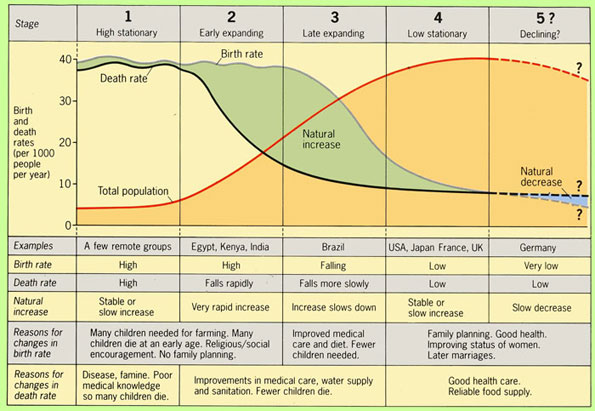
    Eighty-two years after the original development of the four stage Demographic Transition Model (DTM) by the late demographer Warren Thompson (1887-1973), the cracks are starting to show on the model that for many years revolutionised how we think about the geography of our global population.

    Thompson’s achievement was an important one. He suggested that we were in the midst of a transition, from an ‘old’ world dominated by high mortality, autocracy and subsistence to a ‘new’ world characterised by low mortality, democracy and an ever globalising economy. Our global society, slowly but surely, was moving to what he described as a ‘stage 4’ of the DTM: an earthly paradise in which mortality, fertility and population growth are low. However, is this really paradise? Is it too early to pop the champagne and congratulate ourselves for thousands of years of social and economic development? Is this the end of the demographic transition?

    What is stage 5?

    The mainstay of the geography classroom in secondary and tertiary education is the 4 part DTM.  Its theoretical representation shows a graph whereby high and fluctuating birth and death rates dramatically decline in stages 2 and 3 and come to equilibrium in stage 4 whereby birth and death rates are low. Simultaneously intertwined in the graph is a line representing population growth rates which starts low, increases exponentially and levels off in stage 4.

    Today we may be entering the next and largely unanticipated stage of development. Countries of the developed world have long said farewell to times where woman used to be chained to an animal cycle of reproduction and death used to be an almost daily occurrence. We may need to ask: is stage 4 really sustainable in the long term? Are we still in transition? The developed world is now one that experiences a low death rate and therefore an aging population, a birth rate far below the replacement level and a flat lining of population growth.

    I would by no means be the first to suggest we may be entering something what would be best defined as stage 5. The three main indicators of stage 5 of the DTM are: a very low birth rate, a low death rate and a slow decrease of the total population. How is this different from stage 4? The birth rate is the lowest the human race has ever experienced and for the first time since the Stone Age (excepting medieval plagues), the total population of some developed countries are in decline.

    Does Stage 5 exist anywhere?

    Firstly, a distinction needs to be made between the old world, the new world and the whole world. The ‘old’ world simply refers to the relatively undeveloped world characterised by high birth rates and a predominantly agrarian economy. Examples include Zambia and Uganda, places sitting at around stage 2 of the DTM. The ‘new’ world refers to the developed world of places which include East Asia, Europe, North America and increasingly parts of the developed world, notably China. Much of the developed and developing world has already reached stage 4 and many countries are headed decisively into stage 5.

    The most startling example of the exhaustion of stage 4 is Russia’s recent demographic performance. Since the breakup of the Soviet Union, Russia has lost 5.7 million people through higher death rates and lower birth rates. This is equivalent to the emptying of Scotland and the city of Newcastle-upon-Tyne.

    The rest of Europe is seeing below replacement level fertility rates. The only phenomena sustaining the level of population in these countries are the diasporas of overpopulated Africa and Asia. Not only has Europe entered stage 5 of the demographic transition, it’s now facing the challenge of its related social issues*.

    What might a stage 5 world look like?

    Some current trends lead to some fascinating projections of the future demographic make-up of the most technologically advanced factions of our global society. The low birth rate, especially in Europe, has allowed for an empowerment of women unseen before in history. Many are essentially swapping children for careers. This financially advantages both the parents and the 1 or 2 children who can enjoy a healthy share of the family income.

    Another dimension to a ‘stage 5 family’ is the inter-generational relationships between 3 and sometimes 4 generations of a single blood line. That is to say, it creates a situation where a grand child can have a relationship with a parent, a grand-parent and sometimes even a great grand-parent thanks to longer life expectancy and low death rates. This of course is rare in the ‘old’ world where a child may never know a grandparent beyond childhood. The reader may care to notice that this particular geography of the family, a 1 or 2 child household with living grand-parents, is not all that unusual.

    The decline of fertility in Europe has reached a point where it is below the replacement level needed to sustain the population. The reason that the European population is still growing, albeit slightly, is because of the influx of immigrants. The resulting greater multiculturalism can strain the patience of the most liberal and tolerant of people. It is a well known script from social scientists that immigrants tend to form insular communities in their arrival destination. The conflict between the British far-right pressure group, the English Defence League and British Muslims provides a textbook example of problems that arise from the ever evolving demographic transition. Problems that are of such importance, they are often reflected in the make up of parliament.

    Beyond stage 5

    Clearly, Thompson’s 4 stage DTM is increasingly outdated in most developed parts of the world. One possible solution to the dilemma of lost identity, rapid aging and depopulation may be a policy aimed at reversing the negative correlation between economic development and fertility. Mikko Myrskylä, Hans-Peter Kohler and Francesco C. Billari published an article in Nature 36 months ago outlining an irregularity in one of the most established relationships in the social sciences. Although it is normal for fertility decline in medium to high-HDI countries, there is evidence for fertility increase in areas of very advanced human development.  Perhaps it is this that could serve as a new model of what might be called ‘stage 6’ of humanities ever changing demographic transition.

    Edward Morgan is a 3rd Year Human Geography student at the University of St Andrews, Scotland.

    *It has been suggested that the ‘top-up’ of population with immigrants has led to the return of the anti-immigration far-right in Europe and it has been used to explain the electoral successes of parties such as the British National Party, Front National (France) and the ultra-right wing Danish Peoples Party.

    ~~~~~~~~~~~~~~~~~~

    Keith Montgomery does a good introduction to the demographic transition model

    Paper by Mikko Myrskylä, Hans-Peter Kohler and Francesco C. Billari.


    http://hs-geography.ism-online.org/2010/09/07/the-demographic-transition-model/
    Thompson’s Demographic Transition Model with stage 5.

    Photo courtesy of BigStockPhoto.com

    .

  • Public Pensions: Reform, Repair, Reboot

    Ill-informed chatter continues to dominate the airwaves when it comes to California public pensions. It’s a big, complex and critical issue for government at all levels in the Golden State. What makes debate so distorted is that public pensions actually differ from agency to agency — and advocates on the issue often talk past each other. Pension critics often point to outrageous abuses as if they were typical. On the other hand, pension defenders often cite current averages that understate long-term costs. All this fuels the typical partisan gridlock that Californians lament yet seem powerless to change in our state.

    Credit Governor Jerry Brown for trying to overcome the polarization. That’s what most California voters want him to do, according to a new Field Poll, one of the leading opinion research firms in California. His 12-point pension package (unveiled in October) is successfully framing the debate — and enjoys encouraging support from voters. I agree with them. While Brown’s plan is far from perfect (as he acknowledged in presenting it as a way to build consensus) it sensibly tackles some of the most challenging areas where reform is needed. Among the key reforms he’s proposed:

    • Increasing the retirement age from 55 to 67 (with a lower age to be spelled out for public safety workers).
    • Replacing the current “defined benefit” pensions with a hybrid program that includes a defined benefit component, but also a 401(k)-like defined contribution component
    • Prohibiting retroactive pension increases.
    • Requiring all employees to contribute at least 50 percent of the cost of their pensions

    These generally follow the surprisingly strong stand taken by the League of California Cities, which was based on recommendations from a committee of City Managers that I served on. Our work was grounded in four core principles:

    1. Public retirement systems are useful in attracting and retaining high-performing public employees to design and deliver vital public services to local communities;
    2. Sustainable and dependable employer-provided defined benefits plans for career employees, supplemented with other retirement options including personal savings, have proven successful over many decades in California;
    3. Public pension costs should be shared by employees and employers (taxpayers) alike; and
    4. Such programs should be portable across all public agencies to sustain a competent cadre of California public servants.

    Our goal was to ensure the public pension system is reformed, instead of destroyed. Our reform package mirrors Brown’s calls for a hybrid system, raising retirement ages and increasing the portion of pension costs borne by employees. We also backed his bid to base retirements on the top three highest years of pay, curbing the abuses that often artificially raise final year salaries to “spike” pension pay-outs.

    Typical of California’s other challenges, the issue faces long odds in the Legislature and uncertain fate at the ballot box. Partisan Democrats are leery of crossing unions by embracing Brown’s package. Partisan Republicans are demanding more far-reaching changes. Brown hopes to bridge the differences to win majority support by drawing on moderates in both parties. “He hasn’t riled up one side or the other,” noted Field Poll director Mark DiCamillo. “He’s managed to strike the middle ground on a very polarizing issue.” Unfortunately, moderates are hard to find in Sacramento.

    That leaves the roll of the dice that comes with ballot initiatives. Since it takes millions to bankroll a successful ballot measure, few sensible measures get far without support from well-heeled interests.

    In the eternal game of chicken that goes on in Sacramento, the Legislature keeps one eye on those special interests. About the only hope for reform is if a majority is worried that failure to act might spur an expensive ballot box war and an even worse outcome.

    This issue might be the exception, however. Public outrage is real. So is the need for reform. In Ventura, we took an early lead on this issue, first with our Compensation Policies Task Force, then union contracts that established a lower benefit and later retirement age for new hires and increased contributions from all employees of at least 4.5% of their pay. But real reform to level the playing field can only come at the State level.

    Before this issue devolves into another ballot box catastrophe that radically oversimplifies the issues to a “yes” or “no” choice on an initiative bankrolled by special interests, legislators in both parties need to come together on sensible reform. The Governor has put such a program on their desks. Reasonable people can differ on the details. But only unreasonable people want all-or-nothing victories. This is an issue that both sides should be willing to compromise on. The only way that will happen is if voters push both parties toward sensible compromise in the year ahead!

    Photo by Randy Bayne

    Rick Cole is city manager of Ventura, California, and recipient of the Municipal Management Association of Southern California’s Excellence in Government Award. He can be reached at RCole@ci.ventura.ca.us