Blog

  • California in 2011: Suburbs Up, Exurbs Down?

    I had the fortune recently to stumble on the California Department of Finance’s estimates of population change in California during the period July 1, 2010 – July 1- 2011. This is distinct from the Federal census, which tried to establish the number of people in all localities as of April 1, 2010. These California statistics are for a short period of only one year; they are not as reliable, of course, as a real census.  

    Percentagewise, the county that grew fastest was a Sacramento suburban county called Placer, which grew by 1.45 per cent (or, I suppose, what financial people would call 145 basis points) during that one year. It was also only one of two California counties where more people moved to from within the United States than from outside the United States (the other being Riverside County). It was also  one of three where the number of people moving in over that moving out was greater than the excess of births over deaths, the other two being Napa County, which is suburban in its southern reaches before the grapes begin, and San Francisco County, which is known for, well, for not being big on baby-making. (Nevertheless San Francisco County did have a natural increase of 3,138 persons, whereas, as we shall see later, some rural counties had more deaths than births.)

    But what came as a surprise  was that Placer’s sister county, El Dorado, also a Sacramento suburban county running up into the mountains, gained a mere 26 basis points; and the other foothill counties of the Gold Country actually lost population during the year! This came as a surprise to me, for I have a house in Calaveras County and in the past I had spent time there; the Gold Country seemed to be a haven for the semi-retired and the part-time worker and even the long distance commuter; and Grass Valley had the beginnings of a high tech industry spilling over from Silicon Valley.

    I don’t know what the terms “suburb” and “exurb” mean to New Geography readers, but I have my own definition which seems handy enough to me. A “suburb” has subdivisions and planned communities; developers buy land, subdivide, and build homes or sell lots often with covenants of various kinds.  People still prefer suburbs – even ones quite distant from the urban cores – over the city, in part due to factors like cheaper housing, better schools, and newer amenities.

    Exurbs are different. In an exurb, people split parcels into smaller lots, sell the lots, and then people build custom houses on them with no covenants (except maybe a few easements) and any architectural style the government will allow and perhaps a few they don’t. A good place to see the contrast is in the area just north of Cajon Pass. Victorville, Adelanto, and parts of Hesperia and Apple Valley abound with subdivisions, like the Orange County of my youth. But if you go a little bit to the southwest, around Pinnon Hills and Phelan, there is not a “subdivision” to be seen, and yet houses and, on the road, commercial establishments get thicker and thicker every year. (I have, on occasion for the past 25 years, taken the road to the monastery at Valyermo from Orange County, and I have seen these changes.)

    Overall, it looks like the “suburbs” are growing – far more than the cities –  while the “exurbs” are not. Placer County is an explosion of subdivided suburbs and “planned communities” as far as Newcastle and Lincoln.

    In contrast, El Dorado has some of these in its west end, but they are not expanding much. And the other Gold Country Counties, Nevada, Amador, Calaveras, Tuolumne, and Mariposa, all of which shrank slightly in population, fit my definition of “exurban” – they have exurbs, and they are not very agricultural unless you count backyard wine and marijuana patches.  These areas had been much sought out since the inflationary “survivalist” days of the 1970s. Now, it seems, the economy and gasoline prices are not affecting the prosperity and desirability of organized suburbia, but they are making the areas beyond organized suburbia less desirable than they used to be. I wonder if this is a nationwide trend.

    Another discovery may point to the age of residents in various counties. Of the counties that actually lost population over the year the three on the Redwood Coast  – Del Norte, Humboldt, and Mendocino – did so in spite of having an excess of births over deaths. So did the two in the far northeast, Modoc and Lassen. To read that a county in California lost population is in the “this I have lived to see” category.

    Oddly, did one county in the Central Valley also declined. Kings, which is metropolitan Hanford, declined despite the fact that next door Tulare County was a big gainer; and Inyo County – home of Bishop, Lone Pine, and Death Valley – had an identical number of births and deaths. On the other hand, the Gold Country counties I mentioned – plus Sierra, Plumas, Siskiyou, Trinity, and Lake, outside the Sacramento Valley – had an excess of deaths over births. Perhaps these particular counties, more than the others, had been settled by retirees or empty nesters, who were no longer having children.

    For its part, the rain-drenched Redwood Coast and the far northeast were less attractive, apparently, to retirees. In the counties not attractive to retirees, natural increase exceeded even immigration from outside the United States, which was positive in every county except Alpine, where it was exactly zero. Also, only in the aforementioned Placer and Napa Counties, and the City of San Francisco, did inward migration of any kind – from the U.S. or outside – exceed the “natural increase.”

    The “native Californian,” once a slightly exotic phenomenon, seems to be becoming the norm. The days of what Carey McWilliams called, in his book title of 70 years ago, California: The Great Exception, seem to be at an end. We have entered a world we never knew before. California may become, at long less, less exceptional, still sprawling but in a more organized fashion.

    Howard Ahmanson of Fieldstead and Company, a private management firm, has been interested in these issues for many years.

    Photo courtesy of Bigstockphoto.com
  • The Troubled Future of the California High-Speed Rail Project

    A congressional oversight hearing, focused on the concerns surrounding the troubled California high-speed rail project, cast new doubts on the likelihood of the project’s political survival.

    The December 15 hearing was the second of two hearings called by the House Transportation and Infrastructure Committee to examine the Administration’s "missteps" in handling the high-speed rail program. Before a largely skeptical groups of committee members — Reps Mica (R-FL), Shuster (R-PA), Denham (R-CA), Miller (R-CA), Napolitano (D-CA), and Harris (R-MD)— two panels of witnesses offered a mixture of support and criticism concerning the project’s impact, financial feasibility and prospects for the future. The first panel comprised six California congressmen — three testifying against the project (Reps. Nunes (R), McCarthy (R) and Rohrabacher (R)), three in support of it (Reps. Cardoza (D), Costa (D) and Sanchez (D).) The second panel consisted of FRA Administrator Joseph Szabo, California Rail Authority CEO, Roelof Van Ark, local elected officials and representatives of citizen groups.

    A Brief Project Overview

    The proposed high-speed line, from Sacramento and San Francisco to Los Angeles and San Diego, was originally estimated to cost $43 billion in 2008 when the state’s voters approved a $9.95 billion bond measure (Proposition 1A) to help finance the project.  Since then, the total cost estimate for the project has more than doubled to $98.5 billion and the completion date has been pushed back by 13 years to 2033.

    The "initial construction section" of 140 miles is proposed to be built in the sparsely populated Central Valley from south of Merced to north of Bakersfield. The $6 billion project is to be financed with a $3.3 billion federal contribution and $2.7 billion worth of state Proposition 1A bonds. Construction is to begin in 2012. However, to qualify as an "Initial Operating Segment" as required by the authorizing bond measure and capable of running high-speed trains, the line has to be extended by another 290 miles to San Jose (or 300 miles to the San Fernando Valley), at an additional cost of $24.7 billion.

    To finance the latter construction, the California Rail Authority’s business plan calls for $4.9 billion in Proposition 1A bonds and assumes a $19.8 billion federal contribution – $7.4 billion in federal grants and $12.4 billion in the yet to be created Qualified Tax Credit Bonds (QTCB). The latter assumption came in for sharp committee criticism as wishful thinking. The bill authorizing QTCB (or TRIP) bonds, proposed by Sen. Wyden (D-OR), is not given much chance of passing in the House. Even if passed, it would only offer $1 billion for the California HSR project rather than $12.4 billion as claimed in the Authority’s business plan. Further federal high-speed rail grants are equally uncertain given the bipartisan congressional refusal to appropriate funds for high-speed rail two years in a row. In other words, the funding for the Initial Operating Segment hinges on highly questionable assumptions as to continuing federal aid.

    Even more conjectural are the Authority’s funding assumptions for the subsequent phases of the project— a line extension from San Jose to the San Fernando Valley and a southern connection, to Los Angeles and Anaheim. That phase of construction according to the Authority’s business plan, would require a further federal contribution of $42.5 billion between 2021 and 2033 (plus $11 billion in private investment).

    Left unstated in the Authority’s business plan, one informed observer speculated, is the secretly entertained hope that by 2015 (when the additional federal funding will be needed), the economic circumstances — and perhaps political circumstances as well — will have changed, allowing a resumption of generous federal support.

    A "Boondoggle" or a "Compelling Opportunity for Our State"?

    Witnesses testifying before the committee aligned along predictable fault lines. Critics of the rail project (mostly, but not all, Republicans) tended to focus on the specific weaknesses of the project: its unrealistic assumptions concerning future funding; the quixotic choice of location for the initial line section ("in a cow patch," as several lawmakers remarked); a lack of evidence of any private investor interest in the project; the eroding public support for the project (nearly two-thirds of Californians would now oppose the project if given the chance, according to a recent poll); the "devastating" impact of the proposed line on local communities and farmers; and the unrealistic and out-of-date ridership forecasts (with more passengers in 2030 predicted to board trains in Merced, a small farming community in Central Valley, than in New York’s Penn Station). Other witnesses asserted that the current project is vastly different from the one Californian voters approved in 2008; and that it is lacking proper management oversight (it is a project "of the consultants, by the consultants and for the consultants" one witness remarked).

    Defenders of the project (mostly, but not all, Democrats) resorted largely to abstract arguments about the merits of building a high-speed rail system in California. They saw the project as a compelling long-term vision, as a travel alternative to congested highways and air lanes, as a way to reduce greenhouse gas emissions, and as a means of creating thousands of jobs. They argued about the difficulty and prohibitive costs of the alternative of building more highways and airports to accommodate future population growth.

    Federal officials are fond of reminding us that construction of the interstate highway system also began "in a cow patch " — in that particular case, a wheat field in the middle of Kansas. But they ignore a fundamental difference between the two decisions: the interstate highway system was backed from the very start by a dedicated source of funds, thus ensuring that construction of the system would continue beyond the initial highway segment "in the middle of nowhere." 

    The California project has no such financial assurance. Should money for the rest of the system never materialize— as is likely to happen— the state will be stuck with a rail segment unconnected to major urban areas and unable to generate sufficient ridership to operate without a significant state subsidy. The Central Valley rail line would literally become a "Train to Nowhere" — a white elephant and a monument to wasteful government spending.
     
    ~~~~~~~~~~~~~~~~~~~~

    Note: the NewsBriefs can also be accessed at www.infrastructureUSA.org

    A listing of all recent NewsBriefs can be found at www.innobriefs.com

  • The Sun Belt’s Migration Comeback

    Along with the oft-pronounced, desperately wished for death of the suburbs, no demographic narrative thrills the mainstream news media more than the decline of the Sun Belt, the country’s southern rim extending from the Carolinas to California. Since the housing bubble collapse in 2007, commentators have heralded “the end of the Sun Belt boom.”

    Yet this assertion is largely exaggerated, particularly since the big brass buckle in the middle of the Sun Belt, Texas, has thrived throughout the recession. California, of course, has done far worse, but its slow population growth and harsh regulatory environment align it more with the Northeast than with its sunny neighbors.

    Moreover, the Sun Belt is poised for a recovery, according to the most recent economic and demographic data. Even such hard-hit states as Arizona and most impressively Florida appear to be making an unexpected, and largely unheralded, recovery.

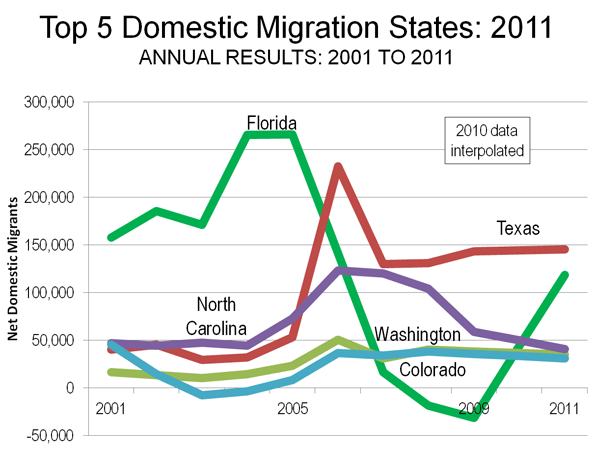
    Take Florida. The Sunshine State may have experienced rapid population loss during 2008 and 2009, but the just-released 2011 Census estimates show a remarkable turnaround, with the state adding 119,000 domestic migrants last year. This may be less than half the gains in 2004 and 2005, when the in-migration reached nearly 250,000, but it is close to levels enjoyed a decade ago.

    The big winners in terms of growth were in the South, with Texas, Florida and North Carolina as the leading in-migration states. Virginia, South Carolina, Georgia, Tennessee and Virginia also ranked in the top 10. Overall, the Southern states reaped 95% of the inter-regional net domestic migration (people moving from one state to another). Arizona, another state widely written off, enjoyed an 11th place finish, with a net gain over 13,000.

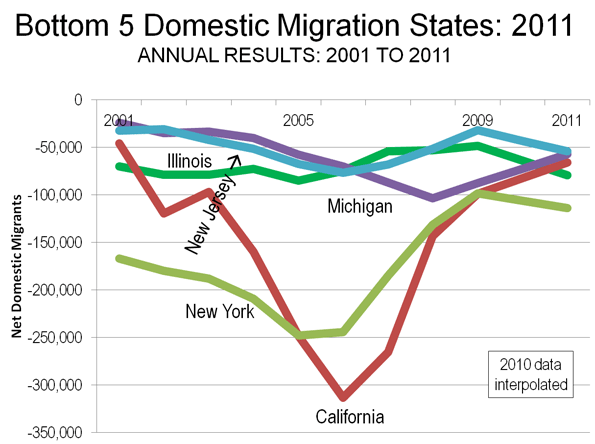
    As for the much-cherished notion that people will start flocking to highly urbanized, high-cost littoral states? Well, as they say in my native New York, fuggedaboutit. As has been the case for most of the past few decades, the Empire State has once again been the biggest loser, not of pounds, losing 113,000 people. Following close behind are California and Illinois, all of which are once again losing people in large numbers to other places.

    In contrast, one of the few Sun Belt states to lose migrants is former high-flier Nevada, which lost 11,000 people to other states. The Silver State’s continued decline seems traced to what Phoenix economist Elliot Pollack describes as its “one-trick pony economy.” In Nevada, that economy is tied to gambling, which has been hit by the recession and by increasing competition both domestically and in East Asia. It also suffers from its unhealthy “evil twin” dependency on still-weak California.

    The reasons behind these shifts are complex. For one, there is a slowly improving economic climate in many Sun Belt cities. In terms of year-to-year job growth, Dallas ranks first and Houston third, while  Orlando, Miami and Phoenix all are among the top 10 of the country’s 32 largest metropolitan areas. Among the states Texas ranks fifth and Arizona ranks seventh, while Florida clocks in at 16th. This may not be the gangbuster growth of previous decades, but is far from moribund.

    Looking forward, some of the “bubble states” appear to be taking a lesson from Texas and are reconsidering their former growth formula, which relied far too much on tourism, retirees and housing construction. “We know the business model has to change from just tourism and retirees,” notes Chris McCarty, director of the Bureau of Economic and Business Research at the University of Florida. “We need to make a modification in our approach and now there’s a desire to do something about it.”

    Increasingly, places like Phoenix, Orlando and Tampa are focusing on more broad-based growth in such fields as biomedicine, software and trade, which may produce steadier, if not quite as rapid, growth. Aggressively pro-business governments in almost all Sun Belt states — with the exception of California — will enjoy better economic prospects as companies seek out lower-tax, less regulated environments.

    But ultimately demographic trends may prove more determinative. People moving into a state provides many things — such as new workers, skills and, perhaps most important, capital. An examination of IRS data of income brought in as a result of migration by the Tax Foundation shows that Florida ranked third in terms of overall gains, behind only Montana and South Carolina. Arizona ranked fifth. The biggest losers are all in the frost belt: Michigan, New York, Rhode Island and Illinois.

    If we are, as is likely, returning to something approximating earlier patterns, we should expect these trends to accelerate gradually over the coming years. One critical factor will be our rapidly aging population.  Over the past decade, Phoenix as well as the Florida burgs of Tampa-Saint Petersburg, Orlando and Jacksonville all ranked among the top 10 destinations for aging boomers. This pattern may be reasserting itself.

    Housing prices are a critical factor here. Once-soaring prices in communities such as Orlando and Phoenix have adjusted to the more historic median multiple (median housing price relative to income) of roughly three; in contrast, despite some declines, prices in metropolitan areas like New York, Los Angeles, San Francisco, San Diego and San Jose all remain around six or higher.

    This suggests that many retirees and down-shifting boomers — people still working but able to relocate their jobs — may find cashing out of their more expensive houses in the Northeast, Chicago or coastal California an effective way of supplementing often depleted IRAs. “There’s a lot of older people with equity who can find bargains that weren’t around in 2006,” observed the University of Florida’s McCarty.

    More important still is the movement of younger people from the large millennial generation. Despite the assumption that this group inevitably prefers dense, expensive cities, the 2010  Census showed people 25 to 34 moving primarily to Sun Belt cities such as Orlando, Tampa, Houston and Austin, as well as Raleigh, North Carolina.

    “There are a lot of people who will be getting into their 30s [who] still haven’t created a household or bought a home,” says Phoenix-based economist Elliot Pollack. “They mostly won’t be able to do that in California or the Northeast, but they can do it in places like Arizona.”

    Pollack maintains that the real estate meltdown has actually created opportunities for the emerging generation. Burdened by college debt and what could still be a sluggish economy, they may find, like so many of their parents, that their best options for homeownership lie in these Sun Belt growth markets. In this sense, the millennials, like the generations before them, may not be the ones to kill the Sun Belt  but the demographic which will  propel it into a new period of more steady, and sustainable, growth.

    Net Domestic Migration By State, 2010-2011
    State 2011
    Texas    145,315
    Florida    118,756
    North Carolina      41,033
    Washington      35,166
    Colorado      31,195
    South Carolina      22,013
    Tennessee      20,328
    Georgia      17,726
    Virginia      15,538
    Oregon      13,636
    Arizona      13,150
    Oklahoma        8,933
    District of Columbia        8,334
    Louisiana        7,085
    North Dakota        6,368
    Kentucky        5,761
    Arkansas        5,724
    Montana        3,888
    West Virginia        2,814
    South Dakota        2,610
    Delaware        2,347
    New Mexico        2,202
    Alabama        1,974
    Alaska           740
    Wyoming         (149)
    Idaho         (256)
    Utah         (826)
    Vermont         (841)
    Nebraska         (977)
    Maine      (1,000)
    Pennsylvania      (1,121)
    Iowa      (1,361)
    Hawaii      (2,320)
    Maryland      (2,994)
    New Hampshire      (3,645)
    Rhode Island      (6,273)
    Mississippi      (6,672)
    Kansas      (7,928)
    Minnesota      (8,073)
    Massachusetts    (10,886)
    Wisconsin    (10,990)
    Nevada    (11,113)
    Indiana    (11,412)
    Missouri    (11,831)
    Connecticut    (16,848)
    Ohio    (44,868)
    New Jersey    (54,098)
    Michigan    (57,234)
    California    (65,705)
    Illinois    (79,458)
    New York  (113,757)
    Data from US Bureau of the Census


    This piece first appeared at Forbes.com.

    Joel Kotkin is executive editor of NewGeography.com and is a distinguished presidential fellow in urban futures at Chapman University, and contributing editor to the City Journal in New York. He is author of The City: A Global History. His newest book is The Next Hundred Million: America in 2050, released in February, 2010.

  • The Great Dakota Boom

    The Census Bureau released their yearly population estimates today. As noted by Wendell Cox, the estimates showed signs of the South’s continued leadership in population expansion. While the overall numbers of people involved are much smaller, the Dakotas, in particular North Dakota, also showed signs of growth worthy of note. According to the Census Bureau, North Dakota now has an estimated population of around 683,000, up over 11,000 in just one year. This made it the 6th fastest growing state in the nation over the past year- a notable achievement in its own right for a state more accustomed to dealing the challenge of outmigration.

    However, the most interesting thing about the new estimate is that it represents a new record population for the state. There have never been more North Dakotans then there are today. The previous high count was about 680,000 way back in 1930. With the onset of the depression, the state entered a long period largely marked by periods of population decline and stagnation.

    As a lifelong North Dakotan, I’ve occasionally found myself having difficulty coming to grips with our state’s recent prosperity. North Dakotans can be a self effacing lot, and it sometimes seems that there’s a still a healthy dose of skepticism among my fellow citizens regarding our current good fortune. We’re not used to being on top like this, seeing our often ignored home highlighted in the press for its economic strength and tagged as “the state the recession forgot.” For decades, we’ve been trying to find ways to deal with what seemed an inexorable cycle of rural decline and depopulation. While the new estimate is just a number, it does serve to break a bit of a psychological barrier for the state. We’re not just making up lost ground anymore- we’re now in uncharted territory and building beyond previous limits. It’s a refreshing change.

    Historians refer to the 1880s and period from 1900-1915 as the “Great Dakota Booms”. Growth was unchecked in what became North and South Dakota, and the population soared as immigrants poured into the region in search of economic opportunity. While oil has taken the lead role in place of land in this performance, it appears that our corner of the nation is in another “Great Dakota Boom” for many of the same reasons. Hopefully it will prove lasting. I, and my fellow North Dakotans will just have to learn to deal with prosperity. Call it “How North Dakota (and Matthew) Learned to Stop Worrying and Love the Boom”.

    All in all, it’s a good time to be a Nodak.

  • New Census Data Reaffirms Dominance of the South

    The 2011 state population estimates released earlier today by the Census Bureau show that the South has retained its dominant position in both population and growth over the last year. Southern states accounted for more than one half of the nation’s population growth between 2011 and 2000, despite having little more than one third of the population. Moreover, the South was the recipient of 95% of the inter-regional net domestic migration (people moving from one state to another), with the West accounting for the other 5%, with the losses split between the Northeast and the Midwest.

    Overall, a net 533,000 people moved from one state to another, somewhat above the low of 503,000 in 2008 and below the 573,000 at the beginning of the previous decade (2001). The figure, however, remained less than one-half that of the mid 2000s peak.

    The state data confirmed the "return to normalcy," that had been indicated by the 2010 American Community Survey data.

    The South Rises Again

    In 2011 (July 2010 to June 2011), seven of the top domestic migration gaining states were in the South. This is a restoration of the same dominance the South achieved in 2001 to 2006. Some of the states have changed, but the overall impact is little different.

    Texas:Texas again led the nation in net domestic migration, adding 145,000 people from other states to its population. This was a slight increase from the 143,000 net domestic migrants in 2009 (Note 1) and was the highest for Texas since the artificially intense exodus from Louisiana in the year (2006) following hurricanes Katrina and Rita. Texas has led the nation in net domestic migration for six years and ranked second in the nation over the 2001 to 2009.

    Florida: Most spectacularly, however, has been the performance of Florida. Florida had been a net domestic migration leader for years, and had been number one from 2001 through 2005. However, when its highly inflated house prices collapsed (New York Federal Reserve Bank research refers to Florida as one of the "four bubble" states, along with California, Arizona and Nevada), Florida lost domestic migrants for the first time in at least six decades, in both 2008 and 2009. That has been radically turned around. In 2011, Florida added 119,000 net domestic migrants, housing prices dropped to normal levels (Note 2). While this is less than one half the gains in 2004 and 2005, it exceeds the annual Texas increase in the previous decade by 20%.

    North Carolina and South Carolina: North Carolina ranked third, adding 41,000 net domestic migrants. This is an improvement from a fourth-place ranking in the previous decade. Neighboring South Carolina added 22,000 net domestic migrants and ranked sixth. This is an improvement from the previous decade’s ranking of seventh. The domestic migrants to North Carolina and South Carolina have been called "halfbacks," as some have suggested that many who had moved to Florida from the Northeast have subsequently moved to North Carolina and South Carolina, essentially one half of the way back to where they moved from originally.

    Tennessee, Georgia and Virginia: Tennessee (7th), Georgia (8th) and Virginia (9th) rounded out the South’s seven of the top 10 states. Tennessee improved from having been 8th in 2001 to 2009, while Georgia dropped from 5th and Virginia was a new entrant, having previously ranked 12th.

    Western Runners-Up

    While the West continued to show net domestic migration gains, this formerly fastest-growing area of the nation has fallen well behind.

    Washington: Washington ranked fourth in 2011, an improvement from ninth between 2001 and 2009. Washington added 35,000 net domestic migrants.

    Colorado: Colorado also improved its position, adding a net 31,000 domestic migrants and ranking fifth in 2011, which is up from its 10th ranking in 2001 through 2009.

    Oregon:Oregon ranked 10th, adding 14,000 net domestic migrants and was a new entrant to the top 10, having placed 11th between 2001 and 2009.

    Things Never Change: The Bottom 10

    A similar restoration of normalcy is evident in the bottom 10 states. From 2001 to 2009, all of the bottom 10 net domestic migration states were in the Northeast or the Midwest, joined by California. This changed somewhat in 2011, with formerly fast-growing Nevada, edging out one of the former bottom 10. There was some movement at the very bottom of the list.

    New York: New York recovered its last place position (51st), which it held overall between 2001 and 2009, but had yielded to California later in the decade. New York lost 114,000 net domestic migrants in 2011, which compares to the 1,650,000 loss between 2000 and 2009.

    Illinois:Illinois had the second-highest net domestic migration loss, sending 79,000 of its residents to other states. Illinois had ranked 49th in net domestic migration in the previous decade, with a 615,000 loss. Unlike the other biggest losers, New York and California, the Illinois rate in the single year of 2011 exceeded its annual rate of net domestic migration loss between 2000 and 2009.

    California:The bad news is that California continues to be among the most hemorrhaging states in net domestic migration. The 2000 to 2009 net domestic migration loss of 1,500,000 was more than the population of the cities (municipalities) of San Francisco and Sacramento combined. Perhaps it is good news that the net domestic migration loss dropped to 66,000 in 2011, less than half the annual rate in the previous decade. California ranked 49th in net domestic migration in 2011, an improvement from its 50th place position in 2001 through 2009.

    Michigan: Michigan continued its heavy losses, losing a net 57,000 domestic migrants in 2011 and ranking 48th. In the previous decade, Michigan had also ranked 48th and had a net loss of more than 535,000 domestic migrants.

    New Jersey, Ohio and Connecticut: New Jersey, Ohio and Connecticut occupied the next three higher positions in the bottom ten. The New Jersey and Ohio ranks of 47th and 46th were the same as in the previous decade. Connecticut ranked 45th in 2011 and had ranked 42nd, at the top of the bottom 10, in the previous decade. Each of these states experienced an acceleration of net domestic outmigration relative to their annual loss in the previous decade. In the previous decade, the New Jersey and Connecticut losses had been driven by the New York metropolitan area, which suffered the preponderance of the net domestic migration losses in the Northeast.

    Missouri and Indiana: The Midwestern states of Missouri and Indiana were new entrants to the bottom 10. Missouri ranked 44th in net domestic migration in 2011, losing 12,000, a substantial deterioration from its 20th ranking in the previous decade when the state added 41,000 residents from other states. Indiana ranked 43rd compared to its 32nd place ranking in the previous decade.

    Nevada: Nevada, which had ranked sixth in net domestic migration in the previous decade, occupied the top position in the bottom 10, at 42nd. Nevada lost 11,000 domestic migrants, compared to a gain of more than 360,000 in the previous decade. Like Florida, house prices had escalated sharply during the housing bubble and prices have since fallen back to normal levels. However, much of Nevada’s economy is tied to that of California, which could be a hindrance to the restoration of its previous growth.

    Other Notes

    The other "bubble state," Arizona ranked 11th in net domestic migration, adding 13,000 new residents from other states. As in Florida, house prices had escalated sharply but have since fallen back to normal levels. However, despite its healthy domestic migration, Arizona’s gain is far less than its annual rate in the previous decade.

    There are nothing but surprises in the balance of the top 15. Oklahoma, which has long exported people, especially to the West, ranked 12th in net domestic migration, an improvement from 19 in the previous decade. The District of Columbia ranked 13th, which is a strong improvement from its previous ranking of 37th. Louisiana continued its recovery, ranking 14th, which is an improvement from 45th in the previous decade. North Dakota, whose 2000 population was less than that of 1920, ranked 15th, which is an improvement from 31th in the previous decade.

    No Matter How Much Things Change They Stay the Same

    Both over the last decade and in 2011, the South accounted for 53% of the nation’s growth, the West 32%, with the Midwest rising from 8% to 9% and the Northeast falling from 7% to 6%. And, as indicated above, net domestic migration results were similar. The conclusion from the new census estimates is consistent with the old adage that "no matter how much things change, they stay the same."

    Net Domestic Migration by State:
    2001-2009 and 2011
    By 2011 Rank
    State 2011 2011 Rank 2001-2009 2001-2009 Rank
    Texas       145,315                   1        838,126                   2
    Florida       118,756                   2     1,154,213                   1
    North Carolina         41,033                   3        663,892                   4
    Washington         35,166                   4        239,037                   9
    Colorado         31,195                   5        202,735                 10
    South Carolina         22,013                   6        306,045                   7
    Tennessee         20,328                   7        259,711                   8
    Georgia         17,726                   8        550,369                   5
    Virginia         15,538                   9        164,930                 12
    Oregon         13,636                 10        177,375                 11
    Arizona         13,150                 11        696,793                   3
    Oklahoma           8,933                 12           42,284                 19
    District of Columbia           8,334                 13         (39,814)                 37
    Louisiana           7,085                 14       (311,368)                 45
    North Dakota           6,368                 15         (18,071)                 31
    Kentucky           5,761                 16           81,711                 15
    Arkansas           5,724                 17           75,163                 16
    Montana           3,888                 18           39,853                 21
    West Virginia           2,814                 19           17,727                 26
    South Dakota           2,610                 20             7,182                 27
    Delaware           2,347                 21           45,424                 18
    New Mexico           2,202                 22           26,383                 24
    Alabama           1,974                 23           87,199                 14
    Alaska               740                 24           (7,360)                 29
    Wyoming             (149)                 25           22,883                 25
    Idaho             (256)                 26        110,279                 13
    Utah             (826)                 27           53,390                 17
    Vermont             (841)                 28           (1,505)                 28
    Nebraska             (977)                 29         (39,275)                 36
    Maine          (1,000)                 30           29,260                 23
    Pennsylvania          (1,121)                 31         (33,119)                 34
    Iowa          (1,361)                 32         (49,589)                 40
    Hawaii          (2,320)                 33         (29,022)                 33
    Maryland          (2,994)                 34         (95,775)                 43
    New Hampshire          (3,645)                 35           32,588                 22
    Rhode Island          (6,273)                 36         (45,159)                 38
    Mississippi          (6,672)                 37         (36,061)                 35
    Kansas          (7,928)                 38         (67,762)                 41
    Minnesota          (8,073)                 39         (46,635)                 39
    Massachusetts       (10,886)                 40       (274,722)                 44
    Wisconsin       (10,990)                 41         (11,981)                 30
    Nevada       (11,113)                 42        361,512                   6
    Indiana       (11,412)                 43         (21,467)                 32
    Missouri       (11,831)                 44           41,278                 20
    Connecticut       (16,848)                 45         (94,376)                 42
    Ohio       (44,868)                 46       (361,038)                 46
    New Jersey       (54,098)                 47       (451,407)                 47
    Michigan       (57,234)                 48       (537,471)                 48
    California       (65,705)                 49   (1,490,105)                 50
    Illinois       (79,458)                 50       (614,616)                 49
    New York     (113,757)                 51   (1,649,644)                 51
    Data from US Bureau of the Census


    —–

    Note 1: The Census Bureau did not produce domestic migration data for 2010 (2009-2010). Any reference to 2010 in this article is based upon an interpolation of the 2010 estimate from 2009 and 2011 Census Bureau estimates.

    Note 2: By 2010, housing affordability in all of Florida’s four major metropolitan areas with the exception of Miami had been returned to a Median Multiple (median house price divided by median household income) of approximately 3.0 or less, which is the historical norm (See: 7th Annual Demographia International Housing Affordability Survey). During the housing bubble of the early to middle 2000s, the Median Multiple had risen to above 5.0 in all of the major metropolitan areas except Jacksonville.

    Wendell Cox is a Visiting Professor, Conservatoire National des Arts et Metiers, Paris and the author of “War on the Dream: How Anti-Sprawl Policy Threatens the Quality of Life

  • Rethinking College Towns

    As a practitioner in both consulting and local government, I have observed that in local communities nothing seems to prompt productive action better than a local crisis or strongly felt threat like a factory closure. 

    Unfortunately, we are often inclined to take action to close the barn door only after the horse has escaped.

    That may be why “college town economic development” could be considered the ultimate oxymoron.  Higher education has been a growth industry for half a century. As a result, college towns and university neighborhoods have prospered in good times and bad and typically see little reason to pursue economic growth. 

    New realities in the economy and technology, however, mean their admirable invulnerability is no longer assured.  The paradigm of guaranteed growth in college town USA is coming to an end.

    More Debt, Fewer Jobs

    As this is written, the Occupy movement on campuses is protesting high tuition costs and the $25,000 average debt that comes with the diploma, with even the Secretary of Education in a Democratic administration calling upon colleges in a Las Vegas conference November 29 to cut their prices.

    Increasingly, what doesn’t always come with that diploma these days is a job or even a place to live away from mom and dad. Corporate cost-cutting, offshoring, and white collar automation promise fewer jobs for our graduates even beyond the current slowdown.  And the growth of for-profit universities, fast-track degree programs, and lower-cost distance learning offer strong competition to the traditional economic base of college towns that relies on large numbers of students spending four years in their town.

    In addition, there is likely to be a reduction in the number of future college students, as the millennial or “echo boom” begins to pass through their teens and early twenties.    To survive, college towns have to reinvent themselves in order to “find a new way to prosper and thrive” in future years.

    Additional Roles for College Towns

    These various threats to colleges place the economy of the town or neighborhood outside the campus in even greater jeopardy. Thanks to technology, professors can now deliver their services to customers who have never set foot in town. College town barbers and pizza places cannot.

    But happily, the college town has the potential for even greater growth than the university, not being narrowly tied like the latter to instruction and research nor to serving a single age group.

    The key to that growth lies in marketing. But that’s an activity college towns have seldom done well when they’ve done it at all. Colleges themselves have often mystifyingly underperformed in this pursuit.

    Despite the college town’s current prestige and trendiness, there simply won’t be enough high tech to fill the space in every college town with aspirations for a research park. And tech is unlikely to create jobs in places with only small non-research colleges.

    But colleges’ assets can lend themselves to college town success not only as “A Place to Learn” and “A Place to Research” but also as “A Place to Visit” and “A Place to Live.”

    A Place to Visit or Live

    As detailed in The Third Lifetime Place, college towns have significant opportunities to further develop and market themselves to potential visitors as “A Place for Sports and Entertainment,” “A Place to Heal,” “A Place to Meet,” and even “A Place to Vacation.”  The biggest payoff, however, may be from marketing the college town as “A Place to Come Home To” during working years or “A Place to Retire” thereafter.

    College towns are already taking off as retirement destinations. With the now-beginning retirement of the huge Baby Boom generation, a college town with advantages for retirement that doesn’t develop and market them is simply leaving money on the table.

    But the technology that enables telecommuting and the money it saves both corporations and independent entrepreneurs can also make the college town a great place to live for workers who are not faculty or college staff. The advantages of good schools and small town living that so many families pay top dollar for in metropolitan suburbs can be readily found in many college towns and with a smaller price tag.

    A Unique Competitive Advantage

    As places to market for living or retirement, college towns are blessed with a unique competitive advantage: their status as the Third Lifetime Place (TLP) in the lives of thousands of alumni. 

    Most of us have a special place that joins in lifetime significance the place where we grew up — which will always be “home” — and the place where we’re spending most of our adult lives. This third place is or was a pleasurable temporary refuge from both work and home responsibilities.

    The traditional TLP has been the year-after-year vacation spot. Later becoming the location of the second home, the final validation of its TLP significance was its choice for retirement. The most conspicuous success among traditional TLPs has been Florida, which moved from vacationland status to Retirement Central and also a favored place to locate a business, take a job, or hold a convention.

    But as suggested in The Third Lifetime Place, for the  highly college-educated generations that started with the Boomers, the four or more years spent in the college town may make it a more potent TLP than the place at the lake where they spend two weeks every July. 

    The most enjoyable and often most life-changing years of one’s youth were often those spent in the college town. Lifetime devotion to the football team, return trips to campus for reunions, and gifts to the alma mater testify to the strong feelings graduates have about these years.  And emotional appeals are probably the most potent force in marketing anything.

    Obstacles to Overcome

    But despite the powerful TLP marketing advantage, business as usual on campus, in city hall, or in the chamber of commerce office will not be enough to make the economic payoff happen.

    The most daunting impediment may be an “if-it-ain’t-broke-don’t-fix-it” complacency, the consequence of a seemingly bulletproof prosperity. Another is a left-of-center activist political climate that is characteristically anti-business and anti-growth which commonly results in high local taxes or high levels of regulation.   

    Unfortunately, a long history of dominating the provision of a universally popular product like higher education no longer assures places perpetual prosperity. The poster child for that reality is Detroit.  The Motor City once figured it would keep riding high so long as Americans continued to buy cars. But that’s not what happened.

    Per the Chinese character that designates both “danger” and “opportunity,” the effects of changes in higher education on college towns will depend on how our towns respond to them.  And that will depend to a large degree on the quality of their business, civic, and political leadership.

    John L. Gann, Jr., President of Gann Associates, Glen Ellyn, Illinois–(800) 762-GANN—consults, trains, and writes on marketing places to grow sales, jobs, property values, and tax revenues.  Formerly with Extension at Cornell University, he is the author of How to Evaluate (and Improve) Your Community’s Marketing published by the International City/County Management Association.

    E-mailed information on The Third Lifetime Place: A New Economic Opportunity for College Towns is available from the author at citykid@uwalumni.com.

    New Paltz, NY photo by Flickr user joseph a

    .

  • Reset Your Life in Flyover Country

    Bert Sperling just released a new list of  “The Best Places to Hit Refresh” and perhaps surprisingly many are located in the much-ignored flyover states. According to the list, five cities throughout the Midwest and Great Plains perfect for those looking to start over. Their methodologies included looking at the city’s overall population, unemployment rates, rates of singles living in the city, and the types of economies that the city can call their own—from oil in the upper Great Plains to education in the eastern Midwest.

    What cities grace the list and why? In fifth place, Sioux Falls, SD, with its location in a state with some of the country’s most business-friendly laws (no corporate income tax, for example), low unemployment rate (5.5%), and a singles rate that rivals some of the larger U.S. metros (19th in the nation) allows for a perfect opportunity for those looking to start over. An economy that includes a number of banks and other financial firms and excellent health care has attracted a huge growth rate in recent years.

    Next on the list is a tie between two more southwestern cities: Lawton, OK and Logan, UT. Both of these locales offer low unemployment rates (5.6% and 5.7%, respectively) and a high singles rate (15.9% and 16.4%). Lawton’s economy consists mostly of the Fort Sill U.S. military base, while Logan’s boasts Utah State University as its major economic provider.

    Next up is the city of Lincoln, NE whose residents enjoy the lowest unemployment rate in the country at 4.1%. The city’s economy is composed of several financial and insurance firms, a Goodyear tire factory, and the University of Nebraska at Lincoln which helps to give the city a high rate of singles at 15.1%.

    The second best city to start over is the northern city of Fargo, ND. Home to Microsoft Business Solutions, Fargo began its growth even before the explosion of the oil and gas industry in western North Dakota. The populace enjoys the nation’s third-lowest unemployment rate at 4.5%, while the presence of North Dakota State University and Minnesota State University at Moorhead contribute a high rate of singles (15.9%) as well as a young feel to the isolated city.

    Finally, the best city to start over according to Sperling is the Midwestern college town of Iowa City, IA. The city boasts a very low unemployment rate (4.7%), a high singles rate (16.1%), and a well-educated workforce thanks to the presence of the University of Iowa. The city’s culture is positively affected by Chicago’s proximity and the university’s label as a Big Ten college, as well as a diverse student population. Iowa City is a flourishing Midwestern city with deep cultural roots that make for a great place to not only start over, but to live as well.

    All of this comes at a perfect time after a University of Iowa journalism professor, Stephen Bloom, openly marginalized the state of Iowa’s populace as the “elderly waiting to die”. Sperling’s list helps to solidify Iowa (and the rest of the Midwest and Great Plains) as a hopeful place with opportunity as fertile as the soil itself.

  • The Trend Away from Illinois

    Illinois has become famous for producing Barack Obama, but now another sort of fame is in the news. The Illinois Policy Institute has come out with a devastating report on “the state of Illinois”:

    Illinois residents are fleeing the state. When people leave, they take their purchasing power, entrepreneurial activity and taxable income with them. For more than 15 years, residents have left Illinois at a rate of one person every 10 minutes.

    Recent data from the Internal Revenue Service shows that, in 2009, Illinois netted a loss of people to 43 states, including each of its neighbors – Wisconsin, Indiana, Missouri, Kentucky and Iowa. Over the course of the entire year, the state saw a net of 40,000 people leave Illinois for another state.

    The data reflects a continuation of a trend of out-migration from Illinois that has lasted more than a decade. Between 1995 and 2009, the state lost on a net basis more than 806,000 people to out-migration. 

    When people leave, they take their income and their talent with them. In 2009 alone, Illinois lost residents who took with them a net of $1.5 billion in taxable income. From 1995 to 2009, Illinois lost out on a net of $26 billion in taxable income to out-migration.

    Illinois lost one person every 10 minutes between 1995 and 2009. Will the people who stay in Illinois demand reform before more wealth and jobs leave the state?

  • California: Codes, Corruption And Consensus

    We Californians like collaboration. Before we do things here, we consult all of the “stakeholders.” We have hearings, studies, reviews, conferences, charrettes, neighborhood meetings, town halls, and who knows what else. Development in some California cities has become such a maze that some people make a fine living guiding developers through the process, helping them through the minefields and identifying the rings that need kissing.

    Here’s an example. This is a (partial?) list of the groups who will have a say on any proposed project in my city, Ventura:

    • City agencies (Planning, Engineering, Flood Control, Traffic, Building & Safety, Utilities, Police, Fire)
    • Historic Preservation Committee
    • Parks and Recreation Committee
    • Design Review Committee
    • Planning Commission
    • City Council
    • School District
    • Neighborhood and Community Councils
    • No-Growth Citizen Groups
    • Chamber of Commerce
    • Ventura Citizens for Hillside Preservation
    • California Department of Fish and Game
    • United States Department of Fish and Wildlife
    • Ventura County Local Agency Formation Committee (discretionary authority regarding annexations)
    • Los Angeles Regional Water Quality Control Board (new MS4 Stormwater Permit issues)
    • Ventura County Environmental Health
    • California Coastal Commission (for some projects within the Coastal Zone)
    • California Native American Heritage Commission and Designated Most Likely Descendant of local tribe
    • United States Army Corps of Engineers
    • Natural Resources Defense Council, Surfrider Foundation, Heal the Bay, other environmental groups
    • And all parties who have requested to be on notice, as well as the general public and other agencies, will be informed of any California Environmental Quality Act (CEQA) document.

    I didn’t pick Ventura because it is the most difficult. It’s not. I think Ventura is pretty typical for a coastal California city, actually.

    The result of having all these stakeholders is that, in many California communities, particularly those in coastal and upscale locations, everyone has a veto on everything. At the beginning of a project the developer faces a huge amount of uncertainty about what the project will look like once it gets past the gauntlet and about the cost of the development process. Add to that uncertainty about who will demand what, how long the approval process will take, market conditions and the regulatory environment when the project is completed, if it is completed.

    This is where the corruption connection comes in.

    In economics, we teach that there are two types of corruption, centralized and decentralized. Decentralized corruption is the more pernicious of the two.

    Think of a city where organized crime has a successful protection racket. This would be centralized corruption. The mob is going to collect from everyone, but it has an incentive not to collect too much. It doesn’t want to draw too much attention to itself or chase the business out of town.

    By contrast, decentralized corruption consists of a bunch of independent gangs, each trying to collect all they can before the next group of thugs comes along. Each gang of thugs will demand and collect too much, and chase the business out of town.

    Of course, if you want to develop a property in California no one will hold a gun to your head and demand money, and everyone is way too polite to call it extortion. Certainly, no group thinks of itself as a mob of corrupt gangsters. Instead, the members think of themselves as stakeholders, and they hold delays, lawsuits, or project denial to your head. The results are the same.

    First, you have to meet everyone, and everyone wants something in return for support, or for refraining from opposition. Groups will demand “mitigation fees,” delays, studies and more studies, and changes in the project. You will meet their demands, or you will be sued, or the project will be denied.

    Time spent on meetings, studies, and negotiations is expensive. The cost of the local “guide,” necessary to get through the local maze, is expensive. The “mitigation fees” are expensive. Delays are expensive. Studies are expensive. Changes in the project are expensive. Lawsuits are expensive. And risk is expensive.

    Eventually, the project is no longer profitable. No wonder California’s unemployment rate is 30 percent above the United States unemployment rate.

    The current climate provides California’s local governments with their best economic development opportunity: Eliminate the legal extortion by guaranteeing a project’s prompt approval if it meets existing general plans, specific plans, zoning, building codes, and adopted design criteria. Any community that did this would see immediate increased economic activity. To steal a phrase from a famous economist, it is the closest thing to a free lunch.

    A city does outreach before it develops its zoning and community design plans. It only adds to the cost of development to require builders to go through the entire process again, fighting the same battles, every time a project is proposed.

    The best thing about this idea is that it has been tried, and it works. The City of San Diego has seen an amazing-for-California energy since its redevelopment agency implemented such a plan several years ago. In the worst economy in 50 years, San Diego has been building and providing commercial and housing projects for all economic levels in its downtown area. It is time for the rest of California to get on with it.

    Bill Watkins is a professor at California Lutheran University and runs the Center for Economic Research and Forecasting, which can be found at clucerf.org

    Photo: Two Tree Hill, Ventura California by Joseph Liao (Chowee).

  • The Robotics Census

    Immigration is a concern for countries around the world, not just the U.S. It’s that annoying tendency of humans to gravitate toward an area where they can survive as opposed to staying where they are barely surviving or worse.  Once there, of course, these workers are seen often as taking jobs, altering local cultures and in general upsetting lots of apple carts.  

    Here in the US, most fear concerns Spanish speakers but how about a whole other classification of immigrant workers whose impact may be the most insidious I of all: those that speak machine code, the basic language of computers.

    We’re talking about what we call robots, machines that can think and can do tasks for humans. In many instances, they can replace or reduce the human workers needed to do a job. Hence, they must be considered workers themselves.

    Unfortunately, they aren’t even counted in our national census, a clear instance of anti-machine racism. How are we to evaluate our true workforce? It’s left to the statistical department of the International Federation of Robotics (IFR) to keep track of them, where they are born and where they eventually work.

    The numbers IFR deals with are not cumulative numbers. The actual number of robots working at any one time is a function of their lifespan which is about that of a dog:  about 12-15 years, usually. But since we’ve only had robots since the late sixties, that doesn’t mean much. Improvements that increase lifespan are always being made.

    These new workers come in various categories including personal service robots, professional service robots and industrial robots. Like their human counterparts, robot workers come with varying levels of skill and intelligence.

    A personal service robot can do anything from vacuum cleaning to lawn-mowing to window cleaning. Recognize those jobs? They used to be done by low-skilled workers and kids looking to make a buck around their neighborhood. Not anymore. This constitutes the fastest growing segment of robotics, with about 15 million more of these are due to be released into the wild by 2014.

    The professional service robot can handle medical applications, search and rescue, bomb disposal, and in increasing numbers, military jobs like aerial surveillance: drones. The fastest growing jobs of this segment are milking robots – the days of stools and pails are over – and defense applications.  

    And therein lies the paradox of the robot worker. You can’t really complain about fewer jobs for window washers while praising the selfless robots willing to die for us.

    How then are we to think about those now ubiquitous automated checkout stands in your local CVS which management wants to make you use to check out your own purchases — as if it’s fun? While ignoring that each of those stations used to be a human’s job. Almost makes you want to resolve to patronize only human checkers, that is, if you can find one!

    Some of the smartest of the new immigrant workers are the industrial robots. Industrial robots generally have appendages and they work overwhelmingly in the automobile and the electronics industry. Most of them have found work of late in the Republic of Korea, China and the ASEAN countries.  The IFR tells us there are more than 1,300,000 in service.

    Don’t let that apparently low number fool you. You have to understand that one industrial robot can be a factory. All it takes to turn that one robot into an army is new software. They are quick learners. One day it’s a welder, the next it’s an electrician. They are designed to work 24 hours straight, with no lunch and no breaks, doing the same operation over and over with the utmost precision.

    Mind-numbing consistency, that’s the ticket. Robots don’t make things better than people do. They simply make things the same, forever. Work turned out on Friday is the same as that turned out on Monday. Moreover, they have other advantages. A robot-populated factory filmed for a documentary in Japan needed to import lighting. The actual factory needed none. Such factories may also dispense with HVAC systems, potted plants and lavatories.  You can hear the heavy breathing among the bean-counters!

    If the hairs on the back of your neck haven’t perked up by now, we can add a chilling coda. Who do you think is turning out all these robots? That’s right, robots! Under the watchful eyes of their control humans as of now, but later, who knows?

    To measure the impact of these immigrants on local populations, the IFR uses a metric called Robot Density. Simply it is the number of multipurpose industrial robots per 10,000 persons employed in manufacturing industry whether automotive, electronic or generally. The IFR found the worldwide average industrial robot density of the 45 countries it surveys is about 50 robots. The bottom 21 countries have less than a 20-robot density.

    However, in 2010, the most automated countries were Japan, Republic of Korea, and Germany with densities of 306, 287 and 253 respectively. The fact that all these countries have low human birthrates makes you think a bit.

    If you take just the auto industry in Japan and Germany the densities rise to 1,436 and 1,130. Number three in the auto industry by the way is Italy with 1,229.

    What about the good ol’ USA? In 2010, 1,112 industrial robots worked in the auto industry for every 10,000 human workers. We also tend to have more babies.

    You see what’s happening here? At 1000, the number of robots equals one-tenth of the (human) workforce.

    Our future arch enemy in the auto industry, China, increased their density from a paltry 2006 level of 37 to a paltry 105 in 2010, though with their population numbers and still relatively low wages they could probably put autos together Henry Ford style and still make money.  

    The undeniable fact is robots are taking over the auto industry in the same way the Swiss captured the watchmaking industry just four hundred years ago. Remember? The other big robot user, the electronics industry, can boast similar numbers and similar robotic domination.

    Are robots to blame for the recent recession and its attendant job losses? Well, you can rest easy knowing that robots suffered during the last few years, too. Job placements, in fact, were down 47% to the lowest level reported since 1994.

    But by 2010, the auto and electronics industries had begun their recovery and robot placements recovered by 50%. In monetary terms this uptick was worth $5.7 billion to robot manufacturers. Substantial, but still not up to 2008 levels. Worldwide worth of the robot worker market, notes IFR, now totals some $18 Billion annually.

    Noted science fiction writer Isaac Asimov once composed a set of laws to restrain the behavior of robots and to make them more acceptable to society. The original set has been refined and added to over the years by others and by Asimov, himself. They are:

    1. A robot may not injure a human being or, through inaction, allow a human being to come to harm.
    2. A robot must obey the orders given to it by human beings, except where such orders would conflict with the First Law.
    3. A robot must protect its own existence as long as such protection does not conflict with the First or Second Laws.

    And, there is a fourth known as the “zeroth” law, to precede the others:

    0.  A robot may not harm humanity, or, by inaction, allow humanity to come to harm.

    Robots currently are not smart enough to read, understand or follow these laws. In the case of milking robots that isn’t a problem, but with drones, it might be. Humans have to control them. When things are going well, these multi-talented helpers are more than welcomed and appreciated. After all, nobody really wants handmade automobiles. If they’re all different, how would you get parts for them? And electronics built by Chinese ladies with soldering irons is not a business model that inspires confidence.

    The fact is, for good and/or evil robots are now firmly entrenched in our industrial culture. And more are on the way. In the next four years, robot immigration , according to IFR, will increase by about 6% per year on average: about 6% in the Americas, about 7% in Asia/Australia, and about 4% in Europe.

    Whether they are harming humanity depends on your perspective. They are taking jobs in some places and they are creating jobs in others. Perhaps the most we can hope for is a tempering of the automation frenzy while we humans prepare for the onslaught. We’re going to need more education and training to live with and control our new compatriots. For the near future, it may be wise to keep track of the new census, the combined census, because that’s the way it’s going to be from now on. Us and them.

    So far, in some countries,  one in ten industrial workers has their more capable, robotic counterpart.    Every technological advance has consequences, winners and losers; and it’s disingenuous to pretend they don’t.

    Robert Carr, as far as we know, is human and writes occasionally on technology. He is based in Los Angeles.

    Photo by BigStockPhoto.com.