Blog

  • Manufacturing Executives Predict Jobs will Return to the U.S.

    A recent poll of 3,000 C-level manufacturing company executives found that 85% see certain manufacturing functions returning to the U.S., citing increasing costs overseas (37%), logistics/delivery demands (20%), quality issues (7%) and other reasons (37%).

    From the Cook Associates Survey:

    85 percent of manufacturing executives see the possibility of certain manufacturing operations returning to the U.S., with 37 percent citing overseas costs as the major factor. Nineteen percent cited logistics and 36 percent stipulated other reasons, including economic/political issues, quality and safety concerns, patriotism and overseas skills shortages for highly technical manufacturing processes.

    Cook Associates Executive Search polled nearly 3,000 manufacturing executives primarily in small- to mid-sized U.S. companies from October 13 through November 18, 2011. Participants consisted of C-level executives (CEO, CFO, COO) and key functional Vice Presidents (Operations, Manufacturing, Supply Chain).The survey data was supplemented by written comments submitted by individual executives.

    The survey identified low-volume, high-precision, high-mix operations, automated manufacturing and engineered products requiring technology improvements or innovation as the primary forms of manufacturing returning to the States.

  • Florida Rising

    New Internal Revenue Service migration data, compiled by the Tax Foundation, confirms that more people are again moving to Florida than are moving out. After a loss in the number of 30,000 domestic migrants ("exemptions") in 2008-9 as indicated on tax returns, Florida added 30,000 in 2009-10. This is still a far lower net migration than before the burst of the housing bubble, but is an indication that Florida has returned to growth. Florida’s migration turnaround was recently noted in new American Community Survey data (see Domestic Migration: Returning to Normalcy?). Additionally, in 2009-10, Florida ranked third out of the 50 states and DC in personal income gains from net domestic migration relative to 2009. Only Montana (#1) and South Carolina (#2) did better.

  • Central Valley Noir: California’s Changing Geography of Murder

    Phillip Marlowe, Joe Friday, pack your bags. Your talents are needed elsewhere. The City of Angels is starting to live up to its namesake but the same cannot be said of the state’s agricultural communities.

    Homicide has long been associated with the inner city, the worst crime suffered disproportionately by those who fare the worst. But the annual report on homicide released this month by the California Attorney General reveals that counties traditionally dominated by agriculture have the highest rates. Monterey, Merced, San Joaquin and Kern counties top the list where the largest city to be found is Bakersfield with under 350,000 residents. In fact, the counties that hold the state’s four largest cities, Los Angeles, San Jose, San Diego and San Francisco, are not even in the top ten. Alameda, Fresno and Contra Costa are the only arguably urban-dominated counties to be in the top ten and including Fresno on this list is a stretch.

    Why is this the case? The city of Salinas in Monterey County has a horrible gang problem as does Fresno. Although most criminologists do not link murder to a poor economy, the Central Valley has suffered tremendously in recent years, causing one observer to call it “California’s Detroit .” Los Angeles, which had the state’s second highest murder rate in 2001, saw a precipitous drop in violent crime in the last decade under LAPD Chief Bill Bratton. It’s 2010 murder rate (5.9 homicides per 100,000 residents) was nearly half of the rate in 2001 (11).

    Another eye-popper in the report was the incidence of homicide in the Hispanic community: Hispanics comprised nearly 45 percent of the state’s homicide victims and nearly 49 percent of those arrested for the crime (27 percent of victims were black and 18 percent were white for comparison).

    Other interesting highlights of the report:

    • The homicide rate went down for the fifth year in the row to a rate of 4.7 homicides per 100,000 residents – the lowest rate since 1966. Monterey and Merced both had rates of 10.
    • Thirty-six percent of all homicides were gang-related. Another thirty-six percent occurred as a result of an argument.
    • Whites who murder and are murdered tend to be older than other ethnic groups: 40 percent of white arrestees were age 40 or over, and 52 percent of white murder victims were over 40.
    • For cases in which the cause of murder is known, 71 percent of homicides involve a firearm.

  • Iowa: Not Just the Elderly Waiting to Die

    Stephen Bloom, a journalism professor at the University of Iowa, created quite a stir in Iowa this week with a piece in The Atlantic describing his unique observations on rural Iowa as evidence that it doesn’t deserve its decidedly powerful hand in the vote for the president. After the article appeared last Friday both his colleagues and the massive student body of the state he so harshly criticizes are returning the favor.

    Mr. Bloom’s writing is not offensive because it contains no truths, but because has over-generalized our collective character as unfalteringly Christian, complacent, ignorant, and uncultured.  He continually describes a sense of delusion that is rampant in the Iowa populace. And, of course, since we’re from Iowa we must have met a meth head before, right?

    When I was a four year old, my parents picked up everything they had and transplanted their lives from Phoenix all the way to Northwest Iowa. I was young, but I can still remember the farm that we originally settled in– it was the kind of farm you see in a painting: a one-level home, a big red barn, two silos for storage, a small thicket grove with a number of deer, and even a fenced-in area for hogs. I was living the rural Iowa dream.

    Eventually, when I was around seven, our next settlement of choice was a (very) small town only a couple of miles from the farmhouse. The city’s population had around 200 people, the vast majority of them at least 50 years old, and a main street littered with old buildings and storefronts of yesterday that had been abandoned over the years since their mid-century inceptions. People didn’t move to this town; instead those living in it would die from old age, or, in my case, move away in hopes of seeing something bigger.

    I’m well aware of the stereotypes of Iowans: we’re wannabe hicks, we’re uncultured, we hunt, we tend to our rolling hills of corn and beans, we all drive Ford trucks because they “ride better” than anything else. I’ve grown up with people that fulfill these stereotypes here and there and I am no stranger to small town life, but not every soul that I have met in this state fits the profile as Professor Bloom posits. Far from it.

    Expectedly, Bloom’s portrayal of Iowans hasn’t exactly had a warm reception. On Tuesday, the Daily Iowan’s front page had perhaps the most outrageous quote that Bloom’s article included, labeling rural Iowans as nothing more than “the elderly waiting to die, those too timid (or lacking in educated [sic]) to peer around the bend for better opportunities, an assortment of waste-toids and meth addicts with pale skin and rotted teeth, or those who quixotically believe, like Little Orphan Annie, that ‘The sun’ll come out tomorrow.’”

    Yesterday, Sally Mason, the president of the University of Iowa, sent out a campus-wide letter reminding the students that she “disagrees strongly with and was offended by Professor Bloom’s portrayal of Iowa and Iowans”. She reminds us of the generosity that Iowans famously possess and of our “pragmatic and balanced” lifestyles. She also goes on to speak about Dubuque’s recent revitalization, the kinds of companies Iowa has attracted (namely Rockwell Collins in Cedar Rapids and Google in Council Bluffs), and the fact that Iowa City, at times called the “Athens of the Midwest”, is designated as the only “City of Literature” in the United States. It seems like Bloom forgot to take any of this into account.

    He even goes so far as to berate and categorize Iowa’s Mississippi River cities as “some of the skuzziest cities” that he’s ever visited. Cities such as Burlington, Keokuk, Muscatine, and Davenport all seem to be more degraded, violent, and worse-off than some of the cities he’s used to having seen growing up in New Jersey, a place with cities that are labeled time and time again for their overall “skuzziness.” Has he ever driven to Newark?

    It seems that Bloom’s laughable interpretation of his years in Iowa have a few rings of truth that I’ve definitely witnessed, but to completely overgeneralize a people into one category assuming it’s only an “Iowa thing” is inappropriate and crude. Is he correct about anything at all? The numbers show that he is off base about the state as a whole.

    The Mississippi River cities’ so-called blight is similar to many other hard hit industrial cities in the Midwest, perhaps on a similar scale to areas in Michigan (which was the only state in the past Census to actually lose population) where Bloom has holed up most recently as a visiting professor for the University of Michigan. Even so, Iowa has the 11th lowest household poverty rate in the nation. So much for widespread blight.

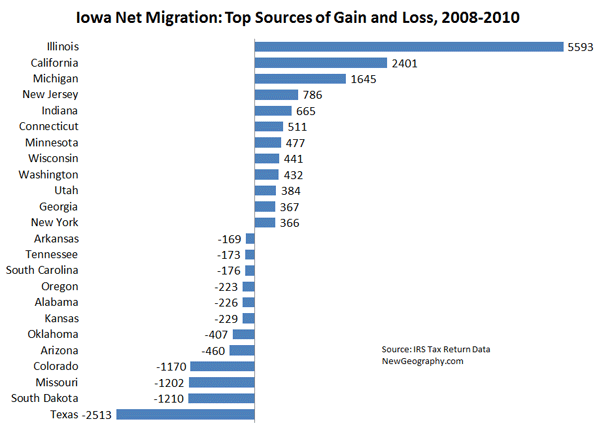
    The state’s brain drain is always a topic of discussion. There has been a very noticeable population shift of rural to urban in the past half-century which was especially fueled by the farming crisis in the 80s, but this trend holds out empirically for all Midwestern states. The problem is that a look at the numbers doesn’t confirm major outmigration. Iowa saw a net gain from other states according to IRS tax return data from 2008-2010. In fact, the net gain from the top 12 source states ­­– states like Illinois, California, and Michigan – in the last three years is 40% higher than the net loss to the top destinations. If Iowans are “fleeing” anywhere, it’s to places like Texas, the largest gainer, and second placed South Dakota which the professor would no doubt like even less.

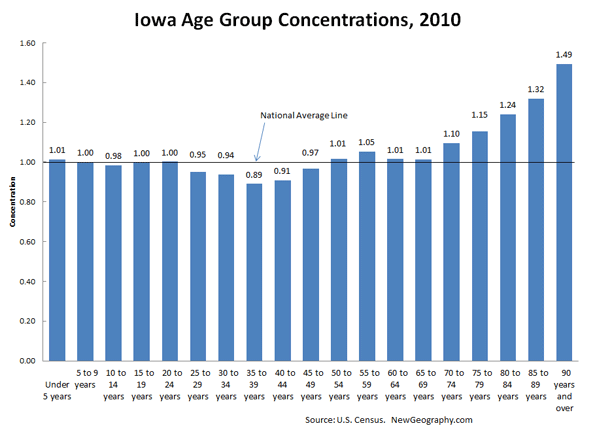
    Iowa does have high concentrations of people over age 70, but that group makes up about 10% of the total population, not enough to skew the other age groups much from the national average. Iowa has an average number of children, and it lags the most in 35-44 year olds: about 10%. This older group skews the state’s educational attainment numbers as well. Iowa’s young workforce is well educated, ranking 11th of all states in residents with at least an associate’s degree. Bloom’s claim that the state is uneducated is simply not true.

    The median age of those living in rural areas is 41.2 while urbanites are relatively young at 35.8. To further add to these negative trends, rural areas have a job growth rate of -6% in the past three years, these numbers mainly fueled by the recession. But overall state jobs are is down 2.8% since January 2008, better than 35 other states. Clearly Iowans are not lazy and giving up.

    Four Iowa cities were even included on CNN Money’s Best Cities to Live in 2011. (This includes the Mississippi River city of Bettendorf.) The state and its cities are also a great place to do business, according to Forbes. In 2010, Des Moines was ranked first, with Cedar Rapids at 13th beating out even a few Texan heavyweights, including Houston, Dallas, and Fort Worth that have been lauded for having a plethora of jobs. The 2011 list puts Des Moines in second place and Cedar Rapids in 11th. It seems Iowa isn’t as economically distraught as Bloom leads us to believe.

    Bloom comes off as nothing more than an ignorant, smug “city-slicker” (a word that Iowans apparently use to describe Obama) who sees the state through an apparently very blurry window. He claims to have seen all 99 counties of Iowa, but how can he possibly paint a portrait of the state that is so absurdly misguided after living here for so long?  If this is what they teach in journalism school, perhaps our skepticism of the media may be better placed than even we suspect.

    Jacob Langenfeld is a senior undergraduate at the University of Iowa studying economics and geography.

    Mark Schill contributed demographic analysis to this piece.

    Des Moines photo courtesty of BigStockPhoto.com.


  • Heavy Metal Is Back: The Best Cities For Industrial Manufacturing

    For a generation American manufacturing has been widely seen as a “declining sport.” Yet its demise has been largely overplayed.  Despite the many jobs this sector has lost in the past generation, manufacturing remains remarkably resilient, with a global market share similar to that of the 1970s.

    More recently, the U.S. industrial base has been on a powerful upswing, with employment climbing steadily since 2009. Boosted by productivity gains and higher costs in competitors, including China, U.S. manufacturing exports have grown at their fastest rate since the late 1980s. In 2011 American manufacturing continued to expand, while Germany, Japan and Brazil all weakened in this vital sector.

    To determine the best cities for manufacturing my colleague Mark Schill at Praxis Strategy Group measured the 51 largest regions in the country in terms of how they expanded their “heavy metal” sector — think automobiles, farm and energy equipment, aircraft, metal work and machine shops. We averaged absolute growth rate and momentum in 148 heavy metal manufacturing industries over ten-, five-, two-, and one-year time frames.

    Our top ranked area, Houston, is one of only four regions that enjoyed net job growth in manufacturing in the past 10 years. This year its heavy manufacturing sector expanded by almost 5%. Houston’s industrial growth is no fluke; over the past year its overall job growth has been about the best among  all the nation’s major metros.

    Houston’s industrial success owes much to the city’s massive port and booming energy sector, says Bill Gilmer, senior economist at the Federal Reserve office of Dallas. “Houston is about energy — it’s about fabricated metals and machinery,” he says. “It’s oil service supply and petrochemicals. It’s all paced by a high price of oil and new technology that makes it more accessible.”

    This shift towards domestic energy augurs well for a huge and economically beneficial  shift in America’s  longer term economic prospects, he points out. Cheap natural gas, for example, makes petrochemical production in America more competitive than anyone could have imagined a decade ago. Linkages with Mexico in terms of energy as well as autos has made Texas — which is also home to No. 4 ranked San Antonio and No. 15 ranked Dallas — the nation’s primary export super-power, with current shipment 15% to 20% above pre-crisis levels.

    The energy and industry connection also can be seen in No. 10 Oklahoma City, where heavy industry has been booming through much of the recession due to its strong fossil fuel industry. This synergy between energy and manufacturing could also spread to other regions, including many not associated with large fossil fuel deposits  New finds in the Utica shale in Ohio, for example, could be worth as much as  $500 billion; one energy executive called it “the biggest thing to hit Ohio since the plow.”

    These gas finds may help ignite the heavy metal revival. As coal-fired plants become more expensive to operate due to concerns over greenhouse gas emissions, the region will have a new, cleaner and potentially less expensive power source.

    Already the  boom in natural gas has sparked a considerable industrial rebound in parts of eastern Ohio including the building of a new $650 million steel plant for gas pipes in the Youngstown area.  Karen Wright, whose Ariel Corporation sells compressors used in gas plants, has added more than 300 positions in the past two years. “There’s a huge amount of drilling throughout the Midwest,” Wright says. “This is a game changer.”

    But the industrial rebound is not only about energy. Another critical factor is rising  wages in East Asia, including China. Increasingly, American-based manufacturing is in a favored position as a lower-cost producer. Concerns over “knock offs” and lack of patent protection in China may also spark a growing “Made in the USA” trend.

    The shift back to U.S. production may be a great sign for many regions. Our No. 3 ranked area, Seattle-Tacoma-Bellevue, is picking up heavy metal jobs associated with the aerospace industry. A growing focus on domestic production for Boeing’s new aircraft could bring even more prosperity to the high-flying region, which also ranked No. 1 on our recent technology industry growth ranking.

    If new industrial growth is just another piece of good news in the Pacific Northwest, it’s manna from heaven to the long suffering industrial heartland heavily concentrated in the Great Lakes region, which includes much of Ohio, Michigan, Indiana, Illinois , Wisconsin and Minnesota.  Long reviled as the “rust belt” this area now leads in the industrial rebound with over 100,000 new manufacturing jobs in just the past year.

    Particularly well positioned is No. 2 ranked Milwaukee, which is home to a wide array of specialized manufacturing firms ranging from machine tools to energy. Over the past year alone the region added almost 3900 heavy metal jobs and has consistently led other Great Lakes communities in job creation.

    But Milwaukee is not the only rust belt rebound town. The greater Detroit area, No. 6 on our list, actually added the most heavy metal jobs — more than 12,000 — than any region of the country. The area’s ranking, however, was dragged down by its legacy; greater Detroit still has lost almost 130,000 positions in the past decade.

    The heavy metal revival has a long way to go. And we cannot expect it to produce the same kinds of jobs produced in the last century. For example, the new jobs will be more highly skilled; even as the share of the workforce employed in manufacturing has dropped from 20% to roughly half that, high skilled jobs in industry have soared 37%, according to a New York fed study.

    Regions seeking strong industrial growth will have to focus more and more on training more skilled workers. Even after years of declining employment and surplus numbers of graduates in the arts and law, manufacturers in heavy industry are running short on skilled workers. Industry expert David Cole predicts there could be demand for 100,000 new workers by 2013. According to Deloitte Touche, 83% of all manufacturers suffer a moderate or severe shortage of skilled production workers.

    The resurgence of heavy metal should lead regions, and the federal government, to consider shifting their emphasis toward productive, skilled based training and away from a single-minded focus on the BA or graduate degree. Few regions suffer a shortage of art history or English graduates.   This more practical emphasis is particularly critical for the Midwest, which is home to four of the ten highest-ranked industrial engineering schools in the nation.

    Even more important: training workers for the assembly lines of tomorrow. These jobs, notes Ariel’s Karen Wright, will require not BA degrees but high degrees of math and mechanical skills that can be apply to expanding companies like hers.

    As we enter a new economic era, regions should look beyond the current obsession with “creative” and “information” industries. Instead, they should focus on a resurgent industrial economy — which then can provide a customer base for advertising, graphics and software companies — as a primary driver of economic growth.  Turn down those soulful   Adele tracks: Heavy metal is back.

    The Top Regions for Heavy Metal
    Manufacturing Job Growth


    Score consists of 10, 5, 2, and 1 year job growth rate and job momentum and 2011 industry concentration. 

    Rank MSA Name Score
    1 Houston-Sugar Land-Baytown, TX 68.5
    2 Milwaukee-Waukesha-West Allis, WI 65.6
    3 Seattle-Tacoma-Bellevue, WA 64.7
    4 San Antonio-New Braunfels, TX 60.7
    5 Virginia Beach-Norfolk-Newport News, VA-NC 60.4
    6 Detroit-Warren-Livonia, MI 58.2
    7 Kansas City, MO-KS 56.3
    8 Hartford-West Hartford-East Hartford, CT 56.1
    9 Sacramento–Arden-Arcade–Roseville, CA 54.4
    10 Oklahoma City, OK 53.3
    11 Pittsburgh, PA 53.2
    12 Salt Lake City, UT 52.6
    13 Richmond, VA 52.0
    14 Portland-Vancouver-Hillsboro, OR-WA 51.8
    15 Dallas-Fort Worth-Arlington, TX 51.5
    16 Cincinnati-Middletown, OH-KY-IN 51.3
    17 Cleveland-Elyria-Mentor, OH 51.3
    18 San Diego-Carlsbad-San Marcos, CA 50.5
    19 Raleigh-Cary, NC 50.1
    20 San Jose-Sunnyvale-Santa Clara, CA 48.7
    21 Birmingham-Hoover, AL 48.0
    22 Minneapolis-St. Paul-Bloomington, MN-WI 47.9
    23 Atlanta-Sandy Springs-Marietta, GA 47.6
    24 Louisville/Jefferson County, KY-IN 47.3
    25 Austin-Round Rock-San Marcos, TX 47.2
    26 St. Louis, MO-IL 46.8
    27 Orlando-Kissimmee-Sanford, FL 46.7
    28 Charlotte-Gastonia-Rock Hill, NC-SC 46.2
    29 Denver-Aurora-Broomfield, CO 45.7
    30 Boston-Cambridge-Quincy, MA-NH 44.9
    31 Chicago-Joliet-Naperville, IL-IN-WI 44.6
    32 Washington-Arlington-Alexandria, DC-VA-MD-WV 44.0
    33 Memphis, TN-MS-AR 43.9
    34 Tampa-St. Petersburg-Clearwater, FL 42.9
    35 Indianapolis-Carmel, IN 42.9
    36 Providence-New Bedford-Fall River, RI-MA 42.9
    37 Rochester, NY 42.3
    38 Columbus, OH 42.2
    39 Phoenix-Mesa-Glendale, AZ 41.9
    40 Jacksonville, FL 41.1
    41 Los Angeles-Long Beach-Santa Ana, CA 40.2
    42 Miami-Fort Lauderdale-Pompano Beach, FL 40.1
    43 Nashville-Davidson–Murfreesboro–Franklin, TN 39.8
    44 Philadelphia-Camden-Wilmington, PA-NJ-DE-MD 39.1
    45 Buffalo-Niagara Falls, NY 38.7
    46 Riverside-San Bernardino-Ontario, CA 37.9
    47 New Orleans-Metairie-Kenner, LA 35.7
    48 Baltimore-Towson, MD 34.3
    49 Las Vegas-Paradise, NV 31.0
    50 New York-Northern New Jersey-Long Island, NY-NJ-PA 30.1
    51 San Francisco-Oakland-Fremont, CA 24.5
    Analysis includes job data from 148 six-digit NAICS industry sectors covering Primary Metal Manufacturing (NAICS 331), Fabricated Metal Manufacturing (332), Machinery Manufacturing (333) and Transportation Equipment Manufacturing (336).
    Data Source: EMSI Complete Employment, 2011.4 


    This piece first appeared at Forbes.com.

    Joel Kotkin is executive editor of NewGeography.com and is a distinguished presidential fellow in urban futures at Chapman University, and contributing editor to the City Journal in New York. He is author of The City: A Global History. His newest book is The Next Hundred Million: America in 2050, released in February, 2010.

    Mark Schill of Praxis Strategy Group perfomed the economic analysis for this piece.

    Photo courtesy of BigStockPhoto.com.


  • Let’s Level the Inter-generational Playing Field

    With President Obama’s speech in Osawatomie, Kansas decrying the growing economic inequality and lack of upward mobility in America, the issue has finally arrived at the center of this year’s campaign debates. While most discussions of this growing inequality focus on the gap between America’s poorest and richest citizens, a recent report by the Pew Foundation highlights how the same economic trends over the last two and a half decades have also widened the wealth gap between the oldest and youngest Americans to the highest levels in history.

    In a time of great political unrest and economic anxiety, this inter-generational wealth gap has the potential to throw gasoline on an already white hot fire. Only by understanding the sources of this increasing disparity can the country develop policies that will help to close the gap and create a fairer, less economically stratified society.

    Drawing on data provided by the U.S. Census Bureau’s Survey of Income and Program Participation (SIPP), Pew documents the tectonic shifts that have occurred in households’ net worth based upon age between 1985 and 2009. During this time, the average net worth of households headed by those under 35 fell from $11,521 to just $3,662, a drop of 68%.  During the same period, the net wealth of households, as measured by adding up the value of all assets owned minus liabilities such as mortgages or credit card debt associated with those assets, headed by those over 65 increased by 42%, from $120,457 to $170,494 (all figures are expressed in 2010 dollars).

    Of course younger households have always been less wealthy than older ones, since the heads of those households haven’t had a lifetime to acquire wealth. In 1984, this effect of age on household wealth meant that senior citizen households had, on average, ten times the wealth of those headed by people younger than 35. However, the enormous generational shift in household wealth that occurred in the intervening twenty-five years meant that, by 2009, the net worth of senior citizen households was 47 times greater than younger households. The resulting disparities in economic well-being are reflected in each generation’s perception of its own economic situation.  

    Those Americans over 65 in 2009 are members of what generational historians call the Silent Generation. Only 25% of Silents expressed any dissatisfaction with their personal financial situation that year, a percentage that did not increase in the next two years of the Great Recession.

    By contrast, 36% of people under 35 in 2009 – mostly members of the Millennial Generation – expressed dissatisfaction with their individual finances in 2009, a number that rose to 39% in 2011. But the biggest jump in dissatisfaction with personal finances between 2009 and 2011 occurred among the next older cohort, who are considered to be members of Generation X. In 2009, only 30% of Xers felt dissatisfied, a number that shot up to 42% in 2011.  Finally, 32% of the Baby Boom generation, born from 1946 to 1964 and approaching their retirement years in 2009, were dissatisfied with their personal financial situation, a number that rose only to 39% by 2011.

    One of the reasons behind this disparity of financial and economic concern among generations lies with the different impact the nation’s housing market has had on each generation between 1985 and 2009.  The great housing price collapse that began in 2008 had little impact on Millennials, only 18% of whom currently own their own home. By comparison, 57% of Gen Xers own their own home. Three-fourths of them bought after 2000 when housing prices began to soar. As a result, about one in five members of Gen X now say their home mortgage is under water, with the balance owed greater than the value of the house. By comparison, only 13% of Boomers and a miniscule 4% of Silents, most of whom bought homes well before the crash, report having under water mortgages. In fact, if it weren’t for the overall rise in housing prices since 1984 that Silents were able to take advantage of, that generation’s net worth would have fallen by a third in the twenty-five years since, instead of rising by 42%. Clearly, to improve Gen X’s attitudes toward the economy and reduce the inter-generational wealth gap, something must be done to fix the nation’s housing market.

    For older generations – Boomers facing retirement and Silents already enjoying their new life – housing is not an especially large concern. Retirement savings based on stock market valuations and/or interest rates and the certainty of pension payments are clearly a much bigger issue with these generations. Almost two-thirds of Boomers believe they may have to defer their retirement beyond 65 because of the decline in their savings and net worth, with about one in four now expecting to work until at least 70. While the stock market has almost fully recovered from the 2008 crash, for those counting on a more interest-oriented set of retirement payouts from bonds or CDs, years of rock bottom interest rates, designed by the Federal Reserve to stimulate the housing market and help the economy recover, have made these investments problematic at best. In some ways, economic policies that are designed to help Gen X with their housing challenges offer older generations scant comfort, and in certain instances actually exacerbate their concerns over their personal finances.

    Millennials diminished sense of economic opportunity remains focused almost entirely on the job market. About two-thirds of Millennials are employed but only slightly half of those are working full-time. Almost two-thirds of Millennials without a job are looking for work. Unemployment among 16-24 year olds rose to 19.1% by the fourth quarter of 2009, a full eight points higher than in 2007 before the crash. For all other generations, unemployment has gone up on average by only 5 points during the same time period. It seems too obvious to be worth stating, but the best way to increase Millennials’ wealth is to create an economy where they can all find jobs.

    Anxiety that the nation’s economy is only working for the wealthiest drives much of  the overall feeling of fear, uncertainty and doubt that pervades the nation’s political debate.  But an examination of household wealth suggests the remedy to this disease varies by generation.

    Senior citizens turned out in record numbers in the 2010 election to decry the policies of the Obama administration, but it would appear from both the economic and attitudinal data that most of them are more interested in fighting to hang on to what they have or in resisting other societal changes than in expressing any dissatisfaction with their own personal financial situation. Boomers complain about what has happened to their plans for retirement, but it is hard to see how fixing entitlements by raising the retirement age, or cutting the overly generous pensions of public employees will do anything to impact their own retirement prospects directly. To really close the generational wealth gap, policies should be adopted which raise the economic well being of America’s two youngest generations, rather than focusing on those who are already relatively better off. 

    To bring up the least wealthy of the nation’s households to levels closer to those more fortunate would require taking much more aggressive steps than Washington has so far been willing to consider.  This might require expanding the scope and size of government, something older generations especially are steadfastly resisting. This inter-generational debate over the nation’s “civic ethos,” driven by the differing economic circumstances of each generation, will be and ought to be the fundamental issue of the campaign – precisely where President Obama’s speech in Osawatomie, Kansas placed it.

    Morley Winograd and Michael D. Hais are co-authors of the newly published Millennial Momentum: How a New Generation is Remaking America and Millennial Makeover: MySpace, YouTube, and the Future of American Politics and fellows of NDN and the New Policy Institute.

  • The High-Speed Rail Program Under Congressional Scrutiny

    A combative and clearly agitated Transportation Secretary Ray LaHood defended the Administration’s high-speed rail program at a December 6 oversight hearing of the House Transportation and Infrastructure Committee to discuss congressional concerns with the program’s direction and focus. "We will not be dissuaded by the naysayers and the critics," LaHood said heatedly.

    But he convinced few skeptical committee members who believe that the Administration has bungled the program by spreading the money too thinly all over the country and on projects that are not truly high-speed. Average speeds after the $10 billion worth of improvements, the Committee was told, will range from 60 to 70 mph. In Europe and Japan, high speed trains maintain average speeds of 150 mph and higher (average speed is considered a more accurate measure of performance and service quality than top speed for it reflects trip duration.) "The President’s vision of providing 80 percent of Americans with access to high-speed rail service is unnecessary and isn’t going to happen," said Railroads Subcommittee Chairman Bill Shuster (R-PA).

    "We need one high-speed rail success, and our country‘s best opportunity to achieve high-speed rail is in the Northeast Corridor," Committee Chairman John Mica (R-FL) told the Secretary. This sentiment was echoed by a panel of experts who followed LaHood’s testimony. The panel consisted of Joan McDonald, N.Y. DOT Commissioner and Chairman of the NE Corridor Advisory Commission, Richard Geddes, associate professor at Cornell University, Ross Capon, President of the National Association of Railroad Passengers and NewsBriefs editor Ken Orski. "The Northeast is a compelling market for high-speed rail service," said McDonald. It is probably the only corridor that has all the attributes necessary for viable high-speed rail service, and where passenger trains do not have to share track — and thus are not slowed by— freight trains," added Orski. An abbreviated version of Ken Orski’s testimony follows below. 

    ###

    Let me state at the outset that I do not question the merits or the need for intercity passenger rail service. Railroads have been an integral part of the nation’s transportation system for a century and a half and they continue to play a vital role in the economy. Nor do I question the desirability of high-speed rail— a technology that I believe we ought to pursue in this country.
    What I do question is the manner in which the Administration has gone about implementing its ten billion dollar rail initiative— or what the White House expansively calls "President Obama’s bold vision for a national high-speed rail network."

    Misleading Representations
    The Administration’s first misstep, in my judgment, has been to misleadingly represent its program as "high-speed rail," thus, conjuring up an image of bullet trains cruising at 200 mph, just as they do in Western Europe and the Far East. It further raised false expectations by claiming that "within 25 years 80 percent of Americans will have access to high-speed rail." In reality the Administration’s high-speed rail program will do no such thing. A close examination of the grant announcements shows that, with one exception, the program consists of a collection of planning, engineering and construction grants that seek incremental improvements in the existing facilities of Class One freight railroads, in selected corridors used by Amtrak trains.

    While some of the projects funded with HSR dollars may result in modest increases in speed, frequency and reliability of Amtrak services, none of the awards, except for the California grant, will lead to construction of new rail beds in dedicated rights-of-way. As any railroad operator will tell you, dedicated track reserved exclusively for passenger trains is essential to the operation of true high-speed rail service— such as the service offered by the French TGV, the German ICE and the Japanese Shinkansen trains, that run at top speeds of 200 miles per hour and higher.

    Lately, the Administration has toned down its rhetoric. It no longer claims that high-speed rail is "just around the corner" (Sec. LaHood’s own words of some time ago) but rather that the HSR grants are "laying the foundation for high-speed rail corridors." But even that claim seems overblown. While track upgrades will allow Amtrak trains to reach top speeds of 110 mph in some cases, average speeds— which is a more accurate measure of performance and service quality, for it determines trip duration — will increase only moderately.

    For example, while a $1.1 billion program of track upgrades between Chicago and St. Louis will enable Amtrak trains to increase top speeds to 110 mph, average speeds between those two cities —slowed by frequent stops and the need of Amtrak trains to share track with freight traffic — will rise only 10 miles per hour, from 53 to 63 mph. Travel time will be cut by 48 minutes, to 4 hours 32 minutes (Illinois DOT announcement, December 22, 2010)

    In France, TGV trains between Paris and Lyon, cover approximately the same distance (290 miles) in a little under two hours, at an average speed of 150 mph. Yet, federal officials did not hesitate proclaiming the Chicago-St. Louis project as "historic" and hailing it as "one giant step closer to achieving high-speed passenger service."

    Had the Administration candidly represented its HSR initiative for what it really is — an effort to introduce useful but modest enhancements in existing intercity Amtrak services— it would have earned some plaudits for its good intentions to improve train travel. But by pretending to have launched a "high-speed renaissance," when all evidence points to only small incremental improvements in speed and trip duration, the Administration, I believe, has suffered a serious loss of credibility. Its pledge to "bring high-speed rail to 80 percent of Americans" is not taken seriously any more.

    Lack of a focus
    The Administration’s second mistake, in my opinion, has been to fail to pursue its objective in a focused manner. Instead of identifying a corridor that would offer the best chance of successfully deploying the technology of high-speed rail, and concentrating resources on that project, the Administration has scattered nine billion dollars on 145 projects in 32 states, and in all regions of the country. (A complete list can be found here). Only a few of these awards (CA, IL, NC, WA, NEC) are of a sufficient scale to produce any appreciable service improvements. The remaining grants will support minor facility upgrades, preliminary engineering, and planning and environmental studies. Indeed, the program bears more resemblance to an attempt at revenue sharing than to a focused effort to pioneer a new transportation technology.

    The Northeast Corridor
    Ironically, the Northeast corridor, where high-speed rail has the best chance of succeeding, has received scant attention. And yet, this corridor is probably the only one in the nation that has all the attributes necessary for effective and economical high-speed rail service. It also is the only rail corridor in the nation where passenger trains do not have to share track — and thus are not slowed by— freight trains.

    In sum, no other travel corridor in the nation offers better conditions for successful implementation of high-speed rail service, or a more compelling case for moving forward with an ambitious investment program.

    To its credit, the Administration has belatedly recognized the deployment potential of the Northeast Corridor and tried to make up for its past neglect by awarding two major grants for track and catenary improvements in the Corridor. These grants are a small beginning in what will hopefully become a redirected HSR program, with a focus on the Northeast corridor. Its goal should be to raise average speeds between city pairs to 150 mph—the generally accepted standard for high-speed rail service.

    The need to involve the private sector
    In view of the constraints on the federal budget, any such program will of necessity require substantial participation of the private sector. The density of travel in the NE Corridor and its continued growth should, in principle, generate a sufficient stream of revenue to attract private capital and create opportunities for public-private partnerships.

    However, this is still an untested hypothesis. We simply do not have enough experience with public-private partnerships in the passenger rail sector to make confident predictions about the response of the private investment community— its assessment of the risk, rewards and expected rate of return on investment in such an enterprise.

    Thus, I believe that an early step in the process should focus on thoroughly exploring the potential of private financing and ascertaining the private investors’ interest in this venture— both domestically and internationally. This should include an examination of the lessons learned from the Channel Tunnel project — the largest rail infrastructure project in the world totally financed by the private sector.

    ###

    While the Administration’s handling of the high-speed rail program has— understandably and justifiably— made Congress reluctant to support this initiative any further, I do hope that under the Committee’s leadership, and with the help of the NEC Advisory Commission, Amtrak and the several participating states, a reformulated high-speed rail initiative— focused on the NE Corridor and involving a public-private partnership— will soon begin taking shape.

    One often hears these days that we, as a nation, have lost the will to think big— that we no longer have the ambition and imagination to mount "bold new endeavors" that capture the public imagination— the kind of motivation that caused our parents’ and grandparents’ generation to build the Hoover Dam, the Golden Gate Bridge and the Interstate Highway System. Launching a multi-year public-private venture to usher in true high-speed rail service in the Northeast Corridor, a project of truly national significance, offers us an opportunity to prove the skeptics wrong.

    Ken Orski has worked professionally in the field of transportation for over 30 years.
     
    Photo courtesy of BigStockPhoto.com

    ~~~~~~~~~~~~~~~~~~~~

    Note: the NewsBriefs can also be accessed at www.infrastructureUSA.org

    A listing of all recent NewsBriefs can be found at www.innobriefs.com

  • Los Angeles Gets Old

    During the last decade, Los Angeles County grew by about 300,000, an insignificant figure for a region of 9.8 million people. As in the previous decade, the slight increase in population was made possible by an increase in the number of Latinos (10.5%) and non-Hispanic Asians (18%). But overall growth was slowed by a sharp    decline in non-Hispanic white (7.4%) and non-Hispanic African American (8.5%) populations (see Table 1).

    Less recognized, immigration, the demographic fuel that previously fed LA’s economic engine also has slowed down. With little in-migration from other states, we are beginning a new phase in our trajectory: aging together, native and foreign born.

    This is a crucial moment in our history. We could be at the end of the period where Los Angeles thrived as a destination of choice for the working-age population and may simply begin to age, much like our counterparts in the Northeast. Is LA finally out of its “sunbelt” phase and entering its graying era?

    Demographic Changes – An Overview

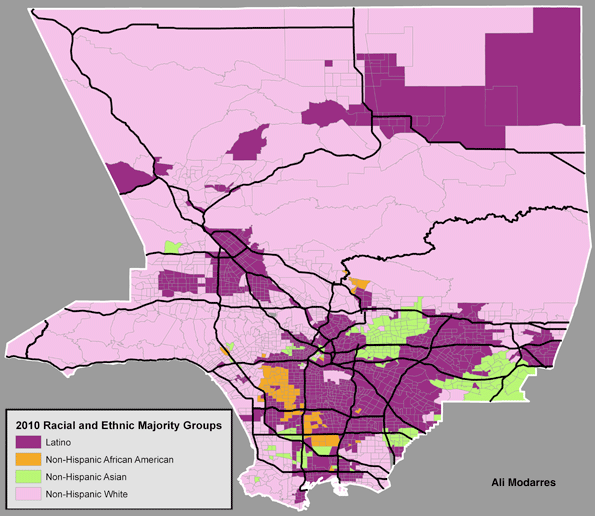
    As Figure 1 illustrates, the geography of race and ethnicity has changed little over the course of the last few decades. Latinos have retained or expanded their majority status in a significant number of neighborhoods. Asian and Asian-American neighborhoods are highly concentrated in an area known as the San Gabriel Valley, while the non-Hispanic white population continues to dominate in areas outside the central city, with the exception of a few tracts in and around the Figueroa corridor (in downtown LA) connected with recent downtown development. Non-Hispanic African Americans have lost their majority status in some South LA neighborhoods where Latinos have come to outnumber them.


    Immigration

    California’s declining immigration can be attributed to a tarnished economic image of the state and its anti-immigrant sociopolitical environment.  This might seem puzzling to many residents of Los Angeles, who live a very immigrant-rich environment.

    First, are immigrants still coming to Los Angeles at the same rate as before)?  

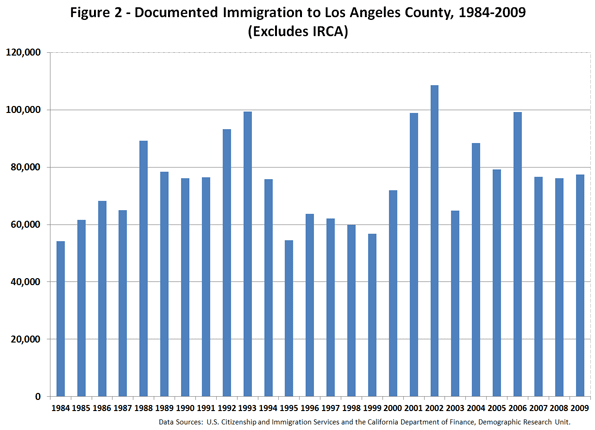
    Figure 2 helps provide the answer to this question, by illustrating the annual immigration patterns to the county. The 2007–2009 period has seen less annual immigration, but the nearly 80,000 immigrants per year is as many or more than those from 1994 to 2000. Comparing the period of 1990–1999 with 2000–2009 illustrates that, during the last ten years, a larger number of immigrants have arrived in the county (718,166 versus 841,325).

    But what seems clear is that if they are arriving in LA, fewer are staying for the long term. This secondary migration can be made visible by comparing the number of immigrants arriving in Los Angeles County with a tabulation of LA’s foreign-born population by year of U.S. entry.

    The 2009 American Community Survey shows that, among the nearly 3.5 million foreign-born residents of the county, 909,692 arrived between 1990 and 1999 and 811,808 between 2000 and 2009 (see Table 2). Comparing these figures with the number of immigrants who arrived in Los Angeles during the same periods from their countries of origin (718,166 in the 1990s and 841,325 in the 2000s) indicates that we attracted more immigrants from the 1990–1999 cohort (a net gain of close to 192,000) and lost members of the 2000–2009 cohort (about 30,000).

    Clearly the county lost its foreign-born population to other regions of the state and the nation. This is somewhat troubling since it reveals that the allure of the region may be waning among the working-age immigrant population. In fact, as Table 2 portrays, Los Angeles has gradually become home to an old-stock immigrant population, where the foreign-born population hails from earlier eras (i.e., the 1980s and the 1990s).

    Does this mean that the foreign-born population is also getting older? The answer to this question is complicated. Based on 2009 American Community Survey (ACS) data, the average age of the foreign-born population in the country is slightly over 44, with 70% of the population falling between the ages of 27 and 62. This suggests that the immigrant population is a bit older than commonly expected.   Also, with fewer than 6% of the foreign-born population being younger than age 18, it is clear that the number of children arriving is significantly less than often assumed.   

    Therefore, it may be crucial to ask a pointed question. Does Los Angeles have the appropriate economic infrastructure to attract new immigrant while keeping more of our working age immigrants?  Considering the economic circumstance of the recent immigrants, the cost of living in Los Angeles, and the current economic and job environment, it should not come as a shock that many are leaving Los Angeles. After all, this is exactly what the native-born population has done throughout the history of the United States: leaving harsh economic conditions for better opportunities in other cities and states.

    Native born

    What about the native born population? 

    Surprisingly, with an average age of slightly over 30 years, the native-born population is younger than its foreign-born counterpart. This becomes clear as we compare the age structure of both groups. Among the working-age population, the foreign-born outnumber the native-born. However, among young and old residents, the native-born population is a larger group. Before jumping to any particular conclusion, we should be reminded that the native-born population includes a large number of individuals whose parents are immigrants. This means that the younger population is multi-racial and multi-ethnic in character. To illustrate this, I provide a detailed analysis of the native-born population in the following paragraphs.

    As Table 3 illustrates, among those 0–19 years old (the first two columns), Latinos outnumber other racial and ethnic groups. This is more pronounced among those 0–9 years old. However, in every age category older than 19, the non-Hispanic white population outnumbers others. Interestingly, it is only among the age 60+ residents that non-Hispanic African Americans outnumber Latinos (124,587 versus 119,676). This information, combined with what appears on Figure 3, suggests our foreign-born population is aging and new immigrants are not arriving fast enough to keep their average age low. But at the same time their children (particularly among Latinos) are clearly a significant portion of the younger and the working-age population. This illustrates that our economy and social structure operate largely based on the dividends from past decades of high immigration. Without a renewed immigration pattern that expands the working-age population, our economic prospects are somewhat dubious.  

    LA’s Demographic Future

    Table 4 provides a brief glimpse to our demographic future. Here we have the average age for the native-born population by race and ethnicity. With an average age of 20.6, native-born Latinos are younger than the non-Hispanic native- born population (at an average of 37.4). In fact, a significant majority of native-born Latinos are under age 40. This is in stark contrast to foreign-born Latinos who are, on an average, in their early 40s. Compared with an average age of 20.6 among native-born Latinos, the age gap between the two groups becomes clear, further highlighting the decline of younger Latino immigrants in Los Angeles.  

    Clearly the demographic path of Los Angeles County has been altered. We are becoming older and more native born. Blaming immigrants, the easy game of the last two decades, can no longer explain our social and economic ills. We need to embrace who we are and what our economy, politics, and collective decision making have brought to our doorsteps. It may be difficult to accept that we are getting older, but our region is losing young people as well. Table 5 contains the last bit of information we need to understand about how we became a region with a graying population.

    Between 2000 and 2010, we lost residents in five age categories: 0–4, 5–9, 10–14, 25–34, and 35–44. This suggests that – as we have seen in other high-cost urban regions – young families are leaving! Among the working-age population, we were able to hang on to those 15–24 and age 45 and older. These individuals are from older families whose young adults (15–24) may or may not choose to stay in the region. With declining immigration and departing younger families, the Los Angeles region is on its way to becoming a much grayer place.

    A Brief Note on Policy Options

    To be sure, there is nothing wrong with aging. It happens to the best of us. However, one needs to plan for it. Los Angeles County can develop policies that benefit a working-age population and its pending retirement needs (or rethink why it has lost its luster to immigrants and the native-born population.

    Unless conditions change, the ambitious children of immigrants will surely behave like other native-born citizens and look to regions where economic prosperity is most likely. High cost of housing, a less than satisfactory educational system, inadequate health services, and an inefficient transportation system might drive the second generation young families to other region.   

    The solution to the growing loss of our productive population does not lie in building more condos and subsidizing iconic places, such as downtown LA.   We need more jobs a burgeoning economy to keep productive people here. This needs to be tied to the integration of immigrants and their children.  Immigrants are not different from those who were born here. They also want the best quality of life they can get: for themselves and their children. If Los Angeles cannot provide that, perhaps other cities and regions can.

    Table 1 – Racial and Ethnic Structure of Los Angeles County, 2000-2010
    Population by Race and Ethnicity 2000 2010 Change 2000-2010 % Changes 2000-2010
      Population Percent Population Percent
    Total 9,519,338 100.0 9,818,605 100.0 299,267 3.1
    Not Hispanic or Latino 5,275,851 55.4 5,130,716 52.3 -145,135 -2.8
    Not Hispanic or Latino; White alone 2,946,145 30.9 2,728,321 27.8 -217,824 -7.4
    Not Hispanic or Latino; Black or African American alone 891,194 9.4 815,086 8.3 -76,108 -8.5
    Not Hispanic or Latino; American Indian and Alaska Native alone 26,141 0.3 18,886 0.2 -7,255 -27.8
    Not Hispanic or Latino; Asian alone 1,123,964 11.8 1,325,671 13.5 201,707 17.9
    Not Hispanic or Latino; Native Hawaiian and Other Pacific Islander alone 24,376 0.3 22,464 0.2 -1,912 -7.8
    Not Hispanic or Latino; Some other race alone 18,859 0.2 25,367 0.3 6,508 34.5
    Not Hispanic or Latino; Two or more races 245,172 2.6 194,921 2.0 -50,251 -20.5
    Hispanic or Latino 4,243,487 44.6 4,687,889 47.7 444,402 10.5
    Hispanic or Latino; White alone 1,676,614 17.6 2,208,178 22.5 531,564 31.7
    Hispanic or Latino; Black or African American alone 25,713 0.3 41,788 0.4 16,075 62.5
    Hispanic or Latino; American Indian and Alaska Native alone 42,330 0.4 53,942 0.5 11,612 27.4
    Hispanic or Latino; Asian alone 10,299 0.1 21,194 0.2 10,895 105.8
    Hispanic or Latino; Native Hawaiian and Other Pacific Islander alone 2,845 0.0 3,630 0.0 785 27.6
    Hispanic or Latino; Some other race alone 2,244,066 23.6 2,115,265 21.5 -128,801 -5.7
    Hispanic or Latino; Two or more races 241,620 2.5 243,792 2.5 2,172 0.9
    Source: U.S. Census Bureau, 2000 and 2010


    Table 2 – Foreign Born Population in Los Angeles County by Decade of Entry in the U.S.
    Decade of entry Population Percent
    Before 1950 24,568 0.7
    1950-1959 67,127 1.9
    1960-1969 182,618 5.2
    1970-1979 569,689 16.3
    1980-1989 934,034 26.7
    1990-1999 909,692 26.0
    2000-2009 811,808 23.2
    Total 3,499,536 100
    Source: U.S. Census Bureau, American Community Survey, 2009 
    Note: Selected Data is from PUMAs 4500 to 6126


    Table 3 – Race and Ethnicity among Native Born Population, by Age – Los Angeles County
    Race and Ethnicity 0 – 9 10-19 20-29
    Non-Hispanic Latino Non-Hispanic Latino Non-Hispanic Latino
    White alone 235,638 433,253 245,522 374,450 299,123 233,629
    African Americans 97,213 4,494 115,954 3,908 116,017 4,569
    Native Americans 2,010 5,093 1,930 5,102 4,179 3,720
    Asian 106,150 2,007 98,866 2,413 76,293 2,094
    Pacific Islander 2,806 150 4,262 479 3,141 155
    Other 3,989 360,581 4,908 317,786 2,830 203,948
    Two ore more  races 44,079 33,447 31,733 30,319 28,443 19,189
    Total 491,885 839,025 503,175 734,457 530,026 467,304
    Race and Ethnicity 30-39 40-49 50-59
    Non-Hispanic Latino Non-Hispanic Latino Non-Hispanic Latino
    White alone 293,983 138,832 348,042 90,154 346,481 57,596
    African Americans 97,312 2,297 116,845 1,065 99,881 816
    Native Americans 2,180 2,557 2,371 1,872 4,205 2,249
    Asian 39,582 1,992 22,476 772 20,151 515
    Pacific Islander 3,740 354 2,149 157 1,556 57
    Other 2,182 103,856 958 53,540 742 36,311
    Two ore more  races 20,435 11,770 13,319 7,022 10,131 4,695
    Total 459,414 261,658 506,160 154,582 483,147 102,239
    Race and Ethnicity 60+ Total Total
    Non-Hispanic Latino Non-Hispanic Latino  
    White alone 522,510 80,945 2,291,299 1,408,859 1,821,615
    African Americans 124,587 1,011 767,809 18,160 342,155
    Native Americans 1,883 1,483 18,758 22,076 22,034
    Asian 32,665 845 396,183 10,638 287,823
    Pacific Islander 2,395 147 20,049 1,499 10,993
    Other 1,029 30,085 16,638 1,106,107 894,042
    Two ore more  races 10,254 5,160 158,394 111,602 187,210
    Total 695,323 119,676 3,669,130 2,678,941 3,565,872
    Source: U.S. Census Bureau, ACS 2009


    Table 4 – Average Age by Race and Ethnicity, Los Angeles County
    Race Latino Non-Hispanic All
    Average Age Population Std. Deviation Average Age Population Std. Deviation Average Age Population Std. Deviation
    White 21.7 1,408,859 18.9 41.2 2,291,299 23.0 33.7 3,700,158 23.5
    African American 23.2 18,160 18.0 36.2 767,809 22.1 35.9 785,969 22.1
    Native American 26.6 22,076 20.0 36.3 18,758 20.1 31.1 40,834 20.6
    Asian 26.9 10,638 19.0 24.2 396,183 20.8 24.2 406,821 20.8
    Pacific Islander 28.5 1,499 18.7 31.2 20,049 19.8 31.0 21,548 19.7
    Other 19.0 1,106,107 16.0 23.5 16,638 18.3 19.1 1,122,745 16.1
    Two or more races 21.2 111,602 17.7 24.7 158,394 19.7 23.2 269,996 19.0
    All 20.6 2,678,941 17.8 37.4 3,669,130 23.2 30.3 6,348,071 22.6
    Source: U.S. Census Bureau, ACS 2009


    Table 5 – Age Composition and Changes from 2000 to 2010, Los Angeles County
    Age 2000 2010 Change % Change
    Under 5 years 737,631 645,793 -91,838 -12.5
    5 to 9 years 802,047 633,690 -168,357 -21.0
    10 to 14 years 723,652 678,845 -44,807 -6.2
    15 to 19 years 683,466 753,630 70,164 10.3
    20 to 24 years 701,837 752,788 50,951 7.3
    25 to 34 years 1,581,722 1,475,731 -105,991 -6.7
    35 to 44 years 1,517,478 1,430,326 -87,152 -5.7
    45 to 54 years 1,148,612 1,368,947 220,335 19.2
    55 to 59 years 389,457 560,920 171,463 44.0
    60 to 64 years 306,763 452,236 145,473 47.4
    65 to 74 years 492,833 568,470 75,637 15.3
    75 to 84 years 324,693 345,603 20,910 6.4
    85 years and over 109,147 151,626 42,479 38.9
    Total 9,519,338 9,818,605 299,267 3.1
    Source: U.S. Census Bureau, 2000 and 2010


    Ali Modarres is an urban geographer at California State University, Los Angeles. This report is based on a longer article appearing in the 2011 edition of the journal of California Politics and Policy.

    Photo by Bigstockphoto.com

  • Durban, Reducing Emissions and the Dimensions of Sustainability

    The Durban climate change conference has come to an end, with the nations of the world approving the "Durban Platform," (Note 1) an agreement to agree later on binding greenhouse gas (GHG) reduction targets by 2020. The New York Times reported: "Observers and delegates said that the actions taken at the meeting, while sufficient to keep the negotiating process alive, would not have a significant impact on climate change."

    Not surprisingly, not all are pleased by the largely toothless agreement. Nnimmo Bassey, chair of Friends of the Earth international, told The Guardian:"Delaying real action till 2020 is a crime of global proportions." Todd Stern, the United States representative, signed on to the deal but noted that "there is plenty the US is not thrilled about."

    There is general agreement that any program to reduce GHG emissions must do so in the most efficient (least expensive) manner. The United Nations Intergovernmental Panel on Climate Change (IPCC) has concluded that sufficient emissions reductions can be achieved for between $20 and $50 per ton. Any cost above that must be considered wasteful and likely to reduce economic growth, while increasing poverty.

    Yet, researchers often leap from identifying a strategy to reduce GHG emissions to recommending its implementation, without ever examining the cost.

    Often  missed for instance, is that reductions in some sectors may prove less expensive than in others. The European Conference of Ministers of Transport has noted that "It is important to achieve the required emissions reductions at the lowest overall cost to avoid damaging welfare and economic growth." Across-the-board targets would misallocate resources, unnecessarily reducing economic growth and increasing poverty. This is particularly important in transport, because IPCC data indicates the potential for cost effectively reducing GHG emissions from this sector is considerably less than its contribution to emissions.

    GHG Emissions from Automobiles: In the United States and other high income nations, however, mandates are being pursued that would impose far higher costs. Our new report, published by the Reason Foundation, Reducing Greenhouse Gas Emissions from Automobiles reviews two general approaches. The first is behavioral approaches, the favorite of policymakers, that would force people to leave the suburbs to live in higher densities ("compact city" or "smart growth" policies) and discourage personal mobility. The second is facilitative approaches, which would reduce GHG emissions through technological advances, minimizing the necessity for command and control mandates over people’s lives.

    Behavioral Approaches: In what passes for the conventional wisdom, current thinking would require densification for virtually all new development, while trying to force people out of cars to travel by transit, bicycle or walking, all characterized as "sustainable" transport modes. Further, these strategies would seriously impede personal mobility by increasing travel times and reducing access to employment. This reduction in accessibility to jobs would be a backward step for any nation interesting in longer term economic growth (Note 2).

    The behavioral strategies are described in two principal US reports: Driving and the Built Environment which was produced by the National Research Council and Moving Cooler, by a consortium of organizations led by the Urban Land Institute and Cambridge Systematics. Each of these reports provides detailed estimates of the GHG emission reductions to be expected from land-use and mass transit strategies by 2050 in the United States.

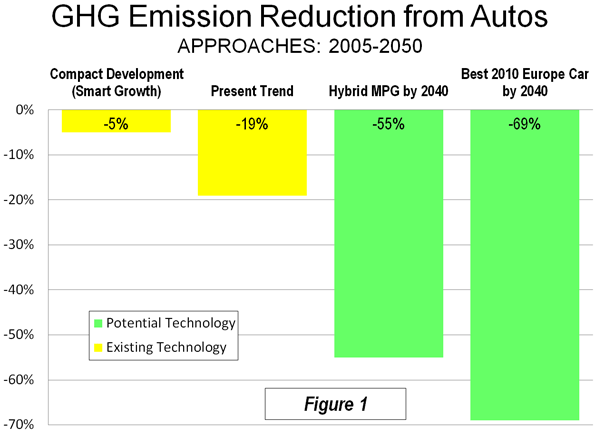
    The reductions are relatively modest, averaging less than 5% from the early 2000s to 2050 .  Driving and the Built Environment indicates that the drafters did not agree its most aggressive scenario was achievable. Moving Cooler was soundly criticized by the American Association of State Highway and Transportation Officials and on these pages by leading transport consultant Alan E. Pisarski (see: ULI Moving Cooler Report: Greenhouse Gases, Exaggerations and Misdirections).

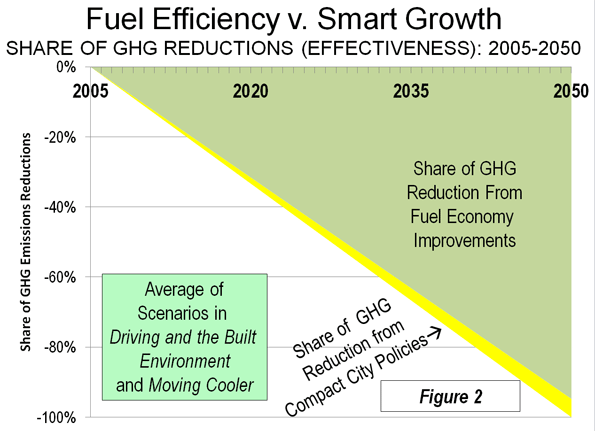
    These proscriptive policies focus on housing and land use even thought nearly all of the improvement in GHG emissions would result from automobile fuel economy improvements, not compact city policies. Depending upon the scenario, between 89% and 99% of the reduction in GHG emissions from cars by 2050 (Figure 1) would be the result of fuel economy improvements, rather than from compact city policies (based on comparison base year, early 2000s, fuel economy).

    Moreover, even the modest 1% to 11% reduction (5% average) in GHG emissions due to compact city policies are likely high because of greater traffic congestion, which neither report considers. Higher density urban areas, such as compact city policies would require, would spark greater traffic congestion. This means that cars travel slower and in more erratic traffic conditions. This, ironically, increases fuel consumption and GHG emissions per mile or kilometer. Thus, as noted here before, under these policies, GHG emissions from cars could actually increase.

    Neither Driving and the Built Environment nor Moving Cooler report considers the economic impact of compact city land rationing, which drives up housing prices and could thus be expected to impose higher costs on households. The economic literature is virtually unanimous in associating higher land and thus house prices with smart growth type land rationing policies. The increased costs could be many times the IPCC $20 to $50 per ton of GHG emissions removed.

    Even the popular assumption that suburban housing produces materially greater GHG emissions is questionable. Most US research fails to capture the common GHG emissions from elevators, heating, air conditioning, lighting, etc. in larger multi-unit housing, which are costs attributed to the building itself (landlord or condominium building) as opposed to  household energy bills (simply because there are no data). Yet, research in Australia indicates that common GHG emissions render higher density multifamily housing more GHG intensive than either townhouses or detached housing. Also escaping many researchers is the fact that carbon neutral housing is being developed, which could remove any GHG emissions differences between housing types.

    Compact city or smart growth policies have little potential to reduce GHG emissions and would do so at exorbitant costs that are well beyond those identified by the IPCC. This is not surprising, since compact city and smart growth policies have been widely touted long before the general concern over climate change. Denser cities have been pushed as a means to improve “community,” spur economic efficiency,   reduce air pollution and deal with such ephemeral – given recent massive energy finds – notions of “peak oil”.

    Facilitative Approaches: Any achievable program to reduce GHG emissions must be multi-dimensional and focus primarily on achieving that goal in the most economically and socially beneficial manner and not be based upon tired policies designed long ago to serve other agendas. There is no need for expensive and draconian compact city approaches. A report by McKinsey and the Conference Board concluded that substantial and cost effective GHG emission reductions were possible, “while maintaining comparable levels of consumer utility,” which was defined as “no change in thermostat settings or appliance use, no downsizing of vehicles, home or commercial space and traveling the same mileage.” In other words, there is no need to interfere with people’s lives or preferences (Note 3).

    The most promising approaches involve improvements in fuel economy. For example, Volkswagen has developed a two-seater car that achieves 235 miles per gallon (US) of gasoline or petrol (1 liter per 100 kilometers). With current fuel economy averaging little over 20 miles per gallon (12 liters per 100 kilometers) in the United States, the frontiers of fuel economy improvement have barely been approached.

    Moreover, substantial GHG emissions reductions can be achieved at levels far below 235 miles per gallon. The United States Department of Energy, Energy Information Administration (EIA) forecasts that even if driving increases 29% from 2005 to 2025, GHG emissions from cars would be reduced by 7% (Note 4). If, as is demonstrably possible, the EIA forecast fuel efficiency improvements were to continue to 2050, the reduction would be 19%, despite an increase in driving of more than 60%. At a slower driving growth rate more consistent with more recent trends, the reduction could be 33% (Figure 2).

    Further, if the US light vehicle fleet (cars and sport utility vehicles) were to achieve the current fuel economy performance of the best hybrid vehicles, the reduction in GHG emissions would be between 55% and 64% by 2050. Matching European performance forecasts would reduce GHG emissions even more.

    A substantial increase in the fastest growing sector of commuting, working at home (often telecommuting), could also help. Nothing can cut emissions more thoroughly than working at home, which produces zero GHG emissions. Yet, this innovation – which already surpasses transit use in most American metropolitan areas – inexplicably receives little or no attention from planners intent on herding people into higher densities and travel modes that take longer.

    The great advantage of facilitative approaches is that, as the McKinsey-Conference Board report indicates, people are permitted to live their lives as they prefer even as emissions are reduced.

    The Dimensions of Sustainability: Perhaps the greatest problem with behavioral approaches is that they may not be sustainable at all. Sustainability is multi-dimensional. Compact city and smart growth policies lack financial sustainability because they spend far too much per ton of GHG emissions. They lack economic sustainability because they would impose substantially higher costs, especially on housing prices. Ultimately, unless humans radically change their demonstrated preferences, compact city and smart growth policies may not be politically sustainable because people are likely to resist them either at the ballot box, or by moving – as demonstrated in the latest census – even further out from the urban core or to smaller, less regulated and less dense regions. All three dimensions of sustainability, financial, economic and political, must be prerequisites to material GHG emissions reductions.

    Notes:

    (1) Reuters provides an early summary of the Durban Platform.

    (2) The strong connection between economic growth and minimizing urban travel times is identified in research such as by Prud’homme and Lee at the University of Paris and Hartgen and Fields at the University of North Carolina, Charlotte.

    (3) The McKinsey-Conference Board report was co-sponsored by Shell, National Grid, DTE Energy and Honeywell, as well as environmental advocacy organizations, the Environmental Defense Fund, the Natural Resources Defense Council (NRDC),

    (4) Proponents of compact city policies sometimes claim that fuel efficiency improvements cannot reduce GHG emissions because the increase in driving neutralizes their impact. EIA projections indicate otherwise, as is shown here.

    Wendell Cox is a Visiting Professor, Conservatoire National des Arts et Metiers, Paris and the author of “War on the Dream: How Anti-Sprawl Policy Threatens the Quality of Life

    Photograph from BigStockPhoto.com
  • Wanted: Blue-Collar Workers

    To many, America’s industrial heartland may look like a place mired in the economic past—a place that, outcompeted by manufacturing countries around the world, has too little work to offer its residents. But things look very different to Karen Wright, the CEO of Ariel Corporation in Mount Vernon, Ohio. Wright’s biggest problem isn’t a lack of work; it’s a lack of skilled workers. “We have a very skilled workforce, but they are getting older,” says Wright, who employs 1,200 people at three Ohio factories. “I don’t know where we are going to find replacements.”

    That may sound odd, given that the region has suffered from unemployment for a generation and is just emerging from the worst recession in decades. Yet across the heartland, even in high-unemployment areas, one hears the same concern: a shortage of skilled workers capable of running increasingly sophisticated, globally competitive factories. That shortage is surely a problem for manufacturers like Wright. But it also represents an opportunity, should Americans be wise enough to embrace it, to reduce the nation’s stubbornly high unemployment rate.

    Driving the skilled-labor shortage is a remarkable resurgence in American manufacturing. Since 2009, the number of job openings in manufacturing has been rising, with average annual earnings of $73,000, well above the average earnings in education, health services, and many other fields, according to Bureau of Labor Statistics data. Production has been on the upswing for over 20 months, thanks to productivity improvements, the growth of export markets (especially China and Brazil), and the lower dollar, which makes American goods cheaper for foreign customers. Also, as wages have risen in developing countries, notably China, the production of goods for export to the United States has become less profitable, creating an opening for American firms. The American Chamber of Commerce in Beijing expects China’s “low-wage advantage” to be all but gone within five years.

    It’s also true that American industry hasn’t faded as much as you might think. Though industrial employment has certainly plummeted over the long term, economist Mark Perry notes that the U.S. share of the world’s manufacturing output, as measured in dollars, has remained fairly stable over the last 20 years, at about one-fifth. Indeed, U.S. factories produce twice what they did back in the 1970s, though productivity improvements mean that they do it with fewer employees. Recent export growth has particularly helped companies producing capital equipment, such as John Deere and Caterpillar, and many industrial firms are even hiring more people for their plants, especially in the Midwest, the Southeast, and Texas.

    One area in which industry is positively roaring: firms that service the thriving oil and natural-gas industries, from Montana and the Dakotas to Pennsylvania. In Ohio alone, there are already 65,000 wells, with more on the way, says Rhonda Reda, executive director of the Ohio Oil and Gas Energy Education Foundation—while a new finding, the Utica shale formation in eastern Ohio, could hold more than $20 billion worth of natural gas. As a result, Karen Wright’s business—selling compressors for natural-gas wells—has been soaring, leading her to add more than 300 positions over the past two years. “There’s a huge amount of drilling throughout the Midwest,” Wright says. “This is a game changer.”

    Wright isn’t alone. Firms throughout the Midwest are moving aggressively to meet the demand for natural-gas-related products. Take the $650 million expansion of the V&M Star steel mill in Youngstown, Ohio, which builds pipes for transporting gas. The expansion will add 350 permanent jobs to the factory after it’s completed next year.

    As the natural-gas boom continues, it could have another effect beneficial to industry: keeping energy prices low, which will give American manufacturers a leg up on their global rivals. Companies in the business-friendly midwestern and Plains states will profit the most, while New York and California—though each has ample fossil-fuel resources—will probably be too concerned with potential environmental problems to cash in.

    The industrial resurgence comes with a price: a soaring demand for skilled workers. Even as overall manufacturing employment has dropped, employment in high-skill manufacturing professions has soared 37 percent since the early 1980s, according to a New York Federal Reserve study. These jobs can pay handsomely. An experienced machinist at Ariel Corporation earns over $75,000, a very good wage in an area where you can buy a nice single-family house for less than $150,000.

    A big reason for the demand is changes on the factory floor. At Ariel, Wright points out, the operator of a modern CNC (computer numerical control) machine, which programs repetitive tasks such as drilling, is running equipment that can cost over $5 million. A new hire in this position must have knowledge of programming, metallurgy, cutting-tool technology, geometry, drafting, and engineering. Today’s factory worker is less Joe Six-Pack and more Renaissance man.

    So perhaps it isn’t surprising that American employers are hard-pressed to find the skilled workers they need. Delore Zimmerman, the CEO of Praxis Strategy Group (for which I consult), observes that this shortage extends to virtually any industrial operation. In his hometown of Wishek, North Dakota, whose population is just 800, one company making farm machinery has 17 openings that it can’t fill. Skilled-labor shortages grip the whole of this energy-rich state. Demand for skilled workers in the North Dakota oilfields—from petroleum engineers to roustabouts—exceeds supply by nearly 30 percent. The shortage of machinists is 10 percent. “The HELP WANTED signs in North Dakota are as common as FOR SALE signs in much of the rest of the country,” Zimmerman reports.

    “There are very few unskilled jobs any more,” says Wright. “You can’t make it any more just pushing a button. These jobs require thinking and ability to act autonomously. But such people are not very thick on the ground.” Among the affected industries will be the auto companies, which lost some 230,000 jobs in the recession. David Cole, chairman of the Center for Automotive Research, predicts that as the industry tries to hire more than 100,000 workers by 2013, it will start running out of people with the proper skills as early as next year. “The ability to make things in America is at risk,” says Jeannine Kunz, director of professional development for the Society of Manufacturing Engineers in Dearborn, Michigan. If the skilled-labor shortage persists, she fears, “hundreds of thousands of jobs will go unfilled by 2021.”

    The shortage of industrial skills points to a wide gap between the American education system and the demands of the world economy. For decades, Americans have been told that the future lies in high-end services, such as law, and “creative” professions, such as software-writing and systems design. This has led many pundits to think that the only real way to improve opportunities for the country’s middle class is to increase its access to higher education.

    That attitude is a relic of the post–World War II era, a time when a college education almost guaranteed you a good job. These days, the returns on higher education, particularly on higher education gained outside the elite schools, are declining, as they have been for about a decade. Earnings for holders of four-year degrees have actually dropped over the past decade, according to the left-of-center Economic Policy Institute, which also predicts that the pattern will persist for the foreseeable future. In 2008, more than one-third of college graduates worked at occupations such as waiting tables and manning cash registers, traditionally held by non–college graduates. Mid-career salaries for social work, graphic design, and art history majors are less than $60,000 annually.

    The reason for the low rewards is that many of the skills learned in college are now in oversupply. A recent study by the economic forecasting firm EMSI found that fewer computer programmers have jobs now than in 2008. Through 2016, EMSI estimates, the number of new graduates in the information field will be three times the number of job openings.

    There’s a similar excess of many postgraduate skills. Take law, which flourished in a society that had easy access to credit. Now, with the economy tepid, law schools are churning out many more graduates than the market wants. Roughly 30 percent of those passing the bar exam aren’t even working in the profession, according to a survey by the National Association for Law Placement. Another EMSI study indicates that last year, in New York State alone, the difference between the number of students graduating from law school and the number of jobs waiting for them was a whopping 7,000.

    The oversupply of college-educated workers is especially striking when you contrast it with the growing shortage of skilled manufacturing workers. A 2005 study by Deloitte Consulting found that 80 percent of manufacturers expected a shortage of skilled production workers, more than twice the percentage that expected a lack of scientists and engineers and five times the percentage that expected a lack of managerial and administration workers. “We don’t just need people—we need people who can meet our standards,” worries Patrick Gibson, a senior manufacturing executive at Boeing’s plant in Heath, Ohio.

    Some of Gibson’s fellow manufacturers blame the shortage of skilled workers on the decline of vocational education, which has been taking place for two decades now. Such training is unpopular for several reasons. For one thing, many working-class and minority children were once steered into vocational programs even if they had aptitude for other things, an unfair practice that many people haven’t forgotten. Today’s young people, moreover, tend to regard craft work—plumbing, masonry, and carpentry, for instance—as unfashionable and dead-end, no doubt because they’ve been instructed to aspire to college. “People go to college not because they want to but because their parents tell them that’s the thing to do,” says Jeff Kirk, manager of human relations at Kaiser Aluminum’s plant in Heath, Ohio. “Kids need to become aware of the reality that much of what they learn in school is not really needed in the workplace. They don’t realize a pipe fitter makes three times as much as a social worker.”

    Fortunately, there are signs that some schools are getting that message and passing it along to their students. Funded by industry sources, the Houston Independent School District’s Academy for Petroleum Exploration and Production Technology trains working-class, mostly minority high school students in the skills they’ll need to perform high-wage industrial jobs. Tennessee—like Texas, a growth-oriented state—has developed 27 publicly funded “technical centers” that teach skills in just months and carry a far lower price tag than a conventional college does.

    Two-year colleges will be crucial to the effort to train skilled workers. One of these schools, Central Ohio Technical College, has recently expanded by 70 welding students and 50 aspiring machinists per year. Many of the college’s certificate programs are designed and partly funded by companies, which figure that they’re making a wise investment. “You have a lot of people sitting in the city doing nothing. They did not succeed in college. But this way, they can find a way up,” says Kelly Wallace, who runs the college’s Career and Technology Education Center.

    Such shorter educational alternatives will become ever more important as industrial workers retire. The average skilled worker in the industries supplying the gas boom is in his mid-fifties. “At our plant, you have lots of people with 20 to 30 years’ experience,” says Kirk, who has three high-skill openings that he can’t fill. “But there’s no apprenticeship program—no way to fill the future growth. We are simply running out of people.”

    New programs may not produce enough graduates to fill all these openings. But Karen Wright, at least, suspects that more young people will start looking for careers that offer them the prospect of a decent living and less debt. This may not be the postindustrial future envisioned by Ivy League economists and Information Age enthusiasts. But it could spell better times for a country in sore need of jobs.

    This piece first appeared at The City Journal.

    Joel Kotkin is executive editor of NewGeography.com and is a distinguished presidential fellow in urban futures at Chapman University, and contributing editor to the City Journal in New York. He is author of The City: A Global History. His newest book is The Next Hundred Million: America in 2050, released in February, 2010.

    Photograph from BigStockPhoto.com