Blog

  • An Obituary for the Occupation in New York

    I came to report on the occupation of Zuccotti Park expecting it would pass in a matter of days, like the stillborn movements before it.

    In spite of its self-celebrated cosmopolitanism, New York after 9/11 has become an arid environment for protest under Mayor Michael Bloomberg and Police Commissioner Ray Kelly. The press and the public yawned through the massive anti–Iraq War march in 2003 and the excessive police response to the 2004 RNC protesters (the city is still dealing with those lawsuits). Even after the Wall Street meltdown, an eerie silence prevailed.

    Zuccotti was something else: a physical presence, symbolically charged by its location a stone’s throw from both Ground Zero and Wall Street, with no end date to wait out and no demand to be placated.

    While the act of occupation had little to do with the broader complaint—at the core, unhealthy economic distribution perpetuated by increasingly unresponsive elected “representatives”—it proved a dramatic setting for airing them, and for bringing participants together. For one season the park took on a life of its own, before reverting to a place for “passive recreation.”

    In the course of that season, though, the scene aged badly. With a big push from the Bloomberg administration and tabloid coverage fixated on civic order, Zuccotti Park descended from a new public commons to a fever dream.

    I surveyed the scene for the first time about a week after it started. In that first of what became many such visits, I stayed from early afternoon through the next morning, listening to professors, students, union members, veterans, homeless women, eccentrics, lunatics, librarians, old colleagues from other newspapers, members of various working groups and even a neighbor from Brooklyn there to take it in.

    Occupy Wall Street had yet to draw the high-profile NYPD abuses and errors—the pepper spraying and Brooklyn Bridge arrests—that would give them a shape and purpose they couldn’t sustain themselves. But amid the drum circles and music festival “model society” absurdity of the park, people who’d been at a loss until now about how to express an array of concerns sensed an opening.

    I was less interested in the protest itself than in the creation within Zuccotti of the sort of freewheeling commons New York City has lost under this mayor, even as the Internet and mobile devices eroded what was left of a shared café culture.

    That shift is epitomized by the increasing commercialization of public spaces like the generator-powered gift market at Union Square. But it left a hole that the occupiers briefly filled.

    The handmade cardboard signs, the conversations with engaging strangers, the library, even the General Assembly all seemed like flashes of the participant city that’s hunkered down to wait out an unpopular mayor. Bloomberg has built an ever-expanding safe space for the very well-off at the expense of the rest of us, using his private fortune to encourage New Yorkers to simply leave the city’s civic life in his hands.

    Problems in Zucotti stemmed in no small part from the massively disproportionate police response, intended in part to limit the size and scope of the protests by warning the economically marginal, the physically frail, and the meek about the bad things that might happen to those who participated.

    That tactic backfired. As the occupation grew, the would-be political participants found themselves starved for space, overwhelmed by their own tents and by an excess of hangers-on, panhandlers and carnival-goers unsober in all senses. They were ringed by barricades and police officers, blinded by spotlights aimed into the park at all hours, and eyed at all times by dozens of NYPD cameras carried by officers and atop a 20-foot pole on an unmarked police truck.

    “Just because you’re paranoid,” one Occupier said, sweeping her arm across the park, “doesn’t mean they’re not out to get you.”

    The NYPD response was a far more significant disruption to the life of the city than the protesters themselves—for the first time since 9/11 penning off streets to those without IDs to prove they “belonged” there, erecting barricades that starved businesses of customers, sending so many officers to “protect” the demonstrably nonviolent marches that crime rates went up elsewhere.

    In turn, the occupiers became fixated on the police department. At each march, rumors would swirl about brutality, arrests and reports that “they’re taking the park.” Crowds would at times work themselves into mobs, facing off with the NYPD as though they were in Oakland or Egypt. Yet they failed to notice—let alone respond to—the tactics used to manage them, like complicated penning schemes that broke bigger groups into smaller ones or tricked protesters into separating themselves from the rest of the city instead of showing they were just like everyone else.

    After I reported that the police were exacerbating a split between participants and nonparticipants in Zuccotti by encouraging drunks and rowdies to head down there, the NYPD’s main mouthpiece issued a tepid denial. “Not true,” he said, without specifying what exactly wasn’t true, adding that those types would of course find their way there.

    Explaining his decision to finally clear the park, Bloomberg pointed to the EMT who broke his leg on the sidewalk just outside the park (but inside the barriers separating the police from the protesters) a week earlier, in the middle of the night.

    I was the only reporter on the scene when that happened. My colleagues had dispersed around the park to track a spate of seemingly contagious violent incidents on an especially ugly night.

    Two very large OWS “community watch” members were patiently working to calm down and eject from the park a crazed 20-year-old, Joshua Ehrenberg, who I was told had punched his girlfriend in the face earlier that night. Just outside the barriers separating the sidewalk from the street, officers watched the crowd swelling around the scene.

    The police ignored requests to move on as Ehrenberg kept playing to them, spitting out slogans of the occupation: “The process is being disrespected” since “the community hasn’t consented to this,” trying to get friends to form a human chain with him. As ever, the gawkers accused each other of being infiltrators and police agents.

    As that scene played out, two huge men in still another fight emerged behind us, inside the park, throwing ineffective haymakers at each other, nearly toppling tents. One of the OWS security members left to try to handle that, while his partner finally asked the police, watching from outside the barriers, to come in and remove Ehrenberg.

    Despite the invitation, the crowd swarmed around the entering officers, yelling “Pig!” and the like as the police carried the struggling, still slogan-shouting would-be Occupier out by his arms and legs.

    An EMT there to take him for a psychiatric evaluation, walking backward just ahead of the swollen group of police, protesters and park campers, put his foot through the rungs of a ladder that for some reason was leaning against the sidewalk.

    As he wailed in agony, the crowd gave no space—even as the police calmly asked them to give him room, pushing those who wouldn’t listen back with measured force.

    In press reports about the incident, a city spokesperson incorrectly claimed that the EMT was shoved or assaulted, while Occupation sources peddled the line that this was just one of those things, an unavoidable accident unrelated to the occupation.

    Did he fall or was he pushed? Yes.

    Would the Occupation movement—really, a moment—have collapsed under its own weight without the city’s heavy-handed help? Thanks to that help, we’ll never know.

    This piece first appeared at City and State New York.
  • Interstellar Geography: Finally Another M-Class Planet

    Finally astronomy has begun to keep up with the legendary television show, Star Trek. For decades, one of television’s strongest fan bases has been aware of "M-Class" (Earth-like) planets, on which carbon based, and often-human like life can exists. More often than not, such life did indeed exist in Star Trek. Until this past week, however, there was no hard evidence that our "M-Class" planet, Earth, had any company.

    That changed with the recent discovery of, Keplar-22b, which was discovered by a NASA team using the Keplar Space Telescope. The planet is described as the first of similar size to earth that has been found in the "goldilocks zone" of habitability relative to its sun.

    Of course, Star Trek had many more M-Class planets. But the race may be on. Researchers intend to use their results to extrapolate an estimate of the share of M-Class planets. Star Trek’s nearly half-century lead in this inventory could be at risk.

  • Tilting at (Transit) Windmills in Nashville

    As in other major metropolitan areas in the United States, Nashville public officials are concerned about traffic congestion and the time it takes to get around. There is good reason for this, given the research that demonstrates the strong association between improved economic productivity and shorter travel times to work. As Prudhomme and Lee at the University of Paris and Hartgen and Fields at the University of North Carolina Charlotte have shown, metropolitan areas tend to produce more jobs where employees are able to access a larger share of the jobs in 30 minutes.

    Ahead in Identifying the Problem: Moreover, Nashville officials are somewhat "ahead of the curve," since traffic congestion is far less severe there than in many other metropolitan areas. Among the 100 largest metropolitan areas in the United States, Nashville ranks 39th in the intensity of its traffic congestion, according to data compiled by INRIX, a traffic information firm. Nashville’s traffic congestion is even better compared to large Western European metropolitan areas .

    This favorable traffic situation is despite the fact that Nashville has among the lowest overall transit market shares in the United States or Western Europe (less than 0.5 percent of travel in the metropolitan area). The key to this success, like that of other American metropolitan areas in relation to their international peers is low density and decentralization of employment and other commercial locations.

    Missing the Point on Solutions: Yet, it is clear from an editorial in the Nashville Ledger that officials are inclined to embark on an expensive program of transit expansion. Judging from past experience, this   offers virtually no hope for reducing traffic congestion or for improving economic productivity in the Nashville metropolitan area.

    There are significant misperceptions among local officials about the potential outcomes of proposed commuter rail and bus rapid transit lanes. Perhaps the most important is the assumption that commuter rail and bus rapid transit will reduce travel times. In fact, at the national level, commuting by transit takes approximately twice as long as commuting by single occupant automobile, according to the Census Bureau’s American Community Survey for 2008 to 2010. Rail systems, such as subways (metros) and light rail do little better than transit in general, taking 95% longer than driving alone and two thirds longer than travel by car pools. There is thus virtually no hope that building new transit lines will reduce travel times.

    As often happens when costly new transportation programs are proposed, boosters often resort to erroneous information. The Nashville Ledger cites sources that indicate, for example, that suburban Franklin (in Williamson County, to the south of the Nashville-Davidson County core) has one of the longest work trip travel times in the nation. The reality is quite different. Franklin has an average work trip travel time (23.2 minutes), which is less than national average (25.3 minutes) and little more than Nashville-Davidson County (23.0 minutes).

    Nashville officials need look no further than their own eastern suburbs for evidence of the inability of new rail systems to reduce work trip travel times. In 2006, Nashville began commuter rail service from Lebanon, in Wilson County to downtown Nashville (the Music City Star). Currently, the Music City Star is locked in an intensive (and successful, according to the latest data) competition for last place in the number of riders among the nation’s commuter rail systems, just edging out Austin’s new lightly used system. Despite being the only first ring county with commuter rail service, Wilson County work trip travel times are longer than in the other first ring counties. Door-to-door travel times, which are the only travel times that count, have not been reduced by the rail line.

    Transit is About Downtown: Transit cannot be a comprehensive metropolitan transportation solution remotely competitive with automobile travel times, except to downtown. This is because the quicker, direct transit services from throughout the metropolitan area that are necessary to attract automobile drivers must focus on the most dense and largest employment center, which is downtown. The radial routes that may be capable of serving downtown effectively simply cannot be afforded for other areas of employment. Our research has indicated, the annual cost to provide automobile competitive transit service throughout an urban area in the United States would consume a huge share of the gross domestic product of any such area.

    In Nashville, downtown represents little more than 10% of the metropolitan area employment. Moreover, downtown Nashville represents a declining share of private sector employment in the metropolitan area. According to the Census Bureau’s County Business Patterns, the core Nashville ZIP codes that are served by shuttle buses from the commuter rail station lost 11% of their private sector jobs between 2000 and 2009 (latest data available). At the same time, private sector employment grew 4% in the balance of the Nashville metropolitan area (Note 1).

    Transit to Suburban Destinations: A Non-Starter: There have been proposals to require new suburban office development to be near transit stops. This would accomplish little, because transit access in areas other than downtown is so sparse. Among major metropolitan areas, nearly 65% of major metropolitan area workers are within walking distance of a transit stop, according to research by the Brookings Institution. But being near a transit stop does not mean that transit provides practical mobility to anything like 65% of jobs. The reality, according to the Brookings Institution data,  is that only 6% of jobs in the average metropolitan area of more than 1 million population can be reached by transit  by the average resident  in 45 minutes, a travel time nearly double that of the average commuter in the Nashville metropolitan area (Note 2). It seems likely that 30 minute transit access for commuters would be as low as 3% at the national level. This demonstrates the so frequently repeated fallacy equating access to a transit stop with usable access to the metropolitan area.

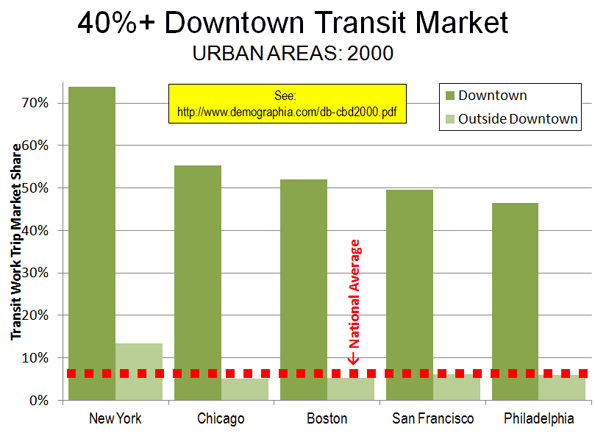
    Transit’s Large Downtown Niche Market: There is no question about the effectiveness (though not the cost efficiency) of transit in providing mobility along the most congested corridors to the nation’s largest downtown areas. This transit niche market accounts for nearly 75% of commuting to the Manhattan business core south of 59th Street, and more than 40% to the downtown areas of Brooklyn, Chicago, San Francisco, Boston and Philadelphia. Yet even in these metropolitan areas, where transit mobility is so important to downtown, transit work trip market shares to areas outside downtown are more akin to the national average of 5% (Figure), except in New York.

    Of course, Nashville’s downtown is not among these large transit-oriented cores. In 2000, census data indicated that 4% of employees commuted to downtown by transit. Even if all of the ridership on the Music City Star is made up of new downtown transit commuters, that figure would be little changed.

    The Need for Stewardship: Before Nashville commits hundreds of millions or billions of tax dollars to expensive transit projects transit in hopes of reducing traffic congestion or travel times, local officials should consider reality. Reducing traffic congestion and travel times are objectives generally beyond transit’s capability. Further, new lines can attract only a small share of commuters, because such a small share of jobs are downtown.

    —-

    Note 1: County Business Patterns provides employment information that largely excludes government employment. According to Bureau of Labor Statistics data, 53 percent of metropolitan Nashville’s increase in employment was government jobs between 2000 and 2009.

    Note 2: Calculated from Brookings Institution data.

    Photograph: Downtown Nashville from BigStockPhoto.com

    Wendell Cox is a Visiting Professor, Conservatoire National des Arts et Metiers, Paris and the author of “War on the Dream: How Anti-Sprawl Policy Threatens the Quality of Life

  • Blago’s Historic Sentencing: Organized Crime in Illinois

    Former Illinois Governor Rod Blagojevich was sentenced today to 14 years in prison. Illinois will now have the dubious distinction of having two back-to-back Governors in jail at the same time. Could a more vigilant press have stopped the amazing political career of Rod Blagojevich? When you look into the background of the former Governor the tentacles of organized crime can’t be ignored.

    Rod Blagojevich has been identified as a former associate of the Elmwood Park street crew of the Chicago Mob by Justice Department informant Robert Cooley. The allegations concern Blagojevich paying street tax to the Chicago Mob to operate a bookmaking operation. Former senior FBI agent James Wagner confirmed that Cooley told the FBI about Blagojevich in the 1980s. The Chicago Sun-Times and Chicago Tribune still haven’t reported on the Cooley allegations concerning Blagojevich. WLS-TV reporter Chuck Goudie has been most vocal in reporting on Blagojevich’s background.

    Blagojevich was tried in room 2525 of the Dirkson Federal Building, the same room used for the massive Family Secrets Chicago Mob trial. It’s odd that Judge James Zagel was the federal judge in both cases. But, there’s more in common than the media has emphasized.

    Blagojevich can’t help but be a little bitter. Former friend Eric Holder was supposed to help Blagojevich land a valuable casino in Rosemont, Il. Congressman Jesse Jackson Jr. is under an ethics cloud but is not going to be indicted for the Obama Senate seat deal. While Barack Obama claims to know nothing about Chicago corruption, as Joel Kotkin said recently: Illinois is a state of embarrassment.

  • Which States Are Growing More Competitive?

    By Hank Robison and Rob Sentz. Illustration by Mark Beauchamp.

    In many ways, individual U.S. states are like 50 laboratories where differing public policy, industry focus, and economic development strategies are tried and tested. Different approaches yield different results and some states become more competitive – gaining a larger share of total job creation — while others struggle and lose share. This phenomenon has been evident over the past few years as our nation struggles to recover. Some states have been doing quite well while others are still limping along.

    In this post we have produced a side-by-side analysis of every state to show how they stack up against each other. The goal is to see which states are becoming more competitive (that is, gaining a larger share of the total job creation), and which are losing their share of the jobs being created. The table and graphic each rank the states based on the overall competitive effect and what percentage of jobs (from 2007-2011) are based on competitive effects.

    HOW WE DID IT

    To produce this analysis we used “shift share,” a standard economic analysis method that reveals if overall job growth is explained primarily by national economic trends and industry growth or unique regional factors. Shift share analysis, which can also be referred to as “regional competitiveness analysis,” helps us distinguish between growth that is primarily based on big national forces (the proverbial “rising tide lifts all boats” analogy) vs. local competitive advantages.

    Read more on shift share in this article: Understanding Shift Share.

    ABOUT THE DATA

    The chart (see the full version here) and table display aggregate industry data (2-digit NAICS) for every state plus Washington, D.C. from 2007-2011. To generate our ranking, we summed the overall competitive effect for each broad 2-digit industry sector (e.g., agriculture, manufacturing, health care, construction, etc.) and added them together to yield a single statewide number that indicates the overall competitiveness of the economy as compared to total economy. We calculate the competitive effect by subtracting the expected jobs (the number of jobs expected for each state based on national economic trends) from the total jobs. The difference between the total and expected is the competitive effect. If the competitive effect is positive, then the state has exceeded expectations and created more jobs than national trends would have suggested. It is therefore gaining a greater share of the total jobs being created. If the competitive effect is negative, then the state is below what we would expect given national trends. In this case the state is losing a greater share of the total jobs being created.

    Click here or on the image to the right to see full infographic.

    State Total Jobs, 2011 Expected Jobs, 2011 Competitive Effect % of Jobs Due To Comp. Effect
    Source: EMSI Complete Employment, 2011.4
    North Dakota
    516,605
    469,857
    46,748
    9.05%
    Texas
    14,399,398
    13,518,812
    880,586
    6.12%
    Alaska
    452,115
    433,687
    18,428
    4.08%
    Louisiana
    2,504,020
    2,407,581
    96,439
    3.85%
    South Dakota
    546,100
    525,117
    20,983
    3.84%
    Nebraska
    1,212,275
    1,172,633
    39,642
    3.27%
    District of Columbia
    815,948
    792,259
    23,689
    2.90%
    Oklahoma
    2,130,093
    2,082,728
    47,365
    2.22%
    Vermont
    422,070
    412,696
    9,374
    2.22%
    Utah
    1,616,991
    1,583,067
    33,924
    2.10%
    Iowa
    1,931,567
    1,893,018
    38,549
    2.00%
    Arkansas
    1,534,714
    1,506,531
    28,183
    1.84%
    Massachusetts
    4,135,549
    4,072,323
    63,226
    1.53%
    Washington
    3,790,572
    3,739,147
    51,425
    1.36%
    Pennsylvania
    7,092,698
    6,999,188
    93,510
    1.32%
    New York
    10,838,410
    10,695,567
    142,843
    1.32%
    Colorado
    3,095,540
    3,055,919
    39,621
    1.28%
    Virginia
    4,716,133
    4,657,857
    58,276
    1.24%
    Wyoming
    388,092
    383,853
    4,239
    1.09%
    Kentucky
    2,320,844
    2,305,702
    15,142
    0.65%
    West Virginia
    906,644
    902,716
    3,928
    0.43%
    Wisconsin
    3,426,638
    3,415,893
    10,745
    0.31%
    New Hampshire
    825,620
    823,626
    1,994
    0.24%
    Montana
    618,754
    617,477
    1,277
    0.21%
    Maryland
    3,313,904
    3,307,612
    6,292
    0.19%
    Kansas
    1,773,058
    1,769,699
    3,359
    0.19%
    Mississippi
    1,477,695
    1,476,543
    1,152
    0.08%
    Connecticut
    2,158,390
    2,157,345
    1,045
    0.05%
    Maine
    796,843
    798,431
    -1,588
    -0.20%
    South Carolina
    2,437,347
    2,443,486
    -6,139
    -0.25%
    Minnesota
    3,388,760
    3,397,958
    -9,198
    -0.27%
    Illinois
    7,202,487
    7,237,065
    -34,578
    -0.48%
    North Carolina
    5,129,787
    5,156,952
    -27,165
    -0.53%
    New Jersey
    4,862,884
    4,904,000
    -41,116
    -0.85%
    Oregon
    2,190,416
    2,209,867
    -19,451
    -0.89%
    Missouri
    3,451,992
    3,484,707
    -32,715
    -0.95%
    Tennessee
    3,518,654
    3,553,409
    -34,755
    -0.99%
    Indiana
    3,490,060
    3,533,252
    -43,192
    -1.24%
    Hawaii
    833,901
    844,613
    -10,712
    -1.28%
    Ohio
    6,426,057
    6,516,379
    -90,322
    -1.41%
    New Mexico
    1,049,578
    1,066,008
    -16,430
    -1.57%
    Delaware
    521,838
    530,012
    -8,174
    -1.57%
    Georgia
    5,152,260
    5,246,899
    -94,639
    -1.84%
    Alabama
    2,463,047
    2,508,686
    -45,639
    -1.85%
    Idaho
    871,814
    888,471
    -16,657
    -1.91%
    California
    19,906,130
    20,292,975
    -386,845
    -1.94%
    Rhode Island
    580,271
    593,811
    -13,540
    -2.33%
    Michigan
    5,068,282
    5,250,678
    -182,396
    -3.60%
    Florida
    9,632,855
    10,042,000
    -409,145
    -4.25%
    Arizona
    3,144,238
    3,290,959
    -146,721
    -4.67%
    Nevada
    1,473,322
    1,584,189
    -110,867
    -7.52%

    OBSERVATIONS

    There’s no surprise at the top: North Dakota is the clear leader. If North Dakota grew at the rate of the national economy, we would have expected about 470,000 total jobs in the state for 2011. Instead, there are an estimated 520,000 jobs in the state. The difference between the two is the competitive effect. In other words, North Dakota is ahead of what we would expect by 47,000 jobs, or nearly 10% greater than it should be.

    Second on our list is Texas, which is 6% (or 880,000 jobs) ahead of where we would predict given national trends. Alaska, Louisiana, and South Dakota are about 4% above their expected jobs totals. Better-than-expected performances in construction — and in some cases, oil and gas extraction and government — are major driving factors for this growth. More importantly, oil is driving lots of other economic activity within some of these states and they are pulling a greater share of jobs to support the resultant industry growth.

    Bolstered by significant government spending, Washington, D.C, also gained a greater share of jobs since the recession. The region is nearly 3% ahead of where we would expect.

    Other states with solid competitive effects (about 1%) are Nebraska, Oklahoma, Vermont, Utah, Iowa, Arkansas, Massachusetts, Washington, Pennsylvania, New York, Colorado, Virginia, and Wyoming.

    Nevada is last on our list. The difference between total jobs and expected jobs is -110,000 or nearly -8%. For Nevada and Arizona, second-last in competitiveness, the construction sector is the major culprit.

    In terms of total job expectations, Florida and California are losing the greatest share of the jobs. They are both about 400,000 below what would be expected. For Florida, that is a much more significant figure (4.25% below expected growth).

    Michigan is nearly 200,000 jobs below where they should be.

    Other states that are losing a significant share of jobs are Tennessee (-1%), Indiana (-1.24%), Hawaii (-1.28%), Ohio (-1.41%), New Mexico (-1.57%), Georgia (-1.84%), Alabama (-1.85%), Idaho (1.91%), California (-1.94%), and Rhode Island (-2.33%).

    CONCLUSION

    The big lesson: states that gained a greater share of the total job creation from 2007-2011 have characteristics that make them more competitive and healthy from a job creation point of view. If a state is losing, then it stands to reason that there are factors within the state that make it less competitive. As the economy recovers, the states with higher competitive effects could have an advantage over states that haven’t been able to create or pull their fair share of the jobs. If a state is hemorrhaging jobs faster than the national economy, there should be cause for concern. There are likely toxic conditions within industry sectors and economic policies that make it very difficult for employment and economic activity to flourish. As the nation recovers these states will likely recover much slower, and other states might just keep pulling more jobs away from them.

    Rob Sentz is the marketing director at EMSI, an Idaho-based economics firm that provides data and analysis to workforce boards, economic development agencies, higher education institutions and the private sector. He is the author of a series of green jobs white papers. For more, contact Rob Sentz (rob@economicmodeling.com). You can also reach us via Twitter @DesktopEcon.

    Dr. Robison is EMSI’s co-founder and senior economist with 30 years of international and domestic experience. He is recognized for theoretical work blending regional input-output and spatial trade theory and for development of community-level input-output modeling. Dr. Robison specializes in economic impact analysis, regional data development, and custom crafted community and broader area input-output models.

    Illustration by Mark Beauchamp.

  • Illinois: State Of Embarrassment

    Most critics of Barack Obama’s desultory performance the past three years trace it to his supposedly leftist ideology, lack of experience and even his personality quirks. But it would perhaps be more useful to look at the geography — of Chicago and the state of Illinois — that nurtured his career and shaped his approach to politics. Like with George W. Bush and Texas, this is a case where you can’t separate the man from the place.

    The Chicago imprint on Obama is unmistakable. His closest advisors are almost all products of the Windy City’s machine politic: ConsigliereValerie Jarrett; his first chief of staff, now Chicago Mayor, Rahm Emanuel; and his current chief of staff, longtime Chicago hackster William Daley, scion of the Windy City’s longtime ruling family.

    All these figures arose from a Chicago where corruption is so commonplace that it elicits winks, nods and even a kind of admiration. Since 1973, for example, 27 Chicago Aldermen have been convicted by U.S. Attorney of the Northern District of Illinois.

    That culture of corruption affects the rest of the state as well. Both Gov. George Ryan (who served from 1999 to 2003 and  and his successor Ron Blagojevich have been convicted a major crimes. So have four of the state’s last eight governors. Blagojevich’s felonies are part and parcel of a political climate that also includes the also newly convicted  Antonin “Tony” Rezko, a real estate speculator and early key Obama backer, sentenced late last month to a ten-year prison sentence.

    Crony capitalism constitutes the essential element of what the legendary columnist John Kass of the Chicago Tribune has labeled both the “Chicago way” and the “Illinois Combine”, not primarily an ideology-driven movement. The political system, he notes, “knows no party, only appetites.”

    Just look at the special favors granted to vested interests while the state has imposed a 65% boost in income taxes for middle class citizens. Companies like Boeing and United, which have head offices in Chicago, get tax breaks and incentives, while everyone else pays the full fare. This game is still afoot.  Even as the state deficit persists, other big players such as the CME group, which operates the Chicago Mercantile Exchange, the Chicago Board of Options and Sears are threatening to leave unless their taxes are also lowered.

    Thus it’s not surprising then that cronyism has become a hallmark of the Obama administration. Wall Street grandees, a key source of Obama campaign funders in 2008 and again now, have been treated to bailouts as well as monetary policies that have assured massive profits to the “too big to fail” crowed while devastating consumers and smaller banks.

    The evolving scandal over “green jobs” — with huge loans handed out to faithful campaign contributors — epitomizes the special dealing that has become an art form in the system of Chicago and Illinois politics.  Beneficiaries include longtime Obama backers such as Goldman Sachs, Morgan Stanley and Google. Another scandal is building up around the telecom company LightSquared. This company, financed largely by key Obama donors, appears to have gained a leg up for a huge Pentagon contract due to White House pressure.

    If the Chicago system had proven an economic success, perhaps we could excuse Obama for bringing it to the rest of us. Most of us would put up with a bit of corruption and special dealing if the results were strong economic and employment growth.

    But the bare demographic and economic facts for both Chicago and Illinois reveal a stunning legacy of failure. Over the past decade, Illinois suffered the third highest loss of STEM (science, technology, engineering and math-related) jobs in the nation, barely beating out Delaware and Michigan. The rest of the job picture is also dismal: Over the past ten years, Illinois suffered the third largest loss of jobs of any state, losing over six percent of its employment.

    The state’s demographic picture also is dismal. In the last decade, Illinois lost population not only to sunbelt states such as Texas and Florida but actually managed to have negative migration even with places like California and New York, net losers to virtually everywhere else. In fact, Illinois had a positive net migration with only one major state, Michigan.

    Chicago and its Daley dictatorship has been much celebrated in the media – particularly after Obama’s election in everything from the liberal New Yorker to Fast Company, which named Chicago “city of the year” in 2008. The following year, the Windy City was deemed the best city for men by Askmen.com, for offering what it claimed was “the perfect balance between cosmopolitan and comfortable, combining all of the culture, entertainment and sophistication of an internationally renowned destination with an affordable lifestyle and down-to-earth work hard/play hard character.”

    Well, you can make that case, unless you happen to be searching for a job. Over the past decade, “the Chicago way” has proven more adept at getting good coverage than creating employment for its residents. In NewGeography’s last cities rankings greater Chicago ranked 41st out of the 51 largest metropolitan areas. Between 2001 and 2011 it actually lost jobs. Since 2007 the region has lost more jobs than Detroit, and more than twice as many as New York. It has lost about as many jobs – 250,000 – as up and comer Houston has gained.  In NewGeography’s recent survey of high-tech growth, the Chicago region stood at a dismal 47th among the nation’s 51 largest metropolitan areas.

    Overall, Chicago Loop Alliance reports that private sector employment in the Loop, the core of the Chicago downtown area, fell from 338,000 to 275,000 between 2000 and 2010. Chicago’s core has fallen further behind, in capturing high end employment than its traditional rival, New York.

    This weak hand is also evident in the region’s strongly negative migration. According to the last Census, Chicago lost more than 200,000 people during the last decade. People are leaving the Chicago area not only for Sun Belt havens but to rising Midwest competitors like Indianapolis and Minneapolis, which offer better business climates, lower housing prices and cleaner governments, says local urban analyst Aaron Renn. Even perennial losers like Los Angeles and New York are net gainers with Chicago.

    Given this economic and demographic track record, it’s no big surprise that the City of Chicago and the State of Illinois face enormous fiscal pressures. The city is facing a deficit of about $650 million and the state’s unfunded future liabilities are upwards of $160 billion. The  new taxes are on tap for state residents, according to Illinois Public Policy Institute, will cost the average Illinoisan a whole week’s earnings.

    One might hope this disastrous record might make President Obama consider taking a different path to governing our country.  Yet sadly it appears that acknowledgement of failure is not part of the “Chicago way” — a denial that may cost us dearly in the years ahead.

    This piece first appeared at Forbes.com.

    Joel Kotkin is executive editor of NewGeography.com and is a distinguished presidential fellow in urban futures at Chapman University, and an adjunct fellow of the Legatum Institute in London. He is author of The City: A Global History. His newest book is The Next Hundred Million: America in 2050, released in February, 2010.

    Official White House Photo by Pete Souza.

  • Wall Street Plays Occupy White House

    Wall Street is disdained in the court of public opinion — detested by the tea party on the right and the Occupy movement on the left. The public blames financial plutocrats for America’s economic plight more than either President Barack Obama or former President George W. Bush. Less than a quarter of all Americans, according to Gallup, have confidence in the banks, which vie for the lowest spot with Big Business and Congress.

    But these angry voters are unlikely to get satisfaction in next year’s presidential election. In fact, things are looking up for the financial elite — which donated more to Washington politicians than almost any other sector of the economy over the past two decades. Wall Street can look forward to a bank-friendly administration if Obama is reelected — and perhaps even better conditions if either of the two leading GOP contenders, Newt Gingrich and Mitt Romney, wins the White House.

    Despite his occasional remarks that decry “fat cat”’ bankers, Obama has effectively serviced the financial bigwigs. Bank prosecutions have declined markedly under Obama — to levels not seen for more than 25 years. Obama has even tried to derail aggressive bank prosecutions pursued by state attorneys general, most of them liberal Democrats.

    This is remarkable since a considerable number of people on Wall Street should likely be in the dock — or in jail — for systematically ruining the national, and even global, economy. Instead, financial powers have enjoyed several big bonus years and have been on a spending binge at overpriced New York restaurants and tony boutiques. Struggling homeowners of middle America may be happy to know that the Manhattan luxury apartment market is running low on inventory.

    Even while trying to exploit the Occupy Wall Street movement for political purposes, Obama still leads in financial sector donations, according to the Center for Responsive Politics. He has secured more cash from the financial elite, at this point, than all the GOP candidates combined. He has even raised twice as much as they have from Bain Capital, the venture firm co-founded by Romney. Why not give up on the white working class when you can sew up the Harvard and Wharton business school constituency?

    Nor can we expect this pro-Wall Street tilt to shift in a second term. Obama’s virtual toadying to Wall Street is long-standing. He was the finance industry’s favorite against Hillary Clinton and then-GOP nominee Sen. John McCain (R-Ariz.). He may call them “fat cat” bankers, but Obama has been a kitten when dealing with financiers.

    The president might not have much interest in conventional energy, manufacturing and industry — economic sectors that really create wealth and high-paying blue-collar jobs — but he has performed wonders to make sure the financial elite does well.

    With his enablers, Treasury Secretary Timothy Geithner and Federal Reserve Chairman Ben Bernanke, Obama has pursued low interest rates and easy money, policies favorable to large financial institutions. They get essentially free cash, which they then lend to the government and others at substantially higher rates. Now, to save the European banks, we hand out more money — not so much to save the old continent or our industries but our banks’ exposure to them.

    Yet even Obama’s record of largely obsequious behavior is not enough for some Wall Street powers. Many financiers are now signing on with Romney. No doubt, the former investment banker seems a safe choice. He is, if you will, to the manor born and is expected to view things as the ultra-rich prefer. To him, the Occupy Wall Street movement has been largely looking for “scapegoats.”

    Romney is a strong defender of the Troubled Asset Relief Program and the financial bailouts. He has even talked about lowering capital gains — though for only the smaller investor. Wall Street would likely be safe with Romney in the White House.

    Gingrich is, as usual, harder to categorize — having said and done so many often contradictory things over the past few decades. Typically, after decrying the TARP bailout as “socialism,” Gingrich supported the bailout legislation. He also received compensation of more than $1.6 million in consulting fees from Freddie Mac, one of the big Washington institutions at the core of the financial crisis.

    As a congressman, Gingrich consistently supported another key source of the meltdown — the wholesale deregulation of the financial industry. He has continued to play to Wall Street’s tune, opposing more stringent regulations. Gingrich symbolizes, as much as anyone, the interplay of the financial elite, Washington lobbying and politics.

    More radical Republican challengers — those perhaps more likely to break the Wall Street consensus — seem to have self-destructed. The shifting tea party favorites — Rep. Michele Bachmann (R-Minn.) and Texas Gov. Rick Perry — have been undermined by their own demonstrated ignorance and a fatal attraction to the far-right social conservative agenda.

    On the left, no one is likely to run against Obama. Politicians are perhaps unwilling to challenge the first African-American president — though many Democrats have grave misgivings about his gentry-friendly economic policy.

    Next November, populists on both the left and the right are unlikely to get satisfaction from whoever wins the White House. In contrast, one faction or another of Wall Street is likely to win big.

    The more traditionalist financial wing favors the GOP policies of greater deregulation, which allow for ever increasing risk-taking and agglomeration of assets. The “progressive faction” — which includes many Silicon Valley venture capitalists — tends toward Obama, who has favored its members with more than $14 billion in subsidies for green ventures and supports their status as arbiters of the future economy.

    Yet those who seek a radical shift in economic policy, whether on the right or left, should not give up. Eighty-one percent of Americans are dissatisfied with the status quo, according to Gallup. Their trust in large economic and political institutions stands at the lowest ebb in a generation.

    This anger could fuel a prairie fire that would force the restoration of competition to capitalism and reduce the power of the bipartisan patrician caste.

    What is needed is some sort of tacit agreement among Americans — independents, tea partiers or Occupy Wall Street — for a break with the Wall Street-first policies of the political leaders of both parties. One crucial component could be a reform of the tax system — with flatter rates and capital gains equalized with income taxes, a policy that now overwhelmingly benefits the top 0.1 percent.

    This does not necessarily mean more regulations — which the financial industry can easily game, in any case. We must instead make bankers more accountable for their failures. Let them feel the pain, and not allow them to prevail with the help of bailouts or to slip into their golden parachutes.

    The whole concept of “too big to fail” — which puts smaller community-oriented banks at a severe disadvantage — should be eliminated. We also need to curb all the cozy special deals concocted for banks, energy companies, green ventures and other well-connected businesses.

    Sadly, such reformist impulses won’t get any more support from a President Romney or Gingrich than from Obama. A break with the bipartisan Wall Street consensus will have to be forced on the unwilling financial plutocrats by a public fed up with the financial hegemon’s overweening power and destructive influence.

    This piece first appeared at Politico.com.

    Joel Kotkin is executive editor of NewGeography.com and is a distinguished presidential fellow in urban futures at Chapman University, and an adjunct fellow of the Legatum Institute in London. He is author of The City: A Global History. His newest book is The Next Hundred Million: America in 2050, released in February, 2010.

    Photo by BigStockPhoto.com.

  • It’s Not the 1980s in Britain Anymore

    Britain’s public sector workers came out on a one day strike last week over government plans to raid their pension funds. Government ministers did the rounds of television studios denouncing the strikers as mindless militants. Both sides are echoing the class struggles of the Thatcher-era, but the truth is that it’s not the 1980s.

    My children were off school, and like many children, glad of it. Schools are among the more solid parts of the public sector action today, and in London were struck out, though in the country the teachers’ unions have not achieved the 90 per cent shut down they were aiming for. Unlike the last great wave of union opposition to Conservative spending cuts, back in the 1980s, the teachers’ unions were supported by the National Association of Head Teachers.

    At the college where I teach, the lecturers in my department were solidly behind the strike, and boldly leafleted and informed students of their decisions in lectures and circulars. Administrative staff, by contrast, crossed the picket lines.

    Overall the strike is well-supported, but not quite the quantum leap of opposition to the Conservative-Liberal coalition that seemed to be in the air. Those joining the marches were 30,000 in London, and a few thousand in the other major cities, which is many more people than the deracinated petit bourgeois mobilised by the #Occupy camps, but does not compare to the bigger union mobilisations of the 1980s.

    Union activists have tried to paint the coalition (which they call the ‘Con-Dem’ government) as Margaret Thatcher’s Conservative government of the 1980s reborn.  As they see it, some ‘anti-Thatcher’ spirit would give the rank and file more fire in their bellies.

    Prime Minister Cameron and his ministers have been trying to spark up a Thatcherite spirit, too. It is their only blueprint for handling the challenge of the public sector union revolt. They have been going around the studios denouncing mindless trade union militants in the same way that Thatcher’s ministers Cecil Parkinson and Norman Fowler did back then. But they have not done it very convincingly. Most of all they have failed to get the public to blame the state sector for the budget deficit, as Mrs Thatcher by and large did. The public is just not in the mood to turn on any group of workers with that much anger. It is people in power that are distrusted, newspaper editors and politicians. The specific plan to cut pensions and raise the pension age is not accepted, but widely seen as the chancellor robbing from people’s rightfully earned savings. Chancellor Osborne has failed to persuade many people that they need to take his harsh medicine.

    It is perhaps typical of the strident Mrs Thatcher that her ghost is haunting the country even though she is still with us, if a little frail. It is a generational thing – anyone over forty either hated or loved Thatcher and by and large it is the ones who hated her who went on to be opinion formers, whether in TV studios, newspapers or teaching in colleges and schools. The under thirties take their idea of the Thatcher era from those teachers, or from the novels of Jonathan Coe, or most recently from the Meryl Streep film. There is a touch of nostalgia for an age that was a bit more black and white, where the choices were starker.

    Today’s class struggle is by no means as clear. As much as the unions talk up the coalition as a return to Thatcherism there is nothing like the determination to lead an offensive against trade union power in Cameron’s cabinet, which, remember, is a coalition with some sceptical Liberal Democratic partners. What is more, the party he leads got elected on the express promise that it had left the ‘nasty party’ image of the Thatcherite 1980s behind. This was the nice Tory party.

    Cameron’s one distinctive policy, the Big Society, if it were to work, would surely be carried along by the kind of people who are on strike today – who struck me as people with a social conscience, and an interest in their communities. It cannot be comfortable for him that this is the very constituency that he most offends.

    Mrs Thatcher was not so bothered about the Social Workers and Community Activists, generally painting them as a big nuisance. What she was good at was rallying the establishment – the newspaper editors, City financiers, industry managers, senior police chiefs and judges were a formidable establishment ready to face down any rebellious mood among the scruff trade unionists or rioting youth. Mr Cameron, though, does not have any such united establishment on his side. They have all been attacking each other for some time now. Right now, Lord Leveson is enquiring into the scurrilous phone tapping done by Rupert Murdoch’s News International. It is a ghoulish picture of the newspaper magnate that emerges, and not the kind of thing that is likely to persuade him to get behind the Cameron government in the way he was behind Mrs Thatcher’s.

    The left, too, is in a weaker state than it looks. There is a kind of trajectory to events, from the student demonstrations of a year ago, through the summer riots and this autumn’s version of #Occupy Wall Street – a tent city in the gardens of St Paul’s cathedral. The rhythm of these protests – and protest is legitimated emotionally by the events in the Middle East, however different those protests are – give the impression of a rising crescendo. But that is deceptive. The anti-capitalist mood is not deeply rooted. Last week they had an opportunity to make their organisation a bit stronger. But without a concerted assault from the government, the opposition is also a little tentative.

    Overall the country is much more exercised by the throwaway line from TV presenter Jeremy Clarkson, that the strikers ought to be shot – for which he has been roundly condemned – than it has been by the strikes.

    On the night Cameron went around the television studios saying that the strikes proved to be a bit of a damp squib. It is a smart spin to put on things. It conveys that he is not rattled, and that it is all a bit of a fuss about nothing. But it is not true enough for him to get away with it. The unions did not land a big punch, but they had a respectable day. Worse still for Cameron is that it sounds like his own strategy is a bit of a damp squib so far.

    James Heartfield’s latest book The Aborigines’ Protection Society: Humanitarian Imperialism in Australia, New Zealand, Fiji, Canada, South Africa, and the Congo, 1836-1909 is published by Columbia University Press, and Hurst Books in the UK.

    Photo by Flickr user Ben Sutherland

  • The Impact of Federal Cutbacks

    During my college days, I had the opportunity to interview a local government official tasked with conducting various disaster response programs. North Dakota had, at the time, been dealing with severe flood issues for nearly a decade, and the interviewee had vast experience dealing with the ins and outs of working within the system to find mitigation solutions. Asked about the challenges of having to deal with a multitude of state and federal agencies, he informed me that the most vital contacts he had were at the federal level. His reasoning?

    “That’s where the money is.”

    Given the current political winds blowing from D.C., the conditions that spurred that view might be about to change in substantial ways.

    With the recent failure of the “Super Committee” to find a deal on potential budget cuts and tax reforms, states may soon find themselves faced with a set of federal spending cuts to programs and services that undergird large parts of their economy. These automatic cuts, triggered in 2013 by the committee’s failure, will total nearly $1.2 Trillion and be between domestic and defense expenditures. While many may laud such cuts as a way to help bring the federal budget back towards a semblance of order, it is worth noting that the impact on state economies moving forward could be substantial.

    Federal spending, be it on defense, salaries for federal workers, infrastructure, or procurement makes up a sometimes major part of state economic activity. As outlined in a recent piece at stateline.com, some states have far greater exposure than others. In New Mexico, home to several major federal research institutions, over 12% of Gross State Product (GSP) is attributable to federal government spending. Virginia and Maryland, home to so many federal workers and contractors are even more economically dependent on federal spending, with 13.5% (MD) and 18.5% (VA) of their economies being due to federal activity. The spillover of cuts at the federal level can’t help but impact on the overall economic health of such states. The impact will likely be felt throughout the nation as federal agencies find themselves forced to tighten their belts.

    Scholars of federalism often refer to the period since the late 1970’s as the era of “New Federalism.” Beginning under President Carter, and embraced fully by the conservative movement during the 1980’s, New Federalism was marked by increasing devolution of powers and responsibility to state governments and calls for states to be given more control over the reins when spending allotted federal dollars.

    While states continue to play an important role in the system, actions taken over the past few years under the Bush and Obama administrations seemed to hearken back to the earlier, cooperative model of federalism, with the federal government taking on a more assertive role in working with and through state and local governments to provide stimulus, reform healthcare, and implement post 9/11 security initiatives. While state leaders might have chafed at the strings tied to certain lines of funding, the dollars provided offered states a way to backfill budget shortfalls during a time of economic stress.

    With the demise of the Super Committee, continued calls for deeper spending cuts and gridlock over raising revenues are setting the table for a changed federal-state relationship. As federal agencies strike their tents on various programs and initiatives, states will find themselves receiving less direct federal largess and facing lower economic activity as federal dollars working their way through the local economy are reduced. Budget austerity may lead the federal government to increasingly leave the states to their own means- devolution by force, instead of by choice.

  • The Evolving Urban Form: Quanzhou

    Quanzhou? Quanzhou (pronounced "CHWEN-JOE"), despite its urban population that is approaching 5 million this urban area is so unfamiliar to Westerners and the rest of the world as to require an introduction. Quanzhou is a prefecture ("shi") in China’s Fujian province. Fujian is just to the north of Guangdong, home of Guangzhou, Shenzhen and Hong Kong’s former province (before the British) and just to the south of Zhejiang, the large rich province at the south flank of the Yangtze Delta (which abuts Shanghai). Quanzhou is also adjacent to Xiamen, one of the original special economic zones established by the legendary reformer Deng Xiao Ping.

    Quanzhou has more than 8 million people in an area similar in size to that of Los Angeles County (4,400 square miles or 11,200 square kilometers). Continuous urbanization spreads through 8 of Quanzhou’s 11 political subdivisions.  

    In Situ Urbanization: Quanzhou has experienced an unusual urban development pattern. Yu Zhu, Xinhua Qi, Huaiyou Shao and Kaijing He at Fujian Normal University have documented an "in situ" urbanization (or urbanization in place, rather than by expansion from a core) that involves conversion of rural areas in place to urban areas, with agricultural employment being replaced by non-agricultural employment. A similar process has been identified in the Indian state of Kerala and some other prefectures in south China. These could be the first natural examples that defy the expansion of urban areas from a core to the periphery that has been the rule since human kind gathered in settlements.

    Quanzhou: The Ultimate: Quanzhou appears to be the most extensive case of in situ urbanization in the world. The older multistoried and single family detached farm houses have become integrated into an urban fabric, though many are falling victim to demolition. Like the economic dynamos of Shenzhen, Dongguan and Guangzhou in Guangdong to the south, Quanzhou has become a major manufacturing center for exports and urbanization is intensifying.

    A Low Density Urban Area for China: The result of in situ urbanization has been a very low density urban area by Chinese standards- something more akin to what some Western planners decry as “sprawl”. Currently, the continuous urbanization of Quanzhou covers an area of more than 500 square miles (1,300 square kilometers) with an estimated population of more than 4.5 million people. At more than 9000 persons per square mile (3,500 per square kilometer), Quanzhou is a quarter more dense than Los Angeles, similar in density to Paris but slightly more than half as dense as Shanghai. Even at its   core, Quanzhou has comparatively low density compared to other Chinese urban areas. For example, the highest density local jurisdiction (Licheng) has a population density similar to that of the city of San Francisco (approximately 18,000 per square mile or 7000 per square kilometer). The three central jurisdictions of Shanghai are 8 times as dense.

    This low density pattern does not extend to nearby urban areas. For example, the core areas of Fuzhou, (Fujian’s capital), just 100 miles up the 8-lane freeway are four times as dense as the core of Quanzhou and the urban area more than double the density.

    Balanced Population Growth: Because it is urbanizing in place, Quanzhou’s population density is increasing throughout the large urban divisions. There is plenty of vacant land throughout the urban area for development, while redevelopment is also taking place at the usually hectic Chinese pace.

    The historic core jurisdictions of Licheng and Fengze grew approximately 30% between the 2000 and 2010 censuses. The largest nearby urban jurisdictions, Jin Jiang and Shi Shi combined for a population increase of approximately 34%, while the outer metropolitan jurisdictions grew only 3%. The outer jurisdictions have far more rural land and are less attractive to residents since low automobile ownership makes them less accessible (see table). There was a population loss of 6 percent in the rural jurisdictions, which is typical for China, as people move for better lives to the urban areas.

    Quanzhou (Fujian) Population Trend by Sector
    Sector 2000 2010 Change % Change
    Jurisdictions with Substantial Urbanization
    Historic Core: Licheng & Fengze      690,000      898,000    208,000 30%
    Near Urban (Jin Jiang & Shi Shi)   1,978,000   2,660,000    682,000 34%
    Outer Urban & Exurban   2,785,000   2,864,000      79,000 3%
    Balance of Prefecture (Principally Rural)   1,830,000   1,719,000  (111,000) -6%
    Total   7,283,000   8,141,000    858,000 12%
    Note: Urban extent estimated at over 4.5 million in 2010

    A Multi-Centric Urban Area: As would be expected in such a low density urban area, Quanzhou is multi-centered, following the pattern of urban areas like Los Angeles, Houston, and Mexico City. The largest center is the historic core, which is divided between Licheng and Fengze (Photograph: Historic core). This core is genuinely historic, with the Kaiyuan Temple (Buddhist) complex dating from 686 AD. Two similar towers (one shown above) were built during the Song Dynasty.


    Historic Core

    But the historic core has substantial modern development. There is extensive new residential high rise and mid-rise development on an island in the Jin river, which is the southern border of Fengze, just north of Jin Jiang. The new high speed rail station is located far from this core and more remote than the major airport, which is located in Jin Jiang.

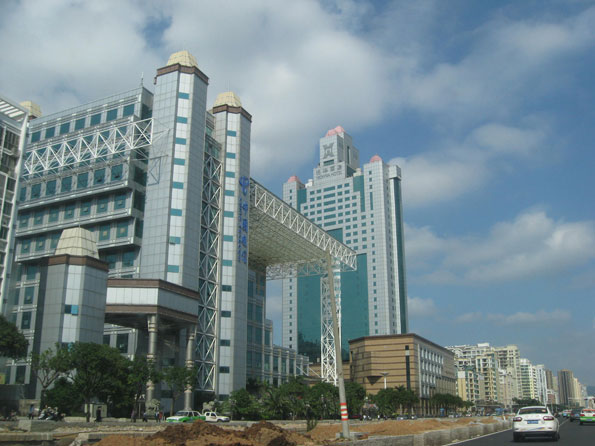
    There is another strong center in Shi Shi, which is 12 miles (20 kilometers) southeast of the historic core. Shi Shi has a large stock of medium rise buildings and has a small, though dense core (Photograph: Shi Shi core). There are also a number of large residential developments under construction in Shi Shi and major parts of the old core are under redevelopment.


    Shi Shi Core

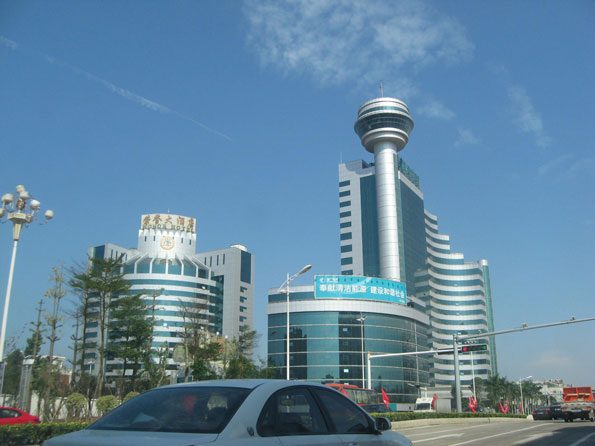
    Jin Jiang is the largest of the jurisdictions in the metropolitan area, with nearly one quarter of the population. It is located just across the Jin River from Fengze. Jin Jiang also has a commercial core (Photograph: Jin Jiang core), though it is less concentrated than the historic core and the core of Shi Shi. Jin Jiang is also home to the airport serving Quanzhou. New, large multi-building high-rise residential development are under construction in many areas of Jin Jiang.


    Jin Jiang Core

    Vanishing Old China: Quanzhou may be the best place to see remnants of China’s urbanization that preceded the rise of places like Shanghai, Beijing, Wuhan and Chengdu. All three of the largest urban jurisdictions are modern, but each has areas with the dusty roads one would expect to see in a lower income nation. At the same time, Quanzhou is on its way to becoming one of the large, prosperous urban areas of China. Already its gross domestic product and the population of its urban extent exceeds that of Fuzhou, the provincial capital. Most typical throughout urban Quanzhou are the multiple building high rise residential developments typical of all large Chinese urban areas. At the same time, there are wide expanses of demolition, where the remnants of the older buildings remain, as sites are readied for more modern projects.

    Replicability? The process of in situ urbanization requires very high rural densities that can equal or exceed the 1000 per square mile or 400 per square kilometer standard used to delineate urban areas by census authorities in Canada, France, the United Kingdom, the United States and some other nations. There would simply be too much space between villages and houses in the rural areas of places like Kansas, Saskatchewan or the Ukraine. As a result, it situ urbanization is likely to remain the rare exception. However, if the world, especially Europe, were to follow the integrative urban-rural model suggested by Thomas Sieverts at the University of Darmstadt (Cities without Cities), something like in situ urbanization would be the result.

    Lead Photo:
    Zenguo Tower at Kaiyuan Temple, Licheng district of Quanzhou (all photos by author)

    See the attached file for 100 more photos of the region.

    Wendell Cox is a Visiting Professor, Conservatoire National des Arts et Metiers, Paris and the author of “War on the Dream: How Anti-Sprawl Policy Threatens the Quality of Life