Blog

  • Canada’s Urban Areas: Descent from Affordability

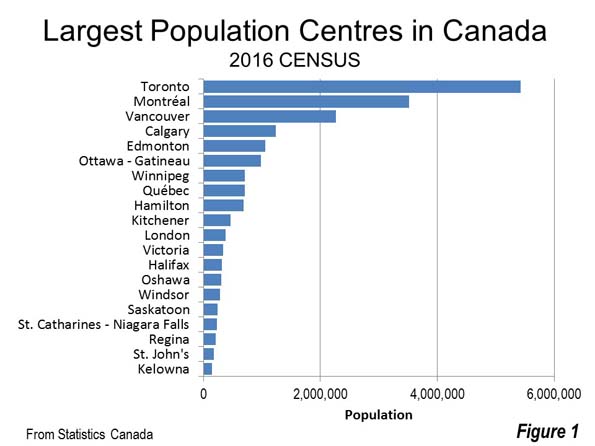
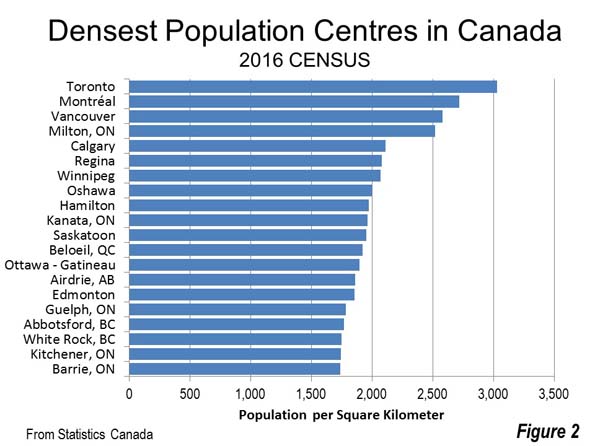
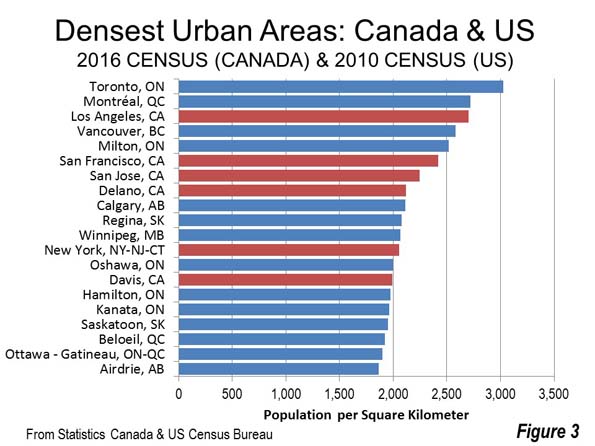
    Canada is a nation of wide open spaces, yet it has high urban area densities recently driven higher by a redefinition of urban area criteria (Note 1). Canada’s largest urban area (population centre) is Toronto, with a population of 5.4 million continues to be the densest of the 59 with more than 50,000 residents. Toronto has a population of 3,028 per square kilometer (7,843 per square mile), approximately five percent above the European Union average. Montréal (population of 3.5 million) has a density of 2,720 per square kilometer (7,045 per square mile), followed by third ranked Vancouver (2,584/6,693), which has a population of 2.2 million.  The top ten is rounded out by Milton, a fast growing Toronto exurb with a density of 2,520 per square kilometer or 6.527 per square mile, Calgary (2,112/5,470), Regina, the capital of Saskatchewan (2,082/5,391) and Winnipeg, which has seen renewed recent growth (2,070/5,360).

    Four other population centres have densities greater than 1,950 per square kilometer (5,000 per square mile , including  Oshawa and Hamilton, which are adjacent to Toronto, as well as Saskatoon, Saskatchewan and Kanata, an exurb of Ottawa (Figure 2).
    Comparisons to the United States

    The new, higher density figures are not surprising considering the especially compact suburbs in view when landing at Pearson Airport in Toronto, or even in Calgary or Edmonton. A combined Canada-US urban area density list illustrates the higher density of Canadian urban areas relative to those in the United States.  Among the five densest urban areas in Canada and the United States, four are in Canada. Los Angeles, the densest large urban area in the United States for the last three censuses, ranks third behind Toronto and Montréal. Vancouver and Milton rank fourth and fifth, just ahead of 6th ranked San Francisco. Immediately behind San Francisco is virtually all post-World War II suburban San Jose. Delano, California, an exurb of Bakersfield in the San Joaquin Valley has about 55,000 residents and ranks 8th on the combined list.

    Residents of Calgary, Regina and Winnipeg, where densification advocates repeatedly condemn their perceived local urban sprawl (a pejorative term for urban dispersion) will doubtless be surprised to know that their population density exceeds that of New York. Only one more US urban area makes the top 20, Sacramento exurb Davis, at 14th, with a population of 73,000 (Figure 3).
    Where’s Portland?

    To those inclined to venerate Portland’s internationally famous densification policies, this list may be disconcerting. Calgarians who bemoan the inferiority of their city in relation to Portland should be heartened to find out that Calgary’s density is more than 50 percent higher than Portland’s (Calgary’s transit market share is more than double Portland’s).

    Portland is not among the densest 20 urban areas , but ranks 72nd, just behind all-suburban Riverside-San Bernardino and a bit ahead of Halifax. If Portland were in Canada, it would rank 38th in population density out of the largest 59 urban areas.

    And Boston?

    Boston has a reputation as one of the densest cities in the United States. Yet, Boston’s huge urban area  is denser than only three of Canada’s urban areas on the list, Belleville, ON, North Bay, ON and Fredericton, NB. Each is smaller than Boston suburb Somerville, which has about 75,000 residents. Among the urban areas of  Canada and the US Boston is 218th in density. (Note 3).

    Urban Containment Not Density Associated with Unaffordability

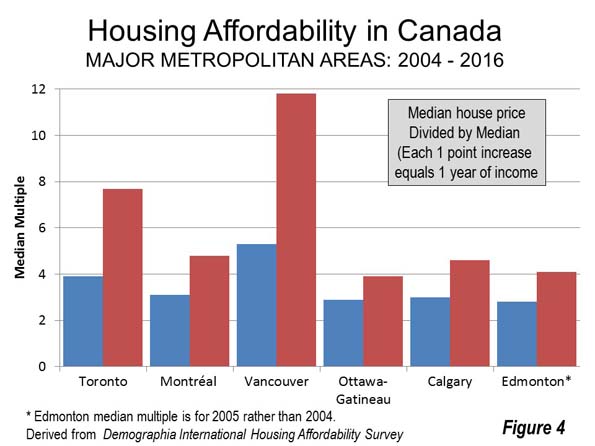
    Canada’s urban areas illustrate that density does not have to mean unaffordable housing. There has been some densification since 2000, but Canada’s urban areas were nearly as dense even then. For example, in the last 15 years, the completely developed city of Toronto, with all its new residential towers, has added only 10 percent to its population. Five of Canada’s six major metropolitan areas Toronto, Montréal, Ottawa-Gatineau, Calgary and Edmonton were affordable at the beginning of the new century, hovering around a median multiple 3.0.

    All that has changed, however, with the imposition of urban growth boundaries and equivalent policies. Ailin He and I showed in a Frontier Centre study (Canada’s Middle Income Housing Affordability Crisis) that house prices had “exploded” relative to household incomes between 2000 and 2015. This cannot be attributed to the modestly higher densities. The big change took place in land use policy, with, for example, Toronto and Calgary adopting urban containment policy that has been strongly associated with the destruction of housing affordability. Residents of Vancouver  — an urban area widely praised among planners —  have been paying the price for urban containment for much longer (Figure 4).

    Canada’s experience up to the end of the 20th century proves that dense and affordable urban areas can be achieved. But since that time, as house prices have risen relative to incomes, Canada’s experience shows that all that can be reversed in an environment of binding urban containment policy.
    Note 1: Between 2011 and 2016, Canada’s urban areas increased more than 40 percent in population density, according to Statistics Canada data. This, however, was not a miracle of urban containment policy or smart growth, it was rather an improved method adopted by Statistics Canada for measuring urbanization. Urban areas are the "physical city," which unlike the metropolitan area has only urban land. Canada now calls its urban areas "population centres," having changed to the new label in 2011, when the United Kingdom labeled them "built up urban areas."

    In 2011 and before, the Census had used municipalities as building blocks for urban areas. Often, those municipalities included large swaths of rural land (as did Los Angeles until well into the 1950s). Now, the building blocks for urban areas in Canada are "blocks", the lowest enumeration geography of the Census (the same revision was implemented by the US Census in 2000). Under the old definition, Canada’s urban areas had a density of 1,180 per square kilometer (3,057 per square mile) in 2011. Now it is 1,698 per square kilometer (4,397 per square mile), a 44 percent increase.

    Note 2: The comparisons are between the 2016 Census of Canada data and the 2010 US Census data, since urban area (population centre) data is only developed in the censuses (the next US census will be in 2020). The list is developed from the 59 urban areas in Canada and the 499 in the United States with 50,000-plus residents in the last censuses.

    Note 3:  A recent article found Boston to be almost five times as dense as Houston. However, this was in municipal (inside the city limits) density. City limits are artificial, political constructs that have nothing to with the organic city (the physical city , also called urban area or the economic city, or the metropolitan area , which is the labor market).  The Houston urban area, with its reputation for "sprawl" is actually one-third denser (1150/2979 ) than Boston’s (856 /2,278). At the physical city level, the urban area is the best indication of urban density. Using metropolitan density as an indicator of urban density is nonsensical, since all metropolitan areas include substantial rural territory.

    Wendell Cox is principal of Demographia, an international public policy and demographics firm. He is a Senior Fellow of the Center for Opportunity Urbanism (US), Senior Fellow for Housing Affordability and Municipal Policy for the Frontier Centre for Public Policy (Canada), and a member of the Board of Advisors of the Center for Demographics and Policy at Chapman University (California). He is co-author of the “Demographia International Housing Affordability Survey” and author of “Demographia World Urban Areas” and “War on the Dream: How Anti-Sprawl Policy Threatens the Quality of Life.” He was appointed to three terms on the Los Angeles County Transportation Commission, where he served with the leading city and county leadership as the only non-elected member. He served as a visiting professor at the Conservatoire National des Arts et Metiers, a national university in Paris.

    Photo: Suburban density in Toronto (Markham) by IDuke – English Wikipedia, CC BY-SA 2.5

  • Is Climate Change Really the Cause of Mexico City’s Water Problems?

    A couple weeks ago the New York Times ran a gigantic front-page Sunday article by architecture critic Michael Kimmelman on Mexico City’s water crisis.

    This piece was billed as the first installment in a series on the effect of climate change on cities. Which is a head-scratcher, since Mexico City’s problems don’t seem to have anything to do with that.

    Mexico City is a megacity of 21.2 million people, making it roughly the size of greater New York. It’s also a mile and a half above sea level on a former lake bed in a valley among the surrounding mountains. So it’s at a significantly higher elevation than even Denver.

    This creates huge problems. A gigantic city has huge water needs. At high elevation, using a gravity feed for water is complicated to say the least. This necessitates costly pumping to delivery water from remote sources. The city is surrounded by mountains making even drainage complex. Much of the city’s water supply has come from its own ground water, and the city is sinking from the subsidence as a result of pumping.

    And of course Mexico and its capital are in the developing world, and so do not have the wealth to construct and maintain New York City style infrastructure.

    All of this is basically covered in the Kimmelman piece, which is good in many ways. But it’s not clear where climate change comes in. All of these problems would exist apart from any climate change. At best, he simply argues that climate change will make things worse, though without citing any real specifics. He only says:

    “It is a cycle made worse by climate change. More heat and drought mean more evaporation and yet more demand for water, adding pressure to tap distant reservoirs at staggering costs or further drain underground aquifers and hasten the city’s collapse.”

    Why in the world would the Times want to make this into a climate change story? It’s manifestly obvious from the article itself that the core water problems in Mexico City have nothing to do with climate change, but come from geography, size, and bad decision making.

    Trying to make it a climate change story only draws attention away from the need to make local changes to address the water situation. It also won’t convince anybody of anything. People who already believe in climate change don’t need any convincing. Those who don’t are never going to be convinced by this article. What’s the point?

    It seems to me that too many urbanist writers today simply can’t resist trying to make every single thing some manifestation of climate change. In that regard, they simply link more and more policy areas to something which is politically gridlocked in the United States. So what people do when they make things about climate change is to implicitly state that they don’t actually want to do anything about it.

    Many changes are eminently justifiable on their own merits. Bringing in climate changes only poisons the waters politically. And it’s a cop out. If you can’t make the case for, say, transit, without resorting to climate change, then your case is simply weak.

    When it comes to things like Mexico City’s water, where there’s a real problem and some action should be taken, better to avoid talking about climate change if you actually want to get anything done.

    Aaron M. Renn is a senior fellow at the Manhattan Institute, a contributing editor of City Journal, and an economic development columnist for Governing magazine. He focuses on ways to help America’s cities thrive in an ever more complex, competitive, globalized, and diverse twenty-first century. During Renn’s 15-year career in management and technology consulting, he was a partner at Accenture and held several technology strategy roles and directed multimillion-dollar global technology implementations. He has contributed to The Guardian, Forbes.com, and numerous other publications. Renn holds a B.S. from Indiana University, where he coauthored an early social-networking platform in 1991.

    Photo: Fidel Gonzalez [CC BY-SA 3.0 or GFDL], via Wikimedia Commons

  • Detroit’s Recovery? Oh Yeah, It’s Real Alright

    So it seems the debate has begun.  There’s been enough progress in Detroit to discuss whether its rebound is for real, or not.

    Two academics, Laura Reese of Michigan State University and Gary Sands of Wayne State University, wrote a piece for the Atlantic a couple weeks ago to counter the spreading narrative of Detroit’s comeback.  The article notes the Motor City’s rebound has caught the attention of the national media and parts of academia, but they aren’t so certain that the trend is real, or if it is, whether it’s indeed sustainable.  From the article:

    “These rosy descriptions were not consistent with the reality of what we continued to see in many Detroit neighborhoods. To provide perspective on Detroit’s comeback story, we examined trends in a variety of indicators including population, poverty, income disparities, business recovery, unemployment, residential sales prices and vacancies, and crime.

    Two major conclusions emerged from our data. First, by a number of measures Detroit continues to decline, and even when positive change has occurred, growth has been much less robust than many narratives would suggest. Second, within the city recovery has been highly uneven, resulting in increasing inequality.”

    In response to this article, blogger Lyman Stone added his take on Detroit’s recovery.  He seems to agree with Reese and Sands that, whatever is happening in Detroit, it’s not touching growing numbers of city residents, and therefore it’s not exactly a comeback:

    “I tend to be on team “Abandon all hope ye who enter here.” Saving Detroit is likely to be extremely costly while still holding a high risk of failure, in my opinion. But this view is predicated on a certain perspective of what it means to succeed. To some, success means population decline stops. To some, success means fewer empty buildings. To some, success means balanced municipal finances. To some, success means increasing employment. To me, I tend to think success means that huge population outflows will stop, and that population will begin to rise. Others may espouse other views, but I tend to think a locality’s ability to provide prosperity only matters in a general equilibrium framework, so a place that makes locals rich by culling the herd of non-rich locals is not “succeeding.” Success means that you offer prosperity to a rising share of the general population.”

    However, Stone notes that there are some positive demographic trends that are evident in Detroit, and seems to make the case that if Detroit is to get out of its hole, it’s at least stopping digging.

    The City Observatory’s Joe Cortright took a positive spin on Detroit in the Atlantic, going against the grain of both pieces and suggesting that Detroit’s comeback shouldn’t be dismissed:

    “Is Detroit “back?” As best I can tell, no one’s making that argument. The likelihood that the city will restore the industrial heyday of the U.S. auto industry, replete with a profitable oligopoly and powerful unions that negotiate high wages for modestly skilled work, just isn’t in the cards…

    That said, there’s clear evidence that Detroit has stanched the economic hemorrhage. After a decade of year-over-year job losses, Wayne County has chalked up five consecutive years of year-over-year job growth. True, the county is still down more than 150,000 jobs from its peak, but it has gained back 50,000 jobs in the past five years.”

    Honestly, I think each of the pieces — indeed, most people — underestimate the depths of Detroit’s collapse, and therefore underestimate the significance of its current recovery.  Detroit’s collapse was not simply an economic one, but a cultural, social and demographic one as well.  It lost virtually all connections with the networks of wealth and information that drive economic growth, and the city had such a pervasive negative perception that it was effectively erased from the minds of many.  What’s happening now is Detroit is reconnecting itself to the national and international network of cities, slowly returning to life among the living.  This is a necessary step for Detroit before any rebound that improves the lives of the majority its residents. 

    I view things this way.  While Detroit suffered immensely from the restructuring and decline of the auto industry, it likely suffered even more from demographic collapse.  Four years ago, I wrote a piece that showed the strength of the city’s demographic vacuum.  It’s not just that the city lost jobs and people moved.  People soured on Detroit in ways no other major city experienced, and left behind a city of concentrated poverty. I’ve often brought this graphic out, and it still amazes me:


    To his credit, Joe Cortright gets this in his article.  Where Reese and Sands argue that Detroit’s economic boost in the downtown and Midtown areas and some select nearby neighborhoods is raising income inequality, Cortright responds with a comment from the Brooking Institution’s Alan Berube: “Detroit does not have an income inequality problem—it has a poverty problem. It’s hard to imagine that the city will do better over time without more high-income individuals.”

    And that’s indeed the critical first step for Detroit.  It has to once again attract a critical mass of middle income and upper income residents who are ready, willing and able to invest in the city, before it can effectively take on its greater economic challenges. The post Great Recession recovery we’re witnessing now means the city is getting closer to being able to take on greater tasks.

    Pete Saunders is a Detroit native who has worked as a public and private sector urban planner in the Chicago area for more than twenty years.  He is also the author of “The Corner Side Yard,” an urban planning blog that focuses on the redevelopment and revitalization of Rust Belt cities.

    Top photo source tomabouttown.wordpress.com

  • A New Age of Progressive Suburbanism?

    We are living in a global suburban age… While statistics demonstrate that the amount of the world population in metropolitan areas is rapidly increasing, rarely is it understood that the bulk of this growth occurs in the suburbanized peripheries of cities. Domestically, over 69% of all U.S. residents live in suburban areas; internationally, many other developed countries are predominately suburban, while many developing countries are rapidly suburbanizing as well.”

    That’s not some anti-urban crackpot statement (as some inner urban elites might think) but from the introduction to a biennial theme of the MIT Center for Advanced Urbanism (USA). They understand that suburban and regional centres are not irrelevant for the future economy but highly important.  MIT are a pretty credible lot – hardly likely to pursue fringe urban planning or economic theories.

    In Australia, however, that message is not getting through. From the Prime Minister, down, there is a sense of irrational exuberance that the jobs of the future will mostly be concentrated in our CBDs and inner cities. Urban planning which supports increased concentration of employment through generous infrastructure allocations to inner urban areas is the manifestation of this inner urban obsession.  And while CBDs and inner urban areas are lavished with costly projects designed mainly to benefit the minority of people who work there, suburban and regional centres – where the majority live, work and play – have been largely left to fend for themselves.

    This process started in the late 1990s and early 2000s, notions about the “creative class” — many of which are being re-examined by author Richard Florida in a new book —   was a cause celebre amongst planning and government circles. It was widely argued that to attract the creative class of worker (synonymous with high skills and the new economy) cities needed to invest heavily in the quality of life in their downtowns. This was a precursor to the inner urban hipster, and, when real estate prices, rose their successors, the rise of the inner-city latte set.

    This thinking fit in well with two other trendy theories, New Urbanism and ‘Smart Growth’ (which redefined suburban progress as urban sprawl). The collective wisdom moved from supporting a growing suburban realm to one that disparaged it: the burbs were for bogans, the home of sprawl, “McMansions” full of low wage earning, culturally deficient and poorly educated masses, eating fast food diets and slurping sugar drinks. Inner cities by contrast were for educated, cultured and knowledgeable people – who had little need for suburban spaces or suburban habits but greater need for inner city waterfront cycle ways, museums, theatres and quality restaurants run by notable chefs. And, of course, lots of baristas. 

    Urban planning shifted quickly to a highly-regulated approach which promoted much higher densities of inner urban housing (and limits on outward expansion) because, after all, the inner city is where everyone in the future will want to live, right? The promises of these regional planning policies bordered on messianic. Take this example from the “Draft Metropolitan Strategy for Sydney to 2031” from the early 2000s:

    “A home I can afford. Great transport connections. More jobs closer to where I live. Shorter commutes. The right type of home for my family. A park for the kids. Local schools, shops and hospitals. Liveable neighbourhoods.”

    And what have we got thus? Some of the worst housing affordability in the world. Worsening congestion. Longer commutes. Limited housing choice, much of it not ideal for raising families.

    The ongoing policy focus and infrastructure obsession with centralisation is utterly at odds with economic and community signals. New economy industries in technical, scientific or professional services, or health and social care, have little interest in centralisation. Digital technology has broken that tyranny of distance. Undeterred though, we continue to watch as political and industry leaders promote costly infrastructure projects that enhance and support further centralised employment and a concentration of amenity in inner urban cores enjoyed by a privileged, mostly childless minority.

    For the record, the proportion of metropolitan wide jobs in the inner cities of Melbourne, Sydney and Brisbane was 11%, 13% and 12% respectively at the last census.  The reality remains that in our metropolitan centres, most people both live and work outside inner city bubbles of privilege. 

    The penny is finally dropping in some minds. Former Victorian Planning Minister, Matthew Guy (now Opposition Leader) once extolled the virtues of high density inner urban development. Looks like he has had a Damascus moment, commenting in The Australian (March 1, 2017) that: “Victoria is becoming a great, heaving, unsustainable mess. The whole of Victoria is just becoming an offshoot of Melbourne.”

    The emphasis on centralisation of jobs, housing and supportive infrastructure makes little sense in a country with such large land masses and capacity for expansion. Not only that, but the economic winds – enabled by rapid expansion of disruptive technology – are blowing the other way. Suburban and regional centres, long disparaged by the cognoscenti should instead be looked on as part of the solution to economic expansion and development. Where once we promoted urban renewal, we now need to turn our minds to suburban and regional renewal. We need to identify the critical infrastructure constraints of suburban and regional business centres and remedy them to encourage accelerated development of employment opportunities across the board.

    In a bid to put some balance into the discussions about urban development and growth, a Suburban Alliance (www.suburbanalliance.com.au) has been formed in Australia – with the intention of supporting research projects into the nature and needs of the suburban economy, and to use these as a platform for well-informed policy advocacy. Wish us luck. The initial focus starts in Brisbane but if the idea finds support, we’d like to see this expand to cover all major urban and regional centres. 

    The more supporters we can muster the sooner this absurd preoccupation with all things inner city can begin to be balanced with a better understanding of the important role played by suburban and regional business centres and why these are part of the solution to enhanced economic opportunity.

    Ross Elliott has more than twenty years experience in property and public policy. His past roles have included stints in urban economics, national and state roles with the Property Council, and in destination marketing. He has written extensively on a range of public policy issues centering around urban issues, and continues to maintain his recreational interest in public policy through ongoing contributions such as this or via his monthly blog, The Pulse.

    Photo: Photograph by Gnangarra [CC BY 2.5 au], via Wikimedia Commons

  • How the Democrats can Rebuild

    Numerous commentaries from both the political left and right have expounded the parlous state of the Democratic Party. And, to be sure, the Democrats have been working on extinguishing themselves in vast parts of the country, and have even managed to make themselves less popular than the Republicans in recent polls.

    Yet, in the longer term, the demographic prospects of a Democratic resurgence remain excellent. Virtually all of the growing parts of the electorate — millennials, Latinos, Asians, single women — are tilting to the left. It is likely just a matter of time, particularly as more conservative whites from the silent and boomer generations begin to die off.

    But, in politics, like life, time can make a decisive difference. It’s been almost a decade since the Atlantic proclaimed the end of “white America,” but Anglos will continue to dominate the electorate for at least the next few electoral cycles, and they have been trending to the right. In 1992, white voters split evenly between the parties, but last year went 54 percent to 39 percent for the GOP.

    Identity politics vs. social democracy

    To win consistently in the near term, and compete in red states, Democrats need to adjust the cultural and racial agenda dominating the “resistance” to one that addresses directly the challenges faced by working- and middle-class families of all races. This notion of identity politics, as opposed to those of social class, is embraced by the progressives’ allies in the media, academia, urban speculators, Hollywood and Silicon Valley, since environmentalism, gender and race issues do not directly threaten their wealth or privileged status.

    The rise of identity politics, born in the 1960s, has weakened the party’s appeal to the broader population, as Columbia University humanities professor Mark Lilla argued in a November New York Times column. But most progressives, like pundit Matthew Yglesias, suggest that “there is no other way to do politics.” To even suggest abandoning identity politics, one progressive academic suggested, is an expression of “white supremacy,” and she compared the impeccably progressive Lilla with KKK leader David Duke.

    This hurts the Democrats as they seek to counter President Donald Trump. Americans may not be enthusiastic about mass deportations, but the Democratic embrace of open borders and sanctuary cities also is not popular — not even in California. And while most Americans might embrace choice as a basic principle, many, even millennials, are queasy about late-term abortions.

    Democrats also need to distance themselves from the anti-police rhetoric of Black Lives Matter. Among millennials, law enforcement and the military are the most trusted of all public institutions. Rabid racial politics among Democrats, notes Lee Trepanier, political science professor at Saginaw Valley State University in Michigan and editor of the VoegelinView website, is steadily turning white voters into something of a conscious racial “tribe.”

    Finally, Democrats have now embraced a form of climate change orthodoxy that, if implemented, all but guarantees that America will not have a strong, broad-based economic expansion. The economic pillars of today’s Democratic Party may thrive in a globalist, open-border society, but not many in the more decidedly blue-collar industrial, agricultural or homebuilding industries.

    This piece first appeared in The Orange County Register.

    Joel Kotkin is executive editor of NewGeography.com. He is the Roger Hobbs Distinguished Fellow in Urban Studies at Chapman University and executive director of the Houston-based Center for Opportunity Urbanism. His newest book, The Human City: Urbanism for the rest of us, was published in April by Agate. He is also author of The New Class ConflictThe City: A Global History, and The Next Hundred Million: America in 2050. He lives in Orange County, CA.

    Photo: Gage Skidmore

  • Chicago’s Crime Wave Understood: Complex Problem, Simple Formula

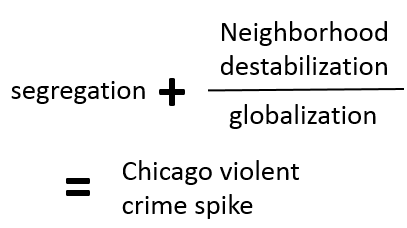
    Chicago’s violent crime problem can be understood through this formula:

    It’s a simplistic, reductionist, even crude, but it explains the roots of Chicago’s crisis as well as anything.

    It has been particularly grueling time in Chicago this recently.  We experienced the murders of at least ten Chicagoans, including two girls, age 12 and 11, shot within 30 minutes of each other in different locations, and a 2-year-old boy.  Once again, Chicago is thrust into the spotlight as President Donald Trump spoke of “two Chicagos” and renewed his pledge to send some kind of federal assistance to deal with the violence (note: you may have seen me refer to “two Chicagos” before, but I’m definitely uneasy with our current President making even starker distinctions between them).  And with each new story of violence, of television and newspaper reporters being sent out to document another life lost, of an expression of heartbreak from a grieving parent, we ask ourselves, “how did it get this way?  How do we solve it?”

    In many respects the violent crime wave is a reaction to the same trends that got our president elected, but coming from even deeper and longer lasting strains of dislocation and disenfranchisement.  It’s also a set of unintended consequences related to very specific policies undertaken by the city itself.  While Chicago’s experience is rather unique among American cities, other cities that exhibit similar traits are seeing the same spike as well.  In each case, the spike is decades in the making.

    Segregation

    It starts with segregation.  Chicago’s leaders during the early years of the twentieth century were the innovators of a segregation system that plagues the city to this day.  Natalie Moore, South Side bureau reporter for Chicago public radio station WBEZ and author of The South Side: A Portrait of Chicago and American Segregation, noted the pervasiveness of segregation in Chicago in this interview with the Chicago Tribune:

    “People know that segregation exists, but they don’t always think about it,” said Moore, WBEZ’s South Side Bureau reporter and the author of “The South Side: A Portrait of Chicago and American Segregation.” “It’s like air and water: You just kind of live it, but you don’t think about it.”

    And how was it established?  Tribune reporter Jeremy Mikula and Moore go on:

    “The institutional racism Moore charts in the book goes back generations and has its roots after the start of the Great Migration. Restrictive covenants prevented African-Americans from moving outside the city’s historic Black Belt until U.S. Supreme Court cases such as Hansberry v. Lee (1940) and Shelley v. Kraemer (1948) eliminated such restrictions in housing.

    Through that time, Moore writes, “the city designed a way for blacks to not fully participate in the freedoms of the North,” and later formulated subtle policy decisions that can still be felt today, she said.

    “All the things from redlining to the Home Owners’ Loan Corporation to blockbusting to white flight, there are so many things that happened in the 20th century that have lingering effects,” Moore said. “It’s never been about white people want to live there and black people want to live there. This is where the history is really important for us to understand.”

    Emphasis added. 

    Tools were developed and employed to create a segregated Chicago — restrictive covenants, redlining, exclusionary zoning, urban renewal, interstate highway development, public housing development, aggressive policing tactics and a judicial system that exploits inequality — and those tools are foundational to our understanding of the way the city operates today. 

    Chicago is not alone in its history of segregation, nor is it alone in its current spike in violent crime.  In fact, it may not even be the worst.  In late 2016, USA Today reported on the nation’s most violent cities, based on 2015 FBI violent crime data.  Chicago was not among the top ten.  The list was headed by St. Louis, followed by Detroit, Birmingham, Memphis, Milwaukee, Rockford, IL, Baltimore, Little Rock, AR, Oakland and Kansas City.  What’s dispiriting is the number of violent cities that are also among the most segregated.  St. Louis, Detroit, Birmingham, Memphis, Milwaukee and Kansas City are on most lists of highly segregated cities, as well as Chicago, Indianapolis, Cleveland, Cincinnati and Philadelphia.  Nearly all have seen violent crime increases.

    Neighborhood Destabilization

    So Chicago became a highly segregated city, with large numbers of blacks cut off from the economic and social networks necessary for upward mobility.  Old segregated spaces increasingly became impoverished spaces, as former white neighborhoods became new segregated spaces.  Concentrated poverty became super-concentrated with the development of the public housing in Chicago, and by the ’80s and ’90s Chicago was notorious for two features of its segregated system: 1) a gigantic collection of gangs operating as organized criminal enterprises; and 2) a depraved and dysfunctional public housing system, which also served as a base for gang activity.  To many, the dysfunction of Chicago’s public housing was crystallized in the story of the murder of Eric Morse, a 5-year-old taken to a vacant 14th floor Ida B. Wells public housing complex apartment by two preteens, and dropped to his death because he would not steal candy for them.  The city, and the nation, was outraged.

    It’s at this point that Chicago made a significant departure from other cities and pursued three policy choices that impacted the stability of its neighborhoods.  First, it made a concerted effort to lock up the leadership of the gang hierarchy, intent on “cutting off the head” of the gangs.  Second, the city recognized the failure of its public housing system, and elected to dismantle its most troublesome projects through its Plan for Transformation.  Third, in a cost-saving measure, the city closed nearly 50 public schools, with nearly all being in the highly segregated south and west sides.

    Each played a role in undermining the stability of Chicago’s south and west side neighborhoods, sending them into the violent crime spiral we see today.

    In the mid-’90s, Chicago police worked with the U.S. Attorney’s office to establish Operation Headache.  At the time the Chicago drug trade was largely controlled by gangs that were more akin to organized crime syndicates than gangs in the conventional sense.  The Gangster Disciples, the Black Disciples, the Vice Lords and the Latin Kings covered large parts of the city and developed distribution networks and open-air drug sales areas, and law enforcement found the problem nearly intractable.  Operation Headache represented a shift in tactics designed to bring them down.  Rather than focus on lower-level drug dealing youth who cycled in and out of the criminal system, they chose to go after gang leaders in an effort to destabilize them, and it was successful:

    “The first wave of convictions stemming from Operation Headache came in March 1996. But the biggest, most symbolically meaningful blow to the Gangster Disciples was delivered in May 1997, when Hoover was convicted of 42 counts of conspiracy to distribute drugs, received a sentence of six life terms, and was transferred to a supermax prison in Colorado, where his cell was located several stories underground and his ability to communicate with the remnants of his gang were severely constrained. Soon, the GDs in Chicago had been all but neutralized, and the authorities shifted their attention to decapitating the city’s other major drug organizations, the Black Disciples and the Vice Lords.

    Over the course of a roughly 10-year stretch starting in the mid-1990s, leaders from the GDs, the Vice Lords, the Black Disciples, and to a lesser extent, the Latin Kings were successfully prosecuted and taken off the street. The top-down assault appeared to work as Safer and his colleagues had hoped: violent crime in Chicago began to decline, with the city’s murder total dropping from a high of 934 in 1993 to 599 10 years later.”

    Beginning in 2000, the Chicago Housing Authority moved out public housing residents from developments that looked like this:

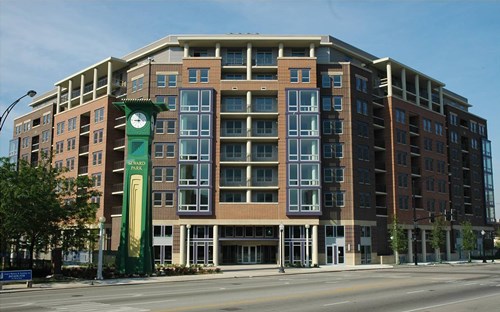
    and demolished them.  The goal was to replace them with less concentrated developments that would be integrated with their surrounding communities that looked more like this:

    or like this:

    The critical difference would be, however, that the CHA would now pursue a mixed-income approach to public housing development to address the city’s segregation problems and poverty concentration.  To do that, a third of residential units in new developments would be reserved for public housing residents, another third would be developed as affordable units for working-class and middle-class residents, and the last third would be sold or rented as market-rate properties. 

    Just as Operation Headache was successful in its early stages, so was the Plan for Transformation.  CHA worked closely with the U.S. Department of Housing and Urban Development to tear down the old public housing towers, and completed developments that did indeed appear more integrated into the surrounding neighborhood and fulfilled the mixed-income character that people desired.  By the mid-2000s both policies looked to be successful elements in the remaking of Chicago.

    But there were unintended consequences that law enforcement and housing officials did not see.  Violent crime in Chicago dropped to historic lows by 2005, leveled off for a few years, and started trending upward.  One reason cited?  Law enforcement became a victim of its success:

    “While experts say the Latin Kings, a Hispanic gang, continue to run a large and rigidly organized drug-selling operation on Chicago’s West Side, the majority of Chicago residents who call themselves gang members are members of a different type of group. Rather than sophisticated drug-selling organizations, most of the city’s gangs are smaller, younger, less formally structured cliques that typically lay claim to no more than the city block or two where they live. The violence stems not from rivalries between competing enterprises so much as feuds that flare up with acts of disrespect and become entrenched in a cycle of murderous retaliation.

    Many close observers of Chicago’s violence believe that, as well-intentioned as it was, the systematic dismantling of gangs like the Disciples led directly to the violence that is devastating the city’s most dangerous neighborhoods in 2016. Taking out the individuals who ran the city’s drug trade, the theory goes, caused a fracturing of the city’s criminal underworld and produced a vast constellation of new entities that are no less violent, and possibly even more menacing, than their vanquished predecessors.”

    Meanwhile, CHA was successful in the dismantling of old projects, but had limited success in the development of new ones, especially when trying to implement the mixed-income model.  In 1999, CHA committed to finding replacement housing for all public housing residents who would be displaced by the demolition, counting on their ability to construct mixed-income developments.  However, they soon ran into several challenges.  Private developers were finding it difficult to obtain financing for mixed-income developments, despite federal, state and local commitments.  But more importantly, market-rate buyers and renters, and even buyers and renters in the affordable range, showed little desire to share space with public housing residents. 

    This curtailed CHA’s ability to construct new developments, and forced them to rely much more heavily on Housing Choice Vouchers (HCVs, commonly referred to as Section 8 vouchers) to provide housing for former public housing residents.   An April 2011 report by CHA found that of the 16,500 public housing family households they committed to developing mixed-income units for, only 20% were actually in such developments.  There were 36% living in CHA projects that weren’t demolished, and 44% received HCVs and were living wherever their voucher would take them.

    Where did voucher holders go?  Generally to working-class black neighborhoods further south or west of former public housing sites on the south and west sides.  Many Robert Taylor and Stateway residents left Bronzeville and moved to the Englewood and Auburn-Gresham neighborhoods further south; many Horner and Rockwell residents left the near west side and Garfield Park and moved to Austin, further west. 

    The last straw was the closure of schools by the Chicago Public Schools in 2013.  By the mid-2000s, for anyone who cared to note it, there was growing evidence of conflict within the city’s public schools as children new to various neighborhoods competed with children of long-time residents.  At the same time the school system continued down its own budget spiral as the service delivery costs went upward and pension obligations went unmet.  That forced consideration of closures by CPS, much to the dismay of community residents familiar with the disruption caused by gang disorganization and an influx of poor residents.  Not only would the education of students be compromised by the closings, they argued, but the conflicts seen as voucher-holding residents moved into their communities would arise again.  New school boundaries would put combustible mixes of vulnerable children in new and dangerous environments.

    Globalization

    The election of Donald Trump as president has brought sharp focus to the polarization of our nation by economics, class and geography.  Well-educated and high-skilled workers are succeeding in today’s economy; less-educated and lower-skilled workers are failing.  A lot of people view this within the context of our nation’s white working class in small cities and rural areas, but the same applies to blacks in cities like Chicago as well.

    I’m going to plagiarize myself and pull some things about Chicago I wrote last year, when I saw six distinct categories of neighborhoods in the city.  Here’s the map:

    Gentrified Communities (dark green): Former middle and working-class neighborhoods that have firmly become well-to-do neighborhoods over the last 30 years or so. Home to a substantial amount of Chicago’s walkable urbanism inventory. Transit supported and amenity rich.

    Gentrifying Communities (light green): Historically similar to the adjacent gentrified communities, but part of a second or third wave of growth that emanated from the first group. Almost as affluent and educated as the first group, and quickly catching up, but not quite there yet.

    Frontline Communities (yellow): Largely working-class neighborhoods that may be experiencing development pressure generated in the gentrified/gentrifying communities. People in the above two areas may identify with communities here as places for authentic ethnic dining or shopping. Less wealthy and with more minorities than the gentrified/gentrifying communities, but less than those on its outer flank. In Chicago, at least, fear of the prospects of gentrification here may exceed reality.

    Stable Prosperous Communities (gold): Middle-class neighborhoods that sprouted in the city at the advent of the suburban era and have changed little since. Single-family home oriented and auto-oriented. In Chicago, home to many city workers who must remain in the city due to residency requirements. Rapidly growing older in its makeup.

    Transitioning Communities (orange): Structurally similar to the stable prosperous communities, but more deeply impacted by one or two transitions. Some are receiving a large influx of new minority residents, largely Latino. Others are experiencing a huge outflow of middle-class families, largely African-American. Those experiencing the Latino influx are becoming younger and less affluent; those experiencing the African-American outmigration are being hollowed out, leaving behind large numbers of older and younger less affluent residents.

    Isolated Communities (brown): Impoverished areas of the city. Middle-class white residents left here in the ’50s and ’60s, replaced by middle-class and working-class blacks who bore the brunt of job loss in the subsequent decades. Plenty of walkable urbanism exists here, but demolition means it’s fading away.

    Here are a few data pieces I gathered for each of the categories I identified (you can click to see bigger):

    Looking at the map, the green and light green neighborhoods have been Chicago’s winners in today’s global economy.  The gold neighborhoods have been doing reasonably well.  Depending on your perspective, the yellow neighborhoods are threatened with gentrification encroachment, or have a reasonable expectation of upcoming revitalization.  The orange and brown neighborhoods?  They’re not doing so well.  They’re the ones largely impacted by Chicago’s century-old segregation legacy, or in various stages of instability via the actions undertaken over the last 25 years. 

    Chicago’s rigid segregation patterns set the stage economic divergence before globalization did, but globalization made it worse.  And in the aftermath of the Great Recession, when globally connected communities returned to their upward trajectory, troubled communities sunk further into the abyss.

    Chicago’s violent crime spike will not be solved with National Guard troops patrolling the streets.  It will not be solved with greater emphasis on gun control laws.  It will not be solved by a wholesale reform of the Chicago Police Department, which has just come out of a year-long investigation by the U.S. Department of Justice that excoriated its “excessive force, lax discipline and bad training.”  All of these measures would have some incremental impact on violent crime.  Crime would go down, if only temporarily.  However, these measures treat the symptom.  None would do anything to address root causes and eliminate the problem for good.

    There is an answer to Chicago’s madness.  It would not solve the problem overnight, but it would have the potential to solve it for the long term.  I’ll outline it in my next blog post later this week.

    Pete Saunders is a Detroit native who has worked as a public and private sector urban planner in the Chicago area for more than twenty years.  He is also the author of “The Corner Side Yard,” an urban planning blog that focuses on the redevelopment and revitalization of Rust Belt cities.

    Top photo: A body is removed from the scene after a man was shot and killed in the 3000 block of West 53rd Place in Chicago. — Anthony Souffle, Chicago Tribune, April 13, 2014

  • The Economics of Dependency

    This article first appeared at Foreign Affairs.

    How countries hit the demographic sweet spot.

    Demographics are among the most important influences on a country’s overall economic performance, but compared with other contributors, such as the quality of governance or institutions, their impact is underappreciated.

    Demographic factors, such as the age structure of a population, can determine whether a given economy will grow or stagnate to an even greater extent than can more obvious causes such as government policy. One of the most consequential aspects of demographics as they relate to the economy is a phenomenon known as the “demographic dividend,” which refers to the boost to economic growth that occurs when a decline in total fertility, and subsequent entry of women into the work force, increases the number of workers (and thus decreases the number of dependents) relative to the total population. The demographic dividend has contributed to some of the greatest success stories of the twentieth century, and countries’ ability to understand and capture this dividend will continue to shape their economic prospects well into the future. Continue reading at Foreign Affairs >>>

    Sami Karam is the founder and editor of populyst.net and the creator of the populyst index™. populyst is about innovation, demography and society. Before populyst, he was the founder and manager of the Seven Global funds and a fund manager at leading asset managers in Boston and New York. In addition to a finance MBA from the Wharton School, he holds a Master’s in Civil Engineering from Cornell and a Bachelor of Architecture from UT Austin.

    Photo: infradept

  • Los Angeles Traffic: Likely To Worsen with Higher Densities

    A few recent days driving the Los Angeles freeways impressed me with how different they are from in most other places in the country. The intensity of the traffic is astounding. Even on the weekend, travel over Sepulveda Pass on the San Diego Freeway (I-405) was highly congested. Traffic really never stopped, but frustratingly inched along for parts of the way and approached 60 miles per hour on other parts. A Saturday trip I feared might take an hour and a half was completed from Simi Valley in less than 60 minutes. Caltrans and the local officials do an admirable job of keeping the traffic moving, which was obvious from the only slight delay near Sherman Way caused by an incident that required a fire truck.

    Traffic Per Lane Mile

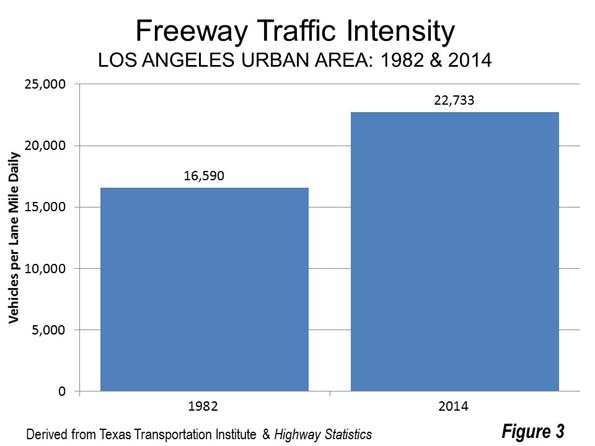
    The latest Federal Highway Administration data indicates that nearly 23,000 cars are handled by each freeway lane on the average day. Among the larger urban areas, only San Jose and close-by Riverside-San Bernardino have a volume of more than 20,000 daily.

    The freeway lane volume in Los Angeles is up from 16,500 cars per lane mile in the early 1980s,  a more 37 percent increase in traffic (Figure 1). This is not surprising, because the urban area, which stretches from the San Fernando Valley to Pomona and Orange County to San Clemente has added almost the same percentage of residents. The city of Los Angeles itself, which covers virtually the same area as it did more than three decades ago has become significantly more dense, also adding about one third to its population.

    At the same time, public policy in California is calling for significant urban densification that will put an even greater strain on the roadway network. Any assumption that a more dense Los Angeles will be anything less than an even more horrific traffic environment is simply folly.

    Billions Spent on Rail: Yet Traffic is Much Worse

    Some, including me while I was on the Los Angeles County Transportation Commission, believe (or in my case “believed”) that an expansion of transit — especially adding urban rail service, would relieve traffic congestion. Los Angeles has now had nearly three decades of experience with that strategy. Yet, traffic has only become more intense.

    Indeed, despite the addition of a substantial urban rail system in Los Angeles County has been accompanied by a general decline in transit ridership on the Metropolitan Transportation Authority services compared to predecessor services operated by the Southern California Rapid Transit District in 1985. In 2016, ridership was even lower than the year before, despite the extensions of rail service to Santa Monica on the Expo Line and to Azusa on the Gold Line.

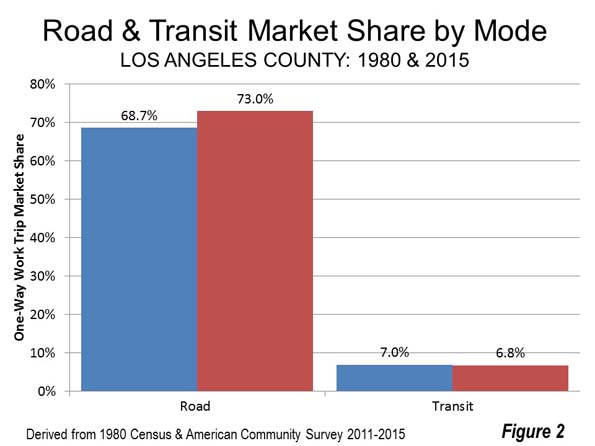
    Even work trip ridership, which transit serves best, is down. In 1980, transit’s market share was 7.0 percent in Los Angeles County. By 2015, transit’s market share had fallen slightly to 6.8 percent. Meanwhile, driving alone expanded significantly from 68.7 percent in 1980 to 73.0 percent in 2015. Working at home increased from 1.5 percent in 1980 to 5.1 percent in 2015 (Figure 2).

    Why Rail has Not Attracted Drivers

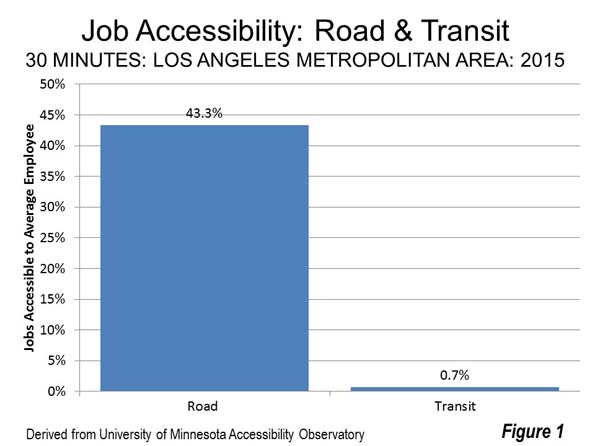
    There are two principal reasons the transit has not been able to attract drivers out of their cars and reduce freeway volumes. The first is that, for the most part, you cannot get from here to there on transit. That is, most jobs and places people are traveling cannot be conveniently accessed by transit. The University of Minnesota Accessibility Laboratory has found that 43.3 percent of jobs in the Los Angeles metropolitan area can be reached by car within 30 minutes. By contrast. Only 0.7 percent of jobs can be reached by transit within 30 minutes. In other words, the accessibility provided by cars is much greater than that of transit. For every job that can be reached by transit within 30 minutes, nearly 60 times as many jobs can be reached by car (Figure 3).

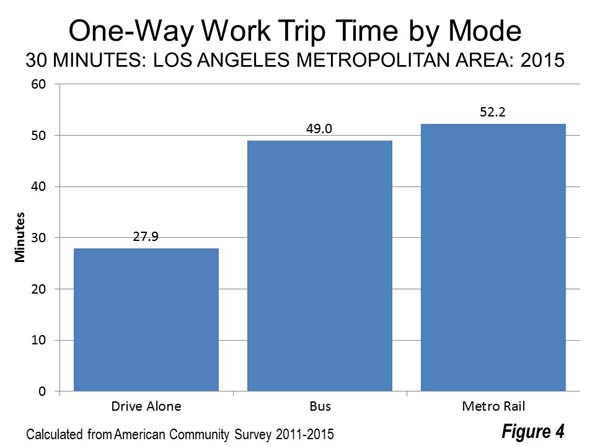
    Even where jobs can be reached by transit, it takes far longer. According to the latest American Community Survey data, the average one way work trip travel time for people driving alone in the Los Angeles metropolitan area is 27.9 minutes. By contrast, the average Metro Rail rider takes 52.2 minutes to reach work (Figure 4). It is not hard to imagine why people have not traded in their faster car travel times for slower trips on transit. Excess travel time, regardless of how traveled, takes away from other necessary activities and recreation.

    Further, with all the talk about “urban villages,” with the expected improved jobs housing balance, it is well to recognize such an achievement would be unprecedented. As former principal planner of the World Bank Alain Bertaud put it: “…the urban village "model does not exist in the real world because it contradicts the economic justification of large cities: the efficiency of large labor markets." The cold water of reality is that "… the urban village model exists only in the mind of urban planners."

    Of course, talk of people living near where they work is dubious, particularly in a metropolitan area where housing affordability  is challenging both for the vast majority of renters and potential buyers. When does anyone think this will happen? In “this life” or maybe in the “life to come?”

    The bottom line, unfortunate and politically incorrect as it is, is that transit simply cannot reduce traffic congestion. Some other strategy needs to be deployed.

    Prognosis: More Density, More Traffic

    Los Angeles traffic is likely to get much worse, especially if the development becomes substantially denser. All of the 12 world urban areas in the recent Tom Tom Congestion Index that have worse traffic than Los Angeles are denser. This is consistent with the international evidence that shows a strong association between higher densities, greater traffic congestion and lengthened work trip travel times. The experience in Los Angeles shows the same thing.

    Wendell Cox is principal of Demographia, an international public policy and demographics firm. He is a Senior Fellow of the Center for Opportunity Urbanism (US), Senior Fellow for Housing Affordability and Municipal Policy for the Frontier Centre for Public Policy (Canada), and a member of the Board of Advisors of the Center for Demographics and Policy at Chapman University (California). He is co-author of the "Demographia International Housing Affordability Survey" and author of "Demographia World Urban Areas" and "War on the Dream: How Anti-Sprawl Policy Threatens the Quality of Life." He was appointed to three terms on the Los Angeles County Transportation Commission, where he served with the leading city and county leadership as the only non-elected member. He served as a visiting professor at the Conservatoire National des Arts et Metiers, a national university in Paris.

    Photo: North on the 110 Toward Downtown, AM Peak (by author)

  • Is L.A. Back? Don’t Buy the Hype.

    With two football teams moving to Los Angeles, a host of towers rising in a resurgent downtown and an upcoming IPO for L.A.’s signature start-up, Snapchat parent Snap Inc., one can make a credible case that the city that defined growth for a half century is back. According to Mayor Eric Garcetti, the Rams, Chargers and the new mega-stadium that will house them in neighboring Inglewood, show that “that this is a town that nobody can afford to pass up.”

    And to be sure, Los Angeles has become a more compelling place for advocates of dense urbanism. Media accounts praise the city’s vibrant art scene, its increasingly definitive food scene and urbanist sub-culture. Some analysts credit millennials for boosting the population of the region and reviving the city’s appeal. Long disdained by eastern sophisticates, there’s an invasion from places like New York. GQ magazine called downtown L.A. “America’s next great city” last year.

    Downtown has transformed itself into something of an entertainment district, with museums, art galleries, restaurants, and sports and concert venues. Yet it has not become, like San Francisco or New York, a business center of note. In fact, jobs in the region have continued to move out to the periphery; downtown accounts for less than 5% of the region’s employment, one-third to half the share common in older large cities.

    Downtown’s residential growth needs to be placed in perspective. Since 2000 the population of the central core has increased by only 9,500; add the  entire inner ring and the population is up a mere 23,000. Meanwhile over the same span, the L.A. suburbs have added 600,000 residents. Jobs? Between 2000 and 2014, the core and inner ring, as well as older suburbs, lost jobs, U.S. Census data show, while newer suburbs and exurbs added jobs.

    In our most recent ranking of the metro areas creating the most jobs, Los Angeles ranked a mediocre 42nd out of the 70 largest metro areas; San Francisco ranked first. That’s well behind places like Dallas, Seattle, Denver, Orlando, and even New York and Boston, cities that we once assumed would be left in the dust by L.A.

    A New Tech Hub?

    The emergence of Snap has led some enthusiasts to predict L.A.’s emergence as a hotbed of the new economy. And to be sure, there is a growing tech corridor in the Santa Monica-Marina area that may gradually gain critical mass. Talk of a growing confluence between tech and entertainment content — the signature L.A. product — and the proliferation of new entertainment venues, could position the area for future growth. At the same time, the presence of Elon Musk’s Space X in suburban Hawthorne, near LAX, has excited local boosters.

    Yet despite these bright spots, Los Angeles’ current tech scene is almost piteously small. One consistent problem is venture capital. Despite the massive size of its economy, and huge population, Los Angeles garners barely 5% of the nation’s venture capital, compared to 40% for the Bay Area, 10% for New York and Boston. Companies that were born in L.A. often end up moving elsewhere, like virtual reality pioneer Oculus, which was frog marched to the Bay Area after being acquired by Facebook.

    Indeed, despite bright spots like Snap, since 2001 STEM employment in the L.A. metro area has been flat, in sharp contrast to high rates of job growth in the San Francisco Bay Area, Austin, Houston and Dallas, and the 10% national increase. Tech employment per capita in the L.A. area hovers slightly below the national average, according to a recent study I conducted at Chapman University. Los Angeles County, once the prodigious center of American high-tech, is also now slightly below the national average of engineers per capita.

    The Poverty Economy

    The regional economy, notes a recent Los Angeles Development Corporation report, continues to produce largely numbers of low-wage jobs, mostly in fields like health, hospitality and services. Sixty percent of all new jobs in the area over the next five years will require a high school education or less, the report projects.

    At the same time in the year ending last September, employment dropped in three key high-wage blue collar sectors: manufacturing, construction and wholesale trade notes the EDC The largest gains were in lower-wage industries like health care and social assistance, hospitality and food service.  Since 2007 Los Angeles County has 89,000 fewer manufacturing jobs, which pay an average of $54,000, but 89,000 more in food service that pay about $20,000. No surprise more than one out every three L.A. households have an income under $45,000 a year.

    All this works well for the people who are increasingly coming to enjoy L.A.’s great restaurants, hipster enclaves and art venues. The football teams will add to this mixture, offering employment selling peanuts, popcorn and hot dogs to generally affluent fans in the stands.

    Yet low wages could prove catastrophic in a region that lags only the Bay Area in housing costs. Some 45,000 are homeless throughout the metro area, concentrated downtown but spreading throughout the region all the way to Santa Ana, in the south. Housing prices have risen to five times median household income, highest in the nation and more than twice the multiple in New York, Chicago, Houston or Dallas-Ft. Worth. L.A. leads the nation’s big metro areas in a host of other negative indicators, including the percentage of income spent on housing, overcrowding and homelessness. A city which once epitomized middle class upward mobility is increasingly bifurcated between a wealthy elite, mostly Anglo and Asian, and a largely poor Latino and African-American community.

    A recent United Way study, for example, found that 37% of L.A. families can barely make ends meet, well above the 31% average for the state; the core city’s south and east sides have among the largest concentrations of extreme poverty in the state. Once a beacon for migrants from all over America, L.A. now has a similarly high rate of mass out-migration as New York. But unlike New York, where immigrants continue to pour in, newcomers to the U.S. are increasingly avoiding Los Angeles – it had the lowest growth in its immigrant population of any major metropolitan area over the past decade. Perhaps even more revealing, the Los Angeles area has endured among the largest drops in the number of children since 2000,notes demographer Wendell Cox,  more than New York, Chicago and San Francisco.

    Altered DNA

    The writer Scott Timberg notes that L.A.’s middle class, was once “the envy of the world.” L.A. used to be a place where firemen, cops and machinists could own houses in the midst of a great city. Dynamic, large aerospace firms, big banks and giant oil companies sustained the middle class.

    But the city has lost numerous major employers over the years, most recently longtime powerhouse Occidental Petroleum, and the U.S. headquarters of both Toyota and Nestle. The regional aerospace industry, which provided nearly 300,000 generally high-wage jobs in 1990, is now barely a third that size. High housing cost have devastated millennials, whose home ownership rate has dropped 30% since 1990, twice the national average.

    Many urbanists hail the emergence of a transit-oriented, dense city. Since 1990, Los Angeles County has added seven new urban rail lines and two exclusive busways at the cost of some $16 billion. Yet ridership on the Metropolitan Transportation Authority rail and bus services is now less than its predecessor Southern California Rapid Transit District bus services in 1985, before any rail services were opened. The share of work trips on transit in the entire five-county Los Angeles metropolitan region, has also dropped, from 5.1% in 1980 and 4.5% in 1990 to 4.2% in 2015. Meanwhile the city endures the nation’s worst traffic.

    Some longtime Angelenos are mounting a fierce ballot challenge — known as Measure S — to slow down ever more rapid densification. The ballot measure would bar new high-density construction projects for the next two years. “The Coalition to Preserve L.A.,” which is funding the measure, claims to be leading in the polls for the March 7 vote, but faces well-financed opposition from politically connected large developers, Mayor Garcetti, both political parties, virtually the entire city council, and much of the academic establishment. The L.A. Times denounced Proposition S as a “childish middle finger to City Hall” and its architecture critic Christopher Hawthorne, has urged the citizenry “to move past the building blocks of post-war Los Angeles, including the private car, the freeway, the single-family house and the lawn.”

    Proposition S proponents include many neighborhood and environmental groups, as well progressives and conservatives, including former Mayor Richard Riordan. The people controlling Los Angeles may dream of being the “next” New York but many residents, notes longtime activist Joel Fox, “are tired of the congestion and development and feel that more building will only add to congestion.”

    Renewing La La Land

    Of course, slowing or banning development by popular proposition is probably not the ideal  way to get control over the deteriorating situation. Yet it is clear that the current trajectory towards more dense housing is not addressing the city’s basic problems. Los Angeles, as the movie “La La Land so poetically portrays, remains a “city of dreams” but that mythology is clearly being eroded by a delusional desire to be something else.

    In my old middle-class neighborhood in the San Fernando Valley, heavily populated by people from the creative industry, the worsening congestion, the upsurge of ever taller buildings and ever more present homeless did not reflect the giddiness of “La La Land.”

    Yet despite all these problems, Los Angeles has the potential to make a great comeback. It has a dispersed urban form that allows for innovation and diversity, and an unparalleled physical location on the Pacific Rim. Its ethnic diversity can be an asset, if somehow it can generate higher wage employment to stop the race to the bottom. The basics are all there for a real resurgence, if the city fathers ever could recognize that the City of Angels needs less a new genome but  should build on its own inimitable DNA.

    This piece first appeared in Forbes.

    Joel Kotkin is executive editor of NewGeography.com. He is the Roger Hobbs Distinguished Fellow in Urban Studies at Chapman University and executive director of the Houston-based Center for Opportunity Urbanism. His newest book, The Human City: Urbanism for the rest of us, was published in April by Agate. He is also author of The New Class ConflictThe City: A Global History, and The Next Hundred Million: America in 2050. He lives in Orange County, CA.

    Photo: AdamPrzezdziek

  • The True Legacy of Gov. Jerry Brown

    The cracks in the 50-year-old Oroville Dam, and the massive spillage and massive evacuations that followed, shed light on the true legacy of Jerry Brown. The governor, most recently in Newsweek, has cast himself as both the Subcomandante Zero of the anti-Trump resistance and savior of the planet. But when Brown finally departs Sacramento next year, he will be leaving behind a state that is in danger of falling apart both physically and socially.

    Jerry Brown’s California suffers the nation’s highest housing prices, largest percentage of people in or near poverty of any state and an exodus of middle-income, middle-aged people. Job growth is increasingly concentrated in low-wage sectors. By contrast, Brown’s father, Pat, notes his biographer, Ethan Rarick, helped make the 20th century “The California Century,” with our state providing “the template of American life.” There was then an “American Dream” across the nation, but here we called it the “California Dream.” His son is driving a stake through the heart of that very California Dream.

    California crumbling

    Nothing so illustrates the gap between the two Browns than infrastructure spending. Oroville Dam’s delayed maintenance, coupled with a lack of major new water storage facilities to serve a growing population, reflects a pattern of neglect. Just this year alone, the massive water losses at Oroville Dam and other storage overflows have almost certainly offset a significant portion of the hard-won drought water savings achieved by our state’s cities. A sensible state policy would have stored more water from before the drought, and would now be maximizing the current bounty.

    Once a national and global leader in infrastructure, according to a report last year by the Center for Budget and Policy Priorities, California now spends the least percentage of its state budget on infrastructure of any state. In the critical Sacramento-San Francisco Delta, an ancient levee and dike system is decaying, and ever more stringent environmental regulations limit key state and federal water facility operations. To be sure, Brown has supported a “water fix” — a dual tunnel through the Delta — to address some of these problems, but his efforts have only produced a mountain of paper, rather than real-world improvements. In terms of preparing for the future, California’s current penchant for endless studies and environmental hand-wringing is fostering pre-Katrina Louisiana conditions, rather than the forward-looking capital investments previously the state’s hallmark.

    This piece first appeared in The Orange County Register.

    Joel Kotkin is executive editor of NewGeography.com. He is the Roger Hobbs Distinguished Fellow in Urban Studies at Chapman University and executive director of the Houston-based Center for Opportunity Urbanism. His newest book, The Human City: Urbanism for the rest of us, was published in April by Agate. He is also author of The New Class ConflictThe City: A Global History, and The Next Hundred Million: America in 2050. He lives in Orange County, CA.

    Photo: Troy Holden