Blog

  • Population Growth in Australia Has Normalized

    Yesterday’s Daily Telegraph contained an interesting article on the increasing number of Australians departing Australia permanently:

    OVERALL migration from Australia has soared to a record high – with 88,000 leaving in the past year, almost half from NSW.

    The stampede abroad is a 90 per cent increase 10 years ago, figures from the Department of Immigration show.

    Half the emigrants are Australian-born who have chosen to start new lives in Britain (15,119), New Zealand, (14,596), the US (8046 and Singapore (6952)…

    At the same time, the number of people emigrating to Australia has dropped, by 9 per cent to 127,458 in the past year, making the ratio of departures to arrivals a record high…

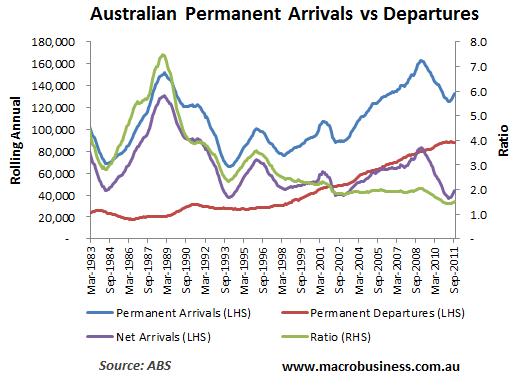
    Upon reading this article, I decided to crunch the numbers to determine how Australia’s migration numbers are tracking. The below chart shows the permanent arrivals vs permanent departures numbers alluded to in the above article. The ratio of arrivals to departures is also shown:


    As you can see, the number of net permanent arrivals into Australia – around 45,000 for the 12 months to September 2011 – is well below the long-run average (around 65,000). The ratio of arrivals to departures is also in long-term decline and currently sits at a 35-year low of 1.5 times.

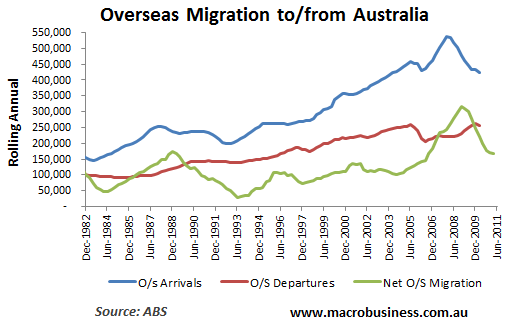
    However, the broader net overseas migration (NOM) statistics published by the Australian Bureau of Statistics, which measures in/out migration of anyone residing/leaving Australia for a period of 12 months or more (rather than permanently), paints a different picture.

    According to these statistics, NOM is still above long-term trends, but has declined sharply from the peak level seen in the year to September 2008, from around 315,000 to 170,000:


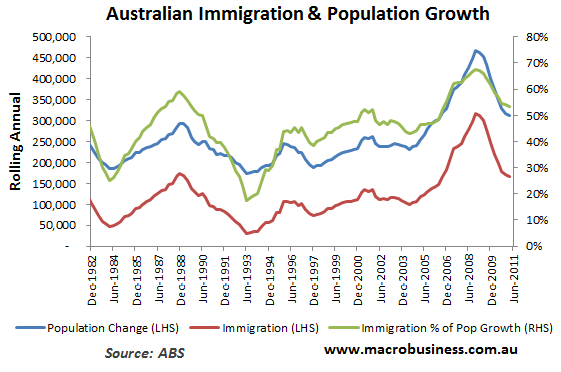
    With the decline in NOM, Australia’s population growth has also fallen significantly, from a peak of just under 470,000 in the year to September 2008 to just under 320,000. The share of population growth coming from immigration has also fallen over the same period from a peak of 67% to 54%.


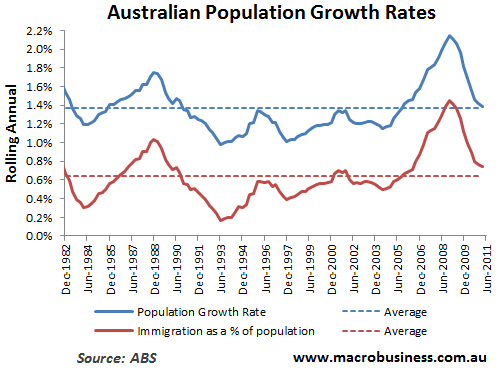
    Finally, in percentage terms, it appears that Australia’s population growth and immigration are returning to average levels after surging in the 3 years to 2008:


    With the ABS scheduled to release the June quarter NOM data in mid-December, it will be interesting to see whether Australia’s NOM mirrors the permanent arrivals/departures figures and registers another fall.

    This piece originally appeared at Macrobusiness.

    Leith van Onselen writes daily as the Unconventional Economist at MacroBusiness Australia. He has held positions at the Australian Treasury, Victorian Treasury and currently works at a leading financial services company. Follow him @leithVO.

  • Urbanizing India: The 2011 Census Shows Slowing Growth

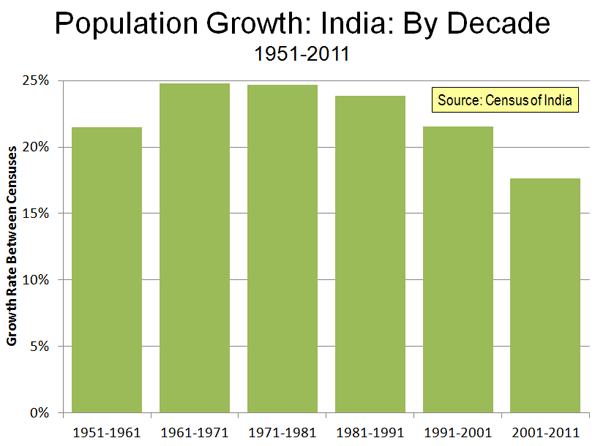
    Provisional results from the 2011 census of India show a diminishing population, the lowest since independence in 1947. From 2001 to 2007, India’s population grew 17.6%, compared to a 20% to 25% growth rate in previous periods since the 1951 census. Even so, India is expected to virtually catch up with China in population by 2020, with United Nations forecasts showing a less than 1 million advantage for China. By 2025, the UN forecasts that India will lead China by more than 50 million people. Nonetheless, like many other developing nations, falling birth rates are substantially reducing population growth in India.

    Moving to the Cities

    India’s still strong growth reflects the fact that it remains a principally rural nation. According to the 2011 census, only 31% of the population of India lives in urban areas. Urban migration, of course, is continuing but at a considerably slower rate than in China. According to the United Nations, the urban population of India will be less than 35% in 2020 and approximately 40% in 2030.  Yet despite this, the number of new urban residents will be substantial. By 2030, another 225 million people will be added to the Indian urban areas, more than the population of Japan and Germany combined.

    The Largest Urban Areas

    During the last decade, the number of urban areas (areas of continuous urban development) in India rose by one half, from 34 to 51 (Table). However, growth was somewhat less than forecast in the largest urban areas, a phenomena that appears elsewhere, such as in now slower growing Mexico City, Sao Paulo, New York and Los Angeles. This pattern seems to be found all around the world, according to a report by the McKinsey Global Institute.

    India: Urban Areas Over 1,000,000 Population: 2011
    Rank
    Urban Area
    2001
    2011
    % Change
    1 Delhi, NCT-UP-HAR   15,358,000   21,622,000 41%
    2 Mumbai, MAH   16,554,000   18,790,000 14%
    3 Kolkata, WB   13,217,000   14,113,000 7%
    4 Chennai, TN     6,425,000     8,696,000 35%
    5 Bangalore, KAR     5,687,000     8,499,000 49%
    6 Hyderabad, AP       5,534,000     7,749,000 40%
    7 Ahmadabad, GUJ     4,519,000     6,352,000 41%
    8 Pune, MAH     3,756,000     5,050,000 34%
    9 Surat, GUJ      2,811,000     4,585,000 63%
    10 Jaipur, RAJ      2,324,000     3,073,000 32%
    11 Kanpur, UP     2,690,000     2,920,000 9%
    12 Lucknow, UP      2,267,000     2,901,000 28%
    13 Nagpur, MAH     2,123,000     2,498,000 18%
    14 Indore, MP      1,639,000     2,167,000 32%
    15 Coimbatore, TN      1,446,000     2,151,000 49%
    16 Kochi, KER     1,355,000     2,118,000 56%
    17 Patna, BH     1,707,000     2,047,000 20%
    18 Kozhikode, KER        880,000     2,031,000 131%
    19 Bhopal, MP     1,455,000     1,883,000 29%
    20 Thrissur, KER        330,000     1,855,000 462%
    21 Vadodara, GUJ     1,492,000     1,817,000 22%
    22 Agra, UP      1,321,000     1,746,000 32%
    23 Visakhapatnam, AP     1,329,000     1,730,000 30%
    24 Malappuram, KER        170,000     1,699,000 899%
    25 Thiruvananthapuram, KER        889,000     1,687,000 90%
    26 Kannur, KER        498,000     1,643,000 230%
    27 Ludhiana, PJ     1,395,000     1,614,000 16%
    28 Nashik, MAH      1,152,000     1,563,000 36%
    29 Vijayawada , AP     1,011,000     1,491,000 47%
    30 Madurai, TN     1,195,000     1,462,000 22%
    31 Varanasi, UP     1,212,000     1,435,000 18%
    32 Meerut, UP      1,167,000     1,425,000 22%
    33 Rajkot, GUJ     1,002,000     1,391,000 39%
    34 Jamshedpur, JH     1,102,000     1,337,000 21%
    35 Srinagar, JK        971,000     1,273,000 31%
    36 Jabalpur, MP      1,117,000     1,268,000 14%
    37 Asansol, WB     1,090,000     1,243,000 14%
    38 Vasai Virar, MAH        293,000     1,221,000 317%
    39 Allahabad, UP     1,050,000     1,217,000 16%
    40 Dhanbad. JH      1,064,000     1,195,000 12%
    41 Aurangabad, MAH        892,000     1,189,000 33%
    42 Amritsar, PJ     1,011,000     1,184,000 17%
    43 Jodhpur, RAJ        856,000     1,138,000 33%
    44 Ranchi, JH        863,000     1,127,000 31%
    45 Raipur , CHH        699,000     1,123,000 61%
    46 Kollam, KER        380,000     1,110,000 192%
    47 Gwalior, MP        866,000     1,102,000 27%
    48 Durg-Bhilainagar, CHH        924,000     1,064,000 15%
    49 Chandigarh, CH        809,000     1,026,000 27%
    50 Tiruchirappalli, TN        847,000     1,022,000 21%
    51 Kota, RAJ        705,000     1,001,000 42%
    Data derived from Census of India


    Delhi: Delhi (National Capital Territory, Uttar Pradesh and Haryana) was reported by the United Nations to have become the second largest urban area in the world, following Tokyo in 2010. However, the Delhi urban area was nearly 1,000,000 people short of the population than projected by the United Nations. However, over the decade, Delhi managed to become the nation’s largest urban area with a population of 21.6 million people, an increase of 41% over its 15.5 million people in 2001 (Note 1). This is an impressive accomplishment, since some demographers have long maintained that Mumbai could be destined to become the largest urban area in the world in future decades.

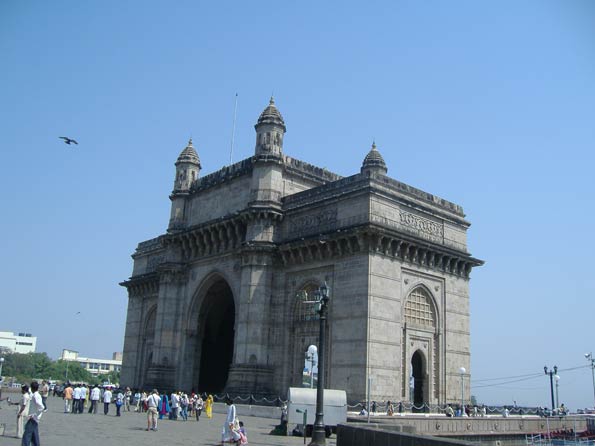
    Mumbai: Mumbai (formerly Bombay), in Maharashtra, placed second with a population of 18.8 million. This compares to a population of 16.6 million in 2001. The Mumbai urban area grow only 14% between 2001 and 2011, a much slower rate than before, driven by declines in the urban core of central Mumbai – another general global phenomena –  and only modest growth in the suburban Mumbai portion of the central city, with explosive growth in the suburban areas outside the central city (Note 2). Mumbai‘s 2011 population is approximately 1.5 million below the level that would have been indicated by the 2010 United Nations projection.

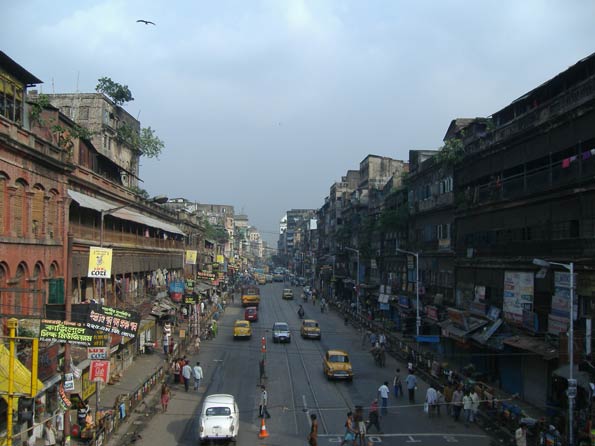
    Kolkata: India’s third largest urban area, Kolkata (formerly Calcutta), in West Bengal, registered a population of 14.1 million, an increase of only 7% from its 13.4 million population in 2001. Like the two larger urban areas, the current population of Kolkata is less than project by the UN. As in the case of Mumbai the shortfall is by approximately 1.5 million.

    Chennai: Chennai (formerly Madras), in Tamil Nadu, ranked fourth among India’s urban areas with a population of 8.7 million, up from 6.5 million in 2001. This 35% growth rate propelled Chennai to a population more than 1 million above expectation.

    Bangalore: Information technology center Bangalore (Karnataka) was the fastest growing of the urban areas over 5 million people, with a population of 8.5 million, an increase of 49% over its 2001 population of 5.7 million. Should Bangalore’s population growth rate continue, it is likely to pass Chennai over the next decade to become the fourth largest urban area. Like Chennai, Bangalore registered a population at least 1 million higher than anticipated.

    Hyderabad: Hyderabad (Andra Pradesh), another of the nation’s leading information technology areas, rose to a population of 7.7 million people, from 5.5 million in 2001. With a 40% growth rate, Hyderabad exceeded its population estimate by at least1 million people.

    Ahmadabad: Ahmadabad, in Gujarat, is the last of the seven urban areas with more than 5 million population had 6.4 million people, which is an increase from 4.5 million in 2001. Ahmadabad grew 41% and achieve the population at least one half million higher than was expected.

    Surat: The fastest growing urban area of the 16 Indian urban areas with more than 2 million people was Surat, in Gujarat. Surat grew from 2.8 million people to 4.6 million, for an increase rate of 63%.

    The Largest State or Province

    The state of Uttar Pradesh registered a population of just under 200 million people in the 2011 census. This makes Uttar Pradesh the largest sovereign national jurisdiction (state or province) in the world. Nonetheless, the largest urban area in Uttar Pradesh has a population of under 3 million: Kanpur. However the Delhi suburbs in Uttar Pradesh, Ghaziabad and Noida are slightly larger than Kanpur.

    Soon the Largest Nation

    As India edges toward becoming the most populous nation, it is clear that its growing urban areas will occupy more of the top positions among the world’s largest urban areas in the years to come. But the pattern here indicates, as elsewhere in the world, that most growth, and the most rapid growth, is occurring not in the largest megacities but in smaller, and perhaps more manageable, ones.

    ——-

    Note 1: This urban area definition includes adjacent urban areas in the state of Uttar Pradesh (Ghaziabad and Noida) and Haryana (Faridabad and Gurgaon, which borders Indira Gandhi International Airport opposite Delhi), which are not considered to be in the Delhi urban area by the census of India but are included in the United Nations definition.

    Note 2: This urban area definition includes the adjacent Panvel and the Navi Mumbai-Panvel urban areas. The latter is between Panvel and Navi Mumbai (proper) which is included in the Mumbai urban area by the census of India.

    Photographs by Author (Delhi, Mumbai, Kolkata)

    Wendell Cox is a Visiting Professor, Conservatoire National des Arts et Metiers, Paris and the author of “War on the Dream: How Anti-Sprawl Policy Threatens the Quality of Life

  • The Best Cities For Technology Jobs

    During tough economic times, technology is often seen as the one bright spot. In the U.S. this past year technology jobs outpaced the overall rate of new employment nearly four times. But if you’re looking for a tech job, you may want to consider searching outside of Silicon Valley. Though the Valley may still be the big enchilada in terms of venture capital and innovation, it hasn’t consistently generated new tech employment.

    Take, for example, Seattle. Out of the 51 largest metro areas in the U.S., the Valley’s longtime tech rival has emerged as our No. 1 region for high-tech growth, based on long- and short-term job numbers. Built on a base of such tech powerhouses as Microsoft, Amazon and Boeing, Seattle has enjoyed the steadiest and most sustained tech growth over the past decade. It is followed by Baltimore (No. 2), Columbus, Ohio (No. 3), Raleigh, N.C. (No. 4) and Salt Lake City, Utah (No. 5).

    To determine the best cities for high-tech jobs, we looked at the latest high-tech employment data collected by EMSI, an economic modeling firm. The Praxis Strategy Group‘s Mark Schill charted those areas that have gained the most high-tech manufacturing, software and services jobs over the past 10 years, equally weighting the last five years and the last two. We also included measures of concentration of tech employment in order to make sure we were not giving too much credence to relatively insignificant tech regions. Our definition of high tech industries is based on the one used by TechAmerica, the industry’s largest trade association.

    Despite the Valley’s remarkable concentration of tech jobs — roughly six times the national average — it ranked a modest No. 17 in our survey. This relatively low ranking reflects the little known fact that, even with the recent last dot-com craze sparking over 5% growth over the past two years, the Valley remains the “biggest loser” among the nation’s tech regions, surrendering roughly one quarter of its high -tech jobs — about 80,000 — in the past decade. Only New York City (No. 44) lost more tech jobs during that time.

    In contrast to this pattern of volatility, our top performers have managed to gain jobs steadily in the past decade — and have continued to add new ones in the last two years. In addition to our top five, the only other regions to claim overall tech gains in the last 10 years are Jacksonville, Fla. (No. 6), Washington, D.C. (No. 7), San Bernardino-Riverside, Calif. (No. 9), San Diego, Calif. (No. 9), Indianapolis (No. 11) and Orlando, Fla. (No. 24).

    So what accounts for high-tech success, and where will jobs most likely grow in the next decade? Certainly being home to a major research university makes a big difference. Seattle, Columbus, Raleigh and Salt Lake City all boast major educational and research assets.

    But it’s one thing to produce scientists and engineers; it’s another to generate employment for them over the long term. Clearly for the San Jose metropolitan region (which is home to Stanford) and the much-hyped No. 29 San Francisco area (home to the University of California Medical Center) academic excellence has not translated into steady growth in tech jobs. Over the past decade the Bay Area has given up 40,000 jobs, or 19% of its tech workforce, including a loss of nearly 6,000 in software publishing.

    Or look at the Boston region (ranked No. 22), which arguably boasts the most impressive concentration of research universities in the country. The region did add jobs in research and computer programming, but these were not enough to counter huge losses in telecommunications and electronic component manufacturing. Over the past decade, greater Beantown has given up 18% of its tech jobs, or more than 45,000 positions.

    One possible explanation may lie in costs, including very high housing prices, onerous taxes and a draconian regulatory environment. In tech, company headquarters may remain in the Valley, close to other headquarters and venture firms, but new jobs are often sent either out of the country or to more business friendly regions.

    Just look at the flow of jobs from Bay Area-based companies to places like the Salt Lake area. In the past two years Valley companies such as Twitter, Adobe, eBay, Electronic Arts and Oracle have all expanded into Utah. This region has many appealing assets for Bay Area companies and workers. Salt Lake City is easily accessible by air from California, possesses a well- educated workforce, has reasonable housing costs and offers world-class skiing and other outdoor activities.

    Another huge advantage appears to be closeness to the federal government, which expends hundreds of billions on tech products both hardware and software. This explains why Baltimore, primarily its suburbs, and the D.C. metro area have enjoyed steady tech growth and, under most foreseeable scenarios, likely will continue to do so in the coming years. Both regions have seen large gains in technology services industries, particularly programming, systems design, research, and engineering.

    Yet even business climate, while important, may not be enough to drive tech job growth. Texas ranks highly in most business surveys, including our own, but it did not fare so well in this one. Indeed No. 32 Austin, often thought as the most likely candidate for the next Silicon Valley, lost over 19% of its high-tech jobs over the past decade, including more than 17,000 jobs in semiconductor, computer and circuit board manufacturing. No. 18 Houston did far better, although it has also lost 6% of its tech jobs over the same period due to the cutbacks in the engineering service, a big sector there. Even more shocking: No. 46 Dallas, generally a job-creating dynamo, has seen roughly a quarter of its high-tech jobs go away, due primarily to losses in telecommunications carriers and in manufacturing of communications equipment and electronics.

    How about other potential up and comers for the coming decade? Two potentially big and somewhat surprising winners. The first: Detroit. Though the Motor City area lost 20% of its tech jobs in the past decade (ranking 40th on our list), it still boasts one of the nation’s largest concentrations of tech workers, nearly 50% above the national average. In the past two years, the region has experienced a solid 7.7% increase in technology jobs, the second highest rate of any metro area.

    The Motor City region seems to have some real high-tech mojo. According to the website Dice.com, Detroit has led the nation with the fastest growth in technology job offerings since February — at 101%. This can be traced to the rejuvenated auto industry, which is increasingly dependent on high-tech skills. Manufacturing is increasingly prodigious driver of tech jobs; games and dot-coms are not the only path to technical employment growth. This could mean good news for other Rust Belt cities, such as No. 28 Cincinatti or No. 38 Cleveland, as well as our Midwest standout, Columbus, which could benefit from growth sparked by the local natural gas boom.

    Another potential standout is No. 8 New Orleans, whose tech base remains relatively small but has expanded its tech workforce nearly 10% since 2009 — the highest rate of any of the regions studied. With low costs, a friendly business climate and world-class urban amenities, the Crescent City could emerge as a real player, aided by the growing prominence of research and development around Tulane University. There has also been a recent growing presence of the video game industry in the city.

    Looking forward, however, it makes sense to be cautious about where tech is heading. By its nature, this is a protean industry; the mix of jobs and favored locales tend to change. If the current boom in social media continues, for example, the Bay Area could recover more of its lost jobs and further extend its primacy. Similarly a surge in manufacturing and energy-related technology could be a boon to tech in Houston, Dallas as well as New Orleans. But based on both historic and recent trends, the surest best for future growth still stands with our top five winners, led by the rain-drenched, but prospering Seattle region.

    Best Places for High Tech Growth
    Ranking of 2, 5, and 10 year growth, industry concentration, and 5 and 10 year growth momentum
    Rank Metropolitan Area Rank Score
    1 Seattle  82.2
    2 Baltimore 75.7
    3 Columbus 67.9
    4 Raleigh 63.2
    5 Salt Lake City 60.0
    6 Jacksonville 59.2
    7 Washington, DC 58.9
    8 New Orleans 58.8
    9 Riverside-San Bernardino 58.2
    10 San Diego 56.1
    11 Indianapolis 55.9
    12 Buffalo 55.8
    13 San Antonio 54.0
    14 Charlotte 53.5
    15 St. Louis 51.6
    16 Pittsburgh 50.8
    17 San Jose 50.5
    18 Houston 50.2
    19 Hartford 50.0
    20 Nashville 49.6
    21 Providence 49.2
    22 Boston 48.3
    23 Minneapolis-St. Paul 48.3
    24 Orlando 48.1
    25 Portland 48.1
    26 Philadelphia 47.4
    27 Louisville 47.2
    28 Cincinnati 46.6
    29 San Francisco 46.6
    30 Denver 46.4
    31 Richmond 45.6
    32 Austin 45.1
    33 Atlanta 44.6
    34 Virginia Beach-Norfolk-Newport News 42.4
    35 Memphis 42.2
    36 Milwaukee 41.5
    37 Rochester 41.2
    38 Cleveland 40.9
    39 Phoenix 38.5
    40 Detroit 37.7
    41 Tampa 37.5
    42 Miami 33.2
    43 Sacramento 32.1
    44 New York 31.4
    45 Las Vegas 31.2
    46 Dallas-Fort Worth 31.0
    47 Chicago 30.2
    48 Los Angeles 29.5
    49 Oklahoma City 26.7
    50 Birmingham 23.5
    51 Kansas City 21.6
    Rankings measure employment in 45 high technology manufacturing, services, and software industry sectors.

    This piece first appeared at Forbes.com.

    Joel Kotkin is executive editor of NewGeography.com and is a distinguished presidential fellow in urban futures at Chapman University, and an adjunct fellow of the Legatum Institute in London. He is author of The City: A Global History. His newest book is The Next Hundred Million: America in 2050, released in February, 2010.

    Mark Schill of Praxis Strategy Group perfomed the economic analysis for this piece.

    Seattle photo courtesy of BigStockPhoto.com.

  • Toyota: How Mississippi Engineered the Blue Springs Deal

    A big crowd gathered earlier today to welcome the first Corolla that rolled off the assembly line at Toyota’s tenth U.S. plant in the tiny hamlet of Blue Springs, Mississippi. Situated in Union County, just 17 miles from Elvis’ hometown of Tupelo, the new plant is the latest new automobile manufacturing facility to fly the flag of a foreign manufacturer in the Deep South.

    The opening culminates a year of project announcements in the area. Mercedes-Benz will invest $350 million to add capacity to its plant just outside of Tuscaloosa, joining Navistar, the nation’s top manufacturer of school buses and medium-duty trucks, which also announced plans to expand in Alabama. In neighboring Tennessee, eleven automotive related projects totaling $300 million have been announced since June. A commissioner from the state’s economic development office recently said that one third of the manufacturing jobs in the Volunteer State now relate to the automotive sector.

    But the growth of the auto industry in the area is not a stroke of fate. “It was a deliberate strategy, a regional strategy,” said David Rumbarger, President and CEO of the Community Development Foundation for Tupelo/Lee County. In 2001, three northeast Mississippi counties, Pontotoc, Union, and Lee, formed the PUL Alliance with the goal of luring a major automobile manufacturer to the area. Two years later, they identified the Blue Springs site, began looking for a tenant, and named the endeavor the Wellspring Project.

    “At the time, North Mississippi said, ‘We’ve got to diversity our economy here’ and we narrowed it down to automotive,’” said Josh West, Economic Developer for Pontotoc and Union counties. Nissan’s announcement in 2000 that it would open the state’s first assembly line plant in Canton proved it could be done.

    Furniture manufacturers, anchored by Ashley Furniture, Lane Furniture and Southern Motion, had long provided the region’s economic backbone (as recently as the 2007 Economic Census, more workers were employed in the state manufacturing furniture than automobiles). But, as with the textile industry, the industry slowly declined through downsizing and outsourcing, forcing locals to explore how to best capitalize on the area’s skilled labor force. The members of the PUL Alliance also probably couldn’t help but notice that the annual compensation cost for workers making automobiles is three times higher nationwide than for those manufacturing furniture.

    Furniture manufacturing provided a good labor basis for the region, West said, “but the computer technology and robotics needed to be taught.” To that end, the PUL Alliance formed a consortium of four area community colleges to offer the skills needed at the Blue Springs facility.

    “Each (college) couldn’t teach all the needed courses by themselves,” Rumbarger said, referring to courses on working with sheet metal, tool and dye technology and robotics, among others. “When we put the four institutions together, it helped spread the education of the workforce. It allowed the whole region to upgrade their skills.”

    After approaching Ford and other domestic manufacturers (“I spent a lot of time in Detroit,” Rumbarger said), Toyota announced in 2007 that it would break ground in Blue Springs, originally to make the Prius; Toyota later announced the plant will make only Corollas. Automakers have generally avoided opening up new plants in states where the United Auto Workers have a long history, choosing instead sites in the South with right-to-work laws that prohibit workers from being forced to join unions if their co-workers do so.

    “It’s definitely a benefit to us to be a right-to-work state,” West said, estimating that less than two percent of private employees in the northern Mississippi area belong to unions.

    The plant received 35,000 applications for 1,300 available spots, hiring mostly locals, with plans to hire more next year. Of course, a spin-off of every new auto plant is the wealth of suppliers who move into the area, producing seat bumpers, plastics, metals and other auto parts that add an estimated 1,000 jobs to the area. With Nissan’s Canton plant a four-hour drive south, suppliers have additional incentive to set up shop.

    According to Rumbarger, economic development officials in the area had a wage target of 15 to 28 dollars an hour for the jobs at the Blue Springs plant, an increase from the average hourly manufacturing wage in the area of $13.50. With the median home value in Union County at $79,200 and a per capita average under $18,000, the wages paid by Toyota should make home ownership easily attainable to its plant employees. The area has also seen an increase of 200 home starts this year compared to last.

    “I would speak to community groups and ask if anyone knew somebody who worked for Toyota. A couple of hands would go up,” Rumbarger said. “Now when I pose the question, nearly half of people know somebody who worked for Toyota. That’s the difference over the last 18 months.”

    Andy Sywak is the former publisher of the Castro Courier newspaper in San Francisco. He now lives in Los Angeles.

    Photo: Toyota Corolla by Paulo Keller

  • The New World Order: A Report on the World’s Emerging Spheres of Influence

    This is the introduction to a new report, "The New World Order" authored by Joel Kotkin in partnership with the Legatum Institute. Read the full report and view the maps at the project website.

    The fall of the Soviet Union nearly a quarter of a century ago forced geographers and policy makes to rip up their maps. No longer divided into “west” and “east”, the world order lost many of its longtime certainties.

    In our attempt to look at the emerging world order, we have followed the great Arab historian Ibn Khaldun’s notion that ethnic and cultural ties are more important than geographic patterns or levels of economic development. In history, shared values have been critical to the rise of spheres of influence across the world. Those that have projected power broadly – the Greek, Roman, Arab, Chinese, Mongol and British empires – shared intense ties of kinship and common cultural origins. As Ibn Khaldun observed: “Only tribes held together by a group feeling can survive in a desert.”

    Of course, much has been written about the rising class of largely cosmopolitan “neo nomads”, who traipse from one global capital to another. But, for the most part, these people largely serve more powerful interests based on what we may call tribal groupings: the Indian sphere of influence, the Sinosphere and the Anglosphere.

    Our approach departs from the conventional wisdom developed after the Cold War. At that time it was widely assumed that, as military power gave way to economic influence and regional alliances, the world would evolve into broad geographic groups. A classic example was presented in Jacques Attali’s Millennium: Winners and Losers in the Coming World Order. Attali, a longtime advisor to French President Francois Mitterrand, envisioned the world divided into three main blocs: a European one centered around France and Germany, a Japan-dominated Asian zone, and a weaker United States-dominated North America.

    Time has not been kind to this vision, which was adopted by groups like the Trilateral Commission. The European Union proved less united and much weaker economically and politically than Attali and his ilk might have hoped. The notion of Japan, now rapidly aging and in a twodecades long slump, at the head of Asia, seems frankly risible. Although also suffering from the recession, North America over the past quarter century has done better in terms of growth and technology development, and has more vibrant demographics than either the EU or Japan.

    More recently, attention has turned to the rise of the so-called BRIC countries – Brazil, Russia, India and China. Yet it turns out that these countries have even less in common than the squabbling members of the European Union. For one thing, they represent opposing political systems. Brazil and India are chaotic but entrenched democracies, for example; Russia and especially China remain authoritarian, one-party dictatorships.

    These economies also are not particularly intertwined. Brazil is a major food exporter; Russia’s economy revolves around energy and minerals; China dominates in manufacturing; and India is vaulting ahead based largely on services. Brazil’s leading export markets, for example, are the United States and Argentina; Russia and China constituted together take barely 8 percent of the country’s exports. China’s largest trading partners by far are the United States, Hong Kong, Taiwan, South Korea and Japan. India ranks only ninth and Brazil tenth.

    More important still, no common “tribal” link, as expressed by a shared history, language, or culture unites these countries and peoples. This link is fundamental to any powerful and long-lasting power grouping.

    In contrast, the Indian and Chinese spheres, for example, are united by deep-seated commonalities: food, language, historical legacy and national culture. A Taiwanese technologist who works in Chengdu while tapping his network across east Asia, America, and Europe does so largely as a Chinese; an Indian trader in Hong Kong does business with others of his “tribe” in Africa, Great Britain and the former Soviet Republics in east Asia. Beyond national borders, these spheres extend from their home countries to a host of global cities, such as Hong Kong, Singapore, London, New York, Dubai, San Francisco, and Los Angeles, where they have established significant colonies.

    The prospects for the last great global grouping, the Anglosphere, are far stronger than many expect. Born out of the British Empire, and then the late 20th Century, the Anglosphere may be losing its claim to global hegemony, but it remains the first among the world’s ethnic networks in terms of everything from language and global culture to technology. More than the Indian Sphere and Sinosphere, the Anglosphere has shown a remarkable ability to incorporate other cultures and people.

    In the future, we will see the rise of other networks, as well. An example would be the Vietnamese sphere of influence, which reflects both the rise of that particular Asian country, and the influence of its scattered diaspora across the world. Culture is key to understanding the Vietnamese sphere: the country’s history includes long periods of Chinese domination that made it resistant to being absorbed into the Sinosphere. Instead, as we argue, Vietnam is likely to be more closely allied, first and foremost, with the United States and its allies.

    Finally, our maps deal with basic demographic issues that will dominate the future. We trace the global rise of women to prominence in business, education and politics. Although Western nations still lead in female empowerment, we argue that the most significant changes are taking place in developing countries, notably in Latin America. It will be these women – in Sao Paolo, Mumbai, and Maseru – who increasingly will shape the future female influence on the world.

    Yet this positive development also contains the seed of dangers. Female empowerment, along with urbanization, has had a depressing effect on fertility rates, seen first in the highly developed countries, and now increasingly in developing ones. Looking out to 2030, many countries, including the United States and China, will be facing massive problems posed by too many seniors and not enough working age people.

    As has always been the case, the emerging world order will face its own crises in the future, with, no doubt, unexpected, unpredictable results. But our bet is solidly on the three spheres of influence which constitute the bulk of this report.

    For the full report, visit The New World Order website at the Legatum Institute.

    Report authors:

    Joel Kotkin is executive editor of NewGeography.com and is a distinguished presidential fellow in urban futures at Chapman University, and an adjunct fellow of the Legatum Institute in London. He is author of The City: A Global History. His newest book is The Next Hundred Million: America in 2050, released in February, 2010.

    Sim Hee Juat is currently a research associate with the Centre for Governance and Leadership at the Civil Service College of Singapore.

    Shashi Parulekar is an engineer by training. He holds a master’s in finance and an M.B.A. He has worked as a high-tech marketer in Asia for several decades.

    Jane Le Skaife is a doctoral candidate in the Department of Sociology at the University of California, Davis. She is currently conducting her dissertation research involving a cross-national comparison of Vietnamese refugees in France and the United States.

    Wendell Cox is a consultant specialising in demographics and urban issues, principal of Demographia and a visiting professor at the Conservatoire National des Arts et Metiers in Paris.

    Emma Chen is a senior strategist at the Centre for Strategic Futures, Singapore. The views expressed within this article are solely her own. Publication does not constitute an endorsement by the Centre for Strategic Futures, Singapore.

    Zina Klapper is Deputy Editor of www.newgeography.com. A Los Angeles-based writer/editor/consultant with a background in journalism, she works in multiple aspects of report presentation. The maps were prepared by Ali Modarres, Professor of Urban Geography at California State University, Los Angeles.

    We also owe a debt to our largely volunteer research staff, headed by Zina Klapper, Editor and Director of Research. This includes Gary Girod and Kirsten Moore from Chapman University, to whom we owe a special debt for directed study focused on the maps. We also wish to thank Sheela Bonghir from California State University at Northridge; Malcolm Yiong and Jasmin Lau at the Centre for Strategic Futures, Singapore, and Chor Pharn Lee at the Ministry of Trade and Industry and researcher Erika Ozuna, based in Dallas, Texas. Special thanks to Nathan Gamester at Legatum Institute in London for helping put this project together and seeing it to fruition.