Blog

  • More Americans Move to Detached Houses

    In defiance of the conventional wisdom in the national media and among most planning professionals, Americans continue not only to prefer, but to move into single family detached houses. Data from the 2010 American Community Survey indicates that such housing attracted 79.2% of the new households in the 51 major metropolitan areas (over 1,000,000 population) over the past decade.

    In contrast households in multi-unit buildings (apartments and condominiums) represented 11.8% of the new housing, while two-unit attached housing represented 11.3% of the increase. There was a 2.3% decline in the "other" category of new housing, which includes mobile homes and boats. A total of 4 million net new occupied detached houses were added in the largest metropolitan areas, while there were 590,000 additional apartments and condominiums and 570,000 attached houses (Figure 1).

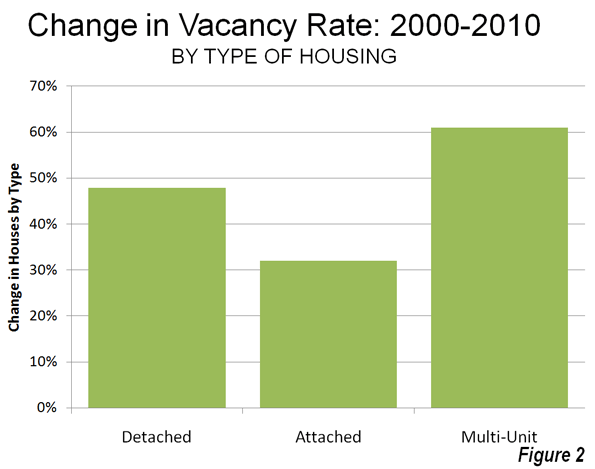
    Detached Vacancy Rate Rises Less than Multi-Unit: Another conventional assumption is that single family homes have been disproportionately abandoned by their occupants, particularly since the collapse of the housing bubble. This is also not true. In 2010 detached housing enjoyed a 92.4% occupancy rate in 2010 which is higher than the 89.4% occupancy rate in attached housing and 84.2% occupancy rate in multi-unit buildings. Because a more of the multi-unit housing is rental, it is to be expected that the vacancies would be the highest in this category. However, at the national level, overall vacancy rates rose the most in multi-unit housing, with an increase of 61%, from 10.7% in 2000 to 17.1% in 2010. The vacancy rate in detached housing rose at a slower rate, from 7.3% in 2000 to 10.7% in 2010, an increase of 48%. Attached housing – such as townshouses – have the slowest rise in vacancy rate, from 8.4% in 2000 to 11.0% in 2010, an increase of 32% (Figure 2).
    Detached and Attached Up in Most Markets, Apartments and Condominiums Down in Most: The move to detached housing was pervasive at the major metropolitan area level. Among the 51 largest metropolitan areas, the share of detached housing rose in 44 and declined in seven. The share of attached housing rose in 32 of the metropolitan areas, while declining in 19. Multi-unit housing experienced an increase in its market share in only three markets, while declining in 48.

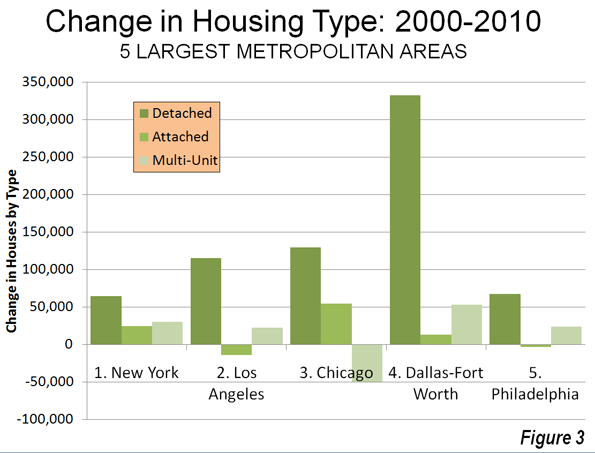
    Largest Metropolitan Areas: Detached housing also increased more than attached housing and multi-unit housing in each of the nation’s five largest metropolitan areas.

    • In the largest metropolitan area, New York, 51.9% of the new housing was detached. This is considerably more than the 36.9% detached market share in 2000. Multi-unit housing accounted for 24.1% of the increase in the market. This is a far smaller share than the 55.7% that multi-unit housing represented in 2000. Attached housing was 19.9% of the increase, nearly 3 times its 2000 share of 6.7%. This movement of New Yorkers to less dense housing forms is particularly significant, in view of the fact that New York has historically had the lowest share of lower density housing (detached and attached) and the highest share of multi-unit houses.
    • In the second largest metropolitan area, Los Angeles, 96.0% of the new housing was detached. This is nearly double the 49.7% that detached housing represented of the market in 2000. The balance of the new housing was split between a share of 18.6% for multi-unit housing and a loss of 11.8% in the attached housing. The share of new units represented by multi-unit houses was less one-half than its percentage of the market in 2000 (39.0%).
    • In the third largest metropolitan area, Chicago, 95.9% of the new housing was detached, well above the 52.5% share in 2000. There was a huge loss in apartment and condominium share, at 31% of the market, while attached housing captured 40.4% of the market.
    • In the fourth largest metropolitan area, Dallas Fort Worth, 84.3% of the new housing was detached, well above the 62.0% share in 2000. Multi-unit housing accounted for 13.5% of the increase, approximately one-half the 2000 market share. Attached housing represented 3.2% of the increase.
    • In the fifth largest metropolitan area, Philadelphia, 77.6% of new housing was detached, well above the 45.3% market share for detached housing in 2000. Apartments and condominiums accounted for 27.7% of the increase between 2000 and 2010, slightly more than the 2000 market share 23.7%. Attached housing represented a minus 4.3% of the new housing.

    Despite being only the fourth largest metropolitan area, Dallas-Fort Worth accounted for 46% of the new housing in the five largest metropolitan areas (Figure 3).
    The three largest metropolitan markets where there was an increase in multi-unit housing share were San Jose, New Orleans and Denver. In San Jose, 55.5% of new housing was multi-unit, while only 10.3 percent was detached. New Orleans had a similar 10.5% detached new housing share, while 65.8% of the new housing was multi unit. In Denver, 31.3% of the new housing was multi-unit, while 60.2% was detached.

    The share of detached housing also declined between 2000 and 2010 in Boston, Kansas City, Minneapolis-St. Paul and Portland. In each of these metropolitan areas, the share of attached housing increased, while the share of multi-unit housing decreased. Nonetheless, detached housing continued to attract a majority of new housing in Kansas City (70.8 percent) and Portland (56.6 percent). Despite Portland’s strong planning emphasis on high density housing, its share of multi-unit housing, and 26.8% between 2000 and 2010 was less than its 2000 market share of 27.5%, with a strong 20.6 percent share in attached housing. Attached housing also accounted for a comparatively large share of new housing in Boston (45.7 percent), Minneapolis-St. Paul (39.7 percent) and Kansas City (25.8 percent). The stronger densification policies that existed in Minneapolis-St. Paul until the middle of the decade may have artificially raised the share of attached new housing.

    Share by housing type data is provided for the major metropolitan areas in Tables 1 and 2.

    Table 1
    Occupied Housing by Major Metropolitan Area: 2000
    Metropolitan Area Detached Attached Multi-Unit Other
    Atlanta, GA 66.6% 3.5% 25.5% 4.4%
    Austin, TX 57.7% 3.7% 32.1% 6.6%
    Baltimore, MD 46.0% 28.5% 24.2% 1.3%
    Birmingham, AL 68.3% 2.6% 17.9% 11.2%
    Boston, MA-NH 48.9% 4.4% 45.4% 1.3%
    Buffalo, NY 60.0% 2.8% 35.1% 2.1%
    Charlotte, NC-SC 67.5% 3.4% 21.8% 7.3%
    Chicago, IL-IN-WI 52.5% 6.3% 40.1% 1.1%
    Cincinnati, OH-KY-IN 64.7% 3.6% 27.8% 3.9%
    Cleveland, OH 65.7% 5.5% 27.7% 1.2%
    Columbus, OH 62.8% 5.5% 29.1% 2.6%
    Dallas-Fort Worth, TX 62.0% 3.1% 30.3% 4.6%
    Denver, CO 60.9% 7.8% 29.0% 2.3%
    Detroit,  MI 70.5% 5.5% 20.7% 3.3%
    Hartford, CT 60.0% 5.2% 34.1% 0.8%
    Houston, TX 61.4% 3.6% 29.1% 6.0%
    Indianapolis. IN 68.4% 5.2% 23.2% 3.3%
    Jacksonville, FL 63.5% 3.9% 22.3% 10.3%
    Kansas City, MO-KS 71.3% 4.6% 21.4% 2.6%
    Las Vegas, NV 53.4% 6.0% 34.7% 5.9%
    Los Angeles, CA 49.7% 8.6% 39.6% 2.0%
    Louisville, KY-IN 70.7% 2.1% 22.2% 5.0%
    Memphis, TN-MS-AR 69.1% 3.8% 22.8% 4.2%
    Miami, FL 45.4% 9.9% 42.1% 2.6%
    Milwaukee,WI 55.7% 5.3% 38.3% 0.7%
    Minneapolis-St. Paul, MN-WI 62.8% 7.7% 27.4% 2.0%
    Nashville, TN 64.9% 4.4% 24.4% 6.2%
    New Orleans. LA 59.9% 7.7% 28.5% 3.9%
    New York, NY-NJ-PA 36.9% 6.5% 56.3% 0.4%
    Oklahoma City, OK 71.6% 3.1% 19.2% 6.0%
    Orlando, FL 61.5% 4.5% 25.1% 8.9%
    Philadelphia, PA-NJ-DE-MD 45.3% 29.8% 23.5% 1.4%
    Phoenix, AZ 61.6% 6.1% 24.9% 7.4%
    Pittsburgh, PA 68.8% 6.5% 20.4% 4.4%
    Portland, OR-WA 63.8% 3.3% 27.5% 5.5%
    Providence, RI-MA 54.3% 2.9% 41.6% 1.2%
    Raleigh, NC 63.6% 5.2% 21.5% 9.8%
    Richmond, VA 71.3% 4.9% 20.4% 3.4%
    Riverside-San Bernardino, CA 67.0% 5.1% 18.6% 9.3%
    Rochester, NY 65.7% 4.3% 26.5% 3.5%
    Sacramento, CA 66.1% 6.0% 24.0% 3.9%
    Salt Lake City, UT 67.0% 4.8% 25.4% 2.8%
    San Antonio, TX 67.4% 2.9% 22.2% 7.5%
    San Diego, CA 51.7% 9.4% 34.5% 4.4%
    San Francisco-Oakland, CA 50.3% 9.3% 39.1% 1.3%
    San Jose, CA 57.0% 9.1% 30.5% 3.4%
    Seattle, WA 60.2% 3.5% 31.6% 4.8%
    St. Louis,, MO-IL 70.2% 3.1% 21.9% 4.8%
    Tampa-St. Petersburg, FL 58.4% 4.6% 25.7% 11.4%
    Virginia Beach-Norfolk, VA-NC 61.4% 10.4% 25.2% 3.0%
    Washington, DC-VA-MD-WV 47.6% 19.4% 32.1% 0.8%
    Average (Weighted) 55.9% 7.5% 33.3% 3.3%
    Data from 2000 Census
    Metropolitan areas over 1,000,000 population as defined in 2010


    Table 2
    Occupied Housing by Major Metropolitan Area: 2010
    Metropolitan Area Detached Attached Multi-Unit Other
    Atlanta, GA 69.2% 5.3% 22.7% 2.7%
    Austin, TX 60.4% 2.6% 31.8% 5.1%
    Baltimore, MD 47.4% 27.3% 24.2% 1.1%
    Birmingham, AL 70.8% 2.4% 16.8% 10.0%
    Boston, MA-NH 48.7% 5.9% 44.2% 1.2%
    Buffalo, NY 62.3% 2.9% 33.0% 1.8%
    Charlotte, NC-SC 68.9% 5.1% 20.4% 5.6%
    Chicago, IL-IN-WI 54.2% 7.6% 37.1% 1.1%
    Cincinnati, OH-KY-IN 68.9% 4.8% 23.2% 3.1%
    Cleveland, OH 68.7% 5.1% 25.1% 1.1%
    Columbus, OH 64.1% 7.3% 26.6% 2.1%
    Dallas-Fort Worth, TX 65.9% 3.1% 27.4% 3.6%
    Denver, CO 60.8% 7.9% 29.4% 1.9%
    Detroit,  MI 71.6% 6.3% 19.1% 2.9%
    Hartford, CT 60.9% 5.3% 33.1% 0.7%
    Houston, TX 65.1% 3.5% 26.0% 5.3%
    Indianapolis. IN 71.3% 5.0% 21.1% 2.6%
    Jacksonville, FL 66.3% 4.8% 21.3% 7.6%
    Kansas City, MO-KS 71.3% 6.4% 20.1% 2.2%
    Las Vegas, NV 60.9% 5.4% 29.9% 3.8%
    Los Angeles, CA 51.0% 8.0% 39.0% 1.9%
    Louisville, KY-IN 71.6% 3.6% 20.9% 4.0%
    Memphis, TN-MS-AR 72.5% 3.3% 20.4% 3.7%
    Miami, FL 47.0% 10.8% 40.0% 2.1%
    Milwaukee,WI 56.2% 6.5% 36.5% 0.8%
    Minneapolis-St. Paul, MN-WI 61.5% 11.0% 25.9% 1.6%
    Nashville, TN 67.2% 5.6% 22.3% 4.9%
    New Orleans. LA 65.1% 6.1% 24.6% 4.2%
    New York, NY-NJ-PA 37.2% 6.7% 55.7% 0.4%
    Oklahoma City, OK 74.3% 3.0% 17.1% 5.6%
    Orlando, FL 64.1% 5.5% 23.4% 6.9%
    Philadelphia, PA-NJ-DE-MD 46.6% 28.5% 23.7% 1.3%
    Phoenix, AZ 67.2% 4.8% 22.2% 5.8%
    Pittsburgh, PA 69.4% 7.5% 19.1% 4.0%
    Portland, OR-WA 62.8% 5.5% 27.4% 4.3%
    Providence, RI-MA 55.7% 3.7% 39.6% 1.0%
    Raleigh, NC 65.4% 8.0% 20.5% 6.2%
    Richmond, VA 73.2% 4.9% 19.0% 3.0%
    Riverside-San Bernardino, CA 70.7% 4.3% 17.1% 7.9%
    Rochester, NY 66.9% 4.8% 25.3% 2.9%
    Sacramento, CA 68.8% 5.6% 22.6% 3.0%
    Salt Lake City, UT 67.8% 6.1% 23.9% 2.2%
    San Antonio, TX 70.8% 2.2% 21.1% 5.9%
    San Diego, CA 53.0% 9.0% 34.5% 3.5%
    San Francisco-Oakland, CA 50.7% 9.4% 38.8% 1.1%
    San Jose, CA 54.3% 10.7% 32.0% 3.0%
    Seattle, WA 60.5% 4.2% 31.5% 3.8%
    St. Louis,, MO-IL 70.8% 4.2% 21.1% 3.9%
    Tampa-St. Petersburg, FL 59.6% 5.6% 24.7% 10.1%
    Virginia Beach-Norfolk, VA-NC 62.5% 11.1% 24.0% 2.5%
    Washington, DC-VA-MD-WV 48.1% 19.6% 31.7% 0.7%
    Average (Weighted) 57.8% 7.9% 31.5% 2.8%
    Data from 2010 American Community Survey
    Metropolitan areas over 1,000,000 population as defined in 2010


    In Housing, Preference Trumps Policy: The trend of the last decade is evidence of a continued preference of American households for detached housing. The results are remarkable for at least two reasons:

    • The first is that there have been unprecedented policy initiatives to discourage, if not to prohibit the building of new detached houses. It seems likely that the miniscule new detached housing share in San Jose, for example, is a direct result of that metropolitan area’s virtual prohibition of new detached housing, rather than any evidence that households have begun to prefer higher density housing. A small detached housing share in the face of a strong public policy bias toward higher density housing says nothing about preferences.
    • Second; the media and wishful advocates of denser settlement patterns have continuously referred to detached housing as having been severely overbuilt during the housing bubble, while suggesting an imperative for households to move into multiunit, often rented housing. The new data, with the larger increase in multi-unit vacancy rates, indicates that there was at least as much overbuilding in more dense housing types as there was in detached housing.

    Despite the expressed preferences of planners, academics and even many builders, American households continue to make their own decisions about housing.

    Wendell Cox is a Visiting Professor, Conservatoire National des Arts et Metiers, Paris and the author of “War on the Dream: How Anti-Sprawl Policy Threatens the Quality of Life

    Lead photo: Houses in Los Angeles. Photograph by author.
  • Florida Gets Dragged Into the 21st Century

    Righteous cries of outrage and anger dominate Florida these days, as unreasonable assaults upon common sense seem to roll with regularity out of the governor’s office. Recently, Governor Scott   published a list of Florida’s higher education faculty, matching salaries to names.  This act was disingenuously styled as an effort towards transparency, but it was really a good old-fashioned right-wing poke at the eggheads. 

    Sadly, this does the Governor no favors, and reinforces the public’s perception of Scott as a reactionary Neanderthal with no heart or soul, perpetually on the wrong side of every issue.   Perception is important because Scott has done some very useful things:  cutting government, eliminating a bloated bureaucracy, stimulating private development, and questioning the economic benefits of all forms of higher education.  Unfortunately, he seems to cloak these actions in such vindictive, uncivil arrogance that the actions themselves remain mostly unexamined.

    The CEO-turned-Governor drove far-reaching budget cuts and deregulation, putting the state legislature into reactive mode, causing many to long for the days of milquetoast former Governor Charlie Crist.   The end result, however, was a budget that went down, not up, for the first time ever, an accomplishment that eluded Crist and his Republican predecessor, Jeb Bush.

    Along the way Scott also eliminated an entire state agency, the Department of Community Affairs (DCA). Some Floridians reacted badly, seeing their state stripped naked of its only protection against the large, out-of-state developers responsible for much of the economic growth in past decades.  While the governor claimed this move would allow towns and cities to determine their own destiny, no more protection from big brother could also mean that small towns, starved for tax revenue, will quickly cave to development pressure regardless of the broader consequences for property values.

    Taking out the DCA was a bold swipe at a bureaucracy that had seen its day come and go.  Established in 1985 to “manage” growth, the DCA failed to manage its own growth, encountered few real estate deals that it didn’t like, and guaranteed that only the largest, most deep-pocketed developers would prevail.  In this moribund economy, developers have yet to gear up for the next boom.  Instead, smaller, more agile players that meet more specific, localized needs are becoming more active.  Now that this large, lawyer-intensive burden is removed, small businesses may have a chance to compete.  Public outcry at large developments may, in fact, be more effective than an easily co-opted bureaucrat when it comes to land values and protection of sensitive wetlands.

    Scott also made national news by rejecting high speed rail between Orlando and Tampa.  Floridians, who were promised this by Barack Obama, were shocked and surprised.  The loss of this vision, along with the potential jobs that it created, was widely bemoaned.  Scott’s move set off a domino effect that has now come to doom the whole program.

    Federal rail programs, given a bad name by the quaint but inefficient Amtrack, make little practical sense today between Tampa and Orlando.  The distance is so short that the train would not be really high-speed in the true sense of the word; just as it reached its cruising speed, it would have to slow down again for Lakeland and other stops.  Missing some key stops such as Disney and lacking connectivity with other rail systems diminishes ridership, there was a real possibility that it would become a white elephant.

    Typecast as a hatchetman, Scott went against type this summer to fund central Florida commuter rail, and it looks like this 19th century spine running north-south through the region will soon be home to Sunrail.  At the recent panel discussion put on by the Orlando Chapter of the American Institute of Architects , “Sunrail” presented plans for 62 miles of track, complete with dreams of low- to mid-rise density clusters at various stops.   Perhaps figuring that the real costs won’t be known until after he is out of office (Sunrail will be 50% federally funded until 2019), Scott threw the region a bone that will create jobs to build and operate the trains. 

    Symposiums on the best way to develop around train stops are already being held.  Job growth and employment-related cluster development plans at least are being discussed. This is some rare good news for Florida’s development community, whether or not the rail system is capable of supporting itself financially .

    True to his form, however, Scott drew hisses for publicly disparaging anthropology, rhetorically asking the Northwest Business Association if it wanted to spend tax money to “educate more people who can’t get jobs in this field ,” preferring instead to focus tax subsidies on science, engineering, and technology.  The remark reinforces the public’s perception of Scott as a man with no heart or soul who seems bent on alienating – often unnecessarily – many whom he needs for support.

    His words mirror the country’s irrational political rhetoric and serve little purpose other than to inflame emotions.  Intent on making enemies with the media, his abuse of the fourth estate prevents constructive dialogue from taking place.  Fatigue at this rancorous rivalry is so high that Scott has become a big turnoff , and whatever he is associated with could quickly be undone the moment he leaves office.  

    It is important to recognize that Florida, under Scott and previous governors, has made strides in diversifying its economy by adding biomedical research through some shrewd venture capital investment.  The state is badly in need of evolving its education system to support these science, technology, engineering, and manufacturing jobs, in order to keep these employers close to home. Bringing Scripps, Nemours, and other research laboratories to the Sunshine State will mean little unless they are reinforced by curriculums producing graduates that will remain in these fields. 

    Scott can and should promote these ideas with a positive spin, mostly because we don’t want to repeat our 1990s experience with the entertainment industry.   A similar state-sponsored effort to bring the film studios was not coordinated much with education, so when state subsidies vanished, moviemakers quickly relocated elsewhere, leaving little trace of their presence behind.

    Scott’s actions have set changes into motion that will all have long-lasting effects in the state of Florida, if they are allowed to remain in place.  It is important for Floridians to realize these achievements and not be too put off by nasty words, nastily delivered. The important long-term effect may be that Scott, while dividing Floridians often unnecessarily, has begun to position the state for recovery.    When the wounds heal, the Sunshine State will emerge more nimble and less bound to institutions that did not serve it well, and will be better positioned to take advantage of the growth potential of America’s fourth most populous state.

    Richard Reep is an Architect and artist living in Winter Park, Florida. His practice has centered around hospitality-driven mixed use, and has contributed in various capacities to urban mixed-use projects, both nationally and internationally, for the last 25 years.

    Photo: Matthew Ingram

  • Arab Spring – American Winter

    2011 brought us the Arab Spring, a year of protests, turmoil, and revolution. 2012 will usher in the American Winter, a new era of withdrawal and separation for America and the Middle East. Contrary to conventional wisdom, America is poised to step back from the dominant role it has played in the Middle East since 1948.

    The author has traveled to the Middle East for more than two decades during which time there was little change among the dictators, strongmen and mullahs that ruled the desert lands. The author has watched Dubai convert itself from a dusty port to a world-class city with the world’s tallest building and biggest airport. Like most people, he has observed the price of oil rise from $17 per barrel to $145 per barrel at its peak. At $80 per barrel, the developed nations of the world ship a trillion dollars each year to the Persian Gulf, representing the largest transfer of wealth in the history of the world.

    It was said that the Arab people were not ready to embrace democracies like western civilizations. It was a clash of cultures like the Crusades a millennium ago. Suddenly, a political tsunami, known as the Arab Spring, swept away rulers in Tunisia, Algeria, Libya, Egypt and Yemen. It threatens next to topple Assad in Syria and may yet undermine the Islamic regime in Iran.

    The aftermath of the tsunami has been as unexpected as the Arab Spring itself. Ten months after its revolution, The Islamic Party of Tunisia, winners of that country’s free elections, will impose Sharia Law on its people. Sharia law is based on the Koran and the cornerstone of Islamic rule. The United States cannot complain. The elections were free, fair and represent the choice of the people. The Libyan National Transition Council announced they too would seek governance under Sharia law. Free elections are to be held in Egypt. The Muslim Brotherhood is expected to become the dominant party in Egypt. Islamic law will be imposed on all Egyptian citizens in what was a secular country.

    The Iraq Parliament refused to vote to keep American troops in that country, a decision that paves the way for closer relations with the Islamic government of Iran. In Afghanistan, President Karzai stated that in the event of a war he would side with Pakistan over the U.S. The Arab Spring, once believed to be a pro-democracy movement, friendly to the U.S., has not tilted that part of the world in our direction.

    After two decades of military involvement, a trillion dollars spent and the loss of 5,000 soldiers, America ends up withdrawing  from the Middle East with very little to show for its efforts. The fledgling democracies are not likely to be following the writings of Thomas Jefferson but the words of Mohammed and the strict laws of the Koran. The dreams of liberty and multiple democracies in the Middle East, unleashed by President Bush in 2003, have been replaced by popular votes for traditional rule under Islamic law. This could not have been foreseen by those – including many around President Bush – who believed that the people of the Middle East yearned for freedom as we did more than two hundred years ago.

    Welcome to the American Winter. 2012 brings new political realities to bear. America can no longer afford to spend a trillion dollars on foreign adventures and nation building. Its domestic needs are too pressing. One way or another, under a President Obama or a President Romney, America’s military adventure in Iraq and Afghanistan will wind down. In particular, Americans have Muslim fatigue, and rightly so. The cost and duration of the war in Afghanistan, the nation’s longest, the war on terror, the nation’s most invasive, and the two Iraqi wars have exhausted its collective patience, squandered our treasure and divided the country. The never-ending Israeli-Arab conflict that drains $6 billion each year from our Treasury has little to show for the effort. Americans do not believe Muslims appreciate the sacrifice of blood and treasure made to save the Bosnian Muslims from the Serbs, rescue Kuwait from Saddam, free Iraq, remove the Taliban in Afghanistan and now evict Gaddafi from Libya.

    Americans have had enough and, significantly, this now includes many conservatives who in the past supported interventions. Americans will never understand the Tunisians or the Libyans voluntarily voting to impose Sharia law on themselves. They especially are dumfounded by women who vote to legalize polygamy and agree to wear the burka. The American people are through with intimate ties to the Muslim Middle East.  They are ready for the American Winter.

    Overall, Americans will welcome a reprieve from the focus and expenditure of time and treasure on that part of the world. It will be good to take a break for a decade or two. It will be healthy for Americans to allow the Middle East to straighten out its own house. Our military has done a wonderful job decimating the terrorist infrastructure. Predator drones will keep Al Queda volunteers to a minimum. The CIA and FBI have infiltrated enough networks that they no longer have to play catch up. The Arab Spring will force Arabs to look inward to solve their own crisis and not to focus on American involvement in their affairs.

    And for us, there’s the opportunity to turn away from dependence on this region. We now have the energy to power our own economy, yet another reason to take a walk from Arabia.  There are more pressing security concerns – like our economy and mass unemployment at home – and the more potent challenge posed by China.

    An American Winter is coming.   The season couldn’t have turned at a more opportune time.

    Robert J Cristiano PhD is a Contributing Editor at New Geography, the Real Estate Professional in Residence at Chapman University in Orange, CA, Senior Fellow at The Pacific Research Institute and President of the international investment firm, L88 Investments LLC. He has been a successful real estate developer in Newport Beach California for thirty years.

    Arab protest photo by Bigstockphoto.com.

  • Overpopulation Isn’t The Problem: It’s Too Few Babies

    The world’s population recently passed the 7 billion mark, and, of course, the news was greeted with hysteria and consternation in the media. “It’s not hard to be alarmed,” intoned National Geographic. “We should all be afraid, very afraid,” warned the Guardian.

    To be sure, continued population increases, particularly in very poor countries, do threaten the world economy and environment — not to mention these countries’ own people. But overall the biggest demographic problem stems not from too many people but from too few babies.

    This is no longer just a phenomenon in advanced countries. The global “birth dearth” has spread to developing nations as well. Nearly one-third of the 59 countries with “sub-replacement” fertility rates — those under 2.1 per woman — come from the ranks of developing countries. Several large and important emerging countries, including Iran, Brazil and China, have birthrates lower than the U.S.

    In the short run this is good news. It gives these countries an opportunity to leverage their large, youthful workforce and declining percentage of children to drive economic growth. But over the next two or three decades — by 2030 in China’s case  – these economies will be forced to care for growing numbers of elderly and shrinking workforces. For the next generation of Chinese leaders, Deng Xiaoping’s rightful concern about overpopulation at the end of the Mao era will shift into a future of eldercare costs, shrinking domestic markets and labor shortages.

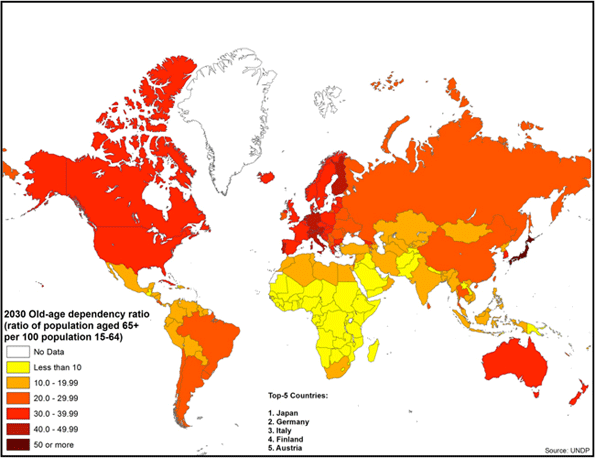
    This scenario is already a reality in Japan and much of the European continent, including Greece, Spain, Portugal, much of Eastern Europe, Scandinavia and Germany. Adults over the age of 65 make up more than 20% of these countries’ populations — compared with 15% in the U.S. —  and their numbers could double by 2030, according to researchers Emma Chen and Wendell Cox.

    In many of these countries, rising debt burdens and shrinking labor markets have already slowed economic growth and suppressed any hope for a major long-term turnaround. The same will happen to even the best-run European economies, just as  it has in Japan, whose decades-long growth spurt ended as its workforce began to shrink.

    By 2030 the weight of an aging population will strangle what’s left of these economies. Germany, Japan, Italy and Portugal, for example, will all have only two workers for every retiree. The U.S. will fare somewhat better, with closer to three workers per retiree. By 2030 the median age  will also be higher in China and Korea than in the U.S. This  age difference will grow substantially by 2050, according to the Stanford Center on Longevity.

    The biggest impact of aging, however, will not occur in northern Europe and Japan, where there may be enough chestnuts hidden away to keep the aged fed, but in Asia. In the next few decades, South Korea, Taiwan, Singapore, Thailand, and even Indonesia will start following Japan into the wheelchair stage of their demographic histories. These are not quite rich places like China and Brazil, which still lack the wealth and a developed welfare state to take care of the elderly Although not headed directly to European or Japanese rates of aging, these countries will experience a doubling of their Old Age Dependency Ratios; both will rise slightly above current U.S. levels by 2030.

    In China, the one-child policy could be used to explain this phenomenon, but this hardly accounts for declining birthrates and rapid aging in countries such as Iran, Mexico or Brazil. Other factors — urbanization, a secular society and upwardly mobile women — also appear to be playing an important role.

    Of course, the populations in most developing countries will still grow, but more due to longer lifetimes than a surfeit of new births.  But projections are often wrong, and their demographic trajectory may slow down more than now predicted.

    The one region expected to continue growing is Africa. Some countries, like Nigeria and Tanzania, are expected to more than double or even triple their current populations by 2050. But as Africa urbanizes and develops, it may eventually experience the same unexpected decline in fertility  we already see in Islamic Iran, multi-cultural Brazil  or throughout east Asia.

    Largely left out of the analysis may well be the next big demographic phenomenon: the rise of childlessness. We have already seen how the move in developing countries from six kids or more per household has reduced population growth. In a similarly dramatic way  the shift towards zero children, particularly in wealthier countries could have unforeseen lasting consquences. After all, with two children, or even with one kid, there’s the possibility of two or more grandchildren. With no children, it’s game over — forever.

    Of course, there have always been unmarried people and childless people; some by necessity or health reasons, others by choice. But now a growing proportion of young child-bearing age women in countries as diverse as Italy, Japan and Taiwan are claiming  no intention of having even one child. One-third of Japanese women in their 30s are unmarried, and similar trends are developing in other Asian countries.

    Life without marriage, and children, has also become the rage among a large proportion of the cognoscenti even in historically procreation-friendly America. Whether it’s because men are seen as weak, or children too problematical, traditional families could erode further in the decades ahead.

    The chidlessness phenomenon stems largely from such things as urbanization, high housing prices, intense competition over jobs and the rising prospects for women. The secularization of society — essentially embracing a self-oriented prospective — may also be a factor.

    If this trend gains momentum, we may yet witness one of the greatest demographic revolutions in human history. As larger portions of the population eschew marriage and children, today’s projections of old age dependency ratios may end up being wildly understated.  More important, the very things that have driven human society from primitive time — such as family and primary concern for children — will be shoved ever more to the sidelines. Our planet may be less crowded and frenetic, but, as in many of our child-free environments, a little bit sad and lot less vibrant.

    Our future may well prove very different from the Malthusian dystopia widely promoted in the 1960s and still widely accepted throughout the media. With fewer children and workers, and more old folks, the “population bomb” end up being more of an implosion   than an explosion.

    This piece originally appeared at Forbes.com.

    Joel Kotkin is executive editor of NewGeography.com and is a distinguished presidential fellow in urban futures at Chapman University, and an adjunct fellow of the Legatum Institute in London. He is author of The City: A Global History. His newest book is The Next Hundred Million: America in 2050, released in February, 2010.

    Photo "Nursery Cart" by flickr user Pieterjan Vandaele

  • HELP WANTED: The North Dakota Boom

    The nation’s unemployment rate has been hovering at nearly nine percent since 2009. But not every state is suffering an employment crisis. In the remote, windswept state of North Dakota, job fairs often bustle with more recruiters than potential workers. The North Dakota unemployment rate hasn’t risen above five percent since 1987.  In the state’s oil country, unemployment hovers at around two percent, and pretty much everyone who wants a job—as long as they are old enough and not incarcerated—is employed.  North Dakota has either tied for or had the lowest unemployment in the country since 2008.   

    The job base of the state (population 672,500) has grown five percent in the past two years. Even more astonishing, there are over 16,000 unfilled jobs, and projections indicate that 45,000 more workers will be needed in the next two years.  Of those jobs, one out of three will be in oil and gas.

    The Booming West

    If you are willing to endure the blazing hot summers and bitterly cold winters, come to western North Dakota, young (or not) man (or woman) and you can get a job. Michael Ziesch has worked with Job Service of North Dakota for the past 15 years and is currently a manager in the Labor Market Information Center. “The average wage in oil and gas is $80,000 plus overtime, and there will likely be plenty of that,” said Ziesch.  Development of the massive Bakken oil field in the western part of the state has tapped out the local workforce.

     If you are not interested in an energy job, consider retail. Employers are paying $15 an hour for convenience store employees and fast food workers. Drive through any community in the area and you will be hard pressed to find a store front devoid of a sign shouting “Help Wanted, Now!” It seems that everything in the state these days ends with an exclamation mark, and for a state filled with unassuming, hardworking, family-centered kind of folks, it’s a little disconcerting.

    New North Dakotans

    Job seekers from outside the state are flocking to Williston, the unofficial capital of the oil boom, located in the remote northwestern corner of North Dakota. The population here has grown from 12,500 to an estimated 22,000 in the past five years.

    Williston is home to 350 oil service companies. Willistonlife.com, an employment and informational website built with the objective of attracting workers to the area, boasts that at any given time, over 1,200 job openings are available in the Williston area alone. On its home page, the website beckons to the nation’s unemployed in large white letters brightly juxtaposed against a black background, “Make Your Move!”

    The wildcat oil culture that the newly arrived encounter, though, is distinctly different than the risk-averse culture of the state. One “New North Dakotan” noted that although long-time residents of the state are pleasant (we smile a lot), helpful (there’s no better place to have a flat tire), kind (we’ll bring you a hot dish if you are sick), and polite (we almost always hold the door open for the person behind us), we are not quite “friendly.” We are a little guarded with folks we didn’t grow up with. Ethnic to us means Norwegian or German. We’re not used to accents other than our own. (And, no, we don’t talk like the actors in the movie Fargo.) One more thing — and this is important — we talk about the weather a lot.

    What should you know before you throw your last $100 in your gas tank and head up to Williston to make cold calls for jobs? Don’t come without a housing plan, or you may find yourself among the hundreds of parking lot denizens, living out of your car.

    New North Dakotans need places to live, creating an enormous construction boom. Williston formerly saw about five new homes a year. So far this year, 2,000 new homes have sprouted up. In 2012, the expectation is for 4,000 more along with apartments, hotels and, outside of town, dormitory-style housing facilities known as ‘man camps’. According to the Williston Herald, since the boom began, the market price of rental housing in Williston has jumped from $300 to $2,000 per month for a modest apartment. Hotels are full and booked for months, charging $170 to $200 a night.  

    Service is hard to come by. Waits of 45 minutes or more are not uncommon at fast-food restaurants. The Dairy Queen closes at 5:00 pm because they can’t retain enough staff to stay open any later, and many small businesses have simply closed their doors for lack of employees. The town’s Wal-Mart doesn’t have enough employees to stock the shelves, so boxes are simply laid open in the middle of the aisles for customers to grab what they need. Locals have discovered a “secret route” into the store to avoid the worst of the incoming traffic, and even the local Luddites have managed to learn how to use the self-checkout lanes as a matter of self-preservation. A professor at Williston State College complained recently that she had to text her husband with a request to pick up clothes hangers while he was out of town visiting relatives because local stores were completely sold out. It’s not only hangers; long lines and low inventory have made running everyday errands a vexing challenge. “It sounds crazy,” this same professor says, “but I order laundry detergent online and have it delivered by UPS to my front door.”

    At Williston State College, faculty often take out their own garbage to help out the strapped maintenance staff.  The school is seeing lower enrollments as students are drawn away from post-secondary education by the lure of instant cash.

    The law of supply and demand has kicked in across all sectors of the community. A severe shortage of contractors, plumbers and electricians means that homeowners wait weeks or even months for simple home projects. The local community college is putting out a second bid for a parking lot because, the first time, they didn’t get any bids at all.

    Even more disturbing in Williston are rumors of impending electricity shortages. Worried about brownouts and blackouts during the long North Dakota winter, many townspeople have picked up generators in Fargo, where they sell for $700, compared to the “sale” price of $1300 in Williston.

    Officials are quick to point out that the state’s larger cities, Bismarck and Fargo, are also thriving. In the Governor’s most recent State of the State address, he posited his explanation of ‘The North Dakota Miracle’: “It is about an educated workforce, low taxation, a friendly regulatory climate.” And if your state happens to be sitting atop 400 billion barrels of oil … hey, it can’t hurt.

    Energy Economics: Boom and Bust

    Oilmen have known for fifty years that beneath North Dakota’s surface lay billions of barrels of oil, perhaps as much as 4 million barrels per square mile.

    In 1952, The Wall Street Journal reported that Williston was receiving a “cornucopia of riches.” Banks were setting new deposit records weekly, and the population had jumped from 7,500 to 10,000.  In the early 1980s, oil prices skyrocketed and the region again became an exploration target as its vast deposits became economically feasible to drill. When prices began to slip, hitting a low of $9 a barrel by 1986, the boom faltered and, even more quickly than it began, it was over. The state spent the later part of the 1990s trying to recover from a brutal bust.

    Today, a perfect storm of two 21st century technologies, hydraulic fracturing and horizontal drilling, along with high prices and unprecedented demand, have come together to make drilling profitable, triggering a new boom that some experts say will be the biggest and longest lasting in the cycle of boom and bust. Conventional wisdom is that this time around the oil boom will be steadier and longer, because oil prices are no longer being defined by the cartels that once controlled the world’s oil prices and, therefore, the economics of energy. In the meantime, the oil pump jacks that dot the skyline are nodding their heads in greeting. Welcome to North Dakota.

    Debora Dragseth, Ph.D. is professor of business at Dickinson State University in Dickinson, North Dakota.

    Photo of Williston, ND traffic jam courtesy of Williston Department of Economic Development.

  • Major Metropolitan Commuting Trends: 2000-2010

    As we indicated in the last article, solo automobile commuting reached an all time record in the United States in 2010, increasing by 7.8 million commuters. At the same time, huge losses were sustained by carpooling, while the largest gain was in working at home, which includes telecommuting. Transit and bicycling also added commuters.  This continues many of the basic trends toward more personalized employment access that we have seen since 1960.

    Solo Automobile Commuting: Among the nation’s 51 metropolitan areas with more than 1 million population, 38 experienced increases in solo automobile commuting between 2000 and 2010. More than 80% of commuting is by solo automobile in 25 of the 51 largest metropolitan areas, with the highest rates being in Birmingham, Detroit, Cincinnati, Indianapolis and Kansas City. Another 28 metropolitan areas have single automobile commute shares of between 70% and 80%, with Boston, Washington and San Francisco between 60% and 70%. As would be expected, the lowest solo automobile commute share was in New York at 51%.

    Car Pools: The national data also showed a nearly 2.4 million loss in carpool use. The losses were pervasive, occurring in all 51 metropolitan areas. Riverside-San Bernardino had the highest carpool market share at just under 15%, while all other major metropolitan areas were below 12%. Car pools have been losing market share for decades.

    Work at Home (Includes Telecommuting): In what we have previously labeled as The Decade of the Telecommute, the nation experienced a 1.7 million increase in working at home over the past decade. The market share gains in working at home were as pervasive as the losses in carpooling, with all 51 metropolitan areas registering increases. Austin had the strongest work-at-home market share, at 7.3%, followed by Portland at 6.5%, San Francisco and Denver at 6.2%, Phoenix at 6.0%, with San Diego, Raleigh and Atlanta above 5.5%. Overall, working at home exceeded transit commuting in 37 major metropolitan areas out of 51 in 2010, up from 27 in 2000. Three metropolitan areas had work at home market shares of less than 3%, including Memphis, New Orleans and last place Buffalo.

    Transit: As noted before, transit enjoyed its first 10 year gain since journey to work data was first collected by the Census Bureau 50 years ago. Overall, transit added 900,000 daily commuters, roughly half that for telecommuters. Transit’s market share increased in 25 of the top 51 metropolitan areas. It is also notable that in a number of the metropolitan areas with the largest expenditures for new rail systems, there were either losses or commuting gains were concentrated in the more flexible bus services.

    New York: As so often has been the case, transit was largely a "New York story." More than one half of the new transit commuters were in the New York metropolitan area, more than 450,000 of the 900,000 increase. New York boasts by far the most extensive transit system in the nation, which serves the second largest central business district in the world and by far the nation’s most important. In 2000, New York had a transit work trip market share of 27.4%. By 2010, New York’s transit work trip market share had risen to 30.7%, more than double that of any other metropolitan area. More than 70% of the new transit commuters in the New York area were on its subway (Metro), suburban rail and light rail systems.

    San Francisco: San Francisco retained its position as the second strongest transit metropolitan area, with a 14.6% work trip market share in 2010. This is up from 13.8% in 2000.

    Washington: Washington was the third strongest transit commuting market, with a 14.0% work trip market share in 2010. This modest increase from 13.4% nonetheless produced the second largest ridership increase in the nation, at more than 130,000. This reflects the strength of Washington’s job market over the decade. Rail ridership accounted for 53% of this increase, while buses accounted for the other 47%.

    Boston and Chicago: Boston passed Chicago to become the fourth strongest transit market, at 11.8% in 2010. This is an increase from 11.2% in 2000. Chicago ranked fifth at 11.2%, a small reduction from the 11.3% in 2000.

    Los Angeles: Los Angeles had the third largest increase in transit commuting, adding 60,000 daily transit commuters. Approximately 75% of these new commuters were attracted by the region’s extensive bus system as opposed to its very expensive but limited rail system. This increase placed Los Angeles in a virtual tie with Portland, with a work trip market share of 6.2%.

    Portland: Portland continued to experience its now 30 year transit market share erosion, despite having added three new light rail lines between 2000 and 2010. Portland’s transit work trip market share fell to 6.2% from 6.3% and now trails the work at home and telecommute market share of 6.5%.

    Seattle:Seattle added 29,000 new transit commuters for the fourth strongest growth in the nation. Approximately 75% of the new commuters were on the metropolitan area’s bus system.

    Atlanta: Atlanta, which is home to the third largest postwar Metro system in the nation (MARTA) gained nearly 9000 new transit commuters, all of them on the bus, while losing more than 3000 rail commuters.

    Miami:Miami added 16,000 new transit commuters, though more than 90% were attracted to the bus system, rather than the rail services.

    Rail and Bus in Texas: Other metropolitan areas with new and expanded rail systems did not fare as well. In Dallas-Fort Worth, the light rail system was more than doubled in length, yet there was a reduction of more than 3000 daily transit commuters. The transit work trip market share in Dallas-Fort Worth dropped from 1.8% to 1.4%, approximately one quarter lower than that of any other major metropolitan area with a new light rail or Metro system. Houston, which built its first light rail line during the period, lost nearly 3000 daily transit commuters, with its transit work trip market share dropping by nearly one-third, from 3.2% to 2.3%. By contrast, the third largest metropolitan area in Texas, San Antonio, lost no commuters from its bus only transit system.

    Other New Rail Metropolitan Areas: Other metropolitan areas with new rail systems experienced modest ridership increases, with 60 to 70 percent of the increase on the bus systems in Charlotte, Minneapolis-St. Paul and Phoenix. Salt Lake City experienced a small decline in transit commuting.

    Below 1 Percent: Four metropolitan areas had transit work trip market shares of less than 1%, including Indianapolis, Raleigh, Birmingham and last place Oklahoma City, with a market share of 0.4%.

    Bicycles: It was also a good decade for bicycle commuting, with the national increase of nearly 250,000. The bicycle commuting market share rose in 45 of the 51 largest metropolitan areas. Portland had the highest bicycle market share at 2.2%, with three other metropolitan areas at 1.5% or above, Sacramento, San Francisco and San Jose. The lowest bicycle commuting market shares were in San Antonio, Cincinnati, Birmingham and Memphis, all at 0.1 percent.

    Walking: There was little change in walking among the nations major metropolitan areas. The largest shares were in New York (5.9%) and Boston (5.4%), with the smallest shares in Raleigh (1.1%), Orlando (1.1%) and Birmingham (1.0%).

    Drifting Away from Shared Commuting: In some ways, the 2000s were different than previous decades, especially with the reversals in bicycle commuting and transit. However, overall, shared ride commuting (transit and car pools) lost share due to the precipitous decline in car pooling. Longer term share increase trends also continued in single-occupant automobile commuting and working at home. The bottom line: personal employment access (personal mobility plus working at home) continues to carve away at the smallish share still held by shared commuting.

    ————-

    Data: The 2000 and 2010 commuting market shares by mode are shown in Tables 1 and 2 (2010 metropolitan area boundaries).

    ————

    Table 1
    Work Trip Market Share: 2000
    Metropolitan Areas Over 1,000,000 Population in 2010
    Metropolitan Area Car, Truck or Van: Alone Car/Van Pool Transit Bicycle Walk Other Work at Home (Includes Telecommute)
    Atlanta 77.0% 13.7% 3.4% 0.1% 1.3% 1.1% 3.5%
    Austin 76.5% 13.7% 2.5% 0.6% 2.1% 1.1% 3.6%
    Baltimore 75.5% 11.5% 5.9% 0.2% 2.9% 0.9% 3.2%
    Birmingham 83.3% 12.0% 0.7% 0.1% 1.2% 0.7% 2.1%
    Boston 71.1% 8.6% 11.2% 0.5% 4.6% 0.8% 3.3%
    Buffalo 81.7% 9.4% 3.3% 0.2% 2.7% 0.5% 2.1%
    Charlotte 80.7% 12.8% 1.4% 0.1% 1.2% 0.8% 2.9%
    Chicago 70.4% 11.0% 11.3% 0.3% 3.1% 1.0% 2.9%
    Cincinnati 81.3% 10.1% 2.8% 0.1% 2.3% 0.6% 2.7%
    Cleveland 81.3% 8.8% 4.1% 0.2% 2.2% 0.6% 2.7%
    Columbus 82.1% 9.7% 2.1% 0.2% 2.3% 0.6% 3.0%
    Dallas-Fort Worth 78.7% 13.9% 1.8% 0.1% 1.5% 1.0% 3.0%
    Denver 76.0% 11.7% 4.4% 0.4% 2.1% 0.8% 4.6%
    Detroit 84.7% 9.2% 1.7% 0.1% 1.4% 0.6% 2.2%
    Hartford 82.6% 8.7% 2.8% 0.2% 2.5% 0.6% 2.6%
    Houston 77.0% 14.3% 3.2% 0.3% 1.6% 1.1% 2.5%
    Indianapolis 82.8% 10.4% 1.3% 0.2% 1.7% 0.7% 3.0%
    Jacksonville 80.3% 12.6% 1.3% 0.5% 1.7% 1.4% 2.3%
    Kansas City 82.6% 10.6% 1.2% 0.1% 1.4% 0.7% 3.5%
    Las Vegas 74.6% 14.7% 4.4% 0.5% 2.3% 1.3% 2.3%
    Los Angeles 71.9% 14.6% 5.6% 0.7% 2.7% 1.0% 3.5%
    Louisville 81.8% 11.2% 2.0% 0.2% 1.7% 0.7% 2.5%
    Memphis 80.7% 13.3% 1.6% 0.1% 1.3% 0.9% 2.2%
    Miami-West Palm Beach 77.3% 13.1% 3.2% 0.5% 1.7% 1.2% 3.1%
    Milwaukee 79.7% 9.9% 4.2% 0.2% 2.9% 0.6% 2.6%
    Minneapolis-St. Paul 78.3% 10.0% 4.4% 0.4% 2.4% 0.6% 3.8%
    Nashville 80.5% 13.1% 0.8% 0.1% 1.5% 0.8% 3.2%
    New Orleans 72.9% 14.6% 5.4% 0.6% 2.7% 1.3% 2.4%
    New York 52.7% 9.3% 27.4% 0.3% 6.0% 1.5% 2.9%
    Oklahoma City 81.6% 12.1% 0.5% 0.2% 1.7% 1.0% 2.9%
    Orlando 80.6% 12.1% 1.6% 0.4% 1.3% 1.1% 2.9%
    Philadelphia 73.1% 10.2% 8.9% 0.3% 3.9% 0.7% 2.9%
    Phoenix 74.6% 15.3% 1.9% 0.9% 2.1% 1.4% 3.7%
    Pittsburgh 77.5% 9.8% 5.9% 0.1% 3.6% 0.6% 2.5%
    Portland 73.1% 11.5% 6.3% 0.8% 2.9% 0.8% 4.6%
    Providence 80.7% 10.5% 2.4% 0.2% 3.3% 0.8% 2.2%
    Raleigh 80.8% 12.1% 0.9% 0.2% 1.6% 1.0% 3.5%
    Richmond 81.7% 10.9% 1.9% 0.2% 1.8% 0.8% 2.7%
    Riverside-San Bernardino 73.5% 17.6% 1.6% 0.5% 2.2% 1.2% 3.5%
    Rochester 81.7% 9.1% 2.0% 0.2% 3.5% 0.6% 2.9%
    Sacramento 75.3% 13.5% 2.7% 1.4% 2.2% 0.9% 4.0%
    Salt Lake City 76.0% 13.4% 3.3% 0.5% 2.1% 0.7% 4.0%
    San Antonio 76.2% 14.9% 2.7% 0.1% 2.4% 1.2% 2.6%
    San Diego 73.9% 13.0% 3.3% 0.6% 3.4% 1.4% 4.4%
    San Francisco-Oakland 62.8% 12.7% 13.8% 1.1% 3.9% 1.3% 4.3%
    San Jose 77.2% 12.4% 3.4% 1.2% 1.8% 0.9% 3.1%
    Seattle 71.6% 12.7% 7.0% 0.6% 3.1% 0.8% 4.2%
    St. Louis 82.5% 10.0% 2.2% 0.1% 1.7% 0.6% 2.9%
    Tampa-St. Petersburg 79.7% 12.4% 1.3% 0.6% 1.7% 1.2% 3.1%
    Virginia Beach-Norfolk 78.8% 12.1% 1.7% 0.3% 2.7% 1.6% 2.7%
    Washington 67.5% 13.4% 11.2% 0.3% 3.0% 0.9% 3.7%
    Top 51 Metropolitan Areas 73.2% 11.8% 7.5% 0.4% 2.9% 1.0% 3.2%
    Calculated from Census Bureau data
    Metropolitan areas as defined in 2010
    Table 2
    Work Trip Market Share: 2010
    Metropolitan Areas Over 1,000,000 Population in 2010
    Car, Truck or Van: Alone Car/Van Pool Transit Bicycle Walk Other Work at Home (Includes Telecommute)
    Atlanta 77.6% 10.3% 3.4% 0.2% 1.3% 1.5% 5.8%
    Austin 75.6% 10.5% 2.3% 0.6% 1.9% 1.8% 7.3%
    Baltimore 76.5% 9.6% 6.0% 0.2% 2.6% 1.0% 4.1%
    Birmingham 84.8% 10.0% 0.6% 0.1% 1.0% 0.5% 3.1%
    Boston 69.5% 7.5% 11.8% 0.7% 5.4% 0.8% 4.4%
    Buffalo 82.0% 7.5% 3.8% 0.3% 3.0% 1.1% 2.3%
    Charlotte 80.6% 10.0% 2.0% 0.2% 1.5% 0.6% 5.1%
    Chicago 71.0% 8.5% 11.2% 0.6% 3.1% 1.0% 4.5%
    Cincinnati 84.1% 7.9% 2.1% 0.1% 2.0% 0.4% 3.4%
    Cleveland 82.3% 7.2% 3.6% 0.3% 2.2% 0.7% 3.7%
    Columbus 82.4% 8.0% 1.7% 0.5% 2.3% 0.6% 4.6%
    Dallas-Fort Worth 81.3% 10.1% 1.4% 0.2% 1.2% 1.4% 4.6%
    Denver 76.3% 9.6% 4.1% 0.8% 1.9% 1.1% 6.2%
    Detroit 84.6% 8.5% 1.5% 0.2% 1.4% 0.8% 3.0%
    Hartford 81.5% 7.9% 3.1% 0.3% 3.0% 1.0% 3.2%
    Houston 79.4% 11.5% 2.3% 0.3% 1.4% 1.7% 3.4%
    Indianapolis 83.9% 8.2% 0.9% 0.3% 1.5% 0.8% 4.3%
    Jacksonville 82.5% 8.9% 1.0% 0.5% 1.4% 1.2% 4.5%
    Kansas City 83.7% 8.5% 1.2% 0.2% 1.4% 0.9% 4.1%
    Las Vegas 78.9% 10.5% 3.8% 0.6% 1.6% 1.3% 3.3%
    Los Angeles 73.5% 10.7% 6.2% 0.9% 2.6% 1.2% 5.0%
    Louisville 83.5% 9.2% 1.9% 0.2% 1.3% 0.9% 3.1%
    Memphis 83.6% 10.3% 1.0% 0.1% 1.5% 0.9% 2.7%
    Miami-West Palm Beach 78.8% 9.4% 3.5% 0.6% 2.0% 1.4% 4.4%
    Milwaukee 80.1% 9.3% 3.4% 0.5% 2.6% 0.7% 3.4%
    Minneapolis-St. Paul 78.3% 7.9% 4.8% 0.7% 2.4% 0.9% 4.9%
    Nashville 81.3% 10.7% 1.0% 0.2% 1.2% 1.0% 4.6%
    New Orleans 78.1% 11.0% 3.2% 0.7% 2.6% 1.9% 2.5%
    New York 50.5% 6.8% 30.7% 0.5% 5.9% 1.6% 3.9%
    Oklahoma City 82.7% 10.6% 0.5% 0.3% 1.6% 1.0% 3.4%
    Orlando 82.1% 9.2% 1.6% 0.3% 1.1% 1.4% 4.4%
    Philadelphia 73.9% 8.0% 9.6% 0.5% 3.5% 0.8% 3.8%
    Phoenix 76.7% 11.8% 2.0% 0.6% 1.5% 1.5% 6.0%
    Pittsburgh 77.0% 8.9% 5.6% 0.3% 3.7% 0.9% 3.5%
    Portland 72.1% 8.8% 6.2% 2.2% 3.3% 0.9% 6.5%
    Providence 81.3% 8.3% 2.6% 0.5% 3.2% 0.9% 3.2%
    Raleigh 82.0% 8.7% 0.9% 0.3% 1.1% 1.1% 5.9%
    Richmond 81.2% 10.1% 1.8% 0.4% 1.2% 0.7% 4.6%
    Riverside-San Bernardino 76.1% 14.8% 1.7% 0.4% 1.8% 1.4% 3.8%
    Rochester 82.6% 7.1% 1.8% 0.4% 3.9% 0.7% 3.6%
    Sacramento 75.6% 11.2% 2.9% 1.7% 1.9% 1.1% 5.5%
    Salt Lake City 77.7% 11.3% 2.9% 0.8% 2.3% 1.0% 4.0%
    San Antonio 79.5% 11.5% 2.1% 0.1% 2.0% 1.4% 3.3%
    San Diego 76.2% 10.1% 3.3% 0.8% 2.8% 1.0% 5.9%
    San Francisco-Oakland 61.5% 10.6% 14.6% 1.7% 4.2% 1.2% 6.2%
    San Jose 77.5% 10.3% 2.9% 1.6% 1.8% 0.9% 5.1%
    Seattle 70.5% 10.2% 8.2% 1.1% 3.5% 1.0% 5.5%
    St. Louis 83.0% 7.7% 2.6% 0.2% 1.9% 0.8% 3.7%
    Tampa-St. Petersburg 80.3% 9.5% 1.6% 0.8% 1.4% 1.4% 5.0%
    Virginia Beach-Norfolk 80.9% 9.4% 1.8% 0.5% 3.3% 0.9% 3.1%
    Washington 65.6% 10.6% 14.0% 0.5% 3.5% 1.0% 4.9%
    Top 51 Metropolitan Areas 73.7% 9.4% 7.9% 0.6% 2.8% 1.2% 4.4%
    Calculated from Census Bureau data
    Metropolitan areas as defined in 2010

    Wendell Cox is a Visiting Professor, Conservatoire National des Arts et Metiers, Paris and the author of “War on the Dream: How Anti-Sprawl Policy Threatens the Quality of Life

    Photo: Manhattan (New York), with the Woolworth Building in the distance (by author)

  • All in the Family, 2011

    We overheard this phone conversation recently between tea party activist Bill Francis and his 19-year-old daughter and Wall Street occupier Serena: 

    Bill:  I understand why you’re protesting but I think you’re missing the point.

    Serena:  What’s that?

    Bill:  You’re mad at rich people and upset that you can’t get a job.

    Serena:  True.

    Bill: And you think that by camping out on the street you’ll get attention?

    Serena: We’ve already made a difference.

    Bill: Tell me how?

    Serena: The media is talking about our issues.

    Bill: They’re just using you.

    Serena:  So what.

    Bill: Liberals like the idea of class warfare.

    Serena:  You used the media.

    Bill:  We knew what we were doing.

    Serena: You were rude.

    Bill:  We made our point.

    Serena: You called Obama a socialist.

    Bill: He is.

    Serena:  What do you mean by that?

    Bill: He wants the government to run our lives.

    Serena: Who do you think is running your life now?

    Bill: That’s the point.  We want to control our own lives.  That’s what being an American means.

    Serena: I think the corporations are in charge and you don’t even realize it.

    Bill: Listen, honey, I can ignore the corporations – I don’t have to buy what they sell.  I can work for anyone I choose.

    Serena: You’re not facing facts.  Corporations and banks are telling politicians what to do.  And they’re moving jobs to other countries.

    Bill: That’s because of taxes.

    Serena:  What’s because of taxes?

    Bill: Jobs leaving the country.

    Serena: Dad, they barely pay any taxes.

    Bill: The point is that they’re free to do business wherever they want.

    Serena: You don’t want to see how much power they have over us.

    Bill: I agree there’s corruption.

    Serena: And greed.

    Bill:  That’s human nature.

    Serena:  Now you’re going to tell me that corporations are people.

    Bill: I just don’t like that you’re sleeping in a tent every night, that’s all.

    Serena:  Don’t worry Dad, I’m safe.  You taught me to take care of myself.

    Bill: I still don’t understand what you’re trying to accomplish.

    Serena:  We’ll figure it out as we go.

    Bill: But, anyway, as long as you’re coming home to take showers and wash your clothes, I suppose it’s o.k.

    Serena: Got to go.  Love you dad.

    Bill: Love you too honey.

    This first appeared at LaborLou.com.

  • America’s Demographic Opportunity

    Among the world’s major advanced countries, the United States remains a demographic outlier, with a comparatively youthful and growing population. This provides an unusual opportunity for America’s resurgence over the next several decades, as population growth elsewhere slows dramatically, and even declines dramatically, in a host of important countries.

    This demographic vitality, however, can only work if there is substantive increase in the economic growth rate and particularly in employment. A growing population brings new entrants into the labor force at a rapid rate. Historically, a relatively positive relationship between workforce entrants and dependents, both old and young, has generated waves of growth across the past several decades. This is widely known as “the demographic dividend.”

    In the 1950s and 1960s, a relatively youthful population helped drive rapid economic growth first in Europe and then in Japan. By the 1970s, this “youth bulge” shifted to developing nations of east Asia, notably Singapore, South Korea, Malaysia and Indonesia. China experienced this surge in workers in the 1980s and 1990s. More recently, the big winners in youth demographics could be found in countries such as Vietnam, Turkey and Brazil.

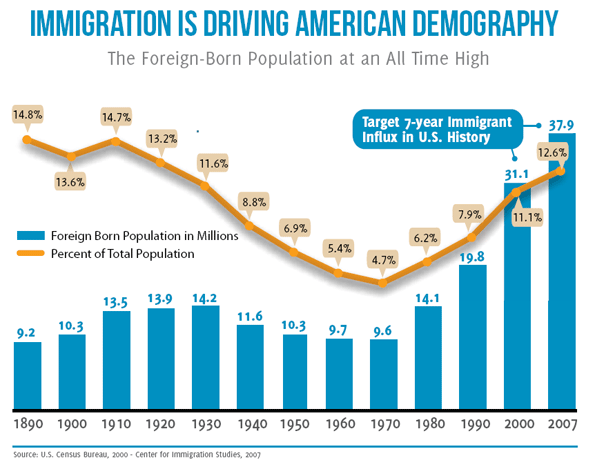
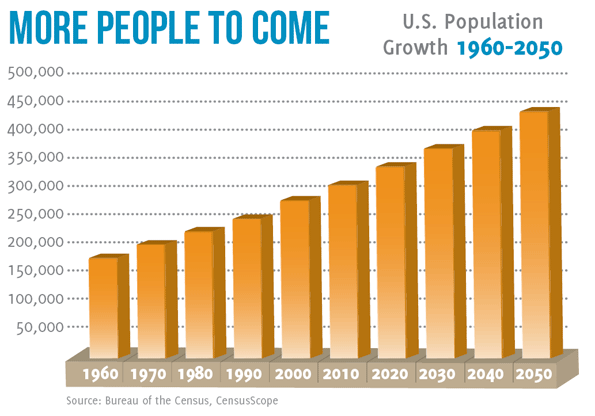
    Yet remarkably throughout this period, the United States has retained its relative youthfulness. The last census showed the nation experienced 10 percent population growth over the first decade of the 21st Century, with a final count approaching 310 million people. This is in large part a product both of immigration and higher birthrates.

    Today, the U.S. fertility rate of over two children per woman remains as much as twice as high as many countries, including Russia, Germany, Japan, Italy, Singapore and Korea. As a result, according to U.S. census projections, the United States will continue to grow to upwards of 420 million by 2050.

    In contrast, the populations of longterm competitors among advanced countries—including the European Union, Japan and Russia—are all expected to stagnate and then decline. Japan is a particularly hard case. Its fertility rate has dropped by a third since 1975. By 2015, a full quarter of the Japanese population will be over 65. Generally inhospitable to immigrants, Japan could see its population drop from a current 127 million to 95 million by 2050, with as much as 40 percent of the population over 65 years of age. By then, no matter how innovative the workforce, Dai Nippon will simply be too old to compete.

    To a large extent, Europe shares this dilemma. By 2050, Europe’s population, now numbering 730 million people, will shrink by 75 to 100 million. Italy’s population alone is slated to drop by 22 percent, while Poland’s will be reduced to 15 percent.

    Due to the one child policy and rapid urbanization, China’s population growth is also expected to slow significantly in coming years while the proportion of seniors soars. In the longer run, population growth will be stymied by a large surplus of boys over girls. As a result, notes demographer Nicholas Eberstadt, more than 25 percent of men in their late 30s by 2030 are likely never to marry.

    Perhaps even more challenged will be Russia, whose low birth and high mortality rates suggest that its population will drop 30 percent by 2050 to less than one-third of that of the U.S. Even Prime Minister Vladimir Putin has spoken of "the serious threat of turning into a decaying nation."

    Russia’s de facto tsar has cause for concern. Throughout history, low fertility and socioeconomic decline have been inextricably linked, creating a vicious cycle that affected once-vibrant civilizations such as ancient Rome and 17thcentury Venice.

    Within the next four decades, most of the developed countries in East Asia, as well as Europe, will become veritable old-age homes: A third or more of their populations will be over 65. The U.S. will also have to cope with an aging population and lower population growth. Comparatively speaking though, the U.S. will maintain a relatively youthful, dynamic demographic. In comparison, the percentage of the population over 65 will be only one in five in the United States.

    The reasons for this divergence with other advanced countries likely includes such things as continuing immigration, greater space, larger houses, a strong aspirational culture and a higher degree of religious affiliation. Whatever the cause, a younger demography could lead to a relatively brighter future for America than is now commonly assumed.

    In the near future, the U.S. could reap a potential critical advantage from a particularly large baby ‘boomlet’ among the Millennial generation, the children of the boomers. This next surge in population may be delayed if tough economic times continue, but over time it will translate into a growing workforce, sustained consumer spending and produce a youthful population likely to push innovation.

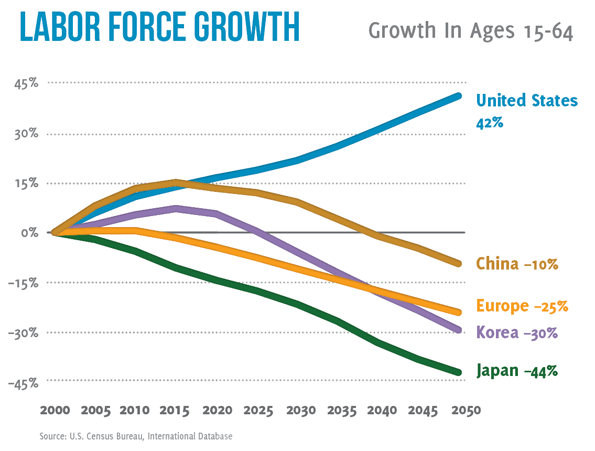
    The most critical shift will be in the growth of the American workforce which is expected to grow by over 40 percent between 2000 and 2050. In contrast, during the same period the number of entrants to the labor pool will decline by 25 percent in the European Union and Korea and plummet over 40 percent in Japan.

    Due to the rapid aging of China’s population, largely due to the impacts of urbanization, that emerging superpower’s workforce is expected to decline by 10 percent. These demographics suggest a far more difficult future for all these countries, as fewer workers support ever-growing numbers of retirees. China’s lack of an established social welfare system makes this transition even more problematic.

    Persistently low birthrates and sagging population growth inevitably undermine the growth capacity of an economy. In large part due to demographic forces, by 2050 Europe’s economy could be half that of the United States’ economy.

    Even frugal Germany, by far Europe’s strongest economy, can expect its growth to be constrained by ever higher spending on seniors and a diminished workforce. By 2030, notes demographer Nicholas Eberstadt, Germany’s public debt will exceed 200 percent of GDP, with annual debt service accounting for 10 percent of GDP. To put this in perspective, that’s nearly twice Greece’s current burden of debt service.

    Other negative consequences of an aging and stagnant (or declining) population are less tangible, but no less real. Similarly, it is generally younger workers who drive innovation. Children provide a large consumer market and push their parents to work harder. By having children, people also make a commitment to the future for themselves, their communities and their country.

    In contrast, a largely childless society generally produces other attitudes. It tends to place greater emphasis on leisure activities over work. It also promotes a shift away from a focus on future growth and toward paying pensions for the aging. An aging society is likely to resist risky innovation or infrastructure investments meant to serve future generations.

    Yet in the immediate future, population and labor force growth present us with enormous challenges. Perhaps the greatest challenge in this era of economic stagnation lies in providing employmen—and adequate education—to a growing workforce. One cause of the U.S.’s persistently high unemployment and underemployment lies in the rapid expansion of the workforce from the large baby boom “echo” or Millennial generation.

    This growing workforce means the country needs to create 250,000 new jobs a month—twice what we produce in a “good” month today—just to stay even. Younger Americans may be unemployed at rates similar to their European counterparts, but in Europe the labor force will be shrinking. For the US to take advantage of its demographic dividend, we need to create the kind of rapid economic growth that sparks widespread job creation.

    One possible, if unpalatable, alternative to meeting the growth challenge would be for the US to follow the path of demographic decline well under way in Europe and Japan. American birthrates, which were rising during the first part of the 2000s, have fallen with the recession and could conceivably become permanently depressed—as occurred in the 1930s—if prospects for economic growth fade.

    A weaker economy could also slow immigration, which has been one of the main causes for the country’s relatively favorable demographics. Roughly one-quarter of all the country’s elementary school students are either immigrants or the children of immigrants. Overall, Mexican immigrants, the largest group coming to the country, average 2.5 children per family compared to 1.8 to their Caucasian counterparts.

    Immigrants, particularly from Mexico, have been hard-hit by the recessions, in large part due to declines in construction and manufacturing where their losses have been higher than native-born Americans. This, not surprisingly, has created diminishing immigration levels across the country.

    Overall, migrants leaving Mexico, both legally and illegally, have dropped by more than two-thirds since 2005, according to that country’s census. Illegal immigration, according to the Pew Center, has fallen even more precipitously, from over 500,000 in 2000- 2004 to barely 100,000 in 2010. This pattern may continue in part due to lower birthrates in Mexico itself—where the average family size has decline from 6.8 children to barely 2.0—and by improving economic conditions.

    A drop-off in immigration from Mexico and elsewhere could be particularly problematic for cities such as New York or Los Angeles, long reliant on newcomers to make up for high levels of domestic outmigration. Already, migration to these cities is roughly 50 percent below the levels in 2000. In 2001, for example, New York welcomed almost 160,000 newcomers; in 2009, that number had dropped to barely 100,000.

    If tough times continue, these levels could drop even further, with profound consequences. Immigrants, for example, fuel much of the urban workforce.

    In Los Angeles, where immigration dropped by 40,000 annually over the past decade, immigrants constitute roughly half the total of those employed.

    Perhaps even more importantly, these immigrants have become critical to creating the kind of grassroots capitalism necessary to create jobs. In the last decade, largely immigrant populations such as Hispanics and Asians expanded their number of businesses at 50 percent higher rates than the overall average. According to the Kaufmann Foundation, the immigrant share of all new startups doubled from 14 percent in 1996 to 29 percent in 2010.

    The future of these new businesses could now be clouded both by diminishing immigration as well as stirring antiimmigrant sentiment. It is perhaps too early to know if strict controls on illegal immigration—enacted in states such as Georgia and Arizona—will slow down migration to other metropolitan regions but this has to be considered as a possibility. Ironically, many of these same areas have been those that were becoming increasingly attractive to newcomers escaping high housing costs in traditional coastal urban magnets.

    Another potential threat to America’s demographic vitality lies in the potential imposition of strong controls on suburban housing development. This is a policy widely supported among Administration officials and their green allies. In places like coastal California where such policies are already in place, housing prices remain artificially elevated, driving large numbers of young families into the interior and further out to other states.

    Generally speaking, people are far more likely to have children in singlefamily homes than in apartment complexes. These potential families also may be impacted by rising tax rates and fiscal burdens, particularly at the state and local levels. Without strong economic growth, it’s difficult to see how even the current level of public education—which is paltry, at best—can be maintained.

    Already poor schools in cities constitute a major reason why so many “young and restless” move from cities to suburbs; but if suburban education also declines, they may be left to send their children to private schools as well. It is logical to assume that, once forced to pay for schools, many parents will become hesitant to have multiple offspring.

    Yet ultimately the question of demographics—and its close link to the need for economic growth—represents a kind of existential question for civilizations. This is understood by some in Europe and Japan, where there have been attempts to increase benefits for families as concerns over demographic declines have grown.

    But can policy really change a society that is falling into demographic decline? So far state measures to encourage child-bearing have failed in a host of countries in both Europe and Asia. One possible solution for Europe, immigration, is now being curbed largely due to fears connected to people of Islamic heritage.

    Similarly, it is difficult to imagine how historically homogeneous China, Korea or Japan would be willing to accommodate large numbers of newcomers. Among the advanced Asian countries, only Singapore, with one of the world’s lowest birth rates, has contemplated using immigrants to stabilize workforce growth and prevent a process of hyper-aging.

    Some in the U.S., particularly on the far right, also oppose greater immigration, in part due to fears of the resultant ethnic shift away from a white majority. In addition, many environmental groups around the world oppose steps to revive birthrates. Some even consider procreation of new carbon-belching citizens as something close to anathema. In Great Britain, Jonathan Porritt, chair of the U.K.’s Sustainable Development Commission has advocated cutting the island’s population in half as a way to reduce global greenhouse gases.

    For their part, some America greens have expressed concern over our country’s relative fecundity. Groups like the Center for Biological Diversity and Greenpeace seek to see a cut in our slightly above replacement level birthrate.

    These pressures, as well as persistently low economic growth, could lead America into a Japanese or European style demographic decline. A growing population may create great environmental and economic challenges, but it seems clear that a scenario of persistent decline and rapid aging presents a far worse prospect.

    This piece originally appeared in Business Horizon Quarterly, published by the National Chamber Foundation.

    Joel Kotkin is executive editor of NewGeography.com and is a distinguished presidential fellow in urban futures at Chapman University, and an adjunct fellow of the Legatum Institute in London. He is author of The City: A Global History. His newest book is The Next Hundred Million: America in 2050, released in February, 2010.