Blog

  • Surprise: Higher Gas Prices, Data Shows More Solo Auto Commuting

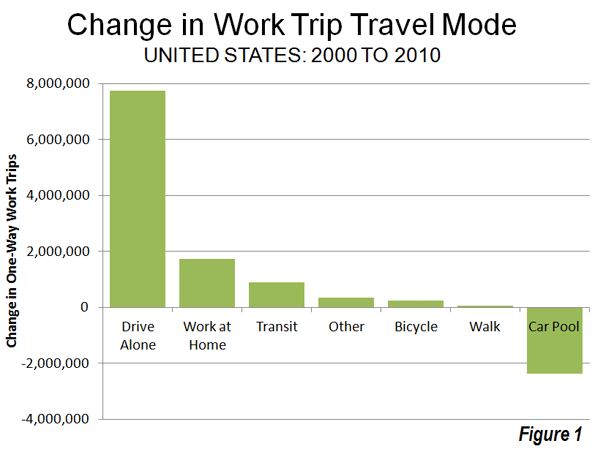
    Despite higher prices and huge media hype over shifts to public transit, the big surprise out of the 2010 American Community Survey has been the continued growth over the last decade in driving alone to work. Between 2000 and 2010, driving alone to work increased by 7.8 million out of a total of 8.7 million increase in total jobs. As a result, this use of this mode reached 76.5% of the nation’s workers, up from 75.6% in 2000. This is the largest decadal share of commuting ever achieved for this mode of transport.

    In view of the much higher gasoline prices that prevailed in 2010, it might have been expected that driving alone would lose market share from 2000 (Figure 1). But this did not — despite many media and academic claims that would or was already taking place — occur.
    The Census Bureau began compiling data on commuting in the 1960 census. In each census through 2000, commuting data was obtained through the census "long form" questionnaire. During the last decade, however, the Census Bureau has begun an annual survey, the American Community Survey, which includes commuting data and a considerable amount of additional data, and the decennial census survey was discontinued.

    Cars Dominate: There have been substantial changes in how the nation travels since the first survey in 1960. In 1960, 64% of the nation’s workers traveled by car. Separate data was not obtained for driving alone and carpools until 1980. The 2010 data indicates that 86.2% of employees used cars for the work trip in 2010. This was a slight reduction from 87.9% in 2000. But the anti-automobile crowd should not celebrate; all of the loss was due to a substantial decline in carpooling. In 2000, 12.2% of workers traveled by car pool. This figure dropped to 9.7% in 2010. With the higher gas prices, it might have been expected that carpooling would have become more popular, because of the lower costs from sharing experiences with other workers. This simply did not occur.

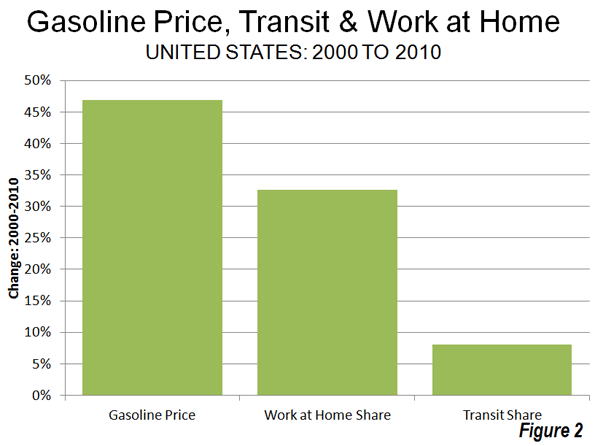
    Working at Home: The big winner among the nation’s commuting modes was working at home, a large share of which is telecommuting. Working at home increased from 3.3% of the workforce in 2000 to 4.3% of the workforce in 2010, for a market share increase of 33%, Overall 1.7 million more people work at home in 2010 than in 2000. It seems likely that the high gas prices encouraged a more working at home as did the move by companies to offload work to freelancers to reduce their costs or boost efficiency. Over the decade, gas prices increased 46%, adjusted for inflation, while the work at home market share increased 33% (Figure 2).
    Further, working at home, as indicated in a previous article, is poised to become the third most popular method of accessing work before 2020, passing transit and trailing only driving alone and carpooling (see Decade of the Telecommute). Working at home might have been much more popular in 1960, when it accounted for 7.2% of employment. But as many home-based industries lost share to chains and malls,   this figure fell by more than one-half by 1970 and then fell to 2.2% in 1980. The doubling of the work at home market share since that time, on the other hand, is attributable to the advances in information technology.

    Transit: Transit experienced by far its best decade since the Census Bureau began tracking commuting. Transit’s long market share slide came to an end, rising from 4.6% in 2000 to 4.9% in 2010. Even so, it might have been expected that a more substantial increase in transit commuting would have occurred as a result of the high gasoline prices. However, only an 8% increase in the transit market share occurred at the same time as gasoline prices increased a real 46%, less in percentage terms than the shift to working at home (Figure 2).

    Part of the problem was revealed in a Brookings Institution report. The percentage of metropolitan area jobs that can be reached by transit for the average worker is very low, which seriously limits transit’s potential for commuting use. Brookings data indicates that less than 10% of the jobs in major metropolitan areas can be reached within 45 minutes by transit by the average worker in major metropolitan areas (see Transit: The 4 Percent Solution). This is not only because transit service is infrequent in many parts of metropolitan areas, but also because it operates so much more slowly, on average, than cars. By comparison, the median work trip travel time by people driving alone is 21 minutes.

    Transit carried 12.1% of the nation’s commuters in 1960 and had fallen to 5.3% by 1990. The results of the last three decades indicate that transit commuting may have stopped declining but has reached a plateau, with only small increase.

    Recent decades have seen establishment and substantial expansion of urban rail systems. A principal rationale for these systems has been reducing traffic congestion, especially during peak hours. The majority of commuting takes place during peak hour and is principally responsible for peak hour traffic congestion. Between 2000 and 2010, Metros (subways and elevated) accounted for 48% of the increase in transit commuting, while buses and a trolley buses accounted for 43%. Light rail (trolleys and streetcars) accounted for less than 2% of the additional transit commuting, despite the fact that light rail has been the dominant form of rail transit expansion (Figure 3).
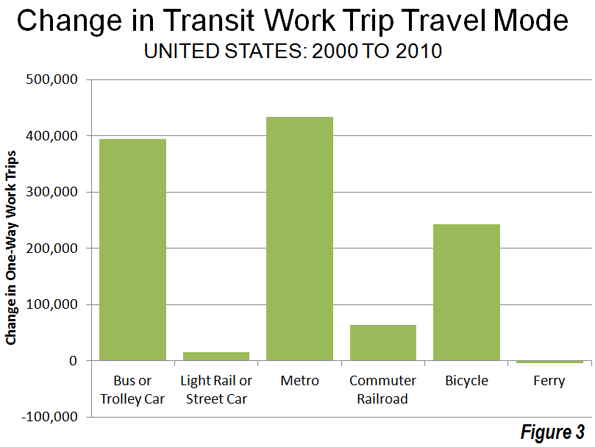
    Bicycling: It was also a good decade for bicycle commuting. Bicycling added nearly 250,000 new commuters and rose from 0.4% of the market in 200 to 0.5% in 2010. The increase in bicycle commuting was 15 times that of light rail. Bicycling was first surveyed by the Census Bureau in the 1980s census, when its market share was also 0.5%.

    Walking: There was little change in walking as a form of commuting. In 2000, 2.9% of commuters walked to work, a figure that dropped to 2.8% in 2010. However, walking has suffered even greater losses than transit over the last 50 years. In 1960, 9.9% of commuters walked to work.

    The Future? One thing is clear from the data of the last decade. There has been no sea-change in commuting, even with the huge gasoline price increases. Few analysts would have predicted that single-occupant commuting would have increased at a time of both high gasoline prices and high joblessness. Further, as the shift to personal mobility continues, the largest percentage increases will like take place in telecommuting, arguably the most energy-efficient form of transport.

    Data from 1960: The table below summarizes work trip access market shares over the 50 years of data collection by the US Census Bureau.

    US Work Access by Mode: 1960-2010
    COMMUTERS 1960 1970 1980 1990 2000 2010
    Car, Truck or Van 41,368,062 59,722,550 81,258,496 99,592,932 112,736,101 118,123,873
    Drove Alone     62,193,449 84,215,298 97,102,050 104,857,517
    Car Pool     19,065,047 15,377,634 15,634,051 13,266,356
    Transit 7,806,932 6,514,012 6,007,728 5,890,155 5,867,559 6,768,661
    Bicycle     468,348 466,856 488,497 731,286
    Walk only 6,416,343 5,689,819 5,413,248 4,488,886 3,758,982 3,797,048
    Other or Unspecified 4401718 2240864 1289613 1225420 1243866 1,595,942
    Work at Home 4,662,750 2,685,144 2,179,863 3,406,025 4,184,223 5,924,200
    Total 64,655,805 76,852,389 96,617,296 115,070,274 128,279,228 136,941,010
               
    MARKET SHARE 1960 1970 1980 1990 2000 2010
    Car, Truck or Van 64.0% 77.7% 84.1% 86.5% 87.9% 86.3%
    Drove Alone     64.4% 73.2% 75.7% 76.6%
    Car Pool     19.7% 13.4% 12.2% 9.7%
    Transit 12.1% 8.5% 6.2% 5.1% 4.6% 4.9%
    Bicycle     0.5% 0.4% 0.4% 0.5%
    Walk only 9.9% 7.4% 5.6% 3.9% 2.9% 2.8%
    Other or Unspecified 6.8% 2.9% 1.3% 1.1% 1.0% 1.2%
    Work at Home 7.2% 3.5% 2.3% 3.0% 3.3% 4.3%
               
    Notes          
    Other includes taxicabs, motorcycles and other
    Blank cells indicate no data
    Taxicab included in transit in 1960
    Workers 14 and over, 1960 & 1970. Workers 16 & over, subsequent censuses
    US Census Bureau data


    Wendell Cox is a Visiting Professor, Conservatoire National des Arts et Metiers, Paris and the author of “War on the Dream: How Anti-Sprawl Policy Threatens the Quality of Life

    Photo: Junction of Interstates 110 (Harbor Freeway) and 105 (Glenn Anderson Freeway) in Los Angeles, which carry four varieties of passenger transport, cars, busway, high-occupancy vehicles and light rail (by author). 

  • How Cities Grow: Dispersion, not Densification

    Analysts occasionally note that urban areas ("cities") are becoming larger and denser. This is only half right. It is true that most of the world’s urban areas are becoming larger, with megacities like Delhi, Jakarta, Shanghai, Beijing and Manila adding more than five million people in the last decade and most other urban areas are growing, but not as fast.

    Understanding Urban Areas: However almost without exception, urban areas are getting less dense. Because there is so much confusion about city "definitions," a clarification is required. The only geography for which overall urban density can be measured is the urban area, which is the area of continuous development. The urban area is not constrained by municipal or other jurisdictional boundaries and does not include rural (undeveloped) territory, even if it is in a "central city" (such as Rome, Ho Chi Minh or Marseille, with their expansive boundaries). An urban area is also different from a metropolitan area, because metropolitan areas (as labor markets) always include rural territory, which is by definition not urban.

    1960-1990 Data: Historical urban population density is not readily available. Kenworthy and Laube were pioneers in this area, publishing estimates from 1960 to 1990 for a number of urban areas. That data indicates density losses in the more than urban areas for which they were able to develop comparable data. The world average decline was 20 percent, ranging from 15 percent in the United States to 29 percent in Europe and 33 percent in Australia. While Tokyo was doubling in population, its population density was dropping 17 percent between 1960 and 1990. While Zurich was adding 21 percent to its population, it was becoming 13 percent less dense.

    Recent Data: The dispersion continues, which is indicated by these high-income world cases:

    Today, the ville de Paris has 700,000 fewer people than at its peak, and inner London (generally the former London County Council area) has lost more than 1,500,000 people since its peak. All growth has been in lower density suburban areas in both the London and Paris urban areas.

    In the United States, urban areas with more than 1,000,000 population more than doubled in population from 1950 to 2000 (2010 data not yet available), while the population density dropped by nearly one-third. Detailed analysis indicates that this trend has continued over the past decade in New York, Los Angeles, Chicago, Dallas-Fort Worth, Seattle, St. Louis and other major US urban areas.

    The dense core city of Seoul has been losing population and all growth has been in the suburbs, which are lower density.

    The dense urban core of Milan has experience substantial population losses, while the less dense suburbs have captured all the growth.

    Dispersion is not limited to high income urban areas, with declining densities in evidence across lower and middle income nations as well. For example:

    Nearly all of the growth in Jakarta has been in the suburbs for the last 20 years, while the core has gained little in population. The net effect is a less dense, but much larger urban area, because the suburbs are not as dense.

    Nearly all of the growth for 30 years in Manila has been in the suburbs, while the core city. Again, the urban area has become much larger, but much less dense because the suburbs are much less dense.

    The dense core of Shanghai has lost population and all growth has been in the suburbs, which are lower density.

    The population in the dense core of Beijing has nearly stopped growing, with nearly all population in the suburbs, which are lower density.

    The core of Mumbai has lost population in two of the last three census periods, while all growth has been in the suburbs, which are lower density.

    The urban core of Mexico City has been declining in population since 1960 and all of the growth has been in the suburbs, which are less dense.

    The dense core city of Buenos Aires has fewer people today than in 1947, while at least 8 million people have been added to nearly 1,000 square miles of lower density suburbs.

    Urban growth continues to be overwhelmingly in less dense suburban areas, rather than in the more dense urban cores, and as a result even as urban areas grow, they become less dense. This is how cities grow.

  • Primatene And The War on (Asthma) Drugs

    On December 31, 2011, Primatene Mist, the only over-the-counter asthma inhaler still available, will be taken off the market. The ban is being pointed to as an example of regulatory overreach by the Obama administration. As a physician and asthma specialist, I have been observing the Primatene controversy for — without exaggeration — decades, and have concluded that there’s blame enough to share between both the pro and con government regulation camps, as well as the pharmaceutical and financial industries.

    The official reason for the ban is the danger Primatene poses to the environment. I have always thought that extending the ban on chlorofluorocarbon propellants (CFCs) to medication was an example of regulatory overkill, because medication is such a small part of the problem. However, it does help to look at the context. Back in 1987, when Ronald Reagan was President and the Montreal Protocol was written, there was international consensus that we needed to do something about depletion of the ozone layer high in the atmosphere, which was causing problems for us here on earth. For many of the products releasing these gasses into the atmosphere — car air-conditioners, hairspray, and deodorant, for example — alternatives could plausibly be found. I wish we could find a way to relieve asthma attacks with a roll-on, but we can’t.

    Medical aerosols were given more time than other products, and, frankly, I don’t think we’ve done a very good job of replacing them. The new inhalers don’t deliver medication as efficiently as Primatene delivers its active ingredient. Still, anyone who looks at the timeline for the upcoming restriction can see that the key decisions were made in 2006 and in 2008. The current administration is following the timetable set by its predecessors.

    The charges of over-regulation have been accompanied by newly expressed sympathies for the plight of poor people with asthma. I think the greater disservice was done recently when stronger air-quality regulations were postponed. The best way to treat asthma is to reduce its incidence, and air quality is one of the biggest factors. It’s unfair to generalize, but I have a feeling that some of the people looking to demonize Big Government for regulating Primatene were also calling tighter air-quality regulations “job-killers” a few weeks ago.

    The best argument against Primatene falls outside of the environmental realm, and that is the medical case. The active agent is epinephrine, which is pharmaceutical adrenaline. This has the ability to relieve the airway tightness produced by an asthma attack, also known as bronchoconstriction. In this, it resembles the action of the preferred asthma-relief medicine known generically as albuterol. However, epinephrine also stimulates the heart. This makes it unsuitable for large numbers of asthmatics who also have heart problems. Most of the people who rely on Primatene are poor, and often overweight and hypertensive. These regular jolts to the heart are not doing them any good.

    In addition, it does nothing to control asthmatic inflammation, which is best accomplished with systematic, daily doses of inhaled corticosteroids, a very different kind of drug. Asthmatic lungs are what British doctors called “twitchy,” i.e., they are chronically inflamed and primed for any asthma trigger, such as diesel fumes, airborne allergens, or viruses, to touch off an attack. Primatene treats symptoms, not causes, and I have no doubt that users miss a lot of work or school and are sub-par performers when they do go. Uncontrolled inflammation is remodeling their airways, costing them lung capacity for the long haul.

    Many who decry the passing of Primatene believe the ban was contrived to squeeze more money out of those who can least afford it. They probably have a point. I would love to see the FDA memos and transcripts from 2006 when the Primatene decision was made, or from 2008 when the fuse was lit, not to mention those of the current owners when they decided to acquire the drug. Even without access to these secrets, we know that drug makers like to tweak existing medicines and bring them back on the market at higher prices than they command over the counter, and that investors sometimes buy up the rights to older drugs with exactly this in mind.

    It doesn’t always work. The next generation drugs are sometimes no improvement over the previous ones. Last year I wrote a post commemorating a landmark: Never before in over 30 years of practice had an entire month passed in which I hadn’t written a prescription for an oral antihistamine. The OTC versions were good, and the new drugs weren’t so much better that they justified prescribing.

    When it comes to asthma, I believe in active intervention. The economics of good asthma care have proven themselves again and again. Want to do something for poor people with uncontrolled asthma? Pay for systematic care. Want to lower the nation’s emergency room bills? Help people control inflammation in their airways through daily use of medication and reducing exposure to triggers. Treating asthma symptoms, whether with Primatene or albuterol, is not asthma treatment, any more than a ride in an ambulance is health care.

    Dr. Paul Ehrlich is co-author with Dr. Larry Chiaramonte and Henry Ehrlich of Asthma Allergies Children: A Parent’s Guide (Third Avenue Books), available only from Amazon.com and from Barnes & Noble. He is co-founder of the website www.asthmaallergieschildren.com, and president of the New York Allergy and Asthma Society. He has been featured as one of the top pediatric allergy and immunology specialists in New York Magazine for the last 10 years.
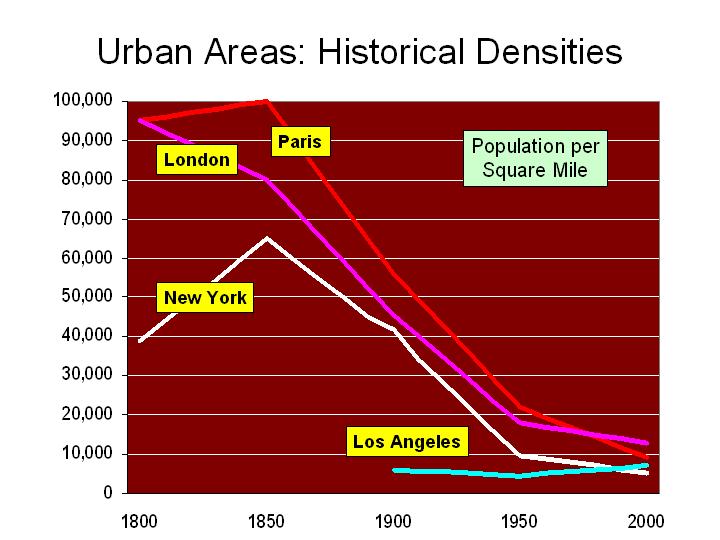
    Photo by eo was taken: Asthma Map

  • Manhattan Moment: Two distinct groups make up ‘Occupy’ protesters

    Strange to say, but there may be something valuable going on among some of the Occupy Wall Street protesters.

    Until now, two narratives have defined both the press coverage and public discussion of the Occupy Wall Street demonstrators camped out in lower Manhattan’s Zuccotti Park.

    The first depicts a collection of buffoonish, semiliterate juveniles engaged in a seeming left-wing version of a college prank. There is, to be sure, something to this story.

    In last week’s Zombie Parade the protesters, giddy with their cleverness, portrayed themselves as the living dead whose lives had been sucked from them by unnamed corporations.

    One of the pre-Halloween costumers was asked why she had chosen to dress up like a zombie who looked like Marie Antoinette, the French queen guillotined by the revolutionaries of 1793. She replied that she had no idea of who Marie Antoinette was but just liked the look of the costume.

    The second narrative sees the protesters as ripe to be harnessed by the labor leaders who hope to tap into their energy on behalf of the Obama 2012 campaign.

    Watching New York Federation of Teachers President Mike Mulgrew prance about, speaking in the name of the protest, you might think Occupy Wall Street had signed on to a campaign to raise teachers’ salaries in a city whose budget shortfalls are already producing layoffs.

    But both of these explanations presume that there is a single, largely unified group of people in Zuccotti Park. There isn’t. The exhibitionists, lost souls and zanies acting out tend to congregate in the Western stretch of the block-long park.

    To their east, where anti-Obama placards outnumber those supporting the president, a more cerebral group of protesters is gathered. Their organizational skills have kept the encampment running in reasonably good order for these past three weeks.

    Some of them, carrying anti-Obama placards, are standard issue leftists who, like the New York Times editorial board, think that the president’s problem is that he has been too moderate and thoughtful.

    But others are caught up in the practical details of self-government on a small scale. They are doing their best not to be co-opted, which is why, despite the hoopla from labor leaders, they haven’t signed on to the union campaign. Like Students for a Democratic Society in the early 1960s, they are grappling with a paradox.

    On the one hand, they insist that corporations ineffectively run the government; on the other, they want more government regulation to control the corporations.

    By contrast, the Tea Party has a ready and plausible answer as to how to restore self-government and break the grip of the crony capitalism that ties the Obama administration to Wall Street. They want to drastically reduce the size of government.

    The protesters have no such view. Like their 1960s predecessors, they’re chasing their tails trying to imagine procedural reforms that will allow the demonstrators to govern themselves, while also curbing the power of those greedy capitalists.

    It’s too easy to dismiss the protesters, with their "Eat The Rich" signs, as just spoiled "trustafarian" misfits. They see themselves as the American equivalents of Egypt’s Tahrir Square protesters who brought down President Hosni Mubarak, but they haven’t noticed that it’s the Islamists who are inheriting the Arab Spring.

    Mocking them is easy; but here at home, the problem of crony capitalism is in fact eating away at our civic entrails. Leftists willing to grapple with this malignancy should be welcomed, if only for the potential seriousness of their efforts.

    As the more thoughtful 68ers eventually discovered, the idea of reforming government by expanding it is a circular dead end.

    This piece originally appeared at The Washington Examiner.

    Fred Siegel is a senior fellow at the Manhattan Institute and scholar in residence at St Francis College in Brooklyn.

  • Obama’s Off-target Class War

    For many conservatives, the notion of class warfare that President Barack Obama now evokes is both un-American and noxious — a crass attempt to cash in on envy among the masses. Yet the problem is not in class warfare itself — but in being clear what class you are targeting.

    In this sense, Obama’s populism is little more than a faux version. He is not really going after the privileges of the super-rich — that would involve actions like removing the advantages of capital gains over earned income or limiting dodges to nonprofit foundations or family trusts. Rather than a war against plutocrats, Obama’s thrust is against the upper end of the middle class, whose income is most vulnerable to higher taxes.

    The president is within his rights to use these class warfare tactics; it’s just too bad he is aiming at the wrong target. Exploiting class divisions, in fact, has long been a part of American politics — from the Jacksonian era through Abraham Lincoln, the New Deal and even Bill Clinton. Obama’s sudden tilt toward class warfare may thrill left-wing commentators such as The American Prospect’s Robert Kuttner. But it’s no real threat to the real ruling classes.

    Though the president’s rhetoric focuses on “millionaires and billionaires,” his proposals do less harm to the ultrarich and their trustifarian offspring than to the large professional and entrepreneurial classes, whose members are earning more than $200,000 a year. More affluent than most Americans, these members of the upper middle class hardly constitute oligarchs. Ninety percent of the targeted class earns less than $1 million annually. Only a tiny sliver, or .01 percent, are billionaires.

    Senate Majority Leader Harry Reid’s proposal to raise the target income level closer to $1 million is a concession to political common sense — but still avoids the big distinction between investor and income earner. Meanwhile, the administration’s rhetorical gambit of using Warren Buffett as the class warfare poster boy reveals its fundamental disingenuousness.

    Many rich do avoid high taxes through dynastic trusts concocted largely to avoid the Internal Revenue Service. Others, like Buffett, put vast amounts into foundations — in his case, the Bill and Melinda Gates Foundation, where it sits tax free. In addition, the patrician class, because its members tend to be more active investors, also pays less, largely because its capital gains earnings are taxed at a low 15 percent rate, less than half that paid by high-income professionals.

    Obama’s biggest problem with class is that his policies have made a bad situation worse. During both the Clinton administration and most of the George W. Bush years, the rich prospered. But so, too, did middle- and working-class homeowners, professionals and construction workers.

    Today, however, only the high-end housing market, roughly 1.5 percent of the market, is flourishing. The vast majority have seen their property values shrink — down 30 percent since 2006. Markets, like Manhattan , which is increasingly dominated by foreign investors, have surged — the average price of a New York condo or co-op has topped $1.4 million, a nifty 3 percent increase over last year.

    But to a large degree, this reflects those who are the biggest beneficiaries of the largesses of Treasury Secretary Timothy Geithner and Fed Chairman Ben Bernanke: hedge fund managers, investment bankers, the corporate aristocracy and officials of “too big to fail” banks. For these financiers, the time since the economic collapse has been very fat years — at least until the European debt crisis.

    The situation, however, has been far worse for small businesses — with serious consequences for job creation. The number of start-ups with employees — the traditional source of new jobs — has dropped 23 percent since 2008. Most entrepreneurs, according to the National Federation of Independent Business, expect the job market to weaken and unemployment to stay high for the foreseeable future.

    “Corporate profits may be at a record high,” said Bill Dunkelberg, chief economist of the National Federation of Independent Business, “but businesses on Main Street are still scraping by.”

    Obama’s phony class war also carries considerable political risk. As Mark Penn, the former Clinton adviser, and others have pointed out, the newest Obama tax strategy most penalizes the professionals who flocked to his cause in 2008 . These voters — concentrated largely in high-tax, high-cost blue states — are also particularly vulnerable to any reduction of write-offs for mortgage interest and state taxes.

    Obama’s left turn also fails to address the America’s biggest problem: how to ignite broad economic growth.

    It should now be clear to all but the most deluded that the administration’s bankrolling of massive solar projects and embrace of hopeless causes like high-speed rail have not reaped much of a bonanza. Indeed, in many places where the administration’s “green” agenda has been adopted most fervently, like California, unemployment rates now surpass even Michigan’s.

    Obama’s misguided economic notions can be seen even when he looks to solve our critical jobs shortage. In addition to the “green jobs” fiasco, the president is looking to Silicon Valley and the information economy — which have lost jobs since 2006. Facebook, Apple, Google and the rest may be swell representatives of American ingenuity — but employ relatively few people in America, and mostly the best educated and thus least vulnerable.

    In contrast, the administration displays relatively little support — and passion — for the many middle-income Americans who depend, directly or indirectly, on industries like oil and gas, warehousing, construction and, except for the bailed-out auto firms, manufacturing. In these sectors, only the fossil-fuel industry has done well — adding more than 500,000 generally well-paying jobs since 2006, despite the Environmental Protection Agency’s best efforts to slow its progress.

    Workers in the energy field – in which salaries average more than $100,000 annually — reasonably fear their jobs could be threatened if Obama is reelected. This could damage his appeal in states like Ohio and Pennsylvania, where many working-class voters are now counting on new oil and gas finds to spur the growth of high-wage employment.

    So how best to confront America’s growing class division? With serious economic growth beyond Wall Street. A flatter tax system with fewer exemptions, limiting trusts and foundations and ending the preference for capital gains would force the wealthy to re-engage the economy. They would have fewer ways to hide their money. Sweep aside both subsidies for oil and gas companies and the renewable industry, regulate sensibly and market forces can drive exploration and development.

    Will Republicans support this approach? Many seem almost incapable of acknowledging the threat to democracy and our social order now posed by the growing concentrations of wealth that eerily recall the 1920s. Others prostitute themselves to fossil-fuel industries — the way the Democrats kowtow to rent-seeking green capitalists. Meanwhile, with Obama’s once strong support on Wall Street weakening, they seem all too eager to dance to big money’s tune to fill their own coffers.

    It’s time to finally acknowledge that the whole “trickle down” from Wall Street approach has been discredited — and with it the current regime of class privilege. You don’t have to be a member of Occupy Wall Street to doubt that what’s good for the top investment bankers is necessarily good for the vast majority of the country.

    Neither mindless budget-cutting nor politically motivated redistribution can solve the growing economic divide or create new wealth. Instead, we need a tax and policy regime that stops favoring financial insiders and instead focuses incentives on the grass-roots hard work and ingenuity that have long been America’s greatest economic asset.

    This piece originally appeared at Politico.com.

    Joel Kotkin is executive editor of NewGeography.com and is a distinguished presidential fellow in urban futures at Chapman University, and an adjunct fellow of the Legatum Institute in London. He is author of The City: A Global History. His newest book is The Next Hundred Million: America in 2050, released in February, 2010.

    Photo of protected Wall Street bull by hunter.gatherer.

  • Silicon Valley Can No Longer Save California — Or The U.S.

    Even before Steve Jobs crashed the scene in late 1970s, California’s technology industry had already outpaced the entire world, creating the greatest collection of information companies anywhere. It was in this fertile suburban soil that Apple — and so many other innovative companies — took root.

    Now this soil is showing signs of exhaustion, with Jobs’ death symbolizing the end of the state’s high-tech heroic age.

    “Steve’s passing really makes you think how much the Valley has changed,” says Leslie Parks, former head of economic development for the city of San Jose, Silicon Valley’s largest city. “The Apple II was produced here and depended on what was unique here. In those days, we were the technology food chain from conception to product. Now we only dominate the top of the chain.”

    Silicon Valley’s job creation numbers are dismal. In 1999 the San Jose-Sunnyvale-Santa Clara area had over 1 million jobs; by 2010 that number shrank by nearly 150,000. Although since 2007 and early 2010 the number of information jobs has increased substantially — up roughly 5000 to a total of 46,000 — the industrial sector, which still employs almost four times as many people as IT, lost around 12,000. Overall the region’s unemployment stands at 10%, well above the national average of 9.1%.

    This is partly because Apple, Intel and Hewlett-Packard have shifted their production — which offered jobs to many lower- and medium-skilled Californians — to other states or overseas. With its focus just at the highest end, the Valley no longer represents the economically diverse region of the 1970s and 1980s. Indeed, it increasingly resembles Wall Street — with a few highly skilled employees and well-placed investors making out swimmingly.

    “Silicon Valley has become hyper-efficient; the region doesn’t create jobs anymore,” says Tamara Carleton, a locally based fellow at the Foundation for Enterprise Development. “In terms of revenue per employee, Facebook’s ratio is unprecedented. Even Apple hasn’t grown significantly this last decade, despite the successful launch of many products and services. While commendable, greater efficiency doesn’t put more jobs in the California economy.”

    This “hyper-efficiency” can be seen in the real state of the valley’s industrial/flex space market. The overall industrial vacancy rate remains 14%, two points higher than in 2009. Areas close to Stanford, such as Palo Alto and Mountain View, have done well, but others on the periphery, such as Gilroy, Milpitas and Fremont, and even parts of San Jose have vacancies reaching over 20%.

    California’s other high-tech centers, with the possible exception of San Diego, are doing worse. The state has been losing high-tech employment over the past decade, while such employment has surged not only in China and Korea, but also in competitor states such as Texas, Virginia, Washington and Utah. According to the annual Cyberstates study, California lost more high-tech jobs — about 18,000 — last year than any other state.

    California’s political leaders, particularly Democrats, still genuflect toward the Valley for economic salvation and job growth. But social media has not proved a jobs-creating dynamo, and it’s clear that the highly subsidized, venture backed “green economy” has floundered miserably and faces a less than rosy future.

    You can feel pride, as an American and Californian, in the legacy of the likes of Steve Jobs but also believe our future cannot be salvaged by high-tech alone. Many of the country’s greatest assets, for example, are physical; in California these include the best climate for any advanced region in the world, fertile soil, a prime location on the Pacific Rim and potentially huge fossil fuel energy reserves, which give it enormous competitive advantages.

    The green theocracy now in control of Sacramento, however, has little interest in these aspects of California. It may prove difficult, if not impossible, to modernize the ports of Los Angeles and Long Beach, prolific sources of good-paying white and blue collar jobs. These ports will soon face increased competition for Asian trade from Gulf and south Atlantic locales eagerly waiting for the 2014 widening of the Panama Canal.

    Administration officials such as Energy Secretary Steven Chu also slate the state’s agriculture for demise by climate change. But just in case he’s wrong, we should note that California’s agriculture — despite green attempts to cut off its water supply — accounts for 40% of state exports. It generates $12.7 billion annually in overseas sales and employs over 400,000 people directly and many thousands more in marketing, processing and warehousing.

    Similarly, California boasts some of the nation’s richest deposits of oil and gas, not only on its sensitive and politically nettlesome coast but along the coastal plains and in the Central Valley. The most recent estimates of the state’s reserves, according to the Energy Information Agency, include nearly 3 billion cubic feet of natural gas and more than three billion barrels of oil, roughly the same as Alaska and more than booming North Dakotas.

    Geologists and wildcatters, usually ahead of the game, believe we have touched only a small part of the state’s energy potential. Some discuss new oil shale discoveries, particularly in the Monterey region, that could dwarf even the massive Bakken find in North Dakota. “If you were in Texas,” quipped economist Bill Watkins to an audience in the hard-hit central California town of Santa Maria, a predominately Latino town north of Santa Barbara, “you’d be rich.”

    A judicious and carefully planned expansion of these resources, particularly in the less populated interior areas, could provide tens of thousands of high-paying jobs. It would also funnel desperately needed revenue to the state. At the same time, such development could forestall much higher energy costs, one of the things driving manufacturers in the state to move elsewhere.

    California is unlikely to take advantage of its physical bounty; its leadership seems to lack enthusiasm for any industrial expansion outside of the “green” economy. Industrial parks across the state are emptying, more houses go into foreclosure and local governments wither on the vine. Unless California begins to take its own economy seriously, it will continue to devolve from the aspirational place that produced not only Steve Jobs but scores of entrepreneurs in everything from movies and oil to agriculture and aerospace.

    The Valley itself will likely do fine. Steve Jobs helped cement the position of Santa Clara Valley as the epicenter of the high-tech world. But this accomplishment does relatively little for the rest of California. What we will miss will not only be Steve Jobs’ creative contributions, but how clearly his opportunistic, entrepreneurial spirit has ebbed away from the Golden State.

    This piece originally appeared at Forbes.com.

    Joel Kotkin is executive editor of NewGeography.com and is a distinguished presidential fellow in urban futures at Chapman University, and an adjunct fellow of the Legatum Institute in London. He is author of The City: A Global History. His newest book is The Next Hundred Million: America in 2050, released in February, 2010.

    Shanghai photo by flickr user acaben

  • The Chicago Machine’s Favorite After School Charity

    One of the great scams of modern political life is the charitable contributions of tax-exempt foundations associated with politicians.  A perfect illustration is one charity associated with former Chicago Mayor Daley which has received some attention.

    The charity, After School Matters, set up by Maggie Daley (former Chicago Mayor Daley’s wife and sister-in-law of White House Chief of Staff William Daley) has received more than $54 million from the financially troubled city.   The Chicago Tribune explains that

    “days before Emanuel took office, the Daley administration awarded the nonprofit a one-year, nearly $6.5 million contract to oversee summer jobs efforts and after-school programs.

    The group is housed in city offices near the Cultural Center, where it pays no rent and uses city computers and phones."

    The Tribune article provides some rather unusual facts. Three full time city of Chicago workers labor full time for the private charity.  It also benefits from corporate contributions, as The Chicago Sun-Times’ ace investigative reporter Tim Novak explains:

    "After School Matters – founded and run by Maggie Daley – raised more money in a single year than 97 percent of the 12,757 charities in Illinois filing reports with the IRS"

    How this corporate support “materialized” is now coming into question. Long time Chicago media critic Steve Rhodes points out that this appears to be a shakedown racket of those who do business with the city of Chicago.

    In 2008, After School Matters became prominent news because of its donor list. Prominent corporations like J.P Morgan Chase and Motorola gave significant contributions to Daley’s charity, and all received City of Chicago contracts.  

    This isn’t just a story about a local charity with conflicts of interest. Federal taxpayers are giving federal stimulus dollars to the Daley charity. Even Mayor Rahm Emanuel, the Chicago Sun-Times reports, admits “the city should not be dictating which charities recipients of city subsidies should donate to.”

    Former Mayor Daley is upset that anyone would think that his wife’s charity isn’t fully dedicated to helping children. The Chicago Sun-Times reports:

    Former Mayor Richard M. Daley on Monday denounced as “disgraceful” and a “personal insult to my wife” an internal audit concluding that recipients of city subsidies were told to donate to Maggie Daley’s After School Matters program.

    The former mayor insisted that no arms were ever twisted to produce donations to the charity that his wife founded to occupy and educate Chicago teenagers.

    Daley’s response is textbook Chicago media spin. When confronted with facts, claim outrage and avoid the specifics.