Blog

  • The Ambiguous Triumph of the “Urban Age”

    In its State of the Population report in 2007, the United Nations Population Fund made this ringing declaration:  “In 2008, the world reaches an invisible but momentous milestone: For the first time in history, more than half its human population, 3.3 billion people, will be living in urban areas.”

    The agency’s voice was one of many trumpeting an epoch-making event.  For the last several years, newspaper and magazine articles, television shows and scholarly papers have explored the premise that  because most of the world now lives in urban rather than in rural areas things are going to be, or at least should be, different.  Often the conclusion is that cities may finally get the attention they deserve from policy makers and governments.  This optimism dovetails nicely with a sizeable literature of urban advocacy chronicling the rejuvenation of central cities and extolling the supposed virtues of high-density city living, even predicting the withering away of the suburbs.

    This supposed triumph of the urban is fraught with ironies, however.   The first is that, rather than a simple rush of people from the hinterlands into the centers of high density cities, there has also been, within almost every urban area in the world, a significant move of the population outward, from dense city centers into peripheral suburban areas and beyond them into very low-density exurban regions.   

    We can use Paris as a typical example.  The city of Paris reached its peak population of nearly 3 million in the 1920s.  It has lost nearly a third of its population since then.  What remains in the city is a smaller and wealthier population.  At the same time the suburbs, accommodating both families of modest income forced out of the city as well as a burgeoning middle class,  have grown enormously, from two million to over eight million.  And this does not count a great deal of essentially urban population that that lives in a vast ring of exurban or “peri-urban” settlement.  Certainly the majority of “urban” dwellers in the Paris region do not live in the elegant apartment blocks along the great boulevards familiar to the tourist.   They live in houses or small apartment buildings in the suburbs and use the automobile for their daily transportation needs.

    In fact, Paris is a good example of an even more fundamental irony.  At the very moment when urban population has been reported to surpass the rural, this distinction has lost most of its significance, at least in many parts of the affluent world.  Two hundred years ago, before automobiles, telephones, the internet and express package services,  cities were much more compact and rural life was indeed very different from urban life.  Most inhabitants of rural areas were tied to agriculture or industries devoted to the extraction of natural resources. Their lives were fundamentally different from those of urban dwellers. 

    Today the situation has changed radically.  Most people living in areas classified as rural don’t farm or have any direct connection with agriculture.  They hold jobs similar to those in urban areas.  And although they might not have opera houses, upscale boutiques or specialized hospitals nearby, the activities that take place in these venues are available to them in ways that they never were before.

    I can confirm the way the distinction between urban and rural has broken down by looking out the window of the house in Omro, WI where I am staying this weekend.  Omro, population about 3000, is located 8 miles west of Oshkosh and is  legally a city under Wisconsin law.  It is also an “urban” place according to the Census Bureau which, like those of other countries, defines urban largely by density standards.   In the case of the US, this means, in simplest terms, a density of at least 1000 people per square mile or just under two people per acre. 

    At one time this 1000-people-per-square-mile figure did provide a logical demarcation line.  Above those densities were places that could afford urban services like public water and sewers, sidewalks, streetlights, municipal fire departments and libraries.  Below that level were places that either didn’t have these services or had to depend on faraway county governments.  Unless you were closely associated with agricultural production or other rural economic activities or you were wealthy enough to provide your own services, it was quite inconvenient to live in rural areas. 

    Today, the automobile, rural electrification, the internet and the rise of alternate and privatized services has transformed what it means to live in rural areas.  “Country living” today has few of the drawbacks that made it inconvenient for middle class residents as recently as fifty years ago, and the migration of so many urbanites into the country has blurred the distinction between urban and rural.

    The view out my window bears this out.  When I look one direction what I see are city streets and houses on land that is technically urban.  Of course, Omro, with a single main street, two traffic lights and only a handful of stores, is not at all the kind of place that most people associate with the words “city” or “urban.”  Like the majority of small urban places in this country, its densities are lower than those found in the suburbs of larger cities.   When I look out the other direction I see mostly fields beyond the city limit.  But, unlike the case in the past,  there is no sharp divide.  There has been a significant increase in the number of houses out in the area that is technically “rural.”  Some of these used to be farmhouses, but there are few farmers anywhere for miles around.  Most farming is now done under contract or  as a large industrial-scale operation.   

    Most of the houses in the “rural” area around Omro have been built in the last decade or two and never housed anyone with any direct connection to farming.  They are suburban in appearance and mostly inhabited by people who work at home, are retired or commute some distance to jobs spread across a vast swath of urban territory that stretches from Fond du Lac south of Lake Winnebago to Green Bay where the Fox River meets Lake Michigan. 

    The result is that today, as you drive outward from the center of Fond du Lac, Oshkosh, Appleton or Green Bay, the number of houses per square mile diminishes, but there is no clear break between city and country.  It is a crazy quilt of agricultural, residential and other uses.  Commuting patterns, if charted on a map, would form a giant matrix of lines running in all directions.  Whether one is in the center of Oshkosh or 50 miles away, however, one can still live an essentially urban existence.   

    This same diffused urban condition holds true for very large swaths of the United States wherever there is enough underground water to allow wells. It is particularly conspicuous in the older and more densely settled eastern part of the country.  A state like New Jersey exhibits a pattern of dense older cities, radiating suburbs, vast exurban territories and farmland and open space, overlapping in ways that confound traditional notions about what is urban and rural. In places like New Jersey, the census distinction has lost almost all of its meaning.

    I don’t mean to suggest that that the news that the majority of the world’s population is now urban has no significance.  In fact this move from the countryside to urban areas has been one of the defining events of world history over the last several centuries.  Although this process was mostly finished in Western Europe and the United States decades ago, it still continues in most of Latin America, Africa and Asia and accounts for a great deal of the dramatic upward surge in income throughout the world.

    Nor am I suggesting the demise of the great cities of Europe or America.  Far from it.  Many rich families in particular will probably continue to choose high-density neighborhoods like those on the Upper East Side of New York or the 16th arrondissement in Paris, although often with a rural retreat as well  As the world gets wealthier, more people may make a choice to live in this way.

    However, current trends give no reason to believe that places like Manhattan or central Paris are going to increase in population and density as part of a “back-to-the-city” movement.    As cities gentrify, they undoubtedly become more attractive, but increased demand leads to higher prices keeping out many families who might choose to live in them.  Furthermore, the gentrifiers tend to have smaller families than those they replace, and they also tend to demand  more room, larger and better equipped housing units, more parks and open spaces.  Because of this, the gentrifiers, citing the need to preserve existing neighborhoods, frequently put up all kinds of barriers to new development and increased population and density, particularly by less affluent citizens.  For all these reasons,  existing city centers in the affluent world are unlikely to accommodate a significantly larger percentage of the population.

    Even in the developing countries, as urbanist Shlomo Angel has shown, most cities are spreading outward at ever lower overall densities just as cities have been doing for many years in the affluent West. For those who don’t have a lot of affluence, and even some who do, low density suburban- and increasingly, even lower density exurban- living, remains alluring for many in both the affluent and the developing world.   In fact, we might even be seeing the initial stages of a major reversal of the kind of urbanization that characterized industrializing cities in the West in the 19th and early 20th centuries. The sharp increase in houses outside Omro may presage at least a partial return to a pre-industrial condition seen, for example, in nineteenth century America when people were more evenly spread across the landscape. 

    This continuing urban sprawl is, of course, deplored by many of those who celebrate the supposed triumph of the “urban age. “ Yet  as I have argued in my book Sprawl:  A Compact History, this phenomenon is by no means as bad as most anti-sprawl crusaders imagine it to be.  Continuing to spread the population could conceivably result in a more equitable, more sustainable pattern of living, particularly as renewable energy and other resources are harvested close to home with less need of the giant systems necessary to maintain our dense industrial-age cities.  In any case, despite all of the planning regulations put in place in cities throughout the affluent world to control growth at the edge, the periphery continues, inexorably, to expand almost everywhere. 

    Nowhere does the evidence suggest that we are witnessing the final triumph of the traditional high-density city.  In fact, the much-ballyhooed urban majority might be in great part a statistical artifact, a way of counting the population that over-emphasizes the move from country to city and fails to account for the powerful counter-movement from the city back toward the countryside.  Indeed the emerging reality of overlapping patterns of high density centers, lower-density peripheries and vast areas of very low density urban settlement, all of them interspersed with agricultural lands and protected open spaces, threatens to upend altogether the traditional notion of what it means to be urban.   

    Robert Bruegmann is professor emeritus of Art history, Architecture and Urban Planning at the University of Illinois at Chicago.

    Photo by urbanfeel.
  • Waging a Green Jihad on Suburban Homes

    It seems rarely a month passes without some new assault on the lifestyle and housing choice preferred by the overwhelming majority of Australians: the detached suburban home. Denigrated by a careless media as ”McMansions” or attacked as some archaic form of reckless housing choice which is suddenly “no longer appropriate” (according to some planning or environmental fatwa), the detached home is under a constant assault of falsely laid allegation and intellectual derision.

    The latest of these assaults is the form of a proposed ”green star” rating scheme for ”McMansions” which critics claim cost could cost homeowners thousands of dollars in devalued prices.  While the critics’ suggestions of financial hardship might be taking the possible impacts a bit too far, it is reasonable to challenge this obsession of regulators and green crusaders which view the detached home as some form of modern environmental vandalism.

    The very first (and what should be obvious) fact that escapes our planning cabal’s attention is that houses, or home units, or even office buildings for that matter, don’t use energy. Only the occupants in them and their behaviour consume energy. The dwelling itself can be designed for more efficient energy use by the occupants, for sure, but remember always that it is people who consume power, not buildings.

    That point was brought home, embarrassingly for our rampaging environmental and social crusaders, by no less than the Australian Conservation Foundation in 2007. Their “Consumption Atlas” revealed what came as a surprise to many, but which should have been widely understood from the start: that wealthy people who can afford to live in the expensive home units and townhouses of trendy inner city areas use much more energy, and have bigger carbon footprints per capita than their suburban counterparts.  More than that, it also revealed that inner city areas are “consumption hotspots” and smaller household sizes have greater environmental impacts than larger (chiefly suburban) households.

    The significance of those findings has been studiously ignored by the advocates of environmental engineering who claim that a leading virtue of wholesale change in housing type from detached suburban to high density inner urban  will be good for the environment. The facts, however, show that it ain’t necessarily so. If a large family of five, for example, (mum, dad and three kids) living in a four bedroom house with two cars in the suburbs produce a smaller carbon footprint than the DINKs and yuppies living in their city apartment, why aren’t the media, environmental and planning advocates asking more questions?

    At the time the ACF report was released, I was running the Residential Development Council, and  can still recall hearing the ACF’s key findings mentioned in some very early radio news bulletins on the ABC.  For some reason, the story quietly petered out but the ACF kindly had a version on-line and once I sent a copy to Demographia’s Wendell Cox, it went on to infamy. Wendell prepared a report analysing its “Housing Form in Australian and its Impact on Greenhouse Gas Emissions” online findings.  

    There have been other reports too, which have either been ignored (where their evidence doesn’t suit the cause) or attacked (if the evidence is clearly getting too close to the truth). If you’re remotely interested in some of the facts (as opposed to the parade of rhetoric in the mainstream media) have a look at the evidence in this study called ”The Relationship Between Housing Density and Built Form Energy Use”’ which you can find online here.  There’s a graph on page six which shows the dwelling operational energy (blue part of the bar) for apartments is roughly three times that of detached homes.  The suggestion that occupants of high density apartments will be less likely to use private transport is yet to be borne out by evidence, with the ACF report admitting that higher incomes allowed inner city residents more opportunity to drive despite the presence of convenient public transport and also (heaven forbid) to fly to places, than households with lower incomes.

    Common sense also comes into play. Consider the basic design of apartment buildings as opposed to the detached house. Cross flow ventilation in apartments is harder to achieve (unless it’s a penthouse occupying an entire floor) than in the detached home with windows on all sides. Then there are the energy uses that the apartment more or less makes essential. There is no room for a solar powered clothes dryer (a washing line) in the backyard. Instead, energy guzzling clothes dryers are practically essential, as are air conditioners, not just for individual apartments but also for common areas throughout the building (foyers and corridors). Lighting in common areas is also almost always permanently on. Lifts to move people up and down also consume energy – taking two people from ground to level 25 in an air conditioned lift produces a lot more carbon than walking up a flight of front stairs into the detached home, after all.

    I’m not proposing that the leftist green agenda which is waging war on the detached home turn the blow torch of blame to the wealthy, nor am I suggesting that there’s anything wrong with apartment and townhouse developments. But what’s wrong with letting market forces play more of a hand without the overt moralising and environmental hand wringing that seems to accompany decisions on urban planning policy? Is it really necessary to malign the detached suburban home, in order to make the alternative more attractive?

    We are talking about middle Australia – and their counterparts in the USA, UK and elsewhere – which is under the barrage of assault for having the temerity to choose a form of dwelling that actually suits them. The fact is that people prefer, in the main, to raise children in houses rather than apartments. They often like to keep pets and have a garden around them. The children tend to like backyards to play in. The cars these families drive aren’t a ”love affair” but a necessity – getting from suburban home to suburban workplace and picking up or dropping off children on the way isn’t very practical with public transport. But you get the strong impression, reading the constant digest of anti-suburban living parading through mainstream media, that mainstream Australians are a reckless bunch of self-interested misfits whose behaviour and choices need to be controlled by people wiser than them.

    And there’s one of the great ironies in all this: those who advocate denying housing choice and enforcing apartments over detached homes, public transport over private, and inner city density over suburban expansion, invariably seem to do the opposite of what they preach.  Next time you come across one of these green jihadists waging war on the suburban home (and the people who live in them), ask them if they live in a house or a unit, how many children they have, ask how many cars (or homes) they own, and ask what their power bill is like.

    In my experience, all too frequently the answer reveals itself as a case of “do as I say, not do as I do,”  which is just plain hypocrisy.

    Ross Elliott has more than 20 years experience in property and public policy. His past roles have included stints in urban economics, national and state roles with the Property Council, and in destination marketing. He has written extensively on a range of public policy issues centering around urban issues, and continues to maintain his recreational interest in public policy through ongoing contributions such as this or via his monthly blog The Pulse.

    Photo by yewenyi.

  • Beyond Words: A 9/11 Remembrance

    On September 7, 2001, a Friday, the communications staff of New York City Mayor Rudolph Giuliani gathered to plan for the week ahead. I had joined the Giuliani administration the previous April as a speechwriter, one of three on the mayor’s staff.

    The biggest event on the schedule was the primary election on Tuesday, September 11, when New Yorkers would choose each party’s nominee to succeed Giuliani. The mayor would be casting his own ballot at Public School 66 on East 88th Street at 7 a.m., followed by a fairly routine round of staff meetings.

    In the evening, he was scheduled to give remarks at the black-tie opening night performance of the New York City Opera, which was to debut its season at Lincoln Center with Wagner’s The Flying Dutchman. Concurrently, there would be an election-night party at the Dylan Hotel on East 41st Street. The mayor might drop in on either of these events, or both of them, or so we all assumed on September 7.

    Four mornings later, I got off the subway at the Brooklyn Bridge station. Looking up, the sky was a bright blue, with one exception: running across it, like a ribbon stretched taut, was a thin but dense cloud of grey. This surprised me a bit, because no one had predicted a storm.

    Up on the sidewalk I kept my eyes on the pavement, lost in my own thoughts. Finally, after a good 70 yards or so, it occurred to me that the street was different today. There were countless people out, as always, but instead of rushing around in their usual morning bustle, they were standing still. Something about this felt weird, displaced, transfixed. It momentarily reminded me of children huddled outside a school during a fire alarm.

    Then I looked up. Ahead and to the right, four blocks to the southwest, the Twin Towers were burning. Keeping symmetry even now, each tower had a gash of yellow flame from which black smoke blew upward in tight veils.

    City Hall was a whirl of confused, frightened activity. The mayor was not in the building. He had gone to the towers. In the frenzied buzz, reports and rumors flew. Someone said a hijacked plane had hit the State Department; someone else added that another plane had struck the Pentagon; another jet, its intentions unknown, was said to be heading for New York.

    Then speculation stopped, and there was only sound.

    It penetrated like the blast of close thunder, but it was not instant. This was a terrible unfurling of sound, a prolonged cascading roar with a shrieking undertone of metal. Then, an ashen cloud – a swirl of chalk-white, grey and brown – hit the glass front doors of City Hall like a wave. Shadows appeared in the cloud, and hands thrust out from the billows, grasping at the doors.

    “Let them in! Let them in!” someone shouted. But a security guard had raced across the rotunda floor and held the doors shut. The ash cloud covered the front of City Hall like a curtain, blinding us to the world outside.

    After a few minutes, we learned that the building was being evacuated. Someone handed me a paper respiratory mask as we went out the front doors. The air was hazy, and the plaza in front of the building was coated in white ash, as if snow had fallen.

    We boarded a city bus that had been detailed to get us out of Lower Manhattan. But then we saw police officers and firefighters in full bunker gear running up the street toward us, as if in flight from something. Because the pall at the World Trade Center was still so thick, we couldn’t see what was going on back there. We just scrambled off the bus and ran. As we did, there was another terrible roar.

    After a few dozen yards, we stopped running. We joined the hundreds of other people walking uptown. We soon came to a scene from another era: A throng of New Yorkers huddled around a radio on the sidewalk, listening for news from the front. It was there that I first learned that the Twin Towers had been completely destroyed, dissolved, along with anyone still inside them. This was an astonishing fact to absorb, a vast and sudden elision of prior understandings. There was nothing to do but keep walking uptown.

    So we did. Almost everybody seemed calm, orderly, reasonable. There were exceptions. One woman in the middle of the sidewalk wasn’t walking anywhere. She was just standing there, facing uptown and then downtown, screaming the same thing over and over again: “This is Jesus’s will!”

    We tried to determine where the scattered members of the mayor’s staff were reassembling. At Union Square, which had a subterranean police station, we learned that the mayor and his team were gathering at the police academy on East 20th Street between Second and Third avenues.

    The police academy served as mayoral headquarters for a few days following September 11. Then operations moved to Pier 92, a shipping terminal on the Hudson River at 52nd Street.

    This huge interior space housed not only the mayor’s office, but also the operations of many city, state and federal agencies. At the end of the terminal was the river. On the banks, soldiers in green camouflage stood at sandbagged gun turrets, as armed patrol boats worked the currents.

    ***
    Mayor Giuliani conducted meetings on the rescue and recovery effort in a small conference room upstairs from the main floor of the makeshift command center. This room, really just a small, rectangular space set off with partitions, was where the mayor brought together the heads of the relevant agencies to talk about every aspect of the city’s response to 9/11.

    At a large table, the mayor sat in the middle, typically with Fire Commissioner Thomas Von Essen and Police Commissioner Bernard Kerik close by. Other officials – a shifting cast that included New York Governor George Pataki and visiting national politicians – would also attend, with aides taking up chairs along the wall or standing near the doorway.

    I valued the opportunity to sit in on these meetings. It was heartening to see a roomful of public officials address an acute challenge with civility and seriousness. In the meetings I witnessed, grandstanding was at a minimum – no small feat, considering that the individuals around the table were accustomed to supremacy within their administrative domains.

    One day, Massachusetts Senator John Kerry walked into the conference room. Giuliani interrupted the meeting to welcome the Democratic senator, and graciously invited him to sit at the table. Kerry just as graciously declined, and remained standing near the doorway as the meeting continued. It was a nice interaction, instructive in its way, though much of what it represented would soon pass.

    ***
    In the spring and summer months leading up to 9/11, Mayor Giuliani’s speech schedule had stuck to the standard big-city ceremonial fare: ribbon cuttings, ethnic festivals, the occasional policy address. Only once during this period did anything jar the normal rhythms and knock all other priorities off the board.

    On June 17, Father’s Day, a Queens hardware-store fire killed three firefighters – John Downing, Brian Fahey and Harry Ford, all fathers themselves. For the next week, researching and preparing the funeral speeches was more or less the sole focus of our office.

    The message was clear: When a firefighter or police officer dies in the line of duty, giving his life in service to the city, all other demands on a mayor’s attention come second. That the mayor would personally attend the funeral – upending any prior commitments, no matter how important – went without saying.

    The sheer scale of the September 11 attacks meant that the process of civic bereavement would have to be handled differently: 343 firefighters were dead, along with 23 New York City police officers and 37 members of the Port Authority Police Department (PAPD).

    There was no way the mayor could attend each uniformed service member’s funeral. Several would be taking place at once: a dozen were on the schedule for Friday, September 28; there were 21 listed for the following day. The funerals would be held in all five boroughs, the Long Island suburbs, New Jersey, and southerly “upstate” New York counties like Dutchess and Orange.

    The mayor would attend as many services as he could, but some other senior municipal official – typically a deputy mayor or the head of a major department – would be representing the city at most of them. This arrangement satisfied no one, including the mayor, but it was the only way to proceed under the circumstances.

    The mayor’s speechwriters wrote for any official who spoke for the administration at the funerals. There were four of us now – John Avlon, Owen Rounds, Matt Lockwood and myself. The directive remained the same as it had been after the Father’s Day fire: Recognize the uniqueness of each firefighter or police officer who had died.

    If anything, this rule was especially important now, since many surviving service members and civilians would be attending multiple funerals and hearing a lot of eulogies. We did not want these speeches to seem in any way rote or impersonal. Some repetition of certain general sentiments from one eulogy to another was unavoidable, but we tried to individualize the speeches as much as possible.

    This involved learning all we could about the lives of those now dead. We did not contact the families, but relied instead upon the public-information staffs of the FDNY, NYPD and PAPD, who were generally thorough, timely and gracious in providing necessary biographical details. The daily work of gathering these details and writing the eulogies gave us an ongoing introduction to a community of men and women who had all been taken from this world prematurely, brutally, and more or less simultaneously.

    FDNY Battalion Chief John Moran, who had directed rescue efforts at the Father’s Day fire, was among the dead on September 11. So was First Deputy Fire Commissioner William Feehan. He had been the first person in the history of the fire department to hold every possible rank, and it was said that he knew the location of every hydrant in the city.

    Gone now, too, was Lieutenant Joseph Leavey, who was laid to rest on what should have been his 46th birthday. Like many firefighters, Lieutenant Leavey had an esoteric field of interest. He was an avid student of New York architecture, and had a fascination with the Twin Towers, taking numerous photographs of them.

    NYPD Sergeant Timothy Roy, 36 years old, had served in the Crown Heights section of Brooklyn. He earned praise for his efforts to ease tensions between blacks and Jews following the 1991 riots in that neighborhood. Sergeant Roy was last seen alive in the main concourse of the 5 World Trade Center building, helping someone who had suffered severe burns.

    I was drawn to a particular group of the fallen, the officers of the Port Authority Police Department. For many Americans, the abbreviations FDNY and NYPD were synonymous with the lost rescuers of 9/11. Those totemic letters were everywhere in the months following the attacks – t-shirts, hats, bumper stickers, even the flanks of missiles in Afghanistan. There were few such references to the PAPD, despite that department’s grievous losses and the bravery of its officers.

    In a way, this was in keeping with the nature of the PAPD’s mission, which involves patrolling airports, bridges, tunnels and harbors in New York and New Jersey, as well as the Port Authority’s namesake bus terminal on Eighth Avenue. This is essential, life-protecting work, but not quite the stuff of television dramas.

    September 11 was a many-layered tragedy for the Port Authority. This was the agency, after all, that had built the World Trade Center in the first place, as a 1970’s downtown-renewal project. Its headquarters were there. Soon after the planes hit on 9/11, PAPD officers from both sides of the Hudson River sped toward the Twin Towers. At least one, Officer Kenneth Tietjen, commandeered a taxicab to reach them. PAPD Captain Kathy Mazza, a former operating-room nurse, assisted the evacuation of Tower One by shooting out glass walls in the mezzanine.

    Officer Tietjen and Captain Mazza were among the PAPD officers killed at the World Trade Center, as was the department’s police superintendent, Fred Morrone. In addition to the heavy toll on its police force, the Port Authority lost 47 civilian employees, including its executive director, Neil Levin. The agency’s role in the rescue effort was both noble and underappreciated, and I sought to write the eulogies for its members whenever I could.

    ***
    Just as the number of casualties on 9/11 altered the city’s official mourning process, so too did the nature of the violence. The steel-buckling forces of fire and gravity that drove two skyscrapers into the earth made the recovery and identification of the dead especially difficult. As of early October, for example, only five PAPD officers were confirmed dead, with 32 still officially counted as missing.

    Recognizing the inevitable, relatives of the missing began to hold memorial services. As the recovery team at Ground Zero gradually found more remains, several families had second ceremonies to mark their return. The funerals would take place through the end of the year, as the recovery team continued its work.

    Researching and writing the eulogies was a daily reminder that the September 11 attack was the murder of thousands of individual human beings. It is easy to remember that day as a collision of mass forces, of crashing planes and clashing civilizations. Yet 9/11 was not just the death of an era, or of our innocence, or of a relatively quiescent phase in geopolitics.

    It was also the death of Officer Antonio Rodrigues, 35, husband of Cristina; father of Sara and Adam; son of Jose and Cecilia; brother of Marisa; four years with the NYPD; one with the PAPD; a landscape artist and trained aeronautical engineer; a native of Portugal.

    One man, gone a decade now. To pause on a single life lost is – as it was then – to consider the numberless possibilities of stolen years, and to fail in the attempt to multiply the unknowable by thousands.

    The author was a senior speechwriter for Rudolph Giuliani from April to December of 2001. He returned to his hometown of St. Louis, where he worked for Mayor Francis Slay as a speechwriter and crime-policy aide, and then joined the Progressive Policy Institute as director of policy development. He is now the senior communications advisor to the Under Secretary of Defense for Policy at the Pentagon.

    Photo by Ennuipoet * FreeVerse Photography (David Bledsoe): 9/11 Memorial; September 11, 2010, Floating Lanterns. At Pier 40, New Yorkers gathered for an interfaith memorial, including floating paper lanterns with messages from New Yorkers written on them.

  • Ground Zero Tolerance: With No Politician Willing to Take Charge, the 9/11 Recovery has Dragged on Far Too Long

    This piece originally appeared in the Village Voice.

    A decade into its unhappy and unexpectedly long life, Ground Zero has undergone its annual if short-lived transformation from New York politicos’ red-headed stepchild to belle of the ball, at least until September 12.

    Governors Cuomo and Christie, among other politicians, have been reportedly jockeying with the mayor for pride of place at the Bloomberg-run anniversary ceremony to score valuable camera time at a charged event that’s valuable to politicians precisely because of its aura of being outside of politics—much as the 40-plus TV specials, complete with “investigations” of twins lost in the twin towers and endless ads featuring terror porn of the planes striking the towers are somehow supposed to be in the “public interest.” The “sacred” site has doubled nicely as a profitable one, as detailed by Graham Rayman in last week’s Voice.

    In a sense, the politicians who will pay tribute this week are benefiting from their own neglect: Except for one week a year, New York’s elected leaders try to have as little as possible to do with Ground Zero. And that’s the main reason why 10 years later and despite a booming real estate market for most of it, there’s still a Ground Zero for them to make pilgrimage to and offer on-air genuflections. The question remains: Once the annual ritual has passed, is there a politician willing to take ownership of Ground Zero?

    In part, the problem has been Giuliani’s big shadow. “American’s Mayor,” who has profited immensely from the unlikely title in the years since, emerged as such a potent symbol in his final days in office that the area’s political leaders turned their attention elsewhere—and let a series of unelected, unresponsive, and unproductive special authorities (read: bureaucrats) take control of the site. Mayor Bloomberg turned his attention to his Far West Side Olympics dream, while a succession of weak governors in New York and New Jersey never managed to leave a mark despite their control of the Port Authority, which owns the site. Bloomberg, whose star has of late been dimmed by two strong new governors, has emerged as the closest thing to a de facto spokesman for the site, while still maintaining some distance from it.

    Absent an elected leader willing to stake his office to the site, a dangerous gamble no one has taken so far—Ground Zero has “progressed” through a series of ill-conceived “master plans”—the Freedom Tower, the Libeskind Master Plan, the insanely pricey Calatrava PATH station, the ever-more-pricey memorial that will finally open on September 11, 2011—that kept the private market from rebuilding even as demand boomed in the low-interest bubble the Fed inflated after the attack in part to dampen its economic impact. It’s no coincidence that the only completed structure at the 16-acre site is private developer Larry Silverstein’s 7 World Trade Center and that the other towers have managed to draw future tenants only through highly subsidized leases for “needy” tenants such as Goldman Sachs. The most glaring example of the absence of leadership, though, was the August 2007 Deutsche Bank fire, which killed two firefighters and seriously injured dozens more after city Housing and Fire inspectors missed glaring violations in the structure, which, at that point, had been awaiting teardown for nearly six years. (It finally took more than nine to take it down.) Neither Bloomberg nor any other politician took much heat for a needless tragedy that cost the lives of additional first responders.

    Years of public frustration with the impossibly slow pace of rebuilding finally manifested in last year’s ugly fight over the so-called “Ground Zero mosque.” Although liberal New Yorkers tried to pretend Republicans had hijacked a local issue to score cheap points nationally, polls showed New Yorkers overwhelmingly opposed the Muslim community center, which, in fact, would be located several blocks from the site. Margaret and Peter Steinfels, co-directors of the Fordham Center on Religion and Culture, recalled hearing a Catholic priest speculate that the surprising outburst of anti-Muslim sentiment, which was largely absent from the city after the attack itself, wouldn’t have happened if the site had been rebuilt. “The priest,” the Steinfelses said, “felt that this void left a lot free-floating emotion that had been displaced to opposition to the Islamic center.”

    The absence of local accountability extends to the events of 9/11, as well as the site. The brave uniformed officials who ran into the cloud as others fled now find themselves reduced to actuarial table figures. The Victims Compensation Fund Special Master Sheila L. Birnbaum, another politically insulated appointee, isn’t covering cancer-related medical costs, arguing a causal link hasn’t yet been proved.

    Chris Ward, the Port Authority executive director appointed by Governor Paterson in 2008, who has had success in pushing construction forward ahead of the anniversary, when national attention will briefly refocus on the site, albeit at a steep price tag, delivered a powerful speech last week that seemed to be a parting shot amid reports that Governor Cuomo wants to bring in his own man after the anniversary to finish the job.

    Calling the September 11, 2011, opening a moment to “begin the important process of weaving this memorial at the heart of the site into the fabric of New York City,” Ward said the PA had “stepped back from a difficult conversation about what the World Trade Center should be, and stripped the site of what I call monumentalism, and focused on construction, of what it could be.”

    If Cuomo manages, with Ward or a replacement, to finally heal the open wound that’s bedeviled the city for a decade, New Yorkers will remember. If he fiddles around as his predecessors have, we’ll remember that, too. Any change at the Port Authority needs to come with a credible plan and time frame on which to judge the results and the governor.

    It’s late, but it might not be too late.

    Contact Harry Siegel at hsiegel@villagevoice.com

    Photo courtesy of bbcworldservice

  • A Fly in the Econometrics? Exaggerating Urbanization

    I was surprised to read in Science Digest that the increase in the urban land from 2000 to 2030 could be as much as 590,000 square miles (1.53 million square kilometers), which Science Digest went on to say would house an increase in the urban population of 1.47 billion people. The shock was because the researchers are suggesting that the substantial urbanization that will occur over the first three decades of this century will be at American urban densities, 2500 per square kilometer or 1000 per square mile. 

    Urbanizing on 1 to 3 Acre Lots? But that was just the beginning. The econometric research, A Meta-Analysis of Global Urban Land Expansion by Karen C. Seto, Michail Fragkias, Burak Güneralp, and Michael K. Reilly, partially funded by the National Science Foundation, indicates that the increase in urban land area between 2000 and 2030 could be as much as 4,900,000 square miles, or 12,600,000 square kilometers. This is more than the area of Australia, Argentina and Mexico combined. It does, however, seem unlikely that developers and home builders will provide for the expanding urbanization in China, India, Indonesia, the Congo, South Sudan and Bangladesh with ranch houses on one to three acre lots.

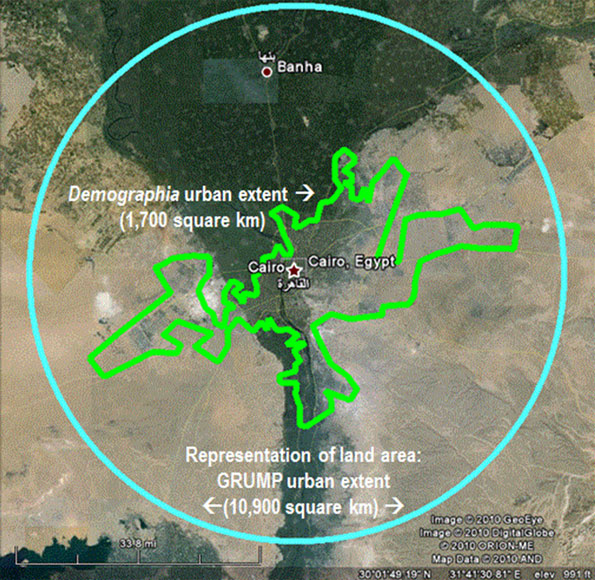
    The 4.9 million square mile or 12.6 million square kilometer urban land increase figure is based upon the GRUMP database, which we reviewed a year ago. GRUMP found the world to have more than 1.3 million square miles of urban development or 3.5 million square kilometers. The GRUMP database is purported to use United States Census Bureau criteria for designating urban land, yet counts three times as much land in the United States as being developed as the Census Bureau. We also showed that the GRUMP urban area for Cairo was at least six times the actual urbanization based upon examination of Google Earth maps (Figure 1: map).

    ng-grump2


    At 4.9 million square miles or 12.6 million square kilometers the average new urbanization would be under 500 per square mile or 200 per square kilometer. These densities fall well short of the urban density thresholds of 1000 per square mile or 400 per square kilometer that are used by census authorities in Canada, France, the United Kingdom and the United States. These nations and others consider densities this low to be rural rather than urban. Indeed, parts of rural China have higher densities than the GRUMP density estimates.

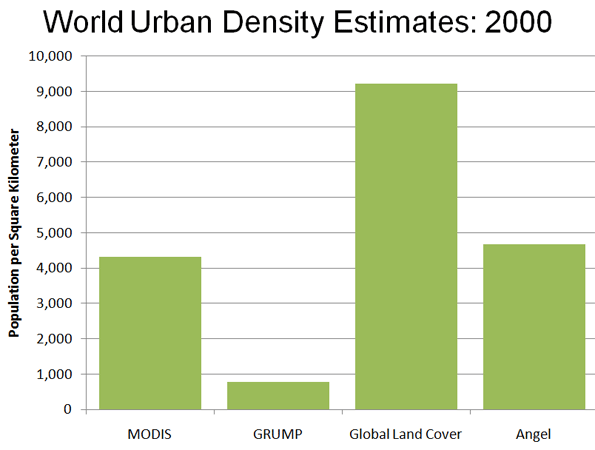
    Estimating Gross World Urban Area: Other estimates of world urbanization are more modest than the GRUMP estimate, which indicated an urban land area of 3,532,000 in 2000. The US Geological Survey MODIS mapping system estimated world urban land area at 650,000 square kilometers in 2000. In A Planet of Cities, Shlomo Angel, Jason Parent, Daniel Civco, Alexander Blei, and David Potere (Angel) use USGS MODIS mapping and further modeling to estimate the 2000 world urban land area at 605,000 square kilometers. Another source, the European Union’s Global Land Cover system put the number at 308,000. The wide variation in estimates indicates the complexity of the task of estimating the world’s urban land area.

    The estimates can be evaluated by comparing their implied population densities.

    • The EU Global Land Cover estimate would have required an average urban population density of more than 9,000 per square kilometer (23,800 per square mile) in 2000, based upon the 2000 United Nations estimate of urban population. This is nearly as dense as the city of New York (not the urban area) and a quarter more dense than Singapore. Anyone who has traveled to urban areas around the world, large and small, would quickly observe that average densities approach neither New York City nor Singapore. The Global Land Cover estimate thus appears to be too low.
    • The GRUMP world land area estimate would mean that the average urban population was 800 per square kilometer in 2000 (2,000 per square mile). This would place the world urban population density at least 15 percent below that of the United States  (900 per square kilometer or 2,400 per square mile) or Canada in 2001 (1,000 per square kilometer or 2,500 per square mile). As every urban planner knows, the United States has the least dense urban areas of any major nation. GRUMP thus appears to substantially over-estimate the amount of urban land.
    • The MODIS and Angel estimates are similar. The MODIS estimate would require an average world urban density of 4,300 per square kilometer (11,100 per square mile), while the Angel estimate would indicate a world urban density of 4,700 per square kilometer (12,200 per square mile). These two estimates would appear the most accurate, because they are well above the US and Canadian densities and any visitor to Manila, Shanghai, Cairo or a myriad of other urban areas in the developing world cannot help but note the much higher densities. At the same time the MODIS and Angel are well below the EU Global Land Cover estimates, which appear to be very high (Figure 2). The MODIS and Angel estimates would indicate that approximately 0.5 percent of the world’s land area is urbanized.

    Demographia World Urban Areas also provides population, land area and urban density estimates, though its detailed data is limited to approximately the approximately 800 urban areas with more than 500,000 population. Applying the Angel, et al urban area size density ratios and projections for urban expansion to 2010 (Angel middle scenario), the Demographia world density estimate would be approximately 20 percent lower, while the urban land area would be 25 percent higher). Demographia World Urban Areas bases its estimates on national census bureau data for urban areas (Note) where it is available and for others estimates urban land area from Google Earth (these are the overwhelming majority of cases), using urban perimeters. More than 50 percent of the difference between the Demographia and Angel estimates results from the use of Census Bureau urbanization data in the United States.

    Believable and Unbelievable Projections: Angel also provides projections for the increase in urban land area. Between 2000 and 2030 Angel projects that new urbanization could be from a middle case of 700,000 square kilometers (270,000 square miles) to a high estimate of 1,160,000 square kilometers (445,000 square miles), with a low case of 360,000 square kilometers (140,000 square kilometers). These are believable figures that are only a small fraction of the high-end 12,600,000 square kilometer (4,900,000 million square miles) projections by Seto, et al.

    The circumstances that might lead to urbanization equaling the land area of Australia, Argentina and Mexico are not believable. A sufficient reasonableness test does not appear to have been conducted.

    Wendell Cox is a Visiting Professor, Conservatoire National des Arts et Metiers, Paris and the author of “War on the Dream: How Anti-Sprawl Policy Threatens the Quality of Life

    ——

    Note: Most of the world’s national census authorities provide geographical data for only legal jurisdictions, such as states, provinces, regions, counties, etc. In some nations, urban area is developed to indicate the population and land area of continuous urbanization. This occurs in the United States, Canada, the United Kingdom, France, Sweden, Denmark and other nations.

    Photo: Developing world urbanization trend to 2030 according to high-end proectiong based upon GRUMP. Houses on two acre lots in Morris County, New Jersey (suburban New York). From Google Earth Pro.

  • The Die-Hard Recession Heads Off The Charts

    “By 1970, the governments of the wealthy countries began to take it for granted that they had truly discovered the secret of cornucopia. Politicians of left and right alike believed that modern economic policy was able to keep economies expanding very fast — and endlessly. That left only the congenial question of dividing up the new wealth that was being steadily generated.”

    Those words, from a Washington Post editorial more than twenty-five years ago, echoed the beliefs not only of politicians and the press, but of mainstream economics professionals resistant to the idea that growth in a market economy would ever stagnate over a protracted period.

    And some of the data did fit nicely. Through several recessions and recoveries, inflation-adjusted GDP rose almost in tandem with a line of predicted growth expectations. But in November 2007, something changed. Real GDP dropped down from what was expected by more than 11 percent, and, as this summer’s data has shown, it hasn’t returned to its pre-recession trend.

    The unusual slump has provoked a stream of commentary that attempts to define the problem, but it hardly matters whether the downturn is identified as the second dip of a ‘double-dip’ recession, a continuation of the ‘Great Recession’, a fast-moving slowdown, a slow nosedive, a long-term stall-out, or a confirmation that the economy has entered a Japanese-style ‘lost decade’. Growth during the 21st century is following a different trend line than it did in the 20th, and employment is also responding in new, different ways from earlier post-World War II recessions.

    A range of additional data also indicates that what we’re hearing is not the regular breathing of an economy as it contracts and expands. Annual growth rates and quarterly moving averages — when examined starting in the mid 1970s, as Greg Hannsgen and I did at the Levy Economics Institute — show a steady decline beginning in 2000.

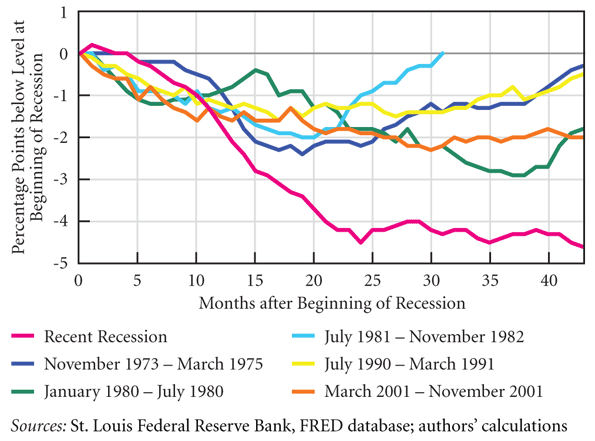
    And the employment numbers make the case yet again. Look at the graph below, with separate lines for the past six recessions. It traces employment-to-population ratios, beginning with the first month of each recession. These ratios are used to measure, among other things, how well a nation utilizes its workforce— a kind of labor drop-out rate.

    You can see at a glance that the pink line indicating the current recession — yes, that one down near the bottom of the chart — is an outlier in the group. It shows that by the 43rd month of the downturn, the ratio stood at just over 58 percent, meaning that 58 percent of the population was employed. That figure is 4.6 percent less than at the recession’s start, when more than 62 percent were working. And it means that this employment decline is steeper, deeper, and longer than in any of the previous five recessions by a long shot.

    Even in the two worst recoveries during the past forty years, this ratio never before declined by more than three percent. By the time the five recessions were this far along, employment had returned either to pre-recession levels, or to a distance from the recession’s start that was, at worst, two percent, compared to the current more than four percent.

    Together, this data makes the case that we’re in a prolonged slump that’s highly unusual, and requires action that’s far more aggressive than the usual responses. Job creation should be the government’s urgent, first priority. The nation needs to recognize just how perilous the employment disaster is — and what a marked departure this recession is from any we’ve seen in the modern era.

    Dimitri B. Papadimitriou is president of the Levy Economics Institute of Bard College, and executive vice president and Jerome Levy Professor of Economics at Bard.

    Photo by mangpages: Recession 1