Blog

  • The Golden State Is Crumbling

    The recent announcement that California’s unemployment again nudged up to 12 percent—second worst in the nation behind its evil twin, Nevada—should have come as a surprise but frankly did not. From the beginning of the recession, the Golden State has been stuck bringing up a humbled nation’s rear and seems mired in that less-than-illustrious position.

    What has happened to my adopted home state of over last decade is a tragedy, both for Californians and for America. For most of the past century, California has been “golden” not only in name but in every kind of superlative—a global leader in agriculture, energy, entertainment, technology, and most important of all, human aspiration.

    In its modern origins California was paean to progress in the best sense of the word. In 1872, the second president of the University of California, Daniel Coit Gilman, said science was “the mother of California.” Today, California may worship at the altar of science, but increasingly in the most regressive, hysterical, and reactionary way.

    California’s dominant ruling class—consisting of public-employee unions, green jihadis, and Democratic machine politicians—has no real use for science as Gilman saw it: as a way to create prosperity for its citizens. Instead, the prevailing credo of the state has been how to do everything possible to return to its pre-settlement condition, with little regard for what that means to the average Californian.

    Nowhere was California’s old technological ethos more pronounced than in agriculture, where great Californians such as William Mulholland, creator of the Los Angeles Aqueduct, and Pat Brown, who forged the state water project, created the greatest water-delivery system since the Roman Empire. Their effort brought water from the ice-bound Sierra Nevada mountains down to the state’s dry but fertile valleys and to the great desert metropolis of Southern California. Now, largely at the behest of greens, California agriculture is being systematically cut down by regulation. In an attempt to protect a small fish called the Delta smelt, upward of 200,000 acres of prime farmland have been idled, according to the state’s Department of Conservation. Even in the current “wet” cycle, California’s agricultural industry, which exports roughly $14 billion annually, is slowly being decimated. Unemployment in some Central Valley towns tops 30 percent, and in cases even 40 percent.

    And now, notes my friend, Salinas Mayor Dennis Donohue, green regulators are imposing new groundwater regulations that may force the shutdown of production even in areas like his that have their own ample water supplies.

    Salinas was the home town of John Steinbeck, author of The Grapes of Wrath and great chronicler of Depression-era California. Today for many in hardscrabble, majority-Latino Salinas, home to 150,000 people, The Grapes of Wrath is less lyrical than real. “California,” notes Donohue, a lifelong Democrat, “remains intent on job destruction and continued hyper-regulation.”

    California’s pain is not restricted to farming towns. The state’s regulatory vigilantes have erected a labyrinth of rules that increasingly makes doing almost anything that might contribute to increased carbon emissions—manufacturing, conventional energy, home construction—extraordinarily onerous. Not surprisingly, the state has not gained middle-skilled jobs (those requiring two years of college or more) for a decade, while the nation boosted them by 5 percent and archrival Texas by a stunning 16 percent over the same time period.

    There is little chance that the jobs lost in these fields will ever be recovered under the current regime. As decent blue-collar and midlevel jobs disappear, California has gone from a rate of inequality about the national average in 1970, to among the most unequal in terms of income. The supposed solution to this—Gov. Jerry Brown’s promise of 500,000 “green jobs”—is being shown for what it really is, the kind of fantasy you tell young children so they will go to sleep.

    Many Californians who aren’t slumbering are moving out of the state—and not only the pathetic remains of the old Reaganite majority. According to the most recent census, those leaving the state include old boomers, middle-aged families, and increasingly, many Latinos as well. Outmigration rates from places like Los Angeles and the Bay Area now rival those of such cities as Detroit. In the last decade, California’s population grew only 10 percent, about the national average, largely due to immigrants and their offspring. Population increases in the Bay Area were less than half that rate, while the City of Los Angeles gained fewer new residents—less than 100,000—than in any decade since the turn of the last century!

    Increasingly, California no longer beckons ambitious newcomers, except for a handful of the most affluent, best educated, and well connected. Through the 1980s and even through the late ’90s, the aspirational classes came to California. Now they head to other, more opportunity-friendly places like Austin, Houston, Dallas, Raleigh-Durham, even former “dust bowl” burghs like Des Moines, Omaha, and Oklahoma City. Meanwhile, Golden California, particularly its expensive, ultragreen coast, gets older and older. Marin County, the onetime home of the Grateful Dead and countless former hippies, is now one of the grayest urban counties in the country, with a median age of 44.

    Of course, the self-described “progressive” mafia that runs California will point to Silicon Valley and its impressive array of startups. But for the most part, firms like Google, Twitter, and Facebook employ only a small cadre of highly educated workers. Overall, during the past decade the state’s high-tech employment fell by almost 4 percent, while Texas’s science-based employment grew by a healthy 11 percent. The sad reality is that turning T-shirt-wearing kids like Mark Zuckerberg into multibillionaires doesn’t do much to reduce unemployment, which even in San Jose—the largely blue-collar “capital” of Silicon Valley—now hovers around 10 percent.

    Magazine cover stories and movies cannot obscure the fact that entrepreneurial growth—the state’s most critical economic asset—has now stalled. In fact, according to a study by Economic Modeling Specialists Inc., last year the Golden State ranked 50th among the states in creating new businesses.

    California remains rich in promise, home to spectacular scenery; a great Pacific location; leading firms like Apple and Disney; and a still-impressive residue of talented, diverse, entrepreneurial, and ingenious people. But the state will never return until the success of the current crop of puerile billionaires can be extended to enrich the wider citizenry. Until the current regime is toppled, California’s decline—in moral as well as economic terms—will continue, to the consternation of those of us who embraced it as our home for so many years.

    This piece originally appeared at The Daily Beast.

    Joel Kotkin is executive editor of NewGeography.com and is a distinguished presidential fellow in urban futures at Chapman University, and an adjunct fellow of the Legatum Institute in London. He is author of The City: A Global History. His newest book is The Next Hundred Million: America in 2050, released in February, 2010.

    Photo by wstera2.
  • Whatever Happened to ‘The Vision Thing’? Part II

    More than two years ago (March 2009, to be precise), New Geography published an article I wrote, entitled Whatever Happened to ‘The Vision Thing’?. It began:

    When I was in elementary school, I remember reading about the remarkable transformations that the future would bring: Flying cars, manned colonies on the moon, humanoid robotic servants. Almost half a century later, none of these promises of the future – and many, many more – have come to pass. Yet, in many respects, these visions from the future served their purpose in allowing us to imagine a world far more wondrous than the one we were in at the time, to aspire to something greater.

    I am reminded of these early childhood memories not because I lament the loss of my flying car (although it would come in handy every now-and-again in fighting the Washington, D.C. rush hour gridlock) but because, with all of the rhetoric about change and hope, the Obama Administration has failed to articulate a strong, singular vision for what the future of America and the world can and should be. While some would argue that now is not the time for grand visions for the future but, rather, for hunkering down and muddling through these desperate economic travails, the fact of the matter is that at least part of the cause of continuing economic decline in this country, and in many other developed nations as well, is a lack of confidence in the future.

    I am now deeply troubled, as I always am when I have had such an epiphany, to report that clearly no one listened to me. As of August 2011, fourteen months away from what promises to be perhaps the most polarizing Presidential election in our Nation’s history, we are farther away than we have ever been from having a shared national vision for the future of our country.

    The current crises impacting the United States — record-high, persistent unemployment; a potentially ruinous national debt as a percentage of our Gross Domestic Product; extreme volatility in the equity markets; a growing gulf between the “haves” and the “have-nots”; etc.; etc; etc.— are as much reflective of a crisis of confidence as they are of structural problems with our economy. And the increasingly toxic discourse between opposing factions within Congress, fueled by pundits and talking heads on cable news programs, talk radio, and the blogosphere, is in part a reflection of the axiom that nature abhors a vacuum. However, everyone is talking about treating the symptomology rather than making the patient better. No one wants to acknowledge the elephant in the room: That we are wandering aimlessly through an increasingly competitive world economy.

    So, what do we want to be when we grow up, America? We are, hopefully, coming out of the downside of an unsustainable economic model, premised on unrelenting, annual growth in the value of all asset classes, which fueled unfettered consumer behavior (“consumer confidence on steroids,” one could argue), and the misguided belief that we are and will always be the greatest nation on earth no matter what. Consequently, we need to decide what kind of America we envision for our future.

    We used to be builders of things, and did that better than any other industrialized democracy. Now we have to compete with the manufacturing juggernaut that is China, unfettered by our democratic and human rights principles and the inherent limitations of a free, capitalistic society. We want to maintain what is still (at least arguably) the highest standard of living in the world, but we don’t want to pay for it through the price of goods produced on our own shores. We are clinging for dear life to the outdated notion that we can enjoy inexpensive goods made by people who live on one-tenth or less what the average American earns, and still continue to have job and income growth. So we need to make the transition from being the largest consumer of goods in the world to once again being a country that does things; big things. The question is: What things? I guess if I could answer that question, I’d appear in an incredibly unflattering picture on the cover of Time magazine right now. But I can at least pose it.

    The political arguments that were brought into sharp focus in the debates over the federal budget and raising the debt ceiling might have perhaps brought more light than heat to bear on our economic problems had they been conducted within the framework of how our future as a nation should be shaped. The appropriate size of the federal government, for example, can only be reasonably determined once we’ve agreed as a nation about what role we want government to play in shaping our future.

    Runaway capitalism — which conferred benefits very selectively, albeit very handsomely, on a small percentage of our population—has proven to be both a very destructive force (e.g. the mortgage meltdown; the Deepwater Horizon environmental disaster; etc.), as well as one that requires governmental intervention when it goes awry (e.g. the TARP program; the Federal Reserve Bank’s interventions in the marketplace; various federal foreclosure prevention programs; the takeover of Fannie Mae and Freddie Mac; etc.; etc.; etc. ad nauseum). Absent such a framework for the future, the national debate has been the victim of an increasingly acute form of intellectual paralysis: The short-term mindsets of our elected officials and the voters — tied to the two-year election cycle — force debate on inherently inadequate, short-term solutions to substantial, long-term problems. Because we have no shared vision of the country’s future, against which short-term solutions might be measured, there are no metrics for productive discourse. Hence, our so-called “leaders” argue in reliance on their “principles,” rather than with a broader view toward implementing the future we want to see.

    Things will only continue to grow worse, and much more polarized (although that’s truly frightening to imagine), unless and until we agree, as a nation, that there are some fundamental issues about our future that need to be addressed… and resolved. Creating jobs in a vacuum is a fool’s errand; so is cutting spending on existing programs when we should be deciding what kind of programs we want and need. The appropriate size of the federal government, how much money needs to be raised in terms of revenue (and from whom), and how those revenues should be efficiently spent, can only be determined with certitude in the context of where we want to go — and how we want to grow — from here.

    I no longer harbor any quixotic notions, as I did two-and-a-half years ago, about the President stepping forward to articulate a bold vision for America’s future: But somebody sure needs to … and soon.

    Photo by Severin St. Martin(Sev!): “Kes has a Vision”; North Shore, Lake Superior

    Peter Smirniotopoulos is a national expert in urban redevelopment, housing policy, and project and public finance. He is the founder and principal of petersgroup consulting, a real estate development and finance consulting practice based in the Washington, D.C. area, which serves the public, private, and non-profit sectors throughout the U.S. He is a former Faculty Member in the Masters of Science in Real Estate program at Johns Hopkins University.

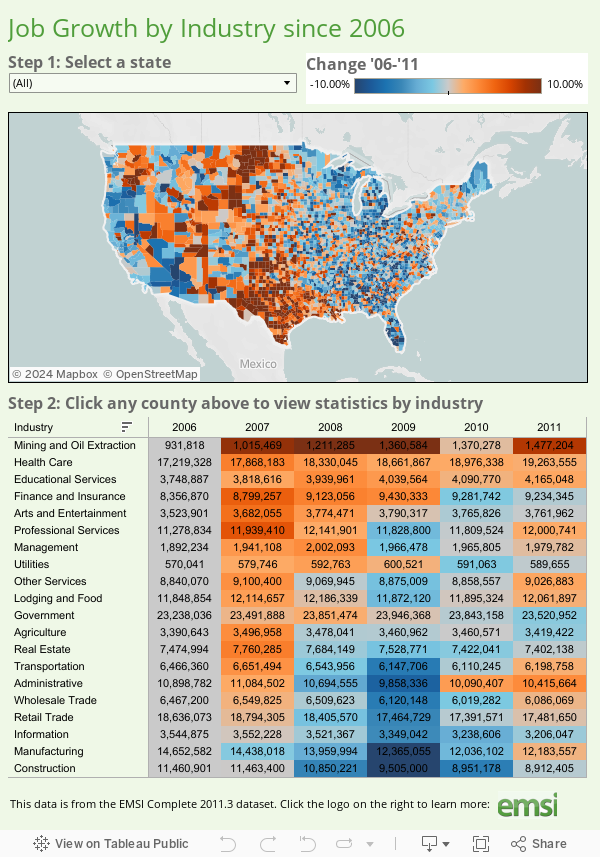
  • Interactive Graphic: Job Growth by Sector for all Counties in the Nation

    The fully interactive map below indicates job growth and decline for all US counties from 2006 to 2011. These show up as hot or cold spots; red for growth, blue for decline. You can select a state to zoom in on and find a county that way, or simply click on a county to drill in. Once you’ve chosen a county, the table under the map will show you job numbers by industry category.

    The data for this graphic comes from EMSI’s Complete 2011.3 dataset, based on data from the Bureau of Labor Statistics and many other sources. Many thanks to Tableau for putting this together. If you have questions or comments about the graphic or the data behind it, please email EMSI’s Josh Stevenson.

  • Millennials Have the Answer to the Country’s Fear, Uncertainty and Doubt

    America is about to enter a presidential campaign that promises to be filled with divisive rhetoric and sharp differences over which direction the nominees want to take the country. This will be the fourth time in American history that the country has been sharply divided over the question of what the size and scope of government should be. Each time the issue was propelled by vast differences in beliefs between generations that caused the country to experience long periods of Fear, Uncertainty and Doubt (FUD), before ultimately resolving the issue in accord with the ideas and beliefs of a new generation.

    Every eighty years America engages in this rancorous, sometimes violent, debate about our civic ethos. The first occurred during and after the Revolutionary War and resulted in the most fundamental documents of our democracy: the Declaration of Independence, the Constitution, and the Bill of Rights.

    The second took place during the Civil War. The 13th, 14th, and 15th Amendments codified the outcome of that debate — this time in favor of the federal government asserting its power over state laws when it came to fundamental questions of personal liberty and civil rights.  It took the Civil War and a massive increase in Washington’s power to accomplish the end of slavery, although it would be another century until the rights of freedom and equality were fully extended to African-Americans. 

    And in the 1930s, the economic deprivations experienced by most Americans from the excesses of the Industrial Revolution, and the collapse of corporate capitalism, led to support for a “New Deal” for the forgotten man that placed the responsibility for economic growth and opportunity squarely on the federal government. The government demanded by the GI Generation (born 1901-1924) greatly surpassed the conventional views of earlier generations.

    In each case, the resolution of these debates depended on the emergence of a rising, young civic-oriented generation that thought the nation’s dominant political belief system   should contain a strong role for government, overturning the more conservative and limited-government views of the older generations then in power.

    Now, as previously, the highly charged ideological arguments on both sides of the issue generate great agitation and anger among older generations, especially Baby Boomers, who have driven our political life towards ever wider polarization. As a result, the resolution of today’s debate over the nation’s civic ethos is not likely to come from older Americans who seem incapable of and unwilling to compromise their deeply held values and beliefs.

    This time around, the largest generation in American history, Millennials, (born 1982- 2003), that  will comprise more than one in three adult Americans by the end of this decade, are destined to play a decisive role in finding a consensus answer to this critical question.   If the United States is to emerge from this most recent period of FUD, it will have to look to the newest civic-oriented generation, Millennials, for both the behavior and the ideas that will bridge the current ideological divide and spur the country into making the changes necessary to succeed in the future.

    Millennials believe that collective action, most often at the local level, is the best way to solve national problems. Using social media, Millennials are organizing groups like the Roosevelt Institute’s Campus Network, to present a very different vision of America’s future. In this Millennialist future, the idea of top down solutions developed by experts in closed discussions will give way to bottom up, action-oriented movements. This will topple institutions as dramatically as Napster upended the recording industry, or the Arab Spring changed the Middle East.  Just as their parents set the rules within which Millennials were free to exercise their creative energies when they were growing up, the new generation will continue to look to the federal government to set national goals or guidelines, as has long been the view of Boomer progressives.   However, the way in which these guidelines are implemented will not be determined in remote and opaque bureaucracies, but by individuals in local communities across the country. In this way, Millennials will embrace progressive values, but with approaches that may be welcomed by many conservatives.

    In the midst of the country’s current period of FUD, it is easy to despair that the nation will be unable to resolve its divisions and come to consensus about a new civic ethos. But throughout its history, when America has been equally fearful of the future, a new civic generation has risen to foster the necessary transition. In the end, this emerging generation served both itself and the country well. Now it is the Millennial Generation’s turn to serve the nation and move America to a less fearful and less divided future.  

    Morley Winograd and Michael D. Hais are fellows of NDN and the New Policy Institute and co-authors of the newly published Millennial Momentum: How a New Generation Is Remaking America and Millennial Makeover: MySpace, YouTube, and the Future of American Politics.

    Photo by kevindooley.

  • Supply of Tech Workers Greater Than Estimated Demand

    CNBC reports the information technology (IT) sector is “where the jobs are.” And the Los Angeles Times writes that tech jobs in San Francisco are a “rare bright spot in the nation’s troubled economy.”

    EMSI’s most current data, however, paints a slightly less rosy picture.

    It’s clear that IT and tech jobs have mostly bounced back since the recession (or barely saw employment dips in the first place). But not every tech-related profession is faring well; jobs in computer programming, for example, have failed to reach pre-2008 levels.

    And in almost all cases, the supply of IT and tech grads far outweighs the estimated annual openings in those areas over the next five years.

    Overall Trends

    IT jobs are spread across nearly every sector, making labor market analysis at the industry level a bit tricky. Tech jobs too are varied and can incorporate many different activities. For this data spotlight, we focused on 11 occupations — mainly in the computer specialist and database/network administrator realm.

    SOC Code Description
    2006 Jobs
    2011 Jobs
    Change
    % Change
    15-1011 Computer and information scientists, research
    28,349
    30,648
    2,299
    8%
    15-1021 Computer programmers
    452,953
    433,188
    (19,765)
    (4%)
    15-1031 Computer software engineers, applications
    511,199
    555,917
    44,718
    9%
    15-1032 Computer software engineers, systems software
    404,764
    430,792
    26,028
    6%
    15-1041 Computer support specialists
    572,327
    567,082
    (5,245)
    (1%)
    15-1051 Computer systems analysts
    584,711
    606,473
    21,762
    4%
    15-1061 Database administrators
    111,008
    113,975
    2,967
    3%
    15-1071 Network and computer systems administrators
    347,629
    358,743
    11,114
    3%
    15-1081 Network systems and data communications analysts
    355,264
    407,983
    52,719
    15%
    15-1099 Computer specialists, all other
    212,981
    221,861
    8,880
    4%
    17-2061 Computer hardware engineers
    70,797
    68,040
    (2,757)
    (4%)
    SOURCE: EMSI Complete Employment (2011.3)

    In total, these 11 tech-related jobs have grown by 3.9% since 2006 in the US (nearly 143,000 new jobs). The only professions on this list to see a net loss in jobs over the last five years are computer support specialists, computer hardware engineers, and computer programmers.

    Computer support specialists account for the second-most jobs of any occupation in this tech group, and they’ve started to make their way back up with growth from 2010-2011. But hardware engineers and programmers continued to shed jobs in the last year — after seeing drops of 5.6% and 5%, respectively, from ’08 to ’09.

    Key Industries for Tech Jobs

    With EMSI’s research tool, Analyst, we’re able to quickly shift from examining occupations to the top industries that staff those occupations (via inverse staffing patterns). This is a particularly useful analysis for tech jobs.

    Consider the case of programmers: the industry breakdown shows this profession is becoming more specialized. In the last five years, there are more programmers in the computer systems design services and custom computer programming services industries, but fewer in generalized industries such as temporary help services, corporate offices, and state and local government.

    FASTEST-CHANGING INDUSTRIES FOR COMPUTER PROGRAMMERS
    NAICS Code
    Description
    2006-11 Change
    541512 Computer Systems Design Services
    6,865
    541511 Custom Computer Programming Services
    5,225
    561320 Temporary Help Services
    -2,400
    541519 Other Computer Related Services
    -2,335
    518210 Data Processing, Hosting, and Related Services
    -1,076
    920000 State government
    -1,020
    930000 Local government
    -726
    541513 Computer Facilities Management Services
    -721
    551114 Corporate, Subsidiary, and Regional Managing Offices
    -590
    511210 Software Publishers
    -376

    This data also suggests that some tech industries — like data processing/hosting services and other computer related services — are either getting by with fewer programmers and other assorted tech workers, or a good number of these positions have been offshored.

    That doesn’t seem to be the case as much with software engineers. More of these workers have been added to IT-related industries and general industries since 2006. The biggest exceptions are wired telecommunication carriers and data processing, hosting, and related services.

    FASTEST-CHANGING INDUSTRIES FOR SOFTWARE ENGINEERS (15-1031 and 15-1032)
    NAICS Code
    Description
    2006-2011 Change
    541512 Computer Systems Design Services
    35,339
    541511 Custom Computer Programming Services
    24,660
    511210 Software Publishers
    5,727
    551114 Corporate, Subsidiary, and Regional Managing Offices
    3,260
    541712 Research and Development in the Physical, Engineering, and Life Sciences (except Biotechnology)
    2,971
    517110 Wired Telecommunications Carriers
    -2,310
    541330 Engineering Services
    1,310
    518210 Data Processing, Hosting, and Related Services
    -1,080
    334111 Electronic Computer Manufacturing
    -1,048

    Metros with Highest Concentration of Tech Workers

    The area with the largest share of tech workers, on a per capita basis, probably won’t come as a huge shock. The San Jose metro, home to Silicon Valley, is more than 4 times more concentrated in tech workers than the nation, and it has the highest median earnings. With a median wage of $50.14 per hour, San Jose has 7% higher wages than the second best-paying metro, Bridgeport, Conn., ($46.59), and 17% higher wages than the third metro on the list, Boston-Cambridge ($41.69).

    Boulder, Colo., is the second-most concentrated metro, at more than 3 times the national average, followed by DC (with a location quotient of 2.73) and Durham-Chapel Hill, NC (2.7).

    Meanwhile, DC and Seattle-Tacoma have seen the most new tech jobs since 2006. DC has added 18,205 jobs (9%), Seattle has added 14,762 (16%), while San Jose is third with 11,102 new jobs (12%).

    Supply/Demand Imbalance

    The job market for tech workers in San Jose, San Francisco, and other pockets of the country seems to be thriving. But there also appears to be a considerable excess of new graduates in these fields compared to the annual demand over the next five years. According to EMSI estimates, there are more than 3 times as many graduates as annual job openings through 2016.

    We gauged the supply of 2009 grads from programs associated with the 11 tech professions using the US Department of Education’s IPEDS database, and looked at the completions in comparison to estimated annual openings (new and replacement jobs) for the same jobs. Note: Not all graduates from tech-related programs will work in tech-related fields (though in higher-skilled areas such as these, the chances are higher) and IPEDS data is subject to misreporting/error on a college-by-college basis.

    Looking at the supply/demand numbers for the individual tech occupations, computer and information scientists have the largest glut (56,865 too many grads per year). Two other occupations have graduate oversupplies that exceed 50,000: network and computer systems administrators and computer specialists, all other.

    There’s only one occupation, meanwhile, with a shortage of associated graduates: computer support specialists (not to be confused with computer support specialists, all other).

    SOC Code
    Description
    Annual Openings
    2009 Completions
    Surplus/Shortage
    2011 Median Hourly Earnings
    15-1011 Computer and information scientists, research
    1,239
    58,104
    56,865
    $44.90
    15-1071 Network and computer systems administrators
    13,234
    66,273
    53,039
    $31.75
    15-1099 Computer specialists, all other
    7,342
    59,726
    52,384
    $35.04
    15-1061 Database administrators
    3,866
    46,498
    42,632
    $33.48
    15-1081 Network systems and data communications analysts
    21,081
    56,792
    35,711
    $28.07
    15-1032 Computer software engineers, systems software
    13,664
    42,621
    28,957
    $42.80
    15-1021 Computer programmers
    9,670
    29,847
    20,177
    $31.38
    15-1031 Computer software engineers, applications
    18,951
    34,105
    15,154
    $40.15
    15-1051 Computer systems analysts
    23,023
    38,104
    15,081
    $34.23
    17-2061 Computer hardware engineers
    2,420
    5,804
    3,384
    $46.17
    15-1041 Computer support specialists
    22,449
    3,424
    -19,025
    $21.10
    Total
    136,939
    441,298
    304,359

    Joshua Wright is an editor at EMSI, an Idaho-based economics firm that provides data and analysis to workforce boards, economic development agencies, higher education institutions, and the private sector. He manages the EMSI blog and is a freelance journalist. Contact him here.

    Illustration by Mark Beauchamp

  • High-density Housing Reflects Dense Government Thinking

    Citizens in Australia’s major cities are becoming increasingly unhappy about what they perceive as the escalating deterioration in their quality of life – traffic congestion, overloaded public transport, unaffordable housing for young people, increases in the costs of basic services and overcrowding. There is little doubt that recent election results and unfavourable opinion polls are partly an expression of this dissatisfaction.

    ‘Save Our Suburbs’ believe that these adverse trends are the result of high-density policies that have been imposed onto communities by state governments. Due to the misleading misinformation that has accompanied these policies, the public may not fully realise the connection between these policies on the one hand and deteriorating standard of living on the other. It is only when one sweeps the propaganda veil aside that one realises how shallow, trivial and sometimes downright deceptive the spin has been.

    We should start out by making it clear that we have no issue with anyone that prefers living in a high-density area or with the free market construction of buildings to fulfill this preference. The issue we have is with the enforced imposition of high density housing upon the bulk of Australians that don’t want it.

    The premise behind this government totalitarianism is that high-density living is better for the environment. They say that people will use their cars less and that greenhouse gas emissions will be greatly reduced. While these two propositions sound very much like commonsense the unfortunate fact is that the data does not bear them out. An idealised Melbourne study currently being quoted assumes that people, no matter where they live, will drive to the central business district daily. This is a completely unrealistic assumption.  Only 9.9 per cent of employment in Melbourne is in the CBD. The majority of destinations for most people in the suburbs lie close to where they live and they do not in fact make daily trips to the CBD.

    To get a better understanding we should look at the Australian Conservation Association’s Consumption Atlas, which shows greenhouse pollution per person in each postal code. The underlying research shows that the actual travel energy used by dwellers in inner Sydney suburbs is more than those in the outer suburbs, even when air travel is excluded.

    When domestic energy is added to travel energy, the energy total for people in the inner suburbs is 22 per cent more than those living in the outer suburbs.  This is because of energy needed in high-rise buildings for communal lifts, scores of individual clothes driers and ever-present security lighting in foyers and garage spaces.

    While we do concede that private transport generates somewhat higher greenhouse gas emissions than public transport, the difference is not nearly as much as people think. Greenhouse gas emissions per passenger kilometer on Sydney City Rail are 105 gm. The figure for the average car is 155 gm. It is much less for modern hybrid vehicles, being a mere 70 gm.

    Furthermore, a study of Melbourne areas shows that the people squeezed into newly converted dense areas did not use public transport to any greater extent and there was little or no change in their percentage of car use compared to living in the previous low-density.
    In fact, traffic congestion increases whenever high-density policies are imposed wherever you are in the world. Any slight increase that may occur in the proportion of people using public transport is overwhelmed by the greater number of people squeezed into that area. The resulting congestion causes higher fuel consumption and dangerous exhaust emissions. The authorities fail to admit that many people still require their cars for getting to the many workplaces, sporting facilities, and relatives and friends homes not easily reached by public transport and for transporting items that are impractical or illegal aboard public transport such as weekend recreation equipment and the family pet.

    High density advocates claim that high-density saves money. This is palpable nonsense. We are all acutely aware that high-density policies have resulted in a dramatic rise in the price of housing, due to the government enforced infill policy causing land scarcity, thereby locking out an entire generation of young people from the housing market. We are also conscious of substantial rises in the cost of services such as electricity, water and sewerage due to the incredibly inefficient modifications required to increase capacity in areas originally designed for lower densities.

    A tragic and often overlooked failure of high-density policies is the adverse effect on human health, especially mental health. There is a considerable body of peer-reviewed research proving the link between density and ill health. An article published on 23 June 2011 by eleven authors in the prestigious scientific journal, Nature, states that the incidence of schizophrenia in city dwellers is double that of people living in less crowded conditions. This article has received worldwide media attention. In view of the serious mental health situation existing in our society, those forcing high-density onto communities that do not want it, should hang their heads in shame.

    We reiterate that we have no issue with those of us that prefer living in a high-density area or with the free market construction of buildings to fulfill that limited demand. What we object to, is having draconian high density policies based on demonstrably faulty premises forced upon the 83 per cent of people that Australian research shows prefer to live in a free-standing home.

    This is especially so when the result is maddening traffic congestion, more greenhouse gases, a creaking and overloaded infrastructure, the young and disadvantaged unable to afford their own home and poorer health outcomes.

    This piece first appeared in On Line Opinion.

    (Dr) Tony Recsei has a background in chemistry and is an environmental consultant. Since retiring he has taken an interest in community affairs and is president of the Save Our Suburbs community group which opposes over-development forced onto communities by the New South Wales State Government.

    Photo by drewish.

  • Infrastructure Bank: Losing Favor with the White House?

    Eighteen months ago, on January 20, 2010, a group of influential politicians, accompanied by a large coterie of representatives of the Washington transportation community, gathered at the Capitol to urge Congress and the Obama Administration to create a “National Infrastructure Bank” to help finance infrastructure investments. The speakers included all the well-known advocates of the Bank: Pennsylvania’s Governor Ed Rendell, Senator Chris Dodd (D-CT), Rep. Rosa DeLauro (D-CT), author of an Infrastructure Bank bill (H.R. 2521), former House Majority Leader Dick Gephardt (D-MO) and Felix Rohatyn, the spiritual godfather of the movement. Standing beside them, in a gesture of support and solidarity, was a large group of executives representing the transportation industry, labor unions and advocacy groups.

    For a while, it seemed like their plea would be answered. A proposal for a $30 billion infrastructure bank focused on transportation-related investments was included in the President’s FY 2011 budget proposal unveiled last September. As recently as last month, Mr. Obama was mentioning the Infrastructure Bank as part of his job stimulus plan to be unveiled after Labor Day.

    But today, the idea is on life support. Neither the Senate nor the House have seen fit to include the Bank in their proposed transportation bills. Congressional Democrats and Republicans alike are in agreement that decisionmaking control over major federal investments should not be ceded to a group of “unelected bureaucrats.” Rather than creating a new federal bureaucracy, they think the focus should be placed on expanding federal credit assistance tools already in place, such as the Transportation Infrastructure Finance and Innovation Act (TIFIA) and the Railroad Rehabilitation & Improvement Financing Program (RRIF).

    There are other reasons for congressional skepticism. House Republicans are suspicious that the Obama-proposed Bank is nothing more than a vehicle for more stimulus spending, disguised as “capital investment.” They want the Administration to be more specific about its proposal: how the Bank would be funded, what kind of investments it would fund and how the $30 billion capital would be repaid. “If this is more of the same stimulus spending, we won’t support it,” Kevin Smith, spokesman for House Speaker John Boehner (R-OH) has been quoted as saying.

    House Transportation and Infrastructure Committee chairman John Mica (R-FL) thinks state-level infrastructure banks would be a more appropriate means of financing major transportation projects at the state and local level. Decentralized infrastructure financing would “keep the federal financing bureaucracy at a minimum and maximize states’ financial capabilities,” according to the House transportation reauthorization proposal.

    Senate Democrats, while not necessarily opposed to another fiscal stimulus, want quick results. They fear that a centralized Infrastructure Bank, with its complex governance structure and layers of bureaucratic conditions, requirements and approvals would be far too slow and cumbersome to be an effective job generator. One or two years could pass before large-scale projects appropriate for Bank financing would get evaluated, selected, approved and under construction, one Senate aide told us.

    What is more, there is a lack of agreement on how the proposed Infrastructure Bank should function. The Administration wants a mechanism that would serve several different purposes. In the words of Undersecretary for Transportation Policy Roy Kienitz who testified at a September 21, 2010 hearing of the Senate Banking Committee, “We need a financing institution that can provide a range of financing options— grants for projects that by their nature cannot generate revenue, and loans and loan guarantees for projects that can pay for their construction costs out of a revenue stream. In short, we need the Infrastructure Bank that the President has proposed.”

    But, “banks don’t give out grants, they give out loans. There is already a mechanism for giving out federal transportation grants — it’s called the highway bill,” countered Sen. James Inhofe (R-OK), ranking member of the Senate Environment and Public Works (EPW) Committee.

    If the proposed entity is to be a true bank – as proposed in a recent bill sponsored by Senators John Kerry (D-MA) and Kay Bailey Hutchison (R-TX) and endorsed by the AFL-CIO and the U.S. Chamber of Commerce– its scope would be confined to projects that can repay interest and principal on their loans with a dedicated stream of revenue — in other words, the Bank could finance only income-generating facilities such as toll roads and bridges. By all estimates, such projects will constitute only a small fraction of the overall inventory of transportation improvements needed to be financed in the years ahead, the bulk of which will be reconstruction of existing toll-free Interstate highways. Hence, a true Infrastructure Bank would be of limited help in creating jobs and reviving the economy, critics argue.

    “A national infrastructure bank must garner broad bipartisan support to move forward,” says Michael Likosky, Director of NYU’s Center on Law & Public Finance and author of a recent book, Obama’s Bank:Financing a Durable New Deal. “This means no grants, a multi-sector reach and a realistic idea of what projects will benefit straight away.”

    President Obama was expected to include the infrastructure bank among his recommended stimulus measures when he lays out his new job-creation plan before the congressional deficit reduction committee in early September. But lately, he seems to have put the idea on the back burner and turned his attention to more traditional “shovel-ready” highway investments using existing financing programs. His advisers may have concluded that the Bank will do little to stimulate immediate job creation— and that the proposal will find little support among congressional Democrats and Republicans alike. If so, check off the Infrastructure Bank as an idea whose time had come and gone.

    ~~~~~~~~~~~~~~~~~~~~

    Note: the NewsBriefs can also be accessed at www.infrastructureUSA.org

    A listing of all recent NewsBriefs can be found at www.innobriefs.com