Blog

  • Inside The Sinosphere

    Avis Tang, a cool, well-dressed software company executive, lives on the glossy frontier of China’s global expansion. From his perch amid tower blocks of Tianfu Software Park on the outskirts of the Sichuan capital of Chengdu, the 48-year-old graduate of Taiwan’s National Institute of the Arts directs a team of Chinese software engineers who are developing computer games  for his Beijing company, Perfect World Network Technology, for  the  Asian and world market.

    A glossy software office in Chengdu seems a long way from the images of centrally directed, belching factories seeking to dominate the global economy. But a close examination of the emerging Sinosphere–or Chinese sphere of influence–shows an economy that is globally dispersed, multinational and increasingly focused on the high-tech and service sectors.

    Yet if Tang came to China to work for Interserv, a Taiwan game developer, he would see that the future of his industry–including its creative side–lies not only in the coastal cities but, increasingly, in those stretching across the vast Chinese interior. “In ten years perhaps all these cities will follow the path of Shanghai,” says Tang, as technology allows businesses that once had to situate themselves in coastal megacities to expand into the interior.

    Widely considered one of the most “livable” of China’s big cities, Chengdu seems to Tang something of an incipient Silicon Valley. The area’s software revenues increased more than tenfold over the past decade, while an estimated 200,000 people are expected to be working in the city’s software industry by 2012.

    Like many of his fellow managers at the sprawling park, home to over 800 foreign-owned companies, Tang is not a citizen of China.  He’s from Taiwan and never set foot in the People’s Republic before 2001.  His wife remains in Taiwan (Tang flies there every month or two to see her).

    Chinese capitalism has relied on diaspora entrepreneurs like Tang. In this sense, the rise of China represents the triumph of a race and a culture. Indeed for most of its history China’s most important export was not silk or porcelain but people. To measure the rise of the Sinosphere, one has to consider not just China itself but what historian Lynn Pan has described as the “sons of the Yellow Emperor.”

    The Sinosphere’s roots lie with the Han expansion into southern China during the Tang dynasty (618-907). By the 12th century, the newly Sinofied southern Chinese had started moving south. There they created trade-oriented colonies like Vietnam, Burma, Malaya and the island of Java. In the 1600s Chinese settlers overcame the aboriginal inhabitants of Taiwan, creating another powerful base in the South China Sea.

    At its height, during the expeditions of the legendary eunuch Admiral Zheng Hein in the early 15th century, China’s maritime “sphere of influence” extended all the way to the Indian Ocean and beyond.

    Although ensuing Chinese regimes pulled back from expansion and all but abandoned their scattered children, the colonies, particularly in Southeast Asia, survived.  They developed business and industries suitable to their new homes, but also maintained their cultural heritage and language. After the Chinese Communist takeover of the mainland in 1949, the diaspora colonies retained their capitalist orientation. Many established trading operations and sent their children to the United States, Canada and Australia, where they enjoyed remarkable success.

    Hong Kong, Singapore, Taipei, Rangoon, Bangkok and Jakarta can be seen as the original testing grounds for Chinese capitalism. In the past few decades North American regions such as Silicon Valley, Southern California, Toronto, Vancouver and New York-New Jersey have been added to the mix. Overall the entire overseas Chinese population has risen to nearly 40 million. Taiwan, which is de facto independent, is home to an additional 23 million, and Hong Kong and Macau, officially part of China but governed under different laws, boasts some 7.5 million.
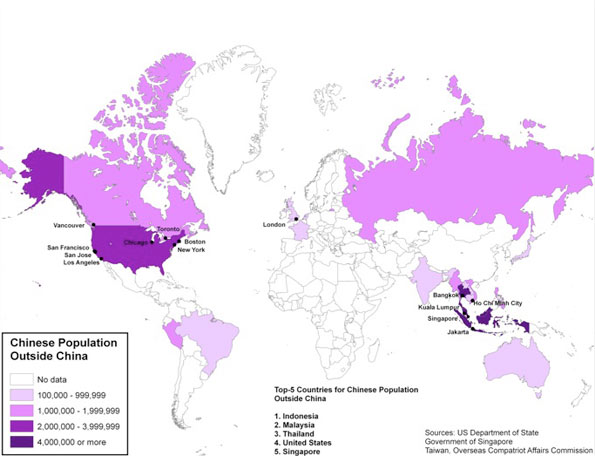
    Even today the ties between overseas Chinese and their home country remain close. The original diaspora countries—including Hong Kong–remain principal sources of investment into China. Among the ten largest sources for inbound investment to the PRC are Hong Kong, by far the largest investor, fourth-ranked Singapore and ninth-ranked Taiwan. Each brings more investments into China than such major powers as Germany, France, India and Russia. The United States, home to the largest overseas Chinese population outside Asia, ranks fifth.

    Other investments come from places like British Virgin Islands, the Cayman Islands and Samoa, which often act as conduits for investors who do not want to be too closely monitored. This seems to include many Chinese investors, particularly in Taiwan, who may not want too much scrutiny of their outlays into the PRC. This includes even Chinese government -owned firms such as China Mobile Communication Corp., which has established an investment HUB in the far away British Virgin Islands.
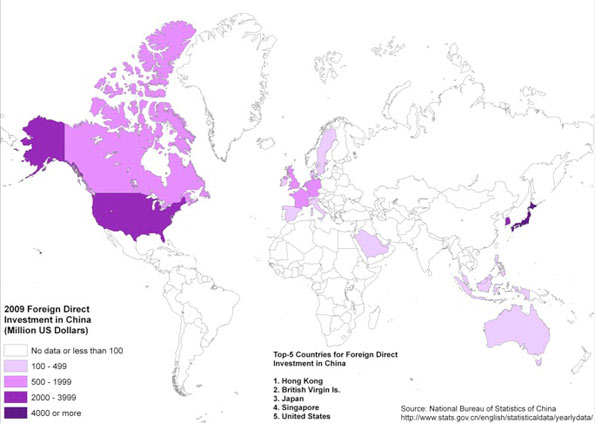
    As China itself has become wealthier, financial flows from the diaspora have continued to increase. Hong Kong’s investment into China grew from $18 billion in 2005 to $45 billion four years later. Singapore’s investment surged from $2.2 billion to $4.1 billion in the same years. This has occurred while new investment from such powerhouses as the United States, Japan, Korea and Germany has stagnated or even dropped.
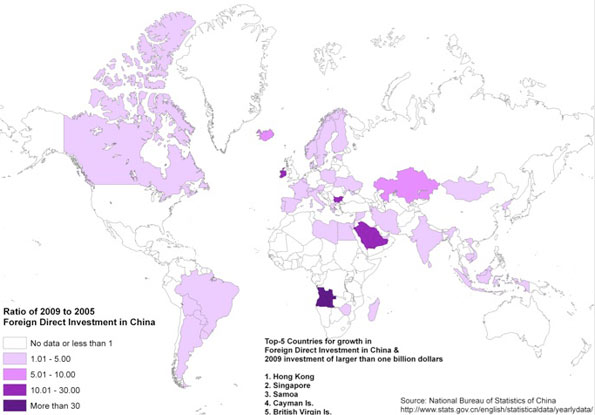
    The second phase of the Sinosphere has been dominated largely by industrial projects, many of them financed or helped technologically by the diaspora. Much of trade, initially, was targeted to the rich consumer markets of North America, Europe and Japan.  Between just 2007 and 2009 China’s share of world exports expanded from 7% to 9%.

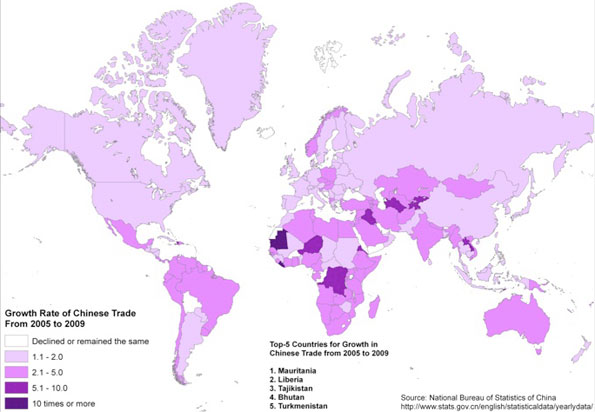
    But today the Sinosphere’s trade flow is shifting. An analysis of trade growth between 2005 and 2009 shows a significant change in focus away from advanced countries to the developing world. In the second half of the last decade, for example, trade with the United States, Japan, Germany, South Korea and the Netherlands grew by less than 50%. In contrast, commerce with key developing countries–including Afghanistan, Tajikistan, Mauretania, the Democratic Republic of the Congo, Liberia Turkmenistan, Iraq and Laos–grew ten times. Trade with large emerging economies, notably Brazil, India, Mexico and South Africa, increased five times during the same period.

    China’s thirst for resources is a big driver of this shift. Now the world’s largest car market and consumer of energy, China is in great need of oil, gas, and other natural resources. It also requires vast amounts of foodstuffs, notably corn and soybeans, for its increasingly urbanized population.

    Two of China’s new trade thrusts follow historic patterns of expansion, the first being growing investment in the Mekong Delta and Southeast Asia (Laos, Vietnam, Myanmar, Thailand, Cambodia and Malaysia). For 2010, Chinese invested $7.15 billion in energy projects alone in Myanmar. On the military side, this also includes moves by China to secure offshore islands for energy development, which is a potential source of conflict with Vietnam, the Philippines and Japan.

    The second big expansion is along the old “silk road” connecting eastern China to the energy and mineral rich “ stans” of Central Asia. This shift enhances the importance of inland Chinese cities, such as Xi’an, Chengdu and Chongqing, which are natural entrepots for central Asian trade. Perhaps even more important may prove the role of Kashgar, which was designated last year as the Special Economic Zone. Sitting on the western edge of the Xinjiang Uyghur Autonomous Zone near the border of Tajikistan, the Chinese envision Kashgar as the main rail and air link to the stans. Recent disturbances by the local Muslim majority, however, could threaten these ambitious plans.
    As China’s economy and wealth has grown, it has moved from being merely a recipient of inbound investment into a major exporter of capital. China’s outbound investment is growing much faster, rising 21% in just the past year; its overseas investment overall has grown from 53.3 billion in 2005 to 224.4 billion in 2009.

    Although still the largest destination for foreign investment, the country has vaulted into the top four in terms of outbound outlays just  behind the U.S., Japan and the U.K. It is not inconceivable that China could challenge the U.S. as the world’s top foreign investor.

    The country’s investment strategy seems to be following two powerful trends.  One has to do with the acquisition of resources to feed the Chinese industrial machine and its growing consumer market. This explains the rapid growth of investment into the Middle East, South America and Africa. Four of the five fastest-growing investment areas for large scale investments–South Africa, Canada, Nigeria and Australia–are all major commodity exporters. Chinese investment in these countries has been growing from three to five times as quickly as those in the U.S. or Western Europe.
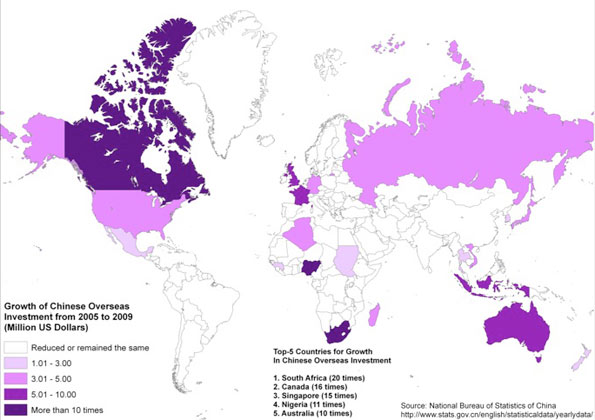
    The second, less obvious, trend relates to the idea that these countries, with generally faster growing populations, represent the most lucrative future markets for Chinese exporters.  This may be best seen in the rapid growth of Chinese government grants as well as the provision of interest-free and concessional bank loans, such as those provided by the government’s Exim bank, primarily to Chinese companies seeking to invest in developing nations, especially Africa, over the past decade. PRC financial backing for companies and projects in countries such as Angola, India, Equatorial Africa, Turkey, Egypt, the Congo and Algeria have grown over 100 times since 2005. Other key developing countries such as South Africa, Ethiopia, Somalia and Ghana all saw increases of tenfold or more.
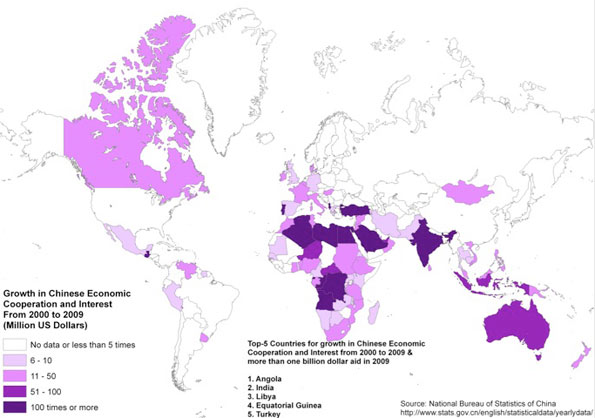
    These developments tell us something of the future of the Sinosphere. It will be largely funded by the Chinese and their diaspora, less focused on the West and more on developing countries, including increasingly those outside the traditional stomping grounds of Chinese entrepreneurs.  The emerging Sinosphere is also likely to be somewhat less focused on manufacturing and more on services like real estate, finance and high-technology exports. This is partially due to the appeal, for manufacturers, of less expensive, more youthful countries like Bangladesh, Vietnam and Myanmar.  Wages for manufacturing workers in the Philippines, Vietnam and Indonesia are now less than half of those in China.

    These shifts are already evident by looking at recent trends in inbound investment to China, much of it from the diaspora and tax havens. Between 2005 and 2009, for example, industrial investment fell from 70% to barely 50% in 2009. The total investment in industry has remained stagnant while dollars into scientific research have grown almost five-fold. We can expect more of this as China prepares to challenge America, Japan and other advanced countries in basic research. At the same time investment into real estate has tripled, while both software and financial flows have more than doubled.
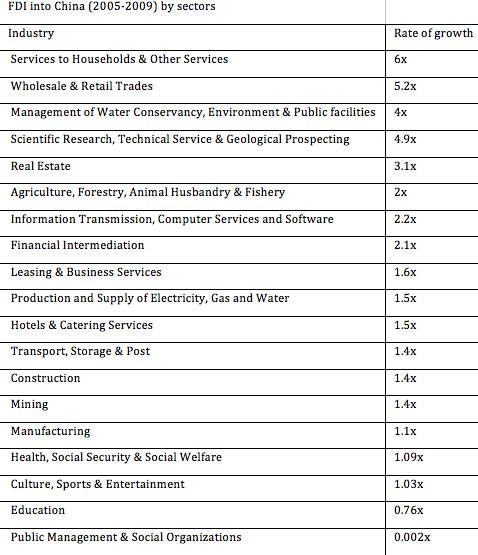
    All this explains the importance Chinese officials place on expatriates like the Taiwan-born Tang. In the 1980s and 1990s Taiwanese and Hong Kong firms spearheaded the development of China’s manufacturing prowess. Now the mainland leadership hopes that high-tech executives such as Tang will nurture and direct China’s leap into the first ranks of the global digital economy, with Perfect World’s Chengdu engineers epitomizing the future imagined by China’s aggressive regional officials. The fact that the company’s games are based largely on Chinese mythology makes the effort an even more natural fit. But Perfect World is not just looking at the Chinese or diaspora markets; it is also marketing aggressively to young gamesters in Europe and North America.

    All this can be seen as a direct challenge to the long dominant software and entertainment industries of the West, heretofore largely unchallenged by China. In a world increasingly  ’SINOFIED’  there may be huge potential for Sinosphere companies to move beyond exporting tangible goods, and increase their trade in ideas and culture to the rest of the world.

    “We are well on our way,” Tang explains from his perch in Chengdu. “China’s move into this kind of business is just beginning.”

    This research was conducted with support from the Legatum Foundation.

    This piece originally appeared at Forbes.com.

    Joel Kotkin is executive editor of NewGeography.com and is a distinguished presidential fellow in urban futures at Chapman University, an adjunct fellow of the Legatum Institute in London, and Senior Visiting Fellow at the Civil Service College in Singapore. He is author of The ity: A Global History. His newest book is The Next Hundred Million: America in 2050, released in February, 2010.

    Sim Hee Juat is currently a research associate with the Centre for Governance and Leadership at the Civil Service College of Singapore. The maps were created by Ali Modarres, Chairman of the Geography Department at California State University, Los Angeles.

    Photo by avlxyz.

  • Iowa Getting Off Bus Speed Rail?

    Iowa Governor Terry Branstad has refused to pay $15,000 in annual dues to the Midwest High-Speed Rail Association. This comes after the state legislature declined to fund intercity rail programs in the 2012 budget. Various public agencies had offered to pay the $15,000 on behalf of the state, however Branstad declined the money, with a spokesperson saying that the Legislature had "made their will crystal-clear" about funding membership in the organization.

    The Midwest High-Speed Rail Association has been promoting an intercity rail system that would serve Chicago from other major metropolitan areas, operating at substantially below international high-speed rail standards. In the case of the Iowa route, travel to Chicago would be slower than the present bus service, which does not require public subsidy and which provides free high-speed Internet. This issue is described in greater detail in an earlier article.

    The proposed national high-speed rail system has run into considerable difficulty at the state level. In addition to the reluctance of Iowa to participate, the states of Florida, Wisconsin and Ohio have refused federal funding. In the case of Florida, the genuine high-speed rail system was canceled by Governor Scott out of fear that the cost overruns, which have occurred in 90 percent of cases, would be the responsibility of state taxpayers. The California system could be nearly $60 billion short of its funding requirements for the first phase and is running into serious difficulties from citizens along the route. The Missouri legislature declined to include funding for part of the Midwest system earlier this year. Finally, the North Carolina legislature has placed requirements for its own review of any future federal grants for high-speed rail.

  • Despite Exhortations, San Antonio Suburbanizes

    "Despite years of effort by city leaders to revitalize San Antonio’s downtown neighborhoods, thousands of residents flocked to sprawling subdivisions on the far North and West sides in the past decade, while the inner city lost residents."

    That is how John Tedesco, Elaine Ayala and Brian Chasnoff of the San Antonio Express-News described the continuing dispersion of the San Antonio metropolitan area’s core Bexar County in an analysis of census tract population trends between 2000 and 2010 (we had reported more generally on the continuing dispersion of San Antonio a few months ago).

    Referring to the "siren song of the outlying suburbs," the authors note that the strongest growth in Bexar County occurred in suburban areas outside the outer beltway (the "Anderson Loop" or state route 1604). The growth, largely on the north and west sides of the county was nearly one-half of total county growth. At the same time, the inner city lost population.

    The Express-News analysis indicates that the population increased 233 percent in the northern and western areas outside the Anderson Loop. Inside the inner loop (Interstate 410), the population increased 7 percent. This includes the inner city area, where the population declined three percent. In the rest of the county (between the inner and outer loops and the outer suburbs of the east and south), the population increase was 24 percent.

    Outside core Bexar County, the metropolitan area added 34 percent to its population, more than any of the three major sectors of Bexar County.

    The reporters noted that "Every San Antonio mayor who served in the past decade preached the virtues of life in the inner city. For many people, it’s an appealing message — in theory. “Most people agree,” former Mayor Phil Hardberger said. “And then they drive out beyond 1604 to their houses.”

    Norman Dugas, a residential subdivision developer and past president of the Real Estate Council of San Antonio told the Express-News “The reality is, market forces are much more important than any planning emphasis or desire to shape development.” Put another way, "preaching" is not enough. People will likely follow their preferences unless forbidden to do so, which is regrettably a policy direction in some places.
    Subsidies to the core areas (often plentiful) and exhortations by public officials (few, if any of whom have themselves moved permanently to the inner city from the suburbs) are unlikely to change how people prefer to live.

  • What Does Rick Perry Have To Do With Texas’ Success?

    You don’t have to like Rick Perry or his sometimes scary neo-confederate politics to admire what has been happening in Texas over the past decade. Rather than trashing the state in order to demean its governor, perhaps the mainstream media should be thinking about what the Lone Star’s success story means for the rest of the country.

    Texas has done what most of other states — notably the blue coastal ones — have failed to do: create jobs. Over the past decade Texas has created 2.1 million jobs — while New York, California, Massachusetts and Illinois have all lost jobs.

    Its relative performance since 2009 has been even more stellar, producing nearly 40% of all new jobs in the U.S. Its unemployment rate stands at 8.2, well below the national average of 9.1 — an outstanding feat given the fact that the state grew 20%, twice the national average, over the decade. Texas is creating jobs for a growing workforce, while other states like New York or Massachusetts struggle to keep up with stagnant or even declining ones.

    Some self-proclaimed progressives like Paul Krugman attribute Texas’ success to population growth and the attraction of low-wage jobs for rapacious employers.

    “It is interesting how, suddenly, not having a job is better than working at a low-paying one,” notes architect and developer Tim Cisneros. True, many of the new jobs in Texas, as elsewhere, pay low wages and do not offer health benefits. But, says Cisneros, insisting that all the new jobs in Texas are low-paying is just not credible. “When you see the new hospitals and the new headquarters being built by Exxon here in Houston you can see there are lots of different opportunities,” Cisneros says.

    As Cisneros points out, people are not flocking to Texas for the privilege of being exploited any more than they come for the 100 degree summer heat. Many — and not only low-skilled campesinos — come for opportunities, including well-paying ones, that are not as readily available elsewhere.

    According to research conducted by the Praxis Strategy group, Texas has boosted mid-skill jobs — those that require two years or more of post-secondary education — by 16% in the past decade, That’s the third-highest rate in the nation (after much smaller Wyoming and Utah) and three times the national average. In contrast, New York has grown such positions by less than 5%, while California and Massachusetts have expanded them by less than 2%. Illinois, President Barack Obama’s home turf, was among the few states to actually lose mid-skill jobs.

    This pattern also applies to the high-tech and science-based industries. Over the past decade Texas’ number of STEM (science, technology, engineering and math-related) jobs has surged by 11%, one of the fastest rates among the states and four times the national average. California, Massachusetts and Illinois all lost positions in these fields.

    Another reason people go to Texas is their wages get them more there than in the big blue metros. For example, houses in Dallas, Austin or Houston cost three times the median income in these areas — or less. That ratio is twice as high, or higher, in places like New York, San Francisco or Los Angeles.

    These factors — job growth and lower costs — may not matter much to “trustifarians” or tenured professors who increasingly dominate the politics of the American left. But they have made Texas cities irresistible for almost every demographic in America, from boomers to the “young and restless” to families. For good measure, the state’s high-tech mecca, Austin, ranked third in attracting college-educated residents — well ahead hip centers like San Francisco, Boston, New York or Los Angeles.

    To be sure, Texas has benefited from higher energy prices, as Perry’s detractors point out.  According to an analysis by the EMSI economic forecasting group, the energy sector jumped from over 230,000 jobs in 2001 to just under 490,000 in 2011. That’s roughly 10% of all the state’s overall job gains. This parallels job growth in other states that have experienced surges in energy-related employment — such as North Dakota and Wyoming.

    But some of this has to do with making your own “luck.” Energy-rich California has all but declared war on its fossil fuel industry, once one of the nation’s most important. Instead, the state has placed lavish bets on renewable fuel and the much ballyhooed notion that “green jobs” could provide a massive base for new employment — something even the green-friendly New York Times has called “a pipe dream.”  In fact, employment in this field has actually started to tick down, and the prospect of ever higher energy prices associated with “clean” fuels could prove another nail in California’s economic coffin.

    So how much of Texas’ relative success is due to Perry and his fiscal policies? Some — but not too much. Perry has faced budget shortfalls based in part on an expanding state government that has grown through the recession: Texas, notes EMSI’s Joshua Wright, is one of only 10 states where state and local government jobs have grown since 2009, rising by almost 30,000 positions. “These numbers don’t exactly bolster Perry’s small-government agenda claims,”says Wright. Free-marketers also point out that Perry clearly favored, sometimes with state funds, people who had the foresight to back his political career.

    But Perry has won business support for things other than naked cronyism. Jim DeCosmo, CEO of the Austin-based Forestar Group, credits Perry with maintaining a business-friendly regulatory regime and with important steps for tort reform. These, he feels, both encourage Texas businesses to expand in the state and for out-of-state companies to move in.

    Most of the credit for Texas’ success lies primarily in the state’s economic culture. Rice University urban scholar Michael Emerson notes that Texas’ pro-business tilt started well before Perry, and is not restricted to the GOP. Many of the state’s most prominent Democrats — including the man Perry beat for governor last year, former Houston Mayor  Bill White — have been strong advocates of economic growth and across-the-board energy development.

    “I do not feel Perry has   much to do with Texas’ success,” says Houston real estate mogul David Wolff , who last year backed both a GOP challenger to Perry and, later, White. “But at least you can say that he has not appeared to hinder it.”

    In fact, Texas’ current and, more so, future prosperity might be better served  if a pragmatist like White ruled the Lone Star State. Perry’s ideological rigidity on spending and social issues may not be the best fit for a state facing massive ethnic change, including a future Latino majority. And as the state becomes more high-tech oriented, education of its surging workforce will grow as a concern, something that Perry does not seem to see as a priority.

    Yet despite the state’s shortcomings — and those of its current governor –  Texas’ success remains remarkable, particularly in comparison with that of the other major states. Rigid adherence to low taxes and light regulation may  not be the panacea for all economic problems but the opposite approach of ever higher taxes and debilitating regulation clearly has failed in terms of creating jobs and opportunities.

    Rather than demean the Lone Star state, perhaps progressives should begin demonstrating an alternative approach for American prosperity that might actually work someplace other than in the fevered imaginations of academics and pundits.

    This piece originally appeared at Forbes.com.

    Joel Kotkin is executive editor of NewGeography.com and is a distinguished presidential fellow in urban futures at Chapman University, and an adjunct fellow of the Legatum Institute in London. He is author of The City: A Global History. His newest book is The Next Hundred Million: America in 2050, released in February, 2010.

    Photo by Gage Skidmore.

  • Megabus – King of the Road

    In recent years there’s been a resurgence in intercity bus travel, driven by the rise of low cost, non-stop service linking tier one cities like New York, Chicago, and Washington, DC with other regional hubs in their surrounding areas. This is a lively and diverse market, particularly on the east coast, with providers like Megabus, Bolt Bus, Greyhound, and a host of so-called “Chinatown” buses.

    These offer service for very low fare, ostensibly as low as a dollar, but more typically $20. Still, that’s far cheaper than even driving in most places, and certainly than flying. These services typically involve curb side loading (no stations) adjacent to a city’s main train station, making them almost a quasi-rail service or rail adjunct, while giving many of the same rail benefits as direct CBD-CBD service without requiring extensive, and expensive, ground transport on either end. With amenities like AC power outlets and free wi-fi – which many Amtrak and commuter trains don’t yet offer – it’s easy to see why they are popular. And this isn’t just with the stereotypical bus ride customer, but increasingly with everything from hip Millennials to the mothers of yuppies coming into the big city for a visit. Megabus and others are drawing an entirely new market who previously would have discounted intercity bus service – including Yours Truly.

    With a low cost service that gets people out of cars and planes and into what is basically a shared transit vehicle, you would think that Megabus would be extremely popular in the urbanist/sustainability community. But you’d be wrong. A large segment of them have indeed seen the virtues of this new school intercity bus service, but a surprisingly large number of them actually revile Megabus.

    Among the common complaints are that Megabus is “subsidized” because it uses valuable curb side real estate in cities for free, that they are implicitly subsidized by highway funding, that passengers waiting for the bus at the stop are a nuisance, that the buses clog the streets and pump fumes into the air in a way that harms the “neighborhood,” and that the service really isn’t that good because of congestion. Even the government of Washington, DC is getting in on the act, as reported they want to charge Megabus a fee for access to their loading zones.

    Every last one of these is bogus. The quickest way to illustrate this is to simply ask how urbanists would react if anti-transit forces made similar arguments against ordinary municipal bus service.

    First, municipal bus service is massively subsidized, both from a capital and operating perspective. Megabus pays for its own buses, drivers, and fuel and actually pays taxes to the government. As for subsidies from free use of curbside real estate and highway funding, large amounts of our city streets – including on pretty much every block on major streets in major cities – have permanently dedicated space to bus stops. The bus agency does not pay for these. City buses also runs on streets paid for with highway and general fund dollars. And in any case, this concrete investment in streets and highways is a sunk cost, with buses contributing little to general freeway congestion.

    As for passengers congregating at stops, that’s frequently the case with city buses as well, as this picture from Chicago shows:

    And to argue about crowds hurting city life seems a bit odd given that we’re told one of rail’s benefits is bringing all those people in to patronize businesses. I know I’ve made purchases at businesses near the Megabus stop that I wouldn’t have otherwise made. And in places like Midtown Manhattan, there are already vehicles of all types more or less continuously stopped or even double parked along the avenues. Megabus is barely a blip here. Plus don’t forget all the loading zones that already serve many private businesses all over our cities.

    Also, these bus stops are typically located in the CBD near a train station, which is already crowded and which itself can be a huge (and tax free) mega-structure in the city that poses disruption in its own right (e.g., Grand Central Terminal). What this also means that any fumes and such disproportionately are in the CBD, not really a neighborhood. Again, many train stations also feature diesel fume generating trains (Metra’s trains in Chicago were recently noted as having unsafe diesel fume concentrations). And also, city buses generally do pump out fumes as well, and truly in the neighborhoods. Anyone who’s spent time in a city knows the delight of having a poorly tuned bus pull away from the stop belching a huge black cloud. I frequently get to experience this while out jogging in my neighborhood.

    Again, if an anti-transit writer tried to disparage investment in city buses with the arguments raised against Megabus, they’d be laughed out of the house by the urbanist/sustainability crowd.

    So why the complaints? They can speak for themselves, but I suspect a couple of items. Firstly, some people just don’t like private sector solutions. That’s a view I can respect, but not agree with. But more importantly, I think that there’s fear that successful private sector intercity bus service undermines the case for high speed rail that is near and dear to the urbanist heart.

    Indeed, it is true that in many cases Megabus frankly does undermine the case, particularly for the “Amtrak on steroids” style HSR proposals on the table in places like the Midwest. Megabus already delivers basically the end to end journey times of the proposed Midwest “high speed rail” system with similar amenities but without the need for billions in government expenditures. Even on the east coast, NYC to Providence has a journey time not that much worse than the Acela – and at 20% of the ticket price. Congestion might be a real concern, but if so, customers would notice. But give Megabus some credit – they build this into their schedules. Generally the journey times are as advertised.

    I prefer to look at it differently though. What Megabus & Co. are proving is that there is a viable market for intercity transit-style travel at the right price. Thus they are helping to get people used to the idea of traveling that way and in a sense priming the pump for high speed rail at a later date as demand increases. The bus operators are doing the hard work of creating and proving out the market for this. Also, Megabus will hopefully force the backers of many of these HSR proposals to rethink their concept around 110MPH peak speeds in favor of true high speed rail. And even in the worst case, Megabus doesn’t say anything against such slam dunk investments as further upgrades to the NEC. Conceivably if and when HSR investments are made, these bus operators will service a different, lower end market and/or evolve into more of a rail complement. (For another perspective on this, see “Will Megabus Kill High Speed Rail?.”)

    In any event, I’m totally puzzled by the lack of enthusiasm or outright hostility against a service which is providing cost effective, green transport and getting people out of their cars today without tax expenditures. That’s not to say these services can’t be improved. Perhaps they should make some payment for curbside space. The wi-fi service is frequently inoperable. And their buses, particularly later in the day, can see schedule slippage as problems cascade. Perhaps some stops should be relocated to be less disruptive. But all of these are easily solvable problems. None of them vitiates the fact that these intercity bus services are one of the best transport innovations of our time.

    Aaron M. Renn is an independent writer on urban affairs based in the Midwest. His writings appear at The Urbanophile, where this piece originally appeared.

    Photo by Sidddd

  • From China’s Interior, A Step Back in Time, A Photo Essay

    In the China of the 21th century, the one where all is about reckless growth, competition and the inevitable slide down into vicious consumerism of colossal proportions, there is still a big portion of it that has not caught up with the craze and preserves its most traditional qualities almost untouched.


    Along the paved road that links the fast-growing cities of Zhangye in Gansu and Xining in Qinghai, lies the Hui village of Menyuan. It sits at about 9500ft, on the north-eastern tip of the Tibetan plateau. Stuck in time, villages like Menyuan allow us to travel back a few hundred years, where carriages pulled by donkeys are still the main mean of transport.

    The Hui are Chinese speaking Muslims and rank among the 56 recognized ethnic minorities by the Chinese Government. Hui people are descendants of the merchants of various middle-eastern origins who transited the Silk Road   between Europe and China. Some merchants stayed behind and married Han Chinese. They adopted the Chinese language but retained their Muslim faith.    Until this day, they preserve the practice of their religion untouched and their diet, dress code and daily practices follow lines prescribed by the Quran.  

    Hui people pass their tradition from generation to generation and even young teenagers seem proud about it. Most seem willing to extend it into the future generations, despite the clash of cultures and the rapid westernization of the China. 


    The Hui’s diet follows Islamic strictures. They do not eat pork and fast during Ramadan. Hui butchers keep their stores and practices as precarious – from a western perspective – as possible.  No need for refrigeration, no need for an enclosed space. Beasts are slain open-air and chopped on-demand. Carcasses hang off hooks pretty much as shiny Armani suits hang from the luxurious stores of Shanghai.


    Chinese traditional medicine and herbal treatments have been adopted by the Hui and roots are sold everywhere on the streets.

    Anything can be made into a store.  A whole family can make a store out of a simple box of metal and passively sit all day at its front door, watching life go by and of course do some business.

    In Menyuan, the atmosphere is nothing short of relaxed. People sit around the streets conversing for hours and people-watching and gossiping are every day’s main entertainment.

    Hui lifestyle, like any religious society, is a conservative one. Even though not as strict as other Muslim groups, Hui tend to segregate women on one side and men on the other. Women dress traditionally with the local cap-like chador and are usually in charge of taking care of their little kids.

    Men, on the other hand, hang out among talking and discussing local events.

    Born and raised in Buenos Aires, Argentina, Nicolas Marino is a 33 year-old architect and photographer currently based in Chengdu, China. For the last 6 years he has chosen a bicycle as means of transport to reach the most remote regions of the world where he focuses most of his documentary work. Some of his journeys include a 10.000km ride from Tehran to Shanghai and several trips around remote and rural China where he has now cycled over 8000km.

  • Dulles Metrorail Silver Line Vs Bus Rapid Transit

    Long overdue rapid transit service from Washington DC to Dulles airport is now under construction. The Dulles Corridor Metrorail Project, known as the Silver Line, may seem like it was an obvious choice as a way to improve the region’s public transportation. Construction began in March 2009, and service is expected to begin by 2013. As those who have used bus service from the DC area to the airport can attest, the current system — a regular city bus equipped with luggage racks — is inadequate. The buses are low capacity, and are not designed for highway driving.

    While rail might seem like the most obvious solution, it is also by far the most expensive and slowest option. The price tag is staggering, and the rail extension will take years to construct. The better option would have been to make use of the existing roadways, and implement an expansive bus rapid transit system (BRT).

    The 23 mile extension of the Washington Metro rapid transit system is forecast to cost $6.8 billion dollars; roughly $296 million per mile. The constant scramble to finance the over-budget project has resulted in more than one construction setback.

    In contrast, consider how a BRT system could have worked, and what it would have cost. One lane in each direction on the Dulles Toll Road could have been designated as a high occupancy vehicle (HOV) lane, to ensure that buses could move relatively quickly. The average cost of implementing a BRT system running on an HOV lane is $8.97 million per mile (in 1999 dollars), which would have brought the cost to roughly $230 million. It should be noted that this average is heavily skewed by one costly project; two million to five million dollars per mile is more typical, which would make the final cost in DC between $52 million and $130 million.

    The buses themselves would have had to be fully articulating — the kind that bend in the middle, also known as accordion buses — with overhead luggage compartments, and a capacity of roughly 87 passengers. They would likely cost somewhere between $750,000 and $1.68 million.

    The overwhelming likelihood is that busses to Dulles would cost near the low end of the price range. The high end is based on the cost of buses used in Boston for their Silver Line BRT system to Logan Airport, where dual fuel electric/natural gas buses are used; these buses run underground, where they cannot burn gas, as well as on surface streets where there aren’t any overhead electric lines.

    The cost per passenger trip is likely to be lower for rail than for BRT, because of rail’s higher capacity per vehicle; the train will transport about 175 passengers per car. Despite this, the lower per passenger operating cost doesn’t come anywhere near making up for the massive capital cost. The interest alone on the $6.8 million dollar loan would equal $1,067,317 per day (amortized over 30 years at a 4% interest rate). This doesn’t factor in the cost of the principle, or the operating cost.

    Even after spending $6.8 billion, only about 10% of travelers to Dulles are likely to arrive by public transportation, according to projections by the Airport Authority. Compare that to 16% for Reagan , which is right in the city (Dulles is more than 25 miles outside of DC’s central business district. This highlights another advantage of BRT: modularity. Instead of all or nothing, BRT can be gradually introduced, and levels of service can be adjusted to meet demand.

    While access to Dulles isn’t the full justification for the Silver Line, it’s hard to imagine the rail extension ever paying for itself. At the end of the day, cost is the number one issue, and BRT wins hands down.

    Steve Lafleur is a Policy Analyst with the Frontier Centre for Public Policy.

    Photo: Metrorail Construction; truss erecting span at I-459 and Rte 123

  • Sizing Up Texas’ Job Growth Under Rick Perry

    Now that Texas Gov. Rick Perry is officially in the running for the Republican presidential nomination, journalists and econ bloggers from almost every national news outlet have examined the Texas’ economy in excruciating detail. The fact that Texas has produced nearly 40% of all new jobs in the US since 2009 has been regurgitated over and over again, and the state’s remarkable population spike has repeatedly been cited as a reason for the big employment growth.

    But more than those shared story lines, writers have offered another strikingly similar theme in their Texas critiques: many have pointed to the wave of oil and gas jobs as the key driver of the state’s economic boom.

    To be sure, energy employment is part of Texas’ growth, as EMSI highlighted in June. But it’s far from the biggest part. CNNMoney did a nice job laying out the super-sectors that have done well in the Lone Star State, and we’re going to drill down even further using EMSI’s detailed data to see which specific industries are fueling the state’s growth.

    How Texas Stacks Up

    It’s true that Texas has accounted for a large share of new jobs in the US, and that’s not just the case since 2009. Going back to 2001, Texas has added more than 2.1 million jobs, according to EMSI’s latest complete dataset, while the rest of the nation has combined for 6.2 million new jobs.

    But Texas is a massive state, of course, with a population of more than 24 million. So to even the playing field, let’s look at percentage job growth.

    As it turns out, there are only four states that have grown from 2001 to 2011 and from 2009 to 2011.

    Like Texas, Wyoming and Utah have also had 18% growth since 2001, but no state has performed better since 2009 than North Dakota. Its employment base has grown 5% in the last two years, compared to 2% for Texas. But because North Dakota has a much smaller population — and workforce — than Texas, its growth typically doesn’t get mentioned in discussions like these.

    Energy is a Big Player — But Not the Biggest One

    Oil and gas extraction employment in Texas has more than doubled in the last 10 years, and support industries for drilling have also boomed. Altogether, the mining, quarrying, and oil and gas extraction sector has jumped from over 230,000 jobs in 2001 to just under 490,000 in 2011.

    But that’s only a fraction of the 14.2 million jobs in the state, and the oil and gas growth accounts for slightly more than 10% of all new jobs in the state since 2001.

    What have been the biggest job gainers? Health care and social assistance (421,000-plus) and government (nearly 282,000) have made the largest additions to their payrolls in the last decade. It should be noted, however, that government jobs have declined in the last year — and were growing stagnant before then.

    Yet once you extract federal government jobs, it’s clear that state and local government employment is doing considerably better in Texas than other states. Texas is one of 10 states that have seen increases in state and local government jobs since 2009, and its growth (29,287) is nearly nine times that of the state with the second-most growth, Kentucky (3,327).

    These numbers don’t exactly bolster Perry’s small-government agenda claims.

    State and Local Government Job Change (2009-11)

    In terms of detailed sub-sectors, temporary health services, crude petroleum/natural gas extraction, and home health services have been the strongest performers in Texas since 2009. Overall, 19 industries have added at least 5,000 jobs since ’09, of which electric power distribution has had by far the largest percent growth (111%).

    NAICS Code Description 2009 Jobs 2011 Jobs Change % Change
    561320 Temporary Help Services 171,096 204,456 33,360 19%
    211111 Crude Petroleum and Natural Gas Extraction 290,638 317,388 26,750 9%
    621610 Home Health Care Services 240,018 263,099 23,081 10%
    930000 Local government 1,240,713 1,261,970 21,257 2%
    213112 Support Activities for Oil and Gas Operations 89,179 108,765 19,586 22%
    221122 Electric Power Distribution 11,840 25,038 13,198 111%
    722110 Full-Service Restaurants 371,893 385,081 13,188 4%
    814110 Private Households 113,106 125,148 12,042 11%
    621111 Offices of Physicians (except Mental Health Specialists) 198,795 210,077 11,282 6%
    622110 General Medical and Surgical Hospitals 265,013 274,810 9,797 4%
    920000 State government 354,190 362,219 8,029 2%
    551114 Corporate, Subsidiary, and Regional Managing Offices 90,157 98,159 8,002 9%
    213111 Drilling Oil and Gas Wells 34,826 42,562 7,736 22%
    425120 Wholesale Trade Agents and Brokers 58,575 64,461 5,886 10%
    452112 Discount Department Stores 63,272 69,137 5,865 9%
    561720 Janitorial Services 152,316 157,919 5,603 4%
    623110 Nursing Care Facilities 99,246 104,651 5,405 5%
    561110 Office Administrative Services 88,376 93,599 5,223 6%
    522110 Commercial Banking 112,482 117,698 5,216 5%

    Key Regional Industries

    We also looked at the most concentrated industries in Texas, as compared to national employment concentration, to see which industries are unique to the state and tend to be export-oriented. Oil and gas extraction — and the production of equipment for extraction — figure prominently among this group of industries.

    Crude petroleum/natural gas extraction is more than 4.5 times more concentrated in Texas than the nation, and it accounts for more than 300,000 jobs. Other industries with high LQs and large employment bases: support activities for oil and gas operations; engineering services; and office administrative services.


    For more on Texas’ economy, be sure to read Tyler Cowen’s post at Marginal Revolution. And for more on Texas’ growth, check out this piece on the top cities in the US.

    Illustration by Mark Beauchamp

  • Urban Violence Abroad: An Arab Spring and a British Autumn?

    Treating urbanisation as some sort of homogeneous movement, a driver of an increasingly interdependent world of shared values, behaviour, and prosperity is to oversimplify.  There may be some common drivers, but urbanisation in the 21st century is likely to be quite different from urbanisation in the 20th century.  Suggesting a universal approaches to governing, managing and planning cities is providing answers without knowing the questions. 

    The role of the city has to be considered in recent outbreaks of localised or national violence.  In this post I raise the issue of urban violence with reference to urbanisation in North Africa and the Middle East, and explore possible parallels with recent riots in Britain.

    Violence and language

    Language, like planning, can be employed to make order out of chaos.  The American invasion of Iraq in 2005 was widely seen as the beginning of an Arab Spring, a label suggesting that people in other Arab nations might rise up in some universal quest for democratic deliverance from oppressive regimes following the expulsion of Saddam Hussein. 

    In keeping with this representation, today’s images of protest and violence in the streets of Egypt, Libya, and Syria are presented as signs of culture change leading inevitably to western-style democracy.  But it would be premature to assume that out of the current movements will come the end of autocracy, a displacement of authoritarian regimes with multi-party democracy, or a cessation of sectarian conflict. 

    Despite deep cultural difference that mean western expectations for Arab outcomes are likely to be flawed, there are parallels between what is happening in North Africa and urban violence in Britain.  Only there, the language is quite different.  The politicians and press are not lauding the people on the streets of London or Birmingham, and the reporting is a lot less optimistic. 

    Cities and revolution

    Have you noticed how the images of North African protests against autocratic governments are male-dominated, and urban? This is hardly new: think Paris at the end of the 18th century or in 1848.

    But today’s turmoil does raise a couple of thoughts.  First, let’s remember there is an enduring tradition of inter-tribal struggle for power and long-standing feuds among sects in the Middle East.  Internecine violence predates the colonial borders and post-colonial regimes that seem to be unraveling now.  Despite the increased trappings of modernisation, little may have changed by way of physical struggles for power in a traditionally male domain.

    But what is interesting is the way uprisings are playing out today as predominantly urban movements.  Urbanisation appears to play an important part in focusing discontent and making disenfranchisement visible.  Growing cities provide gathering places for growing protest.  They are the terrain for harassment, the platform for violence, and the stage for claim and counterclaim.  The march from city to city, whether in defiance or defence, tracks the progress of civil unrest, suppression, and revolution. 

    Social media – uniting or dividing?

    Much has been made of the role of social media in mobilising civilians to a common cause, but it can only really give form to popular protest in an urban setting.  Urbanisation may encourage unity among diverse groups opposing a common tyranny. But such unity is likely be transitory, lasting only to the fall of the first tyrant.

    Within fast growing cities of the Arab world sectarian divisions still run deep and social media may simply reinforce them, calling brothers to arms to settle old enmities once new protests have finished.

    The demographics of growing cities

    It might pay to look more closely at urbanisation to better understand the character of today’s protests.  Look at the underlying demographics of countries at the heart of unrest and regime change in North Africa, and compare them with, say, the US and the UK.  They:

    (1)    Are urbanising rapidly – Syria and Iraq stand out;
    (2)    Have large shares of their populations aged under 30 years – 67% in Iraq and 65% in Syria;
    (3)    Have higher unemployment – quite possibly much higher given the difficulty of measuring this figure in a consistent way.  Libya appears to lead the way, although some of the unemployment figures are little better than informed guesses.

    Syria

    Iraq

    Libya

    Tunisia

    Egypt

    US

    UK

    % Urban

    55.7%

    66.2%

    77.9%

    67.3%

    43.4%

    82.3%

    79.6%

    Urban Growth

    101.5%

    65.2%

    54.3%

    46.6%

    45.9%

    36.2%

    10.2%

    % Aged<30

    65.2%

    66.7%

    60.2%

    49.2%

    59.9%

    39.3%

    36.2%

    % Aged <30 Male

    51.0%

    50.7%

    51.1%

    50.1%

    50.9%

    49.8%

    50.1%

    Unemployment

    12.6%

    15.3%

    30.0%

    13.0%

    11.9%

    9.1%

    7.7%

    Sources: US Census Bureau; TradingEconomics.com; CIA World Fact Book, national statistical offices


    How far, it might be asked, is the Arab spring founded on the frustrations of Arab youth?  And can we really expect revolution in the streets to resolve issues of deprivation, dispossession, and boredom, without the revolutionaries first finding fulfilment and making real material (or spiritual) progress even if the short term ends of overthrowing incumbent rulers are met?

    The road to this Damascus is likely to be long and divided

    The mix of rapid urbanisation, youthful populations, and high unemployment is a volatile one.  Add strong religious, cultural or ethnic divisions and inequality within increasingly urbanised societies and the prospect is for prolonged unrest and sporadic violence. 

    While globalising communications and the accessibility of social media may feed visions of liberal democratic regimes and the illusion of increasingly connected societies, the result in North Africa and the Middle East may be quite different from any western ideal.  Revolution here may lead to ways of sharing and exercising power other than those associated with orderly, liberal democracies; or it may simply reinforce the fractured nature of these societies.

    The road ahead is not clear, nor it is likely to be smooth.

    Lessons for the west?

    Are the industrialised – and post-industrial – cities of the west insulated from the frustrations of youth?  Recent British experience suggests not.  The numbers are smaller, and the middle aged and middle class more likely to resist, but urban conditions of alienation and relative deprivation are significant, particularly among young people in large urban areas. 

    Deprivation is most conspicuous in cities, especially when economic growth is less assured and the fruits less dispersed.  Almost inevitably, the costs of stagnation are distributed disproportionately along ethnic and generational lines when the economy slows and business and governments consolidate. 

    Who’s rioting in Britain?

    In February 2011 it was reported that youth (16-24 years) unemployment in Britain hit a record 20.5%, compared with a general rate of 7.9%.  The majority of young unemployed are concentrated in urban areas: according to a 2009 Centre for Cities publication, the 63 largest British cities and towns contain 59% the country’s youth population, but 64% of the young who are on benefits.  Not only that, but a 2010 publication by the Institute for Public Policy Research suggests that half of Britain’s unemployed youth are black.

    The television images of British urban riots show a high proportion of youth, and a disproportionate representation of black youth.   While the riots were characterised by the level of damage to property and theft, attributing them simply to criminality (or moral weakness) misses the role of divisions within large cities.  When distinctive groups of people within cities sit outside prevailing economic and political structures, their collective lack of respect for property – or lives – should not be so surprising.

    There are obvious differences between the urban domain in Britain and that of North Africa, though.  For a start, dispossessed youth are a minority in Britain, where a strong middle-aged middle class will rally to support government efforts — or even to advance their own — to quell disorder.

    So, in urban settings that are figuratively a world apart a common contributor to street violence is an alienated youth.  But perhaps that’s as far as commonality goes.  In the Arab world, youth is a near or even absolute majority; in the western world it is minority.  In the Arab world it appears to be seeking a share of the power in rapidly urbanising communities; in the western world it is seeking its share of the good life in a long-urbanised society. 

    Phil McDermott is a Director of CityScope Consultants in Auckland, New Zealand, and Adjunct Professor of Regional and Urban Development at Auckland University of Technology.  He works in urban, economic and transport development throughout New Zealand and in Australia, Asia, and the Pacific.  He was formerly Head of the School of Resource and Environmental Planning at Massey University and General Manager of the Centre for Asia Pacific Aviation in Sydney. This piece originally appeared at is blog: Cities Matter.

    Photo by Syria-Frames-of-Freedom