Blog

  • Citizen Bloomberg – How Our New York Mayor has Given Us the Business

    This piece originally appeared in the Village Voice.

    After a charmed first decade in politics, Mayor Mike Bloomberg is mired in his first sustained losing streak.

    His third term has been shaky, marked by the Snowpocalypse, the snowballing CityTime scandal, the backlash to Cathie Black and “government by cocktail party,” and the rejection by Governor Andrew Cuomo of his plan to change how public-school teachers are hired and fired. With just a couple more years left in office, Bloomberg is starting to look every one of his 70 years.

    Soon, he’ll be just another billionaire.

    The mayor’s legacy is remarkably uncertain—largely because he’s done his best to keep New Yorkers in the dark about what it is he’s really set out to do in office.

    In part, this is because the mayor has been far more effective at selling his Bloomberg brand than in getting things done. But it’s also because what he has done—remaking and marketing New York as a “luxury city” and Manhattan as a big-business monoculture—he prefers to discuss with business groups rather than the voting public.

    Withholding information while preaching transparency is a Bloomberg trademark. He aggressively keeps his private life private—meaning not just his weekends outside the city at “undisclosed” locations, but also his spending, his charitable giving, and his privately held business.

    New Yorkers who have received city, campaign, or Bloomberg bucks in one form or another and who expect to do business again in the future agreed to speak anonymously with the Voice about the mayor’s personality, the intersection of his political and private interests, and the goals he aims to achieve.

    Several sources agreed to speak only after hearing what others had said. “It’s Julius Caesar time,” said one source. “There’s lots of knives, but no one wants to be first.” Others refused to be quoted, but encouraged me to give voice to their complaints—which sometimes diverged but often built into a sort of Greek chorus, an indictment of Bloomberg’s mayoralty from those who have seen it in practice, and are vested in it.

    “Hanging out with a billionaire does bad things to your brain,” a source said. “It makes you think you’re right.”

    The candidate who first ran in 2001 on his private-sector résumé and a deluge of advertising never did bother telling voters much about his agenda.

    He pledged in that first run not to raise taxes and to step away from the daily running of his private company if elected to public office, but he brushed aside both vows after the election. In the case of his business, he claimed to have kept his word until his own testimony in a lawsuit unsealed in 2007 showed that he’d been far more active than he’d previously acknowledged.

    The vast redevelopment schemes he unveiled in office were never mentioned on the stump.

    New Yorkers have no trouble picturing Giuliani’s New York, or Dinkins’s “gorgeous mosaic,” or Koch’s “How’m-I-doing?” New York, or Beame’s bankruptcy, or Lindsay’s “Fun City.”

    After two full terms and change, what do you call Bloomberg’s New York? In many ways, the mayor has been merely a caretaker.

    While Bloomberg has called himself the “education mayor,” his claimed success with the public schools has been exposed as largely accounting tricks.

    When asked to describe the boss’s vision for the city, aides and allies tack post-partisanship on to a checklist of Bloomberg LP buzzwords: transparency, data-driven results, and a CEO fixed on the bottom line. Pressed for actual accomplishments, the city’s post-9/11 resurgence usually is mentioned first.

    The attack and its economic fallout played key roles in all three of Bloomberg’s runs, though the story has less to do with strong leadership than with good timing and salesmanship.

    The attack itself, along with his opponent Mark Green’s fumbled response to it, helped put Bloomberg over the top in 2001. The ensuing Fed-sponsored low-interest-rate bubble inflated New York’s markets just in time to help rescue the mayor from record-low approval ratings and ensure his re-election in 2005. When that bubble finally burst in 2008, the Wall Street meltdown became the public rationale for the “emergency” third term.

    “Post-partisanship” has always meant the party of Bloomberg, a convenient handle for a lifelong Democrat who left the party to avoid a contested primary in New York. After the presidential plotting that occupied most of his second term fell short (the big hit that began his losing streak), Bloomberg aimed for a soft landing with a nakedly undemocratic “emergency” bill to allow himself a third term. Instead, it alienated New Yorkers and wrecked his expensively built reputation as a “post-political” leader in the process.

    Transparency has always been something Bloomberg has preferred to pitch rather than practice. In his 1997 business memoir, Bloomberg on Bloomberg—a sometimes valuable guide to the mayor’s approach—he notes that “if public companies change what they’re doing midstream, everyone panics. In a private company like Bloomberg, the analysts don’t ask, and as to the fact that we don’t know where we’re going—so what? Neither did Columbus.” It’s a philosophy Bloomberg brought with him to City Hall.

    “Data-driven”? It’s hard to credit that when crime numbers are artificially deflated by re-classifying rapes as misdemeanors, NYC-reported public school gains disappear when compared to outside measures, and when the city’s 65 percent graduation rate is undercut by state tests showing only 21.4 percent of city students are ready for college.

    “Bloomberg’s data-driven shtick,” said one source voicing a sentiment repeated by several others, “means no one will tell him anything’s failed.”

    As the city’s “CEO,” Bloomberg has managed only to track the ups and downs of Wall Street and the national economy. It’s a strictly replacement-level performance.

    New York went through its rainy-day reserves this year and, with the federal stimulus money spent, now faces $5 billion budget holes in each of the next three fiscal years. The coming budget crunch, says Manhattan Institute fellow Sol Stern, stems in large part from the mayor’s penchant for awarding generous contracts to teachers and other public-sector workers that also add to the pension bills the mayor has at times written off as “fixed costs.”

    Pushing the idea that the city, like a corporation, has a bottom line, Bloomberg diverts attention from the fundamental issue every mayor faces: what the city ought to be doing.

    So what kind of New York has Bloomberg tried to produce?

    The “buck-a-year mayor” offered his business success and vast wealth as his main credentials for running New York. In office, he has envisioned a big-business-friendly city supporting a New Deal welfare state.

    To make that work, he’s promoted “knowledge workers” as New York’s distinguishing resource, the way that waterways, rail lines, and manufacturing facilities were for industrial cities.

    The mayor has often described that group (which, not coincidentally, matches the profile of Bloomberg terminal subscribers) as “the best and brightest,” with no irony intended. The city now acts as its own advertisement to draw in members of the so-called “creative class” who are as likely to work in ICE (Ideas, Culture, Entertainment) as in the city’s traditional FIRE (Finance, Real Estate, Insurance) base. In his typical salesman’s formulation, Bloomberg often suggests that the only alternative to courting that crowd and their wealthy employers would be a cost-cutting race to the bottom.

    How else to pay for the array of services the city provides if not by building a safe and beckoning environment for elites and their Ivy-educated service class to live and work in, unmolested by an untidy big city?

    That promised environment is the vastly expanded and uninterrupted Midtown Central Business District, a coveted goal of the business and real estate communities for nearly a century—if one viewed with suspicion farther south on Wall Street, where Bloomberg effectively ceded control of Ground Zero to a succession of bumbling governors, a major reason that it’s taken a decade for the Trade Center site to even begin rising back up.

    Bloomberg has used a series of mega-plans including his Olympics bid, historic citywide rezoning changes, and pushing the sale of Stuyvesant Town to cut down what remained of working- and middle-class Manhattan. Gone, going, or forcibly shrinking are the Flower District, the Fur District, the Garment District, the Meatpacking District, and the Fulton Fish Market. Even the Diamond District is being nudged out of its 47th Street storefronts and into a city-subsidized new office tower.

    “If New York is a business,” the mayor said in 2003, “it isn’t Walmart—it isn’t trying to be the lowest-priced product in the market. It’s a high-end product, maybe even a luxury product. New York offers tremendous value, but only for those companies able to capitalize on it.”

    (Perhaps oddly, the mayor is a big booster of Walmart’s push to open stores in the city. Earlier this month, he defended the big-box store’s $4 million donation to a city summer job program, snapping at a Times reporter, “You’re telling me that your company’s philanthropy doesn’t look to see what is good for your company?” Asked how Walmart fits into the mayor’s vision, Deputy Mayor Howard Wolfson told me on Twitter that it “fits into the strategy of creating jobs and capturing tax $$ here that are currently going to NJ and LI.”)

    But even as Wall Street has revived, ordinary New Yorkers haven’t benefited from the promised trickle-down.

    Middle-class incomes in New York have been stagnant for a decade, while prices have soared, with purchasing power dropping dramatically. Never mind Manhattan—Queens taken as its own city would be the fifth most expensive one in America. While unemployment in the city has dropped below 9 percent, through June the city had replaced only about half of the 146,000 jobs lost during the recession—and the new jobs have mostly been in low-paying retail, hospitality, and food services positions, according to the Drum Major Institute for Public Policy. Poorly paid health care and social-service jobs, often subsidized by the city, make up 17.4 percent of all private-sector jobs as of 2007, a nearly one-third increase since 1990. Only 3 percent of the private-sector jobs in New York are in relatively high-paying manufacturing positions as of 2007, a figure that’s in the low double digits in Los Angeles, Chicago, and Houston. And the jobs expected to appear over the next decade are also clustered at the bottom of the pay scale.

    A Marist Poll this year showed a striking 36 percent of New Yorkers under 35 intending to leave in the next five years, with 61 percent of that group citing the high cost of living. New York State already leads the nation in domestic out-migration—and New York City has had more than twice the exit rate of struggling upstate locations like Buffalo and Ithaca. More New Yorkers left the city in every year between 2002 and 2006 than in 1993, when the city was in far worse shape, with sky-high crime rates and an economy on the verge of collapse.

    Despite the mayor’s recruiting efforts, people with bachelor’s degrees continue to leave the city in greater numbers than they arrive here, with Brooklyn alone declining by 12,933 such citizens in 2006, according to the Center for an Urban Future, with many of those leaving discouraged by New York’s high costs, and the low quality of the public education available to their children.

    Mike Bloomberg thinks everyone’s dream is to come to the city with an MBA and find an inefficiency to exploit and become a billionaire, or at least get a good job with one, argued three unrelated sources who have worked with the mayor, all of whom asked not to be quoted directly on the mayor’s view of himself. His idea that everyone’s dream is to be on Park Avenue, say those sources, has alienated and insulted outer-borough “Koch Democrats.” Their dream is a house, and Mike Bloomberg diminishes that dream because he thinks everyone wants to be him.

    As Bloomberg memorably put it while floating his candidacy in early 2001: “What’s a billionaire got to do with it? I mean, would you rather elect a poor person who didn’t succeed? Look, I’m a great American dream.”

    Without an impressive public-school system, Bloomberg’s vision for New York falls apart. But the public-school “miracle” the mayor touted for years has proven all pitch and no payoff.

    Despite a massive 40 percent hike in per-pupil spending during Bloomberg’s first two terms, along with a 43 percent boost in teacher pay, the “historic” gains the mayor trumpets failed to register at all on the gold-standard national tests taken by the same students. When new state leaders put an end to the state’s easily gamed tests, what was left of the city’s years of paper gains disappeared.

    The ever-rising test scores Bloomberg had relentlessly promoted fell almost all the way back to the mundane levels that had prevailed when the mayor took control of the system in 2002. The incredible success he’s claimed in closing the achievement gap between black and Hispanic students and their white and Asian peers that’s vexed generations of educators disappeared entirely by some measures.

    Without high-quality schools to produce a cadre of well-educated citizens attractive to employers, Bloomberg’s implicit social contract with New Yorkers—that courting big businesses will help the little guy—breaks down, and the city’s appeal to those businesses is seriously tarnished, along with its long-term appeal to employees with children.

    “Bloomberg yoked his education agenda to his ambitions for higher office,” said Stern, who had initially backed both mayoral control of the schools and Bloomberg’s education agenda. “He recognized that the way he was going to prove [to voters nationwide] that he’d given more bang for the buck was through test scores, while at the same time he was also introducing cash incentives to principals and teachers for getting the scores up.” (That program was quietly shuttered this month after a city-commissioned study found the payments had no impact on student performance.)

    “So he invited the corruption,” Stern said, adding that he expects a numbers-juicing scandal to hit before Bloomberg leaves office. New Chancellor Dennis Walcott, responding to reports of grade-tampering in the city and a nationwide wave of such scandals, announced his own investigation this month, but it remains to be seen if the school system can fairly probe itself, and with the mayor’s reputation hanging in the balance.

    Asked in 2007 how New Yorkers could register their discontent with the schools now that he was presumably term-limited out of office, Bloomberg cracked, “Boo me at parades.”

    Some New Yorkers have taken him up on that, but more significantly they’ve also stopped caring enough to vote.

    The mayor has indeed governed as the city CEO he promised to be in 2001, redefining public life so that businesses are “clients,” citizens “customers,” and Bloomberg the boss entrusted with the city’s well-being, with no need to consult with the board before acting.

    After 1.9 million New Yorkers took to the polls in the 1989 and 1993 contests between Dinkins and Giuliani, less than 1.5 million voted in 2001’s nail-biter, and just 1.3 million turned out in 2005, when the outcome was never in doubt. Bloomberg nonetheless spent $84.6 million running up the score in a 19-point win intended to make him look “presidential.” In 2009, the mayor, responding to internal polls showing most New Yorkers wanted him out, broke the $100 million mark to project inevitability and discourage voters from showing up at all. Despite perfect weather on election day, three out of every four voters didn’t bother to participate. Just 1.2 million New Yorkers voted in an election that Bloomberg won by only 50,000 votes—collecting the fewest winning votes of any mayor since 1919, when there were 3 million fewer New Yorkers and women didn’t have the franchise. For the first time, Bloomberg’s spending failed to translate into popular support.

    As the city’s electorate shrank around him—even as its population grew by more than a million people between 1990 and 2010, Bloomberg’s political stature swelled. The voters who just stayed home allowed the mayor to hold on to power despite an outnumbered base of the city’s social and financial elites and the technocratic planners they often bankroll, a political and governing coalition last seen 40 years ago under fellow party-switcher John Lindsay.

    “My neighbors [in Manhattan] don’t vote in city primaries,” said a source. “They vote in presidential elections where their vote is useless. They’ve privatized their lives. Private schools, country houses, Kindles instead of libraries, cars instead of trains.”

    In exchange for Citizen Bloomberg’s benighted leadership, we’ve accepted a staggering array of conflicts of interest. The mayor’s fortune renders obsolete the “traditional” model of interest groups buying off politicians. He not only does the reverse, buying off interest groups to advance his political agenda but also uses his fortune to staff and support his business. At the same time, he builds the Bloomberg brand that supports it all: Bloomberg LP, the Bloomberg Family Foundation, Bloomberg Terminals, Bloomberg News, Bloomberg View, Bloomberg Government, Bloomberg Law, Bloomberg Markets—not to mention Mayor Bloomberg.

    The mayor wrote his own rules in a remarkably deferential 2002 agreement with the city’s toothless Conflict of Interest Board, and then ignored them when it was convenient, continuing to be regularly involved in his company’s affairs and acting in city matters where Bloomberg LP or Merrill Lynch (which until recently owned 20 percent of Bloomberg LP) had a stake.

    Top-level City Hall workers, favored legislators, and others have moved freely between City Hall and the mayor’s private interests, keeping it in the “Bloomberg Family.” Bloomberg LP is now run by former Deputy Mayor Dan Doctoroff, while the Bloomberg Family Foundation’s approximately $2 billion endowment is controlled, on a “volunteer” basis, by Deputy Mayor Patti Harris. The prospect of a private Bloomberg jackpot job is on a lot of minds around City Hall and throughout New York.

    Craig Johnson, the former state senator who lost a re-election bid after bucking his party to back the mayor in supporting charter schools, was hired this month by Bloomberg Law. “I wasn’t about to let him go to some other company,” Bloomberg said, all but winking. “I was thrilled to see my company hired him. I didn’t have anything to do with that.”

    Beyond the $267 million he spent in three mayoral runs, he documented nearly $200 million more in “anonymous” charitable contributions. And that cool half-billion is just the spending Bloomberg has chosen to disclose.

    Harris, now City Hall’s highest-paid official, came to the administration from Bloomberg LP. Through her control of Bloomberg’s ostensibly anonymous donations passed through the Carnegie Foundation to local institutions, she’s served as the Medici Mayor’s chief courtier—working for the city while using his private fortune to rent the silence, and occasionally the active assent, of its cultural groups on his behalf. That city giving dropped precipitously when Carnegie was replaced by the new Bloomberg Family Foundation, also run by Harris, which is now spreading cash to potential Bloomberg constituencies nationwide.

    As Bloomberg explained in 1997, when Harris worked for Bloomberg LP:  “Her sole job is to decide which philanthropic activities are appropriate for our company and to ensure we get our money’s worth when we donate time, money, and jobs. One of Patti’s questions is, ‘When does helping others help us?’… Not only does Patti commit our dollars, she also follows, influences, and directs how our gifts are used, ensuring our objectives are met.”

    Elsewhere in his memoir, he adds: “Peer pressure: Its impact in the philanthropic world is hard to overstate.”

    Meanwhile, Bloomberg News, supported by income from his sophisticated “Bloomberg terminals,” has grown to employ about 2,500 journalists, and at some of the best rates in the industry.

    After offering up vague statements about avoiding conflicts of interests—no easy task when the boss is a potential presidential candidate, mayor of the nation’s biggest city, and one of that city’s wealthiest men—Bloomberg View debuted in May with a remarkable opening editorial. The editors conceded that they didn’t know yet what their principles would be—”We hope that over time a general philosophy will emerge”—but they were confident they would end up aligned with the “values embodied by Mike Bloomberg, the founder of Bloomberg LP.”

    In June, brand-name Bloomberg pundit Jonathan Alter launched into an exceptionally vitriolic attack on charter school detractor and former Bloomberg education adviser-turned-foe Diane Ravitch. The piece ran with no acknowledgment of the evident conflict of interest in taking shots at perhaps the most prominent critic of Citizen Bloomberg’s education policies, under the Bloomberg View banner.

    Bloomberg seems to view himself as congenitally above such conflicts, explaining in Bloomberg on Bloomberg, “Our reporters periodically go before our sales force and justify their journalistic coverage to the people getting feedback from the news story readers…. In return, the reporters get the opportunity to press the salespeople to provide more access, get news stories better distribution and credibility, bring in more businesspeople, politicians, sports figures and entertainers to be interviewed…. Most news organizations never connect reporters and commerce. At Bloomberg, they’re as close to seamless as it can get.”

    Speaking of seamless, in 2000 Bloomberg rolled out a new city section, just in time for the boss’s run. Jonathan Capehart, brought in from Newsday, ended up doing double duty as candidate Bloomberg’s policy tutor and his host in different corners of the city, according to former Times reporter Joyce Purnick’s biography of the mayor, Mike Bloomberg: Money, Power, Politics. When the mayor-elect reached out to Al Sharpton on election night to tell him “things will be different with me as mayor,” it was Bloomberg News employee Capehart who placed the call.

    Much as City Hall staffers dream of a Bloomberg job as the big payoff for their loyal labors, few reporters will go out of their way to tweak a potential employer, let alone one who frequently lunches with their current boss. And especially one whose long-rumored ambition is to buy the Times one of these days—a buzz that the mayor’s camp hasn’t discouraged, Berlusconi comparisons be damned. (The Italian prime minister and Ross Perot are two of Bloomberg’s neighbors when he weekends in Bermuda).

    Along with Berlusconi, other comparisons heard in various conversations about Bloomberg included his Trump-like leveraging of his name (“It would be me and my name at risk. I would become the Colonel Sanders of financial information services…. I was Bloomberg—Bloomberg was money—and money talked”), his Hearst-like seduction of legislators with private jet rides and self-serving party-jumping, and his Rockefeller-like use of his private fortune on behalf of the state GOP, though for very different reasons.

    The lifelong Democrat who became a Republican to dodge the mayoral primary has also given millions to the state GOP (as well as $250,000 to the Republican National Committee in 2002, and $7 million in support of the 2004 Republican convention in Manhattan). The cash shipments continued even after the mayor left the party in 2007 to hitch his star to the misleadingly named “Independence Party”—run in the city by crackpot cultist Lenora Fulani.

    While Bloomberg’s support for the GOP dwarfed the money he channeled to the Independence Party, both received just a drop from his enormous bucket of cash—which still made Bloomberg easily the state Republicans’ biggest patron, his table scraps their feast. The party repaid that support in part with their ballot line in 2009, two years after he’d left the party, to go along with his “Independence” line, which proved crucial to his 2001 and 2009 wins, and would have been key had his presidential plans moved forward.

    His Albany cash, though, has often failed to pay off. Perhaps that’s because Bloomberg hasn’t been willing or able to salt the state’s interest groups and leadership class as thoroughly as he has the city’s—his political persuasiveness and popularity have always been coterminous with his cash. In each of his terms, major aims—Far West Side development, congestion pricing, and teacher hiring—have been simply abandoned in the capitol without so much as a vote. Those losses came despite dealing with three weak governors before Cuomo, whose dramatic ascent has left the mayor further diminished. (One of Bloomberg’s rare wins in the state capitol, mayoral control of the city schools, was actually given to him by Assembly Speaker Sheldon Silver, the mayor’s most frequent Albany foil—who had withheld the same gift from Mayor Giuliani.)

    Given Citizen Bloomberg’s success in buying off the city’s opinion makers, cultural institutions, community groups, and organized protesters, it’s no wonder the mayoralty began to feel too small for him, and he spent the bulk of his second term trying to leverage it into the presidency. While his signature congestion-pricing plan failed in the city, it succeeded in landing him on the cover of Time. He followed up by a nationwide victory tour with then-Chancellor Joel Klein and well-compensated occasional sidekick Sharpton to tout the school system’s “amazing results.”

    The master salesman, who talked of transparency while keeping his own cards down, used his fortune to establish at City Hall the “benevolent dictatorship” he saw at Salomon and then employed in his private business: “Nor did so-called corporate democracy get in the way. ‘Empowerment’ wasn’t a concept back then, nor was ‘self-improvement’ or ‘consensus,’ ” Bloomberg writes in his business memoir. “The managing partner in those days made all the important decisions. I suspect that many times, he didn’t even tell the executive committee after he’d decided something, much less consult them before. I’d bet they never had a committee vote. I know they never polled the rest of us on anything. This was a dictatorship, pure and simple. But a benevolent one.”

    But dictatorships never last. “Once Bloomberg leaves a room, it doesn’t exist to him,” said one source, skeptical that the mayor would care about maintaining his influence after he exits office. But given the value of his name, he is taking care to be sure that it isn’t damaged in the exit process.

    Campaign filings released last Friday show the lame duck nonetheless spent $5.6 million on TV and direct mail spots promoting himself in March and April. And after failing to groom a successor, the mayor has belatedly been trying to institutionalize parts of the Bloomberg way.

    “The administration is finally trying to do systematic reform, that’s what [Stephen] Goldsmith is here for,” a source said, referring to the former Indianapolis mayor who emerged as a star of the 1990s “reinventing government” movement, and signed on for Bloomberg’s third term as a deputy mayor. “I think he’s really frustrated. He complains a lot about lawyers.”

    While Police Commissioner Ray Kelly reportedly mulls a Republican run, buzz has been building that Bloomberg will support City Council Speaker Christine Quinn, his Democratic partner in changing the term-limits law, as his successor. A slush-fund scandal left her damaged, but a third term she and the mayor pushed through bought her time to recover, along with a chip to cash with him. Mayor Koch last month outright said that Bloomberg had told him he was backing Quinn, before Koch dialed back his words later the same day.
    But some of the Bloomberg-for-Quinn hype has come from operatives with reason to find a new patron once the billionaire exits office. The mayor, meanwhile, has reason to want a pliant speaker in his final years.
    “Even if he does back her,” a source noted, “he’s not giving her $100 million for a campaign, or to wield as mayor. Once he’s gone, it’s done.”

    Contact Harry Siegel at hsiegel@villagevoice.com

    Photo courtesy of Be the Change, Inc. :: Photo credit Jim Gillooly/PEI
  • Australia’s 2011 Census: Chock Full of Surprises

    There is nothing better than a good old count to check out what’s really happening.  And a lot has happened across Australia over the last five years.  But what actually has happen to the country’s demographic fabric might surprise many. 
    There are ten trends which I think will emerge out of our next national count on Tuesday 9th August.

    1.            Acceleration towards suburbia.  Despite what we are feed by the intelligentsia most Australian’s want to live in a suburban settling.  The amount of new development on the fringe and the proportion of the population living out there will have increased over the last five years.  This trend is also likely accelerate in coming decades as to will a shift to “opportunity” regions, many of which being regional towns.  And there is the real surprise, many of those that moved to suburbia are young – the 25 to 34 age group. 

    2.            Increase in household size.  Household sizes are no longer shrinking.  2006’s 2.6 people per household average will be closer to 2.8 this census and may rise even higher in the future.  Why?  The baby bonus, change in overseas migrant mix, low housing affordability and poor government decisions like, ironically, the first home owners grant and the more recent increase in owner-resident transfer duties in Queensland.

    3.            More family households.  Despite forecasts of more lone person and couple households, we are likely to see an increase in the proportion of family households this census.  In fact the proportion of lone households is likely to fall, as many are forced to live in shared arrangements or move back home with family. 

    4.            Increase in net wealth.  Despite the GFC, rising household costs and now declining house prices our net household wealth will have risen sharply between census periods; as too will our household incomes. Equity in our homes (and investment properties) will have also risen, with more people owning their home outright than ever before.  The August 2011 poll will also find that Australia’s net household wealth is also at a record high.

    5.            Working longer.  The number of hours reported as worked each week will be up, but when they were clocked will be increasingly outside of the core 9 to 5.  Yet, and whilst not a census measurement, our productivity and ability to innovate will be down.  In broader terms our economic measurements are wrong – we have suffocating, quarterly consciousness and proprietary trading rather a focus on nurturing talent and innovation.  The county is far less dynamic as a result.

    6.            Change in demographic mix.  A shift in overseas migrants from China, India, Africa and the Middle-East and less arriving here from more traditional sources such as the United Kingdom, Europe and New Zealand.  This means bigger household groups, a younger age profile and rising demand for detached housing (and burqas too).  

    7.            Larger homes.  Whilst there has been shrinkage in apartment sizes of late and only really to make them easier to sell, most other housing types across Australia over the last five years have gotten bigger.  High and rising land costs, relatively cheap building costs and increasing household sizes are the main reasons why.  Our aging demographic will also want big new homes – assuming that baby boomers move – but how cheap new housing will be to build in the future is uncertain at present.  Home owners are also moving less often and the distance, when the do move, is becoming less.  “Fewer moves, local focus” should be the catch-cry for the next decade.

    8.            Fewer marriages.  And those that are taking the plunge are getting married later.  The average age of mothers having their first child should exceed 30 years. 

    9.            Dissolution of relationships.  Not only are fewer Australians getting married, but we are breaking off relationships at an increasing rate.  Family and relationship disbanding reflects our declining resiliency and mounting acceptance of the nanny state.  We don’t seem to overcome hardships these days, just “cut and run”.  From a housing prospective if our households are fracturing so easily, then why are our prescriptions for housing increasingly rigid?

    10.          Less religion.  Last census more Australia’s nominated that they believed in the Order Of The Jedi than Christianity, so maybe the census is bunkum after all.  Yet more Australian’s are likely to nominate that they have no religion at all.  Whilst we are not America, we do live largely an American way of life and were founded on similar values – industriousness, honesty, marriage and social cohesion – but these seems to be unravelling.  This census count should show us how far lost we have become.

    To paraphrase international urban authority Joel Kotkin “Whatever your politics or economic interests, the 2011 census will show that the country is changing and in a dramatic way – if not always in the ways often predicted by pundits, planners or the media.  It usually makes more sense to study the actual numbers than largely wishful thinking of mostly urban-centric, big-city based and often quite biased analysts.”  As we wrote after the last census, it maybe time for the planning industry to take a breather and set a different course with regard to our urban land use.  Hopefully this time around the planning intelligentsia will take some notice.

    The Matusik Snapshot is opinion and not advice.  Readers should seek their own professional advice on the subject being discussedComments are welcome, contact me on michael@matusik.com.au.

  • Land Use Regulation Blamed for High Hong Kong House Prices

    The Wall Street Journal  reports that growing concern about Hong Kong’s high house prices has led the special administrative region’s Chief Executive Donald Tsang to promise an overhaul of housing and land use policies in the fall.     

    Chou Hong-Wing, a real estate professor at Hong Kong University told The Wall Street Journal  that "Hong Kong isn’t short of land." Chief Executive Tsang indicated agreement, saying that the only way to solve the problem in the long run is tackling "market demand and land supply."

    A broad array of economic research has documented the higher house prices that occur where there land supply is overly restricted. In a survey of seven nations, Hong Kong was rated as the most unaffordable market in the 7th Annual Demographia Housing Affordability Survey in January, with a Median Multiple of 11.4 (median house price divided by median household income). Sydney and Vancouver, both with stringent land rationing (smart growth) programs ranked second and third, at 9.6 and 9.5 respectively.

  • Why America’s Young And Restless Will Abandon Cities For Suburbs

    For well over a decade urban boosters have heralded the shift among young Americans from suburban living and toward dense cities. As one Wall Street Journal report suggests, young people will abandon their parents’ McMansions for urban settings, bringing about the high-density city revival so fervently prayed for by urban developers, architects and planners.

    Some demographers claim that “white flight” from the city is declining, replaced by a “bright flight” to the urban core from the suburbs. “Suburbs lose young whites to cities,” crowed one Associated Press headline last year.

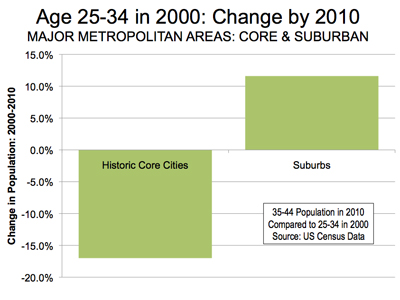
    Yet evidence from the last Census show the opposite: a marked acceleration of movement not into cities but toward suburban and exurban locations. The simple, usually inexorable effects of maturation may be one reason for this surprising result. Simply put, when 20-somethings get older, they do things like marry, start businesses, settle down and maybe start having kids.

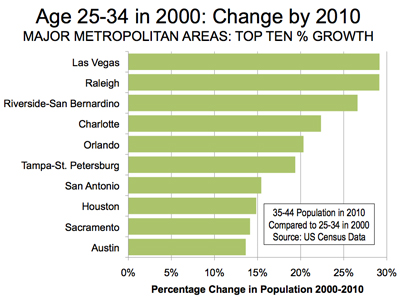
    An analysis of the past decade’s Census data by demographer Wendell Cox shows this. Cox looked at where 25- to 34-year-olds were living in 2000 and compared this to where they were living by 2010, now aged 35 to 44. The results were surprising: In the past 10 years, this cohort’s presence grew 12% in suburban areas while dropping 22.7% in the core cities. Overall, this demographic expanded by roughly 1.8 million in the suburbs while losing 1.3 million in the core cities.

    In many ways this group may be more influential than the much ballyhooed 20-something. Unlike younger adults, who are often footloose and unattached, people between the ages of 35 and 44 tend to be putting down roots. As a result, they constitute the essential social ballast for any community, city or suburb.

    Losing this population represents a great, if rarely perceived, threat to many regions, particular older core cities. Rust Belt centers such as Cleveland and Detroit have lost over 30% of this age group over the decade.

    More intriguing, and perhaps counter-intuitive, “hip and cool” core cities like San Francisco, New York and Boston have also suffered double-digit percent losses among this generation. New York City, for example, saw its 25 to 34 population of 2000 drop by over 15% — a net loss of over 200,000 people — a decade later. San Francisco and Oakland, the core cities of the Bay Area, lost more than 20% of this cohort over the decade, and the city of Boston lost nearly 40%.

    In contrast, the largest growth among this peer group took place in metropolitan areas largely suburban in form, with a strong domination by automobiles and single-family houses. The most popular cities among this group — with increases of over 10% — were Las Vegas; Raleigh, N.C.; Riverside-San Bernardino, Calif.; Charlotte, N.C.; Orlando, Fla.; San Antonio, Houston and Dallas-Fort Worth, in Texas; and Sacramento, Calif..

    Furthermore, most of the growth took place not in the urban centers of these regions but in the outlying suburbs. This cohort expanded by more than 40% Raleigh’s suburbs — 37,000 people — over the decade. Houston’s suburbs gained the most of any region of the country, adding 174,000 members of this particular generation.

    These findings should inform the actions of those who run cities. Cities may still appeal to the “young and restless,” but they can’t hold millennials captive forever. Even relatively successful cities have turned into giant college towns and “post-graduate” havens — temporary way stations before people migrate somewhere else. This process redefines cities from enduring places to temporary resorts.

    Rather than place all their bets on attracting 20-somethings cities must focus on why early middle-age couples are leaving. Some good candidates include weak job creation, poor schools, high taxes and suffocating regulatory environments. Addressing these issues won’t keep all young adults in urban settings, but it might improve the chances of keeping a larger number.

    Our findings may also give pause to those developers who often buy at face value the urbanist narrative about an city-centric real estate future. In the last decade, many developers have anticipated  a continuing tsunami of wealthy young professionals, as well as legions of “empty-nesters,” flowing into the urban cores. This led to a rash of high-end condominium developments. Yet in the end, the condo market turned out far less appealing than advertised, crashing virtually everywhere from Chicago and Las Vegas to Atlanta, Portland and Kansas City. This has left many investors with empty units, distress auctions or far less profitable rentals.

    One hopes the development community might still learn something from that failure. But the Urban Land Institute among others increasingly maintain that vast new frontiers for new high-density growth will develop in the inner-ring suburbs. Yet in many areas with strong central cores, such as New York, Seattle and Chicago, inner suburbs usually grew slowly, particularly in comparison with the further out peripheral expanses.

    Critically, the notion of mass suburban densification is likely to meet strong resistance from local residents. This will be particularly marked in attractive, affluent “progressive” areas like the Bay Area’s Marin County, Chicago’s North Shore suburbs and New York’s Hudson Valley. People who move to these places are attracted by their leafy, single-family-home-dominated neighborhoods and village-like shopping streets. Nothing short of economic catastrophe or government diktat would make them accept any intense program of densification.

    Of course, some urbanists claim that the new millennial generation, born after 1983,  will prove “different” from all their predecessors. Yet research to date finds older millennials may prove more attracted to suburban living than many density advocates suggest. According to a survey  by Frank Magid and Associates, more millennials consider suburbs as their “ideal place” to settle than do  older groups.

    As generational chroniclers Morley Winograd and Mike Hais have noted, the fact that most millennials plan to get married and have children only reinforces this trend over time. Another problem may prove that millennials may be running out of ideal urban options.  Back in the 1990s it was far easier to buy a home in one of the nation’s handful of really attractive cosmopolitan urban settings — for example,  brownstone Brooklyn, Northside Chicago, LA’s beach communities or San Francisco. Today these areas suffer some of the highest housing prices relative to incomes of any places in the country.

    Rather than blindly accept the vision of a mass movement back to the urban centers, developers might focus instead on what kind of housing, and community, addresses the needs and affordability concerns of millennials as they move into full adulthood. Over the next ten years, the number of millennials entering their mid-30s will expand by over 40 million   – a population larger than those of elderly residents who will be old enough to give up their homes.

    This large group is also most likely to continue moving to the lower-density, more affordable South and  West. These areas already boast disproportionate percentages of millennials, Hais and Winograd report.

    It’s time for developers and planners to look more closely at how young adults as they enter their 30s vote with their feet. Unless there has been a mind-numbing change in attitude or an unexpected return to good governance in cities, young adults entering middle age will continue their shift toward suburban and lower-density areas in the decade ahead, upending the predictions of most pundits, planners and development experts.

    This piece originally appeared at Forbes.com.

    Joel Kotkin is executive editor of NewGeography.com and is a distinguished presidential fellow in urban futures at Chapman University, and an adjunct fellow of the Legatum Institute in London. He is author of The City: A Global History. His newest book is The Next Hundred Million: America in 2050, released in February, 2010.

    Photo by mamamusings, Liz Lawley, Upstairs Window – Encroaching fog

  • Learning the right lessons from LA’s “Carmageddon”

    Carmageddon has come and gone, and the world didn’t end. The catalyst for the predicted disaster was the closure of Interstate 405 in Los Angeles for construction for the weekend of the 16th and 17th of July. Freeway closures aren’t all that unusual, but the 405 is not a regular freeway. It is both the busiest, and most congested road in America. The 405 carries an estimated half million vehicles per weekday. Had traffic been even close to normal volumes—even weekend volumes—the event would have earned the nickname. However, less people drove. Way less people. In fact, the roads were unusually empty.

    There are two lessons that one might be tempted to take home from this:

    1. Persuasion can cause people to drive less.
    2. America could do with less freeways.

    These are the wrong lessons to take away. Using moral suasion or fear to alter people’s behavior can work under certain circumstances, but it hasn’t helped alter people’s day to day commuting patterns. People drive more now than ever, even though the glamorization of automobiles has diminished, and the appeal of urban living has increased. There are plenty of people who choose urban, auto-free living, but that’s a choice that isn’t made by public interest campaigns. It may be the case that there are compelling arguments for stalling the growth of urban freeways, but using Carmageddon to make that point would be disingenuous.

    The two real lessons of Carmageddon are:

    1. Persuasion can convince people to drive less under unusual circumstances–temporarily.
    2. When faced with the right incentives, people will drive less.

    The fear stirred up about the closure for months obviously worked. Billboards went up; the media counted down; celebrities Tweeted warnings at the behest of the city; Mayor Villaraigosa advised people to “go on vacation,” and councilor Paul Koretz told people to “stay the Hell away.” But this only works in acute situations, where there is a credible threat. The fact that the apocalyptic term Carmageddon caught on certainly helped permeate the public consciousness. But everyone knows LA traffic is usually incredibly bad, yet they endure it on a daily basis. People in LA are grudgingly willing to tolerate the country’s worst traffic, but they’re not willing to venture into the city with Interstate 405 closed unless they have to. Since it was on a weekend, most of them didn’t. Many radio shows even pre-taped segments to keep their guests from getting stuck in traffic. Several film and television productions were shut down for the weekend. These types of deferrals can be arranged, but rarely, and with sufficient notice. Citing Carmageddon as an example of how we can do with less automobile traffic is like pointing to a blackout as an example of how we can reduce electricity consumption.

    The most important lesson, though, is that people respond to incentives. Since the city obviously doesn’t want people to “stay the Hell away” forever, they’re going to have to come up with another way to use incentives if they want to tackle gridlock. LA drivers spend over half a billion hours per year stuck in excess traffic delays, which costs the economy roughly $12 billion dollars. Adding more freeway lanes seems like an obvious solution, except for the fact that it doesn’t work. Studies have shown that every percentage increase in roads leads to an equal percentage increase in driving. In other words, more roads mean more driving. There are certainly exceptions to this, since the optimal level of roads isn’t zero, but it does illustrate the fact that we can’t just build our way out of traffic congestion. Instead, we need to introduce strong incentives other than fear to reduce congestion. That incentive is congestion pricing.

    While road tolls aren’t the most appealing thing to drivers, electronic tolls can reduce the amount of discretionary driving, and convince some number of people to take transit rather than driving. Some would describe this approach as a “War on Drivers,” but the reality is that the intention is precisely the opposite. It is an attempt to make sure that drivers can actually get where they need without soul crushing traffic. If that means they’ll have to pay $2 to drive to the store to get bread, maybe they’ll walk to the corner store instead. Incentives are important, and even small incentives can radically shift people’s behavior. Goading people into changing their behavior rarely works. Otherwise no one would drink cola, or eat trans-fats.  On ordinary days, people need to get places, and for most people, driving is more convenient. The number of people for which driving is the most convenient choice will decline if the urban renaissance being predicted does materialize, but we can’t count on the majority of existing drivers to abandon their cars and move to city cores. Acknowledging that cars will be the dominant mode of transportation for the foreseeable future, and that people drive more than they need to when it is free are key to addressing traffic congestion. Otherwise, everybody will continue to sit in traffic.

    This piece originally appeared at the Frontier Centre for Public Policy Blog.

    Steve Lafleur is a public policy analyst with the Frontier Center for Public Policy.

  • The Evolving Urban Form: Chicago

    Looks can be deceiving. No downtown area in the western world outside Manhattan is more visually impressive than Chicago. Both the historic Loop and the newer development north of the Chicago River, especially along North Michigan Avenue have some of the most iconic structures outside of emerging Asia. Yet these vertical monuments mask a less celebrated reality: that of dispersing, low density urban area.

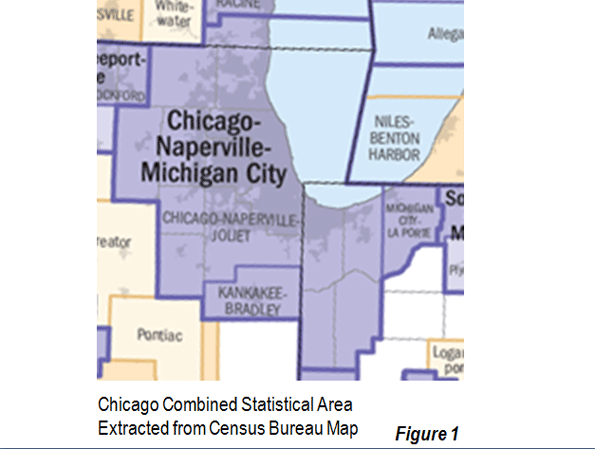
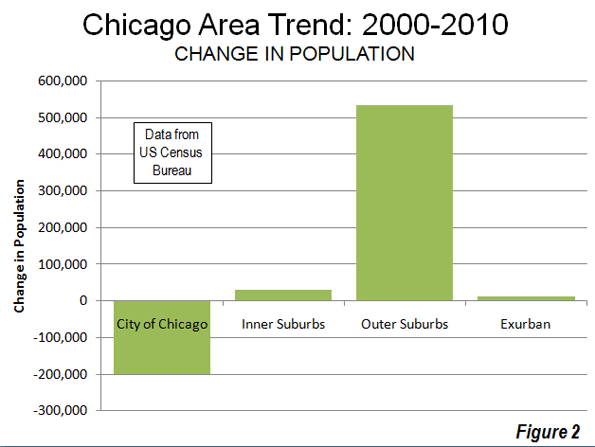
    Chicago Combined Statistical Area: Let’s take a close look at the 2010 census data. Overall, the combined statistical area, which includes the metropolitan area (Note 1) and two exurban counties added nearly 365,000 people, for a growth rate of 3.9 percent. This is well below the national growth rate of approximately 10 percent (Map, Figure 1). Chicago followed the general trend of with growth being greatest in the outer suburbs while declines took place both in the inner suburbs and the historical core municipality (Figure 2).

    Massive Core City Loss: The historical core city of Chicago lost but 200,000 people, and fell to a population of 2.7 million, the lowest count since the 1910 census. The population is down 925,000 from 1950 and at the current rate would drop at least 1 million from the 1950 peak by the 2020 census.  Chicago is at risk of joining London and Detroit as the only two historical core municipalities in modern times that have lost more than 1 million people.

    Inner Suburbs: As in New York and Seattle, Chicago’s inner suburbs grew slowly. The inner suburbs include the part of Cook County that is outside the city of Chicago as well as Lake County, Indiana (home of Gary), which shares the city of Chicago’s eastern border. The inner suburbs added fewer than 30,000 residents and grew only one percent.

    This suggests some limitations to the newly developing mantra that has inner suburbs will be the locus of future growth although there are scattered inner suburbs in other cities (such as Hoboken, New Jersey) that did see growth. Perhaps the old mantra, about people returning to the city from which they had never come was finally quashed by the realities of the 2010 census.   

    Outer Suburbs: The outer suburbs, which include the remaining counties of the metropolitan area, grew at a rate of 16.5 percent, actually grew faster than the national average of approximately 10 percent. The outer suburbs added more than 500,000 people. The largest growth, 175,000 was in Will County, to the south, one of the five “collar counties” that used to define the boundaries of the metropolitan area. McHenry County, the most distant of the collar counties added 100,000. The fastest growth was in far suburban and also southern Kendall County, which more than doubled in population.

    Chicago Metropolitan Area: Overall, the Chicago metropolitan area added approximately 360,000 people and grew 4.0 percent from 2000. This is well below the national average population growth rate, however was above that of the Los Angeles metropolitan area, once among the  nation’s of leading growth areas until the last decade.

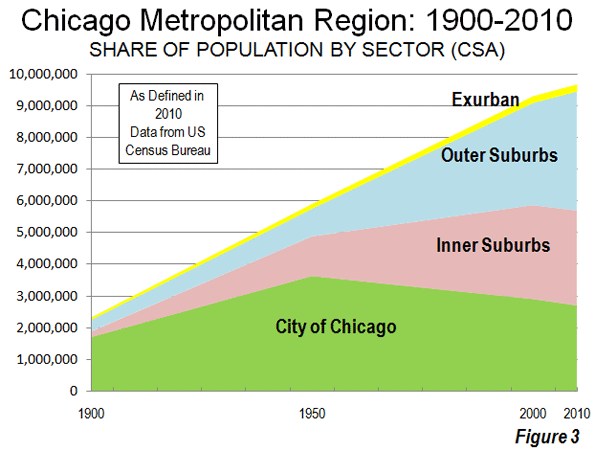
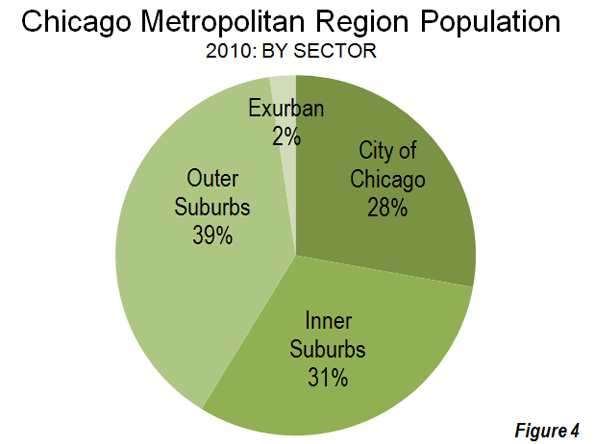
    Historical Trends: The city of Chicago, like other historical core cities, had previously been dominant in its metropolitan area. The earliest Census Bureau metropolitan area (“metropolitan district”) estimates from 1900 indicated that more than 90 percent of the region’s population was contained in the city of Chicago. By 1950, the city of Chicago had fallen to 66 percent of the metropolitan area as defined in that year.  The city of Chicago now has only 28 percent of the combined statistical area population of 9.7 million (Figure 3, Table and Note 2).

    CHICAGO METROPOLITAN AREA
    POPULATION TREND BY COUNTY: 2000 TO 2010
    1900 1950 2000 2010 Change: 2000-2010 % Change: 2000-2010
    HISTORIC CORE MUNICIPALITY
    Chicago   1,698,575   3,620,962   2,895,671 2,695,598 -200,073 -6.9%
    INNER SUBURBAN      178,052   1,255,982   2,965,634 2,995,082 29,448 1.0%
    Cook County, IL      140,160      887,830   2,481,070 2,499,077 18,007 0.7%
    Lake County, IN        37,892      368,152      484,564 496,005 11,441 2.4%
    OUTER SUBURBAN      378,896      884,980   3,237,011 3,770,425 533,414 16.5%
    DeKalb County, IL        31,756        40,781        88,969 105,160 16,191 18.2%
    DuPage County, IL        28,196      154,999      904,161 916,924 12,763 1.4%
    Grundy County, IL        24,136        19,217        37,535 50,063 12,528 33.4%
    Jasper County, IN        14,292        17,031        30,043 33,478 3,435 11.4%
    Kane County, IL        78,792      150,388      404,119 515,269 111,150 27.5%
    Kendall County, IL        11,467        12,155        54,544 114,736 60,192 110.4%
    Kenosha County, WI        21,707        75,238      149,577 166,426 16,849 11.3%
    Lake County, IL        34,504      179,097      644,356 703,462 59,106 9.2%
    McHenry County, IL        29,659        50,656      260,077 308,760 48,683 18.7%
    Newton County, IN        10,448        11,006        14,566 14,244 -322 -2.2%
    Porter County, IN        19,175        40,076      146,798 164,343 17,545 12.0%
    Will County, IL        74,764      134,336      502,266 677,560 175,294 34.9%
    CHICAGO METROPOLITAN AREA   2,255,523   5,761,924   9,098,316 9,461,105 362,789 4.0%
    EXURBAN METROPOLITAN COUNTIES        75,540      150,332      213,939 224,916 10,977 5.1%
    Kankakee Coiunty, IL        37,154        73,524      103,833 113,449 9,616 9.3%
    La Porte County, IN        38,386        76,808      110,106 111,467 1,361 1.2%
    CHICAGO COMBINED STATISTICAL AREA 2,331,063 5,912,256 9,312,255 9,686,021 364,150 3.9%
    Data from the US Census Bureau


    Since 1950 (Note 3), all of the growth in the Chicago area has been in the suburbs. By 2000, both inner suburbs and the outer suburbs each had more people than the city of Chicago. Today the outer suburbs, with forty percent of the region’s population, represent the largest demographic force in Chicago (Figure 4).

    We do not usually associate Chicago with the dreaded term “sprawl” but Chicago now stands as the third largest urban agglomeration in the world in land area, trailing only New York and Tokyo. The Chicago urban area covers more land than Los Angeles, which has a far higher urban density.

    Dispersing Employment: Chicago’s dispersion extends to employment. Despite having the second strongest central business district in the nation (after Manhattan), jobs are rapidly decentralizing. Last year the Downtown Loop Alliance reported that private sector employment in the Loop fell 20 percent during the last decade. Overall, the downtown area of Chicago now represents approximately 10 percent of regional employment, barely half the percentage of Manhattan or Washington, DC.

    American community survey data from 2009 indicates the total employment in the North West corridor along Interstate 90 has at least as much employment as downtown Chicago. This corridor, anchored by the edge city (Note 4) of Schaumburg, is typical of emerging suburban centers around the nation. Only two percent of workers in this corridor use transit for commuting.

    Another corridor, along Interstate 88 (anchored by Lisle and Aurora) has at least two thirds the employment of downtown, with only one percent commuting by transit. The North Shore corridor encompassing parts of northern Cook County and Lake County is of similar size to the Interstate 88 corridor and has a larger transit work trip market share of five percent.

    Downtown, on the other hand, has the third largest transit work trip market share in the nation, following Manhattan and Brooklyn. In 2000, 55 percent of people working downtown (the larger downtown including the Loop, north of the River and adjacent areas to the west and south) commuted by transit. This illustrates the strength of transit for providing access to the largest, most dense downtown areas in contrast to dispersed suburban areas.

    Perhaps more telling, the number of jobs and resident workers (the “jobs-housing” balance) in the city of Chicago are converging toward equality. According to American community survey data, there are 1.1 jobs in the city of Chicago for each working resident. This is substantially less, for example, than Washington (2.6), Atlanta (2.0), Boston (1.7), San Francisco (1.4) and Baltimore (1.4).

    On the other hand, two of the three large suburban corridors have higher ratios of jobs to workers than the city of Chicago. The Interstate 88 corridor has 1.3 jobs per worker, while the North Shore has approximately 1.5 jobs per worker. The Interstate 90 corridor has slightly more jobs than workers. These data indicate that Chicago is well on the way to a more evenly distributed employment pattern that has become more common around the nation.

    Middle America’s Leviathan: The Chicago area has been very resilient through the years. After nearly a century as the nation’s “second city,” Aaron Renn points out the area could fall from its much cherished “global city” status. Still, Chicago remains the dominant urban area between the coasts. Virtually all of its Midwestern competition has fallen away (such as Detroit, St. Louis and Cleveland). However, in the longer run Chicago could be displaced by Dallas-Fort Worth and Houston. Nonetheless, the urban area’s visually arresting business district will retain its iconic status even if, overall, the region looks more and more like the rest of highly dispersed Middle America.

    ——

    Note 1: This article uses metropolitan area and combined statistical areas as defined by the authoritative US Office of Management and the Budget.

    Note 2: The 1950 references provided because the closest to the Post-War democratization of homeownership and car ownership and expansion of car oriented suburbanization. Before World War II, most US historical core cities were comparatively dense, while a far smaller share of the population lived in the suburbs.

    Note 3: Figure 3 and the Table show data for the 2010 geographical definition of the combined statistical area. Earlier metropolitan area definitions are also referred to in the text.

    Note 4: An “edge city” is a major employment center outside the central business district (downtown).  “Edge city” became a part of the language as a result of Joel Garreau’s 1991 book, Edge City: Life on the Urban Frontier.

    Photograph: Downtown Chicago from the Air (by author)

  • Adelaide Land Prices Top Sydney

    The median price of serviced (improved) lots for new houses in Adelaide is reported to have risen above that of far larger Sydney by the Housing Industry Association of South Australia. Housing Industry Association of South Australian Executive Director Robert Harding attributed the high price of land to government policies that have limited the supply of land available for building. Nearly all thousands of square miles of land around Adelaide are off-limits to house building due to state government restrictions.

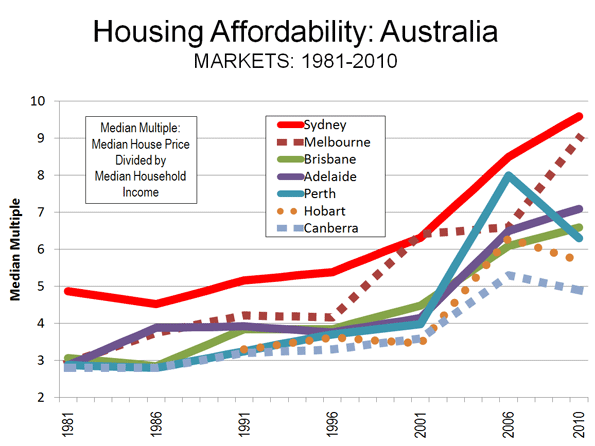
    Adelaide is the slowest growing major metropolitan area of Australia, yet has some of the worst housing affordability among larger metropolitan markets. The 7th Annual Demographia Housing Affordability Survey found median priced Adelaide housing to be 7.1 times median household incomes, ranking the metropolitan area eighth most unaffordable out of 82 with more than 1,000,000 population.

    Before the adoption of its strong smart growth (urban consolidation) land use restrictions, median house prices in Adelaide were one-half or less the present level (Figure). By comparison, new houses can be purchased in much of the United States for less than the median price of an empty lot in Adelaide ($180,000), though not in areas that have adopted smart growth restrictions.