Blog

  • Honolulu: Mega Rail Project in a Micro City

    An exorbitantly costly rapid transit heavy rail project has been proposed for the small Hawaiian island of Oahu, where the leading metropolis, Honolulu, ranks 53rd in population among U.S. cities, with less than 500,000 people. If the project moves forward it will be the world’s only elevated heavy rail in a metro area with a population of under four million.

    Nothing about this 20-mile long rail project makes sense, except for its politics and its cronyism. It is projected to cost $5.3 billion according to the financial analysis of the city, or $7.2 billion, according to the state. For comparison, the Blue Line between Los Angeles and Long Beach that opened in 1990 has the same length and would cost roughly $1.5 billion to build now.

    Cities worldwide and in the U.S. have shown a clear preference for light rail. The only rapid transit (heavy rail) system built in the US since 1990 is the one in Los Angeles in 1993; another was constructed in San Juan, Puerto Rico in 2004. In the same period, 19 light rail systems were installed.

    Honolulu lost a case against the EPA concerning its sewage in 2008; the current bill for fixing its sewage treatment stands at between four and five billion. Note that project costs in Hawaii have a wide range. That’s part of being a remote island state with high transportation and inventory costs, and of crony politics that generate multiple change orders and inefficiencies which result in large cost overruns.

    Hawaii’s liabilities add up: a total of the sewer consent decree, the proposed rail, the necessary airports and harbors modernization, repairs to some of the worst road pavements in the nation, and one of the nation’s highest — and underfunded — public employee pension and medical benefit systems comes to $40 billion over the next 20 years, for a state of 1,360,000 people. That’s about $120,000 per family of four, of which 17% is for the proposed rail, which is the only discretionary project in the mix.

    The 2008 recession sensitized the previous governor, Linda Lingle, to the mounting liabilities. She ordered a financial analysis of the rail project by one of the nation’s leading financial assessment firms. They opined that it will cost $7.2 Billion. Current Governor Neil Abercrombie and the pro-rail mayor dismissed the report as an “anti-rail tirade.”

    The city’s advocacy forecasts for the rail project are seriously suspect. Bent Flybjerg, Chair and Professor of Major Program Management at Oxford University’s Saïd Business School, has revealed that forecast manipulation is the norm in rail proposals, internationally. For example, the Blue Line in Los Angeles was forecast to carry 35,000 trips in the opening year. It carried only 21,000. A more suitable comparison for Honolulu is Tren Urbano in San Juan, Puerto Rico, which opened in 2006. The similarities are eerie. Both are unique island cities with heavy rail projects under Federal Transit Administration (FTA) oversight, and have the same project planner, Parsons Brinkerhoff, who estimated 80,000 trips in the opening year for Tren Urbano, and a construction cost of $1.25 billion. FTA approved both. Tren got 25,000 trips, and was ultimately built for $2.25 billion, a nearly 100% cost overrun.

    After the first year of operation, bus fares were doubled to push people to use the Tren. It didn’t work. A new sales tax of 5.5% was eventually enacted, and San Juan added 1.5% on top of that. Tren Urbano was a catalyst for financial hardship.

    Another recent example is the Edinburgh trams, originally scheduled to open in July 2011 but rescheduled to 2014. The original cost was projected at $640 million, but estimates now are over one billion dollars. As of spring 2011, 72% of the construction work remains to be done, but only 38% of the budget is left.

    Past experience and hard evidence have never fazed politicians in Hawaii. In 2008, Honolulu’s mayor Hannemann used several million dollars of taxpayer and political contribution funds to convince voters that his fully elevated (heavy) rail is actually a light rail system that would cost under $4.5 billion, and would solve Honolulu’s congestion problems.

    Hannemann gave then-Minnesota Congressman and Transportation Committee Chair Jim Oberstar a helicopter ride along the route. He failed to indicate that three of the train route’s 20 miles would be on prime agricultural land, and that 12 of the 20 miles would be in low-density suburbia. Oberstar declared it a good project, and offered promises of federal funding.

    Then the city released the draft Environmental Impact Statement (EIS), just two days before elections which included a referendum or rail. The EIS was several thousand pages long. Many cried foul, but Senator Inouye advised the people to read the abstract. It was devoid of any quantitative information. The plan for passage barely worked: 50.6% of the voters voted in favor of rail.

    The 2010 final EIS revealed that congestion in 2030 with rail will be far worse that it is now. The project is not green, given that 96% of Honolulu’s electricity comes from oil and coal. The present marketing push has switched to jobs and development opportunities. But six billion dollars would produce many more jobs and benefits if spent on almost any other infrastructure endeavor.

    In late March, Transportation Secretary Ray LaHood, FTA Administrator Peter Rogoff, Senator Inouye and Hawaii Congresswoman Mazie Hirono descended on Honolulu to stage a pro-rail rally with the mayor, the unions and the cronies. However, anti rail sentiment is growing, and, following an earlier lawsuit, a second one was filed in May 2011.

    Honolulu is still completing the paperwork for its heavy rail, but preparatory construction has already started. This irrational project needs to be stopped. Stopping it will save the federal government $1.8 billion, save overtaxed Hawaii residents well over $5 billion, and save visitors to Hawaii about $700 million. It will save prime agricultural land, preserve island beauty and, importantly, save Honolulu from decades of added taxation, debilitating construction, and lack of funds for essential infrastructure projects.

    Panos D. Prevedouros, PhD, is a Professor of Civil Engineering at the University of Hawaii-Manoa.

    Photo by super-structure (Jason Coleman), “Honolulu Murals”.

  • Australians Are Getting A Carbon Tax They Don’t Want

    Within weeks, the Australian government is expected to announce a package of measures including a carbon tax to stimulate renewable energy sources and abate carbon emissions. Officials, activists and journalists around the world will hail Australia as a courageous and forward-looking country, ready to take its responsibilities seriously. Some will rebuke their own governments for being less bold. Yet they will ignore an inconvenient detail. According to opinion surveys, at least 60 per cent of Australians strongly oppose the tax. Since it was flagged in February, support for the ruling Labor Party has fallen to its lowest level in 40 years. Only 27 per cent of Australians now nominate Labor as their first preference. Nor did they vote for it. In the lead up to last August’s federal election, both major parties ruled out a carbon tax. Prime Minister Julia Gillard declared, just hours before polling day, that “there will be no carbon tax under the government I lead”. Her job approval rating is 31 per cent.

    So why is this happening? The current malaise can be traced to a combination of long and short term causes. Like other western countries, Australia was profoundly changed by the 1960s social movements. In the decades after World War II, as Britain lost its empire and turned to Europe for an economic future, Australia shifted its agricultural and mineral commodity trade to Asia, admitted growing numbers of immigrants from outside the British Isles, and came to rely on the United States for security. Elites in the professions, judiciary, churches, universities and bureaucracies conceiving Australia as an outpost of British civilisation, found the ground moving under them.

    Radicalised by Australia’s participation in the Vietnam war, baby boomers poured out of an expanded university system to spearhead a range of movements, over time supplanting the old elites. By the 1980s, universities, schools, many professions, the media, and most of the public sector were dominated by left-progressives. Their “long march through the institutions” was perhaps more thorough-going than in the United States, since anti-leftists had yet to find a substitute for British imperialism.

    One of the social movements was environmentalism. Australia is an isolated, sparsely populated continent with hauntingly beautiful landscapes and unique natural species. Late-coming westerners found a pristine wilderness, populated by aboriginals with close spiritual ties to the land. Since European settlement, these features have, in various forms, injected a romantic strain into the country’s transplanted British culture. That strain was mostly confined to the arts and radical fringe movements. In large part, the colonies, federated in 1901, evolved a practical outlook shaped by nineteenth-century liberalism and the blessings of trade, industry and commerce.

    The 1960s saw a fusion of the romantic strain with ideologies shaped by streams of Marxism, left-wing anarchism and revivals of Counter-Enlightenment Romanticism. Sharing a preference for ecological protection over economic growth, inner-city-based activists, including many socialists, current or former communists, Trotskyites and others from counter-culture circles, like hippies, together with aboriginal peoples, campaigned to lock up remnant bushland, native forests, wetlands and traditional aboriginal sites in “green-belts” or national parks. They targeted urban expansion and industries like logging, cattle-grazing and mining, which boomed in a mineral-rich arc across northern Queensland and Western Australia. Conflicts over mining projects were routine in the 1970s and 1980s. Uranium was particularly contentious.

    But it was in Tasmania that the new environmentalism came of age. State government plans for a hydro-electric dam on the Franklin River became a cause celebre, attracting strong opposition from environmentalists, and wide public interest. Many leading-lights of the movement, including the current Greens Party leader, made their name in that struggle. Ultimately, the activists came out on top, winning support from federal Labor just before the 1983 election, at which they returned to power.

    The Franklin tussle cast a long shadow over Australian politics. Many analysts thought it contributed to Labor’s victory. Nature conservation crept onto the mainstream agenda. In 1984, various green lobby groups, including some of the more hard line activists, came together to form Greens parties in New South Wales and Queensland, modeled on the German Greens. Other states followed, and in 1992 a national Greens Party emerged. Over time, Greens gained a presence in state and federal parliaments. Some were ideological refugees from defunct communism. Before joining the Greens, for instance, one serving Greens senator was a member of the Socialist Party of Australia, a successor organisation to the Communist Party.

    While open to compromise on environmental concerns, Labor never embraced green ideology. A moderate party in the British tradition, built on craft trade unionism rather than socialism, Australian Labor was essentially pragmatic. Its environment agenda was adapted to job security, rising living standards and the interests of mining, forestry and transportation workers. For most Australians, the environment was still a marginal issue.

    Then came the climate panic. Australia is a land of climate extremes, where severe drought alternates with devastating floods. By 2006 the continent had been in the grip of drought for virtually a decade. Water restrictions even hit the major cities, as morale began to sag under fears of interminable dryness. That year also saw some unseasonably hot days. From their posts on the “commanding heights” of academia, politics and media, green ideologues sensed a chance to ramp up their rhetoric on global warming, claiming the drought would persist until carbon emissions were cut. Now they hoped to impose their anti-growth philosophy on the whole economy, not just individual projects.

    This time their message fell on fertile ground. Surveys began to show majority support for strong action on climate change. Conservative Prime Minister John Howard, who was lukewarm on the issue, and had refused to sign the Kyoto Protocol, was caught off guard. Looking to the election due in 2007, Labor succumbed to opportunism. They took to spouting green rhetoric, promising ratification of Kyoto, an emissions trading scheme (ETS) and a renewable energy target. Come 2007, the sense of exhaustion around Howard’s eleven year government was enough to tip Labor into office. But the party’s green chickens eventually came home to roost. Having hyped global warming as a great moral cause, Prime Minister Kevin Rudd suffered the indignity of returning empty-handed from the failed Copenhagen Conference. By this time the drought had broken, and the Liberal-National opposition changed course, defeating Rudd’s ETS in the senate.

    Public support for climate action began to slide. According to the authoritative Lowy Institute Poll, it is now down to 41 per cent, from 68 per cent in 2006. Workers grew nervous about the implications for trade-exposed or energy intensive industries like mining, steel production and power generation. They shifted back to former attitudes on the environment, leaving the government stranded. Following advice from his inner-circle, including then Deputy Prime Minister Gillard, Rudd deferred the ETS until after the election scheduled for late 2010, but he suffered a crushing loss of credibility. His colleagues dumped him for Gillard.

    For city-based progressives, especially in the publicly-funded sector, climate action became a vehicle to burnish their moral authority and claim a larger share of the nation’s wealth, reversing two decades of market-oriented reform. Prompted by Labor’s turmoil, more of them defected to the Greens. At the election hastily called for 21 August 2010, neither major party won a majority in the House of Representatives. The balance of power was held by the Greens and four other independents. In the senate, the balance went exclusively to the Greens. Desperate to survive, Gillard signed up to a formal alliance with them. After weeks of negotiation, the Greens and enough independents sided with Labor to form a minority government. Their price was the carbon tax she ruled out just hours before election day.

    When the dust settled, Australians found that, by pure chance, their country was in the hands of a climate junta, euphemistically called the Multi-Party Climate Change Committee, consisting of Gillard, the Treasurer, the Minister for Climate Change, the Greens leader and his deputy, and two independents. Posing as an open-minded enquiry into Australia’s climate options, the Committee is driven by an inescapable political logic. None of them can break ranks without bringing down the government, ending the most power any of them will ever have. This logic overrides everything, even rising public anger. The opposition’s line, that “Labor may be in government but the Greens are in power”, resonates widely. Few think Gillard really believes in the tax. Moreover, it comes at a time when consumer confidence is weak, and cost-of-living pressures dominate surveys of public concerns.

    Never has such a gulf opened up between elite and popular opinion. Nothing has turned around opposition to the Committee’s tax, not Gillard’s promise of compensation for low to middle income earners, not favourable media coverage, not reports by scientific experts, not declarations signed by eminent citizens, not even an advertising campaign fronted by Oscar-winning actress Cate Blanchett. Urging Australians to “say yes”, the ad unleashed a wave of resentment towards the globe-trotting star, who owns a $10 million “eco-mansion” in one of Sydney’s exclusive suburbs. Tabloid newspapers dubbed her “Carbon Cate”.

    Most opinion-leaders will applaud Gillard’s carbon tax package. They will ignore the real story: Australians are being made to walk the climate plank, with a cutlass at their back.

    John Muscat is a co-editor of The New City.

    Photo by MystifyMe Concert Photography

  • Living and Working in the 1099 Economy

    We used to call it “Free Agent Nation.”  Now, it seems like the new term of art will be “The 1099 Economy.”   While the names may change, they all point to a phenomenon of rising importance: the growing number of Americans who don’t have a “regular job” but instead work on individual contracts with employers or customers.   These folks don’t get the traditional W-2 paystub at the end of the year; they report their taxes with the IRS form 1099.

    The 1099ers are a growing part of our economy.   There are a number of ways to slice the data.  If you look at US Census Bureau figures on the self-employed, we find 21.4 million self-employed Americans in 2008.  Recent data from EMSI suggests that the figures might be even higher.   Tracking workers who are not covered by unemployment insurance, the EMSI researchers suggest that more than 40 million Americans operate in the 1099 economy.   This represents about 1/5 of the total US workforce.

    As someone who has operated in the 1099 Economy for a decade, I can state that there are many benefits to this status:  more flexibility, more opportunities for unique and creative work, and more control over one’s work circumstances.    And, 1099 status can be profitable. Many fast growing ventures operate as sole proprietorships.  For example, in 2008, the Inc. 500 list looked at the ownership structures of firms on this list of US’s fast growing companies.  The largest sole proprietorship, Milwaukee’s Service Financial, had $11 million in revenue, but only one employee, its owner. 

    While the freedom of operating in Free Agent Nation can be tempting, there are downsides.  The data suggests that for many people, operating in the 1099 Economy may not be their first choice.  The EMSI research cited above found that the number of non-covered jobs in the US grew by 4 million between 2005 and 2009.   The fastest growth occurred in the mining, quarrying, and oil/gas extraction sectors where more than half of all workers are now non-covered.  Other areas with high concentrations of 1099 workers are in real estate (74% of workers are non-covered) and agriculture/forestry (74%).  This non-covered status creates a more flexible labor market, but it also creates potential challenges for these workers operating in notoriously unstable industries. 

    The 1099 Economy has emerged somewhat below the radar over the past decade.  Few economic development organizations have devoted much thought or research to the needs of this segment of the economy.  And, that’s not a good thing if 20% of the local workforce is invisible to community leaders.   Based on my experience, I see several segments within the broad category of the 1099 economy:  the reluctant 1099ers, the entrepreneurial 1099ers, and the “gig economy” work force. 

    The Reluctant 1099ers:  This group includes those who operate in the 1099 economy because they have no choice.   This group includes those sectors that have previously operated with traditional employment contracts, but have now shifted to the new structures.  Examples include mining, utilities, finance and insurance, and some administrative fields.  While individuals in these specific jobs may be happy with their circumstances, the workers, in a collective sense, face a more uncertain and probably less profitable work situation as 1099 contractors.

    The Entrepreneurial 1099ers:   Many budding entrepreneurs operate in the 1099 economy.  Sole proprietorships and LLCs/LLPs may have numerous workers under contract, yet appear in government statistics as a self-employment venture.  While most sole proprietorships are quite small and generate limited revenue, a sizable portion does generate significant incomes and may be poised for rapid revenue and job growth.  These individuals and their firms are the invisible portion of many local entrepreneurial ecosystems.

    The “Gig Economy” Workforce:   Last but not least, the gig economy workforce refers to those who operate in industries that traditionally operate on a project or “gig” basis.  Perhaps the best known example is film-making where crews come together for a film and then break up for other projects.  Other examples include the arts, theatre, writing, web design, and construction.  These sectors have a long history of operating via these structures.  It is clear that more industries are moving in this direction as well.   In response, a host of new kinds of support organizations, such as New York’s Freelancer’s Union, are emerging.  If current trends continue, we can expect to see similar groups arising across the US.

    Regardless of how one classifies these workers, they remain largely invisible to policy makers and to economic and workforce developers.   That needs to change.  In addition to recognizing the importance of this part of the workforce, we also need to develop a more nuanced understanding of their concerns and needs.   At a minimum, providing a stronger safety net—as suggested by the Freelancer’s Union and others—makes sense.   It also makes sense to develop work spaces that support the 1099ers.   Here, the recent growth in co-work spaces is a positive trend.    Finally, we need new kinds of support and services for the 1099ers.  These might include traditional training in business development, but other supports, such as networking or peer-to-peer lending or on-line tools to find customers and partners should also be part of the mix.    It’s time to recognize that the 1099 economy is here to stay and will be an important part of every community’s workforce for decades to come.

    Erik R. Pages is the President of EntreWorks Consulting, an economic development consulting and policy development firm focused on helping communities and organizations achieve their entrepreneurial potential.

  • Drones on the Prairie

    When the Base Realignment and Closure Commission was drawing up its list of military installations to close back in 2005, consultants assured the city of Grand Forks, North Dakota, that its Air Force base would be spared. Days before the list was made public, though, word leaked out that Grand Forks was on the chopping block, after all.

    North Dakota’s Congressional delegation swung into action and managed to win the base a reprieve; its KC-135 Stratotankers would be reassigned, but they would be replaced by unmanned aerial vehicles (UAVs). Earlier this month, in a ceremony that drew local dignitaries, industry executives, and military brass, Grand Forks Air Force Base marked the arrival of its first Global Hawk aircraft.

    Gunmetal gray, with long, white wings stretching out from the fuselage, the Global Hawk can stay aloft for 30 hours at a time, transmitting sensor data back to operators on the ground. The plane, manufactured by aerospace giant Northrop Grumman, has become a staple of the Air Force’s intelligence, surveillance, and reconnaissance efforts in Iraq and Afghanistan. Eleven Global Hawks will eventually be stationed at Grand Forks, along with 450 additional base personnel.

    “The base is our second largest economic engine,” said Eric Icard, senior business development officer at the Grand Forks Region Economic Development Corporation. “To have a new mission with a new technology solidifies the Air Force’s commitment to the Grand Forks region.”

    Sgt. Joseph Kapinos couched the plane’s arrival in more personal terms: “I think people are excited, because they feel like we have a mission again.”

    Grand Forks AFB

    Col. Don Shaffer, Commander of the 319th Air Base Wing at Grand Forks Air Force Base, told a crowd of dignitaries that the arrival of the Global Hawk marked a transition for the base to a "global vigilance mission." Photo by Marcel LaFlamme

    The ceremony came on the eve of the fifth Unmanned Aircraft Systems Action Summit in Grand Forks, which was sponsored by the Red River Valley Research Corridor. With military procurement of unmanned aircraft projected to double over the next decade, North Dakota has worked to position itself as one of the nation’s hubs for UAV research and training. Last month, the University of North Dakota (UND) awarded degrees to the first five graduates of its unmanned aircraft operations program. At the Summit, Northrop Grumman presented Minnesota’s Northland Community and Technical College with a full-scale model of a Global Hawk for use in its UAV maintenance and repair shop.

    It’s too soon to say whether the Upper Great Plains will emerge as a new powerhouse of the military-industrial complex, a new buckle on what regional planners have dubbed the Gunbelt. Participants at the Summit said that the real economic boom would come as UAV technologies begin to find commercial applications. One major impediment is the ban on flying UAVs in the National Airspace System; North Dakota Congressman Rick Berg has pushed for the creation of test sites where UAVs could fly (and it’s no secret that North Dakota is angling to be one of them), but the FAA reauthorization bill that would make that possible is currently mired in conference committee.

    North Dakota has been riding a wave of media adoration as of late, buoyed by low unemployment numbers and a massive oil strike. But 42 of its 53 counties still posted population losses in the 2010 Census.

    How, the question remains, do rural communities stand to benefit from the burgeoning UAV industry? Are all of these "knowledge economy" jobs bound to spring up in Grand Forks
    and Fargo, even as the state’s struggling farm communities continue to wither away?

    Not if Carol Goodman has anything to say about it. Goodman heads the Job Development Authority in Cavalier County, up by the Canadian border; the county lost 17% of its population between 2000 and 2010, dipping below 4,000 people for the first time in over a century. She’s working to redevelop an abandoned missile base from the Cold War era as a UAV testing site, which could create as many as 670 jobs in the county.

    “Tell them to send some of those UAVs over here,” said Bob Wilhelmi, owner of the lone bar in the wind-blown town of Nekoma. A man from neighboring Walsh County said that, the year after next, his school district will not have a single child enrolled in kindergarten. 

    Mickelsen Safeguard Complex

    The Stanley R. Mickelsen Safeguard Complex: once an antiballistic missile site with its eyes on Moscow, now a potential test bed for unmanned aircraft. Photo by Marcel LaFlamme

    The unmanned aircraft industry in North Dakota is a sort of test case for what happens when a traditionally agrarian state decides to pursue high-tech growth. It’s still not clear whether the state will succeed. But to watch those airmen jostle for a picture with their base’s newest piece of hardware, or to hear a recent UND graduate pitch the start-up company that will keep him in Grand Forks, or even to look up for a while at the clear, empty Dakota sky, you start to think that the state’s drone charmers may just have a shot.

    This piece originally appeared at Daily Yonder.

    Marcel LaFlamme is a graduate student of the Department of Anthropology at Rice University in Houston.

    Lead photo: Official U.S. Air Force

  • The Evolving Urban Area: Seattle

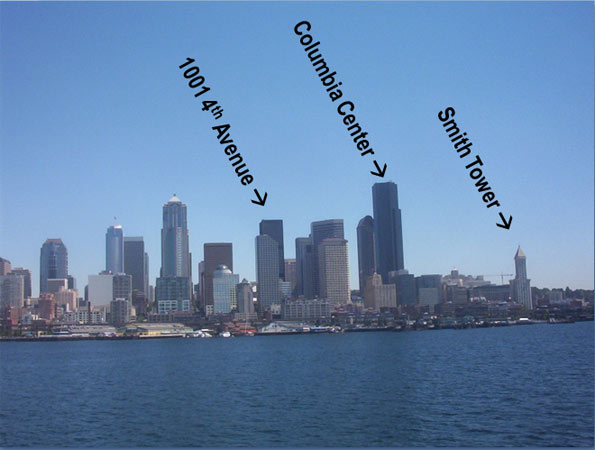
    Lunching at Seattle’s Space Needle, the casual observer might imagine that one of the nation’s most dense urban areas is spread out below. To the immediate south of the Space Needle is one of the nation’s premier downtown areas. In 2000 downtown Seattle had the seventh largest employment base in the country and was one of the most dense. Its impressive, closely packed buildings witness a storied past. For more than 60 years, between 1914 and 1990, downtown Seattle has had the tallest building on the West Coast, Smith Tower, and was the fourth tallest building in the world when built. It held the title for an impressive 55 years, from 1914 to 1969, when another Seattle building briefly took the title (1001 4th Avenue). Later (1985), Seattle’s Columbia Center became the first building on the West Coast to exceed 75 floors, but by 1990 had been passed by the U.S. Bank Tower in Los Angeles (see Elliot Bay photograph and Note 1).

    However, looks can be deceiving.  In 2000, Seattle ranked last in urban population density out of the 11 urban areas in the 13 western states with more than 1 million population (just behind Portland, which ranked next-to-last).  The Seattle urban area’s density was approximately 60 percent below that of Los Angeles, the US’s  densest urban area. Even the Houston and Dallas-Fort Worth urban areas, famous for their great expanse, were denser than Seattle. Updated urban area density data from the 2010 census will not be available for at least a year.

    Nor is the historical core municipality of Seattle particularly closely packed. With a population density of 7,200 per square mile, the city of Seattle is considerably less dense than a number of Los Angeles suburbs such as Santa Ana (12,000) and Garden Grove (9,500). Even so, the city of Seattle is nearly two-thirds more dense than the city of Portland (4,400), despite the latter’s densification claims.

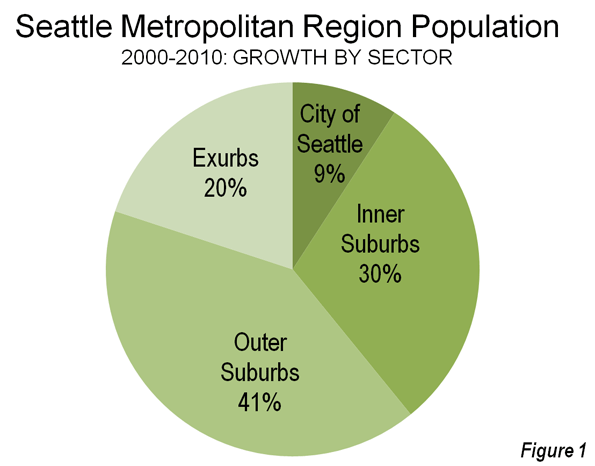
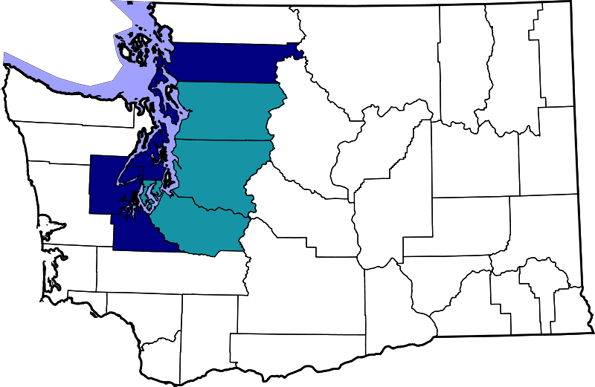
    The 2010 Census: The 2010 census indicates a continuing dispersion of population in the Seattle metropolitan region (Figure 1). The Seattle metropolitan region, formally the Seattle combined statistical area (Note 2) is composed of the core Seattle metropolitan area (King, Pierce and Snohomish counties) and five exurban statistical areas, Bremerton (Kitsap County), Olympia (Thurston County), Mount Vernon (Skagit County), Oak Harbor (Island County) and Shelton (Mason County).

    Seattle Combined Statistical Area: Population 2000-2010
    Area 2000 2010 Change % Share of Growth Share of Population
    City of Seattle        563,374        608,660           45,286 8.0% 9.2% 14.5%
    Balance: King County     1,173,660     1,322,589        148,929 12.7% 30.3% 31.5%
    Pierce & Snohomish Counties     1,306,844     1,508,560        201,716 15.4% 41.0% 35.9%
    Metropolitan Area Outside Seattle    2,480,504    2,831,149        350,645 14.1% 71.2% 67.4%
    Metropolitan Area     3,043,878    3,439,809        395,931 13.0% 80.4% 81.9%
    Exurban Metropolitan Areas        663,260        759,503           96,243 14.5% 19.6% 18.1%
    Combined Statistical Area    3,707,138    4,199,312        492,174 13.3% 100.0% 100.0%
    Calculated from US Census data


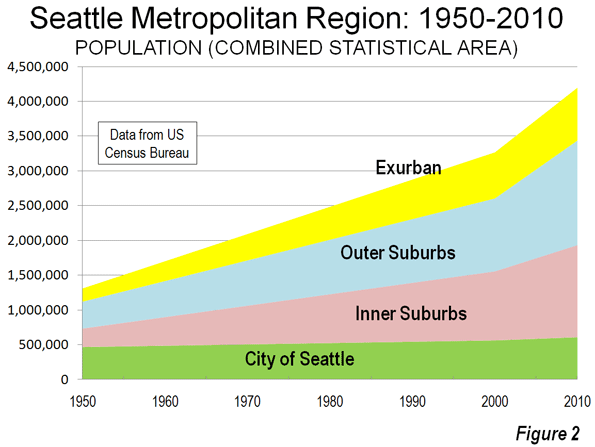
    City of Seattle (Historical Core Municipality): Overall, the historical core city of Seattle grew 8.0 percent, from 564,000 to 609,000 between 2000 and 2010, which was one of the healthiest increases among major cities. In adding 45,000, the city still only accounted for 9.2 percent of the Seattle metropolitan region population growth.  The city of Seattle now constitutes less than 15 percent of the metropolitan region population, down from 36 percent 1950 (same geographic area). In 1950, the city of Seattle had nearly two thirds of the population of King County. By 2010, the city of Seattle was less than one third of King County’s population, despite annexations. As the city has continued to decline in its share of the metropolitan region’s population, the impressive downtown area has also lost its dominance and by 2009 had fallen to 8 percent of the metropolitan region’s employment.

    Inner Suburbs: Areas outside the city of Seattle accounted for more than 90 percent of growth in the metropolitan region. The inner suburbs, which include the residential development to the south, north and east of Seattle in King County grew more than 50 percent faster than the city of Seattle, at 12.7 percent between 2000 and 2010. The inner suburbs grew from 1,170,000 to 1,320,000, adding nearly 150,000 new residents, more than three times the city of Seattle increase. King County outside Seattle also captured 30 percent of the metropolitan region’s growth and now has 32 percent of the metropolitan region’s population. The eastern suburbs of King County are home to one of the nation’s largest, most diverse and successful edge cities, Bellevue, as well as the Microsoft campus in neighboring Redmond.

    Outer Suburbs: The outer suburbs, which include Pierce County (Tacoma is the county seat) and Snohomish County grew 15.4 percent, nearly double the growth rate of the city of Seattle. The outer suburbs grew from 1.3 million to 1.5 million, adding 200,000 new residents, more than four times the city of Seattle’s increase. Pierce and Snohomish counties captured 41 percent of the metropolitan region’s growth and now account for 36 percent of the metropolitan region’s population.

    Exurban Areas:  The exurban statistical areas grew nearly as quickly as the outer suburbs. Between 2000 and 2010, the exurban areas increased their population by 14.5 percent.  The exurban statistical areas accounted for 20 percent of the metropolitan region’s population growth. These more distant areas grew from 660,000 to 760,000 people, adding nearly 100,000 new residents. This is more than double the increase in the city of Seattle population. Approximately 18 percent of the population in the metropolitan region lives in the exurban statistical areas, a larger number than residing in the city of Seattle.

    The Dispersion Continues: The dispersion of Seattle, like that of metropolitan regions around the nation and the world, has been going on for decades. The city of Seattle has accounted for only 5 percent of the metropolitan region’s population since 1950 (Figure 2) with suburbs and exurbs accounting for the vast majority of the nearly 3,000,000 increase.

    Despite the pre-2010 census media and academic drumbeat to the effect that metropolitan areas were no longer dispersing, the census revealed a totally different and even inconvenient truth. This does not mean that both residents of the entire metropolitan region, suburbs and core city, should not be proud of an attractive urban area in an incomparable natural setting. Yet, the vast majority of the region’s population and employment growth is taking place outside the core. Seattle is following the national and international pattern to ever greater dispersion.

    _________

    Note 1: Downtown Seattle is on a hill and the newer buildings are generally on higher ground than Smith Tower, which makes the difference in height look greater.

    Note 2: "Combined statistical areas" were formerly "consolidated metropolitan statistical areas."

    Top Photograph: Downtown Seattle from the Space Needle (by author)

    Wendell Cox is a Visiting Professor, Conservatoire National des Arts et Metiers, Paris and the author of “War on the Dream: How Anti-Sprawl Policy Threatens the Quality of Life

  • Infographic: Which Industries Are Growing in Your State?

    EMSI teamed up with Tableau Software to create this industry data display. You can visualize every broad-level (2-digit NAICS) industry by state over the last decade. Also, click on the dot for each state to see the trends for each sector. The bigger the dot, the more jobs that state has in the selected industry. It may take a few seconds to load.

    A few observations:

    1. Right off the bat, you can see the explosive growth of the mining sector nationally over the past few years. If you scroll to mining and oil exploration in the dropdown or isolate it by clicking on the chart, you can see Texas has by far the largest number of jobs among all states. We covered this sector and specific oil and gas extraction occupations in depth recently.

    2. One of the cool things to do is scroll through each year to see the changing complexion of employment. There’s widespread growth projected for most states in 2011, with a few exceptions, but clicking back through the past few years shows a much different picture.

    3. Another intriguing sector is manufacturing. In the last decade, it hasn’t fared well. That much is clear. But notice the tide start to shift in 2010, with Indiana and Michigan showing slight growth. And in 2011, nearly three-quarters of the US is expected to see job expansion.