Blog

  • Will J.R. Recognize the New Dallas?

    In the sixties and seventies, Dallas’s prime tourist attraction was an assassination site. The town seriously needed a new image. It got one in a soap opera that revealed a city besieged by blonds, big  hair and big homes. “Dallas,” which premiered in 1978, did for Big D what “Sex in the City” and “Seinfeld” did for New York: it painted a portrait of the city for the world.

    The last “Dallas” episode aired in 1991, but TNT recently resurrected the hit show. This iteration features a new crop of Ewings beside originals Larry Hagman, Linda Gray, and Patrick Duffy. Dallas, of course, was never like “Dallas.” Since the series premiered, Dallas evolved. From its residents to its politics, Dallas today bears little resemblance to the city the show depicted. Which Dallas will J.R. come home to?

    When the series debuted, Dallas was a conservative place. In 1980, Reagan took 59 percent in Dallas County, the anchor of the much larger Dallas-Fort Worth metroplex, now home to more than 6 million people. As the county grew, it became more diverse, and consequently, more Democratic.  No one would mistake it for San Francisco, politically and demographically, but it more resembles present-day Los Angeles than old Dallas.    

    In 2008, for example, Obama won 57 percent in Dallas County. Since “Dallas” first aired, Dallas elected two female Jewish mayors and an African-American, current U.S. Trade Representative Ron Kirk. Although voters rejected gay marriage in 2005, they sent openly gay city councilor Ed Oakley to a mayoral runoff two years later (Oakley lost). If a real J.R. today causes trouble, he’ll contend with Sheriff Lupe Valdez, who’s also gay.     

    Minority growth transformed Dallas County politics. In 1980, there were two white residents for each non-white resident. Now, it’s the other way around. After “Dallas,” whites fled to northern exurbs. African-Americans, Hispanics, and other minorities spread throughout the urban core and inner-ring suburbs. Dallas votes Democratic; the surrounding counties don’t. Southfork Ranch, the white mansion in the “Dallas” opening, sits in rock-Republican Collin County, a mostly white, upper-middle class area with more than five times the residents as were there in 1980. In many respects, this is where “Dallas” culture – as defined by the old series – still thrives.

    Outposts of the exclusive “Dallas” lifestyle still exist in much of North Dallas. George W. Bush settled into his post-presidency in an 8,500 sq. ft. Preston Hollow estate. Old-moneyed enclaves Highland Park and University Park draw the ire and envy of the metroplex. In Good Christian Bitches, socialite Kim Gatlin dishes about Botoxed beauties and Bible belt back-stabbers. These clichés sell: ABC used her Park Cities-inspired tale for their upcoming series “Good Christian Belles.”

    Besides the population, the economy has also diversified: oil is now an ensemble player, not the lead. Exxon Mobil has headquarters near Dallas, but Houston is the energy superstar, despite not getting its own show. The metroplex hosts twenty Fortune 500 companies, including Southwest Airlines, Texas Instruments, and GameStop. This mix, along with the fact the region mostly avoided the housing crisis, explains why the recession hurt Dallas less than other cities.

    If you only saw “Dallas,” you’d suspect shoulder pads and cowboy boots pass for high-fashion. But Dallas was always more cosmopolitan than the series let on. Neiman Marcus started in Dallas. Dallasites who can afford to—and many who can’t—gather at upscale eateries, fashion premiers, and charity galas.  J.R. Ewing-types may fill Cowboys Stadium suites, but they also fill box-seats at the $354 million AT&T Performing Arts Center. It’s not all BBQ, rodeos, and pageant queens in Big D.

    That perception, nonetheless, persists as does the idea of J.R. as the archetypal Texan. On a trip to Spain, his name came up after I told my hosts I was from Texas. Who knew Sevillanos loved Aaron Spelling productions? As Dallas transforms, it can’t shake the cowboy/oilman stereotype. Like a Hollywood starlet, Dallas has been typecast.

    But still I hope the next “Dallas” includes a broader cast of characters. An uptown Indian high-tech executive or feisty female mayor would be nice. Producers must show off the city’s grandiosity. Dallas strives for bigger and best, for bragging rights if no more; it never lets up. The same year it lost a quixotic Olympic bid, it opened the colossal American Airlines Center. Ridiculed in the nineties, the Dallas Mavericks stand as N.B.A. champs today. Always scouting for new business, Dallas lured AT&T from San Antonio in 2008.

    “Dallas” left fans wondering, “Who shot J.R.?” The real mystery, three decades later, is why a multi-layered city retains a one-note reputation. Dallas, after all, has remade itself.          

    Writer Jason Thurlkill grew up near Dallas. He reported for “The Hotline” and a “New York Observer” publication. Previously, he worked for a Washington D.C. political consulting firm. He studied government at the University of Texas and earned his Master of Public Policy at the University of Chicago.

    Photo by david.nahas.
  • More Hyperbole on Ghost Cities in China

    The so-called Chinese "Ghost Cities" have been the subject of a number of articles in recent months. There appears to be some truth in the reports, such as in the building of a near empty new city in Inner Mongolia (Ordos). There is also a good deal of hyperbole.

    A recent article ran in the Business Insider, entitled "New Satellite Pictures of China’s Ghost Cities," which relied principally on satellite images, some quite old. Somewhat more proximate (as on-the-ground")  pictures are provided and linked in this article. They show that at least two of the Ghosts have risen from the dead (or they may never have been dead at all).

    Changsha, Hunan: Changsha is the rapidly growing capital of Hunan province, adding nearly 50 percent to its urban districts between 2000 and 2010 (even greater growth than in the US growth leaders, Las Vegas and Raleigh). The Business Insider article displays a satellite image showing huge areas of construction both to the northeast and to the west of the urban area.

    When planning a 2009 trip to China, I chose to visit Changsha because of the extensive construction shown in this very same satellite image. In my continuing satellite image research on urban areas, especially relating to  Demographia World Urban Areas, I noted that this appeared to be the most extensive construction in the nation. A number of photographs are included inour Changsha Rental Car Tour,  which were taken in September 2009.

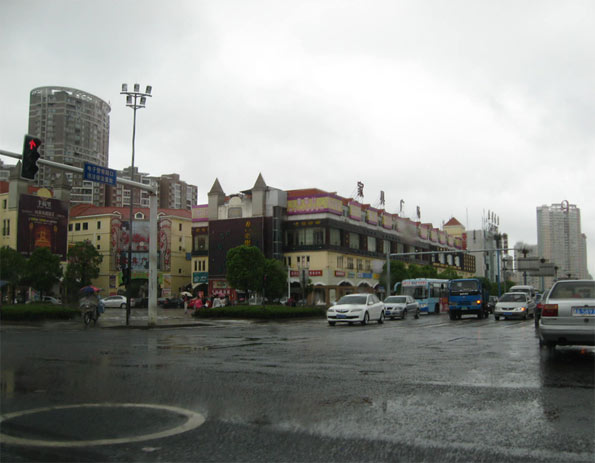
    On a rainy and quiet Sunday afternoon I took a tour of the northeast construction area and found that much of the construction had been finished. Moreover it was obvious from both the traffic and the open shopping centers and shops that this was anything but a "ghost city" (see photograph, above).

    The next day I took a similar trip to the western construction area. As in the northeast, much of the construction was complete and the communities were alive.

    Zhengzhou, Henan: Zhengzhou is also rapidly growing even faster than Changsha (over 60 percent in 10 years) and is the capital of Henan province. The article displays multiple satellite images of the Zhengzhou New Area. Because of a previous article in the Daily Mail, I took the opportunity on a recent trip to visit the Zhengzhou New Area and file a report. The Zhengzhou New Area is alive.

    The Business Insider also indicates an unfamiliarity with Chinese geography.

    Outside Jiangsu? A couple of the photographs referred to empty developments as being "outside Jiangsu," as a Westerner might describe a development as being outside Phoenix or Omaha. However Jiangsu is not an urban area or city, it is a province. Thus, to refer to a development as being outside Jiangsu is akin to referring to a development as being outside Arizona or Nebraska.

    Changsha Already Twice as Large as Los Angeles? The Business Insider also advises us that Changsha is already twice as big as Los Angeles. In fact, there are no comparable geographies between Los Angeles and Changsha that could make such a statement even close to accurate. Regrettably, many writers and much of the press make comparisons between China and other nations without the remotest idea of the meaning of the geographical terms they are using. Here are a couple of ways that Los Angeles and Changsha can be compared.

    1. Central municipality: The central municipality or core city of the Los Angeles area is the city of Los Angeles. It has a population of approximately 3.8 million people, but accounts for less than one third of the population of either the metropolitan area (functional area or labor market area) or the urban area (physical area or area of continuous development). Strictly speaking, there are no central municipalities in China, because the regions or prefectures are themselves municipalities. It is as if the city of Los Angeles comprised both Los Angeles and Orange counties. Chinese municipalities are divided into districts and if a comparison were to be made at the central municipality level, Changsha’s central district would have to be used. This would be the district (qu) of Furong, which has a population of 500,000 people, about 1/8 that of the city of Los Angeles.

    Core city comparisons are fraught with difficulties. This is illustrated by Melbourne, which had little more than 70,000 people in the last Australian census, approximately two percent of the metropolitan population. The 2010 US Census showed Melbourne, Florida to be larger.

    2. Urban Area: The one level at which they valid comparison could be made is the urban area, or the area of continuous urban development. The latest data for Los Angeles (2000) indicates an urban area population of 11.7 million people. The 2010 US Census counts for the Los Angeles area suggest that the urban area total, once released will be little higher than the 2000 figure.

    Based upon the 2010 census data, the next edition of Demographia World Urban Areas will estimate the Changsha urban area at approximately 3,000,000 people. Thus, by the urban area metric, Changsha has a population approximately one-quarter that of Los Angeles.

    It is possible that Business Insider like others, compared the population of the central city of Los Angeles (3.8 million), which is only part of the urban area to that of the Changsha municipality (7 million), which has more than double the population of the Changsha urban area and covers at least 25 times as much land area (virtually all it rural). They are not the same thing.

    —–

    Photograph: In the northwestern Changsha "ghost city:" September 2009 (by author)

  • Can Florida Escape the Horse Latitudes?

    When it comes to the winds of change, Florida remains in the horse latitudes.  This zone of the Atlantic around 30 degrees latitude was so named by ship captains because their ships, becalmed in the water, seemed to move faster when they lightened their load by throwing off a few horses.  Florida’s governor Rick Scott, who campaigned on a promise to create 700,000 jobs in this state, appears to have adopted the same tactic by throwing overboard the Department of Community Affairs, the state agency that regulated real estate development.  Other bureaucracies may be next in line if the state doesn’t show signs of improvement soon.

    Billy Buzzett, appointed head of this bureaucracy, was in Orlando last week to discuss the new future of Florida growth management.  Growth will now be lightly monitored by the Department of Economic Opportunity , which is in charge of reviewing development plans, and will handle unemployment benefits as well.  Mr. Buzzett stated that the department’s mission will also include items such as weatherization of structures for hurricanes. All of this is good, but it’s a puzzling mix to throw into a single bureaucracy.  Obviously, real estate regulation is not the focus of this governor, who saw regulation as one of the chief obstacles to creating jobs in this state.

    The Department of Community Affairs was created in 1985 to set some standards for quality of life as well as for environmental protection.  Failing at both tasks, the DCA came under fire during the last election cycle as a statewide referendum (Amendment 4) on growth gained support from people tired of seeing forests converted into strip malls.  The referendum, narrowly defeated, would have people vote in Cailfornia-style ballots for such changes.  This may have been a bad idea, based on how California’s growth controls have stifled its once vibrant economy.

    In this era of minimal new building, the reinvention of growth management may be seen as a way to pass the time while we wait for the economy to recover.  In reality, however, there are some very large implications in the future.

    Governor Scott wants the state to be more like Texas, which regulates with a far lighter hand and seems to be navigating through this particularly horrid recession better than other big states.  Texas has growth and does not have an onerous, time-consuming process which weeds out all but the deepest pocketed investors.  Unlike Texas, however, Florida has few natural resources like oil and mineral wealth to fall back on for revenue, and therefore deregulates itself without any diversification of income stream.

    What this means to the local economy will be hard to predict.  Certainly, the DCA was able to negotiate with private developers, and helped to shield cities and counties from a lot of the pressure from out-of-state interests.  Without the DCA, it will be interesting to watch which of Florida’s regions stand up to this pressure and which regions, starved for cash, cave in to the pressures of growth.

    Although defeated, Amendment 4 clearly scared the real estate interests to death.  Legislation now prevents anything like that from happening again.  While real estate development clearly needs to be left in the hands of professionals, it also seems to have risen to the top of citizens’ awareness.  Whether it stays there or not is up to the state’s citizens, most of whom immigrated from elsewhere in search of the good life.  Growth benefitted the lowest economic class by creating cheap housing, construction jobs and access to consumer goods.  Florida, however, by grabbing the bottom tranche of workers, has missed a chance to build a more vertically integrated middle class with higher skilled workers.

    Orlando in particular is in an unfortunate situation, as it has no natural hard boundaries like the sea.  Like Atlanta, Central Florida’s metropolitan area can grow in concentric rings forever and ever, gobbling up more agriculture, wetlands, and forests.  Such a development pattern puts value on the rim, rather than in the center, leaving the older parts of the city devoid of investment, energy, and hope.  With private interests, whose mission is to grab the low hanging fruit, in chargethere will be little redevelopment of these interior districts, despite the sunk costs of infrastructure that could give them an edge. 

    Making more stuff is the business of growth.  Making stuff better is the business of development.  And development is what older neighborhood areas like this sorely need.  Successful in-fill redevelopment, in both suburban and urban locations, can still happen if employment can be added to the mix.

    It is up to our region’s leadership to turn this pattern around, and start valuing our real estate a little differently than in the past.  For example, debasing our wetlands to their mere economic value overlooks their larger value in terms of biodiversity.  Bringing wetlands and agriculture into our growth management policy would be a good first step towards creating a sustainable future for Central Florida.  Florida’s environmental movement need not turn into a shrill anti-growth machine as has happened elsewhere, but should be a partner with the real estate interests to protect the more long-term natural assets that bring so many to the Sunshine State in the first place.

    Recycling also need not be just the job of the utility department.   Recycling land through the EPA’s brownfield program is already underway by many municipalities, and provides a vehicle to reinvent neighborhoods that have failed. 

    As always, clean water will be the limiting factor to growth.  Already a concern of Florida, the state is divided into various water management districts, who regulate how clean water can be removed from the aquifer, and what kind of dirty water can be put into it.  No doubt this regulation will be under assault next.

    Without Secretary Buzzett’s new department, Florida is already showing signs of new employment opportunities and diversity.  Military spending in Florida is up, thanks to the National Center for Simulation, and medical research spending is continuing at a steady pace.  These were added to the mix of growth, tourism, and agriculture upon which Florida has traditionally relied. More jobs that revolve around these two industries will include support technology, computer science, manufacturing, and services. 

    These industries grew despite the regulatory burden of the state.  What is dangerous about Secretary Buzzett’s new department is its blasé treatment of the public’s genuine desire for better environmental management and a better quality of life.  Like many places, Florida has its share of “not in my backyard” sentiment reacting against more development.  The anger voiced in 2010 through Amendment 4, however, represented something new and deeper:  a collective sense that enough is enough.  Speculative development, built during the boom and remaining unoccupied to this day, is in every community, urban and rural.  Few believe that the empty condos, ghost town subdivisions, empty strip shopping centers, and vacant office parks are improvements over what was there before, and fewer still want this kind of insanity to return.

    So the death of the DCA, which allowed speculative development to the point of embarrassment, may have been a good thing.  Employment-based growth, which so far has eluded Florida’s regions, may now have a chance to take place.  With the new industries arriving, job creation is already a reality – no horses had to be thrown overboard to make that happen. What Florida needs now is some leadership at the local level to promote more employment-based growth that is slow, but sure, and that is sustainable for the long haul.   

     Richard Reep is an Architect and artist living in Winter Park, Florida. His practice has centered around hospitality-driven mixed use, and has contributed in various capacities to urban mixed-use projects, both nationally and internationally, for the last 25 years.

    Photo: Desiree N. Williams

  • Which Modes are “Multi-Modal” & Enhance Mobility?

    One thing that makes Smart Growth appealing is its language.  Terms like “livability” and “transit-oriented development” sound engaging, and “smart” growth is, frankly, self-flattering for its acolytes.  On transportation matters, advocates rarely declare their intent to reduce roadway capacity and divert money to transit projects (along with other auto unfriendly policies).  Instead, they say they are pursuing a “multi-modal” strategy to promote “transportation choice.”

    But what are acceptable modes in a multi-modal strategy?  And do all choices equal greater mobility?

    In Boston, some enterprising businesses have been renting out Segways – those futuristic, gyro-balanced transporters.  Tourists find them easy to ride and extremely convenient for scooting around the historic landmarks on the city’s wide sidewalks.  But residents see them as a nuisance, so the 13-member Boston City Council has voted unanimously to ban them from city sidewalks.

    The Segway is certainly another mode of travel.  Shouldn’t the Boston City Council, which promotes multi-modal transportation, embrace the Segway?

    Those favoring the ban don’t necessarily want the Segways to disappear from the city.  They want to move them onto roads where tourists unfamiliar with Boston’s road network can jostle with hurried commuters in 4,000 pound cars and even heavier buses and commuter rail cars.

    Like cars, Segways provide motorized transport for individuals, and its self-balancing upright design makes it more compact and maneuverable than a bicycle or moped and, thus, more suitable to mix with pedestrians on the sidewalk.  And like roads, sidewalks are inherently multi-modal and can accommodate more than just foot traffic.

    When planners and progressive politicians bark the virtues of “multi-modal” and “transportation choice,” they are usually just pushing taxes and subsidies for mass transit, especially rail transit.  Unfortunately, clever rhetoric too often trumps critical thinking.

    For example, light rail transit is considered by many to be the apogee of an urban transportation system, but replacing existing bus lines with rail lines does not necessarily enhance mobility but simply substitutes one form of collective transport for another.

    Furthermore, in most communities the only mobility choices people have are private transport (automobiles) or public mass transport (buses or rail).  Expanding transportation choices would mean introducing private competition for mass transit services and public support, such as mobility vouchers for low income people, for private transport (e.g., Zipcars or taxis).

    As cities continue to face bleak budget forecasts, the costs of different travel modes will remain an important consideration.  Because mobility is intricately tied to economic prosperity, it’s equally important to understand which modes enhance mobility and which ones merely give it lip service.

    Ed Braddy is the director of the American Dream Coalition, a non-profit organization promoting freedom, mobility and affordable homeownership.  He can be reached at 352-281-5817 or at ed@americandreamcoalition.org.

  • The New State of Coastal California?

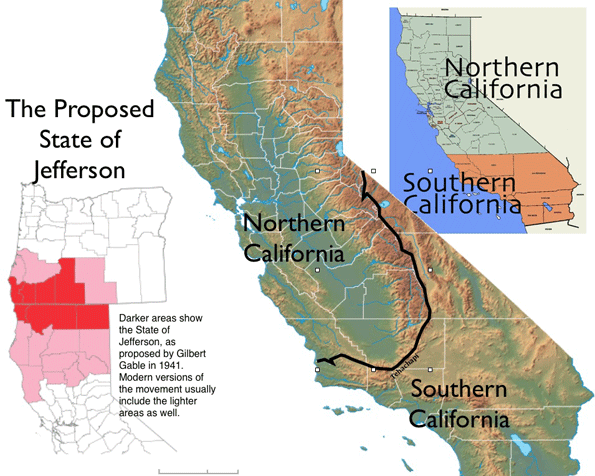
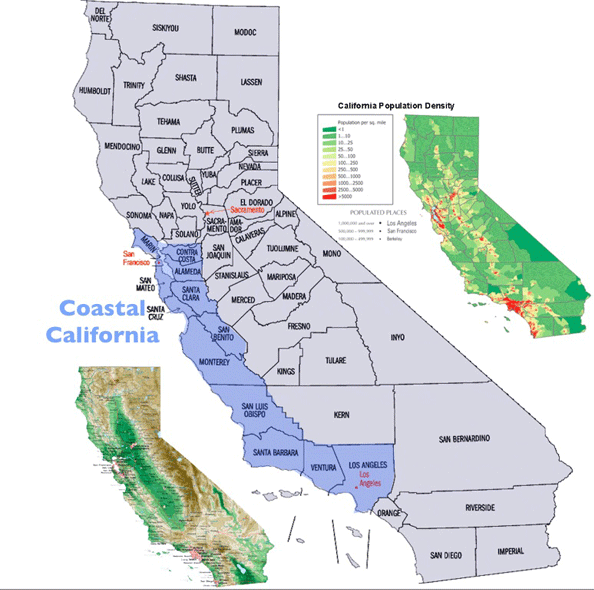
    In 2009, former California legislator Bill Maze proposed dividing his state, hiving off thirteen counties as Coastal (or Western) California (see map). Maze, a conservative from the agricultural Central Valley, objects to the domination of state politics by the left-leaning Los Angeles and San Francisco metropolitan areas. The initial impetus for his proposal was the passage by state voters in 2008 of Proposition 2, requiring larger pens and cages for farm animals. Agricultural interests denounced the measure, arguing that it would increase their costs and threaten their livelihoods. Meanwhile, the state’s on-going water crisis, which largely pits farmers against environmentalists, widens the divide. Unforgiving invective marks both sides of the debate. A post in Politics Daily characterized secessionist farmers as dolts fighting against “liberal Hollywood types [who] don’t understand the importance of torturing animals.” The Downsize California website, on the other side, fulminates against coastal “radicals” who are “infatuated with nature over mankind and are sympathetic to illegals and criminals.”

    The desire to divide unwieldy California may be quixotic but it is nothing new; at least 27 divisional schemes have been proposed since statehood in 1850. Most have sought to split the state along north-south lines. In the mid 1800s, southern California secessionists felt marginalized and ill-served by a state government based in the distant Sacramento. By the mid 1900s, the tables had been turned, as northern Californians came to resent the demographically and economically dominant greater Los Angeles (LA) area. The California State Water Project, with its vast pipes snaking over the Tehachapi Mountains, was a particular irritant. As a child growing up in northern California’s Bay Area in the 1960s, I almost never heard positive statements about LA, which was widely condemned as a vast suburban wasteland inhabited by shallow people scheming to “steal our water.” Such naked regional bigotry was spouted by people who would have been ashamed to say anything remotely smacking of racial or religious prejudice.

    Economic and political evolution, coupled with substantial immigration and emigration, gradually reduced the tensions between the Los Angeles and San Francisco metropolitan areas while accentuating the division between urban coastal and interior agricultural regions. But as the 2004 “voter index map” reproduced above shows, the state’s actual political divide is far more complex than that. Close inspection reveals a Democratic voting zone essentially split between coastal northern California and the Los Angeles area, with a few interior outliers in college towns, urban cores, Hispanic rural areas, and mountainous recreation sites. Contrasting to this area is a spatially larger and more contiguous but demographically smaller Republican-voting block covering the rest of the state.

    Maze’s scheme places several relatively conservative countries (Ventura, San Luis Obispo) in liberal Coastal California, doing so largely for reasons of geographical contiguity. Less explicable is his exclusion of the left-voting northern coastal countries of Sonoma, Mendocino, and Humboldt. These may be relatively rural counties, but where the main crops are wine grapes and marijuana one should not expect conservative voting patterns. Note that certainly highly rural and relatively remote regions have solidly left electoral records, an unusual pattern. These include the Big Sur coast in Monterrey County, with its artistic heritage, and the counter-cultural “hippy” centers of Mendocino and southern Humboldt counties, such as Willits and Garberville.

    Martin W. Lewis has taught college-level geography for 20 years, and is currently a senior lecturer at Stanford University. He is a co-author on two leading textbooks in world geography, Diversity Amid Globalization and Globalization and Diversity. He is also the author of Green Delusions: An Environmentalist Critique of Radical Environmentalism, and Wagering the Land: Ritual, Capital, and Environmental Degradation in the Cordillera of Northern Luzon, and is co-author of The Myth of Continents.

  • Growing a Productive Urban Economy

    Suggestions that we can grow the Auckland, NZ economy by encouraging business into the central business district (CBD) in the interests of innovation do not reflect the weight of experience.  Sure, higher order professions have tended to concentrate there, and become relatively more important as manufacturing, retailing, and distribution have decamped.  And in Auckland, at least, tertiary education has become a major player in the CBD.  University employment has boosted the scientific as well as education sector.

    But much as introductions might be made and ideas swapped over coffee, the real capacity to bring innovation to fruition belongs in the workshops, laboratories, production lines, and sales office of real companies. 

    Obvious as it may seem, we need more – and bigger – businesses to lead the way if Auckland is to grow through innovation and the resulting productivity gains.  This blog is about why this is so and how we might help.

    Firm growth and local linkages

    The argument reflects a long-standing interest in industry, but the principles also apply to things like financial services, software, and design. 

    My most compelling experience is dated.  In the seventies I visited 120 firms in the emergent electronics industry in inner London (the heart of creativity according to the density gurus), outer London, and central Scotland.  What I learnt then still seems relevant today.

    I wanted to know how businesses in different localities grow.  I examined where they made their purchases and where their markets were.  I was particularly interested in how much they depended on the local area to sustain their growth.

    The results were no surprise: the more successful firms depended least on their local area.  As higher value, higher growth firms expanded, though, they did strengthen reliance on their local workforce.  Critical local skills became embedded even as businesses became international in scope.  A commitment to and dependence on an established workforce became a key to maintaining the presence of innovative or high tech firms in an area.  This experience still rings true when we think about firms like Fisher and Paykel, Glidepath, and Rakon in Auckland today.

    Growth firms are nevertheless highly likely to invest away from their home base.  By itself that’s no bad thing.  It may be the beginning of the end, though, if they cannot raise the finance locally.  As the weight of their equity shifts offshore, so their local presence becomes more tenuous.

    The best outcome is probably when innovative and growing firms can be supported locally, generating local jobs, deepening local skills, and building local household and business income even as their business with the rest of the world grows.

    And that’s where we seem to struggle in Auckland, despite some exceptions.  As firms succeed here they often cannot find the resources they need to grow and maintain their local roots. 

    Relocating to grow

    The companies I analysed all those years ago more or less sorted themselves out.  In Inner London there were still a few post-war innovators beavering away.  For the most part these had not grown much.  The real inner London success stories, the firms that had prospered, were largely gone.  They may have kept an office in the city but R & D, production, and distribution had moved elsewhere.

    Elsewhere was outer London, or the new towns, villages, and cities in southeast England.  This included a world-leading electronics belt centered on Reading, an hour from the City of London. 

    A key step in firm growth is the ability to relocate from small start-up premises.  Consequently, localities away from congested inner cities were where the real innovation was taking place.

    The new firm nurseries

    Where do new companies come from in the first instance?  It’s not coffee shops in the CBD and there aren’t too many enduring ideas sketched on beer coasters in inner city pubs.  Some – the exceptions – may be born of enthusiasts working in garages. 

    Most new firms I found in the UK research were outside London.  Many had spun-off established companies.  This suggested one key to innovation: knowledgeable employees leaving firms to do it their way.  Often they spied opportunities in their former employment that the established business could not exploit – new processes or materials, new products or applications, or new markets. 

    In some cases, existing businesses spun off their own new enterprises to exploit new opportunities outside existing operations. 

    The rise of innovative, growth firms in low density areas outside London was hardly surprising.  Space was affordable, whether a start-up factory unit or land or premises for expansion.  Firms could attract staff because the living and commuting was easy.  Compared with London, costs were favourable.  And when they relocated, firms tried to go where key staff could easily follow.

    Later – in the late eighties – I visited the Cambridge Technology Park some 90 minutes north of London.  This was a highly successful centre of innovation and investment.  A low density environment attracted innovative light industry to easily accessed sites on the fringes of a provincial city –itself a university centre – set in an attractive living environment. 

    The dynamics behind Silicon Valley near San Francisco were similar.  Leading edge firms here have continued to spin off imitators and innovators in an area with room to expand and access to great living conditions.  Again, a key university, Stanford, is a contributor to ongoing success and business vitality.

    The ingredients of a dynamic economy

    This, then, is another key to a dynamic economy: the capacity of larger, older firms (and other institutions) to create the seed bed from which the new ones grow and expand in a continuous process of industry evolution – birth, growth, decline, and death. 

    As a variation aside, the process of firm evolution today includes the take over and reconfiguration of the old and tired.  Under-performing businesses are acquired and their assets rationalised, potentially renewing creative energy.  Leaner businesses may result, with new capital, a new sense of direction, and more vigorous management. 

    (Of course, a takeover may also be a financial play, with assets stripped, pumped, and packaged for a share market float, with precious little value added).

    We need the places — and space — where old firms can operate without incurring endlessly increasing costs, growth firms can expand, and new firms come into being.  What we cannot expect to do is conjure new enterprise out of an entrepreneurial vacuum.  And we definitely shouldn’t seek to straitjacket new firms and old within an inner city environment.

    What can we do?

    One reason for Auckland’s under-performance may be that our planning has acted inadvertently against sustained business renewal and growth.  Plans have may have over-focused on the inner city.  Planners have concentrated on how and where we can live and failed to plan for where we might work.  We dragged our feet in the zoning of substantial areas of affordable business land.  As a result, we have pushed up the cost and pushed down the appeal of Auckland as a place for growing firms. 

    One simple thing we could do is make sure that there is plenty of industrial land available.  This should be well connected, preferably removed from the congestion of inner Auckland.  There are a few good opportunities on the books of the council at the moment.  Large parcels at Silverdale, Massey North, Drury, and Pokeno are in various stages of planning, for example.  Bringing these plans to fruition will lift the prospect of Auckland participating in a productivity-led recovery.  Tying the areas together – and to the ports and airport – through the motorway system will provide the connections they need locally and internationally. 

    There are other issues to be addressed.  We could do with a focus in education on the skills, culture, and aptitude to make things happen.  Our universities must continue to connect individually and jointly with diverse vocational needs across the business board.  And let’s continue to explore how to attract capital to invest in expanding firms within the region.

    I am not assuming we can compete with the cheap land and labour of Asia, or match the host of engineers that Asian universities turn out each year.  But when people with the right skills and background do come along, let’s ensure that they encounter an environment that supports entrepreneurship and growth, and not leave them doodling and dreaming in inner city coffee shops.  And let’s do what we can to make sure that leaving town is no longer the mark of a successful firm.

    Phil McDermott is a Director of CityScope Consultants in Auckland, New Zealand, and Adjunct Professor of Regional and Urban Development at Auckland University of Technology.  He works in urban, economic and transport development throughout New Zealand and in Australia, Asia, and the Pacific.  He was formerly Head of the School of Resource and Environmental Planning at Massey University and General Manager of the Centre for Asia Pacific Aviation in Sydney. This piece originally appeared at is blog: Cities Matter.

    Photo by man’s pic