Blog

  • Fwd: California’s Bullet Train — On the Road to Bankruptcy

    For California’s high-speed rail boosters including their chief cheerleader, U.S. Transportation Secretary Ray LaHood, the month of May must have felt like a month from hell. First came a scathing report by California legislature’s fiscal watchdog, the non-partisan Legislative Analyst’s Office (LAO), questioning the rail authority’s unrealistic cost estimates and its decision to build the first $5.5 billion segment in the sparsely populated Central Valley between Borden and Corcoran. That segment, the LAO noted, has no chance of operating without a huge public subsidy, yet the terms of the voter-approved Proposition 1A, explicitly prohibit any operating subsidies.

    These concerns were echoed by an eight-member Independent Peer Review Group. “We believe the Authority is increasingly aware of the challenge of accurate cost estimating,” wrote its chairman Will Kempton in a letter to the California High-Speed Rail Authority’s CEO, Roelef van Ark. The Legislative Analyst‘s Office had concluded that if the cost of building the entire Phase I system were to grow as much as the revised HSRA estimate for the Central Valley segment (an increase of 57%), the Phase I system would end up costing not $43 billion as originally estimated, but $67 billion.

    The two reports unleashed a torrent of criticism from the press. In sharply critical editorials, The Wall Street Journal and the Los Angeles Times questioned the project’s fiscal viability and the Authority’s poor decisionmaking. The project is “a monument to the ways poor planning, management and political interference can screw up major public works,” opined the LA Times. (“California’s High Speed Train Wreck,” May 16). “If the state can’t come up with enough money to finish the route, a stand-alone segment in the Central Valley would literally be a train to nowhere and a big drain on taxpayers,” said the Wall Street Journal (“California’s Next Train Wreck,” May 18). “The legislature needs to kill the train now. Once this boondoggle gets out of the station, the state will be writing checks for decades,” added the Journal in its most recent editorial (“Off the California Rails,” May 30). The San Francisco Examiner and The Sacramento Bee also have been critical in their reporting. Governor Brown needs to “squarely address the issues raised by the legislative analyst’s report,” a Sacramento Bee editorial urged.

    Even some of the state’s former legislative supporters, such as state senators Joe Simitian, Alan Lowenthal, Anna Eshoo and Mark DeSaulnier have expressed reservations and urged the Authority to rethink its direction. “I don’t want to see an EIR (Environmental Impact Report) completed for a project that will never be built,” Senator Joe Simitian told Roelef van Ark at a Senate Budget Subcommittee hearing on financing the first rail segment in the Central Valley.

    At the urging of the Legislative Analyst’s Office, the rail authority asked the U.S. DOT for more flexibility about where and when to build the initial “operable” segment. The LAO went as far as recommending that “If the state can’t win a waiver from the federal government to loosen the rules and the timing for using high-speed rail grants, it should consider abandoning the project.” Not only would the Central Valley segment, by itself, have insufficient ridership and revenues to stand on its own, the Legislative Analyst wrote, but “the assumption that construction of the Central Valley segment could move quickly because of a lack of public opposition has already proved to be unfounded.” The LAO suggested several alternative segments that could be more financially viable and economically beneficial than the Central Valley segment. They included Los Angeles-Anaheim, San Francisco-San Jose and San Jose-Merced.

    But in a remarkable exercise of inflexibility and delusion, the U.S. Department of Transportation turned a deaf ear to the request. “Once major construction is underway…the private sector will have compelling reasons to invest in further construction,” the DOT letter stated in an assertion totally unsupported by any evidence.

    “California is a test case for whether high-speed trains can succeed in the U.S. — and so far, the state is failing the test,” the LA Times editorial concluded. The feds’ refusal to reconsider their position has substantially magnified and accelerated the likelihood of that failure.

    LATE-BREAKING NEWS 6/6/2011: In the wake of the LAO report, both houses of the California Legislature have passed legislation that, in effect, is a vote of no confidence in the California High Speed Rail Authority (CHSRA) and its Board. The bills place the Authority within the state’s Business, Transportation and Housing Agency, thus giving the Governor decisionmaking power over the project. The Senate bill would “vacate” the appointments of the current Board members and provide for the appointment of a new advisory Board with special expertise in construction management, infrastructure finance and operation of rail systems. The House bill would retain the current Board but only in an advisory capacity. The two bills will have to be reconciled before they are sent to the Governor for signature. However, with the bills sponsored by three Democrats, the Governor is expected to sign the final bill into law [SB 517 (A. Lowenthal), passed on June 1 by a vote of 26-12; AB 145 (Galgiani and B. Lowenthal) passed on June 3 by a vote of 50-16].

    There is a possibility that a change of leadership at the Authority, coupled with mounting grassroots opposition in the Central Valley, might delay the project past September 2012 — the federal deadline to start construction— and thus disqualify the project from federal grant assistance extended under the stimulus (ARRA) legislation. The deadline was reaffirmed in a letter from U.S. DOT’s Undersecretary for Policy, Roy Kienitz. “U.S. DOT has no administrative authority to change this deadline, and do not believe it is prudent to assume Congress will change it,” Kienitz wrote to Roelof van Ark.
  • Federal Survey: Fewer Transit Commuters

    Results from the US Department of Transportation’s 2009 National Household Travel Survey indicate that transit’s work trip market share in the United States was only 3.7 percent in 2009. This is a full one quarter less than the 5.0 percent reported by the Bureau of the Census American Community Survey for 2009. Further, the NHTS data does not include people who work at home. If the work at home share of employment from the American Community Survey is assumed, the transit work trip  market share would be 3.5 percent.

    Much of the difference is due the differing questions asked in the two surveys. The American Community Survey asks how people "usually" got to work last week, while the National Household Travel Survey (NTHS) data is based upon actual diaries of travel kept by respondents. The NHTS reports that among people who respond that transit is their "usual mode" of travel to work, transit is used only 68 percent of the time. In contrast, the daily trip diaries report that commuters who drive alone are a larger share of the market than those who indicate driving alone as their usual mode of travel. People who report their usual mode as "car pool" actually use a car pool to get to work only 55 percent of the time, an even lower rate relative to "usual" mode than transit.

    The daily trip diaries from the NHTS also a large difference in travel times between automobile commuters (including car pools) and transit. The average automobile commute time was 22.9 minutes, while the average transit commute time was more than double, at 53.0 minutes.

  • Listing the Best Places Lists: Perception Versus Reality

    Often best places lists reflect as much on what’s being measured, and who is being measured as on the inherent advantages of any locale.  Some cities that have grown rapidly in jobs, for example, often do not do as well if the indicator has more to do with perceived “quality” of employment.

    Take places like Denver and Seattle. Both do well on what may be considered high-tech measurements – bandwidth, educated migration, entrepreneurial start ups – but have trailed other places in terms of creating jobs. Others, such as Oklahoma City and Raleigh, do better in terms of overall job creation and cost competitiveness.

    There are effectively few truly objective criteria, and the Area Development list does tend to weigh a bit heavy on the factors that help more expensive – although not necessarily the most costly – cities. If cost of doing business, or regulatory environments were given more weight, some of the high fliers would not do as well.

    We prefer to focus less on atmospherics and more on how people, and businesses, are voting for their feet. San Francisco and New York have generally had slower job growth and greater outmigration, but do well on lists that focus on perceived qualitative factors.

    But then there is Austin. Here is one region that has it all, the low costs and favorable regulatory climate of Texas along with the amenities associated with a high-tech region. The area creates a large number of jobs of varying types and is still inexpensive enough to attract young, upwardly mobile families. This gives it a critical advantage over places like Silicon Valley, Los Angeles or New York.  Unlike those three centers, Austin performs extraordinarily well in quantitative measurements.

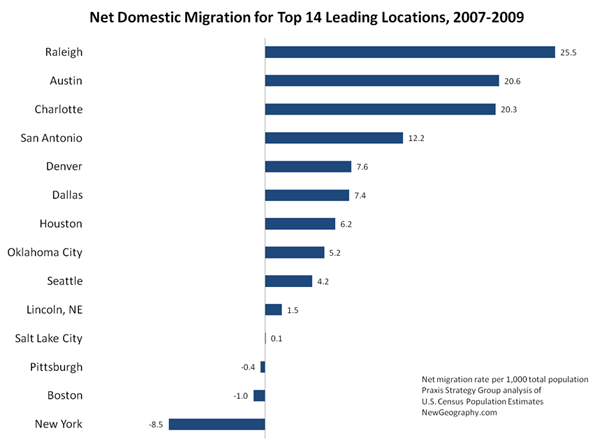
    The region that most closely matches Austin in these respects is not Seattle and Denver, but Raleigh Durham. Recently a group of leaders from Raleigh made a visit to Denver to learn what makes that city successful. Speaking to the group, we pointed out that by objective measurement – job growth, educated migration, population growth – Raleigh beat Denver by a long shot, yet it was to Denver the group was looking for inspiration. In fact, over the past three years, Americans have moved to Raleigh at a rate more than three times that of Denver.  Perception can be a funny thing which makes a winner feel inferior to a clear runner-up.

    Another strange result is that New York and Houston had the same number of mentions. Yet looking at numbers — from educated migration, job growth, population increase — Houston slaughters New York. People, from the college educated on down are flocking to Houston while fleeing, in rather large numbers, from New York. One has to wonder where the rankers live and where they are coming from. Houston triumphs on performance, while New York, to a large extent, wins on perception. 

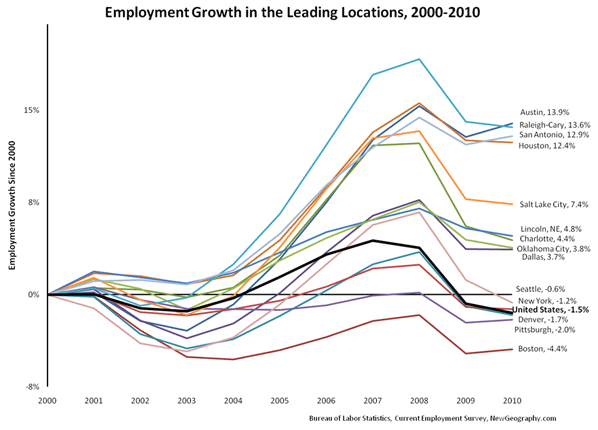
    Looking simply at job growth over the past ten years for the Leading Locations mentioned on at least five surveys, the 14 regions separate themselves into three groups.  The top tier of places – Austin, Raleigh, San Antonio, and Houston – all have seen job growth of more than 12% and seem to be recovering from the recession faster than the others.  

    Salt Lake City and Charlotte were tracking with the top tier of places until 2007 but have since fallen to the second tier of cities.  The remainder of the second tier includes steady growers Dallas and Lincoln, along with Oklahoma City, a region that has seen a boom in jobs since bottoming out in 2003.

    The final job growth tier of places includes five regions that have fewer jobs than ten years ago.  Seattle drops just below the zero line after being hit particularly hard by the 2001 and 2008 recessions, while New York and Denver finish near the national rate.  Pittsburgh and Boston spent most of the decade below their 2000 employment levels, but each seem to be recovering from the recession faster than many of the other Leading Locations cities. 

    But perhaps the biggest problem with lists has to do with the size of regions. Much of the fastest growth in America, particularly in terms of jobs, has been in small metros, many with fewer than 1 million or 500,000 residents. Smaller dynamic areas such as Anchorage, Alaska; Bismarck, North Dakota; Dubuque, Iowa; or Elizabethtown, Kentucky – all in the top 25 of NewGeography’s Best Cities for Job Growth 2011 Rankings – are too small to show up on some lists yet may be a location of choice for expansion. This reflects not so much their relative desirability but the fact that, unlike larger regions, they simply are not included on many rankings.

    Ultimately, a list of lists does tell us much, but perhaps only so much for a specific individual or business. For someone interested in the movie business, for example, Los Angeles – and increasingly places like New Orleans or Albuquerque – are great draws, but perhaps not so much for financial services.  The lists of lists are useful to identify hotspots, but for most location decisions, it may be more imperative to drill down to more detailed industry sectors and workforce attributes. And most of all, take the perception factor into account and look instead at the real numbers to tell you where to go.

    This piece first appeared at AreaDevelopment.com, as part of its Leading Locations series discussing best cities rankings.

    Joel Kotkin is a Distinguished Presidential Fellow in Urban Futures at Chapman University in California, an adjunct fellow with the London-based Legatum Institute, and the author of The Next Hundred Million: America in 2050. Mark Schill is Vice President of Research at Praxis Strategy Group, an economic research and community strategy firm.  Both are editors at NewGeography.com, a provider of two surveys for Area Development’s Leading Locations list.

    Photo by mclcbooks

  • Understanding the Egyptian Protests: Headwaters of the Arab Spring

    On Tuesday, January 25, 2011, the leaders of the Egyptian protest group, April 6 Youth Movement (A6Y), led hundreds of thousands of protesters chanting, “Bread, Freedom, Human Rights” into Cairo’s Tahrir Square. The events that followed completely surprised the economic elites gathering for the annual World Economic Forum meeting in Davos, Switzerland. Few put much stock in the importance of the actions of young people in Egypt until the protests overturned that country’s entrenched power structure in a matter of weeks.

    Why were the leaders of the global economy so surprised by the events that have come to be known as the Arab Spring, and why did they feel so threatened by them? Why did the protester’s demands spread so quickly throughout the Arab world after decades of suppression by autocratic regimes? 

    The answer to these questions lies in an understanding of the complex interaction between technological and generational change, fueled by a hunger for a better future, that continues to be the underlying source of the institutional instability and that will reshape the entire region. In a new Kindle Single, Headwaters of the Arab Spring, NDN fellows Morley Winograd and Mike Hais explain how these intertwined forces are destined to undermine institutions and leaders in every corner of the world.  

  • Orlando: Uncle Sam Meets Mickey Mouse

    Hawks and doves disagree on whether World War II ended the Great Depression.  Depending on which species of bird squawks louder, military spending may be the only way out of our current financial malaise.  In many ways it is already happening, although it is a surreptitious and quiet influence felt mostly in the high-tech economic sector.  Defense growth in one of the most unlikely places – Orlando, Florida – has already begun to diversify the region’s income stream, create a new urban corner of Central Florida, and tap into some of the natural allies and partners that already exist here.  Mickey Mouse is now sharing Orlando with Uncle Sam as the militarization of the local economy increases.

    America’s current rough patch, as Dr. Roger Siebert recently wrote about , seems to be deeper than any in recent memory, and recalls the 1930s.  During that time, isolationism was only cured by a slap in the face:  Pearl Harbor.  Today’s isolationism, so vigorously voiced in the calls to depart Afghanistan, seems to echo that period.  Enlistment in the military isn’t exactly vigorous, and intervention in troubled regions is not on the radar screen of even the most ardent hawk.  America seems too self-involved at the moment to care.

    Yet at this very same time, Pentagon spending is quietly rising in the modeling, simulation, and training fields.  Already employing 53,000 Floridians, 9,000 more than the state’s hallowed agriculture industry, this growth sector is hugely dependent upon a high-skilled, high-wage workforce.  The ability to train soldiers, sailors, and pilots without the expense of actual bombs and equipment has clearly demonstrated its benefits to the satisfaction of the military brass, making it inevitable that more is to come.

    Co-located next to Florida’s premier high-tech medical research park, Lake Nona, the National Simulation Center is the most common name used to describe the efforts underway at the Central Florida Research Park on the east side of town.  More importantly, however, the Center is adjacent to the University of Central Florida.  Already the second largest university in the country, UCF is home to much of this Center’s local 18,000 workforce.   With Navy, Air Force, and Marines research and training, the Simulation Center has quietly become the world’s largest military simulator .

    Regionally, it leverages its old Naval Training Center roots and proximity to NASA facilities at Cape Canaveral to capture workers, skill sets, and continuous research and improvement.    While the town struggles with slumping tourism and anemic population growth, the high-tech military industry is rapidly taking over as one of the biggest new economies to hit Florida.

    Spinoffs from military research can only benefit Central Florida’s attractions and rides, as future tourists will be able to experience more and more virtual thrills in addition to more traditional meatspace rides and shows.   In the meantime, it remains a quiet partner in diversifying the economy.

    In the 1990s, the Naval Training Center left Orlando, ostensibly because it duplicated facilities that the Navy had elsewhere.  Its developable land, close to downtown Orlando, became Baldwin Park, and the old barracks, classrooms, and laboratories were quickly bulldozed for lucrative residential real estate.  Few were aware that the functions of the Orlando Naval Training Center were downsized, not eliminated, and were quietly relocated to the east side of town.

    The Training Center evolved into the National Simulation Center. As a research-intensive industry, it capitalized on its new proximity to the University of Central Florida’s campus, and began an interchange with the engineering and computer science programs at that school.  UCF, today with over 50,000 students, has quickly grown to become the nation’s second largest university, just behind Ohio State.  UCF’s own Research Park has grown to rival the fabled Research Triangle in North Carolina, due to the synergy between military and higher education.

    Its new location also moved the Training Center a little bit closer to the Kennedy Space Center as well.  The Navy has always had a presence at Cape Canaveral, and with the employee base around the Space Center available less than an hour’s commute away, the Training Center has already benefitted from the availability of this highly skilled workforce who has suffered from the ebb and flow of NASA’s political fortunes.

    Medical research being conducted by Scripps, Burnham, and Nemours will also benefit from this activity, as they are all building new facilities at Lake Nona.  This medical research campus will employ many with the same skills, education, and training as the Simulation Center, and provide choices for the scientists and engineers living in Lake Nona’s suburbs.  This makes the residential real estate around Lake Nona a bright spot in Central Florida’s otherwise horrendous housing market .

    Surrounding the Simulation Center, small companies have already started feeding creativity and innovation into the giant maw of the military, and spinoffs – commercialization of its technology – have also benefitted larger companies such as Orlando’s game design team at Electronic Arts and the military contractor Lockheed Martin.  This supply chain, once established in Orlando, gives localized sustainability to this industry and suggests that it has achieved a foothold among the tourism, agriculture, and growth industries firmly established in Central Florida.

    Geographically, East Orlando is difficult to develop.  Like the surface of swiss cheese, land above the flood plain, traditionally agricultural, is interlaced with wetlands and lakes, and it has been historically ignored for the broad swaths of low-hanging fruit closer to the theme parks and population centers on the west side of town.  Pressure to develop, however, has suddenly put this area in the spotlight, and controversial proposals by homebuilders and other owners have raised questions about whether Florida should stay on its historic pathway of man vs. nature.   Infrastructure – roads, utilities, and other unglamorous investment – still doesn’t exist in much of East Orlando.  Because development has historically been in small pockets fragmented by the area’s mosaic of wetlands, connectivity and sheer mass will be difficult to achieve without great cost to the environment.

    Yet this does not have to be so.  Dense development can happen with respect to nature, as proven by countries such as Germany and Sweden .  If left to the same old forces that developed the rest of Florida, it is unlikely that East Orlando will experience any innovation regarding development strategy, and Central Florida will host the same old battles of environmentalists vs. developers again and again.  The state’s growth strategy – leaving it up to private interests – may have already guaranteed this outcome.

    If, however, innovation transcends the research mission and influences the style of development to support this research, then the military and medical centers in East Orlando have a chance to provide a true, new pathway to the future.  Like Victor Gruen’s 1963 concept for Valencia, which recognized such modern aspects of society such as the car, East Orlando could be planned as an employment-based community within the context of nature using contemporary science and technology.  Orlando, the ephemeral city home to amusement parks and orange groves, could become a model for development to influence other areas struggling with the same questions.

    Militarization of the economy may become a vehicle for true change.  The cluster of military agencies and private businesses, headed by Lockheed Martin, all revolve around this economy and provide a badly-needed shot in the arm of Orlando’s workforce.  With high-salary, highly educated workers, global connectivity, and a growth engine no less than the Department of Defense, Orlando can be assured of some good times ahead while the tourism and housing sectors recover.  The region’s leadership must think carefully how to embrace this new savior, and what the greater implications are for the future.

    Richard Reep is an Architect and artist living in Winter Park, Florida. His practice has centered around hospitality-driven mixed use, and has contributed in various capacities to urban mixed-use projects, both nationally and internationally, for the last 25 years.

    Photo by Research Development Engineering Command

  • The Katrina Effect: Renaissance On The Mississippi

    In this most insipid of recoveries, perhaps the most hopeful story comes from New Orleans. Today, its comeback story could serve as a model of regional recovery for other parts of the country — and even the world.

    You could call it the Katrina effect. A lovely city, rich in history, all too comfortable with its fading elegance and marred by huge pockets of third-world style poverty, suffers a catastrophic natural disaster; in the end the disaster turns into an opportunity for the area’s salvation.

    Had Katrina never occurred New Orleans would likely have continued its inexorable albeit genteel decline; the area’s population dropped from 627,000 in 1960 to 437,000 in 2005, the year the hurricane occured. Instead the disaster brought new energy and a sense of purpose to the Big Easy.

    I first realized that New Orleans was going through some kind of renaissance when looking at some numbers.  In our list of the country’s biggest brain magnets — based on analysis of where college-educated adults were moving to by demographer Wendell Cox —  New Orleans ranked No. 1, ahead of such hot spots as Raleigh-Durham, N.C., and Austin, Texas.

    Then came our analysis of the best large cities for jobs: New Orleans ranked No. 2 in our survey, up a remarkable 46 places. New Orleans’ performance was particularly impressive in the information field, which includes software and entertainment, and in which the Big Easy grew the most — over 30% last year alone – among our major metros.

    Yet numbers do not tell the whole story. Sometimes statistics simply look great against the background of catastrophic decline. New Orleans was so far down and received so much recovery money that recent improvements could be explained as a short-term bounce back from a disaster.

    But the resurgence of New Orleans, whose population is now back to almost 350,000, represents something far more significant and long-term. For one thing, the storm undermined the corrupt, inept political regimes that had burdened the area for decades. “Katrina shattered the networks and broke down the old hierarchies,” notes Tim Williamson, a New Orleans native and founder of Idea Village, a nonprofit focused on aiding local entrepreneurs.  ”People felt we were dying. Now we feel like we are refounding a great American city.”

    For example, inept leaders like former Mayor Ray Nagin and the equally lost Kathleen Blanc have been replaced by more effective figures like Mayor Mitch Landrieu and Gov. Bobby Jindal. Equally important, according to a recent Brookings report, New Orleanians have become noticeably more engaged with their community. Particularly impressive have been improvements in the local schools, once among the nation’s worse. Last year, the majority (61%) of public school students in Orleans Parish (counties in NOLA are called parishes) attended charter schools, which are now attracting some middle class families.

    Most impressive, this once stagnant region has transformed into an entrepreneurial hot bed. “Five years ago people thought we were crazy to be here,” says Matt Wisdom, founder of Turbosquid, a firm with 45 employees that provides three-dimensional images to corporate clients. “Now instead of people being amazed we are here, they want to get here to ride the wave.”

    Walking along Magazine Street from the edge of the Garden District to the Central Business District, you still pass some rough areas. But the way is peppered with scores of independently owned shops and small businesses, many of them opened since the hurricane. Their owners for the most part appear to be younger than 40.

    “We used to have this huge brain drain to the Northeast, the West Coast and Texas, but this has changed,” Williamson says. “After Katrina everyone was forced to become an entrepreneur. The dominant concept for the rebuilding has become one of resiliency and self-employment — it’s been bottom up. It’s become as much of our identity as Mardi Gras or the Jazzfest.”

    Since its founding back in 2000 Idea Village has assisted 1,000 local companies with business plans, financing and focus. Most are small, but some of what Williamson calls post-Katrina generation companies, like Naked Pizza, founded in 2006, have expanded rapidly. Specializing in a healthy, organic version of the traditional high-fat fast food, Naked Pizza has won financial backing from Dallas Maverick owner Mark Cuban. The company, which employs 40 employees at its New Orleans headquarters, expects to have over 70 franchises by the end of the year  .

    Many rapidly rising businesses specialize in digital media, attracting talent from other places like the West Coast and New York. 37-year-old Kenneth Purcell, founder of Iseatz, moved his entertainment and travel business from New York to NOLA in 2009 and has since grown his company from seven people to 25.

    One big advantage of starting a business in New Orleans is its affordable housing. Based on median price against median household income, the region’s prices are roughly 50% less than those in New York or San Francisco. This is particularly attractive both to middle-aged couples with children who can afford a spacious suburban home that are far less expensive than their equivalents in Los Angeles, Westchester or Silicon Valley.

    It also is attractive to the smaller subset of employees, many of them young, who are drawn to traditional cities. Some New Orleans neighborhoods remind me of pre-1980 Greenwich Village, offering a charming urban environment without either the extortionate price tag or oppressive density.

    Immigration, much of it from Mexico, also is contributing to the regional remake. Over the past decade, as both white and black populations dropped, the Asian population grew by 3000 and Hispanics by 33,500, most of them settling in suburban Jefferson Parish.  Once predominately African-American, New Orleans is returning to its more multi-racial past while re-establishing its strong cultural and social ties to Latin America.

    Yet despite all positive signs, it may be too early to proclaim, as some boosters do, a “New Orleans miracle.” After all, the city’s population remains over 100,000 below its depressed pre-Katrina levels. There are still over 47,000 vacant housing units in the city, many of the uninhabitable, notes Allison Plyer, who runs the Greater New Orleans Community Data Center. Overall, the recovery remains stronger in the suburbs, many of which suffered less damage from the storm. The share of regional population living in Orleans Parish, where the city of New Orleans is located, has slipped to 29% compared with 37% in 2000. Jefferson Parrish now has more jobs than the city across all income categories.

    Plyer believes the priority for the entire region lies in restoring the higher-paid blue-collar and middle-class jobs that for decades have disappeared from the city.  Young tech and media firms can help gentrify parts of a city, but they are not sufficient to provide opportunities to the vast majority of its residents. To do this, Plyer suggests, the region will have to focus more on “export” oriented jobs in industries such as  energy, manufacturing and trade.

    Critically these fields can provide decent salaries for a broad swath of workers.  Right now, Plyer adds, 45% of the workforce earns less than $35,000 a year, one byproduct of the domination of the generally low-paying tourism industry. Jobs connected to shipping pay twice as much on average as tourism; energy three times as much. A new steel plant announced recently by Nucor in suburban St. James Parish could create more than 1200 jobs with average pay of $75,000 annually.

    “We’ve allowed Houston and Biloxi to move ahead in a lot of these other industries,” she explains.  ”We have to move ahead in engineering and services and energy to compete with Texas. We can’t be just a tourism economy.”

    Ultimately, New Orleans’ long-term recovery may depend on exploiting historic raison d’etre: location. The region  stands astride the primary corridor for the Midwest grain trade and sits in the middle of the Gulf trade routes. It also boasts some of the nation’s richest energy deposits.

    Coupled with its enormous cultural appeal, resurgence in the  more traditional economy could spark the most remarkable urban comeback story of the new century. Once the poster child for urban despair, New Orleans may develop a blueprint for turning a devastated region into a role model not only for other American cities but for struggling urban regions around the world.

    This piece originally appeared at Forbes.com.

    Joel Kotkin is executive editor of NewGeography.com and is a distinguished presidential fellow in urban futures at Chapman University, and an adjunct fellow of the Legatum Institute in London. He is author of The City: A Global History. His newest book is The Next Hundred Million: America in 2050, released in February, 2010.

    Photo by Adam Reeder

  • Planning Decisions Must be Based on Facts

    While the misreporting of city population density comparisons commented on by  Wendell Cox was probably inadvertent, it is indicative of a general problem relating to contemporary planning – misrepresentation of facts.

    We are repeatedly told of the wonderful results of infill high density policies in locations such as Portland, USA or Vancouver, Canada which on investigation are found to be non-existent or applicable only to a small locality instead of to the city as a whole.

    Quantitative data is frequently misrepresented. To give one example, a 2008 Canadian study is often quoted as proving high-density reduces greenhouse gas emissions. Inspection and interpretation of the data provided reveals this to be negligible.  Without any evidence to the contrary, it seems reasonable to assume that the Canadian fraction of total household emissions that relate to transport is similar to that shown on the Australian Conservation Foundation’s website, being 10.5%. Applying this value to the data in Chart 2 of this Canadian study one finds that for those living within 5 km of the city centre there would be a transport difference attributable to increased density of only 1% in total annual emissions per person. For people living 20 km or more from the city centre the difference would be much less at 0.2%.

    We are told that high-density imposed on areas originally designed for low density is good for the environment; that it provides greater housing choice, that it reduces housing cost, that it encourages people on to public transport; that it leads to a reduction in motor vehicle use and that it saves on infrastructure costs for government. Not only do none of these claims stand up to scrutiny in any significant way, the contrary mostly prevails.

    Movements advocating high-density show characteristics of an ideology, their members’ enthusiasm resulting in a less than objective approach. The desire by these individuals to be socially and environmentally responsible and to identify with a group marketing these imagined benefits is understandable. Some may even benefit professionally. However the result is policies for which no objective favorable justification can be provided and which are not wanted by the greater community who have to live with the consequences.