Blog

  • The Evolving Urban Form: Jakarta (Jabotabek)

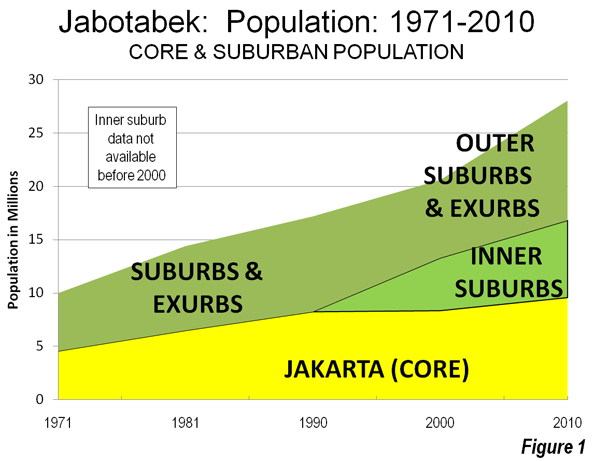
    There is probably no large urban area in the world that better illustrates the continuing dispersion of urban population and declining urban population density than Jakarta. Recently released 2010 census data indicates over the past decade that 84 percent of the metropolitan area (Jabotabek) population growth occurred in the suburbs (Note 1). This continues a trend which saw more than 75 percent of growth in the suburbs between 1971 and 2000 (Figure 1).

    Savannah State University (Georgia) Professor Deden Rukmana notes that this trend includes “many moderate and high-income families” who left the central city for better amenities while many poor people moved out to the fringe areas to escape what might be seen in the West as gentrification . 
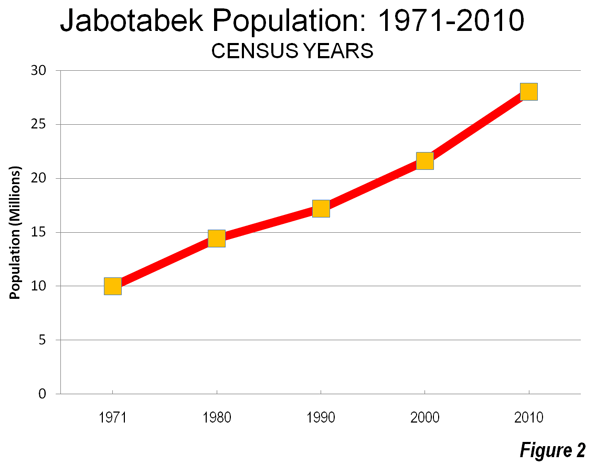
    The Megacity: Jabotabek: Jakarta is one of only a few world megacities (over 10 million) that have changed their names in recognition of their regional rather than core city focus (this sentence corrected from original). The most recent megacity with a new name is Mexico City, now referred to as the Valley of Mexico (Zona Metropolitana del Valle de México). Other examples are Tokyo-Yokohama (Kanto) and Osaka-Kobe-Kyoto (Keihansh1n).   Jakarta’s changed name, Jabotabek, represents an acronym made up of the beginning letters of the municipality of Jakarta and the three adjacent regencies (subdivisions of provinces), Bogor, Tangerang and Bekasi (Note 3). Jabotabek is one of the fastest growing megacities in the world and is experiencing accelerated growth. This is in contrast to the situation identified by the McKinsey Global Institute, which noted the declining growth rates of most megacities. In 2000, Jabotabek had a population of approximately 20.6 million, which by 2010 had risen to 28.0 million or 36 percent, nearly doubling its rate of population from the 1990s.    Jabotabek’s additional 7.4 million people is nearly equal to that of London (Greater London Authority), nearly as large as the city of New York and more people than live in the entire Greater Toronto area. In 2000, Jabotabek had a population of approximately 20.6 million, which by 2010 had risen to 28.0 million (Figure 2).
    Jabotabek’s unexpectedly high growth was greater than the 6.6 million added in both the Shanghai and Manila regions over the same period and above the 5.8 million increase in the Beijing region. The percentage growth in Shanghai and Beijing was slightly higher than in Jabotabek and slightly lower in Manila. The megacities of the United States, Western Europe and Japan have all fallen back to growth rates of less than five percent per decade (Tokyo-Yokohama, New York, Osaka-Kobe-Kyoto, Los Angeles and Paris).

    Population Trends by Sector: Population growth and rates are indicated in the table for the sectors of Jabotabek and the constituent jurisdictions.

    Jakarta Region (Jabotabek)
    Population by Sector: 2000-2010
    2000
    2010
    Change
    % Change
    Core: Jakarta 8.36 9.59 1.23 15%
    Inner Suburbs (Municipalities) 4.94 7.23 2.30 47%
    Tangerang 1.33 1.80 0.47 36%
    Tangerang Selatan 0.80 1.30 0.50 63%
    Depok 1.14 1.75 0.61 53%
    Bekasi 1.66 2.38 0.71 43%
    Outer Suburbs & Exurbs 7.30 11.20 3.90 53%
    Bogor (Municipality) 0.75 0.95 0.20 27%
    Bogor (Regency) 2.92 4.78 1.86 64%
    Tangerang (Regency) 2.02 2.84 0.82 41%
    Bekasi (Regency) 1.62 2.63 1.01 63%
    Jabotabek: Total 20.60 28.02 7.42 36%
    Population in millions


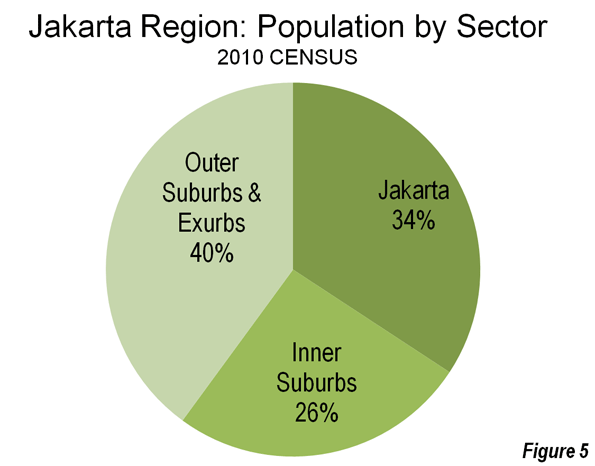
    City of Jakarta: The core city of Jakarta is the "Special Capital Region" of  Indonesia, similar to the District of Columbia in the United States, the Distrito Federal in Mexico or the Capital Federal in Argentina. This core of Jakarta grew 15 percent and added more than 1.2 million population, rising from 8.36 million in 2000 to 9.59 million in 2010, a turnaround from a loss of nearly 500,000 people between 1995 and 2000. The city of Jakarta captured 16 percent of metropolitan area growth and now accounts for 34 percent of the population of Jabotabek (Figures 3, 4 & 5).
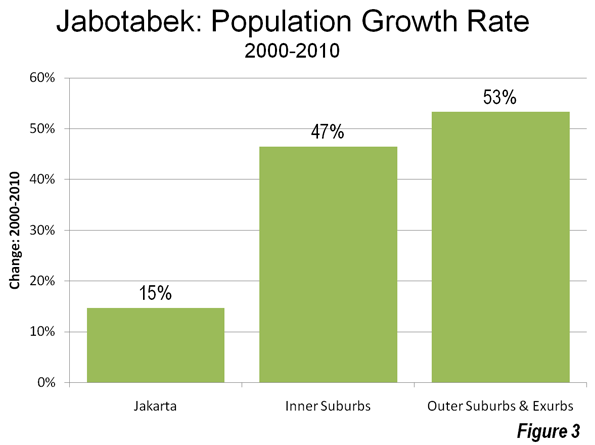
    Inner Suburbs: The inner suburbs, which are made up for the purposes of this article by the municipalities of Bekasi, Tangerang, Depok and Tangerang Selatan (South Tangerang) grew 47 percent during the 2000, from 4.94 million to 7.23 million. These inner suburban municipalities captured 31 percent of the metropolitan area growth and now have 26 percent of the population of Jabotabek (Figures 3, 4 & 5).
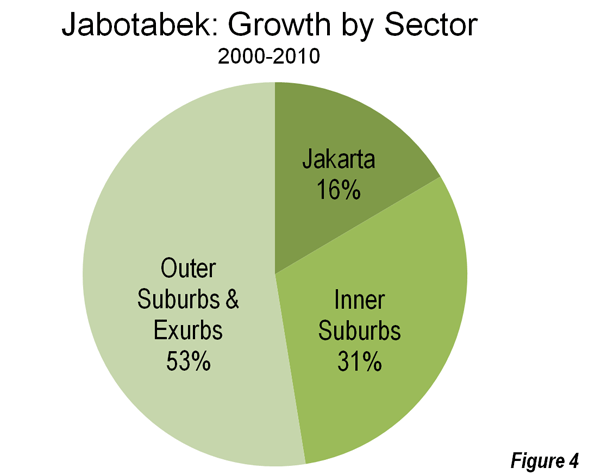
    Outer Suburbs and Exurbs: The outer suburbs and exurbs (Note 2) experienced the greatest growth, at 53 percent, rising from 7.30 million to 11.20 million. For the first time, the outer suburbs surpassed the core with the largest population. The outer suburbs and exurbs accounted for 53 percent of the metropolitan area growth and now have 40 percent of the population of Jabotabek (Figures 3, 4 & 5).
    Urban Area:  The substantial growth of Jabotabek occurred principally in the urban area (the area of continuous development or the agglomeration). It appears likely that the urban area population will exceed 24 million (Note 4). It thus seems likely that the Jakarta urban area will again be ranked as the second largest in the world, following Tokyo-Yokohama. Jakarta had been displaced by Delhi (and Seoul-Incheon), for which United Nations 2010 estimates had indicated higher than anticipated population growth as Delhi passed Mumbai to become the largest in India.

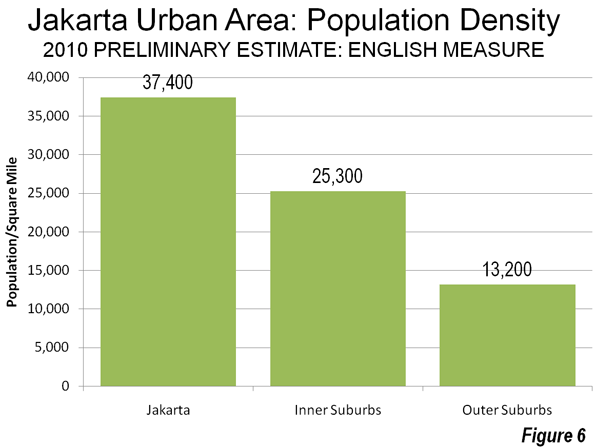
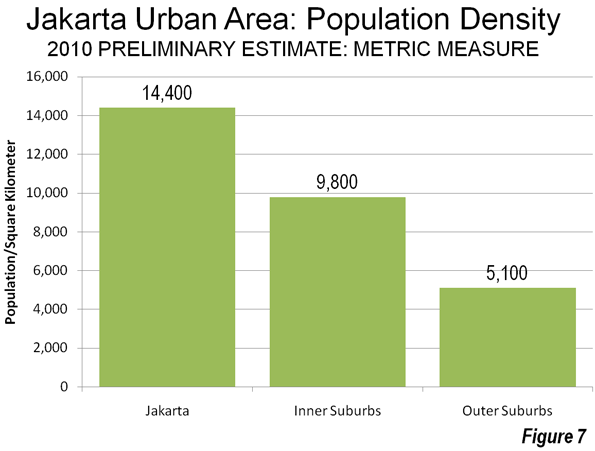
    Overall, the Jakarta urban area has a population density of approximately 22,000 per square mile or approximately 8500 per square kilometer. Yet the overall density of the Jakarta urban area has declined as population has moved to the outer suburbs which have a population density only one third that of the city of Jakarta. The inner suburbs have a population density that is only two thirds that of the city of Jakarta (Figures 6 and 7).
    Despite this, the Jakarta urban area is much denser than most large urban areas in the high income world. Overall, the Jakarta urban area is approximately 2.5 times as dense as the Paris urban area, more than three times as dense as the Los Angeles urban area, and approximately seven times as dense as the Portland urban area. Other urban areas in the developing world are even denser:  Delhi is more than 1.5 times as dense as Jakarta, Mumbai more than three times as dense and Dhaka is more than four times.



    Informal housing, city of Jakarta (photo by author)


    A Larger Metropolitan Area?  This continuing population growth could cause Jabotabek to expand even further. Indonesia’s President Susilo Bambang Yudhoyono (SBY) has proposed expanding the metropolitan area to include the regencies of Karawang, Serang, Purwakarta and Sukabumi as well as the municipalities of Serang, Sukabumi and Cilegon. Already, Jakarta’s continuous urbanization nearly reaches the Karawang urban area to the east (population over 600,000) and is nearing Serang regency to the west. SBY’s "Greater Jakarta" has a population approaching 36 million according to the 2010 census. Further pressure on suburban growth could be generated by plans in Jakarta to limit the core city’s population to 12 million.

    Yet even so it may take some decades, before Jakarta, or perhaps Delhi, could pass Tokyo-Yokohama’s nearly 37 million people to become the world’s largest urban area, assuming that they do not experience the reduced population growth so widespread in other megacities.   

    ———

    Notes:

    1. Caution should be used in making comparisons of metropolitan areas, especially between nations. There is virtually no consistency in the delineation of metropolitan areas between nations. In some cases, such as Japan, the United States, France and Canada, Metropolitan areas are based upon commuting patterns, but even between these nations there is no consistency.

    2. For the purposes of this article, suburbs are inside the urban area, but outside the central city (Jakarta). Exurbs are the portions of the metropolitan area (Jabotabek) outside the urban area.

    3. The provinces of Indonesia and the state of Virginia are subdivided similarly. In Virginia, all of the land area is divided into municipalities or counties. In the provinces of Indonesia, all of the land area is divided into municipalities (kota) and regencies (kapupaten). The regencies are further divided into sub-districts (kecamatan). Jabotabek is located in three provincial level jurisdictions, the Special Capital District of Jakarta, and the provinces of West Java (Java Barat) and Bantan. West Java has a population of 43 million, approximately 6,000,000 more than the largest state in the United States, California. Banten is bordered on the west by the Sunda Strait, location of Krakatoa, the volcano.

    Further, the name Jabotabek may not survive. As municipalities (Note 3) were carved out of the regencies in the 1990s and 2000s, the megacity was called Jabodetabek by some and proposed additions to the metropolitan area could bring even more variations. Inconsistent and alternative names probably make likely that sources will continue to call the megacity "Jakarta."

    4. This urban area population is much larger than reported by the United Nations, which for Indonesian urban areas limits its estimates to the jurisdiction of the core city, and thus excludes suburbs. As is generally the case throughout the world, the continuous urbanization of Indonesian urban generally areas extends far beyond core cities.

    —–

    Photograph: Luxury housing in Cileungsi sub-district, Bogor regency (outer suburbs), by author

    Wendell Cox is a Visiting Professor, Conservatoire National des Arts et Metiers, Paris and the author of “War on the Dream: How Anti-Sprawl Policy Threatens the Quality of Life

  • Recover, Rebuild: Christchurch New Zealand After the Earthquake

    Lincoln University in New Zealand did a great job of assembling some leaders in the principles and practice of disaster recovery for its Resilient Futures workshop recently in support of recovery in Christchurch after the February earthquake.  And in keeping with one of the themes – the importance of quality and timely communications – the papers and summary are already posted on the web.

    Without being there, it’s hard to judge the tone of discussion and the weight given to the lessons from experience overseas and in New Zealand.  But quick publication of the papers provides useful insights. 

    My immediate thoughts follow – but I recommend anyone interested to read the summary and original papers.

    Key themes

    Some of the papers looked a bit academic, but there is correspondence between what the practitioners and academics have  to say.  It’s good to see theory and practice reinforce each other. 

    Here are what I see as the most important threads:

    (1)    The common sense but urgent approaches proposed for recovery, and the practicality of  some of the examples of what has been done elsewhere and what can be done in Christchurch;
    (2)    The role of central government; there were differences in the detail among speakers, but by and large they see government adopting a leadership and motivational role, providing funding and oversight, especially in the recovery stage;
    (3)    Local democracy is a key based on the role of local government and citizen participation, especially in the planning and rebuilding processes, and on the importance of involving local, even localised, communities (“clusters", "villages”).
    (4)    The need for existing institutions to adapt to changed circumstances, streamlining decision-making while maintaining transparency;
    (5)    The need to ensure that citizen, community, and other interest groups can participate and contribute by way of knowledge, resources, and time;
    (6)    The need for speed, which nevertheless brings with it a risk of exacerbating pre-disaster imbalances and inequities between areas and groups; and the trade-off that may be required between speed and deliberation to deliver good long-term outcomes;
    (7)    Recognising how easily the temporary can become permanent, and planning accordingly;
    (8)    The window of opportunity that might be created for improving land uses and infrastructure in the course of replacement and rebuilding;
    (9)    Finding the time to envision the future, to build consensus around architecture and planning options, and to achieve citizen buy-in to proposed solutions;
    (10)The need for plans to address and reduce – and be seen to reduce – future risks;
    (11)The significance of open space,  the importance of greenways and green-spaces, the likelihood that the city will have to expand, and the notion of an expanded city as an assembly of connected villages.

    (It’s reassuring to see I’m not alone in advocating a new approach to spatial planning to limit the damage arising from extreme events, and to facilitate post-disaster recovery.  See my post of March 2 2011).

    The challenges

    There are potential contradictions in all this.  For example, speed is of the essence where infrastructure and shelter are laid waste, where jobs have evaporated, and communities have been torn apart. But haste should not create a city with parts which are forever temporary, where material gaps among groups widen, or where short-term expediency creates long-term risks. 

    Nor should the importance of government leadership limit the capacity of the community at large to participate in rebuilding, to deliberate and debate, and help shape the new Christchurch.

    The various speakers confirmed the importance of addressing multiple risks, something fundamental to planning for resilient cities.  If it can address multiple risks and provide outcomes that reduce them, then planning for the new Christchurch will enable “communities and local leaders to make best use of the opportunities the event has created”.

    The experience of previous disasters confirmed that public engagement is central to achieving “political stability, community buy-in and support for new initiatives, the identification of workable solutions, and a generally positive recovery that promotes confidence in both the process and the likely end result”.

    Differentiating recovery and rebuilding

    Perhaps what we need to do if we are to use the wealth of material and insight provided by the Lincoln University initiative, and others like it, and to work through the contradictions is distinguish between recovery and rebuilding.  Recovery is about restoring as quickly as practical safety, security and shelter, and the structures and infrastructure needed to ensure them.  It demands urgent attention, rapid deployment of resources, and  high level of expediency. 

    Rebuilding is a little less urgent and maybe even more challenging.  It is about the way communities will live in the future, how people get on with their lives, their play, their work, and their recreation in a healthy and prosperous urban environment.  Rebuilding requires deliberation, identification of options, and working our way to consensus.  It cannot be rushed.  Nor should it be unnecessarily prolonged.  Ideally, rebuilding will start with community engagement rather than tagging it on through consultation later on, a strategy which risks energy- and morale-sapping disputes about objectives and outcomes.

    Getting the governance right

    It appears from the papers presented that we know what has to be done: it’s how we set about doing it that is critical to a successful rebuild.

    Accelerating and sustaining recovery while laying solid foundations for rebuilding is perhaps the biggest challenge facing those in positions of authority and leadership.  Recognising the differences between them might be a good starting point.

    If this challenge is to be met, it is important that the governance structures – who does what and under what authority – are appropriate at the outset.  The creation of a central agency, the Christchurch Earthquake Recovery Authority (CERA), looks like a good start, especially if it focuses on recovery and thereby gives Christchurch City Council the space and capacity it needs to provide leadership in the rebuilding process.  How these two agencies demarcate their roles and work alongside each other will have a major impact on the creation of a resilient and liveable Christchurch.

    Phil McDermott is a Director of CityScope Consultants in Auckland, New Zealand, and Adjunct Professor of Regional and Urban Development at Auckland University of Technology.  He works in urban, economic and transport development throughout New Zealand and in Australia, Asia, and the Pacific.  He was formerly Head of the School of Resource and Environmental Planning at Massey University and General Manager of the Centre for Asia Pacific Aviation in Sydney. This piece originally appeared at is blog: Cities Matter.

    Photo by Geof Wilson

  • Goodbye, New York State Residents are Rushing for the Exits

    For more than 15 years, New York State has led the country in domestic outmigration: for every American who comes to New York, roughly two depart for other states. This outmigration slowed briefly following the onset of the Great Recession. But a new Marist poll released last week suggests that the rate is likely to increase: 36 percent of New Yorkers under 30 are planning to leave over the next five years. Why are all these people fleeing?

    For one thing, according to a recent survey in Chief Executive, New York State has the second-worst business climate in the country. (Only California ranks lower.) People go where the jobs are, so when a state repels businesses, it repels residents, too. It’s also telling that in the Marist poll, 62 percent of New Yorkers planning to leave cited economic factors—including cost of living (30 percent), taxes (19 percent), and the job environment (10 percent)—as the primary reason.

    In upstate New York, a big part of the problem is extraordinarily high property taxes. New York has the 15 highest-taxed counties in the country, including Nassau and Westchester, which rank first and second nationwide. Most of the property tax goes toward paying the state’s Medicaid bill—which is unlikely to diminish, since the state’s most powerful lobby, the political cartel created by the alliance of the hospital workers’ union and hospital management, has gone unchallenged by new governor Andrew Cuomo.

    New York City doesn’t suffer from outmigration to the extent that the state does; in fact, the city grew slightly over the past decade, thanks to immigration. And there’s more work in Gotham than in the state as a whole. The problem is that the kind of work available shows that the city accommodates new immigrants much better than it supports middle-class aspirations. A recent report from the Drum Major Institute helps make sense of the Marist numbers: “The two fastest-growing industries in New York are also the lowest paid. More than half of the city’s employment growth over the past year has been in retail, hospitality, and food services, all of which pay their workers less than half of the city’s average wage.” Worse yet, more than 80 percent of the new jobs are in the city’s five lowest-paying sectors. Parts of the country are seeing a revival of manufacturing—traditionally a source of upward mobility for immigrants—but not New York City, whose manufacturing continues to decline. The culprits here include the city’s zoning policies, business taxes, and declining physical infrastructure.

    Then there’s the cost of living in New York City. A 2009 report by the Center for an Urban Future found that “a New Yorker would have to make $123,322 a year to have the same standard of living as someone making $50,000 in Houston. In Manhattan, a $60,000 salary is equivalent to someone making $26,092 in Atlanta.” Even Queens, the report found, was the fifth most expensive urban area in the country.

    The implications of Gotham’s hourglass economy—with all the action on the top and bottom, and not much in the middle—are daunting. The Drum Major report, which noted that 31 percent of the adults employed in New York work at low-wage labor, came with a political agenda. The institute wants the city to subsidize new categories of work by expanding the scope of “living-wage” laws, which require higher pay than minimum-wage laws do, to all businesses that receive city funds or contracts. But that would mean higher taxes for the middle class and a further narrowing of the hourglass’s midsection.

    Governor Cuomo is calling for a property-tax cap, but without “mandate relief” for localities—for example, relaxing state laws that require localities to pay out exorbitant pension benefits. Mayor Michael Bloomberg has pledged not to increase local taxes, but even at their current level, city taxes and regulations will keep serving as an exit sign for aspiring twentysomething workers. In short, we can expect New York to lead the country in outmigration for the near future.

    This piece first appeared in the City Journal.

    Fred Siegel is a contributing editor of City Journal, a senior fellow at the Manhattan Institute, and a scholar in residence at St. Francis College in Brooklyn.

    Photo by Christopher Schoenbohm

  • Transit: The 4 Percent Solution

    A new Brookings Institution report provides an unprecedented glimpse into the lack of potential for transit to make a more meaningful contribution to mobility in the nation’s metropolitan areas. The report, entitled Missed Opportunity: Transit and Jobs in Metropolitan America, provides estimates of the percentage of jobs that can be accessed by transit in 45, 60 or 90 minutes, one-way, by residents of the 100 largest US metropolitan areas. The report is unusual in not evaluating the performance of metropolitan transit systems, but rather, as co-author Alan Berube put it, "what they are capable of." Moreover, the Brookings access indicators go well beyond analyses that presume having a bus or rail stop nearby is enough, missing the point the availability of transit does not mean that it can take you where you need to go in a reasonable period of time.

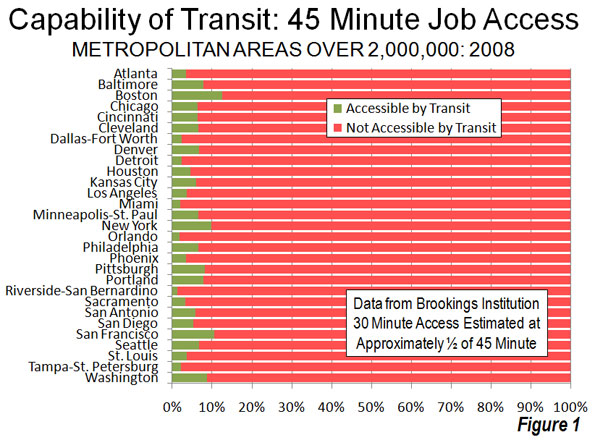
    Transit: Generally Not Accessible: It may come as a surprise that, according to Brookings, only seven percent of jobs in the nation’s largest metropolitan areas can be reached by residents in 45 minutes during the morning peak period (when transit service is the most intense). Among the 29 metropolitan areas with more than 2,000,000 population, the 45 minute job access average was 5.6 percent, ranging from 12.6 percent in Boston to 1.3 percent in Riverside-San Bernardino. The New York’s metropolitan area’s 45 minute job access figure was 9.8 percent (Figure 1).

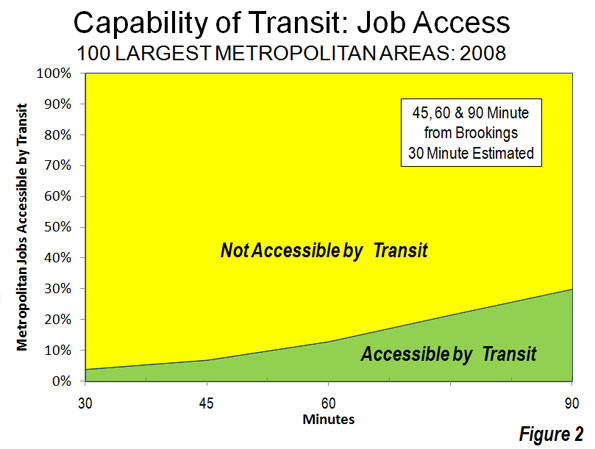
    Brookings did not examine a 30 minute transit work trip time. However, a bit of triangulation (Note 1) suggests that the 30 minute access figure would be in the range of 3 to 4 percent, at most about 4,000,000 jobs out of the more than 100 million in these metropolitan areas.   At least 96 percent of jobs in the largest metropolitan areas would be inaccessible by transit in 30 minutes for the average resident (Figure 2).

    The Brookings report also indicates that indicates that 13 percent of employment is accessible within 60 minutes by transit and 30 percent within 90 minutes (Note 2). Brookings focuses principally on the 90 minutes job accessibility data. However, the reality is that few people desire a 45 minute commute, much less one of 90 minutes.

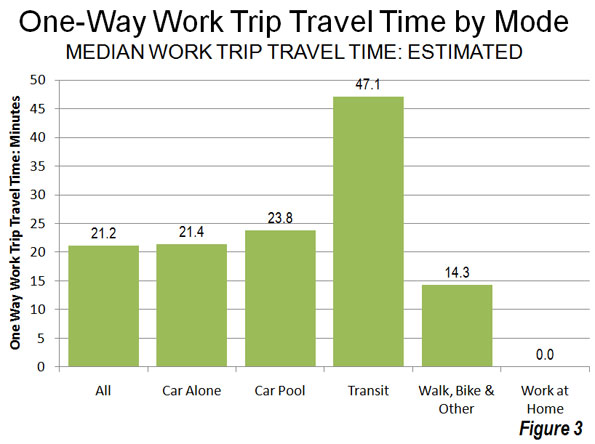
    In 2009, in fact, the median one way work trip travel time in the United States was 21 minutes (Note 3). Approximately 68 percent of non-transit commuters (principally driving alone, but also car pools, working at home, walking, bicycles, taxicabs and other modes) were able to reach work in less than 30 minutes. The overwhelming majority, 87 percent, were able to reach work in 45 minutes or less, many times transit’s seven percent. Transit’s overall median work trip travel time was more than double that of driving alone (Figure 3).

    A mode of transport incapable of accessing 96 percent of jobs within a normal commute period simply does not meet the needs of most people. This makes somewhat dubious claims that transit can materially reduce congestion or congestion costs throughout metropolitan areas. The Brookings estimates simply confirm the reality that has been evident in US Census Bureau and US Department of Transportation surveys for decades: that transit is generally not time-competitive with the automobile. It is no wonder that the vast majority of commuters in the United States (and even in Europe) travel to work by car.

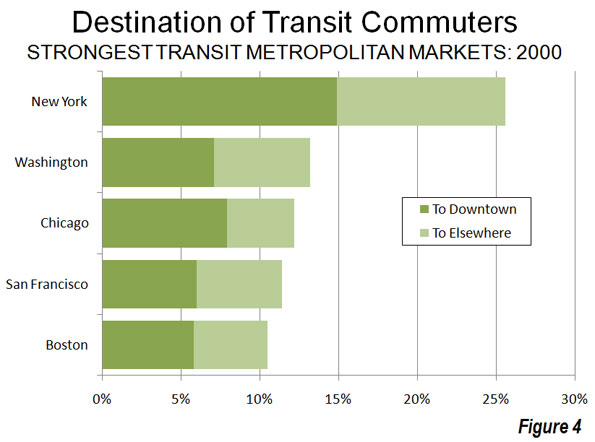
    Much of the reason for transit’s diminished effectiveness lies in the fact that downtowns — the usual destination for transit — represent a small share of overall employment. Downtown areas have only 10 percent of urban area employment, yet account for nearly 50 percent of transit commuting in the nation’s largest urban areas (Figure 4).

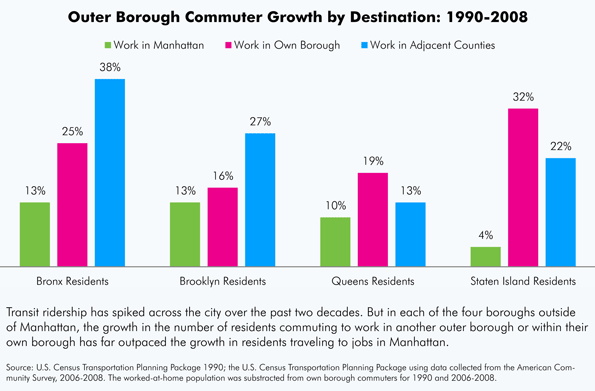
    Meanwhile, core areas, including downtown areas, represent a decreasing share of the employment market as employment dispersion has continued. Since 2001, metropolitan areas as different as Philadelphia, Portland, Dallas-Fort Worth, Salt Lake City, Denver and St. Louis, saw suburban areas gain employment share. Even in the city of New York, outer borough residents are commuting more to places other than the Manhattan central business district (link to chart).

    Transit: The Long Road Home: Transit problem stems largely from its relative inconvenience.    In 2009, 35 percent of transit commuters had work trips of more than 60 minutes. Only six percent of drivers had one way commutes of more than 60 minutes. For all of the media obsession about long commutes, more than twice as many drivers got to work in less than 10 minutes than the number who took more than an hour. In the case of transit, more than 25 times as many commuters took more than 60 minutes to get to work as those who took less than 10 minutes.

    Economists Peter Gordon and Harry W. Richardson have shown that the continuing dispersion of jobs (along with residences) has kept traffic congestion under control in the United States. Available data indicates that work trips in the United States generally take less time than in similar sized urban areas in Europe, Japan, Canada and Australia.

    Transit Access is Better for Low Income Citizens: The Brookings report also indicated that job accessibility was better for low income citizens than for the populace in general. Approximately 36 percent of jobs were accessible to low-income residents in 90 minutes, compared to the overall average of 30 minutes. This, of course, is because low income citizens are more concentrated in the central areas of metropolitan areas where transit service is better. But even this may be changing. For example, Portland’s aggressive gentrification and transit-oriented development programs are leading to lower income citizens, especially African-Americans, being forced out of better served areas in the core to more dispersed areas where there is less transit. Nikole Hannah Jones of The Oregonian noted:

    "And those who left didn’t move to nicer areas. Pushed out by gentrification, most settled on the city’s eastern edges, according to the census data, where the sidewalks, grocery stores and parks grow sparse, and access to public transit is limited." 

    Realistic Expectations: More money cannot significantly increase transit access to jobs. Since 1980, transit spending (inflation adjusted) has risen five times as fast as transit ridership. A modest goal of doubling 30 minute job access to between 6 and 8 percent would require much more than double the $50 billion being spent on transit today.

    Moreover, there is no point to pretending that traffic will get so bad that people will abandon their cars for transit (they haven’t anywhere) or that high gas prices will force people to switch to transit. No one switches to transit for trips to places transit doesn’t go or where it takes too long.

    Nonetheless, transit performs an important niche role for commuters to some of the nation’s largest downtown areas, such in New York, Chicago, Boston, San Francisco, and Philadelphia. Approximately half or more of commuters to these downtowns travel there by transit and they account for nearly 40 percent of all transit commuters in the 50 largest urban areas.   

    Yet for 90 percent of employment outside downtown areas, transit is generally not the answer, and it cannot be made to be for any conceivable amount of money. If it were otherwise, comprehensive visions would already have been advanced to make transit competitive with cars across most of, not just a small part of metropolitan areas.  

    All of this is particularly important in light of the connection between economic growth and minimizing the time required to travel  to jobs throughout the metropolitan area.

    The new transit job access is important information for a Congress, elected officials, and a political system seeking ways out of an unprecedented fiscal crisis.

    A four percent solution may solve 4 percent of the problem, but is incapable of solving the much larger 96 percent.

    Notes:

    1. For example at difference between transit commuters reaching work in less than 30 minutes and 45 minutes, Brookings employment access estimate of 7 percent at 45 minutes would become 3 percent at 30 minutes.

    2. The Brookings travel time assumptions appear to be generally consistent with data from the Census Bureau’s American Community Survey (ACS) and the US Department of Transportation’s National Household Transportation Survey (NHTS). Brookings, ACS includes the time spent walking to transit in work trip travel times (For example, the ACS questionnaire asks respondents how long it takes to get from home to work and thus includes the time necessary to walk to transit).

    3. Median travel times are estimated from American Community Survey data for 2009 and includes working at home. The "median" is the point at which one half of commuters take more time and one-half of commuters take less time to reach work and is different from the more frequently cited "average" travel time, which was 25.5 minutes in 2008.

    4. Is Transit Better in Smaller Metropolitan Areas? It is generally assumed that transit service is better in larger metropolitan areas than in smaller metropolitan areas. Yet, the Brookings data seems to indicate the opposite. Larger metropolitan areas tended to have less job access by transit than smaller metropolitan areas. In the largest 20 percent (quintile) of metropolitan areas, only 5.5 percent of employment was accessible within 45 minutes. This was the smallest quintile accessibility score, and well below the middle quintile at 9.2 percent and the bottom quintile at 8.3 percent. The top quintile included metropolitan areas with 2.6 million or more people, the middle quintile included metropolitan areas with 825,000 to 1,275,000 population and the bottom quintile included metropolitan areas between 500,000 and 640,000 (Figure 1). This stronger showing by smaller metropolitan areas probably occurs because it is far less expensive for transit to serve a smaller area. Further, smaller metropolitan areas can have more concentration in core employment.  Even so, smaller metropolitan areas tend to have considerably smaller transit market shares than larger metropolitan areas.

    Wendell Cox is a Visiting Professor, Conservatoire National des Arts et Metiers, Paris and the author of “War on the Dream: How Anti-Sprawl Policy Threatens the Quality of Life

    Photo: Suburban employment: St. Louis (by author)

  • Diagnosing New Inflation Symptoms

    It’s been more than three years since the Great Recession began, and it’s no longer debatable that the federal spending in its wake did not provoke inflation. Years of forecasts by fiscal conservatives about the result of government expenditures have proved to be wrong. After three fiscal stimulus packages, core inflation — which excludes the volatile prices of oil and commodities— remains very much in check. The core rate is the most reliable guide to future inflation, and it has not trended upward.

    Headline inflation, however, the rate that does include these two, has increased. Is the recent uptick in gas and food prices a game-changer on inflation? Does it mean that predictions of an inflation tsunami were well-founded? And what’s the best course to follow now?

    Many commodity prices have made double and triple digit gains over the past year. The changes are more than a blip — cotton futures, for example, have risen 162 percent— even if the cost of oil continues to decline. These prices are notoriously subject to rapid change for reasons that don’t reflect the structure of the U.S. economy. Factors can include Middle East politics, weather, activity in the developing world, and, most significantly today, speculative profiteering.

    Gold and other commodities have become a hot destination for players — money managers — as these markets have become the rare opportunity for high returns. In the absence of federal regulation and supervision, the low interest rates that are so crucial to business growth and to the vast majority of Americans have been allowed to feed into the permissive speculative superstructure.

    The run-up has clearly impacted the poor and the hungry in the undeveloped world. In academic and policy circles, there’s a high level confidence that commodities account for only a small share of GDP in wealthy countries, and so aren’t of concern as long as core inflation is under control. At the Levy Institute, in contrast, our research shows that even in the developed world expensive food, energy, and materials can crowd out other household purchases. Consumer budgets can be hurt even before serious headline inflation appears.

    If commodity prices were to continue to climb broadly and sharply, the Federal Reserve could face the prospect of a serious episode of cost-push inflation, similar to what we saw in the 1970s and ’80s. Fed Chairman Ben Bernanke might find himself occupying the chair of Paul Volcker in more ways than one.

    This kind of inflation is caused neither by the effects of low interest rates on the broader economy, nor by government spending. And, as with any symptom of ill health, the cause dictates the appropriate treatment. So if Bernanke’s response was to raise interest rates dramatically in the hope of abating inflation to some arbitrarily low target, it would be a risky mistake. An interest rate rise would be a serious danger to growth and job creation. Business and labor are far too fragile to deal with a double whammy from rising gas and food prices coupled with monetary policy tightening.

    A better response would be ‘watchful waiting’, a phrase seen in the December 1996 minutes of the FOMC (Federal Open Market Committee) meeting. A commodity price inflation could remain at least somewhat isolated.

    Higher commodity prices will be used as an excuse to charge that the Fed’s supposedly lax policy has unleashed an inflationary flood of cash throughout the economy. But the Fed’s so-called ‘easy money’ is parked at the Fed itself, as bank reserves, since banks are not lending. This can’t cause inflation either. Logic hasn’t stopped newly re-branded Republican presidential candidate Newt Gingrich, who recently admonished that “The Bernanke policy of printing money is setting the stage for mass inflation.”

    Those who purchase securities for long-term investment evidently disagree. Bond traders aren’t anticipating an inflationary surge. Just look at the yield spread between inflation-indexed and non-indexed Treasury securities of the same maturity. It has remained almost constant over the past year. In other words, buyers who want their returns insulated from inflation are paying only slightly more for protection than they were last year. That flatness — the unwillingness to pay a premium for inflation insurance — indicates that long-term bond buyers haven’t revised their inflation forecasts.

    Also unlikely to revise their predictions: inflation doom-drummers, even as energy prices level, and wages, another inflation indicator, are by no means jumping. Like eons of ‘the-end-is-nigh’ prognosticators, they don’t exactly have a great track record. Back in spring 2008, a frenzied Glenn Beck urged Fox viewers to “Buy that coat and shoes for next year now.” Some of his Washington cohorts are coy about inflation’s estimated time of arrival. Republican House Majority Leader Eric Cantor, for example, tells us that “fears” of “future” inflation are “hanging over the marketplace.” Others, like former Pennsylvania Senator Rick Santorum, say its already arrived (Obama brought it). The accusations continue despite a lengthy stretch of the lowest inflation rates in modern U.S. history, even with the current commodities rise.

    Paul Ryan (R-WI) has been hailed as both a truth sayer and a soothsayer on the economy. He recommends that the Federal Reserve raise interest rates now to head off inflation “before the cow is out of the barn”, ignoring the pain this would cause families and businesses. Here’s my recommendation: Don’t trust predictions about the future from those who’ve misread the present, and been very wrong in the past.

    Dimitri Papadimitriou is President of the Levy Economics Institute of Bard College, and Executive Vice President and Jerome Levy Professor of Economics at Bard College.

    Photo by Deb Collins (debs-eye): Beurs van Berlage, built by Hendrik Berlage between 1896 and 1903 as the commodities exchange in Amsterdam.

  • The Recipe for Unlivable Cities in New Zealand

    The Auckland Council’s great vision is to make Auckland one of the world’s most livable cities. Yet the outcome of its currently proposed plans will be a city which is second best for most Aucklanders.

    Some 60% to 80% of residents of New World cities state a clear preference for a single family home with its own backyard. In Victoria state, where Melbourne is located, 70% of the population, for example, preferred a single family home according to one government study. There have been similar findings from US based groups like the National Association of Realtors.

    Yet even when this is acknowledged, many in the media, taking their clue from planners and urban theorists, seek to change this reality.  The May 9 issue of the NZ Herald carried a story titled “The Dying Backyard Dream” tells us “Many Auckland suburbs will become home to high-rise apartment blocks with the quarter acre dream (1,000 sq m) reserved for the privileged few.”

    This fairly represents the intended outcomes of Council’s Spatial Plan as outlined in the discussion paper “Auckland Unleashed”.  But if this new vision is realized how can Auckland be a “liveable city” for all those residents who are unable to realize their preference for a low-density suburban home? Instead, they must “learn to accept” life in “terrace houses, duplexes, courtyard houses, maisonettes, and 4 -5 storey apartment buildings”.

    When working-class and middle-class households find they are priced out of the market for the housing of their choice, they will simply move to some other location, here or overseas. This has long been the case with British migrants to places like New Zealand and now people from China and the diaspora countries, currently the largest source of new immigrants.

    Yet these households provide the core labour force for the productive sectors, and for the manufacturing sector in particular. For some reason engineers and scientists tend to place more emphasis on home life and work life balance than financiers, and other members of the “creative classes”. (i.e. those who are creative with other people’s money). Hence, in the Bay Area, engineers and scientists gravitated to suburban Silicon Valley while the “creative classes” gravitated to downtown San Francisco.

    The New Geography team have documented the recent changes in the diverse states of the U.S. using the data from the 2010 U.S. Census. Their findings deserve careful study if we want to provide livable cities for the mass of New Zealanders, rather than for a wealthy elite.  In the U.S., according to the most recent Census, middle class people and companies have moved to Texas and the Southeast, because these areas are business-friendly, have low housing costs, reasonable taxation, and regulatory environments that encourage industrial expansion.

    This suggests it may be time to propose urban visions that are more humane for the vast majority by rejecting intensification and concentration in favor of the more adaptable and resilient environment of more dispersed cities and suburbs.  A key advantage of smaller dispersed cities such as Raleigh, Austin, San Antonio and Indianapolis, is their more affordable housing means up to four out of five households can afford their preference for a suburban house with a backyard.

    The densifiers insist that dispersal increases commuting times and yet the average commute in low-density urban areas like Salt Lake City and Kansas City is slightly above twenty minutes. (Aucklanders should be so lucky).  If the aim is economic growth and job creation, the transport system must provide genuine mobility throughout the entire labour market of the metropolitan area, not just to the central business district.

    Auckland’s Spatial Planners should take note of this recent research, and Christchurch leaders should seize the opportunity to be the Number One City in New Zealand if they don’t.
    A major source of evidence in support of Unleashing Auckland is the ARC’s “Future Housing Demand Study” which assumes that Auckland’s density must increase to develop a healthy and growing urban economy. Unfortunately these assumptions are not supported by any evidence from the rest of the New World. In fact, forced densification is as often as not a   recipe for failure.

    The Auckland urban area is already the second densest in the New World and the street network was never designed to cope with such high densities. Rather than reducing congestion, doubling the density on a given street increases the vehicle trips on that street by at least 70 – 90%. How can such densification reduce congestion?

    These surveys of housing preference also tell us that the growing number of smaller households will not NEED three bedrooms, and hence will not prefer them. Such inferences ignore the growth in the spatial demands of home occupations, home arts and crafts, telecommuting, and the need for spare rooms to accommodate visiting friends and relatives – not to mention a lifetime’s accumulation of stuff. Even single people will buy a three bedroom house to guarantee long term salability and value. The rooms soon fill it up.

    Aging couples are presumed to want to be rid of their backyard “burden”. Yet we are a nation of gardeners, and retirees are some of the keenest gardeners of all. It’s a healthy hobby.

    The Wellington Regional Strategy Report also assumes the need for intensification, and also presumes “need” determines “preference” as in:

    The eventual decrease in two-parent families will have implications in terms of reducing demand for larger dwellings on larger sections, resulting in a surplus of this stock.

    So larger dwellings must be getting cheaper. Sorry, they are not.

    The report also presumes that ordinary folk just don’t know what they are doing when they make their choices. Researchers find that people actually make their trade-offs very well – especially the trade-off between travel times and distances, and price and amenity.

    Evidently, the early development of Silicon Valley was a dreadful error because“ … having centrally located and compact form of residential development provide greater benefits to the city than lower density forms.” But what would those scientists and engineers know? They built the world’s premier technology region in the suburbs, just as had been done a half century earlier in Los Angeles or in scores of other tech belts scattered from Austin, TX to the outer rings of London, Paris and Tokyo.

    The report also claims a “large proportion of retirees are currently moving to Kapiti Coast, which indicates there is an insufficient housing supply in other locations to meet their needs.” Maybe these retirees have actually chosen to live on the Kapiti Coast, an area of smaller, low density development sixty kilometers from Wellington, because they prefer it. Many people would share their choice. Similarly, who speaks for the children who lose the freedom to enjoy spontaneous outdoor play, and to benefit from a free-ranging life?

    There is nothing wrong with medium and high-density living for those who make a free choice within a functioning and affordable market. Councils should be maximizing our freedom to choose by focusing on general affordability. They must start by reducing the cost of land by freeing up supply.

    Owen McShane is Director of the Centre for Resource Management Studies, New Zealand.

    Photo by Pat Scullion

  • Asia’s New Landless Peasants?

    Landless people have long sparked instability in Asia. From the days of the Qin dynasty (3rd century B.C.), through the huge Taiping rebellion in the mid-19th century, to the successful Communist revolutions in China and Vietnam and a nearly successful insurrection in Malaysia during the mid-20th, the property-less have historically risen against those in power.

    Today as East Asia grows more affluent, landlessness is again on the rise. Although peasants in many places remain both poor and restive, the real threat is in the region’s dynamic cities, where rapid increase in housing prices threatens to push hundreds of millions outside the property-buying market.

    This boost in prices is due to the rapid economic and population growth in many Asian cities. Across China the price of housing per square meter more than doubled over the past decade, according to the National Statistical Bureau. Prices-compared-to-incomes in the diaspora hot beds of Singapore and Hong Kong are now, according to research from the consultancy group Demographia, the highest in the advanced world — at least 50% higher than New York, San Francisco, Toronto, Sydney or London.

    There are some good market-based reasons for these high prices. Most major Asian cities are thriving economically and growing far more rapidly than their Western counterparts. Over the past decade, the population of Shanghai, China’s largest city, rose 35%, or by nearly 6 million, which is more than the population of any Western European city besides London, Paris and Essen-Dusseldorf. Beijing’s population rose by 6 million in the past 10 years to nearly 20 million. And Singapore’s far more affluent population jumped 20%, a rate exceeded in the advanced world only by Atlanta, Ga., among urban areas of more than 4 million.

    The recent spike in prices, particularly in the more affluent cities, also stems from high liquidity, low interest rates and rising inflation, notes Cheong Koon Hean, CEO of Singapore’s Housing and Development Board. To these factors she adds what she calls “a herd mentality” as people rush to invest in property as a hedge against inflation.

    The traditional Chinese obsession with property ownership exacerbates these factors. As  Nanjing-based blogger and social critic Lisa Gu writes, “Owning a property is the greatest life-goal for most Chinese citizens.”

    In mainland China the rush to own is bolstered by the lack of a strong social safety net or popular trust in other investment vehicles, such as stock and bonds. ”China lacks good investment channels besides housing,” says Han Hui, senior partner in prominent Beijing real estate law firm. “People put money into real estate because they still don’t trust anything else.”

    The appeal of home-ownership in China is particularly marked since it’s more of a land-use right, which in the case of residential property, expires after 70 years (40 years for commercial property). The lease begins to run out on the date that the real estate developer signs for the land, and not on the homeowner’s date of purchase.

    Whatever its cause, this Asian form of irrational exuberance is clearly boosting inequality across the region’s cities.

    This is becoming a key issue, particularly for the younger generation.  ”House price” ranked third on the list of the top 10 most popular phrases used by Chinese netizens, says Lisa Gu. Many young Chinese, she notes, are giving up on the ideal of owning a house before marriage and starting their lives together as renters. This is widely called “getting married naked.”

    For young professionals this now might just prove a temporary annoyance, but it could evolve into something more bothersome as they age. Some might opt to avoid very expensive cities, such as Beijing or Shanghai, for up-and-coming smaller urban centers such as Chengdu, the provincial capital of agriculturally fecund Sichuan province. This city has a growing tech center but offers housing prices as much as one third those in China’s existing megacities. Although salaries are also lower, overall affordability remains much higher than in the established urban regions.

    For the many millions of poorer Chinese, including the many migrants from the countryside, the housing crunch presents a more serious issue. Most have moved to the big cities, particularly in eastern China, for better opportunities and quality of life. Virtually all the net growth in Beijing and Shanghai, according to the most recent Chinese census, came not from registered residents but among migrants — those lacking hokou status. They constitute now over one third of the population in these megacities.

    Such migrants include people of various incomes, but also a large impoverished population.  Some live in sub-standard conditions not often associated with the gleaming epicenters of Asian capitalism. Like residents of the slums of third-world cities, many are landless peasants, a group now estimated at 70 million or 80 million.

    This problem of landless peasants is likely to grow as more land is set aside for urban and industrial development. Many will face difficulty finding a decent place to live even as more affluent Chinese snatch up multiple apartments for speculative investment. This has accelerated a worsening gap between rich and poor that is of major concern to the country’s Communist rulers.

    Of course, no one suggests anything like a new peasant rebellion is in the offing. It is critical to recognize that, for all its imperfections, China’s astounding rise has lifted hundreds of millions of people out of the grip of unceasing poverty.

    But unaddressed, the property crisis could well slow east Asian capitalism’s rapid ascent. High housing prices may already be contributing to depressed birthrates — even in places where the “one child” policy does not apply, such as Singapore, Taiwan and South Korea.

    Such long-term problems are overshadowed by more immediate concerns. Fallout about cascading house prices led the Chinese central government earlier this year imposed new restrictions aimed at slowing rampant speculation — such as requiring 60% payments for second homes and restricting the purchases of additional homes.

    The interior city of Chongqing has taken even more drastic steps. The hardline government there has embraced a distinctly uncapitalist response to the housing crisis: a massive program to increase the supply of rental as well as state-owned apartments that would be available to poorer residents, including those from the countryside. This contrasts with programs in Singapore, where 80% of the population live in the public housing, but some 95% own flats purchased from current owners or the Housing Development Board.

    In China, the failure of the housing market to find places for the poor and working class could provide a rationale for expanding the state’s role in managing the economy. It certainly provides fuel for Chongqing’s active affirmation of what is seen as a revival of “red culture.”

    Beyond such ideological implications, the housing crisis could threaten both the long-term social stability and economic growth of East Asia. Unless addressed, growing dissatisfaction among a large bloc of property-less citizens has the potential to become a politically destabilizing force and a brake against market-friendly liberalization. As East Asia remains the primary driver of the world’s economic engine, this could prove bad news not only for upwardly mobile Chinese but everyone else as well.

    This piece originally appeared at Forbes.com.

    Joel Kotkin is executive editor of NewGeography.com and is a distinguished presidential fellow in urban futures at Chapman University, and an adjunct fellow of the Legatum Institute in London. He is author of The City: A Global History. His newest book is The Next Hundred Million: America in 2050, released in February, 2010.

    Photo by Colin Manuel