Blog

  • United States: Less Congestion than Europe per INRIX

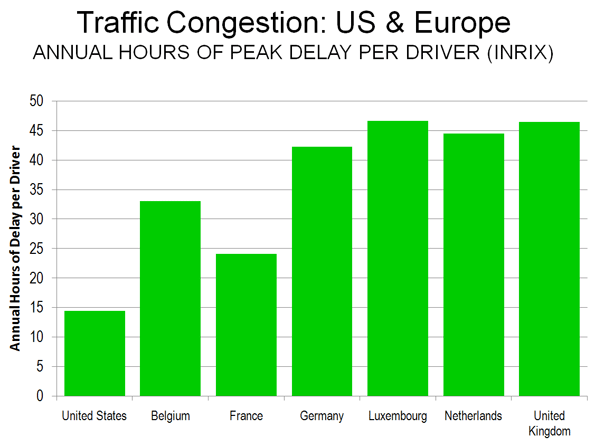
    A new international report indicates that traffic congestion in the United States is far better than in Europe. The report was released by INRIX, an international provider of traffic information in 208 metropolitan areas in the United States and six European nations.

    The report shows that the added annual peak hour congestion delay in the United States is roughly one-third that of Europe. The rate of France was somewhat less than twice the rate of the US and rates in Luxembourg, the United Kingdom, Germany and the Netherlands were three times as high.

    In the United States, peak period traffic congestion adds 14.4 hours annually per driver. This compares to an average delay per year of 39.5 hours for the European nations. Luxembourg, the United Kingdom, the Netherlands and Germany had the greatest lost time, at from 42 to 47 hours. Again, France scored the best in Europe, at 24.1 hours of lost time in traffic per year (Figure).

    Among individual metropolitan areas. Los Angeles had the greatest peak hour delay, at 74.9 hours annually. Utrecht (Netherlands), Manchester (United Kingdom), Paris, Arhem (Netherlands) and Trier (Germany) second through sixth in the intensity of traffic congestion, all with 65 or more hours of delay per driver per year.

    These findings are consistent with international data indicating that traffic congestion tends to be more intense where there are higher urban population densities.

  • California: Club Med Meets Third World?

    On March 25th, the Bureau of Labor statistics released a report that showed that California jobs had increased by 96,000 in February.  The state’s cheerleaders jumped into action. Never mind that the state still has a 12.2 percent unemployment rate, and part of the decline from 12.4 percent is because just under 32,000 discouraged workers left California’s labor force in February. 

    Unfortunately, the cheerleaders are likely to once again be disappointed.  It is unwise to build a case on one data point.  Data are volatile and subject to all sorts of technical issues.  For example, the estimate of California’s job growth is seasonally adjusted data and subject to revision.

    More importantly, even if California did see 96,000 new jobs in February, that pace is unlikely to be maintained.  California’s economy is just too burdened by the State’s DURT: Delay, Uncertainty, Regulation, and Taxes.  Instead of enjoying the truly vibrant recovery one would expect given its climate, location, natural resources, university network, workforce, and natural and manmade amenities, California’s economy will grow far below its potential, burdened by its DURT. 

    People often ask me to identify the most important impediment to California’s economic growth, but there isn’t just one.  Every business is different.  One may be most impacted by regulation, another by taxes.  Instead, it is the total cost of the DURT.

    Taxes are certainly one component of DURT.  The Tax Foundation ranked California 49th in business taxes and Kiplinger ranks California worst in retiree’s taxes, which serves as a good proxy for individual tax burdens.  No doubt, California’s taxes are high, but that alone wouldn’t be too big a problem.  People happily pay to live in California.  Higher taxes and home costs are just the beginning.

    California is in its own class when it comes to regulation; nothing is unimaginable in a state where bulk of the executive leadership comes from the San Francisco-Oakland area.  Today, there are two regulations that are particularly hurting California’s economy, AB32 and SB375.  AB32 is California’s attempt to unilaterally solve the planet’s global warming problem.  It will have serious implications, all of them detrimental to economic activity.  SB375 attempts to advance its global warming  goals through regional planning mandates.  Here’s a sympathetic analysis of SB375 from a smart guy.

    Those are just the most onerous regulations.  California has thousands of regulations and more come daily.  California had 725 new laws come into effect on January 1, 2011, and the state has over 500 constitutional amendments, averaging over four new constitutional amendments a year.

    Which brings us to uncertainty.

    Uncertainty about the future regulatory environment is detrimental to economic activity.  It is extraordinarily difficult to plan when the regulatory environment is in such a state of flux, and nothing is unimaginable.

    Regulatory uncertainty is far from California’s only source of uncertainty.  California’s local governments are notoriously fickle, particularly in the generally affluent coastal areas.  I know of one project that spent four years in planning, only to be denied by the City Council, even though the project was supported by the planning department.  That’s just expensive.  Developers spend hundreds of thousands of dollars on architects, engineers, and planning consultants while jumping through the hoops set up by the planning department, neighborhood groups, environmentalists, and other special interest groups.

    This type of story is all too common in Coastal California.  Some California communities, such as Santa Monica, require that prior to building a new house, you must use two by fours, string, and flags to provide the outline of the proposed structure for up to 90 days.  This is to facilitate neighbor complaints before the project is built.

    The previous story also relates to delay.  Delay in California is legendary, a result of regulatory hurdles, demand for studies, and legal action.  California newspapers often describe projects as controversial, but this is redundant.  Every project is controversial in California. 

    Want to rebuild an aging bridge?  Someone will sue you and claim the old bridge is a historical landmark.  Want to put in a solar farm?  Someone will sue you because the land is home to endangered rats, turtles, salamanders, toads, fairy shrimp, or something.  Endangered species are everywhere in California.  Want to put a condominium project in a depressed part of town?  Someone will sue you because it doesn’t match the neighborhood.  Want to build a house?  Someone will sue you because it will block their view.

    All these things and more happen in California.  It’s no surprise that businesses find California a very challenging place to be profitable.  California’s markets are huge.  No doubt about it.  So, some business will operate in the state.  California’s location on the Pacific Rim and it ports also compel some business to be in California, even if costs are high.  California is a fantastic place to live.  So, people who can afford to will live here.  Some business owners will locate businesses where the owner wants to live.  But, most businesses are too competitive to give up profits to live in California.  Many keep their headquarter s here while shipping their new jobs to other states, or abroad.

    Even so, California is unlikely to become Detroit.  It, sadly, is also unlikely to achieve its potential or regain its previous economic vigor.  The cost of California DURT is just too high.  Instead, the place will become increasingly divided.  Coastal regions, for the foreseeable future, will become even more affluent, heavily white and increasingly Asian.  Hosts of unseen, less fortunate people support them, often commuting from more hardscrabble interior locations.

    Considerable poverty will coexist uncomfortably in California’s coastal paradise.  Working class families already crowd into housing units designed for one family, and this will likely only get worse. 

    What Coastal California won’t have is much of a middle class.  Lack of opportunity and high housing costs makes the most pleasant parts of California an unattractive place for people who define quality of life by opportunity and affordable housing, young families.  Domestic migration is likely to continue to be negative.

    For its part, inland California is already depressed, 27 counties have unemployment rates over 15 percent.  Eight have unemployment rates above 20 percent.  Even during the boom, many of California’s inland areas had extraordinarily high unemployment rates.  Central California’s poverty and blight will only get worse.

    All this is courtesy of expensive California DURT.  Because of it, California’s economy will lag.  More importantly, California seems to be morphing into almost a Hollywood caricature.  The self-absorbed hedonistic wealthy live side by side with the poor, like  a combination of a Club Med and Leisure Village in a third-world country.

    Bill Watkins is a professor at California Lutheran University and runs the Center for Economic Research and Forecasting, which can be found at clucerf.org.

    Photo by chavez25

  • Bicycle Commuting: A US System and A World-Wide Guide

    To my pleasure, there is now a United States Bicycle Route System that goes more places than Amtrak and Greyhound do. Have a look at the proposed map of the national corridor plan.

    The goal is to create clearly marked north-south and east-west routes, as romantic as the Oregon Trail or as functional as the Erie Canal. The trail of Lewis and Clark is on one of the routes.

    I can only hope that the plan serves as an inspiration to would-be cyclists and every-day bike commuters. To be fair, it takes years to master the dark and often wet arts of cycling. My riding-to-work garb includes reflective gear from London, Alaskan socks, a headlight from San Diego, a lock from Amsterdam, and a rain jacket from Ohio. On my first commute, after a year of wondering of “whether I could do it,” I searched so hard to find a safe route that I got lost.

    Serious bike commuting requires owning two or three bikes, as one or two will always have flats or breakdowns, and, you need a rain bike. Plus, strategic wardrobe planning can take hours. But bike commuters get to have the satisfaction of passing cars stuck in traffic, and tired legs at the end of day leave you feeling more virtuous than Mother Teresa (if you want more inspiration, there’s a cycling jersey with her picture).

    Just to be clear: No one behind the car wheel likes a cyclist, because bicyclists run red lights, hop up on curbs, pound on hoods, drop F-bombs, and give drivers the middle finger salute. Politically, cyclists fall on the spectrum somewhere between Greens and Anarchists. In some 300 cities — it’s a global movement— to protest local (car-inspired) injustices, they have formed into Critical Masses that parade around like errant storm troopers.

    I am surprised that no one has articulated a bicycle foreign policy — in German it would be Fahrradweltanschauung — given that there are more bikes in the world than cars and they are used more often. Fifty million bikes are manufactured annually worldwide, versus twenty million cars. China’s market share is 400 million. But many American states and counties fight having a bicycle coordinator on their payroll.

    Here’s a highly personal comparison of where some cities and regions currently stand in relation to a world of bicycles:

    Geneva: My hometown, so I know the roads well. The city is trying to expand its bike lanes and trams. Whenever road construction is completed, a new bike lane emerges from the rubble. Biking works in Geneva, despite the hills, wind and rain, but many bike lanes are stopped by dead ends or traffic. I am forever lifting my bike over curbs, cobblestones, or rails, and searching for a better way around the medieval town.

    New York: I can thank former New York mayor Ed Koch for converting me into a bicycle romantic. In spring 1980, he decided to accept a strike from New York’s Transport Workers Union that, for eleven days, mothballed the city’s buses and subway. (Koch referred to the strikers as “wackos.”) The only way to get around New York was to walk or ride a bike. I dusted off my childhood Raleigh Grand Prix and rode off to work, never looking back on a life that did not involve bicycles.

    Although I no longer live in New York, I still like riding there. The West Side, Central Park, and the Brooklyn Bridge are bike friendly. If you want to understand why George Washington lost the battle of Harlem Heights (as I do), a bike is the only way to get there. But, as much as biking has improved in and around New York in the last thirty years, it remains a “car” city. Cyclists are an afterthought, and poorly represented by messengers flying down Seventh Avenue, no hands on their bars, talking on their cell phones, flipping off confused pedestrians.

    The administration of Mayor Michael Bloomberg has proposed a master plan of 900 miles of bike lanes around New York, up from 400 miles, bringing out pools of angry car drivers who hate sharing the road with cyclists and haunted pedestrians. A New York Magazine cover story called it “Bikelash.” But 100,000 riders mount a bike every day in Manhattan.

    Hanoi: In 1993, before the Politburo began importing waves of noisy scooters and small motorcycles, to bike around the old French quarter and West Lake (past General Giap’s house and Ho’s mausoleum) was a delight. Everyone rolled at slow speeds, and no one stopped at the intersections; the bike traffic just melded together, like DNA. In the Vietnam War, bikes beat B-52s.

    Berlin: It’s expansive, like Los Angeles, but flat as a dish and with many bike lanes, all of which go to places of historical interest: the Reichstag, the Holocaust Memorial, the remnants of the Berlin Wall, or Checkpoint Charlie. Each time I am there, I rent a bike, and it takes me everywhere. The only downside to Berlin biking is the weather, which has a lot of cold rain. Bikes make Berlin.

    Amsterdam: I find the biking to be hair-raising. The Dutch power through intersections or along bike paths as though they were in a bonus sprint on the cobblestones of Paris-Roubaix (the famous bike race). Yes, the lanes go everywhere, and bikes in Holland — at least those not stolen and thrown into the canals — are sacred objects. But think about wearing some body armor.

    Beijing: My favorite bicycle city. To be in the saddle enables you to go almost anywhere. Bike lanes are wider than many Western boulevards, and you can bike around Tiananman Square, to the Forbidden City, down to South Station, and out toward the Marco Polo Bridge (where World War II began in China). The way to see the hutong — ancient alleys — is on a bike. Beijing treats its citizens with more respect when they are cycling than it shows them at other times.

    London: Cyclists wear reflective vests, stretch rubber bands on their pants legs, and blow strange whistles at anything in their way. Coming out of the mist, they look prehistoric and think nothing of biking in rain, sleet or snow, doing battle with buses, cars, and pedestrians, or riding bikes that look like they survived the Blitz. The London mayor has introduced a fleet of shared bikes that can be used around town, based on annual membership. Because traffic is on the “wrong side,” I find biking in London scary, but it delivers the goods.

    Suburbia, USA: I have spent more time that I would have wished biking around suburbs, exurbs, malls, highways, and developments. It’s the least satisfying bicycle experience. I grew up in the suburbs, with baseball cards in my spokes. Suburban drivers hate cyclists. Integrating bicycles into suburban life, with its SUV panzer divisions, will be a national challenge.

    Toronto: Canada’s guerrilla team, the Urban Repair Squad, goes out at night to paint bike lanes onto city streets. (“They say the city is broke. We fix it. No charge.”) So effective is their painting that the city of Toronto maintained the counterfeit lanes for two years, thinking they were official.

    Southampton, New York: Southampton prohibits riding a bike through town. It’s fine to thunder through the Potemkin village of million dollar boutiques in a gas-guzzling, tinted-windowed pimp mobile, but God forbid that anyone should roll through on their own power. It gets my vote as the worse bicycle town in America.

    ***

    Like all bikevangelists, I dream of highways given over to cyclists, and see cycling as the way wean the U.S. from Middle Eastern oil and solve every problem from global warming to obese children. Consider this: Compared to the costs of high-speed rail and highway construction, the U.S. Bicycle Route System requires only maps, sign posts, imagination… and strong legs.

    Photo by the author: “My bike in Beijing. One gear. Heavy as bricks, but very smooth”.

    Matthew Stevenson is the author of Remembering the Twentieth Century Limited, a collection of historical essays. He is also editor of Rules of the Game: The Best Sports Writing from Harper’s Magazine. He lives and rides in Switzerland.

  • Bus Versus Train: A Dying Debate

    The Los Angeles Metropolitan Transportation Authority’s cutbacks on its bus line, eliminating about 12% bus service, illuminate the problems of mass transit in LA, specifically the relative inefficiency of trains in the city. This 12% is a further reduction after the 4% cutbacks six months ago, sparking anger from the Bus Riders Union. Metro Chief Executive Art Leahy says that his decision to decrease spending is a result of the low ridership, yet city trains, which are also underperforming, remain relatively untouched.

    Leahy argues that buses are easier to eliminate, re-route, and reschedule than rail lines are. However, he also says that the cutting back on lesser-used bus lines will free up the resources to enhance the ones in higher demand. Many bus riders feel that they are getting a raw deal seeing as bus lines, which transport 80% of the MTA’s passengers, only get 35% of the operating budget to begin with. This being true, how much is the other 65% really helping the rail lines then?

    The Bus Riders Union thinks that the MTA’s preference for trains over buses is an unfair reflection of class interests. Because rich people do not take the bus, there is no incentive to keep it running. As is becoming increasingly clear, especially with the current high-speed rail discussions, rich people don’t want to ride the train anymore either. This local debate, therefore, is not an argument of whether to cutback on buses or trains; it is an argument about how to deal with the general decline in mass transit.

  • The 30th Anniversary of the C-Train in Calgary

    I’ve spent a good chunk of the last few months working on a study of Calgary’s light rail transit (C-Train) system, which was released today by the Frontier Centre for Public Policy.  I’ve had a long standing interest in LRT systems, and spent the summer of 2009 working for the Cascade Policy Institute in Oregon, where we compiled massive amounts of data on their world renowned LRT system as part of an ongoing project.  The data (including actual field research, which proponents of the system haven’t done–they rely on survey data), indicates that ridership is lower, and costs are far higher than proponents believe.

    That firsthand experience (which included riding the train every day), coupled with the empirical literature from light rail systems across North America, shattered my previous conviction that light rail transit can be an economical method of transit.  For the record, I do believe that subways can be profitable in dense urban cores (even the badly managed TTC nearly breaks even), and buses already are profitable in many cases (especially inter-urban bus services, such as Greyhound and Megabus).  Many proponents of LRT believe that it is a happy medium between subways and buses.  If that were the case, it would be profitable.  However, LRT combines the disadvantages of the two: it is slow, inflexible, and expensive.  Numerous studies, in particular an authoritative study by the non-partisan United States Government Accountability Office, have demonstrated that on average, buses are a cheaper, faster, and more flexible than LRT for providing mass transit.

    While I use many different metrics to demonstrate that the costs and benefits of LRT are wildly exaggerated, my favorite is that Calgary spends both the most on transit and the most on roads per-capita.  Given that Calgary’s entire land use and transportation framework for the past several decades has been built around the C-Train, it is hard to call it anything but a failure. The City has cracked down on parking so aggressively to encourage people to ride the train that there are only 0.07 parking spaces per employee in the central business district.  Because of this, Calgary is tied with New York for the highest parking prices on the continent.  But many of those people who would otherwise have parked downtown instead park in the free parking spots provided at C-Train stations.  Not only is free parking horribly inefficient, but this also emphasizes one of the major contradictions of the C-Train: it isn’t getting people out of their cars, and it isn’t helping to curb urban sprawl–two of its primary goals.

    Unsurprisingly, those last two findings proved controversial, though not as controversial as my assertion that the C-Train fails to help the urban poor.  A columnist for the Calgary Herald wrote an angry response to my Herald article that accompanied the story (though doesn’t seem to have read the study).  She attempts to refute my arguments about urban sprawl, and the impact of the C-Train on the poor, while dismissing the study as “a cost-benefit analysis guaranteed to resonate with other right wingers who share the mantra of lower taxes above all else, including over the reality of everyday experience.” I’m not clear on when cost-benefit analysis became a right wing concept, but I’ll let that one go.  I will, however, address her two criticisms in short order.

    The idea that urban transit could worsen sprawl seems odd.  The reason why it does so in Calgary is because the C-Train network is built on a hub and spoke model.  What this means is that transit is concentrated on going from the outskirts, into the city center.  Since LRT is so expensive, and since people need to be ‘collected’ by buses to get to LRT stations, the city has less resources to provide transit circling the core, or travelling east-west.  And if you can’t provide good transit for people who aren’t living along LRT lines, and don’t work along one of the lines, people are just going to keep moving further out (hence the highest road costs in the nation).  Here’s what Calgary Transit’s current planning manager has to say about the C-Train’s impact on sprawl:

    “In one respect, it should allow Calgary to be a more compact city, but what it’s done is it’s actually allowed Calgary to continue to develop outward because it was so easy to get to the LRT and then get other places,” says Neil McKendrick, Calgary Transit’s current planning manager.”

    While that comment is true for those who can afford to live by LRT stations (or to drive to them), it doesn’t apply to the city’s poorest.  As it happens, LRT lines raise the cost of adjacent housing (though for proximate high end housing it lowers the value–hardly a concern for the poor)–by $1045 for every 100 feet closer to a rail station.  This isn’t a terribly complicated concept.  If you spend a massive amount of money on a form of transit that is considered to luxurious, the price of housing goes up. This is exacerbated by the fact that diverting transit resources to those areas makes transit there comparatively better, making it that much more desirable comparatively for people who intend to use transit at all–even as just an occasional amenity, say for going downtown on weekends.  LRT is great for people who can afford to live by the stations, but not so much for anyone else.

    Unfortunately, for many, light rail transit has become a sacred cow.  But if Calgary is ever going to have adequate rapid transit, the City will need to explore more cost effective options.  Buses may not be trendy, but expanding BRT in Calgary would dramatically improve people’s mobility at a reasonable cost. Fortunately, the current Mayor has acknowledged that BRT will have to be part of the solution for making Calgary a transit friendly city.  He also made the wise decision of de-prioritizing the southeast LRT extension (expected to cost $1.2-$1.8 billion). If the Mayor follows up on his promise to make BRT an integral part of Calgary Transit in the short term, the City will not only have far better transit, but it will have a chance to watch the LRT and BRT operating side by side so that the people can decide for themselves whether the billion plus required to build the Southeast LRT is worthwhile.  My bet is on BRT.

    This piece originally appeared at stevelafleur.com

  • The End of the Line: Ambitious High-speed Rail Program Hits the Buffer of Fiscal Reality

    A well-intentioned but quixotic presidential vision to make high-speed rail service available to 80 percent of Americans in 25 years is being buffeted by a string of reversals. And, like its British counterpart, the London-to-Birmingham high speed rail line (HS2), it is the subject of an impassioned debate. Called by congressional leaders “an absolute disaster,” and a “poor investment,” the President’s ambitious initiative is unraveling at the hands of a deficit-conscious Congress, fiscally-strapped states, reluctant private railroad companies and a skeptical public.

    The $53 billion initiative was seeded with an $8 billion “stimulus” grant and followed by an additional $2.1 billion appropriation out of the regular federal budget. But instead of focusing the money on improving rail service where it would have made the most sense— in the densely populated, heavily traveled Northeast Corridor between Boston and Washington— the Obama Administration sprinkled the money on 54 projects in 23 states.

    Some of the awards are engineering and construction grants but many more are simply planning funds intended to plant the seeds of future passenger rail service across the country. Only two of the projects could be called truly “high-speed rail” because they would involve construction of dedicated rail lines in their own rights-of-way where trains could attain speeds of 120 mph and higher. The remaining construction money will be used to upgrade existing freight rail facilities owned by private railroad companies (the so-called Class One railroads) to allow “higher speed” passenger trains to run on track shared with freight carriers.

    Many of the proposed improvements will result in only small increases in average speed and in marginal reductions in travel time. For example, a $1.1 billion program of track improvements on Union Pacific track between Chicago and St. Louis is expected to increase average speeds only by 10 miles per hour (from 53 to 63 mph) and to cut the present four-and-a-half hour trip time by 48 minutes. A $460 million program of improvements in North Carolina will cut travel time between Raleigh, NC and Charlotte, NC by only 13 minutes according to critics in the state legislature.

    Shared-track operation has raised many questions in the minds of the intended host freight railroad companies. Railroad executives are concerned about safety and operational difficulties of running higher speed passenger trains on a common track with slower freight trains and they are determined to protect track capacity for future expansion of freight operations. Their first obligation, they assert, is to protect the interests of their customers and stockholders. This has led to protracted negotiations with state rail authorities in which the private railroads are fighting Administration demands for financial penalties in case passenger train operations fail to achieve pre-determined on-time performance standards. In some cases, negotiations have hit an impasse causing the Administration’s implementation timetable to fall behind. In other cases, freight railroad companies have reluctantly given in, not wishing to alienate the White House or fearing its retaliation.

    A serious blow to the presidential initiative was delivered by a group of three determined, fiscally conservative governors who rejected billions of dollars in grant awards because they were concerned that the proposed passenger rail services could require large public subsidies to keep the passenger trains operating. In the U.S. federal system, the governors and state legislatures have the final say concerning construction and operation of public transportation services within state boundaries. The refusal of the governors of Wisconsin, Ohio and Florida to participate in the White House HSR program thus took much wind out of the sails of the Administration initiative.

    Perhaps the most serious blow was delivered by Governor Rick Scott whose state of Florida was supposed to host one of the Administration’s showcase projects: an 86-mile true high-speed rail line, built in its own right-of-way in the median of an interstate highway between the cities of Tampa and Orlando. A score of international rail industry giants converged on Florida in the expectation of participating in a rich bonanza of contract awards and a chance to bid on a future rail extension from Orlando to Miami.

    But they came to be disappointed. A study conducted by the libertarian think tank, the Reason Foundation, convinced Governor Scott that the project could involve serious cost overruns and the risk of continuing operating subsidies. This caused the Governor to decline the federal grant, thus putting an effective end to the project. A last-minute effort by rail supporters to challenge the Governor’s decision was stopped in its tracks when the state supreme court upheld unanimously his right to veto the project.

    This left the Administration with just one true high-speed rail project: California’s proposed 520-mile high-speed rail line connecting Los Angeles with Northern California’s San Francisco Bay area and Sacramento. The origin of this venture dates back to 2008 when voters approved a $9.95 billion bond measure as a down payment on the $43 billion system. Since then the project became mired in multiple controversies. One relates to a lack of a clear financial plan, another to what critics, including the state’s official “peer review” panel, claim to have been overly optimistic forecasts of construction costs, ridership and revenues. Then came a report raising questions about the escalating price tag for the project which now is estimated at $66 billion. This is occurring in a state that is staggering beneath a $26 billion deficit.

    In the face of fierce opposition that developed in the wealthy Bay Area communities lying in the proposed path of the rail line, the sponsoring agency, the California High-Speed Rail Authority, decided to start construction in the sparsely populated and economically depressed Central Valley, where land is relatively cheap, unemployment is high and community opposition was expected to be minimal. The decision was spurred by demands from the Obama Administration that its $3.6 billion grant result in a rail segment that has “operational independence.” The first 123-mile stretch, to be built between Fresno (pop. 909,000) and Bakersfield (pop. 339,000), was quickly derided by critics as a “railroad to nowhere.” Even in the low-density Central Valley, the expected disruption caused by the project to communities, farms and irrigation systems has stirred political opposition. Its future – as indeed the fate of the entire $43-66 billion (take your pick) venture – is shrouded at this point in uncertainty.

    The same can be said of President Obama’s high-speed rail initiative as a whole. Just as the proposed £32 billion high-speed rail link between London and Birmingham has been called an “expensive white elephant” and a “vanity project,” so the White House high-speed rail initiative is being criticized as a “boondoggle” and derided as a monument to President Obama’s ambition to leave behind a lasting legacy à la President Eisenhower’s Interstate Highway System. Editorial opinion of major national newspapers has turned critical as have many influential columnists and other opinion leaders. A number of senior congressional leaders – including the third-ranking Republican in the House, Majority Whip Kevin McCarthy, and the chairman of the influential House Transportation and Infrastructure Committee, John Mica, have likewise openly criticized the initiative as wasteful and poorly executed.

    Even elected representatives from states that would potentially benefit from the government’s largesse have been skeptical about plans for high-speed rail in their states. “Blindly committing huge sums of money to this project will not make it worthwhile, and to do so at this time would be premature and fiscally irresponsible,” wrote one member of the congressional delegation from the state of New York. Members of the North Carolina legislature have introduced a bill to bar the state department of transportation from accepting $460 million in federal high-speed rail funds, pointing to the meager trip time savings resulting from the proposed rail projects and the potential need for operating subsidies.

    As this is written, Capitol Hill observers give the high-speed rail program only a small chance of obtaining additional congressional appropriations in Fiscal Year 2012 and beyond. A March 15 report in which the congressional House Committee on Transportation and Infrastructure discusses its views of the forthcoming Fiscal Year 2012 transportation budget, the Obama Administration’s proposed $53 billion high-speed rail program is not even mentioned. Turning off the spigot of federal dollars next year would effectively starve out the Administration’s rail initiative.

    The President’s proposal came at a most inopportune time, when the nation is recovering from a serious recession and desperately trying to reduce the federal budget deficit and a mountain of debt. In time, however, the recession will end, the economy will start growing again, and the deficit will hopefully come under control. At that distant moment in time, perhaps toward the end of this decade, the nation might be able to resume its tradition of “bold endeavors” — launching ambitious programs of public infrastructure renewal.

    That could be an appropriate time to revive the idea of a high-speed rail network, at least in the densely populated Northeast Corridor where road and air traffic congestion will soon be reaching levels that threaten its continued growth and productivity. For now, however, prudence, good sense and the common welfare dictate that we, as a nation, learn to live within our means.

    Ken Orski has worked professionally in the field of transportation for over 30 years.

  • The Best Cities For Minority Entrepreneurs

    As the American economy struggles to recover, its greatest advantage lies with its diverse population. The U.S.’ major European competitors — Germany, Scandinavia, France, Italy, the Netherlands and Italy — have admittedly failed at integrating racial outsiders. Its primary Asian rivals, with the exception of Singapore, are almost genetically resistant to permanent migration from those outside the dominant ethnic strain.

    In contrast, America’s destiny is tied to minorities, who already constitute a third of the nation’s population and who will account for roughly half of the population by 2050. Younger and more heavily represented in the labor force, minorities are poised to become the primary source of entrepreneurial growth.

    The clear advantage with minorities, particularly immigrant minorities, lies in their own self-selection. Risk-takers by the very act of emigration, they are more likely to start small firms than other Americans. In fact, a recent Kauffman Foundation study found that immigrants  were unique in boosting their  entrepreneurial activities since the onset of the recession.  Overall the share of immigrants among new entrepreneurs has expanded from 13.4% in 1996 to nearly 30% this year.

    Forbes asked demographer Wendell Cox (www.demographia.com), researcher Erika Ozuna and me to examine the immigrant entrepreneurial phenomena among the nation’s 52 largest metropolitan areas. The results (below) turned out to be in many ways surprising, and almost counter-intuitive.

    Usually we think of immigrant entrepreneurs as clustering in crowded city communities or high-tech  places like Silicon Valley. But based on rates of self-employment, housing affordability, income growth and migration, immigrant entrepreneurs tend to prefer sprawling, heavily suburbanized regions, many of them clustered in the South and Southwest.

    The best U.S. city for minority entrepreneurs on our list, Atlanta, has long been a haven for black entrepreneurs. But, recently, its Latino and Asian populations have exploded, with exceptionally high rates of self-employment.  In the past decade, the Atlanta region’s Asian population surged 74%, while its Latino population grew by 101%. The overall foreign-born population rose by roughly 300,000.

    Similar surges took place in almost all the top cities on list. They include Baltimore (No. 2), Nashville (No. 3), Houston, Miami, Oklahoma City, Riverside San Bernardino, Calif., the Washington D.C. metro area,  Orlando, Fla.. and Phoenix, Ariz.

    Latino shopping center developer Jose Legaspi traces much of the entrepreneurial success in these areas to this rise in population. This is particularly true in places like Miami, which has the nation’s highest rate of foreign immigration, and has long boasted of its role as “the capital of the Americas.” Less renowned are cities like Houston, which now enjoys a higher per capita rate of immigration than Boston, Seattle or Chicago. All these cities have engendered dense pockets of diverse and often dispersed ethnic populations; in some locales, ethnic groups share neighborhoods and economic space. It’s increasingly common to see stores owned by ethnic groups serving both their own tribe as well as others.

    “The entrepreneurial class will follow the immigrant population,” notes the Montebello, Calif.-based entrepreneur, who has developed retail centers in such diverse locations as Los Angeles, Las Vegas, Atlanta, Phoenix and Fort Worth, Texas. “You get small retailers following their needs as well as a growing professional class.”

    Legaspi notes that an increasingly critical factor for the growth of many of these fastest-growing minority areas is cost of living. With the exception of Baltimore and Washington — whose growth is tied to the expansion of the federal government — the cities on our list enjoy relatively low housing costs. Minorities “American dream” generally does not revolve around an  apartment in dense, expensive urban areas, Legaspi n says, but want an affordable single-family house.

    This also applies to middle- and working-class African-Americans, whose shift away from cities to suburbs has been among the most remarked upon phenomena identified by the Census. In Atlanta, for example, the ratio of median income to median house value is 4.6 for African-Americans, 3.1 for Asians and 5.2 for Hispanics. In 35th-ranked San Francisco it’s 14.3 for African Americans, 7.1 for Asians and 10.6 for Hispanics. No surprise that per-capita minority growth is far more rapid in Atlanta than in the avowedly “multi-cultural” Bay Area.

    Land use and other regulations also play a role here, not only for housing prices but for entrepreneur opportunities. Again, with exception of the Washington and Baltimore areas,  the fast-growing minority regions, and rapidly growing self-employed populations, are regions with diffuse, multi-polar and heavily suburbanized land patterns.

    The strip mall, much detested among urban aesthetes and planners often serves as “the immigrants’ friend,” says Houston architect Tim Cisneros. In places like Houston, Cisneros points out, Columbians, Nigerians, Mexicans , Indian and Vietnamese businesses usually cluster not in downtown centers or fancy high-end malls, but in makeshift auto-oriented strip  centers, where prices are low, parking ample and the location within easy driving distance of various ethnic populations. You want a good Indian meal in Houston, you don’t need to head downtown, but to the outer suburbs of Fort Bend County.

    In contrast, many of the more expensive, denser regions — many with storied high-tech sectors — did poorly in our survey. Besides San Francisco, Minneapolis ranked  No. 49, San Diego No. 48, San Jose No. 46 and Boston No. 45. Chicago clocked in at a dismal No. 50.New York, the legendary home of minority entrepreneurship, ranked a meager No. 39.

    Jonathan Bowles, president of the New York-based Center for an Urban Future, traced this poor performance to a myriad of factors, including sky-high business rents, which stymie would-be entrepreneurs in minority communities. “[Entrepreneurs] face incredible burdens here when they start and try to grow a business,” Bowles suggested. “Many go out of business quickly due to the cost of real estate and things like high electricity costs. It’s an expensive city to do business without a lot of cash.”

    Yet not every region at the bottom of our list came from the array of high-end “luxury” cities. The bottom of the list also included a host of rustbelt cities, including Detroit (No. 47), Cleveland (No. 51) and Milwaukee (last place at No. 52). Clearly cheap rents and affordable space are not enough when weighed against slow job growth, weak immigration and general economic stagnation.

    And often, notes Richard Herman, an immigrant attorney in Cleveland, a cultural pre-disposition against immigrants plays a destructive role in many of these cities. “The rust belt cities don’t tend to welcome newcomers,” Herman says. “The infrastructure, the sentiment is not there. But you can’t get around it. We have to change our culture if want to change our situation.”

    Here is the full ranking of the top 52 metros for minority entrepreneurs, compiled by researchers Wendell Cox and Erika Ozuna:

    1. Atlanta-Sandy Springs-Marietta, GA
    2. Baltimore-Towson, MD
    3. Nashville-Davidson-Murfreesboro-Franklin, TN
    4. Houston-Sugar Land-Baytown, TX
    5. Miami-Fort Lauderdale-Pompano Beach, FL
    6. Oklahoma City, OK
    7. Riverside-San Bernardino-Ontario, CA
    8. Washington-Arlington-Alexandria, DC-VA-MD-WV
    9. Orlando-Kissimmee, FL
    10. Phoenix-Mesa-Scottsdale, AZ
    11. Memphis, TN-MS-AR
    12. Dallas-Fort Worth-Arlington, TX
    13. San Antonio, TX
    14. Tampa-St. Petersburg-Clearwater, FL
    15. Austin-Round Rock, TX
    16. Charlotte-Gastonia-Concord, NC-SC
    17. Indianapolis-Carmel, IN
    18. Los Angeles-Long Beach-Santa Ana, CA
    19. Richmond, VA
    20. New Orleans-Metairie-Kenner, LA
    21. Jacksonville, FL
    22. Tucson, AZ
    23. Portland-Vancouver-Beaverton, OR-WA
    24. Raleigh-Cary, NC
    25. Louisville-Jefferson County, KY-IN
    26. Birmingham-Hoover, AL
    27. Seattle-Tacoma-Bellevue, WA
    28. Cincinnati-Middletown, OH-KY-IN
    29. Sacramento-Arden-Arcade-Roseville, CA
    30. Pittsburgh, PA
    31. Kansas City, MO-KS
    32. Columbus, OH
    33. Las Vegas-Paradise, NV
    34. Virginia Beach-Norfolk-Newport News, VA-NC
    35. San Francisco-Oakland-Fremont, CA
    36. Denver-Aurora-Broomfield, CO
    37. St. Louis, MO-IL
    38. Buffalo-Niagara Falls, NY
    39. New York-Northern New Jersey-Long Island, NY-NJ-PA
    40. Rochester, NY
    41. Hartford-West Hartford-East Hartford, CT
    42. Salt Lake City, UT
    43. Providence-New Bedford-Fall River, RI-MA
    44. Philadelphia-Camden-Wilmington, PA-NJ-DE-MD
    45. Boston-Cambridge-Quincy, MA-NH
    46. San Jose-Sunnyvale-Santa Clara, CA
    47. Detroit-Warren-Livonia, MI
    48. San Diego-Carlsbad-San Marcos, CA
    49. Minneapolis-St. Paul-Bloomington, MS-WI
    50. Chicago-Naperville, Joliet-IL-IN-WI
    51. Cleveland-Elyria-Mentor, OH
    52. Milwaukee-Waukesha-West Allis, WI

    This piece originally appeared in Forbes.com

    Joel Kotkin is executive editor of NewGeography.com and is a distinguished presidential fellow in urban futures at Chapman University, and an adjunct fellow of the Legatum Institute in London. He is author of The City: A Global History. His newest book is The Next Hundred Million: America in 2050, released in February, 2010.

    Photo by LHOON