Blog

  • New York City Population Growth Comes Up Short

    Just released census counts for 2010 show the New York metropolitan area historical core municipality, the city of New York, to have gained in population from 8,009,000 in 2000 to 8,175,000 in 2010, an increase of 2.1 percent. This is the highest census count ever achieved by the city of New York.

    Nonetheless, the figure was 245,000 below the expected level of 8,420,000 (based upon 2010 Census Bureau estimates). The higher population estimate had been the result of challenges by the city to Census Bureau intercensal estimates. The city of New York attracted 29 percent of the metropolitan area growth. Approximately 43 percent of the metropolitan area’s population lives in the city.

    Overall, the New York metropolitan area grew from 18,323,000 to 18,890,000, an increase of 3.1 percent. The suburbs grew approximately twice as rapidly as the city of New York, at 4.0 percent, and attracted 71 percent of the metropolitan area growth.

  • Charlotte Continues Strong Growth

    According to US Census Bureau data, the Charlotte (NC-SC) metropolitan area grew 32 percent, from 1,330,000 to 1,758,000 between 2000 and 2010. The historical core municipality, the city of Charlotte grew from a 2000 base of 568,000 to 731,000 in 2010 (an increase of 29 percent). The city of Charlotte is largely of a post-World War II suburban form. The city of Charlotte attracted 38 percent of the metropolitan area growth.

    The suburbs grew at a 35 percent rate, higher than that of the city of Charlotte. The suburbs captured 62 percent of the metropolitan area growth.

  • Slow Growth in Providence: City Grows

    The Providence (RI) metropolitan area was one of the slowest growing in the 2000 to 2010 period, according to counts just released by the Census Bureau. Providence grew 1.1 percent, from 1,583,000 to 1,601,000. The historical core municipality, the city of Providence gained 2.5 percent, from 174,000 to 178,000 and grew faster than the suburbs, like neighboring Boston. The city of Providence reached its population peak in 1940, at 254,000.

    Even so, the suburbs attracted 75 percent of the metropolitan area growth.

  • Home Ownership and the American Dream

    What defines the American Dream? A new poll by Big Builder reveals that one answer to this enduring question may be home ownership. A major portion of the American population (59%) believes that they are living the American Dream. Respondents distinguished owning a home as the second most important factor of the American Dream, just behind raising a family.

    Another statistic in this poll seem to suggest that this trend may be more stifled as the younger generation of Americans (18-29 year olds) come to the crucial decision of buying a home. Still, 49% see home ownership as a “sound investment,” while 49% of this age group call it “too risky.” Perhaps the effect of the weak economy has been especially evident in this age group.

    Some interesting contradictions also arise in these statistics. For instance, 58% of those who believe the housing crisis is a chronic problem also recommend buying a home. Furthermore, 75% of respondents claim to not have benefited from any federal program to assist in ownership (such as mortgage interest deduction), yet 71% confessed to taking the deduction. The pollsters have considered that perhaps the government’s assistance in home ownership may be unclear for many Americans.

    A final statistic worth mentioning is that 58% of Americans believe that fulfilling the American Dream is influenced mostly by their own skills and hard work than by the current state of the economy. The ubiquitous American Dream still runs on hard work and the pressing notion of owning a home, it would seem.

  • The Deconstruction of Barack Obama

    The first two years of the Obama Administration have been historic and eventful. The first openly liberal president in a generation has dramatically increased government spending and intervention in the nation’s economy. The federal deficit soared to $1.65 trillion dollars and 35% of Americans now receive some type of government assistance.

    The President seems to view the American economy through the prism of an academician. His vision of America held that his New Economy would be supported by the troika of plentiful Green jobs, new federal employment, and a revitalized and robust union based economy.

    Give him credit. President Obama has held true to his vision even if the economy, and the American people, did not.

    The “Green Jobs” of Mr. Obama’s new economy have not materialized despite huge government incentives. The president’s New Energy for America plan called for a federal investment of $150 billion over the next decade to catalyze the private sector to build a clean energy future.

    Obama’s plan is to:

    • Provide short-term relief to American families facing pain at the pump
    • Help create five million new jobs by strategically investing $150 billion over the next ten years to catalyze private efforts to build a clean energy future.          
    • Within 10 years save more oil than we currently import from the Middle East and Venezuela combined    
    • Put 1 million Plug-In Hybrid cars – cars that can get up to 150 miles per gallon – on the road by 2015, cars that we will work to make sure are built here in America
    • Ensure 10 percent of our electricity comes from renewable sources by 2012, and 25 percent by 2025
    • Implement an economy-wide cap‐and‐trade program to reduce greenhouse gas emissions 80 percent by 2050

    The President’s plan called for renewable energy to supply 10% of the nation’s electricity by 2012, rising to 25% by 2025. The problem with his vision was that America was already generating 11.4% of its electricity from renewable sources when he delivered his speech. Ironically, most renewable energy comes from hydro-power, a source disdained by many greens. (US Energy Information Administration, Electric Power Monthly, June 2010.). T. Boone Pickens’s plan to build wind farms across the Great Plains was the most publicized private response to Obama’s vision never materialized. The U.S. Chamber of Commerce reported on March 10th that 351 “shovel ready” energy projects were stalled nationally due to “a tangle of state and local regulations”. These 351 projects were to create 1.9 million jobs and infuse the economy with “a $1.1 trillion short-term shot in the arm”. William Kovacs, senior vice-president of the chamber said, “In fact, there weren’t any shovel ready projects.”

    In the end, the outpouring of new technologies and jobs in the new “green” economy simply never materialized. 

    Indeed, despite the grand vision of a Green economy, America remains deeply dependent on others for its energy.

    The second leg of Obama’s troika was new government employment. He was successful in signing his health care reform into law but delayed implementation to 2014. The 2010 election that changed 63 House seats to the Republicans, has acted to unwind much of this legislation. If not repealed outright, Obamacare will likely face starvation from Republican cuts in funding necessary to implement the 2,900 page law with its hundreds of new federal regulations. Federal civilian employment in the president’s 2012 budget, will be 15 percent higher in 2011 than it was in 2007. This effort is also likely to be stymied.

    Union workers, the third leg of Obama’s troika, were well served in the first two years of the Obama Administration. The United Auto Workers inherited ownership in General Motors and Chrysler, and obtained federal protection of their relatively high wages and Cadillac health care benefits.  Had GM and Chrysler been allowed to enter Chapter 11 bankruptcy, it’s likely both would have been drastically reduced. Under the health reform act, union workers received exemptions from taxation for their Cadillac health care plans – unlike those of private companies.

    According to the most recent Employer Costs for Employee Compensation survey from the U.S. Bureau of Labor Statistics, as of December 2009, state and local government employees earned total compensation of $39.60 an hour, compared to $27.42 an hour for private industry workers – a difference of over 44 percent. This includes 35 percent higher wages and nearly 69 percent greater benefits. (Adam Summers Reason Foundation – Comparing Private Sector and Government Worker Salaries May 10, 2010).

    Will union members be able to hold their ground or be forced into major concessions during the coming deconstruction? State governors like Christie (NJ), Daniels (IN), Kasich (OH), and now Governor Walker of Wisconsin are taking on the unions head-on for the first time in generations. New conservative majorities in state house around the country are deconstructing collective bargaining agreements, above market wage gains, and Cadillac fringe benefits. Labor’s gains, and political clout, may have peaked in 2008. 

    Will President Obama adhere to his academician’s vision of the New Economy or will he be forced to succumb to the realities of the coming Great Deconstruction? Congress is arguing whether it can afford $4 billion in cuts to a $3 trillion budget in order to avoid an imminent government shutdown.

    Overlooked and more momentous is that for the first time since World War II, both houses of Congress – and some in both parties – are debating how to enact massive cuts in government spending. This is the beginning of the Great Deconstruction. Like the proverbial snowball rolling downhill, the $4 billion cuts of March 2011 could eventually canonball into hundreds of billions of actual spending reductions as the federal government deconstructs.

    The Government Accounting Office released a report on March 1st entitled ‘Opportunities to Reduce Potential Duplication in Government Programs, Save Tax Dollars, and Enhance Revenue.’ The report identified $200 billion in annual waste from duplicative federal programs. The agency found 82 federal programs to improve teacher quality; 80 to help disadvantaged people with transportation; 47 for job training and employment; and 56 to help people understand finances. Finding ways to cut billions in federal spending is not be the problem. Finding politicians with the political will to withstand the barrage of criticism from impacted constituents is another matter.

    The Great Deconstruction has already begun. Will President Obama, clearly a savvy politician, recognize this inexorable reality of this gathering force, leap in front of it, and claim ownership? Or will he stick to his academician’s vision and allow the snowball of deconstruction to roll over him? 

    Robert J Cristiano PhD is the Real Estate Professional in Residence at Chapman University in Orange, CA and Head of Real Estate for the international investment firm, L88 Investments LLC. He has been a successful real estate developer in Newport Beach California for thirty years.

    Other works in The Great Deconstruction series for New Geography
    Deconstruction: The Fate of America? – March 2010
    The Great Deconstruction – First in a New Series – April 11, 2010
    An Awakening: The Beginning of the Great Deconstruction – June 12, 2010
    The Great Deconstruction :An American History Post 2010 – June 1, 2010
    A Tsunami Approaches – Beginning of the Great Deconstruction – August 2010
    The Tea Party and the Great Deconstruction – September 2010
    The Great Deconstruction – Competing Visions of the Future – October 2010
    The Post Election Deconstructors – Mid-term Election Accelerates Federal Deconstruction – November 2010
    The State Government Deconstructors – November 2010

  • Declining Detroit

    The historical core municipality of the Detroit metropolitan area, the city of Detroit, continued its steep population decline between 2000 and 2010. The new census count indicates that the city dropped to 733,000 residents, from 951,000 in 2000. This drop of 25 percent was the largest in any census period since 1950, when the city peaked at a population of 1,850,000. Even so, the percentage decline from 1950 of 61.4 percent remains less than that of city of St. Louis, which has experienced the steepest population decline of any municipality that has reached 500,000 population in modern times (62.7 percent).

    The decline did not extend to the suburbs, which gained a modest 2.3 percent between 2000 and 2010. Suburban growth has also been substantial since 1950, with 2.2 million new residents added.

    However, the suburban growth was not enough to erase the impact of the city of Detroit decline. The Detroit metropolitan area fell from 4,452,000 in 2000 to 4,296,000 in 2010, a loss of 3.6 percent. The loss was the greatest among major metropolitan areas reporting up to this time. Nonetheless, even with the huge city of Detroit loss, the Detroit metropolitan area has grown more than 30 percent and more than 1,000,000 people.

  • Pollution: An Off – Road Guide to Environmental Hot Spots

    Not all pollutants are created equal, nor do they necessarily hang out in the same hot spots. Rankings of the most polluted cities — you know who you are — have become depressingly familiar. But those standings almost always represent a statistical stew of assorted toxins in the air and water, averaged together. The list that follows may surprise you: A quick look at a handful of cities, each with the unfortunate distinction of being the worst in the U.S. for a specific environmental health hazard.

    Bakersfield, California
    While the Los Angeles metro area is synonymous with dangerous smog – and LA is, in fact, the leader in ozone pollution – it is actually Bakersfield, California that has the nation’s worst overall air quality, according to the American Lung Association’s State of the Air report. An inland city between LA and Fresno, this “gateway to the Central Valley” defies the stereotype of dirty, urban air; rural Bakersfield is a major agricultural center.

    A combination of factors pushed Bakersfield into the #1 spot. Like LA, it, too, suffers from ozone pollution. Ozone is a necessary component of the Earth’s upper atmosphere, where it shields the planet from the sun’s more harmful rays. However, when ozone collects at ground level, it can interrupt photosynthesis in plants and cause detrimental health effects in humans. When breathed in, ozone and other components of smog irritate the respiratory system, and can cause asthma, bronchitis, heart attacks, and other cardiopulmonary problems that may result in premature death.

    Air pollution has long been a problem in California because of geographical and weather conditions that allow the pollution to hang over the regions, rather than dispersing. The Golden State’s much-renowned sunshine actually exacerbates the problem, reacting with car exhaust and other pollutants to create ozone molecules, helping to make California home to the six worst U.S. cities for ozone pollution.

    Of course, ozone is not the only environmental problem Bakersfield faces. It also ranks second in year-round particle pollution and first in periodic short-term spikes of particle pollution.

    Libby, Montana
    Another pollution frontrunner that is not located in a large city. Libby, Montana, a town of 3,000 residents, is home to the nation’s deadliest environmental dangers and the most expensive Superfund clean-up site monitored by the Environmental Protection Agency. The dangers stem from a nearby vermiculite mine which provided employment for many of the residents. Vermiculite, a component in some types of insulation, is not hazardous in itself, but it is often found in ore deposits along with another mineral – asbestos. Miners who extracted and broke up the rocks containing vermiculite also released tiny asbestos fibers into the air and breathed them into their lungs. Over time, these fibers caused lung scarring, asbestosis, and symptoms of mesothelioma, a deadly cancer that affects the lining of the chest or abdomen.

    More than 400 Libby-area residents have died of asbestos-related illnesses, and another 1,500 show lung scarring, which can be a precursor to other serious diseases. The miners were not the only ones at risk. Those who unwittingly brought fibers home on their clothes exposed their families. Some children even played in the soft piles of mining waste, breathing in asbestos dust as they did. Despite the fact that the mine’s owners, the W.R. Grace corporation, knew of the dangers as early as 1964, the mine remained open until 1990. Because mesothelioma symptoms can take between 20 and 50 years after exposure to surface, the residents of Libby may have yet to see the full impact of the mine on the town. Mesothelioma life expectancy is tragically low, with most patients surviving only 9 to 12 months after diagnosis, making asbestos a serious environmental health threat.

    Pensacola, Florida
    America’s worst drinking water, according to a compilation of results from a five-year Environmental Working Group report. The EWG looked at percentage of chemicals in the water, the total number of contaminants, and the most dangerous average level of a single pollutant. Topping their list was this panhandle city. Analysts found 45 of the 101 chemicals the study tested for in Pensacola’s water, and 21 of those chemicals exceeded health standards. For comparison, the city with the second worst drinking water – Riverside, California – contained 30 chemicals, 15 of them at unhealthy levels.

    Among the worst contaminants in Pensacola’s water were radium-228, trichloroethylene, tetrachloroethylene, alpha particles, benzene, and lead. Radium-228 and alpha particles are both dangerous because of their radioactivity. Trichloroethylene is used as an industrial solvent, and tetrachloroethylene is more commonly known as dry cleaning fluid. In addition to these contaminants, the Pensacola drinking water also contained cyanide and chloroform — obvious health hazards — and lead, which can be a natural contaminant, but more often works its way into drinking water through old pipes. Also problematic for Pensacola: benzene, once a gasoline additive, is now used in the making of plastics, rubber, and dyes, and linked to the development of certain types of leukemia.

    Jeorse Park Beach, Indiana
    The most polluted beach in America in 2010. Few would think of Indiana as a beach state, but where its borders meet Lake Michigan there are several beachfronts that locals take advantage of in the summer. One of these, Jeorse Park Beach I near East Chicago, ranked as #1. Of 78 water quality tests conducted by the National Resource Defense Council, this beach exceeded pollution standards for human and animal waste 76 percent of the time, more often than any other beach. Not surprisingly, it had to be closed several times in 2010 due to bacterial contamination.

    Lake Michigan has long been plagued with pollution problems. Nearby steel mills from several states dump waste in the lake, and a BP oil refinery in Whiting, Indiana, reportedly discharges raw sludge into the lake on a regular basis. Though protesters in 2007 managed to extract a promise from BP that it would not expand and hence dump more waste, as of 2010, expansion was proceeding as originally planned. Though the company still insists it will keep its promise, the pledge is unenforceable, since BP has a permit to increase waste production and get rid of it in the lake.

    Photo of the highly toxic Berkeley Pit, Butte, Montana by grabadonut

    Krista Peterson is a recent graduate of the University of Central Florida and an aspiring writer. As a health and safety advocate, she shares her passion for the wellness of our communities.

  • Boston: The Outlier

    The new 2010 census results for the Boston metropolitan area show the historical core municipality, the city of Boston, increasing its population at a greater rate than that of its suburbs. Thus far, Boston is the only historical core municipality with essentially the same boundaries as in 1950 that has experienced a growth rate greater than the suburbs in the 2000 to 2010 period. Boston grew from 589,000 to 617,000, an increase of 4.8 percent. Even so, the city remained more than 20 percent below its historic peak of 801,000 in 1950. Further, even with its faster growth, the city of Boston captured only 18 percent of the metropolitan area growth between 2000 and 2010. The city of Boston contains 14 percent of the metropolitan area population.

    By comparison, the suburbs grew 3.5 percent and accounted for 82 percent of the metropolitan area growth.

    Overall, the Boston metropolitan area, which stretches from Massachusetts into New Hampshire grew from 4,391,000 to 4,552,000, for a growth rate of 3.7 percent, approximately one-third of the national growth rate between 2000 and 2010. This growth rate is the same as in Los Angeles and Milwaukee, which were the slowest growing major metropolitan areas (population over 1,000,000) reporting so far, with the exception of Cleveland, Detroit and Pittsburgh, which lost population.

    Boston retains its position as the nation’s 10th largest metropolitan area, having passed losing Detroit and been passed by Atlanta.

  • Appalatin: A Perfect Rhythm Falling Into Place

    Nesting in Louisville since 2006, slowly taking its time to form and blossom, Appalatin is six working professionals who haven’t quit their day jobs — two native Kentuckians and four immigrant Kentuckians from Latin America, who do lot of professional-quality music in their spare time.

    If one were to introduce Appalatin to the world in one longish sentence, it might be something like this: “Appalatin is sunny, high-spirited, fun music, technically a cross-pollination of Appalachian-Kentucky Hillbilly and various Latin American Sounds (primarily Andes & Coastal Central American) — specifically Rumba, Andean, Central American Folk, American Folk, Cuban, Cha Cha, trova movement from the Sixtes and Seventies, Cumbia, and Bluegrass — with some of their influences being Silvio Rodriquez of Cuba, Mercedes Sosa of Argentina, Victor Jara of Chile, Nineties Spanish pop band Jarabe de Palo and jam bands like the Allman Brothers.”

    Meet this time from foreign shores not Paul, John, George, and Ringo, but rather Obanodo “Marlon” Solano, Steve Sizemore, Yani Vozos, (who has emerged as the group’s unofficial/official spokesperson), Fernando Moya, Luis de Leon and the amicable Mario Cardenas, who speaks mostly in Spanish.

    The first time I see them was at the Americana Festival this past summer — and they caught my ear. Right away there was something extra-special and highly individual about Appalatin — not just the fact that the music they performed is unusual (i.e., “Shady Grove” with Andean Pan Pipes and Central American Spanish guitar rhythms) — but also the fact that they made it cohesive, natural and relaxed.

    As people, they are very, very much like the music they perform. They have a notably warm, genial, and relaxed air about them, similar to the Carolina Chocolate Drops, that gives them the potential to be a real crowd-pleaser and a favorite.

    Yani Vozos recaps their genesis this way: “In August 2006, Steve and Marlon jammed once, then I came in and we did a show at [the] Jazz Factory. A year later Fernando joined the band, a year later Mario started playing off and on, and a year after that Luis joined the band, and here we are.”

    Steve and Yani both hail from small towns in Kentucky — Hazard County, and Richmond plus Estill County, respectively. Marlon grew up on a farm in a tiny community, only in San Lorenzo, Nicaragua. Fernando, surprisingly the most urban of the bunch given his tribal heritage, hails from just outside of Quito. Mario hails from Loja — the “Nashville or New Orleans of Ecuador” (his words), and Luis is from the State of Chiapas and lived in Guatemala for twelve years before coming here.

    The music that emerges from this divergent mix is remarkable in the degree to which it both melds seamlessly together and preserves the essence of each of its ingredients.

    Appalatin began with a long-running set of gigs at various of the locations of Heine Brothers Coffee that lasted from 2006 until Spring/Summer of this year, an affiliation which gave them excellent exposure to some of the most literarily and artistically acute people in the city and one which they might therefore resume sometime in the near future. They have also appeared earlier this year at the Tequila Factory and have an annual gig at the Kentucky Museum of Art & Craft – appropriately enough for the Day of the Dead celebration – in addition to other sporadic gigs around town over the past four years. On the out-of-town front so far, they have put in appearances in Lexington, Frankfort, and London, Kentucky (an event that got rained out, but they played for the organizers, anyway) and Corydon, Indiana. Basically they have taken their time since 2006 in bringing the particular and challenging synthesis of their eclectic sound together, forming it based on the common-denominator influences shared by each of the members.

    Yani summarizes their seminal period, throughout which they were mentored by Louisville music-development legend John Gage, this way: “We started out playing cover tunes of mostly Latin folk music, and as musicians, we were comfortable playing together from the beginning. But Heine Bros. gave us the opportunity to develop the sound and get more comfortable playing with each other. For a long time, we rehearsed very little and only played together at Heine Bros., it was our rehearsal spot.. . . Everyone has unique but vaguely similar backgrounds, and the format that we use is very open, i.e., play a song and everyone adds their flavor and we see what happens. This was definitely cultivated at the Heine Bros., because we would just play and have fun and experiment with cover songs. So, when Marlon and myself began to introduce original songs it was easy to cultivate the original sound because of the open format and everyone being comfortable with each other.”

    Getting There

    This past summer, they felt they had enough original material together to record an album and put the finishing touches on it in the middle of December — it should be released just a few weeks after this article hits the stands. As a comparison, Justin Bieber had been discovered, released an album, and garnered world-wide recognition in half the time Appalatin has spent in R&D — but Beiber isn’t as original and wouldn’t appear to have that long shelf life that I project can be expected from Appalatin.

    The great thing about Appalatin is that their sound hits you like early blues or Sainkho Namtchylak’s surreal throat singing — when you first hear it, what you (or at least it was true for me) get is this irrational but exciting feeling of “This is such a great sound, but is so new to me — so clearly it is still so unknown — I must be the only person who’s heard it; otherwise everyone would be listening to it, and I would have heard it long ago.”

    This experience of feeling like you’re discovering something totally new to everyone is still possible for new listeners to Appalatin — but, if I am right about their trajectory in the future, that should change.

    Appalatin’s own feeling of recent discovery has to do with acquiring that necessity to create something permanent that all artists feel when they realize that at last they are “there”; as Steve puts it, “When we recorded the album this summer, that was the first time we felt like, OK, we have to do this. You know, the rest of the time we’re just like, all right, let’s play, let’s have fun.”

    The good-feeling, upbeat music that has emerged as their signature has been the result of a cross-cultural experience for all the members; they didn’t just play together, they visited each other’s areas as a precursor to composing together, and immersed themselves independently in each other’s folk music. Both Kentuckians, independently, spent time in Central and South America — Yani in Nueva Morolica, Honduras from mid-2000 to late 2002, during a stint in the Peace Corps. Steve lived in Santiago, Chile for a year and a half, and in Buenos Aries, Argentina for almost a year, where he taught English as a second language. This is where they both really got into their mutual love of Latin American and Spanish music.

    The situation was the reverse for the Hispanic members, who were immersed in their own local traditions as well as in Latin American commercial pop, and who got into Bluegrass and Appalachian Hillbilly music, again independently, upon coming into the U.S. The key difference is that the Latin Americans already had a little bit of a leg-up, since they didn’t have to leave their respective countries to discover the commercial American stuff.

    But here they are now, all together, with primarily much the same influences – Steve, a planner at U of L, who is drummer/percussionist-of-all-trades (congas, bongos, cajons, etc.); Marlon, who is self-employed with his homemade jewelry business Naturaleza al Descubierto (plus being an archaeologist), on guitar & vocals; Fernando, on Bamboo Flutes and Chagrango, makes Andean flutes and sells them along with native crafts at art fairs and festivals around the region; Luis, a journalist and photographer for Al Dia En America, the local Spanish-language paper, also submits to papers in Mexico and Guatemala, and is the one on harmonica and Maracas (who, according to Fernando, brings the “blues-y flavor”); Mario, a retired industrial engineer, dubbed by the other members ‘the Godfather,’ a.k.a. the group’s oldest member, providing bass and background vocals; and spokesperson Yani, a U of L Graduate Student Advisor, on vocal, guitar and mandolin, who, according to Fernando, accounts, with Steve, for the group’s “gringo flavor.’”

    Appalatin: The Music You Can’t Ignore


    There is an old cough medication somewhere out there with the slogan, “Tastes Awful But It Works.” On the surface, one might think that combining Applachian with a variety of Latin American styles might be more like a case of “sounds awful but it doesn’t work,” or even possibly ending up like a Hasil Adkins song – “sounds awful but it somehow manages to work.” But the ears don’t lie — and, if you think about it, of course, the folk traditions in both the Americas, rooted in European, African, and Native American customs and styles, would have to blend together smoothly and harmoniously — a perfect fit.

    There could be some influences from their past that have affected their music that the members themselves are unaware of – I asked them this and they responded with a joke at their own expense, that possibly music they didn’t necessarily like, but that happened to be in the background of their individual childhoods, would account for what I was hearing.

    However, that isn’t what I meant at all. Personally, the unreported influences I think I might be hearing are not unlikable in any way — some Caribbean rhythms, which might have sneaked in undetected via the Nicaraguan and Honduran streams. Possibly for Marlon, it might be Nicaraguan ranchera and Latin American music; for Steve it might be top 40; for Yani it could be the Greek roots music of his heritage; or for Fernando it might be the heavy metal to which he says he used to pick up girls as a teenager.

    Appalatin still has to make the mark they deserve in Louisville, let alone in the rest of the world, but from this point on they should “get known” very quickly, especially with their new CD coming out. They make music one really cannot ignore, and their own peculiarly inviting and stage-warming presence should clinch it, especially among those who tend toward the traditional in music. So, while they have enjoyed the success of having played for the U.S. Ambassador to Sweden, I would have to say I cannot imagine any panties ever being thrown onstage at an Appalatin concert. On the other hand, they do report having once played for dogs. Yes, dogs: “We played a dog party, yes its true, a party in a gymnasium where dogs were running around with their owners, they all seemed to enjoy it.” And as for panty paucity and party-pooper factor, I wouldn’t want to go so far as to give the wrong impression: “Last Cinco de Mayo at the Tequila Factory [we had] people dancing on table at the end of the night.” So, OK, not panties — but close enough.

    In what they refer to as “a narrow brush with fame,” Appalatin was invited to play (though in the end Yani was the only one who could attend) an EPA rally on the expansion of a coal- fired energy plant in Southwest Jefferson County, in company with Jim James and Daniel Martin Moore.

    Appalatin’s playlist so far consists of originals, traditional American Folk — both North and South American, that is — and covers of some Latin American commercial music. They’ve also done renditions of Andean music, such as covers (“Alturas” among them) of Inti-Illimani songs. Here’s their take on some of their own favorites so far: “I [Yani] think that all of the songs are special and have the power to speak to and move people both here and abroad. For me though, I am a fan of "Canta mi Gente," "Spread the Love Around," "Luna Llena," "Pine Mountain Top," and "Shady Grove.. . . Oh, and "Carro Loco," too, is a foot stompin’, knee slappin’ jam that will get even the most timid in the mood to move. Definitely has potential to catch on.”

    Regarding the future the group members envision for themselves, Yani has this to say: “I think that we will continue to grow as musicians and as a band, always paying tribute to past folk traditions from Latin America and here in Kentucky. I also see us experimenting with different styles and perhaps other instruments as well. Flamenco is something that we are all very fond of as well as Brazilian music as well as more rock and blues. We have talked about incorporating the violin/fiddle, saxophone (Luis plays this) and electric lead guitar (Yani plays this) and perhaps a drum kit.”

    For the future, a quote from Steve Sizemore on Appalatin’s Facebook page — “2011 should be a big year for Appalatin!”

    I think that is a safe prophecy to make.

    This piece originally appeared at Louisville Music News.

    Photo by Paul Moffett, Louisville Music News.

    Appalachia-based Alexander Clark Campbell has done critical pieces on film, C&W music, local and regional travel, and food. He currently covers the worldbeat music scene for Louisville Music News.

  • The High Speed Rail Battle of Britain

    A high speed rail battle is brewing in Great Britain, not unlike the controversies that have lit up the political switchboard in the United States over the past six months.

    The Department for Transport has announced a plan to build a "Y" shaped high speed rail route that would connect Leeds and Manchester, to Birmingham, with a shared line on to London and London’s Heathrow Airport.

    The government places the construction cost at £32 billion and makes familiar claims that the economic benefits would be 2.6 times the cost.

    These apparently impressive benefits relative to costs are not convincing to George Monbiot, the well-known environmental columnist for The Guardian. He points out that much of the purported benefit is a mere conversion of time savings into currency, which hardly produces "investment grade" projections.

    Monbiot further observes that these monetized time savings benefits largely will not be returned to the taxpayers who pay for the system. This raises a fundamental question. If the time savings benefits are so great to the users, why shouldn’t they pay for the whole system instead of the projected (and perhaps unreliable) 60 percent? Why should taxpayers be required to pay 40 percent (or probably more)?

    As in the United States, the critics get little respect. The Financial Times refers to the Taxpayers Alliance, which opposes the high speed rail program as an "anti-public spending group." In fact, like taxpayers organizations around the world, the Taxpayers Alliance does not oppose public spending but rather opposes wasteful public spending. The Transport Secretary himself, Philip Hammond employs a form of populist character assassination, calling opponents of the high speed rail line "truck importers and climate change deniers," echoing similar sentiments from this side of the Atlantic where promoters would have you believe that anyone who questions high speed rail is best described as an enemy of the people. Demonization should not be used as a substitute for debate.

    In the above referenced article, the Financial Times notes that 69 business people signed a letter favoring the project. FT refers specifically to executives of three companies, including Seimens, without mentioning that the firm is among the world’s biggest builders and promoters of high speed trains.

    Meanwhile, as in the United States, the government and much of the British media have accepted cost, ridership and revenue projections as produced by the consultants as if they were holy writ. Given the experience of Britain on this very corridor, this makes "child-like faith" look like ultimate truth.

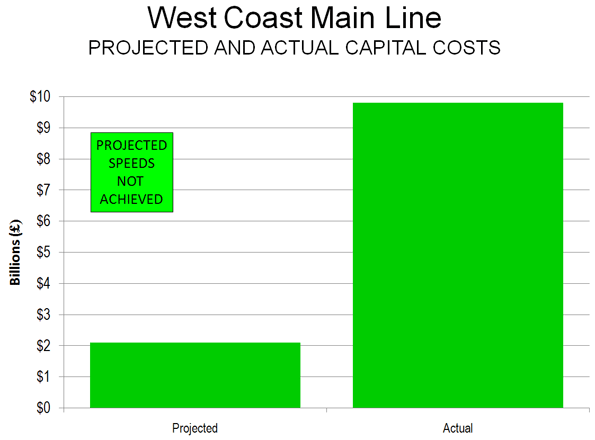
    Much of the proposed high speed rail line would be built parallel to the West Coast Main Line (which runs from London, through Birmingham and Manchester to Glasgow). Nothing short of a dog’s breakfast has been made of West Coast Main Line projects. In the 1980s, the tilting Advanced Passenger Train was developed to increase speeds to 155 miles per hour along the West Coast Main Line. The project was scrapped and all of the expenditure lost. Then there was the West Coast Main Line upgrade in the late 1990s and 2000s, to increase speeds to 140 miles per hour, which was to have cost £2 billion. The trains never exceeded 125 miles per hour, but the costs exceeded projections approached £10 billion instead, a world record cost blowout of Big Dig proportions (Figure).

    This should not be a surprise. The international record of high-speed rail projections is nothing short of horrific.Not only have costs proven far higher, but ridership and revenue have been less than projected. All of this means that taxpayers end up paying more.

    Again, Britain is a prime example. The Eurostar London to Brussels and Paris continues to attract at least 50 percent less ridership originally projected. High speed rail systems in Taiwan and Korea have had similar ridership shortfalls.

    As in Britain, costs have been higher as well. In Korea, the high speed rail line costs rose three times projections. Costs in California have increased 50 percent in two years and doubled over a decade even before the first shovel has been turned (inflation adjusted).  The cost escalation has already equaled the high end of the range predicted by Joe Vranich and me in our Reason Foundation Due Diligence Report on the California system in 2008.  

    If the proposed high speed rail project were simply to miss its cost and revenue targets by the international average (which is far better than the British experience), the benefits to users would fall below £1.00 for each £1.00 of cost. Both the strategic case and the business case for high speed rail would be blown apart. The spectre of cost overruns was a major factor in Governor Scott’s cancellation of the Florida high speed rail project.

    Not surprisingly, there is rising concern about high speed rail in Britain.A group of 21 officials, including former Chancellor of the Exchequer (minister of the treasury, finance and economics) Nigel Lawson, signed a letter to the Daily Telegraph calling the project "an extremely expensive white elephant isn’t what the economy needs. If the government wants to encourage growth there are better ways to get Britain growing and make us more competitive than getting each family to pay over £1,000 for a vanity project we cannot afford." The signatories also included Mark J. Littlewood, Director-General of the Institute of Economic Affairs, one of Great Britain’s leading free-market think tanks.

    Further, as in the United States there is also strong opposition from neighborhood groups concerned about the impact of trains operating at more than 200 miles per hour or faster through their neighborhoods. Eventually, up to 18 trains per hour are projected in each direction. This means that a 1,300 foot long train will pass houses and other adjacent development every one minute and forty seconds.

    There are the usual claims that the high speed rail line will reduce greenhouse gas emissions. However, as in California, the reality dissipates quickly, like steam into the air. Areport prepared for the Department for Transport by Booz Allen Hamilton concluded that the busiest section of the line, from London to Manchester would result in a net increase in greenhouse gas emissions when construction emissions are included (over a 60 year time analysis). Perhaps the intention is to begin reducing greenhouse gas emissions sometime after 2075?

    Monbiot further dismantles the environmental case, looking into the government reports to find that 92% of the passengers would switch to high-speed rail from alternatives that produce lower levels of greenhouse gas emissions (including conventional train, new travel and air).

    In Britain, as opposed to the United States, the proposed high speed rail system would relieve congestion on a passenger rail line. In contrast, US high speed rail lines would be built in corridors where there are few, if any rail passengers, much less passenger rail congestion.

    Even so, there are disagreements in Britain over whether high speed rail is the least costly way to address the problem, or indeed, whether there is a "problem" of sufficient magnitude to justify the public expenditure.

    The huge ridership increases projected may well be "over the top" given Britain’s less than population replacement fertility rate. As in the United States, some question the wisdom of high speed rail subsidies at a time that the government is (or in the case of the United States, should be) committed to an unprecedented austerity program that is falling heavily on middle income people who will not be the principal beneficiaries of high speed rail.

    In the final analysis, the questions will come down to who rides, how far and how fast. Will riders, in this third iteration, ride as fast as promised?  More likely it’s Britain’s beleaguered taxpayers who will be taken for a ride, with costs low-balled and ridership exaggerated as before.

    Revised on 3/22/2011. The original version had inappropritately refered to George Monbiot in the sentence about Transport Secretary Hammond. This was due to an editing error.

    Wendell Cox is a Visiting Professor, Conservatoire National des Arts et Metiers, Paris and the author of “War on the Dream: How Anti-Sprawl Policy Threatens the Quality of Life

    Photo by Jon Curnow