Blog

  • Why We Can’t Shun Manufacturing for the Service Sector

    There’s been a lot of talk lately about the shift in the US economy away from production and increasingly into services. Consider the employment data from the US: In 1950, 30% of all US jobs were in manufacturing while 63% were in services. In 2011, 9% of total employment remains in manufacturing, 86% in services.

    So does this signify a shift in consumers’ tastes from manufactured goods to services? The short answer is no; if anything, we consume more “things.” The difference is that things are manufactured with far less labor, and they are increasingly made somewhere else. The manufacturing industries still remaining in the US have seen tremendous improvements in productivity. Less-skilled work continues to flow out of the US, but the work that remains is higher-skilled, and more productive. Accordingly, the manufacturing jobs that remain in the US pay well.

    Some look to the loss of US manufacturing jobs without concern: the future (they argue) is in service industries. As jobs disappear in manufacturing, others open in services like health care and retail. The problem is that as more manufacturing jobs leave, more productivity leaves as well.

    Consider this: Classical economists saw productivity as the key in determining relative wages — the more productive the laborer, the higher his/her wages. Unlike manufacturing, service-sector jobs have strict limits in terms of productivity. For example, a live performance of Beethoven’s 5th requires the same amount of performers/employees as when it was performed early in the 19th century. Compare that with the production of almost anything manufactured — the number of workers now required to produce a bolt of fabric, for example.

    So how is it that workers in service sectors, where productivity has relatively little growth, maintain wages competitive with workers in manufacturing, where productivity has done nothing but increase?

    At least part of the answer lies in what modern economists have dubbed the “Baumol Effect,” after influential economist William Baumol. The Baumol Effect states that lower productivity notwithstanding, service industries have to pay wages comparable to manufacturing in order to get the workers it needs: it’s a simple matter of labor market competition.

    So let’s put a little data behind this. The following table lists the 2010 national sales and employment numbers for 2-digit NAICS industry sectors, ranked in terms of total sales.

    Industry
    Name
    Sales (Millions)
    Jobs 
    Employment Rank
    31-33
    Manufacturing $4,444,349 12,116,153
    4
    90
    Government $3,055,594 23,931,184
    1
    52
    Finance and Insurance $2,335,933 9,276,170
    8
    62
    Health Care and Social Assistance $1,671,158 18,983,244
    2
    54
    Professional, Scientific, and Technical Services $1,482,841 11,711,344
    6
    53
    Real Estate and Rental and Leasing $1,391,188 7,374,135
    11
    44-45
    Retail Trade $1,194,951 17,369,914
    3
    51
    Information $1,135,475 3,252,198
    18
    23
    Construction $1,123,601 8,886,854
    9
    42
    Wholesale Trade $993,673 6,071,136
    13
    48-49
    Transportation and Warehousing $770,350 6,084,630
    12
    72
    Accommodation and Food Services $691,475 11,872,079
    5
    56
    Administrative and Support and Waste Management and Remediation Services $601,900 10,138,827
    7
    81
    Other Services (except Public Administration) $502,463 8,872,041
    10
    22
    Utilities $377,695 595,031
    21
    55
    Management of Companies and Enterprises $376,055 1,935,179
    19
    11
    Agriculture, Forestry, Fishing and Hunting $360,521 3,456,096
    17
    21
    Mining, Quarrying, and Oil and Gas Extraction $355,246 1,410,588
    20
    61
    Educational Services $260,555 4,080,407
    14
    71
    Arts, Entertainment, and Recreation $208,984 3,780,900
    16
    Total $23,334,007 171,198,110
    Source: EMSI Complete Employment, 4th Quarter 2010

    When considering what industry sectors to prioritize for workforce and economic development efforts it is important to look beyond basic employment numbers. This is because, while a sector might have a lot of jobs, it might not actually be producing a lot of income for the region, which is also very important for overall economic health and vitality.

    Sectors that generate more income per worker tend to have much bigger ripple effects, which means that a lot more people are impacted as a result of direct and indirect spending. The following table is organized by sales per worker, derived by dividing the total sales for an industry by total employment for a particular year.

    Industry Sector
    Sales Per Worker
    Utilities
    630K
    Manufacturing
    370K
    Information
    350K
    Finance and Insurance
    250K
    Mining, Quarrying, and Oil and Gas Extraction
    250K
    Real Estate and Rental and Leasing
    190K
    Management of Companies and Enterprises
    190K
    Wholesale Trade
    160K
    Government
    130K
    Professional, Scientific, and Technical Services
    130K
    Construction
    130K
    Transportation and Warehousing
    130K
    Agriculture, Forestry, Fishing and Hunting
    100K
    Health Care and Social Assistance
    90K
    Retail Trade
    70K
    Accommodation and Food Services
    60K
    Administrative and Support and Waste Management and Remediation Services
    60K
    Other Services (except Public Administration)
    60K
    Educational Services
    60K
    Arts, Entertainment, and Recreation
    60K
    Source: EMSI Complete Employment, 4th Quarter 2010

    Here’s our take on manufacturing and a few other basic observations that help to illustrate the difference between production and service sectors.

    When it Comes to Income Manufacturing is Still King

    At $4.4 trillion in total sales, manufacturing is by far the biggest income generator in our nation, despite a fairly rapid decline in employment (manufacturing has slipped to fourth in overall employment). Despite these trends, manufacturing still manages to far outperform all other industries in terms of pure income creation. Each individual that works in manufacturing generates roughly $370,000 per year. This is a very important fact to consider in a day and age when many folks advocate for improving the service sectors. 

    Again, here’s the thing to note: sectors like manufacturing that generate more income per worker have much bigger ripple effects, creating much more impact in a region while helping to raise wages in lower-productivity service sectors. 

    Government Services: High on Employment but Low on Productivity

    The government sector is twice the size of the manufacturing sector (in terms of employment) but only produces $3 trillion in earnings or $130K in income per worker. Government is a bit trickier to analyze using the sales per worker criteria because the government is essentially capturing tax dollars and spending them on various services (education, military, infrastructure). Government can provide a lot of stability to regional economies, but it’s not really a growth industry (unless you’re in DC!).

    Utilities and Finance – Low Employment but High Sales/Job Ratios

    The utility and finance sectors have lower employment (ranked 8th and 21st, respectively) but rather large sales to job ratios (250K per worker and 650K per worker, respectively). Keep in mind, the utility sector has a lot of overhead and equipment that factor into the equation. There is a huge amount of capital in play in this sector that requires a relatively small workforce. Finance and insurance can generate very large amounts of capital, and they have much less overhead.

    Health Care is Not a ‘Growth Industry’

    Health care, the ultimate service sector, has become the second-largest employment sector in the country, yet it produces only $90K in sales per worker, which is pretty low compared to manufacturing, information, or finance. Basically, the health care sector is important for obvious reasons and it can be a source of good jobs for a local region, but it’s not really an “economic driver” that is going to propel our nation into greater prosperity.

    Retail Trade vs. Information

    The retail trade and information industry sectors have similar income generation ($1.19 trillion and $1.13 trillion, respectively), however, retail trade is five times the size of information in terms of employment. This is why every economic developer is looking for “the next Facebook” and not “the next Napa Auto Parts.” Retail trade only generates $70K per worker while information generates $350K per worker.

    So what’s wrong with a service-based economy? It shrinks manufacturing employment as well as the manufacturing sector’s ability to prop up wages. A labor market that loses wage pressures of high-productivity manufacturing industries will settle at wage rates lower than markets where this wage-boosting effect is present. Economic development policy makers should be careful about shunning manufacturing or other production sectors in favor of service sectors.

    Dr. Robison is EMSI’s co-founder and senior economist with 30 years of international and domestic experience. He is recognized for theoretical work blending regional input-output and spatial trade theory and for development of community-level input-output modeling. Dr. Robison specializes in economic impact analysis, regional data development, and custom crafted community and broader area input-output models. Contact Rob Sentz with questions about this analysis.

    Illustration by Mark Beauchamp

  • Minneapolis, St. Paul & Memphis Core City Losses

    Census results released today show again show losses, though small, in historical core municipalities. The city of Minneapolis lost 40 people, between 2000 and 2010, falling from 382,618 to 382,578. The city of St. Paul, also a historical core city of the Minneapolis-St. Paul metropolitan area fell from 287,000 to 285,000.

    The historical core municipality of Memphis dropped from 650,000 to 647,000, despite the fact that much of the city is of a post-World War II suburban form.

  • Asthma: The Geography of Wheezing

    Are you familiar with the Hygiene Hypothesis? The HH — or, as some of us call it, the “pound of dirt theory” — is grabbing attention again. A minor medical press feeding frenzy followed the publication in the New England Journal of Medicine of a study based on data from Europe. The summary?

    “Children living on farms were exposed to a wider range of microbes than were children in the reference group, and this exposure explains a substantial fraction of the inverse relation between asthma and growing up on a farm.”

    This is the Hygiene Hypothesis incarnate. The HH posits that part of our immune system produces an antigen called IgE, which evolved to fight parasites in unhygienic conditions that have prevailed for most of human history, and since we are now cleaner, these antigens attack otherwise harmless proteins in some of us, making us sick, in the form of allergies. Instead of attacking, say, hookworms, the antigen goes after that just-chomped peanut butter sandwich.

    Proponents of the HH compare the prevalence of allergies in East and West Germany before and after unification. East Germany had more children growing up on farms and in larger families than West Germany, and much lower rates of allergies and asthma. Now, with its more westernized culture, East German rates of allergies and asthma have nearly caught up with West Germany.

    It makes a great story. The whole farm-city thing resonates deep in the American mind. It evokes the mythic hold that farm life has over our national psyche. Farms good; cities bad. Wholesome Jeffersonian America is good for our children not only morally, but physically. The implication is that if we all grew up on farms, asthma wouldn’t be at the epidemic levels we now have. The trouble is that in medical science there are too many variables to draw sweeping conclusions from one set of data, and anyone who would do so is not a serious scientist, or is driven by an agenda (or both).

    A case in point is a Forbes blogger who took a pot shot at mold-inspired litigation against landlords, interpreting the study to mean that mold is good for us. The Forbes blogger mentioned the case of Bianca Jagger, who sued her landlord about mold growing in her Park Avenue apartment. Erin Brockovich, Michael Jordan, and Ed McMahon are other celebrities who have coped with mold contamination, along with countless sufferers whose names are not familiar to us.

    Some mold is, undoubtedly, good. Without it, we wouldn’t have penicillin or blue cheese. But some mold can kill, particularly stachybotrys chartarum – a toxic black mold – which is often found in buildings with water damage. Other molds, while not immediately life threatening, are still potent allergens, including the ones you find in the woods behind the back 40, in Central Park, and in virtually any basement anywhere. In fairness, it’s not as easy for landlords to decide which molds to allow in their properties as it is, say, to choose between Stilton or Roquefort. As for that wet laundry you left in the washing machine for two days, it may not make you sneeze, let alone kill you, but it does stink.

    As objectionable as I find enlisting a specious inference in service of an ideological argument against the American tort bar, there are medical considerations to look at before we let the kids run barefoot through the barnyard as immunotherapy against asthma.

    First, these were European farms under study. The European farm population may or may not be a fairly homogeneous group compared to city dwellers, and genetics make a large difference in who develops asthma. It stands to reason that generations of working the family farm may have bred a hearty cohort of kids who can breathe the local air without wheezing.

    Second, there may be something about European farming practices that makes their farm/city dynamic different from ours. European farms are regulated very differently from our own, in part because of the health fears of the European commissioners. For example, genetically modified food is much more tightly restricted in Europe, if it is legal at all. This means that Europeans use different fertilizers and pesticides than the ones we use here, which undoubtedly affects the rural health picture.

    And European farm asthma may just be lagging behind ours. Typical farms are rampant with chemicals. Add to that the effects of weather on the pollen count and the aromatic plumes from manure lagoons, and no wonder rural America is suffering from an asthma epidemic that rivals the one we’re seeing in urban America.

    CDC researcher Dr. Teresa Morrison, medical epidemiologist in the Air Pollution and Respiratory Health Branch, was lead author of an article in the Journal of Asthma which concluded that “Asthma prevalence is as high in rural as in urban areas.” The goal of their research is “… to document patterns of asthma symptoms among rural residents in Midwestern states, and learn more about possible environmental exposures that potentially lead to asthma attacks.”

    David Van Sickle, who has worked with Morrison, holds a doctorate from the University of Wisconsin, and is founder of a Madison-based company called Reciprocal Sciences. In a guest editorial for www.asthmaallergieschildren.com in November, he wrote that studies of farm workers in California showed that exposures to agricultural dusts were associated with the development of persistent wheeze, exposure to pesticides was associated with the development of asthma in women, and that community exposures to airborne waste from large scale animal agriculture might also be associated with exacerbations of asthma. As he also pointed out, this may have remained hidden because it’s hard to study, but that is changing, in no small part because Van Sickle has developed an iPhone app called Asthmopolis, which can transmit information to doctors every time the patient—say a farmer—toots on his inhaler.

    No one who has studied immunology, as I have, can ignore the contribution farms have made to the treatment of the human immune system. As every biology student should know, vaccination began because Edward Jenner noticed that milk maids exposed to cow pox gained immunity from small pox. I have my doubts that a similar benefit can be derived with asthma.

    The country — where the air is full of all kinds of pollen and chemicals — is probably not the ideal choice for a Fresh Air Fund-style migration of wheezing children. But who knows? Maybe some of those farm microbes do have a salutary effect on kids’ immune systems. I wouldn’t recommend sending the kids to the city, either (check out some of the reasons a Bronx neighborhood has the nation’s highest asthma rates). If I sound equivocal, it’s because I am. Maybe sneezing, wheezing, and itching are the price we — that’s an urban and rural “us” — pay for “progress.”

    Dr. Paul Ehrlich is co-author with Dr. Larry Chiaramonte and Henry Ehrlich of Asthma Allergies Children: A Parent’s Guide (Third Avenue Books), available only from Amazon.com and from Barnes & Noble. He is co-founder of asthmaallergieschildren. He is a fellow of the American Academy of Pediatrics, the American Academy of Allergy, Asthma & Immunology, and the American College of Allergy, Asthma & Immunology, as well as a clinical assistant professor of pediatrics at New York University School of Medicine, and an attending physician at Beth Israel Medical Center and at the New York Eye & Ear Infirmary. He has been featured as one of the top pediatric allergy and immunology specialists in New York Magazine for the last 10 years and counting.

    Photo by Nathan T. Baker: “I might have to get a cooler style for this asthma inhaler.”

  • Why North Dakota Is Booming

    Living on the harsh, wind-swept northern Great Plains, North Dakotans lean towards the practical in economic development. Finding themselves sitting on prodigious pools of oil—estimated by the state’s Department of Mineral Resources at least 4.3 billion barrels—they are out drilling like mad. And the state is booming.

    Unemployment is 3.8%, and according to a Gallup survey last month, North Dakota has the best job market in the country. Its economy “sticks out like a diamond in a bowl of cherry pits,” says Ron Wirtz, editor of the Minneapolis Fed’s newspaper, fedgazette. The state’s population, slightly more than 672,000, is up nearly 5% since 2000.

    The biggest impetus for the good times lies with energy development. Around 650 wells were drilled last year in North Dakota, and the state Department of Mineral Resources envisions another 5,500 new wells over the next two decades. Between 2005 and 2009, oil industry revenues have tripled to $12.7 billion from $4.2 billion, creating more than 13,000 jobs.

    Already fourth in oil production behind Texas, Alaska and California, the state is positioned to advance on its competitors. Drilling in both Alaska and the Gulf, for example, is currently being restrained by Washington-imposed regulations. And progressives in California—which sits on its own prodigious oil supplies—abhor drilling, promising green jobs while suffering double-digit unemployment, higher utility rates and the prospect of mind-numbing new regulations that are designed to combat global warming and are all but certain to depress future growth. In North Dakota, by contrast, even the state’s Democrats—such as Sen. Kent Conrad and former Sen. Byron Dorgan—tend to be pro-oil. The industry services the old-fashioned liberal goal of making middle-class constituents wealthier.

    Oil also is the principal reason North Dakota enjoys arguably the best fiscal situation in all the states. With a severance tax on locally produced oil, there’s a growing state surplus. Recent estimates put an extra $1 billion in the state’s coffers this year, and that’s based on a now-low price of $70 a barrel.

    North Dakota, however, is no one-note Prairie sheikdom. The state enjoys prodigious coal supplies and has—yes—even moved heavily into wind-generated electricity, now ranking ninth in the country. Thanks to global demand, North Dakota’s crop sales are strong, but they are no longer the dominant economic driver—agriculture employs only 7.2% of the state’s work force.

    Perhaps more surprising, North Dakota is also attracting high-tech. For years many of the state’s talented graduates left home, but that brain drain is beginning to reverse. This has been critical to the success of many companies, such as Great Plains Software, which was founded in the 1980s and sold to Microsoft in 2001 for $1.1 billion. The firm has well over 1,000 employees.

    The corridor between Grand Forks and Fargo along the Red River (the border between North Dakota and Minnesota) has grown rapidly in the past decade. It now boasts the headquarters of Microsoft Business Systems and firms such as PacketDigital, which makes microelectronics for portable electronic devices and systems. There are also biotech firms such as Aldevron, which manufactures proteins for biomedical research. Between 2002 and 2009, state employment in science, technology, engineering and math-related professions grew over 30%, according to EMSI, an economic modeling firm. This is five times the national average.

    While the overall numbers are still small compared to those of bigger states, North Dakota now outperforms the nation in everything from the percentage of college graduates under the age of 45 to per-capita numbers of engineering and science graduates. Median household income in 2009 was $49,450, up from $42,235 in 2000. That 17% increase over the last decade was three times the rate of Massachussetts and more than 10 times that of California.

    Some cities, notably Fargo (population 95,000), have emerged as magnets. “Our parking lot has 20 license plates in it,” notes Niles Hushka, co-founder of Kadrmas, Lee and Jackson, an engineering firm active in Great Plains energy development. Broadway Drive in Fargo’s downtown boasts art galleries, good restaurants and young urban professionals hanging out in an array of bars. This urban revival is a source of great pride in Fargo.

    What accounts for the state’s success? Dakotans didn’t bet the farm, so to speak, on solar cells, high-density housing or high-speed rail. Taxes are moderate—the state ranks near the middle in terms of tax per capita, according to the Tax Foundation—and North Dakota is a right-to-work state, which makes it attractive to new employers, especially in manufacturing. But the state’s real key to success is doing the first things first—such as producing energy, food and specialized manufactured goods for which there is a growing, world-wide market. This is what creates the employment and wealth that can support environmental protection and higher education.

    Thankfully, this kind of sensible thinking is making a comeback in some other states, such as Ohio and Pennsylvania. These hard-pressed states realize that attending to basic needs—in their case, shale natural gas—could be just the elixir to resuscitate their economies.

    This piece originally appeared in the Wall Street Journal.

    Joel Kotkin is executive editor of NewGeography.com and is a distinguished presidential fellow in urban futures at Chapman University, and an adjunct fellow of the Legatum Institute in London. He is author of The City: A Global History. His newest book is The Next Hundred Million: America in 2050, released in February, 2010.

    Photo by SnoShuu

  • Perspectives on Urban Cores and Suburbs

    Our virtually instant analysis of 2000 census trends in metropolitan areas has the generated wide interest. The principal purpose is to chronicle the change in metropolitan area population and the extent to which that change occurred in the urban core as opposed to suburban areas.

    From a policy perspective, this is especially timely because of the recurring report that suburbanites have been moving to the urban core over the last decade. We have dealt with this issue extensively, noting the lack of data for any such interpretation. As of this writing, with data for more than half of the major metropolitan areas (over 1,000,000 population) in, there remains virtually no evidence that people are "moving back to the city" (actually, most suburban growth came from outside metropolitan areas, not from the "cities").

    The Policy Context: Urban Cores and Suburbs

    This discussion is not new, and generally pits anti-automobile interests – including much of the urban planning community – who favor the urban development patterns of prewar America (generally the urban planning community) against those who would prefer allowing people to make their own choices about where they live or work..

    Over the past 60 or more years, the data indicates that consumers have nearly exclusively chosen less dense and more suburban areas. This is not to suggest, however that many of us, including this author, automatically favor suburbs over urban cores. Indeed, I have enjoyed years of alternating between living in suburban America and the urban core of the (inner) ville de Paris (arrondissements I, II, V, VII and XI). But if you have a taste for urban living, that does not mean high-density cities are inherently superior to suburban living. People, after all, have different preferences.

    Urban areas include both urban cores and suburbs. The delineation of urban cores and suburbs is subjective. There was for example a time – say around 1820 – when development to the north of New York’s Houston Street would have been considered suburban. More than two thirds of the present ville de Paris was suburban before the city limits were expanded in the 1860s. Now, no one would consider, for example, Washington Square or Herald Square to be suburban and the suburbs of Paris now extended to more than 80 times the land area of the 1860s ville de Paris.

    One overlooked way to approach the current debate would be to look not at municipal boundaries but forms of development. Around 1950 we began the breakneck expansion of automobile oriented suburbanization which had proceeded more modestly for two or more decades before.

    The Urban Core:

    This analysis defines the urban core consistent with the criteria of the US Bureau of the Census in 1950. Metropolitan areas are organized around urban areas (urbanized areas). We use the "central cities" of the core urban areas in 1950 as the urban core in the analysis. Those portions outside the 1950 urban core are thus considered suburban. Where an urban area did not exist in 1950 (such as in Las Vegas and Tucson), the urban core is the central city of the urban area when it was first established.

    No existing specification of the urban core is ideal, though the present one is appropriate for the policy purpose stated above. Clearly, the urban core would be far better defined at the census tract or even census block level based upon the characteristics of an urban core. This would include factors such as high residential population density, high transit usage, walkability and a high percentage of multiple unit residential buildings.

    Such an ideal definition of the urban core cannot be measured with municipal boundaries. Yet, municipal boundaries have routinely been used by researchers to delineate the urban core, not least because the data is readily available. However there three notable difficulties with the use of municipal boundaries to define the urban core.

    First; some areas with urban core characteristics are outside the core municipalities. As The Infrastructurist notes, municipalities like Jersey City or Hoboken have the characteristics of urban cores. However, since they are not a part of the core municipality (city of New York), they are classified as suburbs in our analysis. It is well to remember that both Hoboken and Jersey City represented suburban development, during their period of greatest growth, before 1930.

    Second, other areas with postwar suburban characteristics are inside the core municipalities. For example, Richmond County (Staten Island), a part of the city of New York is principally suburban. Much of it was developed well after 1950 and consists largely of single family homes. The median construction date of owner occupied housing in Staten Island is 1970, which compares to 1965 in adjacent Middlesex County, New Jersey. It is newer than in Morris County New Jersey (1965), much of which is outside the urban area (all median house construction years from the 2000 census). Major portions of core municipalities such as Los Angeles, Houston, Dallas, Portland, Seattle, Denver and others are also postwar suburban.

    Third, in a number of core municipalities, there is little, if any urban core, at least from a residential perspective. For example, one would be hard-pressed to identify an urban core in municipalities such as Phoenix or San Jose (despite the fact that the San Jose urban area is more dense than New York urban area). In metropolitan areas such as these, it might be preferable to define virtually all growth as suburban, though our analysis still defines these municipalities as the urban core.

    Based upon the early results from the census it seems that if the more ideal census tract-based urban core definition were used, the urban cores would be shown to be capturing an even smaller share of growth, while suburban areas would be capturing more. But this analysis will have to wait until all the numbers are in.

    Historical Core Municipality

    The term "historical core municipality" is used to denote the urban cores using municipal boundaries.  The term "city" is avoided because of its multiple definitions. Cities can be municipalities (such as in the city of New York), urban areas (such as the New York urban area), metropolitan areas (such as the New York metropolitan area) or multi-county regions or prefectures of countries like China (such as Wuhan or Shenyang).

    This lack of clarity can be routinely seen in media reports that indiscriminately (and without comprehension) make comparisons between cities, using differing definitions. This can even extend even to more technical literature (see pages 12-14 of Urban Transportation Policy Requires Factual Foundations).

    Principal Cities: Starting in 2003, the Census Bureau substituted the term "principal city" for the previous "central city" term. The use of principal city designations and the largest municipality as the principal name of a metropolitan area are appropriate for the purposes intended by the Census Bureau.

    In its State of Metropolitan America, the Brookings Institution uses up to the three largest principal cities (which it calls "primary cities") and consider other parts of metropolitan areas as suburbs.

    Neither approach, however, is appropriate in analyzing postwar suburbanization. Any municipality in a metropolitan area with more than 250,000 population is considered a principal city, regardless of its urban form. Any municipality with more than 50,000 population but which also has more jobs than resident workers is also a principal city, regardless of its actual on the ground reality.

    This leads to a situation in which, for example, Los Angeles has 26 principal cities. Any postwar urban form definition would classify nearly all as suburban (and much of the historical core municipality of Los Angeles, notably the San Fernando Valley, itself is suburban). For example, the suburban city of Cerritos is a principal city, yet was largely filled by dairy farms well into the 1950s and was called Dairy Valley.

    Other principal cities hardly existed in 1950. Virginia Beach has become the largest municipality in its metropolitan area, having displaced Norfolk. Yet, in 1950 Virginia Beach had a population of only 5,400, well below the 50,000 threshold that was required of central cities (smaller than Ponchatoula, Louisiana, doubtless an unfamiliar municipality to most readers). Arlington, Texas, the third municipality in the Dallas-Fort Worth-Arlington metropolitan area, had a population of 7,700 in 1950, again well below the central city threshold. Arlington is not an urban core, it is a suburban jurisdiction.

    Virginia Beach is a good example of a suburban area that has become the largest municipality in a metropolitan area. Its greater size, however, does not make Virginia Beach the urban core. Otherwise, Contra Costa County in California could, by consolidating with its constituent municipalities (God forbid), replace San Francisco as the metropolitan area’s urban core.

    Perhaps the ultimate example of the problem of principal cities being confused with urban cores is Hemet, California, a principal city of the Riverside-San Bernardino metropolitan area that is, in fact an exurb and not in the primary urban area.

    Toward the Future

    An eventual more precise analysis of urban cores and suburban trends will be welcome. Yet, as our analysis of trends in New Jersey indicated, even the growth in more urban core oriented municipalities was minuscule compared to the state’s suburban growth. Further, much of the urban core growth in the nation came from areas that, although formally located within “city limits” actually were on the suburban fringe. This was true, for example, in Kansas City, Oklahoma City and even Portland.  This suggests that the small share of growth reported in urban cores would be even less if it were based on census tract data; and suburbanization, as a way of life, may indeed be even more prevalent than this year’s numbers suggest. 

    Wendell Cox is a Visiting Professor, Conservatoire National des Arts et Metiers, Paris and the author of “War on the Dream: How Anti-Sprawl Policy Threatens the Quality of Life

    Photo by urbanfeel

  • USDOT Rail Grants to Obligate Taxpayers

    The US Department of Transportation has announced a competitive grant program to reallocate funding that was refused by Florida for a proposed high speed rail line from Tampa to Orlando. The line was cancelled by Governor Rick Scott because of the prospect for billions of dollars of unplanned obligations that could have become the responsibility of the state’s taxpayers.

    Eligibility: Eligible applicants are states, groups of states, Amtrak or other government agencies that authorized to "provide intercity or high-speed rail service on behalf of states or a group of states. The grant program requires recipients of grants (read "taxpayers") to provide financial support to intercity and high speed rail passenger rail programs in the event that cost and ridership projections are optimistic (a routine occurrence).

    Obligation to Pay for Cost Overruns: As in the program announced in 2009. the state, group of states, government agency will be required to demonstrate its financial capacity (that is, the capacity of their taxpayers) to pay for cost overruns (page 9). This open-ended liability led Governor Chris Christie of New Jersey to cancel a new transit-Hudson River rail tunnel, which had costs that were escalating out of control that would be the obligation of the state’s taxpayers. Governor Christie and Governor Scott were both aware of the disastrous record of major infrastructure cost overruns, such as in the Boston Big Dig project, the Korean high-speed rail program and the overwhelming majority of passenger rail projects in North America and Europe, according to a team led by Oxford University Professor Bent Flyvbjerg.

    Obligation to Pay Operating Costs: Moreover, inaccurate passenger and revenue forecasts have been pervasive in high-speed rail systems, as has been documented by Flybjerg, who found that cost overruns occurred in nine out of ten projects:

    … we conclude that the traffic estimates used in decision making for rail infrastructure development are highly, systematically and significantly misleading.

    This is illustrated by the fact that even a decade and one-half after the Eurostar London to Paris and London service was opened, ridership remains 60 percent below projection. Ridership on the Taiwan and Korea high speed rail systems has been one-half or more below projections. Our analysis of the Tampa to Orlando line revealed exceedingly high ridership projections, which were inexplicably raised even higher in a new report just released. Failure to achieve ridership projections increases the likelihood that a line will need operating subsidies, which would be the ultimate responsibility of taxpayers under the USDOT program.

    Federal Grant Repayment Obligation: Moreover, taxpayers of any grant recipient would be required to repay part or all of the federal grant if a sufficient level of service is not maintained for a period of 20 years (page 41). The operation of this provision is illustrated by recent Florida experience. Tri-Rail, the Miami area’s commuter rail service only narrowly escaped having to repay $250 million when its service level was deemed to not meet requirements of a federal grant by early in the Obama presidency. Tri-Rail was rescued by a state subsidy of nearly $15 million annually, which restored an artificially high level of service.

    Intercity and High Speed Rail Program: The federal intercity and high-speed rail program is largely limited to upgrades of Amtrak-type service. Before Governor Scott’s decision, only two of the programs (Florida and California) would have achieved international standard high speed rail speeds.  

  • What kind of Cities do we Want, Sustainable, Liveable or Resilient?

    A critical issue from the dreadful earthquake that has severely damaged so much of central Christchurch, taken so many lives, and terrified so many residents of the whole urban area, lies in whether the Central Area should be rebuilt. Some believe it should be abandoned for some other location; others see an opportunity to set new standards in sustainability, urban design, energy efficiency, or whatever ideal urban form takes your fancy.

    Let’s put the issue of “sustainable cities” to one side because the can words means anything, and hence mean nothing.  It has become one of the most overused phrases in the English language.

    Not surprisingly, Many of Auckand’s leaders are thrilled by the recent official ranking of Auckland as the tenth most livable city in the world, and have announced their determination to make Auckland even more “liveable” than it is now. This target of livability is also surfacing in Christchurch, normally to bolster demands for urban rail, transit-oriented gentrification, promoting cycling and walking, and making the city attractive to the “creative class”.

    However this quote from a US urban blog should give the livability boosters pause:

    Much of the highly touted livability of Portland has come at the expense of making it unlivable, that is, unaffordable, to anyone without a six figure income. The creative and professional classes thrive in Portland because they are the only ones who can afford it, and they are the ones who appreciate the development style the city has tried to mandate.

    I first raised this issue of ‘rich folk’s livability’ in How Can Cities With Unaffordable Housing Be Ranked Among The Most Livable Cities In The World? here on NewGeography. Then Wendel Cox further quantified such city’s “unlivable reality" in Unlivable Vancouver, in NewGeography.

    Cities designed to be sustainable or livable are likely to be unaffordable for all but a few.

    The Case for Resilient Cities

    Many of us watched the devastation caused by the floods in Queensland, Australia, driven by major rainstorms inland, and Pacific Typhoons devastating the West Coast and the hinterlands. The combination of a strong El Nina with the Pacific Decadal Oscillation means such events will be more common and more extreme in this part of the world than we have become used to since the similar combination of 1917/18.

    However, Phil McDermott, on his blog Cities Matter was quick to comprehend the lessons to be learned by our political leaders and urban planners.

    He opens his blog comment Cities in Search of Resilience with:

    An age of extreme events?

    Without debating whether an increase in the frequency of extreme events reflects climate warming, such events can be catastrophic when they impact on densely populated areas. Natural disturbances, whether geophysical (tsunami, earthquakes, mudslides) or climatic (flooding, hurricane strength winds, tidal surges), become disasters if they strike heavily populated centres. 

    So do human acts of aggression. The tactic of terrorising civilian populations taken to new heights in the bombing raids of the Second World War and adopted by today’s extremists is most effective – and destructive – when directed at the heart of major cities.

    Later in the post Phil sets out the following vulnerabilities generated by the current "compact city" planning paradigm:

    It relies on sophisticated, centralised interdependent systems of services. This creates greater capacity for disruption when any one part fails. Economies of scale in utilities may come with increased risk of failure under duress.  This applies to sewage treatment infrastructure, communications, water, energy distribution, and power supplies. It also applies to public transport systems.

    Poorly designed intensification reduces permeable surfaces, intensifying flood impacts.

    Converting brownfield and even greenfield sites (such as undeveloped urban space) to housing or mixed use reduces the safety valve of open space and increases vulnerability associated with the concentration of buildings and populations.

    Crowding more people into smaller spaces around constrained road capacity reduces prospects for rapid evacuation from the city or into safe structures and areas.
    Lifting the density of buildings increases the consequential impacts of severe events by such things as the collapse of structures, the spread of fire, and the transmission of disease.

    Read the whole post here. You might think Phil was setting out a list of lessons to be learned from Christchurch – but that "extreme event" was still in the future. A few days later, Phil responded to this tragedy with a second blog post, that picked up the same theme, titled "A Cruel Blow to a Beautiful City" which offers this timely warning:

    We cannot resist the power of earthquakes, hurricanes, tsunami, and the like. But we can perhaps limit the devastation that accompanies them.

    The implosion of many of Christchurch’s beautiful heritage buildings is a tragedy on its own, the wiping from the landscape of much of the City’s and nation’s history. But seeing the collapse of more modern buildings is sobering. 

    What are the lessons of architecture and engineering that might be drawn from this?

    How much resistance can we realistically build into our structures?  Or should we be thinking less rigidly, and explore designs that deflect or reduce the impacts when buildings are faced with irresistible forces? Should we think more about the survival of the people in and around buildings and less about the survival of the structures? Are there innovations in design that offer refuge, protection, and escape even if walls crumble and floors collapse?

    This event in Christchurch must surely erode planners’ resistance to the decentralisation that is the mark of a prosperous, modern city, that makes it that little bit more liveable, and so much more resilient in the face of disaster?

    Surely, Hurricane Katrina, and these events in Australia and New Zealand suggest that planners should stop worrying about sea level rises that MIGHT, or might not, happen in 100 years – with plenty of warning – and start thinking more about making our cities resilient in the face of catastrophic events which we know can happen tomorrow – hurricanes, cyclones, blizzards, volcanoes, earthquakes and tsunami.

    However, the proper debate should not be as simple-minded as "high rise vs. low rise" or "old vs. modern". In Christchurch, liquefaction contributed to the collapse of some of the modern buildings. In the Kyoto earthquake some robust high-rise blocks simply fell over, because of the total collapse of the ground under the building, but remained in one piece.

    Such problems and issues are not solved by sets of simple rules but by the application of skill, experience and wisdom. 

    Owen McShane is Director of the Centre for Resource Management Studies, New Zealand.

    Photo by Kym Rohman

  • Are Chinese Ready to Rent?

    In 2010 “House price” ranked third on the list of the top 10 most popular phrases used by Chinese netizens. It came to no one’s surprise. In most Chinese cities housing prices have increased significantly over the past decade, with an especially sharp rise over the past three years.

    “House Price” is a term used loosely, due to the fact that the vast majority of Chinese real estate is made up of apartments or condominiums, while only a small few are town houses or fully detached homes. However, terminology aside, owning a property is the greatest life-goal for most Chinese citizens.

    It is worth mentioning that in China property ownership does not mean land ownership as it does in the West. According to Chinese law, what people are buying is similar to a land-use right, which in the case of residential property, expires after 70 years (40 years for commercial property). The countdown begins on the date that the real estate developer signs for the land, and not on the homeowner’s date of purchase.

    So why do Chinese people have such zest for real estate?

    Different from the western mentality: “Home is where your heart is” or “home is where you hang your hat;” the traditional Chinese concept is: “home is where your house is.”

    Prior to the 1980s, people still followed the custom of living with their parents after getting married. It was not uncommon to see a three-generation family living together in a single home. At that time renting was unheard of, as most apartments, if needed, were provided for free to a person or family by their employer, typically a state-owned entity.

    With China’s transformation from a strictly planned economy to a market economy, many state-owned companies became limited companies which restricted    free housing provision. However, employees were given the option of buying their current residences at a very low price, and most people did.

    Increasingly today, when a young couple gets married , both sets of parents make their utmost effort to help their children purchase a home. For many young people who do not live in their original hometown, it is  essential that they buy a property in the city where they work, as that is the easiest way for them to obtain a local hukou (urban residence permit). Without this, they cannot enjoy the same rights and social benefits as the locals. 

    People in China refer to the demand from young couples as “rigid demand,” meaning they must bear the social pressure to purchase a house before they can get married.

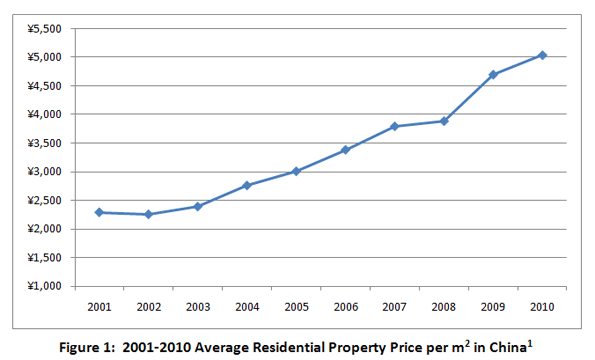
    For middle-aged Chinese, buying a house is seen as a relatively simple and secure investment, because as indicated in Figure 1, housing prices have increased steadily over the past decade.

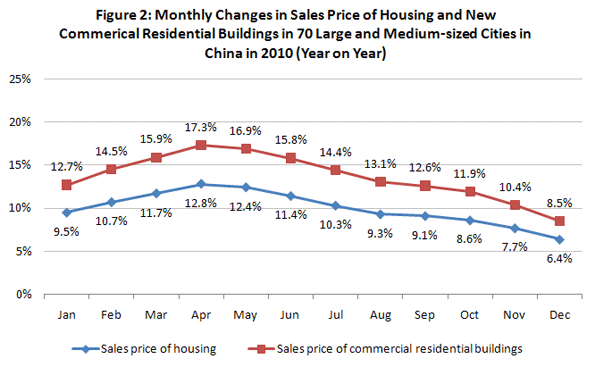
    This may now be getting out hand and the Chinese government has identified housing prices as a serious national issue. Some macro restrictive policies on home buying were issued in April 2010. Figures issued by the National Statistical Bureau, Figure 2, prove these restrictive policies did relieve somewhat the rate of house price increase.

    Immediately following the New Year, the Chinese central government announced that its top priority for 2011 would be controlling inflation. Shortly afterwards, a more stringent policy designed to limit speculation was issued on January 26th, 2011. Subsequently, each city issued its own policies based on this, with Shanghai and Chongqing, two Zhixiashi (provincial level municipalities administrated directly under the central government) taking the lead.

    Shanghai issued the following policies on February 1st, 2011.

    1. Any household purchasing a second home must provide a 60% down payment on a mortgage; and the interest rate on the mortgage will be 110% of the benchmark rate.
    2. From the publication date of this policy, households who already own one house will only be allowed to purchase one additional home.
    3. From the publication date of this policy, households who already own two or more houses will not be allowed to purchase any additional homes.
    4. Individuals selling a home less than five years since the date of purchase will be charged an additional sales tax of 5.5% of the full sales price.

    Many more cities followed in step, and announced their own sets of policies in the following weeks.

    Only one month after these policies came into effect, it is difficult to determine their effectiveness as house prices are still increasing compared with last year, although rate of change has dropped.

    The steady price has led to a renewal of interest in rented public housing. Chongqing became the first city to respond to the central government’s call with plans to build 40 million square meters  in public-rent housing units, which will provide accommodation to 1-2 million people within the next three years and to 800,000 families by 2015. In total, Chongqing will invest 120 billion RMB (18.3 billion USD) on public-rent housing construction.

    By 2012, Chongqing will also grant the urban hukou to 3 million farmers (10 million by 2020) with rural Hukou. In exchange, these farmers will give up their agricultural land, most of which will be developed into public-rent apartments.

    Who will be eligible to apply for public-rent housing?

    Chongqing’s criteria are as follows:

    1. Applicants must be over 18 years of age.
    2. Applicants must have a job which provides steady income.
    3. Monthly income must be under 2000 RMB (305 USD) for individuals and 3000 RMB (457 USD) for families. (These two numbers will fluctuate according to other economic index changes.)
    4. Families must not already have housing or have housing in which the average space per family member is lower than 13m2.

    One thing worth pointing out is that there is no hukou limit for public-rent housing applications, which means that citizens from other cities are equally qualified. All eligible applications will be placed into a lottery and public-rent apartment allocations will go to the lottery winners.

    These public-rent apartments range from 39m2 or 420 square feet (1 bedroom, 1 living room) to 53 m2 or 570 square feet (2 bedrooms, 1 living room) with the corresponding monthly rent around 390 to 530 RMB (59 to 81 USD). When you consider that the current average price of residential property per square meter in Chongqing is 5700 RMB (868 USD), that means a person could rent a 53 m2 apartment for 47.5 years before paying the equivalent cost of purchasing an apartment of the same size.

    Following suit, many other cities in China have also started to construct public-rent apartments.

    Are all the problems solved?

    Certainly this can help most lower-income citizens to find a place to live, but there are other problems. Tenants in China are not protected by laws that uphold renter’s rights as in the west. This is largely due to the fact that there are few apartment buildings owned by a single company or person. Citizens can only rent directly from home-owners with virtually no regulatory controls over the personal renting market.  Long-term leasing contracts are nearly impossible to negotiate, and landlords are able to demand large increases in rent, or even eviction at a whim. This means that renters have no stability, and usually have to face the difficulty of moving frequently.

    More buildings designed specifically for renting, and regulations protecting both tenants and home-owners are desperately needed.

    China has a long way to go when it comes to providing accommodation for its 1.3 billion citizens. Although one clear problem lies with the resources to construct the ”hardware”, this country’s development cannot continue without also upgrading its “software”: people’s way of thinking. In this case, that means convincing people to accept the idea of renting, reversing centuries of preference for ownership.

    Lisa Gu is a 26-year old Chinese national. She grew up in Yangzhou (Jiangsu) and lives and works in Nanjing (Jiangsu).

    Photo by Charles Ryan