Blog

  • Columbus: Suburban and Core Gains

    The Columbus (Ohio) metropolitan area increased in population from 1,613,000 in 2000 to 1,837,000 in 2010 (13.9 percent). This growth rate is likely to have been among the strongest in the Midwest and is greater than the growth rate of Seattle, which had grown more quickly in recent decades.

    The historical core municipality, the city of Columbus, which is largely suburban in form, grew from 713,000 to 787,000, an increase of 10.4 percent. The city of Columbus captured 33 percent of the metropolitan area’s growth.

    The suburbs experienced a growth rate of 16.7 percent and captured 67 percent of the metropolitan area growth. Suburban Delaware County had a population increase of 58 percent, while more distant counties, Union (28 percent) and Fairfield (19 percent) also experienced strong growth. The core county of Franklin, which includes the city of Columbus, grew nine percent.

  • Cleveland: Huge Core Loss Overwhelms Suburban Gain

    The Cleveland metropolitan area population fell from 2,148,000 in 2000 to 2.077,000 in 2010, according to the just released 2010 census figures. All of the loss was attributable to the city of Cleveland. However, population growth in the suburbs was small.

    The 2010 census data indicates that the city of Cleveland lost 16.9 percent of its population between 2000 and 2010, the largest loss yet reported by a historical core municipality (excluding Hurricane Katrina ravaged New Orleans). Cleveland dropped from 477,000 in 2000 to 397,000 in 2010. The city of Cleveland reached its population peak of 914,000 in 1950 and has since fallen 57 percent.

    The suburbs added 10,000 residents, for a growth rate of 0.6 percent. This small gain was insufficient to offset the loss of 80,000 residents in the city of Cleveland and the metropolitan area suffered a population loss of 3.3 percent.

    The core county of Cuyahoga (which includes the city of Cleveland) declined 114,000 residents, for a loss of 8.2 percent. All of the four suburban counties gained, with by far the largest gain (14 percent) in Medina County.

  • City of Philadelphia Gains, Dispersion Continues

    For the first time since the 1950 census, the city of Philadelphia has registered a gain in population. In 2010, the city had 1,526,000 residents, up 8,000 from the 1,518,000 in 2000. The city had reached its population peak of 2,071,000 in 1950 and even with the increase since 2000 remains below its population as recorded in the 1910 census. The city (the historical core municipality) accounted for three percent of the metropolitan area growth.

    Overall, the Philadelphia (Pennsylvania, New Jersey, Delaware and Maryland) metropolitan area grew 4.9 percent, from 5,687,000 t o 5,946,000 residents. While this is modest growth relative to the national rate of 10 percent, the Philadelphia metropolitan area grew faster than the Los Angeles metropolitan area (3.7 percent), which had outgrown Philadelphia in every census period during the 20th century.

    The suburbs added 6.5 percent to their population and captured 97 percent of the population growth. Outer suburban Cecil County, Maryland grew the fastest, at 18 percent, while outer suburban Chester County added the most new residents (65,000) and grew 15 percent. Gloucester County, New Jersey also grew quickly, at 13 percent.

  • Los Angeles: Slowest Growth Since Late 1800s

    Just released 2010 Census data indicates that the city of Los Angeles and Los Angeles County experienced their smallest numeric population growth since the 1890 to 1900 census period.

    The city of Los Angeles had been expected to top 4,000,000 population by 2010 and the California State Department of Finance had placed the population at nearly 4,100,000 as of January 1, 2010. In fact, however the census count for April 1, 2000 was 3,793,000, up 98,000 from 3,695,000 in 2000. This means that the State Department of Finance estimated four new residents for every one actual new resident between 2000 and 2010 (We had previously questioned the aggressive population projections released by the State Department of Finance in an Orange County Register op-ed,  60 Million Californians: Don’t Bet on It). The lowest number of people added in a previous census period to the population of the city of Los Angeles was 52,000, between 1890 and 1900, with growth from 50,000 to 102,000.

    Los Angeles County, by far the largest in the nation, was expected to top 10,000,000 residents by 2010, and the State Department of Finance had estimated a population of 10,441,000. In fact, the census count for Los Angeles County was 9,819,000, up 300,000 from 2000. According to Bureau of the Census estimates, Los Angeles County grew much more strongly early in the decade, achieving more than three-quarters of its decadal growth by 2003. After that, the population dropped at did not recover to above the 2003 level until 2008. The population growth rate came to a near halt as housing prices escalated during the housing bubble. The State Department of Finance population estimate placed the population increase between 2000 and 2010 at more than double that counted by the Census Bureau. The lowest number of people added in a previous census period to the population of Los Angeles County was 69,000, between 1890 and 1900, with growth from 101,000 to 170,000.

    The other county in the Los Angeles metropolitan area, Orange, also experienced record low growth. Orange County grew from 2,846,000 to 3,010,000 residents, adding just 164,000 to its population. Not since the 1940 to 1950 period was growth so slow, when the population rose 75,000, from 131,000 to 216,000.

    Overall, the Los Angeles metropolitan area grew a lethargic 3.7 percent from 2000 to 2010. This is the slowest growth rate among the 26 metropolitan areas for which data has been reported (with the exception of New Orleans, which lost population due to Hurricane Katina). By comparison, Los Angeles metropolitan area growth between 1990 and 2000 was 9.7 percent. Both slow growing St. Louis (4.2 percent) and Chicago (3.9 percent) grew faster than Los Angeles.

    The historic core municipality of Los Angeles attracted 21 percent of the metropolitan area growth, while the suburbs attracted 79 percent of the growth. The suburbs grew 6.2 percent, while the city of Los Angeles grew 2.6 percent.

  • Population Dispersion Continues in Riverside-San Bernardino, San Diego and Sacramento

    Population growth continued the strongest in the suburban areas of Riverside-San Bernardino, San Diego and Sacramento, while unusually strong growth occurred in the historical core municipalities, all of which are dominated by a suburban urban form.

    Riverside-San Bernardino: Riverside-San Bernardino experienced by far the fastest growth of any metropolitan area in California, at 30 percent from 2000 to 2010. This growth rate placed the metropolitan area otherwise known locally as the "Inland Empire" fourth in growth rate among the 26 reporting major metropolitan areas, behind Raleigh, Las Vegas and Austin. The Riverside-San Bernardino metropolitan area grew from a population of 3,255,000 in 2000 to 4,225,000 in 2010. At the growth rates of the past decade, Riverside-San Bernardino would pass San Francisco, to become the state’s second largest metropolitan area by 2012.

    Riverside-San Bernardino is virtually an all suburban metropolitan area. The historical core municipality of San Bernardino grew 11.4 percent, from 188,000 in 2000 to 210,000 in 2010, capturing two percent of the metropolitan area growth. Suburban areas accounted for 98 percent of the growth.

    San Diego: The San Diego metropolitan area grew 10 percent from 2000 to 2010, rising from 2,814,000 to 3,095,000. This growth rate was nearly double or more than that of the other major coastal metropolitan areas in California (Los Angeles, San Francisco and San Jose). Even so, the actual population count was approximately 130,000 below the California State Department of Finance estimate. We had previously questioned the aggressive population projections released by the State Department of Finance in an Orange County Register op-ed, 60 Million Californians: Don’t Bet on It).

    The historical core municipality grew 6.9 percent from 1,223,000 to 1,307,000 and, as in 2000 is the nation’s eighth largest municipality (having been passed by San Antonio and having passed Dallas). The city of San Diego, with a largely suburban urban form, attracted 30 percent of the metropolitan area population growth. The California State Department of Finance estimate for the city was much higher, at 1,376,000, indicating an estimate of two new residents for every actual resident counted.

    Sacramento: The Sacramento metropolitan area grew strongly between 2000 and 2010, at 19.6 percent. The population rose from 1,797,000 to 2,149,000, adding more new residents than the much larger combined metropolitan areas of San Francisco and San Jose.

    The historical core municipality of Sacramento grew from 407,000 to 466,000 (a gain of 14.6 percent) and accounted for 17 percent of the metropolitan population growth. Suburban areas grew 21.1 percent and accounted for 83 percent of the metropolitan area growth.

  • Bay Area Growth Slowing

    New 2010 Census data indicates that the two major metropolitan areas in the San Francisco Bay Area, San Francisco and San Jose, have settled into a pattern of slow growth.

    San Francisco: The San Francisco metropolitan area grew 5.1 percent between 2000 and 2010, a more than one-half drop from the 1990 to 2000 rate of 11.9 percent, from 4,124,000 to 4,335,000, for a gain of 211,000. Only in one decade (1970 to 1980) have the five counties of the metropolitan area gained at such a slow percentage rate.

    The historical core municipalities of San Francisco and Oakland gained 20,000 residents, from 1,176,000 to 1,196,000. San Francisco reached a population of 805,000, up from 777,000 in 2000. As in the case of both the city of Los Angeles and Los Angeles County, the State Department of Finance estimate (857,000) was well above the Census Bureau population count (We had previously questioned the aggressive population projections released by the State Department of Finance in an Orange County Register op-ed,  60 Million Californians: Don’t Bet on It). Even with this increase, however, the city of San Francisco remains below its population peak of 827,000, recorded in a 1945 special census, according to the Census Bureau.

    The city of Oakland declined in population from 399,000 to 391,000. The historical core municipalities grew 1.7 percent, compared to the 6.5 percent growth rate of the suburbs. The historical core municipalities captured nine percent of the metropolitan area growth, with 91 percent of the growth going to the suburbs. The State Department of Finance estimate, at 430,000, was more than 10 percent above the actual Census Bureau count. The city of Oakland also reached its population peak of 401,000 in a 1945 special census.

    While San Francisco remains the second largest metropolitan area in the state (after Los Angeles), this distinction could soon be lost. Riverside-San Bernardino registered a population of 4,225,000 and at growth rates of the last decade, would pass San Francisco by 2012.

    San Jose: The San Jose metropolitan area grew 5.8 percent between 2000 and 2010, from 1,736,000 to 1,837,000. The historical core municipality of San Jose rose 5.0 percent, from 901,000 in 2000 to 946,000 in 2010. San Jose captured 44 percent of the metropolitan area growth, the highest figure among the reporting metropolitan areas except for the largely suburban historic municipality of Oklahoma City (47 percent). The State Department of Finance had estimated the city of San Jose population at 1,023,000 in 2010, indicating that its growth estimate for the decade was more than 2.5 times the increase indicated in the census count.

    The suburbs of the San Jose metropolitan area grew 6.7 percent and accounted for 56 percent of the population growth.

  • New Jersey: Still Suburbanizing

    The state of New Jersey virtually defines suburbanization in the United States.  New Jersey is not home to the core of any major metropolitan area but, major portions of the nation’s largest metropolitan area (New York) and the fifth largest metropolitan area (Philadelphia) are in the state (See map). These two metropolitan areas comprise 17 of the state’s 21 counties. Another county (Warren) is in the Allentown, Pennsylvania metropolitan area, while Atlantic (Atlantic City), Cumberland and Cape May are single-county metropolitan areas. No one, however, should make the mistake of imagining that New Jersey is wall to wall suburbanization. In the 2000 census, more than 60 percent of the state’s land area was rural, with urban areas (areas of continuous urban development) making up less than 40 percent of the state’s land area, while 94 percent of the 2000 population was urban (which includes suburban).
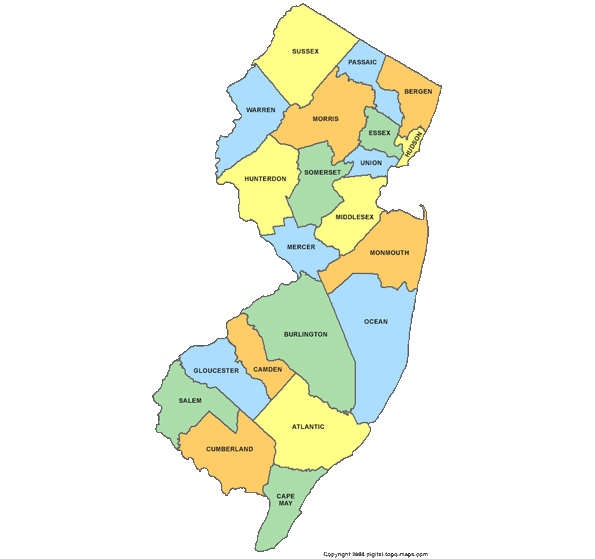
    Map courtesy of Passaic Public Library

    The recently released 2010 census data indicates that the dispersion of New Jersey population, which was underway by 1900 and continued apace in the last decade.

    New Jersey’s Larger Municipalities: This is not to suggest that it was a bad decade for the larger municipalities in the state. However, the 20th century was not kind to New Jersey’s largest municipalities. At some point during the century, six municipalities reached a population of 100,000 or more. Four of these municipalities were near the city of New York and were eventually engulfed by its suburbanization (Newark, Jersey City, Paterson and Elizabeth). Another, Camden, was engulfed by Philadelphia’s expansion and the last, the state capital Trenton, is midway between the cores of the two metropolitan areas and has more recently become a part of the New York metropolitan area.

    The new decade started out better for these municipalities. Newark, Jersey City, Elizabeth and Camden gained population between 2000 and 2010. However, even after the population gains, Newark’s population remains 165,000 (37 percent) below its 1930 peak. Jersey City remains 70,000 (22 percent) below its 1930 peak, despite the growth of a new financial district just across the Hudson River from lower Manhattan. Camden remains approximately 35,000 (37 percent) below its 1950 peak. Of the four municipalities gaining population, Camden did the best, adding 6.9 percent to its population, a full 50 percent above the statewide increase of 4.5 percent.

    Paterson and Trenton posted small population losses. Trenton remains nearly 45,000 (33 percent) below its 1950 peak (Table 1).

    Table 1
    New Jersey Municipalities Achieving 100,000 Population
    Census Population Peak
    Municipality 2000 2010 Change % Change Population Year
    Newark      273,946    277,140       3,194 1.2%     442,337 1930
    Jersey City      240,055    247,597       7,542 3.1%     316,715 1930
    Paterson      149,222    146,199      (3,023) -2.0%     149,227 2000
    Elizabeth      120,568    124,969       4,401 3.7%     124,969 2010
    Trenton        85,403      84,913         (490) -0.6%     128,009 1950
    Camden        78,672      84,136       5,464 6.9%     124,555 1950
    Total      947,866    964,954     17,088 1.8%   1,285,812
    Balance of State   7,466,484  7,826,940    360,456 4.8%
    New Jersey   8,414,350  8,791,894    377,544 4.5%   8,791,894 2010


    Elizabeth and Paterson however have been far more successful in retaining their population than other older municipalities, both in New Jersey and around the nation. Both Elizabeth and Paterson have become majority Hispanic and have a sizeable African American community. They also have a large immigrant community.  In Elizabeth, 45 percent of the population is foreign born, almost four times the national rate. Paterson has an immigrant population of 25 percent.  

    The Older Suburban Counties: Nonetheless, even with the modest population reversals in four of the five municipalities in the Philadelphia and New York metropolitan areas, their corresponding older suburban counties grew slower than the rest of the state in the 2000s. Combined, Camden, Essex, Hudson, Passaic and Union counties – fast growing suburbs of the early 1900s – grew at a rate of 1.6 percent, compared to the statewide growth rate of 4.5 percent, capturing 12 percent of the statewide growth.  (Table 2).

    Table 2
    New Jersey County Population Growth by Area
    Area 2000 2010 Change % Change Share of Growth
    5 Older Suburban Counties  2,923,130  2,969,617    46,487 1.6% 12.3%
    Balance of NY & Phila Metropolitan Counties  4,887,467  5,184,873  297,406 6.1% 78.8%
    Outside NY & Phila Metropolitan Area     603,753     637,404    33,651 5.6% 8.9%
    Total  8,414,350  8,791,894  377,544 4.5% 100.0%
    Note: 5 Older Suburban Counties Include Camden, Essex, Hudson, Passaic and Union


    The Newer Suburban Counties: The bulk of New Jersey’s growth has taken place, as in the rest of the country, in more newly suburbanizing counties of the Philadelphia and New York metropolitan areas (Note 1). The growth rate in these counties was 6.0 percent, well above the statewide growth rate of 4.5 percent. Overall, the outer suburban counties accounted for 73 percent of the state’s population growth during the 2000s. The strongest growth was in Ocean County, which is at the furthest distance (fifty to one hundred miles) from New York City.  Ocean County grew 13 percent, adding 66,000 people to its population, nearly one-fifth of the state population gain. Gloucester County, in the Philadelphia area also grew 13 percent, adding 33,000 to its population. Ocean and Gloucester accounted for more than one-quarter of New Jersey’s population growth. Only one other county added more than 50,000 people, Middlesex, which is adjacent to the New York City borough of Staten Island in New York, much of which is made up of postwar suburbanization.

    Counties Outside the Large Metropolitan Areas: The counties outside the New York and Philadelphia metropolitan area, Atlantic, Cape May, Cumberland and Warren added 5.6 percent to their population and nine percent of the state’s population gain. The largest growth was in Atlantic County (8.7 percent) and Cumberland County (6.1 percent), both adjacent to counties of the Philadelphia metropolitan area. Cape May County had the largest population loss in the state, at 4.9 percent (Essex County, where Newark is located, lost 1.2 percent, the only other county to lose population).

    Small Area Analysis: The dispersion of the population is also illustrated by "place" data, which includes incorporated municipalities (Note 2) and "census designated places."

    Generally, newer housing reflects the distance of suburbs from the urban core. Gaining a larger share of population growth, this demonstrates a primarily  suburban, rather than urban core oriented, expansion.  An analysis of the more than 500 places (municipalities and "census designated places") indicates that the greatest share of New Jersey’s growth is in new suburban areas.

    Among places in which housing has a median construction date of 1945 or earlier, there was a 0.8 percent reduction in population. The growth rate then rises with each 10 year increment, reaching 4.0 percent in places with a median construction date of 1976 to 1985 and 11.1 percent for places with a median construction date of later (though this is the smallest category).
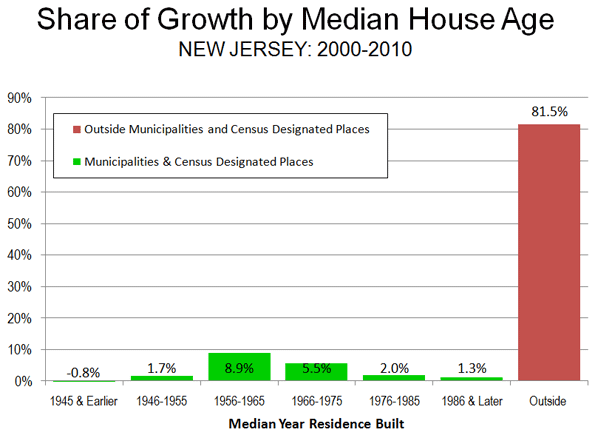
    However, the growth in these places accounts for only 18.5 percent of the state’s population gain. The other 81.5 percent was outside the incorporated municipalities and the census designated places. This population is generally in the state’s townships, some of which are older (such as North Bergen or Woodbridge), but most of which are much newer.  However, much of the growth in the townships was in newer areas, with 84 percent in areas with median construction dates of 1966 or later (Note 3)

    Thus, all-metropolitan New Jersey is becoming more suburban, while older, major municipalities such as Newark, Jersey City and Camden are enjoying a welcome respite from their generally steep declines.

    Note 1: These counties include Bergen, Burlington, Cumberland, Hunterdon, Mercer, Middlesex, Monmouth, Morris, Ocean, Salem, Somerset and Sussex.

    Note 2: New Jersey township officials have been engaged with the Census Bureau in a dispute over whether New Jersey townships should be considered incorporated. This analysis uses the "non-incorporated" status as defined by the Census Bureau, without taking a position on the nature of the disagreement.

    Note 3: The Census Bureau routinely makes changes to "census designated places" between censuses. As a result it is not possible to reconcile the township and place totals to the state total. There is a discrepancy of approximately 1.5 percent. This discrepancy is small enough to make the township figures generally reflective of the median construction dates.

    Wendell Cox is a Visiting Professor, Conservatoire National des Arts et Metiers, Paris and the author of “War on the Dream: How Anti-Sprawl Policy Threatens the Quality of Life

  • The MERS Mess

    In 1995, seeking to streamline mortgage processing, Fannie Mae, Freddie Mac, and a group of banks came together to create a new company to register and assign mortgages. The company, Mortgage Electronic Registration Systems, Inc. (MERS), served as a way for mortgage originators to quickly process new mortgages, centralizing files and cutting down on the need to deal with local government record keepers. With banks increasingly focused on bundling, securitizing, and selling off mortgages they had originated, MERS was designed to move mortgages more rapidly off their hands and into the booming mortgage-backed securities market. The goal of the process, as stated by MERS, was to simplify “the way mortgage ownership and servicing rights are originated, sold and tracked” while also eliminating “the need to prepare and record assignments when trading residential and commercial mortgage loans.”

    The business model proved wildly successful. According to the New York Times MERS now “claims to hold title to roughly half of all the home mortgages in the nation — an astonishing 60 million loans.” However, as the system boomed in an era of rampant mortgage speculation and securitization, criticism arose. Detractors, such as Professor Christopher L. Peterson of the University of Utah School of Law, argue that MERS is based on a “problematic legal doctrine,” and that by “adopting such a radical shift in how mortgages are recorded and foreclosed, without legislative change, the mortgage finance companies have rebuilt their industry on a legal foundation of sand.” According to Peterson,

    “The shift away from recording loans in the name of actual mortgagees and assignees represents an important policy change that erodes not only the tax base of local governments, but also the usefulness of the public land title information infrastructure. MERS did not, by itself, cause the mortgage finance crisis and its ensuing aftermath. But it was an important cog in the machine that churned out the millions of unsuitable, poorly underwritten, and incompletely documented mortgages that were destined for foreclosure.”

    As foreclosure rates have risen, so have legal challenges to the role of MERS in the process. Such cases have, among other issues, questioned the right of MERS to act as the “mortgagee of record,” and to initiate foreclosure proceedings. Results have been mixed. Judges in California, Massachusetts, and Kansas have ruled that MERS “has the authority to initiate home foreclosure proceedings.” MERS itself points to rulings in several other states that it claims show it stands on solid legal ground. However, courts in New York, Florida and Oregon have ruled otherwise, with multiple rulings in Oregon throwing a wrench into the foreclosure market in the state. MERS, in an apparent attempt to clear up issues of standing in foreclosure proceedings,recently began encouraging its members to stop making foreclosures in its name, and is now proposing new rules to curtail the practice.

    Some local governments are also exploring potential legal and legislative investigatory proceedings against MERS, upset at the banking industry’s use of MERS to avoid paying local recording fees for mortgages. Given the dire state of state and local budgets, and the unpopularity of the financial industry, it bears watching to see if more local governments follow their lead in an attempt to recoup a source of funding that was previously theirs. MERS and its financial industry backers appear to be girding themselves for coming legislative battles, launching “an aggressive campaign on Capitol Hill to bolster the legality of the way companies have turned mortgages into securities.” With housing markets already on shaky ground, and talk of a double dip in prices beginning to surface, the uncertain future of MERS and the mortgages it holds is yet more potentially bad news for areas struggling to recover from the housing bust.

  • The Protean Future Of American Cities

    The ongoing Census reveals the continuing evolution of America’s cities from small urban cores to dispersed, multi-polar regions that includes the city’s surrounding areas and suburbs. This is not exactly what most urban pundits, and journalists covering cities, would like to see, but the reality is there for anyone who reads the numbers.

    To date the Census shows that  growth in America’s large core cities has slowed, and in some cases even reversed. This has happened both in great urban centers such as Chicago and in the long-distressed inner cities of St. Louis, Baltimore, Wilmington, Del., and Birmingham, Ala.

    This would surely come as a surprise to many reporters infatuated with growth in downtown districts, notably in Chicago, Los Angeles, Denver and elsewhere. For them, good restaurants, bars and clubs trump everything. A recent Newsweek article, for example, recently acknowledged Chicago’s demographic and fiscal decline but then lavishly praised the city, and its inner city for becoming “finally hip.”

    Sure, being cool is nice, but the obsession with hipness often means missing a bigger story: the gradual diminution of the urban core as engines for job creation. For example, while Chicago’s Loop has doubled its population to 20,000, it has also experienced a large drop in private-sector employment, which now constitutes a considerably smaller share of regional employment than a decade ago. The same goes for the new urbanist mecca of Portland as well as the heavily hyped Los Angeles downtown area.

    None of this suggests, however, that the American urban core is in a state of permanent decline. The urban option will continue to appeal to small but growing segment of the population, and certain highly paid professionals, notably in finance, will continue to cluster there.

    But the bigger story — all but ignored by the mainstream media — is the continued evolution of urban regions toward a more dispersed, multi-centered form. Brookings’ Robert Lang has gone even further, using the term “edgeless cities” to describe what he calls an increasingly “elusive metropolis” with highly dispersed employment.

    Rather than a cause for alarm, this form of  development  simply reflects  the protean vitality of American urban forms.  Two regions, whose results were released last week, reveal these changing patterns. One is the Raleigh region, which has experienced a growth rate of 42%, likely the highest of the nation’s regions with a population over 1 million. This metropolitan area, anchored by universities and technology-oriented industries, is among the lowest-density regions in the country, with under 1,700 persons per square mile, slightly less than Charlotte, Nashville and Atlanta.

    Unlike the geographically constrained older urban areas, Raleigh’s historical core municipality experienced strong growth, from 288,000 to 404,000, a gain of 40%. This gain was aided by annexations that added nearly 30% to the area of the municipality (from 113 to 143 square miles). The annexations of recent decades have left the city of Raleigh with an overwhelmingly suburban urban form. In 1950, at the beginning of the post-World War II suburban boom, the city of Raleigh had a population of 66,000, living in a land area of only 11 square miles.

    Even here, however, the suburbs (the area outside the city of Raleigh) gained nearly two-thirds of the metropolitan area growth (65%) and now have 64% of the region’s population. Over the last ten years, the suburbs have grown 43%. It is here that much of the economic growth of the Research Triangle has taken place, as companies concentrate in predominately suburban communities such as Cary.

    Yet in most demographically healthy urban regions, the growth continues to be primarily in the suburban centers. One particularly relevant example is the Kansas City area, a dynamic region anchoring what we have identified as “the zone of sanity.” Like most American regions, the Kansas City area is growing, but in ways that often do not resemble the fantasies of urban density boosters.

    KC’s growth pattern is important and could be a harbinger of what’s to come in this decade. Along with Indianapolis, this resurgent Heartland region is expanding faster than the national average. It is also attracting many talented people, ranking in our top ten list of the country’s “brain magnets,” a performance better than such long-standing talent attractors as Seattle, Portland, San Francisco, and Boston. Between 2007 and 2009, the Kansas City region’s growth in college-educated residents was more than twice the rate of our putative intellectual meccas of New York, Chicago or Los Angeles.

    But despite the wishes of some  in Kansas City’s traditional establishment, this cannot be interpreted as meaning that  the “hip and cool” are being lured en masse to the city’s inner core. Over the past decade, as in most American regions, Kansas City has expanded far more outward than inward. Despite a modest increase in the city’s population of some 18,000 — much of it in the city’s furthest urban boundaries — the city’s population remains below its 1950 high. On the other hand, some 91% of its 200,000 population increase occurred in the suburban periphery.

    Critically, it is important to note that this expansion reflects not so much the growth of “bedroom” communities, but a dramatic shift of employment to the periphery. By far the most important center for this new suburban growth in jobs and people lies across the river in Johnson County, Kan.. Over the past decade, Johnson County has accounted for roughly half of the region’s total growth.

    Johnson County  – which boasts among the highest levels of educated people in the country — also has become the primary locale for many technology and business service firms, with more people commuting into the area than out. This reflects an increasingly suburbanized economic base. Over the past decade the urban core of Jackson County has lost 42,000 jobs, while the surrounding suburbs have grown by 20,000, with the biggest growth in largely exurban Platte County.

    So what does this tell us about the future of the American urban region?  Certainly the expansion of relatively low-density peripheral areas negates the notion of a  ”triumphant” urban core. Dispersion is continuing virtually everywhere, and with it, a movement of the economic center of gravity away from the city centers in most regions.

    But in another way these patterns augur a bright future for an expansive American metropolis that, while not hostile to the urban center, recognizes that most businesses and families continue to prefer lower-density, decentralized settings.  The sooner urbanists and planners can accommodate themselves to this fact, the sooner we can work on making these new dynamic patterns of residence and employment more sustainable and livable for the people and companies who will continue to gravitate there.

    This piece originally appeared at Forbes.com

    Joel Kotkin is executive editor of NewGeography.com and is a distinguished presidential fellow in urban futures at Chapman University, and an adjunct fellow of the Legatum Institute in London. He is author of The City: A Global History. His newest book is The Next Hundred Million: America in 2050, released in February, 2010.

    Kansas City skyline photo by Tim Samoff

  • What India Hands to the World

    Yoga. Mantras. Bollywood. Henna tattoos. Once unique to India, each of these has now become commonplace in households across the globe. As a first generation East Indian American, I’ve had an opportunity to contrast the world my parents experienced with the one I inhabit. When my parents first settled here in the 1980s Indian cultural influences were not this prominent, but the increases in America and around the globe have been dramatic.

    Any gym is bound to teach a yoga class. Popular exercise regimens such as Pilates have been influenced by ancient Indian spiritual exercises. During a recent study abroad trip to Goiania, a medium sized city in the Brazilian countryside, I was surprised to encounter yoga classes, and many of my Brazilian classmates wanted to learn Yoga from me.

    Bhangra, a North Indian folk dance, has been incorporated into gym workouts. Sarina Jain, the Indian American creator of The Masala Bhangra Workout, says she’s “the first to bring Indian dance to the U.S. fitness industry at a global level.” The DVD has been named one of the five hottest workouts by America Online.

    Meditation, similarly, has become widely popular. This ancient Vedantic technique to reach inner peace has been popularized by Indian gurus who have spread the practice throughout the West; one transcendental meditation organization claims to have taught more than 50,000 students across the United States, Latin America and Africa during the past two years alone. The bestselling book (and then film) “Eat, Pray, Love” has further popularized the use of meditation to tame the mind. Julia Roberts, who plays the protagonist in the film, even identifies herself as a Hindu who regularly meditates.

    Other Vedantic influences on daily life include reciting mantras, and the popularization of words such as “guru” and “pundit” to describe people with expertise. The idea that all of your actions, whether good or bad, produce consequences that shape your future is a common theme in many cultural value systems, but the term “karma” captures that concept in one word and has become used throughout the English-speaking world, as well as elsewhere.

    Billions of people around the world also value the concept of ahimsa — non-violence — as popularized by Mahatma Gandhi. His ideas strongly influenced Martin Luther King Jr. Ahmisa also explains why many Hindus and Jains are vegetarians The belief that what you eat affects your behavior, and that a vegetarian diet can help tame the mind, has been popularized worldwide by Indians, who are known for their exquisite vegetarian cuisine.

    Worldwide, flavorful Indian spices and seasonings have increased the appeal of vegetarian food. India produces over four million tons of spice, and exports around 180 spice products to over 150 nations. The Indian Spice Board is currently planning to set up three promotional centers in, respectively, Dubai, Chicago and Europe.

    Spices are also of special interest in the alternative health community, where they are viewed as anti-inflammatory agents, that can help the aging brain and play a role in cancer prevention. Turmeric and several other spices are part of the Indian Ayurvedic system. Ancient Indian epics like The Ramayana reference Ayurveda, a holistic approach to health that fuses the forces of mind, body, senses and spirit. Today, about thirty companies are leading the way, with a million dollars or more per year in business to meet the growing demand for Ayurvedic medicine. The larger Ayurvedic medicine suppliers have also moved into the businesses of toiletries —soap, toothpaste, shampoo — which use traditional herbal ingredients.. For example, L’Oreal has been reported to be looking into purchasing an Indian Ayurvedic skin care brand, and companies like Estée Lauder have created their own Ayurvedic spa treatments.

    But even more wide-spread is India’s music and dance scene. The sitar, first popularized in the US by Ravi Shankar, has been used by artists from the Beatles to Janet Jackson. The most powerful Indian cultural export, though, has long been its film industry, nicknamed Bollywood, which is generally believed to produce the largest number of feature films in the world. Bollywood makes more ticket sales than Hollywood does, though revenue figures are much higher for the latter Sometimes dubbed in local languages, these films, filled with colorful costumes, dances, music, and love stories are watched in Kuwait, Nigeria, Russia, Scandinavia, the Caribbean and even Fiji.

    Through television, Brazil has been particularly touched by India. Brazil’s 2009 Emmy Award-winning telenovela (soap opera), Passage to India, introduced Indian culture there on a broad scale. As an Indian traveling through Brazil, almost every person I met asked whether I watched the show. Even in Cavalcante, a remote area, a truck driver knew that the cow is considered sacred in India, and was newly aware of the Indian custom of arranged-marriage.

    Another result of the show’s popularity has been that Brazilians are now fascinated by Indian clothing. I noticed malls consistently had at least one Indian themed store selling kurti tops – Indian style blouses which are popularly worn over skinny jeans or tights. I also saw men wearing t-shirts with pictures of Indian Gods and Goddesses, and saw them printed on swim suit cover ups. Of course, you rarely see Indians wearing this kind of garment, since, many consider these displays on clothing to be somewhat offensive.

    There are many other aspects of Indian culture that have spread on a global scale. From curries to computer programs, self-realization to the arts, and well beyond, we are seeing its influence. The popular Indian art of using henna to create beautiful body designs and patterns only temporarily affects the surface of the skin. But the influence of India is likely to leave a permanent — and positive —impact on the world.

    Photo from Travelscope

    Sheela Bhongir is an undergraduate student at California State University, Northridge studying Urban Studies and GIS. She is working as an intern on Legatum’s new map of the world project.