Blog

  • Maglev-Jitney Could Revolutionize Mass Transit

    Using EDS suspension developed in Germany with Halbach array magnets, mini-maglev jitneys are a new technology that could transform congested corridors of Orlando. The train car itself is small – only 8’ wide x 30’ long – and holds approximately 12 sitting people and 8 or 9 standing people. But the ability of the train to zip along the centerline of crowded arteries like 17-92 and 50, and future tracks along secondary strips within the region, could give people a new way to travel.

    Silent, with no moving parts, the electrodynamic maglev can ride along a guideway buried in the center of the road. Depressions for the jitney’s levitation magnets are shallow enough to drive over, making maglev tracks no more an obstacle than railroad crossings. Within cities like Portland, electric streetcars with clicking and buzzing pantographs are the norm, and drivers, pedestrians, bikers, and buses all coexist within a narrow public street. Here in Orlando, the pantograph, exposed to hurricanes, would be a liability, and the maglev instead presents a safer, more reliable transit system of the future.

    How does it work? The train rests on tires at each stop, but as it accelerates past walking speed, powerful permanent magnets in the chassis lift it up off the guideway. Solid magnets in the guideway present an opposing force (really, the same pole is offered to the jitney’s undercarriage, pushing it forward and away). Electric power is present only immediately underneath the vehicle’s footprint, making the guideway a benign, inert force within the busy roadways in the city.

    The car itself is a “smart” car, with no driver needed – a GPS-controlled computer stops and starts the car, with motion detectors delaying it briefly while passengers get on and off. As the car glides along, the photovoltaic roof powers the car’s air conditioners, lights, wi-fi system, and other devices. If the car breaks down, it simply comes to rest on its wheels, and it can be towed to safety within minutes.

    But maglev technology, already in use for decades in France, Germany, Japan, and China, is already outstripping older technology in safety and reliability. These older systems went for speed, making for very large, heavy trains travelling in excess of 300 mph.

    The mini-maglev, by contrast, will feature headways within minutes of each other – if you miss one, another will be along in 10 minutes or less in peak times. Bike racks in front and back allow you mobility once you reach your stop, and since they are designed for short trips, the cars are designed for standing as well as seated passengers. A full 360◦ glazed car will allow views in and out – making the trip pleasant, safe, and enjoyable.

    Whispering along at conventional traffic speeds, mini-maglevs offer the busy commuter an option that is convenient, reliable, and beautiful. These jitneys are life-enhancing features that will set Orlando apart from other cities in terms of sense-of-place. Neither a 19th century train nor a 20th century bus, the mini-maglev borrows a transportation concept from the islands – the jitney – and recognizes our region’s multipolar, fine-grained circulation system already in place. Instead of fighting this system with a heavy steel-wheel rail system on 19th century rails like Sunrail, it simply enhances existing corridors.

    Jitneys roam many Caribbean islands, gathering workers around the villages and transporting them into the resorts and the towns in packets of 10 or 15 passengers a vehicle. Frequent stops make them more like large-scale vanpools rather than small-scale buses, and they act as the connective tissue among the spread-out villages and settlements in which islanders dwell.

    The spirit of the jitney is transformed by 21st century technology into a transit system serving the needs of a spread-out, dense region like Orlando. Let’s face it: while driving, we are highly tempted to chat on the telephone, text, or do many other things other than drive. Waiting at red lights or stopped in traffic jams, the pleasure that once was driving has now receded all too frequently in favor of frustration, anger, and fatigue. We sense the lost time behind the wheel, seeking to make up for some of it with mobile communication, but this has an external price to pay: the driver ahead misses the green light because he is texting, making your trip longer as well.

    In the mini-maglev future, the distance and time are unchanged; what has changed is your freedom while you travel. Getting there will be fun again, and arriving in a mini-maglev jitney will be the new way to make an entrance.

    Electronic Jitney farecards will make paying for the ride super-easy, and if you have any question about the route, timetable, or stops, fear not: your smart phone app will show you where you are going, where you want to get off closest to your stop, and map out how to get there from here. It will also helpfully show you what is coming up along your path: A library, your friend, a Starbucks…

    And, for frequent riders, a feature long desired by mass transit commuters worldwide: on-call jitneys. Frequent riders will be able to electronically request a jitney at their desired stops, making these computer-controlled cars come to you. Getting off work late no longer means a lengthy nighttime wait for a taxi, or the next bus not due for another hour. You can request the car, and the farecard will give you back a message instructing you when and where to show up. With computer-controlled routing, mass transit is now more individually customizable than ever.

    The mini-maglev jitney, combined with personal electronic systems, transforms mass transit from a Victorian burden on cities into a sexy, hip way to get where you need to go.

  • Britain’s Housing Crisis: Causes and Solutions

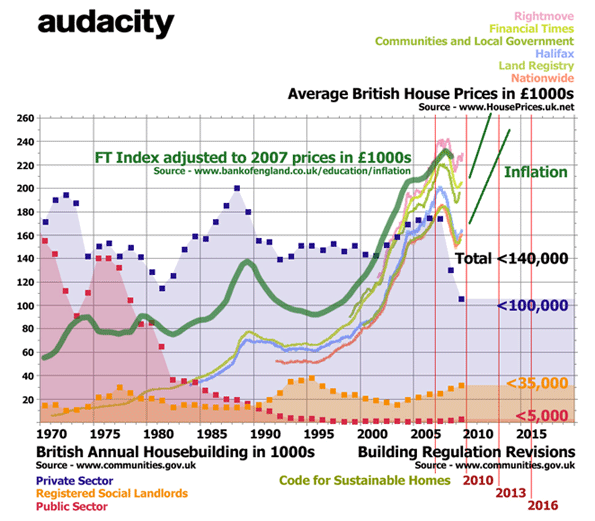
    British house construction has remained at a low level for a decade.   Total new house and flat completions for all tenures last year were 113,670 for England, 17,470 for Scotland, and 6,170 for Wales. Excluding Northern Ireland that is 137,310 for Britain. Under 140,000 homes a year is low for a nation of 60 million.

    We are nearly at the lowest level of housing production since reliable records began in the 1920s. (Note 1)  

    Anyone expecting British house building to pick up soon will be disappointed, even as the housing market inflates into another bubble. Grant Shapps,  the Coalition government’s Housing and Local Government Minister, is also hoping that house price inflation will not return to make the present housing predicament worse.  

    He will be disappointed, too. Shapps wants modest deflation and more houses to be built. However, he is powerless to make that happen while his government sustains the national denial of Freehold development rights that in Britain defines the planning system. By denying landowners the right to build on any land they own, the system works against significant levels of housing production.

    The renewal of house price inflation

    The low level of production all but guarantees renewed house price inflation. According to estate agency Savills, inflation-adjusted house prices grew by 68 per cent in the decade up to 2010, even after the British housing market finished wobbling during the sub-prime mortgage finance crisis. Savills told readers of The Telegraph that house prices will inflate by 40 per cent in real terms over the next decade.  

    Britain’s vast majority of home owners will be relieved. Most people have felt uneasy with financial dependency on the debt and equity in their home. For most British households wages and pensions are insufficient.

    At the root of the problem lies the peculiar nature of Freehold in Britain. The government enjoys an effective national instrument in their effort to protect the housing market. An old innovation of the post-war planning system, this ensures cheap farm land can never come onto the market to allow the building of low cost homes in great volume, sufficient to precipitate a housing market crash worth having. Planning as a denial of development rights works very well to protect the members of the Council of Mortgage Lenders.

    This keeps house building volume low.   Britain’s former volume house builders have begun to make the painful adjustment to work within the Coalition’s planning system. It will not be easy for them.

    The national denial of development rights is sustained, and in many ways the problem is worse under the Conservative-led coalition than under New Labour.

    The house builders have been stripped of New Labour’s national target of 240,000 net additional homes a year, but that was an unmet and inadequate target.   Even more troubled are plans to develop 50 proposed “eco towns” also proposed by Labour, itself a small, even deluded, enterprise that is pathetic compared to development elsewhere in the world.

    Urban expansion and new settlements – whether in Britain or elsewhere – require land. And Britain, contrary to popular belief has land aplenty. The restraints placed on builders can best to described in the words of Sir Peter Hall, as a “Land Fetish”.   

    The planning system also is host to an eco-fetish that the Coalition appears willing to sustain regardless of housing need.

    Inevitably some house builders will have subscribed to the idea that the environment is too precious to allow much land to be developed, but not all.  This leaves no centralised attempt to satisfy the demand for new household formation following from population growth, the needs of immigrants, or to encourage the replacement of the worst housing stock. For greens of the more misanthropic persuasion, opposition to both population and production makes sense. They don’t want humanity to reproduce either biologically or industrially. They don’t want a world that is always about advancing human interests through industry.

    Yet the need for new homes won’t so easily go away.

    A three sided predicament

    This contemporary British housing trilemma will not be easily resolved. The country seems to accept expensive, inadequate housing and mortgage debt as a fact of life.  

    Yet this leaves us with no solution for future needs.

    Something needs to change.  Hugh Pavletich and Wendell Cox publish as Demographia have found – for the seventh year running – increasing unaffordability of British housing.  

    The Solution: 250 New Towns

    The only reasonable solution is to tear down the current planning structure. What we need is an audacious move to build some 250 new towns.

    This movement would try to replicate past successes. In the brief inter-war period, 1918 to 1938, popular owner occupation flourished, with economically struggling farmers keen to sell their Freehold land to house builders.  

    How long will Britain live with low levels of construction, increasingly higher prices and consistently low levels of affordability? The increasing drag of house price inflation on household incomes and the acceptance of poor quality British housing in short supply cannot be sustained indefinitely.  

    How long will Britain sustain housing unaffordability as a financial opportunity, protected by a weak government?  

    The British collective obsession with inflating house prices must end sometime, unless we are to lose all sense of housing primarily as somewhere useful to live.  

    The freedom to build on your own land will deflate the housing market, dramatically in some locations.  Giving all landowners their Freehold right to build will liberate the commercial construction industry from the burden of inflated land prices, allowing disruptive advances in industrial production.  

    If Britain faces the house price inflation projected by Savills in the next 10 years there are many home owners dependent on housing equity who will not object. Neither will the house builders object too much as they build a low number of luxury eco-homes, to the undoubted applause of the architectural press. They may enjoy the praise for their greenness. Farmers might subsist as environmentalists. Greens will be sufficiently deluded to imagine there was some point to all this. The City will make a healthy return.

    The green zealots are conspicuous, and need to be confronted by industrialists with a sense of humanity. Now is no time to let them get away with their anti-humanism.

    Britain certainly is capable of more than is currently being discussed. National housing output had peaked in 1968 at 413,714, more than twice the current rate.

    We have to answer the question: Who will organise to better explain and end the housing predicament in low wage industrial Britain? We are hoping the 250 new towns club can start the ball rolling.

    —-

    Note 1 – Marian Bowley, ‘Table 2, Numbers of Houses Built in England and Wales between January 1, 1919 and March 31, 1939’, in Housing and the State 1919-1944, London, George Allen & Unwin, 1945, p 271

    Ian Abley, Project Manager for audacity, an experienced site Architect, and a Research Engineer at the Centre for Innovative and Collaborative Engineering, Loughborough University. He is co-author of Why is construction so backward? (2004) and co-editor of Manmade Modular Megastructures. (2006) He is planning 250 new British towns.

  • Obama’s High-Speed Rail Obsession

    Perhaps nothing so illustrates President Obama’s occasional disconnect with reality than his fervent advocacy of high-speed rail. Amid mounting pressure for budget cuts that affect existing programs, including those for the inner city, the president has made his $53 billion proposal to create a national high-speed rail network as among his top priorities.

    Our President may be an intelligent and usually level-headed man, but this represents a serious case of  policy delusion. As Robert Samuelson pointed out in Newsweek, high-speed rail is not an appropriate fit for a country like the U.S. Except for a few areas, notably along the Northeast Corridor, the U.S. just lacks the density that would make such a system work. Samuelson calls the whole idea “a triumph of fancy over fact.”

    Arguably the biggest problem with high-speed rail is its extraordinary costs, which would require massive subsidies to keep operating. Unlike the Federal Highway Program, largely financed by the gas tax, high-speed rail lacks any credible source of funding besides taxpayer dollars.

    Part of the pitch for high-speed rail is nationalistic. To be a 21st century super power, we must emulate current No. 2 China. But this is a poor reason to indulge in a hugely expensive program when the U.S. already has the world’s most evolved highway, freight rail and airline system.

    Also, if the U.S. were to follow the Chinese model, as some have suggested, perhaps it should impose rule from a Washington version of a centralized authoritarian government. After all, dictatorships are often quite adept at “getting things done.”  But in a democracy “getting things done” means balancing interests and efficiencies, not following orders from above.

    In China high-speed rail is so costly that the trains are too expensive for the average citizen. Furthermore, construction costs are so high the Chinese Academy of Sciences has already warned that its debts may not be payable. This experience with ballooning costs and far lower fare revenues have raised taxpayer obligations in Taiwan and Korea and added to heavily to the national debt in Japan.

    The prospect of mounting and uncontrollable costs has led governors to abandon high-speed projects  in Ohio, Wisconsin and most recently Florida, where a battle to save the Tampa-Orlando line has begun . In times of budget stress, the idea of building something new, and historically difficult to contain by costs, becomes a hard sell.

    Oddly, the leaders of California, faced with one of the worst fiscal positions in the country, are determined to spend several billions on what Sacramento Bee columnist Dan Walters has dubbed a “train to nowhere” for 54 miles between Madera and Corcoran — two unremarkable and remote Central Valley towns. The proposal makes the former Alaska Sen. Ted Stevens’ notorious ”bridges to nowhere” project seem like frugal public policy.

    California’s train to nowhere has been justified as part of wider project to construct a statewide system. But the whole idea makes little financial sense: The University of California’s Institute for Transportation describes the high-speed proposal as based on an “inconsistent model” whose ridership projections are simply not “reliable.”

    Equally suspect are cost estimates, which have doubled (after adjustment for inflation) from 1999 to $42.6 billion last year and. A new study says that the project could currently cost close to $65 billion. Costs for a ticket from Los Angeles to San Francisco, originally pegged at $55 one way, had nearly doubled by 2009, and now some estimates place it at about to at least a $100 or perhaps much as $190 — considerably more than an advanced-purchase ticket on far faster Southwest Airlines.

    There’s growing political opposition to the system as well, and not just among penny-pinching right-wingers. Residents and local officials in the San Francisco Peninsula, a wealthy and reliably liberal portion of Silicon Valley, largely oppose plans to route the line through their communities. This includes some prominent liberal legislators, such as San Mateo’s Assembly Jerry Hill, who has threatened to put high-speed rail back on the ballot if costs start to surpass initial estimates. Another Democrat, California Treasurer Bill Lockyer has doubts that the rail authority will be able to sell the deal to potential bond-buyers   due in part to a lack of consistent estimates in ridership or cost.

    So why is Obama still so determined to push the high-speed boondoggle? Largely it’s a deadly combination of theology and money. Powerful rail construction interests, notably the German giant Siemens, are spreading cash like mustard on a bratwurst to promote the scheme. Add to that construction unions and the ever voracious investment banks who would love to pocket fees for arranging to sell the bonds and you have interests capable of influencing either party.

    Then there’s what might be called the “density lobby” — big city mayors, construction firms  and the urban land owners. These magnates, who frequently extort huge public subsidies for their projects, no doubt think it grand to spend billions of public funds on something that might also increase the value of their real estate.

    And finally there are the true believers, notably planners, academics, green activists and an army of rail fans. These are people who believe America should be more like Europe — denser, more concentrated in big cities and tied to the rails. “High speed rail is not really about efficient transport,” notes California transit expert and accountant Tom Rubin. “It’s all about shaping cities for a certain agenda.”

    Yet despite their power, these forces face mounting obstacles. As transportation expert Ken Orski points out, the balance of power in the House now lies with suburban and rural legislators, whose constituents would not benefit much from high-speed rail. And then there are governors, increasingly Republican and conservative, very anxious not to add potentially huge obligations to their already stressed budgets.

    The most decisive opposition, however, could come from those who favor transit spending but understand to the need to prioritize.  High-speed rail is far more expensive than such things as fixing current commuter rail and subways or expanding both public and private bus service. Indeed, the money that goes to urban rail often ends up being diverted from other, more cost-effective systems, notably buses.

    The choice between high-speed rail and more conventional, less expensive transit has already been presaged in the fight against expanding LA’s expensive rail system by organizations representing bus riders. These activists contend that rail swallows funds that could be spent on buses

    Much the same case is being made the San Francisco peninsula. The opponents of high-speed rail on the San Francisco Peninsula are outraged that the state would spend billions on a chancy potential boondoggle when the popular Caltrain commuter rail service is slated to be curtailed or even eliminated.

    One can of course expect that anti-spending conservatives will be the biggest cheerleaders for high-speed rail’s decline. But transit advocates may be forced to join the chorus of opposition, in order to steer   transit spending towards more basic priorities as buses in Los Angeles, subways in New York or commuter rail in the San Francisco Bay Area.

    In an era of tough budgets, and proposed cutbacks on basic services, setting sensible transportation priorities is crucial. Spending billions on a conveyance that will benefit a relative handful of people and places is not just illogical. It’s obscene.

    This piece originally appeared in Forbes.

    Joel Kotkin is executive editor of NewGeography.com and is a distinguished presidential fellow in urban futures at Chapman University, and an adjunct fellow of the Legatum Institute in London. He is author of The City: A Global History. His newest book is The Next Hundred Million: America in 2050, released in February, 2010.

    Photo: Center for Neighborhood Technology

  • Tampa to Orlando High Speed Rail: The Risk to Local Taxpayers

    No sooner had Florida Gov. Rick Scott rejected federal funding for the Tampa to Orlando high-speed rail line, than proponents both in Washington and Tallahassee set about to find ways to circumvent his decision. While an approach has not been finalized, a frequently suggested alternative is to grant the federal money to a local government, such as a city or county or even to a transit agency.

    Eliminating State Taxpayer Risks, Creating Local? In an announcing his decision, Governor Scott cited the substantial risks to Florida taxpayers from cost overruns, the ongoing obligation under the federal grant to subsidize operations and the fact that under certain circumstances Florida might even have to repay the $2.4 billion in federal grants. Any local government accepting the federal money would expose itself to the financial risks from which Florida taxpayers have been exempted by Governor Scott’s action.

    None of these risks is an idle threat.

    (1) Capital Cost Overruns: Based upon the international experience, the eventual construction cost overruns for the Tampa to Orlando high-speed rail line could easily run to $3 billion, more than doubling the price of the project (Note on Extent of Taxpayer Liability, below). In light of the recently reported 50 percent increase in California high-speed rail construction costs, even the $3 billion estimate could turn out to be conservative. The problem is that any local federal grant recipient (city, county or transit district) would be responsible for these cost overruns.

    (2) Ongoing Operating Subsidies: The ridership projections for the Tampa to Orlando high-speed rail line are exceedingly optimistic. This could well lead to a situation in which substantial subsidies are necessary to operate the trains, despite claims of proponents to the contrary. These subsidies would be the responsibility of any city, county or transit district that becomes a grant recipient.

    (3) Federal Pay-Back: If, for any reason, the eventual high-speed rail service levels are not sufficiently high because of lower than projected ridership or if service is canceled, any city, county or transit district could be required to return the $2.4 billion in federal grants. Florida is already paying millions annually for a similar "transgression." In 2009, service reductions on the Tri-Rail Commuter Rail System in the Miami area led the Obama Administration’s Department of Transportation to demand repayment of one quarter billion dollars in grants. Tri-Rail was saved from this obligation only by a multimillion dollar Tallahassee bailout. Proponents have claimed that this rail obligation could be negotiated away for high-speed rail. Why was the Tri-Rail obligation not negotiated away in 2009?

    By rejecting the federal funding, Gov. Scott has inoculated Florida taxpayers against these risks.

    However, there would be no inoculation for any local jurisdiction whose commissioners or city council accepted the expensive "gift" of federal funding for the high speed rail line. Their taxpayers would have to pay. The very financial viability of any such jurisdiction could be at risk.

    The Risk Could Revert to State Taxpayers: Eventually, the risk could be again be visited upon state taxpayers as a local government facing virtual bankruptcy would doubtless seek a bailout in Tallahassee, repeating the Tri-Rail experience, though much more expensively. Moreover, canceling a half built project, which might be tempting as costs escalate above projections, would simply not be viable. The political pressure to complete the project, at whatever cost, could prove to be overwhelming.

    Delusions About Private Responsibility for Cost Overruns: Some proponents claim that these huge obligations can be somehow transferred to the private builder/operator that is selected for the project. Nothing like this has ever happened in public-private partnerships around the world, and for good reason. Companies do not stash away billions of dollars for cost overruns.

    Further, the winning bidder will be a consortium of other companies, established with limited liability by larger companies. The consortium would abandon a project it could not afford sooner rather than later. Any bankruptcy of the builder/operator would be limited to the consortium and would not extend to the parent companies, leaving the local taxpayers to pay.

    There is no escaping the fact that the taxpayers of any city or county accepting the federal money would be providing financial guarantees to an international infrastructure industry that has left a "train" of huge and unanticipated financial obligations around the world in its wake (Note on Cost Escalation, below).

    Believing in Santa Claus? Public officials, and most recently Orlando Mayor Teresa Jacobs, have indicated support for high-speed rail if private and federal funds pay for it, and state and local taxpayers aren’t exposed to liability. This is a wise position, but untenable. Expect Santa Claus to arrive in the midst of a Florida summer before that, with a sleigh full of billions.

    —-

    Note on Extent of Taxpayer Liability: This $3 billion is in addition to the already committed $280 million of taxpayer funding. Proponents of the high-speed rail line have assumed that the $280 million would be the limit of taxpayer obligations. As this article shows, the $280 million could be a "drop in the bucket" compared to the likely eventual taxpayer liability.

    Note on Cost Escalation: An international team of researchers led by Oxford University Professor Bent Flyvbjerg has found in Megaprojects and Risks: An Anatomy of Ambitionthat similar projects routinely cost far more than taxpayers and other funders are told. They also attract fewer riders and generate less revenue (which can require operating subsidies). The Flyvbjerg team implies that these "lowball" (our term) projections are not accidental but all are the result of "strategic misrepresentation," (their term) which project promoters employ to increase the potential that projects will be approved. The researchers also refer to "strategic misrepresentation" as "lying," which is an exceedingly strong term for academic research and is reflective of the strength of the conclusions.

  • The Evolving Urban Form: Seoul

    Based upon the preliminary results of the South Korea 2010 census, Seoul has become the world’s third largest metropolitan area. The jurisdictions making out the metropolitan area, the provincial level municipality of Seoul (which is the national capital), the province of Gyeonggi and the provincial level municipality of Incheon now have a population of approximately 23.6 million people. This is third only to Tokyo – Yokohama, which has a population of approximately 40 million and Jabotabek (Jakarta), which is approaching 30 million. While international metropolitan area population estimates should be taken with a "grain of salt," (Note 1: Metropolitan Areas) the rise of Seoul is nearly unprecedented in the high-income world. Further, many more people are projected to move to the Seoul metropolitan area as the trend of rural and smaller area migration to larger urban areas continues.

    A Difficult History: However, any analysis of Seoul and its progress must begin in the context of the overall economic progress of South Korea and its difficult history.

    Seoul was a major battleground in the Korean War of 1950 to 1953. During 1950 alone, military control of the municipality of Seoul changed hands four times. Today, despite the precariousness of the political situation on the Korean Peninsula, the northern suburbs of Seoul are as close as four miles (seven kilometers) from the demilitarized zone, which forms the border with North Korea. 

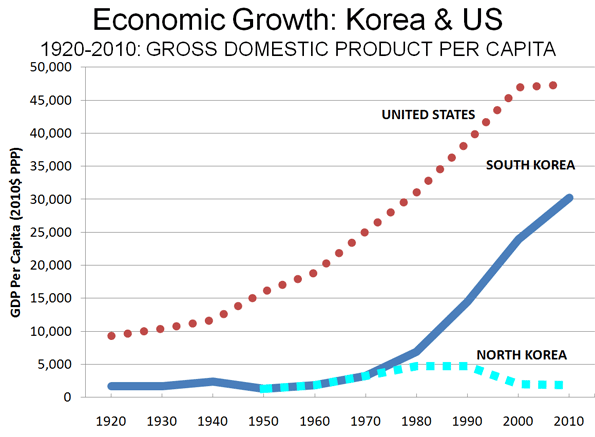
    Strong Economic Growth: A very poor country even before the war, South Korea has been an economic success story. Based upon data produced for the Organization for Economic Cooperation and Development by the late economist Angus Maddison, South Korea had a gross domestic product per capita (purchasing power parity) of less than $1300 (2010$) in 1950. It had peaked, as a Japanese colony, somewhat above that level before World War II, but never approached one quarter of the GDP per capita of the United States and averaged less than one third of then high income Argentina.

    After the Korean War, initial economic progress was slow. As late as 1965, South Korea’s GDP per capita was less than that of Mozambique. Since that time, South Korea’s GDP per capita has risen from approximately $2000 to $30,200 in 2010 It exceeded Argentina in the 1980s.  

    South Korea today has a higher GDP per capita than Spain and New Zealand and less than 10 percent behind the European Union, on which it is gaining quickly. As the capital, the Seoul is a prosperous metropolitan area in a prosperous country.

    South Korea’s prosperity is also considerable contrast to that of North Korea’s. South Korea’s GDP per capita is more than 15 times that of North Korea (Figure 1). This would make any future reunification far more expensive for South Korea then Germany’s unification was for West Germany, because the economic disparity, though substantial, was much less.
    The Urban Area: Growing and Dense: The Seoul urban area (area of continuous development) includes the municipality of Seoul and also includes the urbanization of Incheon, to the west and substantial suburban development in the province of Gyeonggi on the other three sides (Note 2: Urban Areas). Based upon an analysis of data from the 2010 census, we have estimated the Seoul urban area population at 22.5 million. The next edition of Demographia World Urban Areas: Population & Projections (current edition) will show Seoul to be the world’s third largest urban area, trailing only Tokyo-Yokohama and Delhi (which recently passed Mumbai to become India’s largest urban area). Jakarta, the second largest metropolitan area, ranks as the fourth largest urban area, though will soon pass Seoul, because of much stronger growth. Among high income world urban areas, Seoul’s population growth has been greater than that of any other since 1950 except for Tokyo-Yokohama. Seoul added more than 20 million people, while Tokyo-Yokohama added more than 25 million people. By comparison, New York added less than 10 million people and Paris added 4 million people.

    Seoul’s population density is among the highest of the world’s affluent urban areas. With population density of 27,000 people per square mile (10,400 per square kilometer), Seoul ranks second in the high income world among urban areas of more than 5 million people, trailing only Hong Kong, which is more than twice as dense. Thus, Seoul is more than twice as dense as Tokyo-Yokohama, three times as dense as Paris and four times as dense as Los Angeles or Toronto, the densest urban regions in North America.

    With the exception of Hong Kong, no first world urban area has the density of high rise condominium developments as are found in Seoul. While virtually all of the recent urban expansion in both population and geography has been in the suburbs, nearly all of the new residences are in high rise buildings.

    Seoul is also the home to massive city real estate developments. For example, Ilsan, in Gyeonggi is a very large planned high-rise community to the north of the Han River (which bisects the urban area), west of Seoul and north of Icheon. Most of Ilsan was developed by the early 2000s. The high rise development of Songdo, four miles (seven kilometers) south of the core of Incheon is intended to be home to 75,000 people and 50 million square feet of office space.

    Seoul’s Han River is crossed by multiple bridges, including architectural icons. A new international airport (Seoul-Incheon) was opened in 2005, 43 miles (70 kilometers) away from the Seoul central business district. This airport, on an island west of Incheon is most remote international Airport among the world’s megacities (urban areas over 10 million population), 8 miles further even than Narita International Airport from central Tokyo. Domestic flights continue to operate out of Gimpo Airport, which is halfway between the cores of Seoul and Incheon.

    Distribution of Population Growth: The municipality of Seoul – the capital district – is one of the largest municipalities in the world, with nearly 10 million people (Note 3: Municipalities). However, like many core municipalities that have not expanded their boundaries, Seoul is losing population. The 2000 census shows the population to have declined 900,000, or nearly 10 percent, from 1990. The population loss during the 2000s was a somewhat more modest 200,000.
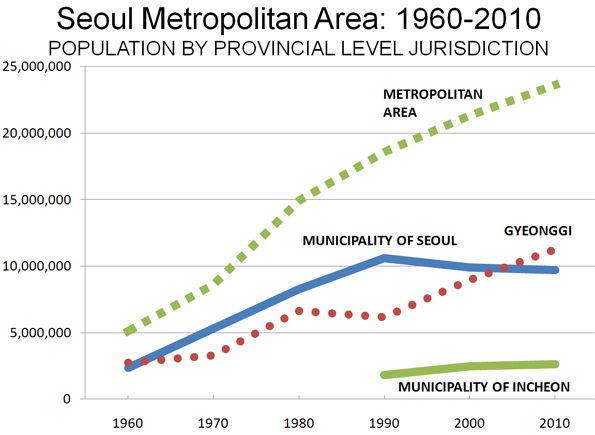
    Since 1990, all the population growth in the Seoul metropolitan area since has been in the suburbs. The province of Gyeonggi has gained more than 5 million residents, while the municipality of Incheon has added more than 800,000 residents.  During the 2000s, the province of Gyeonggi added enough population to exceed the municipality of Seoul as the largest provincial level jurisdiction in the metropolitan area (Table).

    Seoul Metropolitan Area Population: 1960-2010
    Year Metropolitan Area Provincial Level Jurisdiction
    Seoul Gyeonggi Incheon
    1960 5.1 2.4 2.7  
    1970 8.6 5.3 3.3  
    1980 14.9 8.3 6.6  
    1990 18.6 10.6 6.2 1.8
    2000 21.4 9.9 9.0 2.5
    2010 23.6 9.7 11.3 2.6
    In Millions
    Incheon created from Gyeonggi in 1981


    The Future? There is also some question about whether Seoul will remain the national capital. In 2004, the national government decided to move the capital to Gongju, 90 miles (150 kilometers) south of Seoul. The decision was both preceded and followed by considerable political jockeying and it appears that the government is backtracking on the capital move (though construction has begun).

    Regardless of the eventual fate of the new capital, Statistics Korea projections indicated that the Seoul metropolitan area will continue to expand. The population of the municipality of Seoul is expected to decline through 2030 while the suburban jurisdictions of Incheon and Gyeonggi are expected to continue their growth. Further, more rapid growth is anticipated in North Chungcheon and South Chungcheon provinces as the metropolitan area, and perhaps even the urban area spreads further to the south. This larger metropolitan area is projected to grow to more than 31 million people by 2030.

    —-

    Note 1: Metropolitan Areas: Metropolitan areas are the economic dimension of the urban form. They represent the labor markets (area from which people commute to the urban area) and thus include both the urban area and surrounding economically attached rural and exurban areas. There are no international standards for delineating metropolitan areas and most national statistical agencies have no such delineation. The nations that do giving me metropolitan areas have differing standards and even within nations there are substantial difficulties. The only serious attempt to define metropolitan areas based upon consistent standards was by urban expert Richard L. Forstall (who ran the Rand McNally "Ranally" international metropolitan area program), Richard P. Green and James B. Pick. The complexity of the research is indicated by the fact that their list is limited to the top 15 in the world. Other attempts to delineate metropolitan areas generally rely on complete second or third level jurisdictional boundaries, such as counties, states or provinces. This can lead to specious comparisons of densities, because the jurisdictions that are used vary so much in size. This is perhaps best illustrated by comparing Portland and Riverside – San Bernardino. In 2000 (latest available data), the Riverside – San Bernardino urban area had a densities slightly higher than that of Portland. Yet the metropolitan areas vary greatly in size, due simply to the size of the counties that comprise them. The two counties of the Riverside – San Bernardino metropolitan area cover four times as much land area as the seven county Portland metropolitan area.

    Note 2: Urban Areas: urban areas are the structural dimension of the urban form (the "urban footprint"). Urban areas are the area of continuous urban development. They may also be called urbanized areas (such as United States, United Kingdom, France, India and Canada); urban centers (Australia) or urban agglomerations (United Nations). Canada will switch its terminology for urban areas to "population centres" in the 2011 census. The distinction between urban areas and metropolitan areas can be confusing and has led some internet – based lists to somewhat indiscriminately mix the two. Moreover, the term "urban area" has even been used to denote an area well beyond the continuous urbanization (more akin to a metropolitan area), such as in its definition by statistics New Zealand.

    Note 3: Municipalities: international comparisons of municipalities (often called "cities," which is a term that can also be used for two substantially different concepts, metropolitan areas and urban areas) are generally invalid, because there is no geographic or population criteria between or even within nations by which municipalities are defined. This is illustrated by the fact that the world’s largest municipality, Chongqing is largely rural, not urban, and covers an area approximately the size of Austria or Indiana. While the municipality of Chongqing (and virtually all other Chinese "cities") is larger than its metropolitan area, municipalities may be far smaller than their metropolitan areas. For example, the municipality of Melbourne ("city of Melbourne") has less than 2 percent of the metropolitan area population, while the municipality of Atlanta has less than 10 percent of the metropolitan area.

    Note 4: The United Nations population estimates show the Seoul urban area to be limited to the municipality of Seoul which produces a far smaller estimate of less than 10 million people.

    —–

    Photo: Suburban Seoul (by author)

    Wendell Cox is a Visiting Professor, Conservatoire National des Arts et Metiers, Paris and the author of “War on the Dream: How Anti-Sprawl Policy Threatens the Quality of Life

  • Debt Ceiling or Spending Limit?

    We’re seeing a lot of debate in Washington about what is commonly referred to as the "national debt ceiling." This post is an attempt to shed some light – and provide some good resources for further information – on what this really means. National debt is not the total future obligations of the federal government to pay. It is basically all the public debt (like Treasury bills) plus money we owe to other governments – in other words this ceiling only puts a limit on how much the federal government can borrow, not on how much they can spend.

    The national debt number is available "to the penny" at the Treasury Direct website. There are only a few categories of debt that are not subject to the limit, mostly having to do with the way that Treasury Bills are issued to pay all the interest up front (discounted) and the way that payment is handled in accounting terms. Raising the National Debt Ceiling involves raising the limit on the public debt ceiling.

    There is a bigger number that most other countries use to define “debt”. The official definition for “debt” used in the European Union, for example, includes obligations to Social Security, Medicare, etc. at the national level, plus regional and local government debt. (Thanks to Yannick for initiating a discussion of the distinction with his comment to my 2009 piece on Public Debt Crisis.) In the U.S., the larger number is usually referred to as "total indebtedness". There is no limit set on the promises of the US government to spend money — for example, the almost $13 trillion committed to the post-crisis bailouts and stimulus was not subject to the debt limit despite that number being almost equal to the total national debt. The limit only applies to how much the Treasury can borrow to meet its obligations. So if the question is “should the ceiling be raised?” then my answer is “it doesn’t really matter.” Congress can keep spending without it.

    When politicians say they are against raising the debt ceiling it’s usually referred to as “Grandstanding” – which Merriam-Webster explains is to act so as to impress onlookers.

  • Giving the “New Houston Metro” Credit Where it’s Due

    Tuesday, the Houston Metropolitan Transit Authority (Metro) held a blogger luncheon with senior Metro people (Chairman, CEO, board members, managers) at the Rail Operations Center south of Reliant.  It was an informative event with a lot of good two-way Q&A.  And it included an impressive tour of the facility, which, btw, is not air conditioned in the main maintenance bay.  Let’s just say it was the right time of year for a tour and I’m really glad I don’t work there in the summer.  The facility is doing its job though: Metro claims to have the highest operational uptime for rail cars in the country.

    Sometimes in my push for increasing commuter bus services and cutting back rail, I fail to give credit to a lot of good work that is going on at the “New Metro”:
    a few issues for our collective consideration:

    • They really are a lot more open and transparent, and are really trying to do the right things.  
    • There’s been a lot to clean-up, and they’ve done a good job (although CEO Grenias says it will take another 2-3 years to completely turn around the organization).  
    • They’ve also done a good job continuing to reach out and create collaborative agreements to provide commuter bus services outside of their service area (like Baytown and Pearland).
    • They’ve fixed the poorly performing Airport Direct service, price and route-wise.
    • They shifted to a cash basis for the General Mobility Program instead of increasing debt.
    • They fixed their broken relationship with the FTA.

    There was a lot of good talk about improving express commuter bus services to TMC, Greenway, and, most importantly, Uptown.  I pitched them on expanded HOV/HOT lanes (like the 610 Loop) and laptop trays and wifi on the commuter buses, which are under consideration.  They have a very high percentage of downtown commuters – 30-40% – and claim a pretty high number for TMC – 20-30% – but that includes people who park in Smithlands and ride the rail, which I don’t consider a true commuter solution (it’s not doing anything to reduce freeway congestion).

    Ultimately, they’re trapped by the voter referendum and the federal money process to keep pursuing a rail plan (and line prioritization) that really doesn’t make a lot of sense given the new fiscal reality since the referendum was passed.  It will make even less sense if the Republican House guts rail funding.  But at least they’re taking steps to “firewall” the rail plan financially so it doesn’t end up stealing from critical local and commuter bus operations.  I may not agree with the overall strategic direction of the agency, but they do have good people doing good work within the constraints of the game they’re forced to play.

    This post originally appeared at houstonstrategies.com

  • Chicago Takes a Census Shellacking

    The Census results are out for Illinois, and it’s bad news for the city of Chicago, whose population plunged by over 200,000 people to 2,695,598, its lowest population since before 1920.  This fell far short of what would have been predicted given the 2009 estimate of 2,851,268. It’s a huge negative surprise of over 150,000, though perhaps one that should have been anticipated given the unexpectedly weak numbers for the state as a whole that were released in December.

    The American Community Survey data from last year show a clear improvement in items like college degree attainment (up 7.6 percentage points since the 2000 Census) and median household income (up 18%, which trailed the nation slightly, but beat Cook County and the state).  These data points show the very real improvements that have swept over a portion of the city, the visible gentrification that envelops the greater core area has now been shown to have been unable to power overall population growth, or to restrain the rampant exurbanization in the region.

    White and Black Flight

    The non-Hispanic White Only population of the city actually declined by 52,449, or 5.78%.  The “minority” population declined even further, -147,969 or 7.44%, meaning the city actually grew its white population share by 0.38 percentage points, perhaps indicating the early stages of the “Europeanization” of Chicago as the core gentrifies and disadvantaged groups and the white working class are pushed further to the fringe.

    Indeed, the Black Only population plunged by 177,401 as blacks increasingly moved to suburbs, especially southern ones  like Matteson, Lansing, Calumet City, Park Forest, and Richton Park, each of which added thousands of new black residents.  Some indications are that a significant number of black residents left the region altogether.  The traditional black magnet of Atlanta – which struggled through much of the decade – was a top five destination for people leaving Chicagoland over the past decade, and Chicago was the #2 source of in-migrants to Memphis, another black hub, according to IRS data.

    Hispanic population was the bright spot for Chicago, as the city added Hispanic residents to the tune of 25,218, or 3.35%.  Hispanics boosted their population share in the city by nearly 3 percentage points.  But even this growth isn’t that impressive.  The city of Indianapolis, at less than a third Chicago’s population, added over 45,000 Hispanics on a much smaller base.

    Demographic Reality: Massive Exurbanization

    Much has been made of Chicago’s legitimate and real urban core renaissance, but the cold reality remains that this is one of America’s most sprawling regions. Regional growth continued to be heavily focused not in the city or established inner suburbs, but the exurbs.  Kendall County more than doubled in population, and counties like Grundy, Boone, and Kane also made the top five in the state. Cook County, which is about half made up of the city of Chicago, as a whole actually lost population. And traditional suburban powerhouse DuPage has flattened, while Lake County, Illinois fell just short of the national average in growth. During the last decade, a net of over 25,000 people moved from metro Chicago to metro Rockford, making that city the #2 destination for those leaving Chicagoland. Given that Rockford is hardly an economic mecca, clearly exurbanization is spreading far beyond traditional metro boundaries. Sprawl of the most intense kind is alive and well in Chicagoland.

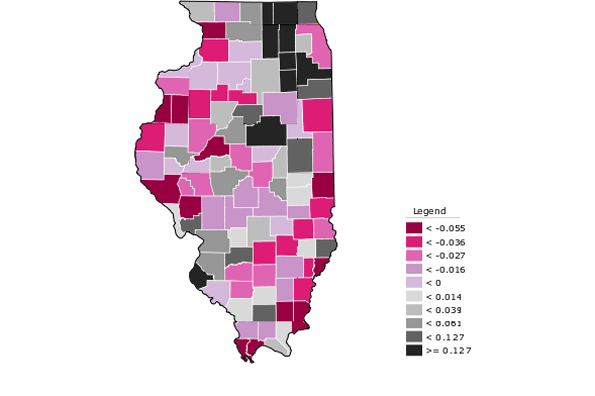
    The following map illustrates this, with a five bucket sort of 2000-2010 population percentage change, growing counties in black, shrinking in red:


    The raw data on regional growth speaks for itself:

    Core+Suburb vs. Exurb

    2000

    2010

    Total Change

    Pct Change

    Core + Established Suburb (Cook, DuPage, Lake Counties)

    6,925,258

    6,815,061

    -110,197

    -1.6%

    Exurb (Other IL Metro Chicago Counties)

    1,347,510

    1,771,548

    424,038

    31.5%

    This sprawl might be more understandable in rapidly growing cities like Atlanta and Houston that can both densify the core and grow outwards simultaneously.  But the Chicago-Joliet-Naperville-IL Metropolitan Division (the full MSA is not yet available since Wisconsin hasn’t been released yet) grew at less than half the national average. This means that the exurbanization trend in Chicagoland is almost entirely loss of population share by the core to the fringe.

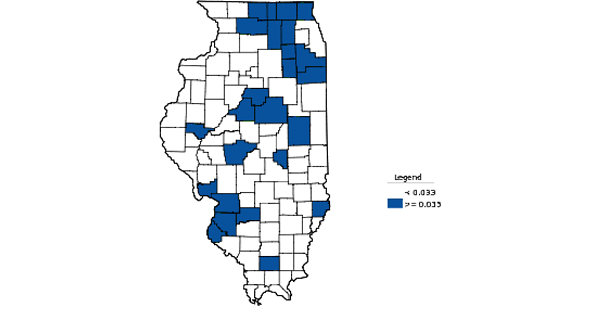
    To put an even starker view on the concentration of growth in Illinois as a whole, this map highlights only those counties that grew faster than the already anemic statewide average:


    Other than a handful of counties, the group of fastest growing counties in the state is dominated by suburban and especially exurban Chicago and St. Louis counties.

    For those of us who’ve chosen to plant our flag in the city, these results are most unwelcome news, no two ways about it. This is especially true as underfunded pensions and city budget gaps loom large, and where the per capita load only goes up as the population goes down.  This report should be a call to arms to the next mayor and the city as a whole to make the promise of revitalization a reality, and bring growth and prosperity to the city as a whole, not just a the upscale core. Cities like Chicago have to become more aspirational; places of upward mobility to broad sections of the middle and working classes. The city and Cook County can’t afford another decade like this one.

    Aaron M. Renn is an independent writer on urban affairs based in the Midwest. His writings appear at The Urbanophile.

    Photo by Gravitywave