Blog

  • Why Duany is Wrong About the Importance of Public Participation

    One of the news stories circling lately is an interview with Andres Duany where he asserts that public participation requirements are too onerous to enable great work to be done.   Early in my career I worked as a public historian and historic preservation specialist, so rather than launch immediately into my opinion, let me tell you a true story.

    In the 1950s, business owners in downtowns across the country became agitated over the fact that their central business districts were facing a double challenge: increasing amounts of traffic congestion and increasing competition from new suburban shopping centers.  One of the towns feeling these challenges was Green Bay, Wisconsin, which had a very energetic and forward-thinking business leadership circle. 

    The good men of Green Bay did what most forward-thinking leaders do when faced with a fearful challenge on the horizon: they hired a consultant.  The consultant they chose was Victor Gruen, an architect who had recently gained fame designing the nation’s first enclosed shopping mall, in Edina, Minnesota.  In the couple of years that had lapsed since the Southland Mall plans hit the streets, Gruen had become a celebrity – the Andres Duany of his day. 

    In a 2006 article for the New Yorker, Malcolm Gladwell described Gruen as “short, stout, and unstoppable, with a wild head of hair and eyebrows like unpruned hedgerows.” Gladwell summed up Gruen’s impact pretty succinctly:

    Victor Gruen didn’t design a building; he designed an archetype. For a decade, he gave speeches about it and wrote books and met with one developer after another and waved his hands in the air excitedly, and over the past half century that archetype has been reproduced so faithfully on so many thousands of occasions that today virtually every suburban American goes shopping or wanders around or hangs out in a Southdale facsimile at least once or twice a month. Victor Gruen may well have been the most influential architect of the twentieth century. He invented the mall.

    Gruen asserted in Green Bay, as he did in dozens of other cities in the 1950s and 1960s, that the key to solving downtown’s competition challenge was to completely separate vehicular traffic from pedestrians.  By massively widening Main Street at the north end of the commercial district and completely enclosing the core of the existing commercial district, all of downtown’s problems would be solved.  All the plan required was money and a willingness to be unsentimental and practical.

    You don’t have to be Duany to understand what happened.  It took 20 years for Gruen’s vision to become some form of reality, and during that time the City’s business and political leadership –and its planning staff – stuck to Gruen’s plan as diligently as the real world constraints of financing and private development would allow.  

    By the time it opened in 1977, the new Port Plaza Mall and associated parking lots and garages had obliterated acres of downtown buildings, dislocated a hundred residents.  It sent dozens of businesses to liquidation or to the far edges of the newly-sprawling city where many of them are located today.  If Gruen considered the collateral damage of grand ideas at all, I wager he simply viewed them as the price of progress. 

    All of this might be tolerable from a strict economic standpoint if Gruen’s grand plan had worked.  It didn’t.  Port Plaza Mall was a money-loser from virtually day one.  By the early 1980s, Port Plaza was doing so poorly that the City took the advice of another consultant and bulldozed another full block of buildings to add the magic third anchor, which they were assured was the way to fix the mall’s ails.  By the early 2000s, that anchor was gone. 

    Green Bay, like many other cities that drank the downtown mall Kool-Aid, continues to struggle with a downtown that is dominated by a windowless, dispiriting, too-vacant hulk where its heart should be.  Meanwhile, the region’s former skid row, right across the Fox River within eyesight of the mall, has become the hottest urban neighborhood in the region, and the winner of a Great American Main Street Award. 

    This isn’t simply a story about the virtues of historic preservation.  Gruen’s idea didn’t fail because Green Bay wanted old buildings or because the people who lived and worked in those old downtown buildings did something to undermine the plan.  Like most people of that era, the majority of the City’s leadership and residents placed their faith in the expert and in the concept of progress.  Any gut misgivings they may have had were pushed aside.  The plan was made by a national expert, right?

    Gruen’s mall failed because he envisioned and sold an ideal solution without giving any attention to economic realities, and without consideration of the myriad of unforeseen factors and unintended consequences that could, and did, develop.  Gruen stood at the beginning of an era, and there was no way anyone could anticipate how the world would change in a few short decades.

    The greatest failure of Gruen’s plan was that he did not recognize or acknowledge that his Grand Vision could very well turn out all wrong.     

    We should have learned by now that our Grand Visionary Designers are not infallible. Our landscapes are littered with Grand Visionary Architecture that was supposed to fix something, or create Something Big. And so few of those grand visions ever came out the way they were promised, or managed not to create a new set of problems.  Never heard of Port Plaza?  That’s because there are Port Plazas of one flavor or another in virtually every city in the country.  Some are malls, some are stadiums, some are brutalistic, forsaken parks.  You can pick them out easily by their Grand Design ambitions and their total lack of life. 

    Our failure to learn this lesson is a blot on architecture and planning.

    This history is exactly why Duany is wrong about the importance of public participation.  Public participation is important not just to try to get people to go along with our vision, to give us a chance to yell loud enough to drown them out, or to allow us to demonstrate the superiority of our Grand Vision over their piddling little concerns.  When residents resist a new development  – even when they supposedly “don’t like change” – it doesn’t take many questions or much effort to develop a real understanding of their concerns and their point of view.   

    We fail consistently to realize that the locals are there every day and we are not. Local residents have a level of detail and a critical perspective that can make the difference between whether a proposed project supports the health of the community or creates a new burden.   Much of the time, the real concerns of the residents of an area have to do with nuts and bolts issues that can be fixed with relatively little effort or accommodation.  It’s possible that local resistors might have good reasons why the proposed change is a bad idea.  If we don’t enable and empower them to speak, we have made the same mistake as Gruen and we are likely to create a similar legacy.

    Understanding the real reasons why people oppose a project requires the willingness to do so, the humility to listen, and the internal fortitude and self-assurance to admit that possibly, oh just possibly, we don’t know everything that there is to know.   That is the real mark of wisdom.

    Duany and other marquee designer types have the privilege of maintaining a distance from the dirty work of making a project functional in real life. Don’t overlook the work of the nameless landscape architects and architects who are hired by the developers after the big name architects are paid, have gathered their glory, taken their big checks and left.  It is those highly competent, highly talented professionals who deal with the Grand Architect’s ignored steep slope under that proposed building or those planting beds that will block other drivers’ vision of the charming landscaped driveway emptying out onto a major intersection.  

    Ah, little stuff. Who cares?

    If the people who live around a proposed development oppose a development, chances are those people know something that is important to the health of their neighborhood and the larger community. If we think that we know more than to have to listen to them, then we are no better than little Napoleons in big capes, creating monuments to our hubris that our children and grandchildren will have to clean up. The lessons of the damage caused by our ignorance are all around us.

    Photo by Jeanette Runyon

    This piece originally appeared in Forbes.

    Joel Kotkin is executive editor of NewGeography.com and is a distinguished presidential fellow in urban futures at Chapman University, and an adjunct fellow of the Legatum Institute in London. He is author of The City: A Global History. His newest book is The Next Hundred Million: America in 2050, released in February, 2010.

  • A $53 Billion High-Speed Rail Program to Nowhere

    Vice President Joe Biden announced today a plan to spend $53 billion over the next six years on passenger high-speed rail projects that will help reach the goal of giving 80 percent of Americans access to high-speed rail within 25 years. According to the announcement, the proposal will place high-speed rail "on equal footing with other surface transportation programs." The initiative includes $8 billion in the President’s FY 2012 budget proposal, of which $4 billion will be focused on building new infrastructure and $4 billion will be dedicated to system preservation and renewal. The announcement makes no mention how the plan will be paid for.

    Congressional reaction to the announcement was immediate. House Transportation Committee Chairman John Mica (R-FL) and Railroads Subcommittee Chairman Bill Shuster (R-PA) issued a press release expressing "extreme reservations" regarding the Administration’s plan. Several congressional sources we reached for comment pronounced the Administration initiative "dead on arrival."

    "What the Administration touted as high-speed rail ended up as embarrassing snail-speed trains to nowhere," Mica said. "Rather than focusing on the Northeast Corridor, the most congested corridor in the nation…the Administration continues to squander limited taxpayer dollars on marginal projects," Mica added. "This is like giving Bernie Madoff another chance at handling your investment portfolio."

    Rep. Shuster was equally critical. "The Administration continues to fail in attracting private investment, capital and the experience to properly develop and cost-effectively operate true high-speed rail," he said. "Government won’t develop American high-speed rail. Private investment and a competitive market will." Shuster was also critical of the manner in which the Administration has administered the program. "Selecting routes behind closed doors runs counter to the Administration’s pledges of transparency. … High-speed rail funding could become another political grab bag for the President. …If the Obama Administration is serious about high-speed rail, they should stop throwing money at projects in the same failed manner."

    The strong condemnation by two leading congressional transportation spokesmen poses a serious obstacle for the Administration’s proposal on Capitol Hill. They are not alone. House leadership has called for cancelling the high-speed rail program as part of its deficit reduction plan.

    Opposition from governors and state legislatures adds another hurdle to the Administration’s plan. Without state support high-speed rail projects cannot go forward. But, as we have seen, the governors of Wisconsin and Ohio have declined to participate in the Administration’s HSR programs. Other governors, concerned about potential operating subsidies, open-ended risk of construction overruns or unable to raise the required matching funds, may do likewise.

    Florida’s Gov. Scott, in introducing his budget proposal on February 7, offered a hint about his thinking, that makes HSR boosters uneasy. "Over the last few years,’ the Governor said, "Florida accepted one-time hand-outs from th federal government. Those temporary resources allowed state and local governments to spend beyond their means. There was never any reason to think that Florida taxpayers could afford to continue that higher level of spending once the federal hand-outs are gone. The false expectations created by the federal hand-outs are the reason we hear about a multi-billion dollar deficit." The words "high-speed rail" and  "operating subsidies" were not mentioned, but the implication was clear.

    Several other high-speed rail projects are in danger of collapse because of stringent conditions demanded by the Federal Railroad Administration (FRA)— conditions that the host railroads find unacceptable. As reported by the respected railroad observer Fred Frailey, high-speed rail projects in Washington State, North Carolina and Virginia, totaling $1.4 billion in HSR grants, are in jeopardy because the service agreements negotiated by the states with Class 1 railroads have been rejected by the FRA as not strict enough. At the core in each case is the railroads’ insistence that passenger train operations must not interfere with freight operations and their refusal to accept penalties for potential delays suffered by passenger trains.

    If these projects fall through, there will be little to show for the $10.5 billion HSR program other than a 48-minute reduction in travel time between Chicago and St. Louis as a result of an ongoing project with Union Pacific (see, "The Uncertain Future of the High-Speed Rail Prgram," InnoBrief, January 5, 2001). It is revealing that the only example the White House announcement chose to highlight  was a $38 million program of track improvements between Portland and Brunswick, ME to permit a 30-mile extension of the five Downeaster round trips to and from Boston at slightly increased speeds, as Frailey pointed out.

    Given this meager progress, given more than ample evidence of congressional and state-level opposition, and with so many, much more deserving infrastructure needs awaiting federal support (incl. rail in the Northeast Corridor), one wonders why the Administration has chosen to doggedly pursue its unrealistic vision of a nationwide high-speed rail network. We hope Congressmen Mica and Shuster will try to get some answers.

  • China’s Empty Trains… & Other Unintended Consequences

    In a technical sense, the economy has been in recovery since June of 2009. A year and a half into the rebound though, a general cloud of economic malaise continues to cover the nation. Fears of a diminished America are perpetuated from our political and punditry classes. We are told that our collective lack of preparation, education, innovation, industry, and of infrastructure are all setting us up to fall further. Economic indicators may reflect a bounce-back, but structurally, America is waning. It is China that is increasingly emerging as the world’s bright spot in terms of development. With its 10% annual growth rate, an economy poised to become the world’s largest, and a strategic smart-growth development plan, resplendent in renewable energy splendor and high-speed rail, the nascent superpower is aimed ever upwards.

    This tidy narrative that the doom-chatterers both envy and fear is being dented by a number of recent stories concerning Chinese rail initiatives. As Tsinghua University’s Economics Professor Patrick Choavec writes, China’s high-speed rail is “expensive both to build and to operate, requiring high ticket prices to break even. The bulk of the long-distance passenger traffic, especially during the peak holiday periods, is migrant workers for whom the opportunity cost of time is relatively low. Even if they could afford a high-speed train ticket — which is doubtful given their limited incomes — they would probably prefer to conserve their cash and take a slower, cheaper train. If that proves true, the new high-speed lines will only incur losses while providing little or no relief to the existing transportation network.”

    Similarly, individual Chinese municipalities are eagerly developing subway systems, but as Chinese political scientist Zhang Ming wrote in China Daily, “geographical conditions in many cities are not conducive to building and/or maintaining subways. The landscape and hydrological conditions of a city determine whether it can have a subway… medium-sized cities may not have enough commuters to sustain a metro. Even in many large cities, which have enough commuters, subways are running at a loss because of the very high cost of operation and maintenance.” Historically, drive and a true demand have never run into a topographic problem it couldn’t solve, but these examples do raise questions about the efficacy of blanket government policies that ordain massive, heavily subsidized projects. Could such ventures produce results that are opposite of their intended outcome?

    China can find the answer right here in the States. The Italian sociologist Marco d’Eramo has related how the Home Owners’ Loan Corporation in 1933 and the Federal Housing Authority in 1934, created in part to stem the mass wave of Great Depression-related foreclosures, did “more than any other measure… to contribute to turning America into a nation of unconquerable homeowners.” To increase homeownership for all, both agencies devised classification systems that assigned values to neighborhoods and homes that they then sought to rehabilitate through loans to potential buyers. The resulting standardized divisions largely enforced segregation in the name of stability, only further depressing segments of the housing market.

    Recent lessons from the Great Recession’s continued housing fallout show us how government policy can produce the opposite effect of its initial intention, as well. The still-reeling property values of neighborhoods nationwide, and the huge tracts of unused housing at the periphery of metro edges were created with the encouragement of government bodies just like the HOLC and FHA’. These policies expanded the cause of homeownership without taking into consideration the actual demand and cost. Subsidizing trains that very few can ride is quite similar to encouraging the building of houses in which very few can live.

    At least initially, it is easy to see why such investments look good to government entities. They promote job growth, increase demand for supplies and resources, and contribute to overall GDP. Where something wasn’t, something now is. But they are unsustainable projects in the long run. Without continued government subsidies—or of higher wages for Chinese workers to afford train tickets, or of an endless supply of cheap credit to US potential homebuyers—they tend to eat off of themselves. The eventual decline in Chinese trade ridership and in US home purchases shows the peril when government policies create incentives for development without real, inherent demand .

    With this in mind it is important to view President Obama’s high-speed rail proposals in the context of each location. High-speed rail is an important, necessary step to upgrade America’s infrastructure in certain locales, but it is not an across-the-board panacea. Chicago, for example, the rail capital of the nation, beset with both passenger and freight rail congestion, is a logical beneficiary of dedicated high-speed rail funds to develop a system capable of handling its latent demand and to untangle its gridlock. With Chicago’s large economic presence over its neighbors, it makes little sense, then, that freshly minted Wisconsin Governor Scott Walker remains adamantly opposed to a project that would benefit Milwaukee and Madison.

    Other places, though, have valid qualms. Cost concerns in Florida, for example, are legitimate. The 90 mph top speed on the Southeast High Speed Rail Corridor between Charlotte and Raleigh doesn’t sound too, well, high-speed. Cities like Denver, which supports a dense enough population to represent a demographic demand for light rail, can encourage its development as its roads reach capacity. In states like South Dakota and Iowa, it may mean going back to dirt.

    The new head of the House Committee on Transportation and Infrastructure, Rep. John Mica (R-FL), made sense when he said, “I am a strong advocate of high-speed rail, but it has to be where it makes sense”. There is a difference between creating infrastructure for which there’s an inherent demand and nudging people to utilize it, and developing large-scale infrastructure projects for their own sake.

    Knowing the limitations of past attempts and failures, America has a chance to outgrow its mistakes and render the supposed competition with China irrelevant, as that aspiring nation fumbles in its own policy prescriptions. Harnessing the lasting lessons of the Great Recession means understanding that success isn’t measured in the size of a home, or in the length of a high-speed rail system. It’s measured in the effectiveness and efficiency of a place. If the U.S. holds this to heart, no one could be better primed to compete, as China’s empty trains swiftly rattle onwards.

    Photo by Ivan Walsh, High Speed Bullet Train, Beijing to Tianjing, China

    Ben Schulman is a Chicago-based writer on urban affairs. One of the proprietors behind independent record label Contraphonic, Inc., Schulman also heads the Contraphonic Chicago Sound Series.

  • More Condescension Surrounds Los Angeles Stadium Plan

    The head of the group pushing the Los Angeles plan for an NFL stadium, Anschutz Entertainment Group, doesn’t understand why anyone would be suspicious of the finances behind his plans for a downtown football stadium. From the LAT:

    “Almost every other community in the world would be throwing parades,” Leiweke said.

    Really? A power-hungry developer backed by a reclusive Denver billionaire comes along with a plan to tear down part of the city-owned-and-operated convention center and jam in a stadium without providing any specifics on how the deal would be structured – other than his promise that it won’t cost taxpayers a dime – and he’s wondering why so many people are skeptical?

    “When the proposal gets there, everyone’s going to take a deep breath and realize: There is zero risk to the taxpayer,” Leiweke said. “This is people trying to scare people. And it’s a shame.”

    More disinterested voices continue to point out that pro sports teams do little, if anything, to boost local economies – and that the job creation figures being bandied about for the downtown stadium are crazy high. From the LAT:

    Villaraigosa said the stadium complex would create more than 22,000 jobs, an assertion that drew a laugh from Brad Humphreys, an economics professor at the University of Alberta, Canada, who has studied such facilities for years. “That’s way outside the usual garbage that I read,” he said. “The best estimate … would be zero jobs created.” Construction jobs, he explained, would be the most visible, but they would be short-term.

    Humphreys and colleagues studied every city in North America that had built sports facilities in the last 40 years, “and we were unable to find any evidence that the local economy ever did any better,” he said. What such developments tend to do is move existing money, and presumably jobs, around — as, say, entertainment dollars that would have been spent in Westwood are spent instead downtown.

    This piece originally appeared at Mark’s LA Biz Observed blog.

  • The Real Answer to Houston’s Traffic Congestion

    The Houston Chronicle editorial board recently argued that light rail is key to combating Houston’s traffic congestion problems. But if you look at the three cities with worse traffic congestion than Houston – DC, Chicago, and LA – they have much more transit, including tons of light rail in LA. Transit clearly hasn’t solved the problem in these cities. These people aren’t stuck in that traffic because they like it – it’s because the transit doesn’t go where they need to go or isn’t timely. This is especially true with the rise of dispersed job centers in those cities where the trains don’t go or don’t provide good connectivity to the suburbs where people live.  Let’s see, in Houston we have downtown (<7% of jobs), uptown/Galleria, the med center, Greenway, Greenspoint, the Energy Corridor, Ship Channel, and NASA – among others.  If that’s not a dispersed set of job centers poorly suited to rail connectivity, then I don’t know what is.

    It’s absurd to argue a light rail network focused inside the 610 Loop is going to do anything to relieve congestion or provide relief to commuters from the vast suburbs outside the loop.  The solution is not doubling down on our multi-billion dollar LRT network, but instead scaling it back (University line only, IMHO) and instead spending the funds on a radical increase in express bus commuter services connecting all suburbs to all job centers with frequent nonstop 60+ mph transit using high-speed HOV/HOT lanes.  Imagine driving to your local suburban transit center (which might just be a mall parking lot) and finding regular, frequent express buses (of all sizes) serving every major job center in Houston.  These buses could have amenities like wifi and laptop trays.  They might even be run by private operators (with subsidized fares) competing on routes, schedule, reliability, service, and amenities.  And after they get to the job center, they can circulate to get you right to your building – no long walks in heat, cold, or rain.  Finally, all of this is a single-seat service without annoying and time-consuming transfers from bus-to-rail or rail-to-bus (or even rail-to-rail).

    It’s a much more practical solution for a city like Houston, but one that requires innovating ‘outside the box’ as a transit agency rather than parroting the “more rail” mantra that every other transit agency in the country repeats endlessly.

    For more details, see these two previous posts:

    This post originally appeared at Houston Strategies.

  • Confirming International Research: Hudson Tunnel Costs Explode

    Governor Chris Christie of New Jersey is looking like a prophet now. In late October, the Governor cancelled a new tunnel across the Hudson River between New Jersey and New York City, because of the potential for cost overruns, which would be the responsibility of New Jersey taxpayers. By that point, the cost of the tunnel had escalated at least $1 billion to $9.7 billion. The tunnel was to have doubled New Jersey Transit and Amtrak capacity into Penn Station from New Jersey.

    Now Amtrak proposes to build the tunnel itself, a scaled down version of the previous tunnel. The new tunnel would increase capacity for New Jersey Transit and Amtrak trains by 65 percent.

    However, the cost is not scaled down. For one-third less the capacity, initial estimates place the cost of the new tunnel at 40 percent more ($13.5 billion) than the already escalated cost of the cancelled tunnel.

    Of course, it is likely that if planning and construction proceed, the cost of the tunnel could increase substantially beyond initial estimate. This virtual inevitability is indicated in international research by Oxford University professor Bengt Flyvbjerg and others.

  • Australia’s Housing Affordability “Outrage”

    There is mounting concern in Australia about the nature and extent of country’s housing affordability crisis. Expressions of distress are not limited to the middle income households who are locked out of the Great Australian Dream of home ownership. There is heightened interest from advocates of low income households and an opposition political party. Moreover, Australia’s overvalued housing is receiving renewed attention in international circles.

    Part of this attention is attributable to the 7th Annual Demographia International Housing Affordability Survey, which was released in late January. The Demographia Survey, which I co-author with Hugh Pavletich of Performance Urban Planning in Christchurch (New Zealand) covered 325 Metropolitan markets in seven nations (United States, United Kingdom, Canada, Australia, Ireland, New Zealand and Hong Kong, in China). The Survey assesses housing affordability using the United Nations and World Bank recommended measure of median house price divided by median household income (the Median Multiple). The data shows housing to be severely unaffordable in Australia, which was the most unaffordable nation included in the survey.

    In response, Michael Perusco of Melbourne’s Sacred Heart Mission and chairman of the Council to Homeless Persons called the affordability statistics "alarming.“ He added he was not surprised by the housing affordability data, noting the stress on the people he serves caused by inflated prices.

    Kirsten Moore recently reported in these pages on the statement by the Australian Green party. Senator Scott Ludlam, the party’s shadow minister (spokesperson) for housing called Australia’s housing affordability a "world-class outrage." He went on to say "When a family or an individual has to spend so much of their income on paying their mortgage, it has a seriously adverse affect on their education and training opportunities, on their investment opportunities and on their ability to pay for services like health care and child care."

    The real estate industry also expressed concern. David Airey, president of the Real Estate Industry Association of Australia issued a statement in response to the Demographia Survey, saying that: "for the majority of Australian families the difference between household income and loan payments is narrowing quickly."

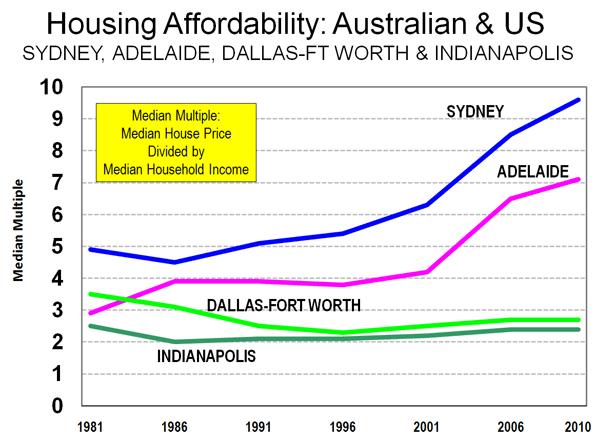
    Various measures indicate that households with mortgage payments equaling 30 to 35 percent or more of their gross annual income on mortgage suffer from “mortgage stress." Mortgage stress has been spreading around Australia like invasive species. Last year’s Demographia Survey showed that the median income household in Sydney would pay 57 percent of its income for a mortgage if it bought a median priced house in the current market. In Adelaide, the figure would have been 47 percent. Over the last year things have only gotten worse.

    This is not merely a response to growth, or economic vitality. The median income household in the vibrant Dallas-Fort Worth region, for example, (larger than Sydney) would pay approximately 17 percent of their incomes for a mortgage on the median priced house. This is despite the fact that population growth and the demand for housing has been much greater in Dallas-Fort Worth than in Sydney (Figure 1).


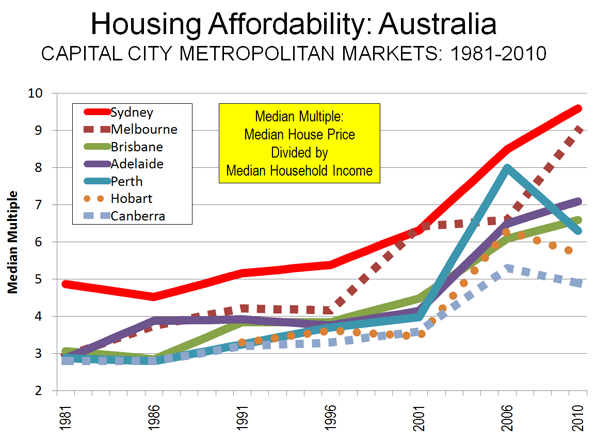
    In Indianapolis, similarly sized to Adelaide and growing faster, the median income household would pay 14 percent of their income for a mortgage on the median priced house. House prices have risen more than 130 percent relative to incomes over the last three decades in Australia’s major metropolitan areas (Figure 2). By comparison, the increase has been only one-eighth as much (16 percent) in the United States.

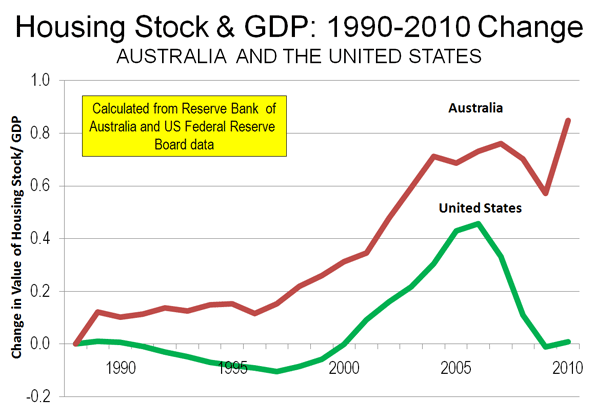
    The extent of the house price increases is starkly illustrated by comparing the value of the own housing stock to the gross domestic products of Australia and the United States since 1988 (the first year for which Australian house value data is readily available).

    According to data from the United States Federal Reserve Board, the value of the US stock of owned housing in 2010 was approximately the same in relation to the Gross Domestic Product as it was in 1990. On the other hand data from the Reserve Bank of Australia indicates that the value of the own housing stock in Australia was 85 percent higher relative to the Gross Domestic Product than in 1990. Thus, the value of the owned housing stock in Australia is today at least $1.9 trillion greater than it would have been if the 1990 ratio had been retained (Figure 3).

    Of course, part, although far from all of the United States experienced a severe housing bubble that burst in 2007. Even so, the increase in gross house values relative to the gross domestic product in the United States  never approached the massive increase in valuation that has occurred in Australia.

    The Green Party statement rightly blamed "Government’s actions that provide incentives designed to benefit investors and speculators and to keep house prices going up." The price rises have been principally the result of state government policies banning most development on the urban fringe and created a severe shortage of competitively priced land for development. It is an established economic fact of life that, all things being equal, the prices of goods and services tend to rise where there are serious limitations on supply, whether land, petroleum or bananas (as in the case of Typhoon Larry in Queensland in 2006).

    The effects of such policies is to telegraph to investors both in Australia and around the world the potential for speculative gain in a housing market.   The biggest losers come largely from the ranks of younger middle income Australians, including many immigrants, who would like to own their own homes. It is astounding that in egalitarian Australia, which has an enviable historic record of concern for lower and middle income households, is being transformed into a country where   inheritance or access to foreign capital will be a prerequisite for home ownership for middle income people.   

    The Organization for Economic Cooperation and Development (OECD) has raised concerns about the role of restrictive land use regulations in Australia (as well as the United Kingdom, which is also covered in the Demographia Survey).  OECD has recommended that Australia ease land supply constraints by streamlining planning and zoning regulations.

    The experience of Australia, along with a number of other markets covered in the Demographia Survey demonstrates that severe restrictions on the supply of land for development remain fundamentally incompatible with both housing affordability and the aspirations of lower and middle income citizens.

    Photograph: New "detached" housing in Perth (by author).

    Wendell Cox is a Visiting Professor, Conservatoire National des Arts et Metiers, Paris and the author of “War on the Dream: How Anti-Sprawl Policy Threatens the Quality of Life

  • California High Speed Rail Costs Escalate 50 Percent in 2 Years

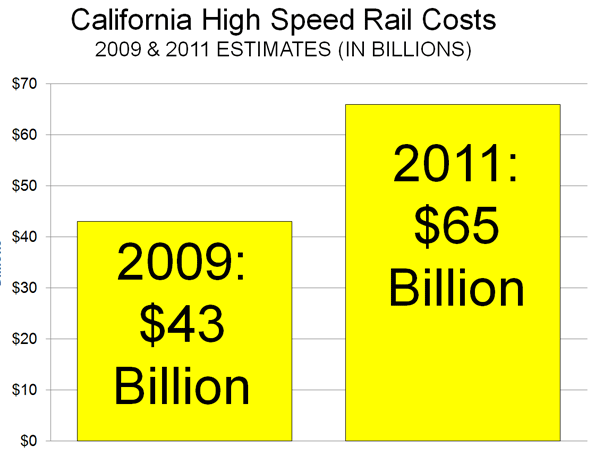
    The highly respected Californians for Responsible Rail Design (CARRD) has released a new cost estimate for the phase 1 Los Angeles to San Francisco high-speed rail line. Based upon an analysis of California high-speed rail Authority documentation, including stimulus grant applications and other internal sources, CARRD estimates that the line will now cost $65 billion, rather than the current estimate of $43 billion.

    The CARRD release indicated:

    Our analysis, based solely on official and publicly available Authority documents, determines the
    current project costs are approximately $65 billion. The $43 billion figure was inaccurate, even at the time it was made.

    CARRD also pointed out that there has been no recent update to the official cost estimates and that the planned October 1, 2011 update, required by state legislation, may not be released on time because of contract negotiation difficulties with Price Waterhouse Coopers.

    Even as environmental and planning work has advanced, no update to the official capital cost estimate has been made. This is true even when the only alternatives in most segments still being studied are significantly more expensive than those used to calculate the $43 billion number

    However, CARRD cautioned even this 50% increase in just two years may understate the eventual costs:

    …we have received some feedback that these numbers may actually be too conservative since there still is very little engineering information about some of the most technically challenging parts of the project (like the mountain passes).

    The new CARRD cost estimate is consistent with the perennial cost escalation that has been noted in such projects by Oxford University professor Bengt Flyvbjerg and others, who found that passenger rail systems typically have cost overruns of 45 percent.