Blog

  • The Social Side of the Internet

    Is success in social networking measured by the number of “Friends” you have on Facebook, or “Followers” you have on Twitter, or “Connections” you make on LinkedIn? 

    The jury is still out on how social media and social networking will ultimately play out, but new research shows real benefits are being realized from it.

    A Harris Poll conducted December 6-10, 2010 found, “Social media has opened the door, or more accurately, many doors, to increasingly numerous ways for people to interact with others, customize their online experiences and receive positive, enriching benefits from their activity therein.  In fact, two in five Americans say that they have received a good suggestion for something to try as a result of their use of social media (40%).”

    A generation gap remains, but the mere fact that “Matures” are involved in social media constitutes news.  The Harris study reports, “A majority of Echo Boomers (those 18-33) say they have received a positive suggestion for something to try from their activity on social media (59%), compared to 44% of Gen Xers (those 34-45), one third of Baby Boomers (those 46-64) (34%), and just one in five Matures (those 65 and older) (19%).”

    Pew Research Center’s Internet & American Life Project found that social media’s benefits to groups are now widely recognized by both Internet users and non-users.  The study, The Social Side of the Internet, was released on January 18, 2011 and can be found at PewInternet.org.  The general findings state, “The internet is now deeply embedded in group and organizational life in America.

    Pew studied groups and found in part:

    • 68% of all Americans (internet users and non-users alike) said the internet has had a major impact on the ability of groups to communicate with members. Some 75% of internet users said that.
    • 62% of all Americans said the internet has had a major impact on the ability of groups to draw attention to an issue. Some 68% of internet users said that.
    • 60% of all Americans said the internet has had a major impact on the ability of groups to connect with other groups. Some 67% of internet users said that.
    • 59% of all Americans said the internet has had a major impact on the ability of groups to impact society at large. Some 64% of internet users said that.
    • 59% of all Americans said the internet has had a major impact on the ability of groups to organize activities. Some 65% of internet users said that.
    • 52% of all Americans said the internet has had a major impact on the ability of groups to raise money. Some 55% of internet users said that.
    • 51% of all Americans said the internet has had a major impact on the ability of groups to recruit new members. Some 55% of internet users said that.

    Does all this suggest that a shift in communications is now upon us?  I believe the answer is an unqualified yes.  Many experts predict that by 2014 the whole concept of the “new media” and the “social net” will have lost their novelty status as they become fixtures of American business, communications and life.

    Many forward thinking companies are moving aggressively to position themselves for this shift.  They are beginning to purpose their content for real-time, anytime, two-way dialogue. They are building communities around their own content.   American Express is doing a great job at OpenForum using content to build community and establish thought leadership within the small business community.

    Why?  The “social net” represents a paradigm shift for an organization.  It is not as much about the technology as it is about integrating a new way of assembling and distributing information in   more open and accessible way.  This shift needs to be incorporated into an organization’s DNA.  This takes time and a total commitment from the organization.

    When the communications shift happens, those organizations that have staged early will realize tremendous benefits.  Those organizations that have not will face a very difficult and time-consuming process of not only integrating new technologies into their organizations, but also assimilating the cultural changes that are needed to make this process successful.

    The social internet is not a mercurial event, but rather a game changer that will impact every aspect of our lives – something already evident but likely to become more obvious.

    Dennis M. Powell is the founder of Massey Powell which provided content logistics services that help organizations ready their content and leverage it into the social media environment.  He invites all New Geography readers to visit http://socialmedianewslink.com to learn more about social media.

    Illustration by Matt Hamm

  • The Death of Earmarks

    Record deficit spending in Washington has many faces: Defense, Medicare, Social Security. But none has received more criticism in recent months than the infamous and notorious earmark. Conjuring up images of “Bridges to Nowhere” or “Teapot Museums”, earmarks, or Congressionally Directed Funding, have become the poster child for irresponsible, out of control, big government spending. But is the earmarking practice by Congressional representatives really pushing our country to the brink of bankruptcy? That is what many critics would have the public believe. By playing on the public’s disgust with overspending and sensationalizing it with examples of wasteful projects that abuse the system, earmarks have been turned into a proverbial whipping boy for all forms of government spending.

    Sources of criticism are not limited to the media or political newcomers trying to make a name by misdirecting supporters from the true causes of our spending crisis. President Obama has recently come out in strong opposition to the earmarking process. During the State of the Union speech, he called for a ban of all earmarks and has threatened to veto any bill that contains them.

    Senator Daniel Inouye (HI), Chairman of the Senate Appropriations Committee, issued a statement on February 1 announcing the Committee will place a moratorium on earmarks for the current session of Congress. Yet he does not concede and end the war on earmarks, later committing to revisiting the issue once “the consequences of the decision are fully understood”. I think that what Senator Inouye is trying to say is be careful what you wish for because you just might get it.

    Certainly, I am not suggesting that the current level of our federal expenditures is acceptable. But it seems a bit disingenuous to target a spending practice that makes up three tenths of one percent of our federal budget. By comparison, Social Security and Defense spending make up 21 and 20 percent of the federal budget, respectively. Much of the political grandstanding to abolish earmarks is merely distraction from the real cause of damage.

    Eliminating earmarks does not actually curb spending at all. It merely moves the decision of which projects get funded from Congressional members to the administrators of federal agencies. By the time earmarking occurs through the appropriations process, the budgets of the federal agencies have already been authorized. Earmarks merely provide legislators the ability to further divvy up a very small portion of those budgets to meet local needs of those they represent.

    The good projects that benefit our nation and local communities are often overshadowed by the abuses and frivolous projects of a few. But for every “Bridge to Nowhere” there are examples of projects and program that fulfill a specific national interest and uplift local economies. Unfortunately, the examples of money well spent do not garner as much attention as the more rare occasions when taxpayer dollars are frivolously wasted on pet projects.

    Forget about funding directed for regions in need of important flood control projects or high tech vaccine research and development to create life-saving Staph vaccines (the number one killer of wounded soldiers in the battlefield) for the military. These things are not important as long as an abomination like the “Bridge to Nowhere” has been perpetrated upon the taxpaying public. Small businesses and startup companies capable of producing high tech products that the government wants will now suffer as large corporate interests with unfair advantages deploy extensive resources to access fresh funding that now flows through federal agencies located far from Middle America.

    It’s terrible timing for small business. Whispers in the U.S. House of Representatives of the impending doom of the federal Small Business Innovation Research Program could be a double gut punch for small research and manufacturing companies. Small companies get only 4.3% of federal research dollars, but produce five times as many patents per dollar as large companies and 20 times as many as universities.

    What does this mean for local community leaders? Communities and small businesses must become more competitive. With the departure of earmarking, much of this funding will be redirected through agency grant programs. Unfortunately, the pool of recipients is often smaller and is more concentrated in large east and west coast interests. How do small interests compete? Companies may need to invest more time and money into pursuing procurement and contracting opportunities with the federal government. They may need to consider hiring experts to write grants, monitor agency program funding, or hire consultants to broker connections with program directors, contract managers, and decision makers within federal agencies. Often times, half the battle can be won by conveying your message to the proper audience.

    If beauty is in the eye of the beholder, then I would suggest that wasteful spending is in the eye of those not receiving it. It has been my experience that the same people denouncing earmarks and government spending are the first ones with their hands out when they catch the slightest whiff of federal funding that may benefit their own interests. “It is not wasteful spending until it goes to someone who isn’t me”.

    The future of earmarks remains an uncertain one. What is certain, however, is that the debate will rage on and good projects, small business and high tech startups will bear the consequences of tired rhetoric and political showmanship.

    Ryan Aasheim is an Associate with Praxis Strategy Group where he works extensively with the Red River Valley Research Corridor technology-based economic development initiative. He was formerly Economic Development Director for U.S. Senator Byron Dorgan.

    Photo by Nick Ares

  • The Midwest: Coming Back?

    Oh my name it is nothing
    My age it is less
    The country I come from
    Is called the Midwest

    –Bob Dylan, “With God on Our Side,” 1964

    For nearly a half century since the Minnesota-raised Robert Zimmerman wrote those lines, the American Midwest has widely been seen as a “loser” region–a place from which talented people have fled for better opportunities. Those Midwesterners seeking greater, glitzier futures historically have headed to the great coastal cities of Miami, New York, San Diego or Seattle, leaving behind the flat expanses of the nation’s mid-section for the slower-witted, or at least less imaginative.

    Today that reality may be shifting. While some parts of the heartland, particularly around Detroit, remain deeply troubled, the Midwest boasts some of the lowest unemployment rates in the country, luring back its native sons and daughters while attracting new residents from all over the country.

    For example, Des Moines, Omaha, Kansas City, Columbus, Minneapolis, Milwaukee and Madison have all kept their unemployment rates lower than the national average, according to a recent Brookings survey. They are also among the regions that have been able to cut their jobless rates the most over the past three years.

    This contrasts sharply with the travails of the metropolitan economies of the Southeast, Nevada, Arizona and California. Of course, other regions are doing better than the Sun Belt sad sacks. The stimulus and TARP benefited some parts of the Northeast, but even those areas haven’t performed as well as the nation’s mid-section. The only other arc of prosperity has grown around the Washington leviathan, largely a product of an expanded government paid for by the rest of the country.

    In contrast, the relative prosperity in parts of the Midwest largely stems from the private sector. Take the rise in the price for agricultural commodities, global energy demand, greater home affordability and a  slow but perceptible pickup in domestic manufacturing. According to University of Iowa researcher Jacob Langenfeld, these factors suggest that it’s time to stop seeing the Heartland as a perennial loser and to start seeing it as a “[model] for effective economic development.”

    The new reality is reflected in several ways.  In terms of personal-income growth last decade, several Midwest regions ranked  among the top ten in the U.S., including Milwaukee, Cleveland, Kansas City and Cincinnati.

    These cities all performed better than Seattle, Denver or Portland. San Jose and San Francisco, those perennial darlings of the information age,  sat around the bottom of the list. The mid-section also boasts many of the nation’s healthiest real estate markets, according to Realtor.com. Three of the top five markets–Kansas City, Kansas, Omaha and Fargo–are located in the region

    An analysis of shifting migration patterns provides even more intriguing evidence. Over the past century the Midwest’s share of the nation’s population fell from nearly 35% of the total to barely 21%. Only the Northeast, now less than a fifth of the population, has experienced a similar decline, while the West and South have registered impressive gains.

    Now some of the very regions that experienced losses over the past few decades, such as St. Louis, suffer much lower rates of out-migration than a similarly sized area like San Diego. Others, such as Indianapolis, Columbus, Madison and Kansas City, have enjoyed strong rates of domestic migration. In sharp contrast, coastal giants like metropolitan Los Angeles or New York have worse domestic out-migration rates than Detroit.

    The outcome of the recent midterm elections means that political changes may further propel the Midwest express. The new Congress is largely dominated by representatives of the heartland such as Speaker John Boehner of Ohio and Budget Committee Chairman Paul Ryan of Wisconsin. This marks a powerful shift from the previous Congress, controlled by iron-fisted coastal Democrats like former Speaker Nancy Pelosi of San Francisco.

    We can expect the new Congress to adhere more closely to Midwestern interests on a host of issues. Energy legislation will now reflect the interests of Midwestern states, which depend heavily on coal, rather than the renewable dreams of the coastal big cities. In transportation we may see a shift in priorities from high-speed rail to such mundane things as roads and bridges.

    More important still may be changes at the local level. For decades Midwestern governors and mayors tried to emulate the Northeast and West Coast. Historian John Teaford observed that the struggling Midwestern cities in the 1960s and 1970 employed “cookie cutter” redevelopment in a vain effort to replicate the great coastal cities. Ultimately the building of “international style” towers, sports stadia and cultural palaces did little to restore places whose economies had become increasingly uncompetitive.

    In recent years, the most risible example of coastal aping could be found in Michigan, the nation’s most economically ravaged state. Under Gov. Jennifer Granholm Michigan focused on a strategy of promoting “cool cities” to lure the young entrepreneurial hipsters away from the coasts. Like California, Michigan placed huge bets on renewable fuels and other green industries.

    By the end of Granholm’s term this winter the state suffered one the country’s highest unemployment rates, a falling population and epic out-migration. She has been replaced by a pragmatic pro-business conservative, Rick Snyder, who is focused on a practical economic-development agenda. Similar shifts have taken place in Ohio and Wisconsin.

    The new brand of Midwestern realism has been embraced for years by some regions. For example, non-partisan business and civic leaders in Kalamazoo, Mich., have pushed both educational reform and economic diversification. The region, though hardly booming, has done better than the state overall and is experiencing an entrepreneurial and community renaissance.

    Kalamazoo entrepreneurs tend to understand that the key to Midwestern renewal lies with the region’s core competencies and attractions. David Zimmermann, founder of Kalexsyn, a flourishing biotech company, identifies these assets:  Michigan’s resident pool of skilled labor, a low cost of living and a generally community-oriented, family-friendly atmosphere.

    Zimmermann says his company, which now employs 30 workers and has revenues of $5.4 million, has surprisingly little trouble attracting younger skilled workers. The median age at the company, he notes, is only 36, and many have come to Kalamazoo from traditional coastal biotech hot spots. This includes several researchers some who originally left the Midwest in their teens and twenties.

    “People are looking at the Midwest and crunching the numbers,” Zimmermann says. “Maybe you take a 20% pay cut from San Francisco but you buy a nice house for $200,000. You come out way ahead. We think this a very strong advantage.”

    Such a newfound appreciation for the Midwest represents a critical element in expanding the region’s turnaround. With enhanced power in Washington and more common sense government at home, the Midwest could be poised to regain a competitive advantage that has been missing for several generations.

    This piece originally appeared in Forbes.

    Joel Kotkin is executive editor of NewGeography.com and is a distinguished presidential fellow in urban futures at Chapman University, and an adjunct fellow of the Legatum Institute in London. He is author of The City: A Global History. His newest book is The Next Hundred Million: America in 2050, released in February, 2010.

    Photo by Paladin27

  • Regional Exchange Rates: The Cost of Living in US Metropolitan Areas

    International travelers and expatriates have long known that currency exchange rates are not reliable indicators of purchasing power. For example, a traveler to France or Germany will notice that the dollar equivalent in Euros cannot buy as much as at home. Conversely, the traveler to China will note that the dollar equivalent in Yuan will buy more.

    Economists have attempted to solve this problem by developing "purchasing power parities," which are used to estimate currency conversion rates that equalize values based upon prices (Note 1). This helps establish the real value of money in a particular place.

    When people move from one region of the United States to another they can encounter a similar phenomenon. For example, a dollar is not worth as much in San Jose as it is in St. Louis. Research by the US Department of Commerce Bureau of Economic Analysis (BEA), for example, found that in 2006 a dollar purchased roughly 35 cents less in San Jose than in St. Louis. BEA researchers estimated "regional price parities" for states and the District of Columbia and for all of the nation’s metropolitan areas (Note 2). Regional price parities can be thought of as the equivalent of regional (state or metropolitan area) exchange rates. This research was covered in previous newgeography.com articles by Eamon Moynihan and this author.

    This article uses Department of Labor, Bureau of Labor Statistics metropolitan area consumer price indexes to estimate the 2009 cost of living and per capita personal income adjusted for the cost of living.

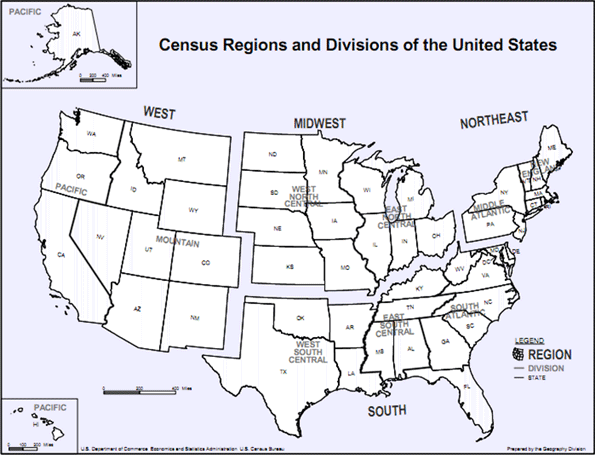
    Cost of Living: At the regional level (See Census Region Map, Figure 1), there are substantial differences in the cost of living (Figure 2). The lowest cost of living is in the Midwest, at 4.8 percent below the nation. The South has the second lowest cost of living at 3.9 percent above the national level. The West is the most expensive area, 13.5 percent above the national cost-of-living, while the Northeast’s cost-of-living stands 11.3 percent above the national rate.
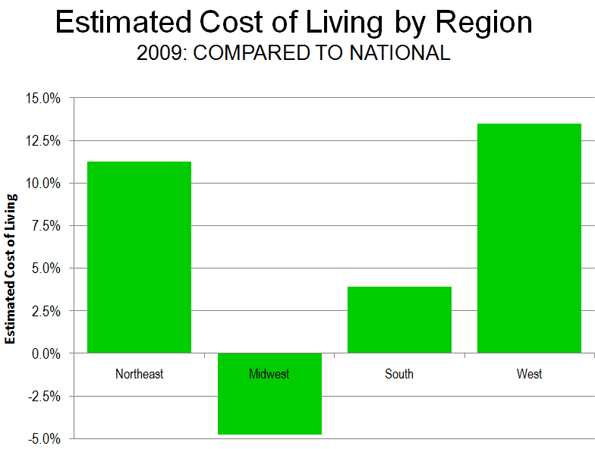
    The cost of living in the South may seem higher than expected. But if the higher cost metropolitan areas of Washington, Baltimore and Miami are excluded, the cost of living in the South falls to 1.5 percent below the national rate. If the California metropolitan areas are excluded from the West, the cost of living still remains 4.0 percent above the national rate.

    Per Capita Income: The highest unadjusted per capita incomes are in the Northeast, followed by the West, the South and the Midwest. Yet when metropolitan area exchange rates are taken into consideration, the order changes significantly. The Northeast remains the most affluent, and the Midwest moves from last place to second place. The South is in third place, the same as its income rating, while the West falls from second place to fourth place (Figure 3).

    Cost of Living: Variations in the cost of living, which is reflected by the metropolitan area exchange rates, remains similar in 2009 to the 2006 rankings.

    The Top Ten: The lowest costs of living were in (Table 1):

    1. St. Louis, where $0.891 purchased $1.00 in value at the national average.
    2. Kansas City, where $0.903 purchased $1.00 in value at the national average.
    3. Cleveland, where $0.921 purchased $1.00 in value at the national average.
    4. Pittsburgh, where $0.941 purchased $1.00 in value at the national average.
    5. Cincinnati, where $0.944 purchased $1.00 in value at the national average.

    Rounding out the most affordable 10 are two metropolitan areas in the South (Atlanta and Dallas-Fort Worth), two in the Midwest (Detroit and Milwaukee) and one in the West (Denver). No Northeastern metropolitan area was ranked in the top 10.

    Table 1
    Estimated Cost of Living: 2009
    Metropolitan Areas over 1,000,000 with Local CPIs
    Rank Metropolitan Area
    Metropolitan Exchange Rate: to Purchase $1.00 at National Average
    Compared to Lowest Cost of Living
    1
    St. Louis, MO-IL
    $0.891
    0%
    2
    Kansas City, MO-KS
    $0.903
    1%
    3
    Cleveland, OH
    $0.921
    3%
    4
    Pittsburgh. PA
    $0.941
    6%
    5
    Cincinnati, OH-KY-IN
    $0.944
    6%
    6
    Atlanta. GA
    $0.958
    8%
    7
    Detroit. MI
    $0.959
    8%
    8
    Milwaukee. WI
    $0.959
    8%
    9
    Dallas-Fort Worth, TX
    $0.976
    10%
    10
    Denver, CO
    $0.996
    12%
    11
    Minneapolis-St. Paul, MN-WI
    $1.000
    12%
    12
    Houston, TX
    $1.000
    12%
    13
    Tampa-St. Petersburg, FL
    $1.006
    13%
    14
    Phoenix, AZ
    $1.011
    14%
    15
    Portland, OR-WA
    $1.034
    16%
    16
    Chicago, IL-IN-WI
    $1.041
    17%
    17
    Philadelphia, PA-NJ-DE-MD
    $1.054
    18%
    18
    Baltimore, MD
    $1.068
    20%
    19
    Riverside-San Bernardino, CA
    $1.078
    21%
    20
    Miami-West Palm Beach, FL
    $1.085
    22%
    21
    Seattle, WA
    $1.120
    26%
    22
    San Diego, CA
    $1.151
    29%
    23
    Boston, MA
    $1.175
    32%
    24
    Washington, DC-VA-MD-WV
    $1.181
    33%
    25
    Los Angeles, CA
    $1.222
    37%
    26
    San Francisco-Oakland, CA
    $1.258
    41%
    27
    New York, NY-NJ-PA
    $1.281
    44%
    28
    San Jose, CA
    $1.343
    51%
    Estimated from BEA 2006 data, adjusted by local Consumer Price Index for 2006-2009


    The Bottom Ten: The most expensive metropolitan areas were:

    28. San Jose, where $1.343 purchased $1.00 in value at the national average.
    27. New York, where $1.281 purchased $1.00 in value at the national average.
    26. San Francisco, where $1.268 purchased $1.00 in value at the national average.
    25. Los Angeles, where $1.222 purchased $1.00 in value at the national average.
    24. Washington, where $1.181 purchased $1.00 in value at the national average.

    The bottom ten also included three metropolitan areas in the West (Riverside-San Bernardino, San Diego and Seattle), one in the Northeast (Boston) and one in the South (Miami). There were no Midwestern metropolitan areas in the bottom 10.

    Per Capita Income: Per capita income in 2009 was then adjusted for the cost of living.

    Top Ten:Washington has the highest per capita income, adjusted for the cost of living, at $47,800. San Francisco placed second at $47,500. Denver ranked third at $46,200, while the cost-of-living adjusted income in Minneapolis-St. Paul was $45,800 and $45,700 in Boston. The top 10 also included two Midwestern metropolitan areas (St. Louis and Kansas City), two from the Northeast (Baltimore and Pittsburgh) and one from the West (Seattle).

    Bottom Ten: The least affluent metropolitan area was Riverside-San Bernardino, with a per capita income of $27,800. Phoenix was second least affluent at $33,900 while Los Angeles was third least affluent at $35,000. The fourth least affluent metropolitan area was Tampa-St. Petersburg at $36,600 and the fifth least affluent metropolitan area was Portland at $37,400. The bottom 10 also included two metropolitan areas from the South (Atlanta and Miami), two from the Midwest (Cincinnati and Detroit) and one from the West (San Diego).

    The cost of living adjusted income data includes surprises. New York, commonly considered a particularly affluent metropolitan area, ranked 17th in cost-of-living adjusted income, and below such seemingly unlikely metropolitan areas as Pittsburgh, Kansas City, Cleveland, St. Louis and Milwaukee. These metropolitan areas also ranked above San Jose, which ranked first in unadjusted income in 2000, but now ranks 16th in cost of living adjusted income (Table 2).

    Table 2
    Personal Income Per Capita Adjusted for  the Cost of Liviing
    Metropolitan Areas over 1,000,000 with Local CPIs
    Rank (Cost of Living Adjusted)
    Rank (Unadjusted Income)
    Metropolitan Area
    Per Capita Income 2009: Adjusted for Cost of Living
    Per Capita Income 2009: Unadjusted
    1
    2
    Washington, DC-VA-MD-WV
    $47,780
    $56,442
    2
    1
    San Francisco-Oakland, CA
    $47,462
    $59,696
    3
    8
    Denver, CO
    $46,172
    $45,982
    4
    9
    Minneapolis-St. Paul, MN-WI
    $45,772
    $45,750
    5
    4
    Boston, MA
    $45,707
    $53,713
    6
    18
    St. Louis, MO-IL
    $45,288
    $40,342
    7
    7
    Baltimore, MD
    $44,908
    $47,962
    8
    15
    Pittsburgh. PA
    $44,848
    $42,216
    9
    19
    Kansas City, MO-KS
    $43,862
    $39,619
    10
    6
    Seattle, WA
    $43,730
    $48,976
    11
    13
    Houston, TX
    $43,581
    $43,568
    12
    16
    Milwaukee. WI
    $43,477
    $41,696
    13
    11
    Philadelphia, PA-NJ-DE-MD
    $43,247
    $45,565
    14
    21
    Cleveland, OH
    $42,734
    $39,348
    15
    12
    Chicago, IL-IN-WI
    $41,990
    $43,727
    16
    3
    San Jose, CA
    $41,255
    $55,404
    17
    5
    New York, NY-NJ-PA
    $40,893
    $52,375
    18
    20
    Dallas-Fort Worth, TX
    $40,494
    $39,514
    19
    23
    Cincinnati, OH-KY-IN
    $40,437
    $38,168
    20
    10
    San Diego, CA
    $39,647
    $45,630
    21
    24
    Detroit. MI
    $39,147
    $37,541
    22
    17
    Miami-West Palm Beach, FL
    $38,124
    $41,352
    23
    26
    Atlanta. GA
    $38,081
    $36,482
    24
    22
    Portland, OR-WA
    $37,446
    $38,728
    25
    25
    Tampa-St. Petersburg, FL
    $36,561
    $36,780
    26
    14
    Los Angeles, CA
    $35,045
    $42,818
    27
    27
    Phoenix, AZ
    $33,897
    $34,282
    28
    28
    Riverside-San Bernardino, CA
    $27,767
    $29,930
    Estimated from BEA 2009 income data and 2006 regional price parity data, adjusted by local Consumer Price Index for 2006-2009


    Some expensive metropolitan areas such as Washington, San Francisco and Boston ranked at or near the top, but their cost-of-living adjusted incomes were considerably less than the unadjusted incomes. On average, it took $1.20 to purchase $1.00 of value at national rates in these three metropolitan areas. Washington’s unadjusted per capita income was 40 percent ($16,100) higher than that of St. Louis, however when the cost of living is factored in, Washington’s advantage drops to 6 percent ($2,500).

    Caveats: The analysis above does not consider cost-of-living differentials within metropolitan areas. For example, data from the ACCRA cost of living index indicates generally higher prices in the cores of the largest metropolitan areas, such as New York (especially Manhattan), Chicago and San Francisco. Further, these data make no adjustment for relative levels of taxation. A cost of living analysis using disposable income would produce different results, dropping higher taxed metropolitan areas to lower rankings and raising lower taxed metropolitan areas higher.

    Cost of Living Differences: Will They Continue? The spread in cost-of-living between metropolitan areas have been driven wider over the last decade by the relative escalation of house prices in some metropolitan areas in the West, Florida and the Northeast. Whether these shifts in cost of living will be reflected in migration patterns will be one of the things to look for in the new Census.

    ———

    Note 1: Purchasing power parity data is published by the World Bank, the International Monetary Fund (IMF) and the Organization for Economic Cooperation and Development (OECD).

    Note 2: The BEA research applied regional price parity factors only to employee compensation and excluded other income. It is possible that, had the analysis been expanded to these other forms of income, the differences in cost of living would have been greater.

    Photo: Rosslyn, VA business district, Washington (by author)

    Wendell Cox is a Visiting Professor, Conservatoire National des Arts et Metiers, Paris and the author of “War on the Dream: How Anti-Sprawl Policy Threatens the Quality of Life

  • The President’s Unserious Proposal

    "Within 25 years, our goal is to give 80 percent of Americans access to high-speed rail." With this ringing statement in his State of the Union address, President Obama injected new hope into the flagging spirits of high speed rail advocates. Predictably, spokesmen for industry associations, progressive advocacy groups and other stakeholder interests praised the President’s goal as a symbol of his renewed commitment to support investment in infrastructure. But hardly any one we spoke to at the TRB meeting took the President’s ambitious goal seriously.

    "After listening to President Obama’s remarks on high-speed rail, I am left with more questions than answers," observed Rep. Bill Shuster, Chairman of the Subcommittee on Railroads of the House Transportation and Infrastructure Committee, who addressed the TRB Committee on Intercity Passenger Rail. "These promises mean little and the White House knows it," observed a railroad industry consultant attending the meeting, "it’s not within Obama’s power to commit future Administrations and Congresses to this pipe dream." "The President is out of touch with reality; where does he think the money will come from?" was a succinct reaction of a former senior U.S. DOT official.

    Lack of a Financial Plan

    There is good reason for these expressions of skepticism. Although some likened President Obama’s expansive vision to President Eisenhower’s historic call for a 42,000-mile Interstate Highway network, there is a vast difference between the two initiatives. The Interstate Highway proposal was backed by a reliable and steady revenue stream in the form of a federal gas tax. The high speed rail goal lacks a financial plan. It is not supported by a dedicated source of revenue that could maintain the program on a self-sustaining basis over a period of years. Nor can the Administration count on borrowed money or annual appropriations out of general revenue in the current political environment in which deficit reduction rather than new spending is the top congressional priority. Calling expenditures on high-speed rail "investment" does not obscure the reality that we would be spending money that we do not have. As if to underscore this point, the Congressional Budget Office announced on January 25 that this year’s federal budget deficit of $1.5 trillion will be the biggest one in history and the largest as a share of the economy since World War II. "Obama’s proposal is likely to land with a dead thud on Capitol Hill," opined National Journal’s transportation editor Fawn Johnson.

    States’ Ambivalence

    A second reason for skepticism is the ambivalent attitude of the states toward high speed rail. As Federal Railroad Administrator Joseph Szabo, speaking at the TRB meeting, correctly pointed out, the high-speed rail initiative is a state-driven program. Hence, support of governors and state legislatures will be essential if the Obama vision is to succeed. But, as we have seen, several fiscally-strapped states (Wisconsin, Ohio, Iowa) have declined to participate in the Administration’s HSR program while Florida’s Governor Scott still has to be heard from.

    Other governors and state legislatures may well follow their example should they conclude that high-speed rail projects will burden their constituents with massive annual operating subsidies and possibly open-ended risk of construction overruns. The protracted and still inconclusive track-sharing negotiations with the Class 1 railroads suggest that more than one state is having second thoughts about the wisdom of proceeding with these projects (at least on terms demanded by the Administration). About one-half of the dedicated HSR funds still remain unobligated according to the latest Federal Railroad Administration report.

    Fred W. Frailey, a respected writer and commentator on the railroad industry and author of Twilight of the Great Trains thinks that enthusiasm for high-speed trains has peaked and is on the wane. Writing in the current (March) issue of TRAINS, Frailey says the collapse of support is not merely a partisan event. Election results suggest that the public was never really won over. Nor will the Association of American Railroads or its member railroads fight for HSR. "So anyway you cut it, the high-speed show is over," Frailey concludes.

    A Fresh Congressional Posture

    This does not mean that fast trains will have no role to play in America’s future. There is a need to diversify travel alternatives in crowded travel corridors to accommodate future population increases. But, as a congressional hearing in New York City on January 27 made clear, federal efforts should be refocused on places where passenger rail investment is economically justified and where there exists a potential of sufficient ridership to attract private capital. As Congressmen Mica and Shuster correctly concluded, this means concentrating on the densely populated and heavily traveled Northeast Corridor with its serious air traffic congestion and well-developed urban transit distribution networks in major metropolitan areas.

    A majority of the witnesses testifying at the hearing seemed to agree with the two congressmen. They included such influential advocacy groups as Building America’s Future (Gov. Ed Rendell and Mayor Michael Bloomberg), America 2050 (Petra Todorovich) and U.S. High Speed Rail Association (Thomas Hart).

    Thus, the need to involve the private sector and to focus on the Northeast Corridor as a matter of first priority could well emerge as the core elements of a new congressional posture on high-speed rail. Instead of lavishing money on projects in numerous states in an unrealistic and fruitless attempt to make high-speed rail accessible to 80 percent of Americans, Congress would use targeted financial incentives to attract private investment and encourage private sector involvement in a few corridors where high-speed rail service makes economic and transportation sense. The inducements could include long-term operating concession agreements, loan guarantees, tax credits, availability payments and other creative financing arrangements. Whether additional federal funds to bolster such a policy will be forthcoming in the deficit-conscious 112th Congress, remains to be seen.

    Ken Orski is Editor and Publisher of Innovation NewsBriefs, a Washington-based transportation newsletter in its 22nd year of publication.

  • Why Most Americans are Both Liberal and Conservative

    American politics is consumed by a bitter, at times violent, debate about the overall role of government and specific governmental programs.

    Pundits often frame this divide in terms of geography (red states versus blue states), ethnicity (Hispanics and blacks versus whites), class (rich versus poor), or age and gender. Those factors matter, but seeing polarization only in terms of group versus group misses an important paradox about Americans: Most of us have both deep conservative instincts and liberal instincts.

    This personal inner conflict need not calcify our national divide. Instead, it could form the basis for a new and unifying consensus or civic ethos. To do this, though, our political leaders must build on the quintessentially American politics of today’s Millennials (those born between 1982 and 2003), who prize individual initiative at the local level to achieve national goals.

    Why we look left and right at the same time
    American political opinion looks in two directions – both left and right, or liberal and conservative – at the same time. Social scientists Lloyd A. Free and Hadley Cantril were the first to use survey research to describe and analyze this paradox of public opinion that has always shaped US politics.

    In their book, “The Political Beliefs of Americans” (1967), they maintained that Americans consistently demonstrate a conflict between their general attitudes toward “the proper role and sphere of government,” (which drove the big GOP gains last November) and their attitudes toward specific governmental programs (which helps explain broad American support for “big government” programs like Medicare).

    According to Mr. Free and Mr. Cantril, most Americans have conservative attitudes concerning the size of government, and liberal beliefs in support of programs to protect themselves economically. This leads majorities to favor smaller government, individual initiative, and local control while endorsing major governmental programs ranging from Social Security to student grants and loans.

    Tensions go back to our founding
    This tension has always been a part of American politics. The US Constitution was itself the product of fierce debate in the wake of the failed Articles of Confederation. The ingenious solution the Founders gave us was both a strong central government and equally powerful guarantees of individual liberty embodied in the Bill of Rights. Notably, that solution was largely the product of that era’s young adults, the so-called Republican Generation.

    Still, the Constitution didn’t settle the question of the government’s role in the economy and personal welfare. That wasn’t resolved, at least temporarily, until the Great Depression, when Americans gave their strong support to FDR’s New Deal programs. Again, it was that period’s young adults – the “greatest generation” – that led the new consensus.

    Small government, big programs
    Such consensus, of course, doesn’t erase our conflicting convictions. Even in the depths of the Great Depression, Gallup revealed this conflict between the public’s programmatic liberalism and conservative ideology. On the one hand, large majorities believed that the government should provide free medical care to the poor (76 percent), extend long-term, low-interest loans to farmers (73 percent), and implement the newly created Social Security program (64 percent). By contrast, only a minority wanted the government to take over railroads (29 percent) and banks (42 percent), or limit private fortunes (42 percent).

    In 1964, as President Johnson was announcing his Great Society initiatives, Free and Cantril, using the results of commissioned Gallup polls, determined that within the electorate, ideological conservatives outnumbered liberals by more than 3 to 1 (50 percent to 16 percent). But in those very same surveys, support for liberal government programs exceeded conservative opposition by a ratio of 4.6 to 1 (65 percent to 14 percent).

    Using data from four of the Political Values and Core Attitudes surveys conducted by the Pew Research Center over the past two decades, we confirmed their research. Across four Pew surveys, from 1987 to 2009, ideological conservatives outnumbered liberals by a ratio of 3.5 to 1, but liberal supporters of specific programs outnumbered conservative opponents by a 2.2 to 1 margin.

    In every Pew survey, there were always more conservatives than liberals regarding the overall role of government and a greater number of liberals than conservatives in support of programs designed to promote equality and economic well-being. In effect, the United States is neither a center-right nor a center-left nation; it is, and always has been, both at the same time.

    Not surprisingly, voters who identify as Republicans have tended toward the conservative side of these two tendencies. And Democratic identifiers have leaned toward the liberal side. Although the gap between the identifiers of the two parties has widened recently, during most of the time since Free and Cantril first published their findings, the greatest number of both Democratic and Republican identifiers, as well as independents, has been ideologically conservative and programmatically liberal.

    Moderates driven out
    Today, driven by more liberal attitudes among the Democrats’ young Millennial Generation and minority supporters, and the more conservative beliefs of the Republicans’ older, white base, the leadership of the two parties is more polarized than at any time since the Great Depression.

    For the first time ever, among Democrats in the House of Representatives, the liberal Congressional Progressive Caucus contains more members than the moderate New Democrats and conservative Blue Dogs combined.

    Across the aisle, few congressional Republicans are willing to call themselves moderates, and liberals, once a meaningful bloc in the GOP, have entirely disappeared.

    Despite these divisions, the leaders of each party must find a way to work together to synthesize both strands of America’s political DNA – a belief in the importance of a strong national community and equality of opportunity as well as a strong desire to limit government’s encroachment on individual liberty – into a new civic ethos that is broadly acceptable to most Americans.

    Millennials can foster a new consensus
    The belief of America’s youngest adult generation, Millennials, in the efficacy of individual initiative at the local level to achieve national goals provides a basis for just such a solution. To once again bind the wounds of internal discord, our political leaders should adopt this approach and successfully appeal to the ideological conservatism and programmatic liberalism of the American people.

    This piece originally appeared at the Christian Science Monitor.

    Morley Winograd and Michael D. Hais are fellows of the New Democrat Network and the New Policy Institute and co-authors of Millennial Makeover: MySpace, YouTube, and the Future of American Politics (Rutgers University Press: 2008), named one of the 10 favorite books by the New York Times in 2008.

    Photo by Zach Stern

  • Mega-City Semantics in China’s Pearl River Delta

    Recently an article ran in The Telegraph about China ‘creating the largest mega-city in the world with 42 million people‘. The title of the piece is a bit misleading as the government is not planning a new city per se, but rather combining a group of nearby cities into one huge ‘mega-city’. The targeted group of cities makes up the Pearl River Delta region in China’s southern Guangdong Province.

    Home to China’s famous first tier cities Guangzhou and Shenzhen, the Pearl River Delta is already one of the most populated places on earth. It is the manufacturing powerhouse of the country, thanks in large part to it being the first economically liberalized region after Reform and Opening Up. As a result of this, the Pearl River Delta has absorbed ambitious migrants from all over China for the better part of three decades.

    In addition to Guangzhou and Shenzhen, the proposal calls for integrating smaller (albeit still in the millions population-wise) cities of Donggaun, Foshan, Huizhou, Zhaoqing, Jiangmen, Zhongshan and Zhuhai into one. Upon first reading, the proposal doesn’t make much sense as the Pearl River Delta region has done an excellent job already of linking transportation and infrastructure among its different cities- so why the need to amalgamate into one city?

    Yet the intention of the integration becomes clear when Ma Xiangming, the chief planner at the Guangdong Rural and Urban Planning Institute, articulates that:

    “The idea is that when the cities are integrated, the residents can travel around freely and use the health care and other facilities in the different areas.“

    This is the key. The Chinese government still enforces the hukou household registration system for its citizens, making it difficult for people who move from one city to another to use the services offered by their new city. Restrictions for migrants to new cities are not only limited to healthcare and educational services, but to investment opportunities as well such as starting a business or purchasing a new home.

    By amalgamating the cities of the Pearl River Delta into one ‘mega-city’, this gets rid of the bureaucratic restrictions of the hukou registration. Now, the migrants who have left their native homes and settled in the Pearl River Delta can move more freely around the region. This is much more than semantics, it is a huge step forward in the liberalization of movement and opportunity for its citizens. It is unbelievable that The Guardian piece makes no mention of the significance of this development.

    UPDATE:

    Now there are reports that the story of the Pearl River Delta mega-city is false. According to an AFP report, China denies plan to create world’s biggest city.

    The error made by the original Telegraph article is most likely due to a misunderstanding by the reporters. As I mentioned above, the title was highly misleading, nothing more than a sensational headline designed to get reader attention. And the consultants quoted in the original article are city planners, professionals whose job it is to make recommendations on how to go about development, not the final decision makers who approve projects.

    The fact that the Pearl River Delta is not going to become one ‘mega-city’ doesn’t necessarily take away from the interest in integrating the region, making it a place where services are shared and the ease of mobility between its cities is increased.

  • Gifting China

    Listening to public radio, the host was interviewing a college professor as to why China has brought more innovation and progress in many areas of its growth, leaving other countries behind. In particular they mentioned high speed rail, low energy vehicles, and construction. The entire show was based solely upon how China’s universities educate differently than America, as if somehow a graduate student would suddenly posses the knowledge, experience, and drive to make major changes in transportation, science, design, and construction.

    When I hire American college students either as interns or graduates, what they have learned has little practical application as to the tasks that my business needs. Thus, we need to educate them on design (land surveying, civil engineering, planning and architecture), presentation techniques and the latest technology. What students do posses is a strong desire to make a difference in the world. I’m sure it is similar in China.

    China has made explosive progress by the process required of American companies who must comply with their restrictions to do business in their country. Let me explain:

    About 4 years ago we looked into designing neighborhoods in China. What we discovered is that an American company cannot do business directly in China. Instead of working directly, we would be required to enter into a partnership with an existing consulting firm in China. There is a problem with that requirement. If I would pursue business in China, I’d have to partner with a firm that did not have our talent, methods, or technologies we possessed. To work with an unknown firm would require us to share information that would have been exclusive to our firm, essentially training them in the strengths we took so long to accumulate. I figured that this would be a quick (and cheap) way their government could force American businesses to train their companies in our methods, and in most cases our advancements.

    Why would a company with a competitive edge want to provide privileged information to gain business? What is there to prevent that “partnering” business to break off relationships once they drain the knowledge base? Certainly they do not hire us because we have a larger workforce.

    American progress has been fostered by questioning why. Why is something being done this way? How can we make it better? This leads to innovation. Innovation was a major reason our country progressed more aggressively compared to countries that teach their students to think in only one way. China could see us as a knowledge base to farm information from our corporations wanting China’s riches.

    China seems to present an image of more progress. By forcing partnerships to do business in China we may have taught their corporations our best secrets. “We” being not just the United States, but every other country with their top designers, scientists, and technologies sharing knowledge.

    Once they have this knowledge and know-how, why would they need us? That is the foundational problem, and one reason I have not pursued work in China.

    The American way is innovation – something which I’ve seen little of in the development of our land and the building of our housing by the largest of American corporations. We should be going back to the drawing boards to accelerate American innovation and technology, and this time, not hand over this competitive edge so easily.

  • Pimp My Stripmall, Please!

    If anything characterizes the face of Florida’s landscape, it is the proliferation of shopping malls of all types. Generation by generation, as population swelled, country roads widened into highways and each intersection seemed to blossom into four parking lots framed by strip centers decorated with small, freestanding stores and restaurants. These malls represented the prosperity of the American middle class. Now that consumerism has slowed and been rechanneled online, new malls aren’t being built and the existing ones are looking a bit dog-eared, with shuttered stores, empty parking lots, and aging facades. Repurposing the American mall is a huge opportunity waiting for the right moment, and represents an opportunity to heal much of Florida’s economic stagnation.

    As the car culture rose after World War II, malls – convenient places that fit our newly prosperous lifestyle — rose as well. Thinkers, sentimental about the hard work that went into an organic, localized Main Street were largely horrified at its replacement by strip shopping centers and regional shopping malls. Yet this growth continued unabated, and while the debate over the mall’s moral stance raged, the building type continued to be a popular investment vehicle. It became codified and regulated into a more and more complex, layered experience, dominated by traffic and parking, manipulated by industrial psychologists, and fine-tuned by mall managers so that the best possible presentation of goods was made to the consumer.

    The consumer was unsentimental about the architectural debris that was left in the wake of the flight to the suburbs. As old village streets saw local businesses shuttered, cries of “Too hard to find parking” and “Why are your prices so high?” echoed on their sidewalks. Purposeless old Main Street: The lucky ones became tourist destinations, filled with chocolate shops and art galleries. Here in Central Florida, the lucky ones include Mount Dora, Sanford, and Ybor City, where parking lots and garages have been surgically inserted into the back alleys, a rigorous code enforces the form, and hand built architectural details from America’s Victorian era still surprise and delight.

    The consumer will continue to be a strong component of the American middle class, and no doubt many malls will continue to thrive. Florida’s oversupply has attracted tremendous attention, and repurposing raw space could become a creative new way that cities will grow. Winter Park Village, a 1960s indoor regional shopping mall, was cut open and now features a mixed-use shopping, dining, entertainment, and residential space barely resembling its former self. Metro Church in Winter Springs occupies a former Belk-Lindsey department store, with church-related functions occupying what was once a general lease area. Full Sail University in Winter Park is largely housed in converted strip centers as well. These conversions are not unique to Central Florida, and will likely continue into the future.

    The biggest opportunity, however, seems untried as of yet in America: manufacturing in a mall. Production, much more than consumption, creates jobs, and the raw open space of old retail sites can be easily converted into industrial uses. Geography is in their favor. Malls were typically built if at least 3,000 surrounding households could be found to support them; today these households could provide labor, instead of cash, to the right investor looking to onshore a product.

    Aligning industry with opportunity seems difficult on the surface. Manufacturing investment abounds in relatively unregulated India, but with the huge sunk costs that American industry already has, startups and expansions seem to be nonexistent. Turning this around would require a fundamental shift in American culture, allowing us to think of ourselves as producers once again. American know-how hasn’t vanished; rather, it lies dormant underneath the heavy regulatory burden, and under the high barriers to entry that our manufacturers created in their quest to be the largest and to shut out competition.

    New products are being created every day… overseas. If investment isn’t coming from within America, perhaps the right NGO sponsoring microloans could be tapped to consider the broken, declining landscape of suburban America to reinvigorate our natural American creativity and give small scale capital access to startups. Selecting the industries that we want to have, re-onshoring them, and producing things people need would once again provide jobs, diversify the local economy, and create the kind of upward mobility we once counted on for the American Dream.

    And the physical plant – one of the biggest investments that a producer makes – is already there. The regulatory burden of redevelopment, shouldered by the initial developer, should be minor at best, depending on the quality of the infrastructure, which would speed a conversion into reality. At a time in Florida when growth is on pause, the redevelopment of existing assets is likely the most favored way to provide economic expansion and pull Florida out of its nosedive.

    Mall redevelopment would please the environmental movement, as well. Huge swaths were cut into the Florida wilderness to make way for retail, with nary a peep from environmentalists in the eighties and nineties. One of the tenets of sustainable development is to confine construction to areas that are already strongly modified by human activities, and repurposing abandoned space fits this mandate to a tee.

    Florida, with its abundance of unused retail space, has an opportunity to become a leader if it can attract the right kind of investor. India, with all its problems including ethnic strife and the lingering caste system, is certainly not waiting for opportunity to create its own future. China, with its authoritarian regime, has surged ahead in terms of entrepreneurial spirit that seems sorely lacking in America at the present moment. Seeing gold in a dead strip mall may seem farfetched, but out of opportunities like this we can reinvent our own future and fuel a renaissance of the American dream, one mall at a time.

    Richard Reep is an Architect and artist living in Winter Park, Florida. His practice has centered around hospitality-driven mixed use, and has contributed in various capacities to urban mixed-use projects, both nationally and internationally, for the last 25 years.

    Photo by Clinton Steeds: Phoenix Village Mall, Ft. Smith – Bench at Back Entrance. The photographer writes that it was the first mall in Arkansas when it opened in 1970, adding, “It has so far failed to live up to the “Phoenix” part of its name”.

  • Double Digit Ridership Increase Leaves London-Paris-Brussels High Speed Rail Behind Projections

    The Eurostar, the high speed rail service that links London with Paris and Brussels remains more than 60 percent below its ridership projections as of 2010, according to recently released ridership information. This is despite a double digit (12 percent increase in ridership between 2009 and 2010.

    According to a Parliamentary inquiry, consultants projected that Eurostar ridership would reach nearly 25 million passengers by 2006. As of 2010, ridership still languishes below 10 million, at 9.5 million. Rosy ridership and revenue estimates have often occurred with major infrastructure projects, especially rail projects, as has been documented in research by Flyvbjerg et al.

    In 2009, the government of the United Kingdom has assumed £5.2 billion in debts of the builder/operator of the high-speed rail Channel Tunnel link to St. Pancras Station. This is in addition to the £1.7 billion that had been granted by the government to the builder/operator to extend the line.